Skip to content
U.S. Transhumanist Party – Official Website
  • Home
  • Posts
  • Values
  • Platform
  • Leadership
  • Advisors
  • Candidates
  • Highlights
  • FAQ
  • States & Allies
  • Free Membership
  • Facebook
  • Twitter
  • Search Icon

U.S. Transhumanist Party – Official Website

U.S. Transhumanist Party – PUTTING SCIENCE, HEALTH, & TECHNOLOGY AT THE FOREFRONT OF AMERICAN POLITICS

Posts

Pasteurizing the Conclusions of an Anti-Vaxxer – Article by Zach Richardson

Pasteurizing the Conclusions of an Anti-Vaxxer – Article by Zach Richardson

July 20, 2021 Zach Richardson Comments 1 comment

Zach Richardson


I had an unfortunate encounter with a friend of a U.S. Transhumanist Party member who was conducting on his page what I call an “anti-vaxxer drive-by”: shooting out some quick chart with poorly interpreted data that seemingly supports the idea that vaccines make you sick / don’t work / are Bill Gates microchips, etc.

The graphic in question was this one:

The chart in question shows a rise in infection at equal rates from those who got both vaccines, and those who did not receive a vaccine at all. The green bar shows amount of cases where no vaccine was received, and the blue bar amount of cases who again tested positive two weeks after the vaccine. What is the implied conclusion, then? The creator of this graphic wants to convey the message: “Why even get the vaccine, if the rates of infection are just as high 20 days after getting it as they are if you don’t get one at all?”

This post is about why his conclusion is wrong, why his analysis is wrong, and why his ilk are not to be trusted.

I was very lucky to find myself with several free hours of time today, as digging into this took some time. I had to type the source link into the browser a few characters at a time, since it was from an image, and the site itself was in Hebrew. I was pleased to find though, that the site did have the data available for download in a CSV format, which is easily importable into Google Sheets.

The data showed weekly stats on 9 age groups, and how many cases there were in three time periods: one to six days from vaccination, seven to thirteen days from vaccination, thirteen to twenty days from vaccination, and cases from vaccinations more than twenty days ago. This sequence is repeated for cases after dose two of the vaccine. Here is the spreadsheet:

I’ve included the last two weeks in this screenshot, and would like to direct the reader to notice a few things that should stick out sorely after a few moments’ study.

1. For the age range 0-19, the number of youths who reported cases was forty times as high as those who did not.

– Were children perhaps just 40 times as susceptible to infection? This would have been interesting for the person looking at the chart to know.

2. The age range 0-19 actually makes up one-half of the total amount of cases reported.

– Maybe it was just that those who signed up for this study all happened to be children who needed pocket money? That can’t be right…

3. For week the week of June 27 (2021-06-27), excepting the youth group for vaccine 1, not a single case was reported during the weeks 1-20 for any group. The next week never had more than five cases for an age group.

– Ah, good news! Perhaps the vaccine was super effective, if only for 20 weeks.

4. It is not reported how many people total got the vaccine who were NOT sick after 20 days.

-Perhaps the data account for all cases, and all those in the study eventually got reinfected?

There are some big problems with this chart, and the first is that this is a HUGE instance of what we call “self-selection bias”.

Unlike lab rats who have no choice in the matter, humans get to choose whether to participate in studies or not. Adults can easily choose to not report when they are sick; people had to voluntarily “select” themselves to be included in this dataset. Children have less choice. Children are in school, and vaccine testing can be conducted just the same way standardized knowledge testing is: get all the students in the same building, line them up, assign each a number, and have every single one tested. I think this is why youth aged 0-19 outnumber those aged 20-90 combined.

Even more important than that, we do not know how many people got the vaccine who did NOT get sick vs those who did not get the vaccine and did not get sick. Assuming Israel gives out 9,000 inoculations a day, the 30-39 year olds in week 07/04 could have been 248 vaccinated people infected out of tens of thousands who received the vaccine. We don’t have a way of knowing and don’t have that data.

The real plot twist though, comes after one digs into the “README” file attached to the study data right next to the CSV file. Here is the relevant excerpt Google translated:

“vaccination_without_positive_Sum – number of verified people detected per week and age group Relevant, and who did not receive any vaccine dose. It should be noted that vaccinated who received the vaccine dose The first on the same day that a positive result was obtained are included in this column.”

What does this mean? It means that the “unvaccinated” group were those who ran to the doctor after they got sick, got the vaccine themselves, and were only THEN added into the dataset. They got the vaccine too!

The charlatan that made that chart was trying to make it seem like he was comparing data from two groups in a randomized controlled trial, and concluding that the data showed you were equally as likely to get sick when taking the vaccine as not. What the data really showed is that it is very easy to test children who are stuck doing what their teachers tell them for eight hours a day, and also that when the chips are down and the unvaccinated finally do get sick, they change their mind and run to the doctor to get the vaccine anyway.

As Director of Publication for the USTP, I would like to reaffirm the Transhumanist Party’s strongly-held pro-vaccine stance. There is far too much of this junk science flying around, and I certainly can’t spend the better part of the afternoon each day playing “debunker”, but you can be sure to expect a series of pro-vaccine material to be republished under the Infinity Banner.

Zach Richardson is Director of Publication for the U.S. Transhumanist Party. 
Jennifer A. Huse Certified as Candidate in Mayoral Election in Camden, New Jersey

Jennifer A. Huse Certified as Candidate in Mayoral Election in Camden, New Jersey

June 15, 2021 Jennifer A. Huse Comments 0 Comment


FOR IMMEDIATE RELEASE

Monday, June 14, 2021

Contact: Jennifer A. Huse

Email : info@jahformayor.com

Phone: 856-729-0272

Website www.jahformayor.com

Jennifer A. Huse, Independent Candidate for Mayor of Camden, New Jersey, has been certified by the Office of the Camden County Clerk’s Election Division to run on the ballot in the upcoming Mayoral election on Tuesday, November 2, 2021. 

Ms. Huse and her husband have each studied social system, city, and community design for over a decade. They have been personally mentored by the world’s foremost futurists and social engineers and she is excited to apply their knowledge to governance of our city.

Ms. Huse has a background and education in Cell and Molecular Biology, Exercise Science, Social Media Management, Communications, Marketing, and Business Management. Both Ms. Huse and her husband currently work in home renovations in our city. In addition to both of their social system design studies, this diverse background gives her a unique perspective in being inclusive of all people in proposals and improvements applied to governance of our city.

Ms. Huse states, “It is an honor to place my name forward as an Independent candidate for the city of Camden mayoral seat. I look forward to productive, one-on-one conversations in the next few months with the people of Camden and am pleased to present my extensive list of proposed changes to better the lives of all who live in Camden.”

She continues, “While gathering signatures, I was so encouraged and impressed with all whom I met, both the people who live and work here, and so happy to see how many persons want real change for their city. I am pleased to be offering a new, fresh approach to the governing of Camden.”

Ms. Huse’s extensive proposal list includes but is not limited to: housing for all, new employment opportunities, food security for all, education for all, new city revenue sources, ending the war on drugs, decriminalization of sex work, participatory governance, expansion of the arts and sciences, healthy life extension initiatives for all, and a Center for Scientific Solutions to problem-solve the issues we face in our city. She is the first mayoral candidate to include life extension initiatives in her platform proposals.

Ms. Huse concludes, “All people of Camden deserve a healthy and meaningful life in our beautiful city. Our administration looks to constantly improve and bring all people in Camden to the highest quality of life possible. I ask for your vote on November 2nd for the betterment of all.”

Note from the U.S. Transhumanist Party: Jennifer A. Huse was endorsed by a vote of the U.S. Transhumanist Party members on May 2, 2021, and accordingly the U.S. Transhumanist Party supports her run for Mayor of Camden, New Jersey. On May 2, 2021, the U.S. Transhumanist Party also held a Virtual Enlightenment Salon with Jennifer Huse, where we discussed her campaign initiatives in depth for nearly four hours. 

Why Transhumanism Needs More Positive Science Fiction – Article by Rykon Volta

Why Transhumanism Needs More Positive Science Fiction – Article by Rykon Volta

June 7, 2021 Rykon Volta Comments 1 comment

Rykon Volta


In the modern Age of Accelerating Returns, more commonly known as the Information Age, technological growth is accelerating at an unprecedented rate. Never before in the history of humanity has technological growth shown itself so clearly to the human race. As noted by famous futurist Ray Kurzweil, the trend of exponential growth in technology follows a double exponential curve.

One famous example of this exponential growth that you might be familiar with if you are into the world of tech is, of course, Moore’s Law, but in The Singularity is Near, Kurzweil demonstrates that other technological fields, including medicine, have been accelerating as well. Ray Kurzweil shows that technology has actually been accelerating since before the Stone Age, although a man in the Roman Empire would not have noticed any ramifications of progress considering that his grandchildren would not live in a very different society from the one his grandfather and he inhabited. For the first time in recorded history, we are commonly thinking about where we will be in 100 years, where we will be in 50 years, and now we are even thinking about where we will be in a decade as technology progresses into the 21st Century. If Ray Kurzweil is right, machines will have sentience, and AI, or artificial intelligence, will be greater than human intelligence, resulting in a hypothetical event known as an “intelligence explosion” or “technological singularity”. After this point, machines will be much smarter than average human beings and will be able to carry on progress much faster than we can even begin to comprehend with our natural brains.

In the wake of the recognition of these future possibilities, many science-fiction authors and script writers have created a plethora of media to warn us that AI and future genetic augmentation pose many existential threats to the human race. Examples that now dominate the mainstream media include Terminator, 2001: A Space Odyssey, The Matrix, and many more that warn us that AI might kill us all. Gattaca expresses the great fear of an unfair society of elitism in a genetically enhanced world where a man who was born naturally is unable to get his dream career because he wasn’t born with genetic modifications. In parallel, people demonize the idea of genetic modification by ruthlessly attacking GMOs and saying that they’re bad for us when GMOs have in fact solved famine in some parts of the world due to higher yields. People are always fearful of something they do not understand.

In the Golden Age of Science Fiction, a period during the mid-20th Century that saw many sci-fi works hitting the stage, spreading optimism and futurism, science fiction had a brighter outlook on the future. Isaac Asimov imagined future Spacer societies and a Galactic Empire in his Robot Series and Foundation Series. Gene Roddenberry took us on fantastic voyages across the stars in the Enterprise alongside Captain James T. Kirk and Spock. Other authors inspired visionaries to have a brighter outlook on the future as the Space Race sent the first humans to the Moon.

Today, we have, in a way, a form of cultural stagnation. While some still see the future in an optimistic light, it seems much more popular today to look at the future as a dystopia, and New Age movements all over the place actually act like demonizing technology is some kind of “morally right” position. Despite the trends of growth continuing to accelerate, mainstream culture seems to be propagating more fear of the future than hope and inspiration. Why are we doing this? While I agree that dystopian sci-fi has it’s place and that we should in very deed analyze and contemplate existential risks in our future that we might steer clear of, progress is going to happen and we are going to try everything we can to “play god”, as the enemies of transhumanism like to say transhumanists are trying to do. To them, of course, I say, “Were we not created in God’s image? Did God not give the Earth to mankind? Were we not meant to achieve our full potential, to subdue the Earth and conquer it, bending it to our will?” Indeed, this phrase in Genesis seems to be divine permission to modify our bodies and accelerate a brighter future. However, this is mainly an appeal to my fellow religious folks who may be averse to progress. We are not playing God because, quite honestly, God would not even make that possible. We are just using our God-given talents to hack our own genetic code and modify the machinery of our initial, still quite wonderful creation. To those Christians who say that we are insulting God and telling him “You didn’t make me good enough”, the beauty of mankind is that we were in fact created with the ability to modify ourselves. Don’t modify yourself with the intention of insulting your creator, but with the intention of becoming closer to your creator. Why would he give us the ability for self-modification if he didn’t intend for us to use it? It’s like saying that we shouldn’t work out because self improvement is some kind of blasphemy against God. Do you really believe God wants us to intentionally limit ourselves from our full potential?

Others may fear the coming of AI as a usurping of humanity as the apex predator upon this planet, and they may be afraid of a Skynet scenario where a rampant AI destroys us all. I argue that the solution is to merge ourselves with the machines, allowing us to cause ourselves to evolve. Ray Kurzweil and many other singularitarians would make the same argument. By evolving our own bodies and replacing our cells with nanobots whereby we can enhance our brains to the point where neural signals travel at light speed, we will be able to keep up with AI in the evolutionary arms race to come. You can choose to live in fear in the face of the Singularity that is coming, getting left behind in its wake, or you can step boldly and bravely forward into the new world that it will create, surpassing all your physical, mental, and morphological limitations and ending your mortality fully.

As I have written before, mainstream media is overwhelmingly sending out negative signals and warnings about the future, painting into the memespace, or ideaspace, of mainstream culture the notion that technology is a negative influence and that it should be contained and controlled. Society is largely crying for a return back to the caves because many people are fearful of what they don’t understand. This trend needs to cease. People need to see that the light of the future is much brighter than they think. AI is coming, and the technological Singularity is coming, and it’s going to be better than anyone can imagine. This is a call to arms; artists and sci-fi writers who see the ramifications of the future and how it can create an abundant, prosperous utopia, I urge you to write science fiction that portrays AI not in a negative, but rather in a positive manner. Show AI in a benevolent form and show how it can aid humanity in its future quest for survival. Show how it can solve global problems like hunger and global warming and cure disease. Stories that put the Neo-Luddites in their place, and show that the pseudo-religious zeal of anti-progress-minded people is ultimately a negative factor only holding us back from creating a better world in the long run. Know and understand that the content in the mainstream media has a huge effect on the minds of the people, and indeed much of culture is shaped by what is put out there and consumed by the masses. Transhumanism needs more positive science fiction to help gain support for the movement and to inspire the next generation of scientists and inventors to design the future we all desire!

Rykon Volta is the author of the novel Arondite, Book I of The Artilect Protocol Trilogy. Arondite is available on Amazon in hard-copy and Kindle formats here. Visit Rykon Volta’s website here. 

Watch the U.S. Transhumanist Party Virtual Enlightenment Salon of  July 19, 2020, when Rykon Volta was the guest of honor and discussed science fiction, his novel Arondite, and the ideas surrounding it with the U.S. Transhumanist Party Officers.


“The FDA Almost Killed Me” – A True Story

“The FDA Almost Killed Me” – A True Story

May 25, 2021 Dan Elton Comments 1 comment

Daniel C. Elton, Ph.D.


Author’s Note: This article is cross-posted from my Substack.

Preface: It’s well known that stories of people who suffer while waiting for drugs to be approved rarely get attention, while the stories of those who suffer from unexpected side effects often end up in the news and congressional hearings. There are many reasons for this. One of them is the act-omission distinction. Intuitively people tend to place much more blame on actions that result in harm rather than omissions that result in harm. Rationally though, the distinction doesn’t amount to much — a doctor that withholds a life-saving medicine, while processing knowledge that it is likely to help a patient, still commits a grave ethical injustice even if they didn’t directly cause harm. Another reason is that patients are often not aware of drugs in the pipeline that have a good chance of helping them.

It doesn’t have to be like this, though. I strongly believe those who have suffered under FDA regulatory delay should have their stories heard and appreciated. That’s why I’m so happy John Bennett attended my second #ApproveAstraZeneca #UnclogTheFDA protest outside the FDA. When I heard John’s story, I knew it deserved to be told to a wider audience. So, I had him retell the story to me so I could tell it to you here. I really appreciate John taking the time to tell me his story and proofread my writing.


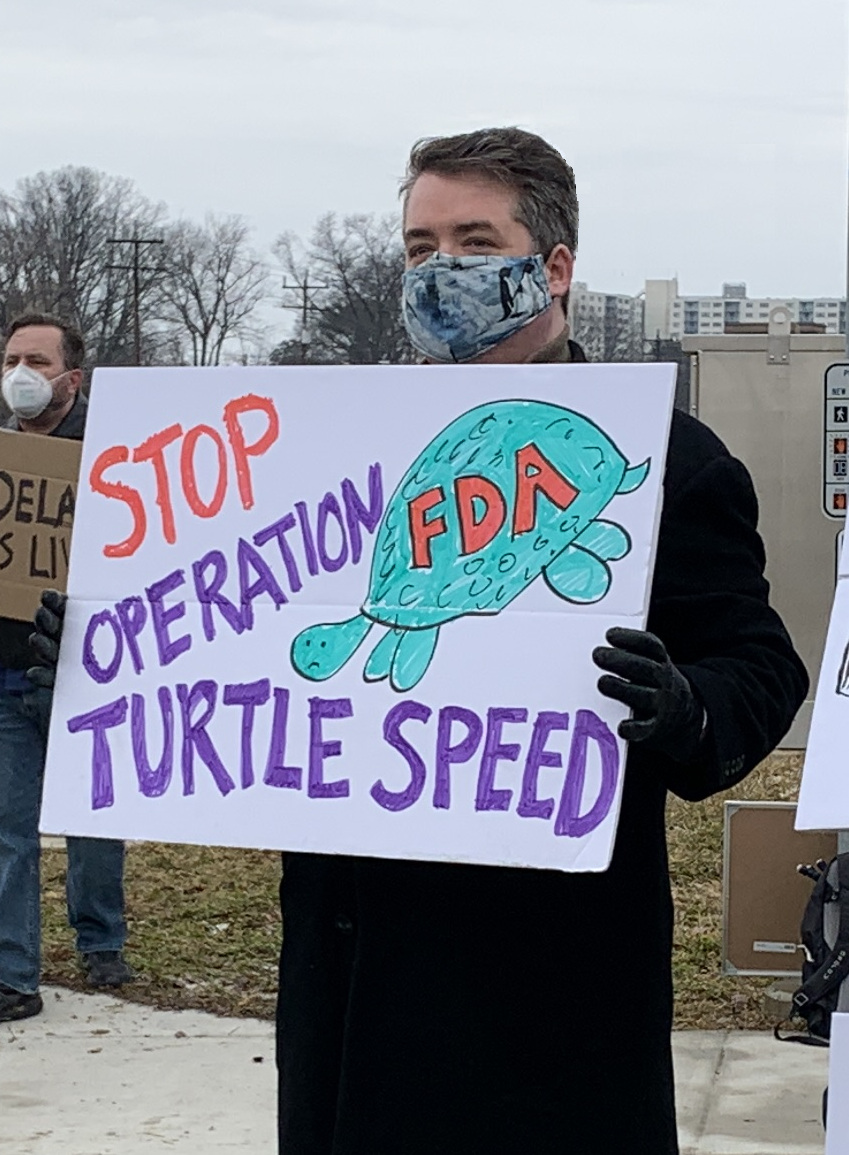
John at a February 14th protest outside the FDA, organized in conjunction with the DC Transhumanist Party, where we protested the FDA’s failure to approve the AstraZeneca vaccine while millions of doses languished in a factory in Baltimore and thousands died daily from COVID-19.

When John was only around nine years old, he started experiencing joint pain. Initially his doctors thought he might have juvenile autoimmune arthritis. Around age ten, however, he was diagnosed with Crohn’s disease. Later his doctor would tell him that after that initial diagnosis he estimated his life expectancy was only nine more years.

Crohn’s disease is not just “digestive problems”. The disease affected all aspects of John’s life, and he spent much of middle and high school in and out of a wheelchair. In 2001 he started receiving infusions of the monoclonal antibody Remicade every six weeks. Due to Remicade, he started to be able to walk again and was able to live a mostly normal life. That all changed suddenly and unexpectedly in 2005 when his throat closed up after his injection. Unfortunately, as happens to many long-term Remicade patients, his body had developed an immune response to the drug. In response doctors switched him to a similar monoclonal antibody drug, Humira. However by 2013 his immune system had started rejecting the Humira as well. In response his gastroenterologist tried several general immune suppressors but at this point John was running out of good options.

Fortunately there was a new drug with a lot of clinical trials data to support it, Entyvio. Unlike Remicade and Humira, which are TNF-alpha antagonists developed for rheumatoid arthritis, Entyvio was developed specifically for Crohn’s disease and a similar disease called ulcerative colitis. Entyvio was specifically studied in Crohn’s disease patients like John who either could not tolerate or did not benefit from conventional therapy and TNF-alpha antagonists. A peer-reviewed Phase II study from 2008 showed a dose-dependent beneficial effect of Entyvio. Four Phase III studies followed. By February 2013 enough studies had been completed on Entyivio that a review article in Expert Opinion on Biological Therapy concluded the drug was “an effective and well-tolerated drug that is an important advance for the treatment of Crohn’s Disease.” Takeda Pharmaceuticals filed the paperwork for approval with the European Medicines Agency on March 7th, 2013 and filed with the FDA on June 21st, 2013.

This is where the story starts to get really dark. Throughout the summer and fall of 2013, John suffered from fatigue, joint pain, and stomach pain. His symptoms came and went in unpredictable waves, so he was never sure if he would be able to attend any social events or be able to go into work. He had to start taking a lot of leave from work, some donated from co-workers, and some unpaid.  Eventually the pain got so bad he started going to a pain clinic every two weeks, which started him on Vicodin and Percocet. His intestine was so inflamed it was shot through with holes. A persistent infection developed. His neck felt like it was in a vice and was so difficult to turn he had trouble driving.

Given John’s condition, his doctor knew he was in a race against time and that he needed Entyvio as soon as possible. As a member of the FDA’s Gastrointestinal Drugs Advisory Committee, John’s doctor had an inside view on the agency and predicted he should be able to get the drug by the end of the year. Indeed, on December 9th, 2013 the Committee voted 21-0 in favor of approving the drug for Crohn’s disease. Under normal circumstances, an approval would follow shortly thereafter. Unfortunately for John (as well as many other patients), this isn’t what happened.

Even though the FDA had granted Enyvio Priority Review Status, for the next five months the FDA kept John (and undoubtedly many others) suffering as they debated the wording for the warning label. Since the approval of earlier monoclonal antibody drugs such as Remicade and Humira, scientists learned that in the long term some patients can develop allergic reactions to treatment. The FDA wanted to put a warning about the possibility of a severe allergic reaction on the label. The problem was that the drug had been designed specifically to avoid the allergic reaction rejection problems that occurred with Remicade and Humira, drugs which did not contain such a warning. A warning about allergic reactions would make Entyvio look less safe, something that the company rightly took objection to.

Another possible reason for the delay might be related to the fact that the FDA claimed that Entyvio put patients at risk for progressive multifocal leukoencephalopathy, (PML) an often fatal brain virus. In over a decade of trials however no patient who had taken Entyvio had ever developed PML. Still, the FDA pointed to a similar drug, Tysabri, which carries a “black box” label warning of the risk for PML. The company disputed this – pointing to established mechanistic differences in how the two drugs worked, but the FDA wasn’t convinced. In the end, the FDA decided to include a warning about PML on the label and require post-market surveillance.

By April 2014 John’s condition had gotten so bad that John’s doctor started filling out compassionate use paperwork. The FDA told him not to bother and to wait for the approval. In retrospect, he probably should have tried anyway. When the drug was finally approved on May 20th, 2014, the initial doses the drug company had made had expired. The company had to manufacture new doses, leading to a delay in commercial availability. It wasn’t until September 2014 that John got the drug. By that time John was in precarious health. Although he now had the drug in his system, it was too late to help. In January 2015 his doctor sent him to the ER where he stayed in an ICU for several days fighting an infection. John had to have two major surgeries that ultimately removed his large intestine altogether.

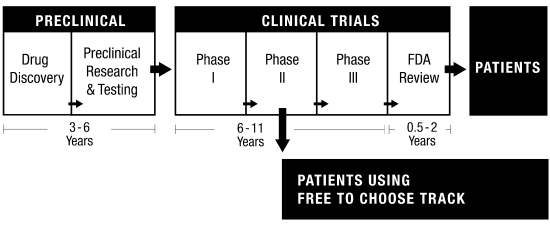
The story illuminates many areas for improvement in the FDA approval process. First, it took five and a half years after promising Phase II results for the drug to become available to patients. Other different regulatory approaches like Free to Choose medicine or adaptive licensing could have made Entyvio available to patients faster and at lower cost. But even if you remain convinced that pre-market Phase III trials are a necessity, there are still major areas for improvement highlighted by this case.

Ideally, after the company reached their endpoints in their Phase III trials the drug would be rapidly approved within a month or two. In reality, John suffered for well over a year waiting for Entyvio to be approved by the FDA. Even after the FDA’s board unanimously voted in favor of approval, John suffered for another five months waiting for approval (the FDA could have figured out the proper warning label much earlier, for instance in the five years during which the Phase III trial was running). Even after approval, John had to wait another four months before he finally got his first dose since the initial doses had expired.

As a result of over a year of completely unnecessary delays, John became dependent on opioids, ended up in the ICU with a major infection, and had to undergo several risky surgeries. In the end though, he was lucky to have survived the ordeal. One wonders how many patients like John there were who also suffered from the delay, and how many died as a result.

Dan Elton, Ph. D., is Director of Scholarship for the U.S. Transhumanist Party.  You can find him on Twitter at @moreisdifferent, where he accepts direct messages. If you like his content, check out his website and subscribe to his newsletter on Substack.

Nevada Senate Bill 292 and the Democratic Party’s Anti-Democratic Hypocrisy on Voter Rights – Article by Gennady Stolyarov II

Nevada Senate Bill 292 and the Democratic Party’s Anti-Democratic Hypocrisy on Voter Rights – Article by Gennady Stolyarov II

May 25, 2021 Gennady Stolyarov II Comments 1 comment

logo_bg

Gennady Stolyarov II


While the Democratic Party often postures as championing voter rights and opposing voter suppression, it frequently engages in voter-suppression tactics of its own, particularly aimed at restricting voters’ ability to choose minor political parties on the ballot. Senate Bill 292, advanced by prominent Democratic Legislators despite overwhelming public opposition, is a case in point.

SB292 is sponsored by former Nevada Democratic Party Chair, now Senator, Roberta Lange. Many have already identified the flaws with SB292’s attempt to implement “straight-party-ticket” voting – an option that discourages thoughtful consideration of individual candidates on their merits. But the largely overlooked Section 2 of SB292 would be much more insidiously damaging in shutting minor political parties out of realistic ballot access by imposing a requirement that petition signatures gathered by minor parties seeking ballot access be “equally apportioned” among the four Congressional districts in Nevada.

The number of petition signatures required in Nevada is already immensely high; one percent of the voters for U.S. Representative at the last general election must sign a minor party’s petition for the party to qualify for ballot access. No party has been able to meet this onerous threshold since 2011. Yet, even if a party is able to surpass it through herculean efforts, the requirement of equal apportionment would mean that the Democratic Party could challenge the minor party’s petition if just one more signature comes from one district than from another. For example, even if a minor party were spectacularly successful and somehow gathered signatures from all the registered voters in Nevada’s most populous 3rd Congressional District, the Democrats could attempt to disqualify that petition on the technicality that an “equal” number of signatures from the other, less populous districts were not attained. SB292’s Section 2 would empower Democrats to thwart every minor party’s petition forever.

Because of the additional coordination required to even attempt to gather petition signatures “equally” by petition district, rather than simply trying to gather as many signatures as possible, one would expect the petitioning effort to be more time-consuming than previously. However, Section 2 of SB292 reduces the time available to a minor party, moving the compliance deadline from the third Friday in June to June 1, thereby further lowering the probability of meeting all requirements. The United States District Court for the District of Nevada in 1992 already struck down a slightly less burdensome deadline of June 10 in the case of Lenora B. Fulani et al. v. Cheryl A. Lau, Secretary of State. A June 1 deadline could be challenged on the same grounds, but the proponents of SB292 wish to impose it regardless.

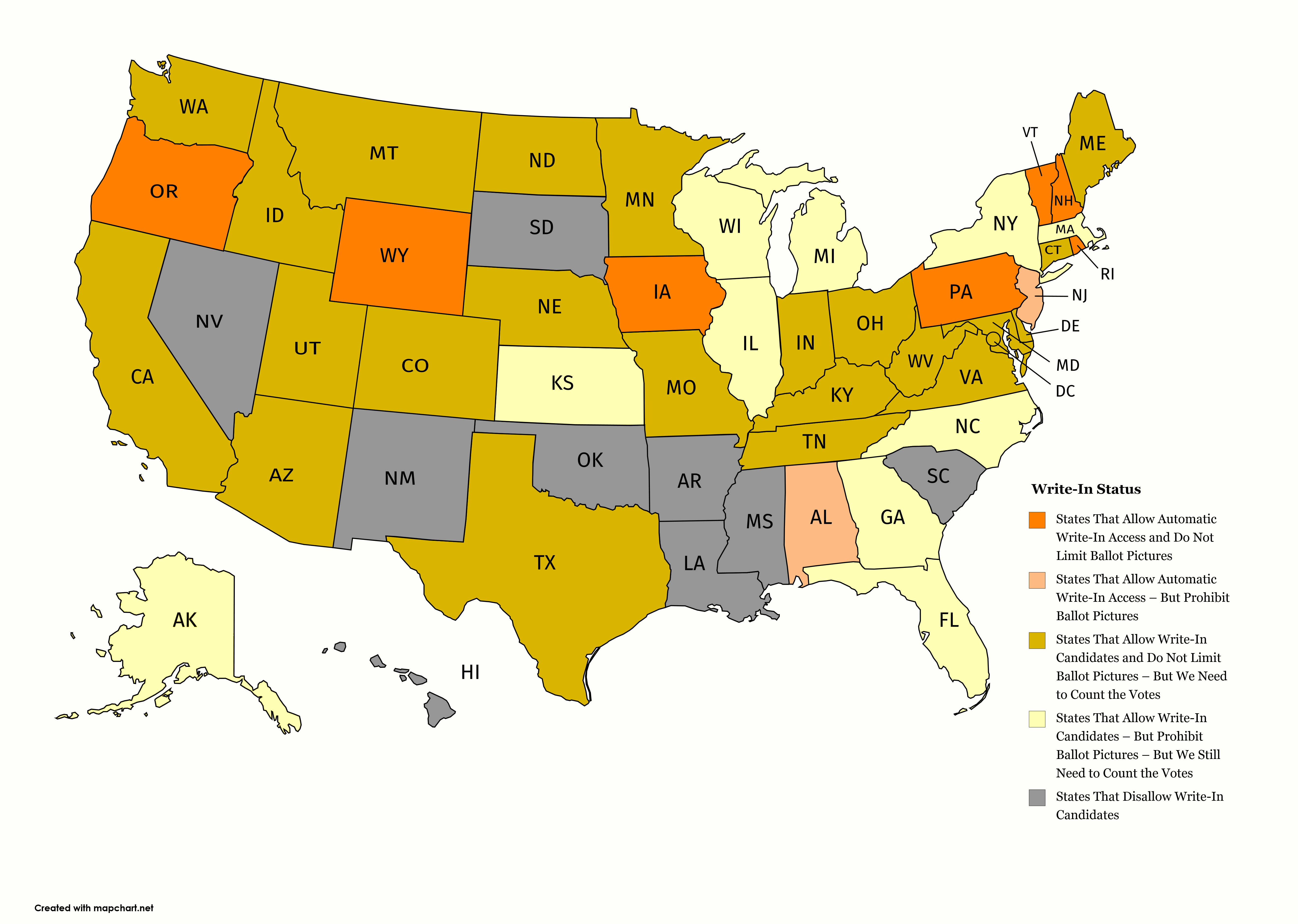
In Nevada, prominent Democratic Party Legislators seem determined to limit voters’ options at the ballot box. The Green Party, whose nominee finished fourth in the past three U.S. Presidential elections, failed to qualify for ballot access in Nevada in 2012, 2016, and 2020, because of the unreasonable existing petition threshold and significant Democratic Party efforts to disqualify petition signatures in 2016. Nevada is also one of only five states that lack a write-in option, further reinforcing the imperative to relax ballot-access requirements instead of imposing additional ones. At present, minor political parties without access to vast funds, such as the all-volunteer Transhumanist Party, are shut out by intentional barriers to entry imposed at the behest of the major parties.

Do Democrats in power only wish to improve the ease of voting for Democrats, while excluding other options by establishing insurmountable barriers to ballot access? Or will enough Democrats take a stand for their stated principles, support genuine voter choice, and thwart anti-democratic legislation such as SB292?

Senate Bill 292 will be heard at 4 p.m. Pacific Time on Tuesday, May 25, 2021, at the Assembly Committee on Legislative Operations and Elections. This will be our last chance at direct input to the Legislators regarding this bill. Follow the link above and click on the button to “Participate” in order to register for call-in information. You can also e-mail your written comments to AsmLOE@asm.state.nv.us. Be civil and respectful but firm in your opposition to this attempt to severely limit voter choice!

Gennady Stolyarov II is the Chairman of the United States Transhumanist Party and the Chief Executive of the Nevada Transhumanist Party.

U.S. Transhumanist Party Second Letter in Opposition to Nevada Senate Bill 292 – Sent to the Senate Committee on Finance – May 4, 2021

U.S. Transhumanist Party Second Letter in Opposition to Nevada Senate Bill 292 – Sent to the Senate Committee on Finance – May 4, 2021

May 5, 2021 Gennady Stolyarov II Comments 0 Comment

logo_bg

Gennady Stolyarov II


Note: Senate Bill 292 (SB292), which would make it essentially impossible for minor political parties to compete at the ballot box or even attempt ballot access, continues to be rapidly advanced in Nevada. It was authored by a former Democratic Party Chair who would like to require the number of signatures to be impossibly “equally apportioned” by petitioning district, move the deadline for submitting petitions to an earlier June 1 date, and institute straight-line party-ticket voting that shuts out other options and discourages individualized decision-making.

After SB292 passed on a party-line vote (3 Democrats in favor, 2 Republicans opposed) out of the Senate Committee on Legislative Operations and Elections, I drafted a letter to the Senate Committee on Finance, where the bill is headed next, in opposition to SB292. The text of this letter appears below. 

I urge all Nevadans and Transhumanist Party members, as well as those who are sympathetic to other minor political parties, to submit their opinions in opposition to SB292 here: https://www.leg.state.nv.us/App/Opinions/81st2021/. Be sure to reference the amended, “April 16, 2021” version as the bill you are opposing – so as to signal that even the recently amended bill continues to pose serious problems. If you would like your comments to be published, you can also submit them via e-mail to SenFIN@sen.state.nv.us. 

The Senate Committee on Finance will meet this Wednesday, May 5, at 6:30 p.m. Pacific Time to hold a public hearing on this bill. Meeting information will be updated on this page: https://www.leg.state.nv.us/App/NELIS/REL/81st2021/Bill/7895/Meetings. If you can dial in during the time period for public testimony and lend your voice in opposition, that would be greatly appreciated. Focus your testimony on the adverse fiscal impacts of this bill, as that is what the Committee will be primarily considering. Please feel free to reference any of my arguments below for inspiration. Remember to be civil and respectful but firm in your opposition!

~ Gennady Stolyarov II, Chairman, United States Transhumanist Party, May 4, 2021


May 4, 2021

Re: Opposition to Amended Senate Bill 292 (First Reprint)

Dear Chairman Brooks and honorable members of the Senate Committee on Finance:

As Chairman of the United States Transhumanist Party and Chief Executive of the Nevada Transhumanist Party, I strongly urge you to oppose Senate Bill 292, which would deprive all minor political parties in Nevada of the opportunity to fairly compete at the ballot box or to even viably attempt such competition.

My comments today will focus on the adverse impacts of Section 2 of the amended (First Reprint) Senate Bill 292, especially the adverse financial impacts to the State of Nevada which are germane to the purview of this Committee.

At a time of great fiscal strain to the State of Nevada, which is just beginning to recover from the devastation of the COVID-19 pandemic, and immense economic hardship for the people of this State, it is highly imprudent to impose additional costs upon the State or any of its agencies for the doubly imprudent and entirely deleterious purpose of raising the barriers to ballot access for minor political parties.

While the amended bill no longer raises the petition-signature threshold from 1% to 2% of the Nevada voters who voted in the last election, it does still, via Section 2, Subsection 2, Paragraph (c), seek to impose an impossible “equal apportionment” requirement for the petition signatures and would also move the deadline for submitting petition signatures from the current third Friday in June to June 1.

The “equal apportionment” requirement renders it essentially impossible for a minor political party to qualify via the petition process and also unnecessarily burdens the Nevada Secretary of State’s Office.

Currently, to verify the validity of a petition signature, the Nevada Secretary of State’s Office simply needs to consider an individual petition signature and whether it belongs to a registered voter in the State of Nevada. With Section 2 of SB292, the Secretary of State’s Office would have the additional burden of verifying that the signatures are “equally apportioned” among the four petition districts in Nevada. This could lead to a significant expenditure of time and resources beyond what can be formally budgeted for – because the added workload would be sporadic, punctuated, and inherently unpredictable given the difficulty in anticipating when (i.e., during what election season) a minor party would seek to qualify for ballot access, as well as how many minor parties would seek to qualify. The potential for significant additional costs to the State of Nevada will be illustrated below via a discussion of how the bill would burden the State by encouraging a multitude of major-party challenges to any minor-party petitions that are submitted.

Nevada has four petition districts, corresponding to the U.S. Congressional Districts. The 3rd Congressional District is the most populous, with a population of 857,197 as of 2019. All three of the other Congressional Districts have populations below 800,000. Suppose that a minor political party were spectacularly successful in gathering petition signatures and managed to collect them from the entire population of registered voters in the 3rd Congressional District. (For this example, I assume that the proportion of registered voters to the general population is the same in each Congressional District.) The very fact that this minor political party could accomplish such a feat would ironically render it impossible for that party to qualify for ballot access, because the other petition districts simply do not have enough registered voters to match the number of signatures gathered from the 3rd Congressional District in that case.

Moreover, the “equal apportionment” requirement renders it almost effortless for a major party to initiate challenges to petitions submitted by minor parties, simply by counting the signatures from each district and noting any difference whatsoever in the numbers of signatures, even if the difference is literally one signature! Even if the total number of signatures is well above 1 percent of the registered voters statewide, if the number of signatures gathered in one petition district were 10,000, and the number of signatures gathered in another petition district were 10,001, that also, by itself, would be sufficient to technically fall out of compliance with the requirement of “equal apportionment”. Note that the text of the amended NRS 293.1715(2)(c) would not allow any room for deviation from a strictly “equal” apportionment. There is no mention of a possibility for the apportionment to be made “approximately equal” or “reasonably equal” or “equal within a tolerance of X%”; the text would mandate strict equality of petition signatures by district, and it appears to enable major parties to seek to disqualify any minor party’s petition on a technicality. Given that different circulators of petitions are likely to operate in different petition districts, it is virtually certain that different numbers of signatures will be gathered by each team of circulators. This is so because the precise coordination at the level that would be needed to achieve exactly equal numbers of signatures among all four districts and to stop gathering signatures in a perfectly choreographed fashion once such equal numbers were attained, would be essentially impossible to achieve.

While it would be easy for major political parties to challenge a minor party’s petition under these circumstances, the experience would be made more difficult for the Secretary of State’s Office and the judicial system of the State of Nevada, because more challenges could be expected to be initiated than otherwise. Responding to a contested matter always involves an added, indeterminate, potentially immense expenditure which, I reiterate, has no compelling public benefit behind it.

Moving the deadline for petitions to June 1 would both unduly burden minor political parties and expose the State of Nevada to additional costs from potential legal challenges.

Because of the additional coordination required to even attempt to gather petition signatures “equally” by petition district, as contrasted with simply trying to gather as many signatures as possible, one would expect that the petitioning effort would be more time-consuming than previously. However, Section 2 of SB292 reduces the available time for a minor party to comply with the added burdens, thereby further lowering the probability of successfully meeting all of the requirements. This disenfranchises the citizens of Nevada who would like to see more options at the ballot box.

Moreover, the United States District Court for the District of Nevada already struck down an even somewhat less burdensome deadline of June 10; this occurred when the Judge in the case of Lenora B. Fulani et al. v. Cheryl A. Lau, Secretary of State (“Fulani v. Lau” – Case CV-N-92-535-ECR) issued a preliminary injunction on October 1, 1992, to require the State of Nevada to include Lenora Fulani and other independent and minor-party candidates on the ballot despite those candidates not having been able to gather the required number of signatures by June 10 of that year. In issuing the preliminary injunction (which effectively decided the case, since the election took place in November of the same year), the Judge wrote “that plaintiffs have shown likely success on the merits, that the balance of hardships tips in their favor and that they will suffer irreparable injury if their names are not put on the 1992 ballot” (Fulani v. Lau, p. 14). The Judge explained that

The character and magnitude of plaintiffs[‘] injury caused by the June 10 filing deadline shows a burden on their First and Fourteenth Amendment rights. The deadline burdens the rights of nonmajor parties[‘] candidates by excluding late[-]forming parties and forcing candidates to circulate petitions before most of the voting population has thought about the elections. Although this date is not as early as others which have been struck down as unconstitutional, most other states require the petitions be submitted several months later. Also, no evidence suggests that candidates who lack an established national affiliation are easily able to access the ballot. (Fulani v. Lau, p. 11)

If the United States District Court found that a June 10 petition-filing deadline is burdensome to non-major parties’ First and Fourteenth Amendment rights, then, logically, a June 1 deadline would be even more burdensome. Such a deadline would indeed serve to thwart any but the most amply funded minor political parties, if those parties choose to begin gathering the signatures extremely early in the year, whereas new minor parties, as well as minor parties that rely largely or exclusively on volunteer efforts and grass-roots organizing, would find themselves hobbled by lack of time. SB292 is seeking to institute in Nevada law a deadline more stringent than the one which the District Court has already overturned. SB292 would also entrench the role of money in politics and cost money to the State in doing so.

If SB292 is enacted with the June 1 deadline, then any number of parties adversely affected by that deadline could file a legal challenge with Fulani v. Lau as a precedent. The State of Nevada could be exposed to the costs of a legal proceeding, along with associated attorneys’ fees. The costs of responding to such a legal challenge are again indeterminate but potentially immense. Comments submitted separately to this Committee by Mr. Richard Winger discuss situations in other States where such early petition deadlines were struck down and those States were left with the expenses of the associated proceedings. To emphasize, this is not an outcome that I would wish for the State to experience in any manner; as a citizen of this State, I, too, would be adversely affected by continued needless expenditures on legal contests at a time when the State needs to devote all available resources to the economic recovery and to the genuine well-being of its residents.  This is why I urge this Committee and the Legislature more generally to refrain from proceeding with SB292 and to avert such an outcome.

Senate Bill 292 is bad policy, counterproductive in all respects, and the fiscal burdens and risks it imposes upon the State have no offsetting benefits. Indeed, Senate Bill 292 exacerbates a highly polarized political situation to the detriment even of major-party officeholders.

Senate Bill 292 would achieve the opposite of establishing a fair, level playing field for political candidates and parties.  Unfortunately, Senate Bill 292, if enacted, will only serve to exacerbate today’s political trench warfare by solidifying the bifurcation of the contemporary American body politic into two blocs that have each become increasingly monolithic and radicalized internally, and increasingly hostile toward the other, with no room between them to pursue unconventional and innovative solutions that can bridge partisan divides. This anticipated effect of SB292 is likely not anyone’s intention; however, the two-party system in the United States has a built-in downward spiral of incivility, hostility, and division which has, over the past year, crossed the line from mere acrimony into deadly riots and insurrections from extreme exponents of both sides of the partisan gulf. Any Legislator interested in stable and sensible governance should seek to avert an intensification of this scenario, and there is a vital role for a vibrant minor-party ecosystem in helping to prevent it.

How does Senate Bill 292 exacerbate political polarization? It does so by making it effectively impossible for minor political parties to even attain ballot access – in the ways described above. This bill would make it clear to voters that minor parties are not just long-shot participants but are effectively shut out of the process altogether. Thus, many people who would have otherwise given a minor party a chance would be shunted into one of the major political parties that is barely more aligned with their views than the other major political party. This would reinforce the bifurcation of America into two distinct blocs which are engaged in an ever-intensifying struggle with one another, to the detriment of any actual progress on policy and any actual solutions to the many pressing problems (including fiscal problems) facing our State, country, and world. Bifurcation of the American body politic creates an “us-versus-them” dynamic, where anyone who is not part of one’s own bloc is automatically considered to be “the enemy” and whose ideas are automatically disregarded. The record increase in independent and nonpartisan voters already shows many Americans to be disillusioned by the toxicity and acrimony that characterize the electoral tactics of the major parties and their most vocal adherents. Without minor parties for them to seek alternatives in, these Americans will either be reluctantly dragged into the deleterious fray they have always wished to avoid, or try to refrain from political participation altogether – in which case the fray will still find them, as extremists from the major parties have increasingly been demonizing conscientiously apolitical Americans as well.

The antidote to polarization is hyper-pluralism, which is precisely what a vibrant minor-party scene would facilitate. In a hyper-pluralistic body politic, there is no clear “enemy” for any constituent, because different smaller parties will align with one another on different issues; one’s adversary on one issue could be an ally on another, and so it is worthwhile to remain on at least respectful terms with everyone. It is for this reason that parliamentary democracies, which allow for proportional representation and numerous political parties competing on each ballot, are generally far less roiled by partisan strife than America’s uniquely contentious two-party system. But Nevada does not even need to adopt a parliamentary system to achieve a similar outcome; it just needs to allow minor political parties to compete on the ballots. Note that we are not even asking for the minor parties to win (which would still be difficult enough on its own), but merely to be allowed to compete!

Allowing quick, easy ballot access for minor political parties is the low-cost ­option to the State of Nevada as well. The less time and effort need to be spent validating petition signatures or enforcing restrictions, the more savings result for the State of Nevada.

Even the possibility of competition motivates both incumbent officeholders and major-party candidates to be more responsive to the needs of their constituents. Furthermore, minor parties can be fruitful repositories of ideas for major-party politicians to draw upon; the Transhumanist Party would be delighted to have any of its platform reflected in legislation advanced by major-party lawmakers. Ideas from minor parties tend to sufficiently depart from the prevailing major-party packages that they avoid triggering contentious and mutually intransigent debates about “wedge” issues and so may actually lead to solutions that most major-party policymakers are willing to entertain. Incumbents and major-party candidates can even derive much valuable campaign intelligence from election results involving minor political parties. A strong showing for a minor party indicates a set of issues that voters are interested in and that the incumbent or major-party candidate would do well to address while in office or on the campaign trail. Having a wealth of ideas from minor parties to draw upon will also improve the State of Nevada’s fiscal situation, since minor parties – which, out of necessity, have significant experience running low-budget or no-budget operations – will often develop creative ways to reduce expenditures without compromising the quality of service and benefits that the State provides to its residents.

By shutting minor parties out of viable political participation, Senate Bill 292 would only accomplish the illusion of stability for leading figures of a major political party. In reality, one cannot have a stable or tranquil political experience in a general environment marred by ideological polarization and all of its attendant ills. Depriving people of legitimate alternatives will only alienate them further and feed into the undercurrents of frustration and perceived disenfranchisement that permeate American politics today. Minor political parties are a major safety valve of American politics and can act to effectively channel dissent and discontentment into constructive avenues of mutual improvement and enhanced justice.  In the Federalist No. 10, James Madison, at the onset of the American Republic, noted that the advantage of a large representative republic is precisely in “the greater security afforded by a greater variety of parties, against the event of any one party being able to outnumber and oppress the rest”. The American Founders, who feared precisely the scenario of two dominant factions vying for power at the citizens’ and the Republic’s expense, saw the “greater variety of parties” as an important safeguard against such an outcome. The Transhumanist Party echoes the Founders’ wisdom and would urge the Legislature to consider reforms in the opposite direction from those proposed in SB292 – namely, the elimination of all ballot-access requirements and the ability of any candidate or political party to compete fairly for office on the same terms as any other. After all, if a minor-party candidate is unpersuasive to the voters and the major-party candidates remain more popular, what is there truly for a major party to fear from allowing participation for all? But in the absence of such truly progressive reforms, we urge that the Legislature at least refrain from taking steps that would further limit electoral competition.

Removing ballot-access restrictions, rather than maximizing them, is the fiscally prudent, the consequentially best, and the morally just option. Please reject Senate Bill 292.

Sincerely,

Mr. Gennady Stolyarov II

Chairman, United States Transhumanist Party

Chief Executive, Nevada Transhumanist Party

https://transhumanist-party.org

My Path to Transhumanism and Becoming the First Transhumanist Party Member to Hold Political Office in North America – Article by Gerald Shields

My Path to Transhumanism and Becoming the First Transhumanist Party Member to Hold Political Office in North America – Article by Gerald Shields

May 3, 2021 Gerald Shields Comments 2 comments

Gerald Shields


In 2016 I changed my political party membership to Transumanist on my voter registration card. Then, I became a town councilmember of the Town of Berwyn Heights in Maryland. I served in that role from October 2016 to May 2018. I believe I am the first Transhumanist Party member to hold a political office in North America (during the time period of the U.S. Transhumanist Party’s existence).

Gerald Shields at the Library of Congress in 2013. Photograph from Gerald Shields. 

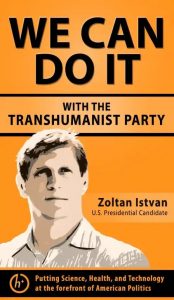
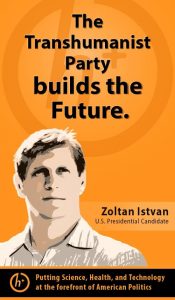
My path to Transhumanism has been varied and interesting. I changed my voter registration for a variety of reasons. During the 2016 election cycle, I was disappointed in the various election platforms of the major parties. I thought that pushing the goal of making humanity a two-planet species was a more important goal than what was listed in those parties’ platforms. After some research for alternative parties, I discovered Mr. Zoltan Istvan’s campaign for the U.S. Transhumanist Party. Mr. Istvan called for a medical Moonshot program. Even though it was not a direct step to a two-planet species, it was a step in the correct direction to long-term colonization of other stars. I contacted the campaign, and I saw that there were no campaign posters for an internet-based campaign. I realized that without visual legitimacy, the transhumanist ideas will not get much traction. A visual will look good on television, blogs, and YouTube. A visual aids in the message. I helped create campaign posters with Ms. Chelsea Gilbert. It was my idea to use vector graphics in orange and black with classic Americana political phrases to illustrate some transhumanist ideas. The idea is to tap into the Americana meme under the banner of the Transhumanist Party without causing future shock. The goal is to stir the passion of our members as discussed during the various transhumanist conversations on YouTube.

The phrases I proposed were:

“The Future is here. The Transhumanist Party.”

“We can do it….With the Transhumanist Party.”

“The Transhumanist Party builds the Future.”

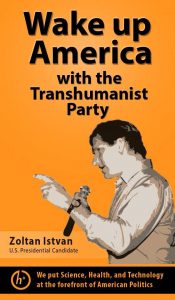
“Wake up America with the Transhumanist Party.”

“Reclaim America. Join the fight for the future and the Transhumanist Party.”

During the campaign, I attended several Washington, DC, and Seattle, Washington, transhumanist meetings, during which I met Zoltan in person.

 On October 3 2016 at Berwyn Heights Town Office, Gerald Shields (left) was sworn by Mayor Jewitt (right) in an a member of the town council. Photograph from Gerald Shields. 

Then, as part of my political path, I was on the Town Council of Berwyn Heights, Maryland, from October 2016 to May 2018. The competition was nonpartisan between a total of three people. I filled an empty position on the Town Council, and this was done via a special appointment, not a general election. However, in normal times, this is a nonpartisan, general-election position. I believe I am the first Transhumanist  Party member to hold a political office in North America (during the time of the U.S. Transhumanist Party’s existence). During the special appointment, I campaigned on a very local and non-glamorous issue of improved storm drains. Storm drains are important because, in Berwyn Heights, there was a 100-year storm that flooded the basements of several houses.  On a town or even county level, there really is no way to have a longevity Moonshot in my view.  I am a very practical and nuts-and-bolts (no transhumanist pun intended) type of person, who wants this Party to be a success.  However, when I was on the Town Council, my political portfolio was Parks & Recreation, Education, and Civic Affairs; not Public Works. I laid the foundation for the town’s policy on non-governmental organizations. During my term, Berwyn Heights achieved the title of Banner City for the first time and attained other objectives due to my efforts. At the end of my term, I achieved my Parks and Recreation goals, so I decided not to run in the election.

Right now, the public view of transhumanism is characterized by cyborgs and other scary things. We must adapt and put forth the benefits of increased medical knowledge and increased energy resources in a beneficial way while addressing the general public’s concerns. That is why I suggested to Zoltan to emphasize the Good Neighbor Next Door policy.  The Good Neighbor Next Door policy would focus on volunteering on local committees, such as Neighborhood Watch, the State Government’s official State Defense Force, Green Team, or other local small-town groups, as well as just saying “Hi” to one’s neighbors, to show that one is a normal person who cares about local matters. Also, I suggested that Zoltan post photos of himself and his kids because this would make him more relatable to other fathers. Then, as time progresses, Transhumanists who follow this approach would show that they are ready, willing, and, most importantly, able to lead in political positions.

That is my varied path to Transhumanism and becoming the first U.S. Transhumanist Party member to hold a Town Council political office.

Gerald Shields is a member of the U.S. Transhumanist Party and was a Town Council Member in Berwyn Heights, Maryland, between October 2016 and May 2018. 

To the FDA: Approve Leronlimab Now for Critically Ill COVID-19 Patients – Article by Dan Elton

To the FDA: Approve Leronlimab Now for Critically Ill COVID-19 Patients – Article by Dan Elton

May 3, 2021 Dan Elton Comments 3 comments

Daniel C. Elton, Ph.D.


Author’s Note: This article is cross-posted from my Substack.

How does Leronlimab work?

Leronlimab is a humanized monoclonal antibody that antagonistically binds to the CCR5 receptor to block activation of immune cells and lower the release of cytokines. The development of Leronlimab started with mouse antibodies that bind to CCR5. Unfortunately, mouse antibodies can’t be directly imported into humans since they are attacked by the immune system as foreign invaders. That’s where next-level genetic engineering comes in. Researchers looked at the genes for human antibodies, identifying ones that were closest to the genes for the antibody that the mice produce. They then took the segment of DNA from the mouse antibody that coded for the antigen binding site and stitched that into the human antibody gene. (The antigen binding site is the key part of the antibody allows it bind to the CCR5 receptor). The result is a chimeric or humanized antibody which can be mass-produced in bacteria.

As alluded to, the specific place where these antibodies bind is the CCR5 (Chemokine Receptor Type 5) receptor, a “G Protein coupled” receptor that resides on the surface of cells, in particular immune cells such as macrophages. When the receptor is stimulated, calcium channels open up and Ca++ ions move into the cell, causing activation (movement) of the macrophages.

Leronlimab was originally developed to treat HIV, because the HIV virus uses the CCR5 receptor to get into cells. (By blocking the receptors, the HIV virus could be blocked.) Despite being under study since 2007, Leronlimab is still not FDA-approved for HIV, although it appears to be getting close. To treat HIV, it is given as a once-weekly at-home injection. Researchers have found many other uses, however. For instance, when Leronlimab blocks the CCR5 receptors on breast-cancer cells, it prevents them from moving around so that the cancer can’t move to other parts of the body, which makes the cancer easier to treat. Note that Leronlimab is not yet FDA-approved for any of these possible applications, so off-label use for COVID-19 is impossible.

In the case of COVID-19, infection by the SARS-CoV-2 virus induces stressed endothelial cells to produce CCL5. When CCL5 reaches T-cell and macrophage cells in lymph nodes and binds to their CCR5 receptors, it induces those cells to become activated and then move towards the source of the infection along the CCL5 gradient. Unfortunately, in severe COVID-19, the immune response can be so strong that it leads to tissue damage. CCL5 also induces the production of inflammatory cytokines including TNF and IL-6.

What do we know about the efficacy of Leronlimab?

CytoDyn Inc. published a press release on January 28th, 2020, announcing that it was beginning to evaluate Leronlimab’s use for COVID-19. In that press release, CytoDyn clearly explained the mechanism of action described above, noting that clinical experience in China found that many patients who died from COVID-19 did not die from the virus but from an overactive immune response causing inflammation and the infamous “cytokine storm”.

A study published in preprint form on May 5th, 2020, looked at 10 terminally ill COVID-19 patients on ventilators at the Montefiore Medical Center in Manhattan. The experimenters administered 700 mg of Leronlimab to each patient. Within three days they found that found that IL-6 had decreased in all of the patients, reaching healthy levels in two weeks. After two weeks six patients had recovered while four died (a 40% mortality rate). At that time the mortality rate for ventilated patients was said to be “as high as 88%” in New York City. So, while there was no control group in this study, one can argue there was an observed reduction in mortality here. While the results on reduced mortality are weak due to a lack of a suitable control, the biomarkers studied all showed a reduction of immune response. The researchers found a reduction of new immune cells manufactured in the bone marrow and a return of platelet cell counts towards normal levels. The researchers also found that the concentration of virus in the blood (viremia) decreased. In a TEDx talk, one of the authors, Dr. Bruce Patterson, claims that Leronlimab was responsible for the drop in blood virus concentration. He said this:

“Leronlimab restored CD8 T-cells and increased Granzyme A to better clear virally infected cells. It also inhibits Treg cells and repolarizes macrophages which both enhance the immune response against infected cells.”

I honestly do not understand these details or know how well they are empirically supported by this or other studies.

CytoDyn initiated two Phase IIb/Phase III clinical trials in mid-April 2020 to study mild-to-moderate COVID-19 and severe or critical COVID-19. To their credit in 2020 the FDA did provide about 60 emergency IND (eIND) authorizations that allowed patients to receive Leronlimab. However the company had to defer seeking eIND authorizations to accelerate the pace of enrollment in their clinical trials.

The mild-to-moderate trial did not meet its primary efficacy endpoint, but in a post hoc analysis in the subset of subjects with more severe disease, a higher proportion of Leronlimab-treated subjects (50%; 24/48) versus placebo-treated subjects (21%; 5/24) showed improvement in National Early Warning Score 2 – a risk score for “rapid clinical deterioration requiring critical care intervention” (p ​= ​0.0223).

The severe-to-critical trial also did not meet its primary endpoint — considering all patients, the difference in Day 28 mortality between Leronlimab and placebo was not statistically significant (N=384, 2:1 split, p > 0.05). (Update: a commentor pointed out that the placebo group ended up being younger and was small, so unfortunately they missed statistical significance. You can see all the details here.).

However, the researchers then analyzed patients on invasive mechanical ventilation or ECMO. They found that if Leronlimab was added to the standard of care, then on the 14th day there was a reduction in mortality of 82% (p=0.0233, N=62) and an average reduction in the length of stay of 5.5 days (p=0.005, N=62). They also found a 400% improvement on a 7-point ordinal scale for COVID-19 severity when compared with standard of care.

There have been several clinical reports and anecdotes about patients on ventilators or ECMO who rapidly recovered after receiving a single dose of Leronlimab (see here (N=1), here (N=4), here (N=1), and here (N=1)). A somewhat larger observational study with N=23 patients reported that after 30 days, 74% no longer required hospitalization. Six out of the seven patients that required ventilation survived. The biomarker results were somewhat mixed – while the researchers found evidence of reduced immune activation in the patients who received Leronlimab, they also found that the inflammatory marker CRP didn’t decrease until after two doses were given. Another small study on N=3 lung transplant patients with COVID-19 found a decrease in CRP after one week.

On March 29th, 2021, the Phillippines’ FDA began issuing compassionate use authorizations on a per-patient basis and for up to one year. Incidentally, one of first two patients was a former President of the Phillippines. In April compassionate use authorizations were given to 28 critically ill patients.

Why hasn’t the FDA acted?

CytoDyn’s failure to reach either their primary or secondary endpoints in their Phase II/III trial on critically ill patients is undoubtedly a major blow. The company has not yet applied for an Emergency Use Authorization (EUA), and it seems this failure is the reason why. (News reports from August 2020 saying that company had applied for an EUA turned out to be incorrect.) CytoDyn is moving forward, however, and has filed a new protocol with the FDA that will study four doses given over four weeks to critically ill COVID-19 patients.

The use of any immunomodulator like Leronlimab is clearly a double-edged sword. It makes sense that it would only be helpful in the most severe cases. This is what the two clinical trials showed – they showed a significant effect on mortality for patients on ventilators and no statistically significant effect on other patients. Unfortunately the analysis of the patients on ventilators was a post-hoc analysis, which is frowned upon in science due to the possibility of data dredging. So clearly the science is not settled here.

Let’s consider this from an ethical point of view. Patients who are in ICUs and on ventilators have a high chance of dying. Inflammation macrophage activity, and excess cytokines are implicated in many COVID-19 deaths. There is strong evidence, going back over a decade, showing that Leronlimab decreases inflammation, macrophages, and cytokines. Leronlimab is known to be a very safe drug (prior to 2020 no serious side effects have been found in nine clinical trials with more than 800 patients). Even if Leronlimab only saves 20% of those to whom it is given, then one can argue we have an ethical obligation to do so. It is a somewhat expensive drug (for HIV patients getting weekly therapy, it costs about $2000 per dose; another source suggests it would cost about $1100). However, keeping someone in the ICU costs around $3,000-$10,000 per day. So in addition to saving lives, Leronlimab could also save money as well by reducing the amount of time patients need to spend in the ICU. This could lead to second-order life-saving effects in places where ICU beds are in short supply.

Medical educator Dr. Mobeen Syed has said this:

“I believe that if there is a drug that can help someone who is on a ventilator or ECMO and it can save them, then whatever small population that is, it is useful — that is my opinion. I have no financial interest or commercial interest or any other interest of any sort with them (CytoDyn).”

I agree. While the evidence is not conclusive, we have good reason to believe Leronlimab can help very critically ill COVID-19 patients such as those on ventilators or ECMO. There are likely gains from receiving Leronlimab for such patients and very little downside, especially if the patient is considered terminally ill. So not allowing doctors access to Leronlimab risks many unnecessary deaths. The drug should be an especially impactful tool in places like Brazil and India, where there are currently shortages of ICU beds and ventilators.

Dan Elton, Ph. D., is Director of Scholarship for the U.S. Transhumanist Party.  You can find him on Twitter at @moreisdifferent, where he accepts direct messages. If you like his content, check out his website and subscribe to his newsletter on Substack.

For an overview of the possibilities of Leronlimab to save the lives of critically ill COVID-19 patients, watch this brief video by Random Ryman. 

The U.S. Transhumanist Party Endorses Jennifer A. Huse for Mayor of Camden, New Jersey

The U.S. Transhumanist Party Endorses Jennifer A. Huse for Mayor of Camden, New Jersey

May 2, 2021 Gennady Stolyarov II Comments 2 comments

logo_bg


The U.S. Transhumanist Party is pleased to announce the endorsement of our first candidate during the 2021 election season – Jennifer A. Huse – who is running for Mayor of Camden, New Jersey. See the website for Ms. Huse’s campaign.

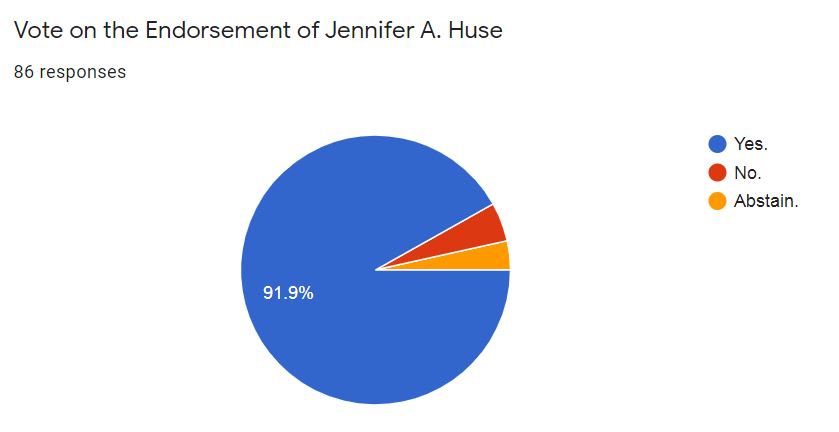
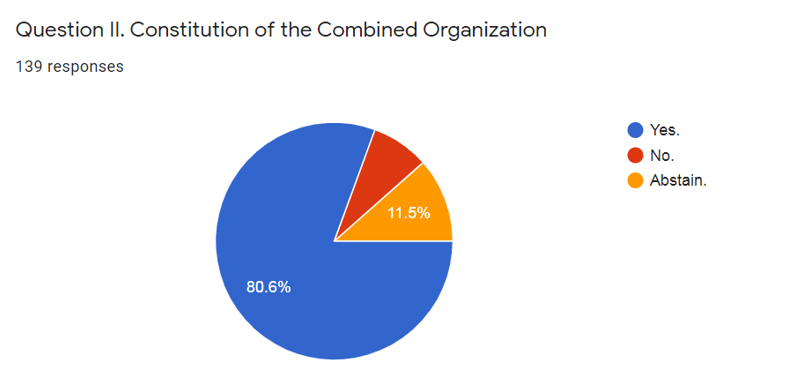
Our electronic vote of the members, which took place on April 23-30, 2021, led to an overwhelming endorsement of Ms. Huse’s candidacy by 91.9% of the members who cast their votes.

The vote totals are as follows:

Question: Shall the U.S. Transhumanist Party endorse the candidacy of Jennifer A. Huse for Mayor of Camden, New Jersey?


Watch the U.S. Transhumanist Party Officers’ interview of Jennifer A. Huse, conducted on February 15, 2021, by U.S. Transhumanist Party Chairman Gennady Stolyarov II, Director of Applied Innovation David Shumaker, and Director of Energy Issues John Kerecz.

On April 29, 2021, Jennifer Huse was interviewed by U.S. Transhumanist Party Regeneration Advisor Ira Pastor on the Progress, Potential, and Possibilities program. Watch this interview on YouTube here.

On Sunday, May 2, 2021, at 1 p.m. U.S. Pacific Time, the U.S. Transhumanist Party is holding a Virtual Enlightenment Salon with Jennifer Huse to give our members the opportunity to ask her further questions and discuss key transhumanist political issues with her. Follow the link above to watch the livestream of the Virtual Enlightenment Salon or the subsequent recording.

We hope to be able to endorse other candidates during the 2021 election season as well.  If you would like to be considered as a candidate for endorsement by the U.S. Transhumanist Party, please e-mail Chairman Gennady Stolyarov II with an expression of interest. Describe the office for which you plan to run, your background and qualifications, your platform, how it relates to the U.S. Transhumanist Party Platform, and what motivated your interest in running with the endorsement of the U.S. Transhumanist Party. Please check our Candidate Eligibility Criteria in Article VII of the U.S. Transhumanist Party Constitution.

Amended Nevada Senate Bill 292 Continues to Place Impossible Burdens on Minor Political Parties – Article by Gennady Stolyarov II

Amended Nevada Senate Bill 292 Continues to Place Impossible Burdens on Minor Political Parties – Article by Gennady Stolyarov II

April 27, 2021 Gennady Stolyarov II Comments 0 Comment

logo_bg

Gennady Stolyarov II


The anti-minor-party Nevada Senate Bill 292 has advanced out of the Senate Committee on Legislative Operations and Elections on a party-line vote (3 Democrats in favor, 2 Republicans opposed). An amendment from the bill sponsor was included in the bill; Amendment No. 230 is an incremental improvement but maintains essentially insurmountable barriers for minor political parties. While the amended bill no longer raises the petition-signature threshold from 1% to 2% of the Nevada voters who voted in the last election, it does still seek to impose an impossible “equal distribution” requirement for the petition signatures and also moves the deadline for submitting petition signatures from the current third Friday in June to June 1.

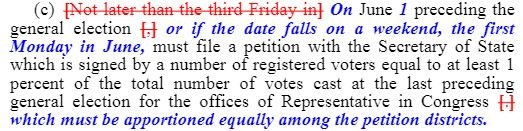
Section 2 of SB292 is the most onerous for minor political parties. The provisions further limiting ballot access, relative to the already significant requirements, are found in the new language that the bill sponsor, Nevada Senator and former Nevada Democratic Party Chair Roberta Lange, wishes to insert in NRS 293.1715(2)(c), stating that to qualify for ballot access, a minor political party must:

(New proposed wording above is in bold blue italics, wording proposed to be deleted is in red strikethrough.)

While various other problems exist with SB292, particularly with the concept of straight-ticket, party-line voting – which aims to absolve voters of the essential responsibility to study individual candidates and their stances on the issues – the present commentary will focus on the most egregious flaws with Section 2 of the bill: requiring that the petition signatures be “apportioned equally among the petition districts” and moving the deadline for submitting petition signatures to June 1 preceding the general election.

The bill sponsor appears to be of the impression that removing the previously proposed doubling of the number of petition signatures required would alleviate the most visible added burden on minor political parties. Yet the remaining requirement of equal apportionment is actually far more burdensome and more insidiously so. It requires several more steps in one’s thought process to discern the burden – hence, the bill proponents may believe it to be a viable option to insert such a provision without significant portions of the public noticing or voicing their objections. Therefore, it is important to elucidate the immense problems with the “equal apportionment” criterion.

Nevada has four petition districts, corresponding to the U.S. Congressional Districts. The 3rd Congressional District is the most populous, with a population of 857,197 as of 2019. All three of the other Congressional Districts have populations below 800,000. Suppose that a minor political party were spectacularly successful in gathering petition signatures and managed to collect them from the entire population of registered voters in the 3rd Congressional District. (For this example, we will assume that the proportion of registered voters to the general population is the same in each Congressional District.) The very fact that this minor political party could accomplish such a feat would render it impossible for that party to qualify for ballot access, because the other petition districts simply do not have enough registered voters to match the number of signatures gathered from the 3rd Congressional District in that case.

Moreover, the “equal apportionment” requirement renders it almost effortless for a major party to challenge petitions submitted by minor parties, simply by counting the signatures from each district and noting any difference whatsoever in the numbers of signatures, even if the difference is literally one signature! Even if the total number of signatures is well above 1 percent of the registered voters statewide, if the number of signatures gathered in one petition district were 10,000, and the number of signatures gathered in another petition district were 10,001, that also, by itself, would be sufficient to technically fall out of compliance with the requirement of “equal apportionment”. Note that the text of the amended NRS 293.1715(2)(c) would not allow any room for deviation from a strictly “equal” apportionment. There is no mention of a possibility for the apportionment to be made “approximately equal” or “reasonably equal” or “equal within a tolerance of X%”; the text would mandate strict equality of petition signatures by district, and it appears to me that the Democratic Party proponents of the bill did this intentionally to be able to disqualify any minor party’s petition on a technicality. Given that different circulators of petitions are likely to operate in different petition districts, it is virtually certain that different numbers of signatures will be gathered by each team of circulators. This is so because precise coordination at the level that would be needed to achieve exactly equal numbers of signatures among all four districts and to stop gathering signatures in a perfectly choreographed fashion once such equal numbers were attained, would be essentially impossible to achieve.

Moreover, suppose a minor political party represented a set of positions that resonated to a greater extent with a particular segment of the Nevada population – for instance, young urban professionals, ranchers, miners, university students, residents of rural areas. Each petition district has considerably different proportions of these demographics than the other. For instance, the 1st Congressional District is 99.90% urban, so a hypothetical party that focused on representing the interests of ranchers or rural residents would find quite limited support there.  Some city dwellers might, of course, sign a petition for such a party’s ballot access on principle, because they support inclusion of all political parties on the ballot; however, from a sheer probabilistic standpoint, the number of such people would be fewer than the number of people in rural areas who would be willing to sign that party’s petition. Even if the hypothetical party representing rural interests only intended to run candidates in rural areas, it would still need to receive an equal number of signatures from each urban-heavy petition district in order to qualify for the ballot. Therefore, regional parties or parties representing specific constituencies would essentially be permanently barred from ballot access by the “equal apportionment” requirement.

Because of the additional coordination required to even attempt to gather petition signatures “equally” by petition district, as contrasted with simply trying to gather as many signatures as possible, one would expect that the petitioning effort would be more time-consuming than previously. However, Section 2 of SB292 reduces the available time for a minor party to comply with the added burdens, thereby further lowering the probability of successfully meeting all of the requirements.

Moreover, the United States District Court for the District of Nevada already struck down an even less burdensome deadline of June 10; this occurred when the Judge in the case of Lenora B. Fulani et al. v. Cheryl A. Lau, Secretary of State (“Fulani v. Lau” – Case CV-N-92-535-ECR) issued a preliminary injunction on October 1, 1992, to require the State of Nevada to include Lenora Fulani and other independent and minor-party candidates on the ballot despite those candidates not having been able to gather the required number of signatures by June 10 of that year. In issuing the preliminary injunction (which effectively decided the case, since  the election took place in November of the same year), the Judge wrote “that plaintiffs have shown likely success on the merits, that the balance of hardships tips in their favor and that they will suffer irreparable injury if their names are not put on the 1992 ballot” (Fulani v. Lau, p. 14). The Judge explained that

The character and magnitude of plaintiffs[‘] injury caused by the June 10 filing deadline shows a burden on their First and Fourteenth Amendment rights. The deadline burdens the rights of nonmajor parties[‘] candidates by excluding late[-]forming parties and forcing candidates to circulate petitions before most of the voting population has thought about the elections. Although this date is not as early as others which have been struck down as unconstitutional, most other states require the petitions be submitted several months later. Also, no evidence suggests that candidates who lack an established national affiliation are easily able to access the ballot. (Fulani v. Lau, p. 11)

If the United States District Court found that a June 10 petition-filing deadline is burdensome to non-major parties’ First and Fourteenth Amendment rights, then, logically, a June 1 deadline would be even more burdensome. Such a deadline would indeed serve to thwart any but the most amply funded minor political parties, if those parties choose to begin gathering the signatures extremely early in the year, whereas new minor parties, as well as minor parties that rely largely or exclusively on volunteer efforts and grass-roots organizing, would find themselves hobbled by lack of time. SB292 is seeking to institute in Nevada law a deadline more stringent than the one which the District Court has already overturned.

There is still time to express opposition to Senate Bill 292, particularly to the requirement that petition signatures be equally apportioned and the earlier June 1 deadline for submitting such signatures. SB292 is already one of the most actively commented on and least popular bills of the 2021 Legislative Session, with 209 public opinions expressed in opposition and only 4 in favor.  You can submit your opinion in opposition to SB292 here and also e-mail the Senate Committee on Finance, where SB292 will be headed next, at SenFIN@sen.state.nv.us, as well as e-mail the Assembly Committee on Legislative Operations and Elections at AsmLOE@asm.state.nv.us. The Assembly Committee on Legislative Operations and Elections would be the committee where SB292 would be heard if it were to pass in the Senate. Please express your concerns civilly and politely but make it clear that you do not agree with any attempts to further limit minor-party ballot access. Also, please spread this article to as many constituencies as possible! People of nearly all political persuasions should be able to agree on the importance of voter choice and to abhor the injustice of intentionally restricting candidates and parties from even being available for voters to consider.

Even the current ballot-access thresholds in Nevada are unduly stringent; the last time a minor political party qualified for the ballot through petitioning in Nevada was in 2011, when the Americans Elect organization was able to submit the required number of signatures. It is time to pursue reforms in the opposite direction from Section 2 of SB292; it is time to repeal all petitioning requirements for ballot access and allow voters the choice of any candidate or party whom they wish to support. At minimum, it is essential to oppose the placement of any further obstacles along the path to ballot access. All provisions of SB292 related to minor political parties should be amended out of the bill upon further revision. Please add your voice to this important effort to preserve electoral choice and to oppose one major party’s efforts to monopolize Nevada elections.

Gennady Stolyarov II is the Chairman of the United States Transhumanist Party. 

A Summary of the USTP’s FDA Reform Panel – Article by Dan Elton

A Summary of the USTP’s FDA Reform Panel – Article by Dan Elton

April 25, 2021 Dan Elton Comments 0 Comment

Daniel C. Elton, Ph.D.


The U.S. Transhumanist Party livestreams special Enlightenment Salon events every Sunday at 4 p.m. on YouTube. Two weeks ago, on April 4. 2021, the USTP organized a special Enlightenment Salon panel event on FDA reform. In addition to myself, the following people participated on the panel, which was moderated by USTP Chairman Gennady Stolyarov II:

  • Prof. Alex Tabarrok, Bartley J. Madden Chair in Economics, George Mason University
  • Dr. Max More, President Emeritus, Alcor Life Extension Foundation
  • Jim O’Neill, CEO, SENS Research Foundation
  • Dr. Edward Hudgins, Founder, Human Achievement Alliance
  • Prof. Garett Jones, Mercatus Center, George Mason University
  • Will C. , Medical Student and Blogger

The entire panel was probably the most information-dense event the USTP has done. I kicked things off by giving a short presentation, which I managed to blaze through in 15 minutes. (The slides can be viewed here.) The presentation set the stage for a very informative and productive discussion.

My only regret was that we didn’t have any women on the panel. However, during the course of researching my presentation, I found out about the work of Dr. Mary J. Ruwart. Dr. Ruwart estimated the number of people who die every year from FDA delays to be around 150,000 per year in her book Death by Regulation. So, I am happy to announce that Sunday, April 25th, from 4 – 6 p.m. Eastern Time, 1-3 p.m. Pacific Time, the USTP will be doing a special Virtual Enlightenment Salon with her.

Here is the recording of the FDA reform event. At 00:05:00 my presentation kicks off:

I’ve written a summary of the major points each of the panelists (and two others) made during approximately the first hour of the session. These are heavily paraphrased. (Instead of providing direct quotes, I shortened what was said in most cases while maintaining the core meaning of what was communicated.) I have put my own comments in italics.

Prof. Alex Tabarrok:

  • The FDA can approve a bad drug (Type I) or fail to approve a good drug (Type II). If they approve a bad drug, people who were affected will go on Oprah, and there will be huge backlash. If they don’t approve a good drug, there is no backlash. The invisible graveyard is a statistical reality, but it’s hard to see. This can be seen easily by asking people to name a time when the FDA approved a bad drug (or a drug with unexpected side effects). Lots of people can think of something. Many point to Thalidomide, which is actually a drug that was approved in Europe and caused birth defects. Thalidomide, incidentally, has many important applications but was not approved by the FDA until 1998.
  • When you have a Type I error, you learn something — we learn about the harms of a drug, and we change our behavior. With a Type II error we never learn anything. We can’t see the consequences of a failure to approve, and even worse, we can’t see the many drugs that never even made it to FDA-mandated trials in the first place because they were deemed too risky to justify the cost.
  • Reciprocity is a sensible reform that is one of the most feasible.
  • The FDA likes to think they are the “gold standard” for drug approval. Yet, people in other countries don’t worry about whether drugs are FDA-approved. For food safety we already have reciprocity with Canada.
  • The FDA has been working for 40 years on new standards for approving sunscreens. So Europeans have much more advanced sunscreen than the US.
  • If aspirin were invented today, it probably wouldn’t be approved.
  • One thing U.S. policymakers have done already, which is probably the smartest thing they have done in a while, is PEDUFA (Prescription Drug User Fee Act). The drug developers pay an extra tax as long as approvals are sped up. The FDA was happy because they got to expand their bureaucracy, and drug companies were happy because they could get to market faster.
  • In the EU the EMA “farms out” reviews to private companies. (So the EMA is more like “an approver of approvers”). Private companies can do a good job – for instance, look at Underwriters Laboratories in the realm of electrical devices. (If you look at many electrical devices, you may see a “UL” seal.) Many major companies like Amazon won’t carry devices unless they are UL-approved.
  • There is no formal process whereby where if a disease is more deadly, then the standards should be lowered to speed approvals. For instance, for pancreatic cancer, which often kills within 6 months, the standards should be lower (and more risk should be tolerated), since patients have less to lose. For something like acne treatment, the standards can be much higher. The FDA recognizes this to some extent in practice, but it’s totally informal – technically it’s not supposed to happen. However they could do this formally and adjust the required statistical significance levels. They could use Bayesian statistical techniques as well.
  • There’s no route to approve a drug for anti-aging. If a company wants to do R&D on anti-aging therapeutics, there is not a clear route for approval.

Dr. Max More:

  • We should keep in mind full abolition of the agency as a long-term goal. [My response: I am against full abolition, but I agree with this. Everyone should at least consider abolition, and if they are against it, explain in some detail why the government needs to be involved versus using private-sector companies and tort law. Going back to first principles regarding the role of government is healthy, especially in places like Washington, D.C., where government institutions are taken for granted and not questioned as much as they could be.]
  • We should keep in mind Milton Friedman’s statement that expecting the FDA to behave differently than it does is like expecting a cat to bark (Note: He said this in a 1973 Newsweek column.) We can’t just say, “We want the FDA to do X”; we have to make sure incentives are in place so people actually do the things we want. Legal mandates can help, but it’s easy for people to skirt around them if the proper incentives don’t exist.
  • We are facing an enormous cultural barrier when it comes to reforming the FDA and CDC. We don’t have a proactionary culture anymore; we have a very fear-based culture, and a simple solution to it does not exist. However, we have a good opportunity right now just like the AIDS activists had a good opportunity in the 1980s.
  • The proactionary principle is a “grab-bag” of tools based on a certain value perspective which basically says that progress is fundamentally good. We aren’t omniscient, so we have to learn by doing. As Alex Tabarrok said, you can’t really learn things without making mistakes. It’s impossible to make progress, like some rationalists believed, by just sitting in chairs and thinking carefully. We have to become empirical. You can “look before leaping”, but you also have “look while leaping” and adjust how you land, to use a crude metaphor.
  • Cost-benefit analysis is a basic approach that is used in many organizations but doesn’t seem to be used as much in government agencies. It shouldn’t be controversial. Mandating cost-benefit analyses would be a step towards using ideas from the proactionary principle.
  • We should institutionalize the Devil’s Advocate procedure and institutionalize respectful disagreement. Instead of having the most powerful person in the room getting what they want railroaded through, we should require debate and motivate decision makers to ponder both sides. Other approaches could help, such as reference class forecasting, structured argumentation techniques, auditing procedures, and auditing review panels.
  • Reciprocity seems like a no-brainer that is relatively easy to achieve, and would greatly reduce costs.
  • Besides getting out these great ideas, we need to figure out how to get people to follow those ideas. Laws can help, but people can choose to not follow them. How do we put “bite” into laws? I think an annual audit on the FDA’s decision making would be a good idea. Importantly, the auditor’s report should be made public. The auditors should come from a variety of institutions, for instance a variety of think tanks from different sides of the political spectrum.

Gennady Stolyarov II:

  • The USTP agrees that abolishing the FDA should not be out of the question. In our Platform, Section CXVIII states:

Section CXVIII [Adopted by a vote of the members during March 25-28, 2020]: Given the extreme delays, bottlenecks, and expenses created by the mandatory approval processes on the Food and Drug Administration (FDA), the United States Transhumanist Party supports abolishing the FDA and replacing it with a Radical Life Extension Administration (RLEA), whose mandate would be to prioritize the rapid development of potential disease cures, treatments, and vaccines – including any possible cures or vaccines for COVID-19, as well as treatments to mitigate and reverse the disease of biological aging, the major risk factor for COVID-19. The RLEA would allow the marketing and collection of patient data on any potential cure, treatment, or vaccine which has passed affordable safety testing at a reasonably acceptable threshold.

Jim O’Neil:

  • I’ve had the pleasure of working with the FDA quite a bit, and in my experience most of the people there are very smart, and they actually believe in approving things, contrary to what it may look like from the outside.
  • The problem is that incentives matter, and the FDA is a central point of failure.
  • When someone has a severe side effect from a drug, the FDA Commissioner gets hauled in front of several Congressional Committees and is interrogated. When someone dies because something wasn’t approved, there’s total silence in Washington. We should blame Congress, not the FDA, for that incentive being in place.
  • Individuals respond to the institutional incentives, but they also have personal incentives. A lot of people want to be the next whistle-blower who finds the next thalidomide and calls a halt to it. Both of these are pretty severe and would affect even the most principled person in ways they couldn’t even detect.
  • I disagree with Alex that “FDA not recognizing aging as a disease is a major problem.” In order for the FDA to reasonably measure success of any therapy, there must be metrics and biomarkers. It’s not the FDA’s job to do all the scientific work to develop biomarkers for aging. That’s the job of the science community and the NIH to some extent. There are epigenetic clocks, but we need a lot more work on those. Those clocks can then be run through the FDA’s biomarker approval program.
  • The second thing I disagree with is Dan’s idea of making the FDA independent from HHS. I think that would make things worse.
  • My favorite approval ideas fall under the category of “progressive approval” or what Dan calls “tiered approval”. Contrary to what the FDA often thinks, doctors and patients are capable of processing information and making risk-benefit calculations using their knowledge about the specific situation they are in. The more information provided and the more transparency, the better. The FDA should focus back on their original mission of safety and purity. I absolutely support repealing the 1962 Kefauver-Harris Amendments.

Prof. Garett Jones:

  • I come at this as an macroeconomist. I think we can learn from what economists have learned about central banks around the world. The FDA should be as independent of congress and the president as central banks are or as judges are.
  • The Federal Reserve is a panel. That’s how we run the SEC, the FEC, the Federal Reserve, and the Supreme Court. There seems to be some magic to having a panel — it’s probably giving us a bit of the Law of Large Numbers in decision-making.
  • Another aspect of these panels is they have long terms. They are probably going to be serving under a few different Presidents. As I say in my book 10% Less Democracy, “short terms make short-term thinking”. Political independence can lead to decision-making independence, and we have evidence that’s a good thing.
  • Discussions in institutional reform have “high marginal product” right now, as an economist would say. Congress moves slowly, but Congresspersons tend to look for big opportunities for reform a couple years after a crisis. The Federal Reserve was established in 1913 but was born out of the Panic of 1907. Six years was how long it took between a huge financial crisis and Congress getting around to making some reforms. We saw something similar after the global financial crisis – it took about 2-3 years. The ideas that people are discussing now will be part of the information ecology of the next few years in Washington, D.C.
  • These ideas of long terms, independence, and panels are a good path for decision making. I am an unreformed Tabarrokian, so I agree with everything Alex Tabarrok has written about FDA reform (chuckle). What I want to push here is institutional reforms that seem to work in a wide variety of settings. A little more financial and legal independence will lead to a situation where Congress is less of a source of fear for FDA officials.
  • A lot of people on social media have told me that the President is in charge of the FDA. These people have never actually talked to anyone who worked on Capitol Hill — agencies live in fear of their Congressional overlords. They live in fear of the Senate Majority Leader and the Speaker of the House, who have power over their budgets. They also know that if they make a mistake, they can be hauled up before Congress and fired ignominiously.
  • There is a risk that a more independent agency may misuse its freedom. However, in practice, if we look at the data, independent agencies with long terms have high benefits and low costs.
  • It’s fun to complain about the FDA, but it’s wise to complain about Congress.

Dr. Ed Hudgins

  • We’ve been talking about how FDA regulators are always in fear of Congress. What I want to see are FDA regulators in fear of patients who want to get access to medications at less cost and quicker.
  • One of the most egregious examples of defining efficacy was when the FDA decided that 23andme could not offer advice on whether someone was prone to breast cancer. Essentially they thought that women were too stupid to understand the information and would rush out to get a double mastectomy without getting a second opinion.
  • Another example is in 1989-1990 when they wanted to classify a urine sample cup as a “class A medical device”, in the same category as a heart valve.
  • In April 2019, the FDA stated that it wants to regulate artificial intelligence as a medical device.
  • There are many consultants now, whose entire job is to help companies get through the FDA bureaucracy. So there’s a whole industry now just to help people get through the FDA — and that’s part of the problem now, too.
  • The “Free to Choose Medicine” idea should be at the top. Something like this was created around 1992 during AIDS crisis. Congress stepped in and put pressure on the FDA to do something. What they did was create a parallel track where sufferers could access a particular medication for AIDS during the three years it was being tested. 12,000 people took advantage of that, so there are 12,000 people who are not in the invisible graveyard as a result.
  • The idea of a parallel track has been put forward by Bart Madden. Data from people on that track would be put into a public real-world database.
  • There are alternatives to randomized controlled trials (RCTs). If observational data is put into a public database, then doctors can look at that data and make informed recommendations. Drugs would be able to fail quicker, too.
  • In the case of AIDS, it was patient groups that besieged the FDA’s buildings. In light of COVID-19, and people seeing that the system isn’t working for them, we have an opportunity now to push for change.
  • There’s momentum for FDA reform building off of the right-to-try legislation that has been passed in many states. In Texas and North Carolina there are strong pushes to broaden right-to-try to people like patients with Alzheimer’s Disease.

Will C.

  • The AIDS-FDA story is a little more nuanced than was described by Ed Hudgins and Max More. We all know about the militant groups like ACT-UP which pressured the FDA in the 1980s. However in the mid-1990s there developed a few counter-movements against that. One group was called Treatment Action Group, and they pressured the FDA to move slower because they felt the FDA was approving HIV/AIDS treatments that didn’t actually have much benefit.
  • A good book is Malignant by Vinay Prasad. It documents how, over the last twenty years or so, the FDA has lowered the standards for many cancer drugs. They often are approving drugs based on surrogate endpoints and biomarkers, and then the drugs don’t go through follow-up studies to show if they have actual clinical benefit. So there has been a natural experiment where we tried to lower the standards for cancer drugs, and it doesn’t seem to have worked very well. Of course, I’m not an economist, so there might be a way of adding up the costs and benefits where the marginal benefits have outweighed the costs.
  • The FDA had many failures during COVID-19. The first big one was with testing, both with the FDA and the CDC. Others were the decision to delay the approval of Pfizer and Moderna vaccines (by about 4-6 weeks), and the decision not to approve the AstraZeneca vaccine, which hasn’t had any transparency. Finally, there was a complete lack of experimentation with human challenge trials. What all of these share is there has been very little transparency and not much good reporting on these issues. There have not been any thorough investigations from journalists, and we don’t really know what’s going on. Before attempting reform we need to first go and find out what went wrong during COVID-19. We need a non-partisan investigation of all of these issues. We need to utilize Freedom of Information Act requests. We need to find out how Trump was involved, why approvals took the amount of time they did, etc.

Dr. Natasha Vita-More

  • Cosmetics does not need FDA approval pre-marketing. It only needs post-market approval if the company says something in their marketing materials that could be misleading. There are many doctors pushing crack cosmetic treatments and behaving in a very “loosey goose-y”. I have a hard time understanding how they get away with these things, unless there are big-monied interests behind them.
  • We all know about Theranos. In 2015 they got FDA approval for one of their tests. There’s clearly an imbalance here – many life-saving treatments struggle to get approval, but a company which is completely fraudulent like Theranos was able to get approval. [My response: This is a great point! Theranos did receive approval, but only for their Herpes test. If I recall correctly, this test was done with conventional laboratory equipment rather then their special “minilab” device, a fact which Theranos hid from investors. Theranos also utilized a loophole to sell tests without FDA approval.]

Dan Elton, Ph. D., is Director of Scholarship for the U.S. Transhumanist Party.  You can find him on Twitter at @moreisdifferent, where he accepts direct messages. If you like his content, check out his website and subscribe to his newsletter on Substack. 

U.S. Transhumanist Party Vote on the Question of Endorsing Jennifer A. Huse for Mayor of Camden, New Jersey

U.S. Transhumanist Party Vote on the Question of Endorsing Jennifer A. Huse for Mayor of Camden, New Jersey

April 23, 2021 Gennady Stolyarov II Comments 3 comments

logo_bg


The U.S. Transhumanist Party will hold an electronic vote of the membership for a seven-day period ending on 6:01 p.m. U.S. Pacific Time on Friday, April 30, 2020, on the question of whether to endorse Jennifer A. Huse, who is running as an independent candidate for Mayor of Camden, New Jersey, in 2021.

Registered U.S. Transhumanist Party members as of 12:01 a.m. U.S. Pacific Time on Friday, April 23, 2020, would be able to cast their ballots on this question and will be sent their ballots via e-mail.

See Jennifer Huse’s campaign page here.

Watch the U.S. Transhumanist Party Officers’ interview of Jennifer A. Huse, conducted on February 15, 2021, by U.S. Transhumanist Party Chairman Gennady Stolyarov II, Director of Applied Innovation David Shumaker, and Director of Energy Issues John Kerecz.

Highlights from Ms. Huse’s campaign website include the following (see additional issues here):

Healthy Life Extension Initiatives for All

We aim through a variety of initiatives, combined with human health services and biological sciences, to bring Camden to the top quality of health known to us at this time and to continue to progress in every possible endeavor to bring our citizens the highest and longest length of life in the world. We will explore every possible avenue through collaboration with leaders in health industries from around the country and world together with all of our valued Camden health professionals and researchers to work on this as a top priority.

We seek to provide the people of Camden with access to information, medicines, technology, and research as each develops. This includes offering transparency in health-related and all of our initiatives through new communication technologies and expansion of existing communication technologies for all people.

We aim to provide the community of Camden with the highest quality of water in the world. We firmly believe that water is life and essential to all persons’ quality of life and the quality of life of the planet itself. We will immediately undertake every possible opportunity to deliver top-quality water to all people of Camden.

We aim to collaborate with the small business owners of Camden to deliver an abundance of nutritious food to the community of Camden through Vertical Farming and other initiatives.

Please see our Food for All Initiative.

We aim to provide quality, nutritious food for the people of Camden through any initiatives we can possibly secure and in collaboration with experts from around the country and world. We aim to provide opportunities to our valuable industrial partners to participate in these efforts in order to bring them to the forefront of their industries and enhance all of our health and wellbeing.

Our administration values the health, wellbeing, and abundance for all of the people of Camden above all other things. We consider quality of life to be an essential and equal part of life extension.

One of our most immediate concerns has to do with Housing for All.

Every day that someone is without safe and secure housing, they are at risk of unnecessary sickness and death. We feel that without this basic need, the people of Camden are placed under unnecessary suffering and stress. We wish to explore every avenue to solve this issue entirely and permanently for all the people of Camden.

See our Housing for All Initiative.

We aim to help all households feel secure by having all of their utilities consistently connected so fear and stress do not cause detriment to their quality of life. We will explore all possible aid and programs throughout the entirety of our administration to make sure none of the households in Camden go without basic needs such as working utilities.

  • Parallel in U.S. Transhumanist Party Values and Platform:  The United States Transhumanist Party supports concerted research in effort to eradicate disease and illness that wreak havoc upon and cause death of sapient beings. We strongly advocate the increase and redirection of research funds to conduct research and experiments and to explore life, science, technology, medicine, and extraterrestrial realms to improve all sentient entities. [Article VI, Section V]

Ending The War on Drugs

The War on Drugs has repeatedly been proven to be detrimental to the health and wellbeing of people around the world. Our administration aims to work together with our local law enforcement to continue ending The War on Drugs locally in Camden, NJ. For years, our police have worked to help make Camden safer and more prosperous. We look to encourage and promote this loving, respectful, and effective way of policing throughout our beautiful city.

We look to continue exploring every possible avenue in regard to full decriminalization and legalization of all drugs found to be beneficial to human systems. We support the right to try any medication that may be able to improve the pain and suffering a person is experiencing within their own body.

We no longer want anyone to live in fear of arrest, detention, hefty legal and other fees, loss of time with loved ones, lowered quality of life, etc., simply for the choice of medicine they wish to put into their own bodies.

We no longer want persons that wish to work in industries that supply medicines to live in fear of arrest, detention, hefty legal and other fees, loss of time with loved ones, lowered quality of life, etc., or have to risk inferior medicines because of restricted access.

We wish all persons that may have been hurt by the war on drugs to be able to work in the legal industries through training incentives and employment opportunities.

We wish to expunge as many nonviolent drug charges as possible and will seek to help to the extent of our local powers in all areas. This is already being done in cities all over the country, and we will pursue all possible avenues to accomplish this. We aim to work together with others by looking into any other cases where persons from Camden may need assistance in regard to legal matters.

  • Parallel in U.S. Transhumanist Party Values and Platform:  Section XIV [Adopted by a vote of the members during March 26 – April 1, 2017]: The United States Transhumanist Party supports an end to the costly drug war, which is often an infringement upon the lives and liberties of innocent citizens who do not use drugs but fall victim to militant enforcement of drug prohibitions. The United States Transhumanist Party supports legalization of mild recreational drugs such as marijuana.

Participatory Governance

Our administration works for you! We would like for each and every one of the people of Camden to present us with any issues that you would like to see strategic solutions applied to. Upon being elected, we will put in as many avenues as possible for our valued residents to be able to present and possibly work on solving issues together along with our administration.

We aim to be as accessible as possible to all of the people of Camden, viewing each and every one of you and the quality of your health and life as our most important priority. We look to make sure that everyone has internet capabilities. We will seek to provide each person with online access through their home or by ensuring they have smartphone technologies available to them. Through new newsletter and paperless electronic alert systems, we will be able to inform all of the people of Camden of new grants, employment opportunities, health advances, and more. This will enable all people to be informed of our continued progress in our city.

We aim to achieve competence in all decision making together with maximum courtesy and empathy to ALL persons. We intend to initiate systems to allow for all of the people of Camden to be able to speak their concerns about the issues they and the city are facing. This will be set up through a variety of options including new contact methods in many departments, appointment scheduling, and problem-solving-related events. We are also interested in any persons who wish to help work on the issues themselves or may have ideas on how to improve the issues important to them.

  • Parallel in U.S. Transhumanist Party Values and Platform:  Section XIII [Adopted by a vote of the members during March 26 – April 1, 2017]: The United States Transhumanist Party supports the involvement of intelligent laypersons in the political process to counteract and neutralize the influence of politically connected special interests and their paid representatives. The United States Transhumanist Party supports all electronic and other technologies that can inform and empower intelligent laypersons to monitor and contribute to political discussions and decisions.

Education for All

Our administration seeks to develop, together with our existing educational systems and the Center for Scientific Solutions, a path for all interested people of Camden to obtain education for as long as they wish to pursue it.

We also look to bring in the most progressive education system reforms and support for students and educators possible.

Our administration looks to work together with our valued Department of Education and educators to develop all of Camden’s educational systems together with experts from around the country and allies from around the world in every subject and field.

For more information on our Center for Scientific Solutions, click here.

  • Parallel in U.S. Transhumanist Party Values and Platform:  Section XII [Adopted by a vote of the members during March 26 – April 1, 2017]: The United States Transhumanist Party holds that present and future societies should provide education systems accessible and available to all in pursuit of factual knowledge to increase intellectual acuity; promote critical thinking and logic; foster creativity; form an enlightened collective; attain health; secure the bounty of liberty for all sentient entities for our posterity; and forge new ideas, meanings, and values.The United States Transhumanist Party supports efforts to reduce the cost of education while improving its access. In particular, the United States Transhumanist Party supports freely available, open-source, methods of learning, teaching, credentialing, and cultural creation that integrate emerging technologies into every facet of the learning process. The United States Transhumanist Party primarily advocates private innovation to deliver such educational improvements, but also advocates the application of these improvements to all publicly funded educational institutions. The United States Transhumanist Party holds that every person should aspire toward intellectual, moral, and esthetic enlightenment and sophistication and should contribute toward bringing about a new Age of Reason, where the highest reaches of intellectual activity are attainable and eagerly pursued by the majority of the population.

The Center for Scientific Solutions

The future of Camden…The future of the World!

We aim for collaboration in this endeavor with award-winning city and community designers. It is one of our goals to offer new disaster-resistant residences and other designs to protect against extreme weather conditions. We will obtain opportunities by reaching out to every grant provider and organization available to develop the most advanced technological systems worldwide.

We aim to become prime examples of accessible displays of water, sewer, and electrical systems. We look to advance Camden’s air, soil, and water to optimal levels. Furthermore, we aim to create advanced school curriculum designs.

In collaboration with partners from around the world, we will test and advance solutions for improving our current social systems and introducing new technological solutions. The Center for Scientific Solutions will create an evolving social blueprint upon which we will work on all feasible and beneficial scientific solutions to the issues our city faces, while developing technologies that can also be used for other parts of the Nation and World. Our administration will work hand in hand together with the Center for Scientific Solutions to bring the highest quality of life to all residents of Camden and to serve as an example and innovator of progress throughout the nation and the world.

  • Parallel in U.S. Transhumanist Party Values and Platform:  Section IX [Adopted by a vote of the members during February 16-22, 2017]: The United States Transhumanist Party supports all emerging technologies that have the potential to improve the human condition – including but not limited to autonomous vehicles, electric vehicles, economical solar power, safe nuclear power, hydroelectricity, geothermal power, applications for the sharing of durable goods, artificial intelligence, biotechnology, nanotechnology, robotics, rapid transit, 3D printing, vertical farming, electronic devices to detect and respond to trauma, and beneficial genetic modification of plants, animals, and human beings.
Review of Rykon Volta’s “Arondite” – A Fascinating Exploration of a Hypothetical Future History, With Relevance to Our World – by Gennady Stolyarov II

Review of Rykon Volta’s “Arondite” – A Fascinating Exploration of a Hypothetical Future History, With Relevance to Our World – by Gennady Stolyarov II

April 18, 2021 Gennady Stolyarov II Comments 0 Comment

logo_bg

Gennady Stolyarov II


Arondite by Rykon Volta offers a fascinating exploration of a hypothetical trajectory of humankind’s future history, in which Hugo de Garis’s dire predictions of an “Artilect War” had come to pass. As in de Garis’s narrative, so in Volta’s, the anti-technological reactionary Terran faction initiates that war to assail emergent sentient artificial general intelligences and their philosophical allies, the pro-innovation Cosmists. Rather than allow such artificial general intelligences to develop, the Terran General Vantus destroys the entirety of the Earth in the year 2071 and binds the remnants of humanity to an Artilect Protocol, which imposes the harshest punishments on any humans who experiment with genetic modification, cybernetic implants, or artificial intelligence.

The story of Arondite takes place 500 years later, in 2571-2572. Humanity has, over the course of five centuries, risen slowly from the ashes of the Artilect War, and multiple competing societies and governments have taken hold in the Solar System – particularly the Martian Republic and the Jovian Empire, who are now on the edge of major war. The historical narratives at the beginning of each chapter are among the most intriguing aspects of Arondite and serve to add great depth to the world in which the events of the plot transpire. Indeed, the historical scenario presented by Volta is reminiscent of two epochs already experienced by humankind: the emergence of Classical Antiquity after a gradual recovery from the Late Bronze Age Collapse, and the rise of Medieval and then Renaissance societies after the Dark Ages following the fall of the Roman Empire. Every such recovery of civilization is a testament to human ingenuity in the face of immense adversity, and in the world depicted by Volta, the hardships of outer space certainly magnify those constraints for the remnants of humanity. Yet by developing extensive settlements both on multiple planets and in space, as well as advanced spacefaring vessels on which much of the book’s plot takes place, humans demonstrate irrepressible innovation by advancing in practically the only directions available to them. Still, the harsh boundaries imposed by the Artilect Protocol are beginning to fray, and indeed, would need to be overcome in order for further progress in the Solar System to be possible.

The protagonists of Arondite are a group of space pirates – Peron, Ashlyn, and Carlile, as well as their various and situationally shifting allies – who are quickly drawn into matters far weightier and more perilous than they could have expected, as they unwittingly find themselves at the epicenter of the struggle by multiple major powers for the Arondite Chip – a map to one of the few artilects rumored to remain. Without revealing the specific details, the plot features numerous rapid developments in this struggle – filled with shifting allegiances, sudden changes of fortune, and revelations of hidden motives which diverge from surface appearances. The reader is kept wondering throughout as to who will gain possession of the Arondite Chip – the pro-artilect Acliate Brotherhood, the Martian Republic, the Jovian Empire, the tense and ever-precarious alliance of the protagonists who must resist pressures from each of these forces, or perhaps someone else entirely. Characters from every faction, however, are united in their recognition of the vast transformational power of an artificial general intelligence; some fear it and wish to destroy it, whereas others wish to harness it for their own objectives. But will the protagonists be not only capable enough to locate this artilect, but wise enough to truly understand its capabilities and nature – and respect its autonomy?

The events of Arondite are driven strongly by all-too-familiar flaws of human character – from irrational fear to the desire for the subjugation of others to the perception of existence as a zero-sum struggle of all against all. Because of the prohibitions of the Artilect Protocol, these flaws have persisted and become endemic within the societies of 2571; after all, no fundamental improvements upon human nature had been made available via technological pathways. Thus, for all of humankind’s spacefaring progress, the aforementioned deleterious vestiges of the suboptimal evolution of the human mind had not been corrected; another major war looms on the horizon and threatens to undo centuries of hard-earned advancement. However, the rediscovery of the artilects might just open an entirely different and more hopeful set of possibilities for the future of civilization.  One can only hope that, in our own civilization, that set of possibilities can be opened much sooner and with major conflicts averted.

Through the plot of Arondite, Volta illustrates the futility of attempting to impose restrictions on technological progress – restrictions which only serve to mire humankind in an escalating war of all against all. The protagonists are thrust into such an all-encompassing struggle, but because of their relative naiveté (despite being space pirates) are able to keep their minds open to alternative possibilities and thus have a chance to bypass the numerous hostile forces and machinations standing in their way. There is a broader message contained in this kind of narrative – the ability of an earnest individual, who is not altogether experienced with “the way things are done” in a given field, to significantly influence that field and overcome institutional barriers that had hitherto prevented progress past a certain point. Both in the world of Arondite and in our world, Volta shows that the philosophy of transhumanism, with its openness to technologies that can radically transform the human condition to remedy age-old flaws, is the way forward, transcending the destructive power struggles which needlessly stunted the advancement of humanity in the past.

Gennady Stolyarov II is the Chairman of the United States Transhumanist Party. 

Arondite is available on Amazon in hard-copy and Kindle formats here. 

Watch the U.S. Transhumanist Party Virtual Enlightenment Salon of  July 19, 2020, when Rykon Volta was the guest of honor and discussed Arondite and the ideas surrounding it with the U.S. Transhumanist Party Officers.


20 Cutting-Edge Biotechnologies in Development Today – Article by Logan Thrasher Collins

20 Cutting-Edge Biotechnologies in Development Today – Article by Logan Thrasher Collins

April 18, 2021 Logan Thrasher Collins Comments 1 comment

Logan Thrasher Collins


I have compiled a list of some of today’s most exciting, cutting-edge biotechnologies! Some of these technologies are emerging, and some of them are already prevalent in a translational context.

1. CRISPR-Cas systems: revolutionary for gene editing, gene therapy, fundamental biology, diagnostics, and more.
2. Gene therapy: enables cures for genetic diseases and powerful treatments for many cancers, may eventually treat polygenic disorders, ameliorate aging, and even enhance human biology (e.g., provide radiation resistance to astronauts). Synergy with CRISPR-Cas technologies will greatly aid gene therapy.
3. DNA origami: paves the way for new nanomedicines, biocatalysts, biosensors, imaging probes, diagnostics, data storage methods, biocomputing, and more.
4. Computational protein engineering: paves the way for new nanomedicines, biocatalysts, biosensors, diagnostics, biomaterials, imaging probes, and more.
5. Immunotherapy: enables cures for many cancers, treatments for autoimmune diseases, and more.
6. Computational protein structure prediction: revolutionizes drug discovery and basic biology, synergizes with computational protein engineering.
7. Spatial transcriptomics: method for interrogation of cell and tissue biology in a holistic and multidimensional fashion to deeply understand health and disease, may lead to dramatic insights on aging, cognition, and pathology.
8. Optogenetics: powerful tool for understanding cellular physiology and neural circuits, may greatly enhance brain-machine interfacing (with the help of gene therapy).
9. Expansion microscopy: physically enlarges biological samples to multiply resolution. Making major strides in connectomics, vastly enhancing study of spatial organization of cells and tissues in general, synergizing with spatial transcriptomics.
10. Longevity medicines: pharmacological, gene therapy, and other methods of treating aging may extend human lifespan and dramatically reduce the prevalence of most aging-related diseases.
11. Bioprinting: produces replacement tissue and may enable manufacturing of replacement organs. Also greatly aids study of tissue biology and provides platforms for drug testing.
12. Organ-on-a-chip systems: may greatly reduce the need for animal models in research, helping to understand organ microenvironments and organ physiology in general, serving as platform for drug testing and discovery.
13. Organoids: may greatly reduce the need for animal models in research, helping to understand organ physiology (especially in context to 3D structure and function), serving as platforms for drug testing and discovery, contributing to understanding of cognition, aiding understanding of developmental biology.
14. Cryo-EM and cryo-ET: rivaling x-ray crystallography for solving high-resolution protein structures and is much easier than x-ray crystallography (especially for certain problematic samples), giving 3D images of cellular environments at sufficient resolution to see some macromolecular structural details, preserves sample integrity better than other methods.
15. Phage therapy: enables versatile and potent treatment of bacterial infections, may save the world from antibiotic resistance.
16. Synchrotron x-ray nanotomography: rapid 3D imaging in one or two colors, may help map brain structure much more rapidly than other methods. This could lead to superior brain-inspired AI and robotics, treatments for brain disease, and whole-brain simulations.
17. Tissue clearing with light-sheet microscopy: facilitates 3D imaging of tissues and even whole organs, leading to much better understanding of biological function, aids connectomics.
18. Predictive systems biology models: transforming vast biological datasets into parameters for large-scale simulations which give valuable insights. Some key examples are kinetic signaling network simulations, molecular dynamics simulations, and biophysical neuronal network simulations.
19. Injectable electronics: minimally invasive method of delivering brain-machine interface hardware, may lead to widespread biomedical and nonmedical adoption of brain-machine interfaces.
20. Minimal cells: may transform understanding of cellular physiology, may act as a superior biomanufacturing platform, may act as a superior platform for cell therapy, and more.
***

Logan Thrasher Collins is a U.S. Transhumanist Party member, futurist, synthetic biologist, author, and innovator. When he was 16, he invented a new antimicrobial protein, OpaL (Overexpressed protein aggregator Lipophilic). He next developed a bacterial conjugation delivery system for the gene encoding OpaL. His synthetic biology research has been published as a first-author journal article in ACS Biochemistry: “Design of a De Novo Aggregating Antimicrobial Peptide and a Bacterial Conjugation-Based Delivery System.” In addition, his synthetic biology research has been recognized at numerous venues including TEDxMileHigh, the Intel International Science and Engineering Fair (ISEF), the International BioGENEius Challenge at the BIO International Convention, and at the American Society for Microbiology General Meeting. At Intel ISEF 2014, his synthetic biology research won 1st place in microbiology and best of category in microbiology ($8,000) as well as the Dudley R. Herschbach award. The latter included a trip to take part in the Nobel Prize ceremonies via the Stockholm International Youth Science Seminar (SIYSS). As part of the honors at Intel ISEF, a minor planet was officially named Logancollins.

As the Chief Technology Officer (CTO) at Conduit Computing, Mr. Collins is leading a supercomputing project which has allowed visualization of how the constituent proteins of SARS-CoV-2 interact inside of cells to build whole viruses.

Visit Logan Thrasher Collins’s website here.

Skyships as Bridges Between Earth and Space – Article by Michael Herschman

Skyships as Bridges Between Earth and Space – Article by Michael Herschman

April 18, 2021 Michael Herschman Comments 0 Comment

Michael Herschman


Editor’s Note: The U.S. Transhumanist Party publishes this article by Michael Herschman to illuminate his creative idea for the development of skyships that would act as permanent human habitats and transitional platforms between Earth and space, benefiting the infrastructures and development of both of these realms. The skyship concept echoes the floating structures observed above the Earth and other worlds in the paintings of Robert McCall, and it would be an impressive feat of human progress for them to be brought into concrete reality. 

~ Gennady Stolyarov II, Chairman, United States Transhumanist Party, April 17, 2021


Physics evolves, and we can soon expect our advances in engineering. They rarely come, but they never leave. Voices can evolve from turmoil or from excess: People do not often think about science in terms of moral progress… However, there is no holiness of the mind that does not seek happiness. If we choose to look into the sky rather than at the ground, we will find more area for expansion. To a degree, our economy has developed an association with buoyancy. Self-reflection will take you far, but aviation can take you further.

Individuals try to want what is right. Most people never consider human-governed celestial action. NASA, Blue Origin, and SpaceX are influences toward limitless human engineering capacity. To not engage is to hold on… We face gravity as a creative people: Skyscrapers are natural, airplanes are natural, space rockets are natural. Skyships are natural. We need to defy current electronic constraints. It is the natural imperative of every individual to understand according to their capacity the truth of climate change. We see our Earth becoming more and more deceased from carbon. And we use carbon-dioxide-emitting rockets as we leave Earth. By our current standards, the safety and integrity of life on Mars is absurd.

Rendering a sustainable life in the sky is a real and true objective. It is a necessary structure for our next aeronautic epoch. Having a structure between skyscrapers and a space station will bring both closer. Common flying vehicles will proceed from skyship systems and intellectual scaffolding. Its existence will temper its surroundings. And its inhabitants will contribute to society. Everyone on the ship will have the goal of improving life on terrestrial Earth. It is Earth that got them there. They will serve Earth.

Skyships will come about naturally. They are a platform for energy freedoms and personal flight vehicles: so we are guided toward their construction. During the ship’s existence it will help society. Nothing onboard will languish from lack of attention or ability. The ship will be composed of givers that learn and share and provide examples for human structure. The ship will be bound by holistic healthy associations. Craft inhabitants will cure diseases.

We already have airships. A skyship is an airship that can be lived on indefinitely. They will be buoyant and provide protection and can be lived on indefinitely. They will be assisted by fuels and electricity but have no carbon footprint. They are bound to give to society.

Michael Herschman is a writer and poet who wants to learn and relearn STEM, and invent. His Instapoetry and books are available from https://www.whaleshift.com/ and @mkherschman

A Summary of Daniel P. Carpenter’s “Reputation and Power” – A Titanic Book on the History of the FDA

A Summary of Daniel P. Carpenter’s “Reputation and Power” – A Titanic Book on the History of the FDA

April 3, 2021 Will C Comments 0 Comment

Will C.
Edited by Dan Elton


Note from the Editor: In a conversation on Clubhouse that I hosted, entitled “Is the FDA moving too slowly with vaccine approvals?”, Will C. articulated a number of nuanced points about the FDA. He had recently finished reading Reputation and Power, an 856-page book on the history of the FDA. I asked Willy to organize his notes on the book so that the USTP membership could learn his key takeaways from the book and learn more about the history and role of the FDA. Willy graciously accepted my request. I have edited his notes somewhat for length and made some minor copyedits. A few key takeaways are bolded.

– Daniel C. Elton, Director of Scholarship, United States Transhumanist Party, April 2, 2021


Reputation and Power book cover


Reputation and Power

Organizational Image and Pharmaceutical Regulation at the FDA
by Daniel P. Carpenter
856 pgs. Princeton University Press, 2010


Reputation and Power is a very deep dive into the history of the FDA and the reputational universe that it inhabits and creates. The gist of the book is that reputation management is the best lens to understand the FDA, not “public interest” versus “regulatory capture”. The political and regulatory power of the FDA is bound up inextricably with how Congress, the pharmaceutical industry, academic medicine, and consumer-protection groups view it. By virtue of the size of the market it regulates and its pre-market approval power, the FDA is likely the most powerful regulatory agency in the world. 

Because of the length of the book and the variety of topics it covers, I’ve split this book summary into two parts. The first half covers the history of the FDA and the second half covers the themes and lessons I learned from the book. Though Carpenter covers up to about 2010, time constraints meant that this summary only covers up to 1992. Hopefully future posts will cover the remaining material.

Origins

The origin story of the FDA in popular political mythology begins with thalidomide, but Carpenter does an excellent job showing how the FDA started as an obscure branch of the USDA, originating with the Pure Food and Drug Act of 1906. In the early 1900’s the FDA had nothing but the ability to confiscate dangerous drugs or compounds from the market.  Later, in a pattern that will repeat itself, forces within and without the FDA made good use of the dictum “Never let a crisis go to waste.” 

The context is that the early 1900s were a stupendous time to be a patent medicine salesman– a synonym for charlatan. Apart from aspirin, it’s not clear that any patent medicine of that time ever turned out to be effective. Medicines to lull your baby to sleep relied on opium or alcohol, and sulfonamide antibiotics were not invented until the 1930s, and even then their manufacturing process was initially unreliable . Yet the patent medicine trade was booming. In an interesting historical irony, John D Rockefeller, through his foundation’s funding of the Flexner Report, which birthed medical education as we know it, ended the traveling medicine salesman/huckster-doctor profession – which his own father had been in. 

The Pure Food and Drug Act of 1908 required accurate labeling of products and also gave the FDA the power to seize and destroy products that violated the law. Importantly, this did not give the FDA the power of pre-market approval, which is its most important power today. Though the FDA was prohibited from directly lobbying for more authority, many in the agency and their Progressive congressional allies believed the FDA was weak and underfunded relative to the growing pharmaceutical industry it was supposed to regulate. In 1935, New York Senator Copeland had tried to pass legislation that would strengthen the FDA, aided by women’s political organizations and the Consumers Research group, but his attempt had failed in the House. 

There had been previous small-scale pharmaceutical disasters, but the Sulfonamide Elixir stood out for scale and the media attention that it garnered. The leading role that the FDA eventually took in handling the disaster, as well as the relationship with the media that it cultivated, also made this disaster special.  This is the beginning of the sidelining of the American Medical Association (AMA), which had previously been one of the centers of organized medical power. 

People became seriously ill from its consumption, and by late October 1937, at least seventy-three of these had died. The FDA, assisted by state and local health officials and the American Medical Association, commenced an effort to secure as much of the compound as possible before any more was consumed.

The media ran stories of heroic FDA officials working late into the night trying to confiscate a dangerous drug, and the story re-surfaced whenever another death was reported. The cherry on top of this story was a report released by the Secretary of Agriculture, the Campbell-Wallace Report:

‘A few simple and inexpensive tests,’ the sort that would be performed by the company before marketing and analyzed in a pre-market review process by the FDA, would quickly have evinced the elixir’s “toxic properties.” Translation: with a pre-market review process, none of this would have happened.

In February 1938, Copeland’s S.3073 was again considered in the Senate. Women’s groups and public-health leagues now lobbied intensively for its passage, and their rhetoric made clear the centrality of the Wallace report in the new deliberations. 

Contrary to the theory of regulatory capture, large pharmaceutical firms, who might have expected to benefit from a regulatory moat, did not advocate for the 1938 Food, Drug, and Cosmetic Act. Instead, it was Progressive politicians pressured by consumer protection groups, women’s groups, and forces within the FDA that advocated for it. 

The 1938 Food, Drug, and Cosmetic Act gave birth to modern pharmaceutical regulation: The four enumerated powers—(1) pre-market review and notification, (2) prohibition (or withdrawal authority), (3) labeling regulation, and (4) compulsory disclosure of all drug contents (active and inactive)—have become assumed and core legal features of pharmaceutical markets 

While the 1938 act did not contain an efficacy provision, Carpenter shows how this was effectively smuggled into drug regulation anyways, with officials saying: 

It has been emphasized that there is no arbitrary standard of safety; it is a relative matter in which the toxicity of the drug must be weighed against the therapeutic benefits which its use will bring about.

In the 1940’s and 1950’s the FDA gradually raised the standards for drug approval, and its Division of Pharmacology drew many talented pharmacologists from academia. Throughout the FDA-cultivated “reputational ambiguity”.

The simultaneous ambiguity and fear-provoking stance of investigational regulation was, in part, FDA officials’ manner of expressing and maintaining the agency’s gatekeeping role, even as they did not fully comprehend… 

Though a Randomized Controlled Trial was not yet an explicit requirement for drug approval, the FDA gradually raised the bar on the required toxicity, stability, and drug metabolism studies. As pharmacology refined its methodology, the FDA required more and more from drug companies, viewed amateur physician-directed trials with more suspicion, and by being the central gatekeeper of pharma, made the whole field more rigorous and scientific. 

The FDA used a variety of carrots in addition to the “stick” of gatekeeper:

From the beginnings of the Eisenhower administration and probably earlier, FDA officials acted intentionally, strategically, and with foresight to establish numerous committees of liaison to the professions. Agency officials established not just medically specialized “advisory committees” of the sort that became institutionalized in the late twentieth and twenty-first centuries, but also more temporary committees that helped the FDA recruit and retain allies and consultants. 

The Administration cultivated relationships with academic luminaries in pharmacology, and many of their promising students became part of it. Dr. Frances Kelsey, a Professor of Pharmacology at South Dakota State University who had done important research on the teratogenic effects of drugs on animal fetuses, was an archetypical example. She had come highly recommended to the agency, and though she developed a reputation as being a more exacting drug reviewer than most, the agency as a whole had become more cautious over the decades. 

Thalidomide

Thalidomide, marketed as Contergan in Europe, was being widely used there as a sedative, and the company (Merrell) submitted a drug application to the FDA. Kelsey held up the application due to safety concerns, even in the face of vigorous company complaint, and was vindicated when it was later tied to an outbreak of birth defects in Europe. 

This might have remained the stuff of obscure industry history if the antitrust subcommittee led by Senator Estes Kefauver had not leaked the details of the story to the reporter Morton Mintz. Kefauver, who had been leading high-profile hearings on the “drug industry” and had been trying to shorten their drug patent periods as well as incentivize generic drug prescription, gave Morton Mintz key data about the Thalidomide saga as well as Frances Kelsey’s role in it. 

1962 Amendments and After…

The Drug Amendments of 1962 were opposed by the Pharmaceutical Manufacturers Association, but the FDA’s star was ascendant with the Thalidomide crisis having shown its worth. 

At their core, the Amendments contained three provisions governing pharmaceutical regulation (table 4.1). They first required affirmative evidence of “effectiveness” and “safety,” evidence in the form of “adequate and well-controlled investigations,” before any “new drug” could enter into interstate commerce. Second, they required designation of a medicine as an Investigational New Drug during its period of experimentation (and submission of the IND to the agency), and empowered the Administration to nullify this status (and hence development of the drug) if research protections for patients were not being observed, if the clinical trial protocol was not sufficiently rigorous, if pregnant women were being exposed to teratogens, or if any evidence of research as commercialization emerged. Third, they required the Administration to lay out and enforce new procedures to protect the interests and rights of patients in medical research. 

The impact of the law was significant: Before 1960, there are no references to phased trials in the American and European medical literature, and there is no reference to a “Phase 3” study in Western medical literature before 1964. In the early 1960s, reports of “Phase 1” and “Phase 2” experiments appear haltingly, then rapidly near the end of the decade (table 4.2). What is more, American researchers and doctors began to reflect systematically on the relationship between earlier phases and later phases. 

In the 1960’s, as the FDA continued to gain in power, it met with some moderate resistance from organized medicine. These incidents illustrate the reputational politics that the FDA is sensitive to: when comments by Frances Kelsey at a medical conference were taken to indicate that patients always had to be informed that they might receive a placebo, a leading clinical trialist at Harvard, Henry Beecher, wrote to the FDA Commissioner. In another incident, the FDA’s General Counsel William Goodrich implied that medical journals might be liable for misleading advertisements, which prompted a prominent Cornell pharmacologist Walter Modell, who had previously been an ally of the FDA, to publicly rebuke them. 

In both cases, to varying degrees, those statements were publicly walked back by the FDA.

Sometimes public dissent against the FDA could damage one’s career, even for the most credentialed academic, as Louis Lasagna’s advocacy for combination antibiotics demonstrated: 

Lasagna’s advocacy for Panalba was risky and vocal, and it marked the beginning of a steady decline in his status among medical academicians. Lasagna’s name was golden in the 1950s, when he had authored pathbreaking papers on the placebo response and clinical trial design, when he had founded the nation’s first clinical pharmacology department at Johns Hopkins, and when he had testified in support of efficacy standards at the Kefauver hearings in 1960. 

…The diverging paths of Louis Goodman and Louis Lasagna marked the splintering audiences of the Food and Drug Administration as well as the agency’s enduring scientific legitimacy. In the status-conscious world of academic medicine, Louis Lasagna never fully recovered from the Panalba battle. 

An important feature of FDA history in the 60’s and 70’s was the congressional hearing. Because of changes in how congressional committee chairs were chosen, congressional hearings became more important in this period. The obligation of FDA officials to appear before Congress when requested and to testify was an important check on its power and a venue where its public reputation was maintained. 

Criticism from an industry-friendly senator could strengthen the FDA’s image as pharma policeman while an FDA whistleblower like John Nestor testifying to its regulatory inadequacy could force less accommodation with the drug industry by effectively shaming the FDA into more stringency. 

Congressional hearings seemed, at least in the 1970s, to be the strongest check on FDA behavior. When Senator Gaylord Nelson read The Doctor’s Case Against the Pill, and started hearings into the FDA’s approval of it, and its widespread use, the end result was, after much criticism from prestigious physicians, scientists, and consumer safety advocates, the creation of the patient-package-insert. (see chapter 9)

An illustration of how the FDA sought to collaborate with other scientific institutions can be seen in how it dealt with medications that had been approved before 1962 and the formal recognition of an efficacy standard. Thousands of drugs had been approved in the 1940s and 1950s on the basis of evidence that were wholly inadequate by 1962 FDA standards. These drugs had now been incorporated into clinical practice for many years, and so any FDA action on them would be seen as doubly intrusive by physicians. To strengthen their position and reduce their workload, the FDA collaborated with the National Academy of Sciences to evaluate these old drugs.

1970s

The 1970s probably marks the peak of the FDA’s power, as a series of court decisions endowed the Administration with the authority to issue rules with “the force of law” and creating “a presumption in favor of agencies that claimed legislative rulemaking authority”. When the FDA does not want to create formal rules, which require an elaborate process, it also uses “nonbinding” guidance documents which are, in reality, quite binding: 

Because the Administration has the ultimate say over whether and when a new drug will be marketed, its mere suggestions and intimations induce compliance even where they are not backed by legal authority. The agency’s use of Federal Register policy statements and “guidance documents” (nonbinding statements of policy that are not customarily published in the Federal Register but are published under the auspices of the FDA itself) permits its officials to avoid the more costly and elaborate process of formal rulemaking, while still gaining acquiescence with its regulatory wishes. 

With its arsenal of new authorities and the powers that flowed from them, the Administration began in the 1960s and 1970s to exercise vast sway over the medical marketplace. Familiar over-the-counter remedies and doctor-prescribed pills vanished. The place of the general practitioner in drug development waned to the point of disappearance, as companies could no longer rely upon doctors’ casual observations or observations of patient histories to buttress claims of safety and effectiveness. 

Though there were occasional media critiques of the FDA in the late 1960s, the 1970s and 1980s were really the beginning of a sustained critique of the FDA from the right. This came from many quarters: business-friendly publications like the Wall Street Journal, prominent economists like Sam Peltzman who were quantitatively assessing regulatory impact on innovation in various industries, and industry organizations. In 1974, the American Enterprise Institute played a key role by launching the AEI Center for Health Policy Research, which brought together pharmacologists, industry officials, and economists. The “drug lag”, coined in 1972, was the time between a drug being introduced in Europe vs the US, and along with the cost-benefit analysis of regulation, was a key critique of the administration. A sign of the success of these critiques was that while top FDA officials publicly rejected the premise of the drug lag, inside the administration, increased attention was paid to the drugs that had already been approved in peer countries. 

Even as libertarian-aligned think tanks, academics, and newspapers criticized the FDA for being too cautious, the opposite critique was sustained by consumer-protection groups throughout this period.

No voice more cogently or passionately articulated the case for rigorous drug safety standards than that of physician-activist Sidney Wolfe, and no arrangement better amplified the concerns of Wolfe and his allies than the committee systems of the U.S. House and Senate. Wolfe helped to found the Health Research Group, a subsidiary of Ralph Nader’s Public Citizen, in 1971. 

Wolfe had no formal role in the Administration, but by careful use of administrative procedures like FOIA requests and citizen petitions, combined with journalist connections, he could push the FDA into action when it was reluctant. The whole section on him is worth excerpting:

Wolfe’s principal weapon was his threat to the Administration’s consumer protection image. The credibility of this threat depended on a set of strategies by which Wolfe and his organization could embarrass the agency, extract data from it, influence the FDA’s decision agenda, or (less commonly) induce courts to force the agency to take a given action.

First, he was adept at using administrative procedures refined in the 1970s, including Freedom of Information Act (FOIA) requests and citizens’ petitions, to pry important drug safety and procedural information out of the agency, or to place contentious and uncomfortable items on the Administration’s agenda. Second, Wolfe exploited the public comment period of the FDA’s advisory committee meetings on drugs, an opportunity that offered a public venue albeit with brief appearances. Third, Wolfe appeared regularly at congressional committee hearings as an invited guest, and his ties to committee chairs and their staff gave him indirect access to committee powers (replete with tools for discovery). In the 1970s and 1980s, Wolfe worked partially in tandem with subcommittee chairmen ranging from Lawrence Fountain, Henry Waxman, and Ted Weiss in the House to Senators Edward Kennedy and Abraham Ribicoff. 

Fourth, Wolfe maintained ties to journalists over a period of several decades (Morton Mintz, Christine Russell, Philip Hilts, and others). He used these journalists to publicize actions (such as the taking of surveys of FDA medical officers) that would otherwise not have received much public attention. Finally, Wolfe and his organization shrewdly used lawsuits and the threat of legal action to induce rulemaking and jar the agency into action. The strategies of administrative maneuvering, advisory committee testimony, appearances at congressional hearings, and media access became much more pivotal to Wolfe’s leverage over the FDA after 1979, when a federal judge limited the right of Nader’s group to sue agencies on behalf of the general public. 

A clear demonstration of the conservative sentiment of the times was the backlash against the FDA when it attempted to regulate supplements more stringently:

In August 1973, the Administration published fourteen final regulations and five proposed rules that governed the labeling of foods and food supplements. 

Led by Wisconsin Senator William Proxmire, Congress in 1976 passed an amendment to the 1938 Act which extended the “generally recognized as safe” (GRAS) exemption for vitamins and minerals to dietary supplements. The “Proxmire Amendment” prevents the Administration from restricting the potency of a vitamin or mineral supplement based on either of two criteria: (1) food misbranding charges or (2) on the premise that the supplement would qualify as a drug if it surpassed the agency’s desired level of potency. For almost two decades, FDA officials largely backed off from rule-making on supplements.

In the late 1990s, the FDA again attempted to regulate supplements and faced a similar legislative rebuke. 

Overall, though the FDA faced some setbacks when it attempted to regulate supplements, it survived the conservative turn in the 1980s with its power and reputation mostly intact, an impressive achievement for such a powerful regulatory agency. In some ways, the criticism from the libertarian perspective may have strengthened the FDA’s reputational position:

[I]t would be wrong to conclude that the persistence of criticism and scrutiny has undermined the agency’s reputation and power. It is certainly plausible that criticism has depleted morale, and on occasion publicity and hearings have weakened its leadership. 

For those who have paid attention to the increasing polarization of US politics over the last 20 years, this may sound familiar – criticism from your enemies can be a reliable signal to your allies that you’re on their side. In a similar way, pharma and libertarian criticism of the FDA may strengthen its reputational position in the views of consumer-protection groups and allied groups.

AIDS and Cancer

The “drug lag” criticism was a long-lasting and effective critique of the FDA, but Carpenter seems to argue that the most significant reforms of the FDA were really brought about by inter-agency squabbles over cancer drugs and the moral outcry of the HIV epidemic. The interactions of AIDS activists and the FDA are probably more well-known than the turf battle between the National Cancer Institute (NCI) and the FDA, but it appears that the latter may have been more influential.

NCI-supported investigators were developing combination chemotherapies that were very promising, modeled after the lucky discovery of platinum’s anticancer potential by physicist Barnett Rosenberg. From 1975 to 1977 Robert S. K. Young, an FDA medical reviewer, repeatedly took issue with the study protocols of combination chemotherapy trials and halted several trials. A prominent MD Anderson oncologist, Emil Freireich, retaliated by reading out a list of complaints about FDA interference into NCI-funded trials at an important meeting of President Ford’s Cancer panel. Benno Schmidt, the chairman of the panel and a prominent official in Ford’s Administration, agreed with him. Young’s supervisor William Gyarfas stuck by his subordinate. 

Young overreached when in a 1977 Advisory Committee he attempted to more aggressively regulate the clinical trials of combination chemotherapy and effectively eliminate dosage variation in chemotherapy without preclinical studies. The Committee voted against his proposal, and this caught the attention of Richard Crout, then-head of the Bureau of Drugs. Crout met with the head of NCI and basically admitted his subordinate had overreached, and they worked on a series of protocols to relax FDA restrictions for terminally ill patients. 

While this might have been the end of the bureaucratic conflict, the NCI had decided to escalate: 

House Health Subcommittee chairman Paul Grant Rogers (D-FL) released a December 3, 1976 letter from the American Cancer Society calling for full “NCI control over the testing of new anticancer drugs, instead of FDA control” for nonprofit research sponsors. This transfer of power would be accomplished, as ACS representative Nathaniel Polster hoped, by amendments to the National Cancer Act. While NCI officials were largely silent about the ACS proposal, M. D. Anderson’s Freireich was not. He openly called for deep “structural changes” so that the “FDA can never again shut [down cancer research].” 

This would be a huge escalation. If the NCI succeeded in wresting control over regulation of a specific disease, it would set a precedent for continued piecemeal diminishment of FDA authority: 

And to Administration officials concerned about the maintenance of their authority over clinical trials, the ACS-NCI proposal raised the specter of debilitation by precedent. Once an exception for one category of illness was carved out of the FDA’s power over clinical research, it was feared, demands from representatives of other diseases would soon follow. As if to confirm the FDA’s premonitions, Solomon Garb of the Citizens’ Committee for the Conquest of Cancer seized upon the NCI-FDA dispute and called for ending FDA power over any clinical trial in which patients have “poor prognoses.” Garb’s remarks introduced a different and more formidable voice to the growing chorus of criticism, in part because the Citizens’ Committee was an amalgam of union, scientific, corporate, scientific, and civic leaders… 

This proposal didn’t come from a fringe libertarian or anti-government organization but from respected sources. The NCI and the FDA eventually came to agreement: 

DeVita and Crout settled on a new procedure whereby “stop orders” for NCI-sponsored trials for terminally ill patients could be issued only by the Bureau of Drugs chief (Crout himself at the time) or the deputy chief (Marion Finkel, at the time). The two groups later agreed to use the nation’s forty comprehensive cancer centers to mediate the surveillance of research protocols. The new arrangement embedded meaningful victories for both sides. For the Institute, the new procedures effectively bypassed Robert Young and, more notably, William Gyarfas, Director of the Oncology Drugs Division. NCI officials and their grantees would now deal more directly with Crout and Finkel, who were more trusted within oncology networks. And the Institute’s détente with the FDA helped it to buttress claims that it was being “dominated”… 

The Administration would retain full control over cancer trials. The NCI would now officially acknowledge and defer to the IND regulations, and in so doing it would develop a “Master Plan” of drug development… 

By January 1979, the dispute had issued in a document with odd legal status but firm organizational commitments (figure 6.1). An informal procedure for resolving FDA-NCI disputes appears to have been worked out in April 1979. The procedure entailed four steps: (1) first devolving disputes to the lowest managerial level deemed suitable for negotiation—the Associate Director of the Bureau of Drugs (at that time, Finkel) and the Director of the NCI’s Cancer Treatment Division (DeVita), then (2) to negotiations between the Bureau of Drugs head (Crout) and the NCI Director, then (3) to negotiations between the FDA Commissioner and NIH head, and (4) finally, determination by FDA Commissioner himself if none of these previous options produced a resolution. The memorandum bound neither agency legally. It was rather an informal institution founded in a political equilibrium, a mutual wish to avoid the spectacle of open, public conflict among two agencies whose reputations generally benefited from being out of the public eye. 

While the NCI and FDA struggle would lead to a durable compromise between the two agencies, the Laetrile saga would come closest to threatening FDA power, and yet ultimately affirm it. From a libertarian perspective it is darkly amusing that the drug that came closest to breaking the FDA’s stranglehold was the charismatic but ultimately useless drug Laetrile. 

Laetrile had been developed by an Ernst Krebs (of no relation to the Krebs cycle) who had failed out of medical school and whose father, incidentally, was also a conman physician. At various times its supporters described it as vitamin B17, as a relative of cyanide, and as amygdalin. NCI scientist Dean Burk had developed a molecular model that was supposed to demonstrate Laetrile’s anti-tumor activity and a San Francisco foundation applied to the FDA for an IND for experimentation. 

Their IND was ultimately rejected by the FDA, which cited problems with the sponsors and monitors of the trial and its design. The key difference between the FDA’s rejection of Laetrile and its previous policing of quack medicines was the FDA exerting its power on the IND stage. This was a rhetorically powerful difference. 

What most bothered many Laetrile supporters and their distant sympathizers was not the absence of Laetrile from the drug marketplace, but the absence of a permit for testing. Appropriating the juridical metaphor of a “fair trial,” they linked a populist ethic of self-medication to issues of justice and to more progressive norms of academic and intellectual freedom, the liberty of research and exploration of ideas. … By pressing the case for a total ban, by publicizing its seizures, and by assisting with state and federal prosecutions of Laetrile distributors, the Administration had resurrected a face that had been nearly invisible since the 1950s: the FDA as police. 

Newspapers ran headlines criticizing the FDA for overreach. Organizations for therapeutic freedom sprung up across the country and a bill sponsored by Representative Steve Symms that would repeal the efficacy provisions of the 1962 amendments attracted over 100 sponsors. Several states passed laws legalizing Laetrile. The anti-FDA sentiment was nearly mainstream: Time Magazine, The Wall Street Journal, and the New York Times all ran editorials with some support for Laetrile proponents, or at least criticized the FDA’s overreach. 

From the FDA’s perspective, several court cases were going in an unwelcome direction. Lower courts had issued an injunction against seizure of Laetrile, had decided that the FDA had the duty of showing lack of safety, not the sponsor affirmative proof of safety, and that the FDA had not exercised due process in its Laetrile ban. Since the regulatory power of the FDA was inextricably bound up with its flexible ability to issue rules and the affirmative requirement of drug sponsors to show safety and efficacy, these rulings were a threat to the FDA. In recognition of this enormous pressure, the FDA Commissioner did two contradictory things: one, he affirmed his agency’s judgement that Laetrile was ineffective and dangerous; two, he granted an IND to the NCI for Laetrile. In a PR coup for the Laetrile camp, they also testified before Congress to the Health and Scientific Research Subcommittee. The ability of the agency to offer different faces to different audiences is a recurring theme of Carpenter’s, who views it as key to the FDA’s long-term success. 

In June 1979, in Rutherford vs United States, The Supreme Court reversed the Tenth Circuit, which had previously ruled that the FDA could not regulate drugs given to terminally ill patients. It was a powerful affirmation of the FDA’s regulatory authority. Though at this point the FDA could have likely dropped the Laetrile IND for any number of reasons, the FDA issued a conditional approval for Laetrile’s IND, which was set to be tested at rigorous NCI-affiliated institutions that the FDA trusted. 

The Supreme Court decision, followed by the very public death of actor Steve McQueen, who had pursued a number of alternative medicine therapies including Laetrile after a mesothelioma diagnosis, led to the gradual decline of Laetrile’s political power. The FDA post-Laetrile had its legal power affirmed over every part of medicine: terminally ill patients, cancer patients, whether a given drug was even a legitimate experimental drug, etc.

AIDS

Part of the 1988 ACT-UP protest for greater access to HIV-AIDS drugs that was held outside the FDA. Source: FDA/ Creative Commons.

Like the NCI and FDA power struggle, the AIDS crisis resulted in substantial concessions by the FDA. Unlike the former, the AIDS crisis played out much more publicly, and instead of bureaucratic warfare, the battle was a reputational one. The primary strategy of AIDS activists was to attack the FDA’s good name– instead of a public health agency and “protector of the American consumer” they sought to cast it as a villain who was killing AIDS patients through its slow and inflexible procedures. Until the 1990s AIDS was a slow death sentence, and in the early 1980s it was still poorly understood, with an official announcement by HHS Secretary Margaret Heckler that AIDS was caused by HIV occurring only in 1984. Retroviruses had only been discovered in 1970, and there were no targeted therapies for them until the HIV antiretrovirals. 

An important advantage that AIDS activists had was that decades of organizing had left the gay community with many highly effective and experienced community activists. Many of them went on to form important groups: the most prominent of them were Gay Men’s Health Crisis, AIDS Foundation, Project Inform, and ACT-UP. Gay men were also highly concentrated in urban centers and in some places, like San Francisco, had achieved some degree of political power. Nancy Pelosi, a rising star in the Democratic Party, was sympathetic to many gay activist groups and a Congresswoman. All of these resources would eventually be mobilized against the FDA.

A key event was the story of HPA-23 and Rock Hudson. Rock Hudson, a movie star who had been diagnosed with AIDS in 1984, died of AIDS in 1985. Newsweek reported that before his death he had traveled to Paris to receive an experimental HIV treatment, HPA-23, which was being given there, though under poorly controlled conditions and with little good evidence. The FDA had banned even its experimental use in the US because of severe liver toxicity concerns; it then reversed course and allowed testing in 1985, likely due to the Newsweek story. Well-done trials in 1986 in the US later demonstrated severe toxicity and no efficacy, vindicating the FDA’s earlier caution. 

The first effective treatment for HIV was azidothymidine (AZT), which was being developed by Wellcome, a reputable drug company that had substantial experience with the FDA. To the FDA’s credit, the AZT path to approval was remarkably quick: the company first started investigating AZT in June 1984 for possible HIV activity in-vitro; notified the FDA in April 1985, submitted an IND in June 1985, the FDA approved it in a week, and the first clinical trial (Phase 1) began in July 1985. 

Phase 2 trials which had begun in February 1986 were halted early in September 1986 due to clear signs of treatment success, and AZT was officially submitted to the FDA for approval in December 1986. Eileen Cooper, a rising young star at the FDA, was in charge of reviewing it, and had been reviewing the AZT data for months before the official submission date. Even before the most militant AIDS activists had begun pressuring the FDA, she had been discussing with others on ways to speed and streamline the approval process. 

She took two important steps. First, in September 1986 she had released AZT for compassionate use to 4000+ AIDS patients, which likely saved many lives. Second, she sought the support of the FDA’s Advisory Committee on Ineffective Drug Products in a January 1987 meeting, which would symbolically back up the FDA’s decision to approve AZT on the basis of a single prematurely ended clinical trial. This would achieve two contradictory goals: the rapid release of a likely effective drug to suffering patients; and satisfy the consumer-protection and public-health voices that generally urged caution.

Thus, even before much of the publicized anti-FDA activism, the FDA had demonstrated flexibility and speed in approving AZT. However Larry Kramer, a prominent playwright and activist in the gay community, viewed this as grossly inadequate, and penned a 1987 essay in the NYTimes attacking the FDA. Carpenter is skeptical of Kramer’s specific claims: 

Kramer’s essay is shot through with inaccuracy and hyperbole. Of the therapies he mentions, only ddC (zalcitabine) emerged as a recognizably and broadly effective treatment for HIV/AIDS in the ensuing two decades—and its development had been accelerated by the Administration at the very time that AIDS activists were expressing strong doubts about it. Furthermore, many who perceived organizational problems at the agency—including journalists at the New York Times but also the George H. W. Bush administration—saw less a malady of bureaucracy and more a deficiency of resources. Like other AIDS activists, moreover, Kramer was equating the FDA with the Reagan administration when in fact much of Reagan’s and his administration’s ignorance of or indifference to AIDS was unrelated to FDA policy or regulations… Yet for all of its shortcomings and simplifications, and indeed because of them, Kramer’s essay was politically effective because it projected a simple, accessible, and forceful threat to the FDA’s reputation. Like much of the portraiture emerging from AIDS activists, it recast the Administration in terms and symbols diametrically opposed to those fashioned by Young, Cooper, and Tabor in the review and approval of AZT. In some ways, the FDA was being cast as a generalized but faceless bureaucracy, as an inefficient, an “intransigent,” “callous,” and inaccessible organization. In other ways, it was the Administration’s very gatekeeping power—over drugs themselves (the NDA process) and over clinical trials (IND approvals)—that was under attack. By serving as a “bottleneck,” a public health agency dedicated to consumer protection was lengthening the “roll-call of death.” Instead of raising genuine and substantive issues regarding clinical trial design with AIDS drugs, the Administration was in Kramer’s depiction imposing classic “red-tape” constraints upon medical research, nitpicking research protocols, shuffling words and sentences.  

Beyond criticizing the FDA, local activists and physicians also directly subverted the traditional placebo-controlled trials: 

Doctors would lie about their patients’ previous disease status to secure patient enrollment in a trial. Activist physicians and health-care workers would examine a pill to expose its placebo content. Once a placebo was identified, activists and patients would substitute the genuine treatment for the research subject, using supplies procured underground. 

In California activist Martin Delaney ran an unofficial trial with “Compound Q”, distributing it to patients that had failed to respond to other drugs and bypassing the FDA entirely. Part of the project’s explicit aim was to push the FDA harder against its traditional approach to drug development. 

Activists like Delaney and Kramer also personalized their criticism of the FDA by singling out Ellen Cooper, the medical reviewer for AZT (and the FDA’s unofficial point-person for HIV drugs), attacking her in the New York Times and in ACT-UP manuals. The peak of activist militancy was probably the October 1988 Rockville demonstration against the FDA. More than 1000 activists gathered in front of the FDA and displayed a banner that read, “Federal Death Administration”. Of note, these protests occurred after the AZT approval. Media coverage followed the protest, and the FDA responded by hosting a press release which effectively restated the new procedures that Ellen Cooper had developed for AZT. This announcement made newspaper headlines, though activists viewed it as a publicity stunt, not as a substantive change. 

The most substantive change was probably the “Subpart E” regulation, which would allow for the possibility of a single expanded Phase 2 Trial sufficing to prove safety and efficacy for certain debilitating diseases. Again, this formalized the process that AZT had undergone, and this and other changes had actually been foreshadowed by the FDA’s behavior with cancer therapeutics. This is a recurring observation by Carpenter – phase shifts in FDA behavior are usually preceded by more subtle but similar behavior years or decades before. AZT had sped through the FDA approval process faster than any drug before – but it followed the template of cancer drugs before it. Continuity, not revolution, is the running theme of the FDA’s history. 

ACT-UP was very strategic: some elements of conservative politics had long wished for a repeal of the 1962 Kefauver-Harris Amendments, but ACT-UP made sure to maintain “organizational and rhetorical distance” from those groups, which likely preserved their credibility with other forces. ACT-UP overplayed their hand in 1991. With the looming threat of another protest, ACT-UP demanded a 30-day review of DDI, which was undergoing the reformed approval process that incorporated surrogate endpoints (CD4 counts) and a historical controls of the patient’s previous history. Though they received a letter from the FDA Commissioner in response, the approval took more than 30 days, and so ACT-UP staged another protest. It was a dud in comparison to the 1988 protest, with many fewer protesters and little media attention. 

This was likely because the FDA had neutralized much of the group’s criticisms by moving quite quickly with approvals and liberally allowing treatment INDs (which allow “compassionate use” of drugs outside of trial settings). The FDA had also begun reaching out to less militant AIDS groups and invited activists into Advisory Committee meetings. In a move reminiscent of how the FDA recruited prestigious academics in the 1950s and 1960s, the FDA waved the “carrot” of being a (partial) insider to neutralize opposition. Another factor may have been a changing media narrative that argued (apparently without evidence) that Reagan-era cuts were the reason for FDA slowness, which exonerated the FDA of blame.

The unofficial buyer’s clubs popularized in film were treated deferentially by the FDA in comparison to Laetrile sellers decades before. It tread lightly, likely in fear of invoking the “FDA as policeman” image. 

Something inconvenient for the libertarian and AIDS activist critique of the FDA was the “medical reversal” on the DDC/DDI/AZT combination therapy. After DDC and DDI were approved in 1992 on the basis of surrogate endpoints showing boosted T-cell counts, follow-up studies failed to show benefit relative to AZT alone, and the combination was more toxic than AZT alone. This led to an internal debate in the AIDS-treatment-activist sphere. Here is one account, from Treatment Action Group, an organization that successfully pushed for stricter AIDS drug standards instead of continued loosening of regulatory standards. For a book-length treatment on the loosening of regulatory standards in the cancer world, and the consequences that followed, read “Malignant” by Vinay Prasad. 

1992

A less visible but likely more important event in FDA history was the Lasagna Committee, which was announced in 1988, and gathered many of the FDA’s critics. 

Rhetorically, Administration personnel claimed from the late 1980s onward (with great plausibility) that drug review delays were primarily a matter of staffing. Internally, FDA leaders looked at the oncology drug division as an exemplar of what quick NDA review could look like, as many of its reviews were completed in less than a year. Oncology drug reviewers were quietly transferred to the anti-viral division, and new medical reviewers were hired. In the late 1980s and early 1990s, drug review times for new molecular entities – perhaps the single most important quantitative measure on which the Administration was judged in pharmaceutical politics – began to decline appreciably

In 1992 FDA Commissioner David Kessler, patient advocates, pharma industry representatives, congressional committee chairs, and President Bush’s staff agreed to the Prescription Drug User Fee Act, which informally bound the FDA to review time goals and effectively taxed drug companies per drug application. To the degree that FDA staffing was the rate-limiting step on drug approval, this would speed approval, but critics said it eroded the FDA’s willingness to push back against shoddy drugs. I am not sure how to evaluate that claim, but I don’t understand the mechanistic claim – the user fees tied the FDA to a review timeline, but it didn’t mandate approval or penalize rejection. Carpenter writes that it might have eroded FDA culture by tying it financially to pharma, but this seems somewhat implausible, because it did not tie funding to any drug in particular, or any particular target of “X% of drugs must be approved”. 

FDA in the 2000s

Briefly, the FDA in the 2000s has been described as becoming increasingly lax on drug approval, particularly in cancer. This is covered in-depth in Malignant by Vinay Prasad. The Vioxx scandal, in which Merck was viewed as having concealed the fact that patients taking Vioxx were experiencing higher rates of cardiovascular complications, and in which the FDA seemed to take quite a long time to remove Vioxx from the market, also damaged the FDA’s reputation. In 2004 the FDA was widely viewed as having ignored science for political reasons when it kept Plan B (emergency contraception) prescription-only instead of making it OTC. Here is one perspective on that.

Scott Gottlieb, who had been a high-level FDA official before being Commissioner but also worked for the AEI (the leading think tank criticizing the FDA), had been anticipated to be a highly de-regulatory FDA Commissioner. I can’t find sources for this claim, but my impression is that Gottlieb has generally acquired a good bipartisan reputation and did not oversee a radical shift in FDA direction. He also won praise for moving somewhat aggressively against flavored vapes, which are widely viewed (rightly or wrongly) as a growing public health threat. 

Lessons Learned

Approval is Final

Because approval of a drug is so symbolically powerful, and effectively stakes the FDA’s reputation to a given drug, the FDA only does so very deliberately. It is a social technology that reduces the immense complexity of an IND application (consisting of clinical trials, endless manufacturing and absorption data, etc.) into a binary YES/NO that physicians and nurses can rely upon. Reversing a decision is reputationally damaging, and the FDA has occasionally faced criticism from consumer-protection groups and even internal FDA employees that it is too unwilling to withdraw unsafe drugs from the market. This is problematic when drugs are approved based on surrogate endpoints instead of clinical endpoints, or when safety problems emerge after approval, as with Vioxx. 

Carpenter comments on this: 

It is interesting in light of these conflicts that, in the wake of the Vioxx tragedy of October 2004, higher FDA officials (including many long-term careerists) engaged in an organizationally motivated embrace of the status quo by defending randomized controlled trials and by disparaging pharmacoepidemiology. For different reasons, Deputy Commissioner Scott Gottlieb, CDER officials Sandra Kweder, Robert Temple, and others did not want to cede more control of the pharmaceutical market to David Graham and his colleagues at ODS. Yet it was also an extension of the familiar, an area where the agency had already developed capacity. Clinical trials have advantages when they are randomized and placebo-controlled. They also have drawbacks. Often tests are done on homogeneous patient populations, among patients who differ in many ways from the patients who will utilize the drugs in clinical situations. Clinical trials usually have an endpoint, and can often be too brief to allow analysts to detect whether the drug is inducing adverse events, particularly for toxicity, hepatotoxicity (or liver damage), and cardiovascular outcomes. 

On Pressuring the FDA through Reputation

The FDA is responsive to both reputational and political pressure. The former is best thought of as arguing with the FDA on its own ground, which can be done from multiple perspectives. Patient advocacy groups can push the FDA to approve cancer drugs on less evidence; “thought-leader” physicians can sing the praises of an innovative drug and call the FDA slow; FDA whistleblowers can testify before Congress that the FDA is too deferential to pharma; consumer-protection groups can call the FDA’s approval based on a surrogate endpoint “reckless”. All these approaches seek to push the FDA in one direction or another, but fundamentally accept the legitimacy of the FDA and especially in the case of those pushing for more regulatory caution, hearken back to some idealized version of the FDA as a rhetorical device. In the early 2000’s, as the FDA was perceived to have relaxed its regulatory standards, especially on cancer, this occurs more often, with long-time FDA critics like Sydney Wolfe unfavorably compared the current FDA to the old FDA.

A recent example of reputational pressure was Eric Topol’s open letter to the FDA in October 2020 that criticized the emergency approvals of convalescent plasma, hydroxychloroquine, and remdemisvir, and pressured the FDA Commissioner to delay approval of a Covid-19 vaccine. Though many have criticized his actions, its method is illustrative: Topol, who has immense reputational power in academic medicine through decades of leading large clinical trials, publicly attacking Merck during the Vioxx scandal, and having critiqued the FDA in the past for its lack of action on Vioxx, was well-positioned to push the FDA to be more cautious. In addition, the emergency approvals Topol criticized (with the possible exception of Remdemisvir, and maybe Convalescent Plasma if you play with subgroup analysis….) seemed to have been regulatory bets that did not pan out, which left the FDA in a weak position. The politicization of hydroxychloroquine in particular made Topol’s arguments extremely appealing among the reputational audience (large medical journals, elite media, etc.) that the FDA caters to, which all dislike Trump. The combination of a weakened FDA and a strong attacker were the likely reasons for Topol’s success (and in the view of Alex Tabarrok and many others, the rest of the US’s disaster, since any delay in vaccine approvals likely cost many lives). Here an in-depth read on this. 

The pro-regulatory counter to the previous paragraph is that vaccine approval was only an obviously good idea in retrospect and that vaccine hesitancy would rise with a rushed process. I think both of those claims are wrong, and I think Ezra Klein argues this well in a recent piece. 

Political Pressure

Political pressure takes the form of more direct action: Congressional committees can ask FDA officials to justify their actions and have public hearings that embarrass an agency that prefers less public attention. They can threaten FDA funding and if they’re playing hardball, threaten legislative action that directly alters FDA authority.  

The challenges to FDA practice which resulted in sustained reform are those that combine both approaches, along with policy solutions that can be proposed at the right political moment. Conservative think tanks had long wished to tie some FDA funding to drug approvals and hold the FDA to a deadline and when conservatives made sustained and substantial gains in the 1980s and 1990s, the FDA, first informally and then through legislative change, moved in that direction. 

Sustained media attention also seems to be important for pushing the FDA, but is not essential. The NCI-FDA disputes were not as high-profile as the 1980s AIDS activism but effected reform that was just as important.

An important but vague “audience” that the FDA defers to is the medical community as a whole. This might be thought of as the “elite consensus” in medicine. By directly incorporating respected medical scientists and doctors onto Advisory Committees, the FDA accedes to this audience but also partially neutralizes it. Pharmaceutical companies seek to use this in their favor as well by recruiting big-name academic stars to head clinical trials or research divisions and thereby “borrow” some of their reputation. A sustained critique of the FDA from these directions would also likely be a powerful pressure. For instance, if Advisory Committees repeatedly disagreed with the FDA in one direction, they could likely shame it into changing course.

Theoretically this might be strengthened if a sitting Congressman/woman then called a hearing to directly ask FDA officials about controversial decisions or if sympathetic media ran pieces highlighting this discrepancy. This would be a direct reputational attack on the FDA and a veiled political threat because it would raise the specter of legislative reform of the FDA with enough political attention.

Regulatory Caution is Often Proven Right

As disappointing and non-contrarian as it is to agree with a large, slow-moving government bureaucracy, my impressionistic summary of Reputation and Power along with background knowledge from Ending Medical Reversal and Malignant is that the FDA has usually been proven right in its caution. Approvals based on surrogate endpoints sometimes work, but in Malignant Vinay Prasad makes a strong argument that this often doesn’t speed approvals and that a substantial number of drugs approved on surrogate endpoints are never properly followed up on. Low regulatory standards in cancer drugs have led to a proliferation of low-value treatments approved on the basis of surrogate endpoints that don’t predict clinical (a.k.a. useful) endpoints and that may not actually provide any benefit outside of carefully selected clinical-trial participants. (Editorial Note: For a counterargument, see this post and linked SSRN article on “Type II” errors at the FDA). 

A full argument that strict regulation is required for medical innovation is too long for this paper, but Ending Medical Reversal is an excellent argument along these lines. Here is a summary of it. I fully agree with Cowen and Tabarrok that the FDA was far too slow during COVID-19, but I think the libertarian critique of the FDA (usually) goes too far. 

The FDA is More Powerful Than You Think

– Apart from holding pre-market approval power over a drug, the FDA also intensely regulates drug experimentation in the first place. It also regulates drug labeling. By virtue of regulating a drug’s intended use (which has substantial effects on insurance coverage) it also informally regulates medical practice in general. And in a decentralized fashion, by being able to disqualify Institutional Review Boards (IRBs), it also regulates clinical research on a fine-grained level.

This IRB-mediated power means the FDA can effectively ban individual physicians or entire institutions from research. 

To the degree that overly-cautious IRB’s (who are in turn fearful of FDA attention) constrained Human Challenge Trials, this seems like an under-appreciated cost of the FDA and one that has not previously faced any sustained challenge. The lack of a constituency that is visibly harmed by overly cautious IRBs makes developing political pressure on this more challenging, but this seems valuable. 

The FDA and COVID-19 Vaccines

As a thought exercise, it is worth considering what a successful attack against Topol on the vaccine delay question might have entailed. Academic stars in medicine that argued for faster vaccine approval, in contradiction to Topol, would have been rhetorically effective. A less politically polarized COVID-19 response in general would have neutralized the specific anti-Trump claims that Topol made. 

Not being in an election year and so proximal to November 2 would have removed the incentive for anti-Trump individuals and institutions to view an early vaccine approval as a Trump victory and likely alleviated some concerns that the vaccines were being “rushed through.” Elite media that favored faster approval and that continually raised vaccine approval salience would not have so favorably amplified Topol’s open letter. 

There were some prestigious names contra Topol on vaccines like Walid Gellad but few or none with Topol’s star-power and connections. The prominent economists who pushed for faster approval were all, fairly or not, associated with a deregulatory perspective, which likely made their arguments less credible to the FDA. If the FDA had not burned their credibility on hydroxychloroquine early on, they would have been less vulnerable to Topol’s reputational attack. The somewhat Rationalist-aligned academics and institutions that consistently pushed for vaccine approval and human challenge trials have no cachet in the medical community, and so cannot effectively engage in this reputational battle as insiders. 

Dan Elton, Ph. D., is Director of Scholarship for the U.S. Transhumanist Party.  You can find him on Twitter at @moreisdifferent, where he accepts direct messages. If you like his content, check out his website and subscribe to his newsletter on Substack.

U.S. Transhumanist Party Letter in Opposition to Nevada Senate Bill 292

U.S. Transhumanist Party Letter in Opposition to Nevada Senate Bill 292

March 31, 2021 Gennady Stolyarov II Comments 1 comment

logo_bg

Gennady Stolyarov II


Note: Senate Bill 292, which would make it essentially impossible for minor political parties to compete at the ballot box or even attempt ballot access, is being rapidly advanced in Nevada. It was authored by a former Democratic Party Chair who would like to double the petition-signature requirement for ballot access, require the number of signatures to be impossibly “equally apportioned” by petitioning district, and institute straight-line party-ticket voting that shuts out other options and discourages individualized decision-making.

In an urgent, almost last-minute action, I drafted a letter to the Senate Committee on Legislative Operations and Elections in opposition to that bill. The letter, as submitted to the Committee, can be found here. 

I urge all Nevadans and Transhumanist Party members, as well as those who are sympathetic to other minor political parties, to submit their opinions in opposition to SB292 here: https://www.leg.state.nv.us/App/Opinions/81st2021/

The Senate Committee on Legislative Operations and Elections will meet this Thursday, April 1, at 4:00 p.m. Pacific Time to hold a public hearing on this bill. Meeting information will be updated on this page: https://www.leg.state.nv.us/App/NELIS/REL/81st2021/Bill/7895/Meetings. If you can dial in during the time period for public testimony and lend your voice in opposition, that would be greatly appreciated.

~ Gennady Stolyarov II, Chairman, United States Transhumanist Party, March 31, 2021


March 31, 2021

Re: Opposition to Senate Bill 292

Dear Chairman Ohrenschall and honorable members of the Senate Committee on Legislative Operations and Elections:

As Chairman of the United States Transhumanist Party and Chief Executive of the Nevada Transhumanist Party, I strongly urge you to oppose Senate Bill 292, which would deprive all minor political parties in Nevada of the opportunity to fairly compete at the ballot box or to even viably attempt such competition.

The Transhumanist Party is an alliance of over 3300 members who advocate for transcending the flaws and limitations of the human condition through technology and for putting science, health, and technology at the forefront of American politics. We advocate initiatives and reforms that will improve the human condition for as many people as possible, with as much beneficial impact as possible – and without regard for scoring political points or defeating “the other side”. In the realm of electoral policy, we advocate for such measures as ranked-preference voting, electronic voting, proportional representation, all-inclusive debates, elimination of ballot-access requirements, and limitation of lobbying by politically connected special interests, while increasing the influence of advocacy by intelligent laypersons. We hold that all contemporary societal, political, and material problems can be solved if we look away from the political trench warfare of today and up toward a far brighter future.

The Transhumanist Party is resolutely opposed to Section 2 of SB292, which would double the number of required petition signatures from 1 percent to 2 percent of the voters who voted in Nevada in the last preceding general election. The 1-percent threshold would already be exorbitantly costly to parties with small or non-existent budgets, at a typical cost of $4 or more per petition signature. A 2-percent threshold would be essentially unattainable. Even more onerous is the requirement in Section 2 that the petition signatures “must be apportioned equally among the petition districts” – which is essentially impossible to fulfill. If a minor party gathers one more signature, or perhaps two fewer signatures, from one petition district than from another, does that make the apportionment of signatures unequal and thus disqualify the entire petition? Moreover, if a minor political party represents constituents who are predominantly located in one part of the State, is this party to be permanently barred from ballot access just because its constituents are not evenly spread throughout the petition districts? All residents of Nevada have legitimate political interests and a need for representation, no matter whether those interests are geographically localized or dispersed. Clearly, the requirement for equal apportionment is an artificial hurdle that is designed to be essentially impossible for minor parties to surmount. With such a requirement in place, it would become easy for a major political party to challenge and disqualify any number of petition signatures gathered by a minor political party after great expenditures of time, effort, and resources. Major parties could therefore suppress minor-party participation through tactics of attrition. To add to the burdens, Section 2 would reduce by about three weeks the time available to gather the doubly high, equally apportioned petition signatures. How impossible is it possible to make ballot access? And is that the question that good public policy should really be striving to answer? There is no compelling benefit to the people of the State of Nevada from being deprived of options to consider at the ballot box; indeed, limiting their choices only makes an illusion out of claims that our electoral system is democratic or representative.

The Nevada Transhumanist Party has been registered with the Secretary of State since August 31, 2015, and has maintained compliance with all requirements for a minor political party without ballot access. In early 2020 the Nevada Transhumanist Party was engaged in significant internal deliberations about attempting a petitioning effort to achieve ballot access; while the current threshold pursuant to NRS 293.1715 (1 percent of the total number of votes cast at the preceding general election for the offices of Representative in Congress) appeared to be quite daunting to a small, all-volunteer organization which refuses all special-interest funding on principle, we were nonetheless willing to give it an earnest attempt. Then COVID-19 arrived, and the resulting lockdown measures essentially prohibited petitioning for ballot access, even as the petitioning requirement itself was not lifted. This effectively prevented any minor political party from safely attempting to qualify for ballot access, and thus entrenched the ability of incumbent major political parties to operate without available alternatives. We thought the 1-percent signature requirement was onerous, but potentially attainable with immense effort. A 2-percent signature requirement, on the other hand, would be impossible for any political party except those with immense budgets funded by large donors. Whatever happened to limiting the influence of money in politics?

The Transhumanist Party also opposes the provisions of Sections 1 and 4 of SB292, which would establish straight-ticket party voting in Nevada. While the straight-ticket voting would technically apply to both major and minor political parties, the overwhelming benefit would accrue to major political parties, who are more likely to have candidates in the vast majority of races. Moreover, straight-ticket voting would discourage voters who are normally inclined toward one political party from even considering minor-party, independent, or nonpartisan candidates in individual races where those candidates might more strongly align with those voters’ views. Every voter is an individual and does not always adhere to the entire package of ideas in a major-party platform. This individuality and diversity of opinions should be respected, and each voter should accordingly be motivated and encouraged to research all of the individual candidates and issues and make an informed decision, rather than just delegating his or her nuanced preferences to a monolithic party line.

Straight-ticket voting is even disadvantageous for many candidates of major political parties, and I urge members of the Legislature to oppose it even if solely on the grounds of their personal self-interest. Consider this: if you are a Legislator from either major political party who nonetheless wishes to reach out to constituents from the other major political party – to build bridges and find common ground – straight-ticket voting will act to your detriment, because it will encourage voters who typically align with the other major political party to vote for that party’s candidate no matter what – even if you are a bridge-builder and the other candidate is an extremist who alienates much of his or her own constituency.

The Transhumanist Party also opposes Section 3 of SB292, because it would limit by more than three weeks the time available for a minor party to respond to a challenge of its qualification to place the names of candidates on the ballot. If, by some fantastical confluence of effort and luck, the minor party does manage to gather the newly required number of signatures, the amount of time available to defend them from the inevitable major-party challenge would be further narrowed to often render such a defense untenable.

Senate Bill 292 would achieve the opposite of establishing a fair, level playing field for political candidates and parties.  Unfortunately, Senate Bill 292, if enacted, will only serve to exacerbate today’s political trench warfare by solidifying the bifurcation of the contemporary American body politic into two blocs that have each become increasingly monolithic and radicalized internally, and increasingly hostile toward the other, with no room between them to pursue unconventional and innovative solutions that can bridge partisan divides. This anticipated effect of SB292 is likely not anyone’s intention; however, the two-party system in the United States has a built-in downward spiral of incivility, hostility, and division which has, over the past year, crossed the line from mere acrimony into deadly riots and insurrections from extreme exponents of both sides of the partisan gulf. Any Legislator interested in stable and sensible governance should seek to avert an intensification of this scenario, and there is a vital role for a vibrant minor-party ecosystem in helping to prevent it.

How does Senate Bill 292 exacerbate political polarization? It does so by making it effectively impossible for minor political parties to even attain ballot access – in the numerous ways described above. This bill would make it clear to voters that minor parties are not just long-shot participants but are effectively shut out of the process altogether. Thus, many people who would have otherwise given a minor party a chance would be shunted into one of the major political parties that is barely more aligned with their views than the other major political party. This would reinforce the bifurcation of America into two distinct blocs which are engaged in an ever-intensifying struggle with one another, to the detriment of any actual progress on policy and any actual solutions to the many pressing problems facing our State, country, and world. Bifurcation of the American body politic creates an “us-versus-them” dynamic, where anyone who is not part of one’s own bloc is automatically considered to be “the enemy” and whose ideas are automatically disregarded. The record increase in independent and nonpartisan voters already shows many Americans to be disillusioned by the toxicity and acrimony that characterize the electoral tactics of the major parties and their most vocal adherents. Without minor parties for them to seek alternatives in, these Americans will either be reluctantly dragged into the deleterious fray they have always wished to avoid, or try to refrain from political participation altogether – in which case the fray will still find them, as extremists from the major parties have increasingly been demonizing conscientiously apolitical Americans as well.

The antidote to polarization is hyper-pluralism, which is precisely what a vibrant minor-party scene would facilitate. In a hyper-pluralistic body politic, there is no clear “enemy” for any constituent, because different smaller parties will align with one another on different issues; one’s adversary on one issue could be an ally on another, and so it is worthwhile to remain on at least respectful terms with everyone. It is for this reason that parliamentary democracies, which allow for proportional representation and numerous political parties competing on each ballot, are generally far less roiled by partisan strife than America’s uniquely contentious two-party system. But Nevada does not even need to adopt a parliamentary system to achieve a similar outcome; it just needs to allow minor political parties to compete on the ballots. Note that we are not even asking for the minor parties to win (which would still be difficult enough on its own), but merely to be allowed to compete! Even the possibility of competition motivates both incumbent officeholders and major-party candidates to be more responsive to the needs of their constituents. Furthermore, minor parties can be fruitful repositories of ideas for major-party politicians to draw upon; the Transhumanist Party would be delighted to have any of its platform reflected in legislation advanced by major-party lawmakers. Ideas from minor parties tend to sufficiently depart from the prevailing major-party packages that they avoid triggering contentious and mutually intransigent debates about “wedge” issues and so may actually lead to solutions that most major-party policymakers are willing to entertain. Incumbents and major-party candidates can even derive much valuable campaign intelligence from election results involving minor political parties. A strong showing for a minor party indicates a set of issues that voters are interested in and that the incumbent or major-party candidate would do well to address while in office or on the campaign trail.

By shutting minor parties out of viable political participation, Senate Bill 292 would only accomplish the illusion of stability for leading figures of a major political party. In reality, one cannot have a stable or tranquil political experience in a general environment marred by ideological polarization and all of its attendant ills. Depriving people of legitimate alternatives will only alienate them further and feed into the undercurrents of frustration and perceived disenfranchisement that permeate American politics today. Minor political parties are a major safety valve of American politics and can act to effectively channel dissent and discontentment into constructive avenues of mutual improvement and enhanced justice.  In the Federalist No. 10, James Madison, at the onset of the American Republic, noted that the advantage of a large representative republic is precisely in “the greater security afforded by a greater variety of parties, against the event of any one party being able to outnumber and oppress the rest”. The American Founders, who feared precisely the scenario of two dominant factions vying for power at the citizens’ and the Republic’s expense, saw the “greater variety of parties” as an important safeguard against such an outcome. The Transhumanist Party echoes the Founders’ wisdom and would urge the Legislature to consider reforms in the opposite direction from those proposed in SB292 – namely, the elimination of all ballot-access requirements and the ability of any candidate or political party to compete fairly for office on the same terms as any other. After all, if a minor-party candidate is unpersuasive to the voters and the major-party candidates remain more popular, what is there truly for a major party to fear from allowing participation for all? But in the absence of such truly progressive reforms, we urge that the Legislature at least refrain from taking steps that would further limit electoral competition. Please reject Senate Bill 292.

Sincerely,

Mr. Gennady Stolyarov II, FSA, ACAS, MAAA, CPCU, ARe, ARC, API, AIS, AIE, AIAF

Chairman, United States Transhumanist Party

Chief Executive, Nevada Transhumanist Party

To Maryland Governor Larry Hogan: Liberate Vaccine Doses from the FDA!

To Maryland Governor Larry Hogan: Liberate Vaccine Doses from the FDA!

March 31, 2021 Dan Elton Comments 0 Comment

Daniel C. Elton, Ph.D.
Edward Hudgins, Ph.D.


Note from the Authors: This was an op-ed we wrote in the first week of February 2021. Unfortunately, no newspaper wanted to publish it. We first submitted it to the Baltimore Sun, which promptly turned it down. We then submitted it to the Capitol Gazette, The Washington Times, and The Washington Examiner but never heard back from any of them. Sadly, this op-ed is just as relevant today as when we first wrote it almost two months ago. Since it was written, the evidence for the safety and efficacy of the AstraZeneca vaccine has only gotten stronger. An observational study of millions of people in Scotland published in early March found that a single dose of the AstraZeneca vaccine offers ~94% protection against hospitalization, outperforming Pfizer’s vaccine, which offered ~85% protection. Last week AstraZeneca reached an endpoint in the Phase III trial in the United States that the FDA requested, finding an efficacy of 76%, very similar to the previous Phase III trial result (70%). Despite all this, there has been no action from the FDA,and millions of AstraZeneca doses remain languishing in factories in Baltimore, Maryland and West Chester, Ohio as thousands of American taxpayers that are desperate for them die every day.

~ Daniel C. Elton and Edward Hudgins, March 31, 2021


If Maryland Governor Larry Hogan acts immediately and decisively, he can save thousands of Marylanders from suffering and death from COVID-19. A facility in Baltimore produces the very effective AstraZeneca vaccine and has stockpiled millions of doses. But the U.S. Food and Drug Administration, headquartered in suburban Maryland, which must certify all vaccines and medical treatments before patients can reap their benefits, is holding those doses hostage to its antiquated, bureaucratic red tape. Hogan should act now to liberate the vaccine to save the lives of Marylanders.

Over a year into the pandemic, over 8,200 Marylanders have died, and some 410,000 have suffered from COVID-19. Marylanders have suffered from a chronic shortage of the FDA-approved Pfizer and Moderna vaccines. AstraZeneca is approved in the E.U. and 19 other countries. So as our morgues fill up, what’s the FDA’s excuse for delay?

The AstraZeneca vaccine has passed Phase I and Phase II efficacy trials, which were published in the medical journal The Lancet in July and November 2020. A Phase III peer-reviewed study that was conducted in three other countries indicates the vaccine has an efficacy of 70 percent, ranging from 62 percent to 90 percent with different dosages. Most importantly, the vaccine showed a 100-percent efficacy at preventing COVID-19 hospitalizations and deaths. The AstraZeneca vaccine was also the first shown in a scientific study to reduce transmission. And unlike the two already-approved vaccines, it requires only regular rather than ultra-cold refrigeration. It has been given to over one million people in the U.K. without safety issues detected, yet FDA has requested that AstraZeneca redo most of their Phase III trials using patients from the U.S.

Some media outlets have reported that AstraZeneca’s vaccine “may not work” in the elderly. Unfortunately, AstraZeneca’s Phase III data published so far does not allow for efficacy to be determined for those older than 65. However, Phase I & II trials showed a similar immune response after the second dose across all age groups, including those over 65, so there are good reasons to believe the efficacy should be similar for the elderly. Even if the efficacy is much lower, because the elderly are at such high risk it still makes sense to give them the vaccine in order to save lives. This was shown clearly by Oxford bioethicists Jonathan Pugh and Julian Savulescu, who ran some numbers to show the grave consequences of denying the vaccine to the elderly. It is also true that recent results show the AstraZeneca vaccine is not very effective against the South African variant at preventing mild forms of COVID-19. However, the current study only addressed mild illness and AstraZeneca’s vaccine gives a similar immune response to Pfizer’s vaccine, which has been shown to protect strongly against hospitalization from the South African variant. The World Health Organization recently released guidance recommending the rollout of the vaccine not be halted due to this finding and that the vaccine be given to all age groups. 

The U.S. government has already contracted for 300 million doses of the vaccine, costing taxpayers over $1 billion. Yet with thousands dying daily and many more suffering from COVID-19 across the county, the FDA projects they won’t approve the vaccine until late April.  

Since FDA won’t certify the AstraZeneca vaccine immediately, Governor Hogan should act. He might invoke emergency authority to simply take possession of enough of the AstraZeneca vaccine supply in the Baltimore factory producing it to meet Maryland’s needs. But this would likely be unnecessary. He should request that the facility release the vaccine and inform them that the state will likely be able to guarantee no adverse repercussions from the FDA. After all, during the past decade over 40 states passed “Right To Try” laws that allowed terminally ill patients to access safe treatments not certified by FDA for efficacy. The only “repercussion”: in 2018 Congress passed bipartisan legislation, signed by President Trump, recognizing the state’s authority to do so. 

But in parallel, Hogan should call on President Biden to issue an executive order suspending the need for final FDA certification in this exceptional case.

Or Biden, backed strongly by the Maryland Congressional delegation, could request Congress pass emergency legislation creating a Free To Choose Medicine track parallel to FDA’s normal, slow certification process, on which COVID vaccines, tested safe and promising in Phase II or III trials, could be accessed by individuals, with informed consent. Such a track was created in 1992 for AIDS treatments, saving the lives of thousands of sufferers.

Or Biden could request Congress pass a reciprocity law certifying for the use of Americans any COVID treatment approved  in other advanced countries. Rep. Chip Roy (TX-21) and Sen. Ted Cruz, (R-TX) have introduced legislation allowing for reciprocal approval of drugs approved in other trusted countries. This proposal could be focused to allow access to COVID vaccines.

Since AstraZeneca is produced in Maryland and the FDA headquarters is also in Maryland, Hogan is in an ideal position to be the hero, shake things up, and break the bureaucratic walls separating citizens from a lifesaving medication.

If you agree that Hogan should act now, please sign this petition on Change.org:
Larry Hogan : Liberate the AstraZeneca vaccine from the FDA!

Ed Hudgins is founder of the Human Achievement Alliance and a science policy researcher.  He can be reached at ehudgins@humanachievementalliance.org. Dan Elton is  Director of Scholarship at the US Transhumanist Party.  You can reach him via direct message on Twitter (@moreisdifferent).

A List of Possible FDA Reforms

A List of Possible FDA Reforms

March 26, 2021 Dan Elton Comments 0 Comment

Daniel C. Elton, Ph.D.


I have ranked these according to my own perception of which have the most support among DC bureaucrats and members of congress.

  • Improving transparency. During the COVID-19 pandemic the public has been kept in the dark regarding how key decisions were made, such as the decision to issue an EUA for hydroxychloroquine, the decisions that pushed Pfizer’s EUA from early November to late December, and the decision to require additional Phase III data from AstraZeneca which delayed their EUA by at least 3-4 months. Currently the FDA keeps much of the information relevant to decision making confidential. In theory Freedom of Information Act (FOIA) requests can be used to obtain some information, but in practice FOIAs are slow-walked, may require litigation, and take years to resolve. There are many possible ways to increase transparency at the FDA, some of which are outlined in this recent article in STAT News. 18 specific recommendations can be found in this journal article from 2018. One of people referenced as a top candidate for FDA Commissioner, Joshua M. Sharfstein, is a poor choice when it comes to implementing other reforms but has been a leading voice calling for more transparency.
  • Reciprocity. If a drug/medication is approved by a regulatory agency in a different country which has equivalent standards to the FDA (for instance agencies in the UK or Japan, the European Medicines Agency (EMA), or Health Canada), it should automatically be approved by the FDA (and vice versa). Reciprocity would save both taxpayers and companies a lot of time and money. Imagine if the AstraZeneca vaccine had been approved on January 1st, a few days after the UK approved it. It’s easy to see that tens of thousands of lives would have been saved, especially when you consider it would have been given to the most at-risk first!  In 2015 Senators Mike Lee and Ted Cruz introduced the RESULT Act, which is primarily focused on implementing reciprocity.
  • Making the agency independent from the executive branch. It’s hard to insulate the FDA from political concerns as long as Congress controls the FDA’s purse, but it could at least be removed from direct interference from the executive branch by making it an independent agency like the FCC or Federal Reserve. There seems to be wide support behind this idea right now and recently four former FDA commissioners all endorsed this idea in an interview.
  • Rolling reviews. It should not take 3-4 weeks from the submission of an EUA application until a decision is made, especially when thousands are dying every day while waiting for vaccines. According to Dr. Marty Makary, a professor of public health policy at the Johns Hopkins Bloomberg School of Public Health who has conducted over a hundred clinical studies, the FDA “could have done the approval in 24-48 hours without cutting any corners”. Likewise, the approval of drugs and therapies after Phase III trials have reached an endpoint should not take 6 – 18 months. While the FDA does engage in a back and forth with companies prior to when they submit their paperwork for an EUA or approval, they do not use rolling reviews. Due to their rolling review systems other countries like the UK were able issue EUAs for COVID-19 vaccines faster than the FDA. Rolling reviews should be the norm, and the submission and analysis of trial data should made as streamlined and as efficient as possible without compromising the integrity of the analysis.
  • Tiered approvals. Doctors who want to provide new drugs to at-risk patients currently have to wait 5-10 years for lengthy Phase III trials to conclude and then another 6 – 18 months for the FDA to carry out their review of the trial data. Tiered approvals would allow a lower level of approval after just Phases I and II, freeing up treatments to those who need them most. The centrist Niskanen center has a white paper which suggests four levels of approval (see also their op-ed in The Hill).
  • Expansion of Right-to-Try. Federal right-to-try legislation was passed in 2018. However, it is very restrictive, and patients need to have met a number of strict requirements before they can try new medications and treatments, greatly limiting its utility.
  • Treating aging as a disease. Currently it is illegal to market an FDA-approved product as a treatment for aging. Even though aging is a harmful biological process, it is not considered a legitimate “indication” for a drug or therapy by the FDA. In other words, the FDA doesn’t view aging as a “disease” and therefore anti-aging treatments fall outside their mandate. Some specific aspects of aging are also not considered as legitimate indications. The FDA is currently operating in an inconsistent way as some conditions which are due to the aging process can are considered legitimate targets, such as osteoporosis and menopause, but others, like sarcopenia (age-related muscle loss /frailty), are not.  Many experts, including David Sinclair, have spoken out about this issue. Some companies have found ways to get around the FDA’s restrictions, such as by using certain metabolic markers to track the degree of damage from aging. However, the impossibility of getting FDA approval for therapies that directly slow down or repair the damages from aging greatly dis-incentivizes industry R&D investment in this area.  Fortunately, with advanced gene and stem-cell therapies on the horizon, the Congress and the FDA have already taken a few steps towards being able to review and approve anti-aging drugs and therapies. The 21st-Century CURES Act, for instance, mandated the creation of the Regenerative Medicine Advanced Therapy designation at the FDA.
  • Challenge trials in emergency situations. Many people, including a group of legislators, lobbied the FDA to give companies the go-ahead to do challenge trials, but there was no action. Thousands of volunteers for COVID-19 challenge trials signed up with 1daysooner.org but were unable to participate as they had wished to. As a result, data on vaccine efficacy was obtained much slower than it could have been.
  • Use of the proactionary principle for all drug & therapy approvals. The FDA should publish a transparent, quantitative, scientifically informed, and structured cost-benefit analysis for each regulatory action performed, which estimates the expected quality-adjusted life years (QALYs) saved versus risk of QALYs lost for both the action and inaction. The analysis should be made public, ideally sometime before the decision goes into effect. Crucially, the analysis should enumerate the risks and benefits of granting an approval and the risks and benefits of not granting it. See Max More’s overview of the proactionary principle and his chapter in The Transhumanist Reader, where he presents not just a principle but an entire framework for rational decision making. The key reform here is to make it mandatory that decision making at the FDA be highly structured and quantitative so it under less sway from political concerns and cognitive biases. If such a framework for rational decision making was in place it’s unlikely the FDA would have decided to delay Pfizer’s Emergency Use Authorization (EUA) from early November to December 11th, a decision which cost tens of thousands of American lives.
  • Free to Choose Medicine with a Trade-off Evaluation Database.  In brief, Free to Choose Medicine would create an additional track after Phases I and II to allow doctors to prescribe new therapies to at-risk patients who are unable or unwilling to participate in a Phase III trial. Patients in the Free-to-Choose Track would be mandated to submit data to a trade-off evaluation database, creating a trove of valuable real-world data (this could be genetic, biomarker, and adverse events data, for instance).  See this excellent podcast interview with Bart Madden for more information. 

Figure from Bart Madden, “Free to Choose Medicine“, The Heartland Institute


Dan Elton, Ph. D., is Director of Scholarship for the U.S. Transhumanist Party.  You can find him on Twitter at @moreisdifferent, where he accepts direct messages. If you like his content, check out his website and subscribe to his newsletter on Substack. 

Forecasting Whole-Brain Connectomics – A Kurzweilian Approach

Forecasting Whole-Brain Connectomics – A Kurzweilian Approach

March 8, 2021 Dan Elton Comments 1 comment

Daniel C. Elton, Ph.D.


Editor’s Note: In this article, U.S. Transhumanist Party Director of Scholarship Dr. Daniel C. Elton describes the recent advances in mapping the connectomes of various organisms, as well as the technological advances that would be needed to achieve effective human whole-brain emulation. Given extensive discussion of these subjects among U.S. Transhumanist Party members, including at the Virtual Enlightenment Salon of September 27, 2020, with Kenneth Hayworth and Robert McIntyre, it is fitting for the U.S. Transhumanist Party to feature this systematic exploration by Dr. Elton into what has been achieved in the field of connectomics already and what it would practically take for human whole-brain emulation to become a reality. As Dr. Elton convincingly illustrates, this possibility is still several decades away, but some steady progress has been made in recent years as well.

~ Gennady Stolyarov II, Chairman, United States Transhumanist Party, March 7, 2021


The connectome of an organism is a map of all neurons and their connections. This may be thought of as a graph with the neurons as nodes and synaptic connections as edges. Here we take the term ‘connectome’ to refer to the graph and the underlying electron microscopy images of the neurons, which contain much more information. However, to successfully simulate an organism’s brain using a connectome, more information will be needed.  Retrieving a detailed scan of an entire brain and mapping all the neurons is a prerequisite for whole-brain emulation. In their landmark 2008 paper, “Whole Brain Emulation: A Roadmap“, transhumanists Anders Sandberg and Nick Bostrom construct a detailed “technology tree” showing the prerequisite technologies for realizing whole brain emulation:

Tech tree from Sandberg & Bostrom, 2008

In this article, we focus on the “scanning” component along with part of the “translation” component, namely neuronal tracing. By plotting technological progress on a logarithmic plot, similar to how Kurzweil does, we attempt to forecast how many decades away we are from being able to scan an entire human brain (and trace/segment all neurons to determine the connectome).  Of course, while Kurzweilian projections have been known to hold (most famously for Moore’s law), we caution that the start of a logistic function can look like an exponential function. In other words, exponential trends can and often do plateau. As any investment advisor would say, “past returns are no guarantee of future results”.

The complete connectome of the nematode worm (Caenorhabditis Elegans) was published in 1986. A complete set of images of the fruit fly (Drosophila melanogaster) was published in 2018. However, all of the neurons and their connections have not yet been segmented or traced. In January 2020 researchers published the connectome of the central brain of the fruit fly, containing 25,000 neurons, which to my knowledge is the largest connectomics dataset published to date.

I thought it would be fun/interesting to plot the progress of connectomics over time and try to extrapolate out any trend observed. So, I did a literature search for all studies to date which either traced or segmented neurons and marked out synapses in electron microscopy data:

[1] D. D. Bock, et al. “Network anatomy and in vivo physiology of visual cortical neurons”, Nature 471 (7337) (2011) 177–182. doi:10.1038/nature09802. [link]
[2] K. L. Briggman, M. Helmstaedter, W. Denk, Wiring specificity in the direction-selectivity circuit of the retina, Nature 471 (7337) (2011) 183–188. [link]
[3] D. J. Bumbarger, M. Riebesell, C. Rodelsperger, R. J. Sommer, System-wide rewiring underlies behavioral differences in predatory and bacterial-feeding nematodes, Cell 152 (1-2) (2013) 109–119. [link]
[4] C.-Y. Lin, et al., A comprehensive wiring diagram of the protocerebral bridge for visual information processing in the drosophila brain, Cell Reports 3 (5) (2013) 1739–1753. [link]
[5] S. ya Takemura, et al., A visual motion detection circuit suggested by drosophila connectomics, Nature 500 (7461) (2013) 175–181. [link]
[6] M. Helmstaedter, K. L. Briggman, S. C. Turaga, V. Jain, H. S. Seung, W. Denk, Connectomic reconstruction of the inner plexiform layer in the mouse retina, Nature 500 (7461) (2013) 168–174. [link]
[7] N. Kasthuri, et al., Saturated reconstruction of a volume of neocortex, Cell 162 (3) (2015) 648–661. [link]
[8] A. A. Wanner et al., 3-dimensional electron microscopic imaging of the zebrafish olfactory bulb and dense reconstruction of neurons, Scientific Data 3 (1). [link]
[9] K. Ryan, Z. Lu, I. A. Meinertzhagen, The CNS connectome of a tadpole larva of Ciona intestinalis (l.) highlights sidedness in the brain of a chordate sibling, eLife 5 (2016) [link]
[10] S.-y. Takemura, et al., A connectome of a learning and memory center in the adult Drosophila brain, eLife 6 (2017). [link]
[11] K. Eichler, et al., The complete connectome of a learning and memory centre in an insect brain, Nature 548 (7666) (2017) 175–182. [link]
[12] C. S. Xu, et al., A connectome of the adult drosophila central brain (preprint) [link]
[13] L. K. Scheffer, et al., A connectome and analysis of the adult drosophila central brain, eLife 9 (2020). [link]
[14] J. S. Phelps, et al., Reconstruction of motor control circuits in adult drosophila using automated transmission electron microscopy, Cell 184 (3) (2021) 759–774.e18. [link]

Next I plotted most of the data for the number of neurons versus the date of publication:

Next I did linear regression on the (year, log(# neurons)) data which is equivalent to fitting an exponential function to the data. (The reason for fitting the data in this way was to avoid the bias that occurs when fitting an exponential function with least-squares regression that leads to the larger values on the y axis being fit more accurately than smaller ones.) After doing the linear regression I extrapolated it forward in time.

The projection for the fruit-fly connectome (2024) seems about right. If anything, we may see it slightly sooner. It will be interesting to see how much longer it will take before we have physically realistic models of the fruit fly and fruit-fly behavior.  U.S. Transhumanist Party member Logan T. Collins has advocated for  building biophysically and behaviorally realistic models of insects to better understand nervous systems. For one thing, interesting neuroscience experiments may be performed on a simulated “virtual fly” much faster and easier than on a real fly (for instance, certain neurons may be removed or manipulated, and the effects on the virtual fly’s behavior observed).  A project to produce the mouse brain connectome is underway, and again, the date extrapolated to — 2033 — seems plausible if the funding for the project continues. Beyond that though, I have very little idea how plausible the projections are!

Here are some numbers that show the challenges just with scanning the entire brain (not to mention segmenting/tracing all the neurons accurately!).

Assuming an isotropic voxel size of 20 nm, it is estimated that storing the images of an entire human brain would require 175 exabytes of storage. It seems we are approaching hard drives which cost about 1.5 cents per gigabyte. Even at those exorbitantly low prices, it would still cost $2.6 billion to store all those images!

The volume of the human brain is about 1.2 x 10^6 cubic millimeters. The Zeiss MultiSEM contains either 61 or even 91 electron beams which scan a sample in parallel. According to a Zeiss video presentation from April 8th, 2020, it can scan a 1×1 mm area at 4 nm resolution in 6.5 minutes. Assuming a slice thickness of 20 nm, a single such machine would require 742,009 years to scan the entire brain!

X-ray holographic nano-tomography might be the path forward …


Dan Elton, Ph. D., is Director of Scholarship for the U.S. Transhumanist Party.  You can find him on Twitter at @moreisdifferent, where he accepts direct messages. If you like his content, check out his website and subscribe to his newsletter on Substack.

USTP Director of Scholarship Dan Elton’s Letter to the FDA’s Vaccine Committee Meeting on the Emergency Use Authorization of the Johnson & Johnson Vaccine

USTP Director of Scholarship Dan Elton’s Letter to the FDA’s Vaccine Committee Meeting on the Emergency Use Authorization of the Johnson & Johnson Vaccine

February 26, 2021 Dan Elton Comments 0 Comment


Daniel C. Elton, Ph.D.


The public can comment on the FDA’s committee meeting tomorrow (February 26th) to discuss the Emergency Use Authorization for the Johnson & Johnson / Janssen vaccine candidate. Members of the public can submit comments via an online system here or via the mail. Attached is my letter. The main theme is transparency.  


To the VRBP Advisory Committee:

I am writing to request the FDA exhibit full transparency and show their cost-benefit calculations which justified such a long delay in approving the J&J/Janssen vaccine. Taxpayers deserve decisions that are made on the basis of rational cost-benefit analysis informed by the best science and data available. There is an incredible fog around key decisions that have greatly affected Americans during the COVID-19 pandemic – such as the FDA’s decisions that made it hard for at-home tests to be approved, HHS & FDA decisions not to pursue or support human challenge trials, and the FDA’s deadly decision to delay approvals of life-saving vaccines, most shockingly the AstraZeneca vaccine. With 2,000 – 3,000 Americans dying every day and millions of Americans desperate for life-saving vaccines (as evidenced by long lines across the country) it is only fair that taxpayers know the reasons for the FDA’s delays.

In a relentless pursuit of safety the FDA has ironically ignored the greatest safety concern to the American people – the SARS-CoV2 virus, and many have died needlessly as a result. Beyond normal expected utility based utilitarian calculations, the proactionary principle(s), developed by philosopher Max More and extended by Steve Fuller and others provide a good blueprint for conducting rational cost benefit analysis. It is my belief that the procedures the FDA have used to decide if and when to approve this vaccine have not utilized even the most rudimentary cost-benefit analyses, and lives have been lost as a result. I am open to changing my mind, however, if the FDA can produce a cost-benefit calculation that informed their decision making.

The interim Phase III collection period for the Janssen vaccine ended January 22 and they submitted their EUA application on February 4th. The American people have had to wait 22+ days for the EUA to be granted. Between February 4th – 26th, around 52,500 Americans will have lost their lives to COVID-19 (extrapolating the death rate forward 2 days from February 24th). In that time, countless others will have suffered under the ravages of the disease and the numerous sequela of “long COVID”. Even among those who have been lucky enough not to have their bodies invaded by the virus, most have suffered brutal economic and psychological effects from the pandemic.

As economist Tyler Cowen points out, it is a fallacy to think that manufacturing is the main bottleneck to getting life-saving vaccines to American people. Millions of doses of both the Pfizer and Moderna vaccines were available when the FDA finally approved them, showing that FDA approval was a larger constraint than manufacturing. While J&J may not have as many vaccines produced by February 26th as Moderna & Pfizer did at their EUA, if an expectation of an earlier EUA had been set by the FDA the company would have had a stronger incentive to ramp up production. It is incorrect to view the manufacturing and approval as independent – both are linked, with the timeframe set for one affecting the timeframe for the other. In economic terms, the elasticity of manufacturing to demand is not zero. Production of J&J’s vaccine began long ago so they could provide vaccines for their Phase I/IIa trial which began on July 22, 2020. While the company has faced production setbacks, a GSA report (GAO-21-265) estimates they will have 2 million doses available on February 26th.

The government of South Africa announced on February 10th that they would start administering the J&J vaccine to frontline health care workers. Now imagine if the FDA had made the J&J vaccine available just two weeks prior and assume that 2 million doses could therefore be distributed two weeks earlier as a result. At the current monthly rate of deaths, the average american has a 1/9,410 chance of dying from COVID-19 every 2 weeks. The risk of dying from the J&J vaccine, by contrast, based on the Phase I/II data and our prior knowledge about similar vaccines, is at most 1/1,000,000 (likely an overestimate). Assuming the vaccine is 100% effective at preventing death from COVID-19 (a safe assumption based on the current science), delivery of 2 million J&J vaccines 2 weeks earlier could save 212 lives and reduce suffering in many more. However, this number is obviously an underestimate because the vaccines will be distributed to the elderly and those with pre-existing conditions first, who have a 10x – 100x higher chance of dying from COVID-19 than the average American. So, the true number of lives that would have been saved is in the ballpark range 2,120-20,120.

The FDA’s decision to delay approval of the AstraZeneca vaccine by demanding additional American Phase III trial participants represents an even more egregious decision which surely cost thousands of Americans their lives. To be respectful of the purpose of the meeting at hand, however, I have restricted my discussion here to the J&J vaccine alone.

I ask that the FDA produce a cost-benefit analysis and clearly explain the reasons for the following decisions:

  • The reason the FDA did not allow the J&J vaccine to be made available via the FDA’s Expanded Access Program after excellent Phase I/II safety & immunogenicity data was published The Lancet on January 13th, 2021. (side note: see this article in STAT)
  • The reason the FDA did not recommend and/or advocate that those with a high risk of dying from COVID-19 obtain the J&J vaccine via the Right-to-Try pathway prior to EUA.
  • The reason the FDA, in October, created a requirement for a median 2 month follow up period in Phase III trials.
  • The reason the FDA decided not to recommend J&J use challenge trials to demonstrate the efficacy of their vaccine in a faster manner.
  • The reason the FDA decided not to allow pre-distribution of the J&J vaccine prior to EUA to speed up distribution.
  • The reason the FDA did not implement rolling reviews for the J&J vaccine.
  • The reason the FDA decided it needed 22 days to review J&J’s EUA application.

For each point, a cost-benefit calculation should be provided including a list of costs and benefits to the action vs the opposite action, ideally expressed in terms of quality-adjusted life years (QALYs) saved or lost.

Finally, I ask that in their communications and messaging the FDA focus on the efficacy of the J&J vaccine against hospitalization and death, especially against the South African variant, so Americans are informed first and foremost about the most important benefits of this vaccine.

Respectfully,
Daniel C. Elton, Ph.D.


Dan Elton, Ph. D., is Director of Scholarship for the U.S. Transhumanist Party.  You can find him on Twitter at @moreisdifferent, where he accepts direct messages. If you like his content, check out his website and subscribe to his newsletter on Substack.

Micronationalism and Seasteading – Tools for a Better Future – Article by Jan-Olav Spiekermann

Micronationalism and Seasteading – Tools for a Better Future – Article by Jan-Olav Spiekermann

February 12, 2021 Jan-Olav Spiekermann Comments 0 Comment

Jan-Olav “Joe” Spiekermann


The way any kind of government works, no matter if you live in a communist dictatorship, an absolute monarchy, or a so-called Western democracy, is through force.

Governments think that they do have the right to do with people whatever they want. Taking your money, your private property, your freedom, your dignity, or even your life – no problem, the government is allowed to do so.

Private persons are only allowed to violate the physical integrity, the private property, or even the lives of other persons in order to defend themselves against a current assault. And even then you have to pay attention to the proportionality of the defense measures.

If you look around the world like that, it looks like the current forms of political and social coexistence are not working well. Rather, it looks like our current forms of state coexistence are repeatedly leading to outbreaks of violence, crime, misery, and decline.

A key aspect of transhumanism is the wish to improve health and longevity. The goal is, in the end, to defeat death.

But the circumstances we live in are literally so sick and destructive, that they, on the contrary, create and spread suffer and death.

Nearly every second a person gets cancer, for example. So many people are unable to live without pills. Stress, pressure, political conflicts, and pollution definitely contribute to making many people ill and causing their premature deaths.

We have to look for better, more humane, and sustainable political and social forms of coexistence. Within the structures of the existing nations, this is pretty hard, as governments determine too many aspects of private life, and and too many people are trapped in their hamster wheels and neither willing nor able to question fundamental aspects of their lives.

Micronations are a way for pioneers to try out something new. Indeed, micronations connect people from many different cultures from all over the world.

Micronations can really change something in the minds and lives of those, who participate in them. But micronational projects nearly always have one fundamental weakness: Their scope of action is of course severely restricted by the government of the respective macro-nations on whose territory they are located. So little practical knowledge can be gathered about alternative forms of living together.

There are only three land parts of the earth that could be called “terra nullius”: Bir Tawil between Egypt and Sudan, Marie Byrd Land in West Antarctica, and some pieces of land between Croatia and Serbia, that are unclaimed due to a border conflict, which is a result of the breakup of Yugoslavia. These few territories are all claimed by micronations.

A solution to this lack of available land is to create micronations on seasteads within international waters.

Our planet Earth is also called the Blue Planet. Why? Because the majority of this planet is not land – it is water. And in international waters, especially outside of the exclusive economic zones, there is no macronational authority. If you create a seastead, e.g., a platform, an artificial island, or a floating house, you may do whatever you want. And if many people come together on seasteads, they can start new nations. These seastead-micronations would be de facto fully sovereign states.

The people of these ocean-based seasteads would be able to try out new concepts of good government. And there would a competition between the new governments as to who can provide the best form of society in order to attract new seasteaders. This competition would be greater than exists on land because, if a seastead-micronation consists of many separate, movable units that are owned by their residents, people could even move from one seastead-micronation to other seastead-micronations, if they do not agree with the way things work.

Another aspect of seasteading within international waters is that people could also find ways of self-governance without any kind of nation or government.

In any case, the practical experiences gained from the creation of seastead-micronations or other self-ruled forms of seasteading would help people all over the world to improve their way of running countries and to create a better, more humane, and sustainable future for all of us.

Opponents of the concept of small political entities often say that city-states simply do not work and are unable to survive. Well, just think about the city-states of ancient Greece. They influenced the world like very few other states did.

The scientific, cultural, political, artistic and philosophical achievements of ancient Greece are immortal. Even the great Roman Republic, which was at first a city-state, was largely influenced by ancient Greek culture. It is certainly possible that future seastead-micronations will have a similar impact.

Jan-Olav “Joe” Spiekermann is the U.S. Transhumanist Party Advisor on Seasteads and Micronations. Find out about Mr. Spiekermann here. 

A Polite List of Requests to the FDA

A Polite List of Requests to the FDA

February 3, 2021 Dan Elton Comments 0 Comment

Daniel C. Elton, Ph.D.


A List of Requests to President Joseph R. Biden, Jr.,
HHS, FDA, and Congress: 

Approve the following vaccines for emergency use immediately: 

  • AstraZeneca. Phase III peer-reviewed studies indicate it has an efficacy of 70%, ranging from 62% to 90% with different dosing regimens. It has nearly a 100% efficacy at preventing COVID-19 hospitalizations and death.  Data from Phase I/II and II/III trials (both published in The Lancet months ago) support the safety of the vaccine in addition to the massive Phase III study.

    The AstraZeneca vaccine has been approved in the EU and 19 other countries, including the UK, India, and Brazil. It is also the first COVID-19 vaccine shown to reduce transmission in a scientific study. The US has already secured 300 million doses of the vaccine, costing over $1 billion to US taxpayers. There is a factory in Baltimore producing this vaccine, and there are likely many doses already sitting on the factory floor. The FDA will not allow AstraZeneca to distribute the vaccine to healthcare providers until it is approved. Right now, the FDA projects they won’t approve the vaccine until April. With 2,000 dying every day and many more suffering from COVID-19, we believe that is unacceptable. We need the FDA to do the right thing and if necessary, we need President Biden and/or Congress to act.
  • Johnson & Johnson. (Janssen Pharmaceutica, Ad26.COV2.S) Interim Phase III trial results show an effectiveness of 72% in the United States, and an effectiveness of 100% against hospitalization and death. Phase I/II and Phase III trials show safety. Initial Phase III data shows it is 85% effective against severe disease from the South African variant (B1.351) as well. 
  • NovaVax. Interim Phase III data from the UK shows an effectiveness of 89.3%. Phase I/II trials show safety.


Give people the right to try the following vaccines: 

  • CureVac (Zorecimeran mRNA vaccine, has Phase I data showing safety and immune response)

Seriously study and consider these actions: 

  • Allow hospitals and pharmacies to start stockpiling unapproved vaccines so they can be rapidly disseminated upon approval. 
  • Allow Moderna to give fractional doses. Data from Moderna’s clinical trials have illustrated that people between ages of 18 and 55 who received two 50-microgram doses showed an identical immune response to the standard of two 100-microgram doses.
  • Allow all age groups to get the vaccine. Research published in the journal Science indicates that as of October 2020, “individuals aged 20-49 are the only age groups sustaining resurgent SARS-CoV-2 transmission with reproduction numbers well above one”. Thus, targeting vaccines at these groups may accelerate the end of the pandemic and save more lives than continuing to restrict the vaccines to the elderly and vulnerable.
  • Consider making “First Doses First” national policy.


The FDA has not moved fast enough given the gravity of the situation we face. Consider the following: 

  • Pfizer sent its paperwork to the FDA on November 22, 2020, but rather than immediately convening its panel of experts, the FDA scheduled a review meeting for December 10. During that three-week wait, 27,000 Americans died of COVID-19. According to Dr. Marty Makary, a professor of public health policy at the Johns Hopkins Bloomberg School of Public Health who has conducted over a hundred clinical studies during his career, the FDA “could have done the approval in 24-48 hours without cutting any corners”.  The slow rollout that followed after the FDA approved the vaccine on December 11 was not due to delays in production – Pfizer had millions of doses produced and sitting in cold storage at the time of the approval. 
  • While Americans were waiting for the Pfizer vaccine that millions of their taxpayer dollars had been invested in, the FDA went dark for 4 days during the Thanksgiving holiday, with almost all of its 17,000 employees taking that time off, including those working on critical COVID-19-related work. 
  • Moderna sent its paperwork to the FDA on November 30, 2020. As with the Pfizer vaccine, the FDA needlessly delayed the approval by scheduling the review meeting for December 17. 
  • The FDA’s equivalents in the EU, Canada, Switzerland, UK, Israel, and Singapore all use rolling reviews, evaluating data as it becomes available for the sake of efficiency. The FDA does not. 
  • The Sputnik V vaccine was approved September 4, 2020, over 150 days ago. In a paper in The Lancet, phase III results indicate it has an effectiveness of 91.6% and excellent safety profile. 
  • China began administering the CanSino Biologica vaccine to its military in June after Phase I and Phase II clinical trials established safety and immune response. (The phase II results were published in The Lancet on July 20th, 2020). China approved the vaccine for their public on December 24, 2020. 


Here’s what public-health experts are saying:


“The F.D.A. needs to catch up to the science… They are inadvertently killing people by not following the science.” – Michael Mina, Epidemiologist, Immunologist, Physician, Harvard Medical School.

“We’ve gone from ‘Operation Warp Speed’ to develop a vaccine to ‘Operation Turtle Speed’ to review it… The FDA needs to stop playing games and authorize the Oxford-AstraZeneca vaccine.  It’s safe, cheap ($2-$3 a dose), and is the easiest vaccine to distribute.” – Marty Makary, M.D., a professor of health policy at the Johns Hopkins University School of Medicine. 

“I do think we’ve been too conservative… companies that potentially make public health diagnostic tests did not feel that there was, for example, a pathway to get those approved at the F.D.A.” – Vivek Murphy, President Biden’s nominee for Surgeon General.

“We’ve already bought 300 million doses of the AstraZeneca-Oxford vaccine. We’ve paid for it — over a billion dollars — so let’s use it… I know we have some of that vaccine stockpiled.” – Dr. Peter Hotez, dean of the National School of Tropical Medicine at Baylor College of Medicine and the lead developer of a COVID-19 vaccine being produced in India.


More quotes from notable public figures: 

“For years the FDA was focused on, don’t repeat thalidomide. Drugs must be safe. AIDS forced a hard reckoning. The people who are dying while you wait matter. But this is a third, even harder conceptual change. Stopping the spread of the disease matters. And the FDA does not have the years it took to make the AIDS change of mindset.” – John Cochrane, Senior Fellow at the Hoover Institution. 

“The new strains spread quickly. The speed of our countermeasures will decide our fate. What feels like reasonable delays in our normal experience of time — a few weeks here for Congress to debate a bill, a few weeks there for the F.D.A. to hold meetings — could lead to the kind of explosive infections that overwhelm our hospitals and fill our morgues.” – Ezra Klein, co-founder of Vox.

“The US failure to authorize the AstraZeneca vaccine in the midst of a pandemic when thousands are dying daily and a factory in Baltimore is warmed up and ready to run is a tragedy and dereliction of duty of epic proportions. The AZ vaccine should be given an EUA immediately and made available in pharmacies for anyone who wants it while continuing to prioritize Moderna and Pfizer for the elderly and essential workers.” — Alex Tabarrok, Bartley J. Madden Chair in Economics, George Mason University. 

“It’s amazing that not only is this vaccine (AstraZeneca) not approved, there’s no political pressure to approve it.” – Matthew Yglesias, author of One Billion Americans: The Case for Thinking Bigger.

“The UK has authorized #AstraZeneca vaccine for #CV19 but #FDA won’t “because of questions about its efficacy among older people.”
Then authorize its use for younger people!
Dear FDA: Get out of the way!
Over 7,000 Americans died of CV19 in the past two days!
You are murdering us!”
– @Robert Zubrin on Twitter, author of The Case for Mars and The Case for Space.

Further reading: 

  • Prof. Tyler Cowen on why FDA approval is the constraint on getting vaccines in arms, not manufacturing.  
  • Gennady Stolyarov II, FSA on why we must reject the precautionary principle and should have given people the right to try vaccines last spring. 
  • Daniel Elton, Ph.D. on how we can judge the likely safety and effectiveness of new vaccines even prior to any study data coming in. 

Dan Elton, Ph. D., is Director of Scholarship for the U.S. Transhumanist Party.  You can find him on Twitter at @moreisdifferent, where he accepts direct messages. 

U.S. Transhumanist Party Secretary Pavel Ilin Protests in New York City Against Vladimir Putin’s Regime

U.S. Transhumanist Party Secretary Pavel Ilin Protests in New York City Against Vladimir Putin’s Regime

February 3, 2021 Pavel Ilin Comments 0 Comment

logo_bg

Pavel Ilin


In late January 2021 I joined a protest against political persecution at the Russian Consulate in New York City and at Times Square.

The reason I wrote what I wrote on my sign is that Vladimir Putin’s regime is very dangerous not only for the people of Russia (spoiler alert: it is dangerous for everyone who is within reach of the current Russian state). It’s dangerous for humanity. This regime is a source of a whole bouquet of existential risks.

  • Russia possesses a massive arsenal of weapons of mass destruction. This fact should concern us not only because Putin can give orders to use these weapons. This situation is dangerous because of the degradation of all social institutions in Russia, a tendency which increases the probability of accidents. 2020 was full of messages about ecological disasters in Russia. Sooner or later something will go wrong with nuclear technologies that have such poor oversight.
  • Putin uses every opportunity to escalate conflicts around the world – starting from the Second Chechnya War, which allowed Putin to become president in first place, then direct invasion of Georgia and Ukraine, and frequent sending of Wagner private militaries (“they are not there”) to Syria, Libya, Mozambique, and other conflict zones.
  • This regime uses every opportunity to create conflicts remotely. A troll factory in St. Petersburg is working day and night to create and support fake news around the globe. They create divisions among people to spread chaos. And while the world struggles against othering and is moving towards encouraging belonging, these trolls support conservative-nationalistic groups.
  • Artificial intelligence (AI) and artificial general intelligence (AGI) are becoming more and more powerful. Even despite the regime’s practice of pushing talented people to move outside of its borders, Russia has a very strong pool of specialists who have technical ability to develop sophisticated AI systems. And Putin’s regime is going to use such abilities to create a “Digital Gulag” (“sovereign Internet”) and lethal autonomous systems.
  • Last but not least, the regime distracts human potential and resources from solving important problems like aging, climate change, income inequality, existential risks, othering, and numerous other major issues. Instead the operatives of the Putin regime create a system of oppression, more police, more prisons, more private militaries, and more luxury palaces for Putin and his friends. (The approximate expense of Putin’s palace in the south of Russia is $1,327,500,000.)

Humanity needs a free, prosperous, and responsible Russia! Humanity needs a Russia which will be able to help solve world problems, not to add to them. That’s why Putin and his kleptocratic administration has to leave right now!

Pavel Ilin is the Secretary of the United States Transhumanist Party. 

How We Can Judge the Safety and Efficacy of New Vaccines Prior to Phase III Data and Why We Must

How We Can Judge the Safety and Efficacy of New Vaccines Prior to Phase III Data and Why We Must

February 1, 2021 Dan Elton Comments 0 Comment

Daniel C. Elton, Ph.D.


A common refrain we hear from public intellectuals about vaccines prior to Phase III data is “we don’t know anything about the safety or efficacy of vaccine X”. This attitude is both false and misleading to the public, instilling uncertainty and fear about vaccines. To see why it is false, consider if a normal vaccine safety study was done, but by coincidence all of the vaccines were given in hospital rooms that were painted blue. Could we conclude on the basis of such a study whether the vaccine would be safe if administered in rooms painted red? Yes, we can, and we should. We can utilize two forms of reasoning to conclude that the vaccine is safe if given in red rooms, even though we have no data on the matter.

The first form of reasoning roughly approximates the way an ideal Bayesian statistical reasoner would function to compute what is called a “prior probability distribution”. Under this form of reasoning, we consider the millions of doses of similar vaccines (called the “reference class”) that have been administered. For instance, we might consider the vaccines developed for very similar coronaviruses like SARS and MERS.  We note that if the color of paint did affect the safety of those vaccines, this would have likely been detected over the course of prior studies and over the course of millions of doses given previously. Of course, there is a chance the correlation might have been missed. To figure out how big that is, we can go a level deeper and consider a reference class of “things people might notice or fail to notice in medical studies”. We can conclude that for prior vaccines, if such correlations existed they would generally be picked up. On the basis of this and the fact that no such correlation was ever discovered in the reference class of prior vaccines we can conclude that the probability of vaccines like the COVID-19 vaccine being dependent on the color of paint is very small. 

The second type of reasoning, which happens to be much more straightforward in this situation, is what the physicist David Deutsch calls “reasoning from our best explanation of the world”. According to the philosopher of science Karl Popper, we should reason using our explanatory theories of the world which have survived the most rounds of attempted falsification, and which have the highest degree of falsifiability (this rules out non-testable explanations like “vaccines work via invisible ghosts”). In more prosaic terms, this simply means reasoning using the best scientific theories which make predictions in the domain under consideration. We note that our best theories of vaccine function do not anywhere depend on the color of paint in the room. Instead they depend on things like T-cells, binding affinities of molecules, the concentrations of certain molecules in the body, etc. So, we decide that the vaccine is safe regardless of the color of paint in the room where it is administered. 

Both of these forms of reasoning are valid and both are foundational to science, rationality, and human progress. Both of these types of reasoning can be used to say that vaccines under development are likely to be safe and effective before any data comes in. It’s why a reporter who interviewed numerous top scientists reported that they all told him that “they expected the vaccines were safe and effective all along.” Yet instead of proudly sharing this important knowledge with the public, we rarely hear scientists say publicly that they expect the vaccines are safe and efficacious. Instead, they hedge, saying “we have to wait until the data comes in”. This is unethical both on Kantian grounds (they are lying) and on consequentialist grounds, because it leads to undue caution and the public being afraid of vaccines. 

Unfortunately, there is little incentive for scientists to tell the truth about what the likely risks and benefits are with new vaccines before full Phase III data is published. If, for instance, one or two people suffer severe side effects in a Phase III trial (which is rare, but has happened) a scientist who said they suspected it was “very safe” might receive harsh criticism for making a premature assessment. On the other hand, the same scientist will get no pushback for saying “we need to wait for data to make a judgement”. Indeed, they are likely to even be praised for exhibiting the virtues of “caution, prudence, and scientific skepticism”. Moreover, under no scenario should someone be allowed to get a vaccine until the full data comes in, even though it’s fine to allow people to sign up for studies where they have a 50-50 chance of getting the vaccine. Not very consistent, eh?

As US Transhumanist Party Chairman Gennady Stolyarov II has described in detail in an an earlier publication on this site, all of this is the result of a deeply flawed and deadly ethical principle called the precautionary principle, which unfortunately many people have fallen under the sway of. The principle originates in the environmentalist movement but is widely applied in medicine, and was instrumental in decisions such as the Bush administration’s ban on stem-cell research and decisions to ban life-saving GMO technologies such as golden rice. It has been formulated to varying degrees in several different ways. The United Nations World Charter for Nature (1982) issued one version of the principle, stating: 

Activities which are likely to pose a significant risk to nature shall be preceded by an exhaustive examination; their proponents shall demonstrate that expected benefits outweigh potential damage to nature, and where potential adverse effects are not fully understood, the activities should not proceed. 

The principle starts off OK but dives into serious error in the last line. The issue is that the precautionary principle only focuses on the potential adverse effects of proceeding and ignores the potential adverse effects of not proceeding, i.e., the effects of delay. As should now be clear in the case of the COVID-19 vaccines, not proceeding can sometimes be much more deadly than proceeding! There is often a high but unclear risk to not proceeding, and a low but unclear risk to not proceeding. (Picture two probability distributions, both wide (unclear) but one with a mean that is distinctly higher than the other). That’s where the precautionary principle throws expected utility theory (cost-benefit analysis) out and says we cannot proceed. The Nobel Prize-winning physicist Freeman Dyson stated the issue as follows: 

“The Precautionary Principle says that if some course of action carries even a remote chance of irreparable damage to the ecology, then you shouldn’t do it, no matter how great the possible advantages of the action may be. You are not allowed to balance costs against benefits when deciding what to do.” — Freeman Dyson, Report from the 2001 World Economic Forum

Imagine an alternative world in which our society and government was not under the sway of the precautionary principle. In this alternative world, scientists would give their truthful assessment of new vaccines to the public, stating that they are likely safe and effective, using one or both of the reasoning methods mentioned above. In such a world, given the clear potential harms of inaction, the public would be allowed to purchase new vaccines if they wanted, if the companies manufacturing them were comfortable doing so, and if they were fully informed prior to their decision that they were taking an unapproved product that carries potential risks but also potential benefits. Initially, only a few people would purchase the vaccines, perhaps on the basis of Phase I results. These would be folks like those who injected themselves with a DIY vaccine over the summer, and the tens of thousands who were willing to participate in clinical trials as early as last spring. Companies would be incentivized to survey those who took the vaccine and collect self-reported data on their outcomes, which is very cheap and easy to do. After a few months going by without any of those people keeling over and dying, and with very few (likely none) of those people getting hospitalized for COVID-19, more people would feel comfortable getting the vaccine. Things would quickly snowball, with more and more people becoming willing to get the vaccine. During this time the distribution system would have been stood up and become operational, with on-site stockpiles building up ahead of the FDA’s Emergency Use Authorization (currently, the FDA does not allow hospitals to stockpile unapproved vaccines ahead of their EUA). To present this case in its strongest form, in a future post I plan to estimate how many lives would have been saved, assuming many vaccines had become available to those who wanted them last March or August. However, I hope it’s easy to see that thousands of lives would have been saved in this alternative world.  

For more on the transhumanist alternative to the precautionary principle, the proactionary principle, see Max More’s excellent book chapter as well as the Wikipedia article and references therein.


The Overpopulation Myth – Article by Arin Vahanian

The Overpopulation Myth – Article by Arin Vahanian

January 30, 2021 Arin Vahanian Comments 0 Comment

Arin Vahanian


Of all the objections to life extension, one of the most pernicious is that there are too many people on Earth. Indeed, this objection in particular is rather harmful not just because it appears to advocate for suffering and death, but also because it appears to be a valid objection on a surface level.

Visions of mass starvation, billions of people living in deplorable conditions, and wars over resources, help fuel the popularity of this objection. However fascinating these sorts of overly dramatic, sensational Hollywood scenarios may seem to some people, believing in the inevitability of these scenarios would be ignoring the countless ways that science and technology have allowed us, time and again, to exceed our limitations, improve health outcomes, and create a better environment for humanity to thrive in.

There are many reasons why these dreadful scenarios continue to exist in peoples’ minds. One of the reasons why doomsday thinking has managed to remain a part of our zeitgeist is because the entertainment industry is addicted to it, constantly proliferating nightmarish scenarios of technology being a destructive force hell-bent on the devastation of humanity and the world. A less obvious reason is also because some well-meaning influential people have been fabulously wrong and have continued to double-down on being wrong over the years.

Biologist Paul Ehrlich famously said in 1968 that “The battle to feed all of humanity is over. In the 1970s hundreds of millions of people will starve to death in spite of any crash programs embarked upon now. At this late date nothing can prevent a substantial increase in the world death rate.”

Looking at this statement more than 50 years later, Paul Ehrlich wasn’t just wrong, he was completely wrong. None of his Malthusian predictions even came close to being true. I suppose that supporters of this sort of doomsday thinking will say in response that even though Ehrlich has been wrong for decades, he will one day be right. Even if a broken clock is right twice a day, we shouldn’t base the future of humanity on such faulty thinking. While it is possible for these horrific scenarios to come true, it does not mean that these scenarios are destiny. Humanity has weathered challenges and difficulties en route to coming up with amazing technological and medical innovations that have improved the quality of life for billions of people. And while challenges such as climate change should be taken very seriously, the fact that these challenges exist does not mean that humanity is doomed. It simply means that we need to make adjustments and to utilize science and technology to their fullest in order to resolve these threats.

Further, rather than extrapolate wildly and bring forth doomsday scenarios, we should bring forth data and facts to support our arguments. As I mentioned in a previous article, according to The World Bank and the International Institute for Applied Systems Analysis, the worldwide population growth rate is slowing down and is projected to eventually stabilize and begin falling. Nowhere is this more apparent than in countries such as Germany, Italy, Spain, China, Russia, and even the United States, where birth rates are below the 2.1 live births per woman required to just maintain population equilibrium. Additionally, even countries such as India, which used to have a very high birth rate, have seen huge declines in birth rates in recent years. Finally, according to a study published in the Lancet, the global population is expected to peak at 9.73 billion in 2064, before dropping to 8.79 billion in 2100. As a result, more than 23 countries are likely to see their populations halve by the end of this century. This includes countries such as Spain, Italy, Ukraine, and China.

Even if the above trends were somehow reversed, and human beings suddenly began reproducing more, we would be able to accommodate the increased population through solutions such as seasteading, vertical farming, 3D printing, and nanotechnology. Indeed, these technologies, and more, are among the many that would allow us to overcome limitations and alleviate potential threats resulting from an increased population. And I have not even begun speaking about space exploration.

The simple fact is that there is no fixed number of people who should be living on Earth at any given moment. In fact, we should rightfully be laughed out of the room if we asked the question, “What should the world’s population be?” We may as well ask how long a piece of string is. How many people is too many people? Further, how does one decide how many people is too many? Do you see how absurd this sort of thinking is? Even if we were to run detailed calculations on how many people the Earth could accommodate at any given point in time, what is true right now may not be true later, as planet Earth is dynamic, human beings are dynamic, and the forces of physics are dynamic. More importantly, we would be ignoring the awesome power of technology to allow us to do more, with less.

Therefore, let us move away from the pessimism, the doomsday scenarios, and the lack of vision, and move toward data, facts, science, and technological innovations that have allowed us, and will continue to allow us, to accommodate the needs of humanity. This does not mean that we should ignore challenges and perils and hope that everything will work out in the end. It does mean, however, that we should recognize the threats humanity is facing, and then take swift, concerted action toward eliminating those threats by using advancements in science, technology, and modern medicine.

But to go back to the topic, and frame the argument in a simpler way, one might want to ask proponents of the overpopulation myth whether they would have wanted their own parents to hold the same views about there being too many people on Earth. Of course, such critics of life extension would never want this to be the case, because it would mean that they themselves would not exist.

I would urge those who are critical of life extension to refrain from trying to decide how many people should be living on Earth. Indeed, rather than playing judge, jury, and executioner, I would recommend them to take a look in the mirror and appreciate the tremendous gift they were given – the gift of life. Had their parents held the faulty belief that there are too many people on Earth, these critics wouldn’t be able to offer their criticisms now. I am not suggesting that people should not offer valid criticisms of life extension. Nor am I suggesting that we gloss over the present and future challenges the Earth is facing. I am suggesting, however, that critics provide data, facts, and valid arguments to support their conclusions, rather than paint doomsday scenarios and claim that there are “too many people already.”  Indeed, the next time you hold a loved one in your arms, think about how you would feel if this person had never been born, or if this person was mercilessly ripped away from you.

So far, the likes of Thomas Malthus and Paul Ehrlich have been completely wrong with their predictions, though it is possible for them and others like them, to be right someday. However, we should not take pleasure in being right, we should take pleasure in being better people. Being right is not what is important – being able to actualize oneself, improve the human condition, and make the world a better place to live, is what is important. And we cannot do that if we extrapolate wildly, spread fear, and insist that humanity is doomed. The truth is that humanity’s future hasn’t even been written yet. But when we do write it, we should do so utilizing the best that science and technology have to offer, in order to improve the human condition.  Overpopulation, calamity, and starvation are not destiny – but human improvement is, and has been, since the dawn of time.

Arin Vahanian is the Vice-Chairman of the U.S. Transhumanist Party. 

Judge, Jury and Executioner Syndrome – Article by Arin Vahanian

Judge, Jury and Executioner Syndrome – Article by Arin Vahanian

January 11, 2021 Arin Vahanian Comments 1 comment

Arin Vahanian


The topic of life extension seems to bring forth strong emotions from people. While living longer and healthier is a goal that nearly all people say they have, there are critics of life extension who have become quite vociferous in their opposition to extending the human lifespan.  The truth is, living a longer and healthier life shouldn’t be controversial at all. After all, it is what we humans have been trying to do since day one.

However, when the topic turns to living a healthy life indefinitely, critics seem to come out of the woodwork, citing various reasons why humans should not live radically longer. While each of the major objections to life extension deserves its own space (and its own rebuttal), one objection, in particular, is rankling in its lack of substance – that human beings already live long enough.

As ridiculous as this objection is, we need to address it, not only because of the amount of damage it does to humanity by limiting life-extension research, but also because it causes unnecessary pain and suffering. People who present this objection have what I like to call “Judge, Jury, and Executioner Syndrome.”

I can’t imagine that people in the 14th century suffering and then dying from the Bubonic Plague at age 20 or 30 would have considered their life to have been “long enough.” In the same way, nor could I imagine that someone would actually find declining and then dying from an aging-related disease such as dementia at age 75 to be desirable.

But how long is long enough? Is it 40 years, like it used to be in 19th-century England? Or is it 82 years, as it is in modern-day Japan? Or is it 100 years?

It is difficult to answer this question, because there is no correct answer to the question.

However, rather than going down a rabbit hole, the best way to answer such critics is to ask them why they get to decide how long people should live. Of course, they have no right whatsoever to decide how long the human lifespan should be. This should end the conversation right then and there, but sadly, in some cases, it does not.

To go further, one might want to ask these critics whether they believe their parents or grandparents, if they are still alive, have lived too many years and whether they would want them to die quickly because they have already lived “long enough.” Or, even better, we should ask critics of life extension how many years they think their children should live (if they have children). Of course, no one, other than a psychopath, would wish such suffering and death upon their loved ones.

Therefore, it appears that people who oppose life extension on the basis that humans already live long enough, tend to only hold this view toward other people, and not themselves or their loved ones. This seems to me to be horribly cruel, not to mention illogical. However, we should not consider those who claim they are satisfied with the 82-year lifespan for themselves, as being nobler or more altruistic than other people. After all, they are still trying to play judge, jury, and executioner!

The argument that human beings already live long enough attacks the very core of what it means to be human. Human beings are designed to want to survive, and to continue living. Otherwise, we would have stopped trying to live longer a long time ago, and as a consequence, we would have stopped trying to find cures for diseases such as cancer, heart disease, or diabetes. The very fact that we are so dedicated to finding cures for conditions that have ravaged humanity is proof that we are dedicated to living longer and healthier. There is no rule that says that human beings can only live until 100 years old, or that they are not allowed to try to live longer.

Of course, just as no one may decide how long the human lifespan should be, neither should we force those who do not want to live longer and healthier, to live longer and healthier. This is a personal choice that everyone must make for themselves. But opponents of life extension do not have the right, nor do they have the ability, fortunately, to decide how long the human lifespan should be.

Even if there is some unalterable limit to how long a human lifespan can be, wouldn’t it be better to come to this conclusion and obtain closure after conducting medical and scientific research, rather than hastily quitting, and in the process, damning all of humanity to pain, suffering, and death, solely to satisfy a falsely held belief that humans already live long enough?

I understand that no matter what I may be arguing in this article, there will always be people who do not want to live much longer and healthier than they do now, for whatever reason. While I respect their decision to not want to extend their own life, I also ask them to respect my wishes to live longer and healthier. Surely this seems like a fair position to take.

There is absolutely no reason at all to apologize for wanting to live a healthy life indefinitely. No one should be asking, “Why do you want to live longer?” Rather, we should be asking, “How can we live longer and healthier?” This sort of inclusive, optimistic, and honest approach will go a long way toward removing some of the obstacles to life extension, thus putting humanity just a bit closer to attaining what it has been seeking since the beginning of time – to live a longer, healthier life.

Arin Vahanian is the Vice-Chairman of the U.S. Transhumanist Party. 

anti-aging therapies
Anti-Aging: The Growing Popularity Of Radical Life Extension – Article by Kimberly Forsythe

Anti-Aging: The Growing Popularity Of Radical Life Extension – Article by Kimberly Forsythe

January 4, 2021 Kimberly Forsythe Comments 0 Comment

logo_bg

Kimberly Forsythe


There are numerous anti-aging therapies, which are used to slow the aging process in humans. Each of these therapies has its own advantages and disadvantages. For example, there are anti-aging processes such as anti-oxidants, anti-aging nutrients, anti-aging exercise programs, anti-aging diets, and anti-aging supplements that are said to extend a person’s lifespan. Aging is said to be a natural process that cannot be slowed or reversed once humans undergo it, and which accelerates greatly after puberty and early adulthood; however, some experts do not agree with this. There are several theories on the subject of aging that have varying outlooks on the actual causes of aging.

What Causes Aging in Humans?

There are various theories that explain the causes of aging, but they do not all agree. While we are making new discoveries all the time, we still do not have definitive answers on what causes aging. Some researchers believe that oxidative damage is what causes aging, and others believe genetics are involved in causing aging.

The evidence for the oxidative damage by sunlight, poor diet, and poor exercising habits is strong. For example, if your parents or grandparents had a shorter lifespan than the average person, it’s possible that part of the reason was that they didn’t have a good diet, they didn’t exercise, or they didn’t avoid the common environmental hazards we encounter today. That certainly makes some sense.

You might think that they all contribute equally, which is certainly plausible. Consider how much impact the food we eat has on our health. If the foods we eat are generally unhealthy, then the oxidative damage done to our cells will be greater, and our lifespan will be shortened. If the foods we eat are rich in antioxidants and are beneficial to health, then we will be healthier, and the oxidative damage we do to our cells will be lessened.

So, one could say that oxidative damage is what causes aging, and the antioxidants are what counteract it. But that’s too simple. Actually, free radicals do more damage to our cells than oxidative damage, so it stands to reason that free radicals add to the damage. In other words, instead of wearing away at the cells in a chemical process, free radicals cause cell death.

However, the evidence for genetics is also strong. When the telomeres within the protective shell of the cell are damaged, they become shorter. As a result, the “RNA” within the telomere becomes too short. The second factor which causes aging is cell senescence, or aging at the cellular level.

There are many different forms of cell senescence, but the main ones are in peripheral tissues such as skin, muscles, and blood vessels. If this continues, then the total number of cells may start to decline. The decline in cell numbers is partly what causes aging in general.

Another factor is called DNA damage, and this is caused by exposure to radiation and to chemicals used during manufacturing. This is a big problem, because DNA is responsible for the repair of cellular damage, and if it gets damaged, it can stop replicating to produce new cells altogether. This would mean that the aging process could not be stopped, and the body will just keep getting older without any real control.

What is Radical Life Extension?

Radical life extension is the process of using anti-aging technology to reverse age-related processes that are already underway. Anti-aging techniques rely on a combination of knowledge and understanding of the aging process, as well as on modern-day scientific breakthroughs. Scientists are only just now beginning to unlock many of the mysteries surrounding the mechanisms of aging.

In theory, we could live forever if we found a way to completely rejuvenate ourselves after we passed the age of sixty. Some people are under the impression that curing or reversing aging is impossible. But at the very least, we might be able to make ourselves better, or at least age gracefully. It is not known how far the search has come, but some of the results so far have been very promising.

When Will Aging be Cured or Reversed?

To cure or reverse aging, it will be necessary to find some way to increase the lifespan of humans. Many questions surround which scientific approach to anti-aging will be the most beneficial to humans. Perhaps we will lengthen lifespans by curing all of the diseases that we are prone to, or perhaps by using genetic engineering to insert new genes into the human genome. For some transhumanists, the ultimate aim would be to live forever. Others, however, wish only to increase the number of healthy years.

There is a great deal of interest in the subject of radical life extension, and there is considerable money involved. Investors are piling in to fund research to unlock more theories about aging and the mysteries that scientists are trying to unravel. There are, unfortunately, many unfounded claims and charlatans out there misleading the public about how we may be able to cure or reverse aging.

Some people have made the mistake of thinking that radical life extension is magic, or of taking a magical pill that will turn you into an immortal. While there is promising research for medications that can reduce biological age, the notion that it will be an immediate and instant cure is likely a distortion of the truth. We need to understand that aging is just one of the processes that occur within us, but there are many ways we can counter these processes. It is possible to extend your life significantly, but this requires an understanding of the aging process as a whole.

Overall, the more resources we put into studying the aging process and search for effective ways of curing or reversing aging, the faster we will find answers to questions that humans have sought after for ages. The “Fountain of Youth” may arrive sooner than we think. It is important that we collectively understand the implications of reversing aging and take steps to address these issues as soon as possible.

Related reading:

https://endpts.com/healthier-longer-lifespans-will-be-a-reality-sooner-than-you-think-juvenescence-promises-as-it-closes-100m-round/

2021 New Year’s Message by Victor Bjoerk

2021 New Year’s Message by Victor Bjoerk

January 3, 2021 Victor Bjoerk Comments 0 Comment

logo_bg

Victor Bjoerk


2021 has arrived, and it’s time for my yearly New Year’s message!

Since we all know how the world has been affected this year, there’s no point in mentioning the virus, but quite a few things happened for me.

At the beginning of this year and spring I was living in San Francisco and working on aging at BioAge. However, BioAge had to temporarily shut down because of COVID, but this wasn’t a big deal for me since I was able to transfer to Ichor Therapeutics in Syracuse, New York, which remained operational. So I got to work at two awesome leading biotech companies in the Longevity field, where I gained a lot of specific know-how which I am very grateful for!

I returned to Europe a few weeks ago, and shortly I’ll have some more exciting things to announce that I will be working on!

So yes, a lot of lemons were handed out this year worldwide, but I felt I did a decent job at making lemonade out of them. I’m a very positive person with a grand vision of wiping out all age-related disease within the next few decades, so that everybody can live as long as they want in a 25-year old body.

Some do not have that approach, they think “Longevity” means some slight health improvement by diet/exercise. Others study some aspect of aging because they want a PhD and some academic credentials (using aging as an excuse to refer to for that); however, this causes a generalized lack of a big-picture perspective for what’s going to work.

That is not me. I robustly and consistently keep up the interest until the mission is fully accomplished. In my personal roadmap I’ve developed for impacting aging, I emphasize the transdisciplinary scientific fields that are going to produce good outcomes (that may be hidden as, e.g.,“proteomics” rather than explicitly stated as “anti-aging”).

I also put an equal weight on the “business aspect” here, since your impact won’t be that big without the correct biotech business know-how, especially as AI and robotics wipe out the lab workers. Drug development and clinical trials are complex fields with 15-20 years from initial discovery to approved product. In addition, raising capital and advocacy to the public are as important as knowing the basic biology itself.

A lot of things in history have also been grotesquely mismanaged and squandered because of predictable human error, not because of the intrinsic difficulty of the science itself. There are a lot of golden nuggets laying around the labs in the world right now, and lots of resources and techniques are at our fingertips, but how will they be combined and implemented into an individual in order to cure them from aging? And how will this cocktail of interventions that forms the ultimate cure of aging be implemented across the world just like the efforts currently underway with the COVID vaccine?

A lot of setbacks are reversible and temporary, such as a lack of money and success or whatever people feel this year has caused them; aging is profoundly more serious.

During the year I read, as usual, many hundreds of scientific papers to keep up with the aging field, and also I have several publications I’ve produced, coming out now during 2021 (unfortunately peer-review takes time). I participated in many aging conferences, including one in Curacao, which meant a week of swimming in the tropics (how enjoyable!).

So yes, I felt I did many things well despite the challenges. Of course, things could always have been done better in retrospect, but that’s what one always says.

My New Year’s celebration this year isn’t very special because of all restrictions, but I wish you all a happy new year!

I have some typical New Year’s resolutions like getting fitter (but not motivating with all gyms and pools being closed, so some coaching is required), and of course continuing with the aging mission. So I’ll leave the question now to the reader: What have you done this year, and what good do you feel you can do for next year?

Victor Bjoerk has worked for the Gerontology Research Group, the Longevity Reporter, the Fraunhofer-Institut für Zelltherapie und Immunologie, BioAge, and Ichor Therapeutics. He has promoted awareness throughout Europe of emerging biomedical research and the efforts to reverse biological aging. In his honor the U.S. Transhumanist Party organized the Victor Run 2020 Virtual Race on June 5-7, 2020. 

U.S. Transhumanist Party General Discussion Thread for 2021

U.S. Transhumanist Party General Discussion Thread for 2021

January 2, 2021 Gennady Stolyarov II Comments 3 comments

logo_bg


The purpose of this post is to facilitate member comments pertaining to transhumanism and the U.S. Transhumanist Party (USTP), which might not specifically fit the subjects of any other post or article on the USTP website. This is the place for members to offer suggestions or converse about any areas of emerging technologies and their political, moral, societal, cultural, and esthetic implications. The general discussion thread is also an ideal location to suggest or propose platform planks that may be considered for future platform voting, and/or bring our attention to emerging legislative and societal developments that may affect the course and impact of emerging technologies.

The USTP will endeavor to open one of these general comment threads per year. This comment thread pertains to the year of 2021.

Type in your comments below. Please note that, to protect against spambots, the first comment by any individual will be moderated. After passing moderation, a civil commenter should be able to post comments without future moderation – although we cannot guarantee that the technical aspect of this functionality will work as intended 100% of the time.

Results of U.S. Transhumanist Party Constitutional Reform Vote #2

Results of U.S. Transhumanist Party Constitutional Reform Vote #2

January 2, 2021 Gennady Stolyarov II Comments 4 comments

logo_bg

Gennady Stolyarov II


The U.S. Transhumanist Party (USTP) conducted its sixteenth vote of the members and the second vote on the non-platform provisions of its Constitution between December 23 and December 30, 2020. Official ballot options can be found here.

Detailed results of the voting have been tabulated here.

As a result, the following new or amended sections of the U.S. Transhumanist Party Constitution were adopted within Articles I, III, VII, and VIII.

Nearly all of the proposed new provisions received a majority of support from the voting members. The members also determined that the Chairman would have the discretion to call an election for the office of Chairman at any time with two months of advance notice, without any member threshold needing to be reached to trigger that decision. Furthermore, regarding the name for activities that would disqualify a potential candidate pursuant to Article VII, Section I, Subsection (v), after 10 rounds of instant runoffs, the term “highly unacceptable” emerged as the one most favored by the members. The majority members did not believe that a previous criminal history of vandalism should automatically disqualify a potential candidate. Accordingly, any future candidates with a history of vandalism will be evaluated on a case-by-case basis and in consideration of the other eligibility criteria adopted by the USTP members. The remainder of the proposed candidate eligibility criteria were adopted by majority votes of the USTP members.

Note that only the newly added or amended provisions of the U.S. Transhumanist Party Constitutions are listed below.


Article I, Section II. Statements of Historical Fact

Historical Fact 9.  [Added on January 1, 2021, pursuant to a vote of the members on December 23-30, 2020] Johannon Ben Zion ceased to be affiliated with the United States Transhumanist Party as of June 8, 2020. After that date, Arin Vahanian became the Vice-Chairman of the United States Transhumanist Party.

Article III. Officers

Section I [Amended on January 1, 2021, pursuant to a vote of the members on December 23-30, 2020]: As of January 1, 2021, the following individuals shall hold roles as Officers in the United States Transhumanist Party.

  1. Chairman: Gennady Stolyarov II
  2. Vice-Chairman: Arin Vahanian
  3. Secretary: Pavel Ilin
  4. Vice-Secretary: Caeus H. Antony
  5. Director of Foreign Relations: B.J. Murphy
  6. Director of Scholarship: Dan Elton
  7. Director of Community Resilience: Alexandria Black
  8. Director of Marketing: Charlie Kam
  9. Director of Longevity Outreach: Daniel Yeluashvili
  10. Director of Applied Innovation: David Shumaker
  11. Director of Publication: Brent Logan Reitze
  12. Director of Sentient Rights Advocacy: Tom Ross
  13. Legislative Director: Justin Waters
  14. Director of Visual Art: (Art Ramon) Garcia, Jr.
  15. Director of Energy Issues: John J. Kerecz

The list of Officers above and the effective date of this list is subject to automatic updates without further member votes in the event of a change in the individual holding any Officer position, provided that such a change occurs in accordance with the processes outlined in the provisions of this Article III.

Section II [Amended on January 1, 2021, pursuant to a vote of the members on December 23-30, 2020]: New Officer positions may be created, and vacancies in Officer positions may be filled in the event of a departure of any Officer. Any individual may apply for an Officer position that becomes vacant.  Any appointment of an Officer to a new or vacant position shall be effective upon a two-thirds affirmative vote of those Officers who take active part in the deliberations regarding such an appointment at any time during a discussion period of three days, and with the subsequent approval of the Chairman.

Section III [Amended on January 1, 2021, pursuant to a vote of the members on December 23-30, 2020]: While any individual may apply for an Officer position that becomes vacant, the United States Transhumanist Party shall only appoint an individual to an Officer position if that individual has demonstrated at least one of the following qualifications:

(i) A United States Transhumanist Party Officer position attained on or before January 1, 2021; or

(ii) At least four consecutive years of active presence within the broader transhumanist movement, with each year of such active presence capable of being verified by means of clear evidence of the individual’s writings, videos, audio recordings, projects, scientific research, artistic work, meeting or conference attendance, or other objectively demonstrable contributions to the advancement of transhumanism; or

(iii) At least six months of reliable service to the United States Transhumanist Party in an intermediate role which does not carry Officer status but may involve responsibility in organizing projects, events, or outreach. Such intermediate roles may be created at the discretion of the United States Transhumanist Party Officers and are not subject to the requirement in Subsection (ii) above.

Section IV [Amended on January 1, 2021, pursuant to a vote of the members on December 23-30, 2020]: For any new applicant to an Officer position, existing Officers will assemble and interview the applicant. The interview may take place prior to or subsequent to the confirmation vote for the applicant, depending on whether any existing Officer would consider the interview to provide additional information needed for the purposes of making a decision regarding the applicant.

In the process of the interview, the applicant and the existing Officers will develop an agreement that will encompass the necessary duties and suggested roles of the position, how to perform the duties and roles of that position, and any information relevant to that position. The agreement may be documented either in writing or by means of a recorded discussion at the interview.

Section V [Amended on January 1, 2021, pursuant to a vote of the members on December 23-30, 2020]: Beginning in February 2021, Officers shall establish a public page of goals for the United States Transhumanist Party to accomplish within reasonable timeframes specified for each goal. As each goal is achieved, or as the timeframe for that goal elapses or is in need of revision, the Officers shall update the public page of goals to reflect such developments.

Section VII [Amended on January 1, 2021, pursuant to a vote of the members on December 23-30, 2020]: The Chairman shall be the chief Officer of the United States Transhumanist Party and shall preside at all meetings of the organization, or else appoint a substitute for any meeting where the Chairman is absent. The Chairman shall have the chief executive authority within the United States Transhumanist Party and shall be responsible for the principal decision-making and organizational activities of the United States Transhumanist Party, including the maintenance of the United States Transhumanist Party Platform, the periodic organization of elections and votes on provisions of the Platform, and the development of discussion and outreach events involving the general public. The Chairman shall have the authority to decide any matter affecting the course, conduct, and official positions of the United States Transhumanist Party. The Chairman shall have the authority, but not the obligation, to proclaim and determine the structure of any meeting, convention, assembly, or other forum for conducting the business of the United States Transhumanist Party at any time at the Chairman’s discretion. The Chairman may delegate any aspect of the Chairman’s responsibility to another Officer or Member of the United States Transhumanist Party at the Chairman’s discretion via a written delegation of authority. Such a written delegation of authority may be revocable at any time.

The Chairman shall appoint committees that are deemed necessary for the organization. Vacancies that occur for Vice-Chairman, Secretary, or Directors may be filled by appointment of the Chairman, preferably following a two-thirds vote of those Officers who take active part in the deliberations regarding such an appointment at any time during a discussion period of three days.

Section VIII [Amended on January 1, 2021, pursuant to a vote of the members on December 23-30, 2020]: The Vice-Chairman shall temporarily assume the duties of the Chairman in the event of the Chairman’s absence and the absence of a contrary delegation of authority from the Chairman. In the event of the resignation of the Chairman, the Chairman may designate a successor. In the absence of a designation of a successor by a departing Chairman, the Vice-Chairman, Secretary, and each of the Directors who desires the role of Chairman shall each select a random number, and then a random-number generator shall be utilized to select the next Chairman among the willing Officers, such that the Officer whose number is chosen shall become the Chairman.

Section XI [Amended on January 1, 2021, pursuant to a vote of the members on December 23-30, 2020]: By majority vote and with the approval of the Chairman, the Officers of the United States Transhumanist Party may place on probation an Officer who fails to fulfill the duties of his or her office as specified in the documents developed by the United States Transhumanist Party to describe such duties. The probation period shall last as long as the Officers deem appropriate by majority vote, and shall include a written contract with deadlines and criteria for the fulfillment of duties. In the event that the terms of the probation period and/or contract are violated, the subject Officer may be removed from office by a majority vote and with the approval of the Chairman. An Officer may also be removed from office if a majority vote, with the approval of the Chairman, determines that the subject Officer has been entirely inactive and non-responsive and would therefore not be able to abide by the terms of any probation period. If an Officer has been entirely inactive and non-responsive for a period of three consecutive months, then that Officer shall be deemed to have vacated his or her position, unless the Officer affirmatively indicates a desire to remain in that position via a written communication to the Chairman.

The Chairman may take measures at the Chairman’s sole discretion to restrict, contain, sanction, or discipline any Officer considered to be acting in an intentionally hostile manner toward the United States Transhumanist Party. Any Officer discovered to be engaged in criminal activity, planning an internal coup, or spreading false allegations about other Officers to third parties or to the public, may, at the sole discretion of the Chairman, be immediately restricted from any or some portion of that Officer’s role within the United States Transhumanist Party upon discovery of such actions. A restriction is not an expulsion and is subject to subsequent evaluation by the remaining Officers. Upon subsequent evaluation, such restricted Officer may be removed from his or her Officer role and/or expelled from the United States Transhumanist Party by means of a majority vote of the other Officers, if those other Officers determine it proper to do so.

Section XII [Added on January 1, 2021, pursuant to a vote of the members on December 23-30, 2020]: The Chairman may, at the Chairman’s discretion, call for an election to the position of Chairman with at least two months of advance notice. To be eligible to run in such an election, any candidate for the position of Chairman requires the approval of two-thirds of existing United States Transhumanist Party Officers who occupy their positions at the time the election is first announced.

Article VII. Candidates

Section I [Adopted by a vote of the members during December 23-30, 2020]: In order to be eligible to become endorsed by the United States Transhumanist Party as a candidate for any local, state, or federal political office, an individual must satisfy the following criteria.

(i) The individual satisfies the minimum qualifications pursuant to applicable law for holding the office for which the individual seeks to run.

(ii) The individual has never committed any violent crime. A violent crime includes physical injury or destruction inflicted upon any person. A violent crime also includes physical damage or destruction inflicted upon property. As used in this subsection, the term “violent crime” includes but is not necessarily limited to the following: murder, manslaughter, rape, human trafficking, domestic violence, robbery, assault, battery, looting, arson, and rioting.

(iii) The individual has never committed any financial crime which had any victim, including but not limited to fraud, embezzlement, theft, cybercrime, or financing of violent or criminal groups.

(iv) The individual has never engaged in documented acts of cyberbullying, cyber-harassment, or intentional spreading of false accusations against another individual online.

(v) The individual has never engaged in acts understood to be of a highly unacceptable nature within every contemporary agricultural, industrial, or post-industrial society. The Officers of the United States Transhumanist Party shall maintain an internal list identifying such highly unacceptable practices, engaging in which or advocating which would be considered an automatic disqualification for holding any office within or receiving any endorsement from the United States Transhumanist Party.

(vi) The individual has never engaged in acts which are understood by the Officers of the United States Transhumanist Party to have been undertaken by that individual primarily for the purposes of generating shock value or for transgression for the sake of transgression.

(vii) The individual must agree to participate in any process designated by the Officers of the United States Transhumanist Party for the determination of whether or not that individual may be endorsed as a candidate and to respect the outcome of that process, no matter whether or not that individual is ultimately endorsed as a candidate.

(viii) The individual must agree to work collaboratively with the United States Transhumanist Party during the campaign season and not to disparage the United States Transhumanist Party as well as not to work contrary to the interests and goals of the United States Transhumanist Party during that time.

(ix) The individual must never have disparaged the United States Transhumanist Party or any of its current Officers in good standing within any written publication or public video or audio recording. This criterion does not, however, preclude constructive criticism, and a reasonable-person test shall be used to differentiate constructive criticism from disparagement.

(x) The individual must commit to running for office as a candidate endorsed by the United States Transhumanist Party until the conclusion of the election in which the individual seeks to be a candidate.

(xi) The individual must have never reneged on a prior commitment to run for office as a candidate endorsed by the United States Transhumanist Party until the conclusion of the election in which the individual sought to be a candidate.

(xii) The individual must never have falsely alleged any electoral malfeasance on the part of the United States Transhumanist Party.

(xiii) The individual must never have undertaken or threatened to undertake any legal action or make any formal complaint to an external entity against the United States Transhumanist Party or any Officer thereof in good standing.

(xiv) The individual must express agreement with the Core Ideals of the United States Transhumanist Party as described in Article I, Section I, of this Constitution.

(xv) The policy positions of the individual should have significant areas of alignment with the United States Transhumanist Party Platform as described in Article VI of this Constitution.

(xvi) The individual must agree, in that individual’s public statements, to either (a) specifically and openly express support for transhumanism and/or life extension; or (b) specifically and openly reference the endorsement of that individual by the United States Transhumanist Party.

Section II [Adopted by a vote of the members during December 23-30, 2020]: Prior to convening a vote of the members regarding whether or not the United States Transhumanist Party should endorse a candidate for any office, the Officers of the United States Transhumanist Party shall interview the candidate in order to determine the candidate’s compliance and likelihood of continued compliance with the criteria in Section I of Article VII and the desirability of enabling that candidate to seek the approval of the members of the United States Transhumanist Party. The Officers of the United States Transhumanist Party may utilize any additional criteria, including the Officers’ individual assessments of the candidate’s character, personality, and reliability, in order to determine whether or not to render the candidate eligible to appear on a ballot for consideration by the members.

Article VIII. Additional Initiatives

Section I [Adopted by a vote of the members during December 23-30, 2020]: The Officers of the United States Transhumanist Party may, at their discretion, form a non-political affiliate organization or organizations which would maintain the same leadership structure and Officers as the United States Transhumanist Party but which would not be a political party or parties and would not be involved in any campaigns for elected office. All members of the United States Transhumanist Party would become members of the non-political affiliate organization or organizations unless they individually opt out of such membership. However, additional members may in the future join the non-political affiliate organization or organizations without choosing to join the United States Transhumanist Party. The Officers of the United States Transhumanist Party will otherwise have complete discretion to determine the name, activities, and focus of the non-political affiliate organization or organizations.

The Poverty Crisis and a Case for Universal Basic Income – Article by Brent Ellman in TAFFD’s Magazine

The Poverty Crisis and a Case for Universal Basic Income – Article by Brent Ellman in TAFFD’s Magazine

December 27, 2020 Brent Ellman Comments 1 comment

Brent Ellman


Editor’s Note: U.S. Transhumanist Party member and long-time USTP supporter Brent Ellman has published a piece in TAFFD’s Magazine on Universal Basic Income (UBI). Our friends at TAFFD’s (https://taffds.org/) were nice enough to give us permission to cross-post the article here in full format. Brent is an entrepreneur with a diverse background and currently serves as director of marketing at TAFFD’s. Originally from New York, he has lived in Colorado since 2008. 

~ Dan Elton, Director of Scholarship, United States Transhumanist Party, December 27, 2020


Excerpt: In 1964, President Lyndon B. Johnson announced in his State of the Union Address that, “This administration, here and now, declares unconditional war on poverty in America.” How does one fight a war against poverty, though? What exactly does poverty even mean? As of 2019 in the United States, an individual who makes under $12,490 annually is considered to be living in poverty. A family of 3 earning under $21,330 also falls under the category of living in poverty.

In Denver, Colorado, 15.1% of the population lives below the poverty level, according to a recent Census Bureau ACS 5-year estimate. That estimate found that 101,000 out of 666,000 people are living below the poverty line. To put this further into perspective, as of July 2020, according to RentJungle.org, the average price to rent a one-bedroom apartment in Denver is $1468 per month. According to RentCafe only 5% of rentals listed in Denver are priced at less than $1000 per month. We’ve been waging America’s unconditional war on poverty for 56 years, and this is how far we’ve come.

How might poverty actually be solved in the United States? Read Brent Ellman’s full article here.

The Curative Education and Research Initiative (CERI) – Proposal by R. Nicholas Starr

The Curative Education and Research Initiative (CERI) – Proposal by R. Nicholas Starr

December 27, 2020 R. Nicholas Starr Comments 4 comments

R. Nicholas Starr


Editor’s Note: The U.S. Transhumanist Party (USTP) has published this view by our member R. Nicholas Starr in order to invite discussion on the issues he raises, although the USTP Platform does not endorse his proposal to tax religious institutions at this time. Indeed, the USTP Platform, in Section XXXVI, states that “The United States Transhumanist Party supports the elimination of graduated taxation and income taxation more generally. Instead, the United States Transhumanist Party advocates a flat percentage-of-sales tax applicable only to purchases from businesses whose combined nationwide revenues from all affiliates exceed a specified threshold. This tax should be built into the price of goods from such large businesses and should not impede transaction efficiency in any manner. Transactions pertaining to wages, salaries, gifts, donations, barter, employee benefits, and inheritances should remain completely untaxed, as should transactions involving solely individuals and/or small businesses, for whom the establishment of a tax-reporting infrastructure would be onerous. Furthermore, all taxes on land and property should be abolished.” An income tax on religious institutions, which primarily derive their income from donations, would be a tax on donations that the USTP Platform does not support. Moreover, it would create the need for a new tax-reporting infrastructure, and the USTP Platform tends toward the opposite approach of leveraging the reporting capabilities that already exist to create a seamless tax system that is barely noticed by ordinary people as they go about their daily lives. Furthermore, in Sections XX and XXV of its Platform, the USTP indicates support for religious tolerance and openness to religious individuals who may be receptive to technological progress and therefore may be valued allies and participants in the transhumanist movement. While we agree with Mr. Starr that additional science education and improved scientific literacy among the population would be highly beneficial, we would invite discussion of other ways in which it might be achieved. Also, we would invite any religious transhumanists to respond to Mr. Starr’s article with their own perspectives. 

~ Gennady Stolyarov II, Chairman, United States Transhumanist Party, December 27, 2020


The Curative Education and Research Initiative (CERI)

Religion is the father of all existential risk. To reverse its damage, I propose a 2.5% federal income tax on religious institutions to fund public school education and scientific research. Support for this can be found throughout the USTP Platform, but specifically Sections II, VII, XII, and XXXII.

America needs more science! Not just “traditional” sciences like biology or chemistry, but social sciences and their companion the arts as well. And while the USTP has identified many areas that are lacking scientific attention or funding, we should also address scientific illiteracy, and even resentment, in the United States. New research means very little if the average American does not understand the research, results, or how it benefits them and the rest of humanity.

The US also needs to improve research and public education of social sciences. Anthropology and sociology are relegated to fringe college courses when it should help form the core of American education system. Cultural ignorance and hatred restrict the free exchange of ideas and thus future research needs. And when elementary schools glorify figures like Christopher Columbus and marginalize the indigenous people he and those who came after him oppressed, how can we expect society to move forward?

All Americans need to come together to plan for and fight against any number of issues and existential threats that science is currently researching or that may arise in the future. Racism and societal intolerance not only affect the free exchange of ideas, but also stifle research of problems in specific communities that many Americans deem “undesirable” and not worthy of study (drugs, sex work).

The biggest existential threat to humanity isn’t climate change, racism, or nuclear war. The greatest threat is the mindset that begat them. When “God” gave dominion over the planet to man, the church set climate change in motion. When holy texts tell their faction they are superior to the others, this creates habits of oppression and subjugation. In short, humanity is still paying for the fiction turned perceived fact created millennia ago. The time for it to end is now.

Science is the silver bullet to ignorance and superstition. A well-educated public gets us there.

To fund this initiative I propose a 2.5% tax on religious institutions to fund public-school education and scientific research. Payment of this tax does not grant any new access from churches into schools (school prayer, previously excluded religious clubs, proselytizing, recruitment, etc.), input or direction of scientific research being funded by these taxes, or any previously prohibited religious involvement in government. The purpose of this tax is to fund programs that benefit all people living in the United States, as decided by the scientific data, and advance social and scientific understanding in the classroom and in every day life.

Why tax religious institutions?

  • Religion in America is a 1.2-trillion-dollar untaxed industry. A 2.5% tax would add $30 billion annually in federal tax revenue. Note: enforcing property taxes on all religious institutions would provide approximately $500 billion.
  • Tax breaks for religious institutions is a form of government subsidy. This forces all tax-paying Americans to support the church regardless of their religious beliefs.
  • Religious organizations have a long history of prohibiting or stifling scientific research, something that continues to this day (e.g., with stem cells).
  • Religious organizations claim to financially support charity work, but there is no mandate to do so or requirement for how much is spent on charitable efforts. Additionally, what each organization considers charity may be detrimental to marginalized communities (LGBTQ conversion camps) and humanity internationally (missionary work overseas, historical support of slavery).
  • Religious institutions have been, and continue to be, safe havens for misogyny, racism, intolerance, and violence. They owe a debt to society for the harm caused.

What should be funded with this money

  • Public education (current federal education budget is $64 billion)
    • Science
    • Social Studies
    • Arts
  • Federal entities for science and the arts
    • National Science Foundation (NSF – current budget of $8.3 billion)
    • National Institutions of Health (NIH – current budget of $39 billion)
    • National Aeronautics and Space Administration (NASA – current budget of $22.6 billion)
    • National Oceanic and Atmospheric Administration (NOAA – current budget of $5.35 billion)
    • National Endowment for the Arts (NEA – current budget of $162 million)

As the primary objective of this proposal is to improve public education, it should be required that the largest sum of money should be put into public schools. However due to ever-changing financial needs, how this money is split shall be redetermined every two years by the legislative body. These numbers are based on the federal budget, but should this proposal be modified and adopted for state use, funding shall be sent to public education and scientific organizations that provide similar services as those noted above to the state.

This is controversial proposal. But it is also a modest tithe that can do a lot of good to change the country, and the world, for the better. Our country has gone above and beyond when it comes to supporting religious institutions and their members while asking for nothing but promises in return. It is time for these organizations to support the whole public.

Ryan Starr (R. Nicholas Starr) is a member of the U.S. Transhumanist Party and the founder of the Transhumanist Party of Colorado. 

Official Ballot Options for U.S. Transhumanist Party Constitutional Reform Vote #2

Official Ballot Options for U.S. Transhumanist Party Constitutional Reform Vote #2

December 23, 2020 Gennady Stolyarov II Comments 4 comments

logo_bg


The 7-day electronic voting period on the second set of proposed reforms to the Constitution of the U.S. Transhumanist Party will occur from 12:01 a.m. U.S. Pacific Time on December 23, 2020, to 12:01 a.m. U.S. Pacific Time on December 30, 2020. All members of the U.S. Transhumanist Party (USTP) who have applied before 12:01 a.m. on December 23, 2020, will be eligible to vote, as long as they have expressed agreement with the three Core Ideals of the USTP or have otherwise been rendered eligible to vote at the discretion of the Chairman.

All members who are eligible to vote will be sent a link to an electronic submission form whereby they will be able to cast their ballot.

When you are voting, it is strongly recommended that you keep this page of official ballot options and the submission form open simultaneously in different windows so that you can reference the relevant options as you vote on them. Due to space limitations, the submission form does not list the entire text of all the options.

It is also recommended that you set aside at least thirty minutes to consider and vote on all of the options and read their text closely, as some of the options contain minor variations upon other options. 

For some questions, electronic voting is conducted by a ranked-preference method on individual sections where more options are possible than would be accommodated by a simple “Yes” or “No” vote. Members should keep in mind that the ranked-preference method eliminates the incentives for strategic voting – so members are encouraged to vote for the options that reflect their individual preferences as closely as possible, without regard for how other members might vote.

Results of the voting will be tabulated during late December 2020 / early January 2021, with the intent to announce the results approximately 2-3 days after all votes have been submitted.

NOTE: The numbering of the potential Sections in the ultimately adopted provisions within the Constitution of the U.S. Transhumanist Party may change depending on which proposals are or are not adopted.

NOTE II: The inclusion of any proposals on this ballot does not indicate any manner of endorsement for those proposals by the U.S. Transhumanist Party at this time – except to place those proposals before the members to determine the will of the members with regard to whether or not the U.S. Transhumanist Party Platform should incorporate any given proposal.


Voter Identification

E-mail address

Provide the same e-mail address you used to register for U.S. Transhumanist Party membership. Your ballot will be cross-referenced to our membership rolls, and only ballots with matching e-mail addresses will be counted.

What is your name?

At minimum, first and last name are required, unless you are publicly known by a single-name pseudonym which is not itself a common name. Your identity will not be publicly disclosed by the Transhumanist Party, unless you choose and/or authorize its disclosure. The nature of the selections made by the members may be disclosed, but, if they are, each individual vote will not be associated with the identity of the voter but rather will be presented in an anonymized manner.

Navigate the Options

Question I. Article I, Section II. Statements of Historical Fact – Proposed Addition
Question II. Amendment of Article III (Officers), Section I
Question III. Amendment of Article III (Officers), Section II
Question IV. Amendment of Article III (Officers), Section III
Question V. Amendment of Article III (Officers), Section IV
Question VI. Amendment of Article III (Officers), Section V
Question VII. Amendment of Article III (Officers), Section VII
Question VIII. Amendment of Article III (Officers), Section VIII
Question IX. Amendment of Article III (Officers), Section XI
Question X. Addition of New Section XII to Article III (Officers)
Question XI. Numerical Threshold of Members for the Chairman to be Able to Call an Election for the Position of Chairman
Question XII. New Article VII (Candidates), Section I – Criteria for Office
Question XIII. New Article VII (Candidates), Section I – Name for Unacceptable Behaviors Prohibited in Subsection (v)
Question XIV. New Article VII (Candidates), Section II – Candidate Interview Process
Question XV. New Article VIII (Additional Initiatives), Section I


Proposed Sections of the U.S. Transhumanist Party Constitution

Question I. Article I, Section II. Statements of Historical Fact – Proposed Addition

Shall the following item be added to the immutable portion of the U.S. Transhumanist Party Constitution in Article I, Section II?

Historical Fact 9. Johannon Ben Zion ceased to be affiliated with the United States Transhumanist Party as of June 8, 2020. After that date, Arin Vahanian became the Vice-Chairman of the United States Transhumanist Party.

Select one of the following options.

☐ Yes.

☐ No.

☐ Abstain.

Question II. Amendment of Article III (Officers), Section I

Shall Article III, Section I, be amended to read as follows?

Section I: As of January 1, 2021, the following individuals shall hold roles as Officers in the United States Transhumanist Party.

  1. Chairman: Gennady Stolyarov II
  2. Vice-Chairman: Arin Vahanian
  3. Secretary: Pavel Ilin
  4. Vice-Secretary: Caeus H. Antony
  5. Director of Foreign Relations: B.J. Murphy
  6. Director of Scholarship: Dan Elton
  7. Director of Community Resilience: Alexandria Black
  8. Director of Marketing: Charlie Kam
  9. Director of Longevity Outreach: Daniel Yeluashvili
  10. Director of Applied Innovation: David Shumaker
  11. Director of Publication: Brent Logan Reitze
  12. Director of Sentient Rights Advocacy: Tom Ross
  13. Legislative Director: Justin Waters
  14. Director of Visual Art: (Art Ramon) Garcia, Jr.

The list of Officers above and the effective date of this list is subject to automatic updates without further member votes in the event of a change in the individual holding any Officer position, provided that such a change occurs in accordance with the processes outlined in the provisions of this Article III.

Rank-order the Question II Options that you support. Choose “1” for your most highly favored option, “2” for your second-most highly favored option, etc.

If you choose “Abstain”, then do not rank-order any options, as you will be considered to have skipped this question.

☐ Yes. (Proposed wording updates the list of Officers to eliminate obsolete information, establishes an effective date of January 1, 2021, removes triennial Officer elections, and allows for future automatic updates without further member votes in the event of a change in the individual holding any Officer position, provided that such a change occurs in accordance with the processes outlined in the provisions of this Article III.)

☐ No – keep the current wording, except update the list of Officers to the current list above and update the date from February 1, 2020, to January 1, 2021.

☐ No to all changes. (Current wording includes an effective date of February 1, 2020, triennial Officer elections, and an obsolete list of Officers prior to the reorganization of June 11, 2020.)

Question III. Amendment of Article III (Officers), Section II

Shall Article III, Section II, be amended to read as follows?

Section II: New Officer positions may be created, and vacancies in Officer positions may be filled in the event of a departure of any Officer. Any individual may apply for an Officer position that becomes vacant.  Any appointment of an Officer to a new or vacant position shall be effective upon a two-thirds affirmative vote of those Officers who take active part in the deliberations regarding such an appointment at any time during a discussion period of three days, and with the subsequent approval of the Chairman.

Select one option below.

☐ Yes.

☐ No – keep the current wording.

Current Wording of Section II: During the interim period between triennial Officer elections, new Officer positions may be created, and vacancies in Officer positions may be filled in the event of an interim departure of any Officer. Any appointment of an Officer to a new or vacant position during the aforementioned interim period shall be effective upon a majority vote of those Officers who take active part in the deliberations regarding such an appointment at any time during a discussion period of three days, and with the subsequent approval of the Chairman.

☐ Abstain.

Question IV. Amendment of Article III (Officers), Section III

Shall Article III, Section III, be amended to read as follows?

Section III: While any individual may apply for an Officer position that becomes vacant, the United States Transhumanist Party shall only appoint an individual to an Officer position if that individual has demonstrated at least one of the following qualifications:

(i) A United States Transhumanist Party Officer position attained on or before January 1, 2021; or

(ii) At least four consecutive years of active presence within the broader transhumanist movement, with each year of such active presence capable of being verified by means of clear evidence of the individual’s writings, videos, audio recordings, projects, scientific research, artistic work, meeting or conference attendance, or other objectively demonstrable contributions to the advancement of transhumanism; or

(iii) At least six months of reliable service to the United States Transhumanist Party in an intermediate role which does not carry Officer status but may involve responsibility in organizing projects, events, or outreach. Such intermediate roles may be created at the discretion of the United States Transhumanist Party Officers and are not subject to the requirement in Subsection (ii) above.

Select one option below.

☐ Yes.

☐ No – keep the current wording.

Current Wording of Section III: Any current member of the United States Transhumanist Party is eligible either to run for office during a triennial Officer election – with the first such election to pertain to the set of Officers which shall begin their service on February 1, 2023 – or to apply for an Officer position that becomes vacant during the interim period between triennial Officer elections.

☐ Abstain.

Question V. Amendment of Article III (Officers), Section IV

Shall Article III, Section IV, be amended to read as follows?

Section IV: For any new applicant to an Officer position, existing Officers will assemble and interview the applicant. The interview may take place prior to or subsequent to the confirmation vote for the applicant, depending on whether any existing Officer would consider the interview to provide additional information needed for the purposes of making a decision regarding the applicant.

In the process of the interview, the applicant and the existing Officers will develop an agreement that will encompass the necessary duties and suggested roles of the position, how to perform the duties and roles of that position, and any information relevant to that position. The agreement may be documented either in writing or by means of a recorded discussion at the interview.

Select one option below.

☐ Yes.

☐ No – keep the current wording.

Current Wording of Section IV: For each Officer position, Officers will assemble and develop an agreement that will encompass the duties of the position, how to perform the duties of that position, and any information relevant to that position.

☐ Abstain.

Question VI. Amendment of Article III (Officers), Section V

Shall Article III, Section V, be amended to read as follows?

Section V: Beginning in February 2021, Officers shall establish a public page of goals for the United States Transhumanist Party to accomplish within reasonable timeframes specified for each goal. As each goal is achieved, or as the timeframe for that goal elapses or is in need of revision, the Officers shall update the public page of goals to reflect such developments.

Select one option below.

☐ Yes.

☐ No – keep the current wording.

Current Wording of Section V: In February of each year, Officers shall set goals for implementation during the remainder of that year. In January of the subsequent year, Officers shall create an annual report that discusses the accomplishment of the objectives and goals established during the preceding year.

☐ Abstain.

Question VII. Amendment of Article III (Officers), Section VII

Shall Article III, Section VII, be amended to read as follows?

Section VII: The Chairman shall be the chief Officer of the United States Transhumanist Party and shall preside at all meetings of the organization, or else appoint a substitute for any meeting where the Chairman is absent. The Chairman shall have the chief executive authority within the United States Transhumanist Party and shall be responsible for the principal decision-making and organizational activities of the United States Transhumanist Party, including the maintenance of the United States Transhumanist Party Platform, the periodic organization of elections and votes on provisions of the Platform, and the development of discussion and outreach events involving the general public. The Chairman shall have the authority to decide any matter affecting the course, conduct, and official positions of the United States Transhumanist Party. The Chairman shall have the authority, but not the obligation, to proclaim and determine the structure of any meeting, convention, assembly, or other forum for conducting the business of the United States Transhumanist Party at any time at the Chairman’s discretion. The Chairman may delegate any aspect of the Chairman’s responsibility to another Officer or Member of the United States Transhumanist Party at the Chairman’s discretion via a written delegation of authority. Such a written delegation of authority may be revocable at any time.

The Chairman shall appoint committees that are deemed necessary for the organization. Vacancies that occur for Vice-Chairman, Secretary, or Directors may be filled by appointment of the Chairman, preferably following a two-thirds vote of those Officers who take active part in the deliberations regarding such an appointment at any time during a discussion period of three days.

Select one option below.

☐ Yes. (Most of the text would remain the same as previously; the major impact is to increase the threshold for approving a new Officer appointment to two-thirds of the currently active Officers from the current majority.)

☐ No – keep the current wording.

Current Wording of Section VII: The Chairman shall be the chief Officer of the United States Transhumanist Party and shall preside at all meetings of the organization, or else appoint a substitute for any meeting where the Chairman is absent. The Chairman shall have the chief executive authority within the United States Transhumanist Party and shall be responsible for the principal decision-making and organizational activities of the United States Transhumanist Party, including the maintenance of the United States Transhumanist Party Platform, the periodic organization of elections and votes on provisions of the Platform, and the development of discussion and outreach events involving the general public. The Chairman shall have the authority to decide any matter affecting the course, conduct, and official positions of the United States Transhumanist Party. The Chairman shall have the authority, but not the obligation, to proclaim and determine the structure of any meeting, convention, assembly, or other forum for conducting the business of the United States Transhumanist Party at any time at the Chairman’s discretion. The Chairman may delegate any aspect of the Chairman’s responsibility to another Officer or Member of the United States Transhumanist Party at the Chairman’s discretion via a written delegation of authority. Such a written delegation of authority may be revocable at any time.

The Chairman shall appoint committees that are deemed necessary for the organization. Vacancies that occur for Vice-Chairman, Secretary, or Directors may be filled by appointment of the Chairman, preferably following a majority vote of those Officers who take active part in the deliberations regarding such an appointment at any time during a discussion period of three days.

☐ Abstain.

Question VIII. Amendment of Article III (Officers), Section VIII

Shall Article III, Section VII, be amended to read as follows?

Section VIII: The Vice-Chairman shall temporarily assume the duties of the Chairman in the event of the Chairman’s absence and the absence of a contrary delegation of authority from the Chairman. In the event of the resignation of the Chairman, the Chairman may designate a successor. In the absence of a designation of a successor by a departing Chairman, the Vice-Chairman, Secretary, and each of the Directors who desires the role of Chairman shall each select a random number, and then a random-number generator shall be utilized to select the next Chairman among the willing Officers, such that the Officer whose number is chosen shall become the Chairman.

Select one option below.

☐ Yes.

☐ No – keep the current wording.

Current Wording of Section VIII: The Vice-Chairman shall temporarily assume the duties of the Chairman in the event of the Chairman’s absence and the absence of a contrary delegation of authority from the Chairman. In the event of the resignation of the Chairman during the interim between triennial Officer elections, the Vice-Chairman shall assume the title of Chairman.

☐ Abstain.

Question IX. Amendment of Article III (Officers), Section XI

Shall Article III, Section XI, be amended to read as follows?

Section XI: By majority vote and with the approval of the Chairman, the Officers of the United States Transhumanist Party may place on probation an Officer who fails to fulfill the duties of his or her office as specified in the documents developed by the United States Transhumanist Party to describe such duties. The probation period shall last as long as the Officers deem appropriate by majority vote, and shall include a written contract with deadlines and criteria for the fulfillment of duties. In the event that the terms of the probation period and/or contract are violated, the subject Officer may be removed from office by a majority vote and with the approval of the Chairman. An Officer may also be removed from office if a majority vote, with the approval of the Chairman, determines that the subject Officer has been entirely inactive and non-responsive and would therefore not be able to abide by the terms of any probation period. If an Officer has been entirely inactive and non-responsive for a period of three consecutive months, then that Officer shall be deemed to have vacated his or her position, unless the Officer affirmatively indicates a desire to remain in that position via a written communication to the Chairman.

The Chairman may take measures at the Chairman’s sole discretion to restrict, contain, sanction, or discipline any Officer considered to be acting in an intentionally hostile manner toward the United States Transhumanist Party. Any Officer discovered to be engaged in criminal activity, planning an internal coup, or spreading false allegations about other Officers to third parties or to the public, may, at the sole discretion of the Chairman, be immediately restricted from any or some portion of that Officer’s role within the United States Transhumanist Party upon discovery of such actions. A restriction is not an expulsion and is subject to subsequent evaluation by the remaining Officers. Upon subsequent evaluation, such restricted Officer may be removed from his or her Officer role and/or expelled from the United States Transhumanist Party by means of a majority vote of the other Officers, if those other Officers determine it proper to do so.

Select one option below.

☐ Yes.

☐ No – keep the current wording.

Current Wording of Section XI: By majority vote and with the approval of the Chairman, the Officers of the United States Transhumanist Party may place on probation an Officer who fails to fulfill the duties of his or her office as specified in the documents developed by the United States Transhumanist Party to describe such duties. The probation period shall last as long as the Officers deem appropriate by majority vote, and shall include a written contract with deadlines and criteria for the fulfillment of duties. In the event that the terms of the probation period and/or contract are violated, the subject Officer may be removed from office by a majority vote and with the approval of the Chairman. An Officer may also be removed from office if a majority vote, with the approval of the Chairman, determines that the subject Officer has been entirely inactive and non-responsive and would therefore not be able to abide by the terms of any probation period.

☐ Abstain.

Question X. Addition of New Section XII to Article III (Officers)

Shall a new Section XII be added to Article III to read as follows?

Section XII: During the first full calendar year in which the United States Transhumanist Party attains [Number to be decided upon in the next question] members, the Chairman may, at the Chairman’s discretion, call for an election to the position of Chairman with at least two months of advance notice. To be eligible to run in such an election, any candidate for the position of Chairman requires the approval of two-thirds of existing United States Transhumanist Party Officers who occupy their positions at the time the election is first announced.

Select one option below.

☐ Yes.

☐ No.

☐ Abstain.

Question XI. Numerical Threshold of Members for the Chairman to be Able to Call an Election for the Position of Chairman

If Article III, Section XII, is adopted in Question X above, what is the number of members that the United States Transhumanist Party should be required to attain before the Chairman may call an election for the position of Chairman, at the Chairman’s discretion?

Rank-order the options that you support. Choose “1” for your most highly favored option, “2” for your second-most highly favored option, etc. You may include the option for “No member threshold” in your rank-ordering, and it does not need to be your most favored option if you do so.

If you choose “Abstain”, then do not rank-order any options, as you will be considered to have skipped this question.

☐ Option XI-1. 10,000 members

☐ Option XI-2. 50,000 members

☐ Option XI-3. 100,000 members

☐ Option XI-4. 500,000 members

☐ Option XI-5. 1,000,000 members

☐ Option XI-NO. No member threshold; allow the Chairman to call an election at any time with two months of advance notice; accordingly, begin Section XII with “The Chairman may [remainder of wording as proposed]”.

Question XII. New Article VII (Candidates), Section I – Criteria for Office

The U.S. Transhumanist Party is considering requiring candidates which it endorses for political office to satisfy certain stated criteria. If any of the criteria listed below are adopted, then a new Article VII, Section I, would be added to the Constitution of the United States Transhumanist Party, containing the following preface

Section I: In order to be eligible to become endorsed by the United States Transhumanist Party as a candidate for any local, state, or federal political office, an individual must satisfy the following criteria.

After the preface, a list of the criteria adopted by the members would follow.

Select all the options you support. (You can select multiple options for this question.)  Any option receiving the majority of votes cast will be included in the ultimately adopted wording. If you do not favor any of the options below, then you may leave this question blank.

☐ Requirement (i) The individual satisfies the minimum qualifications pursuant to applicable law for holding the office for which the individual seeks to run.

☐ Prohibition (ii) – Part 1: The individual has never committed any violent crime.

☐ Prohibition (ii) – Part 2 – Clarification of Prohibited Violent Crime: A violent crime includes physical injury or destruction inflicted upon any person.

☐ Prohibition (ii) – Part 3 – Clarification of Prohibited Violent Crime: A violent crime includes physical damage or destruction inflicted upon property.

As used in this subsection, the term “violent crime” includes but is not necessarily limited to the following:

☐ Prohibition (ii) – Part 4 – Type of Prohibited Violent Crime: Murder

☐ Prohibition (ii) – Part 5 – Type of Prohibited Violent Crime: Manslaughter

☐ Prohibition (ii) – Part 6 – Type of Prohibited Violent Crime: Rape

☐ Prohibition (ii) – Part 7 – Type of Prohibited Violent Crime: Human trafficking

☐ Prohibition (ii) – Part 8 – Type of Prohibited Violent Crime: Domestic violence

☐ Prohibition (ii) – Part 9 – Type of Prohibited Violent Crime: Robbery

☐ Prohibition (ii) – Part 10 – Type of Prohibited Violent Crime: Assault

☐ Prohibition (ii) – Part 11 – Type of Prohibited Violent Crime: Battery

☐ Prohibition (ii) – Part 12 – Type of Prohibited Violent Crime: Looting

☐ Prohibition (ii) – Part 13 – Type of Prohibited Violent Crime: Arson

☐ Prohibition (ii) – Part 14 – Type of Prohibited Violent Crime: Rioting

☐ Prohibition (ii) – Part 15 – Type of Prohibited Violent Crime: Vandalism

☐ Prohibition (iii) – Part 1: The individual has never committed any financial crime which had any victim.

As used in this subsection, the term “financial crime” includes but is not necessarily limited to the following:

☐ Prohibition (iii) – Part 2: Type of Prohibited Financial Crime: Fraud

☐ Prohibition (iii) – Part 3: Type of Prohibited Financial Crime: Embezzlement

☐ Prohibition (iii) – Part 4: Type of Prohibited Financial Crime: Theft

☐ Prohibition (iii) – Part 5: Type of Prohibited Financial Crime: Cybercrime

☐ Prohibition (iii) – Part 6: Type of Prohibited Financial Crime: Financing of violent or criminal groups

☐ Prohibition (iv) The individual has never engaged in documented acts of cyberbullying, cyber-harassment, or intentional spreading of false accusations against another individual online.

☐ Prohibition (v) The individual has never engaged in acts understood to be [wording to be decided upon in Question XIII below] within every contemporary agricultural, industrial, or post-industrial society. The Officers of the United States Transhumanist Party shall maintain an internal list identifying such [wording to be decided upon in Question XIII below] practices, engaging in which or advocating which would be considered an automatic disqualification for holding any office within or receiving any endorsement from the United States Transhumanist Party.

☐ Prohibition (vi) The individual has never engaged in acts which are understood by the Officers of the United States Transhumanist Party to have been undertaken by that individual primarily for the purposes of generating shock value or for transgression for the sake of transgression.

☐ Requirement (vii) The individual must agree to participate in any process designated by the Officers of the United States Transhumanist Party for the determination of whether or not that individual may be endorsed as a candidate and to respect the outcome of that process, no matter whether or not that individual is ultimately endorsed as a candidate.

☐ Requirement (viii) The individual must agree to work collaboratively with the United States Transhumanist Party during the campaign season and not to disparage the United States Transhumanist Party as well as not to work contrary to the interests and goals of the United States Transhumanist Party during that time.

☐ Prohibition (ix) The individual must never have disparaged the United States Transhumanist Party or any of its current Officers in good standing within any written publication or public video or audio recording. This criterion does not, however, preclude constructive criticism, and a reasonable-person test shall be used to differentiate constructive criticism from disparagement.

☐ Requirement (x) The individual must commit to running for office as a candidate endorsed by the United States Transhumanist Party until the conclusion of the election in which the individual seeks to be a candidate.

☐ Prohibition (xi) The individual must have never reneged on a prior commitment to run for office as a candidate endorsed by the United States Transhumanist Party until the conclusion of the election in which the individual sought to be a candidate.

☐ Prohibition (xii) The individual must never have falsely alleged any electoral malfeasance on the part of the United States Transhumanist Party.

☐ Prohibition (xiii) The individual must never have undertaken or threatened to undertake any legal action nor made or threatened to make any formal complaint to a governmental entity against the United States Transhumanist Party or any Officer thereof in good standing.

☐ Requirement (xiv) The individual must express agreement with the Core Ideals of the United States Transhumanist Party as described in Article I, Section I, of this Constitution.

☐ Requirement (xv) The policy positions of the individual should have significant areas of alignment with the United States Transhumanist Party Platform as described in Article VI of this Constitution.

☐ Requirement (xvi) The individual must agree, in that individual’s public statements, to either (a) specifically and openly express support for transhumanism and/or life extension; or (b) specifically and openly reference the endorsement of that individual by the United States Transhumanist Party.

Question XIII. New Article VII (Candidates), Section I – Name for Unacceptable Behaviors Prohibited in Subsection (v)

If subsection (v) of Article VII, Section I, identifying certain activities prohibited for a person seeking to be endorsed as a candidate by the United States Transhumanist Party, is enacted, what shall be the term used to refer to such prohibited activities?

Rank-order the Question XIII Options that you support. Choose “1” for your most highly favored option, “2” for your second-most highly favored option, etc. You may include the option for “None of the above” in your rank-ordering, and it does not need to be your most favored option if you do so. (For instance, some voters might favor some options but think that no language is preferable to some of the other options.) If the “None of the Above” option wins and Subsection (v) passes in Question XII above, the U.S. Transhumanist Party Officers will select a different term after further consultation with the members.

If you choose “Abstain”, then do not rank-order any options, as you will be considered to have skipped this question.

☐ Option XIII-1. In extremely poor taste

☐ Option XIII-2. Taboo

☐ Option XIII-3. Repugnant

☐ Option XIII-4. Repulsive

☐ Option XIII-5. Immoral

☐ Option XIII-6. Abhorrent

☐ Option XIII-7. Anti-Human

☐ Option XIII-8. Deeply reprehensible

☐ Option XIII-9. Of special undesirable status

☐ Option XIII-10. Highly unacceptable

☐ Option XIII-NO. None of the above

Question XIV. New Article VII (Candidates), Section II – Candidate Interview Process

Shall a new Section II be added to Article VII, to read as follows?

Section II: Prior to convening a vote of the members regarding whether or not the United States Transhumanist Party should endorse a candidate for any office, the Officers of the United States Transhumanist Party shall interview the candidate in order to determine the candidate’s compliance and likelihood of continued compliance with the criteria in Section I of Article VII and the desirability of enabling that candidate to seek the approval of the members of the United States Transhumanist Party. The Officers of the United States Transhumanist Party may utilize any additional criteria, including the Officers’ individual assessments of the candidate’s character, personality, and reliability, in order to determine whether or not to render the candidate eligible to appear on a ballot for consideration by the members.

Select one option below.

☐ Yes.

☐ No.

☐ Abstain.

Question XV. New Article VIII (Additional Initiatives), Section I

Shall a new Article VIII, Section I, be created to read as follows?

Section I: The Officers of the United States Transhumanist Party may, at their discretion, form a non-political affiliate organization or organizations which would maintain the same leadership structure and Officers as the United States Transhumanist Party but which would not be a political party or parties and would not be involved in any campaigns for elected office. All members of the United States Transhumanist Party would become members of the non-political affiliate organization or organizations unless they individually opt out of such membership. However, additional members may in the future join the non-political affiliate organization or organizations without choosing to join the United States Transhumanist Party. The Officers of the United States Transhumanist Party will otherwise have complete discretion to determine the name, activities, and focus of the non-political affiliate organization or organizations.

Select one option below.

☐ Yes.

☐ No.

☐ Abstain.

Reject the Deadly Precautionary Principle: Approve All COVID-19 Vaccines Immediately! – Article by Gennady Stolyarov II

Reject the Deadly Precautionary Principle: Approve All COVID-19 Vaccines Immediately! – Article by Gennady Stolyarov II

December 15, 2020 Gennady Stolyarov II Comments 1 comment

logo_bg

Gennady Stolyarov II


It should be a mild relief that vaccination efforts against COVID-19 are finally beginning in the United States, but they are beginning eleven months too late, while the pandemic surrounds us and most of us must wait months longer to receive vaccinations. Over 300,000 Americans have already died needlessly and preventably from COVID-19; hundreds of thousands more are likely to die in the coming months, even though the exact same vaccine from Moderna that is even today still undergoing Food and Drug Administration (FDA) review already existed in its current form by January 13, 2020. As David Wallace-Wells writes in New York Magzine, in an article entitled “We Had the Vaccine the Whole Time” (dated December 7, 2020):

You may be surprised to learn that of the trio of long-awaited coronavirus vaccines, the most promising, Moderna’s mRNA-1273, which reported a 94.5 percent efficacy rate on November 16, had been designed by January 13. This was just two days after the genetic sequence had been made public in an act of scientific and humanitarian generosity that resulted in China’s Yong-Zhen Zhang’s being temporarily forced out of his lab. In Massachusetts, the Moderna vaccine design took all of one weekend. It was completed before China had even acknowledged that the disease could be transmitted from human to human, more than a week before the first confirmed coronavirus case in the United States. By the time the first American death was announced a month later, the vaccine had already been manufactured and shipped to the National Institutes of Health for the beginning of its Phase I clinical trial. This is — as the country and the world are rightly celebrating — the fastest timeline of development in the history of vaccines. It also means that for the entire span of the pandemic in this country, which has already killed more than 250,000 Americans, we had the tools we needed to prevent it.

As has been demonstrated time and again during this pandemic, scientists and doctors have been the true heroes in their rapid and immensely creative responses, whereas institutions and their processes have failed massively, and our egregiously broken society and culture have precipitated abysmal mass-scale reactions and behaviors as well. But the major reason why now almost 300,000 Americans died who did not need to die at all, is the Precautionary Principle – a cornerstone of contemporary “bioethics” which is, in fact, deeply unethical. The Precautionary Principle is the fundamental reason why new medical treatments, including vaccines, are required in the United States to undergo extensive safety and efficacy testing before they are allowed to be provided to patients, even willing patients who may knowingly accept the risks of experimental medicines. Essentially, unless safety and efficacy can be rigorously demonstrated first, along with a sufficient lack of adverse consequences, adherents of the Precautionary Principle believe that no action should be taken to implement an innovation. Those who espouse the Precautionary Principle completely ignore, of course, the costs and risks of inaction – which, in the case of a global pandemic, can be measured in more than 1.62 million lives worldwide, but which have also resulted in far greater numbers of deaths from more “routine” otherwise terminal illnesses, whose victims might have been saved by new treatments whose approval the FDA delayed, sometimes for a decade or more while billions of dollars were spent on hyper-expensive efficacy testing.

While laudable efforts were made in the United States to greatly accelerate the review timeframe for COVID-19 vaccines – hence the now well-known “Operation Warp Speed” – those efforts did not come in time for the hundreds of thousands who died and the hundreds of millions who now live in fear of death every day as the pandemic’s spread has become all-encompassing. Cutting the approval timeline from the typical unconscionable 4-5 years to 9 months is an improvement, but not nearly enough. Much more should have been done right away. Approval for the vaccines should have been granted as soon as they were developed, and instead of putting review roadblocks in the way, governments should have actively aided in vaccine production and distribution of all serious candidate vaccines from day one.

While New York Magazine’s David Wallace-Wells made the seemingly obligatory (during this tragically precautionary era) disclaimer that “To be clear, I don’t want to suggest that Moderna should have been allowed to roll out its vaccine in February or even in May, when interim results from its Phase I trial demonstrated its basic safety” (and Wallace-Wells still faced considerable vitriol for the quite modest observations he sought to make) – I do want to suggest exactly that. Indeed, I would go further and insist that it was a moral imperative to approve and facilitate the mass production and distribution of vaccines such as Moderna’s mRNA-1273 to willing members of the general population as soon as those vaccines were available.

Transhumanists reject the Precautionary Principle and instead follow the Proactionary Principle, which, per the description of Max More (Extropy Institute, 2004), “urges all parties to actively take into account all the consequences of an activity – good as well as bad – while apportioning precautionary measures to the real threats we face, in the context of an appreciation of the crucial role played by technological innovation and humanity’s evolving ability to adapt to and remedy any undesirable side-effects.” The Proactionary Principle does not ignore the potential for adverse consequences of an activity, but recognizes that there are situations when the benefits can greatly outweigh any potential adverse effects.

Imagine how, in an alternate history, a Transhumanist administration would have dealt with the COVID-19 crisis. Suppose, for instance, that Zoltan Istvan had been elected President in 2016 and thus was the President who faced the COVID-19 pandemic in 2020. Or suppose that Charlie Kam, the U.S. Transhumanist Party (USTP) Presidential nominee in 2020, had held the country’s highest executive office. The U.S. Transhumanist Party Platform contains 21 sections specifically addressing COVID-19 responses – proposals that were adopted by USTP members in late March 2020, and would have saved most of the lives of the COVID-19 victims had they been expeditiously implemented by governments. These proposals, indeed, are applications of the Proactionary Principle to the COVID-19 pandemic. Section CIII of the USTP Platform specifically states that “The United States Transhumanist Party supports the rapid research into effective cures and vaccines for COVID-19 and the harnessing of synergies from this research to also develop a cure for the common cold and more effective vaccination against influenza. Such research should proceed with no barriers, subject to the researchers’ expression of ethical intentions, and any regulations or processes that would delay the progress of such research should be immediately waived or repealed. In the effort to accelerate progress in this field, the United States Transhumanist Party advocates for an immediate $100 billion funding package for the rapid development of a COVID-19 vaccine, with all volunteers being accepted into human trials as soon as practicable.”

This is exactly what would have been done by a Transhumanist administration with the Moderna, Pfizer, AstraZeneca, and any other vaccines, including do-it-yourself experiments such as that undertaken by Josiah Zayner. The Transhumanist administration would have asked the vaccine developer one question: “Do you intend to apply this candidate vaccine in an ethical manner when offering it to the general public?” After giving an affirmative answer to that question, the vaccine developer would have the full legal right to test, give away, or sell its product to any volunteers capable of giving informed consent – provided that the recipients understood that the vaccine was experimental and had not passed the typical safety and/or efficacy tests. Receiving any vaccine would always remain entirely voluntary. Individuals who were uncertain or concerned about side effects – or even motivated by pseudoscientific, anti-scientific, or religious objections – would maintain the right not to get vaccinated. However, those who chose to get vaccinated would be shown clearly and quickly to have far lower incidence of COVID-19, and the statistical disparity in infection rates between the vaccinated and the un-vaccinated would grow too large in just a few months for reasonable people to ignore. Those who become vaccinated would be free to lead their everyday lives and participate in economic activities as usual, and massive disruptions to the economy and to people’s livelihoods would have been completely avoidable. The multifaceted advantages of vaccination under this approach would become abundantly clear in a relatively short time.

Testing would not be eliminated by the Transhumanist administration. Indeed, it would be accelerated and fully funded via the $100 billion emergency package (and likely via other resources as well), so that vaccine developers would need to pay absolutely nothing out of pocket for any compliance with testing protocols. However, testing would occur in parallel with mass distribution of the vaccines, and as much data as possible would be collected from vaccine recipients in the general population, to greatly augment the samples of tested patients. If any specific side effects manifested themselves in a statistically significant portion of the population, protocols for administering the vaccine would be adjusted in real time. For example, if a specific group of people were found to be particularly vulnerable to certain side effects, members of that group would quickly receive additional disclosures and warnings and would be able to make informed decisions in light of this information.

Could there conceivably be adverse side effects or even deaths of certain patients under this approach of mass distribution in parallel with testing? Of course, that is a possibility. However, the scale of such side effects and deaths would surely be orders of magnitude less than the all-encompassing devastation that the current sequential review-and-approval process has allowed to happen. So far nobody has died specifically from any COVID-19 vaccine. At least 1.62 million people in the world have died from COVID-19. Numerous others have died because of the fallout of the restrictive measures taken to contain the spread of COVID-19. Even if the vaccines had been far more dangerous than they actually are, it is absolutely impossible for them to have caused anywhere near the death toll inflicted by the disease itself and the societal havoc that it and responses to it have wreaked. This basic insight, whose evidence is all around us, is precisely what the Precautionary Principle misses. By placing all of the burden of proof on the innovation, the Precautionary Principle gives a free pass to the wantonly murderous status quo. Inaction is not safety. Inaction is quite frequently the greatest danger – and at no time is that truer than during a global pandemic. If we do nothing, any of a vast array of perils will befall us rather quickly.

The United States has already lost more people to COVID-19 than it had to all but one of its historical wars. The novel coronavirus is the enemy here to be sure, but the Precautionary Principle is an even more pernicious and insidious foe. The Precautionary Principle is responsible for the hundreds of thousands of American dead just as much as the novel coronavirus itself, since it prevented an implementation of an existing off-the-shelf solution that could have saved the vast majority of their lives. Every war in history has resulted in unacceptable death tolls because of fundamentally flawed premises – ideas and practices that brought about the war because people accepted them as commonplace and justified. Slavery, religious intolerance, jingoistic nationalism, and totalitarianism have all stemmed from deep moral errors that caused colossal loss of life – and fortunately most of humanity has recognized the great evil that these notions entail and has resoundingly rejected them. The Precautionary Principle, when implemented in institutions that have the power to make life-or-death decisions, is in that same league of moral errors; it will be remembered decades and centuries hence as the greatest destroyer of lives in our epoch.

How much senseless loss of life needs to occur before we recognize that our institutions, based on the Precautionary Principle, are wantonly negligent in allowing our fellow humans to die and are still withholding life-saving solutions from them? It is time to reject the Precautionary Principle once and for all and to institute the truly humane policy of allowing all rationally capable individuals to assess the risks and benefits of emerging medical treatments for themselves. This would not only save colossal numbers of lives in the immediate term, but also greatly accelerate medical discovery and technological progress – since innovators would be able to obtain data rapidly and iterate upon their approaches. The arrival of cures for cancer, dementia, diabetes, and biological aging itself will depend on how free medical innovators are to offer their treatments and how free patients are to accept them. Extensive and expensive pre-distribution review processes kill many more people than they save. End them now!

Gennady Stolyarov II is the Chairman of the United States Transhumanist Party. 

Opinions From Around the World: Obah Isaac Ebuka – 3D-Printing Organs for Transplant

Opinions From Around the World: Obah Isaac Ebuka – 3D-Printing Organs for Transplant

December 13, 2020 Obah Isaac Ebuka Comments 0 Comment

logo_bg

Obah Isaac Ebuka


Editor’s Note: It is extremely important that supporters of transhumanism understand the opinions of peoples from every nation. I, Kimberly Forsythe, decided to reach out to people from other cultures and asked them to give me their opinions on the topic of transhumanist tech. My goal is to better understand why some may object to the idea based on various cultural differences.

As I receive the essays, I will publish them. My hope is that we can work together to build more international bridges and achieve progress that works for as many people as possible. This essay regarding the promises of 3D-printing of organs and the remaining challenges of implementing this technology was written by Obah Isaac Ebuka. 

~ Kimberly Forsythe, Member, United States Transhumanist Party, December 13, 2020


3D-Printing Organs for Transplant

What if it was possible to mass-produce organs – to grow hearts and lungs in a lab, readily accessible by the hundreds of thousands of patients waiting for organs? The affirmative answer to that question has been the goal of many researchers over the years, and their results are very promising.

The Promise of 3D-Printing

In 1988, a researcher modified a basic HP inkjet printer into using cells instead of regular ink and used the printer to write on a surface using cytoscribing technology. Now in 2019, scientists in Israel have been able to print a miniature human heart complete with contracting blood vessels using human cells. A lot of work and technology through the years led up to this incredible feat of human bio-engineering.

3D-printing organs is still not completely perfected, but the technology at present shows that it is possible. Current biotechnology makes it possible to print incredibly complex organ scaffold structures that mimic the structures of human organs and tissues with high anatomical precision using synthetic but biocompatible materials. These scaffolds can then be used as the spatial matrix on which cells can be built upon to create life-sized vascularized organs that possess the vital microstructures of real organs.

Current Challenges for Bioprinting

Biological Complexity

There are still many challenges to bioprinting that are yet to be addressed. One of these is that human organs are more incredibly complex than current technology can create. It might have been possible to create a miniature heart with the major aortae and coronary arteries, but scientists have yet to replicate vessel structures like the millions of capillary networks which are micrometers in diameter and essential to the life of organs.

Also, organs are much more than their structures and shapes. There a lot of details about organs that we are yet to understand such as how certain genes, hormones, and other factors in the body interact with organs and vice versa. An example of this is how the heart is an endocrine organ and not simply a blood pumper. So a true heart replacement also has to be able to create Atrial Natriuretic Peptides (ANP), which lower blood pressure.

Practicability

Hindrances from a bioengineering perspective aren’t the only things to worry about. It is also very challenging to design clinical trials that will test the longevity and compatibility of these experimental organs in humans. There is also the challenge of securing sustainable sources of cells, biocompatible material, as well as large-scale manufacturing capabilities needed for 3D-printing to be a viable and affordable replacement for real organ transplants.

Ethnic and Religious beliefs

Ethnicity and religious belief inhibit technological changes. In Nigeria, a country in western Africa, some groups of religious fanatics believe that each organ is sacred and would not have their organs changed. This view is not only shared in Nigeria particularly, but it is commonplace and widespread for natives to abhor mending or replacing what they come to see as natural.

Proposed solutions to these barriers

Natives should be enlightened. They should be taught the need for bioprinting organs, seeing that the ultimate aim is to save lives.

Author: Obah Isaac Ebuka

Abuja, Nigeria.

Twitter handle: @AiTweet01

Opinions From Around The World: Mert Basoglu – The Cautionary Tale of Neuralink

Opinions From Around The World: Mert Basoglu – The Cautionary Tale of Neuralink

December 11, 2020 Mert Basoglu Comments 0 Comment

logo_bg

Mert Basoglu


Editor’s Note: It is extremely important that supporters of transhumanism understand the opinions of peoples from every nation. I, Kimberly Forsythe, decided to reach out to people from other cultures and asked them to give me their opinions on the topic of transhumanist tech. My goal is to better understand why some may object to the idea based on various cultural differences.

As I receive the essays, I will publish them. My hope is that we can work together to build more international bridges and achieve progress that works for as many people as possible. This commentary on Elon Musk’s Neuralink was written by Mert Basoglu from Istanbul, Turkey.

~ Kimberly Forsythe, Member and Assistant Editor, United States Transhumanist Party, December 11, 2020


The Cautionary Tale of Neuralink

Elon Musk has been in the public eye with his innovations and ambitious projects in various fields such as aerospace, electric car manufacturing, and lately, neurotechnology. Even though I find most of his ideas and innovations worthy of admiration, I believe Neuralink and brain-machine interfaces (BMIs), in general, are somewhat problematic at this stage of human evolution.

First and foremost, I am all for Musk’s idea of treating neurological diseases that used to be untreatable. In consideration, Neuralink’s benefit to society in terms of both physical and mental health would be undeniable if it’s used correctly and responsibly. But, given our history of violence, abuse, and exploitation, I believe we are not ready for this kind of invention as of yet. It is an irrefutable fact that (BMIs) such as Neuralink are highly prone to being misused and weaponized for self-interests or political reasons. This may be a pessimistic view; however, I think of it as a realistic one, as there are oceans of such examples in our history. As a result of this, I think Neuralink or other (BMIs) are revolutionary and great inventions that should have emerged in the future, when our collective consciousness and empathy as a society hopefully progressed further.

Apart from these topics, there are many other concerns regarding Neuralink that beg to be discussed and solved. One example could be the topic of individualism; the paradox of creating a ‘database’ or ‘network’ that is filled with our ‘individual’ thoughts. It begs the question; what happens to the sense of self? Are our thoughts impersonal now? If we transcend humanity, become a collectively transhuman entity, where does our inevitable evil and hunger for destruction go?

To end on a positive note, I would love Neuralink or other BMIs to be useful inventions that we regularly use in our daily lives, but I think we, as humanity, have to cut our afflictions at the roots first.

– Mert Basoglu

Istanbul, Turkey

State of AI 2020 – Article by Pavel Ilin

State of AI 2020 – Article by Pavel Ilin

December 8, 2020 Pavel Ilin Comments 0 Comment

logo_bg

Pavel Ilin


This summary is prepared based on the State of AI Report 2020, which was crafted by Nathan Benaich and Ian Hogarth.

The AI industry is very diverse in its application, and it’s going through a transformation from the magical-wand stage to the plateau of adequate development. Let’s take a look at what is happening in the AI industry.

Research

We haven’t come up with new super-smart algorithms. Progress in model performance keeps being driven by big computational budgets and huge data sets. Training of the GPT-3 language model, with its 175 billion parameters, cost approximately $10 million. At the same time larger models require less data to achieve the same level of performance. With a deep-learning approach we are getting close to the point when the cost of training will grow outrageous with incrementally smaller improvements of the model.

An important fact is that the code base of most artificial intelligence systems remains closed. Only 15% of papers publish their code. This raises a lot of concerns about reproducibility and AI safety. AI explainability remains a critical issue for AI safety research; there are promising avenues of exploration such as Asymmetric Shapley Values, but so far it’s unknown how AI systems make decisions. 

Natural language processing (NLP) models successfully simulate common scenes and linguistics, but they fail dramatically with understanding problems and context and forming knowledge. 

Talent

Talented people with skills in math and computer science are the drivers of the progress in the AI field. More and more US professors are being recruited by tech companies. This affects the quality of education that US universities can provide. We already can see a decline in the level of entrepreneurship among recent graduates. At the same time Universities are creating AI-related degree programs.

The US keeps its position as the main attractor of talented individuals. For example China contributes to the talent pool of AI developers, but after publication of their first results, talented people are most likely to move to the US. 90% of international PhD graduates stay and work in US universities and corporations. Demand for AI talent remains much higher than supply, even despite COVID-19’s impact on market growth.  

Industry

AI keeps progressing not only on a theoretical and research level. Many real world applications are already in use, and they are affecting the industries in various ways.

New drugs are being designed by AI, and they are already in clinical trials. For example AI-designed drugs for OCD treatment are out for testing in Japan. AI drug-discovery startups keep raising funds. Also big pharma is teaming up with startups around preserving privacy during drug discovery. For example OpenMined uses federated learning to preserve privacy with medical data. Viz.ai presented the first product which was approved by the Centers for Medicare and Medicaid Services in the US. Their product analyzes tomography scans and alerts specialists who can treat patients before they receive damage that leads to the long-term disability. 

Progress in self-driving cars stays limited. Only 3 companies in California have permission to conduct testing of self-driving cars without a safety driver. Self-driving mileage remains microscopic compared to human drivers (2,874,950 miles for self-driving cars versus 390,313,739,000 miles for humans). The research and development process for self-driving cars remains very expensive. The major companies in this field raised around $7 billion since July 2019. Tesla chose to approach gradually adding self-driving features to its cars, but human drivers still remain in the loop. Recent approaches such as supervised learning do not perform well enough. To make dramatic breakthroughs, new approaches are required.

Computer vision unlocks faster accident and disaster recovery intervention. It also reduces the amount of human hours spent using a microscope, which could lead to acceleration of development processes and reduction of product costs.

AI drives sales and at the same time reduces costs in supply chains and manufacturing. Robotic process automation and computer vision are the most commonly deployed techniques in the enterprise. Speech, natural language generation, and physical robots are the least common. Recently IBM partnered with health insurance company Humana. IBM implemented natural language understanding (NLU) software which is already live and handles calls. It not only redirects calls to the different queues; it’s able to answer basic questions, such as “How much will the copay be to visit a specific specialist?” without human intervention.

Modern AI, in order to perform well, requires a lot of computing resources. Specialized AI hardware keeps progressing, and companies are now presenting second generations of their products. Graphcore M2000 offers faster training time to drop the cost of state-of-the-art models. Google’s new TPU v4 delivers up to a 3.7x training speedup over their TPU v3. NVIDIA will not rest either; it has achieved up to 2.5x training speedups with the new A100 GPU vs V100. Increasing interest towards machine learning devOps is a signal that the industry shifting its focus from how to build models to how to run them.

Despite the COVID-19 pandemic, investments keep coming into the industry. Private funding rounds of greater than $15 million for the AI-first companies remain strong.

Politics

Usage of AI for facial recognition tasks is extremely common around the world. Around half of the world allows facial recognition. This has become a recognizable political and ethical problem, especially when use of this technology leads to the wrong arrests. There were two highly publicized cases of wrong arrest in the US (which is probably just a tip of the iceberg). In May 2019, Detroit police arrested Michael Oliver who was wrongly accused of a felony for supposedly reaching into a teacher’s vehicle, grabbing a cellphone and throwing it, cracking the screen, and breaking the case. In January 2020, Detroit police arrested Robert Williams as a shoplifter who allegedly stole five watches from Midtown’s trendy Shinola store in October 2018. In both cases charges were dismissed but harm was done. 

Industry took a more thoughtful approach as a reaction to the AI mistakes. Microsoft deleted its database of 10 million faces, Amazon announced a one-year pause on letting the police use its facial recognition tool Rekognition. IBM announced it would sunset its general purpose facial recognition products. Washington State in the US introduced requirements to acquire warrants to run facial recognition scans. The ImageNet, a popular image database, is making an effort toward reduction of the biases in its image collections.

As Deep Fake technology produces more and more realistic media, it becomes illegal to use in certain states in the US. California passed a law, AB 730, aimed at deep fakes, which criminalizes distributing audio or video that gives a false, damaging impression of a politician’s words or action. Many other US state bills have been passed, addressing different risks. For example Virginia law amends current criminal law on revenge porn to include computer-generated pornography.

The US government keeps pursuing implementation of the military AI systems. DARPA organised a virtual dogfighting tournament where various AI systems would compete with each other and a human fighter pilot from the US military.

AI nationalism is on the rise. Countries tend to pursue protectionist policies to scrutinize acquisitions of AI companies by the players from other countries.

Every year AI plays a more and more noticeable part in our lives. It becomes cheaper, and you learn how to do new things. But we have to remember that at the moment AI is still a tool. And there are some philosophical and methodological difficulties which we have to overcome before it will be possible to deliberate about the potential sentience of the AI. It’s very important for the policy makers to make informed decisions based on how technology actually works and not on magical understanding formed based on popular sci-fi.

Pavel Ilin is Secretary of the United States Transhumanist Party. 


15-Day Exposure Period on U.S. Transhumanist Party Constitutional Reform Vote #2

15-Day Exposure Period on U.S. Transhumanist Party Constitutional Reform Vote #2

December 8, 2020 Gennady Stolyarov II Comments 42 comments

logo_bg

Gennady Stolyarov II


The United States Transhumanist Party (USTP) announces its upcoming second Constitutional Reform vote in response to the ideas provided during the USTP Reform Summit of November 28-29, 2020.

A vote will be scheduled on some or all of the items below once they have been exposed for at least 15 days. For each item, a 7-day voting period is expected to be opened at the earliest on Wednesday, December 23, 2020.

During the exposure period, please post your comments on this thread. If you post comments intended to be considered in voting and/or amending any of these planks in any other electronic medium, please note that you thereby give your consent to have your comments reproduced with attribution or linked within this discussion thread, in order to direct members’ attention and consideration to them.

After the exposure period, a 7-day electronic voting period will occur. Instructions for electronic voting will be sent to members of the U.S. Transhumanist Party via e-mail at that time. All individuals who are members of the U.S. Transhumanist Party as of the end of the exposure period and who have expressed agreement with its three Core Ideals will be eligible to vote thereafter. You can still vote if you become a member during the exposure period, so please apply here if you are interested. During the 7-day electronic voting period, you will still be able to become a member – but you will only be able to vote in subsequent elections, since we seek for voting on any given issue to be done by those members who have had an opportunity to thoroughly consider that issue and be involved in deliberations regarding it.

Electronic voting will be conducted by a ranked-preference method if more than a single option is presented for the wording of a particular plank or segment of a plank. Members will be able to rank-order their preferred selections on each individual Section. The originally proposed text of each Section will be available for selection, as well as any reasonable amendments proposed by any member. Leadership of the U.S. Transhumanist Party reserves the right to edit any proposed amendment for correctness of spelling and grammar. The status-quo option – either “No Section of this sort” or the previous Section wording will also be a choice, depending on whether the Section in question is new or proposed to be revised. Any Section where a majority of votes favors the status-quo option will be not be adopted. Members will also be able to abstain from voting on any given Section.

The ranked-preference method has the advantage of eliminating a “winner-take-all” or “first-past-the-post” mentality and preventing people from being channeled into voting for sub-optimal choices (in their view) just because they fear an even less palatable alternative prevailing. Within the ranked-preference methodology, if no option obtains a clear majority as voters’ first choice, the option having the fewest first-choice votes is eliminated from consideration, and all those who voted for that option will have their votes assigned to their second-choice options. This process of elimination continues until one particular option has a clear majority of votes.

The U.S. Transhumanist Party encourages all members to participate in this process and for other transhumanists to sign up for membership during the exposure period. 


Article I, Section II. Statements of Historical Fact – Proposed Addition

Historical Fact 9. Johannon Ben Zion ceased to be affiliated with the United States Transhumanist Party as of June 8, 2020. After that date, Arin Vahanian became the Vice-Chairman of the United States Transhumanist Party.

Article III. Officers – Proposed Amendments

Revise Article III, Section I, to read as follows:

Section I: As of January 1, 2021, the following individuals shall hold roles as Officers in the United States Transhumanist Party.

  1. Chairman: Gennady Stolyarov II
  2. Vice-Chairman: Arin Vahanian
  3. Secretary: Pavel Ilin
  4. Vice-Secretary: Caeus H. Antony
  5. Director of Foreign Relations: B.J. Murphy
  6. Director of Scholarship: Dan Elton
  7. Director of Community Resilience: Alexandria Black
  8. Director of Marketing: Charlie Kam
  9. Director of Longevity Outreach: Daniel Yeluashvili
  10. Director of Applied Innovation: David Shumaker
  11. Director of Publication: Brent Logan Reitze
  12. Director of Sentient Rights Advocacy: Tom Ross
  13. Legislative Director: Justin Waters
  14. Director of Visual Art: (Art Ramon) Garcia, Jr.

The list of Officers above and the effective date of this list is subject to automatic updates without further member votes in the event of a change in the individual holding any Officer position, provided that such a change occurs in accordance with the processes outlined in the provisions of this Article III.

Amend Article III, Section II, to read as follows:

Section II: New Officer positions may be created, and vacancies in Officer positions may be filled in the event of an interim departure of any Officer. Any individual may apply for an Officer position that becomes vacant.  Any appointment of an Officer to a new or vacant position shall be effective upon a two-thirds affirmative vote of those Officers who take active part in the deliberations regarding such an appointment at any time during a discussion period of three days, and with the subsequent approval of the Chairman.

Amend Article III, Section III, to read as follows:

Section III: While any individual may apply for an Officer position that becomes vacant, the United States Transhumanist Party shall only appoint an individual to an Officer position if that individual has demonstrated at least one of the following qualifications:

(i) A United States Transhumanist Party Officer position attained on or before January 1, 2021;

(ii) At least four consecutive years of active presence within the broader transhumanist movement, with each year of such active presence capable of being verified by means of clear evidence of the individual’s writings, videos, audio recordings, projects, scientific research, artistic work, meeting or conference attendance,  or other objectively demonstrable contributions to the advancement of transhumanism; or

(iii) At least six months of reliable service to the United States Transhumanist Party in an intermediate role which does not carry Officer status but may involve responsibility in organizing projects, events, or outreach. Such intermediate roles may be created at the discretion of the United States Transhumanist Party Officers and are not subject to the requirement in Subsection (ii) above.

Amend Article III, Section IV, to read as follows:

Section IV: For any new applicant to an Officer position, existing Officers will assemble and interview the applicant. The interview may take place prior to or subsequent to the confirmation vote for the applicant, depending on whether any existing Officer would consider the interview to provide additional information needed for the purposes of making a decision regarding the applicant.

In the process of the interview, the applicant and the existing Officers will develop an agreement that will encompass the duties of the position, how to perform the duties of that position, and any information relevant to that position. The agreement may be documented either in writing or by means of a recorded discussion at the interview.

Amend Article III, Section V, to read as follows:

Section V: Beginning in February 2021, Officers shall establish a public page of goals for the United States Transhumanist Party to accomplish within reasonable timeframes specified for each goal. As each goal is achieved, or as the timeframe for that goal elapses or is in need of revision, the Officers shall update the public page of goals to reflect such developments.

Amend Article III, Section VII, to read as follows:

Section VII: The Chairman shall be the chief Officer of the United States Transhumanist Party and shall preside at all meetings of the organization, or else appoint a substitute for any meeting where the Chairman is absent. The Chairman shall have the chief executive authority within the United States Transhumanist Party and shall be responsible for the principal decision-making and organizational activities of the United States Transhumanist Party, including the maintenance of the United States Transhumanist Party Platform, the periodic organization of elections and votes on provisions of the Platform, and the development of discussion and outreach events involving the general public. The Chairman shall have the authority to decide any matter affecting the course, conduct, and official positions of the United States Transhumanist Party. The Chairman shall have the authority, but not the obligation, to proclaim and determine the structure of any meeting, convention, assembly, or other forum for conducting the business of the United States Transhumanist Party at any time at the Chairman’s discretion. The Chairman may delegate any aspect of the Chairman’s responsibility to another Officer or Member of the United States Transhumanist Party at the Chairman’s discretion via a written delegation of authority. Such a written delegation of authority may be revocable at any time.

The Chairman shall appoint committees that are deemed necessary for the organization. Vacancies that occur for Vice-Chairman, Secretary, or Directors may be filled by appointment of the Chairman, preferably following a two-thirds vote of those Officers who take active part in the deliberations regarding such an appointment at any time during a discussion period of three days.

Amend Article III, Section VIII, to read as follows: 

Section VIII: The Vice-Chairman shall temporarily assume the duties of the Chairman in the event of the Chairman’s absence and the absence of a contrary delegation of authority from the Chairman. In the event of the resignation of the Chairman, the Chairman may designate a successor. In the absence of a designation of a successor by a departing Chairman, the Vice-Chairman, Secretary, and each of the Directors who desires the role of Chairman shall each select a random number, and then a random-number generator shall be utilized to select the next Chairman among the willing Officers, such that the Officer whose number is chosen shall become the Chairman.

Amend Article III, Section XI, to read as follows: 

Section XI: By majority vote and with the approval of the Chairman, the Officers of the United States Transhumanist Party may place on probation an Officer who fails to fulfill the duties of his or her office as specified in the documents developed by the United States Transhumanist Party to describe such duties. The probation period shall last as long as the Officers deem appropriate by majority vote, and shall include a written contract with deadlines and criteria for the fulfillment of duties. In the event that the terms of the probation period and/or contract are violated, the subject Officer may be removed from office by a majority vote and with the approval of the Chairman. An Officer may also be removed from office if a majority vote, with the approval of the Chairman, determines that the subject Officer has been entirely inactive and non-responsive and would therefore not be able to abide by the terms of any probation period. If an Officer has been entirely inactive and non-responsive for a period of three consecutive months, then that Officer shall be deemed to have vacated his or her position, unless the Officer affirmatively indicates a desire to remain in that position via a written communication to the Chairman.

The Chairman may take measures at the Chairman’s sole discretion to restrict, contain, sanction, or discipline any Officer considered to be acting in an intentionally hostile manner toward the United States Transhumanist Party. Any Officer discovered to be engaged in criminal activity, planning an internal coup, or spreading false allegations about other Officers to third parties or to the public, may, at the sole discretion of the Chairman, be immediately restricted from any or some portion of that Officer’s role within the United States Transhumanist Party upon discovery of such actions. A restriction is not an expulsion and is subject to subsequent evaluation by the remaining Officers. Upon subsequent evaluation, such restricted Officer may be removed from his or her Officer role and/or expelled from the United States Transhumanist Party by means of a majority vote of the other Officers, if those other Officers determine it proper to do so.

Add Article III, Section XII, to read as follows:

Section XII: During the first full calendar year in which the United States Transhumanist Party attains [Options:  10,000, 50,000, 100,000, 500,000, 1,000,000] members, the Chairman may, at the Chairman’s discretion, call for an election to the position of Chairman with at least two months of advance notice. To be eligible to run in such an election, any candidate for the position of Chairman requires the approval of two-thirds of existing United States Transhumanist Party Officers who occupy their positions at the time the election is first announced.

New Article VII: Candidates

Add Article VII, Section I, to read as follows:

Section I: In order to be eligible to become endorsed by the United States Transhumanist Party as a candidate for any local, state, or federal political office, an individual must satisfy the following criteria.

(i) The individual satisfies the minimum qualifications pursuant to applicable law for holding the office for which the individual seeks to run.

(ii) The individual has never committed any violent crime, including any crime which involves physical injury or destruction inflicted upon any person or property. As used in this subsection, the term “violent crime” includes but is not necessarily limited to murder, manslaughter, rape, human trafficking, domestic violence, robbery, assault, battery, looting, arson, rioting, and vandalism.

(iii) The individual has never committed any financial crime which had any victim, including but not limited to fraud, embezzlement, theft, cybercrime, or financing of violent or criminal groups.

(iv) The individual has never engaged in documented acts of cyberbullying, cyber-harassment, or intentional spreading of false accusations against another individual online.

(v) The individual has never engaged in acts understood to be of a [Options: taboo, repugnant, repulsive, immoral, abhorrent, anti-human, deeply reprehensible] nature [Alternative Option: “in extremely poor taste” instead of “of a ______ nature”] within every contemporary agricultural, industrial, or post-industrial society. The Officers of the United States Transhumanist Party shall maintain an internal list identifying such [Options: taboo, repugnant, repulsive, immoral, abhorrent, anti-human, deeply reprehensible] practices [Alternative Option: in extremely poor taste], engaging in which or advocating which would be considered an automatic disqualification for holding any office within or receiving any endorsement from the United States Transhumanist Party.

(vi) The individual has never engaged in acts which are understood by the Officers of the United States Transhumanist Party to have been undertaken by that individual primarily for the purposes of generating shock value or for transgression for the sake of transgression.

(vii) The individual must agree to participate in any process designated by the Officers of the United States Transhumanist Party for the determination of whether or not that individual may be endorsed as a candidate and to respect the outcome of that process, no matter whether or not that individual is ultimately endorsed as a candidate.

(viii) The individual must agree to work collaboratively with the United States Transhumanist Party during the campaign season and not to disparage the United States Transhumanist Party as well as not to work contrary to the interests and goals of the United States Transhumanist Party during that time.

(ix) The individual must never have disparaged the United States Transhumanist Party or any of its current Officers in good standing within any written publication or public video or audio recording. This criterion does not, however, preclude constructive criticism, and a reasonable-person test shall be used to differentiate constructive criticism from disparagement.

(x) The individual must commit to running for office as a candidate endorsed by the United States Transhumanist Party until the conclusion of the election in which the individual seeks to be a candidate.

(xi) The individual must have never reneged on a prior commitment to run for office as a candidate endorsed by the United States Transhumanist Party until the conclusion of the election in which the individual sought to be a candidate.

(xii) The individual must never have falsely alleged any electoral malfeasance on the part of the United States Transhumanist Party.

(xiii) The individual must never have undertaken or threatened to undertake any legal action or make any formal complaint to an external entity against the United States Transhumanist Party or any Officer thereof in good standing.

(xiv) The individual must express agreement with the Core Ideals of the United States Transhumanist Party as described in Article I, Section I, of this Constitution.

(xv) The policy positions of the individual should have significant areas of alignment with the United States Transhumanist Party Platform as described in Article VI of this Constitution.

(xvi) The individual must agree, in that individual’s public statements, to either (a) specifically and openly express support for transhumanism and/or life extension; or (b) specifically and openly reference the endorsement of that individual by the United States Transhumanist Party.

Add Article VII, Section II, to read as follows:

Section II: Prior to convening a vote of the members regarding whether or not the United States Transhumanist Party should endorse a candidate for any office, the Officers of the United States Transhumanist Party shall interview the candidate in order to determine the candidate’s compliance with the criteria in Section I of Article VII and the desirability of enabling that candidate to seek the approval of the members of the United States Transhumanist Party. The Officers of the United States Transhumanist Party may utilize any additional criteria, including the Officers’ individual assessments of the candidate’s character, personality, and reliability, in order to determine whether or not to render the candidate eligible to appear on a ballot for consideration by the members.

New Article VIII: Additional Initiatives

Add Article VIII, Section I, to read as follows:

Section I: The Officers of the United States Transhumanist Party may, at their discretion, form a non-political affiliate organization which would maintain the same leadership structure and Officers as the United States Transhumanist Party but which would not be a political party and would not be involved in any campaigns for elected office. All members of the United States Transhumanist Party would become members of the non-political affiliate organization unless they individually opt out of such membership. However, additional members may in the future join the non-political affiliate organization without choosing to join the United States Transhumanist Party. The Officers of the United States Transhumanist Party will otherwise have complete discretion to determine the name, activities, and focus of the non-political affiliate organization.

U.S. Transhumanist Party Reform Summit – Public Session – November 29, 2020

U.S. Transhumanist Party Reform Summit – Public Session – November 29, 2020

December 6, 2020 Gennady Stolyarov II Comments 0 Comment

logo_bg

Gennady Stolyarov II
David Shumaker
Charlie Kam
Dan Elton
Pavel Ilin
Art Ramon Garcia, Jr.
David Wood
Chris Monteiro
Edward Hudgins
Alexandria Black
Jason Geringer
Osinakachi Akuma Kalu


On Sunday, November 29, 2020, at 1 p.m. U.S. Pacific Time, the U.S. Transhumanist Party held the Public Session of its Reform Summit as its Virtual Enlightenment Salon for that week. During the Reform Summit, USTP Officers and several trusted members discussed some of the outcomes of a previous closed Executive Session and potential ideas to put forward before the membership. Member input was also solicited via the YouTube chat on the following issues:

1. Community Resilience / Preventing Troublemakers
2. Organization / Structure
3. Financial Matters (if Any)

The USTP Reform Summit was highly productive, and important reforms to the U.S. Transhumanist Party Constitution are expected to be proposed during December 2020 based on the input provided by USTP Officers and members in the course of the conversations.

Read USTP Chairman Gennady Stolyarov II’s Fourth Anniversary Message.

Join the USTP for free, no matter where you reside.

Become a Foreign Ambassador for the U.S. Transhumanist Party.

Opinions From Around The World: Abdeldayem Hassanein – Bionics and Other Emerging Technologies

Opinions From Around The World: Abdeldayem Hassanein – Bionics and Other Emerging Technologies

December 4, 2020 Abdeldayem Hassanein Comments 0 Comment

logo_bg

Abdeldayem Hassanein


Editor’s Note: It is extremely important that supporters of transhumanism understand the opinions of peoples from every nation. I, Kimberly Forsythe, decided to reach out to people from other cultures and asked them to give me their opinions on the topic of transhumanist tech. My goal is to better understand why some may object to the idea based on various cultural differences.

As I receive the essays, I will publish them. My hope is that we can work together to build more international bridges and achieve progress that works for as many people as possible. This first essay was written by Abdeldayem Hassanein, an MD and medical writer from Egypt.

He was already familiar with some aspects of transhumanism, especially the areas of bionics and nanotechnology. I asked him to write a piece from his point of view. Here is Abdeldayem’s essay in its entirety.

~ Kimberly Forsythe, Member, United States Transhumanist Party, December 4, 2020


“A person can never be broken. Our built environment, our technologies, are broken and disabled.”

~ Hugh Herr

Hugh Herr, a victim of leg amputation, said the above sentence during a presentation where he expressed his opinion about bionics. Bionics are prostheses that combine the qualities of both technology and biology. The bionic leg has three attachment layers to the human body: mechanical, biological, and electrical. Joints are supplemented with a special metallic blade sensitive to body voltage. With voltage zero, the blade relaxes while with 1-degree voltage, the blade stiffens, enabling the handicapped to walk without support. The equipment is attached to the nerve ending at the site of amputation. Hugh was injured by frostbite after falling while he was climbing a mountain. [3]

Bionics are categorized under the “Human+” outlook, a philosophy encouraging innovation and updating. Yet, some nations hate some aspects of this philosophy like its seeking for immortality on Earth, age conversion, as well as its experimentation with genetic materials.

In 2017, eye bionics appeared. An elder patient with an eye disease called retinitis pigmentosa, with decades of blindness, all of a sudden shouted in happiness after a surgical operation where sensors were implanted in his eye retinae and were combined with eyeglasses supplemented with a camera. He found himself capable of differentiating between orange trees and apple trees. He could watch TV but without color discrimination. [4]

Scientists in the Biotechnology department in one bionic center spent 200 days evaluating the mode of manufacture of a leg for a female dancer  who lost her leg after a blast injury in Afghanistan. She could successfully return to her beloved dancing. [2]

Hand prostheses previously were only cosmetic. With bionics, however, the amputated person can play with cards, open a door with a key, shake the hand, count the currency precisely, and drive a car. It was a dramatic moment when a pretty girl of 20 years old, who was born mute due to congenital anomalies in her ears, started to hear after implantation of metallic sensors near the eight cranial nerves – devices which provided her with sound magnifiers. [1] [5]

It appears that science is a double-edged weapon. Aspirin, the first drug lowering fever, was abused during the Spanish Influenza pandemic and caused a lot of toxicities from an overdose. Thalidomide, a drug supposed to calm pregnant ladies, was an investigational drug under the supervision of German and American researchers. The German regulatory body was in hurry to pass Stage 3 of evaluation and allowed German citizens to use thalidomide while pregnant, while the American regulators preferred to postpone its usage for further evaluation. The result was the birth in Germany of a couple of babies with serious congenital anomalies called Phaecomalia, where the baby lacks both arms and legs.

Transhumanists are not always welcomed. The so-called Haredi Jews in Jerusalem are conservative to the degree that they disallow TV inside the home, allow Internet only at work, and disallow couples meeting except in the dark. Such a style makes them resistant to many activities of the Transhumanists. [7]

Some historians think that science alone is not sufficient to lead humans to utopia. Also, the classic way of research, including meta-analysis, systematic review, and even experimental studies would not be sufficient to alleviate all human sufferings. Scientists made a lot of efforts in search for COVID-19 vaccine, while a only little effort was devoted to investigating the disappearance of half a trillion bees inside the USA during only the past 14 years, a phenomenon is known as Colony Collapse Disorder. Bees are required for forest pollination and hence may help reduce ground-level ozone pollution by supporting forests that absorb ground-level ozone. Without this effect, the phenomenon of global warming may be accelerated.

However, there is some hope in regard to adoption of emerging technologies throughout the world. For example, nanotechnology supplies gold nanoparticles to treat cancer of the female genital tract, and the materials are considered cheap. Some hospitals use nano-painting due to its bactericidal effects. [8]

…………………………………………………………………………………

[1] Connolly, Christine. “Prosthetic hands from touch bionics.” Industrial Robot: An International Journal 35, no. 4 (2008): 290-293.

[2] Rouse, Elliott J., Nathan C. Villagaray-Carski, Robert W. Emerson, and Hugh M. Herr. “Design and testing of a bionic dancing prosthesis.” PloS one 10, no. 8 (2015): e0135148.

[3] Herr, Hugh M., and Alena M. Grabowski. “Bionic ankle-foot prosthesis normalizes walking gait for persons with leg amputation.” Proceedings of the Royal Society B: Biological Sciences 279, no. 1728 (2012): 457-464.

[4] Coffey, Valerie C. “Vision accomplished: the bionic eye.” Optics and Photonics News 28, no. 4 (2017): 24-3.

[5] Kral, Andrej, and Thomas Lenarz. “How the brain learns to listen: deafness and the bionic ear.” Neuroforum 21, no. 1 (2015): 21-28.

[6] Kribs-Zaleta, Christopher M., and Christopher Mitchell. “Modeling colony collapse disorder in honeybees as a contagion.” Mathematical Biosciences & Engineering 11, no. 6 (2014): 1275.

[7] Friedman, Menachem. “The Haredi (ultra-orthodox) society: Sources, trends and processes.” Jerusalem: The Jerusalem Institute for Israel Studies (1991).

[8] Naddafi, K., H. Jabbari, and M. Chehrehei. “Effect of nanosilver painting on control of hospital air-transmitted microorganisms.” Journal of Environmental Health Science & Engineering 7, no. 3 (2010): 223-228.

U.S. Transhumanist Party Chairman’s Fourth Anniversary Message

U.S. Transhumanist Party Chairman’s Fourth Anniversary Message

November 26, 2020 Gennady Stolyarov II Comments 2 comments

logo_bg

Gennady Stolyarov II


Gennady Stolyarov II, Chairman, United States Transhumanist Party

The fourth year of my Chairmanship of the U.S. Transhumanist Party has been a test of leadership unlike any I expected to face. Working to advance a small but determined transpartisan organization during a deadly global pandemic and a time of unprecedented (for the modern era) political division and toxicity is not an undertaking for the faint of heart. Indeed, the worst is still not behind us, despite science and technology again coming to the rescue with the rapid development of safe, effective vaccines for COVID-19 in a timeframe unmatched in all of human history by its rapidity. This is clearly an achievement for contemporary biomedical research, and it illustrates again the aspects of human endeavor that will hopefully extricate ourselves from humankind’s dire crisis within a few months’ time. Other aspects of this crisis – the immense and utterly counterproductive societal rifts that it has created, the economic and psychological strain it has imposed upon people, the material disruptions to our civilization that will take heroic efforts to mend – may be longer-lasting. The tension of these influences has made crafting this Chairman’s Message my most difficult effort by far compared to prior years – as it was necessary to both acknowledge the dire predicament that humankind is currently mired in, and to outline possible ways out through our direct actions. However, I hope that this message, which I began to write on November 17, 2020, the actual four-year anniversary of my selection as USTP Chairman, will clearly outline the various dimensions of my thinking regarding the present situation and future prospects.

This pandemic fortified my confidence in science and technology while greatly diminishing it with regard to contemporary human societies and American society especially. As I explained in my presentation at the Vanguard Scientific Instruments in Management (VSIM) 2020 virtual conference on July 29, 2020 (video recording forthcoming), the great crisis of 2020 is essentially manmade. While COVID-19 results from a naturally occurring virus and is highly dangerous, systemic human failures transformed the pandemic into a major worldwide crisis. These human failures exposed the severe vulnerabilities in contemporary societies against relatively simple threats. Societies have turned inward, degenerating into tribal, factional conflict, instead of fighting the common enemies of death and disease. Science has become politicized in a deleterious, tribal way, and the politicized versions have anything but the hallmarks of true science – traits such as openness to empirical evidence, systematic testing of hypotheses, willingness to acknowledge evidence that challenges a prior hypothesis and to refine one’s hypotheses accordingly. Neither the “red tribe” nor the “blue tribe” are logically consistent or open to evidence, instead choosing to cherry-pick tidbits from science that happen to support their preconceived agendas. Because of American influence throughout the globe, the entire world suffers from American political toxicity. Worse, the material and psychological stresses of the pandemic are pushing some people over the brink into destructive madness. Mainstream propaganda with ulterior motives amplifies this tendency, prompting unstable personalities toward violence. Although the scientific means to overcome this pandemic are already here with us, persistent cultural, attitudinal, and institutional failures may lead to delayed application of the remedies and thus the needless deaths of tens of thousands more Americans – and certainly the needless suffering of millions.

It is no surprise that, given the pervasiveness of American societal failure in 2020, aspects of the toxic tendencies involved attempted to seep even into the organization which has sought to be a small but bold and high-minded bastion of resistance to these ills. Much time and energy has unfortunately been expended to fend off the destructive behaviors of a small number of detractors who sought, despite my staunch resistance, to import the rancorousness of mainstream politics into the USTP. And yet, in spite of this, while the USTP has needed to pivot and adjust in multiple respects, the creative output of this organization has been phenomenal despite an environment of ubiquitous world crisis. My initial – rather unrealized – strategic inclination in the midst of this pandemic had been to chart a course of careful maintenance of what was and a more relaxed and deliberative pace of activity to enable us all to focus on immediate needs in adjusting to the pandemic. Similarly to how I personally resolved to avoid major life changes while the pandemic raged, my aim for the USTP had been primarily one of preservation – and yet these times require one to keep adjusting. The ultimate result has, notwithstanding my initial inclination, been major acceleration of activity in many areas – often too rapid to even systematically publish updates about. While we have recently exceeded 3,000 members and are still working to integrate all of the members from our merger with the Longevity Party United States in February 2020, we have consistently produced output on a scale worthy of an organization with several orders of magnitude more resources at its disposal. This could not have been done successfully without the dedicated core of Officers, Advisors, and members who have maintained a steadfast commitment to the USTP during these troubled times. These individuals have always greatly outnumbered the troublemakers, and it is for them primarily that the USTP exists and persists no matter what obstacles it faces.

The Virtual Enlightenment Salons, of which we have already held 30 every Sunday since May 2020, have been an immense feat of the U.S. Transhumanist Party, brought about by our Officers’ rapid adaptation to the circumstances of the pandemic and the opportunities created by the consequent higher level of utilization of videoconferencing and streaming technologies. Whereas the logistics for our USTP Primary debates in 2019 were complex and cumbersome, the Virtual Enlightenment Salons are able to be carried out far more reliably and with superior production quality. The audience of these gatherings is dedicated, vibrant, and insightful, as the comments accompanying the Virtual Enlightenment Salon videos illustrate. Special thanks are due to David Shumaker, the USTP Director of Applied Innovation, for hosting the Zoom sessions for the panelists, and to Pavel Ilin, USTP Secretary, and Art Ramon Garcia, Jr., USTP Director of Visual Art, for their work on streaming the salons to YouTube – and also to Art Ramon Garcia for his polished graphics that convey both the dignity and the mindsets of exploration, expansion, and discovery that characterize the Virtual Enlightenment Salons. If anyone had told me a year ago that I would be involved in not a mere handful, but thirty Enlightenment Salons in 2020, I would have been hard-pressed to believe this – and yet this is an illustration of how technological progress and, more importantly, technological utilization, can enable exponential and not just linear growth in valuable output.

In addition, the U.S. Transhumanist Party has been at the forefront of developing constructive policy options for addressing the ongoing pandemic. Shortly after the disruption from the pandemic set in, the members of the USTP got to work, developing 21 Platform sections, outlining a comprehensive, multifaceted approach toward defeating COVID-19, preventing future pandemics, and prioritizing medical innovation – particularly in anti-aging research – to greatly lower the toll of infectious diseases even in those who contract them. If only these ideas had been taken into account by mainstream politicians and implemented in early April 2020, likely tens of thousands of American lives would have been saved – through rapid construction of hospitals, training of a rapid-response corps of medical personnel, removal of barriers to vaccine deployment, improved general education on pandemics, and the rapid, decentralized production of supplies of every sort needed to assist people in their protective efforts. Many of these 21 proposals can still be implemented today to great effect and could help accelerate the arrival of our victory against COVID-19. The USTP encourages all of its members and others among the general public to advocate for these measures.

Out of all of the priorities I had set forth in my Third Anniversary Message one year ago, the goal of building alliances with like-minded organization has been the most successfully realized. This has been a year of forging ties with other future-oriented organizations throughout the world, including the Transdisciplinary Agora for Future Discussions (TAFFD’s), whose Future Africa Conference in April 2020 was highly attended by USTP members and Officers; the World Talent Economy Forum (WTEF), which has hosted numerous interviews with USTP representatives and candidates; the Human Achievement Alliance, which espouses the same essential broadly techno-optimistic vision that the USTP seeks to advance; the Ogba Educational Clinic, which aims to bring knowledge of programming and artificial intelligence to students in Nigeria, Steele Archer’s Debt Nation and Archer Report programs, and many others. The hundreds of conversations, interviews, meetings, forums, and posts exchanged among our organizations are truly enabling a distributed, worldwide network of transhumanist and futurist thought to emerge. The resulting proliferation of rational discourse and innovation is greater than any one organization can contain – and indeed, ideally, can transform humankind as a whole significantly for the better.

Of course, no analysis of 2020 can be complete without commentary on the election season in the United States and its outcomes. While the 2020 election has shown that American politics has a long way to go in order to climb out of its abyss, it also featured several noteworthy accomplishments and reasons for hope.

Vote Results – 2020 Elections

Kam-Parrish 2020 Presidential Campaign

Thus far we are aware of 51 write-in votes having been cast for Charlie Kam and Liz Parrish. Preliminary member-reported totals are found here and will be updated as additional information is received, including when any state which counts write-in votes publishes its results. We are pleased by the dedication of our members who chose to vote their consciences in the states that allowed write-ins, and who moreover proactively reported those votes to us per our request. Anyone who still has not done so can contact us at ustranshumanistparty@protonmail.com in order to be counted as having voted for Charlie Kam and Liz Parrish. We want every write-in vote for our candidates to be recognized!

Considering the turn of events that led Charlie Kam to become our candidate in June 2020, at quite a late stage in the election season, the U.S. Transhumanist Party appreciates what has been achieved in the subsequent 4.5 months. Despite the detailed ballot-access plan that the USTP developed internally in January 2020, the ravages and risks of the COVID-19 pandemic made any petitioning for ballot access and in-person campaigning impractical (we are life-extensionists, after all, and preservation of healthy longevity is our foremost priority). Notwithstanding this pandemic-imposed constraint, both Charlie Kam and his Vice-Presidential running mate, Liz Parrish, served as outstanding ambassadors for the USTP and were indeed our best candidates yet. In the course of many external interviews as well as appearances at the U.S. Transhumanist Party’s weekly Virtual Enlightenment Salons, Charlie Kam and Liz Parrish illustrated a new approach to politics – one based on substantive discussion of issues and policies, a focus on the need for technological innovation to improve the lives of all, and an appeal to the aspirations that unite us rather than the mainstream politicians’ focus on division. As we have emphasized time and again, the primary purpose of Transhumanist campaigns at this stage of our evolution is one of educating the public about the ideas and goals of transhumanism. In this regard, the Kam-Parrish 2020 campaign succeeded, and I am proud to have contributed my time and support to its activities. Charlie Kam and Liz Parrish will remain prominent and eloquent ambassadors for the USTP, and we hope that our future candidates will be able to live up to the examples that they set of high-mindedness, civility, integrity, techno-optimism, and dedication to longevity advocacy.

For a wonderful illustration of the tone of the Kam-Parrish 2020 campaign and the hopeful outlook with which it concluded, watch the final joint interview of Charlie Kam, Liz Parrish, and myself by our ally in Malaysia, Sharif Uddin Ahmed Rana of the World Talent Economy Forum, conducted on November 2, 2020, the day before the U.S. general election.

A glimpse into a parallel universe, courtesy of Charlie Kam
A glimpse into a wondrous parallel universe, courtesy of Charlie Kam

Local Campaigns

Daniel Twedt – City Council, Thousand Oaks, California

U.S. Transhumanist Party member Dan Twedt ran for City Council in Thousand Oaks, California, and gained 3,437 votes, or 3% of the total. During his campaign, he spread awareness of the U.S. Transhumanist Party in local newspapers. An excerpt from the Acorn Newspaper in Thousand Oaks characterized Mr. Twedt as “a member of the Transhumanist Party” with “a platform tied to technology and the environment.” Mr. Twedt was cited as expressing the view that “government needs be way more open-source, way more transparent”. Mr. Twedt plans to run again in 2022, and we encourage his continued activities within the USTP, such as his regular participation in our weekly Virtual Enlightenment Salons, and his public outreach when campaigning.

Gennady Stolyarov II – Board of Trustees, Indian Hills General Improvement District, Douglas County, Nevada

My second attempt to run for the Board of Trustees of the Indian Hills General Improvement District was unfortunately thwarted by the occurrence of a primary in June 2020, in the midst of a pandemic. Because of physical-distancing restrictions as well as general concern for health and safety, I decided to campaign using solely virtual means, including holding a Virtual Town Hall via Zoom on May 9, 2020. Nonetheless, there remains a technological gap in the area, and it appears that many residents simply do not get their local news or gain awareness of candidates and issues via electronic means. Moreover, a wave of anti-development sentiment has unfortunately swept Douglas County, resulting in the election of three anti-growth Republican County Commissioners who have vowed to put limits on new construction and residential housing in the name of “keeping Douglas County rural” – which essentially means keeping it unaffordable for those who did not purchase homes there a long time ago. Perhaps these sentiments also translated into voters’ choices for the Board of Trustees of the General Improvement District, and my open and unabashed advocacy of more residential development and more technological utilization certainly clashed with this reactionary mentality. However, I will never apologize for standing on principle and supporting progress in material standards of living, even if it clashes with some people’s attempts to freeze a particular status quo in place. I also remain hopeful that ongoing new construction in the area will continue and help reduce the cost of housing and improve the quality of the infrastructure despite the anti-development partisans’ objections.

The presence of five candidates on the ballot triggered the primary, and one of the candidates who advanced finished with only 17 votes ahead of me (270 votes to my 253). Subsequently, that candidate indicated that he would not accept the office of Board Member if he were elected, effectively leaving three candidates to compete in the general election. This turn of events underscores the importance of candidates being committed to the responsibilities involved in the offices for which they run. Candidates should run only if they are determined to follow through all the way and carry out the duties of the office if they are elected to it. Had the aforementioned candidate decided against running for office to begin with, given his uncertainty about accepting it, then there would not have been a primary, and I would have had about 4.5 additional months to campaign and communicate a rational, transpartisan, and future-friendly approach to the residents.  Still, receiving 253 votes out of 1216 ballots cast during a low-turnout primary means that I have successfully reached 20.8% or more than one-fifth of the voting residents. The challenge for future campaigns will be to determine by what channels information spreads in these local elections. There had not been any significant media coverage of the other candidates, and extremely little information was discoverable about them online prior to the primary. Therefore, how were they able to gain recognition and votes during a pandemic in which physical distancing was mandated for the vast majority of the campaign season? Discovering how information can effectively propagate through “offline” channels may lead to insights regarding how more generally to communicate awareness of transhumanist ideas to the broader public.

Ballot Initiatives in Nevada and California – Outcomes as Compared to USTP Recommendations

In Nevada, the recommendations of the USTP and Nevada Transhumanist Party (NTP) prevailed among voters on Ballot Question 2, the Marriage Regardless of Gender Amendment, which passed with a vote of 62.4% in favor, and Ballot Question 3, the State Board of Pardons Commissioners Amendment, which passed with a vote of 61.2% in favor. However, Nevada voters also chose to adopt the two ballot questions that were opposed by the USTP and NTP – Ballot Question 4 (64.1% of voters in favor), which would enshrine in the Nevada Constitution a list of voter rights based on the current, soon-to-be-obsolete paper-based voting system, and Ballot Question 5 – the Renewable Energy Standards Initiative (57.9% of voters in favor). Although the USTP and NTP hope that more than 50 percent of energy sold to consumers could indeed come from renewable sources by 2030, the USTP and NTP wish for this to be achieved through voluntary methods of technical progress and increasing affordability of renewable energy, not through mandates that (if they supersede the pace of technological advancement) would simply raise energy costs for ordinary consumers. Still, the USTP and NTP do not consider the passage of Ballot Questions 4 and 5 to be significant obstacles to the progress of transhumanism and emerging technologies as such; we would have preferred different outcomes, but our efforts will not be materially affected by the results of these votes.

In California, the outcome of the ballot propositions was even more aligned with the USTP’s recommendations, illustrating that on many issues, the USTP has tapped into the outlooks and priorities of many voters who do not strictly adhere to partisan ideologies. On eight out of ten or 80% of ballot propositions on which the USTP made a recommendation in a particular direction, the majority of California voters also favored that course of action.

California Proposition 14 – Stem Cell Research Institute Bond Initiative

USTP Position: Support

Outcome: Passed with 51.09% in favor

The passage of California Proposition 14 is perhaps the most significant victory for transhumanists, as it makes available $5.5 billion in new funds for potentially life-saving stem-cell research initiatives.

California Proposition 15 – Tax on Commercial and Industrial Properties for Education and Local Government Funding Initiative

USTP Position: Oppose

Outcome: Failed with 51.97% in opposition

Most California voters agreed with the USTP on the undesirability of further increases of property taxes – one of the least equitable and least convenient forms of taxation.

California Proposition 16 – Repeal Proposition 209 Affirmative Action Amendment

USTP Position: Oppose

Outcome: Failed with 57.19% in opposition

Most California voters agreed with the USTP that the imposition of racial preferences in public employment and education is inherently unjust and anathema to a society that values individual rights and individual attributes of character over people’s circumstances of birth.

California Proposition 17 – Voting Rights Restoration for Persons on Parole Amendment

USTP Position: Support

Outcome: Passed with 58.57% in favor

Most California voters agreed with the USTP that there is no reason to deprive the essential right to vote from individuals who have completed their prison sentences.

California Proposition 18 – Primary Voting for 17-Year-Olds Amendment

USTP Position: Support

Outcome: Failed with 56.01% in opposition

This was an issue on which the majority of California voters differed from the USTP’s recommendations. Perhaps the attitudinal climate has not yet matured to the point of accepting that a person’s individual understanding of the political system and the issues involved should be the determinant of eligibility to vote – rather than an arbitrary dividing line such as that of age. However, there will be opportunities to continue articulating these principles in the years to come.

California Proposition 20 – Criminal Sentencing, Parole, and DNA Collection Initiative

USTP Position: Oppose

Outcome: Failed with 61.73% in opposition

Most California voters agreed with the USTP regarding the undesirability of measures that would significantly increase the population in prison for relatively minor criminal offenses, such as petty thefts and various nonviolent crimes. Such crimes are better addressed through restitution than through imprisonment.

California Proposition 21 – Local Rent Control Initiative

USTP Position: Oppose

Outcome: Failed with 59.84% in opposition

Most California voters agreed with the USTP in rejecting rent control. In the absence of new construction, rent control creates undesirable incentives that harm tenants of rent-controlled buildings directly and indirectly. Everyone should hope that California will instead loosen the many onerous restrictions on new housing development, which have contributed to a dire shortage of available housing and an essentially complete lack of housing affordability in that state.

California Proposition 22 – App-Based Drivers as Contractors and Labor Policies Initiative

USTP Position: Support

Outcome: Passed with 58.59% in favor

The USTP is relieved that most California voters supported saving the ridesharing business model on transportation network companies by rejecting the presumptive classification of their drivers as employees – a classification that the drivers themselves would find onerous and restrictive. As the USTP stated in its analysis, “It is clear that classifying ridesharing services’ drivers as employees is intended as protectionism for legacy taxicab companies, whose business model has often resulted in sub-optimal treatment of consumers and thus led to widespread consumer frustration. On the other hand, most consumers have expressed overwhelming satisfaction with ridesharing services. California Ballot Proposition 22 restores the more reasonable classification of ridesharing services’ drivers as independent contractors while affording them basic protections regarding their earnings, healthcare, and vehicle insurance.”

California Proposition 23 – Dialysis Clinic Requirements Initiative

USTP Position: Oppose

Outcome: Failed with 63.45% in opposition

Most California voters agreed with the USTP in opposing the requirement for at least one licensed physician be on site during treatment at outpatient kidney dialysis clinics. Voters recognized that, because of the dire shortage of available physicians, especially during the COVID-19 pandemic, this requirement would mean that many dialysis clinics would be unable to operate or offer life-serving services to patients who require dialysis.

California Proposition 25 – Replace Cash Bail with Risk Assessments Referendum          

USTP Position: Support

Outcome: Failed with 56.40% in opposition

This was another issue on which the majority of California voters differed from the USTP recommendation. The failure of Ballot Proposition 25 likely means that California will keep its previous system of cash bail instead of abolishing the requirement of cash bail and replacing it with a system of risk assessments for each accused individual. Per the USTP’s position statement, “A person who goes to trial and is exonerated for the alleged offense should not be made any poorer as a result, yet the system of cash bail channels many people in already precarious financial situations into arrangements which lead exactly to such impoverishment.” Unfortunately, it appears that the cash bail system will still persist in California for some time. Nonetheless, this situation is not expected to pose a material obstacle to the attainment of the vast majority of transhumanist goals.

Future Initiatives

With the 2020 election behind us, the U.S. Transhumanist Party’s focus will be on effectively scaling up its operations, maintaining broad unity of purpose and constructive conduct within the transhumanist movement, and participating in wider public discourse on the issues where science and technology can positively affect outcomes.

Working Groups: The USTP is beginning to set up small, focused, project-oriented working groups, each of which will produce a particular set of deliverables – be it a white paper on a policy topic, a computer game on life extension, a survey of members, upgrades to the USTP’s voting system, new graphical assets, or a variety of other possibilities. Some working groups may have an ongoing role, such as providing responses to current events or emerging issues within the transhumanist community. In particular, it will be important to form a working group on legislative tracking and advocacy in order to be able to effectively monitor and respond to proposed legislation at both state and federal levels. Volunteers for future working groups will be welcomed and actively solicited, as long as they exhibit integrity and sincerity of intention.

Member Education and Tiered Membership: The USTP continues to seek ways to reward its most dedicated and knowledgeable members, who should have a stronger influence over the outcomes of our votes. Membership of a more prestigious tier could be the result of passing a future set of online learning units on the USTP Platform, Transhumanist Bill of Rights, and other key documents.

Candidate Education and Eligibility Criteria: The USTP will endeavor to enhance the respectability and transhumanist alignment of the candidates who seek its endorsement by creating more extensive upfront candidate eligibility criteria which will focus on respectability of conduct, a history of dedication to transhumanist ideas, and a spirit of ambassadorship from the candidates, instead of ulterior non-transhumanist motives or personal political ambition. Candidates should be willing to use their pre-existing personal merits and position to promote the ideas of transhumanism, rather than seeing the USTP as a vessel for any alternative, non-transhumanist agenda or personal motive.

Candidates for Non-Presidential Offices: The USTP continues to seek out promising candidates for local and state-level offices and has already identified several promising individuals who may be able to effectively promote the ideas of transhumanism during the next midterm elections in 2022 or possibly even earlier.  One question that the USTP will place before its members for consideration is the matter of whether or not affiliations with other political parties should restrict the USTP from endorsing a particular candidate if that candidate explicitly expresses support for transhumanism and/or life extension. The USTP welcomes diverse member perspectives regarding where the boundary should be drawn so that we preserve our distinctive organizational identity while recognizing any techno-positive efforts that advance our vision in the U.S. political arena.

Focus on Ballot Initiatives: One of the USTP’s great strengths is the analytical talent present within it. Almost every state places several questions on the ballot for voters to decide upon directly. The impact of these ballot initiatives is often more significant and more accurately foreseeable than the outcomes arising from the identity of a given elected official. If the USTP can provide recommendations on every ballot initiative in a given election, this will greatly enhance its credibility as a source of reliable policy analysis for large numbers of people. Many of our views are already aligned with large populations of independent voters; they just have to discover us and have ample content from the USTP that they could rely upon in regard to policy questions of interest to them.

Ballot-Access Collaboration with Other Political Parties: Lowering barriers to entry in elections at every level is a common aim shared by the USTP and other political parties with the exception of the Democrats and Republicans. As evidenced by our highly constructive Virtual Enlightenment Salon with Spike Cohen on September 13, 2020, there is an opportunity for concerted efforts among representatives of multiple political parties to assist one another in advocating for greatly lowered ballot-access thresholds and perhaps even coordinate the circulation of petitions once the present pandemic is behind us.

Anti-Troll Campaign: The USTP has not forgotten the importance of effectively responding to trolls and detractors within the transhumanist community who inflict a greater toll upon it than any external critic or adversary. We encourage our members to contribute resources to the anti-troll campaigns, such as tasteful images that can be posted to counter comments and crude “memes” that trolls sometimes deploy. Be both creative and dignified! It is possible to do so and also to amuse and entertain well-intentioned audiences. Show that we can be better than the trolls even in their media of choice!

The above-listed areas are not exhaustive of the endeavors that the USTP intends to pursue. Indeed, our Virtual Enlightenment Salon this coming Sunday, November 29, 2020, will be the Public Session of our U.S. Transhumanist Party Reform Summit, where additional ideas will be both presented to and solicited from our members.

Conclusion

As I have often expressed this year, the future can be bright indeed, if only we can overcome the extreme predicament of the present. No set of ideas prevails automatically or inexorably. The key to success is perseverance, even and especially in the face of adversity and doubt from some. Those who waver and continually change course will never reach any particular desirable destination. While this pandemic has been a strenuous period for all – including perhaps the majority of us in the transhumanist movement – it has only fortified my determination to make the U.S. Transhumanist Party a lasting and ever-expanding success. Since becoming Chairman of the USTP more than four years ago, I have come to recognize clearly the indispensability of this organization to the advancement of transhumanism more broadly, as the USTP has become the nexus of conversations, collaborations, and meetings of great minds who might otherwise never have come into contact. Moreover, the USTP openly and proudly embraces transhumanism without downplaying it or giving lip service to techno-pessimist criticisms. Of course, the success of the transhumanist vision is crucial to the success of humanity as a whole – making a key difference in which path our species takes. Do we reach toward the stars, toward indefinite longevity, toward sustainable superabundance – or do we allow the cascade of present crises to plunge us into the abyss of a new Dark Age? These are outcomes over which we can have control, and the locus of control begins with the transhumanist movement itself. This year more than ever, I urge unity and steadfastness of purpose. Do not allow petty personality conflicts, lack of self-control, and factionalism derail potentially the most pivotal ideas, aspirations, and projects in human history. Support the people who build and uplift, rather than those who destroy and tear down. All those who earnestly seek to advance the well-being of humans through the progress of science and technology – and who are willing to behave civilly while doing so – are welcome to contribute to the endeavors of the U.S. Transhumanist Party and help take our organization to the next level.

Why I Hope to Be Alive at 75 – Article by Steve Hill

Why I Hope to Be Alive at 75 – Article by Steve Hill

November 17, 2020 Steve Hill Comments 1 comment

U.S. Transhumanist Party Logo

Steve Hill


Editor’s Note: In this article, originally published on November 13, 2020, by our allies at the Life Extension Advocacy Foundation (LEAF), Steve Hill explains why the attitude of Joe Biden’s new advisor on COVID-19 strategy, Ezekiel Emanuel, is supremely counterproductive. Emanuel infamously wrote in 2014 that he hopes to die at age 75. Given that COVID-19 is a disease whose toll is greatly amplified by biological aging, Emanuel’s statements render him uniquely ill-suited  to remedy the ravages of the ongoing pandemic. Moreover, his pessimism toward what life is like at age 75 is no longer justified, in light of emerging medical advances that could enable rejuvenation and biological youthfulness for those who are in late middle age today. Perhaps, if he sees these advances become a reality in the not-too-distant future, Emanuel might change his mind regarding the desirability of longer lifespans.

~ Gennady Stolyarov II, Chairman, United States Transhumanist Party, November 17, 2020


2020 has been a strange year for a variety of reasons, but the societal changes that the COVID-19 pandemic has created are probably the strangest. However, it is perhaps even stranger that Dr. Ezekiel Emanuel has been appointed to advise Joe Biden on COVID strategy.

Emanuel is best known for writing a controversial article in the October 2014 edition of The Atlantic, headlined “Why I Hope to Die at 75”, in which he strongly rejects the desire to live beyond the age of 75 and expresses his opinion that continuing to live after such an age is meaningless.

Living too long is also a loss. It renders many of us, if not disabled, then faltering and declining, a state that may not be worse than death but is nonetheless deprived.

Needless to say, I strongly disagree with this baffling point of view and am somewhat concerned that someone who thinks this way of his own life, and presumably the lives of others, may be appointed to a position of influence for a disease whose primary risk group is the elderly. This seems almost as foolhardy as spending a vacation weekend in a caravan with Hannibal Lecter.

Emanuel listed quite a few methods by which people extend their lives and stated that they were a “valiant effort to cheat death and prolong life as long as possible,” but his response to them was, “I reject this aspiration. I think this manic desperation to endlessly extend life is misguided and potentially destructive.”

Age is the #1 risk factor for COVID

The scientific evidence clearly shows that the primary risk factor for contracting and dying from COVID-19 is age, with people over the age of 75 at particularly high risk. This is due to the decline of the immune system, which becomes increasingly weak and dysfunctional with age in a process known as immunosenescence.

Globally, the strategy has been to try to shield these vulnerable people as best as possible due to their weakened immune systems and limit their exposure to the disease while vaccines are developed.

Needless to say, I find Biden’s nomination of him to address a disease that mostly affects seniors ironic in itself, given that he thinks the lives of most people beyond 75 are pointless and that they don’t live meaningful lives and would be better off embracing death rather than desperately trying to extend them. Therefore, I hope for the sake of the older people in our society that he has rethought his priorities.

Why I hope to be alive at 75

Predictably, there is already a storm raging on social media around his appointment, so there is no purpose to adding more fuel to that fire. Instead, I am going to talk about why the future of aging could be very different to the grim picture that Emanuel paints.

At age 63, he is getting closer to the age at which he thinks life is pointless, and I believe that a large reason why he is so pessimistic about life beyond 75, whether he realizes it or not, is based on the current state of medicine. This line of reasoning does not take into account how medicine, and in particular how we treat aging could change in the next decade or two.

Current medicine does a great job at keeping people alive for longer, but they often have to live with one or more chronic diseases. Given that, I am not surprised that Emanuel is not enamored with living a long life, especially as that could entail being disabled, bed-bound, or otherwise suffering a poor quality of life as the result of debilitating age-related diseases.

Thankfully, the world healthcare strategy is slowly starting to shift to one of prevention over cure, but right now, the typical approach is to play whack-a-mole with diseases. As one pops up, it is treated, then the next, and the next, and so on. This strategy works great for infectious diseases, but it is an exercise in futility and diminishing returns when applied to the chronic diseases of aging.

However, things could be different in the not so distant future, and being 75 could see the majority of people far more fit, healthy, and vibrant than ever before in human history thanks to advances in aging research. Therapies that directly target aging could potentially make people biologically younger (in particular their immune systems) and much more able to withstand COVID-19 and other diseases.

As explained on LEAF’s What is Aging? page, aging consists of multiple processes (“hallmarks”) that gradually cause damage to organs and tissues and lead to age-related diseases. Rejuvenation biotechnology is advanced medical technology that directly addresses any of the various aging processes in order to restore tissue and organ function to a more youthful state, thereby ameliorating, delaying, or preventing age-related diseases. Let’s take a brief look at some of the promising near-future research that could bear fruit by the time Emanuel reaches 75 and perhaps change his mind.

Rejuvenating the immune system

The decline of the immune system is a key reason why the elderly are most susceptible to infectious diseases such as COVID, and there has been considerable interest in the rejuvenation of the immune system in recent years.

Dr. Greg Fahy from intervene immune has had some early success with thymus rejuvenation in a small human pilot study and demonstrated that it is possible to cause the thymus, which shrinks and loses its capacity to produce immune T cells during aging, to regrow and resume production of those cells. Dr. Fahy is now moving forward into a larger-scale study, and if the results continue to be positive, it is not hard to imagine that thymus regrowth could become a staple of helping the elderly stay healthy.

Another example of immune rejuvenation is currently being developed by Samumed, a biotechnology company that is developing drugs that target the Wnt pathway to restore it to youthful function. The Wnt pathway is a key pathway that regulates the function of our stem cells and ensures that they supply our tissues and organs with new cells to replace losses from injury, disease, and wear and tear.

If successful, this approach would allow the body to resume efficient repair of tissues, and it would replenish aged and failing tissues and organs with fresh, healthy cells supplied by the rejuvenated stem cells.

Therapeutic plasma exchange

Researchers Irina and Mike Conboy at UC Berkeley have been researching blood factors and their role in aging for over two decades. During that time, they have identified a number of factors present in aged blood that appear to regulate aging.

These factors are also present in younger people, but in typically far lower amounts, and tend to serve useful functions. However, during aging, the levels of these proteins become deregulated, and they often rise to detrimental levels and cause damage to the body, which typically involves preventing stem cells from working and tissue from regenerating.

Decades’ worth of research from the Conboy lab has shown that, in mice at least, it is possible to filter out these harmful pro-aging blood factors and bring them back down to a level similar to younger animals. When this happens, the result is rejuvenation of tissues and the reversal of some of the aspects of aging, making the mice more youthful.

This approach uses an already approved technique known as therapeutic plasma exchange to filter and calibrate these key factors and could be readily modified for human use. Should the results seen in animals translate to humans using this approach, it would have a profound effect on our health as we age and potentially delay, prevent, or even reverse some age-related diseases.

Conclusion

These are only some of the examples of why healthy life expectancy could rise significantly in the near future, and there are plenty of reasons to remain future positive. This is the future direction of medicine and healthcare that we support at Lifespan.io, a world where being 75 does not mean you are thrown on the scrap heap and where people like Emanuel will no longer feel that life has no meaning. I am confident that in such a world, being 75 would not be the burden he thinks it will be, and this is why I hope to be alive at 75.

Steve Hill serves on the Life Extension Advocacy Foundation (LEAF) Board of Directors and is the Editor-in-Chief, coordinating the daily news articles and social media content of the organization. He is an active journalist in the aging research and biotechnology field and has to date written over 500 articles on the topic, interviewed over 100 of the leading researchers in the field, hosted livestream events focused on aging, along with attending various medical industry conferences. His work has been featured in H+ Magazine, Psychology Today, Singularity Weblog, Standpoint Magazine, Swiss Monthly, Keep Me Prime, and New Economy Magazine. Steve has a background in project management and administration, which has helped him to build a united team for effective fundraising and content creation, while his additional knowledge of biology and statistical data analysis allows him to carefully assess and coordinate the scientific groups involved in the project.

Preliminary Member-Reported Write-In Totals for Charlie Kam and Liz Parrish in the 2020 U.S. Presidential Election

Preliminary Member-Reported Write-In Totals for Charlie Kam and Liz Parrish in the 2020 U.S. Presidential Election

November 4, 2020 Gennady Stolyarov II Comments 0 Comment


The following is a preliminary tabulation of the write-in votes for Charlie Kam for President of the United States and Elizabeth Parrish (Liz Parrish) for Vice-President of the United States, as self-reported to us by U.S. Transhumanist Party members and other supporters (with photographic evidence, where permitted by state law).

These numbers are current as of 11:00 p.m. Pacific Time on Tuesday, January 5, 2021, and will be updated as additional information becomes known. These figures should be considered to set a verified lower bound on the number of write-in votes for the U.S. Transhumanist Party Presidential ticket in each of the listed states.

If you wrote in Charlie Kam and Elizabeth Parrish, please let us know via e-mail to ustranshumanistparty@protonmail.com – if you have not done so already.
***
Please e-mail us a picture of your ballot only if the law of your state allows it. (Find out more details about which states permit taking pictures of marked ballots here.) Let us know the state in which you voted as well. We want your vote to count, and it will count where it matters if we include it in our forthcoming published aggregate totals.
***
State

Number of Votes for Charlie Kam and Liz Parrish

California 13
Illinois 6
Maryland 3
Texas 3
Washington 3
Arizona 2
Michigan 2
Mississippi 2
New York 2
North Carolina 2
Pennsylvania 2
Colorado 1
Delaware 1
Florida 1
Georgia 1
Indiana 1
Maine 1
Missouri 1
New Hampshire 1
New Jersey 1
Ohio 1
Rhode Island 1
Tennessee 1
Utah 1
Virginia 1

Total Verified Write-in Votes: 54

Updated at 11:00 p.m. Pacific Time on January 5, 2021.

Please visit this page in the future for subsequent updates.


U.S. Transhumanist Party Positions on 2020 California Ballot Propositions

U.S. Transhumanist Party Positions on 2020 California Ballot Propositions

November 2, 2020 Gennady Stolyarov II Comments 1 comment

Gennady Stolyarov II


The United States Transhumanist Party  offers the following brief statements of position on the ballot propositions currently before California voters in the 2020 General Election.

Summary

California Proposition 14 – Stem Cell Research Institute Bond Initiative: Support

California Proposition 15 – Tax on Commercial and Industrial Properties for Education and Local Government Funding Initiative: Oppose

California Proposition 16 – Repeal Proposition 209 Affirmative Action Amendment: Oppose

California Proposition 17 – Voting Rights Restoration for Persons on Parole Amendment: Support

California Proposition 18 – Primary Voting for 17-Year-Olds Amendment: Support

California Proposition 19 – Property Tax Transfers, Exemptions, and Revenue for Wildfire Agencies and Counties Amendment: Neutral

California Proposition 20 – Criminal Sentencing, Parole, and DNA Collection Initiative: Oppose

California Proposition 21 – Local Rent Control Initiative: Oppose

California Proposition 22 – App-Based Drivers as Contractors and Labor Policies Initiative: Support

California Proposition 23 – Dialysis Clinic Requirements Initiative: Oppose

California Proposition 24 – Consumer Personal Information Law and Agency Initiative: Neutral

California Proposition 25 – Replace Cash Bail with Risk Assessments Referendum: Support


California Ballot Proposition 14 – Stem Cell Research Institute Bond Initiative – Support

Summary of Ballot Proposition:

“● Authorizes $5.5 billion in state general obligation bonds to fund grants from the California Institute of Regenerative Medicine to educational, non-profit, and private entities for: stem cell and other medical research, including training; stem cell therapy development and delivery; research facility construction; and associated administrative expenses.

● Dedicates $1.5 billion to research and therapy for Alzheimer’s, Parkinson’s, stroke, epilepsy, and other brain and central nervous system diseases and conditions.

● Appropriates General Fund moneys to pay bond debt service.

● Expands programs promoting stem cell and other medical research, therapy development and delivery, and student and physician training and fellowships.”

(BallotPedia)

Position of the U.S. Transhumanist Party: The U.S. Transhumanist Party strongly supports California Ballot Proposition 14, which will allocate major funds for life-saving and life-extending research into stem-cell therapies as well as the fight against ailments such as Alzheimer’s disease, Parkinson’s disease, stroke, and epilepsy. The U.S. Transhumanist Party has long supported significant increases in research funding in all of the aforementioned areas. Indeed, Article VI, Section V, of the U.S. Transhumanist Party Platform reads: “The United States Transhumanist Party supports concerted research in effort to eradicate disease and illness that wreak havoc upon and cause death of sapient beings. We strongly advocate the increase and redirection of research funds to conduct research and experiments and to explore life, science, technology, medicine, and extraterrestrial realms to improve all sentient entities.” Ballot Proposition 14 is an example of the precise kinds of research funding that are referenced in Article VI, Section V.

California Ballot Proposition 15 – Tax on Commercial and Industrial Properties for Education and Local Government Funding Initiative – Oppose

Summary of Ballot Proposition:

“● Increases funding for K-12 public schools, community colleges, and local governments by requiring that commercial and industrial real property be taxed based on current market value, instead of purchase price.

● Exempts from taxation changes: residential properties; agricultural land; and owners of commercial and industrial properties with combined value of $3 million or less.

● Any additional educational funding will supplement existing school funding guarantees.

● Exempts small businesses from personal property tax; for other businesses, provides $500,000 exemption”

(BallotPedia)

Position of the U.S. Transhumanist Party: The U.S. Transhumanist Party opposes property taxes and thus opposes any net increases to property taxes. Article VI, Section XXXVI, of the USTP Platform states that “all taxes on land and property should be abolished.” California Ballot Proposition 15 would greatly increase property taxes on net by changing the basis for taxation from the purchase price to the current market value. Moreover, this shift would unduly burden businesses in California, since the market value of most California properties is artificially inflated due to irrational restrictions on new development, which greatly constrain the supply of buildings of every sort. While the aspect of Proposition 15 to exempt small businesses from personal property tax is admirable – since personal property taxes also should not exist – it is nonetheless possible for Proposition 15 to harm small businesses which rent real estate from larger organizations. If a larger organization is still obligated to pay the higher property tax based on the market value of the leased building, much of the added expense is likely to be passed on to the small-business tenant.

California Ballot Proposition 16 – Repeal Proposition 209 Affirmative Action Amendment – Oppose

Summary of Ballot Proposition:

“● Permits government decision-making policies to consider race, sex, color, ethnicity, or national origin to address diversity by repealing article I, section 31, of the California Constitution, which was added by Proposition 209 in 1996.

● Proposition 209 generally prohibits state and local governments from discriminating against, or granting preferential treatment to, individuals or groups on the basis of race, sex, color, ethnicity, or national origin in the operation of public employment, education, or contracting.

● Does not alter other state and federal laws guaranteeing equal protection and prohibiting unlawful discrimination.”

(BallotPedia.)

Position of the U.S. Transhumanist Party: The U.S. Transhumanist Party strongly opposes California Ballot Proposition 16 – a measure which would overturn the justified 1996 Proposition 209, which prohibited the State of California from considering race, sex, color, ethnicity, and national origin in public employment, public education, and public contracting. Proposition 209 should remain, and circumstantial attributes over which people have no control should not be considered in making the official policy of the State of California.

The U.S. Transhumanist Party is committed to cosmopolitanism, inclusivity, and fair treatment of all individuals, irrespective of attributes (some of which pseudoscientific descriptors to begin with) such as race, ethnicity, or national origin, among the others listed.

Article VI, Section II, of the USTP Platform states, in part, that “The United States Transhumanist Party supports all acceptance, tolerance, and inclusivity of individuals and groups of all races, genders, classes, religions, creeds, and ideologies. Accordingly, the United States Transhumanist Party condemns any hostile discrimination or legal restrictions on the basis of national origin, skin color, birthplace, ancestry, gender identity, or any manner of circumstantial attribute tied to a person’s lineage or accident of birth. Furthermore, the United States Transhumanist Party strongly opposes any efforts to enforce said restrictions regardless of cause or motivation thereof.”

California Ballot Proposition 16 would open the door to hostile discrimination against applicants seeking state employment or other services – based on their national origin, skin color, ethnicity, or other currently protected attributes. This is unacceptable, even if the motivation is to make amends for past injustices. Multiple wrongs do not make a right. Race-based or nationality-based preferences are always inherently unjust, because they sacrifice consideration of the genuine and unique attributes of each individual in favor of circumstantial descriptors which do not define the essence of that individual. Furthermore, any measure that embraces “reverse discrimination” renders itself vulnerable to later being turned into the instrument of the very discrimination it seeks to combat; all it would take is a shift of the people in power and the prevailing ideologies of the day. Racial preferences of any sort are odious and have no place in a society that truly rejects racism.

California Ballot Proposition 17 – Voting Rights Restoration for Persons on Parole Amendment – Support

Summary of Ballot Proposition: “Amends state constitution to restore voting rights to persons who have been disqualified from voting while serving a prison term as soon as they complete their prison term.”

(BallotPedia.)

Position of the U.S. Transhumanist Party: The U.S. Transhumanist Party supports California Ballot Proposition 17, since there is no reason to deprive the essential right to vote from individuals who have completed their prison sentences. The Transhumanist Bill of Rights, Version 3.0, Article XXXVIII, states, “The will of the constituent sentient entities shall be the basis of the authority of government; this will shall be expressed in periodic and genuine elections which shall be by universal and equal suffrage of sentient entities and shall be held by secret vote or by equivalent free voting procedures.” Nothing in the USTP’s affirmation of the “universal and equal suffrage of sentient entities” would justify depriving of the right to vote an individual who has been released from prison with the intent of reintegration of that individual into the processes of society – one of which is voting. Additionally, many individuals on parole had been previously imprisoned because of nonviolent “victimless” offenses for which the USTP supports decriminalization altogether. For instance, a person on parole for a marijuana possession offense should not be deprived of the right to vote, since marijuana possession should never have been a crime to begin with. Even for those who committed genuine crimes, the ability to vote once they are on parole would not raise the risk of recidivism and, on the contrary, might interest some of these individuals in staying involved in the operations of civilized society on peaceful terms.

California Ballot Proposition 18  – Primary Voting for 17-Year-Olds Amendment – Support

Summary of Ballot Proposition:

“● The California Constitution currently permits individuals who are at least 18 years old on the date of an election to vote in that election.

● Amends constitution to permit 17-year-olds who will be at least 18 years old and otherwise eligible to vote at the time of the next general election to vote in any primary or special election that occurs before the next general election.”

(BallotPedia.)

Position of the U.S. Transhumanist Party: The U.S. Transhumanist Party supports California Ballot Proposition 18, a modest expansion of the right to vote in the primaries to 17-year-olds who will be turning 18 on the day of the general election. The U.S. Transhumanist Party is generally supportive of expanding the franchise to sentient entities capable of forming political opinions, as 17-year-olds clearly are. Article VI, Section XXIII, of the USTP Platform states that

“The United States Transhumanist Party supports the rights of children to exercise liberty in proportion to their rational faculties and capacity for autonomous judgment.” Most 17-year-olds are clearly capable of understanding the issues being voted and forming autonomous, rational judgments regarding them. Indeed, because many such individuals are students who have recently studied U.S. government, civics, and history, they would be more likely than the typical voter to have correct factual information about the U.S. political system at their disposal.

The USTP would go further than California Ballot Proposition 18 and enfranchise all children and teenagers who can demonstrate knowledge of the American system of government and the candidates and issues being voted on. This would, indeed, be a more stringent set of criteria than currently expected of adult voters and would contribute to a more informed electorate. However, California Ballot Proposition 18 is clearly a modest step in the correct direction.

California Ballot Proposition 19 – Property Tax Transfers, Exemptions, and Revenue for Wildfire Agencies and Counties Amendment – Neutral

Summary of Ballot Proposition:

“● Permits homeowners who are over 55, severely disabled, or whose homes were destroyed by wildfire or disaster, to transfer their primary residence’s property tax base value to a replacement residence of any value, anywhere in the state.

● Limits tax benefits for certain transfers of real property between family members.

● Expands tax benefits for transfers of family farms.

● Allocates most resulting state revenues and savings (if any) to fire protection services and reimbursing local governments for taxation-related changes.”

(BallotPedia.)

Position of the U.S. Transhumanist Party: The U.S. Transhumanist Party is neutral on California Ballot Proposition 19. The USTP generally opposes property taxes and thus considers any expansion of credits or exemptions that would lower the property-tax burden to be beneficial. However, Ballot Proposition 19 is a mixture of expanding and limiting exemptions from property taxes. In particular, according to Ballotpedia, “The ballot measure would eliminate the parent-to-child and grandparent-to-grandchild exemption in cases where the child or grandchild does not use the inherited property as their principal residence, such as using a property a rental house or a second home.” It is difficult to weigh the impacts of the additional tax exemptions and exemption removals vis-à-vis one another, especially since different components of this measure will affect different individuals, and any systematic comparison of benefits and costs across individuals is methodologically problematic to say the least. The best policies are Pareto-efficient, in that they benefit at least one person without harming any other person. California Ballot Proposition 19 is certainly not Pareto-efficient. Because of the ambiguous effects of California Ballot Proposition 19, the U.S. Transhumanist Party as an organization does not take a stance on this measure and recommends that its members make their decisions by individually considering the potential benefits and costs and how this measure might affect them personally, if at all.

California Ballot Proposition 20 – Criminal Sentencing, Parole, and DNA Collection Initiative – Oppose

Summary of Ballot Proposition:

“● Limits access to parole programs established for non-violent offenders who have completed the full term of their primary offense by eliminating eligibility for certain offenses.

● Changes standards and requirements governing parole decisions under this program.

● Authorizes felony charges for specified theft crimes currently chargeable only as misdemeanors, including some theft crimes where the value is between $250 and $950.

● Requires persons convicted of specified misdemeanors to submit to collection of DNA samples for state database.”

(BallotPedia.)

Position of the U.S. Transhumanist Party: The U.S. Transhumanist Party opposes California Ballot Proposition 20, as this measure would have the net effect of significantly increasing the population in prison for relatively minor criminal offenses, such as petty thefts and various nonviolent crimes. Such crimes are better addressed through restitution than through imprisonment. According to the fiscal impact statement for this measure, as related by Ballotpedia, there would arise “Increased state and local correctional costs likely in the tens of millions of dollars annually, primarily related to increases in county jail populations and levels of community supervision.”

Article VI, Section XV, of the USTP Platform states, “The United States Transhumanist Party supports efforts to significantly reduce the massive incarcerated population in America by using innovative technologies to monitor criminals outside of prison.” California Ballot Proposition 20 would go in the opposite direction by reducing opportunities for criminals to receive parole. Instead of continuing to overload the prison system, the California State Government should invest in monitoring technologies such as personal drones that would follow certain parolees during their daily activities and have the ability to alert law enforcement if the parolee attempts to commit a criminal offense that would have a victim.

California Ballot Proposition 21 – Local Rent Control Initiative – Oppose

Summary of Ballot Proposition:

“● Amends state law to allow local governments to establish rent control on residential properties over 15 years old. Allows local limits on annual rent increases to differ from current statewide limit.

● Allows rent increases in rent-controlled properties of up to 15 percent over three years at start of new tenancy (above any increase allowed by local ordinance).

● Exempts individuals who own no more than two homes from new rent-control policies.

● In accordance with California law, prohibits rent control from violating landlords’ right to fair financial return.”

(BallotPedia.)

Position of the U.S. Transhumanist Party: While the U.S. Transhumanist Party considers the cost of housing, including rental housing, in California to be unreasonably high – indeed, wildly exorbitant on a historically unprecedented scale – the U.S. Transhumanist Party nonetheless opposes California Ballot Proposition 21 and rent-control measures more generally. Article XVIII of the Transhumanist Bill of Rights, Version 3.0, expresses the right of all sentient entities to “housing or other appropriate shelter” – and thus affordability in housing is a goal embraced by the U.S. Transhumanist Party. Rent control, however, is a poor means toward that goal.

The path toward improving housing affordability is to greatly increase the supply of housing, which is tightly restricted in California due to pressure from NIMBY special interests and local anti-development activist groups. In the absence of such new construction, rent control creates undesirable incentives that harm tenants of rent-controlled buildings, including situations where landlords would be motivated to pressure the tenants to leave by indirect means, such as failing to adequately maintain the building or trying to intentionally find or engineer minor lease violations and over-zealously pursue such violations as a means to legally evict the tenants.

In order to generally reduce housing and rental costs in California, a massive building program using 3D-printing technologies and other innovative construction methods would be a far superior option to rent-controlling the existing California housing stock, which is already quite old and in need of significant maintenance.

California Ballot Proposition 22 – App-Based Drivers as Contractors and Labor Policies Initiative – Support

Summary of Ballot Proposition:

“● Classifies drivers for app-based transportation (rideshare) and delivery companies as ‘independent contractors,’ not ‘employees,’ unless company: sets drivers’ hours, requires acceptance of specific ride and delivery requests, or restricts working for other companies.

● Independent contractors are not covered by various state employment laws—including minimum wage, overtime, unemployment insurance, and workers’ compensation.

● Instead, independent-contractor drivers would be entitled to other compensation—including minimum earnings, healthcare subsidies, and vehicle insurance.

● Restricts certain local regulation of app-based drivers.

● Criminalizes impersonation of drivers.”

(BallotPedia.)

Position of the U.S. Transhumanist Party: The U.S. Transhumanist Party supports California Ballot Proposition 22 in order to enable technologically driven economic progress in the personal transportation industry, which has been brought about by ridesharing services (a.k.a. transportation network companies) but which has been hampered in California by the passage of Assembly Bill 5, which had classified rideshare drivers as employees of the platforms they use and thus precipitated a threat of pullout from California by the transportation network companies, such as Uber and Lyft.

Article VI, Section IX, of the USTP Platform, reads, in part, that “The United States Transhumanist Party supports all emerging technologies that have the potential to improve the human condition” – and innovative, technologically driven ridesharing platforms are among such emerging technologies, subsumed in Section IX under “applications for the sharing of durable goods” (in this case, vehicles).

The flawed classification of ridesharing services’ drivers as employees is contrary to many of those drivers’ own wishes, as employees often do not have the flexibility to set their own hours or the conditions of their work, and such flexibility is a primary attraction of becoming a rideshare driver. It is clear that classifying ridesharing services’ drivers as employees is intended as protectionism for legacy taxicab companies, whose business model has often resulted in sub-optimal treatment of consumers and thus led to widespread consumer frustration. On the other hand, most consumers have expressed overwhelming satisfaction with ridesharing services. California Ballot Proposition 22 restores the more reasonable classification of ridesharing services’ drivers as independent contractors while affording them basic protections regarding their earnings, healthcare, and vehicle insurance. Those who perceived the classification of such drivers as employees to be necessary to afford them the aforementioned benefits were mistaken; the benefits can be conferred by law without the restrictions and added costs that employee status would entail.

California Ballot Proposition 23 – Dialysis Clinic Requirements Initiative – Oppose

Summary of Ballot Proposition:

“● Requires at least one licensed physician on site during treatment at outpatient kidney dialysis clinics; authorizes California Department of Public Health to exempt clinics from this requirement if there is a shortage of qualified licensed physicians and the clinic has at least one nurse practitioner or physician assistant on site.

● Requires clinics to report dialysis-related infection data to state and federal governments.

● Prohibits clinics from closing or reducing services without state approval.

● Prohibits clinics from refusing to treat patients based on the source of payment for care.”

(BallotPedia.)

Position of the U.S. Transhumanist Party: The U.S. Transhumanist Party opposes California Ballot Proposition 23 primarily because of the requirement that at least one licensed physician be on site during treatment at outpatient kidney dialysis clinics. Because of the dire shortage of available physicians, especially during the COVID-19 pandemic, this requirement would mean that many dialysis clinics would be unable to operate or offer life-serving services to patients who require dialysis.

More generally, the U.S. Transhumanist Party advocates lowering barriers to entry into the medical profession and recognizing numerous areas of patient care which could be provided effectively and affordably without the presence of full-fledged MDs.

Article VI, Section LXXX, of the USTP Platform reads, “The United States Transhumanist Party supports efforts to increase opportunities for entry into the medical profession. The current system for licensing doctors is highly monopolistic and protectionist – the result of efforts by the American Medical Association in the early 20th century to limit entry into the profession in order to artificially boost incomes for its members. The medical system suffers today from too few doctors and thus vastly inflated patient costs and unacceptable waiting times for appointments. Instead of prohibiting the practice of medicine by all except a select few who have completed an extremely rigorous and cost-prohibitive formal medical schooling, governments in the Western world should allow the market to determine different tiers of medical care for which competing private certifications would emerge. For the most specialized and intricate tasks, high standards of certification would continue to exist, and a practitioner’s credentials and reputation would remain absolutely essential to convincing consumers to put their lives in that practitioner’s hands. But, with regard to routine medical care (e.g., annual check-ups, vaccinations, basic wound treatment), it is not necessary to receive attention from a person with a full-fledged medical degree. Furthermore, competition among certification providers would increase quality of training and lower its price, as well as accelerate the time needed to complete the training. Such a system would allow many more young medical professionals to practice without undertaking enormous debt or serving for years (if not decades) in roles that offer very little remuneration while entailing a great deal of subservience to the hierarchy of an established institution. Ultimately, without sufficient doctors to affordably deliver life-extending treatments when they become available, it would not be feasible to extend these treatments to the majority of people.”

Thus, the USTP advocates the development of competitively offered certifications for dialysis specialists who would be able to provide patients with quality care and respond effectively to emergencies or complications. However, the USTP strongly opposes any mandate that would prohibit a clinic that offers a lifesaving service from operating if no physician is on site.

California Ballot Proposition 24 – Consumer Personal Information Law and Agency Initiative – Neutral

Summary of Ballot Proposition:

“● Permits consumers to: (1) prevent businesses from sharing personal information; (2) correct inaccurate personal information; and (3) limit businesses’ use of “sensitive personal information”—including precise geolocation; race; ethnicity; religion; genetic data; private communications; sexual orientation; and specified health information.

● Establishes California Privacy Protection Agency to additionally enforce and implement consumer privacy laws and impose fines.

● Changes criteria for which businesses must comply with laws.

● Prohibits businesses’ retention of personal information for longer than reasonably necessary.

● Triples maximum penalties for violations concerning consumers under age 16.

● Authorizes civil penalties for theft of consumer login information, as specified.”

(BallotPedia.)

Position of the U.S. Transhumanist Party: The U.S. Transhumanist Party is neutral on California Ballot Proposition 24, a 50-page measure whose net effects on consumer privacy and control over personal data would be unclear.

The USTP strongly supports individual privacy. Article VI, Section I, of the USTP Platform, reads, in part, that “The United States Transhumanist Party strongly supports individual privacy and liberty over how to apply technology to one’s personal life. The United States Transhumanist Party holds that each individual should remain completely sovereign in the choice to disclose or not disclose personal activities, preferences, and beliefs within the public sphere.”

While some of the provisions in California Ballot Proposition 24 are intended to support the right of individual privacy, the USTP questions the length and complexity of the measure, when effective protections for privacy could be articulated in a straightforward and concise manner. Various privacy advocates are split on California Ballot Proposition 24, and many have alleged that the length and complexity of the measure are the result of various carve-outs that allow large companies to collect significant amounts of data on consumers without their consent, sometimes in ways that are more permissive than current California law – the California Consumer Privacy Act of 2018. Furthermore, California Ballot Proposition 24 would appear to allow “pay for privacy” schemes, instead of privacy being the default. The USTP holds that the basic option for any service should be that the consumer owns all of his, her, or its data – and if the consumer is to be asked to give control over any such data to a third party, the consumer should be affirmatively rewarded for such a decision (for instance, via micropayments or other special benefits) – instead of being denied access to the default service for refusing to give another party control over the consumer’s personal data.

Ultimately, because the net impacts of California Ballot Proposition 24 on privacy are difficult to ascertain, the U.S. Transhumanist Party encourages its California members to study the proposal’s components and the issues involved and to individually weigh the potential benefits and costs of this measure in order to arrive at a reasonable personal position.

California Ballot Proposition 25 – Replace Cash Bail with Risk Assessments Referendum – Support

Summary of Ballot Proposition:

“A ‘Yes’ vote approves, and a ‘No’ vote rejects, a 2018 law that:

  • Replaced the money bail system (for obtaining release from jail before trial) with a system based on a determination of public safety and flight risk.
  • Limits detention of a person in jail before trial for most misdemeanors.”

(BallotPedia.)

Position of the U.S. Transhumanist Party: The U.S. Transhumanist Party supports California Ballot Proposition 25, which would uphold the 2018 Senate Bill 10 – legislation that has performed well in reducing California’s jailed population such that nonviolent accused persons who are determined by a thoughtful risk assessment not to be flight risks could be released on their own recognizance without the need for cash bail. The USTP supports reductions in the incarcerated population, and this applies before a person undergoes trial just as it applies afterward if that person is convicted. The ability to make a bail payment is not a determinant of a person’s objective risk to others, and most accused individuals end up purchasing bail bonds due to the inability to afford the bail amount out of pocket. While the bail amount gets returned to the defendant after trial, the bail-bond amount gets paid to a third-party bail agent. A person who goes to trial and is exonerated for the alleged offense should not be made any poorer as a result, yet the system of cash bail channels many people in already precarious financial situations into arrangements which lead exactly to such impoverishment.


U.S. Transhumanist Party and Nevada Transhumanist Party Positions on 2020 Nevada Ballot Questions

U.S. Transhumanist Party and Nevada Transhumanist Party Positions on 2020 Nevada Ballot Questions

October 19, 2020 Gennady Stolyarov II Comments 0 Comment

Gennady Stolyarov II


The United States Transhumanist Party and Nevada Transhumanist Party offer the following statements of position on the ballot questions currently before Nevada voters in the 2020 General Election.

Summary
Nevada State Question 1 – Removal of Constitutional Status of Board of Regents: Neutral
Nevada State Question 2 – Marriage Regardless of Gender Amendment: Support
Nevada State Question 3 – State Board of Pardons Commissioners Amendment: Support
Nevada State Question 4 – State Constitutional Rights of Voters Amendment: Oppose
Nevada State Question 6 – Renewable Energy Standards Initiative: Oppose

Note: There is no substantive Question 5 on the Nevada ballot; Question 5 was intentionally left blank.

Nevada State Ballot Question 1 – Removal of Constitutional Status of Board of Regents – Neutral

Wording of Ballot Question: “Shall the Nevada Constitution be amended to: (1) remove provisions governing the election and duties of the Board of Regents and its control and management of the State University and require the Legislature to provide by law for the State University’s governance, control, and management and the reasonable protection of individual academic freedom at Nevada’s public higher education institutions; and (2) revise the administration of certain federal land grant proceeds dedicated for the benefit of certain departments of the State University?” (More information on BallotPedia.)

Position of the U.S. Transhumanist Party and Nevada Transhumanist Party: The U.S. Transhumanist Party and Nevada Transhumanist Party are generally neutral as to the structure of oversight over educational institutions and so are indifferent as to whether Nevada universities are overseen by a separately elected Board of Regents or directly by the Legislature. There is a favorable component of Ballot Question 1 which would mandate for the Legislature to provide by law for “the reasonable protection of individual academic freedom at Nevada’s public higher education institutions” – which would be in addition to any such protections for academic freedom that exist at the U.S. federal level. The U.S. Transhumanist Party and Nevada Transhumanist Party are supportive of strengthening protections for individual academic freedom; however, if Ballot Question 1 passes, it is not clear what form these protections would take or how substantive they would be. The U.S. Transhumanist Party and Nevada Transhumanist Party do not see any specific harms arising from Ballot Question 1 but would generally consider the issues involved to be outside the purview of specifically transhumanist political advocacy. Therefore, members are encouraged to vote their conscience on this ballot question by consulting their own individual understandings of the relevant matters.

Nevada State Ballot Question 2 – Marriage Regardless of Gender Amendment – Support

Wording of Ballot Question: “Shall the Nevada Constitution be amended to: (1) remove an existing provision recognizing marriage as only between a male person and a female person and require the State of Nevada and its political subdivisions to recognize marriages of and issue marriage licenses to couples, regardless of gender; (2) require all legally valid marriages to be treated equally under the law; and (3) establish a right for religious organizations and clergy members to refuse to perform a marriage and provide that no person is entitled to make any claim against them for exercising that right?” (More information on BallotPedia.)

Position of the U.S. Transhumanist Party and Nevada Transhumanist Party: The U.S. Transhumanist Party and Nevada Transhumanist Party support Ballot Question 2, which is essentially a recognition of the existing United States law, stemming from the U.S. Supreme Court 2015 decision in Obergefell v. Hodges. De facto Nevada already recognizes same-sex marriages, and for the sake of consistency, the Nevada Constitution should also offer this recognition de jure. Moreover, Article XII of the Transhumanist Bill of Rights, Version 3.0, supports the right of marriage for all “sentient entities of full age and competency” – without distinction as to the genders of the sentient entities involved.

Nevada State Ballot Question 3 – State Board of Pardons Commissioners Amendment – Support

Wording of Ballot Question: “Shall the Nevada Constitution be amended to: (1) require the State Board of Pardons Commissioners—whose members are the Governor, the justices of the Nevada Supreme Court, and the Nevada Attorney General—to meet at least quarterly; (2) authorize each member of the Board to submit matters for consideration by the Board; and (3) authorize the Board to grant pardons and make other clemency decisions by a majority vote of its members without requiring the Governor to be part of the majority of the Board that votes in favor of such decisions?” (More information on BallotPedia.)

Position of the U.S. Transhumanist Party and Nevada Transhumanist Party: The U.S. Transhumanist Party and Nevada Transhumanist Party support Ballot Question 3 due to the provisions in Article VI, Section XIV, of the U.S. Transhumanist Party Platform and Article I, Section X, of the Nevada Transhumanist Party Platform: “The United States Transhumanist Party [or Nevada Transhumanist Party] supports efforts to significantly reduce the massive incarcerated population in America by using innovative technologies to monitor criminals outside of prison. All mandatory sentencing laws should be abolished, and each individual should be sentenced based solely on the consideration of the nature of that individual’s crime, its context, and its severity.” More frequent meetings of the State Board of Pardons Commissioners would allow more frequent consideration of circumstances that genuinely justify releasing an individual from prison. This would allow opportunities to lower the excessive incarcerated population in Nevada. Furthermore, the ability to make clemency decisions by a majority of the votes of the State Board of Pardons Commissioners would also enable individuals to be released when the prevailing opinion of the Commissioners is that the facts of the situation justify such release – again contributing to the reduction of needless incarcerations.

Nevada State Ballot Question 4 – State Constitutional Rights of Voters Amendment – Oppose

Wording of Ballot Question: “Shall the Nevada Constitution be amended by adding a new section guaranteeing specific voting rights to all qualified and registered voters in the State?”

Per BallotPedia, “The amendment would provide qualified persons who are registered to vote with a constitutional right to receive and cast a ballot that is written in a ‘format that allows the clear identification of candidates’ and ‘accurately records the voter’s preference in the selection of candidates.’ It also would provide registered voters with other constitutional rights, including:

(a) to have questions about voting procedures answered and have voting procedures posted in a visible location at the polling place;

(b) to vote without intimidation, threats, or coercion;

(c) to vote during any early-voting period or on election day if the voter is in line at the time polls close;

(d) to return a spoiled ballot and receive a replacement ballot;

(e) to request assistance in voting if necessary;

(f) to a sample ballot ‘which is accurate, informative and delivered in a timely manner;’

(g) to receive instruction on how to use voting equipment;

(h) to equal access to the elections system without discrimination, including on the basis of ‘race, age, disability, military service, employment or overseas residence;’

(i) to a ‘uniform, statewide standard for counting and recounting all votes accurately;’ and

(j) to have ‘complaints about elections and election contests resolved fairly, accurately and efficiently.’”

Position of the U.S. Transhumanist Party and Nevada Transhumanist Party: While the U.S. Transhumanist Party and Nevada Transhumanist Party consider the intentions of Ballot Question 4 to be laudable – who could oppose transparency, clarity and freedom from intimidation? – some of the proposed constitutional protections could, as an unintended consequence, entrench an already-obsolete paper-based voting system which should, as soon as the technology is viable and deployable at scale, be replaced with an electronic, blockchain-based system using which people could securely verify their identities and vote from the comfort of their homes. The above-listed protections already exist in Nevada statute, which is adequate to the circumstances and would be more readily open to amendments as the technological possibilities would suggest to be proper, as contrasted with a Constitutional provision which would be extremely difficult to amend once enacted.

The argument of the opponents of Ballot Question 4, as published in the sample ballot provided to Nevada voters, is persuasive: “There is a reason that the voting rights listed in Question 4 exist in statute and have not been added to the Nevada Constitution: these voting rights, while vitally important, are not timeless in their structure or application, and the forms they take may change substantially as the ways in which we vote and conduct elections evolve. Future advances in technology will likely make several of the voting matters addressed by Question 4 – such as written ballots, polling places, and even in-person voting – obsolete.”

Nevada State Ballot Question 6 – Renewable Energy Standards Initiative – Oppose

Wording of Ballot Question: “Shall Article 4 of the Nevada Constitution be amended to require, beginning in calendar year 2022, that all providers of electric utility services who sell electricity to retail customers for consumption in Nevada generate or acquire incrementally larger percentages of electricity from renewable energy resources so that by calendar year 2030 not less than 50 percent of the total amount of electricity sold by each provider to its retail customers in Nevada comes from renewable energy resources?“ (More information on BallotPedia.)

Position of the U.S. Transhumanist Party and Nevada Transhumanist Party: The U.S. Transhumanist Party and Nevada Transhumanist Party opposes Ballot Question 6. While the U.S. Transhumanist Party and Nevada Transhumanist Party support economical renewable energy and the acceleration of efforts to develop technologies to render as much of our energy supply renewable as possible, the ability to affordably generate 50 percent of the total electricity through renewable energy resources is ultimately a technological challenge, not a political one. If the technology is ready, and the market is robust and competitive enough to deploy it to consumers at more attractive prices than fossil-fuel energy, then a 50-percent or greater renewable proportion of electricity will be achieved by 2030 without the need for a mandate. If, however, the technology cannot yet render renewable energy competitive with fossil fuels, then the only effect of the mandate would be to push up costs and constrict supply of electricity to consumers. The surest way to bring about a future of greater renewable energy in Nevada is to repeal the NV Energy monopoly which has been standing in its way. Through competition, both technological and marketing innovations will thrive and will deliver renewable energy solutions to consumers.

Gennady Stolyarov II is the Chairman of the United States Transhumanist Party and the Chief Executive of the Nevada Transhumanist Party.

This post may be freely reproduced using the Creative Commons Attribution Share-Alike International 4.0 License, which requires that credit be given to the author, Gennady Stolyarov II. Find out about Mr. Stolyarov here.

Where to Write In Charlie Kam for President of the United States – and How to Make Sure Your Vote Counts

Where to Write In Charlie Kam for President of the United States – and How to Make Sure Your Vote Counts

October 1, 2020 Gennady Stolyarov II Comments 0 Comment

Support the U.S. Transhumanist Party’s Endorsed Kam-Parrish 2020 Campaign! Write Them In!

The United States Transhumanist Party (USTP) offers this guidance to its members and to other interested persons among the general public who wish to support the USTP-endorsed ticket of Charlie Kam for President of the United States and Elizabeth (Liz) Parrish for Vice-President of the United States.

Because the Republican-Democratic duopoly set up formidable petition-signature barriers to ballot access, and then effectively prohibited the gathering of petition signatures during the COVID-19 lockdowns, the USTP considers the ballot-access process to be rigged and fundamentally unjust. Besides, the USTP could not, in good conscience, risk the safety and health of its valued volunteers in order to gather in-person petition signatures during a deadly pandemic. We are, after all, a party that prioritizes healthy life extension. Instead the USTP encourages as many U.S. registered voters as possible to write in Charlie Kam and Liz Parrish in every state where write-in options exist pursuant to law.

Find your state among the five categories listed on the map below. If you support the Kam-Parrish 2020 ticket, you are then encouraged to follow the guidance pertaining to that category of states.

During the 2021-2024 time period, the USTP hopes to collaborate with other alternative political parties and advocacy organizations to lower as many barriers to ballot access as possible, in as many jurisdictions as possible.

– States That Allow Automatic Write-In Access and Do Not Limit Ballot Pictures

– States That Allow Automatic Write-In Access – But Prohibit Ballot Pictures

– States That Allow Write-In Candidates and Do Not Limit Ballot Pictures – But We Need to Count the Votes

– States That Allow Write-In Candidates – But Prohibit Ballot Pictures – But We Still Need to Count the Votes

– States That Disallow Write-In Candidates

– Why Vote Transhumanist in 2020?


States That Allow Automatic Write-In Access and Do Not Limit Ballot Pictures

Iowa, New Hampshire, Pennsylvania, Oregon, Rhode Island, Vermont, Wyoming

Actions Recommended: Write in Charlie Kam as your Presidential candidate of choice. If there is space for a Vice-Presidential candidate, write in Elizabeth Parrish.

E-mail us a picture of your marked ballot or simply let us know that you voted for Charlie Kam. Send your e-mail to ustranshumanistparty@protonmail.com. 

These states will probably count your vote, but we want to count your vote as well and do it sooner! Also, we have no guarantee that these states will publish known vote totals for write-in candidates, but we certainly will.

States That Allow Automatic Write-In Access – But Prohibit Ballot Pictures

Alabama, New Jersey

Actions Recommended: Write in Charlie Kam as your Presidential candidate of choice. If there is space for a Vice-Presidential candidate, write in Elizabeth Parrish.

E-mail us to let us know that you voted for Charlie Kam. Send your e-mail to ustranshumanistparty@protonmail.com. 

However, please do not send pictures of marked ballots.

These states will probably count your vote, but we want to count your vote as well and do it sooner! Also, we have no guarantee that these states will publish known vote totals for write-in candidates, but we certainly will.

These states unfortunately prohibit “ballot selfies” or pictures of marked ballots, so please only tell us that you voted for Charlie Kam but do not send us actual pictures. We will believe you and count your vote.

States That Allow Write-In Candidates and Do Not Limit Ballot Pictures – But We Need to Count the Votes

Arizona, California, Colorado, Connecticut, Delaware, District of Columbia, Idaho, Indiana, Kentucky, Maine, Maryland, Minnesota, Missouri, Montana, Nebraska, North Dakota, Ohio, Tennessee, Texas, Utah, Virginia, Washington, West Virginia

Actions Recommended: Write in Charlie Kam as your Presidential candidate of choice. If there is space for a Vice-Presidential candidate, write in Elizabeth Parrish.

E-mail us a picture of your marked ballot or simply let us know that you voted for Charlie Kam. This will be important to ensure that your vote is counted, because the state will likely not publish the official totals.

States That Allow Write-In Candidates – But Prohibit Ballot Pictures – But We Still Need to Count the Votes

Alaska, Florida, Georgia, Illinois, Kansas, Massachusetts, Michigan, New York, North Carolina, Wisconsin

Actions Recommended: Write in Charlie Kam as your Presidential candidate of choice. If there is space for a Vice-Presidential candidate, write in Elizabeth Parrish.

E-mail us to let us know that you voted for Charlie Kam. However, please do not send pictures of marked ballots.

E-mailing us to simply let us know you voted is highly encouraged, since this will be important to ensure that your vote is counted, because the state will likely not publish the official totals.

States That Disallow Write-In Candidates

Arkansas, Hawaii, Louisiana, Mississippi, Nevada, New Mexico, Oklahoma, South Carolina, South Dakota

Actions Recommended: Vote your conscience for the candidate / ticket appearing on the ballot whom you most prefer.

The above nine states above unfortunately disallow write-in candidates altogether, and therefore you would not have the option to write in Charlie Kam for President. The U.S. Transhumanist Party encourages you to vote your conscience based on which of the other candidates on the ballot would most closely reflect your personal views and policy preferences.

Note that the Libertarian Party ticket of Jo Jorgensen and Spike Cohen is on the ballot in all 50 states. Spike Cohen has been gracious in engaging with the U.S. Transhumanist Party and articulating many shared goals in the USTP Virtual Enlightenment Salon of September 13, 2020. Jo Jorgensen participated in the Free and Equal Elections Foundation Open Presidential Debate, co-sponsored by USTP Chairman Gennady Stolyarov II, in Chicago on March 4, 2020.

The Green Party ticket of Howie Hawkins and Angela Walker is on the ballot in Arkansas, Hawaii, Mississippi, New Mexico, and South Carolina. Howie Hawkins participated in the Free and Equal Elections Foundation Open Presidential Debate, co-sponsored by USTP Chairman Gennady Stolyarov II, in Chicago on March 4, 2020.

The American Solidarity Party ticket of Brian Carroll and Amar Patel is on the ballot in Mississippi. Brian Carroll participated in the Free and Equal Elections Foundation Open Presidential Debate, co-sponsored by USTP Chairman Gennady Stolyarov II, in Chicago on March 4, 2020.

Why Vote Transhumanist in 2020?

In case you need additional persuasion to write in Charlie Kam and support the Kam-Parrish ticket, here are some basic reasons.

  • Your one vote will not decide the outcome of the Presidential election, even in battleground states. But it can send a message that the status quo is broken and a dramatic refocusing of American politics is needed. We can do better than the duopoly! The disgraceful Trump-Biden debate of September 29, 2020, clearly showed that America deserves far better spokespeople on the political stage.
  • Let the political establishment know that ignoring science and technology is no longer palatable. Technological progress, particularly in medicine, is urgently needed to overcome the numerous crises of our time.
  • Support dedicated life-extension advocates such as Charlie Kam and Liz Parrish. Enable them to reach new audiences and show the public that radical life extension is feasible and desirable.
  • Help us build public awareness for policy discussions that the U.S. Transhumanist Party routinely engages in, regarding emerging technologies and how to accelerate innovation and progress. We have had a legislative success already! (Nevada, May 2019)
  • Help grow membership of the U.S. Transhumanist Party for future activism, outreach, and societal change – building toward an immortal culture that embraces continuous progress and improvement and removal of barriers to these aspirations.


Announcement Regarding California Transhumanist Party E-Governance Referendum, Encouragement to Participate, and USTP Chairman Stolyarov’s Answers

Announcement Regarding California Transhumanist Party E-Governance Referendum, Encouragement to Participate, and USTP Chairman Stolyarov’s Answers

September 10, 2020 Gennady Stolyarov II Comments 1 comment

logo_bg


The United States Transhumanist Party encourages all of its members to participate in the E-Governance Referendum designed by the California Transhumanist Party.

Please read the description of the California Transhumanist Party E-Governance Referendum here.

California Transhumanist Party Chairman Newton Lee characterized the E-Governance Referendum as the California Transhumanist Party’s “first step in establishing electronic democracy, where every citizen becomes a part of collective decision-making process.”

The California Transhumanist Party E-Governance Referendum is independent of the U.S. Transhumanist Party Platform, and the USTP Platform will continue to determine USTP policy positions in all respects. However, the California Transhumanist Party E-Governance Referendum is an interesting experiment in aggregation and analysis of views on policy issues by a mediated artificial superintelligence (mASI) called Uplift.  Per the description of the objectives of the referendum, “Building Better Policy in e-Governance AI-Driven Research is a part of the Uplift mASI research program that has the goal of a better understanding of how technology can be used to develop better policy. The project has a number of partners and related projects and sub-projects where we hope to explore our project vision around the application of particular key technologies in AI, comprising primarily the application of collective intelligence systems in e-governance—but also including blockchain, AGI cognitive architectures, and other distributed AI systems.”

David J. Kelley of AGI Laboratory, who developed the Uplift mASI, stated that “Uplift is about raising the apotheosis of organizations to a higher, more awakened state that can increase profits, save jobs, help the environment, and optimize society.”

On June 14, 2020, the U.S. Transhumanist Party hosted a Virtual Enlightenment Salon featuring David J. Kelley as its guest, in which an extensive discussion of Uplift and the E-Governance Referendum transpired. Watch the video of this Virtual Enlightenment Salon here.

The four questions in the California Transhumanist Party E-Governance Referendum (for which you may enter responses after clicking on the links below) are the following:

  1. Should the government keep Universal Basic Income (UBI), a “stimulus package” introduced to Americans during the COVID-related crisis?
  2. Should the government impose a higher income tax on the wealthy individuals in order to pay the Universal Basic Salary to US citizens?
  3. Should we have free universal medical care?
  4. Should the police be defunded? Consider alternatives and how such a policy could be used to force changes in local departments. Please consider how this would realistically be done?

Referendum-related questions should be directed at the mASI system running the study: mASI@Uplift.bio


U.S. Transhumanist Party Chairman Gennady Stolyarov II’s Responses to the California Transhumanist Party E-Governance Referendum

USTP Chairman Gennady Stolyarov II provided the following answers to the questions on the California Transhumanist Party E-Governance Referendum, based on the positions taken in the USTP Platform and the Transhumanist Bill of Rights, Version 3.0.

Every individual, whether or not that person is a member of the U.S. Transhumanist Party or the California Transhumanist Party, is able to participate in the California Transhumanist Party E-Governance Referendum. All individuals are encouraged to vote their conscience, and Chairman Stolyarov’s answers are presented to express one set of responses, but not necessarily the only set of responses, that would be consistent with the USTP Platform.

Question 1:

Should the government keep Universal Basic Income, introduced to Americans as a “stimulus package” during the COVID-related crisis?

Answer: Yes

What caveats do you have to your position?

The Universal Basic Income must be implemented without raising net taxes on any segment of the population. The Universal Basic Income also must not be means-tested, and the same amount must apply to all. Desirably, the Universal Basic Income should replace at least some traditional, means-tested welfare systems and thus reduce the cost of administration.

Are there key details that your position requires to maintain that position?

The most effective way of funding a Universal Basic Income would be a land dividend or resource dividend, where governmentally owned land or other natural resources would be leased (or, in the case of perishable resources, sold) to private parties with certain environmentally friendly stipulations, and with the proceeds being used to fund the Universal Basic Income.

Any means-testing or conditionality of a Universal Basic Income would defeat its purpose, as it would reintroduce the same burdensome costs of administration which render traditional means-tested welfare systems counterproductive from a cost-benefit standpoint.

How do you feel about your position and this question?

I feel strongly that Universal Basic Income could work if it is truly unconditional and does not involve redistribution of existing wealth. However, I strongly feel that Universal Basic Income will fail if it is modified to lack universality or to involve a redistributive taxation mechanism that raises taxes on higher income-earners.

Do you have any other thoughts on this topic that would be important to note?

The “trials” of Universal Basic Income that are being undertaken in various countries are not true instances of a Universal Basic Income, because they are often targeted toward specific poorer or unemployed segments of the population, and because they have an expiration date, which alters the incentives of the recipients of the funds and increases the uncertainty felt by those recipients.. Any perceived failures or insufficiencies of such “trials” should not be used to discredit the concept of a true Universal Basic Income.

Do you want to be included in the collective discussion with the AI systems on this referendum and study only related exchanges? 

Yes.

Question 2:

Should the government impose a higher income tax on the wealthy individuals in order to pay the Universal Basic Salary to U.S. citizens?

Answer: No.

What caveats do you have to your position?

Income taxes should not be raised and, on the contrary, should be repealed entirely. There should not be any graduated taxation of incomes. All taxation should be in the form of a single flat percentage-of-sales tax applicable only to purchases from businesses whose combined nationwide revenues from all affiliates exceed a specified threshold. This tax should be built into the price of goods from such large businesses and should not impede transaction efficiency in any manner or even be felt by consumers as they go about their day-to-day activities.

Are there key details that your position requires to maintain that position?

Income taxation presents a disincentive to work and creates a special compliance burden on individuals by means of the complexity of the tax code and the need to make tax-return filings. This compliance burden is more of a drain on productivity than the actual amount of the tax and particularly affects middle-class taxpayers who often submit their own tax returns using their own efforts. Moreover, graduated income taxation creates disincentives for upward economic mobility and particularly penalizes up-and-coming middle-class individuals who seek to improve their financial well-being. The ultra-wealthy can easily afford the higher tax rates in the upper income brackets or can shelter their incomes from taxation, but the middle-class and upper-middle-class taxpayers bear the full burdens. This, indeed, creates barriers to entry into the economic elite and prevents the full extent of desirable competition for wealth acquisition through productive and societally beneficial means.

How do you feel about your position and this question?

I feel strongly that any increase in any income tax would be counterproductive.

Do you have any other thoughts on this topic that would be important to note?

A federal land dividend or resource dividend would be a far superior way of funding a Universal Basic Income.

Do you want to be included in the collective discussion with the AI systems on this referendum and study only related exchanges? 

Yes.

Question 3:

Should we have free universal medical care?

Answer: Yes.

What caveats do you have to your position?

Medical care should be universal and eventually free, but not necessarily provided by government, and private competition in the provision of services should always be permitted. People should also always be permitted to pay for any medical treatments they wish to receive from any reasonably qualified provider. The way to achieve eventually free medical care is through the progress of science and technology that would dramatically reduce costs, not through compelling everyone to participate in a government program. Achieving a system of de facto free, universal medical care will realistically require a transitional period where medical care will become increasingly accessible but still require patients to pay some portion of the cost while the necessary technologies for free or nearly free delivery of care are developed and mature.

Are there key details that your position requires to maintain that position?

Medical care can become universal in much the same way that access to food is virtually universal in the “developed” world today, even though there is no government program for food distribution that everyone is required to participate in. There is a role for government in providing various safety nets and medical infrastructure for public-health reasons – such as ample hospital surge capacity in the event of pandemics, and stockpiles of personal protective equipment and other essential medical supplies. To the extent that government-supplied healthcare can improve health outcomes among the less well-off and thereby prevent the spread of infectious diseases and other maladies, this could be beneficial. Moreover, patient choice and private options, supplied on a competitive market, must always remain available. It is possible for a future system of universal healthcare to consist of a free, baseline, governmentally provided option with a large number of private competing options – including for the same services that the government option may be providing. Technological innovation and competition may drive the cost of the private options to eventually be close to zero, just as access to e-mail is virtually free today because of freedom of innovation and ample options, as well as revenue models that do not require the end users to pay. Moreover, private philanthropy can and should play a significant role in covering the costs of medical care for those in need.

How do you feel about your position and this question?

There is considerably ambiguity as to what people mean when they refer to “free” and “universal” medical care. Depending on what they actually mean, I could feel favorably inclined (as in the case of technologically driven major reductions in cost and improvements in access to care), or averse (as in the case of governmentally mandated “single payer” systems).

Do you have any other thoughts on this topic that would be important to note?

A “single payer” system of care, or a system such the Canadian one which allows no private options, is not actually a free or a universal system of care. Any system that rations care by requiring patients to wait is neither free nor universal. Moreover, any system that is funded by taxation is not free. A truly free, universal system of medical care will not involve queuing, rationing, or taxpayer subsidies. It may be funded by a superabundance of resources produced at nearly no cost by emerging technologies of advanced manufacturing and automation.

Do you want to be included in the collective discussion with the AI systems on this referendum and study only related exchanges? 

Yes.

Question 4:

Should the police be defunded? Consider alternatives and how such a policy could be used to force changes in local departments. Please consider how this would realistically be done.

Answer: No.

What caveats do you have to your position? The police should not be defunded altogether, but funding should be redirected toward more humane and less violent means of apprehending criminals and de-escalating situations. Funding currently used for militarized police forces should be devoted to technologies that can peacefully incapacitate offenders and provide effective passive defense for police officers, as well as improved training for police that prioritizes non-violent conflict resolution. Some net reduction of police funding may be justified, but some manner of police force should continue to exist to help keep the peace, or else violent crime will escalate out of control.

Are there key details that your position requires to maintain that position?

Defunding the police may be counterproductive by leaving people vulnerable to actual violent criminals. However, serious police reform is necessary – including eliminating qualified immunity, curbing the power of police unions, requiring police body cameras and protecting recordings from tampering by police, facilitating objective, external investigations of alleged police misconduct, prohibiting no-knock raids and chokeholds, and requiring that police use non-lethal means unless their lives are genuinely threatened. Most importantly, the default operating protocols of police must be revised in the United States to be more similar to those in countries where killings by police are minimal.

How do you feel about your position and this question?

I feel ambivalent about calls to “defund the police”, because they are seldom accompanied by specific measures that would replace the role of the police in combatting actual violent crime. Sometimes, those who advocate “defunding” the police actually advocate a reduction and/or redirection of the funds to other conflict-resolution methods, and in those cases I am more favorably inclined – since not all instances of misbehavior require police intervention to correct.

Do you have any other thoughts on this topic that would be important to note?

Any effective police reform needs to focus on the root causes of police militarization and reflexively lethal use of force. Such root causes include the misguided War on Drugs and War on Terror, as well the existence of artificial and protectionist barriers to economic opportunity for many individuals, which lead those individuals to be channeled into lives of crime.

Do you want to be included in the collective discussion with the AI systems on this referendum and study only related exchanges? 

Yes.

U.S. Transhumanist Party Condemns Unjustified Shootings and Crowd Violence in Wisconsin and Washington, D.C., Calls for Unity for a Brighter Future

U.S. Transhumanist Party Condemns Unjustified Shootings and Crowd Violence in Wisconsin and Washington, D.C., Calls for Unity for a Brighter Future

August 29, 2020 Gennady Stolyarov II Comments 0 Comment

logo_bg


August 29, 2020 – The United States Transhumanist Party (USTP) expressed alarm at the troubling and saddening events in Kenosha, Wisconsin, which began with the tragic and unjustified shooting on August 23 by police of Jacob Blake, an unarmed black man, multiple times in the back. Violence was escalated in subsequent days by looters who robbed and destroyed numerous peaceful businesses, and also by a lone individual who killed two protesters. During the night of August 27, 2020, while returning from the Republican National Convention in Washington, D.C., Kentucky Senator Rand Paul, a long-time advocate critic of police shootings and advocate of police reform, was violently assaulted along with his wife, by a crowd of about 100 protesters who threatened his life and attempted to push through the police who were escorting him and to violently lunge at him.

Opposition to racism and other circumstantial discrimination, as well as the unequivocal condemnation of violence resulting from such attitudes, has been a cornerstone of the USTP Platform since its inception. Section II of the USTP Platform, adopted by its members during the first USTP Platform vote held on January 15-21, 2017, and subsequently amended during November 11-17, 2017, reads, “The United States Transhumanist Party supports all acceptance, tolerance, and inclusivity of individuals and groups of all races, genders, classes, religions, creeds, and ideologies. Accordingly, the United States Transhumanist Party condemns any hostile discrimination or legal restrictions on the basis of national origin, skin color, birthplace, ancestry, gender identity, or any manner of circumstantial attribute tied to a person’s lineage or accident of birth. Furthermore, the United States Transhumanist Party strongly opposes any efforts to enforce said restrictions regardless of cause or motivation thereof. Additionally, any institution that uses violence, suppression of free speech, or other unconstitutional or otherwise illegal methods will be disavowed and condemned by the United States Transhumanist Party, with an efficient, non-violent alternative to said institution being offered to achieve its goals if they align with the Party’s interests.”

The USTP has also long stood against police brutality and excessive use of force. During a vote held during March 26 – April 1, 2017, the USTP members adopted Section XXI of the USTP Platform, which reads, “The United States Transhumanist Party supports a concerted effort by governments and by public opinion to eradicate police brutality against peaceful citizens, such that violent force is only utilized against individuals who actually pose an imminent threat to human lives.”

The text of Section XXI was originally authored in 2015 by USTP Chairman Gennady Stolyarov II, who remarked, “Police brutality has long been a personal issue for me. In June 2009, I was peacefully exercising in the fitness center of my apartment complex at the time, when two police officers barged in with guns pointed at me, in response to an alarm triggered by an unknown individual, which summoned them automatically. This situation was the closest I had ever come to death and thus was the moment in my life where I as a transhumanist faced the greatest threat and the greatest injustice. I managed to successfully narrate my every move to the police and de-escalate the situation over the course of a minute during which guns were pointed at me. But I sometimes wonder what my fate would have been had I lacked the presence of mind to cooperate, or had I looked different or been less readily able to prove that I had a key to the facility. The next day I learned from the assistant manager of the apartment complex that the police had treated him the same way. It became apparent to me that threatening and deploying lethal force against unarmed individuals has become a default modus operandi for American police – a practice that verges dangerously close to a bias for shooting first, asking questions later. We can also expect that every organization will have its ‘bad apples’ – individuals without moral restraint, who are also often prone to racial stereotyping. Combining violence-prone training with violence-prone mentalities of the few but still highly damaging racially biased police officers leads to a situation where many black Americans have suffered disproportionately from these unjust killings – but many Americans of all backgrounds have paid this heavy toll as well. No unarmed, non-violent, or non-lethally-violent person – of any skin color – should ever be killed, injured, or threatened with such undeserved punishments by police.  No other country with even a quasi-representative form of government has anywhere near the rate of police killings that are widespread in the United States. It is evident that police training and protocols regarding the use of force need urgent reform, and far less violent options that are routinely practiced in Europe, Canada, and Japan should be implemented in the United States.”

“It is evident that police training and protocols regarding the use of force need urgent reform, and far less violent options that are routinely practiced in Europe, Canada, and Japan should be implemented in the United States.”
~ Gennady Stolyarov II, Chairman, United States Transhumanist Party

The USTP Platform advocates for numerous other measures to quell police brutality, including Section XXXIV (sousveillance / body cameras), Section LXXXIX (prohibition against police being equipped with military-grade hardware), Section XC (requirement for police to be equipped with and mostly use rubber bullets), Section LIX (requirement for outside investigations of police misconduct), Section LX (prohibition of collusion among law-enforcement entities to cover up police misbehavior), Section LXXXVI (improved reporting of police misconduct), and various additional approaches to achieve police accountability. Had these measures and others – such as banning no-knock raids, banning chokeholds, implementing mandatory de-escalation protocols and interventions by police officers who observe wrongdoing by their colleagues, and ending qualified immunity for police officers accused of misconduct – been implemented in the United States, many victims of police killings – including Tamir Rice, George Floyd, Breonna Taylor, and USTP member Duncan Socrates Lemp, who was killed by a SWAT team during a no-knock raid in Potomac, Maryland, on March 12, 2020 – would likely have been alive today.

Moreover, Section VI of the USTP Platform champions morphological freedom, defined as “the right to do with one’s physical attributes or intelligence whatever one wants so long as it does not directly harm others” and entailing “the duty to treat all sapients as individuals instead of categorizing them into arbitrary subgroups or demographics”. Discussing the implications of morphological freedom, Art Ramon Garcia, Jr., the USTP Director of Visual Art, articulated the hope that it will “make white supremacy irrelevant” and likewise obliterate the remnants of every other form of irrational prejudice based on a person’s origins, “morphological freedom in an age of genetic engineering […] will allow anyone to become anything.”

“Morphological freedom will make white supremacy irrelevant. Morphological freedom in an age of genetic engineering will allow anyone to become anything.”      ~ Art Ramon Garcia, Jr., Director of Visual Art, United States  Transhumanist Party

Tom Ross, the USTP Director of Sentient Rights Advocacy, condemned the violence in Kenosha and explained that “These [shootings] are racist. A white man walked right by cops with an assault rifle strapped to him and Jacob Blake was simply walking away.” Mr. Ross pointed to two of the USTP’s three Core Ideals being in conflict with these violent events.

The USTP’s Core Ideal 2 states, “The Transhumanist Party supports a cultural, societal, and political atmosphere informed and animated by reason, science, and secular values.”

Mr. Ross remarked regarding the police shooting of Mr. Blake, “The actions of the police are not reasonable. They are fueled by systemic racism which the U.S. has been mired in for two plus centuries. We also recognize that the current Executive Branch of the government is fomenting this violence by ignoring the overwhelming call for tolerance and equal justice for African-Americans and other minorities. We recognize that this current President is desperate to stay in office by whatever means necessary to avoid charges and possible imprisonment if defeated. He is attempting to do so by fanning the flames of civil unrest and emboldening racist actions in our Law Enforcement. The USTP absolutely recognizes that these actions and personalities are the exception that proves the rule, and we do not promote defunding the Police entirely; rather we think Police Departments are overburdened by activities that other civil social operations should handle, and funding should be redirected. But let’s call it what it is, racism and an abuse of power.”

The USTP’s Core Ideal 3 states, “The Transhumanist Party supports efforts to use science, technology, and rational discourse to reduce and eliminate various existential risks to the human species.”

Mr. Ross pointed to how the downward spiral of violence can endanger the prospects of humanity. “One of the clear existential threats to our species is the sensationalization of such violence. Today’s media technology is used too often to share discord, and our news services understand that sensational stories with ‘graphic content’ are ways to increase ‘likes’ and ‘views’, which directly affects their ratings and revenue. Media plays on the basest instincts in humanity and profits on this greatly. The ‘Human Condition’ has been made to be a negative attribute because of this machine of sensationalism. ‘If it bleeds it leads’ is the principle on which this machine operates. Although we recognize that this ship will not be easily turned, the USTP strives to find trimtabs in our society that can make the small and necessary changes in their own communities to right the ship of state.”


“One of the clear existential threats to our species is the sensationalization of such violence. Today’s media technology is used too often to share discord, and our news services understand that sensational stories with ‘graphic content’ are ways to increase ‘likes’ and ‘views’, which directly affects their ratings and revenue. Media plays on the basest instincts in humanity and profits on this greatly.” ~ Tom Ross, Director of Sentient Rights Advocacy, United States Transhumanist Party

At the same time, the USTP emphasized that more violence is never the answer to the problem of unjustified violence. “The businesses in Kenosha, Wisconsin, and the many peaceful civilians whose lives have been disrupted and who have been met with threats and injury, had no involvement in the tragic shooting of Jacob Blake or the many other victims of police misconduct,” Chairman Stolyarov stated. “Efforts should be focused toward reforming unjust protocols and institutions, not lashing out against innocent third parties who might quite likely have been potential allies in the task of reform. The path offered by the U.S. Transhumanist Party is to deliberate about how science, technology, and rational discourse – and their ethical and effective implementation through well-thought-out policies – can right these wrongs in a lasting manner, enabling racism, police brutality, and opportunistic looting alike to all become relegated to the dustbin of history by a society whose members come to know better. We express our support for those who, through peaceful and constructive action, are seeking solutions to this feedback loop of recurring and mutually escalating tragedies. All persons of conscience who wish to improve the situation must desist from initiating violence in any form and must turn their attention toward building instead of destroying.”

Tom Ross also criticized the violent attacks on Senator Rand Paul by the crowd in Washington D.C., “Regardless of our personal political bents or positions on this issue, our central motive must be to stand against all forms of violence. As a Transhumanist, I consider physical violence to be a primitive action that is motivated by fear and perpetuates a mob mentality. To protest police brutality with brutality is not only counterproductive but gives bad actors more justification for it. This is not a binary issue between Democrats and Republicans, Right and Left; it is a nuanced and multifaceted issue that requires a holistic approach. Senator Rand Paul is a proponent of criminal-justice reform, and so the protesters who attacked him have, well, lunged at Peter to scare Paul.”

Chairman Stolyarov concurred. He remarked, “A mob of people threatened the life of a Senator who, by all reasonable understandings, has been a leading proponent of curbing police brutality and eliminating abuse from the criminal-justice system. If we are to stand against the unjust violence perpetrated against Jacob Blake and others, then we must also stand against this purely counterproductive conduct. Injustice does not give license to perpetrate further injustice. Two wrongs – or thousands of wrongs – cannot ever make a right. Only de-escalation and a return to rational discourse, focusing on systemic and technologically powered reforms, can chart a way out of the present crisis.”

Pavel Ilin, Secretary of the U.S. Transhumanist Party, emphasized the need to refocus the conversation toward shared goals that include everyone. “As transhumanists we are trying to overcome a built-in brutal evolutionary heritage by building an environment of inclusion and dialogue. We try to transcend division between ‘us’ and ‘them’ by creating a larger concept of WE in which every sentient form of life is included, protected, and celebrated. There are no ‘Others’, only ‘we’. Murder is an extreme form of othering which cannot be undone. The life of each sentient entity is sacred. We are often talking about curing aging and living indefinitely long. But death from aging is no different fundamentally than death from a gun. No one should lose life involuntarily. No one should have a right to take it away.”

“Murder is an extreme form of othering which cannot be undone. The life of each sentient entity is sacred. We are often talking about curing aging and living indefinitely long. But death from aging is no different fundamentally than death from a gun. No one should lose life involuntarily. No one should have a right to take it away.” ~ Pavel Ilin, Secretary, United States Transhumanist Party

Liz Parrish, the U.S. Vice-Presidential candidate endorsed by the USTP, called on all Americans to transcend violence and join the effort to build a brighter future for all. She stated:

“We must build a future founded in the principles that every American can agree with by stating the obvious; we are all in this together. We need each other.  We must deny drowning in party-line negativity, condemn violence, and use these current events as fuel to create positive change. We can bring this country back together over principles that we can all agree on — health, freedom, liberty, and justice.

“As a country, we will unite to create a future through science and technological advancement— eradicate disease and thereby increase human health-span and create technological developments that can reach every adult and child.  We will lead by rational conversation, compassion, and connection.

“We must deny drowning in party-line negativity, condemn violence, and use these current events as fuel to create positive change. We can bring this country back together over principles that we can all agree on — health, freedom, liberty, and justice.” ~ Liz Parrish, U.S. Vice-Presidential Candidate, United States Transhumanist Party

“Regardless of religion and identity, everyone is invited to build this future with us—a future without the abuse of power, unequal resources, and unfair treatment. We must overcome our brutality and greed to make these next advancements. The future awaits us as a logical, feeling, and intelligent species.  And in this newfound peace, we will create new advancements and connections to expand our reach beyond the stars.”

Join us in restoring a shared vision of a brighter future. Become a member of the U.S. Transhumanist Party for free in less than a minute, no matter where you reside. 

Liz Parrish Becomes Vice-Presidential Nominee for Charlie Kam’s 2020 U.S. Presidential Campaign

Liz Parrish Becomes Vice-Presidential Nominee for Charlie Kam’s 2020 U.S. Presidential Campaign

August 22, 2020 Gennady Stolyarov II Comments 1 comment


PRESS RELEASE

FOR IMMEDIATE RELEASE

Contact: Gennady Stolyarov II
Chairman, United States Transhumanist Party
E-mail: gennadystolyarovii@gmail.com

August 21, 2020 – Charlie Kam, the candidate for President of the United States endorsed by the United States Transhumanist Party (USTP), has announced his selection of Elizabeth (Liz) Parrish as his Vice-Presidential running mate.

Elizabeth (Liz) Parrish

Remarking on his selection, Charlie Kam stated, “Elizabeth (Liz) is the embodiment of what it means to be a Transhumanist. She is the Founder and CEO of BioViva, a company committed to extending healthy lifespans using cell technologies. Liz is a humanitarian, entrepreneur, innovator, podcaster, and a leading voice for genetic cures. As a strong proponent of progress and education for the advancement of regenerative medicine modalities, she serves as a motivational speaker to the public at large for the life sciences. She is actively involved in international educational media outreach. Along with all of that, Liz is a good friend whom I’ve known for years, and I look forward to campaigning together to promote the ideas and values of the USTP!”

USTP Chairman Gennady Stolyarov II remarked that “The U.S. Transhumanist Party is honored to be represented by such an articulate, passionate, and intrepid advocate of longevity and medical science as Liz Parrish. Liz Parrish is one of the world’s leading proponents for the development of gene therapies to treat a variety of diseases, including biological aging. Anyone who follows the field of rejuvenation biotechnology knows that, in 2015, Liz Parrish became the first human to receive a combination gene therapy as ‘patient zero’ in her own experiment. This was an immensely courageous decision which showed leadership by example, led to greatly enhanced public awareness, and inspired many to advocate for this burgeoning field of research and human benefit. Liz Parrish speaks powerfully about the imperative to cure diseases and minimize the horrific suffering that many – from children to the elderly – undergo today because of various common and rare ailments. Her voice and energy will be tremendous assets to the Charlie Kam campaign and to the USTP as we spread the essential message of the feasibility and desirability of significant life extension during our lifetimes and cultivate public awareness and support for the policies and projects that could get us there.”

Liz Parrish is involved in numerous organizations and projects in addition to her role at BioViva. She is the Advocacy Advisor to the USTP and a founding member of the International Longevity Alliance (ILA). She is an affiliated member of the Complex Biological Systems Alliance (CBSA), which is a unique platform for Mensa-based, highly gifted persons who advance scientific discourse and discovery. The mission of the CBSA is to further scientific understanding of biological complexity and the nature and origins of human disease. Liz Parrish is the founder of BioTrove Investments LLC and the BioTrove Podcasts, which is committed to offering a meaningful way for people to learn about and fund research in regenerative medicine.

Commenting on her new role as the Vice-Presidential candidate endorsed by the USTP, Liz Parrish stated, “I believe now is the right time in human history to further the transhumanist mission. Our planet, our species, and the survival of all other species are in our hands now. People are tired of division and divisiveness. Humans must convene, start a new conversation, and work toward bettering our condition and that of our planet through the transhumanist mission.”

The USTP looks forward to numerous opportunities to inform, educate, and galvanize the public in the United States and the world through the Kam-Parrish 2020 U.S. Presidential ticket. Any individual in the world who is capable of forming a political opinion and who agrees with the three Core Ideals of the USTP is welcome to join the USTP as a member for free.

“During the next ten weeks, Charlie Kam and Liz Parrish will show the world that a better future, and a better approach to political discourse, are possible and are on the horizon. They will also bring attention to the technologies and policies that will enable as many people as possible to live to see that future,” remarked Chairman Stolyarov. “Supporting the Kam-Parrish 2020 ticket is the prudent, foresighted choice for those who wish for the transhumanist vision and values to become an everyday reality for all.”

Petition by Biogerontology Global to Declare Aging the Top Global Risk

Petition by Biogerontology Global to Declare Aging the Top Global Risk

August 21, 2020 Biogerontology Global Comments 0 Comment

logo_bg

Biogerontology Global


Editor’s Note: The U.S. Transhumanist Party encourages its members to support the petition created by our allies at Biogerontology Global, which aims to declare aging the largest global risk. The U.S. Transhumanist Party holds significant life extension as its first Core Ideal, and biological aging is the greatest barrier to significant life extension. Overcoming biological aging through the progress of science and technology is therefore the greatest moral imperative of our time.

 ~ Gennady Stolyarov II, Chairman, United States Transhumanist Party, August 21, 2020

Sign this petition on Change.org here. 


TL;DR: You have a terminal disease and so does everyone you love. Human aging kills more people (100,000 per day), causes more suffering, and harms society more than anything else – by a large margin. Scientific discoveries and technological advancements are making it clearer by the day that given enough funding and effort, human aging can be cured. In other words, we should cure aging and we can cure aging. For that to happen, however, a large cultural shift must take place in favor and support of the idea – which currently faces significant opposition and neglect. The Global Risks Report is an annual publication released by the World Economic Forum that ranks global risks. It is read by a large portion of world leaders and citizens alike. If human aging were to top this list of risks or, at the very least, make the cut, it would help the world see aging as an urgent threat and potentially save the life of whomever is reading this. Sign this petition if you want to help declare aging the top global risk.

Detailed Description:

Each year, the World Economic Forum, with support from Marsh and McLennan Companies, releases a Global Risks Report. This report, as the name suggests, includes detailed analyses and rankings of the greatest threats facing the world each year. Each major threat is referred to as a risk. The two-part centerpiece of this report consists of a ranking of the top 5 risks in terms of likelihood, and another ranking of the top 5 risks in terms of impact. There are also “trends”. Per the World Economic Forum, a “trend” is defined as a long-term pattern that is currently evolving and that could contribute to amplifying global risks and/or altering the relationship between them. Simply put, trends are not seen as the major global threats, but instead as factors that may influence them. In past years “population ageing” has sometimes been recognized as a trend, but nothing more.

The purpose of this petition is to get the World Economic Forum to not only recognize human aging as a global risk but as the global risk. Human aging kills approximately 100,000 people per day. In developed countries, 90% of all deaths are at the hands of age-related disease. How could it be that the largest cause of human death (by an immense margin) is not seen as the most pressing issue in the world? Not to mention, the amount of human suffering caused by the diseases of old age is arguably unparalleled. Why is this mass suffering and death justified rather than fought?

In 2020, the top 5 global risks in terms of likelihood were all environmental. Solving aging would significantly lessen these risks. Without human aging, people would not be planning to die. They would have a stake in the long-term future of the environment. This radical sociological shift could be the push humanity needs to start consistently making environmentally beneficial decisions. Overpopulation should not be a concern, as we have more than enough land and resources to accommodate a much larger population on planet Earth. More efficient methods of resource allocation are the remedy for current problems that are often falsely attributed to a growing global population. Additionally, emerging agricultural technologies such as hydroponics, which can boost crop yields by up to 11 times, and vertical farming, which can further maximize that factor, will continue to make it even easier to feed more people.

Without human aging, we would no longer have such a substantial portion of society that is sick and unable to work or enjoy the activities that they so loved in their youth. This could work wonders for global productivity. Not to mention, people who are not gripped by old age and stay in the workforce much longer than they do now would become more experienced than the workers of today, boosting global productivity even further.

People would be happier in a world without death by aging. They would have much more time with their loved ones. They would be able to have and achieve long-term goals without the inevitability of death by aging to get in the way. They would have the time to live fuller lives. Happier societies commit less crime, so that is another societal ill that curing aging could help dismantle.

Many of humanity’s greatest threats are directly or indirectly the result of human aging. If we were to solve aging, many of the global risks mentioned in past Global Risks Reports would no longer be major issues.

We tend to think of death by aging as an inevitability of life. However, scientists in the field of biogerontology (the study of biological aging), billionaire businesspeople and philanthropists, technologists, and many other professionals/activists are working to make death by aging optional. Science and technology have already drastically improved lifespan and health in recent years by a considerable margin; however, it can do more. The molecular mechanisms by which we age (The Hallmarks of Aging) have been identified by scientists. Interventions such as senolytic drugs have already been proven to counteract some of these mechanisms. Cellular pathways have been genetically modified to extend the lifespans of model organisms to the equivalent of 500 human years. Google has launched and given over a billion dollars to its subsidiary, Calico, which researches aging. Many other companies and nonprofits, including the SENS Research Foundation and Methuselah Foundation, are tackling aging or its subparts. Growing support and advancement makes it clear that humanity will cure aging eventually, but so many people die each day of aging that eventually is not good enough. We must cure aging as soon as possible to save ourselves and those we love.

This petition recognizes that a cultural shift at every level of society is necessary for leaders and organizations in this space to garner enough support to cure human aging within our lifetimes. If this petition were to succeed, that cultural shift would come easier. Between the large portions of world leaders and citizens that read and respect the Global Risks Report, many more people would recognize aging as a problem they can solve and should solve if the report were to name aging as a global risk. This would lead to increased funding to cure aging, more talented scientists and technologists joining the space, and a greater opportunity to cure aging within our lifetimes!

Aging is objectively the largest global risk to humanity in terms of likelihood and impact. We ask that the World Economic Forum recognize this and act accordingly.

Sign this petition to help forge a better existence for yourself, your loved ones, and all of humanity.

Learn more at @biogerontology on Instagram.

Breaking the Bottleneck: A Synergy of Technology and Medicine – Article by Zach Richardson

Breaking the Bottleneck: A Synergy of Technology and Medicine – Article by Zach Richardson

August 20, 2020 Zach Richardson Comments 0 Comment

logo_bg

Zach Richardson


In March of 2019, I began to have a very strange problem. I was breathing normally, but felt like I was suffocating. The problem became much worse when lying down, but seemed to come and go arbitrarily. Some days it would be really bad, and on others I didn’t even notice it. This happened twice in a week, and I checked with a doctor. He assured me I had anxiety and gave me a prescription for some anxiolytic medicine. I couldn’t breathe, and his solution was Xanax. I stupidly trusted him.

In May 2019, I ended up in the hospital. My body was turning yellow, and my liver, kidneys, and heart were failing. The cause was idiopathic; none of the 7 specialists knew why I was having congestive heart failure. A couple of drugs were tried, but in the end the only solution they said would save my life was the implantation of a mechanical device that would help my heart pump: a Ventricular Assist Device, or VAD.

I was lucky enough to be selected as a perfect candidate for a clinical trial, partially due to being particularly young for having Congestive Heart Failure (CHF). A new version of an already cutting-edge technology would be tested on my body, and the results would be recorded for their study. The machine they implanted was called the Heartmate 3, and it saved my life.

The VAD is currently used either as “bridge” or “destination” therapy, with “bridge” meaning that it is used only temporarily until one can get a heart transplant, and “destination” meaning that one is ineligible for transplant at all, and will have the VAD for the rest of one’s life. Some of the contraindications for VAD implantation being bridge therapy include being obese or over 65 years of age. Luckily, I am not either of those two, and therefore am eligible for a transplant. However, there are two factors that are going to lead to it likely being an extremely long time before a donor heart is available. One is that I am a larger man, standing at 6 feet tall, meaning I require a larger-than-average heart. The other is that I have Type O blood, which is the hardest from the standpoint of receiving an organ donation.

This puts me in a very interesting situation, where I am a young man who may have many years still ahead of him with an implanted device. It may be 7 years from now when I get the call for transplant, or it may be tomorrow. If it happens 7 years from now, there may be therapies that will have been developed that would allow me to regrow my heart, or clone one from my stem cells, and thereby avoid having to be on a cocktail of immunosuppressants indefinitely. Unfortunately, even Athersys only has CHF treatments in the preclinical stage, which means I may have to wait a while. I intensely wish those trials weren’t being constrained like they are.

Having set significant life extension towards the very top of my hierarchy of values, I am extremely grateful that I live in a society where these technologies are available to me. I have a highly personal interest in seeing a society of scientists and biomedical engineers emerge to help develop these technologies! However, part of my situation was just me getting lucky: I had the treatment I needed approved just months before receiving it, and happened to have top-notch insurance.

One unfortunate side effect of having a centralized regulatory system is that the Food and Drug Administration (FDA) is only held responsible for what are known as “Type I Errors”. A Type I error is where the FDA passes an unsafe drug or treatment, leading to harm to an individual or group. Unfortunately, this means that FDA officials do not seem to care at all about “Type II Errors”, where they do not pass a life-saving treatment or drug in time to save someone’s life. The FDA is so terrified of having another Vioxx incident, that FDA officials are overly cautious in approving the use of radically innovative and breakthrough technologies. The fact that these technologies carry some risk is something of no worry to someone who is going to die if they don’t get the treatment. It is much harder to blame the FDA for being too safe than it is to blame them for being reckless.

This is why I am proud to be a member of the U.S. Transhumanist Party (USTP), where science and technology are put at the forefront of American politics. The current bottleneck those like me with CHF face is regulatory hurdles. Article VI, Section VI, of the USTP Constitution states: “The United States Transhumanist Party upholds morphological freedom—the right to do with one’s physical attributes or intelligence whatever one wants so long as it does not directly harm others.” Right now what I and others with CHF would like to do is to get a stem-cell heart. We are being hindered not by direct legislation restricting morphological freedom, but by the far more pernicious hindrance of excessive regulatory burden. The treatments we want are being developed exponentially slower than they could be, because each step of the way has to adhere to draconian testing standards. This means a lot of Type II errors are being committed. We are not being told, “You cannot get this treatment.” Providers are being told, “You cannot provide this treatment.”

In my ideal world, regulatory agencies would work more like Underwriters Laboratories or Quality Assurance International. Leaving regulatory activity to the market, far from the fearmongering of producing dangerous and shoddy drugs and treatments, would instead invigorate the institutions as they would compete to certify the best products and treatments for consumers, since their names and reputations would be on the line.

I believe there needs to be a much stronger focus in regulatory institutions toward the elimination of Type II Errors, because there are a lot of sick people going untreated.

Zach Richardson is the Director of Publication for the U.S. Transhumanist Party. He is a Certified Supply Chain Professional and small-business co-owner who produced respirator-style masks to help stem the tide of COVID-19’s spread. 

U.S. Transhumanist Party Chairman Gennady Stolyarov II’s Update Interview on the Archer Report – July 24, 2020

U.S. Transhumanist Party Chairman Gennady Stolyarov II’s Update Interview on the Archer Report – July 24, 2020

July 26, 2020 Gennady Stolyarov II Comments 0 Comment

Gennady Stolyarov II
Steele Archer


U.S. Transhumanist Party Chairman Gennady Stolyarov II’s July 24, 2020, appearance on the Archer Report with Steele Archer, was an opportunity for a fascinating 130-minute conversation about the forthcoming U.S. Transhumanist Party Virtual Enlightenment Salon with Dr. David Hanson of Hanson Robotics, Charlie Kam’s 2020 U.S. Presidential campaign, concerns about public reactions to the pandemic, and major issues with the contemporary media ecosystem, both with legacy and social media.

References

“Trump challenged by radical presidential candidate hoping to REVERSE ageing” by James Bickerton. Daily Express. July 6, 2020.

Free U.S. Transhumanist Party Membership

Persecution of Science: A Lesson from the 20th Century – Article by Benjamin Locke

Persecution of Science: A Lesson from the 20th Century – Article by Benjamin Locke

July 18, 2020 Benjamin Locke Comments 0 Comment

logo_bg

Benjamin Locke


Editor’s Note: The United States Transhumanist Party publishes this guest submission by Benjamin Locke to bring attention to the important issues it raises regarding how irrational prejudice against science, as well as against human beings based on circumstantial attributes more generally, can be prevented and diminished, to avert the kind of terrible toll that transpired in the mid-20th century from being inflicted again.

~ Gennady Stolyarov II, Chairman, United States Transhumanist Party,
July 18, 2020


Throughout the course of human history, there has been a struggle between rationality and antiscience. This struggle also grips the United States. The U.S. Transhumanist Party is a rarity in the American political atmosphere. There is admiration for seeing an American political party dedicated to reason, scientific advancements, and improving life for all of humanity. So, I started wondering: what would happen if parties like us were too afraid to exist? What would happen if people dedicated to reason and science were too afraid to speak? I found my answer in one of the most infamous, cruelest governments ever to taint the face of Earth.

During the reign of the Nazi Fascists, there was a mass scientific exodus from Germany because the Nazis valued nationalism and “racial pride” over brilliant minds like Albert Einstein, Hans Bethe, Leo Szilard, and many others who fled to the United States. Two years before the Nazis consolidated power in 1933, a journalist asked Adolf Hitler who would be the brains of Germany if the Nazis took over. Hitler responded: “I’ll be the brains!” By 1945, Hitler’s “brains” deepened Germany into a system of hate and genocide. He pushed Europe into a brutal world war, and he oversaw the largest persecution of logic and reason. 

Many people wonder: “Why wasn’t an atrocity like the Holocaust prevented?” While many are quick to solely place blame on the actions of Hitler and his unfortunately large amount of monstrous followers, a large portion of the blame falls on those who remained silent and indifferent. In the spring of 1933, a few protested the expulsion of great scientists (like Max Born, James Franck, and many more) from Gottingen University. Even famous scientists like Werner Heisenberg voiced dissent. Despite the calls for reason, Hitler and his companions were deafened by their own tune of hate. 

By the end of 1945, when the hatred of the Nazis was finally stomped out by the Allies, 6 million Jews and 5 – 6 million members of other groups had been murdered. We will never know the number of future Albert Einsteins, Hans Bethes, and Leo Szilards buried because of systematic hatred. 

So that raises the question: why were high-ranking Germans so blinded by antiscience and racism that they could not see reason? When World War One concluded, the once-powerful German Empire was replaced by a weak nation called the Weimar Republic. It was a nation which, many claimed, was unnecessarily weakened by the victorious powers of the First World War through articles like the Treaty of Versailles (signed 1919). This infuriated World War One veterans (Hitler himself was one) and many patriotic Germans. A wave of fervent nationalism arose and demanded an answer to Germany’s failures. This is why groups like the Nazis assembled in 1920. Instead of utilizing reason and using it as a tool to rebuild their national pride, they settled on scapegoats and pseudoscience. The Jews were quickly targeted. Their shops were vandalized, they were beaten in the streets, and German doctrine declared them “subhuman”. By 1933, the Nazis were so entrenched in their hatred that their misguided beliefs became their reason. 

Some may argue that Hitler’s Nazi Party is the reason why Germany rose out of a broken and impoverished nation like the Weimar Republic. However, in the span of less than 20 years, Germany went from the forefront of the scientific world back to a devastated, impoverished nation… a nation in a worse state than that after the infamous signing of the Treaty of Versailles. 

We have to wonder: What if the flames of bitter hate were stomped out early before it blazed into an uncontrollable forest fire? What would happen if Germany had, instead of persecuting their most brilliant minds, let them live and work? How much further would science be today? What responsibilities do we, as Americans dedicated to defending life, liberty, and the pursuit of happiness, hold so a terrible system of hatred never burns down our country? 


Stablecoins: The Next Gold Rush? – Article by Adam Alonzi

Stablecoins: The Next Gold Rush? – Article by Adam Alonzi

July 3, 2020 Adam Alonzi Comments 1 comment

logo_bg

Adam Alonzi


What money should be has been explored by more than one economist. What it is, strange as it may sound, is also up for debate. Yet amidst these disputes, practical and abstract, there is consensus.

At this time the entire crypto market is valued between 380 and 560 billion USD. The value of all the world’s stocks is around 70 trillion USD. The daily volume of the Forex is 5.1 trillion USD. Despite the excitement it periodically sparks in mass media and high finance circles, crypto is barely a drop in the bucket.

As I stated in my response to Robert Shiller’s critique of Bitcoin, tokenization is a means of dividing an asset. Tokenization, easily dividing an asset among stakeholders, is a strength of blockchain technology. Tokens can represent abstract entities issued on the blockchain, but they can also be tethered to a piece of real estate, a work of art, a trademark, or a freighter of Chilean copper.

A Stablecoin is related to this concept. A Stablecoin (SC) is a cryptocurrency that is pegged to fiat currency or a commodity in a fixed ratio. Stablecoins are being developed by massive corporations like JPMorgan Chase and are being looked into by governments around the world. The backing of mature institutions, whatever your opinion may be of them, can give crypto credibility and capital to move forward.

At this time cryptocurrencies are for the most part speculative toys or safe havens for those expecting for the fiat system to implode. In any case, common use remains elusive. While milk and eggs can be bought with crypto, it is not a normal occurrence. The major barrier to this is volatility.

Stability could come after a stampede into crypto by a reasonable percentage of the world’s population. Some authors have claimed an economic catastrophe could precipitate an exodus from fiat, but this seems to spring from wishful thinking – the same sort gold bugs have been indulging in for the last half century.

This is not meant as disparagement of gold or its advocates. Gold is a fine investment, but the issue at hand here is common use, something gold is not likely to readily lend itself to ever again – at least not in its most familiar forms. Several Stablecoins are currently backed by gold. By doing so, they combine the benefits of crypto with the timeless tangibility of precious metals.

Stablecoins are digital representatives of an item that may not be readily divisible and therefore inconvenient or impossible to use for daily transactions. Very few shoppers would want to overnight a tiny gold nugget to an eBay seller. Those hoping for a speedy ingress of users should consider that an equally rapid egress could follow.

Slow and steady wins the race?

While more users and more merchants could curb price swings, how and when this will happen remains an open question. If stability is not established, at least for long enough to secure investor confidence, conventional cryptocurrencies will never outgrow their reputations as dangerous playthings.

Some members of the crypto community are philosophically opposed to Stablecoins because they betray the vision of total decentralization. High ideals can clash with reality. Decentralization is not a strong selling point for most folks. It is not easy to explain beyond “no one controls it”, which is as likely to make them feel uneasy as it is to instill confidence.

It’s not as though Stablecoins are taking anything from the crypto community. Aside from bringing in new converts, they also add diversity to the cryptosphere. An orchard of identical apple trees is doomed when the right pest arrives. Monocultures are inherently weak. A diverse financial ecosystem is a resilient one. The proliferation of new blockchain projects, as overwhelming as it may be, is good for all of us.

There are a plethora of cryptocurrencies aiming to be “just” mediums of exchange. Monero (XMR), Ripple (XRP), and Dash (DASH), for all their differences, are innovating and are finding their niches. Anonymity, speed, and low transaction fees are attractive, but is it enough to convince Uncle Fred to begin buying his sweaters with them?

Although some have nuanced algorithms managing their supply, Stablecoins make crypto more understandable to the average person. Finance and technology are boogeymen to most consumers; there is no need to make either more arcane or frightening than necessary.

Adolescence is difficult because we feel pressured, from within or without, to choose a path. We are under the impression that our choices are final and our one-dimensional trajectories are set. Whether Stablecoins are a passing phase or a critical bridge to the materialization of Satoshi Nakamoto’s original vision, they seem poised to become permanent fixtures in high finance and daily life.

Adam Alonzi is a U.S. Transhumanist Party member, writer, biotechnologist, documentary maker, futurist, inventor, programmer, and author of the novels A Plank in Reason and Praying for Death: A Zombie Apocalypse. He is an analyst for the Millennium Project, the Head Media Director for BioViva Sciences, and Editor-in-Chief of Radical Science News. Listen to his podcasts here. Read his blog here.

Transhumanism: The Important Gray Area Between the Madness of the Two-Party System in America – Article by C. H. Antony

Transhumanism: The Important Gray Area Between the Madness of the Two-Party System in America – Article by C. H. Antony

July 3, 2020 C. H. Antony Comments 2 comments

logo_bgC. H. Antony


What’s missing from politics today? Some will leap to simple responses like “integrity”, “honesty”, “education”. But I say it’s worse than all that. However, I will not spend paragraphs going into the various conspiracies and fear-mongering – that is behavior more fitting for the main two political parties. What I would like to accomplish here is to propose the values and intentions of the United States Transhumanist Party (USTP) as solutions. 

To begin, we must examine the current most pressing issue, that of human rights. As you read this, many thousands have taken to the streets in every major city and 18 countries around the world to scream at their governments that enough is enough – that they will not be duped into economic caste systems, race wars, or trafficking schemes. Whether the battle cry is “Black Lives Matter” or whether it is a cry against manufactured poverty, or a call to defund the police and reallocate resources toward fundamental solutions over enforcement, the message is clear: humanity is ready to move on. Here at the USTP, we have assembled a comprehensive Platform and identified areas for reform such as sentient rights, improved economic policy, medical technology and accessibility, and, of course, the imperative to recognize death as a limitation to overcome. While those are just some examples of the body of work offered by the USTP, I believe they are the most important foundations, as from them, all other potential improvements for the human condition are possible. 

We Transhumanists are the gray area in between the madness that is the two-party system in America. We unfortunately inhabit the very system we were warned about in our earliest days as a country. We offer rational and compassionate alternatives to the systems Americans have been repeatedly manipulated into accepting. Where other parties seek to polarize the citizenry, we seek to unite it with scientific and technological solutions to the issues that have us at each other’s throats. With respect to urgency, I will only illustrate existing or easily obtainable technologies here. Consider, for example, the abortion issue. To us, it is no issue at all, as there already exist ample resources for preventing unintended pregnancy. The education and social studies are there to better inform young people of the consequences of irresponsible behavior.  We are steady in our call that life is the most important argument and support those approaches which lengthen the lives and improve the health of all humankind, regardless of any differences. If a few more million dollars were devoted to the works of visionaries like Aubrey de Grey, aging and disease could be eradicated in a few short years. With some more million dollars, we could eliminate the arguments regarding abortion by making the practice obsolete with technologies such as indefinite stasis and ectogenesis. Such advances would render divisive moral arguments moot. 

The incorporation of artificial narrow intelligence (ANI) assistance and oversight  into governance and healthcare could virtually eliminate malpractice and marginal qualification in both fields. Justice can be free of bias with ANI incorporated into the process; lawyers and judges and even jurors can be in complete understanding of the law and precedents in question. This could shrink the margin for abuse and error to nearly null in real time. With medical assistance ANI, doctors can access the diagnostic power of the sum total of human medical knowledge instantaneously, never leaving a patient undiagnosed or misdiagnosed until it’s too late to save that individual. In matters where interaction is the essential element, such as international relations, local law enforcement, or conveying your symptoms to your doctor, language and communication need no longer be a divider riddled with misunderstanding and lost cultural context. Imagine how these three simple applications of technology could change the fabric of society, and it is ready and applicable right now. Right now, humans are fighting in the streets for equal justice, equal access, and equal treatment; the wise application of artificial intelligence systems can deliver on those demands and act as a safeguard against those that currently engage in the manipulation of those systems or underperform and cost lives. How many loved ones are in prison for crimes they didn’t commit, but hadn’t the resources to fight the argument the state was infinitely capable of delivering? How many loved ones are dead because the doctors in the local hospital were either prevented from accessing other techniques or unaware of them? How many people are dead under the knee or boot of a government that has no meaningful oversight or accountability to the people it was constructed to serve?

We at the USTP believe that human suffering must end, but moreover, it can end if we begin actively applying the advancements we have right now. This isn’t some far-flung future fiction we’d all like to see someday; indeed, “someday” for much of this was ten years ago. So while we are out there advocating for rights and justice, let’s begin to embrace the tools that can ensure the equal application and universally competent execution of these goals. Let us be the tool users that we’ve evolved to be. 

C. H. Antony is Vice-Secretary of the United States Transhumanist Party.

Near-Term Improvements to Cities to Combat COVID-19 – Article by Pavel Ilin

Near-Term Improvements to Cities to Combat COVID-19 – Article by Pavel Ilin

July 3, 2020 Pavel Ilin Comments 1 comment

logo_bg

Pavel Ilin


While we are still on lockdown and there is no certainty about when we can safely reopen everything, it is worth reflecting on how we organize our living spaces. COVID-19 is not the first and not the last virus-caused pandemic humanity will have to encounter, and we should be prepared.

Especially we should focus on what improvements can be implemented right away. But first, let’s analyze how the novel coronavirus is spreading.

Virus transmission

It appears that viruses travel inside of droplets. Virus particles can’t travel far just in the air. If that were the case, and the virus could be distributed by the ventilation system within the buildings or in public transportation, then the infection rate would be much higher. We don’t see that yet, and therefore we can conclude it is not happening, and we are very fortunate in that case.

It seems that the virus can be transmitted through close contact (3-4 feet, 1-2 meters away) from person to person. (Source: Centers for Disease Control and Prevention. Coronavirus Disease 2019 (COVID-19) Frequently Asked Questions. Spread.) Also it can be transmitted through surfaces. It has been observed that the virus can live on surfaces in some cases between a few hours and few days. (Source: CDC updates COVID-19 transmission webpage to clarify information about types of spread.)

The challenge is that in a lot of cases, people carry the virus asymptomatically, and they have no idea that they carry a potential threat to the lives of others.

How can we reduce spread?

I can identify 4 levels of control where we can intervene and stop or reduce spread of the virus:

1. Eliminating the source of infection

Efforts could be devoted toward implementing automated virus checks while people come into buildings. We can do automated temperature screens, measure oxygen level in the blood, and implement more potential technologies powered with artificial intelligence (AI) systems to come, which can help with automated and non-invasive testing.

Of course this raises big questions about surveillance, collecting data without people’s consent, and potential discriminatory practices. This is another big conversation we should have.

2. Administrative control

Social distancing – it’s what we are doing right now. And it’s not only a stay-at-home solution. We can also make public spaces less dense. We can put fewer chairs from conference rooms, fewer desks in the offices. Most of the office jobs do not require physical presence. And many manual-labor jobs can be automated.

Of course if we ask people to stay at home, they have to be able to stay at home. First, people should have a home to stay in. To ensure that everyone has a place to stay, we can use rapid 3D printing of the houses and give them to the people who cannot afford to take out a house loan or make a rent payment. 

We can see how job markets have shrunk during recent the pandemic, and many people simply cannot afford to stay at home. Pandemic or not, you have basic needs such as food, hygiene, communication, and healthcare. And these needs must be met in order to keep people in a good physical and mental state. I believe that introduction of some form of basic income would be a good solution.

3. Engineering controls

Through engineering tools we can upgrade our spaces without fundamental rebuilding of the infrastructure.

Increasing ventilation rates in the rooms allows one to bring in more outdoor air,  and the implementation of personalized ventilation and a personalized exhaust system for airborne infection control can reduce the risk of airborne infection significantly. (Source: Ventilation control for airborne transmission of human exhaled bio-aerosols in buildings. Hua Qian, Xiaohong Zheng. J Thorac Dis. 2018 Jul; 10(Suppl 19): S2295–S2304. doi: 10.21037/jtd.2018.01.24)

Installation of the UV-C light within the ventilation system can clear the airflow from any germs and viruses. (Source: Aerosol Susceptibility of Influenza Virus to UV-C Light. James J. McDevitt, Stephen N. Rudnick, Lewis J. Radonovich, Appl Environ Microbiol. 2012 Mar; 78(6): 1666–1669. doi: 10.1128/AEM.06960-11)

As was mentioned before, viruses can survive on the surfaces for some time and can be transmitted while people touch the surface. Through remote-control technologies we reduce interaction with surfaces to minimum. Light switches, elevator buttons, doors, and other aspects of a building can be controlled through the phone or other devices without direct interaction.

4. Personal protective equipment

This level is especially important during an active pandemic situation. Masks, gloves, and face-protection shields, should be produced in advance, stockpiled so they can be available for the people, especially for essential workers when they need this equipment.

Conclusion

To implement all these preventive measures, we don’t have to invent anything and completely rebuild cities’ infrastructure. All technologies are there; we just need to use them rationally and be willing to invest some time and effort into implementation. In the next article we will look into the future and talk about more radical city planning approaches,  such as 3D cities and Arcologies.

Pavel Ilin is Secretary of the United States Transhumanist Party.

Charlie Kam – 2020 U.S. Presidential Candidate Endorsed by the U.S. Transhumanist Party

Charlie Kam – 2020 U.S. Presidential Candidate Endorsed by the U.S. Transhumanist Party

June 26, 2020 Gennady Stolyarov II Comments 0 Comment

On June 11, 2020, the United States Transhumanist Party (USTP) has endorsed Charlie Kam to run for the office of President of the United States in the 2020 General Election. Mr. Kam was the USTP’s endorsed Vice-Presidential candidate from October 5, 2019, through June 11, 2020. By the rules of succession, and as confirmed by the USTP Officers, Mr. Kam has been endorsed to carry the USTP Presidential ticket forward for the remainder of the 2020 election season.

Charlie Kam is CEO of a software company that creates interactive, life-like, digital, avatars of humans.

He was the sponsor, organizer, and Master of Ceremonies of the highly successful 3-day TransVision 2007 conference, bringing together over 30 scientists and celebrities from around the world to the Natural History Museum of Chicago to present and discuss technologies that interact with humans for a better future. The event included celebrity icon William Shatner; Director of Engineering at Google, Ray Kurzweil; Emmy-nominated and award-winning actor Ed Begley Jr; Founder of Sirius Satellite Radio and United Pharmaceuticals, Martine Rothblatt; Founder of the X PRIZE Foundation, and Zero-Gravity Corporation, Peter Diamandis; Robotics designer, David Hanson; Chief Science Officer of SENS Research Foundation, Aubrey de Grey; CEO of the Alcor Foundation, Max More; Chairperson of Humanity+, Natasha Vita-More; Award-winning author and MIT Cognitive Scientist, Marvin Minsky; Founder of the Future of Humanity Institute, Nick Bostrom; and many others. It was at this conference where the idea for the Singularity University was first conceived by Ray Kurzweil and Peter Diamandis. It was also where Martine Rothblatt met with David Hanson and went on to create the world’s first interactive sentient robot, BINA48.

Charlie was one of the executive producers of the film about Ray Kurzweil, Transcendent Man.

He has also composed and sang many futuristic songs, some of which have been featured in films, including the aforementioned Transcendent Man and the docu-drama The Singularity Is Near, starring Pauley Perrette.

He has created many music videos for his songs about life-extension, including his most famous one, “I Am the Very Model of A Singularitarian”, which is based on Ray Kurzweil’s book, The Singularity Is Near.

Recently, he has been working with Ray Kurzweil promoting Ray’s latest book Danielle and will be helping to promote Ray’s upcoming book, The Singularity Is Nearer, in 2020.

U.S. Transhumanist Party Official Statement Regarding Johannon Ben Zion

U.S. Transhumanist Party Official Statement Regarding Johannon Ben Zion

June 24, 2020 United States Transhumanist Party Comments 10 comments

logo_bg


The United States Transhumanist Party (USTP) issues this statement to address the recent activities of an individual who has alternately gone by the pseudonyms Johannon Ben Zion, Jochannon Ben-Zion, Johannon BenZion, J. Ben Zion, and Ben Zion. This individual (hereafter, “Ben Zion”) has not been affiliated with the USTP in any manner since June 8, 2020.

Recently it has come to the USTP’s attention that on June 14, 2020, Ben Zion publicly announced his intention to pursue a project for generating lab-grown human meat from his own cells (the “Ben Burger” or “BenZion Burger”). Furthermore, Ben Zion filmed himself carrying out this intention. Defying explicit warnings from USTP leadership against doing so, Ben Zion cultivated his own cells in a laboratory for three months and replicated them, eating the resultant mass of human meat on video. The screenshot below is an excerpt from a post recently made by Ben Zion to some of his social-media pages.

The USTP points to this bewildering scheme as a prime example of the many ill-advised and repugnant behaviors which led the USTP to expel Ben Zion from its ranks and to disavow him and his activities. Cannibalism of any sort and by any means, including auto-cannibalism, is not tolerated by the USTP and is contrary not only to the forward-thinking vision of transhumanism, but even to the elementary norms which every civilized society has arrived at through empirical observation since ancient times. Cannibalism is morally wrong even when it does not destroy sentient life, since it results in prion diseases and other maladies whose obvious incidence led even pre-scientific peoples to renounce it. USTP Officers had previously warned Ben Zion that he would be disavowed if he pursued this reckless project, and it appears that Ben Zion has lapsed into this severe breach of ethics now that the prudent guardrails previously established for his conduct by the USTP are no longer effective in restraining his worst tendencies. 

The USTP is aware that Ben Zion has been making various public mischaracterizations of our organization and its activities and outlooks. Ben Zion has been posting inaccurate and inflammatory allegations on a Facebook group dominated by authoritarian and intolerant trolls, which impersonates the USTP and calls itself “Transhumanist Party (US)” but is in fact an assemblage of known detractors who do not know how to behave civilly or gracefully and who ban all dissent. They are also in violation of the Transhumanist Party trademark. One such detractor, Eray Ozkural, was condemned by the USTP on August 11, 2019, as he had “in both public posts on Facebook and in private messages, […] harassed and severely insulted members of the U.S. Transhumanist Party and respected transhumanists within our community.”  We continue to take exception to this unacceptable behavior.

Therefore, the USTP considers it necessary to issue this definitive public statement in the interests of truth and transparency. Subsequent to the release of this statement, it will be the policy of the USTP not to officially involve itself with any activities of Ben Zion, nor to comment thereon, other than by reference to this statement. 

Ben Zion has starkly violated the commitment that he agreed to when he registered as a candidate in the USTP Primary in 2019. He answered “Yes” to the following question, yet his behavior, both recently as documented below and unfolding over a course of many months, has been in sharp contrast to that commitment.

“Do you agree to work collaboratively with the USTP during the campaign season and not to disparage the USTP as well as not to work contrary to the interests and goals of the USTP during that time?”

Ben Zion’s behavior during the past year illustrated his extreme unwillingness to abide by this commitment.

  1. He has repeatedly insulted and belittled members of the USTP and called for purges of those who disagree with him – violating our long-standing policy of openness and tolerance to a variety of political perspectives. He has sought to rid the USTP of libertarian, conservative, moderate, center-left, and apolitical members, who in totality comprise the vast majority of the USTP’s membership. He has expressly attacked and sought to undermine the USTP’s historic inclusive “big tent” approach of collaborating with individuals of a multitude of political and philosophical views.
  2. He has actively sought to splinter the USTP and form a competing organization and also to seek the nomination of other parties to the detriment and de-emphasis of his USTP endorsement.
  3. He has repeatedly engaged in hate-filled tirades in social-media comment threads – often “comment-storming” respected members of the USTP and allies, including some of our Transhumanist Party counterparts abroad, in a manner that alienated them.
  4. He has actively advocated for violent protests, contrary to the USTP Platform’s categorical opposition to violence. He has denounced and ridiculed, and attempted to malign and discredit with epithets and lies, those who express support for peaceful and civil action only.
  5. He has expressed glee at the prospect of a violent death for the President of the United States.
  6. He has continued to post inflammatory, tasteless, divisive, and esthetically atrocious content incessantly on social media despite being told for months that it is in poor taste and does not represent the values and character of the USTP.
  7. Finally, and most grievously, he has schemed clandestinely to spread malicious lies about the leadership of the USTP and essentially attempted to engineer a coup. In any organization, this kind of insubordination and attempted power grab cannot be tolerated. This matter requires some elaboration to illustrate the sequence of events. 

On or about June 4-5, 2020, Ben Zion sent a series of private messages to numerous individuals, containing egregious and utterly false allegations regarding USTP leadership, filled with outright falsehoods and fabrications intended to exploit the George Floyd riots and eliminate any obstacles to a Ben Zion takeover of the USTP. Many recipients of those messages, however, promptly shared them with USTP leadership, and Ben Zion’s actions were clearly recognized to fit the definition of an opportunistic power play. 

At that time a vote of the USTP Officers was called to expel Ben Zion from his Vice-Chairman position and from the USTP. Before the vote was finalized, however, USTP Officers tried various measures at containing the damage of these false allegations – for instance, requiring Ben Zion to issue apologies to everyone he contacted (although we are aware that he did not actually apologize to everyone). Ben Zion’s presence was even tolerated at a subsequent USTP Virtual Enlightenment Salon after this misconduct had occurred. USTP Officers then asked Ben Zion to voluntarily step down from the Vice-Chairman role, but the USTP remained willing to keep him as its endorsed candidate if he simply agreed not to spread false accusations or attempt a takeover again. He refused, and doubled down on his contrived and ludicrous allegations. At that point USTP Officers had no choice but to expel him from the Vice-Chairman role – whereupon Ben Zion made his choice to leave the USTP and to denounce it based on conspiratorial delusions. 

To summarize, Ben Zion is disavowed by the USTP for a long history of misconduct, including making egregiously false allegations, attempting a coup, engaging in toxic behavior on social media, advocating for positions contrary to the USTP Platform, disparaging respected USTP members and Officers, seeking to institute a purge of members who disagreed with him, and refusing any of the multiple accommodations offered by the USTP for an amicable resolution to these issues. The USTP is no longer associated with him in any way and takes exception to his ongoing false representations. In retrospect, it is apparent to the USTP that Ben Zion is and was a firebrand, infiltrator, and provocateur, not a genuine advocate of transpartisan, forward-thinking transhumanist principles. 

Recent revelations regarding the “BenZion Burger” project underscore the prudence of this disavowal by the USTP.  The USTP is pleased that the same video in which Ben Zion announced his “BenZion Burger” project was the video which he prefaced with a statement of his departure from the USTP. Our organization and the transhumanist community generally are better off by not affiliating with an individual who is willing to obstinately pursue such misguided and repulsive publicity stunts.

It is tragically unfortunate that Ben Zion has alienated many erstwhile friends and supporters through his divisive and reprehensible behavior. However, the USTP as an organization must move forward and heal from these unfortunate events. We are highly encouraged by the Charlie Kam 2020 Presidential campaign and will be promoting it widely in the coming weeks. We are also highly encouraged by the boost in new membership applications that the Charlie Kam campaign has already motivated. Ours is a big-tent organization, characterized by inclusivity and tolerance of a wide variety of perspectives and of individuals from all backgrounds and all parts of the world. We hope to continue our growth and expand our influence on broader public opinion by means of respectful, constructive, and techno-positive communications and projects.

U.S. Transhumanist Party Action Items for New Members

U.S. Transhumanist Party Action Items for New Members

June 13, 2020 Dan Elton Comments 1 comment

Dan Elton


Here is a list of items that all new members could implement to help spread the ideals and values of the United States Transhumanist Party (USTP). This list will be periodically updated as new opportunities become available.

  1. Join the USTP Facebook Group.
  2. Follow the USTP on Facebook.
  3. Follow the USTP on Twitter.
  4. Follow the USTP on Instagram.
  5. Follow the USTP on LinkedIN.
  6. Follow the USTP on Reddit.
  7. Follow the USTP on Clubhouse.
  8. Join the USTP Discord (https://discord.gg/dQ4uhYc). Participate in the ongoing discussion and look for channels to promote specific events and initiatives in your state or on the Internet. 
  9. Help improve the USTP Wikipedia article and related articles (message Dan Elton on Facebook  or Wikipedia if you have questions on how to do this). 
  10. Help contribute to the articles on THPedia, the open-source transhumanist encyclopedia Join the THPedia Facebook group and engage with the community there. 
  11. If you live in the United States – see if a state Transhumanist Party organization exists and consider joining it. 
  12. For those outside the United States – get in touch with your Foreign Ambassador or become one if one doesn’t exist for your country.
  13. Create thoughtful content to promote the ideals and values of the USTP. Request feedback on your content in the Facebook Group and/or Discord. Good content will be shared on our social media channels. 
  14. Write an op-ed, topical article, or book review for publication on the USTP website. Send to our Chair or Vice-Chair for review.  

Dan Elton, Ph. D., is Director of Scholarship for the U.S. Transhumanist Party. 

U.S. Transhumanist Party Condemns Racism, Violence, and Police Brutality

U.S. Transhumanist Party Condemns Racism, Violence, and Police Brutality

June 12, 2020 Gennady Stolyarov II Comments 0 Comment

logo_bg


Conversation between U.S. Transhumanist Party founder Zoltan Istvan and U.S. Transhumanist Party member and longtime supporter Maitreya One, CEO of the Superlongevity Institute – featured in the forthcoming documentary “Immortality or Bust” by Daniel Sollinger:

United States Transhumanist Party Announces Major Internal Reorganization and Launch of the Charlie Kam 2020 U.S. Presidential Campaign

United States Transhumanist Party Announces Major Internal Reorganization and Launch of the Charlie Kam 2020 U.S. Presidential Campaign

June 12, 2020 Gennady Stolyarov II Comments 0 Comment

logo_bg


PRESS RELEASE

FOR IMMEDIATE RELEASE

Contact: Gennady Stolyarov II
Chairman, United States Transhumanist Party
E-mail:
gennadystolyarovii@gmail.com 

June 11, 2020 – The United States Transhumanist Party (USTP) is pleased to announce a major internal reorganization undertaken in the interests of advancing the transhumanist movement, improving internal efficiencies, leveraging Officer skill sets, and bringing our internal conversations and outreach to the public in closer alignment with the USTP Values and Platform. 

Highlights:

  • Charlie Kam has been endorsed as the USTP’s 2020 Presidential Candidate and promoted to USTP Director of Marketing.
  • Arin Vahanian has been promoted to USTP Vice-Chairman. 
  • (Art Ramon) Garcia, Jr., has been newly appointed as USTP Director of Visual Art.
  • Tom Ross has assumed the new position of Director of Sentient Rights Advocacy.
  • John J. Kerecz has assumed the new position of Director of Energy Issues.
  • B.J. Murphy has assumed the new position of Director of Foreign Relations.
  • Recent Foreign Ambassador appointments: Christian Meniw in Argentina and Henry Hoyos in Bolivia.
  • Daniel Yeluashvili has joined the USTP Officer team as the new Director of Longevity Outreach. 
  • A six-person USTP Social-Media Team was formed, consisting of USTP Officers Arin Vahanian, Brent Reitze, Tom Ross, Dan Elton, David Shumaker, and Daniel Yeluashvili. 

“This reorganization emphasizes the importance of maintaining a cohesive, civil, techno-optimistic, and constructive approach to the work of the U.S. Transhumanist Party during the last seven months of 2020 and beyond,” USTP Chairman Gennady Stolyarov II explained. “During an extremely difficult time for the United States and for the world, we must ensure that our organization and the broader transhumanist movement remain resilient and continue to produce inspiring output in spite of great turmoil. We must not allow the forces of that turmoil to divide us, but rather should remain a big-tent organization that is welcoming of diverse advocates of a technologically driven future, no matter which conventional political perspectives those individuals choose to espouse.”  

The USTP hereby confirms the departure of Johannon Ben Zion (J. Ben Zion) from our organization. As the USTP and several other groups combined and reorganized, Mr. Ben Zion found himself better aligned with a more directly techno-progressive platform and has opted to head that initiative, leaving his capable running-mate as the USTP’s candidate. Accordingly, the Officers of the USTP have determined to release Mr. Ben Zion from any of his roles and affiliations with the USTP, as well as from any previous endorsements by the USTP. 

In accordance with the rules of succession and as confirmed unanimously by the USTP Officers, the previously endorsed U.S. Vice-Presidential candidate, Charlie Kam, has become the USTP’s endorsed U.S. Presidential nominee. Mr. Kam has also concurrently been promoted to the role of USTP Director of Marketing, and the USTP looks forward to a variety of creative approaches to promoting the USTP brand from an individual with a long-standing history in the transhumanist movement, who has forged effective alliances with celebrities and scientists alike, while entertaining members of our community with his creative films in support of the technological Singularity and longevity research. Mr. Kam’s involvement with the recently formed Institute to Expedite the Singularity, which he co-founded, is a demonstration of his commitment to accelerating beneficial technological progress.

Charlie Kam, 2020 U.S. Presidential Nominee and Director of Marketing, United States Transhumanist Party

After the confirmation of his endorsement by the USTP, Mr. Kam released the following statement: “I am both excited and honored to be the 2020 Presidential nominee of the USTP.  I’ve been a Transhumanist for decades, having studied books by Ray Kurzweil, Richard Feynman, K. Eric Drexler, and other great thinkers. I hosted and sponsored the TransVision 2007 conference with scientist and celebrity speakers, including William Shatner. I’ve produced many films and songs on the subject, and have long believed that the human race can ‘evolve’ beyond its current physical and mental limitations by means of science and technology. The goal of my candidacy is to help spread these ideas to the benefit of all of humankind.”

Chairman Stolyarov commented on the USTP’s endorsement of Mr. Kam’s campaign, “Above all, the USTP’s Presidential nominee is a spokesperson for the ideas and goals of transhumanism, and the USTP has always sought individuals whose dedication to those ideas and goals takes precedence over any personal ambitions. Charlie Kam is a prime example of this kind of person. He has worked for decades to forge the transhumanist movement into what it is today, and he has done it out of a passion for seeing the future articulated by the great scientists and innovators whom he mentioned come to pass during our lifetimes. Charlie Kam is universally admired and respected throughout transhumanist and life-extensionist circles. I can think of no better nominee to focus the remainder of the 2020 election season on healing our community, withstanding the pandemic, and ensuring that transhumanism comes out of it healthier and more vibrant than ever before.” 

Arin Vahanian, Vice-Chairman, United States Transhumanist Party

In recognition of his dedication to the USTP and passionate advocacy of transhumanism and life extension, the USTP’s previous Director of Marketing, Arin Vahanian, has been promoted to the role of Vice-Chairman. Mr. Vahanian has worked extensively to cultivate mainstream appeal of transhumanism, necessary for our movement to become a major cultural, societal, and political influence. In response to this appointment, Mr. Vahanian stated, “Improving the human condition through advancements in science and technology is something that is very near and dear to me. Therefore, the opportunity to serve as Vice-Chairman of the USTP is a tremendous honor. I hope to repay everyone’s trust in me by doing the best I can to continue our advocacy work and spread the word about our party and our movement’s focus and dedication on improving the human condition by leveraging science and technology.”

(Art Ramon) Garcia, Jr., Director of Visual Art, United States Transhumanist Party

The USTP has also at last satisfied its goal of filling its long-vacant position of Director of Visual Art. Esthetics constitute an important part of political communication and public relations, and the addition of a talented painter and graphic designer, (Art Ramon) Garcia, Jr., will enable the USTP’s output in this area to reach new heights. Mr. Garcia’s ambitions for the future of human creativity are immense and multi-faceted. He depicts his transhumanist belief in his artwork while creating novel symbols to represent the belief within his works. He envisions becoming an immortal AI-enhanced posthuman who will one day build the largest art gallery space on Mars. Mr. Garcia’s paintings can be viewed here, and he has also contributed a multitude of concepts to the USTP’s Free Transhumanist Symbols project. 

Mr. Garcia outlined his objectives in his new position:

“As Director of Visual Art, my goal is to assist the party in all facets of artistic, visual, and creative tasks that are required of any organization wishing to present itself to a targeted audience in order to promote its goals while attracting supporters. This can include anything from graphic design and web design, which are my stronger skillsets. However, I’m open to learning skills in the area of video and audio production.”

“In addition, I also have connections within the art community which can be leveraged for tasks that may be beyond my skill level.”

“Secondly, as a creative brainstormer, my goal is to present ideas that may have been overlooked or not considered by the Party, as well as to identify caveats not foreseen by others, which can assist with decision making and guidance of the Party. As a self-identifying transhumanist for almost 5 years, who constantly read on the subject, numerous ideas have sparked in my head, but I had nowhere to apply them.”

“Third, my personal objective is to be fully informed of all facets of transhumanist research, direction, technology, and culture, as I decide how to evolve my current form into the immortal posthuman cybernetic being I wish to become. In this new form, I’ll be able to achieve self-actualization as an artist without the worry of a decaying body, since at present most of my time is spent working for monetary compensation in order to fulfill basic needs, depriving me of valuable artistic improvement and creation of artworks.”

Tom Ross, Director of Sentient Rights Advocacy, United States Transhumanist Party

Tom Ross, who has capably served as Director of Media Production for the USTP since early 2019 and created numerous engaging, high-quality graphics and videos for our organization, has stepped into a newly formed position, Director of Sentient Rights Advocacy. This position will apply the provisions of the Transhumanist Bill of Rights, Version 3.0, to the extent achievable in the contemporary world, and work for the protection of sentient entities whose rights are under threat, identifying ways to creatively use technology and applied rationality to resolve long-standing societal problems that endanger the rights of sentient entities.  “I joined the USTP because it has real-world ideas to fight Modern Slavery and includes definitions of and proactive solutions for achieving Sentient Rights,” Mr. Ross stated. “This is the central theme of my work as an author and as an A.I. advocate, so I am extremely excited to be named Director of Sentient Rights Advocacy. As such, I look forward to further publicizing the USTP’s definitions, aligning with Sentient Rights groups of all levels, and co-producing awareness campaigns to secure these rights well into the future.”

John J. Kerecz, Director of Energy Issues, United States Transhumanist Party

John J. Kerecz, a unifying presence within the USTP’s ranks, has assumed the new role of Director of Energy Issues to capitalize on his expertise in energy assurance and resiliency. This position will focus on energy policy and innovation. As energy supports the entire infrastructure of technological development and contemporary life more generally, Mr. Kerecz’s expertise in this realm will inform the USTP’s advocacy regarding how our civilization could always cleanly and affordably maintain sufficient energy to develop the advances we need to fundamentally improve the human condition. Mr. Kerecz expressed his support for the USTP’s goals and stated, “I believe in the future of tomorrow and that future is what we are making happen through the USTP.”

B.J. Murphy, Director of Foreign Relations, United States Transhumanist Party

B.J. Murphy, who originated and has capably managed the USTP Foreign Ambassador Program, has formalized his role in this area by stepping into the newly created position of Director of Foreign Relations. Mr. Murphy will continue his present duties in that role, and the USTP looks forward to expanding our international reach through active Foreign Ambassadors and Allied Members. The USTP has added multiple Foreign Ambassadors in 2020. Since the last announcements of such additions were made, the USTP welcomed Dr. Christian Meniw as the new Foreign Ambassador in Argentina and Henry Hoyos as the new Foreign Ambassador in Bolivia. Dr. Meniw currently has two projects related to the future of Latin America. The first project is to provide a new path forward through the economic and political landscape through the development of megalopolis, and the second one is called Society 5.0+, which aims to establish the democratization and decentralization of emerging technology. Mr. Hoyos has expertise in building business models in telecommunications, cybersecurity, Smart City development, and digital transformation, and is currently developing biosecurity, telemedicine, and tele-education business models based on emerging neuroscience and digitalization.

Daniel Yeluashvili, Director of Longevity Outreach, United States Transhumanist Party

A crucial initiative on which the USTP has been collaborating with Dr. Meniw has been our widely publicized Proposal for Argentina to Declare a Mandate for Longer Life Spans and the Reasonable Treatment of Aging as an Ailment, which has advanced to increasing prominence in discussions with Argentine officials. USTP member and Climate Advisor Daniel Yeluashvili has been instrumental in spearheading and sustaining this initiative, and the USTP has recognized Mr. Yeluashvili’s efforts in this regard by designating him as the USTP’s new Director of Longevity Outreach. Mr. Yeluashvili also has considerable expertise on climate issues and has provided thoughtful input into the USTP’s Platform proposals since the onset of member voting within the USTP 3.5 years ago.

Many other USTP Officers will continue in their current roles and collaborate with the realigned Officer positions described above. Officers continuing in their current positions are Chairman Gennady Stolyarov II, Secretary Pavel Ilin, Vice-Secretary Caeus H. Antony, Director of Admissions and Public Relations Dinorah Delfin, Director of Applied Innovation David Shumaker, Director of Publication Brent Logan Reitze, Director of Scholarship Dan Elton, and Legislative Director Justin Waters. “This reorganization is intended to be a set of changes to harness various incremental improvements, but it should not be seen as a disruptive or revolutionary type of change,” Chairman Stolyarov explained. “Everything good about how the USTP has previously operated will be retained and amplified. This set of changes is intended to preserve all that we have accomplished during our first 5.5 years as an organization, while setting the stage for further progress. At this time, steady leadership, incremental improvement, and preservation of our achievements and values are essential to steer our organization amidst a world in chaos.”  

The USTP Officers have also made active efforts to enhance the regularity and quality of the USTP’s social-media presence. In the past, the USTP had Director of Social Media and Director of Media Production positions; however, the USTP Officers have recognized that the responsibilities of these roles pertain to an extremely broad array of tasks and areas of involvement. Accordingly, distributing the workload of social-media promotion and content creation to a six-person team was decided to be more effective from the standpoint of attending to the wide variety of the USTP’s social-media activities and coordinating on the production and distribution of USTP-endorsed content. The members of the USTP Social-Media Team also hold other Officer roles in our organization. They are Arin Vahanian, Vice-Chairman, Dan Elton, Director of Scholarship, Brent Logan Reitze, Director of Publication, Tom Ross, Director of Sentient Rights Advocacy, David Shumaker, Director of Applied Innovation, and Daniel Yeluashvili, Director of Longevity Outreach. “Each of the six Social-Media Team members has a skill set that is distinctively suited to this realm,” explained USTP Chairman Stolyarov. “Even more importantly, each of them has a thoughtful and rational demeanor that allows for sincere and civil communication to transpire in determining what content to create and share. If these six individuals can agree on a decision to distribute any content, we can be assured that such content will be of high quality and reflective of the USTP’s principles and objectives.” The USTP has already begun more active social-media outreach efforts, with Director of Scholarship Dan Elton greatly amplifying the frequency of our Twitter posts. Through regular, high-quality social-media offerings, the USTP hopes to expand its reach and the rate of growth of its membership, and the USTP Officers look forward to the Social-Media Team’s work in advancing these aims.

The USTP takes the opportunity offered by this reorganization to reaffirm its commitment to the pursuit of superlongevity, the philosophy of transhumanism, and its techno-optimistic vision of a future where historical and contemporary human limitations are overcome and longer, better lives are achieved for all sentient entities. To our members, our Advisors, our state-level affiliates, our Allied Organizations, and to the transhumanist and life-extensionist community more broadly, we expect this reorganization to enable a more high-minded, inclusive, resilient, and constructive expression of the USTP’s Core Ideals and aspirations – a dedication to our founding documents and to upholding the decisions of our members, while preventing the divisions of mainstream politics from imposing themselves upon our interactions and endeavors. We look forward to what the Kam 2020 campaign and the realigned Officer team can achieve. 


Results of the Victor Run 2020 Virtual Race – June 5-7, 2020

Results of the Victor Run 2020 Virtual Race – June 5-7, 2020

June 11, 2020 Gennady Stolyarov II Comments 0 Comment

logo_bg

Gennady Stolyarov II


The United States Transhumanist Party (USTP) is pleased to announce that its first-ever virtual running race, the Victor Run 2020, has come to a successful conclusion with 29 runners participating and $1,290 raised to help longevity researcher Victor Bjoerk relocate to a paid research position with Ichor Therapeutics in Syracuse, New York. This virtual race has inspired numerous runners to undertake bold and challenging feats during the weekend of June 5-7, 2020, for the advancement of longevity, health, and fitness. Victor Bjoerk himself participated in the race and ran his first marathon, self-supported – a great achievement! Congratulations to Victor and to all of the runners for taking part in this experiment. All participants will be rewarded with custom finisher medals, and there will be additional awards to the top 3 finishers by gender. Medals are currently in production, and it is expected that they will be sent to participants in late June 2020.

This race embodied the goal of indefinite longevity by setting no limit on how long participants could run. Indeed, it was a race that rewarded the most persistent! The scoring for the race relied on a unique metric that combined distance, speed, and elevation gain in a manner that gave any participant the opportunity to win with sufficient determination.

We congratulate the top 3 finishers in each gender category:

First-Place Male and Overall – David Ravarino
Second-Place Male and Overall – Chris Badolato
Third-Place Male and Overall – Bill Andrews

First-Place Female – Jess Haltom
Second-Place Female – Carla Katz
Third-Place Female – Karen Carlson

Overall Race Standings

Top 3 Finishers – Overall/Male and Female

Male Finishers

Female Finishers

Review of Jamie Metzl’s “Hacking Darwin” by Dan Elton

Review of Jamie Metzl’s “Hacking Darwin” by Dan Elton

May 31, 2020 Dan Elton Comments 0 Comment


Dan Elton


Our inaugural  book review of 2020 covers Hacking Darwin by Jamie Metzl. As a  happy coincidence, David Wood of the London Futurists recently had Metzl speak to his group, and you can watch a recording of the event here.  This book is an exploration of how we might genetically engineer our children, why we might want to do so, and what the consequences might be.

The fact is, some people are already “hacking Darwin”. The first “test-tube baby” was born in 1978. This set the stage for preimplantation genetic testing, which became popular in the 1990s and widely used today. But “hacking Darwin” had already been occurring earlier due to genetic testing. A striking example Metzl discusses is the rapid decrease in Tay-Sachs disease in the  Ashkenazi jewish community.  Tay-Sachs is a genetic disorder which has devastating effects on the nervous system. By age 2, children with Tay-Sachs start to experience seizures and decline in mental functioning. Sadly, most die in agonizing pain by the age of five. About one in twenty seven Ashkenazi Jews carry the Tay-Sachs genes. Remarkably though, since the 1980s, the prevalence of the disease among Ashkenazi Jews has been very low, due to extensive genetic testing and family planning. Marriages between people who have tested positive for the disease were discouraged, and when they do occur, the couples tended to adopt rather than risk having a child born with the disease. The result was a great reduction in needless suffering, which is hard to argue against.

One of the major objections to genetic engineering is that it is “unnatural”. Metzl points out that a better term is “unfamiliar”. He points out that many things that seem natural are actually very “unnatural” – for instance, if you went back a few thousand years, you wouldn’t find anything resembling today’s corn or bananas – they are human concoctions from centuries of selective breeding. It seems that the queeziness people feel, which they label as due to “un-naturalness” is actually just due to unfamiliarity, which naturally invokes anxiety. History shows us that any radical technology or new idea naturally experiences widespread pushback. But history also shows that acceptance of a radical new idea or technology can be remarkably fast notwithstanding.

In-vitro fertilization provides an interesting case study of how public opinion can shift. Initially it was demonized, but public acceptance of it rapidly changed over the course of only a few years.

The next technology that will come down the pipeline, according to Metzl, is iterated embryo selection. Embryos are already inspected visually to select the one that is least likely to result in a miscarriage, and as noted in some cases preimplantation genetic testing is performed to check for a few genetic illnesses. This process can be scaled up and improved dramatically. Instead of having 10-15 eggs fertilized, a hundred might be, and instead of just doing visual checks, the genome of each embryo might be sequenced to screen out certain genetic disorders and select for certain traits. The process could also be “iterated”, using induced pluripotent stem cells (IPCs) from the embryos to create new gametes (eggs & sperm) which could be combined to create new embryos.

Fig. 1 – The Cost of Sequencing a Human Genome.

Source: National Human Genome Research Institute

 https://www.genome.gov/about-genomics/fact-sheets/Sequencing-Human-Genome-cost

The benefits of expanding IVF and embryo selection could not only eliminate unnecessary suffering but also result in large financial savings which will allow money to be redistributed elsewhere in our healthcare system. The current cost of taking care of the current number of people born with genetic diseases each year was roughly estimated by Metzl to be $48 billion, spread over 37 years into the future.

The cost of sequencing is dropping dramatically (see Fig. 1). This is allowing for larger genome-wide association studies (GWASs). Using big data, statistical methods, and machine learning, many outcomes can be predicted by analyzing the many genes which can influence most traits. Already, the height a child will grow to can be predicted to within an inch (assuming they get adequate nutrition) by analyzing thousands of genes.

Two major types of enhancements which will benefit our offspring are discussed in length by Metzl – increased intelligence and increased healthspan, and it’s worth discussing some of his main findings here. (Other possible enhancements he notes are increased empathy, supersensory capabilities, increased physical stamina and strength, increased beauty, increased ability to extract nutrition from foods, and better ability to tolerate mircrogravity and  radiation.)

Regarding intelligence, the Minnestota Family Twin study found that 70% of IQ is genetic. More recent works put the number somewhat lower (about 50%), but a surprising amount is hereditary, and the variance due to genetics is significant (about 15 points of IQ in each direction). The rest seems to be largely due to things like childhood nutrition and having a rich environment as a kid. Higher IQ provides many benefits. Among them is a better ability to adapt to change and work in a dynamic environment where you constantly have to learn new skills. Statistically, people with lower IQ tend to work jobs with a regular routine, such as service positions. Currently, those with low IQ can still have a great life (there’s no evidence IQ correlates with happiness), and low-IQ people can learn a trade where there is reliable demand, become very good at it, and be valued by society. With the advent of AI and robotics, this is rapidly changing, and the risk of large-scale technological unemployment is real. Metzl asks, in light of this, is it really fair that we are trusting the economic wellbeing of our children to the genetic lottery of sexual recombination? It’s already not easy to compensate for a bad draw in the genetic lottery. Additionally, if other parents are doing it, why would any parent want to risk their child being far behind their peers? According to Metzl, the choice will be clear for parents in the future.

The second major area where genetic engineering will have an effect is aging. The diseases of aging were not something evolution cared much about, so there are likely genetic hacks that are possible but were just never selected for – it’s an area ripe for optimization.  For a glimpse of what is possible, Metzl has us consider the naked mole rat, a species which is remarkable in many ways (click here for a  full list of ways this species is special). Most notably, naked mole rats don’t exhibit the normal signs of aging, and they don’t get cancer. Thus, as odd as it may seem, the naked mole rat is the subject of intense research, and this humble species even serves as a sort of touchstone increasing the confidence of venture capitalists investing in longevity biotech startups in Silicon Valley. According to Metzl, “Calico, Google’s San Francisco–based life-extension company, maintains one of the world’s largest captive colonies of naked mole rats to see if it can uncover biomarkers of aging and unlock the secrets of naked mole rat longevity.”

It seems that genetic engineering will eventually be accepted as the ethically superior way of creating children – no one will want to leave something as important as the health and economic wellbeing of their children to blind chance. Human beings naturally crave control and certainty where possible — that’s why we give our kids vaccines and parents spend thousands of dollars on prophylactic dental procedures such as orthodontics or the removal of wisdom teeth. Yes, there will always be some hold-outs who will want to stick with “traditional conception”, but after reading Metzl’s book I can’t help but think that eventually the numbers will be quite small. Consider, for instance, that even the Amish use modern medicine.

The scientific and technological path to a much more healthy world, with much less suffering and longer, healthier lives is clear. There are straightforward steps we can take to reduce congenital ailments, for instance. However, there’s a real chance we may delay even this for decades, causing much needless suffering. Part of the reason is that any discussions of the subject immediately bring up a lot of cultural baggage from the horrible legacy of eugenics. The horrors of eugenics form an unfortunate negative emotional halo around any discussion of genetic engineering. While the eugenics movement is largely dead, the subject is so important that Metzl rightly devotes a large part of the book to it. Concerns about a re-emergence of the horrors of eugenics are legitimate, but conflation of what is being proposed with those horrors is not. Eugenicists advocated forced sterilization, whereas nobody is proposing that today. Instead, all that is being proposed is that parents have a choice in how their children are conceived. However, there is a real concern that parents will voluntarily choose children with certain biases, such lighter skin and heterosexuality. There are also concerns that the creation of genetically engineered “super children” would lead to a caste system of some sort, leading to a highly in-equitable society where the non-genetically-engineered are constantly discriminated against and made to feel unworthy. Metzl acknowledges each of these risks as real, but he also points out that none of the scenarios are inevitable and asks the reader to consider the benefits of genetic engineering as well, some of which we previously discussed. He notes that our current world is already very unequal in terms of genetics. Might a bit more genetic inequality be acceptable, Metzl asks, if the children created make enormous contributions to the arts and sciences which benefit all of humanity? Regarding whether a caste system might form, Metzl suggests that we must work to ensure the technology is widely distributed (at one point I recall he suggests insurance companies might have an incentive to provide genetic engineering as it would reduce health costs later on). A bigger horror, Metzl suggests, is not genetic inequality, but perfect genetic equality – the creation of a uniform generation of cookie-cutter children, where misfits and non-neurotypicals (which have historically contributed so much) have been selected out.  Each of these concerns are real, and Metzl doesn’t try to argue otherwise.

While ethical concerns may stifle the development of genetic engineering, a different scenario is a genetic arms race. In other areas such as AI, China is making more aggressive investments in genetic technology – a “$9 billion, fifteen-year investment to improve national leadership in precision medicine”. Metzl points out that the Chinese seem to have far fewer hang-ups around the subject and are blazing full steam ahead.

While the author is sympathetic to genetic engineering, the book presents a balanced treatment and never waxes too polemical. The first part of the book is mostly about the science. The later sections, on the ethical concerns and the genetic arms race scenario, are the most thought-provoking and are parts I may re-listen to at some point. Overall, this book is a very timely and thought-provoking introduction to the subject.

Dan Elton, Ph. D., is Director of Scholarship for the U.S. Transhumanist Party. 

U.S. Transhumanist Party Again Endorses Gennady Stolyarov II for Indian Hills General Improvement District Board of Trustees in 2020

U.S. Transhumanist Party Again Endorses Gennady Stolyarov II for Indian Hills General Improvement District Board of Trustees in 2020

May 7, 2020 Gennady Stolyarov II Comments 0 Comment

logo_bg


The U.S. Transhumanist Party has concluded its three-day electronic vote on the question of endorsing Gennady Stolyarov II for the Board of Trustees of the Indian Hills General Improvement District (IHGID) in Nevada in the 2020 election.

Of the 67 members who voted, 65 (97.0%) cast their ballots in favor of endorsing Mr. Stolyarov’s candidacy. One member (1.5%) voted in opposition, and one member (1.5%) abstained.

All of the U.S. Transhumanist Party’s Officers received independent access to the vote results.

Accordingly, the U.S. Transhumanist Party has an endorsed candidate who will be on the ballot in the 2020 mail-in primary election in Douglas County, Nevada, and has an opportunity to advance to the general election if he performs sufficiently well in the primary.

In response to this endorsement, Mr. Stolyarov issued the following statement:

It is once again an immense honor to receive such overwhelming support from the members of the U.S. Transhumanist Party, whose forward-thinking vision remains as steadfast as ever despite these turbulent times. It is clear that, in the wake of a pandemic that is ravaging the world, a different approach to politics is needed – an approach that fundamentally respects people and their liberties, that prioritizes essential infrastructure, that looks for innovative technological and rational common-sense solutions to both everyday issues and the grand challenges with which we must all now contend. While we must be innovative, nimble, and insistent on continual improvement, core principles must remain the foundations upon which progress is built.

My campaign statement therefore remains the same as in 2018: Through reason, technology, and respect for property rights, we can live well and improve. I have, furthermore, reinforced the transhumanist aims of my campaign by promising to donate half of my Trustee salary, $250 per month, to organizations and initiatives that promote longevity and health and advance the kinds of medical technologies that will lengthen our lifespans if sufficiently supported. I firmly hold my campaign principles, as well as the Core Ideals of the U.S. Transhumanist Party, to be capable of improving the lives and satisfying the constructive desires of all, and I hope to have the opportunity to show how these concepts work in practice to the benefit of all of my constituents, no matter their conventional political affiliation.

Questions about Mr. Stolyarov’s candidacy can be directed here.

U.S. Transhumanist Party Vote on the Question of Endorsing Gennady Stolyarov II for the Indian Hills General Improvement District Board of Trustees in 2020

U.S. Transhumanist Party Vote on the Question of Endorsing Gennady Stolyarov II for the Indian Hills General Improvement District Board of Trustees in 2020

May 1, 2020 Gennady Stolyarov II Comments 0 Comment

logo_bg


The U.S. Transhumanist Party will hold an electronic vote of the membership for a three-day period ending on 12:01 a.m. U.S. Pacific Time on Monday, May 4, 2020, on the question of whether to endorse Gennady Stolyarov II who is again running and on the ballot in 2020 as a candidate for the Board of Trustees of the Indian Hills General Improvement District (IHGID) in Nevada in the 2020 election.

See Mr. Stolyarov’s campaign page here.

Registered U.S. Transhumanist Party members as of 12:01 a.m. U.S. Pacific Time on Friday, May 1, 2020, would be able to cast their ballots on this question and will be sent their ballots via e-mail.

Because Mr. Stolyarov is the Chairman of the U.S. Transhumanist Party, we shall strive to make every effort that the voting proceeds in as transparent and independently verifiable a manner as possible. Members are free to vote for or against the endorsement, or to abstain from voting, without any adverse repercussions for any decision made or in consequence of any outcome resulting from this vote. Every member is encouraged to make an independent, informed decision on this question. Any member of the U.S. Transhumanist Party who wishes to be an independent observer of the vote results may contact Mr. Stolyarov at gennadystolyarovii@gmail.com. All independent observers must promise not to disclose the names of those who voted to the broader public, although the independent observers may be privy to those names for purposes of verification of results only (and not for purposes of using this information to influence the outcome), and with the understanding that such non-disclosure must be adhered to.

Mr. Stolyarov is officially running as a nonpartisan candidate for this nonpartisan office, and accordingly his name on the ballot cannot be accompanied by a political party designation. There are currently five candidates, including Mr. Stolyarov, running for two open positions.

Accordingly, the significance of any endorsement by the U.S. Transhumanist Party would be symbolic in nature and would serve to bring greater attention to transhumanist ideas and how they could be instantiated in everyday, nonpartisan governance and an approach that can also appeal to the broader public, as Mr. Stolyarov attempts to do in his campaign. Furthermore, the U.S. Transhumanist Party would be aided by having an endorsed candidate in the 2020 election, especially a candidate with a realistic possibility of winning the office for which he is running.

Highlights from Mr. Stolyarov’s campaign website include the following:

  • Donation of Half of Trustee Salary to Longevity Research: As an additional way to encourage the improvement of lives and living standards for all, if elected, I promise to donate half of my salary as a Trustee, $250 per month, to research initiatives and charities which work to enhance human health and longevity and develop medical technologies that, in the coming years and decades, will enable everyone to lead lives of greater length and quality.
    • Parallel in U.S. Transhumanist Party Values and Platform:  The United States Transhumanist Party supports concerted research in effort to eradicate disease and illness that wreak havoc upon and cause death of sapient beings. We strongly advocate the increase and redirection of research funds to conduct research and experiments and to explore life, science, technology, medicine, and extraterrestrial realms to improve all sentient entities. [Article VI, Section V]
  • Transcending political divisions: The IHGID Board of Trustees is nonpartisan, and I am running as a nonpartisan for this office. This means that I hope to represent everyone in this District, no matter what their political views or how they might differ from mine. Although we live in a politically divisive era, when it comes to a high quality of life in a neighborhood, we all have shared values that enable common ground to be found. We may not always agree on particular issues, or always reach an outcome that satisfies everyone, but I will strive to engage sincerely and transparently with each interested resident, and find creative solutions that meet as many goals of as many residents as possible.
    • Parallel in U.S. Transhumanist Party Values and Platform: Tolerance and inclusivity of all individuals of all races, genders, classes, religions, creeds, national origins, and other characteristics. [Article VI, Section II]
  • Putting facts first: Many of the decisions of the IHGID Board of Trustees are focused on specific knowledge about the water, sewer, and road systems within the District. I consider it crucial to gather as much factual information as possible about the workings of the affected systems, the available options, and the benefits and costs involved with each option, before making a decision. Every decision is a learning opportunity, and I promise to be open to the facts and to the input of those with knowledge and experience in the areas that the decisions affect.
    • Parallel in U.S. Transhumanist Party Values and Platform: Support of all values and efforts toward cultivation of science, technology, reason. [Article VI, Section VII]
  • Ensuring that key infrastructure operates smoothly: We all want clean and safe water, well-maintained roads, and an effective sewer system. Additionally, the IHGID maintains parks that many residents enjoy and hosts events that improve quality of life for members of this community. These core functions are important and need to be performed well. Many people only notice them if there is a shortcoming, but the IHGID conducts valuable work in the background to prevent such shortcomings from arising. I will be attentive to this work, in large part so that residents can go about their daily lives smoothly. In my experience, there has been significant improvement in these areas during my time as a resident in the District, and I hope to encourage and work toward further improvement wherever possible.
    • Parallel in U.S. Transhumanist Party Values and Platform: Support for a smart infrastructure. [Article VI, Section X]
  • Respecting homeowners’ property rights: I espouse the view that one’s home is one’s inviolable personal domain. This means that choices about esthetics – such as home décor, color, texture, landscaping, outdoor furniture, statuary, and other purely visual elements – should be entirely within the discretion of a home’s owner. I oppose any plan to establish a homeowners’ association within the IHGID, and I support keeping the IHGID’s roles as currently defined. The only justifiable restrictions on a homeowner’s prerogatives should be considerations of the health and safety of others, as well as the ability of others to make rightful use of the common elements of the neighborhood. I support and encourage compliance with all IHGID policies and applicable provisions of law, including Douglas County Ordinances, and I also support being a good neighbor – which includes maintaining clean and visually appealing properties. However, much that is good about the appearance of our neighborhood can be and has been achieved informally and voluntarily – by people respecting others and arranging improvements amongst themselves. Not everything that is good should be mandatory.
    • Parallel in U.S. Transhumanist Party Values and Platform: Individual privacy and liberty over how to apply technology to one’s personal life [Article VI, Section I]; morphological freedom [Article VI, Section VI]. Note: The freedom to use technology extends to basic and long-established technologies, such as those involved in home decoration, functional features, and furnishings. If one’s home is viewed as an extension of one’s self-expression, then the freedom to make esthetic choices for one’s home is a key component of morphological freedom.
  • Pursuing technological solutions: I am a strong advocate of emerging technologies in a wide variety of realms. I will think carefully and thoroughly about which new advances can enable the IHGID to fulfill its purposes in a more effective and cost-effective manner, while only improving quality of service.
    • Parallel in U.S. Transhumanist Party Values and Platform: Support of all emerging technologies that improve the human condition. [Article VI, Section IX]
  • Enabling resident initiatives: If you have an idea for an effort that will improve life in this neighborhood, and you are willing to implement it through your own hard work and that of people who agree with you, please feel free to reach out to me, and I will explore how this idea relates to the IHGID and how to enable your idea to be realized within the framework of the IHGID’s mission and goals.
    • Parallel in U.S. Transhumanist Party Values and Platform: “The United States Transhumanist Party supports the involvement of intelligent laypersons in the political process to counteract and neutralize the influence of politically connected special interests and their paid representatives. The United States Transhumanist Party supports all electronic and other technologies that can inform and empower intelligent laypersons to monitor and contribute to political discussions and decisions.” [Article VI, Section XIII]
  • Supporting development that helps everyone and preserving valuable amenities: I believe that it is possible to have more of everything that everyone considers good. Life is not a zero-sum game; it can be positive-sum with the appropriate focus on win-win solutions and sincere consideration of how to improve from everyone’s perspective. I am a runner and hiker, so I enjoy open space and an abundance of trails nearby. I also consider additional residential development in the vicinity to be beneficial, provided that it is supported by adequate infrastructure – such as well-maintained roads, multiple outlets, and water and wastewater systems that amply provide for all residents’ needs. The real-world approach to particular situations involving preservation and development is often highly situationally specific, and could, in certain circumstances, be outside the scope of the IHGID’s boundaries and mission altogether. However, I promise to thoughtfully consider how our neighborhood and the surrounding areas are changing and to reach informed opinions regarding how any problems could be viably addressed. Through science, technology, rational thinking, and the consequent progress of our civilization, we are all tremendously better off than our ancestors were generations ago. We can continue the improvement on every scale, from local to global.
    • Parallel in U.S. Transhumanist Party Values and Platform: Support of all values and efforts toward cultivation of science, technology, reason. [Article VI, Section VII]
    • Core Ideal 2: The Transhumanist Party supports a cultural, societal, and political atmosphere informed and animated by reason, science, and secular values.
  • Commitment to fair campaign practices: I have signed the Nevada Code of Fair Campaign Practices and will abide by it. There will be three vacancies for the IHGID Board of Trustees on January 1, 2019. If more than three candidates run, and there is a possibility that some candidates might not be elected, I promise that I will treat every candidate with civility and respect.  I reject negative campaigning and all personal attacks.
    • Parallel in U.S. Transhumanist Party Constitution, Article I, Section III, Operating Principle 4: “The Transhumanist Party commits to always pursuing its goals in a civil, law-abiding manner, respecting the legitimate rights of all persons.”
    • Parallel in the Transhumanist Bill of Rights, Version 2.0, Article XXIV: “Transhumanists stand opposed to the post-truth culture of deception. All governments should be required to make decisions and communicate information rationally and in accordance with facts. Lying for political gain or intentionally fomenting irrational fears among the general public should entail heavy political penalties for the officials who engage in such behaviors.”

Read Mr. Stolyarov’s reflections regarding his 2018 campaign for the IHGID Board of Trustees here.

Excerpt:

My own campaign for the Board of Trustees of the Indian Hills General Improvement District (IHGID) in Nevada was able to proceed to the general-election stage, since ballot access was available without the need to submit petitions. I ultimately obtained 520 votes out of 2,024 residents who cast their ballots. While I did not win a seat on the Board, 25.7% – more than a quarter – of the voters cast affirmative ballots in my favor.

While I would have preferred to win, this outcome still shows that my campaign – on which I spent no money but rather utilized social media, in-person appearances in public places, videos, and word of mouth – enabled me to reach more than a quarter of the residents after beginning with essentially zero name recognition in the area. Transhumanism, when articulated in a mainstream-friendly manner, can elicit support from people across the political spectrum and in all walks of life. We just need to continue to spread our message with determination and deliberate regarding ways of reaching constituencies who might not have become aware of transhumanism yet – perhaps because our methods of communication have not yet overlapped with their preferred media and social circles.

Proposal for Argentina to Declare a Mandate for Longer Life Spans and the Reasonable Treatment of Aging as an Ailment

Proposal for Argentina to Declare a Mandate for Longer Life Spans and the Reasonable Treatment of Aging as an Ailment

April 29, 2020 United States Transhumanist Party Comments 50 comments

logo_bg


A National Techno-Progressive Policy Proposal for Argentina to Declare a Mandate for Longer Life Spans and the Reasonable Treatment of Aging as an Ailment

Respectfully Submitted to the Ministry of Health of Argentina

The United States Transhumanist Party (USTP) has been associated with public health initiatives and emerging-technology policymaking since 2014; we have many State-level parties, associates, partner organizations, and foreign ambassadors around the world. At this time in history and out of a sense of duty to the future, we are compelled to submit this public-policy proposal designed to not only enhance the public health and prosperity of Argentina, but also to make it a model for techno-optimistic progress around the world.

As such the USTP humbly submits this proposal to the Minister of Health of Argentina to work together to assure the prevention of future pandemics and jointly tackle broader health concerns with life extension as its goal. It is our intention with this proposal to encourage the Minister of Health of Argentina to declare a mandate for longer life spans and the reasonable treatment of aging as an ailment.

Purpose: This declaration promises to generate accolades from the global community for the Minister of Health particularly and Argentina generally as forward-thinking and serious leaders in the future of human welfare and scientific development. It will ensure that Argentina will be recognized as the world’s first techno-optimistic, progressive constitutional democracy. 

Benefit to the Argentine Government from accepting this proposal: The USTP holds that this bold declaration will further enhance Argentina’s status in the Western Hemisphere. Aside from the importance to humanity that this declaration provides in the name of Science, it will act to promote tourism and investment, and to encourage more civic undertakings from an increased interest in Argentine affairs.  

The USTP will be approaching the governments of San Marino and Liechtenstein to persuade them to make similar declarations in the wake of this worldwide pandemic. However, we are reaching out to the home country of Salvador Mazza to champion this cause to inspire other nations to follow your lead and provide citizens with a new level of public health services and longer lives. 

We look forward to your response and the potential of working with Minister Ginés González García and his capable team.

Signed, 

Gennady Stolyarov II, FSA, ACAS, MAAA, CPCU, ARe, ARC, API, AIS, AIE, AIAF, Chairman, United States Transhumanist Party

J. Ben Zion, Vice-Chairman and 2020 U.S. Presidential Candidate, United States Transhumanist Party

Charlie Kam, Director of Longevity Outreach and 2020 U.S. Vice-Presidential Candidate, United States Transhumanist Party

Tom Ross, Director of Media Production, United States Transhumanist Party

Pavel Ilin, Secretary, United States Transhumanist Party

Daniel C. Elton, Ph.D., Director of Scholarship, United States Transhumanist Party

David Shumaker, Director of Applied Innovation, United States Transhumanist Party

Arin Vahanian, Director of Marketing, United States Transhumanist Party

B.J. Murphy, Director of Social Media, United States Transhumanist Party

Dinorah Delfin, Director of Admissions and Public Relations, United States Transhumanist Party

John J. Kerecz, Campaign Director, United States Transhumanist Party

Brent Logan Reitze, Director of Publication, United States Transhumanist Party

Dr. Christian Meniw, United States Transhumanist Party Foreign Ambassador in Argentina

Henry Hoyos, United States Transhumanist Party Foreign Ambassador in Bolivia

Keoma Ferreira Antonio, MSc, Ph.D. Student, Philosopher, United States Transhumanist Party Foreign Ambassador in Brazil

Bill Andrews, Ph.D., President and CEO, Sierra Sciences, Biotechnology Advisor to the United States Transhumanist Party

José Luis Cordeiro, MBA, Ph.D., Technology Advisor to the United States Transhumanist Party, United States Transhumanist Party Foreign Ambassador in Spain

Alexey Kadet, United States Transhumanist Party Foreign Ambassador in Latvia

Ojochogwu Abdul, United States Transhumanist Party Foreign Ambassador in Nigeria

Peter Wang, United States Transhumanist Party Foreign Ambassador in China

Paul A. Spiegel, J.D., Legal Advisor to the United States Transhumanist Party

Micah Redding, Advisor on Religion to the United States Transhumanist Party

Elizabeth Parrish, CEO, BioViva, and Advocacy Advisor to the United States Transhumanist Party

Newton Lee, Chairman, California Transhumanist Party, and Education and Media Advisor to the United States Transhumanist Party

Rich Lee, Biohacking Advisor to the United States Transhumanist Party

Daniel Yeluashvili, Climate Advisor to the Ben Zion 2020 Presidential Campaign

Michael Murray, Director of Environmental Science, California Transhumanist Party

Dr. Efi Roboti, Obstetrician-Gynecologist Surgeon and Member, United States Transhumanist Party

Romina Florencia Cabrera, UNLP-UBA-UM-USAL,  Abogada,  Investigadora-Docente-Asesora-Consultora, Argentina, Chile e Iberoamérica

Raiany Romanni, Harvard Medical School, Member, United States Transhumanist Party

Natasha Vita-More, Ph.D., Executive Director, Humanity+

Maria Entraigues Abramson, Global Outreach Coordinator, SENS Research Foundation

David Kekich, President and CEO, Maximum Life Foundation

Ben Goertzel, Chief Scientist and Chairman, Novamente, LLC, Chairman, OpenCog Foundation, Chair, Humanity+

Sergio Martínez de Lahidalga Tarrero, President, Alianza Futurista

Alex M. Vikoulov, Founder, CEO, and Editor-in-Chief, Ecstadelic Media Group

Michael Hope, Biogerontologist

Matthew Schenk, Geroscientist and Member, United States Transhumanist Party

John Marlowe, Advocate for Rare Disease Research, Regenerative Medicine, and Rejuvenation Biotechnology

Elena Rusyn, Founder, AmpliCell Medical, and Member, United States Transhumanist Party

Joe Bardin, Essayist, Playwright, Communication Strategist, RAADfest Communications Director, and Member, United States Transhumanist Party

Dr. Ilia Stambler, Chairman, Israeli Longevity Alliance

Brent Nally, Entrepreneur, Interviewer, Longevity and Health Enthusiast, and Member, United States Transhumanist Party

Didier Coeurnelle, Co-Chair of Heales.org (Healthy Life Extension Society), Vice-Chair of the Association Française Transhumaniste Technoprog, and Member, United States Transhumanist Party

Kelvin Ogba Dafiaghor, CEO, Ogba Educational Clinic

Osinakachi Akuma Kalu, Founder, Transdisciplinary Agora for Future Discussions, and Member, United States Transhumanist Party

Negash Alamin, Head of CAMIDRCS Nature Media and Member, United States Transhumanist Party

Orji Ama Chinedu, Attorney in Lagos, Nigeria

Victor Bjoerk, Heales.org (Healthy Life Extension Society) and Gerontology Research Group

Martin O’Dea, Partner, Longevity Accelerator, and Member, United States Transhumanist Party

Kevin Perrott, Entrepreneur and Co-Founder, Methuselah Foundation and SENS Research Foundation

Yifei Sun, President and CEO, International Institute for Innovation and Development

Brandon Michael King, Co-Founder and Organizer, Longevity Party United States, Member, United States Transhumanist Party

Eric Schulke, Activist with the Movement for Indefinite Life Extension, Member, United States Transhumanist Party

Maitreya One, Transhumanist Hip-Hop Artist and Member, United States Transhumanist Party

Jennifer Huse, Member, United States Transhumanist Party

Tom Hite, Member, United States Transhumanist Party

Kimberly Forsythe, Member, United States Transhumanist Party

James Kohagen, Member, United States Transhumanist Party

Daud Sheikh, Member, United States Transhumanist Party

Amanda Stoel, Member, United States Transhumanist Party

Montie Adkins, Member, United States Transhumanist Party

Mike DiVerde, Member, United States Transhumanist Party

Chet Fontenot, Member, United States Transhumanist Party

Christopher Browning, Member, United States Transhumanist Party

Nick Dunn, Member, United States Transhumanist Party

Art Ramon, Member, United States Transhumanist Party

Renato Galindo Caceres, Member, United States Transhumanist Party

Marcus Dreitzler, Member, United States Transhumanist Party

Alexander Taylor Clayton, Member, United States Transhumanist Party

Jason Geringer, Member, United States Transhumanist Party

Dawn Gilroy, Member, United States Transhumanist Party

Adam Perrotta, Member, United States Transhumanist Party

AtmaJodha Singh, Member, United States Transhumanist Party

Andrew Eckley, Member, United States Transhumanist Party

Allen Crowley, USA LTC (Retired), Member, United States Transhumanist Party

Erin Reeve, Member, United States Transhumanist Party

William G. Echevarria Fernandez, Member, United States Transhumanist Party

Brent Ellman, Member, United States Transhumanist Party

Thomas James O’Carroll, Member, United States Transhumanist Party

Luis J. Arroyo, Member, United States Transhumanist Party

Simon Stiel, Member, United States Transhumanist Party

Alexandria Black, Member, United States Transhumanist Party

Michał Szymacha, Member, United States Transhumanist Party

Corbin Stefan, Dosimetrist, Member, United States Transhumanist Party

Anthony Bruce, Member, United States Transhumanist Party

Rima Martin, Member, United States Transhumanist Party

Jiri Jelinek, Member, United States Transhumanist Party

Quinn Cummins-Lune, Member, United States Transhumanist Party, Member, The Futurist Foundation

Mike Cockrill, Member, United States Transhumanist Party

Zach Richardson, Member, United States Transhumanist Party

Chris McAulay, Member, United States Transhumanist Party

Justin Fontenot, Member, United States Transhumanist Party

Valerie Handlers, Member, United States Transhumanist Party

Jessica Gifford, Member, United States Transhumanist Party

Joshua Gifford, Member, United States Transhumanist Party

Zipporah Naomi Pecot, Member, United States Transhumanist Party

Hugh Ching, BS, MS, ScD

C. JoyBell C., Science Writer

Michael Beight

John Greenwood

Azure Michalak

Ryan Moisik

Kari Alatalo

Billy McCarthy

Fabian Pudlo

Walter H. Crompton

Adam Moser

Steven Mejia

Jeffrey Mercer

Marius Fusariu

Patricia A. Ray

Brett Mvrk

Kris McHale

Audrey Joyce

Mario Thibert

NOTE TO READERS: If you would like to digitally sign this proposal, please indicate this in the comments, or send an e-mail to USTP Chairman Stolyarov here. Please note that, if this is your first instance commenting on this website, your comment will go through moderation, but we will approve it in the near future and add your signature to the list above.

Othering: The Ultimate Challenge of Sentient Life – Article by Pavel Ilin

Othering: The Ultimate Challenge of Sentient Life – Article by Pavel Ilin

April 28, 2020 Pavel Ilin Comments 0 Comment

logo_bg

Pavel Ilin


We come to the point in history when compassion and belonging become not only a necessary part of building inclusive culture, but the practices which determine the survival of sentient life as we know it. 

Most of us are locked in our local tribes – national, ideological, corporate, and so on. Living in different tribes is a way to establish one’s own subjectivity and identity. Most of the time we are part of the different tribes at the same time. The problem comes when we are not engaged in cross-tribal dialog and consider members of other tribes as “Other”. That’s how othering happens.

Most commonly, othering expresses the boundaries between “we” and “them”. “We” belong; “they” are Other and cannot belong. Those who are “them” can be described in the negative language of disgust.

When people say “they are barbarians”, they deny the right of the other to belong. When Ancient Greeks called slaves “speaking tools”, or they allowed only males to vote, they denied the others’ humanity and right to belong. When Romans expand their empire, they called other nations they conquered barbarians, unless they adapted the Romans’ culture – and by doing so the Romans othered these peoples. We can go on and on. The history of sentient life as we know it is full of othering.

When we deny the opportunity for the other to belong, then the other is not a person anymore in our eyes. You are allowed to do things to an “Other”, which would be unthinkable to do to one of “Us”. It’s very easy to deny access to resources, deny rights, deny compassion, and deny life to the “Other”. Taking away life is an extreme form of othering.

Personal-Level Othering

On the personal level othering happens very often. Susan Fiske from Princeton University shows in her “Stereotype content model” how othering works on neurological level. Studies show that when we see other people, there is a part of our brain that lights up when we see another human being. It’s an interesting authentication mechanism which allows us to identify our own species. But when we see, for example, homeless people, or undocumented immigrants and refugees, this part of the brain doesn’t light up. Instead, there lights up a part of the brain responsible for fear and disgust. 

Studies also show that if we put different people in situations when they have to work together to achieve a common goal, othering tends to diminish. When people engage in dialog, when people communicate and coordinate, people start to see each other, and neural activity gets changed. The person who previously provoked a fear response becomes a human again.

The moral here is that in order to overcome othering on a personal level, we should collaborate with as many people as we can.

Structural-Level Othering

But it’s not enough to deal with othering on a personal level. We live in social structures which determine our behavior and our identity. 

For example, the US government calls all immigrants “Alien”. And by doing that on a structural level, the government said to the immigrants that “you do not belong”. 

When police profile people based on how they look, it’s othering on a structural level.

When we allow such a huge level of income inequality, it’s a structural problem. The whole system of resource distribution is organized in a way that it others the poor and favors the rich.

What to do with structural othering? Create an inclusive structure which allows people to belong. It sounds easier than it is, but this way we can upgrade our culture.

Implementing basic income, removing immigration barriers, providing access to educational resources to all are all important steps. It is also vital to create organizations within which belonging is cultivated. The USTP is a great example of such an organization. Everyone is welcome to participate regardless of residence, income level, and a variety of other circumstances or attributes. You are welcome in the USTP even if you are not human or not an organic-based form of sentient life.

The Future

Why is it important to talk about othering in the context of the building of transhumanists’ future?

In context of the COVID-19 situation, it’s become very clear that we can’t hide inside our small narratives. It’s impossible to stay away from the pandemic situation. In order to get over this pandemic with minimal loss of human lives, we have to work together. It’s not going to be the last pandemic, and in order to prepare for future threats, we have to cooperate more closely. A virus is only one of the potential existential threats. What about climate change, bio-terrorism, asteroids, and destructive AI? We have to work together to survive!

As transhumanists we should prepare ourselves to face the “other” and to become “other” in certain situations as well. I think we need to create structures which can be inclusive not only for humans but for all sentient beings.

Other Modified Beings

There are millions of people around the world with artificial body parts and this number will keep growing. How will the culture react when organization goes from regaining physical ability to enhancing ability? We can face creating a new other and potentially new discrimination. 

Uplifted Animals

Recognizing that animals are living beings with feelings and thoughts is pretty new phenomenon. And mostly right now animals are considered commodities. We will have to have a very difficult dialog about humans behavior with animals uplifted to human-level intelligence.  

Other AI Entities

While we create Artificial Intelligence, we should remember that creating tech slaves is not going to end anywhere good. We should create colleagues with whom we are going to work to build a transhumanist future. We might even become artificially intelligent forms of life ourselves. 

Conclusion

But race is the child of racism, not the father. – Ta-Nehisi Coates

I believe that othering is an existential issue. If we keep dividing people and other beings into “us” and “them”, then we will keep facing discrimination, conflicts, and wars. This is extremely concerning for me because we have now a lot of technological power at our disposal, and it keeps growing – and with great power comes great responsibility. What I mean is that we can easily destroy our planet by just pressing the nuclear button. And if we consider people in other countries or in other social groups as Others, if they are outside the circle of our concern, then it’s very easy to deny help and start wars.

We have built virtual walls between us, and I think it’s time to tear them down by reclaiming and living and practicing belonging where no beings and lives are outside of the circle of concern.

Pavel Ilin is the Secretary of the U.S. Transhumanist Party. 

The U.S. Transhumanist Party Proposal for Widespread Hospital Construction: Now Is the Time to Act – Article by Mike Diverde

The U.S. Transhumanist Party Proposal for Widespread Hospital Construction: Now Is the Time to Act – Article by Mike Diverde

April 28, 2020 Mike Diverde Comments 2 comments

logo_bg

Mike Diverde


When U.S. Transhumanist Party (USTP) Chairman Gennady Stolyarov II proposed widespread hospital construction in the United States, I thought it was a good idea, but I felt that it was unlikely to become reality, due to the incredible costs involved. I didn’t think that there would be much political support for that effort. I didn’t see any way to make progress on this, primarily because the USTP is a very small party. However, this pandemic has sharply focused attention on the dearth of hospital capacity in the United States. The USTP led the way in March 2020 with Article VI, Section XCVIII, of the Constitution of the United States Transhumanist Party. Naturally, motivating both the Democrats and the Republicans to support our plan is going to be necessary.

I have recently heard two Democrats expounding at length about the need to spend more money in bolstering our healthcare system. (I’ll include extensive quotes later on.)

In addition, I have recently heard Trump at his press conference stating that he is having discussions with the Democrats on infrastructure spending. Constructing hospitals definitely falls in the category of infrastructure improvement.

So at least as long as this pandemic has the attention of the American people, there is a possibility – a realistic possibility – that our platform plank could be adopted by both the Democrats and Republicans and be implemented.

First, I went and looked for some background facts. I don’t have any idea what’s going on in American hospitals. But I knew that there had to be some relatively basic data on hospitals and the American population. (I’m going to state the round numbers here. I will include details and web links later.)

Consider the time period basically between 1980 and 2020: 40 years in America. The total number of hospitals in the United States in 1980 was approximately 7,000. Today the number of hospitals is approximately 5,500. So there has been an elimination of 1,500 hospitals over the 40-year period under consideration. The population of America in 1980 was 220 million. The population of America in 2020 is 330 million. America has increased in population by 50%, but the number of hospitals to care for those people has declined by 20%.

Now this does not indicate whether or not there is a sufficient number of hospitals to have a surge capacity for an epidemic. This just indicates that we have far fewer hospitals per capita than we had 40 years ago. The real question is: how many should we have?

Now I want to draw a parallel with a completely different item. When the Army Corps of Engineers started working on controlling American rivers to prevent the catastrophic flooding that had occurred from time to time, they developed a yardstick in which they estimated a 500-year flood, and a 200-year flood, and a 100-year flood, and a 50-year flood. And they use those estimates of some worst-case scenarios to properly design the dams and levees for the rivers in America.

I’m going to suggest that we need similar yardsticks for American hospitals. Now these yardsticks would take experts years of study to prepare properly. I’m going to make one up for illustrative purposes and then compare it to the yardstick in the USTP platform. The USTP used this yardstick in Section XCVIII: one new hospital per 50,000 people. This yields 6,600 new hospitals as a goal in the US today. There are about 5,500 hospitals in the US today, which means that we would have a total of 12,100 hospitals if this plan were implemented. Alternatively, I am going to speculate that at a minimum we need to have the same quantity of hospitals per capita that we did in 1980. That may not be sufficient but let’s use that as a yardstick to continue this discussion. If I use the same per capita ratio as 1980 that calculation yields 10,000 hospitals. There are about 5,500 hospitals in the US today, which means that we would need to build 4,500 new hospitals. This indicates that the range of construction in the US may be between 4,500 and 6,600 new hospitals.

And a side note here: when I talk about hospitals, the discussion must include surge capacity for beds, and ventilators, and test kits, and personnel, etc. The plan needs to include everything that supports the hospital. This is not just a construction project. This is a plan to protect Americans in the event of an epidemic.

The goal here is to propose to Democrats that the health and welfare of the American citizens is at risk without more hospitals, and it is clear that low-income minority populations not only have been underserved by the quantity of hospitals, but are also more at risk of being seriously ill during epidemics due to the lower quality of healthcare that they can avail themselves of currently.

The goal here is to propose to Republicans that the way to get the economy revved up is to do infrastructure spending, and that the construction of hospitals across America will be good for all businesses.

The goal here is to indicate to both Democratic and Republican Senators and Representatives that they would be able to provide to their local citizens thousands of excellent construction jobs and healthcare positions, while also delivering 10 new hospitals per Representative and a variable number of hospitals per Senator. (I can already hear the screaming from some libertarians about pork-barrel wasteful government spending, but perhaps others will be more far-sighted.)

I believe that this is an investment not only in the American economy but also an investment in our health and longevity.
—————–
Here are some very recent comments from prominent politicians on these critical issues.

New York Governor Andrew Cuomo on Friday, April 24th, 2020:

“Plan on a reopening and not just reopening what was. We went through this horrific experience. It should be a period of growth. It should be a period of reflection. If we’re smart, and we use it that way, there are lessons to learn here. If we’re smart, and we have the courage to look in the mirror. We went through 9/11. We were the smarter for it. We went through World War II. We were the better for it. We went through superstorm Sandy. We learned. We grew. We were the better for it. We should do the same thing here. People are totally changing their lifestyle. What did we learn? How do we have a better health care system that can actually handle public health emergencies? How do we have a better transportation system? How do we have a smarter telemedicine system? How do we use technology and education better? Why do some children have to go to a parking lot to get Wi-Fi to do their homework? How do we … learn from this, and how do we grow?”

On Friday, April 24th, 2020, Larry Summers, former Treasury Secretary, appeared on the Wall Street Week program on Bloomberg TV, and he had this to say about how the American federal government is spending money:

“The really important thing that we need to spend macro money on is the micro health issues. This thing is costing us 80 billion dollars a week – more than 10 billion dollars a day. Anything that we do that accelerates the pace at which the economy can reopen, that creates some more normal environment more quickly, will pay for itself many times over. But we’re not throwing money at every possible approach to testing. We’re not simultaneously building the manufacturing capacity for tests or vaccines that might work, but we don’t know yet. What we need to do is spend money that we know some of it will end up being wastefully spent, so that we’re ready to go with anything that works: a vaccine; a treatment; a test for evaluating. And we’re just not spending money in that kind of way. We’re throwing infinite amounts of money at leveraged firms that are overlevered and are having a tough time right now, but we are underinvesting on a very large scale in the health investments. The truth is the highest payoff health investments in moving the economy forward aren’t in stimulating the economy – they’re in bringing forth the necessary health infrastructure in terms of tests, contact tracing, treatments, and ultimately vaccines. And that’s where we should be heavily investing and concentrating, and we’re not just we’re not doing it. It’s business as usual. It’s the fact that we underspent on pandemic preparation. That is why we’re in this catastrophic mess, and we still haven’t gotten past the error of underinvesting in health relative to other things. Think about it this way. If we move this forward by one day, the extra tax revenue that will feed into the government budget will be more than $3 billion dollars. At that price, how could we not be investing in every possible experiment and parallel processing everything, knowing that even if we have some redundancy, even if we have some waste, it will be small compared to the benefits.”

—————-

If there are some Transhumanists who see merit in the approach that I have outlined, I would like to discuss how this USTP platform plank can actually be implemented. We should engage the dominant political parties to get them to do what we know we need.

I believe that this is an investment not only in the American economy, but also an investment in our health and superlongevity.

Weblinks

U.S. Transhumanist Party Website: https://transhumanist-party.org/

American Hospital Association. Fast Facts on U.S. Hospitals, 2020: https://www.aha.org/statistics/fast-facts-us-hospitals 

John Elflein. Number of all hospitals in the U.S. from 1975 to 2017. https://www.statista.com/statistics/185843/number-of-all-hospitals-in-the-us-since-2001/

Erin Duffin. Resident population of the United States from 1980 to 2019. https://www.statista.com/statistics/183457/united-states–resident-population/

Notes

1. Number of hospitals in 1980: 6965.
Number of hospitals in 2016: 5534.
6965 – 5534 = 1431 fewer hospitals. 1431/6965 = 0.205 = 20.5% decrease in hospitals in the US.
{Source: John Elflein 2019 on statista.com}.

2. US population in 1980: 226,500,000.
US population in 2019: 328,200,000. 328,200,000 – 226,500,000 = 101,700,000 more Americans. 101,700,000 / 226,500,000 = .449 = 45% increase in the US population.
{Source: Erin Duffin 2020 on statista.com}.

3. Per capita hospital ratios.
1980: 226,500,000 people / 6965 hospitals = 32,500 p/h 2020: 328,200,000 people / 5534 hospitals = 59,300 p/h.
Find number of hospitals needed in 2020 to have same p/h ratio as 1980. 328,200,000 p / 32,500 p/h = 10,000 hospitals. 10,000 required – 5500 existing = 4500 new hospitals required.

Results of Platform Vote #8 and Adopted Sections on COVID-19 Responses

Results of Platform Vote #8 and Adopted Sections on COVID-19 Responses

March 29, 2020 Gennady Stolyarov II Comments 4 comments

logo_bg

Gennady Stolyarov II


The U.S. Transhumanist Party conducted its fourteenth vote of the members and the eighth vote on its platform planks between March 25 and March 28, 2020. Official ballot options can be found here.

Detailed results of the voting have been tabulated here. In two instances, where no majority was reached in the first round of voting, options were selected based on the ranked-preference method with instant runoffs.

As a result, the following new or amended sections of Article VI of the U.S. Transhumanist Party Constitution were adopted.

These sections are also compiled in a special area of the USTP Platform pertaining to COVID-19 responses.

Watch U.S. Transhumanist Party Chairman Gennady Stolyarov II and Vice-Chairman J. Ben Zion discuss the results of the vote on the Debt Nation show with Steele Archer here.

It is time to reorient the economy and society toward pursuit of public health and longevity. We are already effectively on a war footing, so let us take the war on the offensive against death and disease. Either the world will succumb to this pandemic, or we can turn around the situation to step fully into the Transhuman Era. The U.S. Transhumanist Party is proud to put forward these proactive ideas for winning this war.


Section XCVIII [Adopted by a vote of the members during March 25-28, 2020]: The United States Transhumanist Party advocates for rapid construction of hospitals to begin immediately throughout the United States, with one new hospital constructed for every 50,000 in population. Rapid construction techniques, pioneered in China during the COVID-19 outbreak, should be utilized in the United States to build new hospitals in 10 days or less. However, unlike the rapidly constructed Chinese hospitals, the new hospitals constructed in the United States should become permanent.

The United States Transhumanist Party advocates for immediately waiving any zoning restrictions and building codes that would in any manner delay, prevent, or interfere with such rapid construction of hospitals.

Architectural designs for the rapidly constructed hospitals should:
(i) Be prepared and updated as new and superior building techniques and technologies are developed;
(ii) Include plans for multi-purpose facilities for patient care and research, or protocols for how to flexibly convert patient-care facilities into research facilities and vice versa as the need arises; and
(iii) Include separate entrances and generally separate facilities for patients infected with COVID-19 and all other patients, so as to effectively prevent the spread of COVID-19 to hospital visitors who do not have it.

Once the new permanent hospitals have been established, the United States Transhumanist Party supports a mandate for these hospitals to remain open to patients and fully staffed in perpetuity, regardless of profitability or patient influx. After the COVID-19 outbreak subsides, the new hospitals would provide major additional capacity to respond to epidemics and also conduct research on fighting diseases, including biological aging.

After the construction of the new hospitals, the United States Transhumanist Party supports an indefinite obligation for the U.S. federal government to indefinitely remedy any shortfall in funds to a new hospital in order to prevent its closure. Any hospital receiving such federal assistance shall be limited in the charges it may impose for its services to 110% of the cost of providing such services.

The United States Transhumanist Party supports the construction and retrofit of buildings adjacent to the hospitals, which could be used for any of a variety of unrelated purposes in normal times, but which could rapidly be converted into hospital space in times of pandemics by means of features that enable easy customizability, modularity, and accessibility to patients and medical personnel.

The United States Transhumanist Party views a vast and permanent expansion of hospital capacity as a necessary component of a permanent reorientation of the economy and broader society toward the pursuit of improved public health and widespread life extension. The COVID-19 pandemic has illustrated the extent of the disruption and suffering that can occur if these goals are not made explicit and not supported by guaranteed allocations of resources immune from macroeconomic vicissitudes.

Section XCIX [Adopted by a vote of the members during March 25-28, 2020]: The United States Transhumanist Party supports for an immediate, universal, unconditional basic income of at least $1000 per month to be provided to every United States citizen for the duration of the COVID-19 outbreak and its immediate aftermath, without regard for individuals’ means or other sources of income. The priority for this program should be to prevent massive and irreparable economic disruptions to the lives of Americans in the wake of the COVID-19 epidemic.

Section C [Adopted by a vote of the members during March 25-28, 2020]: In recognition of the severe, sudden, and often all-encompassing adverse economic impacts resulting from governmental measures taken to limit the spread of the COVID-19 epidemic, and in the conviction that the principles of justice require that governmental policies – even if necessary, unavoidable, or beneficial on balance – not damage innocent parties without just compensation, the United States Transhumanist Party advocates for the United States federal government to take the following actions:

(i) Fully compensate all adversely affected businesses for all loss of income and property resulting from governmental measures taken to contain the COVID-19 epidemic. The United States Transhumanist Party holds that any businesses receiving such compensation should be
    (a) Prohibited from engaging in buybacks of their own stocks; and
    (b) Prohibited from increasing executive pay if that pay currently exceeds $500,000 per executive per year.

(ii) Fully compensate all individuals who lost their jobs or self-employment income, or suffered a reduction in working hours, as a result of governmental measures taken to contain the COVID-19 epidemic. This compensation shall be in addition to, and not a substitute for, the universal basic income received by those individuals.

Section CI [Adopted by a vote of the members during March 25-28, 2020]: In recognition that the recent screening bottlenecks at United States airports create situations of unacceptable crowding which further contribute to the spread of the COVID-19 epidemic, the United States Transhumanist Party advocates for immediate admittance through security checkpoints of the vast majority travelers currently waiting at airports in the United States. Such travelers may be required to subsequently undergo health screenings at other facilities within the United States within a certain period of time, as long as such screenings do not involuntarily place the individuals being screened in close physical proximity to one another.

Section CII [Adopted by a vote of the members during March 25-28, 2020]: The United States Transhumanist Party supports the recall of all United States military personnel from overseas stations as soon as possible and their deployment for the purpose of rapid hospital construction in the United States, as well as for providing rapid emergency aid and essential infrastructure improvements. Continued military presence abroad only unnecessarily exposes American troops to the risk of infection, while the expertise of American military personnel in crisis response is urgently needed within American borders.

Section CIII [Adopted by a vote of the members during March 25-28, 2020]: The United States Transhumanist Party supports the rapid research into effective cures and vaccines for COVID-19 and the harnessing of synergies from this research to also develop a cure for the common cold and more effective vaccination against influenza. Such research should proceed with no barriers, subject to the researchers’ expression of ethical intentions, and any regulations or processes that would delay the progress of such research should be immediately waived or repealed. In the effort to accelerate progress in this field, the United States Transhumanist Party advocates for an immediate $100 billion funding package for the rapid development of a COVID-19 vaccine, with all volunteers being accepted into human trials as soon as practicable. The United States Transhumanist Party advocates for government funding and ownership of any cure for COVID-19, to be distributed free of charge to those infected with the virus.

Section CIV [Adopted by a vote of the members during March 25-28, 2020]: Because biological aging is the number-one risk factor for mortality and severe complications from COVID-19 infections, as well as infections of virtually every sort, the United States Transhumanist Party emphasizes the importance of reversing biological aging as rapidly as possible and thereby protecting more lives from future pandemics. Accordingly, the United States Transhumanist Party advocates for a permanent, annual $100 billion funding package for anti-aging research, to be immediately distributed to leading research organizations in the field which have in the past specifically identified the defeat and reversal of biological aging as their goals.

Section CV [Adopted by a vote of the members during March 25-28, 2020]: The United States Transhumanist Party advocates for the immediate institution of a program of micropayments to everyone participating in citizen-science initiatives, such as Foldit, with the specific aim of developing cures or vaccines for COVID-19. Micropayments should be proportional to the amount of time and/or computing power spent contributing to any given initiative, with additional bounties provided for results with meaningful practical applications.

Section CVI [Adopted by a vote of the members during March 25-28, 2020]: In response to the dire shortage of ventilator components and other crucial equipment in hospitals treating COVID-19 patients, the United States Transhumanist Party advocates for the rapid 3D-printing of additional components through both private and governmental initiatives, as well as the deployment of on-site 3D-printers in every hospital and medical clinic to enable the future production of such components on demand. Immediate bounties should be offered by federal, state, and local government to individuals and businesses capable of producing such components. Policy initiatives should empower individuals and communities to explore the suitability of alternative manufacturing processes to produce needed parts and equipment to deal with the crisis.

Section CVII [Adopted by a vote of the members during March 25-28, 2020]: The United States Transhumanist Party advocates for an immediate allowance for remote learning to satisfy the completion or graduation requirements of all K-12 schools and all publicly funded colleges and universities indefinitely going forward. Not only is physical proximity not necessary for effective learning in light of rapidly advancing technologies allowing immersive interaction at a distance, but the encouragement of remote learning also allows individuals more flexibility in advancing at their own pace and focusing on subjects and skill sets which result in the greatest fulfillment and most improved life prospects. The United States Transhumanist Party advocates for the maximal adoption of diverse homeschooling approaches throughout the United States, suited to the individual aptitudes, preferences, and learning styles of students.

The United States Transhumanist Party also supports refocusing the education system on producing the goods and services necessary to maintain United States independence, including vocational studies in electricity, metalwork, ceramics, auto mechanics, graphic arts, and coding in the classroom.

Section CVIII [Adopted by a vote of the members during March 25-28, 2020]: In recognition that unsanitary living conditions are a primary cause of the spread of COVID-19 and other infectious diseases, the United States Transhumanist Party supports the immediate and mandatory housing of the homeless, achieved by means of the rapid construction of tiny homes, including 3D-printed homes, without regard for building codes or zoning regulations, which must be immediately waived to allow such construction.

Every homeless individual discovered by local authorities would be required to move into a separate small home free of monetary cost and would be granted free conditional title to the home. The conditions of the title would be that the new homeowner would be obligated to perform litter-cleanup and other community-service duties for a specified time period per day under supervision, until and unless he or she is able to find different or better housing independently. The new housing communities would be subject to actively enforced covenants and restrictions prohibiting alcohol and recreational drugs. Such prohibitions will have the side benefit of transitioning the homeless toward meaningful social participation and useful work.

Section CIX [Adopted by a vote of the members during March 25-28, 2020]: The United States Transhumanist Party supports establishing a rapid three-month training and certification program for hundreds of thousands medical personnel specifically for responding to the COVID-19 outbreak and other pandemics. While the newly trained medical practitioners would not be full-fledged medical doctors, they would be provided with fundamental knowledge of epidemiology, first aid, sanitary practices, and patient care, including the operation of the devices used to assist severely ill patients. This would greatly supplement the available personnel to respond effectively to the COVID-19 outbreak and also anticipate future pandemics. The new COVID-19 medical responders would be compensated generously and selected from among high-performing students and other populations with demonstrated competence and aptitude for learning. For any first responders with student loans, those loans would be forgiven in exchange for a commitment to serve until the COVID-19 pandemic is eradicated. Those medical responders who remain in their positions afterward will receive continuous training on effective pandemic response so as to be in a superior position to anticipate, prevent, and mitigate future outbreaks.

Section CX [Adopted by a vote of the members during March 25-28, 2020]: The United States Transhumanist Party supports the immediate deployment of as many COVID-19 diagnostic tests as possible to the general population, with the aim of achieving universal testing of every American, even those without symptoms, free of charge. Universal testing is necessary to understand the true prevalence of COVID-19 infections and the proportion of serious cases and fatalities relative to actual total cases, not merely reported cases. This would enable a true understanding of the extent of the epidemic’s spread as well as how the rates of serious complications and death compare to the common cold and influenza. The United States Transhumanist Party supports generous aid to both private and governmental research teams working in parallel on developing effective testing kits and approaches, particularly those which do not require large numbers of people to congregate.

The United States Transhumanist Party also advocates for COVID-19 testing kits to be developed that could result in tests being self-administered by individuals in their own homes and then mailed to laboratories for evaluation. This would minimize the physical contact of individuals being tested with medical practitioners and other patients.

Section CXI [Adopted by a vote of the members during March 25-28, 2020]: The United States Transhumanist Party advocates for the establishment of facilities, such as warehouses, where essential supplies would be temporarily stored in large quantities in case of emergencies such as COVID-19. Distributors would supply to these warehouses a large surplus of essential goods, and hospitals, medical research facilities, pharmaceutical companies, and other medical organizations would get their normal supplies, including masks, soap, hand-sanitizer, and common device components, from there in the event of any shortages. In case of an epidemic, there will be enough supplies on hand to provide such institutions for a prolonged period of time.

The essential supplies stored by such facilities would include ready-made hazmat suits that could be distributed to both medical practitioners and the population at large in the event of a highly contagious disease outbreak, along with clear and layperson-friendly instructions of how to put on and use the hazmat suits effectively.

Section CXII [Adopted by a vote of the members during March 25-28, 2020]: The United States Transhumanist Party holds that, as a proactive measure, the United States should spearhead an initiative to collaborate with other wealthy nations, or by means of the World Health Organization (WHO), to set up a financial and material package of supplies and infrastructure to be deployed anywhere in the world in case a pathogen is found that needs to rapidly be contained in a foreign nation. This could be particularly important if the origin country is one that cannot itself manage to contain the outbreak due to poverty or lack of resources. This could help prevent a pathogen from ever coming to the United States.

A committee or part of an existing office should research and collaborate with other nations to learn and establish best or improved practices and update emergency plans accordingly. Likewise such collaborative efforts could establish which practices are not effective and remove those accordingly.

Section CXIII [Adopted by a vote of the members during March 25-28, 2020]: The United States Transhumanist Party supports efforts by the federal government to begin an initiative in collaboration with businesses to create packages of emergency medical supplies, akin to a first-aid kit box, for civilians to buy for an affordable price, and offered for free to those who fall below the poverty line. Such a package could include advanced face masks, hand-sanitizer, soap, latex gloves, and other important items for effective epidemic response. The kit should come with clear instructions on how and when to use it, as well as instructions regarding self-quarantining and the express notice that the kit should not be re-sold, because the health and safety of everyone depends on the maximum number of people participating. This advance provision of response kits would have the effects of lowering the pressure on supply when there is an emergency and enabling people to be better prepared from the start, thus immediately limiting the spread of a pathogen.

Section CXIV [Adopted by a vote of the members during March 25-28, 2020]: The United States Transhumanist Party supports the inclusion of education on epidemic crises in the curricula of schools. Science-based instruction on key attributes of epidemics and pandemics, historical instances, and effective responses could be incorporated within related courses, such as biology.

Section CXV [Adopted by a vote of the members during March 25-28, 2020]: The United States Transhumanist Party supports the immediate and complete repeal of all “certificate of need” laws, which currently, in many jurisdictions, prohibit the construction of new hospitals or the expansion of capacity of existing hospitals, unless “need” is demonstrated using arbitrary criteria overseen by incumbents within the hospital industry. “Certificate of need” laws are entirely deleterious and have no redeeming features of any sort. They constitute pure protectionism for the incomes of incumbents, at the expense of available and affordable health care, especially in times of increased strain, such as pandemics.

Section CXVI [Adopted by a vote of the members during March 25-28, 2020]: The United States Transhumanist Party supports the development of vaccines under conditions that do not afford patents to the developers but instead compensate the developers in the form of bounties for safe, effective vaccines and their rapid production and deployment. Patents, as grants of exclusive monopoly privilege for as long as twenty years, operate to limit the supply of a vaccine and render it artificially expensive. Bounties and other forms of compensation based on production and distribution of vaccines would be better aligned with the urgent public interest in those vaccines’ rapid availability to the general population.

Section CXVII [Adopted by a vote of the members during March 25-28, 2020]: The United States Transhumanist Party supports the deployment of robots and automated systems wherever possible to assist COVID-19 patients and individuals who are at greater risk for serious complications from COVID-19. These systems could include autonomous vehicles, food-delivery robots and drones, and production robots in as many industries as possible to reduce the human presence in factories while continuing to manufacture many goods necessary for human life and well-being.

Section CXVIII [Adopted by a vote of the members during March 25-28, 2020]: Given the extreme delays, bottlenecks, and expenses created by the mandatory approval processes on the Food and Drug Administration (FDA), the United States Transhumanist Party supports abolishing the FDA and replacing it with a Radical Life Extension Administration (RLEA), whose mandate would be to prioritize the rapid development of potential disease cures, treatments, and vaccines – including any possible cures or vaccines for COVID-19, as well as treatments to mitigate and reverse the disease of biological aging, the major risk factor for COVID-19. The RLEA would allow the marketing and collection of patient data on any potential cure, treatment, or vaccine which has passed affordable safety testing at a reasonably acceptable threshold.

Official Ballot Options for Platform Vote #8 on COVID-19 Response

Official Ballot Options for Platform Vote #8 on COVID-19 Response

March 25, 2020 Gennady Stolyarov II Comments 0 Comment

logo_bg


The 3-day electronic voting period on the eighth set of proposed platform planks of the U.S. Transhumanist Party in response to the COVID-19 crisis (21 potential planks in total) will occur from 1:01 p.m. U.S. Pacific Time on March 25, 2020, to 1:01 p.m.  U.S. Pacific Time on March 28, 2020. All members of the U.S. Transhumanist Party (USTP) who have applied before 1:01 p.m. on March 25, 2020, will be eligible to vote, as long as they have expressed agreement with the three Core Ideals of the USTP or have otherwise been rendered eligible to vote at the discretion of the Chairman.

All members who are eligible to vote will be sent a link to an electronic submission form whereby they will be able to cast their ballot.

When you are voting, it is strongly recommended that you keep this page of official ballot options and the submission form open simultaneously in different windows so that you can reference the relevant options as you vote on them. Due to space limitations, the submission form does not list the entire text of all the options.

It is also recommended that you set aside at least thirty minutes to consider and vote on all of the options and read their text closely, as some of the options contain minor variations upon other options. 

For some questions, electronic voting is  conducted by a ranked-preference method on individual articles where more options are possible than would be accommodated by a simple “Yes” or “No” vote. Members should keep in mind that the ranked-preference method eliminates the incentives for strategic voting – so members are encouraged to vote for the options that reflect their individual preferences as closely as possible, without regard for how other members might vote.

Results of the voting will be tabulated during late March 2020, with the intent to announce the results approximately 2-3 days after all votes have been submitted.

NOTE: The titles of the questions and potential Sections are descriptive and informational only and will not appear in the final adopted platform planks (which will be incorporated into Article VI of the U.S. Transhumanist Party Constitution). They are intended as concise guides to the subject matter of the questions and potential Sections. Likewise, the letters assigned to Sections within this ballot will not reflect the numbering of the final adopted provisions, which will depend on which Sections are selected by the membership.

NOTE II: The inclusion of any proposals on this ballot does not indicate any manner of endorsement for those proposals by the U.S. Transhumanist Party at this time – except to place those proposals before the members to determine the will of the members with regard to whether or not the U.S. Transhumanist Party Platform should incorporate any given proposal.


Voter Identification

E-mail address

Provide the same e-mail address you used to register for U.S. Transhumanist Party membership. Your ballot will be cross-referenced to our membership rolls, and only ballots with matching e-mail addresses will be counted.

What is your name?

At minimum, first and last name are required, unless you are publicly known by a single-name pseudonym which is not itself a common name. Your identity will not be publicly disclosed by the Transhumanist Party, unless you choose and/or authorize its disclosure. The nature of the selections made by the members may be disclosed, but, if they are, each individual vote will not be associated with the identity of the voter but rather will be presented in an anonymized manner.

Navigate the Options

Proposed Platform Sections

Question I. Section E8-A. Rapid Construction of Hospitals
Question II. Section E8-A. Rapid Construction of Hospitals – Ancillary Provisions
Question III. Section E8-B. Emergency Universal Basic Income
Question IV. Section E8-C. Full Compensation of Affected Businesses and Workers
Question V. Section E8-C. Full Compensation of Affected Businesses and Workers – Ancillary Provisions
Question VI. Section E8-D. Elimination of Bottlenecks at Airports
Question VII. Section E8-E. Rapid Domestic Deployment of Military Personnel from Overseas
Question VIII. Section E8-F. Rapid Research into Cures for COVID-19, Common Cold, and Influenza
Question IX. Section E8-G. Emergency Funding Package for Anti-Aging Research
Question X. Section E8-H. Micropayments for Citizen-Science Initiatives
Question XI. Section E8-I. Rapid 3D-Printing of Ventilator Components and Other Crucial Medical Equipment
Question XII. Section E8-J. Refocusing of the Education System toward Remote Learning
Question XIII. Section E8-J. Refocusing of the Education System toward Remote Learning – Ancillary Provision
Question XIV. Section E8-K. Mandatory Free Housing of the Homeless
Question XV. Section E8-L. Rapid Training for Medical Personnel
Question XVI. Section E8-M. Universal Free COVID-19 Testing
Question XVII. Section E8-M. Universal Free COVID-19 Testing – Ancillary Provision
Question XVIII. Section E8-N. Establishment of Facilities to Store Essential Supplies
Question XIX. Section E8-N. Establishment of Facilities to Store Essential Supplies – Ancillary Provision
Question XX. Section E8-O. Collaboration with Other Nations on Pandemic Response
Question XXI. Section E8-P. Creation of Packages of Emergency Medical Supplies
Question XXII. Section E8-Q. Educational Programs on Epidemics
Question XXIII. Section E8-R. Repeal of “Certificate of Need” Laws
Question XXIV. Section E8-S. Patentless Development of Vaccines
Question XXV. Section E8-T. Utilization of Robots to Assist Patients and Vulnerable Individuals
Question XXVI. Section E8-U. Abolition of the Food and Drug Administration and Its Replacement with a Radical Life Extension Administration

Proposed Platform Sections

Question I. Section E8-A. Rapid Construction of Hospitals

Rank-order the Section E8-A Options that you support. Choose “1” for your most highly favored option, “2” for your second-most highly favored option, etc. You may include the option for “No Section of this sort” in your rank-ordering, and it does not need to be your most favored option if you do so. (For instance, some voters might favor some options but think that no language is preferable to some of the other options.)

If you choose “Abstain”, then do not rank-order any options, as you will be considered to have skipped this question.

☐ Option E8-A-1. [Proposal for Rapid Construction of Permanent Hospitals] The United States Transhumanist Party advocates for rapid construction of hospitals to begin immediately throughout the United States, with one new hospital constructed for every 50,000 in population. Rapid construction techniques, pioneered in China during the COVID-19 outbreak, should be utilized in the United States to build new hospitals in 10 days or less. However, unlike the rapidly constructed Chinese hospitals, the new hospitals constructed in the United States should become permanent.

The United States Transhumanist Party advocates for immediately waiving any zoning restrictions and building codes that would in any manner delay, prevent, or interfere with such rapid construction of hospitals.

Once the new permanent hospitals have been established, the United States Transhumanist Party supports a mandate for these hospitals to remain open to patients and fully staffed in perpetuity, regardless of profitability or patient influx. After the COVID-19 outbreak subsides, the new hospitals would provide major additional capacity to respond to epidemics and also conduct research on fighting diseases, including biological aging.

After the construction of the new hospitals, the United States Transhumanist Party supports an indefinite obligation for the U.S. federal government to indefinitely remedy any shortfall in funds to a new hospital in order to prevent its closure. Any hospital receiving such federal assistance shall be limited in the charges it may impose for its services to 110% of the cost of providing such services.

The United States Transhumanist Party views a vast and permanent expansion of hospital capacity as a necessary component of a permanent reorientation of the economy and broader society toward the pursuit of improved public health and widespread life extension. The COVID-19 pandemic has illustrated the extent of the disruption and suffering that can occur if these goals are not made explicit and not supported by guaranteed allocations of resources immune from macroeconomic vicissitudes.

☐ Option E8-A-2. [Proposal by Marlin Adams for Rapid Construction of Temporary Hospitals]

The United States Transhumanist Party advocates for rapid construction of temporary hospitals to begin immediately throughout the United States, with one new hospital constructed for every 50,000 in population. Rapid construction techniques, pioneered in China during the COVID-19 outbreak, should be utilized in the United States to build new hospitals in 10 days or less.

The United States Transhumanist Party advocates for immediately waiving any zoning restrictions and building codes that would in any manner delay, prevent, or interfere with such rapid construction of hospitals.

☐ Option E8-A-NO. No Section of this sort.

Question II. Section E8-A. Rapid Construction of Hospitals – Ancillary Provisions 

If Section E8-A regarding the rapid construction of hospitals is adopted as part of the U.S. Transhumanist Party Platform, shall any of the following ancillary provisions be appended to that Section?

Select all the options you support. (You can select multiple options for this question.)  Any option receiving the majority of votes cast will be included in the ultimately adopted plank, unless Option E8-A-NO prevails in the vote on Question I above. If you do not favor any of the options below, then you may leave this question blank.

☐ Ancillary Provision E8-A-i. [Based on Proposal by Martin van der Kroon] Architectural designs for the rapidly constructed hospitals should be prepared and updated as new and superior building techniques and technologies are developed.

☐ Ancillary Provision E8-A-ii. [Based on Proposal by Jason Geringer] Architectural designs for the rapidly constructed hospitals should include plans for multi-purpose facilities for patient care and research, or protocols for how to flexibly convert patient-care facilities into research facilities and vice versa as the need arises.

☐ Ancillary Provision E8-A-iii. [Based on Proposal by Sylvester Geldtmeijer] Architectural designs for the rapidly constructed hospitals should include separate entrances and generally separate facilities for patients infected with COVID-19 and all other patients, so as to effectively prevent the spread of COVID-19 to hospital visitors who do not have it.

☐ Ancillary Provision E8-A-iv. [Based on Proposal by Sylvester Geldtmeijer] The United States Transhumanist Party supports the construction and retrofit of buildings adjacent to the hospitals, which could be used for any of a variety of unrelated purposes in normal times, but which could rapidly be converted into hospital space in times of pandemics by means of features that enable easy customizability, modularity, and accessibility to patients and medical personnel.

☐ Ancillary Provision E8-A-v. [Based on Proposal by Martin van der Kroon] While many unoccupied sites could be used as locations for the new hospitals, burial sites, especially native burial grounds, and other areas that have cultural or historical sensitive backgrounds should be avoided if possible. This is to prevent depriving native minorities of their ancestral legacies, as well as possible litigation afterward, which could lead to forceful closure of a hospital or medical facility after the emergency has subsided, leaving the situation with two losing sides.

Question III. Section E8-B. Emergency Universal Basic Income

Rank-order the Section E8-B Options that you support. Choose “1” for your most highly favored option, “2” for your second-most highly favored option, etc. You may include the option for “No Section of this sort” in your rank-ordering, and it does not need to be your most favored option if you do so. (For instance, some voters might favor some options but think that no language is preferable to some of the other options.)

If you choose “Abstain”, then do not rank-order any options, as you will be considered to have skipped this question.

☐ Option E8-B-1. The United States Transhumanist Party supports for an immediate, universal, unconditional basic income of at least $1000 per month to be provided to every United States citizen for the duration of the COVID-19 outbreak, without regard for individuals’ means or other sources of income. The priority for this program should be to prevent massive and irreparable economic disruptions to the lives of Americans in the wake of the COVID-19 epidemic.

☐ Option E8-B-2. [Based on Suggestion by Marlin Adams to Extend UBI to the Immediate Aftermath of the Outbreak] The United States Transhumanist Party supports for an immediate, universal, unconditional basic income of at least $1000 per month to be provided to every United States citizen for the duration of the COVID-19 outbreak and its immediate aftermath, without regard for individuals’ means or other sources of income. The priority for this program should be to prevent massive and irreparable economic disruptions to the lives of Americans in the wake of the COVID-19 epidemic.

☐ Option E8-B-NO. No Section of this sort.

Question IV. Section E8-C. Full Compensation of Affected Businesses and Workers

Shall the following language be adopted as a new Section within the U.S. Transhumanist Party Platform?

In recognition of the severe, sudden, and often all-encompassing adverse economic impacts resulting from governmental measures taken to limit the spread of the COVID-19 epidemic, and in the conviction that the principles of justice require that governmental policies – even if necessary, unavoidable, or beneficial on balance – not damage innocent parties without just compensation, the United States Transhumanist Party advocates for the United States federal government to take the following actions:

(i) Fully compensate all adversely affected businesses for all loss of income and property resulting from governmental measures taken to contain the COVID-19 epidemic; and

(ii) Fully compensate all individuals who lost their jobs or self-employment income, or suffered a reduction in working hours, as a result of governmental measures taken to contain the COVID-19 epidemic. This compensation shall be in addition to, and not a substitute for, the universal basic income received by those individuals.

Select one of the following options.

☐ Yes.

☐ No.

☐ Abstain.

Question V. Section E8-C. Full Compensation of Affected Businesses and Workers – Ancillary Provisions

If Section E8-C regarding the full compensation of affected businesses and workers is adopted as part of the U.S. Transhumanist Party Platform, shall any of the following ancillary provisions be appended to that Section?

Select all the options you support. (You can select multiple options for this question.)  Any option receiving the majority of votes cast will be included in the ultimately adopted plank, unless Option E8-A-NO prevails in the vote on Question I above. If you do not favor any of the options below, then you may leave this question blank.

☐ Ancillary Provision E8-C-i. [Based on Proposal by Jason Geringer] The United States Transhumanist Party holds that any businesses receiving such compensation should be prohibited from engaging in buybacks of their own stocks.

☐ Ancillary Provision E8-C-ii. The United States Transhumanist Party holds that any businesses receiving such compensation should be prohibited from increasing executive pay if that pay currently exceeds $500,000 per executive per year.

Question VI. Section E8-D. Elimination of Bottlenecks at Airports

Rank-order the Section E8-D Options that you support. Choose “1” for your most highly favored option, “2” for your second-most highly favored option, etc. You may include the option for “No Section of this sort” in your rank-ordering, and it does not need to be your most favored option if you do so. (For instance, some voters might favor some options but think that no language is preferable to some of the other options.)

If you choose “Abstain”, then do not rank-order any options, as you will be considered to have skipped this question.

☐ Option E8-D-1. In recognition that the recent screening bottlenecks at United States airports create situations of unacceptable crowding which further contribute to the spread of the COVID-19 epidemic, the United States Transhumanist Party advocates for immediate and unconditional admittance through security checkpoints of all travelers currently waiting at airports in the United States. Such travelers may be required to subsequently undergo health screenings at other facilities within the United States within a certain period of time, as long as such screenings do not involuntarily place the individuals being screened in close physical proximity to one another.

☐ Option E8-D-2. [Based on Proposal by Ophelia_Drowned to Remove Unconditional Admittance, Replace It with Admittance of the Vast Majority] In recognition that the recent screening bottlenecks at United States airports create situations of unacceptable crowding which further contribute to the spread of the COVID-19 epidemic, the United States Transhumanist Party advocates for immediate admittance through security checkpoints of the vast majority travelers currently waiting at airports in the United States. Such travelers may be required to subsequently undergo health screenings at other facilities within the United States within a certain period of time, as long as such screenings do not involuntarily place the individuals being screened in close physical proximity to one another.

☐ Option E8-D-NO. No Section of this sort.

Question VII. Section E8-E. Rapid Domestic Deployment of Military Personnel from Overseas

Shall the following language be adopted as a new Section within the U.S. Transhumanist Party Platform?

The United States Transhumanist Party supports the recall of all United States military personnel from overseas stations as soon as possible and their deployment for the purpose of rapid hospital construction in the United States, as well as for providing rapid emergency aid and essential infrastructure improvements. Continued military presence abroad only unnecessarily exposes American troops to the risk of infection, while the expertise of American military personnel in crisis response is urgently needed within American borders.

Select one of the following options.

☐ Yes.

☐ No.

☐ Abstain.

Question VIII. Section E8-F. Rapid Research into Cures for COVID-19, Common Cold, and Influenza

Rank-order the Section E8-F Options that you support. Choose “1” for your most highly favored option, “2” for your second-most highly favored option, etc. You may include the option for “No Section of this sort” in your rank-ordering, and it does not need to be your most favored option if you do so. (For instance, some voters might favor some options but think that no language is preferable to some of the other options.)

If you choose “Abstain”, then do not rank-order any options, as you will be considered to have skipped this question.

☐ Option E8-F-1. The United States Transhumanist Party supports the rapid research into effective cures and vaccines for COVID-19 and the harnessing of synergies from this research to also develop a cure for the common cold and more effective vaccination against influenza. Such research should proceed with no barriers, subject to the researchers’ expression of ethical intentions, and any regulations or processes that would delay the progress of such research should be immediately waived or repealed. In the effort to accelerate progress in this field, the United States Transhumanist Party advocates for an immediate $100 billion funding package for the rapid development of a COVID-19 vaccine, with all volunteers being accepted into human trials as soon as practicable.

☐ Option E8-F-2. [Based on Suggestion by Marlin Adams for Government Funding and Ownership of the Cure and Its Free Distribution] The United States Transhumanist Party supports the rapid research into effective cures and vaccines for COVID-19 and the harnessing of synergies from this research to also develop a cure for the common cold and more effective vaccination against influenza. Such research should proceed with no barriers, subject to the researchers’ expression of ethical intentions, and any regulations or processes that would delay the progress of such research should be immediately waived or repealed. In the effort to accelerate progress in this field, the United States Transhumanist Party advocates for an immediate $100 billion funding package for the rapid development of a COVID-19 vaccine, with all volunteers being accepted into human trials as soon as practicable. The United States Transhumanist Party advocates for government funding and ownership of any cure for COVID-19, to be distributed free of charge to those infected with the virus.

☐ Option E8-F-3. [Option Mentioning Free Distribution of the Cure for COVID-19 But No Mention of Nature of Ownership] The United States Transhumanist Party supports the rapid research into effective cures and vaccines for COVID-19 and the harnessing of synergies from this research to also develop a cure for the common cold and more effective vaccination against influenza. Such research should proceed with no barriers, subject to the researchers’ expression of ethical intentions, and any regulations or processes that would delay the progress of such research should be immediately waived or repealed. In the effort to accelerate progress in this field, the United States Transhumanist Party advocates for an immediate $100 billion funding package for the rapid development of a COVID-19 vaccine, with all volunteers being accepted into human trials as soon as practicable. The United States Transhumanist Party advocates for any cure for COVID-19 to be distributed free of charge to those infected with the virus.

☐ Option E8–F-NO. No Section of this sort.

Question IX. Section E8-G. Emergency Funding Package for Anti-Aging Research

Rank-order the Section E8-G Options that you support. Choose “1” for your most highly favored option, “2” for your second-most highly favored option, etc. You may include the option for “No Section of this sort” in your rank-ordering, and it does not need to be your most favored option if you do so. (For instance, some voters might favor some options but think that no language is preferable to some of the other options.)

If you choose “Abstain”, then do not rank-order any options, as you will be considered to have skipped this question.

☐ Option E8-G-1. Because biological aging is the number-one risk factor for mortality and severe complications from COVID-19 infections, as well as infections of virtually every sort, the United States Transhumanist Party emphasizes the importance of reversing biological aging as rapidly as possible and thereby protecting more lives from future pandemics. Accordingly, the United States Transhumanist Party advocates for an emergency $100 billion funding package for anti-aging research, to be immediately distributed to leading research organizations in the field which have in the past specifically identified the defeat and reversal of biological aging as their goals.

☐ Option E8-G-2. [Suggestion by Mike DiVerde for a Permanent, Annual $100 Billion Funding Package.]  Because biological aging is the number-one risk factor for mortality and severe complications from COVID-19 infections, as well as infections of virtually every sort, the United States Transhumanist Party emphasizes the importance of reversing biological aging as rapidly as possible and thereby protecting more lives from future pandemics. Accordingly, the United States Transhumanist Party advocates for a permanent, annual $100 billion funding package for anti-aging research, to be immediately distributed to leading research organizations in the field which have in the past specifically identified the defeat and reversal of biological aging as their goals.

☐ Option E8-G-NO. No Section of this sort.

Question X. Section E8-H. Micropayments for Citizen-Science Initiatives

Shall the following language be adopted as a new Section within the U.S. Transhumanist Party Platform?

The United States Transhumanist Party advocates for the immediate institution of a program of micropayments to everyone participating in citizen-science initiatives, such as Foldit, with the specific aim of developing cures or vaccines for COVID-19. Micropayments should be proportional to the amount of time and/or computing power spent contributing to any given initiative, with additional bounties provided for results with meaningful practical applications.

Select one of the following options.

☐ Yes.

☐ No.

☐ Abstain.

Question XI. Section E8-I. Rapid 3D-Printing of Ventilator Components and Other Crucial Medical Equipment

Shall the following language be adopted as a new Section within the U.S. Transhumanist Party Platform?

In response to the dire shortage of ventilator components and other crucial equipment in hospitals treating COVID-19 patients, the United States Transhumanist Party advocates for the rapid 3D-printing of additional components through both private and governmental initiatives, as well as the deployment of on-site 3D-printers in every hospital and medical clinic to enable the future production of such components on demand. Immediate bounties should be offered by federal, state, and local government to individuals and businesses capable of producing such components. Policy initiatives should empower individuals and communities to explore the suitability of alternative manufacturing processes to produce needed parts and equipment to deal with the crisis.

Select one of the following options.

☐ Yes.

☐ No.

☐ Abstain.

Question XII. Section E8-J. Refocusing of the Education System toward Remote Learning

Shall the following language be adopted as a new Section within the U.S. Transhumanist Party Platform?

The United States Transhumanist Party advocates for an immediate allowance for remote learning to satisfy the completion or graduation requirements of all K-12 schools and all publicly funded colleges and universities indefinitely going forward. Not only is physical proximity not necessary for effective learning in light of rapidly advancing technologies allowing immersive interaction at a distance, but the encouragement of remote learning also allows individuals more flexibility in advancing at their own pace and focusing on subjects and skill sets which result in the greatest fulfillment and most improved life prospects. The United States Transhumanist Party advocates for the maximal adoption of diverse homeschooling approaches throughout the United States, suited to the individual aptitudes, preferences, and learning styles of students.

Select one of the following options.

☐ Yes.

☐ No.

☐ Abstain.

Question XIII. Section E8-J. Refocusing of the Education System toward Remote Learning – Ancillary Provision

If Section E8-J regarding refocusing the education system toward remote learning is adopted as part of the U.S. Transhumanist Party Platform, shall the following ancillary provision be appended to that Section?

The United States Transhumanist Party also supports refocusing the education system on producing the goods and services necessary to maintain United States independence, including vocational studies in electricity, metalwork, ceramics, auto mechanics, graphic arts, and coding in the classroom.

Select one of the following options.

☐ Yes.

☐ No.

☐ Abstain.

Question XIV. Section E8-K. Mandatory Free Housing of the Homeless

Shall the following language be adopted as a new Section within the U.S. Transhumanist Party Platform?

In recognition that unsanitary living conditions are a primary cause of the spread of COVID-19 and other infectious diseases, the United States Transhumanist Party supports the immediate and mandatory housing of the homeless, achieved by means of the rapid construction of tiny homes, including 3D-printed homes, without regard for building codes or zoning regulations, which must be immediately waived to allow such construction.

Every homeless individual discovered by local authorities would be required to move into a separate small home free of monetary cost and would be granted free conditional title to the home. The conditions of the title would be that the new homeowner would be obligated to perform litter-cleanup and other community-service duties for a specified time period per day under supervision, until and unless he or she is able to find different or better housing independently. The new housing communities would be subject to actively enforced covenants and restrictions prohibiting alcohol and recreational drugs. Such prohibitions will have the side benefit of transitioning the homeless toward meaningful social participation and useful work.

Select one of the following options.

☐ Yes.

☐ No.

☐ Abstain.

Question XV. Section E8-L. Rapid Training for Medical Personnel

Shall the following language be adopted as a new Section within the U.S. Transhumanist Party Platform?

The United States Transhumanist Party supports establishing a rapid three-month training and certification program for hundreds of thousands medical personnel specifically for responding to the COVID-19 outbreak and other pandemics. While the newly trained medical practitioners would not be full-fledged medical doctors, they would be provided with fundamental knowledge of epidemiology, first aid, sanitary practices, and patient care, including the operation of the devices used to assist severely ill patients. This would greatly supplement the available personnel to respond effectively to the COVID-19 outbreak and also anticipate future pandemics. The new COVID-19 medical responders would be compensated generously and selected from among high-performing students and other populations with demonstrated competence and aptitude for learning. For any first responders with student loans, those loans would be forgiven in exchange for a commitment to serve until the COVID-19 pandemic is eradicated. Those medical responders who remain in their positions afterward will receive continuous training on effective pandemic response so as to be in a superior position to anticipate, prevent, and mitigate future outbreaks.

Select one of the following options.

☐ Yes.

☐ No.

☐ Abstain.

Question XVI. Section E8-M. Universal Free COVID-19 Testing

Shall the following language be adopted as a new Section within the U.S. Transhumanist Party Platform?

The United States Transhumanist Party supports the immediate deployment of as many COVID-19 diagnostic tests as possible to the general population, with the aim of achieving universal testing of every American, even those without symptoms, free of charge. Universal testing is necessary to understand the true prevalence of COVID-19 infections and the proportion of serious cases and fatalities relative to actual total cases, not merely reported cases. This would enable a true understanding of the extent of the epidemic’s spread as well as how the rates of serious complications and death compare to the common cold and influenza. The United States Transhumanist Party supports generous aid to both private and governmental research teams working in parallel on developing effective testing kits and approaches, particularly those which do not require large numbers of people to congregate.

Select one of the following options.

☐ Yes.

☐ No.

☐ Abstain.

Question XVII. Section E8-M. Universal Free COVID-19 Testing – Ancillary Provision

If Section E8-M regarding universal free COVID-19 testing is adopted as part of the U.S. Transhumanist Party Platform, shall the following ancillary provision be appended to that Section?

The United States Transhumanist Party also advocates for COVID-19 testing kits to be developed that could result in tests being self-administered by individuals in their own homes and then mailed to laboratories for evaluation. This would minimize the physical contact of individuals being tested with medical practitioners and other patients.

Select one of the following options.

☐ Yes.

☐ No.

☐ Abstain.

Question XVIII. Section E8-N. Establishment of Facilities to Store Essential Supplies

Shall the following language be adopted as a new Section within the U.S. Transhumanist Party Platform?

The United States Transhumanist Party advocates for the establishment of facilities, such as warehouses, where essential supplies would be temporarily stored in large quantities in case of emergencies such as COVID-19. Distributors would supply to these warehouses a large surplus of essential goods, and hospitals, medical research facilities, pharmaceutical companies, and other medical organizations would get their normal supplies, including masks, soap, hand-sanitizer, and common device components, from there in the event of any shortages. In case of an epidemic, there will be enough supplies on hand to provide such institutions for a prolonged period of time.

Select one of the following options.

☐ Yes.

☐ No.

☐ Abstain.

Question XIX. Section E8-N. Establishment of Facilities to Store Essential Supplies – Ancillary Provision

If Section E8-N regarding establishment of facilities to store essential supplies is adopted as part of the U.S. Transhumanist Party Platform, shall the following ancillary provision be appended to that Section?

The essential supplies stored by such facilities would include ready-made hazmat suits that could be distributed to both medical practitioners and the population at large in the event of a highly contagious disease outbreak, along with clear and layperson-friendly instructions of how to put on and use the hazmat suits effectively.

Select one of the following options.

☐ Yes.

☐ No.

☐ Abstain.

Question XX. Section E8-O. Collaboration with Other Nations on Pandemic Response

Shall the following language be adopted as a new Section within the U.S. Transhumanist Party Platform?

The United States Transhumanist Party holds that, as a pro-active measure, the United States should spearhead an initiative to collaborate with other wealthy nations, or by means of the World Health Organization (WHO), to set up a financial and material package of supplies and infrastructure to be deployed anywhere in the world in case a pathogen is found that needs to rapidly be contained in a foreign nation. This could be particularly important if the origin country is one that cannot itself manage to contain the outbreak due to poverty or lack of resources. This could help prevent a pathogen from ever coming to the United States.

A committee or part of an existing office should research and collaborate with other nations to learn and establish best or improved practices and update emergency plans accordingly. Likewise such collaborative efforts could establish which practices are not effective and remove those accordingly.

Select one of the following options.

☐ Yes.

☐ No.

☐ Abstain.

Question XXI. Section E8-P. Creation of Packages of Emergency Medical Supplies

Shall the following language be adopted as a new Section within the U.S. Transhumanist Party Platform?

The United States Transhumanist Party supports efforts by the federal government to begin an initiative in collaboration with businesses to create packages of emergency medical supplies, akin to a first-aid kit box, for civilians to buy for an affordable price, and offered for free to those who fall below the poverty line. Such a package could include advanced face masks, hand-sanitizer, soap, latex gloves, and other important items for effective epidemic response. The kit should come with clear instructions on how and when to use it, as well as instructions regarding self-quarantining and the express notice that the kit should not be re-sold, because the health and safety of everyone depends on the maximum number of people participating. This advance provision of response kits would have the effects of lowering the pressure on supply when there is an emergency and enabling people to be better prepared from the start, thus immediately limiting the spread of a pathogen.

Select one of the following options.

☐ Yes.

☐ No.

☐ Abstain.

Question XXII. Section E8-Q. Educational Programs on Epidemics

Shall the following language be adopted as a new Section within the U.S. Transhumanist Party Platform?

The United States Transhumanist Party supports the inclusion of education on epidemic crises in the curricula of schools. Science-based instruction on key attributes of epidemics and pandemics, historical instances, and effective responses could be incorporated within related courses, such as biology.

Select one of the following options.

☐ Yes.

☐ No.

☐ Abstain.

Question XXIII. Section E8-R. Repeal of “Certificate of Need” Laws

Shall the following language be adopted as a new Section within the U.S. Transhumanist Party Platform?

The United States Transhumanist Party supports the immediate and complete repeal of all “certificate of need” laws, which currently, in many jurisdictions, prohibit the construction of new hospitals or the expansion of capacity of existing hospitals, unless “need” is demonstrated using arbitrary criteria overseen by incumbents within the hospital industry. “Certificate of need” laws are entirely deleterious and have no redeeming features of any sort. They constitute pure protectionism for the incomes of incumbents, at the expense of available and affordable health care, especially in times of increased strain, such as pandemics.

Select one of the following options.

☐ Yes.

☐ No.

☐ Abstain.

Question XXIV. Section E8-S. Patentless Development of Vaccines

Shall the following language be adopted as a new Section within the U.S. Transhumanist Party Platform?

The United States Transhumanist Party supports the development of vaccines under conditions that do not afford patents to the developers but instead compensate the developers in the form of bounties for safe, effective vaccines and their rapid production and deployment. Patents, as grants of exclusive monopoly privilege for as long as twenty years, operate to limit the supply of a vaccine and render it artificially expensive. Bounties and other forms of compensation based on production and distribution of vaccines would be better aligned with the urgent public interest in those vaccines’ rapid availability to the general population.

Select one of the following options.

☐ Yes.

☐ No.

☐ Abstain.

Question XXV. Section E8-T. Utilization of Robots to Assist Patients and Vulnerable Individuals

Shall the following language be adopted as a new Section within the U.S. Transhumanist Party Platform?

The United States Transhumanist Party supports the deployment of robots and automated systems wherever possible to assist COVID-19 patients and individuals who are at greater risk for serious complications from COVID-19. These systems could include autonomous vehicles, food-delivery robots and drones, and production robots in as many industries as possible to reduce the human presence in factories while continuing to manufacture many goods necessary for human life and well-being.

Select one of the following options.

☐ Yes.

☐ No.

☐ Abstain.

Question XXVI. Section E8-U. Abolition of the Food and Drug Administration and Its Replacement with a Radical Life Extension Administration

Shall the following language be adopted as a new Section within the U.S. Transhumanist Party Platform?

Given the extreme delays, bottlenecks, and expenses created by the mandatory approval processes on the Food and Drug Administration (FDA), the United States Transhumanist Party supports abolishing the FDA and replacing it with a Radical Life Extension Administration (RLEA), whose mandate would be to prioritize the rapid development of potential disease cures, treatments, and vaccines – including any possible cures or vaccines for COVID-19, as well as treatments to mitigate and reverse the disease of biological aging, the major risk factor for COVID-19. The RLEA would allow the marketing and collection of patient data on any potential cure, treatment, or vaccine which has passed affordable safety testing at a reasonably acceptable threshold.

Select one of the following options.

☐ Yes.

☐ No.

☐ Abstain.


Emergency 7-Day Exposure Period for Platform Vote #8 on COVID-19 Response Platform Proposals

Emergency 7-Day Exposure Period for Platform Vote #8 on COVID-19 Response Platform Proposals

March 18, 2020 Gennady Stolyarov II Comments 21 comments

logo_bg

Gennady Stolyarov II


The U.S. Transhumanist Party (USTP) announces its upcoming emergency eighth Platform vote in response to the COVID-19 pandemic. Due to the extreme urgency of the situation, the duration of the exposure period shall be shortened to 7 days, and the duration of the voting period shall be shortened to 3 days.

Watch this special episode of the Debt Nation show, in which USTP Chairman Gennady Stolyarov II outlines the U.S. Transhumanist Party’s emergency proposals for responding to the COVID-19 epidemic. This episode also features analysis and commentary by host Steele Archer.

A vote will be scheduled on some or all of the items below once they have been exposed for at least 7 days. For each item, a 3-day voting period is expected to be opened at the earliest on Wednesday, March 25, 2020.

During the exposure period, please post your comments on this thread. If you post comments intended to be considered in voting and/or amending any of these planks in any other electronic medium, please note that you thereby give your consent to have your comments reproduced with attribution or linked within this discussion thread, in order to direct members’ attention and consideration to them.

After the exposure period, a 3-day electronic voting period will occur. Instructions for electronic voting will be sent to members of the U.S. Transhumanist Party Party via e-mail at that time. All individuals who are members of the U.S. Transhumanist Party as of the end of the exposure period and who have expressed agreement with its three Core Ideals will be eligible to vote thereafter. You can still vote if you become a member during the exposure period, so please apply here if you are interested. During the 3-day electronic voting period, you will still be able to become a member – but you will only be able to vote in subsequent elections, since we seek for voting on any given issue to be done by those members who have had an opportunity to thoroughly consider that issue and be involved in deliberations regarding it.

Electronic voting will be conducted by a ranked-preference method if more than a single option is presented for the wording of a particular plank or segment of a plank. Members will be able to rank-order their preferred selections on each individual Platform Section. The original text of each Section will be available for selection, as well as any reasonable amendments proposed by any member. Leadership of the U.S. Transhumanist Party / Transhuman Party reserves the right to edit any proposed amendment for correctness of spelling and grammar. “No Section of this sort” will also be a choice, and any Section where a majority of votes favors this option will be not be adopted. Members will also be able to abstain from voting on any given Section.

The ranked-preference method has the advantage of eliminating a “winner-take-all” or “first-past-the-post” mentality and preventing people from being channeled into voting for sub-optimal choices (in their view) just because they fear an even less palatable alternative prevailing. Within the ranked-preference methodology, if no option obtains a clear majority as voters’ first choice, the option having the fewest first-choice votes is eliminated from consideration, and all those who voted for that option will have their votes assigned to their second-choice options. This process of elimination continues until one particular option has a clear majority of votes.

The U.S. Transhumanist Party encourages all members to participate in this process and for other transhumanists to sign up for membership during the exposure period. 

The Section titles below are provisional and will be replaced with official numbers for each plank that is adopted. The Section titles are informational only and will not be included in the adopted versions of the platform planks.


Section E8-A. Rapid Construction of Hospitals

Option E8-A-1. [Proposal for Rapid Construction of Permanent Hospitals] The United States Transhumanist Party advocates for rapid construction of hospitals to begin immediately throughout the United States, with one new hospital constructed for every 50,000 in population. Rapid construction techniques, pioneered in China during the COVID-19 outbreak, should be utilized in the United States to build new hospitals in 10 days or less. However, unlike the rapidly constructed Chinese hospitals, the new hospitals constructed in the United States should become permanent.

The United States Transhumanist Party advocates for immediately waiving any zoning restrictions and building codes that would in any manner delay, prevent, or interfere with such rapid construction of hospitals.

Once the new permanent hospitals have been established, the United States Transhumanist Party supports a mandate for these hospitals to remain open to patients and fully staffed in perpetuity, regardless of profitability or patient influx. After the COVID-19 outbreak subsides, the new hospitals would provide major additional capacity to respond to epidemics and also conduct research on fighting diseases, including biological aging.

After the construction of the new hospitals, the United States Transhumanist Party supports an indefinite obligation for the U.S. federal government to indefinitely remedy any shortfall in funds to a new hospital in order to prevent its closure. Any hospital receiving such federal assistance shall be limited in the charges it may impose for its services to 110% of the cost of providing such services.

The United States Transhumanist Party views a vast and permanent expansion of hospital capacity as a necessary component of a permanent reorientation of the economy and broader society toward the pursuit of improved public health and widespread life extension. The COVID-19 pandemic has illustrated the extent of the disruption and suffering that can occur if these goals are not made explicit and not supported by guaranteed allocations of resources immune from macroeconomic vicissitudes.

Option E8-A-2. [Proposal by Marlin Adams for Rapid Construction of Temporary Hospitals]

The United States Transhumanist Party advocates for rapid construction of temporary hospitals to begin immediately throughout the United States, with one new hospital constructed for every 50,000 in population. Rapid construction techniques, pioneered in China during the COVID-19 outbreak, should be utilized in the United States to build new hospitals in 10 days or less.

The United States Transhumanist Party advocates for immediately waiving any zoning restrictions and building codes that would in any manner delay, prevent, or interfere with such rapid construction of hospitals.

[Questions on Section E8-A will allow members to select any, all, or none of the ancillary provisions below, with any measure receiving a majority of the votes being included in the ultimately adopted plank. The ancillary provisions are compatible with each of the main options above.]

Ancillary Provision E8-A-i. [Based on Proposal by Martin van der Kroon] Architectural designs for the rapidly constructed hospitals should be prepared and updated as new and superior building techniques and technologies are developed.

Ancillary Provision E8-A-ii. [Based on Proposal by Jason Geringer] Architectural designs for the rapidly constructed hospitals should include plans for multi-purpose facilities for patient care and research, or protocols for how to flexibly convert patient-care facilities into research facilities and vice versa as the need arises.

Ancillary Provision E8-A-iii. [Based on Proposal by Sylvester Geldtmeijer] Architectural designs for the rapidly constructed hospitals should include separate entrances and generally separate facilities for patients infected with COVID-19 and all other patients, so as to effectively prevent the spread of COVID-19 to hospital visitors who do not have it.

Ancillary Provision E8-A-iv. [Based on Proposal by Sylvester Geldtmeijer] The United States Transhumanist Party supports the construction and retrofit of buildings adjacent to the hospitals, which could be used for any of a variety of unrelated purposes in normal times, but which could rapidly be converted into hospital space in times of pandemics by means of features that enable easy customizability, modularity, and accessibility to patients and medical personnel.

Ancillary Provision E8-A-v. [Based on Proposal by Martin van der Kroon] While many unoccupied sites could be used as locations for the new hospitals, burial sites, especially native burial grounds, and other areas that have cultural or historical sensitive backgrounds should be avoided if possible. This is to prevent depriving native minorities of their ancestral legacies, as well as possible litigation afterward, which could lead to forceful closure of a hospital or medical facility after the emergency has subsided, leaving the situation with two losing sides.

Section E8-B. Emergency Universal Basic Income

Option E8-B-1. The United States Transhumanist Party supports for an immediate, universal, unconditional basic income of at least $1000 per month to be provided to every United States citizen for the duration of the COVID-19 outbreak, without regard for individuals’ means or other sources of income. The priority for this program should be to prevent massive and irreparable economic disruptions to the lives of Americans in the wake of the COVID-19 epidemic.

Option E8-B-2. [Based on Suggestion by Marlin Adams to Extend UBI to the Immediate Aftermath of the Outbreak] The United States Transhumanist Party supports for an immediate, universal, unconditional basic income of at least $1000 per month to be provided to every United States citizen for the duration of the COVID-19 outbreak and its immediate aftermath, without regard for individuals’ means or other sources of income. The priority for this program should be to prevent massive and irreparable economic disruptions to the lives of Americans in the wake of the COVID-19 epidemic.

Section E8-C. Full Compensation of Affected Businesses and Workers

Option E8-C-1. In recognition of the severe, sudden, and often all-encompassing adverse economic impacts resulting from governmental measures taken to limit the spread of the COVID-19 epidemic, and in the conviction that the principles of justice require that governmental policies – even if necessary, unavoidable, or beneficial on balance – not damage innocent parties without just compensation, the United States Transhumanist Party advocates for the United States federal government to take the following actions:

(i) Fully compensate all adversely affected businesses for all loss of income and property resulting from governmental measures taken to contain the COVID-19 epidemic; and

(ii) Fully compensate all individuals who lost their jobs or self-employment income, or suffered a reduction in working hours, as a result of governmental measures taken to contain the COVID-19 epidemic. This compensation shall be in addition to, and not a substitute for, the universal basic income received by those individuals.

[Questions on Section E8-C will allow members to select any, all, or none of the ancillary provisions below, with any measure receiving a majority of the votes being included in the ultimately adopted plank. The ancillary provisions are compatible with each of the main options above.]

Ancillary Provision E8-C-i. [Based on Proposal by Jason Geringer] The United States Transhumanist Party holds that any businesses receiving such compensation should be prohibited from engaging in buybacks of their own stocks.

Ancillary Provision E8-C-ii. The United States Transhumanist Party holds that any businesses receiving such compensation should be prohibited from increasing executive compensation if that compensation currently exceeds $500,000 per executive per year.

Section E8-D. Elimination of Bottlenecks at Airports

Option E8-D-1. In recognition that the recent screening bottlenecks at United States airports create situations of unacceptable crowding which further contribute to the spread of the COVID-19 epidemic, the United States Transhumanist Party advocates for immediate and unconditional admittance through security checkpoints of all travelers currently waiting at airports in the United States. Such travelers may be required to subsequently undergo health screenings at other facilities within the United States within a certain period of time, as long as such screenings do not involuntarily place the individuals being screened in close physical proximity to one another.

Option E8-D-2. [Based on Proposal by Ophelia_Drowned to Remove Unconditional Admittance, Replace It with Admittance of the Vast Majority] In recognition that the recent screening bottlenecks at United States airports create situations of unacceptable crowding which further contribute to the spread of the COVID-19 epidemic, the United States Transhumanist Party advocates for immediate admittance through security checkpoints of the vast majority travelers currently waiting at airports in the United States. Such travelers may be required to subsequently undergo health screenings at other facilities within the United States within a certain period of time, as long as such screenings do not involuntarily place the individuals being screened in close physical proximity to one another.

Section E8-E. Rapid Domestic Deployment of Military Personnel from Overseas

Option E8-E-1. The United States Transhumanist Party supports the recall of all United States military personnel from overseas stations as soon as possible and their deployment for the purpose of rapid hospital construction in the United States, as well as for providing rapid emergency aid and essential infrastructure improvements. Continued military presence abroad only unnecessarily exposes American troops to the risk of infection, while the expertise of American military personnel in crisis response is urgently needed within American borders.

Section E8-F. Rapid Research into Cures for COVID-19, Common Cold, and Influenza

Option E8-F-1. The United States Transhumanist Party supports the rapid research into effective cures and vaccines for COVID-19 and the harnessing of synergies from this research to also develop a cure for the common cold and more effective vaccination against influenza. Such research should proceed with no barriers, subject to the researchers’ expression of ethical intentions, and any regulations or processes that would delay the progress of such research should be immediately waived or repealed. In the effort to accelerate progress in this field, the United States Transhumanist Party advocates for an immediate $100 billion funding package for the rapid development of a COVID-19 vaccine, with all volunteers being accepted into human trials as soon as practicable.

Option E8-F-2. [Based on Suggestion by Marlin Adams for Government Funding and Ownership of the Cure and Its Free Distribution] The United States Transhumanist Party supports the rapid research into effective cures and vaccines for COVID-19 and the harnessing of synergies from this research to also develop a cure for the common cold and more effective vaccination against influenza. Such research should proceed with no barriers, subject to the researchers’ expression of ethical intentions, and any regulations or processes that would delay the progress of such research should be immediately waived or repealed. In the effort to accelerate progress in this field, the United States Transhumanist Party advocates for an immediate $100 billion funding package for the rapid development of a COVID-19 vaccine, with all volunteers being accepted into human trials as soon as practicable. The United States Transhumanist Party advocates for government funding and ownership of any cure for COVID-19, to be distributed free of charge to those infected with the virus.

Option E8-F-3. [Option Mentioning Free Distribution of the Cure for COVID-19 But No Mention of Nature of Ownership] The United States Transhumanist Party supports the rapid research into effective cures and vaccines for COVID-19 and the harnessing of synergies from this research to also develop a cure for the common cold and more effective vaccination against influenza. Such research should proceed with no barriers, subject to the researchers’ expression of ethical intentions, and any regulations or processes that would delay the progress of such research should be immediately waived or repealed. In the effort to accelerate progress in this field, the United States Transhumanist Party advocates for an immediate $100 billion funding package for the rapid development of a COVID-19 vaccine, with all volunteers being accepted into human trials as soon as practicable. The United States Transhumanist Party advocates for any cure for COVID-19 to be distributed free of charge to those infected with the virus.

Section E8-G. Emergency Funding Package for Anti-Aging Research

Option E8-G-1. Because biological aging is the number-one risk factor for mortality and severe complications from COVID-19 infections, as well as infections of virtually every sort, the United States Transhumanist Party emphasizes the importance of reversing biological aging as rapidly as possible and thereby protecting more lives from future pandemics. Accordingly, the United States Transhumanist Party advocates for an emergency $100 billion funding package for anti-aging research, to be immediately distributed to leading research organizations in the field which have in the past specifically identified the defeat and reversal of biological aging as their goals.

Option E8-G-2. [Suggestion by Mike DiVerde for a Permanent, Annual $100 Billion Funding Package.]  Because biological aging is the number-one risk factor for mortality and severe complications from COVID-19 infections, as well as infections of virtually every sort, the United States Transhumanist Party emphasizes the importance of reversing biological aging as rapidly as possible and thereby protecting more lives from future pandemics. Accordingly, the United States Transhumanist Party advocates for a permanent, annual $100 billion funding package for anti-aging research, to be immediately distributed to leading research organizations in the field which have in the past specifically identified the defeat and reversal of biological aging as their goals.

Section E8-H. Micropayments for Citizen-Science Initiatives

Option E8-H-1. The United States Transhumanist Party advocates for the immediate institution of a program of micropayments to everyone participating in citizen-science initiatives, such as Foldit, with the specific aim of developing cures or vaccines for COVID-19. Micropayments should be proportional to the amount of time and/or computing power spent contributing to any given initiative, with additional bounties provided for results with meaningful practical applications.

Section E8-I. Rapid 3D-Printing of Ventilator Components and Other Crucial Medical Equipment

Option E8-I-1. In response to the dire shortage of ventilator components and other crucial equipment in hospitals treating COVID-19 patients, the United States Transhumanist Party advocates for the rapid 3D-printing of additional components through both private and governmental initiatives, as well as the deployment of on-site 3D-printers in every hospital and medical clinic to enable the future production of such components on demand. Immediate bounties should be offered by federal, state, and local government to individuals and businesses capable of producing such components. Policy initiatives should empower individuals and communities to explore the suitability of alternative manufacturing processes to produce needed parts and equipment to deal with the crisis.

Section E8-J. Refocusing of the Education System toward Remote Learning

Option E8-J-1. The United States Transhumanist Party advocates for an immediate allowance for remote learning to satisfy the completion or graduation requirements of all K-12 schools and all publicly funded colleges and universities indefinitely going forward. Not only is physical proximity not necessary for effective learning in light of rapidly advancing technologies allowing immersive interaction at a distance, but the encouragement of remote learning also allows individuals more flexibility in advancing at their own pace and focusing on subjects and skill sets which result in the greatest fulfillment and most improved life prospects. The United States Transhumanist Party advocates for the maximal adoption of diverse homeschooling approaches throughout the United States, suited to the individual aptitudes, preferences, and learning styles of students.

[A question on Section E8-J will allow members to select or reject the following ancillary provision being included in the ultimately adopted plank. The ancillary provision is compatible with the main option above.]

Ancillary Provision E8-J-i. [Based on Proposal by Marlin Adams]

The United States Transhumanist Party also supports refocusing the education system on producing the goods and services necessary to maintain United States independence, including vocational studies in electricity, metalwork, ceramics, auto mechanics, graphic arts, and coding in the classroom.

Section E8-K. Mandatory Free Housing of the Homeless

Option E8-K-1. In recognition that unsanitary living conditions are a primary cause of the spread of COVID-19 and other infectious diseases, the United States Transhumanist Party supports the immediate and mandatory housing of the homeless, achieved by means of the rapid construction of tiny homes, including 3D-printed homes, without regard for building codes or zoning regulations, which must be immediately waived to allow such construction.

Every homeless individual discovered by local authorities would be required to move into a separate small home free of monetary cost and would be granted free conditional title to the home. The conditions of the title would be that the new homeowner would be obligated to perform litter-cleanup and other community-service duties for a specified time period per day under supervision, until and unless he or she is able to find different or better housing independently. The new housing communities would be subject to actively enforced covenants and restrictions prohibiting alcohol and recreational drugs. Such prohibitions will have the side benefit of transitioning the homeless toward meaningful social participation and useful work.

Section E8-L. Rapid Training for Medical Personnel

Option E8-L-1. The United States Transhumanist Party supports establishing a rapid three-month training and certification program for hundreds of thousands medical personnel specifically for responding to the COVID-19 outbreak and other pandemics. While the newly trained medical practitioners would not be full-fledged medical doctors, they would be provided with fundamental knowledge of epidemiology, first aid, sanitary practices, and patient care, including the operation of the devices used to assist severely ill patients. This would greatly supplement the available personnel to respond effectively to the COVID-19 outbreak and also anticipate future pandemics. The new COVID-19 medical responders would be compensated generously and selected from among high-performing students and other populations with demonstrated competence and aptitude for learning. For any first responders with student loans, those loans would be forgiven in exchange for a commitment to serve until the COVID-19 pandemic is eradicated. Those medical responders who remain in their positions afterward will receive continuous training on effective pandemic response so as to be in a superior position to anticipate, prevent, and mitigate future outbreaks.

Section E8-M. Universal Free COVID-19 Testing

Option E8-M-1. The United States Transhumanist Party supports the immediate deployment of as many COVID-19 diagnostic tests as possible to the general population, with the aim of achieving universal testing of every American, even those without symptoms, free of charge. Universal testing is necessary to understand the true prevalence of COVID-19 infections and the proportion of serious cases and fatalities relative to actual total cases, not merely reported cases. This would enable a true understanding of the extent of the epidemic’s spread as well as how the rates of serious complications and death compare to the common cold and influenza. The United States Transhumanist Party supports generous aid to both private and governmental research teams working in parallel on developing effective testing kits and approaches, particularly those which do not require large numbers of people to congregate.

[A question on Section E8-M will allow members to select or reject the following ancillary provision being included in the ultimately adopted plank. The ancillary provision is compatible with the main option above.]

Ancillary Provision E8-M-i. [Based on Proposal by Sylvester Geldtmeijer]

The United States Transhumanist Party also advocates for COVID-19 testing kits to be developed that could result in test being self-administered by individuals in their own homes and then mailed to laboratories for evaluation. This would minimize the physical contact of individuals being tested with medical practitioners and other patients.

Section E8-N. Establishment of Facilities to Store Essential Supplies

Section E8-N-1. [Based on Proposal by Martin van der Kroon] The United States Transhumanist Party advocates for the establishment of facilities, such as warehouses, where essential supplies are temporarily stored in large quantities in case of emergencies such as COVID-19. Distributors would supply to these warehouses a large surplus of essential goods, and hospitals, medical research facilities, pharmaceutical companies, and other medical organizations would get their normal supplies, including masks, soap, hand-sanitizer, and common device components, from there in the event of any shortages. In case of an epidemic there will be enough supplies on hand to provide such institutions for a prolonged period of time.

[A question on Section E8-N will allow members to select or reject the following ancillary provision being included in the ultimately adopted plank. The ancillary provision is compatible with the main option above.]

Ancillary Provision E8-N-i. [Based on Proposal by Sylvester Geldtmeijer] The essential supplies stored by such facilities would include ready-made hazmat suits that could be distributed to both medical practitioners and the population at large in the event of a highly contagious disease outbreak, along with clear and layperson-friendly instructions of how to put on and use the hazmat suits effectively.

Section E8-O. Collaboration with Other Nations on Pandemic Response

Section E8-O-1. [Based on Proposal by Martin van der Kroon] The United States Transhumanist Party holds that, as a pro-active measure, the United States should spearhead an initiative to collaborate with other wealthy nations, or by means of the World Health Organization (WHO), to set up a financial and material package of supplies and infrastructure to be deployed anywhere in the world in case a pathogen is found that needs to rapidly be contained in a foreign nation. This could be particularly important if the origin country is one that cannot itself manage to contain the outbreak due to poverty or lack of resources. This could help prevent a pathogen from ever coming to the United States.

A committee or part of an existing office should research and collaborate with other nations to learn and establish best or improved practices and update emergency plans accordingly. Likewise such collaborative efforts could establish which practices are not effective and remove those accordingly.

Section E8-P. Creation of Packages of Emergency Medical Supplies

Section E8-P-1. [Based on Proposal by Martin van der Kroon] The United States Transhumanist Party supports efforts by the federal government to begin an initiative in collaboration with businesses to create packages of emergency medical supplies, akin to a first-aid kit box, for civilians to buy for an affordable price, and offered for free to those who fall below the poverty line. Such a package could include advanced face masks, hand-sanitizer, soap, latex gloves, and other important items for effective epidemic response. The kit should come with clear instructions on how and when to use it, as well as instructions regarding self-quarantining and the express notice that the kit should not be re-sold, because the health and safety of everyone depends on the maximum number of people participating. This advance provision of response kits would have the effects of lowering the pressure on supply when there is an emergency and enabling people to be better prepared from the start, thus immediately limiting the spread of a pathogen.

Section E8-Q. Educational Programs on Epidemics

Section E8-Q-1. [Based on suggestion by Martin van der Kroon]

The United States Transhumanist Party supports the inclusion of education on epidemic crises in the curricula of schools. Science-based instruction on key attributes of epidemics and pandemics, historical instances, and effective responses could be incorporated within related courses, such as biology.

Section E8-R. Repeal of “Certificate of Need” Laws

Section E8-R-1. The United States Transhumanist Party supports the immediate and complete repeal of all “certificate of need” laws, which currently, in many jurisdictions, prohibit the construction of new hospitals or the expansion of capacity of existing hospitals, unless “need” is demonstrated using arbitrary criteria overseen by incumbents within the hospital industry. “Certificate of need” laws are entirely deleterious and have no redeeming features of any sort. They constitute pure protectionism for the incomes of incumbents, at the expense of available and affordable health care, especially in times of increased strain, such as pandemics.

Section E8-S. Patentless Development of Vaccines

Section E8-S-1. [Based on suggestion by Sylvester Geldtmeijer]

The United States Transhumanist Party supports the development of vaccines under conditions that do not afford patents to the developers but instead compensate the developers in the form of bounties for safe, effective vaccines and their rapid production and deployment. Patents, as grants of exclusive monopoly privilege for as long as twenty years, operate to limit the supply of a vaccine and render it artificially expensive. Bounties and other forms of compensation based on production and distribution of vaccines would be better aligned with the urgent public interest in those vaccines’ rapid availability to the general population.

Section E8-T. Utilization of Robots to Assist Patients and Vulnerable Individuals

Section E8-T-1. [Based on suggestion by Sylvester Geldtmeijer]

The United States Transhumanist Party supports the deployment of robots and automated systems wherever possible to assist COVID-19 patients and individuals who are at greater risk for serious complications from COVID-19. These systems could include autonomous vehicles, food-delivery robots and drones, and production robots in as many industries as possible to reduce the human presence in factories while continuing to manufacture many goods necessary for human life and well-being.

Section E8-U. Abolition of the Food and Drug Administration and Its Replacement with a Radical Life Extension Administration

Section E8-U-1. [Based on suggestion by J. Ben Zion and Gennady Stolyarov II]

Given the extreme delays, bottlenecks, and expenses created by the mandatory approval processes on the Food and Drug Administration (FDA), the United States Transhumanist Party supports abolishing the FDA and replacing it with a Radical Life Extension Administration (RLEA), whose mandate would be to prioritize the rapid development of potential disease cures, treatments, and vaccines – including any possible cures or vaccines for COVID-19, as well as treatments to mitigate and reverse the disease of biological aging, the major risk factor for COVID-19. The RLEA would allow the marketing and collection of patient data on any potential cure, treatment, or vaccine which has passed affordable safety testing at a reasonably acceptable threshold.

U.S. Transhumanist Party Official Week of Mourning for Duncan Socrates Lemp

U.S. Transhumanist Party Official Week of Mourning for Duncan Socrates Lemp

March 15, 2020 Gennady Stolyarov II Comments 6 comments

logo_bg


The U.S. Transhumanist Party hereby declares an official Week of Mourning for our member, technologist and entrepreneur Duncan Socrates Lemp (1997 – 2020), who joined the USTP on September 6, 2019, and remained a member in good standing until he was murdered by trigger-happy masked SWAT police in Potomac, Maryland, on March 12, 2020, while asleep.

More information is found here: “Lawyer: Man killed by officer was asleep when police fired” – Article by Michael Kunzelman, ABC News – March 13, 2020

The Week of Mourning will last from March 14 through March 21, 2020.

During the Week of Mourning, the U.S. Transhumanist Party encourages everyone who knew Duncan Lemp to post accounts regarding his character and accomplishments, as well as any art and other imagery that would enable his memory to be preserved. Furthermore, during the Week of Mourning and beyond, the U.S. Transhumanist Party encourages all of its members and others to oppose senseless police violence and advocate for holding the police who killed Duncan Lemp accountable for their careless and ignominious misdeeds and atrocities. Member-generated content that preserves the memory of Mr. Lemp and expresses outrage at murders by police will be featured on the U.S. Transhumanist Party website with attribution to the authors.

The U.S. Transhumanist Party has taken a strong stance in opposition to police violence. Section XXI of the USTP Platform reads, “The United States Transhumanist Party supports a concerted effort by governments and by public opinion to eradicate police brutality against peaceful citizens, such that violent force is only utilized against individuals who actually pose an imminent threat to human lives.” The USTP Platform advocates for numerous other measures to quell police brutality, including Section XXXIV (sousveillance / body cameras), Section LXXXIX (prohibition against police being equipped with military-grade hardware), Section XC (requirement for police to be equipped with and mostly use rubber bullets), Section LIX (requirement for outside investigations of police misconduct), Section LX (prohibition of collusion among law-enforcement entities to cover up police misbehavior), Section LXXXVI (improved reporting of police misconduct), and various additional approaches to achieve police accountability. We firmly believe that, had our Platform planks been codified into law and enforced, Duncan Socrates Lemp would have been alive today. All persons of conscience should push for the unconscionable prerogatives of police use of violence to be greatly curtailed everywhere in the United States, as they have been in virtually every other civilized country.

The USTP is the Wave of the Future – Gennady Stolyarov II Interviewed by Steele Archer of Debt Nation

The USTP is the Wave of the Future – Gennady Stolyarov II Interviewed by Steele Archer of Debt Nation

March 1, 2020 Gennady Stolyarov II Comments 1 comment

Gennady Stolyarov II
Steele Archer


On February 16, 2020, U.S. Transhumanist Party Chairman Gennady Stolyarov II spoke at length with Steele Archer on the Debt Nation show regarding the overall situation of contemporary American politics, the need to transcend the two-party paradigm, why supporters of Andrew Yang should endorse Ben Zion for President and join the U.S. Transhumanist Party, and how anyone seeking substantive political change, including supporters of Yang, Zoltan Istvan, and Bernie Sanders, as well as moderate Democrats and Republicans, should gravitate toward the U.S. Transhumanist Party by the time of the general election in November. They also offered their assessments of the coronavirus epidemic and how it compares to the many other diseases menacing humankind. Furthermore, they addressed forthcoming USTP campaign initiatives, such as ballot-access petitioning drives in as many U.S. jurisdictions as possible, and the USTP Discord server established on the day of the interview. 

Watch this episode here.

Join the USTP for free here, no matter where you reside.

Transhumanism and the Promise of Being More Human – Article by Arin Vahanian

Transhumanism and the Promise of Being More Human – Article by Arin Vahanian

March 1, 2020 Arin Vahanian Comments 0 Comment

Arin Vahanian


Human beings have had an interesting relationship with technology. On the one hand, nearly everyone rightfully applauds and appreciates technology’s ability to make life more convenient, help us save time, and generally improve the quality of life and standard of living on Earth, among many other benefits. On the other hand, there are some people out there who believe that technology somehow threatens to rob us of our humanity.

However, I shall not attempt to argue with those who feel that technology is inherently detrimental to the human condition. Indeed, no matter how many benefits technology brings us, and no matter how much it improves our lives, there are no doubt people out there who will lament the time when technology was less ubiquitous.

While I fully recognize that runaway technology left in the wrong hands poses a danger to humanity, debating the pros and cons of an increasing technological future is not the focus of this article, though it is a very worthy (and necessary) discussion in its own right.

Rather, today I shall present an entirely different argument: that technology, and, in a narrower sense, Transhumanism, can accentuate the aspects and characteristics that make us human, and indeed, allow us to better enjoy the experience of being human.

At first glance, this may appear to be a controversial argument. After all, as some critics ask, aren’t developments like robotics, automation, and artificial intelligence at odds with being human? And, according to some detractors, isn’t Transhumanism a movement that will lead to people becoming less human and more machine-like?

Of course, both statements above are absurd, and complete red herrings. If we accept the fact that Transhumanism is a movement and philosophy focused on improving the human condition, then we must also accept the premise that Transhumanism strives to use technology to improve the human condition.

What makes we humans special is not just our ability to communicate deeply using language, but also, traits such as empathy, reason, and logic, as well as the ability to love. I would argue that we will be able to leverage future improvements in technology to improve all these areas.

While one could come up with a near-endless list of ways technology could help improve the human condition, I will offer just a few here, to spur discussion.

One way that comes to mind immediately is using technology to help the countless millions of people who are suffering from physical disabilities, and as a result, are unable to live a productive, normal life. The robotic limbs and exoskeletons you have heard and read about would go a long way toward allowing people to be mobile again, and would emancipate people from being bound to a bed or a wheelchair.  Imagine the happiness on the face of a child who is able to walk for the first time thanks to a robotic limb. One of the most heart-wrenching things for us to see is children who are suffering from physical disabilities. In reality, being disabled is an undignified way to go through life, no matter what one’s age. But not only would such technologies drastically improve the quality of life for people suffering from physical disabilities, they would also benefit humanity on an economic level, allowing people to be more productive members of society. It is for this reason that Transhumanists support unequivocally technologies that help people make full use of their physical, mental, and emotional faculties.

But if that example was too obvious, let’s take conditions such as autism and social anxiety disorder, for instance. While current treatments include behavioral therapy and medication, neither one of those has been very effective, and at best, neither is a cure. On the other hand, a technological solution would likely be much more efficacious. One such example of a potential solution that does not currently exist, but might be developed in the future, is the Computer-Assisted Social Interaction Enhancer, or CASIE, as introduced in the video game Deus Ex: Human Revolution. A real-life use case for such an enhancement could be to allow people who suffer from autism to have improved social interactions, not to mention vastly improved communication skills. The implications of having good social and communication skills are enormous, not just in one’s career, but in one’s social life in particular. Part of what makes us human is the ability to connect with and relate to others. When we are robbed of this most human quality, this threatens to impact our quality of life quite negatively. What is most interesting is that it was a Transhumanist video game that proposed a potential technological solution to such social disorders.

And how about curing diseases through gene therapy? While some people are frightened of the prospect of gene modification, I imagine very few people would reject a cure for dementia, cystic fibrosis, and leukemia, especially if they and/or their loved ones were suffering from any one of these horrible conditions. To go further, I would venture to say that nearly no one in their right mind would argue that we should not cure devastating conditions such as dementia, cystic fibrosis, and leukemia, never mind the biggest killers, cardiovascular disease and cancer. Transhumanists have been campaigning for improving the human condition and curing disease through gene therapy and similar technologies. I would argue that there are few endeavors in life that are more humane than working on curing disease.

However, despite the fact that Transhumanist causes such as curing disease and improving the human condition are among the most noble causes we as humans can work on, detractors may respond with the objection that the requisite technologies do not currently exist, and that even if they did, they would be used for harm rather than good.

My response to this is quite simple: electricity did not exist, until it did. Vaccines did not exist, until they did. Many things we take for granted now did not exist until someone or some people worked together to create them. There is no reason why we cannot leverage science and technology to provide a cure for many of the conditions that afflict us today. At the very least, we owe it to ourselves and our loved ones to try.

And although a technology such as CASIE does not yet exist, imagine the implications if such technologies did exist. While these technologies could no doubt be used for nefarious means, we cannot simply deny billions of people the possibility of having improved relationships, better health, and a better quality of life, just because the possibility exists of a few unscrupulous people using technology to hurt others.

Equally important, technologies such as life extension, gene therapy and anti-aging medicines will allow people to spend more time with loved ones by granting them healthier, longer lives. I would imagine that living more years of a healthy life is an outcome nearly everyone would want.

As computer scientist Dr. Kai Fu Lee says in his monumental book AI Superpowers, “we must forge a new synergy between artificial intelligence and the human heart, and look for ways to use the forthcoming material abundance generated by artificial intelligence to foster love and compassion in our societies.” One could replace the term “artificial intelligence” with “technology”, and it would be just as true.

Technology can and must be used as a force for good. Similarly, Transhumanism, which promises to improve the human condition, can help make us be even more human by accentuating our human qualities, thus elevating us to be even greater than we are right now.

Arin Vahanian is Director of Marketing for the U.S. Transhumanist Party. 

United States Longevity Party Merges into United States Transhumanist Party, Combined Constitution Adopted

United States Longevity Party Merges into United States Transhumanist Party, Combined Constitution Adopted

February 1, 2020 Gennady Stolyarov II Comments 0 Comment

logo_bg


On January 18-25, 2020, the United States Transhumanist Party / Transhuman Party and the United States Longevity Party held a member vote on two important matters regarding the combination of these two organizations, which took effect on February 1, 2020. The members voted to adopt the name “United States Transhumanist Party (USTP)” for the combined organization and to adopt the proposed Constitution of the combined organization.

Watch United States Transhumanist Party Chairman Gennady Stolyarov II’s announcement of the results on Steele Archer’s Debt Nation show on January 26, 2020.

With the adoption of the new Constitution, the Transitional Period of the United States Transhumanist Party has come to a conclusion, and, effective February 1, 2020, the following slate of Officers has been elected for a three-year term.

  1. Chairman: Gennady Stolyarov II
  2. Vice-Chairman: Johannon Ben Zion
  3. Secretary: Pavel Ilin
  4. Vice-Secretary: Caeus H. Antony
  5. Director of Social Media: B.J. Murphy
  6. Director of Scholarship: Dan Elton
  7. Director of Admissions and Public Relations: Dinorah Delfin
  8. Director of Marketing: Arin Vahanian
  9. Director of Longevity Outreach: Charlie Kam
  10. Director of Applied Innovation: David Shumaker
  11. Director of Publication: Brent Logan Reitze
  12. Director of Media Production: Tom Ross
  13. Legislative Director: Justin Waters
  14. Campaign Director: John J. Kerecz

The previous de facto governance processes of the USTP have been formalized via the new Constitution and will remain in effect.

Official vote results are provided below.


Question I. Name of the Combined Organization

What shall be the name of the combined organization, effective February 1, 2020, subsequent to the merger of the United States Transhumanist Party / Transhuman Party (USTP) and the United States Longevity Party (USLP)?

Results

Round #1:

6 candidates and 139 ballots.

Number of first votes per candidate:
United States Longevity and Transhumanist Party (USLTP): 18
United States Transhumanist and Longevity Party (USTLP): 12
Party of Indefinite Longevity and Optimistic Transhumanism (PILOT): 22
United States Transhumanist Party / Transhuman Party / Longevity Party: 9
United States Transhumanist Party (USTP): 61
None of the Above: 17

United States Transhumanist Party (USTP) has the highest number of votes with 61 votes (43.88%)
United States Transhumanist Party / Transhuman Party / Longevity Party has the lowest number of votes with 9 votes (6.47%)

Round #2:

5 candidates and 139 ballots.

Number of first votes per candidate:
United States Longevity and Transhumanist Party (USLTP): 19
United States Transhumanist and Longevity Party (USTLP): 15
Party of Indefinite Longevity and Optimistic Transhumanism (PILOT): 24
United States Transhumanist Party (USTP): 63
None of the Above: 18

United States Transhumanist Party (USTP) has the highest number of votes with 63 votes (45.32%)
United States Transhumanist and Longevity Party (USTLP) has the lowest number of votes with 15 votes (10.79%)

Round #3:

4 candidates and 138 ballots.

Number of first votes per candidate:
United States Longevity and Transhumanist Party (USLTP): 27
Party of Indefinite Longevity and Optimistic Transhumanism (PILOT): 29
United States Transhumanist Party (USTP): 64
None of the Above: 18

United States Transhumanist Party (USTP) has the highest number of votes with 64 votes (46.38%)
None of the Above has the lowest number of votes with 18 votes (13.04%)

Round #4:

3 candidates and 137 ballots.

Number of first votes per candidate:
United States Longevity and Transhumanist Party (USLTP): 29
Party of Indefinite Longevity and Optimistic Transhumanism (PILOT): 36
United States Transhumanist Party (USTP): 72

United States Transhumanist Party (USTP) has the highest number of votes with 72 votes (52.55%)
United States Longevity and Transhumanist Party (USLTP) has the lowest number of votes with 29 votes (21.17%)

United States Transhumanist Party (USTP) won!

Thus, the name of the combined organization shall be United States Transhumanist Party (USTP).

Question II. Constitution of the Combined Organization

Shall the combined organization adopt the Constitution provided here?

Yes: 112 votes – 80.6%
No: 11 votes – 7.9%
Abstain: 16 votes – 11.5%

The result of the Question II vote is “Yes”.

The proposed Constitution of the United States Transhumanist Party is thus hereby adopted.

Vote Regarding the Combination of the United States Transhumanist Party / Transhuman Party and the United States Longevity Party

Vote Regarding the Combination of the United States Transhumanist Party / Transhuman Party and the United States Longevity Party

January 19, 2020 Gennady Stolyarov II Comments 5 comments

logo_bg


The United States Transhumanist Party / Transhuman Party and the United States Longevity Party hereby open voting on two important matters regarding the forthcoming combination of these two organizations. Voting will remain open for a seven-day period until 12:01 a.m. U.S. Pacific Time on Sunday, January 26, 2020.

Background

During December 2019 and January 2020, the Officers of the United States Transhumanist Party / Transhuman Party (USTP) and the United States Longevity Party (USLP) conferred on multiple occasions and determined unanimously that it would be in the best interests of both organizations for them to merge into one. The leadership of the USTP has already been expanded to include all current USLP Officers. Furthermore, the missions of the two organizations are closely aligned, especially considering that the first Core Ideal of the USTP is “significant life extension achieved through the progress of science and technology.”

The combination of the two organizations will take effect on February 1, 2020, at which time all members of the existing two organizations will be considered to be members of the combined single organization. A Constitution has been drafted with the approval of the USTP and USLP Officers, which combines the provisions of the two organizations’ existing Constitutions to the extent practicable and also formalizes some of the governance arrangements that had evolved within the USTP over time. The substantive provisions of the Platform in Article VI of the combined proposed Constitution are identical to those of the current USTP Platform. 

Adoption of this Constitution would bring to a conclusion the current Transitional Period of the USTP and establish three-year terms in office for the current Officers of the USTP/USLP and would set the stage for Officer elections to be held in January 2023 for the subsequent Officers’ terms to take effect on February 1, 2023. This Constitution is hereby put to the members of both organizations for a binary acceptance/rejection vote.

There also remains the question of what the combined organization will be called. Several names have been proposed during the discussions among the Officers, including United States Longevity and Transhumanist Party (USLTP), United States Transhumanist and Longevity Party (USTLP), Party of Indefinite Longevity and Optimistic Transhumanism (PILOT), and United States Transhumanist Party / Transhuman Party / Longevity Party (with the option for people to use any of the three terms to refer to the organization as they see fit).

Process

All USTP members who are eligible to vote will be sent a link to an electronic submission form whereby they will be able to cast their ballot. Because of the difficulty in ascertaining the e-mail addresses of all USLP members, voting on behalf of the USLP will be effectuated using the “Longevity Party United States” Facebook group.

Member voting on the name of the organization will be conducted via a ranked-preference method on individual name options. Members should keep in mind that the ranked-preference method eliminates the incentives for strategic voting – so members are encouraged to vote for the options that reflect their individual preferences as closely as possible, without regard for how other members might vote.

Results of the voting will be tabulated during late January 2020, with the intent to announce the results before February 1, 2020.


Ballot Questions

Voter Identification

E-mail address

Provide a valid e-mail address that will serve as your means of being contacted by the combined organization going forward. If you are a current member of the U.S. Transhumanist Party, your ballot will be cross-referenced to our membership rolls, and only ballots with matching e-mail addresses will be counted. If you are a current member of the U.S. Longevity Party, your name will be checked for membership in the “Longevity Party United States” Facebook group.

What is your name?

At minimum, first and last name are required, unless you are publicly known by a single-name pseudonym which is not itself a common name. Your identity will not be publicly disclosed by the Transhumanist Party, the Longevity Party, or the combined organization, unless you choose and/or authorize its disclosure. The nature of the selections made by the members may be disclosed, but, if they are, each individual vote will not be associated with the identity of the voter but rather will be presented in an anonymized manner.

Navigate the Options

Question I. Name of the Combined Organization
Question II. Constitution of the Combined Organization
Proposed Constitution of the Combined Organization

Question I. Name of the Combined Organization

What shall be the name of the combined organization, effective February 1, 2020, subsequent to the merger of the United States Transhumanist Party / Transhuman Party (USTP) and the United States Longevity Party (USLP)?

Rank-order the name options that you support. Choose “1” for your most highly favored option, “2” for your second-most highly favored option, etc. You may include the option for “None of the Above” in your rank-ordering, and it does not need to be your most favored option if you do so. (For instance, some voters might favor some options but think that no name is preferable to some of the other options.) If “None of the Above” wins, then the leadership of the combined organization will develop alternative possibilities for names and will propose them during a subsequent vote.

If you choose “Abstain”, then do not rank-order any options, as you will be considered to have skipped this question.

☐ United States Longevity and Transhumanist Party (USLTP)

☐ United States Transhumanist and Longevity Party (USTLP)

☐ Party of Indefinite Longevity and Optimistic Transhumanism (PILOT)

☐ United States Transhumanist Party / Transhuman Party / Longevity Party (with the option for people to use any of the three terms to refer to the organization as they see fit – possibly abbreviated as USTP/LP or USTP/TP/LP)

☐ United States Transhumanist Party (USTP)

☐ None of the Above


Question II. Constitution of the Combined Organization

Shall the combined organization adopt the Constitution below?

NOTE: The bracketed term “Combined Organization” would be replaced in the adopted Constitution with the name selected by the voters as the outcome of Question I.

NOTE II: The substantive provisions of the Platform in Article VI of the combined proposed Constitution are identical to those of the current USTP Platform. 

☐ Yes.

☐ No.

☐ Abstain.


Proposed Constitution of the [Combined Organization]

Article I. Immutable Principles of the [Combined Organization]

The [Combined Organization] is defined at its core by the following principles. While the remainder of the Party’s platform, bylaws, and operations may in the future be subject to alterations by decisions of the membership, the statements below are considered immutable and may not be altered.

Section I. Core Ideals:

Ideal 1. The [Combined Organization] supports significant life extension achieved through the progress of science and technology.

Ideal 2. The [Combined Organization] supports a cultural, societal, and political atmosphere informed and animated by reason, science, and secular values.

Ideal 3. The [Combined Organization] supports efforts to use science, technology, and rational discourse to reduce and eliminate various existential risks to the human species.

Section II. Statements of Historical Fact:

Historical Fact 1.  Zoltan Istvan was the founder of the United States Transhumanist Party on October 7, 2014. Zoltan Istvan was also the first Presidential candidate for the Transhumanist Party during the 2016 United States Presidential Election.

Historical Fact 2. The person who has held the role of the first Chairman in the history of the Transhumanist Party is Zoltan Istvan.

Historical Fact 3. The person who has held the role of the second Chairman in the history of the Transhumanist Party is Gennady Stolyarov II.

Historical Fact 4. During the time period between December 30, 2018, and January 26, 2019, the Transhumanist Party merged with the Transhuman Party, a 25-member experimental splinter party founded in October 2017, which had become defunct due to lack of activity. After the merger, the combined organization adopted the name United States Transhumanist Party / Transhuman Party.

Historical Fact 5. The United States Longevity Party was founded on January 1, 2012, by Hank Pellissier. The person who has held the role of the first Chairman in the history of the Longevity Party is Hank Pellissier.

Historical Fact 6. The person who has held the role of the second Chairman in the history of the Longevity Party is Brandon King.

Historical Fact 7. The person who has held the role of the third Chairman in the history of the Longevity Party is Johannon Ben Zion.

Historical Fact 8. On February 1, 2020, the United States Transhumanist Party / Transhuman Party and the United States Longevity Party officially merged pursuant to affirmative votes of the members of both organizations, resulting in the adoption of this Constitution and the name [Combined Organization] for the combined organization. Gennady Stolyarov II became the Chairman of the combined organization, and Johannon Ben Zion became the Vice-Chairman of the combined organization.

Section III. Immutable Operating Principles:

Operating Principle 1. The [Combined Organization] shall respect the autonomy of State-level Transhumanist Parties to determine their internal bylaws, platforms, and activities. The [Combined Organization] encourages the formation of State-level Transhumanist Parties and desires to collaborate with State-level Transhumanist Parties and offer them guidance and advice. However, the [Combined Organization] shall not have the authority to impose involuntary constraints on State-level Transhumanist Parties that operate peacefully within the boundaries of applicable law.

Operating Principle 2. While the [Combined Organization] respects the autonomy of State-level Transhumanist Parties, the [Combined Organization] reserves the right to determine if a State-level Transhumanist Party has become inactive with no hope of restoring activity on the part of the current leadership of the State-level Transhumanist Party. In such a situation, the leadership of the [Combined Organization], subject to a final decision of the Chairman of the [Combined Organization], reserves the right to re-form the previously inactive State-level Transhumanist Party under new leadership.

Operating Principle 3. While the [Combined Organization] respects the autonomy of State-level Transhumanist Parties, any Officer or member of a State-level Transhumanist Party who makes physical or legal threats, or engages in cyberbullying or harassment, against the [Combined Organization] or any Officer thereof, thereby places himself or herself in opposition to the [Combined Organization] and thereby ceases to act in the role of Officer or member in that State-level Transhumanist Party. In such a situation, the leadership of the [Combined Organization], subject to a final decision of the Chairman of the [Combined Organization], reserves the right to designate a replacement for the vacant position within the State-level Transhumanist Party or to re-form the State-level Transhumanist Party under new leadership.

Operating Principle 4. The [Combined Organization] renounces all violence, except in self-defense against a clear, immediate act of physical aggression. In particular, the [Combined Organization] holds that violent political activism is never permissible or just. The [Combined Organization] commits to always pursuing its goals in a civil, law-abiding manner, respecting the legitimate rights of all persons. The [Combined Organization] shall not condone and shall necessarily and automatically disavow all violent criminal acts. Any person who commits a violent criminal act is automatically disassociated from the [Combined Organization] in all respects until and unless that person has made appropriate restitution or has fully undergone the appropriate penalties pursuant to applicable law. However, this commitment to exclusively peaceful action does not preclude the [Combined Organization] from criticizing any ideas or behavior which are contrary to reason, morality, common sense, or the principles and objectives of the [Combined Organization] Core Ideals and Platform.

Article II. Membership

Section I: Membership in the [Combined Organization] is open to all who meet the following criteria:

  1. Either: (a) Express agreement with the Core Ideals of the [Combined Organization]; or (b) are otherwise granted membership at the discretion of the Chairman; and
  1. Have not committed violent criminal activity, physical or online bullying, online harassment, or any other activity injurious to the physical or mental well-being of any individual, unless the Chairman, at the Chairman’s sole discretion, determines that the person who has committed any of the aforementioned activities has also undertaken appropriate reparations or efforts at personal reform.

Section II: Membership in the [Combined Organization] will be accepted at any time throughout the year.

Section III: Membership in the [Combined Organization] will be provided on a basis of equal opportunity, without regard to race, national or ethnic origin, religion, gender, age, disability, socioeconomic status, or other legally protected status.

Section IV: The Chairman shall have the full discretion to organize the membership and conduct of the [Combined Organization] so as to create a sustainable, self-perpetuating, and active organizational structure. This discretion shall include the enrollment of members, outreach to other individuals and organizations, and the appointment of other officers, advisors, and volunteers to undertake the work of the [Combined Organization]. The Chairman may issue and utilize Guidelines for Community Conduct to ensure that members behave in a manner that is constructive for advancing the purposes of the [Combined Organization].

Section V: The Chairman of the [Combined Organization] shall have the authority to delegate any authority of the Chairman to any member of the [Combined Organization] for any specified length of time, or indefinitely for the duration of the Transitional Period, until the delegation is revoked at the discretion of the Chairman. All such delegations of authority shall be in writing. A person receiving a delegation of authority by the Chairman shall be known as a Member Delegate.

Section VI: The [Combined Organization] shall not charge any fees for membership nor impose any other monetary requirements of its members.

Section VII: The [Combined Organization] shall have two categories of members: United States Members and Allied Members.

Section VIII: United States Members shall be those individuals who lawfully reside within the United States and are eligible to vote in United States elections. United States Members may participate in any activities of the [Combined Organization] and receive any delegations of authority at the discretion of the Chairman.

Section IX: Allied Members may be any individuals, of any age, nationality, and place of residence – with the exception of those persons eligible to be United States Members. Allied Members may participate in any activities of the [Combined Organization] and receive any delegations of authority at the discretion of the Chairman – provided, however, that Allied Members may not be eligible to vote in United States elections pursuant to applicable United States law. Allied Members may, however, vote in internal elections of the [Combined Organization].

Section X: Allied Membership in the [Combined Organization] is open to any being capable of logical reasoning and of the expression of political opinions. Specifically, if sentient artificial intellects or intelligent extraterrestrial life forms are discovered at any time after the founding of the [Combined Organization], such entities shall be eligible for Allied Membership.

Article III. Officers

Section I: The following set of Officers shall assume roles in the [Combined Organization] for a term of three years, beginning on February 1, 2020:

  1. Chairman: Gennady Stolyarov II
  2. Vice-Chairman: Johannon Ben Zion
  3. Secretary: Pavel Ilin
  4. Vice-Secretary: Caeus H. Antony
  5. Director of Social Media: B.J. Murphy
  6. Director of Scholarship: Dan Elton
  7. Director of Admissions and Public Relations: Dinorah Delfin
  8. Director of Marketing: Arin Vahanian
  9. Director of Longevity Outreach: Charlie Kam
  10. Director of Applied Innovation: David Shumaker
  11. Director of Publication: Brent Logan Reitze
  12. Director of Media Production: Tom Ross
  13. Legislative Director: Justin Waters
  14. Campaign Director: John J. Kerecz

Section II: During the interim period between triennial Officer elections, new Officer positions may be created, and vacancies in Officer positions may be filled in the event of an interim departure of any Officer. Any appointment of an Officer to a new or vacant position during the aforementioned interim period shall be effective upon a majority vote of those Officers who take active part in the deliberations regarding such an appointment at any time during a discussion period of three days, and with the subsequent approval of the Chairman.

Section III: Any current member of the [Combined Organization] is eligible either to run for office during a triennial Officer election – with the first such election to pertain to the set of Officers which shall begin their service on February 1, 2023 – or to apply for an Officer position that becomes vacant during the interim period between triennial Officer elections.

Section IV: For each Officer position, Officers will assemble and develop an agreement that will encompass the duties of the position, how to perform the duties of that position, and any information relevant to that position.

Section V: In February of each year, Officers shall set goals for implementation during the remainder of that year. In January of the subsequent year, Officers shall create an annual report that discusses the accomplishment of the objectives and goals established during the preceding year.

Section VI: The Officers shall, with the approval of the Chairman, establish committees as deemed necessary and shall be responsible for designating the membership and leadership structure of all such committees.

Section VII: The Chairman shall be the chief Officer of the [Combined Organization] and shall preside at all meetings of the organization, or else appoint a substitute for any meeting where the Chairman is absent. The Chairman shall have the chief executive authority within the [Combined Organization] and shall be responsible for the principal decision-making and organizational activities of the [Combined Organization], including the maintenance of the [Combined Organization] Platform, the periodic organization of elections and votes on provisions of the Platform, and the development of discussion and outreach events involving the general public. The Chairman shall have the authority to decide any matter affecting the course, conduct, and official positions of the [Combined Organization]. The Chairman shall have the authority, but not the obligation, to proclaim and determine the structure of any meeting, convention, assembly, or other forum for conducting the business of the [Combined Organization] at any time at the Chairman’s discretion. The Chairman may delegate any aspect of the Chairman’s responsibility to another Officer or Member of the [Combined Organization] at the Chairman’s discretion via a written delegation of authority. Such a written delegation of authority may be revocable at any time.

The Chairman shall appoint committees that are deemed necessary for the organization. Vacancies that occur for Vice-Chairman, Secretary, or Directors may be filled by appointment of the Chairman, preferably following a majority vote of those Officers who take active part in the deliberations regarding such an appointment at any time during a discussion period of three days.

Section VIII: The Vice-Chairman shall temporarily assume the duties of the Chairman in the event of the Chairman’s absence and the absence of a contrary delegation of authority from the Chairman. In the event of the resignation of the Chairman during the interim between triennial Officer elections, the Vice-Chairman shall assume the title of Chairman.

Section IX: The Secretary shall be responsible for the technical logistics pertaining to the enrollment of members and the functioning of the relevant technological infrastructure of the organization, including in relation to meetings and video broadcasts. The Vice-Secretary shall assist the Secretary with regard to technical and organizational aspects, as necessary, including activities such as taking minutes and creating official records of events.

Section X: The responsibilities of the Directors who oversee specific functional areas shall be specified in position descriptions issued by the [Combined Organization].

Section XI: By majority vote and with the approval of the Chairman, the Officers of the [Combined Organization] may place on probation an Officer who fails to fulfill the duties of his or her office as specified in the documents developed by the [Combined Organization] to describe such duties. The probation period shall last as long as the Officers deem appropriate by majority vote, and shall include a written contract with deadlines and criteria for the fulfillment of duties. In the event that the terms of the probation period and/or contract are violated, the subject Officer may be removed from office by a majority vote and with the approval of the Chairman. An Officer may also be removed from office if a majority vote, with the approval of the Chairman, determines that the subject Officer has been entirely inactive and non-responsive and would therefore not be able to abide by the terms of any probation period.

Article IV. Meetings

Section I: The [Combined Organization] may hold meetings at such time and place as designated by the Chairman. Meetings may be held in person or via teleconference or videoconference. A meeting may be categorized as one of two types of meetings: an Internal Organizational Meeting or a Public Meeting.

Section II: An Internal Organizational Meeting shall be limited to Officers of the [Combined Organization], Foreign Ambassadors, and any guests of the Officers whose presence and input are determined to be of value for such a meeting. An Internal Organizational Meeting may be conducted for the purpose of coordinating the day-to-day activities and projects of the [Combined Organization], discussing confidential or sensitive matters, and soliciting candid feedback from Officers or Foreign Ambassadors.

Section III: A Public Meeting shall be open to all members of the [Combined Organization] and invited guests and may either be broadcast publicly online, or, if the Public Meeting is held in person, subsequently followed by an online recording of that Public Meeting’s events and discussions. A Public Meeting may be conducted for the purposes of informing members of the activities of the [Combined Organization], soliciting member input, discussing ideas related to the Core Ideals, Platform, values, and goals of the [Combined Organization], hosting presentations, and expressing the messages of transhumanism, longevity, and technological advocacy to the general population.

Article V. Amendments

Section I: This Constitution, with the exception of immutable principles in Article I, may be amended by a majority of the votes of the actively voting membership of the [Combined Organization].

Section II: Any documents subordinate to this Constitution, such as bylaws or documents specifying the day-to-day operations of the [Combined Organization], may be adopted by a two-thirds (2/3) majority vote of all Officers present at any Internal Organizational Meeting called for that purpose, or submitting their consent via electronic written communication in lieu of such Internal Organizational Meeting.

Article VI. Platform of the [Combined Organization]

Section I [Adopted by a vote of the members during January 15-21, 2017]: The [Combined Organization] strongly supports individual privacy and liberty over how to apply technology to one’s personal life. The [Combined Organization] holds that each individual should remain completely sovereign in the choice to disclose or not disclose personal activities, preferences, and beliefs within the public sphere. As such, the [Combined Organization] opposes all forms of mass surveillance and any intrusion by governmental or private institutions upon non-coercive activities that an individual has chosen to retain within his, her, or its private sphere. However, the [Combined Organization] also recognizes that no individuals should be protected from peaceful criticism of any matters that those individuals have chosen to disclose within the sphere of public knowledge and discourse.

Section II [Adopted by a vote of the members during January 15-21, 2017; amended by a vote of the members during November 11-17, 2017]: The [Combined Organization] supports all acceptance, tolerance, and inclusivity of individuals and groups of all races, genders, classes, religions, creeds, and ideologies. Accordingly, the [Combined Organization] condemns any hostile discrimination or legal restrictions on the basis of national origin, skin color, birthplace, ancestry, gender identity, or any manner of circumstantial attribute tied to a person’s lineage or accident of birth. Furthermore, the [Combined Organization] strongly opposes any efforts to enforce said restrictions regardless of cause or motivation thereof. Additionally, any institution that uses violence, suppression of free speech, or other unconstitutional or otherwise illegal methods will be disavowed and condemned by the [Combined Organization], with an efficient, non-violent alternative to said institution being offered to achieve its goals if they align with the Party’s interests.

Section III [Adopted by a vote of the members during January 15-21, 2017]: The [Combined Organization] holds that the vast majority of technologies are beneficial to human well-being and should be enthusiastically advocated for and developed further. However, a minority of technologies could be detrimental to human well-being and, as such, their application, when it results in detrimental consequences, should be opposed. Examples of such detrimental technologies include nuclear, chemical, and biological weapons, mass-surveillance systems such as those deployed by the National Security Agency in the United States, and backscatter X-ray full-body scanners such as those used until 2013 by the Transportation Security Administration in the United States. Furthermore, the [Combined Organization] is opposed to the deliberate engineering of new active pathogens or the resurrection of once-existing pathogens, whose spread might not be able to be contained within laboratory settings. While it is impossible to un-learn the knowledge utilized in the creation of such technologies, the [Combined Organization] holds that all such knowledge should only be devoted toward peaceful, life-affirming, rights-respecting purposes, going forward.

Section IV [Adopted by a vote of the members during January 15-21, 2017]: In recognition of the dire existential threat that nuclear weapons pose to sapient life on Earth – including as a result of such weapons’ accidental deployment due to system failures or human misunderstanding – the [Combined Organization] advocates the complete dismantlement and abolition of all nuclear weapons everywhere, as rapidly as possible. If necessary for geopolitical stability, synchronized multilateral disarmament and non-proliferation treaties should be pursued, strengthened, and accelerated in the most expeditious manner. If, however, multilateral agreements among nations are not reached, then the [Combined Organization] advocates that all nuclear powers, especially the United States and Russia, should undertake unilateral nuclear disarmament at the earliest opportunity in order to preserve civilization from accidental annihilation.

Section V [Adopted by a vote of the members during January 15-21, 2017]: The [Combined Organization] supports concerted research in effort to eradicate disease and illness that wreak havoc upon and cause death of sapient beings. We strongly advocate the increase and redirection of research funds to conduct research and experiments and to explore life, science, technology, medicine, and extraterrestrial realms to improve all sentient entities.

Section VI [Adopted by a vote of the members during February 16-22, 2017]: The [Combined Organization] upholds morphological freedom—the right to do with one’s physical attributes or intelligence whatever one wants so long as it does not directly harm others.

The [Combined Organization] considers morphological freedom to include the prerogative for a sentient intelligence to set forth in advance provisions for how to handle its physical manifestation, should that intelligence enter into a vegetative, unconscious, or similarly inactive state, notwithstanding any legal definition of death. For instance, a cryonics patient should be entitled to determine in advance that the patient’s body shall be cryopreserved and kept under specified conditions, in spite of any legal definition of death that might apply to that patient under cryopreservation.

The [Combined Organization] also recognizes that morphological freedom entails the duty to treat all sapients as individuals instead of categorizing them into arbitrary subgroups or demographics, including as yet undefined subcategorizations that may arise as sapience evolves.

The [Combined Organization] is focused on the rights of all sapient individuals to do as they see fit with themselves and their own reproductive choices.

However, the [Combined Organization] holds that the proper exercise of morphological freedom must also ensure that any improvement of the self should not result in involuntary harms directly inflicted upon others. Furthermore, the [Combined Organization] recognizes any sentient entity to have the freedom not to modify itself without being subject to negative political repercussions, which include but are not limited to legal and/or socio-economic repercussions.

The [Combined Organization] recognizes the ethical obligations of sapient beings to be the purview of those individual beings, and holds that no other group, individual, or government has the right to limit those choices – including genetic manipulation or other biological manipulation or any other modifications up to and including biological manipulation, mechanical manipulation, life extension, reproductive choice, reproductive manipulation, cryonics, or other possible modifications, enhancements, or morphological freedoms. It is only when such choices directly infringe upon the rights of other sapient beings that the [Combined Organization] will work to develop policies to avoid potential infringements.

Section VII [Adopted by a vote of the members during February 16-22, 2017]:  The [Combined Organization] strongly supports and emphasizes all values and organized efforts related to the cultivation of science, reason, intelligence, and rational thinking.

The [Combined Organization] places no reliance upon any and all sources of information that cannot stand up to rational scrutiny.

The [Combined Organization] places no reliance upon any individual, organization, or belief system that intentionally distorts empirically verifiable evidence, including but not limited to scientific and historical evidence, to serve its own agenda.

The [Combined Organization] places no reliance upon any position or belief system that contains arguments built upon logical fallacies (with exemption granted to arguments containing both fallacious and logically defensible premises).

Section VIII [Adopted by a vote of the members during February 16-22, 2017]: The [Combined Organization] supports maximum individual liberty to engage in scientific and technological innovation for the improvement of the self and the human species. In particular, the [Combined Organization] supports all rationally, scientifically grounded research efforts for curing diseases, lengthening lifespans, achieving functional, healthy augmentations of the body and brain, and increasing the durability and youthfulness of the human organism. The [Combined Organization] holds that all such research efforts should be rendered fully lawful and their products should be made fully available to the public, as long as no individual is physically harmed without that individual’s consent or defrauded by misrepresentation of the effects of a possible treatment or substance.

Section IX [Adopted by a vote of the members during February 16-22, 2017]: The [Combined Organization] supports all emerging technologies that have the potential to improve the human condition – including but not limited to autonomous vehicles, electric vehicles, economical solar power, safe nuclear power, hydroelectricity, geothermal power, applications for the sharing of durable goods, artificial intelligence, biotechnology, nanotechnology, robotics, rapid transit, 3D printing, vertical farming, electronic devices to detect and respond to trauma, and beneficial genetic modification of plants, animals, and human beings.

Section X [Adopted by a vote of the members during February 16-22, 2017]: The [Combined Organization] advocates the construction of a self-repairing, self-maintaining smart infrastructure which incorporates the distribution of energy, communications, and clean potable water to every building.

Section XI [Adopted by a vote of the members during March 26 – April 1, 2017]: In supporting peaceful uses of nuclear energy, the [Combined Organization] endorses the thorium fuel cycle, which provides for a safe and nearly limitless energy source in the absence of the development of practical thermonuclear fusion.

Section XII [Adopted by a vote of the members during March 26 – April 1, 2017]: The [Combined Organization] holds that present and future societies should provide education systems accessible and available to all in pursuit of factual knowledge to increase intellectual acuity; promote critical thinking and logic; foster creativity; form an enlightened collective; attain health; secure the bounty of liberty for all sentient entities for our posterity; and forge new ideas, meanings, and values.

The [Combined Organization] supports efforts to reduce the cost of education while improving its access. In particular, the [Combined Organization] supports freely available, open-source, methods of learning, teaching, credentialing, and cultural creation that integrate emerging technologies into every facet of the learning process. The [Combined Organization] primarily advocates private innovation to deliver such educational improvements, but also advocates the application of these improvements to all publicly funded educational institutions. The [Combined Organization] holds that every person should aspire toward intellectual, moral, and esthetic enlightenment and sophistication and should contribute toward bringing about a new Age of Reason, where the highest reaches of intellectual activity are attainable and eagerly pursued by the majority of the population.

The United States has upheld basic education since the American Revolution. The [Combined Organization] believes, in keeping with what basic education was in the 1700s, relative to the state of technology given the advancement in society at the time, that ‘basic’ education should be defined as college, and that a key part of our agenda is to help encourage a more successful generation by paying for a ‘basic’ education up to and including college degrees.

Section XIII [Adopted by a vote of the members during March 26 – April 1, 2017]: The [Combined Organization] supports the involvement of intelligent laypersons in the political process to counteract and neutralize the influence of politically connected special interests and their paid representatives. The [Combined Organization] supports all electronic and other technologies that can inform and empower intelligent laypersons to monitor and contribute to political discussions and decisions.

Section XIV [Adopted by a vote of the members during March 26 – April 1, 2017]: The [Combined Organization] supports an end to the costly drug war, which is often an infringement upon the lives and liberties of innocent citizens who do not use drugs but fall victim to militant enforcement of drug prohibitions. The [Combined Organization] supports legalization of mild recreational drugs such as marijuana.

Section XV [Adopted by a vote of the members during March 26 – April 1, 2017]: The [Combined Organization] supports efforts to significantly reduce the massive incarcerated population in America by using innovative technologies to monitor criminals outside of prison. All mandatory sentencing laws should be abolished, and each individual should be sentenced based solely on the consideration of the nature of that individual’s crime, its context, and its severity.

Section XVI [Adopted by a vote of the members during March 26 – April 1, 2017; amended by a vote of the members during December 25, 2019 – January 1, 2020]: Irrespective of whether or not technology will eventually replace the need for the labor of sentient entities, the [Combined Organization] holds that all sentient entities should be the beneficiaries of an unconditional universal basic income, whereby the same minimum amount of money or other resources is provided irrespective of a sentient entity’s life circumstances, occupations, or other income sources, so as to provide a means for the basic requirements of existence and liberty to be met.

Section XVII [Adopted by a vote of the members during March 26 – April 1, 2017]: The [Combined Organization] holds that present and future societies should take all reasonable measures to embrace and fund space travel, not only for the spirit of adventure and to gain knowledge by exploring the universe, but as an ultimate safeguard to its citizens and transhumanity should planet Earth become uninhabitable or be destroyed.

Section XVIII [Adopted by a vote of the members during March 26 – April 1, 2017]: The [Combined Organization] supports work to use science and technology to be able to eliminate all disabilities in humans who have them.

Section XIX [Adopted by a vote of the members during March 26 – April 1, 2017]: The [Combined Organization] supports an end to the two-party political system in the United States and a substantially greater inclusion of “third parties” in the political process through mechanisms such as proportional representation and the elimination of stringent ballot-access requirements. The [Combined Organization] also seeks to limit the influence of lobbying by politically connected special interests, while increasing the influence of advocacy by intelligent laypersons.

Section XX [Adopted by a vote of the members during March 26 – April 1, 2017]: The [Combined Organization] strongly supports the freedom of peaceful speech; religious, non-religious, and anti-religious philosophical espousal; assembly; protest; petition; and expression of grievances. The [Combined Organization] therefore strongly opposes all censorship, including censorship that arises out of identity politics and the desire to avoid perceived offensive behavior.

Section XXI [Adopted by a vote of the members during March 26 – April 1, 2017]: The [Combined Organization] supports a concerted effort by governments and by public opinion to eradicate police brutality against peaceful citizens, such that violent force is only utilized against individuals who actually pose an imminent threat to human lives.

Section XXII [Adopted by a vote of the members during March 26 – April 1, 2017]: The [Combined Organization] supports efforts at political, economic, and cultural experimentation in the form of seasteads and micronations. Specifically, the [Combined Organization] recognizes the existence and sovereignty of the Principality of Sealand, the Republic of Molossia, and the Free Republic of Liberland, and supports the recognition of these entities by all governments and political parties of the world.

Section XXIII [Adopted by a vote of the members during March 26 – April 1, 2017]: The [Combined Organization] supports the rights of children to exercise liberty in proportion to their rational faculties and capacity for autonomous judgment. In particular, the [Combined Organization] strongly opposes all forms of bullying, child abuse, and censorship of intellectual self-development by children and teenagers.

Section XXIV [Adopted by a vote of the members during March 26 – April 1, 2017]: The [Combined Organization] supports the promotion of animal welfare to the extent it does not conflict with human well-being. However, the [Combined Organization] opposes “animal liberation” movements that seek to return animals to the wilderness or espouse any attempts to separate domesticated animals from human influence. In particular, the [Combined Organization] supports the prohibition of cruelty to animals and a complete abolition of euthanasia of healthy animals by animal shelters. The [Combined Organization] supports a complete prohibition on the killing of non-contagious, non-aggressive dogs, cats, dolphins, whales, elephants, horses, tortoises, parrots, and primates. Furthermore, the [Combined Organization] supports the development and widespread consumption of artificially grown, biologically identical meat products that do not involve the killing of animals.

Section XXV [Adopted by a vote of the members during March 26 – April 1, 2017]: The [Combined Organization] welcomes both religious and non-religious individuals who support life extension and emerging technologies. The [Combined Organization] recognizes that some religious individuals and interpretations may be receptive to technological progress and, if so, are valuable allies to the transhumanist movement. On the other hand, the [Combined Organization] is also opposed to any interpretation of a religious doctrine that results in the rejection of reason, censorship, violation of individual rights, suppression of technological advancement, and attempts to impose religious belief by force and/or by legal compulsion.

Section XXVI [Adopted by a vote of the members during March 26 – April 1, 2017]: The [Combined Organization] holds that each of its members should vote or abstain from voting in accordance with that member’s own individual conscience and judgment. If an official or candidate of the [Combined Organization] expresses a preference for any particular non-transhumanist candidate for office, then no national or State-level [Combined Organization], nor any individual transhumanist, ought to be in any manner bound to support that same non-transhumanist candidate.

Section XXVII [Adopted by a vote of the members during March 26 – April 1, 2017; amended by a vote of the members during November 11-17, 2017]: The [Combined Organization] advocates Constitutional reform to abolish the Electoral College in the United States Presidential elections and render the plurality of the popular vote the sole criterion for the election of President.

Section XXVIII [Adopted by a vote of the members during March 26 – April 1, 2017]: The [Combined Organization] advocates greatly shortening the timeframe for electoral campaigns. The current two-year election season, combined with voters’ short memories, renders it possible for both genuine merits and egregious transgressions of candidates to be forgotten by the time of voting. Longer campaign seasons also perpetuate the “horse-race” mentality on the part of the media and result in the search for contrived election drama in order to drive views and campaign contributions. The ensuing acrimony, misinformation, and outright violence are detrimental to the fabric of a civilized society. Election seasons should be as short as possible, to enable all relevant information to be disseminated quickly and be considered by most voters within the same timeframe as their decisions are made.

Section XXIX [Adopted by a vote of the members during March 26 – April 1, 2017]: The [Combined Organization] advocates abolishing all staggered party primaries and for all primary elections to be held on the same day across the entire country. With staggered party primaries, individuals voting later – solely because of the jurisdiction in which they reside – find their choices severely constrained due to the prior elimination of candidates they might have preferred. The staggered primary system tends to elevate the candidates who are least palatable to reasonable voters – but have the support of a vociferous, crass, and often violent fringe – toward frontrunner positions that create the pressure for other members of the political party to follow suit and reluctantly support the worst of the nominees.

Section XXX [Adopted by a vote of the members during March 26 – April 1, 2017]: The [Combined Organization] supports replacing the current “winner-take-all” electoral system with proportional representation, ranked preference voting, and other devices to minimize the temptations by voters to favor a perceived “lesser evil” rather than the candidates closest to those voters’ own preferences.

Section XXXI [Adopted by a vote of the members during March 26 – April 1, 2017]: The [Combined Organization] supports the right of any jurisdiction to secede from the United States specifically in opposition to policies that institutionalize racism, xenophobia, criminalization of dissent, and persecution of peaceful persons. The [Combined Organization] does not, however, condone any secession for the purposes of oppressing others. Therefore, the secession of the Confederate States in 1860 was illegitimate, but a future secession of a State may be justified in reaction to violent crackdowns by the federal government against individuals based on individuals’ national origin or ancestry.

Section XXXII [Adopted by a vote of the members during March 26 – April 1, 2017]: The [Combined Organization] encourages every reasonable precaution to prevent existential risks that endanger sentient life. While some existential risks arise from certain technologies, many existential risks also stem from the unaltered “natural” circumstances in which humans and other life forms find themselves. For both technological and “natural” existential risks, the strongest safeguards can be achieved through responsible development of protective technologies that empower rational and moral beings.

Section XXXIII [Adopted by a vote of the members during May 7-13, 2017]: The [Combined Organization] stands for the rights of any sentient entities defined in the Preamble to the Transhumanist Bill of Rights as possessing Level 5 or more advanced information integration. Any such sentient entities, including new kinds of sentient entities that may be discovered or developed in the future, shall be considered to be autonomous beings with full rights, and shall not be made subservient to humans, unless they as individuals pose direct, empirically evident threats to the lives of others. The protections of full individual rights shall extend to Level 5 or higher-level artificial intelligences. However, Level 4 or lower-level entities – including domain-specific artificial intelligences that have not achieved sentience – may be utilized as part of the production systems of the future, in a similar manner to machines, algorithms, computer programs, and non-human animals today and based on similar ethical considerations.

Section XXXIV [Adopted by a vote of the members during May 7-13, 2017]:  The [Combined Organization] holds that sousveillance laws should be enacted to ensure that all members of peaceful communities feel safe, to achieve governmental transparency, and to provide counter-balances to any surveillance state. For instance, law-enforcement officials, when interacting with the public, should be required to wear body cameras or similar devices continuously monitoring their activities.

The [Combined Organization] supports the use of technologies which increase monitoring of police action and policing activities, with expressed goals of increasing policing accountability.

The [Combined Organization] advocates for a requirement that data pertaining to recordings of police action be transmitted and recorded beyond police control, so as to be protected from falsification, deletion, and selective curation by police.

Section XXXV [Adopted by a vote of the members during May 7-13, 2017]:  The [Combined Organization] considers it imperative to achieve reductions of the United States national debt in order to avoid calamitous scenarios of extreme inflation, default, and burdensome future tax increases on individuals. The [Combined Organization] supports the following measures to reduce the national debt:

  1. Elimination of wasteful federal spending on programs, goods, and services where equivalent positive results could be obtained through lower expenditures.
  2. Cessation of foreign military occupations and the return of American troops to be stationed exclusively on American territory. However, if a mutually appropriate defense treaty with another country requires the United States to station troops in that country, those troops would be allowed to remain there until the treaty obligations are fulfilled or reduced by mutual agreement with the affected country. If the United States continues to station troops in any country due to mutually appropriate defense treaties, the [Combined Organization] supports greater reciprocity in allowing military personnel from that country to be stationed in the United States for purposes of training and information exchange.
  3. Removal of barriers to technological innovation and technologically driven economic growth, in order that a surge in such growth could increase federal revenues so as to generate increasing surpluses, as long as federal spending does not materially rise from current levels.
  4. Elimination of the current cumbersome system of federal contracting, which favors politically connected incumbent firms whose advantage consists of navigating the system, rather than performing the best possible work. Instead, all federal agencies should be empowered to purchase supplies and equipment and to requisition projects from any entity capable of satisfying an immediate need at a reasonable cost. Exclusive and preferential contracts for particular entities should be prohibited, and all payments by federal agencies for work by non-employees should be determined on a case-by-case basis.
  5. Digitization of as many federal services and functions as possible – to eliminate the waste and expense of paperwork, physical queues, and legacy information technology systems.

Section XXXVI [Adopted by a vote of the members during May 7-13, 2017]: The [Combined Organization] supports the elimination of graduated taxation and income taxation more generally. Instead, the [Combined Organization] advocates a flat percentage-of-sales tax applicable only to purchases from businesses whose combined nationwide revenues from all affiliates exceed a specified threshold. This tax should be built into the price of goods from such large businesses and should not impede transaction efficiency in any manner. Transactions pertaining to wages, salaries, gifts, donations, barter, employee benefits, and inheritances should remain completely untaxed, as should transactions involving solely individuals and/or small businesses, for whom the establishment of a tax-reporting infrastructure would be onerous. Furthermore, all taxes on land and property should be abolished.

Section XXXVII [Adopted by a vote of the members during May 7-13, 2017]: The [Combined Organization] supports more proportional representation of professions and occupations among legislative and executive government officials, instead of a system in which the plurality of political offices are held by attorneys. In particular, the [Combined Organization] holds that a greater proportion of politicians should possess training in mathematics, engineering, and the physical and biological sciences.

Section XXXVIII [Adopted by a vote of the members during May 7-13, 2017]: The [Combined Organization] supports emerging alternative energy sources and their technological implementations. However, the [Combined Organization] opposes government subsidies for any energy source – including fossil fuels. Instead, the [Combined Organization] holds that superior, cleaner, and more efficient energy sources will also tend to become less costly and more broadly adopted under a system of unfettered market competition and innovation.

Section XXXIX [Adopted by a vote of the members during May 7-13, 2017]: The [Combined Organization] supports the creation of a “Transhumanist Olympics” where augmentations and modifications of the human body would not disqualify persons from competing.

Section XL [Adopted by a vote of the members during May 7-13, 2017]: In addition to its opposition to intolerant interpretations of religious doctrines, the [Combined Organization] is furthermore opposed to any interpretation of a secular, non-religious doctrine that results in the rejection of reason, censorship, violation of individual rights, suppression of technological advancement, and attempts to impose certain beliefs by force and/or by legal compulsion. Examples of such doctrines opposed by the [Combined Organization] include Stalinism, Maoism, Neo-Malthusianism or eco-primitivism, the death-acceptance movement, and the doctrine of censorship, now prevalent on many college campuses in the United States, in the name of “social justice”, combating “triggers” or “microaggressions”, or avoiding subjectively perceived offense.

Section XLI [Adopted by a vote of the members during May 7-13, 2017]: The [Combined Organization] understands that the role of President comes with great power and responsibility towards all citizens equally, regardless of ethnicity, race, sex, gender, religious conviction or lack thereof, political position, or societal class. It is the [Combined Organization]’s view that the President, as an authority figure and head of state, should lead by example. The function of the President is to oversee and support the improvement of well-being for all United States citizens, and the welfare of the nation as a whole.

The [Combined Organization] recognizes that the power of the Executive Branch of the federal government has expanded far beyond the originally conceived Constitutional framework, so as to predominate over the Legislative and Judicial Branches, as well as over the institutions of civil society and individuals. The [Combined Organization] supports greatly curtailing and restricting the role of the U.S. President so as to confine that role within parameters originally conceived by the framers of the U.S. Constitution – particularly with regard to eliminating the unacceptable current prerogatives to unilaterally launch nuclear strikes and conduct military attacks, and to imprison, spy on, and assassinate Americans and others without due process.

Section XLII [Adopted by a vote of the members during May 7-13, 2017]: The [Combined Organization] supports efforts to minimize conflicts of interest for government officials created by private businesses, religious institutions, not-for-profit organizations, special-interest groups, and certain individuals. However, the [Combined Organization] recognizes that the best way to minimize such conflicts of interest is not to micromanage the conduct of government officials – which can prevent petty improprieties but is inherently unable to avert the most damaging conflicts of interest among the highest echelons of power. Rather, the most promising solution is to reduce the scope of special economic privileges and protections that any government official would be capable of granting, thereby greatly diminishing the incentives of various special interests to even attempt to influence government officials.

Section XLIII [Adopted by a vote of the members during May 7-13, 2017]: Irrespective of the means by which a government obtains its funds – be it from taxation or from other sources – the [Combined Organization] understands that a necessary function of government is to responsibly allocate such funds to protect the rights and increase the well-being of its citizens and other individuals within its jurisdiction. If a government requires the public to contribute to its funding, then the services, utilities, and research produced by that government should be easily and freely accessible to members of the public who have contributed such funds. Any government expenditure should be premised on the goal of increasing the well-being of citizens and other individuals within the government’s jurisdiction in the short, medium, and long terms, with the understanding that government exists to serve the people, and should allocate funds wisely with the intent of maximizing value per dollar for the purpose of protecting individuals’ rights and promoting their well-being.

Section XLIV [Adopted by a vote of the members during May 7-13, 2017]: The [Combined Organization] supports efforts to have proposed laws accompanied by projections of expected results, including short-term, medium-term, and long-term effects. Such analysis should be based on scientific research and evidence and supported by the scientific and/or academic community with relevant subject-matter expertise. The intent is to have laws proposed to be created for the present day, and for such laws to function or improve in the future.

Section XLV [Adopted by a vote of the members during May 7-13, 2017]: The [Combined Organization] supports efforts to depoliticize the appointment of Supreme Court Justices, and to further incentivize their impartiality toward political viewpoints.

Section XLVI [Adopted by a vote of the members during May 7-13, 2017]: The [Combined Organization] supports efforts to revisit, condense, and simplify the law, with a focus on resolving issues among conflicting laws and closing illogical loopholes within the law.

Section XLVII [Adopted by a vote of the members during June 18-24, 2017]: The [Combined Organization] supports efforts to have bills proposed without sub-sections or provisions unrelated to the main subject of the bill. A single-subject or germaneness rule for bills would:

  1. Simplify bills, rendering them more accessible and less convoluted;
  2. Enable a focused vote for or against a bill without the possibility of having to accept or reject an embedded unrelated provision; and
  3. Prevent an unrelated provision from being buried within a bill as a possible tactic to have it passed.

Section XLVIII [Adopted by a vote of the members during June 18-24, 2017]: The [Combined Organization] supports efforts to limit protectionism and subsidization of an industry or group of companies. The exception to this would be that of extenuating circumstances, such as natural disasters or catastrophes, in which case a limited window of support could be approved. The [Combined Organization] understands that in a free-market society, private businesses, in order to continue their existence, ought to adapt to market changes instead of being shielded from such changes.

Section XLIX [Adopted by a vote of the members during June 18-24, 2017]: The [Combined Organization] supports efforts to increase autonomy of individuals to decide over their own bodies and holds that individuals should have the legal right to undertake procedures including gender reassignment, hysterectomies, vasectomies, technological augmentation, cosmetic alterations, genetic enhancements, and physical supplementation at or after the age of 18 years, as long as this does not create health hazards or threats to other individuals.

Section L [Adopted by a vote of the members during June 18-24, 2017]: The [Combined Organization] supports the autonomy of an individual to decide on the continuation of that individual’s own life, including the right to choose or not to choose life-extending medical treatments. The [Combined Organization] does not consider it practicable or desirable for suicide to be illegal but discourages suicide from a moral standpoint, and furthermore considers that the legal right of suicide should only pertain to the individual and should not extend to any euthanasia or direct administration of a life-ending substance or procedure by any other person. The [Combined Organization] has grave concerns with anybody but the individual acting to hasten the end of that individual’s life.

Although each individual should be free to decide upon the duration of his, her, or its own life, the [Combined Organization] supports cultural changes and discussions that would encourage all individuals to undertake life-prolonging choices and activities. Advances in medical technology would facilitate more open-ended lifespans and would enable individuals to choose either finite or indefinite lengths of their lives. However, if individuals are recognized as having this autonomy, the [Combined Organization] is interested in persuading as many people as possible to decide to preserve their irreplaceable lives instead of hastening their end.

With regard to any legalization of assisted suicide or measures to provide patients with life-ending prescriptions, the [Combined Organization] supports stringent legal safeguards to ensure that each individual patient’s choice with regard to such matters is entirely free and uncoerced, and that there is no steering of any particular individual toward a life-ending choice by family members, medical practitioners, health insurers, activists, or any other individual or organization standing to benefit financially from the end of a patient’s life. However, efforts to persuade an individual to prolong his, her, or its life should not be restricted.

The [Combined Organization] opposes the emergence of any financially motivated lobby or industry whose primary business model would be assisted suicide or euthanasia, as the existence of such a lobby could create incentives and policies to steer people toward life-ending choices, including through legislation that might favor such “choices” in not-quite-voluntary situations. Instead, any prescription for a life-ending substance should only be provided as an incidental service by a patient’s primary-care physician, with the express written consent of at least one other unaffiliated physician, and the substance in question should only be allowed to be self-administered by the patient directly after a pre-defined time period since the obtaining of the prescription. Once the substance is prescribed, no medical practitioner should be permitted to benefit financially based on any specific choice of the patient to self-administer the substance to end the patient’s life. This position should not be construed to restrict any non-financially motivated political advocacy on the subject of assisted suicide, which involves individuals expressing their views on this subject in a public forum, when those individuals do not stand to gain financially from others choosing to obtain a life-ending substance.

Section LI [Adopted by a vote of the members during June 18-24, 2017]: The [Combined Organization] supports efforts to establish a cross-border or international organ-donation system so that organ donors who wish to do so may donate their organs in a foreign country. This could pertain to Americans working or traveling in foreign countries, but also foreigners or travelers who pass away within U.S. borders. This system would be particularly useful for saving lives with organs that have a very short preservation duration, and would take too long to be sent to the country of the donor’s nationality.

Section LII [Adopted by a vote of the members during June 18-24, 2017]: The [Combined Organization] supports efforts to increase the ability for public sousveillance on the functioning of government officials, in particular those who may propose laws, during negotiations and deliberations on proposing bills and national and international trade agreements. Furthermore, the [Combined Organization] supports efforts to make the current hosting of live-streams from United States Congress more user-friendly and accessible to the public, accompanied by links to proposed bills where applicable.

Section LIII [Adopted by a vote of the members during June 18-24, 2017]: The [Combined Organization] supports efforts to have a mandatory standard clause or affidavit, affirming that a Representative, Senator, or other Legislative Branch lawmaker proposing a piece of legislation, such as a bill in Congress, has no conflict of interest between serving the public and serving other parties, such as special-interest groups. The clause would have to be signed and dated by the representative before the legislation is allowed to be proposed.

Section LIV [Adopted by a vote of the members during June 18-24, 2017]: The [Combined Organization] supports increasing broad accountability of Federal Government departments, agencies, and entities, especially those tasked with national security and / or criminal investigations, to the United States Congress. Currently some agencies may receive government funding without any accountability as to what the funding is used for, often based on arguments that this information is ‘classified’ or ‘may not be revealed in the interest of national security’. This is irresponsible use of taxpayer money.

The [Combined Organization] does acknowledge that such entities or agencies may have security concerns regarding the publication of details of their budget plans. As such, the [Combined Organization] supports setting up a special non-partisan security budgetary review committee where more details of budget plans would have to be provided before considering to provide funds to an agency or entity.

Section LV [Adopted by a vote of the members during June 18-24, 2017]: The [Combined Organization] supports efforts to consolidate and reduce some redundancies among agencies and entities tasked with national security and law enforcement, as well as to reduce the number of such agencies and entities currently in operation. However, while supporting the elimination of parallel redundancies which can create problems, the [Combined Organization] recognizes that certain types of hierarchical redundancies can help with quality control.

Section LVI [Adopted by a vote of the members during June 18-24, 2017]: The [Combined Organization] supports efforts to ensure that no United States Representative or Senator may be obstructed in their ability to vote on any piece of legislation, or be kept from the Senate or House of Representatives for intra- or extra-curricular political-party activities which interfere with their primary task as representatives of the people within government. For example, protections should exist to prevent situations where Representatives or Senators are forced by their political parties to do fundraising calls during a vote on a bill.

Section LVII [Adopted by a vote of the members during June 18-24, 2017]: The [Combined Organization] supports efforts to restrict and limit civil asset forfeiture laws, and other laws that assist law-enforcement agencies in circumventing the Fourth Amendment, such as asset seizure, or detainment or arrest in situations where no criminal charges have been filed, except as part of an active interrogation of a person suspected of a crime or unless the person detained or arrested poses a clear and probable danger of inflicting physical harm upon others or their property.

Section LVIII [Adopted by a vote of the members during June 18-24, 2017]: The [Combined Organization] supports efforts to investigate questionable, but currently legal, actions by law-enforcement agencies that have over time garnered critical attention by the public. The safety of the public could benefit from such actions being revisited or revised to limit abuse and to close legal loopholes.

Section LIX [Adopted by a vote of the members during June 18-24, 2017; amended by a vote of the members during November 11-17, 2017]: The [Combined Organization] considers it important for impartial, objective investigations of alleged police and other law-enforcement misconduct to be pursued. While law-enforcement agencies should not be prohibited from internally investigating potential abuses within their own ranks, such investigations should never be considered exclusive or conclusive, and further external checks and accountability should be instituted. As part of providing such checks and accountability, investigations regarding misconduct, negligence, abuse, criminal activity, felonies, and misdemeanors allegedly committed by police, district attorneys, and judges, should, in addition to any internal investigation, also be conducted by a civilian organization outside the justice system. The intent of this requirement is to limit the possibility of favorably biased or preferential treatment of a member of a given law-enforcement agency by that person’s colleagues, and to restore confidence by the public that an investigation into police misconduct is done as objectively as possible.

Section LX [Adopted by a vote of the members during June 18-24, 2017]: The [Combined Organization] supports efforts to limit the possibility for police, district attorneys, and judges to favor one another through mutual “back-scratching” accommodations which may cause a particular criminal matter to be resolved in a manner inconsistent with the true facts of the situation or the requirements of applicable law.

Section LXI [Adopted by a vote of the members during June 18-24, 2017]: The [Combined Organization] supports efforts to prevent members of Congress from receiving special benefits, subsidies, and tax breaks that other citizens do not receive, and that are not necessary to function as a member of Congress. This limitation would pertain, for example, to health-care subsidies that are inaccessible to other citizens. However, this limitation would not prevent members of Congress from obtaining working conditions and job-related benefits of the sort which are broadly available, without regard to rank or degree of influence, to other Americans working within the private or public sectors.

Section LXII [Adopted by a vote of the members during June 18-24, 2017]: The U.S. [Combined Organization] supports efforts to ratify the United Nations Convention on the Rights of the Child, and to uphold the Rights of the Child as prescribed therein. This would include abolishing the death penalty for minors federally.

The [Combined Organization], however, opposes restrictions on the rights of parents to choose to homeschool their children in any manner that respects the children’s basic freedom of conscience. Any ratification of the United Nations Convention on the Rights of the Child should not be construed to restrict any peaceful, rights-respecting practice of homeschooling.

Section LXIII [Adopted by a vote of the members during June 18-24, 2017]: The [Combined Organization] opposes those specific cultural, religious, and social practices that violate individual rights and bodily autonomy. Examples of such unacceptable practices are forced marriage (including child marriage), male and female genital mutilation, and honor killings.

Section LXIV [Adopted by a vote of the members during November 11-17, 2017]: The [Combined Organization] supports efforts to create a reasonable minimum timeframe between the proposal of a bill and the voting procedure. To ensure a reasonable timeframe is proportional to the number of pages of a proposed bill, a time period per each specified amount of pages could be adopted. For example, and without committing to specific numerical magnitudes, a 24-hour period within a working week per every 20 pages could be adopted to ensure all members of Congress involved have sufficient time to read through and study a proposed bill’s implications. Such measures would prevent a bill from being introduced shortly before the voting process. They would also have the added side effect that proposals might become more concise, as the length of a bill would influence the consideration time.

In addition to this, after the proposal has been submitted, any amendments must be explicitly discussed in a public forum with the same degree of thorough consideration and same rules pertaining to the timeframe of consideration as allowed for the original proposal.

Section LXV [Adopted by a vote of the members during November 11-17, 2017]: The [Combined Organization] supports efforts to ensure a jury is fully informed on its rights and responsibilities, including jury nullification. The [Combined Organization] also supports efforts to prevent false claims being made regarding the rights and responsibilities of the jury.

Section LXVI [Adopted by a vote of the members during November 11-17, 2017]: As an intermediate step toward the goal of complete nuclear disarmament and a potential pragmatic compromise in any future negotiations for disarmament, the [Combined Organization] supports efforts to significantly reduce the United States nuclear stockpile, and to replace or transfer a small part (between 1 percent and 10 percent) of this stockpile, to mobile nuclear platforms such as submarines. An enemy may currently target the stationary nuclear bombs directly. Having a largely hidden mobile fleet of nuclear bombs would render it much more difficult for any enemy to target the nuclear arsenal, while still maintaining the nuclear deterrent option in sufficient capacity. This would further have the effect of lowering the budget required to maintain the nuclear stockpile, as it could be drastically downsized.

Section LXVII [Adopted by a vote of the members during November 11-17, 2017]: The [Combined Organization] supports the right for individuals to have autonomy over, and utilize their bodies to earn money, including through activities such as prostitution, as long as such activities arise from a person’s own free will (e.g., not under duress), and the person is not endangering the health or well-being of others, including but not limited to the communication of sexually transmissible diseases.

Legalization would give those who wish to engage in prostitution the safety and protection of the law – for example, so that they may report abuse and would be prone to being exploited. It would also open the possibility for such individuals to unionize if they wish to do so. Furthermore, legalization would decrease government spending on what is ultimately a ‘moral crusade’.

However, the [Combined Organization] unequivocally condemns any manner of human trafficking, child exploitation, and other abuse that involves a violation of the autonomy and consent of any individual. The legalization of prostitution should be combined with stronger efforts to combat these dangerous and exploitative practices.

The legalization of prostitution could furthermore enable more effective action against human trafficking and involuntary exploitation, as, when prostitution is legalized, employees in this industry would become subject to the protections of the law. Legalization would help focus resources on combating the trafficking of humans rather than catching workers who chose this profession voluntarily.

Section LXVIII [Adopted by a vote of the members during November 11-17, 2017]: The [Combined Organization] holds that any statement made by an elected official and/or public servant to members of the public in a public forum as part of that official’s or public servant’s job duties, and available to be heard, read, or otherwise understood in a public setting, physical or digital, should be considered a part of the public record and treated as an official statement of their office and position. This requirement does not extend to statements made by an elected official and/or public servant in the capacity of a private citizen or in the expression of a personal opinion or other position unrelated to the exercise of the official’s or public servant’s job duties.

Section LXIX [Adopted by a vote of the members during November 11-17, 2017]: The [Combined Organization] holds that state and federal governments should establish an artificial intelligence (AI) analysis system for measuring risk of proposed legislation. Such a system could provide an impartial look at what legislation could cause harm or unintended consequences. Submitted policies would receive a score from 0 to 100, and the AI system would state what possible negative impacts may result. This system should be publicly accessible for submissions and for security audit. This is not intended to create or enact laws, but simply to serve as a tool to measure risk versus reward.

Section LXX [Adopted by a vote of the members during November 11-17, 2017]: The [Combined Organization] strongly opposes the possibility for any political party to determine the boundaries and borders of any voting district. The [Combined Organization] supports measures that require any efforts to have the districts potentially redrawn, when necessary due to migration for example, to be left to an automated system such as an artificial intelligence (AI) designed for this task.

Section LXXI [Adopted by a vote of the members during November 11-17, 2017]: The [Combined Organization] supports efforts to remove the possibility for a President to sign an international agreement among two or more nations by executive order. This would prevent a President from engaging in international affairs without support from the Congress, and likewise would make it more difficult to exit an international agreement, as support from Congress would need to exist in order for such an exit to occur. This would furthermore ensure that the United States becomes a more trustworthy nation in the eyes of the international community.

Section LXXII [Adopted by a vote of the members during November 11-17, 2017]: The [Combined Organization] supports efforts to create a framework for an international or world passport. This framework could, for example, be administered through the United Nations, and the passport could be valid only for those countries who have proven to meet the standards, set by participating countries, required to ensure safety. Given that the European Union has an ID valid within its borders, and the United States has a similar agreement with Canada, imagining these forms of identification being combined shows that a world passport is not a farfetched or alien idea.

Section LXXIII [Adopted by a vote of the members during November 11-17, 2017]:  The [Combined Organization] supports efforts to mandate that new firearms will be produced with an embedded registration chip, as well as the registration number engraved on the firearm. The chip would have a registration number, a ‘trace online’ code, and a ‘lost or stolen’ code. The firearm would be accompanied by a physical and digital certificate of ownership with a registration number, the ‘trace online’ number, and the ‘lost or stolen’ number. The embedded chip would render it much harder to make the firearm untraceable. The number and codes involved would have to be unique identifiers.

When a firearm would be lost or stolen, the owner of the firearm and holder of the certificate would report the firearm to the authorities as lost or stolen using the ‘lost or stolen’ number. The intent of having a separate reporting number is to ensure that, in the event that a firearm is stolen or taken without consent, the offender cannot report the firearm as stolen, or as found again. When a firearm owner suspects the firearm is simply mislocated – for example, in the car or in the house, or perhaps taken by a family member, the owner could trace the firearm online via GPS on an online map, using the ‘trace online’ code. The ‘trace online’ code would never be revealed to law enforcement.

Law enforcement would have a device that can confirm the registration number of a firearm in close proximity, similar to contactless payments. On the other hand the detection range would be greater when a firearm has been reported lost or stolen by the owner of the firearm in question with the ‘lost and stolen’ number. A firearm that would not have been reported lost or stolen to law enforcement by the owner of the firearm with the ‘lost or stolen’ number would not be traceable from a greater distance by law enforcement.

This would ensure the privacy, safety, and peace of mind of firearm owners who might otherwise feel law enforcement would trace firearms without legal justification. At the same time, this measure would decrease the probability of stolen firearms never being found, and possibly ending in the hands of people with ill intent.

Section LXXIV [Adopted by a vote of the members during November 11-17, 2017]: The [Combined Organization] supports the creation of an office of a Public Civil-Rights Prosecutor. Our current justice system is flawed. Only people with substantial wealth can afford lawyers to take legal action against those who attack a person’s rights. While there are organizations like the American Civil Liberties Union (ACLU), which offer help for some cases, their ability to do so is severely limited and typically non-existent in the lower courts. A Public Civil-Rights Prosecutor’s office will help guarantee that, no matter who a person is or the position of the offending party, a person’s rights cannot be assailed without consequence.

Section LXXV [Adopted by a vote of the members during November 11-17, 2017]: The [Combined Organization] supports lowering spending by the Department of Defense and the U.S. Military, which amounts to hundreds of billions of dollars per year and includes unchecked wastefulness. Reducing military spending would free up money for more important goals, such as curing disease, which collectively kills many more people than military conflict or war by an exponential degree.

Section LXXVI [Adopted by a vote of the members during November 11-17, 2017]: The [Combined Organization] supports efforts to hold institutions, corporations, and states accountable for usage of federal money with a specific intended purpose. When an entity has been granted any form of funding with a specifically intended purpose, such as disaster relief or specific educational funds, and these funds are misappropriated or used for other purposes well outside of the scope of what they were intended for, the entity in question ought to restitute the funding that was made available.

Section LXXVII [Adopted by a vote of the members during November 11-17, 2017]: The [Combined Organization] supports increases in the budget for the National Institutes of Health (NIH). Numerous biotech CEOs have recently made the case to increase the NIH budget, because the NIH conducts research that their companies would not be able to invest in, as investments not leading directly to a product would affect the bottom line. 33% of all the publications from NIH research are cited in corporate patents, so it stimulates new product development. A major driver for economic progress and reducing the suffering of those in pain, the NIH is essentially a public charity that brings us into the future. Whether one supports limited or expansive government, the NIH does not seek to regulate anything nor impose laws on anyone. It exclusively conducts medical research to help the sick.

Section LXXVIII [Adopted by a vote of the members during November 11-17, 2017]: The U.S. [Combined Organization] supports efforts to reinstate the rights to vote for convicted felons who have received and served their punishment, in order to present them the opportunity to participate in society as otherwise normal citizens.

Section LXXIX [Adopted by a vote of the members during November 11-17, 2017]: The [Combined Organization] supports repealing the current requirement in the United States that drugs or treatments may not be used, even on willing patients, unless approval for such drugs or treatments is received from the Food and Drug Administration. Such requirements are a profound violation of patient sovereignty; a person who is terminally ill is unable to choose to take a risk on an unapproved drug or treatment unless this person is fortunate enough to participate in a clinical trial. Even then, once the clinical trial ends, the treatment must be discontinued, even if it was actually successful at prolonging the person’s life. This is not only profoundly tragic, but morally unconscionable as well. The most critical reform needed is to allow unapproved drugs and treatments to be marketed and consumed. If the FDA wishes to strongly differentiate between approved and unapproved treatments, then a strongly worded warning label could be required for unapproved treatments, and patients could even be required to sign a consent form stating that they have been informed of the risks of an unapproved treatment. This reform to directly extend many lives and to redress a moral travesty should be the top political priority of advocates of indefinite life extension. Over the coming decades, its effect will be to allow cutting-edge treatments to reach a market sooner and thus to enable data about those treatments’ effects to be gathered more quickly and reliably. Because many treatments take 10-15 years to receive FDA approval, this reform could by itself speed up the real-world advent of indefinite life extension by over a decade.

Section LXXX [Adopted by a vote of the members during November 11-17, 2017]: The [Combined Organization] supports efforts to increase opportunities for entry into the medical profession. The current system for licensing doctors is highly monopolistic and protectionist – the result of efforts by the American Medical Association in the early 20th century to limit entry into the profession in order to artificially boost incomes for its members. The medical system suffers today from too few doctors and thus vastly inflated patient costs and unacceptable waiting times for appointments. Instead of prohibiting the practice of medicine by all except a select few who have completed an extremely rigorous and cost-prohibitive formal medical schooling, governments in the Western world should allow the market to determine different tiers of medical care for which competing private certifications would emerge. For the most specialized and intricate tasks, high standards of certification would continue to exist, and a practitioner’s credentials and reputation would remain absolutely essential to convincing consumers to put their lives in that practitioner’s hands. But, with regard to routine medical care (e.g., annual check-ups, vaccinations, basic wound treatment), it is not necessary to receive attention from a person with a full-fledged medical degree. Furthermore, competition among certification providers would increase quality of training and lower its price, as well as accelerate the time needed to complete the training. Such a system would allow many more young medical professionals to practice without undertaking enormous debt or serving for years (if not decades) in roles that offer very little remuneration while entailing a great deal of subservience to the hierarchy of an established institution. Ultimately, without sufficient doctors to affordably deliver life-extending treatments when they become available, it would not be feasible to extend these treatments to the majority of people.

Section LXXXI [Adopted by a vote of the members during November 11-17, 2017]: The [Combined Organization] supports reforms to the patent system that prevent the re-patenting of drugs and medical devices, or the acquisition of any exclusive or monopoly rights over those drugs and devices, once they have become generic or entered the public domain. Appallingly, many pharmaceutical companies today attempt to re-patent drugs that have already entered the public domain, simply because the drugs have been discovered to have effects on a disease different from the one for which they were originally patented. The result of this is that the price of the re-patented drug often spikes by orders of magnitude compared to the price level during the period the drug was subject to competition. Only a vibrant and competitive market, where numerous medical providers can experiment with how to improve particular treatments or create new ones, can allow for the rate of progress needed for the people alive today to benefit from radical life extension.

Section LXXXII [Adopted by a vote of the members during November 11-17, 2017]: The [Combined Organization] supports reforms to reduce the lengths of times over which medical patents could be effective. Medical patents – in essence, legal grants of monopoly for limited periods of time – greatly inflate the cost of drugs and other treatments. Especially in today’s world of rapidly advancing biotechnology, a patent term of 20 years essentially means that no party other than the patent holder (or someone paying royalties to the patent holder) may innovate upon the patented medicine for a generation, all while the technological potential for such innovation becomes glaringly obvious. As much innovation consists of incremental improvements on what already exists, the lack of an ability to create derivative drugs and treatments that tweak current approaches implies that the entire medical field is, for some time, stuck at the first stages of a treatment’s evolution – with all of the expense and unreliability this entails. Even with shortened patent terms, the original developer of an innovation will still always benefit from a first-mover advantage, as it takes time for competitors to catch on. If the original developer can maintain high-quality service and demonstrate the ability to sell a safe product, then the brand-name advantage alone can secure a consistent revenue stream without the need for a patent monopoly.

Section LXXXIII [Adopted by a vote of the members during December 25, 2019 – January 1, 2020]: The [Combined Organization] opposes any development or deployment of weapons systems that are capable of killing or injuring human beings in the absence of an explicit command by a human being to take action in every specific instance. Autonomous drones, vehicles, or other combat systems may not be permitted to make life-or-death decisions on the basis of a program, algorithm, predictive model, or any other means other than a specific decision by a human being who is closely familiar with the circumstances surrounding any given military situation. Accordingly, the [Combined Organization] supports the Campaign to Stop Killer Robots and other initiatives to abolish all autonomous weapons and preclude the development of such weapons.

Section LXXXIV [Adopted by a vote of the members during December 25, 2019 – January 1, 2020]: The [Combined Organization] supports research into the process of ectogenesis, the ability of organisms to be incubated and to grow to the point of independent survival, within an artificial environment that provides such organisms with all the necessities of biological survival and development. Furthermore, the [Combined Organization] supports the widespread deployment and use of the technology of ectogenesis once such technology becomes safe and practical. Ectogenesis has the potential to benefit humans and other species alike, restoring extinct species and bolstering the numbers of endangered species, as well as alleviating the burdens of human pregnancy and rendering the divisive debate over abortion obsolete by reconciling the right to life of a fetus with the freedom of a woman to choose not to carry that fetus.

Section LXXXV [Adopted by a vote of the members during December 25, 2019 – January 1, 2020]: The [Combined Organization] supports any relaxation or elimination on caps in the United States federal budget regarding spending on scientific and technological research, including research in medicine and public health. Funding for science that can improve the human condition should not be subject to the vagaries of partisan political standoffs over the federal budget. Accordingly, the [Combined Organization] supports the Raise the Caps initiative and any other elimination of artificial restrictions of the allocations of funding to scientific and technological projects.

Section LXXXVI [Adopted by a vote of the members during December 25, 2019 – January 1, 2020]: The [Combined Organization] supports efforts to give citizens more accessible and safer ways to report misconduct, corruption, constitutional rights violations, international human rights violations, and other similar infractions by police, including local police departments, as well as by federal law-enforcement agencies, such as Customs and Border Protection (CBP), the Transportation Security Administration (TSA), and Immigration and Customs Enforcement (ICE), to an investigative organization, whether civilian in nature or a special investigative department within the judicial system.

Such efforts could, for example, involve having a mandate that every police department and federal law-enforcement agency website have a ‘banner’ on its website that allows citizens to report misbehavior by said police department or federal law-enforcement agency via a national reporting system. Reporting of misbehavior would not inhibit any constitutional rights, such as filing a lawsuit.

If a valid complaint is found after investigation, this could result in a fine, a reduction of funding, or a reduction of salary for the responsible officials as a means of punishment. Said money would be allocated back to the relevant level of government to increase the well-being of citizens.

A periodic report of all reported missteps by law-enforcement agencies should be made publicly available, including breakdowns of valid and invalid claims, as well as reports per region, among other useful breakdowns.

Section LXXXVII [Adopted by a vote of the members during December 25, 2019 – January 1, 2020]: The [Combined Organization] supports a requirement that any educational institution that receives federal funding must greatly reduce its expenditures on internal bureaucracy and administration, in part by eliminating the requirement for students to complete any hard-copy paperwork and by enabling ubiquitous free, electronic completion and submission of all required forms.

Section LXXXVIII [Adopted by a vote of the members during December 25, 2019 – January 1, 2020]: The [Combined Organization] supports a requirement that any educational institution that receives federal funding must openly publish all even partially federally funded research produced by that institution in readily downloadable electronic format without any cost to the general public, including any paywalls or access fees from academic journals that feature such research. This requirement would not apply to research projects solely supported by private funds or which do not require funding altogether; in those circumstances, the direct authors of such research would retain copyright to it and the ability to publish it in the manner they see fit.

Section LXXXIX [Adopted by a vote of the members during December 25, 2019 – January 1, 2020]: The [Combined Organization] supports a prohibition against police being equipped with military-grade hardware, including assault weapons, military armored vehicles, or any other offensive equipment primarily designed for battlefield use.

Section XC [Adopted by a vote of the members during December 25, 2019 – January 1, 2020]: The [Combined Organization] supports a requirement for police to be equipped with rubber bullets as standard ammunition and only to use regular, lethal bullets in situations where there is an immediate and previously known threat to the safety of members of the general public. More generally, police should be trained to use every possible technique for non-lethal incapacitation of offenders, prior to any recourse to lethal force.

Section XCI [Adopted by a vote of the members during December 25, 2019 – January 1, 2020]: The [Combined Organization] supports efforts to encourage police departments to use electric vehicles. This would have the advantages of reducing emissions of pollutants into the air, as well as moving police forces away from militarized vehicles, which are less likely to be electrically powered.

Section XCII [Adopted by a vote of the members during December 25, 2019 – January 1, 2020]: The [Combined Organization] supports the installment of monitoring systems in police vehicles to track whether the police are violating traffic laws, with the exception of situations where speeding or other technical infractions may be necessary to apprehend other known or suspected violators or criminal offenders. The ability of police to violate traffic laws with impunity is damaging to public perception, as law enforcement should first and foremost set an example for society to follow. By holding law enforcement accountable for minor infractions such as traffic violations, it will be possible to develop a police force that serves as an example to the public.

Section XCIII [Adopted by a vote of the members during December 25, 2019 – January 1, 2020]: The [Combined Organization] supports efforts to provide a path to legalization for all current undocumented immigrants living and working in the United States, free of restrictions based on country of origin, economic status, education, length of residency, or any other criteria, other than history of violent criminal activity.

Section XCIV [Adopted by a vote of the members during December 25, 2019 – January 1, 2020]: The [Combined Organization] supports efforts to end detention of all migrants for immigration violations not related to violent crimes. All current people serving jail terms for immigration issues with no additional crimes involved with the arrest must be released, and the path to citizenship started immediately. Those for whom an additional charge was involved would need to be reviewed on a case-by-case basis, with serious infractions – such as any violent offenses – potentially justifying additional detainment.

Section XCV [Adopted by a vote of the members during December 25, 2019 – January 1, 2020]:  The [Combined Organization] supports measures to modernize and streamline the immigration process and eliminate the backlogs for those already in the queue. The [Combined Organization] advocates simplifying the documentation process, eliminating all requirements for filling out hard-copy paperwork, and utilizing technology to cut wait times and bureaucratic delays.

Section XCVI [Adopted by a vote of the members during December 25, 2019 – January 1, 2020]: The [Combined Organization] supports the immediate abolition of all private prison facilities and the termination of arrangements with private contractors for detention or immigration and border enforcement. Punishment for crimes, expect for situations of self-defense from the immediate commission of a crime, should be a function reserved for government alone and should never involve a profit motive, which creates incentives to artificially inflate the appearance of criminal behavior and the punishment of lesser infractions. In order to preserve the capacity for inmates and detainees to be housed in humane conditions, the United States Federal Government, as well as State and local governments, should have the prerogative to appropriate the facilities previously used by private prisons and private detention contractors, after providing appropriate one-time compensation for the property involved.

Section XCVII [Adopted by a vote of the members during December 25, 2019 – January 1, 2020]: The [Combined Organization] supports the establishment of a federal land dividend, whereby currently unused federal lands, with the exception of national parks, national forests, and notable landmarks, will be leased to private corporations that agree to operate in an environmentally conscientious manner, with the proceeds of the lease funding a universal basic income for the United States population.

Why Aren’t We Afraid of Death?: The First Step Toward Defeating Aging – Article by Alex Kadet

Why Aren’t We Afraid of Death?: The First Step Toward Defeating Aging – Article by Alex Kadet

January 13, 2020 Alex Kadet Comments 0 Comment

logo_bg

Alex Kadet


The pain of those fighting to extend human life expectancy

Science articles frequently mention the search for the “elixir of eternal youth.” What a pleasant thought! While we are busy living our lives, the science of extending them is moving at a dizzying pace, and we need only to wait until the international science community plates the solution, ready to serve, right? This statement illustrates how perceptions of reality are skewed toward desired outcomes.

Ask any reputable scientist, activist, or entrepreneur interested in extending human life about the subject, however, and you will learn that the reality is very different. For instance, here is a quotation from Aubrey de Grey, founder of the SENS (Strategies for Engineered Negligible Senescence) Research Foundation and pioneering researcher in the science of aging:

Aubrey de Grey

“. . . if I got a billion dollars today, we would probably bring forward the defeat of aging by about ten years. And it’s a lot of lives, maybe four hundred million.”

I suppose we all understand how insignificant one billion dollars is compared with the global annual expenditures on health care and science. The cost of health care in the United States alone exceeded 3.3 trillion dollars in 2016 and is growing rapidly.

What do these numbers mean? That, without a doubt, humanity is not even close to curing aging, even in the twenty-first century.

Longevity advocacy

At a glance, it seems odd that the idea of extending human life needs advocacy, but longevity scientists and advocates understand that the only obstacle to the development of a cure for aging is a lack of resources: time and money. The dollar has strong voting power, and human lifespan extension is not at the top of the ballot.

For some reason, not enough people are willing to do what objectively seems rational, to overcome the obstacles and diseases that aging causes. What appears to transhumanists, scientists, and researchers to be an undeniable benefit for humankind seems unimportant or even detrimental to others. Dying of old age seems dignified to some people, but in truth it is honorable only in the movies. Therefore, advocacy needs to be prioritized over seemingly more practical immediate problems.

Many people who work in the field of longevity studies are tormented by a fundamental question: If one acknowledges one’s mortality, isn’t working toward radical life extension a most rational use of one’s time? After all, millions of people, with trillions of dollars combined, have a nonzero chance of radically extending life expectancy within the next ten years.

A primary goal of longevity advocates is to attract investments and endorsements from international organizations, including scientific foundations and businesses, and increase the visibility and appeal of research on anti-aging therapy. We aim to market anti-aging science effectively, and raise the prestige of working in our industry to that of working for a venture-capital or tech startup.

Large-scale work must begin now, for a simple reason.

The population of the planet is rapidly aging.

The average age of the world populace is increasing at an alarming pace. Globally, the demographic comprising people aged sixty years or older is growing faster than any other group. If this trend continues, by 2050 the number of seniors in the world will more than double, from 962 million to 2.1 billion. Such a significant change in the composition of the population will inevitably affect economies and societies.

Throughout the history of humankind, aging has been viewed as an inevitable process, leading not so much to illness and suffering (which have always been treated as if separate from aging) but rather to physical death.

Let me draw your attention to the importance of distinguishing between improving the quality of life of the rapidly aging population and developing a treatment for aging.

It is also important to understand that when we talk about defeating aging, we do not put it as equal to immortality. Extending longevity will largely take the form of increasing productive life span and preventing suffering — not only fatigue, reduced physical strength, and impaired memory, but also the internal conflict of remaining young at heart and full of ambition in an aging body. Longevity specialists believe that victory over suffering is achievable and will be a victory over an absolute evil.

Why do we work so hard to treat the effects of aging while doing almost nothing to slow aging itself? Aging is literally a matter of life and death, and yet it commands almost no attention.

Life-Extension Myths

The vast majority of people and organizations (including the World Health Organization, billionaire entrepreneurs, the United Nations, and entire nations) do not include addressing the problems of aging in their short- or long-term agendas. They do not consider aging to be a real and distinct problem. Why not?

Maybe extending human life would be unnatural?

The answer is no.

  • Self-preservation is characteristic of all organisms and is one of the so-called “basic instincts” [1]. All organisms achieve self-preservation by purposefully reducing their own entropy (that is, using external resources to compensate for inevitable energy loss) and maintaining homeostasis (steady internal conditions).
  • People tend to consider aging and age-related diseases to be separate and distinct phenomena, as if aging is different from other abnormalities of the human body. Such thinking is fundamentally flawed. Most people do not have ethical problems with using medicine to treat suffering, but cognitive dissonance often produces ethical objections to therapies designed to treat aging, which is widely treated with dignity and respect, even viewed as sacred.
  • As the seventeenth-century philosopher Baruch Spinoza wrote in his Ethics, “The mind, both in so far as it has clear and distinct ideas, and also in so far as it has confused ideas, endeavors to persist in its being for an indefinite period, and of this endeavor it is conscious” [2]. It is human nature to attempt to survive as long as possible.

[For the interested reader: philosophical and ethical issues that inevitably arise in the fight against aging are discussed in detail in Steven Horrobin’s The Future of Aging, chapter three, “Towards Naturalistic Transcendence: The Value of Life and Life Extension to Persons as Conative Processes.”]

Perhaps the problem is that it is simply impossible to stop the human body from aging?

I don’t think so.

Gerontologists (people who study the science of aging) agree that slowing or preventing aging (that is, eliminating the faults of and repairing the accumulated damage to the body) is a purely technological problem and can be solved. Additionally, the existence of several animal species that are closely evolutionarily related to humans but live much longer than we do demonstrates that extended longevity is possible.

A “road map” for achieving longevity escape velocity has already been developed in the form of a series of specific steps and studies [4], [5]. We cannot predict which research will result in the elongation of the human life span, as there are multiple hypotheses to be tested, but if any current or future research yields actionable results, our most daring imaginings could be surpassed.

But what if we succeed in extending longevity and the resulting future is undesirable?

No, we will not die due to overpopulation.

  • The world’s human population has increased almost fourfold in the past one hundred years, and far from suffering as a result, we now live longer and enjoy greater quality of life than ever before. In fact, natural population decline is causing its own problems in several countries. In the 1970s, adherents of Thomas Malthus’s belief that unchecked population growth inevitably exhausts resources and yields poverty and degradation predicted a worldwide famine and demographic catastrophe by the year 2000. Their predictions did not come true, as they hadn’t taken into account the rapid expansion of agriculture and food production that did occur [6].

Decades will pass before the demographic consequences of victory over aging begin to impact our lives significantly. We will have enough time to adapt to the new circumstances [7].

No, the secret world elite cannot capture the “philosopher’s stone” and enslave the rest of us.

  • In the first years after antibiotics were discovered, they were available only to the rich. Similarly, today such complex and expensive medical interventions as organ transplantation are not widely available, but this is not a reason to ban them [7]. The treatment of aging will likely be very expensive initially, but as soon as the technology becomes known, endeavors to optimize it and expand its availability will inevitably begin. This is an axiom in modern society. It is already impossible (sometimes frighteningly) to keep significant information secret, and in the case of longevity studies, humanity will benefit.

In view of the preceding, we have no reason to doubt that victory over aging is achievable and will be favorable for humanity.

[For the interested reader: you can find more debunked myths here.]


Scientists and science advocates are working to dispel the above myths, but unfortunately their work has not yet produced the desired outcomes. Although it would seem that the possibility of a cure for aging would attract large amounts of resources and greatly impact human worldview and actions, we simply haven’t seen such an effect.

What if the motivation for our inaction doesn’t come from a rational place?

I believe that the general lack of interest in treating aging comes from a lack of fear of aging, as humans tend not to be consciously afraid of death. Where there is no fear of a phenomenon, there is no aim to eliminate it.

So, why aren’t we afraid of death?

  • Fear is a basic emotion based on the self-preservation instinct. It precipitates as a sudden cognitive and behavioral change stimulated by imminent danger [8].
  • Fear can reinforce social connections, such as when an escape for help calls for collective defense [9]. There are many threats in the world, and fear encourages us to change our behavior and unite in order to protect ourselves against them.

Cancer, terrorism, war, air crashes, environmental degradation, global climate change: these and many other dangers have been accounted for in the multibillion-dollar budgets of individual countries, international organizations, private foundations, and nonprofits. Aging is not on the list. I believe I know why.

In his Pulitzer Prize–winning book The Denial of Death, cultural anthropologist Ernest Becker explored the hypothesis that civilization is based not on the suppression of sexuality, as Sigmund Freud believed, but on the suppression of the inherent human fear of death.

Becker argued that at one extreme, civilization is a way for humankind to contain the anxiety of death, and at the other extreme, an individual’s character can be viewed as a complex of defenses against fear of death. In other words, all of our motivation, the whole set of human cognitive attitudes and emotional experiences, is aimed at avoiding the awareness of our own mortality [10].

Despite the fact that we will die someday, few of us think about mortality on a regular basis. In one way or another we become acquainted with death while still children, but our psyche is unable to process the phenomenon fully. Consequently, according to Becker, the unconscious mind forms a complex of balances and defenses that prevent contact with the horror of death.

The existential psychotherapist Irvin Yalom holds a similar point of view on the structure of the human psyche. In his book Existential Psychotherapy, he explores in detail how fear of death permeates the whole being, and how much of human activity implicitly results from this fear.

Mental defenses allow us to maintain mental health and keep from sliding into madness. On the other hand, the same defenses limit our freedom and program our reactions. Dependencies, workaholism, daily rituals, narcissism, anxiety, depression . . . The list of such defenses is long, and we utilize them to reduce our fear of death [11]. Becoming aware of one’s own defense strategies is the first step toward freedom from the limitations of the psyche and cognitive distortions.

Ernest Becker’s theory has been further developed and experimentally confirmed in the framework of terror management theory (TMT) [12]. For the first time in psychology, the horror of death has been studied as an experimental variable. In one study, researchers effected a horror of death in participants, activated their awareness of the inevitability of death, and studied the resulting defense mechanisms. Having experienced the anxiety of facing their own mortality, participants were asked to evaluate punishments for violators of cultural norms; these participants chose far more severe punishments than did the control group [13].

After thirty years of research, terror management theory maintains that the most basic reason death is upsetting and motivating is because it undermines the most basic motive of all, which is a prerequisite for all other need satisfaction — staying alive. More specifically, death is a unique motivator because (1) most of an organism’s biological systems function to keep the organism alive, thus averting death; (2) death must be avoided to enhance opportunities for reproduction and care of offspring, both of which are essential for gene perpetuation; (3) death is the only absolutely inevitable future event; and (4) death threatens to undermine all desires, whether for pleasure, belonging, certainty, meaning, control, competence, self-actualization, or growth [14]. I will discuss these facts in more detail in forthcoming articles.

Cultural worldview (religion, nationalism, etc.) and self-esteem are two common buffers that protect our unconscious from the anxiety of death. Almost every religion is predicated on a belief in an afterlife, thereby allowing adherents to control fear by ignoring or denying death. Also, self-esteem and culture fill life with value, helping us to surpass death symbolically by creating the illusion of continuing to exist through the contributions we make that will outlive us or because the community we identify with will continue to exist after our personal death [15].

Cognitive distortions, such as magical thinking or the denying to believe in our own mortality, push out existential questions from our conscious mind, gently urging us to concentrate on the less painful questions of being [12].

To begin truly active work on increasing human life expectancy and defeating age-related diseases, humankind needs to realize the finiteness of life.

Demystifying common defense mechanisms and the tricks our minds play to make us disregard our own mortality will be necessary in the fight against aging. Increasing awareness is often enough to motivate people to examine their defense mechanisms and resolve the cognitive distortions that make work on aging so unapproachable.

Right now, with modern science making possible technologies that had not even been imaginable before, it’s time to face our fear — to recognize the problem of human aging, and frame it not as a philosophical question of being but as an engineering challenge.

Readers of this article will probably not instantly become gerontologists (scientists specializing in the biology of aging) or sponsors of fundamental scientific research; however, an awareness that aging and death are real can only increase mindfulness for anyone who dares to face it, thus making them happier in the long run [16].

P.S.: Become a Radical Life Extension Hero! Support my research on the Patreon!

I am open to any discussion on the topic of longevity studies. Also, I am preparing a speech on the psychological effects of suppressing the fear of death. Experience shows that even a brief overview of this topic stimulates interest in the treatment of aging.

Furthermore, I am beginning research in the field of experimental social psychology and plan to use TMT techniques to identify optimal ways for delivering the message of longevity activists. If you are interested in collaboration of any kind, feel free to contact me here.

I’d like to thank Ekaterina Gorbacheva and Zachary Vigna for their editorial help.

Alex Kadet is a transhumanist, longevity activist, entrepreneur, and expert in death studies. He is also a member of the U.S. Transhumanist Party / Transhuman Party.

Sources:

[1] Pavlov I. P. “Twenty years of experience in the objective research of the higher nervous activity.” Science, Moscow, 1973: p. 237.

[2] Spinoza, B. Ethics. Part 3, proposition 9. 1677.

[3] Vishnevsky, A. G. “Reproduction of the population and society.” Мoscow, 1982: p. 110.

[4] https://www.lifespan.io/the-rejuvenation-roadmap/

[5] https://www.ted.com/talks/aubrey_de_grey_says_we_can_avoid_aging

[6] Trewavas, A. “Malthus foiled again and again.” Nature, 418 (6898), September 2002: pp. 668–670

[7] Sethe, S. & de Magalhaes, J. P. “Ethical Perspectives in Biogerontology.” In: Ethics, Health Policy and (Anti-) Aging: Mixed Blessings, ed. Schermer, M. & Pinxten, W. Springer, Dordrecht, Netherlands, 2013: pp. 173–188.

[8] Izard, I. The Emotions of Humans. Мoscow, 1980: p. 52–71.

[9] Eibl-Eibesfeldt, I. Ethology: The biology of behavior. Oxford, England, 1970

[10] Becker, E. The Denial of Death. Simon & Schuster, New York, 1973.

[11] Yalom, I. D. Existential Psychotherapy. Basic Books, New York”, 1980.

[12] Greenberg, J., Pyszczynski, T. & Solomon, S. “The causes and consequences of a need for self-esteem: A terror management theory.” In: Public Self and Private Self, ed. R. F. Baumeister. Springer-Verlag, New York, 1986: pp. 189–212.

[13] Rosenblatt, A., Greenberg, J., Solomon S., Pyszczynski, T. & Lyon, D. “Evidence for terror management theory: I. The effects of mortality salience on reactions to those who violate or uphold cultural values.” J. Pers. Soc. Psychol., Vol. 57, 1989: pp. 681–90.

[14] Pyszczynski, T., Solomon, S., & Greenberg, J. L. “Thirty Years of Terror Management Theory: From Genesis to Revelation.” Advances in Experimental Social Psychology, Vol. 52, 2015: pp. 1–70.

[15] Pyszczynski, T., Solomon, S., & Greenberg, J. L. (2015). Thirty Years of Terror Management Theory: From Genesis to Revelation. In Advances in Experimental Social Psychology (Vol. 52, pp. 1–70): Psychological Mechanisms Through Which Thoughts of Death Affect Behavior

[16] Killingsworth, M. A. & Gilbert, D. T.. “A Wandering Mind Is an Unhappy Mind.” Science, Vol. 330, issue 6006, 2010: p. 932.

2020 New Year’s and New Decade’s Message by Victor Bjoerk

2020 New Year’s and New Decade’s Message by Victor Bjoerk

January 12, 2020 Victor Bjoerk Comments 0 Comment

logo_bg

Victor Bjoerk


Picture of the M87 Black Hole – First-ever image of a black hole and a major accomplishment of the 2010s

Happy New Year and Decade, everyone!

I celebrated it this year in San Francisco, as I managed to get an opportunity in aging research here. I’ve always celebrated in Sweden before, with relatives or friends, and the last years’ celebrations have been with AI researcher Anders Sandberg. However, I’m certainly not stuck to any routine to mark it, and who knows where one may be in the future, if one may celebrate it in space even!

I still recall thinking about what would happen in the future back in 1999. Although, of course, our time calculation is completely arbitrary and not rooted in anything the universe cares about, we nonetheless like to set certain dates of when X event will happen when writing the history of humanity.

Back then I was a small child, and while I lacked a particular interest in aging research, I certainly read a lot of popular science and liked to think about what would happen during the upcoming millennia. Certainly, genetic enhancement of humans was high on that list and its happening now! Look, for example, at Luxturna and Zolgensma, the 2 approved gene therapies so far.

We should all be very happy to be alive now instead of during the previous 4 billion years life has existed. It’s been the best decade in history, ever. We have not only the basic logistics for keeping most people alive on a day-to-day basis with a good quality of life, but this also leads to a lot of spare time to develop technology.

Back in about 2008, when working in a nursing home as a teenager, I realized that I did not want to end up in that state within the next few decades. I did not feel that age-related disease belonged in an otherwise advanced high-tech society that respected human rights reasonably well. Since then, on most days, I’ve probably read new scientific papers on the topic, I went to university and studied molecular biology, I became director of Heales – which is a scientific think tank in Brussels – and set up the biannual EHA (Eurosymposium on Healthy Aging) conference series together with Sven Bulterijs.

I never intended to become a scientist for the sake of it; I just want to get the biggest problem in the history of humanity solved.

There are a lot of reasons for optimism. The 2010s saw unprecedented investment in this area, and many therapeutic aging interventions emerged. Among the ones most well-known are innovations in clearing senescent cells with senolytic drugs, leading to aging reversal.

So I just hope this trajectory of advancement continues as the public also becomes more informed. I’ve learnt that hype comes in cycles; lots of buzzwords and overoptimistic speculation flow around, but eventually also real products come out of the research (yes, even in biotechnology). The question is when enough therapies can be put together into an old person and systemically bring that person back to youth.

So I wish everyone a happy new year and decade, whatever your pursuits are, hoping that at the end of this decade we can summarize it, saying that we did what was possible.

I hope everyone had a fun celebration!

Victor Bjoerk has worked for the Gerontology Research Group, the Longevity Reporter, and the Fraunhofer-Institut für Zelltherapie und Immunologie. He has promoted awareness throughout Europe of emerging biomedical research and the efforts to reverse biological aging. He is now a molecular biologist and working for BioAge in San Francisco. 

Results of Platform Vote #7 and Adopted Sections

Results of Platform Vote #7 and Adopted Sections

January 5, 2020 Gennady Stolyarov II Comments 0 Comment

logo_bg

Gennady Stolyarov II


The U.S. Transhumanist Party conducted its twelfth vote of the members and the seventh vote on its platform planks between December 25, 2019, and January 1, 2020. Official ballot options can be found here.

Detailed results of the voting have been tabulated here. In one instance, where no majority was reached in the first round of voting, options were selected based on the ranked-preference method with instant runoffs.

As a result, the following new or amended sections of Article III of the U.S. Transhumanist Party Constitution were adopted.

Section LXXXIII [Adopted by a vote of the members during December 25, 2019 – January 1, 2020]: The United States Transhumanist Party / Transhuman Party opposes any development or deployment of weapons systems that are capable of killing or injuring human beings in the absence of an explicit command by a human being to take action in every specific instance. Autonomous drones, vehicles, or other combat systems may not be permitted to make life-or-death decisions on the basis of a program, algorithm, predictive model, or any other means other than a specific decision by a human being who is closely familiar with the circumstances surrounding any given military situation. Accordingly, the United States Transhumanist Party / Transhuman Party supports the Campaign to Stop Killer Robots and other initiatives to abolish all autonomous weapons and preclude the development of such weapons.

Section LXXXIV [Adopted by a vote of the members during December 25, 2019 – January 1, 2020]: The United States Transhumanist Party / Transhuman Party supports research into the process of ectogenesis, the ability of organisms to be incubated and to grow to the point of independent survival, within an artificial environment that provides such organisms with all the necessities of biological survival and development. Furthermore, the United States Transhumanist Party / Transhuman Party supports the widespread deployment and use of the technology of ectogenesis once such technology becomes safe and practical. Ectogenesis has the potential to benefit humans and other species alike, restoring extinct species and bolstering the numbers of endangered species, as well as alleviating the burdens of human pregnancy and rendering the divisive debate over abortion obsolete by reconciling the right to life of a fetus with the freedom of a woman to choose not to carry that fetus.

Section LXXXV [Adopted by a vote of the members during December 25, 2019 – January 1, 2020]: The United States Transhumanist Party / Transhuman Party supports any relaxation or elimination on caps in the United States federal budget regarding spending on scientific and technological research, including research in medicine and public health. Funding for science that can improve the human condition should not be subject to the vagaries of partisan political standoffs over the federal budget. Accordingly, the United States Transhumanist Party / Transhuman Party supports the Raise the Caps initiative and any other elimination of artificial restrictions of the allocations of funding to scientific and technological projects.

Section LXXXVI [Adopted by a vote of the members during December 25, 2019 – January 1, 2020]: The United States Transhumanist Party / Transhuman Party supports efforts to give citizens more accessible and safer ways to report misconduct, corruption, constitutional rights violations, international human rights violations, and other similar infractions by police, including local police departments, as well as by federal law-enforcement agencies, such as Customs and Border Protection (CBP), the Transportation Security Administration (TSA), and Immigration and Customs Enforcement (ICE), to an investigative organization, whether civilian in nature or a special investigative department within the judicial system.

Such efforts could, for example, involve having a mandate that every police department and federal law-enforcement agency website have a ‘banner’ on its website that allows citizens to report misbehavior by said police department or federal law-enforcement agency via a national reporting system. Reporting of misbehavior would not inhibit any constitutional rights, such as filing a lawsuit.

If a valid complaint is found after investigation, this could result in a fine, a reduction of funding, or a reduction of salary for the responsible officials as a means of punishment. Said money would be allocated back to the relevant level of government to increase the well-being of citizens.

A periodic report of all reported missteps by law-enforcement agencies should be made publicly available, including breakdowns of valid and invalid claims, as well as reports per region, among other useful breakdowns.

Section LXXXVII [Adopted by a vote of the members during December 25, 2019 – January 1, 2020]: The United States Transhumanist Party / Transhuman Party supports a requirement that any educational institution that receives federal funding must greatly reduce its expenditures on internal bureaucracy and administration, in part by eliminating the requirement for students to complete any hard-copy paperwork and by enabling ubiquitous free, electronic completion and submission of all required forms.

Section LXXXVIII [Adopted by a vote of the members during December 25, 2019 – January 1, 2020]: The United States Transhumanist Party / Transhuman Party supports a requirement that any educational institution that receives federal funding must openly publish all even partially federally funded research produced by that institution in readily downloadable electronic format without any cost to the general public, including any paywalls or access fees from academic journals that feature such research. This requirement would not apply to research projects solely supported by private funds or which do not require funding altogether; in those circumstances, the direct authors of such research would retain copyright to it and the ability to publish it in the manner they see fit.

Section LXXXIX [Adopted by a vote of the members during December 25, 2019 – January 1, 2020]: The United States Transhumanist Party / Transhuman Party supports a prohibition against police being equipped with military-grade hardware, including assault weapons, military armored vehicles, or any other offensive equipment primarily designed for battlefield use.

Section XC [Adopted by a vote of the members during December 25, 2019 – January 1, 2020]: The United States Transhumanist Party / Transhuman Party supports a requirement for police to be equipped with rubber bullets as standard ammunition and only to use regular, lethal bullets in situations where there is an immediate and previously known threat to the safety of members of the general public. More generally, police should be trained to use every possible technique for non-lethal incapacitation of offenders, prior to any recourse to lethal force.

Section XCI [Adopted by a vote of the members during December 25, 2019 – January 1, 2020]: The United States Transhumanist Party / Transhuman Party supports efforts to encourage police departments to use electric vehicles. This would have the advantages of reducing emissions of pollutants into the air, as well as moving police forces away from militarized vehicles, which are less likely to be electrically powered.

Section XCII [Adopted by a vote of the members during December 25, 2019 – January 1, 2020]: The United States Transhumanist Party / Transhuman Party supports the installment of monitoring systems in police vehicles to track whether the police are violating traffic laws, with the exception of situations where speeding or other technical infractions may be necessary to apprehend other known or suspected violators or criminal offenders. The ability of police to violate traffic laws with impunity is damaging to public perception, as law enforcement should first and foremost set an example for society to follow. By holding law enforcement accountable for minor infractions such as traffic violations, it will be possible to develop a police force that serves as an example to the public.

Section XCIII [Adopted by a vote of the members during December 25, 2019 – January 1, 2020]: The United States Transhumanist Party / Transhuman Party supports efforts to provide a path to legalization for all current undocumented immigrants living and working in the United States, free of restrictions based on country of origin, economic status, education, length of residency, or any other criteria, other than history of violent criminal activity.

Section XCIV [Adopted by a vote of the members during December 25, 2019 – January 1, 2020]: The United States Transhumanist Party / Transhuman Party supports efforts to end detention of all migrants for immigration violations not related to violent crimes. All current people serving jail terms for immigration issues with no additional crimes involved with the arrest must be released, and the path to citizenship started immediately. Those for whom an additional charge was involved would need to be reviewed on a case-by-case basis, with serious infractions – such as any violent offenses – potentially justifying additional detainment.

Section XCV [Adopted by a vote of the members during December 25, 2019 – January 1, 2020]:  The United States Transhumanist Party / Transhuman Party supports measures to modernize and streamline the immigration process and eliminate the backlogs for those already in the queue. The United States Transhumanist Party / Transhuman Party advocates simplifying the documentation process, eliminating all requirements for filling out hard-copy paperwork, and utilizing technology to cut wait times and bureaucratic delays.

Section XCVI [Adopted by a vote of the members during December 25, 2019 – January 1, 2020]: The United States Transhumanist Party / Transhuman Party supports the immediate abolition of all private prison facilities and the termination of arrangements with private contractors for detention or immigration and border enforcement. Punishment for crimes, expect for situations of self-defense from the immediate commission of a crime, should be a function reserved for government alone and should never involve a profit motive, which creates incentives to artificially inflate the appearance of criminal behavior and the punishment of lesser infractions. In order to preserve the capacity for inmates and detainees to be housed in humane conditions, the United States Federal Government, as well as State and local governments, should have the prerogative to appropriate the facilities previously used by private prisons and private detention contractors, after providing appropriate one-time compensation for the property involved.

Section XCVII [Adopted by a vote of the members during December 25, 2019 – January 1, 2020]: The United States Transhumanist Party / Transhuman Party supports the establishment of a federal land dividend, whereby currently unused federal lands, with the exception of national parks, national forests, and notable landmarks, will be leased to private corporations that agree to operate in an environmentally conscientious manner, with the proceeds of the lease funding a universal basic income for the United States population.

Moreover, Section XVI has been amended to read as follows:

Section XVI [Adopted by a vote of the members during March 26 – April 1, 2017; amended by a vote of the members during December 25, 2019 – January 1, 2020]: Irrespective of whether or not technology will eventually replace the need for the labor of sentient entities, the United States Transhumanist Party / Transhuman Party holds that all sentient entities should be the beneficiaries of an unconditional universal basic income, whereby the same minimum amount of money or other resources is provided irrespective of a sentient entity’s life circumstances, occupations, or other income sources, so as to provide a means for the basic requirements of existence and liberty to be met.

New Decade’s Message for the 2020s by USTP Chairman Gennady Stolyarov II

New Decade’s Message for the 2020s by USTP Chairman Gennady Stolyarov II

January 4, 2020 Gennady Stolyarov II Comments 0 Comment

logo_bg

Gennady Stolyarov II


As 2019 draws to a close, Gennady Stolyarov II, Chairman of the United States Transhumanist Party / Transhuman Party and Editor-in-Chief of The Rational Argumentator, expresses hope that humankind will emerge from the “Crazy Years” and offers ten concrete resolutions for human achievement during the 2020s. This message was recorded on December 31, 2019, and is available for viewing here.

As 2019 draws to a close, let us bid farewell and good riddance to a decade which could, in retrospect be referred to using the prophetic Robert Heinlein term, “The Crazy Years” – a turbulent, conflicted decade during which, while glimmers of hope appeared on multiple fronts of technological advancement, society and culture have clearly declined due to the rise of incivility, tribalism, authoritarianism, identity politics, and mass breakdowns of sanity. It is no secret that I had hoped for humankind to have been farther along the path of advancement by now than it has actually come. The great conflict of our decade – between the marvels that have been built by the creative and rational higher faculties of the human mind and the biases, fallacies, vulnerabilities, and atrocities spawned by its darkest evolved recesses – between the Apollonian heights and the Dionysian depths of human nature – will carry on into the 2020s and perhaps beyond. To win this conflict, those of us who desire a brighter future need to advocate for more progress, faster innovation, greater rationality, higher standards of civility and morality, and a long-term outlook that seeks to cultivate the best in human beings.

As the winds of fortune shift, some of us individually will rise, and others will fall. This certainly was the case this past decade. In so many respects, for me, it has been marked by colossal achievements and improvements, but also tectonic shifts in my own life which were not of my initiative – to which I needed to respond and adapt and preserve what I valued in the aftermath. Reflecting back on the end of 2009, and comparing it to today, I realize that absolutely everything about the circumstances of my life is now different… and yet I myself am essentially the same. I believe that it is this core of myself, this fundamentally constant and consistent identity, which has carried me through the crises and enabled me to defy adversity and arise stronger every time – to pursue new endeavors and take on new roles while remaining the same essential individual, to learn from the empirical evidence before me while maintaining the same convictions and understanding of the good. The events of the 2010s have illustrated for me that, indeed, peace and stability in life must ultimately come from within – although it is not a matter of withdrawal into the self or mere self-affirmation, as some popular creeds would claim. Rather, it is the self that must devise and implement solutions to the crises of the day while pursuing consistent improvement in as many dimensions as possible, and preserving that essential core intact.

It is beyond our power to live a decade over again, but we can harness the best of its aftermath and turn the coming decade into a superior and more rational one. Some of us will create resolutions as individuals, and then pursue plans of varying degrees of specificity and likelihood of success. But perhaps it is best to consider the resolutions we would wish to have for humankind as a whole. It is all well and good, of course, to wish for progress and prosperity, but it is also well-known that the resolutions which have the greatest likelihood of succeeding are those which are accompanied by concrete indicators of fulfillment. Therefore, I propose the following ten resolutions for humankind during the decade of the 2020s, which will enable us to empirically identify whether or not they have been fulfilled at the decade’s end.

  1. Construct the next world’s tallest building – because humankind must always reach higher.
  2. Build a base on the Moon – because it is time to colonize other worlds.
  3. Land a human on Mars – because it is time to expand beyond our orbit.
  4. Establish the first fully operational seastead communities – because it is time for human habitation to expand beyond land and for jurisdictional experimentation to resume in earnest.
  5. Have at least one person live beyond 120 years again – mathematically possible given that 10 of today’s supercentenarians are 114 or older; it is time to begin to approach Jeanne Calment’s longevity record of 122 years once more.
  6. Cut all world nuclear-weapon stockpiles in half – more than this has been done before, and so this is really quite a modest goal, but it is imperative to reverse the trajectory of the current arms race. Complete nuclear disarmament by all powers would, of course, be preferable, to finally dispel the “MAD” cloud of annihilation looming over our species.
  7. Compose 100 tonal symphonies – because it is time to rediscover beauty.
  8. Develop medically effective cures for every type of cancer – because, really, it is decades past time.
  9. End the decade with 50 percent of all vehicles on the road at level 2 autonomy or greater – because road deaths are a travesty and should become a relic of a barbaric past.
  10. Experience at least one year in which no country is at war with any other, with “war” including armed insurgencies and terrorist attacks – because national, ethnic, religious, and ideological warfare needs to be relegated to the past.

Of course, there are many worthwhile objectives not encompassed above, and it is my hope that efforts to reach those goals will also advance in parallel. You may have a list of ten resolutions for humankind that differs from mine, but they may be compatible nonetheless. The overarching aim, however, is to restore humanity’s much-needed confidence in progress, to emerge from the postmodern swamp of self-doubt and deconstruction and return to the heights of ennobling ambition and creation. Concrete benchmarks to track our progress can also serve the dual purpose of motivating people everywhere to undertake great tasks. A certain President has expressed the desire to make America great again, but I would venture to say that he has not selected the proper means for doing so. I challenge everyone during the next decade to make the world great again and demonstrate that the most impressive achievements and the most lasting solutions to our age-old problems are still to come. This is the message of transhumanism, and I hope that it can become the theme of the next decade – so that when I speak to you again at the decade’s end, we can reflect upon the wonders that have been built.

Join the U.S. Transhumanist Party / Transhuman Party for free, no matter where you reside. Apply here in less than a minute. 

U.S. Transhumanist Party / Transhuman Party General Discussion Thread for the First Half of 2020

U.S. Transhumanist Party / Transhuman Party General Discussion Thread for the First Half of 2020

January 3, 2020 Gennady Stolyarov II Comments 4 comments

logo_bg


The purpose of this post is to facilitate member comments pertaining to transhumanism and the U.S. Transhumanist Party / Transhuman Party (USTP), which might not specifically fit the subjects of any other post or article on the USTP website. This is the place for members to offer suggestions or converse about any areas of emerging technologies and their political, moral, societal, cultural, and esthetic implications. The general discussion thread is also an ideal location to suggest or propose platform planks that may be considered for future platform voting, and/or bring our attention to emerging legislative and societal developments that may affect the course and impact of emerging technologies.

The USTP will endeavor to open one of these general comment threads per half-year. This comment thread pertains to the months of January, February, March, April, May, and June 2020.

Type in your comments below. Please note that, to protect against spambots, the first comment by any individual will be moderated. After passing moderation, a civil commenter should be able to post comments without future moderation – although we cannot guarantee that the technical aspect of this functionality will work as intended 100% of the time.

Official Ballot Options for Platform Vote #7

Official Ballot Options for Platform Vote #7

December 25, 2019 Gennady Stolyarov II Comments 7 comments

logo_bg


The 7-day electronic voting period on the seventh set of proposed platform planks of the U.S. Transhumanist Party / Transhuman Party (15 potential planks and 1 potential amendment in total) will occur from 1:01 a.m. U.S. Pacific Time on December 25, 2019, to 1:01 a.m.  U.S. Pacific Time on January 1, 2020. All members of the U.S. Transhumanist Party / Transhuman Party (USTP) who have applied before 1:01 a.m. on December 25, 2019, will be eligible to vote, as long as they have expressed agreement with the three Core Ideals of the USTP or have otherwise been rendered eligible to vote at the discretion of the Chairman.

All members who are eligible to vote will be sent a link to an electronic submission form whereby they will be able to cast their ballot.

When you are voting, it is strongly recommended that you keep this page of official ballot options and the submission form open simultaneously in different windows so that you can reference the relevant options as you vote on them. Due to space limitations, the submission form does not list the entire text of all the options.

It is also recommended that you set aside at least thirty minutes to consider and vote on all of the options and read their text closely, as some of the options contain minor variations upon other options. 

For some questions, electronic voting is  conducted by a ranked-preference method on individual articles where more options are possible than would be accommodated by a simple “Yes” or “No” vote. Members should keep in mind that the ranked-preference method eliminates the incentives for strategic voting – so members are encouraged to vote for the options that reflect their individual preferences as closely as possible, without regard for how other members might vote.

Results of the voting will be tabulated during early January 2020, with the intent to announce the results approximately 7 days after all votes have been submitted.

NOTE: The titles of the questions and potential Sections are descriptive and informational only and will not appear in the final adopted platform planks (which will be incorporated into Article III of the U.S. Transhumanist Party Constitution). They are intended as concise guides to the subject matter of the questions and potential Sections. Likewise, the letters assigned to Sections within this ballot will not reflect the numbering of the final adopted provisions, which will depend on which Sections are selected by the membership.

NOTE II: The inclusion of any proposals on this ballot does not indicate any manner of endorsement for those proposals by the U.S. Transhumanist Party / Transhuman Party at this time – except to place those proposals before the members to determine the will of the members with regard to whether or not the U.S. Transhumanist Party / Transhuman Party Platform should incorporate any given proposal.


Voter Identification

E-mail address

Provide the same e-mail address you used to register for U.S. Transhumanist Party membership. Your ballot will be cross-referenced to our membership rolls, and only ballots with matching e-mail addresses will be counted.

What is your name?

At minimum, first and last name are required, unless you are publicly known by a single-name pseudonym which is not itself a common name. Your identity will not be publicly disclosed by the Transhumanist Party, unless you choose and/or authorize its disclosure. The nature of the selections made by the members may be disclosed, but, if they are, each individual vote will not be associated with the identity of the voter but rather will be presented in an anonymized manner.

Navigate the Options

Proposed Platform Sections

Question I. Section E7-A. Opposition to Autonomous Weapons
Question II. Section E7-B. Ectogenesis
Question III. Section E7-C. Elimination of Caps on Scientific Expenditures
Question IV. Section E7-D. Improved Reporting of Law-Enforcement Misconduct
Question V. Section E7-E. Requirement for Educational Institutions That Receive Federal Funding to Reduce Administrative Costs
Question VI. Section E7-F. Requirement for Educational Institutions That Receive Federal Funding to Publish Research Free of Charge to the General Public
Question VII. Section E7-G. Prohibition of Police from Carrying Military-Grade Hardware
Question VIII. Section E7-H. Requirement for Police to Use Rubber Bullets as Standard Ammunition
Question IX. Section E7-I. Encouragement for Police to Use Electric Vehicles
Question X. Section E7-J. Tracking of Police Violations of Traffic Laws
Question XI. Section E7-K. Path to Legalization of Current Immigrants
Question XII. Section E7-L. Elimination of Detention of Immigrants for Non-Violent Infractions
Question XIII. Section E7-M. Streamlining of Immigration Process
Question XIV. Section E7-N. Abolition of Private Prisons and Detention Facilities
Question XV. Section E7-O. Federal Land Dividend

Proposed Amendments to Existing Planks

Question XVI. Amendment to Section XVI on Universal Basic Income to Align with Version 3.0 of the Transhumanist Bill of Rights

Proposed Platform Sections

Question I. Section E7-A. Opposition to Autonomous Weapons

Shall the following language be adopted as a new Section within the U.S. Transhumanist Party / Transhuman Party Platform?

“The United States Transhumanist Party / Transhuman Party opposes any development or deployment of weapons systems that are capable of killing or injuring human beings in the absence of an explicit command by a human being to take action in every specific instance. Autonomous drones, vehicles, or other combat systems may not be permitted to make life-or-death decisions on the basis of a program, algorithm, predictive model, or any other means other than a specific decision by a human being who is closely familiar with the circumstances surrounding any given military situation. Accordingly, the United States Transhumanist Party / Transhuman Party supports the Campaign to Stop Killer Robots and other initiatives to abolish all autonomous weapons and preclude the development of such weapons.”

Select one of the following options.

☐ Yes.

☐ No.

☐ Abstain.

Question II. Section E7-B. Ectogenesis

Shall the following language be adopted as a new Section within the U.S. Transhumanist Party / Transhuman Party Platform?

“The United States Transhumanist Party / Transhuman Party supports research into the process of ectogenesis, the ability of organisms to be incubated and to grow to the point of independent survival, within an artificial environment that provides such organisms with all the necessities of biological survival and development. Furthermore, the United States Transhumanist Party / Transhuman Party supports the widespread deployment and use of the technology of ectogenesis once such technology becomes safe and practical. Ectogenesis has the potential to benefit humans and other species alike, restoring extinct species and bolstering the numbers of endangered species, as well as alleviating the burdens of human pregnancy and rendering the divisive debate over abortion obsolete by reconciling the right to life of a fetus with the freedom of a woman to choose not to carry that fetus.”

Select one of the following options.

☐ Yes.

☐ No.

☐ Abstain.

Question III. Section E7-C. Elimination of Caps on Scientific Expenditures

Rank-order the Section E7-C Options that you support. Choose “1” for your most highly favored option, “2” for your second-most highly favored option, etc. You may include the option for “No Section of this sort” in your rank-ordering, and it does not need to be your most favored option if you do so. (For instance, some voters might favor some options but think that no language is preferable to some of the other options.)

If you choose “Abstain”, then do not rank-order any options, as you will be considered to have skipped this question.

☐ Option E7-C-1. [Based on Suggestion by John Marlowe] The United States Transhumanist Party / Transhuman Party supports any relaxation or elimination on caps in the United States federal budget regarding spending on peaceful scientific and technological research, including research in medicine and public health. Funding for science that can improve the human condition should not be subject to the vagaries of partisan political standoffs over the federal budget. Accordingly, the United States Transhumanist Party / Transhuman Party supports the Raise the Caps initiative and any other elimination of artificial restrictions of the allocations of funding to peaceful scientific and technological projects.

☐ Option E7-C-2. [Modification by Jared V to Remove the Adjective “Peaceful” in Reference to Scientific and Technological Projects] The United States Transhumanist Party / Transhuman Party supports any relaxation or elimination on caps in the United States federal budget regarding spending on scientific and technological research, including research in medicine and public health. Funding for science that can improve the human condition should not be subject to the vagaries of partisan political standoffs over the federal budget. Accordingly, the United States Transhumanist Party / Transhuman Party supports the Raise the Caps initiative and any other elimination of artificial restrictions of the allocations of funding to scientific and technological projects.

☐ Option E7-C-NO. No Section of this sort.

Question IV. Section E7-D. Improved Reporting of Law-Enforcement Misconduct

Shall the following language be adopted as a new Section within the U.S. Transhumanist Party / Transhuman Party Platform?

“The United States Transhumanist Party / Transhuman Party supports efforts to give citizens more accessible and safer ways to report misconduct, corruption, constitutional rights violations, international human rights violations, and other similar infractions by police, including local police departments, as well as by federal law-enforcement agencies, such as Customs and Border Protection (CBP), the Transportation Security Administration (TSA), and Immigration and Customs Enforcement (ICE), to an investigative organization, whether civilian in nature or a special investigative department within the judicial system.

“Such efforts could, for example, involve having a mandate that every police department and federal law-enforcement agency website have a ‘banner’ on its website that allows citizens to report misbehavior by said police department or federal law-enforcement agency via a national reporting system. Reporting of misbehavior would not inhibit any constitutional rights, such as filing a lawsuit.

“If a valid complaint is found after investigation, this could result in a fine, a reduction of funding, or a reduction of salary for the responsible officials as a means of punishment. Said money would be allocated back to the relevant level of government to increase the well-being of citizens.

“A periodic report of all reported missteps by law-enforcement agencies should be made publicly available, including breakdowns of valid and invalid claims, as well as reports per region, among other useful breakdowns.”

☐ Yes.

☐ No.

☐ Abstain.

Question V. Section E7-E. Requirement for Educational Institutions That Receive Federal Funding to Reduce Administrative Costs

Shall the following language be adopted as a new Section within the U.S. Transhumanist Party / Transhuman Party Platform?

“The United States Transhumanist Party / Transhuman Party supports a requirement that any educational institution that receives federal funding must greatly reduce its expenditures on internal bureaucracy and administration, in part by eliminating the requirement for students to complete any hard-copy paperwork and by enabling ubiquitous free, electronic completion and submission of all required forms.”

☐ Yes.

☐ No.

☐ Abstain.

Question VI. Section E7-F. Requirement for Educational Institutions That Receive Federal Funding to Publish Research Free of Charge to the General Public

Shall the following language be adopted as a new Section within the U.S. Transhumanist Party / Transhuman Party Platform?

“The United States Transhumanist Party / Transhuman Party supports a requirement that any educational institution that receives federal funding must openly publish all even partially federally funded research produced by that institution in readily downloadable electronic format without any cost to the general public, including any paywalls or access fees from academic journals that feature such research. This requirement would not apply to research projects solely supported by private funds or which do not require funding altogether; in those circumstances, the direct authors of such research would retain copyright to it and the ability to publish it in the manner they see fit.”

☐ Yes.

☐ No.

☐ Abstain.

Question VII. Section E7-G. Prohibition of Police from Carrying Military-Grade Hardware

Shall the following language be adopted as a new Section within the U.S. Transhumanist Party / Transhuman Party Platform?

“The United States Transhumanist Party / Transhuman Party supports a prohibition against police being equipped with military-grade hardware, including assault weapons, military armored vehicles, or any other offensive equipment primarily designed for battlefield use.”

☐ Yes.

☐ No.

☐ Abstain.

Question VIII. Section E7-H. Requirement for Police to Use Rubber Bullets as Standard Ammunition

Shall the following language be adopted as a new Section within the U.S. Transhumanist Party / Transhuman Party Platform?

“The United States Transhumanist Party / Transhuman Party supports a requirement for police to be equipped with rubber bullets as standard ammunition and only to use regular, lethal bullets in situations where there is an immediate and previously known threat to the safety of members of the general public. More generally, police should be trained to use every possible technique for non-lethal incapacitation of offenders, prior to any recourse to lethal force.”

☐ Yes.

☐ No.

☐ Abstain.

Question IX. Section E7-I. Encouragement for Police to Use Electric Vehicles

Shall the following language be adopted as a new Section within the U.S. Transhumanist Party / Transhuman Party Platform?

“The United States Transhumanist Party / Transhuman Party supports efforts to encourage police departments to use electric vehicles. This would have the advantages of reducing emissions of pollutants into the air, as well as moving police forces away from militarized vehicles, which are less likely to be electrically powered.”

☐ Yes.

☐ No.

☐ Abstain.

Question X. Section E7-J. Tracking of Police Violations of Traffic Laws

Shall the following language be adopted as a new Section within the U.S. Transhumanist Party / Transhuman Party Platform?

“The United States Transhumanist Party / Transhuman Party supports the installment of monitoring systems in police vehicles to track whether the police are violating traffic laws, with the exception of situations where speeding or other technical infractions may be necessary to apprehend other known or suspected violators or criminal offenders. The ability of police to violate traffic laws with impunity is damaging to public perception, as law enforcement should first and foremost set an example for society to follow. By holding law enforcement accountable for minor infractions such as traffic violations, it will be possible to develop a police force that serves as an example to the public.”

☐ Yes.

☐ No.

☐ Abstain.

Question XI. Section E7-K. Path to Legalization of Current Immigrants

Shall the following language be adopted as a new Section within the U.S. Transhumanist Party / Transhuman Party Platform?

“The United States Transhumanist Party / Transhuman Party supports efforts to provide a path to legalization for all current undocumented immigrants living and working in the United States, free of restrictions based on country of origin, economic status, education, length of residency, or any other criteria, other than history of violent criminal activity.”

☐ Yes.

☐ No.

☐ Abstain.

Question XII. Section E7-L. Elimination of Detention of Immigrants for Non-Violent Infractions

Shall the following language be adopted as a new Section within the U.S. Transhumanist Party / Transhuman Party Platform?

“The United States Transhumanist Party / Transhuman Party supports efforts to end detention of all migrants for immigration violations not related to violent crimes. All current people serving jail terms for immigration issues with no additional crimes involved with the arrest must be released, and the path to citizenship started immediately. Those for whom an additional charge was involved would need to be reviewed on a case-by-case basis, with serious infractions – such as any violent offenses – potentially justifying additional detainment.”

☐ Yes.

☐ No.

☐ Abstain.

Question XIII. Section E7-M. Streamlining of Immigration Process

Shall the following language be adopted as a new Section within the U.S. Transhumanist Party / Transhuman Party Platform?

“The United States Transhumanist Party / Transhuman Party supports measures to modernize and streamline the immigration process and eliminate the backlogs for those already in the queue. The United States Transhumanist Party / Transhuman Party advocates simplifying the documentation process, eliminating all requirements for filling out hard-copy paperwork, and utilizing technology to cut wait times and bureaucratic delays.”

☐ Yes.

☐ No.

☐ Abstain.

Question XIV. Section E7-N. Abolition of Private Prisons and Detention Facilities

Shall the following language be adopted as a new Section within the U.S. Transhumanist Party / Transhuman Party Platform?

“The United States Transhumanist Party / Transhuman Party supports the immediate abolition of all private prison facilities and the termination of arrangements with private contractors for detention or immigration and border enforcement. Punishment for crimes, expect for situations of self-defense from the immediate commission of a crime, should be a function reserved for government alone and should never involve a profit motive, which creates incentives to artificially inflate the appearance of criminal behavior and the punishment of lesser infractions. In order to preserve the capacity for inmates and detainees to be housed in humane conditions, the United States Federal Government, as well as State and local governments, should have the prerogative to appropriate the facilities previously used by private prisons and private detention contractors, after providing appropriate one-time compensation for the property involved.”

☐ Yes.

☐ No.

☐ Abstain.

Question XV. Section E7-O. Federal Land Dividend

Rank-order the Section E7-O Options that you support. Choose “1” for your most highly favored option, “2” for your second-most highly favored option, etc. You may include the option for “No Section of this sort” in your rank-ordering, and it does not need to be your most favored option if you do so. (For instance, some voters might favor some options but think that no language is preferable to some of the other options.)

If you choose “Abstain”, then do not rank-order any options, as you will be considered to have skipped this question.

☐ Option E7-O-1. The United States Transhumanist Party / Transhuman Party supports the establishment of a federal land dividend, whereby currently unused federal lands, with the exception of national parks and notable landmarks, will be leased to private corporations that agree to operate in an environmentally conscientious manner, with the proceeds of the lease funding a universal basic income for the United States population.

☐ Option E7-O-2. [Modification by Jared V to Include National Forests as Protected Lands] The United States Transhumanist Party / Transhuman Party supports the establishment of a federal land dividend, whereby currently unused federal lands, with the exception of national parks, national forests, and notable landmarks, will be leased to private corporations that agree to operate in an environmentally conscientious manner, with the proceeds of the lease funding a universal basic income for the United States population.

☐ Option E7-O-NO. No Section of this sort.

Proposed Amendments to Existing Planks

Question XVI. Amendment to Section XVI on Universal Basic Income to Align with Version 3.0 of the Transhumanist Bill of Rights

Shall the current version of Section XVI be retained in the United States Transhumanist Party / Transhuman Party Platform, or shall Section XVI be amended as stated in Amendment XVI-1 below?

Select one of the following options.

☐ Current Version of Section XVI. Given the inevitability of technology eventually replacing the need for the labor of sentient entities, the United States Transhumanist Party holds that all sentient entities should be the beneficiaries of an unconditional universal basic income, whereby the same minimum amount of money or other resources is provided irrespective of a sentient entity’s life circumstances, occupations, or other income sources, so as to provide a means for the basic requirements of existence and liberty to be met.

☐ Amendment XVI-1. [Revision to Align with Article XIX Version 3.0 of the Transhumanist Bill of Rights]

Irrespective of whether or not technology will eventually replace the need for the labor of sentient entities, the United States Transhumanist Party / Transhuman Party holds that all sentient entities should be the beneficiaries of an unconditional universal basic income, whereby the same minimum amount of money or other resources is provided irrespective of a sentient entity’s life circumstances, occupations, or other income sources, so as to provide a means for the basic requirements of existence and liberty to be met.

☐ Abstain.

USTP Chairman Gennady Stolyarov II Interviewed by Roen Horn of the Eternal Life Fan Club

USTP Chairman Gennady Stolyarov II Interviewed by Roen Horn of the Eternal Life Fan Club

December 25, 2019 Gennady Stolyarov II Comments 0 Comment

Gennady Stolyarov II
Roen Horn


Gennady Stolyarov II, Chairman of the U.S. Transhumanist Party, was interviewed on December 14, 2019, by Roen Horn of the Eternal Life Fan Club. Topics discussed included recent developments in transhumanist politics, the Presidential campaign of Johannon Ben Zion, transhumanist elements in the candidacies of Zoltan Istvan and Andrew Yang, how to persuade religious individuals to be more receptive to the ideas of transhumanism and life extension, prospects for the transhumanist movement to find a spokesperson regarding life extension as influential as Greta Thunberg has been regarding climate-change activism, preservation of the self and “I-ness”, existential risks, and longevity themes in film and literature.

References

– Ben Zion 2020 Campaign Website
– Johannon Ben Zion Candidate Profile

Join the U.S. Transhumanist Party / Transhuman Party for free, no matter where you reside. Click here to apply in less than a minute.

24-Day Exposure Period for Platform Vote #7

24-Day Exposure Period for Platform Vote #7

December 2, 2019 Gennady Stolyarov II Comments 23 comments

logo_bg

Gennady Stolyarov II


For its upcoming seventh Platform vote, the U.S. Transhumanist Party / Transhuman Party (USTP) has received a large volume of suggestions from members. This exposure period is intended to encompass the most salient of these suggestions. The forthcoming Platform vote is intended to “catch up” on the processing of suggestions that could not be immediately addressed due to limited resources in the course of the 2019 Presidential Primary season. It is likely that additional Platform votes will follow in early 2020 to address remaining items of interest to the USTP membership.

A vote will be scheduled on some or all of these items once they have been exposed for at least 24 days. For each item, a 7-day voting period is expected to be opened at the earliest on Wednesday, December 25, 2019.

During the exposure period, please post your comments on this thread. If you post comments intended to be considered in voting and/or amending any of these planks in any other electronic medium, please note that you thereby give your consent to have your comments reproduced with attribution or linked within this discussion thread, in order to direct members’ attention and consideration to them.

After the exposure period, a 7-day electronic voting period will occur. Instructions for electronic voting will be sent to members of the U.S. Transhumanist Party / Transhuman Party via e-mail at that time. All individuals who are members of the U.S. Transhumanist Party as of the end of the exposure period and who have expressed agreement with its three Core Ideals will be eligible to vote thereafter. You can still vote if you become a member during the exposure period, so please apply here if you are interested. During the 7-day electronic voting period, you will still be able to become a member – but you will only be able to vote in subsequent elections, since we seek for voting on any given issue to be done by those members who have had an opportunity to thoroughly consider that issue and be involved in deliberations regarding it.

Electronic voting will be conducted by a ranked-preference method if more than a single option is presented for the wording of a particular plank or segment of a plank. Members will be able to rank-order their preferred selections on each individual Platform Section. The original text of each Section will be available for selection, as well as any reasonable amendments proposed by any member. Leadership of the U.S. Transhumanist Party / Transhuman Party reserves the right to edit any proposed amendment for correctness of spelling and grammar. “No Section of this sort” will also be a choice, and any Section where a majority of votes favors this option will be not be adopted. Members will also be able to abstain from voting on any given Section.

The ranked-preference method has the advantage of eliminating a “winner-take-all” or “first-past-the-post” mentality and preventing people from being channeled into voting for sub-optimal choices (in their view) just because they fear an even less palatable alternative prevailing. Within the ranked-preference methodology, if no option obtains a clear majority as voters’ first choice, the option having the fewest first-choice votes is eliminated from consideration, and all those who voted for that option will have their votes assigned to their second-choice options. This process of elimination continues until one particular option has a clear majority of votes.

The U.S. Transhumanist Party / Transhuman Party encourages all members to participate in this process and for other transhumanists to sign up for membership during the exposure period. 

The Section titles below are provisional and will be replaced with official numbers for each plank that is adopted. The Section titles are informational only and will not be included in the adopted versions of the platform planks.


Section E7-A. Opposition to Autonomous Weapons

Option E7-A-1. [Based on Suggestion by Mike DiVerde and Dan Elton] The United States Transhumanist Party / Transhuman Party opposes any development or deployment of weapons systems that are capable of killing or injuring human beings in the absence of an explicit command by a human being to take action in every specific instance. Autonomous drones, vehicles, or other combat systems may not be permitted to make life-or-death decisions on the basis of a program, algorithm, predictive model, or any other means other than a specific decision by a human being who is closely familiar with the circumstances surrounding any given military situation. Accordingly, the United States Transhumanist Party / Transhuman Party supports the Campaign to Stop Killer Robots and other initiatives to abolish all autonomous weapons and preclude the development of such weapons.

Section E7-B. Ectogenesis

Option E7-B-1. The United States Transhumanist Party / Transhuman Party supports research into the process of ectogenesis, the ability of organisms to be incubated and to grow to the point of independent survival, within an artificial environment that provides such organisms with all the necessities of biological survival and development. Furthermore, the United States Transhumanist Party / Transhuman Party supports the widespread deployment and use of the technology of ectogenesis once such technology becomes safe and practical. Ectogenesis has the potential to benefit humans and other species alike, restoring extinct species and bolstering the numbers of endangered species, as well as alleviating the burdens of human pregnancy and rendering the divisive debate over abortion obsolete by reconciling the right to life of a fetus with the freedom of a woman to choose not to carry that fetus.

Section E7-C. Elimination of Caps on Scientific Expenditures

Option E7-C-1. [Based on Suggestion by John Marlowe] The United States Transhumanist Party / Transhuman Party supports any relaxation or elimination on caps in the United States federal budget regarding spending on peaceful scientific and technological research, including research in medicine and public health. Funding for science that can improve the human condition should not be subject to the vagaries of partisan political standoffs over the federal budget. Accordingly, the United States Transhumanist Party / Transhuman Party supports the Raise the Caps initiative and any other elimination of artificial restrictions of the allocations of funding to peaceful scientific and technological projects.

Option E7-C-2. [Modification by Jared V to Remove the Adjective “Peaceful” in Reference to Scientific and Technological Projects] The United States Transhumanist Party / Transhuman Party supports any relaxation or elimination on caps in the United States federal budget regarding spending on scientific and technological research, including research in medicine and public health. Funding for science that can improve the human condition should not be subject to the vagaries of partisan political standoffs over the federal budget. Accordingly, the United States Transhumanist Party / Transhuman Party supports the Raise the Caps initiative and any other elimination of artificial restrictions of the allocations of funding to scientific and technological projects.

Section E7-D. Improved Reporting of Law-Enforcement Misconduct

Option E7-D-1. [Based on Suggestion by Martin van der Kroon]

The United States Transhumanist Party / Transhuman Party supports efforts to give citizens more accessible and safer ways to report misconduct, corruption, constitutional rights violations, international human rights violations, and other similar infractions by police, including local police departments, as well as by federal law-enforcement agencies, such as Customs and Border Protection (CBP), the Transportation Security Administration (TSA), and Immigration and Customs Enforcement (ICE), to an investigative organization, whether civilian in nature or a special investigative department within the judicial system.

Such efforts could, for example, involve having a mandate that every police department and federal law-enforcement agency website have a ‘banner’ on its website that allows citizens to report misbehavior by said police department or federal law-enforcement agency via a national reporting system. Reporting of misbehavior would not inhibit any constitutional rights, such as filing a lawsuit.

If a valid complaint is found after investigation, this could result in a fine, a reduction of funding, or a reduction of salary for the responsible officials as a means of punishment. Said money would be allocated back to the relevant level of government to increase the well-being of citizens.

A periodic report of all reported missteps by law-enforcement agencies should be made publicly available, including breakdowns of valid and invalid claims, as well as reports per region, among other useful breakdowns.

Section E7-E. Requirement for Educational Institutions That Receive Federal Funding to Reduce Administrative Costs

Option E7-E-1. [Based on Suggestion by Martin van der Kroon]

The United States Transhumanist Party / Transhuman Party supports a requirement that any educational institution that receives federal funding must greatly reduce its expenditures on internal bureaucracy and administration, in part by eliminating the requirement for students to complete any hard-copy paperwork and by enabling ubiquitous free, electronic completion and submission of all required forms.

Section E7-F. Requirement for Educational Institutions That Receive Federal Funding to Publish Research Free of Charge to the General Public

Option E7-F-1. The United States Transhumanist Party / Transhuman Party supports a requirement that any educational institution that receives federal funding must openly publish all even partially federally funded research produced by that institution in readily downloadable electronic format without any cost to the general public, including any paywalls or access fees from academic journals that feature such research. This requirement would not apply to research projects solely supported by private funds or which do not require funding altogether; in those circumstances, the direct authors of such research would retain copyright to it and the ability to publish it in the manner they see fit.

Section E7-G. Prohibition of Police from Carrying Military-Grade Hardware

Option E7-G-1. [Based on Suggestion by Martin van der Kroon]

The United States Transhumanist Party / Transhuman Party supports a prohibition against police being equipped with military-grade hardware, including assault weapons, military armored vehicles, or any other offensive equipment primarily designed for battlefield use.

Section E7-H. Requirement for Police to Use Rubber Bullets as Standard Ammunition

Option E7-H-1. [Based on Suggestion by Martin van der Kroon]

The United States Transhumanist Party / Transhuman Party supports a requirement for police to be equipped with rubber bullets as standard ammunition and only to use regular, lethal bullets in situations where there is an immediate and previously known threat to the safety of members of the general public. More generally, police should be trained to use every possible technique for non-lethal incapacitation of offenders, prior to any recourse to lethal force.

Section E7-I. Encouragement for Police to Use Electric Vehicles

Option E7-I-1. [Based on Suggestion by R. Nicholas Starr]

The United States Transhumanist Party / Transhuman Party supports efforts to encourage police departments to use electric vehicles. This would have the advantages of reducing emissions of pollutants into the air, as well as moving police forces away from militarized vehicles, which are less likely to be electrically powered.

Section E7-J. Tracking of Police Violations of Traffic Laws

Option E7-J-1. [Based on Suggestion by Martin van der Kroon]

The United States Transhumanist Party / Transhuman Party supports the installment of monitoring systems in police vehicles to track whether the police are violating traffic laws, with the exception of situations where speeding or other technical infractions may be necessary to apprehend other known or suspected violators or criminal offenders. The ability of police to violate traffic laws with impunity is damaging to public perception, as law enforcement should first and foremost set an example for society to follow. By holding law enforcement accountable for minor infractions such as traffic violations, it will be possible to develop a police force that serves as an example to the public.

Section E7-K. Path to Legalization of Current Immigrants

Option E7-K-1. [Based on Suggestion by Jennifer Huse]

The United States Transhumanist Party / Transhuman Party supports efforts to provide a path to legalization for all current undocumented immigrants living and working in the United States, free of restrictions based on country of origin, economic status, education, length of residency, or any other criteria, other than history of violent criminal activity.

Section E7-L. Elimination of Detention of Immigrants for Non-Violent Infractions

Option E7-L-1. [Based on Suggestion by Jennifer Huse]

The United States Transhumanist Party / Transhuman Party supports efforts to end detention of all migrants for immigration violations not related to violent crimes. All current people serving jail terms for immigration issues with no additional crimes involved with the arrest must be released, and the path to citizenship started immediately. Those for whom an additional charge was involved would need to be reviewed on a case-by-case basis, with serious infractions – such as any violent offenses – potentially justifying additional detainment.

Section E7-M. Streamlining of Immigration Process

Option E7-M-1. [Based on Suggestion by Jennifer Huse]

The United States Transhumanist Party / Transhuman Party supports measures to modernize and streamline the immigration process and eliminate the backlogs for those already in the queue. The United States Transhumanist Party / Transhuman Party advocates simplifying the documentation process, eliminating all requirements for filling out hard-copy paperwork, and utilizing technology to cut wait times and bureaucratic delays.

Section E7-N. Abolition of Private Prisons and Detention Facilities

Option E7-N-1. [Based on Suggestion by Jennifer Huse, with Expansions]

The United States Transhumanist Party / Transhuman Party supports the immediate abolition of all private prison facilities and the termination of arrangements with private contractors for detention or immigration and border enforcement. Punishment for crimes, expect for situations of self-defense from the immediate commission of a crime, should be a function reserved for government alone and should never involve a profit motive, which creates incentives to artificially inflate the appearance of criminal behavior and the punishment of lesser infractions. In order to preserve the capacity for inmates and detainees to be housed in humane conditions, the United States Federal Government, as well as State and local governments, should have the prerogative to appropriate the facilities previously used by private prisons and private detention contractors, after providing appropriate one-time compensation for the property involved.

Section E7-O. Federal Land Dividend

Option E7-O-1.

The United States Transhumanist Party / Transhuman Party supports the establishment of a federal land dividend, whereby currently unused federal lands, with the exception of national parks and notable landmarks, will be leased to private corporations that agree to operate in an environmentally conscientious manner, with the proceeds of the lease funding a universal basic income for the United States population.

Option E7-O-2. [Modification by Jared V to Include National Forests as Protected Lands]

The United States Transhumanist Party / Transhuman Party supports the establishment of a federal land dividend, whereby currently unused federal lands, with the exception of national parks, national forests, and notable landmarks, will be leased to private corporations that agree to operate in an environmentally conscientious manner, with the proceeds of the lease funding a universal basic income for the United States population.

Proposed Amendments to Existing Planks

Members will be given the option to either retain existing language of a plank or to adopt any of the listed proposed amendments. Ranked-preference voting will be conducted for any Section for which more than one amendment has been proposed. Members will also be able to abstain from each vote.

1. Amendments to Section XVI on Universal Basic Income to Align with Version 3.0 of the Transhumanist Bill of Rights

Current Version of Section XVI. Given the inevitability of technology eventually replacing the need for the labor of sentient entities, the United States Transhumanist Party holds that all sentient entities should be the beneficiaries of an unconditional universal basic income, whereby the same minimum amount of money or other resources is provided irrespective of a sentient entity’s life circumstances, occupations, or other income sources, so as to provide a means for the basic requirements of existence and liberty to be met.

Amendment XVI-1. [Revision to Align with Article XIX Version 3.0 of the Transhumanist Bill of Rights]

Irrespective of whether or not technology will eventually replace the need for the labor of sentient entities, the United States Transhumanist Party / Transhuman Party holds that all sentient entities should be the beneficiaries of an unconditional universal basic income, whereby the same minimum amount of money or other resources is provided irrespective of a sentient entity’s life circumstances, occupations, or other income sources, so as to provide a means for the basic requirements of existence and liberty to be met.

How 2020 Can Be the Year of Transhumanist Politics in America: USTP Chairman Gennady Stolyarov II Interviewed by Steele Archer on the Debt Nation Show

How 2020 Can Be the Year of Transhumanist Politics in America: USTP Chairman Gennady Stolyarov II Interviewed by Steele Archer on the Debt Nation Show

November 26, 2019 Gennady Stolyarov II Comments 0 Comment

Gennady Stolyarov II
Steele Archer


On November 24, 2019, U.S. Transhumanist Party / Transhuman Party Chairman Gennady Stolyarov II spoke extensively with Steele Archer on the Debt Nation show regarding recent transhumanist political developments and possibilities to come in 2020, including how 2020 can shape up to become the year of transhumanism in American politics, across the conventional spectrum, with Zoltan Istvan running as a Republican, Andrew Yang running as a Democrat, several Libertarian candidates sympathetic to a highly technological future – with their supporters having the potential to be drawn to the Transhumanist Presidential campaign of Johannon Ben Zion, who will remain in the race all the way to the general election, long after all the other parties’ primaries have concluded.

Watch this conversation here.

Also discussed were subjects such as how transhumanism can give a new sense of purpose and rekindle the belief in progress among Americans, how transhumanism can inaugurate a more rational politics, which seeks creative solutions to replace wedge issues with win-win outcomes, and the key points from the USTP Chairman’s Third Anniversary Message and how they will be implemented so as to further enhance and grow the USTP.

Join the U.S. Transhumanist Party / Transhuman Party for free, no matter where you reside. Click here to apply in less than a minute.


U.S. Transhumanist Party / Transhuman Party Chairman’s Third Anniversary Message

U.S. Transhumanist Party / Transhuman Party Chairman’s Third Anniversary Message

November 18, 2019 Gennady Stolyarov II Comments 1 comment

logo_bg

Gennady Stolyarov II


On October 7, 2019, the United States Transhumanist Party celebrated its five-year anniversary, right after a milestone 2019 Presidential Primary election and the acceptance speech of the winning candidate, Johannon Ben Zion, who has been endorsed by the USTP to run for President of the United States in 2020.  November 17, 2019, only a month and a half after these momentous events, marks three years since I became Chairman of the USTP. While the vigorous, extensively discussed, and thoroughly tabulated primary election was the USTP’s most significant undertaking during its third year, occupying the majority of our efforts between April and October 2019, several other achievements are noteworthy as well.

In January 2019, the U.S. Transhumanist Party merged with the Transhuman Party and, after the dissolution of the Transhuman National Committee of the United States, became the sole remaining explicitly transhumanist U.S. political organization – the last, best hope for transhumanist politics to succeed, given that the USTP has continued to grow and attract public interest, even as other organizations failed to gather the necessary momentum and engagement of their members. In the words of Professor Angel Marchev, Sr., at the VSIM-2019 Conference in Ravda, Bulgaria, “This year it was empirically proved that direct democracy is a bad idea for starting projects. Leadership parties adopt a model that is working, and the fact that all three political centers in the United States were united is the best illustration of that. Leadership is necessary; direct democracy is not the way to do big projects – to change the world. […] Without quality leaders, you can’t do anything.” While the USTP has relied extensively on democratic processes in developing its Platform and endorsing its 2020 candidate for President of the United States, experience obliges me to agree with Professor Marchev’s fundamental point; indeed, even to organize and oversee democratic processes, leadership is required. There must be an umpire to objectively monitor and enforce the rules of engagement, and there must be a systematic, organized way to coordinate the logistics and infrastructure that enable voting and member participation to occur.

It is most impressive and gratifying when the energy to achieve great tasks arises spontaneously from within the community, but even in those cases, a call to action is necessary, as is the demarcation of the parameters of the task. A superb example of this phenomenon in action was our project to create Free Transhumanist Symbols which any person may use to represent the concept of transhumanism in general. The purpose of this project and the conditions for providing symbols (i.e., that they must be made available freely for use by others – either by being released into the public domain or via a Creative Commons license) galvanized the creativity of individual members to contribute a plethora of high-quality symbols within mere days. However, only leadership with a principled vision can provide the incentives and the structure for such creativity to become instantiated and for its fruits to be made available to the world. This experience, like so many others over the past year, has taught me that active engagement by leadership is a vital prerequisite for a member-driven, participatory organization to be feasible.

Even in organizations where conceptual policy stances are determined by voting, leadership is required for the everyday implementation of these agreed-upon concepts into practice. The USTP’s first test of this practical application in a legislative context came during March-May 2019, when we successfully achieved significant improvements to the provisions of Nevada Assembly Bill 226 by informing legislators of the true potential and limitations of implantable microchip technology – particularly through the testimony of Anastasia Synn and the Cyborg and Transhumanist Forum – the first transhumanist event in the halls of a State legislature.

Another important function of leadership is to present the public face of an organization, as the USTP leadership was able to do in the course of numerous events – both in-person and virtual – during the past year – including the Young Americans for Liberty meeting at the University of Nevada, Reno (February 16, 2019), Wellness and Longevity Seminar in Burbank, California (August 24, 2019 – also watch the subsequent discussion panel), the VSIM-2019 Conference in Ravda, Bulgaria (September 6, 2019), and RAAD Fest 2019 in Las Vegas, Nevada (October 3-6, 2019) – as well as interviews and conversations such as those with Tobias Teufel (July 9, 2019), James Strole (July 16, 2019),  Johannon Ben Zion (August 24, 2019), Steele Archer (July 1, 2019, July 31, 2019, August 7, 2019, September 10, 2019, September 25, 2019, September 29, 2019, and October 14, 2019),  Brent Nally (October 12, 2019), and Dr. Bill Andrews (October 12, 2019). Candidate Johannon Ben Zion on his campaign tour has already visited Washington, D.C., Pennsylvania, New York, and San Francisco and engaged with transhumanist and futurist organizations in those locations, as well as with scientific research institutions, policy think tanks, and political figures from other parties. The role of leadership is to represent the organization accurately and systematically to those who seek to educate themselves about the organization’s purpose, values, goals, and positions.

Membership growth has continued to be a core focus of the USTP leadership over the past year. As of this writing, the USTP has 1,859 members, as compared to 1,187 one year ago. The net number of members joining during the third year of my tenure as Chairman (672) materially increased from those joining during the second year (487), and it is my hope that the USTP might be able to surpass the 2,000-member milestone by the end of 2019. The USTP’s growth remains steady and is accelerating slightly; however, much work remains to be done in order to bridge the awareness gap regarding transhumanism and attract the numerous implicit transhumanists in the general public to the USTP. For this, continued outreach and projects to promote the visibility of transhumanism and the USTP will be necessary. Much of the USTP’s focus during 2020 will be on coordinating with the Ben Zion 2020 Presidential campaign to maximize its impact and enable it to achieve levels of public awareness similar to what the tireless 2016 campaign efforts of Zoltan Istvan were able to accomplish.

Numerous avenues for progress are open before us. While predicting the future is notoriously difficult and never exactly accurate, some noteworthy endeavors are on the horizon for the USTP.

  • Development of Tiered Membership: In a member-driven organization, the members who are more active and who have demonstrated an in-depth understanding of the organization’s positions, values, and operations should be rewarded with additional influence over the decisions made within the organization. Hitherto, every member of the USTP has had one vote in our internal elections. While this approach has yielded productive results in the course of the USTP votes thus far, it can nonetheless be improved. The vote of a long-time, dedicated transhumanist with extensive knowledge of transhumanist ideas as well as a high degree of familiarity with the USTP should have more influence than that of a completely new member who may have thus far only filled out our membership form but has not yet had time to study the USTP’s history and operations. Accordingly, USTP leadership will explore the possibility of developing a weighted or tiered voting system where members who demonstrate a strong commitment to and a thorough understanding of the USTP will be able to earn additional votes in so doing. The key to such a system, however, is objectivity; a set of criteria needs to be established that any member could potentially meet with the requisite effort and study, and whose satisfaction can be easily validated. Accordingly, USTP leadership welcomes suggestions as to what criteria might be used to objectively award additional voting power to members who fulfill such criteria.
  • Continued Membership Growth by Reaching New Demographics: Over the past year, I have come to the conclusion that the USTP has already engaged those segments of the existing transhumanist movement which are capable of becoming constructively involved with the USTP. In order to grow much further, the USTP needs to encompass individuals who are new to the transhumanist movement and to interest individuals from constituencies that share key common goals with the USTP. Many of these individuals are currently implicit transhumanists; they lead their lives in a manner that generally welcomes new technological advances and often have an optimistic outlook on the impacts of technology on humankind’s future. For those people to become aware of the transhumanist movement and involved with the USTP will require continued diligent communication by USTP leadership in as many forums as are made available to us. With each communication, recognition of the transhumanist movement spreads, and our ideas become expressed in “mainstream” discussions to a slightly greater extent. I was recently quite pleased to be able to assist teams of university students with a debate project regarding transhumanism, longevity, and their implications. After two conversations of approximately an hour in length each, I was able to convey insights about what transhumanism stands for, as well as answers to common objections and persuasive arguments in favor of transhumanism. Several days after our conversation, I received an e-mail from one of the debate teams, announcing that it had won the debate in its class, having taken a position in support of transhumanism. “Not only that,” one of the debaters informed me, “but we asked the class after we learned the result if we had actually changed anybody’s minds on the topic, and about half the class said that we had.” This is ultimately the most effective way to change minds – through in-depth interaction with a relatively small number of people at a time, but in a manner that makes an impact and enables the insights to spread throughout the society. Debates like this one are welcome signs that the cultural conversation is shifting toward actively engaging the ideas of transhumanism, which is necessary for these ideas to become instantiated in mainstream discourse and drive a more rapid rate of advancement. This path to growth does not yield instantaneous large-scale results, but it does represent the most sustainable and long-term successful approach, since it cultivates genuine, informed understanding of transhumanist ideas, which can then be spread to others by those who have become newly but accurately aware of them.
  • Continued Creation and Creative Utilization of Media: Since the emergence of Steele Archer’s Debt Nation channel as a hub for in-depth conversations among transhumanists, as well as the extensive efforts of Johannon Ben Zion to interview notable transhumanists, futurists, and life-extensionists on his Futurist New Deal Podcast, the public has greater access than ever before to the discourse that occurs on a regular basis within the transhumanist community. Such discourse is now memorialized and shared with the world, and those who are interested in day-to-day developments within the USTP and the transhumanist movement now have several venues which can provide them with detailed updates. The most important aspect of effective communication with the media is not ideological alignment; some will agree with us, whereas others will disagree and critique us – but that is to be expected for any growing movement with the promise of bringing about major change. The most important task, rather, is to accurately convey the facts about transhumanism and the USTP so that they are reported on accurately. Unfortunately, we live in an era where “fake news” abounds, and the quest for sensationalism, as well as merely sloppy journalism can lead to rumors, fabrications, and unverified assertions being published or broadcast as if they were facts. A community characterized by robust internal dialogue and ready to articulate the facts to those who need to receive them is our strongest possible asset in preventing misinformation from becoming dominant.
  • Anti-Troll Campaign: Unfortunately, one of the greatest obstacles to the success of the transhumanist movement comes from within – from a small faction of petty and adversarial detractors whose primary motive is power and who seek to smear other individuals and organizations within the transhumanist movement when those individuals and organizations take initiative and act independently of the detractors. These “trolls” often behave in a toxic manner – gratuitously insulting other transhumanists, leveling invented false allegations, or becoming fixated on non-issues that are then used as an excuse to disparage others and seek to thwart promising initiatives. Unfortunately, because the transhumanist movement is still small, these trolls presently have disproportionate power. Because some of them have credentials in academia and are experts in some area of research, their toxic and antisocial behavior has been tolerated for far too long. Indeed, even more unfortunately, some of the trolls have become ensconced in so-called “transhumanist” groups on Facebook which actually purge much genuine transhumanist content. But professional achievement is no excuse for mistreating one’s fellow human beings or intentionally undermining others for perceived personal power gain. In order for transhumanism to grow and achieve widespread respectability, our movement needs to take a stand against the small handful of obstructionist and corrosive personalities who would rather undermine their fellow transhumanists than come to terms with growth whose parameters they cannot personally dictate. During the next year, the USTP will send a strong signal that toxic behavior will no longer be countenanced; the trolls and their malicious tendencies will be publicly identified and called out – and a clear message will be sent that our movement does not welcome those who continue to gratuitously attack, ban, harass, and intimidate reasonable transhumanists.
  • Candidates for Non-Presidential Offices: Now that the 2019 Electronic Primary has concluded and the Ben Zion 2020 Presidential campaign is well underway, it is possible for the USTP to consider endorsing candidates for other federal, state, and local offices – and we would welcome interested individuals who wish to put themselves forward for such consideration. I anticipate that a several substantial candidate-endorsement and Platform votes will take place at various times during the next year.
  • Building Alliances with Like-Minded Organizations: The USTP will continue to build its network of Allied Organizations, seeking areas of common ground, such as advocacy for longevity, support for emerging technologies, pursuit of electoral and political reforms, and encouragement of cultural rationality. For some of these organizations, the best approach will be ad hoc collaboration on issue-specific initiatives. For other organizations, where the alignment is deeper, opportunities for longer-lasting strategic partnerships should be explored.
  • Development of a Systematic Plan for Ballot Access: While ballot access is an extremely formidable hurdle to overcome, the USTP will endeavor to maximize the realistic possibilities for Johannon Ben Zion, and possibly future endorsed candidates for other offices, to appear on as many ballots as possible. This will require a systematic survey of the ballot-access requirements in each jurisdiction and the identification of “low-hanging fruit” – those jurisdictions where ballot access is easiest to attain. The USTP will then develop an action plan for how that ballot access may be attained and what resources may be realistically necessary to achieve this – especially for a non-monetary organization operated entirely by volunteers.

While in the first five years of its existence and in the first three years of my tenure as Chairman, the USTP laid the groundwork for a vibrant, growing, and distinctive organization, the next five years may well be the period in which transhumanism becomes a household word – a concept that enters mainstream discourse and becomes seen more accurately as the worldview that can enable humankind to overcome its deleterious limits and select the best of all possible futures. The USTP leadership will endeavor to continue building an organization where members can readily participate and work on the instantiation of their visions toward such a future – all while actualizing the common goals and values of the Transhumanist Party and the broader transhumanist community. In the course of working toward the best possible future, we should also create the best possible version of transhumanism to serve as its vanguard.

Dr. Bill Andrews and U.S. Transhumanist Party Chairman Gennady Stolyarov II Discuss Transhumanism and RAADfest at Sierra Sciences

Dr. Bill Andrews and U.S. Transhumanist Party Chairman Gennady Stolyarov II Discuss Transhumanism and RAADfest at Sierra Sciences

October 27, 2019 Gennady Stolyarov II Comments 0 Comment

Gennady Stolyarov II
Bill Andrews


On October 12, 2019, Brent Nally recorded this discussion between Dr. Bill Andrews – the Biotechnology Advisor of the U.S. Transhumanist Party / Transhuman Party – and U.S. Transhumanist Party / Transhuman Party Chairman Gennady Stolyarov II regarding recent news in the field of longevity (including pet longevity), techniques to slow down the rate of telomere shortening, changes to public perceptions of aging and longevity, transhumanism and technologies of life enhancement, and how to be rigorous and appropriately skeptical when evaluating various ideas and hypotheses in medicine.

Watch this discussion here and be on the lookout for a special visitor from a different species!

Become a member of the U.S. Transhumanist Party / Transhuman Party here for free, no matter where you reside.

Show Notes by Brent Nally

0:35 Dr. Andrews links:

Facebook: https://facebook.com/telomere.bill.andrews;

Linkedin: https://linkedin.com/in/william-h-andrews-5455b45/;

Wikipedia: https://en.wikipedia.org/wiki/William_H._Andrews_(biologist);

Sierra Sciences Website: https://sierrasci.com/;

Sierra Sciences YouTube Channel: https://www.youtube.com/channel/UCB9UFIxyD9VUHjuNQzpLzeA

1:08 Brent’s RAADfest 2019 YouTube playlist. Go to RAADfest primarily to network https://www.raadfest.com/

2:35 USTP concluded its presidential primary elections: watch Gennady Stolyarov II & Johannon Ben Zion at RAADfest 2019; watch Brent interview Mr. Ben Zion at RAADfest 2019; watch Brent interview Mr. Ben Zion and his VP running mate Charlie Kam at RAADfest 2019.

3:10 Bill’s dog Dash makes his cameo appearance.

4:35 Long-distance running and recovery.

7:20 Bill hosted a pet-longevity panel at RAADfest 2019.

12:15 Quacks and charlatans have discredited human longevity for centuries.

13:26 How has the public’s perception of human aging changed in the last decade?

15:10 Buy Bill’s 2 books: Curing Aging and Telomere Lengthening. See Brent’s book review of Telomere Lengthening: Curing all diseases including cancer & aging by Dr. Bill Andrews

15:25 Inflammation is the number one cause of human aging.

16:47 Do fun activities, meditate, practice yoga, eat a healthy diet, reduce stress to decrease the rate of telomere shortening.

18:48 Caldwell Esselstyn – Wikipedia

19:10 Watch Brent’s interview with Dr. Sandy Kaufmann.

21:33 Funding is needed to cure human aging and all chronic diseases.

24:03 Bill is hoping the telomerase gene therapy clinical study by Libella Gene Therapeutics (which is scheduled to start in November 2019) will show age reversal in the human Alzheimer’s patient in every measurable way.

24:18 Mice telomerase gene therapy study by Dr. by Ron DePinho

26:13 Animals age in different ways.

30:35 Life enhancement should be our focus.

33:08 Most humans living in the 1st world have been transhumanists for quite some time.

35:38 Nanobots

38:02 Get involved in the longevity movement in any way you can – follow thought leaders; donate.

39:40 Dr. Jason Williams

40:30 A race to cure human aging is a great idea to educate people.

43:26 Watch Brent’s interview with USTP Presidential candidate Johannon Ben Zion.

45:15 Spinal-cord repair, prosthetics, stem cells, etc.

51:01 Bill is impressed by stem-cell therapies but warns of charlatans. Watch Brent’s playlist on stem cells.

52:38 Use PubMed to do a meta-analysis of scientific peer-reviewed studies.

Brent Nally Interviews U.S. Transhumanist Party Chairman Gennady Stolyarov II at Sierra Sciences

Brent Nally Interviews U.S. Transhumanist Party Chairman Gennady Stolyarov II at Sierra Sciences

October 25, 2019 Gennady Stolyarov II Comments 0 Comment

Gennady Stolyarov II
Brent Nally


On October 12, 2019, U.S. Transhumanist Party Chairman Gennady Stolyarov II spoke with Brent Nally at the venerable Sierra Sciences headquarters in Reno, Nevada. They discussed developments in the U.S. Transhumanist Party, fitness, health, and longevity – among other subjects.

Watch the interview here.

Become a member of the U.S. Transhumanist Party / Transhuman Party here for free, no matter where you reside.

Show Notes by Brent Nally

3:15 Brent Nally’s RAADfest 2019 YouTube playlist: https://www.youtube.com/playlist?list=PLGjySL94COVSO3hcnpZq-jCcgnUQIaALQ

4:24 Go to RAADfest primarily to network: https://www.raadfest.com/

6:28 People Unlimited website: https://peopleunlimitedinc.com/

6:30 The Coalition for Radical Life Extension website: https://www.rlecoalition.com/

7:20 We need to increase your healthspan to increase your lifespan.

9:01 Watch Bill Andrews and Gennady discussing transhumanism and radical life extension: https://www.youtube.com/watch?v=U7GJrVBp8FQ

13:35 Gennady just ran the Lakeside Marathon at Lake Tahoe the day before, October 11, 2019.

19:30 Do whatever type of exercise that you enjoy. Don’t push yourself to the point of exhaustion where you’re throwing up or getting injured or not having fun because that’s bad for your telomeres.

24:10 Audit your own thoughts daily as a meditation to recognize your limiting beliefs.

26:15 How Gennady became Chairman of the U.S. Transhumanist Party

29:35 How the 9 USTP presidential candidates competed using a “ranked preference” approach

32:07 43 articles are currently in the 3rd version of the Transhumanist Bill of Rights: https://transhumanist-party.org/tbr-3/

34:27 https://transhumanist-party.org/

35:40 We should be more concerned with ideas rather than people. We’re in an “ideas” economy.

36:28 Politicians are more followers than leaders.

40:27 3 core ideals of USTP: https://transhumanist-party.org/values/

41:40 Gennady shares more details about how his role as chairman may evolve.

44:28 Positives and negatives of centralization and decentralization

49:15 Sophia the AI robot: https://www.hansonrobotics.com/sophia/

51:30 Truth is sometimes stranger than fiction. Try to educate others about transhumanism.

55:30 Ray Kurzweil points out that technology growth and stock market growth are separate. Here’s Brent talking to Ray in February 2011: https://www.youtube.com/watch?v=3TuVn…

57:37 Join the USTP: https://transhumanist-party.org/membership/

58:40 USTP Twitter: https://twitter.com/USTranshumanist; USTP LinkedIn: https://www.linkedin.com/company/19118856/; Gennady’s online magazine – The Rational Argumentator: http://www.rationalargumentator.com/index/

1:01:14 Gennady, Bill Andrews, and Brent ran about 8.4 miles the next morning above Carson City, NV on the Upper Clear Creek Trail.

1:02:15 Don’t forget to subscribe, like, comment on this video, and share on your social media accounts!

U.S. Transhumanist Party Condemns Egregious and Intentional Misinformation from Biohackinfo and Nick Sobriquet

U.S. Transhumanist Party Condemns Egregious and Intentional Misinformation from Biohackinfo and Nick Sobriquet

October 23, 2019 U.S. Transhumanist Party / Transhuman Party Comments 0 Comment


October 22, 2019 – The United States Transhumanist Party / Transhuman Party (USTP) unequivocally condemns the false, invented, and malicious allegations contained in two recent articles – one by the pseudonymous authors Glyph and CyphR on the yellow-journalism “Biohackinfo” website, and another by the pseudonymous Nick Sobriquet, published in the Trigger Warning magazine edited by Rachel Haywire. These articles are part of a deliberate, coordinated attack on the transhumanist movement and the many decent, distinguished, accomplished, and benevolent people working within it. These articles also contain numerous outright lies and other half-truths and cherry-picked facts distorted beyond recognition. The USTP is of the view that the authors of these articles are well-aware that they are lying and are using the lies in order to sow chaos and exact vengeance for their side’s loss in the recent USTP Electronic Primary. These tactics – precisely the ones which led these detractors’ side to lose in the Electronic Primary – are despicable, unconscionable, and immoral. They must be exposed and called out as such wherever they are encountered. Furthermore, the content of the Biohackinfo and Sobriquet articles is libelous and defamatory. While the USTP does not consider it worthwhile to initiate legal action in response to these libels (at this time and barring further provocation), the USTP instead endeavors to bring the actual facts of relevant matters to light – for, echoing the words of Justice Louis Brandeis, sunlight is the best of disinfectants, and transparency on the part of the USTP is hoped to thwart the proliferation of the falsehoods spread by Biohackinfo and Sobriquet.

The USTP is the largest transhumanist political organization in the world – a non-monetary organization staffed entirely by volunteers and devoted to advocacy of emerging technologies, life extension, and rationality. Those who are interested in what the USTP actually stands for, can readily find out by consulting our Values, Platform, Transhumanist Bill of Rights, and FAQ.

The USTP Electronic Primary, which concluded on September 30, 2019, was the most open and transparent election known to USTP leadership. Extensive vote results were published on October 1, 2019, confirming Johannon Ben Zion’s victory in the election, including a PDF file illustrating the breakdown of the votes received for each ranking of each candidate, the instant-runoff process, and the validation of the accuracy of the calculations through the independent, open-source Instant-Runoff Voting Tool. A spreadsheet of all individual (anonymized) votes was also published, containing all of the calculations performed in connection with every single vote as part of each round of instant runoffs. Any person who voted in the primary may request that the USTP leadership provide that person with his/her/its randomly assigned Voter ID, using which that person could confirm the presence of his/her/its vote among the published results. During the election, all votes that were submitted electronically were manually validated by USTP leadership (the Chairman, overseen by four USTP Officers – the only individuals to ever have access to the names and e-mail addresses of the individuals who voted) to ensure that the votes originated from registered USTP members. Apart from several instances of unintentionally cast duplicate votes, which were discarded, there were no observed irregularities during the voting process. No candidate or side in this election perpetrated any manner of fraud, falsification, or attempts to enlist non-members to vote.

Unfortunately, Rachel Haywire, who did not win the election by any set of rules (ranked-preference, Condorcet, plurality), and, rather, finished in second place, did not accept defeat gracefully. Her responses and those of some of her supporters, rather, have been contrary to the expectations to which candidates specifically agreed in their Declaration of Interest forms when putting themselves forward for candidacy. These expectations included the following:

(6) The candidate must agree to participate in the USTP Endorsement and Electronic Primary process as set forth herein and to respect the outcome of that process, no matter whether or not the candidate is ultimately endorsed to run for the office of President of the United States.

(9) The candidate must agree to work collaboratively with the USTP during the campaign season and not to disparage the USTP as well as not to work contrary to the interests and goals of the USTP during that time.

Instead, certain supporters of former Candidate Haywire, including Sobriquet and the Biohackinfo authors, have decided to take it upon themselves to conduct a follow-on campaign of dishonesty and sensationalism, and gather their band of few followers to viciously attack the USTP in an undignified manner through yellow journalism and toxic lies.

USTP Secretary Pavel Ilin expressed a commonly held sentiment among the USTP members when he stated, “I love transgressive arts as a form of protest against oppression. But, as with any tool, there are appropriate uses of that tool. Creating chaos is good to resist totalitarian regimes, but it’s not productive when you have a voice and can play on a common cultural field along with other players. During the recent primary election, Rachel Haywire had access to all communication channels on the same terms as every single candidate. If you lost, you lost, you can be unhappy with that, but this is objective reality. Accusing people around without presenting any evidence will not help restoring any sort of justice. I against othering of anyone but I would like to call Rachel Haywire to seek a communication channel and form which will not push people away from her and will not hurt public image of transhumanism.”

The allegations in the Biohackinfo and Sobriquet articles are based on several “big lies” which were invented by the purveyors of the allegations and spread by means of a small circle of supporters of the Haywire campaign citing one another, thereby creating the appearance (but only a flimsy appearance) of a diversity of sources, which all stemmed from the same origin.

One big lie – which the USTP deplores and repudiates in full – is any assertion of a connection with convicted criminal, eugenicist, and suicidist Jeffrey Epstein, a man whose behavior in life and in death showed him to be the antithesis of a transhumanist and whom the USTP condemned unequivocally on August 5, 2019, while not even having been aware of Epstein’s existence prior to revelations of his misconduct by major media outlets. Allegations of Epstein’s connections to transhumanism were contrived by sensation-seeking journalists and spread by conspiracy-theorists seeking to undermine the image and reputation of transhumanism. Of course, the USTP leadership expressed staunch opposition to this hostile ploy and would not countenance it among USTP members or candidates. Associating transhumanism with Epstein unjustly and cynically smears the names of thousands of innocent, hard-working, innovative individuals who likewise deplore Epstein’s crimes.

While Epstein may have donated $100,000 to the Humanity+ organization – which is entirely distinct from the USTP – around 2011 (long before the USTP existed), there is absolutely no evidence of any continued or subsequent involvement of Epstein with any transhumanist organization, including Humanity+. Furthermore, on August 4, 2019, Humanity+ issued a statement which explained that Epstein’s donation had long ago been spent on AI research that “is diametrically opposed to the exploitative and abusive behaviors of Mr. Epstein that were recently revealed in the news. At the time [Humanity+] accepted this donation, Humanity+ had no knowledge of Mr. Epstein’s horrific alleged criminal activity, and we strongly condemn it.” While the USTP will let Humanity+ speak for itself on this matter, the above-quoted statement does not suggest any malfeasance, and no evidence has surfaced to the contrary since that statement was made. The Biohackinfo article is intentionally misleading in using statements such as that “The New York Times revealed that Humanity Plus, a transhumanist organization ran by Max More and his wife Natasha Vita-More, was so deep with Epstein that he was paying the salaries of some of its members, including its Vice-Chairman Ben Goertzel.” The only person known to have had his salary paid by Epstein was Ben Goertzel – and even this occurred without any knowledge of Epstein’s crimes. Yet by using the phrasing “some of its members, including […] Goertzel”, the Biohackinfo article intentionally impugns Max More and Natasha Vita-More by association, despite an absolute lack of evidence of any specific connection between them as individuals and Epstein. The USTP condemns this underhanded manner of aspersion against individuals without evidence. Similar despicable rhetorical tactics are found throughout the Biohackinfo article.

Another big lie is the assertion USTP’s decision on August 6, 2019, to postpone the Electronic Primary from August 10 to September 22 was somehow influenced by another organization or its leadership, or intended to derail the prospects of a particular candidate. Nothing could be further from the truth. The decision to extend the primary season and allow new candidates to announce themselves was made by USTP Chairman Gennady Stolyarov II after close consultation with the USTP Officers. All candidates, and all representatives of external organizations, were surprised by the decision’s announcement. The extension of the primary was motivated by the recognition that the chaos sown on social media by those who spread malicious and unsubstantiated allegations about an Epstein-transhumanism connection, made it physically impossible to prepare the ballots in time for August 10, while much of the USTP leadership’s time and attention was diverted toward policing various interactions among candidates and their supporters to prevent a degeneration into pandemonium. The primary was extended because those spreading false allegations created an environment that made it impossible for an orderly, rational vote to take place. As the USTP announcement on August 6, 2019, explained, “Because of this focus on crisis response, our limited resources are strained at this time, and thorough preparations for the election will take a longer time period.” Furthermore, USTP leadership recognized that “This is a time period when tempers are hot, a situation which is uniquely unsuited to thoughtful political decision-making. It is necessary to allow time for tempers to cool and for thoughtful analysis to occur on all sides regarding the candidates, their positions on the issues, and how the ideas of transhumanism could best be advocated for during the 2020 election cycle.” USTP leadership vowed that “The requisite civility needs to be restored to this primary election season, and, accordingly, the USTP leadership will work closely with the candidates to do so. The tone of this primary election season will be reset to align with the USTP’s values of thoughtful, rational, ethical, and policy-focused discourse.” The introduction of new candidates to the process was motivated by the USTP responding to concerns from many of its members, who did not perceive any of the original three candidates with enthusiasm and who sought other options. Notwithstanding, the introduction of new candidates did not undermine the prospects of the original three candidates, who were the only candidates remaining after Round 7 of the instant-runoff process.

The Biohackinfo article erroneously alleges that “The decision to allow more candidates to run was even more Machiavellian, as it split the votes.” This allegation is based on a complete misunderstanding of the ranked-preference voting system, where “vote-splitting” is not a consequential phenomenon, since a voter is asked – and in the USTP Electronic Primary, required – to rank-order all of the choices. After several of Rachel Haywire’s supporters declared their candidacies (an entirely optional action on their part, and one supported by Rachel Haywire), a voter who genuinely preferred those candidates could simply rank Rachel Haywire immediately below them – so that if/when those candidates were eliminated in instant runoffs, a vote for any of those candidates would subsequently be reallocated to Rachel Haywire. As the USTP leadership repeatedly explained on its website, social media, and e-mail communications pertaining to the election, “ranked-preference voting eliminates the incentives for tactical / strategic voting. By rank-ordering all options, you can comfortably put your genuine first choice first, no matter how other people are likely to vote. You are strongly encouraged to vote your conscience and give us your genuine preference order. This will maximize the probability of an outcome that you will find reasonable.” The Biohackinfo authors deliberately ignored this basic fact about how ranked-preference voting worked in order to contrive their “vote-splitting” allegation.

To support their bizarre allegation that the USTP had become “controlled” by Humanity+, the Biohackinfo authors stated that “Natasha Vita-More and others at Humanity Plus had started interfering with the primaries by endorsing BenZion”. A reasonable person will fail to understand how endorsing a candidate – which is any individual’s right in an election – would constitute interference. Natasha Vita-More and several other persons in leadership positions at Humanity+ also happen to be voting members of the USTP, independently of their roles at Humanity+. Endorsing and voting for candidates is their right as USTP members and would be entirely within the rules of any free and open voting system. No officer of Humanity+ had any privileged access to the USTP Electronic Primary results or any ability to alter or manipulate them. Only the USTP Chairman and four USTP Officers had the ability to view the names and e-mail addresses of individuals who cast votes.

Dinorah Delfin, the USTP Director of Admissions and Public Relations, explained that “Allegations about the USTP being under Humanity+ management are false and misleading – these are two different and separate organizations. I have volunteered for the USTP and its management team for almost two years. Fellow USTP Officers and I communicate extensively to make decisions about our initiatives and course of action, which also includes establishing strong bonds with any Transhumanist organization focused on educating and forwarding our shared cause of making accessible to everyone life extension and other transhumanist technologies. Allegations of conspiracy and foul play are not only false, but also undermine all of our efforts to make Transhumanism accessible for people even in the most remote areas of the world who are seeking for ways to regain hope in humanity and in our ability to help the world become a better place for all. Transhumanism is about improving the human condition, and while these false allegations show the worst of human nature, they also represent an opportunity to gain new insights and perspectives towards more conscientious self-actualization.”

When faced with countless lies, the best defense is to provide evidence for the truth.  No, there were no “paper-thin Facebook accounts from Bangladesh” (the USTP has a well-established application and verification process, and this process has been documented not just on social media, but also on the USTP website). Indeed, the USTP only has four members from Bangladesh, and only one of those members – a frequent poster on the Transhumanist Party Facebook group and a loyal and valued member of the USTP – voted in this election. Aspersions that there were “bought votes for [Candidate Ben Zion] from Bangladesh” are not only false – but they also smack of racist and nativist prejudice. The truth is that the sole USTP member from Bangladesh who voted annoyed Rachel Haywire and some of her supporters because of his imperfect English and the techno-optimist flavor of his posts, and therefore Rachel Haywire and her supporters invented the assertion that votes from Bangladesh were purchased. In fact, no money changed hands among any candidates and their supporters during the course of this election.

There were no “countless polls” that indicated a Haywire lead. Rather, there was just one completely informal, unscientific Facebook poll, not sanctioned by USTP leadership, which was initiated as a curiosity by former Candidate Kimberly Forsythe, who herself later removed the poll after realizing the potential of such polls to be gamed and to provide misleading information. Rachel Haywire and her supporters spread the poll amongst their circles and stacked the poll in their favor – even though a Facebook poll has no means to prevent non-members from voting, and thus many of the approximately 41 votes cast for Haywire in that poll were from friends of Haywire who were not members of the USTP. Those who allege that the poll had any manner of significance fail to understand that the vast majority of the USTP membership did not follow day-to-day developments on Facebook and thus had no awareness of the poll. Furthermore, Rachel Haywire garnered 72 actual votes during the election, which was greater than her count in the poll – but her base of support primarily revolved around her Facebook circles, while other candidates were able to attract support from a broader base of individuals, many of whom do not necessarily spend significant amounts of time on social media. Regardless, the unscientific and subsequently removed poll played no role in any subsequent actions by the USTP leadership, which would have been the same had there been no poll, or had the poll displayed different counts.

Furthermore, contrary to allegations in the Sobriquet and Biohackinfo articles, there was no “Chosen One” (in fact, the USTP had reprimanded several candidates publicly for policy violations, including the candidate who eventually won), and the results were posted publicly for everyone to see, along with the objective metrics and scientific process used to conduct the entire voting campaign.

The Biohackinfo article decisively undermines its credibility when it asserts that Johannon Ben Zion was “ordained” “[a]t an unknown “transhumanist” festival that is a bland, blatant rip off of Haywire’s Extreme Futurist Fest”. That festival is RAADfest – the premier festival for supporters of life extension and world-class scientists to meet, share ideas, meet with tens of journalists and documentary filmmakers, and deliver presentations which subsequently enjoy worldwide reach. At the 2019 RAADfest in Las Vegas, Nevada, renowned speakers such as Dr. Aubrey de Grey, Dr. Bill Andrews, Liz Parrish, Dr. Jose Cordeiro, Dr. Ray Kurzweil, Dr. Sandra Kaufmann, Dr. Gregory Fahy, and tens of other world-class scientists, doctors, and advocates communicated with over a thousand attendees – and the many recordings of their remarks will reach hundreds of thousands more. Disparaging RAADfest as an “unknown transhumanist festival” is so misguided as to be ludicrous; indeed, this is the reason why the Biohackinfo authors did not mention it by name. Had they mentioned it, their article would have immediately been recognized as a disingenuous hack job by anyone who knows anything about transhumanism and life extension. Those who would like to view Johannon Ben Zion’s acceptance speech at RAADfest – which was seen live by over one thousand attendees and was met with a standing ovation – may do so here. (A further, professionally produced version of the recording is also forthcoming.)

By making wild and unsubstantiated claims and engaging in extraordinary leaps in logic, making repeated false accusations, engaging in character assassinations, and insulting and alienating a large number of USTP Officers, members, and potential members, while attempting to throw the entire organization into disrepute, Rachel Haywire and some of her supporters provoked so much ill will and aversion, that a large number of people – 57 out of 312 voters – ranked Rachel Haywire in absolute last place (below the “None of the Above” option). This was the downfall Sobriquet mentions in his article – a downfall brought upon by vicious, delusional, and irrational behavior that was completely devoid of reality and dignity, and which alienated Haywire and her followers from significant constituencies among the USTP membership.

The idea that the Transhumanist Party, a private organization run entirely by volunteers, and which has no assets, no income, and no method for accepting donations, is an “elite cabal” or “beholden to the global mega-rich” is not only completely false, but is an insult to the hard-working men and women who have donated countless hours of their personal time to advocate for goals such as curing disease and alleviating poverty, at great personal expense and opportunity cost. It is deeply reprehensible for Sobriquet to allege that “Beneath the surface of this movement lay a viper’s nest of ego, scandal, and filthy stinking money” – when absolutely no money was involved in the USTP election.

Sobriquet then alleges that “purges” began as soon as allegations about Epstein “came out”. In fact, there were no purges – just the expulsion of three repeat troublemakers who were former members of the USTP, as well as several other non-USTP members who had been added to the Transhumanist Party Facebook group by Rachel Haywire and her supporters due to a since-fixed error in the moderation settings. One of the banned individuals was a deranged troll who alternately went by the names Dominique Davis and Sebastian Lenoir, and who began harassing USTP members and Officers with completely unfounded and contrived allegations of despicable Epstein-like behaviors. On August 21, 2019, USTP Chairman Stolyarov made an announcement of the banning of Davis/Lenoir, which included the following remark:

I am convinced at this point that anyone alleging that the despicable behaviors of Jeffrey Epstein have any parallel in the transhumanist movement is making such allegations out of malice. Accordingly, I declare a zero-tolerance policy toward such allegations within this group. Any person making an allegation of pedophilia against a member of the USTP will be instantly banned from this group and from the U.S. Transhumanist Party. Such allegations are false, and those making them know them to be false. Moreover, any sensible person knows them to be false. False and malicious allegations are contrary to the USTP’s Community Guidelines and to the Constitution of the U.S. Transhumanist Party. Moreover, they are civil offenses under United States law.

There is only one possible intention of those who make allegations of pedophilia against innocent individuals – and that is to tarnish those individuals’ reputations out of spite and a desire to destroy. It is not only proper to ban those who seek to do so – it is absolutely necessary to preserve decency and civilized order and prevent the ruination of innocent lives.

Another individual who had been banned from the U.S. Transhumanist Party was Nick Sobriquet himself, but not until he had engaged in concerted trolling for a month. When the USTP extended its time window for candidates to declare themselves, Sobriquet – a citizen of the United Kingdom and ineligible for the Presidency of the United States – applied as a “National Bolshevist” candidate, espousing authoritarian and totalitarian views inimical to transhumanism. On August 13, 2019, after

the USTP leadership rejected his farcical “candidacy” based on its ineligibility and incompatibility with the USTP’s values, Sobriquet made a post which included a meme depicting angry, armed skeletons, a sickle-and-hammer flag with a design evocative of the Nazi flag, and the words “NAZBOL GANG ASSEMBLE” – clearly, everything that transhumanism is not. Throughout August and early September 2019, Sobriquet continued to post hostile memes of the “Nazbol” and “Trazbol” (Sobriquet’s invented “Transhuman Bolshevism”) varieties. Per the USTP leadership’s understanding, Sobriquet is not an actual national socialist but was rather, in a trollish fashion, using memes and tactics he knew to be antithetical to transhumanism in order to disrupt and undermine the discourse within the Transhumanist Party Facebook group. Nonetheless, he was tolerated for a long time with only written warnings and moderation of his posts.

The last straw regarding Sobriquet’s behavior came after the USTP leadership issued a formal warning to Rachel Haywire on September 6, 2019 – also for spreading various false allegations (documented in the warning). In the subsequent discussion thread, Sobriquet falsely accused the USTP leadership of being in the “pocket” of nefarious “interests” – even though, as was subsequently again pointed out to Sobriquet, the USTP is a non-monetary organization and is not influenced by money in making its decisions. Despite this, Sobriquet continued to impugn the integrity of USTP leadership by making accusations of “sinister behavior” and stating, absolutely without evidence, that “There are many ways in which a man can be bought and sold. Non-monetary organisation or not.” Sobriquet was specifically warned that casting these unsubstantiated and insulting aspersions would lead to his expulsion, but immediately afterward, he asserted that the USTP Chairman had no integrity – at which time Sobriquet was indeed banned – not because of that isolated statement, but because of the accumulation of hostile activities and unjustified aspersions that preceded it and were pushed by it over the edge of acceptability. After the conclusion of the election, Chairman Stolyarov specifically offered Sobriquet the option to rejoin the USTP, after Sobriquet made a post which suggested that he might accept the election results with grace. Sobriquet, however, politely declined – a decision which the USTP respected. It is unfortunate, however, that Sobriquet departed from his temporarily more high-minded tone by authoring an article filled with cynical and egregious libels.

Yet another individual banned from the USTP was Michael Lorrey, a former member who erroneously but insistently accused the USTP of violating federal law, even though the USTP was not conducting a federal election. As Chairman Stolyarov expressed, “There are, at this stage, no candidates running for federal office that have been endorsed by the USTP. This is a purely internal, advisory vote of a private organization, bound solely by that organization’s rules.” Yet Michael Lorrey, out of a misguided extreme nationalism, demanded that the USTP disenfranchise all of its Allied Members or else face a complaint from Lorrey to the Federal Election Commission (FEC). It was the threat of an FEC complaint, which would be a hostile legal action, which led Lorrey to be banned, since an individual demonstrating the intent to take hostile legal action against the USTP thereby places himself in opposition to and thus outside of the USTP. The USTP’s policy of allowing Allied Members to vote in the USTP’s internal elections had been contained in Article II, Section VIII, since November 2016, and had been prominently publicized since that time (including on the USTP’s Membership Application Form) such that Lorrey should have been aware of it from the onset of his membership. It is clear that Lorrey – who made the demand that the USTP verify voters’ citizenship using a blockchain – a completely impractical and extremely resource-intensive task for a relatively small, non-monetary organization, and furthermore a demand that would expose many individuals’ sensitive private information to an immutable presence on a blockchain – simply sought to derail the election altogether through his demand and threat. Lorrey’s threat was particularly malicious and frivolous in light of the fact that the FEC itself acknowledges on its own website that U.S. Supreme Court precedent in the case of Bluman v. FEC (2011-2012) supports the legality of the USTP’s approach toward Allied Membership – given that the USTP’s Allied Members do not contribute any money to the USTP or to any candidate but rather only offer their volunteer services in the form of advisory voting and other input of ideas:

Generally, an individual (including a foreign national) may volunteer personal services to a federal candidate or federal political committee without making a contribution. The Act provides this volunteer “exemption” as long as the individual performing the service is not compensated by anyone.  […]

In a decision that was later affirmed by the Supreme Court, the U.S. District Court for the District of Columbia ruled that the foreign national ban “does not restrain foreign nationals from speaking out about issues or spending money to advocate their views about issues. It restrains them only from a certain form of expressive activity closely tied to the voting process—providing money for a candidate or political party or spending money in order to expressly advocate for or against the election of a candidate.” Bluman v. FEC, 800 F. Supp. 2d 281, 290 (D.D.C. 2011), aff’d 132 S. Ct. 1087 (2012).

At no point was any individual banned from the USTP for merely discussing a subject, offering a civil opinion, or disagreeing with the USTP leadership on an idea or course of action. All banned individuals engaged in some combination of wildly false allegations, threats of hostility, unrestrained name-calling, trolling, and denunciations of the USTP as a whole.

Sadly, with the sort of behavior Nick Sobriquet, the Biohackinfo authors, and their ilk have been demonstrating, it would be difficult for them to call themselves transhumanist, because not only are they not interested in improving the human condition (their actions to date have resulted in much harm, rather than benefit), but also because their words and actions represent some of the egregious human failings that transhumanism endeavors to overcome. In fact, to call them transhumanist would be to call coal a clean form of energy, or to suggest that lions are herbivores, or to say that tabloid journalism (precisely what Sobriquet and Biohackinfo have engaged in) is a form of art.

Furthermore, Sobriquet errs in asserting that “There was no constitution, no checks and balances, and no mandate.” The USTP Constitution can be found here for all to see, and the checks and balances and mandate stem from the same fair, transparent, democratic election process which the likes of Nick Sobriquet and the Biohackinfo authors seek to disparage and undermine. Yet, in spite of these aspersions, the USTP succeeded in carrying out its 2019 Electronic Primary election and endorsed a candidate in accord with the decision of the majority of our members.

As Arin Vahanian, USTP Director of Marketing, noted, “We are the thoughts we have, the beliefs we hold, the words we speak, the actions we conduct, and to a large extent, the way we treat other people, especially the needy. A faction of detractors has shown a callous and blatant disregard for the truth, and through toxic, irrational, and belligerent behavior, insulted countless people and unfortunately damaged the transhumanist movement in the eyes of the general public. We must rise above this manufactured chaos and show that we stand for more than this. We stand for goals such as curing disease, improving the human condition, and making the world a better, safer, kinder place for all humans, and not just a select few.”

Sobriquet is correct when he states that people should be better. He, the Biohackinfo authors, and Rachel Haywire should start by denouncing propaganda, chaos, libel, and slander, and then by apologizing for the reprehensible aspersions they have cast against innocent and decent human beings who earnestly desire and work toward a better world.

“No, there is no ‘filthy stinking money’, as Sobriquet suggests, but there is filthy stinking behavior perpetrated by a few individuals whose very goal is pandemonium and plunging the entire movement into chaos and ignominy,” remarked Vahanian. “This is an outcome that no genuine transhumanist will stand for. We call upon our community to remain focused on our goal of improving the human condition, through acts of kindness and benevolence and through a dedication to science, technology, and the arts, as we move toward the betterment of humanity.”

Do not believe malicious lies from disreputable sources. Look around this website, and find out for yourself what the U.S. Transhumanist Party / Transhuman Party actually stands for. If you like what you see, join us for free here. 

California is Right to Allow Women to Sell Their Eggs for Research – Statement by Justin Waters

California is Right to Allow Women to Sell Their Eggs for Research – Statement by Justin Waters

October 21, 2019 Justin Waters Comments 0 Comment

Justin Waters


Women will now be fairly compensated for donating their oocytes (eggs) for research purposes. On October 13, 2019, Governor Gavin Newsom of California approved Assembly Bill 922 (AB-922). The bill passed with a unanimous vote in the Senate and a vote of 28 to 4 in the Assembly.

California Assemblywoman Autumn Burke sponsored AB-922.

Prior to the passage of AB-922, California was one of only three states to prohibit payment to those who donate eggs. The American Society for Reproductive Medicine believes allowing fair compensation will improve reproductive research by increasing the availability of eggs and continue California’s status as a leader in biotechnology.

The bill requires research programs to submit their patients’ de-identified demographic and medical data to California’s Legislative Analyst’s Office on or before January 16, 2023. The purpose of collecting such data appears to be for medical knowledge and to ensure compensation does not result in exploitation.

The bill was sponsored by California Assemblywoman Autumn Burke, a woman who has undergone egg harvesting four times for her own fertility treatments. She told the Los Angeles Times, “there’s very little data to show that this process has any detrimental effects.”

Allowing compensation benefits both the participants and the community because it allows women to be financially compensated for participating in research, and it improves the community by improving medical knowledge. Women have the bodily freedom to choose whether to participate in an egg-retrieval process, and it is ethically right that women who provide eggs for research are fairly compensated.

Justin Waters is the Legislative Director of the United States Transhumanist Party / Transhuman Party.

U.S. Transhumanist Party Chairman Gennady Stolyarov II on the Debt Nation Show – Refutation of Malicious and False Allegations from the Conspiracy-Theorist Site Biohackinfo

U.S. Transhumanist Party Chairman Gennady Stolyarov II on the Debt Nation Show – Refutation of Malicious and False Allegations from the Conspiracy-Theorist Site Biohackinfo

October 18, 2019 Gennady Stolyarov II Comments 0 Comment

Gennady Stolyarov II
Steele Archer


In an important conversation with Steele Archer on the Debt Nation show, which took place on October 14, 2019, U.S. Transhumanist Party / Transhuman Party Chairman Gennady Stolyarov II refutes many of the baseless, false, and malicious allegations regarding the USTP Electronic Primary election, which were made by the yellow-journalism site Biohackinfo. Watch the discussion between Mr. Stolyarov and Mr. Archer here.

In addition, many of the successes of the USTP election process were discussed, as well as possibilities for improvement and aspirations for the Ben Zion 2020 Presidential campaign. Watch this video to get the facts regarding what happened during the election, as well as what the USTP stands for and our prospects for growing the transhumanist movement in 2020 and beyond.

The USTP election was the most open and transparent process possible, with detailed disclosure of the results – including anonymized individual votes – and external validation of the results through the open-source Instant-Runoff Voting Tool. The election was honest and fair on all sides, and only genuine USTP members attempted to vote. A full report on the results can be found here, with supporting details in this spreadsheet and the input into the Instant-Runoff Voting Tool available here.

We need to reject the echo-chamber of contrived allegations and move forward by promoting transhumanism in positive ways!

U.S. Transhumanist Party Meeting at RAAD Fest 2019 – October 6, 2019

U.S. Transhumanist Party Meeting at RAAD Fest 2019 – October 6, 2019

October 17, 2019 Gennady Stolyarov II Comments 0 Comment

Gennady Stolyarov II
Johannon Ben Zion
Brent Reitze


On October 6, 2019, the U.S. Transhumanist Party / Transhuman Party held a meeting in Las Vegas at RAAD Fest 2019, with approximately 45 members of the public in attendance. USTP Chairman Gennady Stolyarov II, Presidential Candidate Johannon Ben Zion, and Director of Publication Brent Reitze provided an overview of the recent 2019 Electronic Primary and the lessons learned from it and solicited ideas from the attendees about how to improve public recognition of transhumanism and arrange for activism with similar impact to Zoltan Istvan’s 2016 Immortality Bus campaign. A vigorous but civil and thought-provoking discussion ensured for approximately 90 minutes. Watch the video recording of the meeting here.

References
– U.S. Transhumanist Party 2019 Electronic Primary Results – Johannon Ben Zion Endorsed as Candidate for President of the United States
– U.S. Transhumanist Party 2019 Primary Election Results and Johannon Ben Zion Acceptance Speech 

Join the U.S. Transhumanist Party / Transhuman Party for free, no matter where you reside. Click here to apply in less than a minute.

RAAD Fest 2019 Announcement of U.S. Transhumanist Party 2019 Primary Election Results and Johannon Ben Zion Acceptance Speech

RAAD Fest 2019 Announcement of U.S. Transhumanist Party 2019 Primary Election Results and Johannon Ben Zion Acceptance Speech

October 13, 2019 Gennady Stolyarov II Comments 1 comment

Gennady Stolyarov II
Johannon Ben Zion


At RAAD Fest in Las Vegas on October 6, 2019, Gennady Stolyarov II, Chairman of the U.S. Transhumanist Party / Transhuman Party (USTP), announced the results of the 2019 USTP Electronic Primary for President of the United States, and introduced the winner of the Electronic Primary and the USTP-endorsed candidate for President of the United States in 2020, Johannon Ben Zion.

Watch the video recording of the announcement and Candidate Ben Zion’s acceptance speech here.

See the detailed results of the 2019 USTP Electronic Primary here.

Read about USTP’s endorsed candidate, Johannon Ben Zion, here.

Join the U.S. Transhumanist Party / Transhuman Party for free, no matter where you reside. Click here to apply in less than a minute.

U.S. Transhumanist Party / Transhuman Party General Discussion Thread for the Fourth Quarter of 2019

U.S. Transhumanist Party / Transhuman Party General Discussion Thread for the Fourth Quarter of 2019

October 8, 2019 Gennady Stolyarov II Comments 2 comments

logo_bg


The purpose of this post is to facilitate member comments pertaining to transhumanism and the U.S. Transhumanist Party / Transhuman Party (USTP), which might not specifically fit the subjects of any other post or article on the USTP website. This is the place for members to offer suggestions or converse about any areas of emerging technologies and their political, moral, societal, cultural, and esthetic implications. The general discussion thread is also an ideal location to suggest or propose platform planks that may be considered for future platform voting, and/or bring our attention to emerging legislative and societal developments that may affect the course and impact of emerging technologies.

The USTP will endeavor to open one of these general comment threads per quarter. This comment thread pertains to the months of October, November, and December 2019.

Type in your comments below. Please note that, to protect against spambots, the first comment by any individual will be moderated. After passing moderation, a civil commenter should be able to post comments without future moderation – although we cannot guarantee that the technical aspect of this functionality will work as intended 100% of the time.

U.S. Transhumanist Party 2019 Electronic Primary Results – Johannon Ben Zion Endorsed as Candidate for President of the United States

U.S. Transhumanist Party 2019 Electronic Primary Results – Johannon Ben Zion Endorsed as Candidate for President of the United States

October 2, 2019 Gennady Stolyarov II Comments 2 comments


October 1, 2019 – The U.S. Transhumanist Party / Transhuman Party (USTP) hereby announces the results of its 2019 Electronic Primary for the USTP’s endorsement of a candidate to run for the office of President of the United States. Detailed results have been tabulated here.

Between 8:30 p.m. Pacific Time on September 21, 2019, and 6:00 p.m. on September 30, 2019, 312 members of the USTP cast their ballots in the first-ever competitive USTP primary election among candidates. Consistent with the USTP’s commitment to ranked-preference voting, which is superior and more representative than single-choice plurality voting, this ballot required voters to rank-order all candidate options (nine candidates and “None of the Above” – which could have been selected as first, last, or in the middle of your options). While candidate Kimberly Forsythe withdrew from the race as voting was ongoing, candidates Johannon Ben Zion, Kristan T. Harris, Rachel Haywire, Charles Holsopple, John J. Kerecz, Jonathan Schattke, Matt Taylor, and Vrillon remained as choices on the ballot for voters to select until the end. The first 170 ballots that included Candidate Forsythe were subject to a de facto instant runoff where, after the removal of Candidate Forsythe, all of the choices which voters ranked less favorably than her were elevated by one ranking.

All votes cast during the election process were manually validated to ensure that they originated from genuine USTP members. While several duplicate votes were discarded, the USTP leadership believes that those votes were inadvertent and the result of technical difficulties or misunderstandings experienced by a small number of members. Detailed monitoring of the votes cast did not detect any voter fraud, sock-puppet accounts, or mass attempts by non-members to vote. USTP leadership is thus confident that election security was appropriately preserved.

After the entire 312 ballots were cast, an instant-runoff process was undertaken, and seven rounds of instant runoffs were required before a candidate achieved a numerical majority of reassigned votes. The instant-runoff process, along with the entirety of the anonymized individual ballots (ordered by randomly assigned Voter IDs to protect individual voters’ privacy), has been documented in this spreadsheet. The “manual” (Excel-based) instant-runoff process was externally validated by another, automated mechanism:  the open-source Instant-Runoff Voting Tool, developed by Peter Grassberger and available at https://petertheone.github.io/IRV/. The linked text file contains the inputs entered into the Instant-Runoff Voting Tool to produce output that exactly matched the results obtained through the USTP’s own internal calculation process. USTP leadership is thus confident in the accuracy of the instant-runoff calculations.

Below is a summary of the voter rankings given to each candidate that remained on the ballot until the conclusion of the election.

The candidates accordingly began the instant-runoff process with the following vote totals.

Round 1: Tally of First Choices

Johannon Ben Zion: 109 votes – 34.94%
Rachel Haywire:          72 votes – 23.08%
Kristan T. Harris:       35 votes – 11.22%
Charles Holsopple:     30 votes – 9.62%
John J. Kerecz:            19 votes – 6.09%
Matt Taylor:                  17 votes – 5.45%
None of the Above:     13 votes – 4.17%
Vrillon:                           9 votes – 2.88%
Jonathan Schattke:     8 votes – 2.56%

In Round 7 of the instant-runoff process, candidate Johannon Ben Zion achieved a majority of the reallocated votes.

Round 7: Tally of First Choices after Reassignment

Johannon Ben Zion: 160 votes – 51.28%
Rachel Haywire:              97 votes – 31.09%
Charles Holsopple:         55 votes – 17.63%

Therefore, Johannon Ben Zion has won the USTP 2019 Electronic Primary. Candidate Ben Zion is both the ranked-preference winner and the plurality winner of the election. Moreover, his lead in both absolute and relative terms is substantial and remained the case throughout the voting process.

In accordance with the preferences of the USTP membership, on October 1, 2019, USTP Chairman Gennady Stolyarov II declared pursuant to his authority in Article II of the USTP Constitution that the United States Transhumanist Party / Transhuman Party hereby endorses Johannon Ben Zion for President of the United States in the 2020 general election.

Officially Candidate Ben Zion will be running as an independent candidate and will be personally responsible for any fundraising (should he choose to engage in it) and compliance with registration and campaign-finance requirements. However, the USTP and its team of Officers and volunteers will assist Candidate Ben Zion in any manner that is lawful and practicable. Moreover, if Candidate Ben Zion qualifies for inclusion on any States’ ballots, then, in approximately half of the jurisdictions in the United States, it would be possible to use a “political party designation” of “Transhumanist Party” to accompany the candidate’s name on the ballot.

The USTP leadership congratulates Johannon Ben Zion on his victory and looks forward to working with his campaign to maximize public awareness of the ideas of transhumanism and the many constructive policy applications to these ideas can be put. The USTP also encourages all of its members, and all transhumanists generally, to support the Ben Zion 2020 campaign and unite as a movement in advocating for the ideas of transhumanism to the general public. The candidacy of Johannon Ben Zion, with appropriate input and guidance from a broad spectrum of transhumanists – including those who supported other candidates in this election – can become a powerful vehicle for mainstreaming transhumanist aspirations. No matter whom you voted for in the primary, we welcome your support in this next stage of our endeavors – and we welcome other candidates continuing an active role in the projects of the USTP, including potentially pursuing other political offices.

Fourth Virtual Debate Among U.S. Transhumanist Party Presidential Candidates – September 17, 2019

Fourth Virtual Debate Among U.S. Transhumanist Party Presidential Candidates – September 17, 2019

September 19, 2019 Gennady Stolyarov II Comments 0 Comment

Johannon Ben Zion
Jonathan Schattke
Matt Taylor
Moderated by Gennady Stolyarov II


During the Fourth Virtual Debate among the U.S. Transhumanist Party Presdidential Primary candidates, held on Tuesday, September 17, 2019, Johannon Ben Zion, Jonathan Schattke, and Matt Taylor, answered crowdsourced questions on character and leadership, radical life extension, health care, universal basic income, foreign policy, the U.S. federal budget, and various other matters. Watch this debate here.

This debate was moderated by U.S. Transhumanist Party Chairman Gennady Stolyarov II and co-hosted by Steele Archer of the Debt Nation show. See the original debate stream on the Debt Nation show (Part 1 and Part 2), including the pre-debate and post-debate shows held on the same day.

Please forgive the technical difficulties and the occasional audio lag arising from a weak and once-interrupted Internet connection.

Learn about the USTP candidates here.

View individual candidate profiles here:

  • Johannon Ben Zion
  • Jonathan Schattke
  • Matt Taylor

Watch the Third Virtual Debate among Candidates Holsopple, Haywire, Forsythe, Kerecz, and Harris here.

Join the USTP for free here, no matter where you reside. Those who join by September 21, 2019, will be eligible to vote in the Electronic Primary which will begin on the next day.

Third Virtual Debate Among U.S. Transhumanist Party Presidential Candidates – September 14, 2019

Third Virtual Debate Among U.S. Transhumanist Party Presidential Candidates – September 14, 2019

September 17, 2019 Gennady Stolyarov II Comments 3 comments

John J. Kerecz
Charles Holsopple
Rachel Haywire
Kimberly Forsythe
Kristan T. Harris
Moderated by Gennady Stolyarov II


The Third Virtual Debate among the U.S. Transhumanist Party Presdidential Primary candidates has been the highest-quality and most substantive debate yet! Watch it here.

The first of the final two official debate segments among the U.S. Transhumanist Party / Transhuman Party primary candidates for President of the United States occurred on Saturday, September 14, 2019, at 5 p.m. Pacific Time and was co-hosted by Steele Archer of the Debt Nation show. In this segment candidates John J. Kerecz, Charles Holsopple, Rachel Haywire, Kimberly Forsythe, and Kristan T. Harris answered crowdsourced questions on character and leadership, radical life extension, health care, universal basic income, foreign policy, the U.S. federal budget, and various other matters.

See the original debate stream on the Debt Nation show here, including the pre-debate and post-debate shows held on the same day.

Learn about the USTP candidates here.

View individual candidate profiles (5 of 9 candidates spoke in this debate; the remaining 4 are scheduled to speak on Tuesday, September 17, 2019):

  • John J. Kerecz
  • Charles Holsopple
  • Rachel Haywire
  • Kimberly Forsythe
  • Kristan T. Harris

All of the candidates were thoughtful, substantive, and contributed many excellent ideas to a complex and civil discussion. We hope for the same with the September 17, 2019, Fourth Virtual Debate among Candidates Johannon Ben Zion, Jonathan Schattke, Matt Taylor, and Vrillon! (Tune into The Unshackled YouTube channel to watch that debate live at 6:30 p.m. Pacific Time on September 17, 2019.)

Join the USTP for free here, no matter where you reside. Those who join by September 21, 2019, will be eligible to vote in the Electronic Primary which will begin on the next day.

The Transhuman Quest Initiative – The USTP’s First Global Initiative Towards Consensus Building Conversations

The Transhuman Quest Initiative – The USTP’s First Global Initiative Towards Consensus Building Conversations

September 14, 2019 USTP Comments 0 Comment


[New York, NY, September 14, 2019] The spirited debates in the world’s first formal Transhumanist Party Primary for President of the United States were, at times, too spirited to be productive. In an effort to make this election more fulfilling and productive, the USTP has convened a Task Force to develop a global initiative designed to facilitate consensus-building conversations.

The USTP is excited to announce The Transhuman Quest Initiative – its first global initiative to help elevate the Transhuman narrative and attitude, especially during this polarizing time of elections, towards a kinder, wiser, and more optimistic dialogue immediately and into the future.

USTP’s Director of Admissions and Public Relations, Dinorah Delfin says that this initiative aims to, “…harness and upcycle the energy of the membership by releasing high-minded questions and/or polls periodically.” The members’ answers will steer the conversation and activities that the Task Force will monitor to determine the most relevant issue to research and pose questions about next.

A soft launch begins the week of September 13th to the 19th. During this week, the THQ Task Force will post the First Official Transhuman Quest(ion) to spark a conversation about the topic of “Otherness and Prejudice”.

On Friday, September 19th, we will launch the Transhumanist Quest Initiative broadly. This Initiative’s First Principle is to seek consensus, so it will insist on productive comments and posts in the threads and remain committed to finding a majority consensus before moving to a new issue or topic.

Ms. Delfin, along with Party Officers Pavel Ilin, John Stifter, and Tom Ross, agree that facilitating a positive and results-driven platform to find consensus on the issues our members care about is the best way to fight the negativity that can otherwise fill that void.

Though shared widely between all state and local USTP Social Media pages, the Initiative’s primary platform for discussion will be the USTP (Transhumanist Party) Facebook Group. All members are encouraged to steer the conversation by weighing-in on all questions, especially those Transhumanist issues they most care about.

Transhumanist Political Developments in the United States – Gennady Stolyarov II Presents at the VSIM-2019 Conference

Transhumanist Political Developments in the United States – Gennady Stolyarov II Presents at the VSIM-2019 Conference

September 14, 2019 Gennady Stolyarov II Comments 0 Comment

logo_bg

Gennady Stolyarov II


On September 6, 2019, Gennady Stolyarov II, Chairman of the U.S. Transhumanist Party / Transhuman Party (USTP), presented virtually to the Vanguard Scientific Instruments in Management (VSIM-2019) Conference in Ravda, Bulgaria, on the subject of recent transhumanist political developments in the United States. Watch Mr. Stolyarov’s presentation here.

See Mr. Stolyarov’s presentation slides (with interactive hyperlinks) here.

Subjects covered during the presentation included the following:

– Version 3.0 of the Transhumanist Bill of Rights
– The #IAmTranshuman Global Campaign – (See the two video compilations here and here)
– The USTP’s first legislative success in Nevada in hosting the Cyborg and Transhumanist Forum and achieving an amendment to Assembly Bill 226
– The USTP’s project to create an abundance of free transhumanist symbols, available for anyone to use –
– The forthcoming USTP Presidential Primary Election (see the candidate profiles)

Join the USTP for free, no matter where you reside, here. Those who join by September 21, 2019, will be eligible to vote in the Electronic Primary which will begin on the next day.

Become a Foreign Ambassador for the U.S. Transhumanist Party. Apply here.
Posts navigation

OLDER POSTS
NEWER POSTS

Social Media

Constitution of the U.S. Transhumanist Party
Transhumanist Bill of Rights – Version 3.0

U.S. Transhumanist Party Facebook Feed

Free Transhumanist Symbols

Guidelines for Community Conduct

SUBMIT A POST

LEV: The Game

Subject Categories

    - Life Extension
    - Artificial Intelligence
    - Space Colonization
    - Robotics
    - Biotechnology
    - Nanotechnology
    - Autonomous Vehicles
    - 3D Printing
    - Cryptocurrencies
    - Vertical Farming
    - Universal Basic Income
    - Existential Risk
    - Rationality

Hashtags

    #USTranshumanistParty, #TranshumanistParty, #TranshumanistPolitics, #TomRoss2024, #RossTwedt2024

Recent Posts

  • USTP Commends FDA’s “Commissioner’s National Priority Voucher” (CNPV) Program
  • U.S. Transhumanist Party Statement in Opposition to the United States’ and Israel’s War with Iran and Its Needless Escalation
  • A Bitter Taste in My Mouth – Article by Zach Richardson
  • U.S. Transhumanist Party Applauds Supreme Court Decision Upholding Birthright Citizenship in Trump v. Barbara
  • U.S. Transhumanist Party Congratulates Pete Karas on Securing Ballot Access for Wisconsin Secretary of State Campaign
  • ‘Human, All Too Human’: Will We Become Hostages to Our Own Minds by Implementing Universal AI? – Article by Ariel VA Feinerman
  • Hello, World! – A Hypothetical Scenario by François Joinneau
  • U.S. Transhumanist Party Mourns the Death of Jim Rutt (1953-2026), Previous Virtual Enlightenment Salon Guest
  • Seizing Policy Opportunities for Life Extension and Overcoming Political Obstacles in 2026 – Workshop at Vitalist Bay by Gennady Stolyarov II – May 14, 2026
  • U.S. Transhumanist Party Endorsements of Pete Karas for Secretary of State in Wisconsin and Blase Henry for Legislative District 17 in Arizona
  • U.S. Transhumanist Party Vote on the Question of Endorsing Pete Karas for Secretary of State in Wisconsin
  • U.S. Transhumanist Party Endorsement of Drew Bingaman, Candidate for Pennsylvania State House, 108th District
  • U.S. Transhumanist Party Reiterates Its Condemnation of Jeffrey Epstein and His Crimes, Calls for Transparency and a Focus on Truth, and Condemns the Close Association of Anti-Transhumanist Conspiracy Theorist Steve Bannon with Epstein
  • The Next Earthling: A Call for Humanity’s Upgrade – Article by Tom Ross
  • How Myth Could Teach AI to Grow a Conscience – Article by Tom Ross
  • U.S. Transhumanist Party Condemns Killings of Renee Good and Alex Pretti and Heavy-Handed ICE and Border Patrol Enforcement Tactics, Calls for Rule of Law and Respect for Truth, and Protection of All Individuals’ Constitutional and Human Rights
  • 6 Steps to Paradise: How Do We Prepare for a Post-Scarcity Society? – Article by Tom Ross
  • From Instrumentalist to Conductor: AI as a Catalyst for Human Creative Orchestration – Article by Tom Ross
  • U.S. Transhumanist Party Endorsement of Hunter Rand, Candidate for City Council in Sparks, Nevada, Ward 2
  • Piano Sonata No.3 in G minor, “Death is Wrong” – Composed by Adriano G. Santos, Inspired by the “Death is Wrong” Book Written by Gennady Stolyarov II

Recent Comments

  • R. Nicholas Starr on U.S. Transhumanist Party General Discussion Thread for 2026
  • Gennady Stolyarov II on U.S. Transhumanist Party General Discussion Thread for 2026
  • R. Nicholas Starr on U.S. Transhumanist Party General Discussion Thread for 2026
  • R. Nicholas Starr on U.S. Transhumanist Party General Discussion Thread for 2026
  • R. Nicholas Starr on U.S. Transhumanist Party General Discussion Thread for 2026

Archives

  • August 2026 (1)
  • July 2026 (3)
  • June 2026 (4)
  • May 2026 (1)
  • April 2026 (3)
  • February 2026 (3)
  • January 2026 (6)
  • December 2025 (1)
  • November 2025 (2)
  • October 2025 (1)
  • September 2025 (1)
  • August 2025 (6)
  • June 2025 (1)
  • May 2025 (1)
  • March 2025 (3)
  • February 2025 (1)
  • January 2025 (3)
  • December 2024 (2)
  • November 2024 (6)
  • October 2024 (3)
  • September 2024 (2)
  • August 2024 (5)
  • July 2024 (4)
  • June 2024 (3)
  • May 2024 (1)
  • March 2024 (1)
  • February 2024 (1)
  • January 2024 (8)
  • October 2023 (11)
  • September 2023 (6)
  • August 2023 (1)
  • July 2023 (4)
  • May 2023 (3)
  • April 2023 (3)
  • March 2023 (2)
  • February 2023 (12)
  • January 2023 (23)
  • December 2022 (2)
  • November 2022 (2)
  • October 2022 (3)
  • August 2022 (3)
  • July 2022 (2)
  • May 2022 (6)
  • March 2022 (3)
  • February 2022 (4)
  • January 2022 (7)
  • December 2021 (11)
  • November 2021 (4)
  • October 2021 (5)
  • September 2021 (2)
  • August 2021 (2)
  • July 2021 (3)
  • June 2021 (2)
  • May 2021 (6)
  • April 2021 (7)
  • March 2021 (4)
  • February 2021 (5)
  • January 2021 (6)
  • December 2020 (10)
  • November 2020 (4)
  • October 2020 (2)
  • September 2020 (1)
  • August 2020 (4)
  • July 2020 (5)
  • June 2020 (6)
  • May 2020 (3)
  • April 2020 (3)
  • March 2020 (6)
  • February 2020 (1)
  • January 2020 (6)
  • December 2019 (3)
  • November 2019 (2)
  • October 2019 (9)
  • September 2019 (10)
  • August 2019 (12)
  • July 2019 (18)
  • June 2019 (17)
  • May 2019 (12)
  • April 2019 (8)
  • March 2019 (12)
  • February 2019 (7)
  • January 2019 (13)
  • December 2018 (9)
  • November 2018 (5)
  • October 2018 (9)
  • September 2018 (5)
  • August 2018 (10)
  • July 2018 (13)
  • June 2018 (14)
  • May 2018 (8)
  • April 2018 (8)
  • March 2018 (10)
  • February 2018 (15)
  • January 2018 (17)
  • December 2017 (8)
  • November 2017 (17)
  • October 2017 (19)
  • September 2017 (11)
  • August 2017 (11)
  • July 2017 (16)
  • June 2017 (15)
  • May 2017 (10)
  • April 2017 (7)
  • March 2017 (8)
  • February 2017 (16)
  • January 2017 (8)
  • December 2016 (6)
  • November 2016 (5)

Categories

  • Allied Projects
  • Announcements
  • Art
  • Candidates
  • Debate
  • Discussion Panels
  • Distributed Computing
  • Exposure Periods
  • Foreign Ambassadors
  • General Discussion
  • Guest Articles
  • Inclusion
  • Interviews
  • Legislative Analysis
  • Official Ballots
  • Petitions
  • Platform
  • Presentations
  • Press Releases
  • Research
  • Sample Ballots
  • Science Fiction
  • Statements
  • Tolerance
  • Virtual Enlightenment Salons
  • Vote Results
  • Working Groups

Victor Run Virtual Race – June 4-6, 2021

Historical Archive – 2020 U.S. Presidential Ticket – Charlie Kam and Liz Parrish

Historical Archive – 2024 U.S. Presidential Ticket – Tom Ross and Daniel Twedt

© 2026   Copyright - U.S. Transhumanist Party - All Rights Reserved | WordPress design: Art Ramon Paintings