Skip to content
U.S. Transhumanist Party – Official Website
  • Home
  • Posts
  • Values
  • Platform
  • Leadership
  • Advisors
  • Candidates
  • Highlights
  • FAQ
  • States & Allies
  • Free Membership
  • Facebook
  • Twitter
  • Search Icon

U.S. Transhumanist Party – Official Website

U.S. Transhumanist Party – PUTTING SCIENCE, HEALTH, & TECHNOLOGY AT THE FOREFRONT OF AMERICAN POLITICS

Posts

U.S. Transhumanist Party / Institute of Exponential Sciences Discussion Panel on Cryptocurrencies

U.S. Transhumanist Party / Institute of Exponential Sciences Discussion Panel on Cryptocurrencies

February 18, 2018 Gennady Stolyarov II Comments 0 Comment

logo_bg

Gennady Stolyarov II
Demian Zivkovic
Chantha Lueung
Laurens Wes
Moritz Bierling


On Sunday, February 18, 2018, the U.S. Transhumanist Party and Institute of Exponential Sciences hosted an expert discussion panel on how cryptocurrencies and blockchain-based technologies will possibly affect future economies and everyday life. Panelists were asked about their views regarding what is the most significant promise of cryptocurrencies, as well as what are the most significant current obstacles to its realization.

Gennady Stolyarov II, Chairman of the U.S. Transhumanist Party, and Demian Zivkovic, President of the Institute of Exponential Sciences, are the moderators for this panel.

Panelists

Moritz Bierling

Moritz Bierling, in his work for Exosphere Academy – a learning and problem-solving community – has organized a Space Elevator bootcamp, an Artificial Intelligence conference, and an Ethereum training course while also authoring a Primer on the emerging discipline of Alternate Reality Design. As Blockchain Reporter for the Berlin blockchain startup Neufund, he has educated the city’s Venture Capital and startup scene, as well as the broader public on the applications of this groundbreaking technology. His work has appeared in a number of blockchain-related and libertarian media outlets such as CoinTelegraph, The Freeman’s Perspective, Bitcoin.com, and the School Sucks Project. See his website at MoritzBierling.com.

Chantha Lueung

Chantha Lueung is the creator of Crypto-city.com, which is a social-media website focused on building the future world of cryptocurrencies by connecting crypto-enthusiasts and the general public about cryptocurrencies. He is a full-time trader and also participates in the HyperStake coin project, which is a Bitcoin alternative that uses the very energy-efficient Proof of Stake protocol, also known as POS.

Laurens Wes

Laurens Wes is a Dutch engineer and chief engineering officer at the Institute of Exponential Sciences. Furthermore he is the owner of Intrifix, a company focused on custom 3D-printed products and software solutions. He has also studied Artificial Intelligence and is very interested in transhumanism, longevity, entrepreneurship, cryptocurrencies/blockchain technology, and art (and a lot more). He is a regular speaker for the IES and is very committed to educating the public on accelerated technological developments and exponential sciences.

The YouTube question/comment chat for this Q&A session has been archived here and is also provided below.

Visit the U.S. Transhumanist Party Facebook page here.

See the U.S. Transhumanist Party FAQ here.

Become a member of the U.S. Transhumanist Party for free, no matter where you reside.

Become a Foreign Ambassador for the U.S. Transhumanist Party.

References

  • U.S. Transhumanist Party Discussion Panel on Artificial Intelligence
  • Panel – Artificial Intelligence & Robots: Economy of the Future or End of Free Markes?
  • Holochain
  • HyperStake


Chat Log from the Discussion Panel on Cryptocurrencies of February 18, 2018

…

Read More Read More

Is Aging Natural, a Disease That We Can Treat, or Both? – Article by Steve Hill

Is Aging Natural, a Disease That We Can Treat, or Both? – Article by Steve Hill

February 16, 2018 Steve Hill Comments 2 comments

Steve Hill


Editor’s Note: In this article, Mr. Steve Hill explains that aging can be described as both natural and pathological without contradiction. This article was originally published by the Life Extension Advocacy Foundation (LEAF).

                   ~ Kenneth Alum, Director of  Publication, U.S. Transhumanist Party, February 16, 2018

Aging is something that we all share, rich or poor; it is something that happens to us all, and we are taught from a young age that it is inevitable. However, some scientists believe that aging is amenable to medical intervention and that such interventions could be the solution to preventing or reversing age-related diseases.

Academics are currently debating whether aging is natural or a pathological disease that we can treat.

In fact, there is now pressure from many academics to classify aging itself as a disease; indeed, doing so could potentially improve funding for aging research and help to speed up progress in finding solutions to age-related diseases. [1] The debate continues, but does it really matter if aging is classified as a disease, or is it largely a matter of semantics?

Fighting a losing battle

Current medical practice sees us trying to treat age-related diseases in the same way we do other diseases; this is the “infectious disease model”, and when it comes to treating age-related diseases, it is a losing battle.

The current approach works like this: as soon as a disease appears, the doctor attacks the disease using everything in the medical armory, and the patient can then continue with life until the next disease happens; this process is repeated until failure. This is an excellent way to deal with infectious diseases, and it has helped to increase life expectancy greatly in the last century; however, there are signs are that this approach is starting to run out of steam. [2-4]

Unfortunately, this “whack-a-mole” approach is a poor choice when it comes to treating the chronic diseases of old age. This is because the damage that the aging processes cause still continues to take its toll; therefore, treating the symptoms will ultimately achieve very little and certainly not cure the disease.

So, given that the aging processes lead to the diseases of aging, it is understandable that scientists are starting to consider aging itself to be a disease. While we do not yet fully understand all the intricacies of aging, we already know a great deal about the individual processes.[5] Certainly, we now know enough about aging to begin developing and testing interventions that directly target the underlying processes in order to prevent or treat pathology.

Treating the underlying processes and repairing their damage, which leads to the familiar diseases of old age, is the basis for the medical approach known as rejuvenation biotechnology, a multidisciplinary field that aims to prevent and treat age-related diseases by targeting the aging processes directly.

Aging is the foundation of age-related diseases

Even if aging is not a disease itself, the individual processes do lead to pathology and age-related diseases, such as cancer, heart disease, Parkinson’s, and Alzheimer’s. So, knowing that these processes create the conditions for diseases to develop, it makes sense to target the processes themselves in order to potentially prevent or treat a slew of age-related diseases at once.

The changes that aging brings vary from one person to another, but the common processes of aging are at work in all of us, albeit with some small variances between individuals. For example, we all suffer wear and tear in our joints due to the loss of cartilage, and we all experience the loss of skin elasticity due to the degradation of elastin and the failure of connective tissues. We all encounter other age-related changes, such as the accumulation of non-dividing senescent cells that cause chronic inflammation and disrupt tissue repair, and we also suffer from the accumulation of metabolic waste products that collect in our bodies over time.

As these changes progress, they eventually lead to the familiar diseases of aging. For example, lipids are critical for the function of our metabolism and are essential as part of our diet; however, over time, these processed lipids begin to accumulate in the blood vessel walls. Macrophages arrive to clear the toxic fatty waste away, but they become immobilized and die. This causes inflammation, attracting more macrophages and continuing the cycle. Ultimately, this debris forms plaques that harden the blood vessels and cause them to narrow; this causes blood pressure to rise and can eventually result in a heart attack or stroke.

This demonstrates that the normal metabolic processes that keep us alive ultimately lead to disease. Importantly, in this case, the early age-related changes that set the scene for disease progression, such as high cholesterol, have no symptoms. Nevertheless, such changes are the precursors of deadly diseases and are considered suitable targets for treatment. The same can be said for the other, more subtle, changes and damages that the aging processes cause.

Age-related conditions, such as arthritis, diabetes, osteoporosis, Alzheimer’s, Parkinson’s and many cancers, all follow this dynamic. Simply put, given the sufficient passage of time, the aging processes will cause us to suffer from multiple diseases. Therefore, we should consider these diseases to be the clinical manifestation of these age-related changes. In fact, medicine has been fighting against age-related changes for a long time, even if it was not obvious. For example, a doctor recommending that his patient should reduce his fat and carbohydrate intake to delay heart disease is already fighting those age-related changes. The diabetic who modifies her diet to better manage blood sugar levels is also doing the same thing.

Some people might contest this point of view, stating that the aging process is “natural” and therefore cannot be a disease. The argument that natural things are always good, the appeal to nature, is a logical fallacy. Such people may see natural and pathological as being mutually exclusive. Thus, what is natural must always be good, and what is pathological is bad, and so it cannot also be natural. This is, of course, false when you consider the meaning of each word. Natural simply means something that follows the normal, established course of events, and pathological means something that is harmful.

Conclusion

So, is aging natural or pathological? Well, by the dictionary definitions, aging can be described as both natural and pathological without contradiction.

Additionally, as it is currently classified, aging could be considered a syndrome, specifically a co-morbid syndrome. This really does describe aging perfectly; it is a group of symptoms that consistently occur together and a condition characterized by a set of associated symptoms. Ultimately, aging is an umbrella term describing a range of pathological changes; it may struggle to be accepted as a disease, but it already qualifies as a syndrome.

However, the question of aging being a disease or not is essentially semantic in nature. What rejuvenation biotechnology seeks to achieve is nothing more than preventing age-related diseases by treating the early stages of pathology, which are considered a natural process. While these early age-related changes have not been given a disease name, they are instrumental in the development of diseases, and surely, when it comes to medical treatment, that is all that matters.

References

[1] Bulterijs, S., Hull, R. S., Björk, V. C., & Roy, A. G. (2015). It is time to classify biological aging as a disease. Frontiers in genetics, 6.

[2] Crimmins, E. M. (2015). Lifespan and healthspan: Past, present, and promise. The Gerontologist, 55(6), 901-911.

[3] Olshansky, S. J., Passaro, D. J., Hershow, R. C., Layden, J., Carnes, B. A., Brody, J., … & Ludwig, D. S. (2005). A potential decline in life expectancy in the United States in the 21st century. New England Journal of Medicine, 352(11), 1138-1145.

[4] Reither, E. N., Olshansky, S. J., & Yang, Y. (2011). New forecasting methodology indicates more disease and earlier mortality ahead for today’s younger Americans. Health Affairs, 10-1377.

[5] López-Otín, C., Blasco, M. A., Partridge, L., Serrano, M., & Kroemer, G. (2013). The hallmarks of aging. Cell, 153(6), 1194-1217.

About  Steve Hill

As a scientific writer and a devoted advocate of healthy longevity technologies Steve has provided the community with multiple educational articles, interviews and podcasts, helping the general public to better understand aging and the means to modify its dynamics. His materials can be found at H+ Magazine, Longevity reporter, Psychology Today and Singularity Weblog. He is a co-author of the book “Aging Prevention for All” – a guide for the general public exploring evidence-based means to extend healthy life (in press).

About LIFE EXTENSION ADVOCACY FOUNDATION (LEAF)

In 2014, the Life Extension Advocacy Foundation was established as a 501(c)(3) non-profit organization dedicated to promoting increased healthy human lifespan through fiscally sponsoring longevity research projects and raising awareness regarding the societal benefits of life extension. In 2015 they launched Lifespan.io, the first nonprofit crowdfunding platform focused on the biomedical research of aging.

They believe that this will enable the general public to influence the pace of research directly. To date they have successfully supported four research projects aimed at investigating different processes of aging and developing therapies to treat age-related diseases.

The LEAF team organizes educational events, takes part in different public and scientific conferences, and actively engages with the public on social media in order to help disseminate this crucial information. They initiate public dialogue aimed at regulatory improvement in the fields related to rejuvenation biotechnology.

The Hallmarks of Aging: Deregulated Nutrient Sensing – Article by Ariah Mackie

The Hallmarks of Aging: Deregulated Nutrient Sensing – Article by Ariah Mackie

February 15, 2018 Ariah Mackie Comments 0 Comment

Ariah Mackie


Editor’s Note: In this article, Ariah Mackie explains that there are four key proteins involved in nutrient sensing that might be key contributors to aging.  This article was originally published by the Life Extension Advocacy Foundation (LEAF).

                   ~ Kenneth Alum, Director of  Publication, U.S. Transhumanist Party, February 15, 2018

As part of our ongoing series covering the hallmarks of aging, we are taking a look at deregulated nutrient sensing today and how these four pathways regulate metabolism and influence aging.

To understand studies on nutrient sensing in the context of aging, let’s introduce four key protein groups. In this post, we’ll explore the pathways they help control and how they affect aging. These key proteins are IGF-1, mTOR, sirtuins, and AMPK [2]. We call these proteins “nutrient sensing” because nutrient levels influence their activity [2].

IGF-1 and the IIS pathway: The Basics

Insulin-like growth factor (IGF-1) inhibits the secretion of growth hormone (GH) by binding to a special receptor on the surface of a cell [1]. Like insulin, IGF-1 takes part in glucose sensing. Both it and insulin are part of the aptly named “insulin and insulin-like growth factor” (IIS) pathway [2].

Attenuation of the IGF-1/GH pathway (IIS) appears to improve lifespan in several model organisms [1]. For example, PI3K mice, which have a weakened IIS pathway, live longer [2]. Additionally, FOXO, a transcription factor (a protein that affects the production of RNA), lengthens lifespans in worms and fruit flies by attenuating IIS signaling [2]. In other studies, IGF-1 improves healthspan even when it does not lengthen lifespan [2].

There’s also evidence of a harmful impact when IGF-1 activity is high. Higher levels of IGF-1 are associated with increased risk of some types of cancer [1]. This increased cancer risk might be due to IGF’s ability to promote pathways that result in increased cell production [1].

IIS and the Not-So-Basics

IGF-1 expression and the IIS pathway are a bit of a paradox. Since it looks like turning down the IIS pathway promotes longevity, you might expect the IIS pathway to be very active in old organisms. It looks like high IIS ages us, after all. However, that’s not the case. In both accelerated and normal aging models, we see that the IIS pathway decreases [2].

One explanation for this weirdness is that it’s a last-ditch measure of the organism to increase its own lifespan. Yet, this short-term decrease in IIS activity can be harmful. In fact, it is so harmful that IGF-1 supplementation is beneficial [2]. What this seems to point to is a dichotomy concerning the expression of IIS. Overall, it looks like turning down the IIS pathway is good over the long term for longevity. This might be because it causes the reduction of metabolism and cell growth, which lessens wear and tear [2]. However, the body’s attempt to do the same in later life goes too far and too late to be truly beneficial.

How IGF-1 affects human lifespan is still fuzzy as well [1]. On one hand, there is an indication of a longevity effect with reduced IGF-1 activity in those with Laron syndrome (who don’t have functional growth hormone receptors), female nonagenarians, and extremely long-lived people [1]. Yet, the epidemiological data is not clear enough to be conclusive on IGF-1’s effects on humans [1]. This is partially due to the difficulty of structuring epidemiological studies on IGF-1, as many external factors, such as nutrition, can confound results [1].

mTOR

Mechanistic target of rapamycin (mTOR) is composed of the mTORC1 and mTORC2 protein complexes. It senses amino acids and is associated with a nutrient abundance [2]. It is a kinase, which means it adds phosphates to molecules [2]. mTOR is a champion regulator of anabolic metabolism [2], the process of building new proteins and tissues. In this way, how it functions is similar to the IIS pathway [2]. At any given moment, the metabolism is either breaking down old parts (catabolism) or building new ones (anabolism). Both mTOR and the IIS are part of the anabolic side of metabolism.

Lower activity of mTOR lengthens lifespan in model organisms, such as mice, yeast, worms, and flies [2]. Along those lines, mTOR activity increases in the hypothalami of aged mice, which promotes late-life obesity. With rapamycin, an inhibitor of mTOR, these effects are ameliorated [2]. As is the case with, IIS, lowered expression of mTOR is not always beneficial. Low expression of mTOR can harm healing and insulin sensitivity and can cause cataracts and testicular generation in mouse models [2].

Sirtuins

Sirtuins are a family of proteins that act as NAD(+) dependent histone deacetylases [2]. To explain what that means, let’s start with histones. Histones are the proteins that DNA wraps around. They serve as a way to compact the DNA (which is very long) in the nucleus, especially during cell division. Histones also help control the expression of genes by spatially making some genes more or less available for proteins like RNA polymerase to attach. On histones, there are lysines, a type of amino acid. It is on these lysines that histone deacetylases remove acetyl groups, which are small molecules. If that sounds too confusing, remember this: adding or removing acetyl groups helps control the expression of genes. In such a manner, sirtuins help control gene expression.

Sirtuins detect when energy levels are low by sensing the coinciding increase of NAD+ [2]. They also help control catabolic metabolism [2]. Upregulating some sirtuins produces anti-aging or health-promoting effects [2]. However, some sirtuins have only weak effects in some species, which makes summarizing their effects difficult. For example, in worms, higher expression of SIR2 yields only slight gains in longevity [2]. Overexpression of SIR2’s most similar counterpart in mice, SIRT1, appears to improve health during aging but not lifespan [2].

Another mouse sirtuin, SIRT6, seems to promote longevity more robustly [2]. Mice deficient in it experience accelerated aging. Conversely, turning it up results in increased longevity [2]. There is also SIRT3, which has been shown to help the regeneration ability of old hematopoietic (blood and immune cell producing) cells when overexpressed [2].

AMPK

AMP-activated kinase (AMPK) senses AMP (adenosine monophosphate) and ADP (adenosine diphosphate). These long-named molecules are present in higher quantities when nutrients are scarce [2].Therefore, it is easiest to remember AMPK as a sensor of fasted or calorie-restricted states and catabolism [2]. Molecularly, AMPK acts by adding phosphates to serine and threonine [3]. By doing so, AMPK helps regulate metabolism [2].

Like sirtuins, higher activity of AMPK has longevity-promoting effects [2]. To illustrate, metformin, a diabetes drug that appears to have a life-extension effect, activates AMPK in mice and worms [2]. Calorie restriction, which is known to increase lifespan in at least short-lived animals, can also increase the activity of AMPK [3]. Conversely, less AMPK sensitivity due to cellular stress results in oxidative stress, reduced autophagy, metabolic syndrome, more fat disposition, and inflammation [3].

Conclusion

In summary, there are four key proteins involved in nutrient sensing that might be key contributors to aging. Turning down the pathways of the first two, IGF-1 and mTOR, promote longevity. Both of these are involved in anabolic metabolism (building tissues) and increase in states of nutrient abundance[2]. Conversely, turning up the activity of the last two, sirtuins and AMPK, helps longevity. They work to promote catabolic metabolism (breaking down tissues) and increase with nutrient scarcity [2].

References

[1] Milman, S., Huffman, D. M., & Barzilai, N. (2016). The Somatotropic Axis in Human Aging: Framework for the Current State of Knowledge and Future Research. Cell Metabolism, 23(6), 980-989. doi:10.1016/j.cmet.2016.05.014

[2] López-Otín, C., Blasco, M. A., Partridge, L., Serrano, M., & Kroemer, G. (2013). The hallmarks of aging. Cell, 153(6), 1194-1217.

[3] Salminen, A., & Kaarniranta, K. (2012). AMP-activated protein kinase (AMPK) controls the aging process via an integrated signaling network. Ageing Research Reviews, 11(2), 230-241. doi:10.1016/j.arr.2011.12.005

About Ariah Mackie

Ariah received a Bachelor’s Degree in Biomolecular Engineering from the University of California in Santa Cruz in 2016. Her career interests are in regenerative medicine for aging, teaching, computational biology, genomics, and bioinformatics.

About LIFE EXTENSION ADVOCACY FOUNDATION (LEAF)

In 2014, the Life Extension Advocacy Foundation was established as a 501(c)(3) non-profit organization dedicated to promoting increased healthy human lifespan through fiscally sponsoring longevity research projects and raising awareness regarding the societal benefits of life extension. In 2015 they launched Lifespan.io, the first nonprofit crowdfunding platform focused on the biomedical research of aging.

They believe that this will enable the general public to influence the pace of research directly. To date they have successfully supported four research projects aimed at investigating different processes of aging and developing therapies to treat age-related diseases.

The LEAF team organizes educational events, takes part in different public and scientific conferences, and actively engages with the public on social media in order to help disseminate this crucial information. They initiate public dialogue aimed at regulatory improvement in the fields related to rejuvenation biotechnology.

Could Filtering Our Aged Blood Keep us Young? – Article by Steve Hill and Nicola Bagalà

Could Filtering Our Aged Blood Keep us Young? – Article by Steve Hill and Nicola Bagalà

February 14, 2018 Steve Hill; Nicola Bagalà Comments 0 Comment

Steve Hill

Nicola Bagalà


Editor’s Note: In this article, Mr. Nicola Bagalà and Steve Hill present the interview they conducted with Dr. Irina Conboy of Berkeley University and Dr. Michael Conboy of Havard University on the topic of youthful blood.  This article was originally published by the Life Extension Advocacy Foundation (LEAF).

                   ~ Kenneth Alum, Director of  Publication, U.S. Transhumanist Party, February 17, 2018

Due to a recently published study on the effects of young plasma on aged mice, we got in touch with Dr. Irina Conboy of Berkeley University. Dr. Conboy is an Associate Professor at the Department of Bioengineering and an expert in stem cell niche engineering, tissue repair, stem cell aging and rejuvenation. Before we dive into the main topic, let’s familiarize ourselves a little with Dr. Conboy and her work.

Dr. Conboy got her Ph.D. at Stanford University, focusing on autoimmunity. She met her partner in science—and in life—Dr. Michael Conboy at Harvard and they got married before embarking on graduate studies; they celebrated their Silver Anniversary a few years ago. During her postdoctoral studies, she began focusing on muscle stem cells, trying to figure out what directs them to make new healthy tissue and what causes them to lose their ability to regenerate the tissues they reside in as we age [1].

Together with her husband Michael, she eventually discovered that old stem cells could be reactivated and made to behave like young ones if appropriately stimulated. The Conboys’ parabiosis experiments—which consisted in hooking up the circulatory systems of aged and young mice—showed that old age is not set in stone and can be reversed in a matter of weeks [2].

The follow-up work by the Conboys uncovered that age-accumulated proteins, such as TGF-β1, inhibited stem cells’ ability to repair tissues even in young mice, and when TGF-β1 signaling is normalized to its young levels, old mice (equivalent to 80-year old people) have youthful muscle regeneration and better neurogenesis in the hippocampus (the area of the brain that is responsible for memory and learning) [3].

While young blood did appear to be beneficial to old stem cells, their evidence suggested that the real culprit of the broad loss of tissue repair with age was the negative influence of age-accumulated inhibitory proteins in aged tissues and circulation, also called the stem cell niche [4].

This conclusion is certainly compatible with the view of aging as a damage accumulation process [5]. As Irina herself pointed out in this interview, in the parabiosis experiments, the old mice had access to the more efficient young organs: lungs, liver, kidneys and immune system of the younger mice, which likely accounted for many of the benefits observed in the elderly parabiosed mice. With respect to the rejuvenation of the brain, the old mice experienced environmental enrichment by being sutured to young, more active parabionts, and this is known to improve the formation of new brain cells, learning, and memory.

An aged niche blocks the action of old and young stem cells alike very quickly; therefore, as Dr. Conboy observed in an article in the Journal of Cell Biology, we can’t treat the diseases of aging by simply transplanting more stem cells, because they will just stop working. Their niche needs to be appropriately engineered as well. Fortunately, there are potential solutions to this problem; such as the use of artificial gel niches and defined pharmacology that are designed to protect transplanted or endogenous stem cells from the deleterious environment of the old body.

This research holds the potential to significantly postpone the onset of age-related diseases and possibly reverse them one day, including frailty, muscle wasting, cognitive decline, liver adiposity and metabolic failure, but Dr. Conboy remains cautious about the possibilities until more data is in. However, she does think that longer and healthier productive lives could improve people’s attitudes towards the environment and treating each other with compassion and respect—a view that we definitely share.

We managed to catch up with Irina and Michael Conboy and talk to them about their work.

For the sake of those new to the topic, what is it in young blood and aged blood that affects aging?

Irina: Numerous changes in the levels of proteins that together regulate cell and tissue metabolism throughout the body.

Mike: We wondered why almost every tissue and organ in the body age together and at a similar rate, and from the parabiosis and blood exchange work now think that young blood has several positive factors, and old blood accumulates several negative, “pro-aging” factors.

A lot of media attention and funding is currently being directed to youthful blood transfusions; how can we move beyond this to potentially more promising approaches, such as filtering and calibration of aged blood?

Irina: People need to understand not just the titles, abstracts and popular highlights of research papers, but the results and whether they support (or not) the promise of rejuvenation by young blood. In contrast to vampire stories, we have no strong experimental evidence that this is true, and there is a lot of evidence that infusing your body with someone else’s blood has severe side effects (even if it is cell-free).

Mike: Translational research!

Some evidence suggests dilution is the most likely reason that young blood has some beneficial effects; what are your thoughts on this recent study [6] in rats that shows improved hepatic function partially via the restoration of autophagy?

Irina: There are certainly “young” blood factors that are beneficial, not just a dilution of the old blood, and this benefit differs from organ to organ. We have published on improved liver regeneration, reduced fibrosis and adiposity by transfusion of old mice with young blood, but these are genetically matched animals, and in people, we do not have our own identical but much younger twins [7].

If dilution is also playing a role here, then can we expect similar or better results from calibrating aged blood?

Irina: Yes, and our work in progress supports the idea.

In your 2015 paper, you identified that TGF-β1 can be either pro-youthful or pro-aging in nature, depending on its level [8]. In the study, you periodically used an Alk-5 inhibitor to reduce TGF-β1 levels and promote regeneration in various tissues. In the study, you showed that TGF-β1 was important in myogenesis and neurogenesis; is there reason to believe that this mechanism might be ubiquitous in all tissues?

Irina: Yes, because TGF-β1 receptors are present in most cells and tissues.

Also, TGF-β1 is only one of a number of factors that need to be carefully balanced in order to create a pro-youthful signalling environment. How many factors do you believe we will need to calibrate?

Irina: There will be a certain benefit from calibrating just TGF-beta 1, but also additional benefits from more than one or just TGF-beta.

How do you propose to balance this cocktail of factors in aged blood to promote a youthful tissue environment?

Irina: We are working on the NextGen blood apheresis devices to accomplish this.

So, you are adapting the plasmapheresis process to effectively “scrub” aged blood clean and then return it to the patient. This would remove the need to transfuse blood from young people, as your own blood could be filtered and returned to you, and no immune reaction either, right?

Irina: Accurate.

This plasmapheresis technique is already approved by the FDA, we believe, so this should help you to develop your project faster, right?

Irina: Exactly.

Do you think a small molecule approach is a viable and, more importantly, a logistically practical approach to calibrate all these factors compared to filtering aged blood?

Irina: Yes, it is a very feasible alternative to the NextGen apheresis that we are working and publishing on.

It is thought that altered signaling is caused by other aging hallmarks higher up in the chain of events; even if we can “scrub” aged blood clean, is it likely to have a long-lasting effect, or would the factors reach pro-aging levels fairly quickly again if nothing is done about the other hallmarks antagonizing them?

Irina: That needs to be established experimentally, but due to the many feedback loops at the levels of proteins, genes and epigenetics, the acquired youthful state might persist.

Ultimately, could a wearable or an implanted device that constantly filters the blood be the solution to these quickly accumulating factors?

Irina: Maybe, but the first step of a day at a NextGen apheresis clinic once every few months might be more realistic.

Filtering seems to be a far more practical solution, so how are you progressing on the road to clinical trials?

Irina: We are collaborating with Dr. Dobri Kiprov, who is a practicing blood apheresis physician with 35 years of experience, and he is interested in repositioning this treatment for alleviating age-related illnesses.

Senolytics and removing senescent cells and the resulting inflammation they cause during the aging process has become a hot topic in the last year or so. What are your thoughts on senolytics as a potential co-therapy with a blood filtering approach?

Irina: Might be good, but we should be careful, as p16 is a normal, good gene that is needed for many productive activities by many cells.

What do you think it will take for the government to fully support the push to develop rejuvenation biotechnology?

Irina: Clear understanding of the current progress and separating the real science from snake oil is very important for guiding funding toward realistic clinical translation and away from the myth and hype.

The field is making amazing progress, but, sadly, it is plagued by snake oil. As much as an “anti-aging free market” encourages innovation, it also encourages hucksters. How can a member of the public tell the difference between credible science and snake oil?

Irina: I was thinking for some time about starting a popularized journal club webpage where ordinary people can see what we typically critically point out in the lab setting about published papers and clinical trials.

How can our readers learn more about your work and support your research?

Irina: The new Conboy lab website is coming up; meanwhile, contact me and Dr. Mike at iconboy@berkeley.edu and conboymj@berkeley.edu

Conclusion

We would like to thank Irina and Michael for taking the time to answer our questions and for providing the readers with a fascinating insight into their work.

Literature

[1] Conboy, I. M., Conboy, M. J., Smythe, G. M., & Rando, T. A. (2003). Notch-mediated restoration of regenerative potential to aged muscle. Science, 302(5650), 1575-1577.

[2] Conboy, I. M., Conboy, M. J., Wagers, A. J., Girma, E. R., Weissman, I. L., & Rando, T. A. (2005). Rejuvenation of aged progenitor cells by exposure to a young systemic environment. Nature, 433(7027), 760-764.

[3] Yousef, H., Conboy, M. J., Morgenthaler, A., Schlesinger, C., Bugaj, L., Paliwal, P., … & Schaffer, D. (2015). Systemic attenuation of the TGF-β pathway by a single drug simultaneously rejuvenates hippocampal neurogenesis and myogenesis in the same old mammal. Oncotarget, 6(14), 11959.

[4] Rebo, J., Mehdipour, M., Gathwala, R., Causey, K., Liu, Y., Conboy, M. J., & Conboy, I. M. (2016). A single heterochronic blood exchange reveals rapid inhibition of multiple tissues by old blood. Nature communications, 7.

[5] López-Otín, C., Blasco, M. A., Partridge, L., Serrano, M., & Kroemer, G. (2013). The hallmarks of aging. Cell, 153(6), 1194-1217.

[6] Liu, A., Guo, E., Yang, J., Yang, Y., Liu, S., Jiang, X., … & Gewirtz, D. A. (2017). Young plasma reverses age‐dependent alterations in hepatic function through the restoration of autophagy. Aging cell.

[7] Rebo, J., Mehdipour, M., Gathwala, R., Causey, K., Liu, Y., Conboy, M. J., & Conboy, I. M. (2016). A single heterochronic blood exchange reveals rapid inhibition of multiple tissues by old blood. Nature communications, 7.

[8] Yousef, H., Conboy, M. J., Morgenthaler, A., Schlesinger, C., Bugaj, L., Paliwal, P., … & Schaffer, D. (2015). Systemic attenuation of the TGF-β pathway by a single drug simultaneously rejuvenates hippocampal neurogenesis and myogenesis in the same old mammal. Oncotarget, 6(14), 11959.


About Steve Hill

As a scientific writer and a devoted advocate of healthy longevity technologies Steve has provided the community with multiple educational articles, interviews and podcasts, helping the general public to better understand aging and the means to modify its dynamics. His materials can be found at H+ Magazine, Longevity reporter, Psychology Today and Singularity Weblog. He is a co-author of the book “Aging Prevention for All” – a guide for the general public exploring evidence-based means to extend healthy life (in press).

About Nicola Bagalà

Nicola Bagalà has been an enthusiastic supporter and advocate of rejuvenation science since 2011. Although his preferred approach to treating age related diseases is Aubrey de Grey’s suggested SENS platform, he is very interested in any other potential approach as well. In 2015, he launched the blog Rejuvenaction to advocate for rejuvenation and to answer common concerns that generally come with the prospect of vastly extended healthy lifespans. Originally a mathematician graduated from Helsinki University, his scientific interests range from cosmology to AI, from drawing and writing to music, and he always complains he doesn’t have enough time to dedicate to all of them which is one of the reasons he’s into life extension. He’s also a computer programmer and web developer. All the years spent learning about the science of rejuvenation have sparked his interest in biology, in which he’s planning to get a university degree.

About LIFE EXTENSION ADVOCACY FOUNDATION (LEAF)

In 2014, the Life Extension Advocacy Foundation was established as a 501(c)(3) non-profit organization dedicated to promoting increased healthy human lifespan through fiscally sponsoring longevity research projects and raising awareness regarding the societal benefits of life extension. In 2015 they launched Lifespan.io, the first nonprofit crowdfunding platform focused on the biomedical research of aging.

They believe that this will enable the general public to influence the pace of research directly. To date they have successfully supported four research projects aimed at investigating different processes of aging and developing therapies to treat age-related diseases.

The LEAF team organizes educational events, takes part in different public and scientific conferences, and actively engages with the public on social media in order to help disseminate this crucial information. They initiate public dialogue aimed at regulatory improvement in the fields related to rejuvenation biotechnology.

The Abolition of Aging – A Book Review – Article by Nicola Bagalà

The Abolition of Aging – A Book Review – Article by Nicola Bagalà

February 13, 2018 Nicola Bagalà Comments 0 Comment

Nicola Bagalà


Editor’s Note: In this article, Mr. Nicola Bagalà provides a book review of the book The Abolition of Aging by David Wood, a book which explains in great detail the benefits that would derive from a successful implementation of the “rejuveneering project”.  This article was originally published by the Life Extension Advocacy Foundation (LEAF).

                   ~ Kenneth Alum, Director of  Publication, U.S. Transhumanist Party, February 13, 2018

As you might recall, in my review of Ending Aging, I said that the book could have benefited from a more in-depth discussion of the benefits of rejuvenation as well as the concerns and objections often raised against it. Anyone else sharing the same feeling will find what they’re looking for in The Abolition of Aging, by Chair of London Futurists David Wood.

Written in an elegant, clear style, The Abolition of Aging brilliantly accomplishes the difficult task of guiding the reader through all the turns and twists of the topic, explaining in great detail the benefits that would derive from a successful implementation of the “rejuveneering project”—as Wood calls it—presenting all the typical objections and related counterarguments, and—in the words of 3G Doctor Director David Doherty—providing innumerable “stunning references and observations”.

Just like there’s no time to waste if we want to defeat aging in time for currently living people to benefit, Wood wastes no time with lengthy preambles; the very first line of the foreword comes directly to the point, bluntly stating what readers unfamiliar with the topic may find shocking: the possibility of eliminating biological aging is now within striking distance.

Possibly preventing the reader’s reaction, the author immediately gives a preliminary discussion of the traditional responses to his claim: “it’s not possible” and “it’s not desirable”, which Wood ascribes—correctly, in my opinion—in no small part to a great desire to avoid an unpleasant discussion that would force us to reconsider many assumptions on the inevitable finitude of human existence, with which most of us have already made our peace.

To succeed in his task of getting us to snap out of a multi-millenary Stockholm syndrome that pushes humanity to praise the tyranny of old age, Wood resorts to every weapon in his arsenal, making a very convincing case that rejuvenation is very much desirable as well as possible.

Skeptics who assume that the technology necessary to rejuvenate people is centuries away will be surprised to learn about how advanced the field actually is and how much faster it is likely to grow than conventional wisdom would have it. The word of senior scientists who claim that the reversal of aging is nothing but a pipe dream, as Wood warns us, should be taken with a grain of salt: The Abolition of Aging provides plenty of examples of luminaries and eminent experts of the past summarily dismissing scientific theories and technologies that today are well-established and taken for granted by everyone. (Among many such examples, one I really cannot abstain from mentioning is the hilariously wrong 1903 prediction by the New York Times that human flight, if at all possible, would take one to ten million years to come true. Less than 70 years later, not only was human flight commonplace, but human beings had landed on the Moon.)

Nonetheless, Wood’s optimism should not be mistaken for complacency. He makes no mystery that the success of the rejuveneering project is a mere possibility, however likely, and not at all a certainty. Many are the unknowns—scientific, political, societal, financial, and more—that could well thwart our efforts in this direction if we’re not careful. Wood offers advice on how to deal with these issues standing in the way of an aging-free world as well as those that might lurk beyond. After all, the functioning of society as we know it hinges on the existence of aging; our lives, our policies, and our customs are built around it. Eliminating aging would require a serious rethinking of much of society’s inner workings, and this operation is not free of risks, as Wood rightfully concedes. Great changes for the better often come with potential downsides, but we should not let this deter us; rather, we should appreciate how the fruits to be reaped are well worth the potential risks involved and act now to prevent or mitigate any unwanted consequences. A world without aging would need to be managed in a different way, but that is not a problem.

A particular obstacle on the way to a world without aging is represented by adverse psychology, to which Wood dedicates an entire chapter. Ever since we had the ability to reflect upon ourselves and the human condition, as the author explains, we’ve had to face our own mortality and fear of death. Fear of death is a very useful adaptation to increase the chance that an individual will live long enough to reproduce, but in the case of a highly self-aware species like us, it’s a double-edged sword. Our deep desire to express ourselves, to learn, create, grow, to live, inevitably clashes against the knowledge of our apparently inescapable demise.

If left unresolved, this inner conflict could strike terror so paralyzing that living our lives would be impossible. With no hope of defeating an apparently all-powerful enemy such as death, the young human race had to devise other ways out of this conundrum—psychological expedients to sugar the pill or even make it appear better than the alternative; for some, having children, creating art, changing the world through their work and so on may all offer the comforting thought of their legacy, and thus part of themselves, carrying on at least to some extent; believers have faith that their immortal souls will continue existing even after their bodies will have perished; others assume a world without death would, for one reason or another, be so unbearable that oblivion would be preferable.

These mental devices have existed for so long that they’ve shaped our society and our morals; accepting death has become a sign of wisdom while trying to avoid or delay it when “the right time” has come is seen as a sign of immaturity and selfishness. These views are so entrenched in most people that any attempt to question their validity is likely to trigger aggressive defensive reactions or, sometimes, contempt and ridicule. For these reasons, life extension is not an easy idea to sell. In his detailed discussion, though, Wood provides valuable advice to ease the advocates’ task, listing the dos and don’ts of how to present the subject.

Rejuvenation is not all the book deals with. Wood’s futurist soul fully reveals itself in his vision of the futures of humanity, faith, and death, which are discussed in the chapter “Towards Humanity+” as well as in the possibilities outlined in chapter 12, “Radical alternatives”, such as cryonics, head transplants, and mind uploading. While these ideas are often plagued by abundant hype and unjustified premature enthusiasm, I find that Wood simply presented relevant facts as they are, with an appropriate dose of healthy skepticism where needed but without any undue disbelief. Cryonics in particular, which is usually unjustly regarded as a scam to part rich fools from their money, is presented as a valid backup plan for those who don’t expect to live long enough to see the dawn of rejuvenation; just like cryonics companies themselves, Wood makes no mystery that it is uncertain if bringing back to life cryopreserved patients will ever be possible, despite encouraging successes with transplantation of cryopreserved animal organs. Then again, I would add that if the chances of coming back to life from cryopreservation are uncertain, there’s no chance whatsoever of coming back after being buried or cremated.

Summing up, I believe that The Abolition of Aging is a must-read for experienced advocates and newcomers alike. People who haven’t made up their minds about supporting rejuvenation will be fully equipped to make an informed decision after reading this book, or, at the very least, will be able to research the topic further; advocates will have plenty of references and useful information for their advocacy efforts. Together with Ending Aging, this book answers pretty much all the whats, whens, hows, and whys to the best of our current understanding.

About Nicola Bagalà

Nicola Bagalà has been an enthusiastic supporter and advocate of rejuvenation science since 2011. Although his preferred approach to treating age related diseases is Aubrey de Grey’s suggested SENS platform, he is very interested in any other potential approach as well. In 2015, he launched the blog Rejuvenaction to advocate for rejuvenation and to answer common concerns that generally come with the prospect of vastly extended healthy lifespans. Originally a mathematician graduated from Helsinki University, his scientific interests range from cosmology to AI, from drawing and writing to music, and he always complains he doesn’t have enough time to dedicate to all of them which is one of the reasons he’s into life extension. He’s also a computer programmer and web developer. All the years spent learning about the science of rejuvenation have sparked his interest in biology, in which he’s planning to get a university degree.

About LIFE EXTENSION ADVOCACY FOUNDATION (LEAF)

In 2014, the Life Extension Advocacy Foundation was established as a 501(c)(3) non-profit organization dedicated to promoting increased healthy human lifespan through fiscally sponsoring longevity research projects and raising awareness regarding the societal benefits of life extension. In 2015 they launched Lifespan.io, the first nonprofit crowdfunding platform focused on the biomedical research of aging.

They believe that this will enable the general public to influence the pace of research directly. To date they have successfully supported four research projects aimed at investigating different processes of aging and developing therapies to treat age-related diseases.

The LEAF team organizes educational events, takes part in different public and scientific conferences, and actively engages with the public on social media in order to help disseminate this crucial information. They initiate public dialogue aimed at regulatory improvement in the fields related to rejuvenation biotechnology.

U.S. Transhumanist Party Announces Alliance with the Institute for Education, Research, and Scholarships (IFERS)

U.S. Transhumanist Party Announces Alliance with the Institute for Education, Research, and Scholarships (IFERS)

February 12, 2018 Gennady Stolyarov II Comments 0 Comment

logo_bg


The U.S. Transhumanist Party is pleased to announce its alliance with the Institute for Education, Research, and Scholarships (IFERS). Visit the website of IFERS here. See the U.S. Transhumanist Party’s page of Allied Organizations.

Established in 2004, the Institute for Education, Research, and Scholarships (IFERS) is an award-winning California-based 501(c)(3) nonprofit public charity organization dedicated to improving society by providing resources to high-achieving students, scientific researchers, community nonprofit projects, and educational organizations. IFERS believes in changing the world for the better through education, research, and scholarships. Its ultimate goal is to create a better world with lasting peace, prosperity, and universal rights for all.

Newton Lee, the founding president of IFERS, is also the Education and Media Advisor for the U.S. Transhumanist Party and the Chairman of the California Transhumanist Party. Recently he was interviewed and featured by VoyageLA magazine in its article “Meet Newton Lee of Institute for Education, Research, and Scholarships”. Newton mentions the California Transhumanist Party in his response to a question regarding his work:

I am also the founding chairman of the California Transhumanist Party since 2017. We support (1) significant life extension and quality of life improvement achieved through the progress of science and technology, (2) an inclusive cultural, societal, and political atmosphere informed and animated by reason and science to foster peace, prosperity, and universal rights for all, and (3) efforts to use science, technology, and rational discourse to reduce and eliminate various existential risks to the human species.

We look forward to collaborations with IFERS on worthwhile projects that U.S. Transhumanist Party members will be able to participate in so as to advance scientific and technological education and research in order to accelerate the arrival of a brighter future for as many people as possible.

Jessica Milne – Presentation on Decentralizing Trust at the California Transhumanist Party Leadership Meeting

Jessica Milne – Presentation on Decentralizing Trust at the California Transhumanist Party Leadership Meeting

February 11, 2018 Jessica Milne Comments 1 comment

logo_bg

Jessica Milne


The California Transhumanist Party held its inaugural Leadership Meeting on January 27, 2018.

Jessica Milne, the California Transhumanist Party’s Director of Information Science and Technology, delivered a presentation entitled, “De-Centralizing Trust: A map to a better tomorrow”, on the subject of organizational dynamics and the various roles individuals tend to fall into in today’s organizations (as well as whether there might be a better way). This video includes a recording of the presentation and the subsequent interaction with the audience, including U.S. Transhumanist Party Chairman Gennady Stolyarov II, California Transhumanist Party Chairman Newton Lee, and California Transhumanist Party Director of Networking Charlie Kam.

Watch the first video from the California Transhumanist Party Leadership Meeting, featuring a presentation by Newton Lee and ensuing discussion on Transhumanist political efforts, here.

Visit the website of the California Transhumanist Party:http://www.californiatranshumanistparty.org/index.html

Read the U.S. Transhumanist Party Constitution: https://transhumanist-party.org/constitution/

Become a member of the U.S. Transhumanist Party for free: https://transhumanist-party.org/membership/

(If you reside in California, this would automatically render you a member of the California Transhumanist Party.)

California Transhumanist Party Leadership Meeting – Presentation by Newton Lee and Discussion on Transhumanist Political Efforts

California Transhumanist Party Leadership Meeting – Presentation by Newton Lee and Discussion on Transhumanist Political Efforts

February 10, 2018 Newton Lee Comments 1 comment

logo_bg

Newton Lee
Gennady Stolyarov II
Bobby Ridge
Charlie Kam


The California Transhumanist Party held its inaugural Leadership Meeting on January 27, 2018. Newton Lee, Chairman of the California Transhumanist Party and Education and Media Advisor of the U.S. Transhumanist Party,  outlined the three Core Ideals of the California Transhumanist Party (modified versions of the U.S. Transhumanist Party’s Core Ideals), the forthcoming book “Transhumanism: In the Image of Humans” – which he is curating and which will contain essays from leading transhumanist thinkers in a variety of realms, and possibilities for outreach, future candidates, and collaboration with the U.S. Transhumanist Party and Transhumanist Parties in other States. U.S. Transhumanist Party Chairman Gennady Stolyarov II contributed by providing an overview of the U.S. Transhumanist Party’s current operations and possibilities for running or endorsing candidates for office in the coming years.

Visit the website of the California Transhumanist Party: http://www.californiatranshumanistparty.org/index.html

Read the U.S. Transhumanist Party Constitution: https://transhumanist-party.org/constitution/

Become a member of the U.S. Transhumanist Party for free: https://transhumanist-party.org/membership/

(If you reside in California, this would automatically render you a member of the California Transhumanist Party.)

Financing the Future – Article by R. Nicholas Starr

Financing the Future – Article by R. Nicholas Starr

February 6, 2018 R. Nicholas Starr Comments 1 comment

logo_bg

R. Nicholas Starr


Editor’s Note: As noted by the author, Mr. Starr, the U.S. Transhumanist Party publishes this article to motivate discussion on a topic where individual transhumanists have varying perspectives. In May 2017 the U.S. Transhumanist Party adopted the following position on taxation in its Platform in Article III, Section XXXVI, of its Constitution:

Section XXXVI [Adopted by a vote of the members during May 7-13, 2017]: The United States Transhumanist Party supports the elimination of graduated taxation and income taxation more generally. Instead, the United States Transhumanist Party advocates a flat percentage-of-sales tax applicable only to purchases from businesses whose combined nationwide revenues from all affiliates exceed a specified threshold. This tax should be built into the price of goods from such large businesses and should not impede transaction efficiency in any manner. Transactions pertaining to wages, salaries, gifts, donations, barter, employee benefits, and inheritances should remain completely untaxed, as should transactions involving solely individuals and/or small businesses, for whom the establishment of a tax-reporting infrastructure would be onerous. Furthermore, all taxes on land and property should be abolished.

~ Gennady Stolyarov II, Chairman, United States Transhumanist Party, February 6, 2018


Since 2016, the U.S. Transhumanist Party has expanded, both in membership and in policy initiatives. And while we have created an ideal foundation for how we want to change our country and our world, voting on ideas isn’t enough. We must take the next step making these ambitions a reality, and it is one step that many of us would rather avoid talking about: how do we pay for all of this?

Individual transhumanists come from all shades of the fiscal spectrum. Many believe that a techno-libertarian approach would be the best way to fund the transhumanist movement, while others look towards traditional taxation methods to provide the necessary capital. While there are many ways to skin this lab-grown bio-engineered pig, the Party as a singular entity needs to determine the best method for funding our lofty goals.

Allow me to make the first controversial suggestion.

The United States is, at this point, completely reliant on capitalism. So reliant, in fact, that we lean on it for political-decision making like the exoskeletons we hope to mass produce in the near future. It’s what holds this country up. And yet it is this political-economic system that is creating staggering wealth inequality. Corporations continue to grow massive wealth while the general public struggles to afford their products.

I propose reorganizing the tax structure so that corporations actually pay taxes and eliminate personal income taxes. By relieving this financial burden on the American citizen, it is possible to enable people to actually afford to improve their lives while increasing the amount of money running through the economy. Sadly, removing personal income tax is not enough, especially when you begin to consider that many employees will likely be replaced by automation. Simply put, corporate entities need pay up. They need to support the political system that supports them. But will that cause business to simply abandon the country all together? While technically possible, it seems unlikely. For as long as there are consumers in the country, business will always want to be located as close as possible to their target market.

There is also an option to modify the above recommendation. Automating the workforce comes with some financial burdens, this has been widely discussed. But there is another, less thought of, burden – that of computing power. How can large-scale automation be achieved without large-scale processing? So instead of shifting the tax burden entirely from individuals to businesses, we could establish a blockchain distribution of computing that businesses would pay individuals to use during times when your computer is otherwise idle. A modest portion would then be taxed to support the infrastructure that both the business and the individual are using. In essence, this is a Universal Basic Income that is supported by capitalism.

Is this an oversimplification of a complex issue? Yes. And I hope that the neglected details spark a healthy and productive discussion on the matter. This is just the opinion of one member, and not the position of the U.S. Transhumanist Party. I encourage every reader to give their thoughts on this difficult and divisive topic in the comments.

Ryan Starr (R. Nicholas Starr) is the is the leader of the Transhumanist Party of Colorado and founder of the Transhumanists of the Sierras. 

Longevity Industry Systematized for First Time – Press Release by Biogerontology Research Foundation

Longevity Industry Systematized for First Time – Press Release by Biogerontology Research Foundation

February 5, 2018 Biogerontology Research Foundation Comments 0 Comment

Biogerontology Research Foundation


CREDIT: The Biogerontology Research Foundation, Deep Knowledge Life Sciences, Aging Analytics Agency and Longevity.International platform

Editor’s Note: Below is a press release by the Biogerontology Research Foundation on the longevity industry, which has been systematized for the first time in the report entitled The Science of Longevity. This press release was originally published here.

~ Dinorah Delfin, Director of  Recruitment, U.S. Transhumanist Party, February 5, 2018

Friday, Feb. 2, 2017, London, UK: The Biogerontology Research Foundation has embarked on a year-long mission to summarise in a single document the various emerging technologies and industries which can be brought to bear on aging, healthy longevity, and everything in between, as part of a joint project between The Global Longevity Consortium, consisting of the Biogerontology Research Foundation, Deep Knowledge Life Sciences, Aging Analytics Agency and Longevity.International platform.

For scientists, policy makers, regulators, government officials, investors and other stakeholders, a consensus understanding of the field of human longevity remains fragmented, and has yet to be systematized by any coherent framework, and has not yet been the subject of a comprehensive report profiling the field and industry as a whole by any analytical agency to date. The consortium behind this series of reports hope that they will come to be used as a sort of Encyclopedia Britannica and specialized Wikipedia of the emerging longevity industry, with the aim of serving as the foundation upon which the first global framework of the industry will be built, given the significant industry growth projected over the coming years.

Experts on the subject of human longevity, who tend arrive at the subject from disparate fields, have failed even to agree on a likely order of magnitude for future human lifespan. Those who foresee a 100-year average in the near future are considered extreme optimists by some, while others have even mooted the possibility of indefinite life extension through comprehensive repair and maintenance. As such the longevity industry has often defied real understanding and has proved a complex and abstract topic in the minds of many, investors and governments in particular.

The first of these landmark reports, entitled ‘The Science of Longevity‘, standing at almost 800 pages in length, seeks to rectify this.

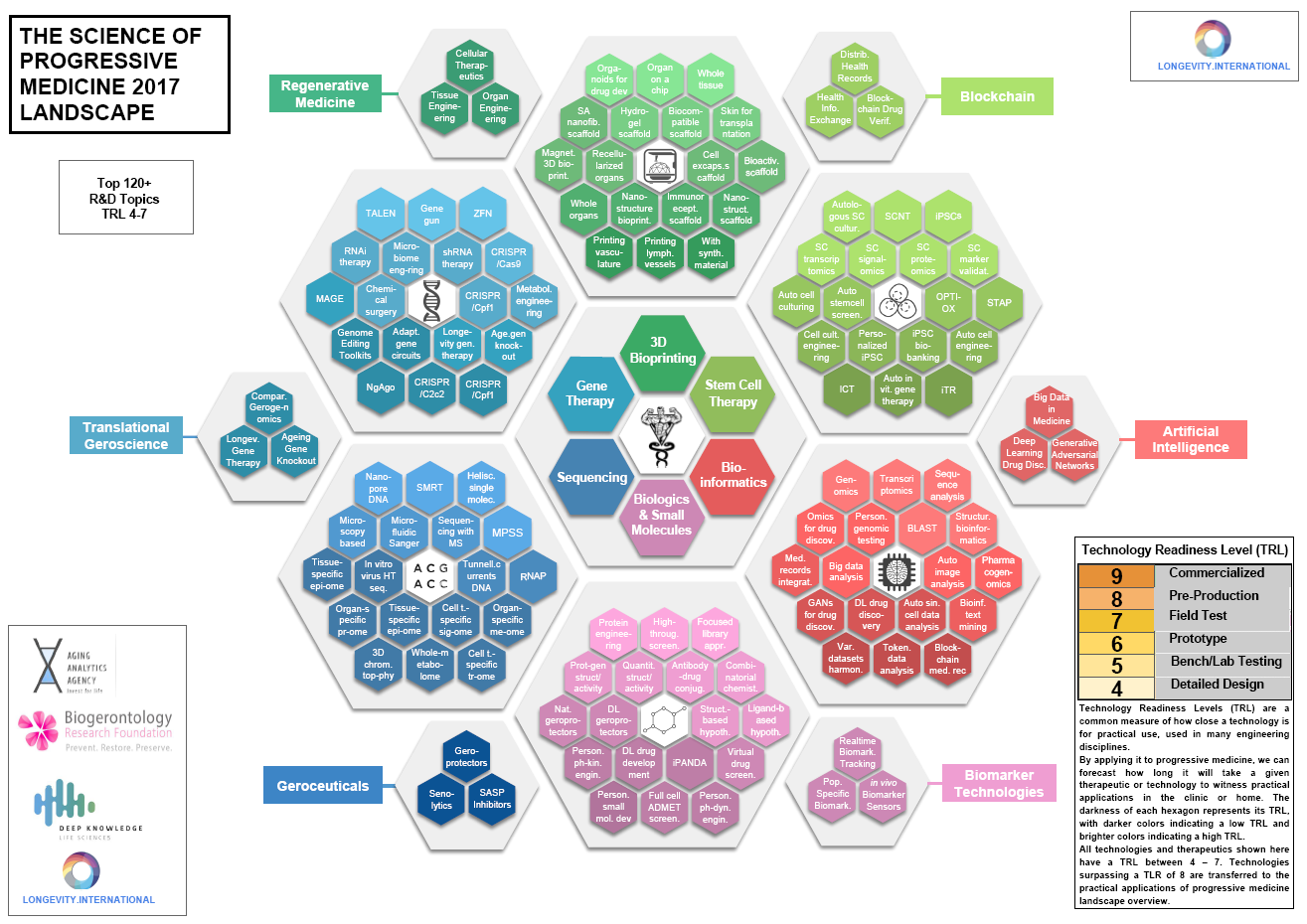
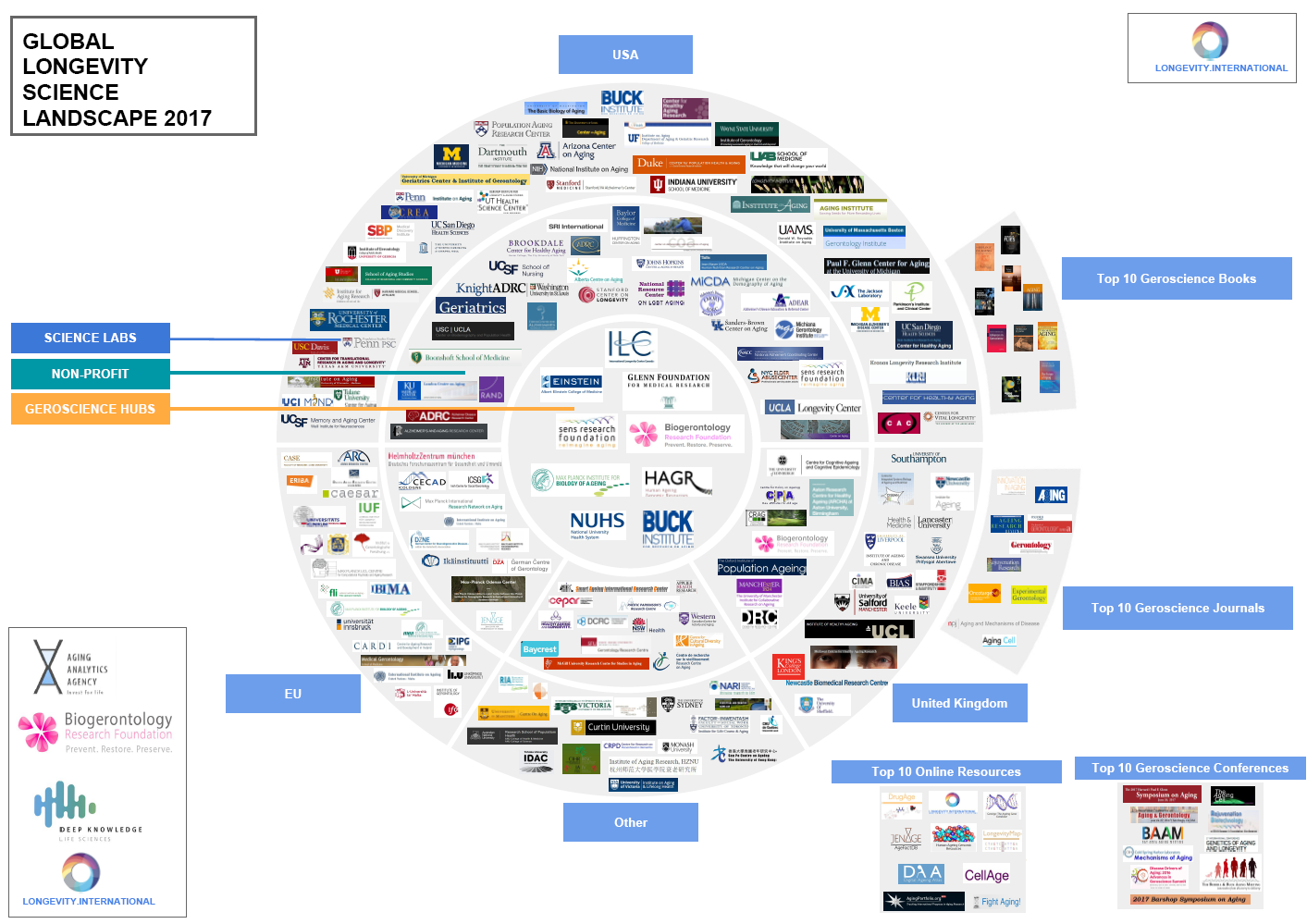
Part 1 of the report ties together the progress threads of the constituent industries into a coherent narrative, mapping the intersection of biomedical gerontology, regenerative medicine, precision medicine, artificial intelligence, offering a brief history and snapshot of each. Part 2 lists and individually profiles 650 longevity-focused entities, including research hubs, non-profit organizations, leading scientists, conferences, databases, books and journals. Infographics are used to illustrate where research institutions stand in relation to each other with regard to their disruptive potential: companies and institutions specialising in palliative technologies are placed at the periphery of circular diagrams, whereas those involved with more comprehensive, preventative interventions, such as rejuvenation biotechnologies and gene therapies, are depicted as central.

In this report great care was taken to visualize the complex and interconnected landscape of this field via state of the art infographics so as to distill the many players, scientific subsectors and technologies within the field of geroscience into common understanding. Their hope was to create a comprehensive yet readily-understandable view of the entire field and its many players, to serve a similar function that Mendeleev’s periodic table did for the field of chemistry. While these are static infographics in the reports, their creators plan to create complimentary online versions that are interactive and filterable, and to convene a series of experts to analyze these infographics and continually update them as the geroscience landscapes shifts. Similar strategies are employed in Volume II to illustrate the many companies and investors within the longevity industry.

These reports currently profile the top 100 entities in each of the categories, but in producing them, analysts found that the majority of these categories have significantly more than 100 entities associated with them. One of their main conclusions upon finishing the report is that the longevity industry is indeed of substantial size, with many industry and academic players, but that it remains relatively fragmented, lacking a sufficient degree of inter-organization collaboration and industry-academic partnerships. The group plans to expand these lists in follow-up volumes so as to give a more comprehensive overview of the individual companies, investors, books, journals, conferences and scientists that serve as the foundation of this emerging industry.

Since these reports are being spearheaded by the UK’s oldest biomedical charity focused on healthspan extension, the Biogerontology Research Foundation is publishing them online, freely available to the public. While the main focus of this series of reports is an analytical report on the emerging longevity industry, the reports still delve deeply into the science of longevity, and Volume I is dedicated exclusively to an overview of the history, present and future state of ageing research from a scientific perspective.

The consortium of organizations behind these reports anticipate them to be the first comprehensive analytical report on the emerging longevity industry to date, and hope to increase awareness and interest from investors, scientists, medical personnel, regulators, policy makers, government officials and the public-at-large in both the longevity industry as well as geroscience proper by providing a report that simultaneously distills the complex network of knowledge underlying the industry and field into easily and intuitively comprehensible infographics, while at the same time providing a comprehensive backbone of chapters and profiles on the various companies, investors, organizations, labs, institutions, books, journals and conferences for those inclined for a deeper dive into the vast foundation of the longevity industry and the field of geroscience.

It is hoped that this report will assist others in visualising the present longevity landscape and elucidate the various industry players and components. Volume 2, The Business of Longevity, which at approximately 500 pages in length aims to be as comprehensive as Volume 1, is set to be published shortly thereafter, and will focus on the companies and investors working in the field of precision preventive medicine with a focus on healthy longevity, which will be necessary in growing the industry fast enough to avert the impending crisis of global aging demographics.

These reports will be followed up throughout the coming year with Volume 3 (“Special Case Studies”), featuring 10 special case studies on specific longevity industry sectors, such as cell therapies, gene therapies, AI for biomarkers of aging, and more, Volume 4 (“Novel Longevity Financial System”), profiling how various corporations, pension funds, investment funds and governments will cooperate within the next decade to avoid the crisis of demographic aging, and Volume 5 (“Region Case Studies”), profiling the longevity industry in specific geographic regions.

These reports are, however, only the beginning, and ultimately will serve as a launching pad for an even more ambitious project: Longevity.International, an online platform that will house these reports, and also serve as a virtual ecosystem for uniting and incentivizing the many fragmented stakeholders of the longevity industry, including scientists, entrepreneurs, investors, policy makers, regulators and government officials to unite in the common goal of healthspan extension and aversion of the looping demographic aging and Silver Tsunami crisis. The platform will use knowledge crowdsourcing of top tier experts to unite scientists with entrepreneurs, entrepreneurs to investors, and investors to policy-makers and regulators, where all stakeholders can aggregate and integrate intelligence and expertise from each other using modern IT technologies for these types of knowledge platforms, and all stakeholders can be rewarded for their services.


The consortium behind these reports is interested in collaboration with interested contributors, institutional partners, and scientific reviewers to assist with the ongoing production of these reports, to enhance their outreach capabilities and ultimately to enhance the overall impact of these reports upon the scientific and business communities operating within the longevity industry, and can be reached at info@longevity.international

###

About the Biogerontology Research Foundation:

The Biogerontology Research Foundation is a UK non-profit research foundation and public policy center seeking to fill a gap within the research community, whereby the current scientific understanding of the ageing process is not yet being sufficiently exploited to produce effective medical interventions. The BGRF funds and conducts research which, building on the body of knowledge about how ageing happens, aims to develop biotechnological interventions to remediate the molecular and cellular deficits which accumulate with age and which underlie the ill-health of old age. Addressing ageing damage at this most fundamental level will provide an important opportunity to produce the effective, lasting treatments for the diseases and disabilities of ageing, required to improve quality of life in the elderly. The BGRF seeks to use the entire scope of modern biotechnology to attack the changes that take place in the course of ageing, and to address not just the symptoms of age-related diseases but also the mechanisms of those diseases.


We Must Unite for an International Ban on AI Weaponry; A Real Solution to Survive the Singularity Along with What Lies Beyond – Article by Bobby Ridge

We Must Unite for an International Ban on AI Weaponry; A Real Solution to Survive the Singularity Along with What Lies Beyond – Article by Bobby Ridge

February 5, 2018 Bobby Ridge Comments 0 Comment

Bobby Ridge


I urge the United States Transhumanist Party to support an international ban on the use of autonomous weapons and support subsidies from governments and alternative funding into research for AI safety – funding that is very similar to Elon Musk’s efforts. Max Tegmark recently stated that “Elon Musk’s $10M donation to the Future of Life Institute that helped put out 37 grants to run a global research program aimed at keeping AI beneficial to humanity.”

Biologists fought hard to pass the international ban on biological weapons, so that the name of biology would be known as it is today, i.e., a science that cures diseases, ends suffering, and makes sense of the complexity of living organisms. Similarly, the community of chemists also united and achieved an international ban on the use of chemical weapons. Scientists conducting AI research should follow their predecessors’ wisdom and unite to achieve an international ban on autonomous weapons! It is sad to say that we are already losing this fight for an international ban on autonomous weapons. The Kalashnikov Bureau weapons manufacturing company announced that they have recently invented an unmanned ground vehicle (UGV), which field tests have already shown better than human level intelligence. China recently began field-testing cruise missiles with AI and autonomous capabilities, and a few companies are getting very close to having AI autopilot operating to control the flight envelope at hypersonic speeds. (Amir Husain: “The Sentient Machine: The Coming Age of Artificial Intelligence“)

Even though, in 2015 and 1016, the US government spent only $1.1 billion and $1.2 billion in AI research, respectively, according to Reuters, “The Pentagon’s fiscal 2017 budget request will include $12 billion to $15 billion to fund war gaming, experimentation and the demonstration of new technologies aimed at ensuring a continued military edge over China and Russia.” While these autonomous weapons are already being developed, the UN Convention on Certain Conventional Weapons (CCW) couldn’t even come up with a definition for autonomous weapons after 4 years of meeting up, despite their explicit expression for a dire concern for the spread of autonomous weapons. They decided to put off the conversation another year, but we all know that at the pace technology is advancing, we may not have another year to postpone a definition and solutions. Our species must advocate and emulate the 23 Asilomar AI principles, which over 1000 expert AI researchers from all around the globe have signed.

In only the last decade or so, there has been a combined investment of trillions of dollars towards an AI race from the private sector, such as, Google, Microsoft, Facebook, Amazon, Alibaba, Baidu, and other tech titans, along with whole governments, such as, China, South Korea, Russia, Canada, and only recently the USA. The investments are mainly towards making AI more powerful, but not safer! Yes, the intelligence and sentience of artificial superintelligence (ASI) will be inherently uncontrollable. As a metaphor, humans controlling the development of ASI, will be like an ant trying to control the human development of a NASA space station on top of their ant colony. Before we get to that point, at which hopefully this issue will be solved by a brain-computer-interface, we can get close to making the development of artificial general intelligence (AGI) and weak ASI safe, by steering AI research efforts towards solving the alignment problem, the control problem, and other problems in the field. This can be done with proper funding from the tech titans and governments.

“AI will be the new electricity. Electricity has changed every industry and AI will do the same but even more of an impact.” – Andrew Ng

“Machine learning and AI will empower and improve every business, every government organization, philanthropy, basically there is no institution in the world that cannot be improved by machine learning.” – Jeff Bezos

ANI (artificial narrow intelligence) and AGI (artificial general intelligence) by themselves have the potential to alleviate an incomprehensible amount of suffering and diseases around the world, and in the next few decades, the hammer of biotechnology and nanotechnology will likely come down to cure all diseases. If the trends of information technologies continue to accelerate, which they certainly will, then in the next decade or so an ASI will be developed. This God-like intelligence will immigrate for resources in space and will scale to an intragalactic size. To iterate old news, to keep up with this new being, we are likely to connect our brains to it via brain-computer-interface.

“The last time something so important like this has happened was maybe 4.2 billion-years-ago, when life was invented.” – Juergen Schmidhuber

Due to independent assortment of chromosomes during meiosis, you roughly have a 1 in 70 trillionth of a chance at living. Now multiply this 70-trillionth by the probability of crossing over, and the process of crossing over has orders of magnitude more possible outcomes than 70 trillion. Then multiply this by probability of random fertilization (the chances of your parents meeting and copulating). Then multiply whatever that number is by similar probabilities for all our ancestors for hundreds of millions of years – ancestors that have also survived asteroid impacts, plagues, famine, predators, and other perils. You may be feeling pretty lucky, but on top of all of that science and technology is about to prevent and cure any disease we may come across, and we will see this new intelligence emerge in our laboratories all around the world. Any attempt to provide a linguistic description for how spectacularly LUCKY we are to be alive right now and to experience this scientific revolution, will be an abysmally disingenuous description, as compared to how truly lucky we all are. AI experts, Transhumanists, Singularitarians, and all others who understand this revolution have an obligation to provide every person with an educated option that they could pursue if they desire to take part in indefinite longevity, augmentation into superintelligence, and whatever lies beyond the Singularity 10-30 years from now.

There are many other potential sources existential threats, such as synthetic biology, nuclear war, the climate crisis, molecular nanotechnology, totalitarianism-enabling technologies, super volcanoes, asteroids, biowarfare, human modification, geoengineering, etc. Mistakes in only one of these areas could cause our species to go extinct, which is the definition of an existential risk. Science created some of these existential risks, and only Science will prevent them. Philosophy, religion, complementary alternative medicines, and any other proposed scientific demarcation will not solve these existential risks, along with the myriad of other individual suffering and death that occurs daily. With this recent advancement, Carl Sagan’s priceless wisdom has become even more palpable than before; “we have arranged a society based on Science and technology, in which no one understands anything about Science and technology and this combustible mixture of ignorance and power sooner or later is going to blow up in our faces.” The best chance we have of surviving this next 30 years and whatever is beyond the Singularity is by transitioning to a Science-Based Species. A Science-Based Species is like Dr. Steven Novella’s recent advocacy, which calls for transition off Evidence-Based medicine to a Science-Based medicine. Dr. Novella and his team understand that “the best method for determining which interventions and health products are safe and effective is, without question, good science.” Why arbitrarily claim this only for medicine? I propose a K-12 educational system that teaches the PROCESS of Science. Only when the majority of ~8 billion people are scientifically literate and when public reason is guided by non-controversial scientific results and non-controversial methods, then we will be cable of managing these scientific tools – tools that could take our jobs, can cause incomprehensible levels of suffering, and kill us all; tools that are currently in our possession; and tools that continue to become more powerful, to democratize, dematerialize, and demonetize at an exponential rate. I cannot stress enough that ‘scientifically literate’ means that the people are adept at utilizing the PROCESS of Science.

Bobby Ridge is the Secretary-Treasurer of the United States Transhumanist Party. Read more about him here. 

References

Tegmark, M. (2015). Elon Musk donates $10M to keep AI beneficial. Futureoflife.org. https://futureoflife.org/2015/10/12/elon-musk-donates-10m-to-keep-ai-beneficial/

Husain, A. (2018). Amir Husain: “The Sentient Machine: The Coming Age of Artificial Intelligence” | Talks at Google. Talks at Google. Youtube.com. https://www.youtube.com/watch?v=JcC5OV_oA1s&t=763s

Tegmark, M. (2017). Max Tegmark: “Life 3.0: Being Human in the Age of AI” | Talks at Google. Talks at Google. Youtube.com. https://www.youtube.com/watch?v=oYmKOgeoOz4&t=1208s

Conn, A. (2015). Pentagon Seeks $12 -$15 Billion for AI Weapons Research. Futureoflife.org. https://futureoflife.org/2015/12/15/pentagon-seeks-12-15-billion-for-ai-weapons-research/
BAI 2017 conference. (2017). ASILOMAR AI PRINCIPLES. Futureoflife.org. https://futureoflife.org/ai-principles/

Ng, A. (2017). Andrew Ng – The State of Artificial Intelligence. The Artificial Intelligence Channel. Youtube.com. https://www.youtube.com/watch?v=NKpuX_yzdYs

Bezos, J. (2017). Gala2017: Jeff Bezos Fireside Chat. Internet Association. Youtube.com. https://www.youtube.com/watch?v=LqL3tyCQ1yY

Schmidhuber, J. (2017). True Artificial Intelligence will change everything | Juergen Schmidhuber | TEDxLakeComo. TEDx Talks. Youtube.com. https://www.youtube.com/watch?v=-Y7PLaxXUrs

Kurzweil, R. (2001). The Law of Accelerating Returns. Kurzweil Accelerating Intelligence. Kurzweilai.net. http://www.kurzweilai.net/the-law-of-accelerating-returns

Sagan C. (1996). REMEMBERING CARL SAGAN. Charlierose.com. https://charlierose.com/videos/2625

Sbmadmin. (2008). Announcing the Science-Based Medicine Blog. Sciencebasedmedicine.org. https://sciencebasedmedicine.org/hello-world/

Zeb2-NAT Molecule May Reverse Cellular Aging – Article by Nicola Bagalà

Zeb2-NAT Molecule May Reverse Cellular Aging – Article by Nicola Bagalà

January 28, 2018 Nicola Bagalà Comments 0 Comment

Nicola Bagalà


Editor’s Note: In this article, Mr. Nicola Bagalà explains a study that shows aged cells that usually resist reprogramming can be regenerated by reducing the level of Zeb2-NAT without harming the cells’ developmental potency.  This article was originally published by the Life Extension Advocacy Foundation (LEAF).

                   ~ Kenneth Alum, Director of  Publication, U.S. Transhumanist Party, January 28, 2018

Researchers have found that by manipulating a single RNA molecule, they can reverse some aspects of cellular aging and regenerate aged cells.

Old cells resist regeneration

As we grow older, our cells gradually age, leading to the development of various diseases. Therefore, inducing cellular regeneration is one of the approaches that researchers are using to combat the age-related diseases associated with cellular aging. Unfortunately, aged cells are often highly resistant to therapies aimed at inducing regeneration.

Ribonucleic acid (RNA) is responsible for the creation of cellular proteins. However, a special type of molecule called non-coding RNA is never made into protein. In fact, when they mapped the human genome in 2001, they discovered that only around 2% of RNA is actually made into proteins.

Now, researchers have found a way to bypass the resistance of aged cells to being regenerated and becoming functionally more youthful.

What the study found out

In a recent Nature Communications paper, a team led by Dr. Bruno Bernardes de Jesus of the Instituto de Medicina Molecular (iMM) João Lobo Antunes in Lisboa discusses a technique that allowed the team to achieve easier cellular reprogramming of old fibroblasts into pluripotent cells [1].

Fibroblasts are connective tissue cells in animals that synthesize both the extracellular matrix, which is a “scaffolding” made up of extracellular molecules that provides structural and biochemical support to cells, and collagen, which is the main structural protein of connective tissues in animal bodies.

The study showed that the fibroblasts of old mice express higher levels of the transcription factor Zeb2. A transcription factor is a protein that regulates the DNA-to-messenger-RNA transcription rate, and Zeb2, in particular, induces epithelial cells to transition to mesenchymal cells. Epithelial cells are one of the four basic tissue types of animal cells, whereas mesenchymal cells are multipotent stem cells that give rise to fibroblasts, among others.

The synthesis of Zeb2 is controlled by the ribonucleic acid Zeb2-NAT (NAT stands for “natural antisense transcript”). What the scientists demonstrated in this paper is that by knocking down Zeb2-NAT in old mouse fibroblasts, Zeb2 can be downregulated significantly, which, in turn, leads to an enhanced fibroblast ability to turn into pluripotent cells rather than mesenchymal cells. The difference is that while mesenchymal cells can turn into only a certain range of related cells, pluripotent stem cells can turn into nearly all types of cells.

The way the researchers silenced Zeb2-NAT was by transfecting the fibroblasts with certain ribonucleic acid sequences—in other words, they introduced these sequences into the fibroblasts’ nuclei to modify their behavior.

Essentially, what they demonstrated is that aged cells that usually resist reprogramming can be regenerated by reducing the level of Zeb2-NAT without harming the cells’ developmental potency.

Conclusion

This study results spotlight the role of non-coding RNA in the fine-tuning and expression of protein-coding genes involved in pluripotency, differentiation, and reprogramming.

This opens the door for the regeneration of aged cells and tissues in an effort to prevent or reverse age-related diseases caused by cellular aging.

Literature

[1] Bernardes de Jesus, B., Pires Marinho, S., Barros, S., Sousa-Franco A., Alves-Vale, C., Carvalho, T., Carmo-Fonseca, M. (2018). Silencing of the lncRNA Zeb2-NAT facilitates reprogramming of aged fibroblasts and safeguards stem cell pluripotency. Nature Communications.

About Nicola Bagalà

Nicola Bagalà has been an enthusiastic supporter and advocate of rejuvenation science since 2011. Although his preferred approach to treating age related diseases is Aubrey de Grey’s suggested SENS platform, he is very interested in any other potential approach as well. In 2015, he launched the blog Rejuvenaction to advocate for rejuvenation and to answer common concerns that generally come with the prospect of vastly extended healthy lifespans. Originally a mathematician graduated from Helsinki University, his scientific interests range from cosmology to AI, from drawing and writing to music, and he always complains he doesn’t have enough time to dedicate to all of them which is one of the reasons he’s into life extension. He’s also a computer programmer and web developer. All the years spent learning about the science of rejuvenation have sparked his interest in biology, in which he’s planning to get a university degree.

About LIFE EXTENSION ADVOCACY FOUNDATION (LEAF)

In 2014, the Life Extension Advocacy Foundation was established as a 501(c)(3) non-profit organization dedicated to promoting increased healthy human lifespan through fiscally sponsoring longevity research projects and raising awareness regarding the societal benefits of life extension. In 2015 they launched Lifespan.io, the first nonprofit crowdfunding platform focused on the biomedical research of aging.

They believe that this will enable the general public to influence the pace of research directly. To date they have successfully supported four research projects aimed at investigating different processes of aging and developing therapies to treat age-related diseases.

The LEAF team organizes educational events, takes part in different public and scientific conferences, and actively engages with the public on social media in order to help disseminate this crucial information. They initiate public dialogue aimed at regulatory improvement in the fields related to rejuvenation biotechnology.

World Health Organization Puts the Elderly Back in the Picture – Article by Elena Milova

World Health Organization Puts the Elderly Back in the Picture – Article by Elena Milova

January 27, 2018 Elena Milova Comments 0 Comment

Elena Milova


Editor’s Note: In this article, Miss Elena Milova explains the success the anti-aging community has had in influencing policy makers at the WHO in including several provisions related to aging, in their global strategy and action plans of the next decade. This article was originally published by the Life Extension Advocacy Foundation (LEAF).

                   ~ Kenneth Alum, Director of  Publication, U.S. Transhumanist Party, January 27, 2018

Not long ago, we wrote about some complications involving the WHO 13th programme of work. In the initial version of this document, developed by the WHO working group in November 2017, the problems of the elderly were nearly completely overlooked. The joint effort of our community helped to bring this critical flaw to public attention.

During the meeting of the working group, it was announced that 90% of the comments received by WHO (out of 400) pointed out the need to set healthy aging as one of the priorities of the new programme of work. However, we didn’t know if our demand to focus on the implementation of the global strategy and action plan on aging and health would be fulfilled.

The good news is that the new draft programme published on the WHO site on November 5th includes several provisions related to aging. Our community managed to persuade these global policymakers to implement all activities listed in the global strategy to help society prepare for the Decade of Healthy Aging (2020-2030). Let’s have a closer look at these provisions.

15. The foundation of WHO’s work is SDG 3: ensuring healthy lives and promoting well-being for all at all ages. WHO is an organization focused principally on promoting health rather than merely fighting disease, and especially on improving health among vulnerable populations and reducing inequities. Leaving no-one behind, the Organization aims to give women and men, girls and boys, in all social groups, the opportunity to live not just long but also healthy lives. WHO will explore measuring this foundation of its work using healthy life expectancy, which could serve as one overarching measure aligned with SDG 3, complemented by the triple billion goal, which leads to three more specific priorities, each with overlapping one-billion people goals.

Healthy life expectancy (HALE) is an assessment of the period of time a person can live in full health. HALE is usually lower than total life expectancy, and the difference between HALE and total life expectancy is regarded as years of life lost to disease.

As the goal of our community is to prolong the healthy period of life by addressing the root mechanisms of aging and postponing age-related disease, the introduction of HALE as a way to measure WHO activities is a very good outcome. It is very hard to preserve health in older ages without addressing the underlying mechanisms of aging and implementing an extensive program that involves educating the public about healthy lifestyles. This choice of indicator means that WHO will strengthen its efforts to keep people healthy for as long as possible, which will ease the introduction of rejuvenation interventions once they are available, as it will likely be a cost-effective way to achieve a more favorable HALE.

16. Life expectancy at birth has consistently increased since the 19th century, largely due to socioeconomic developments and public health measures such as vaccination, nutrition and
sanitation. Today, socioeconomic, political, cultural, environmental and economic forces continue to drive changes in the burden of disease. However, efforts are needed to ensure that their impact is positive. Poor health literacy coupled with weak health-promoting policies make it difficult for people to make healthy choices for themselves and their families. Investment in health promotion and disease prevention allows countries to address economic concerns about the rising costs of the health system and enables potential savings if disease can be avoided.

The WHO draft programme of work refers here to the increasing burden of chronic, non-communicable diseases due to the increasing proportion of people age 60 and over. Indeed, it would be really hard to double or even triple healthcare and pension expenditures for many countries, especially taking into account the ongoing economic crisis. However, this is what aging societies will have to do, if HALE does not grow faster.

This is why WHO is only promoting evidence-based interventions that represent the “best buy” scenarios: the most realistic and cost-effective. When it comes to age-related diseases, which can last 20-30 years or longer, prevention could be much cheaper, and it is more humane, as this scenario would reduce unnecessary human suffering. Therefore, we could consider this provision of the new draft programme as supporting our efforts to introduce longevity lifestyles and even “soft” (careful and evidence-based) biohacking.

17. Healthy life expectancy has not increased at the same pace as life expectancy, and increasing age often brings increasing morbidity and reduced functioning, making healthy ageing an important focus. Most disability-adjusted life years in older age are attributable to chronic conditions and the accumulated impact of such conditions can lead to significant loss in function and care dependence in older age. At the same time, there is emerging evidence that healthy ageing depends on early childhood development and is epigenetically determined. Ensuring healthy ageing is an urgent challenge in all countries.

This provision once again underlines how important it is to focus on prevention. I would like to point out that if childhood is perceived as the foundation of healthy lifestyles, longevity advocates receive carte blanche for working with the younger generation. Activists could think of developing corresponding education programs for schools and universities, and this very provision can be a strong argument when offering such a program to educational authorities.

37. Ensuring healthy ageing is central to universal health coverage, just as it is to the other priorities of GPW 13. The number of people over the age of 60 is expected to double by 2050 and this unprecedented demographic transition will require a radical societal response. The Secretariat will support Member States to promote healthy ageing through the actions defined by the Global strategy and action plan on ageing and health (2016), as well as through the Decade of Healthy Ageing that is planned for the period 2020−2030. These actions include aligning health systems to the needs of older populations, with a special focus on enhancing the functioning of older persons and the management of chronic disease; improving access to medicines; developing systems of longterm care including community-based services; promoting palliative care, creating age-friendly environments; and improving measurement, monitoring and understanding of healthy ageing.

This provision is exactly what we were aiming for when calling the members of our community to take part in the Open Consultation or the Draft. As you remember, all mentions of the WHO documents related to aging were absent; this provision clearly shows that we achieved our goal! Even though the global strategy and action plan on aging and health may not be ideal in terms of rejuvenation research promotion, it helps member states navigate the field with more confidence. This global strategy, which we wanted so much to be the foundation of the draft programme provisions related to aging, contains a very important paragraph that every activist should know about:

105. Finally, better clinical research is urgently needed on the etiology of, and treatments for, the key health conditions of older age, including musculoskeletal and sensory impairments, cardiovascular disease and risk factors such as hypertension and diabetes, mental disorders, dementia and cognitive declines, cancer, and geriatric syndromes such as frailty. This must include much better consideration of the specific physiological differences of older men and women and the high likelihood that they will be experiencing mutimorbidities. This could also be extended to include possible interventions to modify the underlying physiological and psychological changes associated with ageing.

Conclusion

Dear friends, this is a victory! Our community managed to influence policymakers of the highest level: the World Health Organization. We managed to ensure that the new programme of work considers aging and age-related diseases to be an important issue, and the resulting global strategy and action plan on aging and health is an effective guide to helping our society adapt to population aging.

In terms of advocacy, this is a complete victory, which shows two important things. First, when we join forces, we can influence global health policy at the highest level. Our community became stronger, and our voice is being heard! Second, this victory shows that dialogue with the UN and its institutions, including decision-makers in these agencies, is possible, and it goes in the directions that we need: more focus on prevention and more focus on public health education related to aging.

I offer special thanks to Dr. Ilia Stambler for initially turning the attention of the community to this issue. I want to thank and congratulate all participants of the Open Consultation with this achievement. Of course, we are still at the beginning of our path to rejuvenation as a public health priority, but outcomes like this one make me believe that there are more victories to come. Let’s keep working, as the main reward is worth it: health, youth, and freedom from age-related diseases for all!

About Elena Milova

As a devoted advocate of rejuvenation technologies since 2013, Elena is providing the community with a systemic vision how aging is affecting our society. Her research interests include global and local policies on aging, demographic changes, public perception of the application of rejuvenation technologies to prevent age-related diseases and extend life, and related public concerns. Elena is a co-author of the book Aging Prevention for All (in Russian, 2015) and the organizer of multiple educational events helping the general public adopt the idea of eventually bringing aging under medical control.

About LIFE EXTENSION ADVOCACY FOUNDATION (LEAF)

In 2014, the Life Extension Advocacy Foundation was established as a 501(c)(3) non-profit organization dedicated to promoting increased healthy human lifespan through fiscally sponsoring longevity research projects and raising awareness regarding the societal benefits of life extension. In 2015 they launched Lifespan.io, the first nonprofit crowdfunding platform focused on the biomedical research of aging.

They believe that this will enable the general public to influence the pace of research directly. To date they have successfully supported four research projects aimed at investigating different processes of aging and developing therapies to treat age-related diseases.

The LEAF team organizes educational events, takes part in different public and scientific conferences, and actively engages with the public on social media in order to help disseminate this crucial information. They initiate public dialogue aimed at regulatory improvement in the fields related to rejuvenation biotechnology.

Alzheimer’s Drug Turns Back the Clock in Mitochondria – Article by Steve Hill

Alzheimer’s Drug Turns Back the Clock in Mitochondria – Article by Steve Hill

January 26, 2018 Steve Hill Comments 0 Comment

Steve Hill


Editor’s Note: In this article, Mr. Steve Hill discusses an experimental drug, J147, for treating Alzheimer’s disease and also how Alzheimer’s disease is closely linked to aging.  This article was originally published by the Life Extension Advocacy Foundation (LEAF).

                   ~ Kenneth Alum, Director of  Publication, U.S. Transhumanist Party, January 26, 2018

J147 is an experimental drug that has been shown to treat Alzheimer’s disease, and it also appears to reverse some aspects of aging. It is also poised to enter human clinical trials in the near future, although how it works has been somewhat of a puzzle.

A new study  published in the journal Aging Cell has changed all that, and the results are quite intriguing [1]. Researchers at the Salk Institute have solved the mystery of how J147 works and why it makes old flies, mice, and cells more youthful.

Rejuvenating mitochondria

The drug apparently works because it binds to a protein found in mitochondria, the powerhouses of cells; this, in turn, causes cells to function in a more youthful manner. Mitochondrial dysfunction is one of the hallmarks of aging and is thought to be a key reason why we age and develop age-related diseases [2]. This drug appears, at least partially, to address some of that dysfunction.

Finding the target of J147 was the key to revealing the link between Alzheimer’s disease and the aging process. It was the critical information the researchers needed and was holding the drug back from clinical trials.

Dave Schubert, head of Salk’s Cellular Neurobiology Laboratory, and his team originally developed the J147 drug in 2011. The team screened numerous plant-sourced compounds with the potential to reverse the cellular and molecular signs of aging in the brain. The drug was developed as a modified version of a molecule found in the spice curcumin, a common ingredient in Asian foods such as curry.

Since then, the researchers have shown that J147 can reverse memory deficits, increases the production of brain cells, and slows the progression of Alzheimer’s in mice [3]. However, at that point, they did not understand how J147 worked.

Finding the target

During the new study lead by Dave Schubert and Salk Research Associate Josh Goldberg, the researchers used a number of approaches to find out how J147 worked. They eventually identified that the target of J147 was the mitochondrial protein known as ATP synthase, specifically ATP5A, a subunit of that protein. ATP synthase is involved in the mitochondrial generation of ATP, which cells use for energy.

The researchers demonstrated that by reducing the activity of ATP synthase, they were able to protect neuronal cells from a number of toxicities associated with the aging of the brain. One reason for this neuroprotective effect is thought to be the role of excitotoxicity in neuronal cell damage.

Excitotoxicity is the pathological process by which neurons are damaged and killed by the overactivation of receptors for the excitatory neurotransmitter glutamate. Think of it being a bit like a light switch being turned on and off so rapidly that it ends up causing the light bulb to blow.

Recently, the role of ATP synthase inhibition for neuroprotection against excitotoxic damage was demonstrated in a mouse study [4]. The second study showed that mouse models expressing the human form of mutant ATPase inhibitory factor 1 (hIF1), which causes a sustained inhibition of ATP synthase, were more resilient to neuronal death after excitotoxic damage. This data is consistent with this new J147 study, in which an increase in IF1 in the mice reduced the activity of ATP synthase (specifically ATP5A) and was neuroprotective.

ATP synthase is implicated in aging

ATP synthase has previously been shown to influence aging in C. elegans worms and flies. Given that aging is the greatest risk factor for developing Alzheimer’s disease, it is no surprise that the target of the drug is also involved in the aging process.

The team also revealed that by modulating the activity of ATP synthase, they could influence the levels of ATP and other molecules and were able to encourage healthier, more stable mitochondria during aging. Mice given the compound showed profound changes, appearing to look younger at a cellular and molecular level.

The researchers believe that these results are not only encouraging for the treatment of Alzheimer’s, they suggest that J147 may also be useful in treating other age-related diseases.

“People have always thought that you need separate drugs for Alzheimer’s, Parkinson’s and stroke,” said Dave Schubert. “But it may be that by targeting aging we can treat or slow down many pathological conditions that are old-age-associated.”

With J147 having just completed the FDA required toxicology testing in animals, the next step is phase 1 human clinical trials, and the road to approval begins.

Conclusion

It is very heartening to hear important researchers suggesting that in order to treat age-related diseases, one needs to treat the aging processes themselves. This is the exactly what Dr. Aubrey de Grey and others have been saying for many years. It is good to hear more voices joining the call to tackle age-related diseases at their root: the hallmarks and damages where they all begin.

The process of age-related disease begins long before the familiar signs and diagnoses are made; by targeting the early processes that are not given specific disease names, we might yet defeat horrific diseases, such as Alzheimer’s, which rob us of who we are.

Literature

[1] Joshua Goldberg et al. The mitochondrial ATP synthase is a shared drug target for aging and dementia. Aging Cell, 2018 DOI: 10.1111/acel.12715
[2] López-Otín, C., Blasco, M. A., Partridge, L., Serrano, M., & Kroemer, G. (2013). The hallmarks of aging. Cell, 153(6), 1194-1217.
[3] Prior, M., Dargusch, R., Ehren, J. L., Chiruta, C., & Schubert, D. (2013). The neurotrophic compound J147 reverses cognitive impairment in aged Alzheimer’s disease mice. Alzheimer’s research & therapy, 5(3), 25.
[4] Formentini, L., Pereira, M. P., Sánchez‐Cenizo, L., Santacatterina, F., Lucas, J. J., Navarro, C., … & Cuezva, J. M. (2014). In vivo inhibition of the mitochondrial H+‐ATP synthase in neurons promotes metabolic preconditioning. The EMBO journal, 33(7), 762-778.

About Steve Hill

As a scientific writer and a devoted advocate of healthy longevity technologies Steve has provided the community with multiple educational articles, interviews and podcasts, helping the general public to better understand aging and the means to modify its dynamics. His materials can be found at H+ Magazine, Longevity reporter, Psychology Today and Singularity Weblog. He is a co-author of the book “Aging Prevention for All” – a guide for the general public exploring evidence-based means to extend healthy life (in press).

About LIFE EXTENSION ADVOCACY FOUNDATION (LEAF)

In 2014, the Life Extension Advocacy Foundation was established as a 501(c)(3) non-profit organization dedicated to promoting increased healthy human lifespan through fiscally sponsoring longevity research projects and raising awareness regarding the societal benefits of life extension. In 2015 they launched Lifespan.io, the first nonprofit crowdfunding platform focused on the biomedical research of aging.

They believe that this will enable the general public to influence the pace of research directly. To date they have successfully supported four research projects aimed at investigating different processes of aging and developing therapies to treat age-related diseases.

The LEAF team organizes educational events, takes part in different public and scientific conferences, and actively engages with the public on social media in order to help disseminate this crucial information. They initiate public dialogue aimed at regulatory improvement in the fields related to rejuvenation biotechnology.

Exercise is Currently the Best Way to Slow Down Aging – Article by Michael Falk

Exercise is Currently the Best Way to Slow Down Aging – Article by Michael Falk

January 25, 2018 Michael Falk Comments 0 Comment

Michael Falk


Editor’s Note: In this article, Mr. Michael Falk explains how exercising slows down aging. This article was originally published by the Life Extension Advocacy Foundation (LEAF).

                   ~ Kenneth Alum, Director of  Publication, U.S. Transhumanist Party, January 25, 2018

We have all heard that exercise is good for our health. However, it can not only keep you healthy, it can also slow down some aspects of aging. Some researchers even think that it might be possible to use this knowledge to develop new therapies against aging. While waiting for that to happen, we need to exercise in order to slow down the effects of aging.

How important is it to keep fit?

So, how beneficial is exercising? Well, one of the best studies conducted on this subject showed that women will live 5.6 years longer and men 6.2 years longer if they exercise between 1 and 2.5 hours per week [1]. This makes exercise a better lifestyle choice than any other, at least as long as you’re not counting avoiding downright dangerous behavior, such as smoking.

The main benefits of physical activity may come from better health for the heart. Exercise lessens the risk for many types of heart disease [2]. It is even more beneficial for people who already suffered age-related conditions, including stroke and coronary heart disease, and it is more effective than any known drug in preventing repeated episodes [3].

The key improvements also include increased muscle strength, stronger bones, better weight control, and improved cognitive function. This means less risk of age-related diseases, such as Alzheimer’s disease, as well as lethal falls, which are a major risk for the elderly.

The conclusion is that exercise helps with a lot of different aspects of your health in several ways, and we can summarize its effects as improving quality of life and increasing healthspan.

How much exercise do you need?

More exercise does not always improve outcomes. Professional athletes exercise more than the rest of us, and they generally live longer than the average person [4]. However, correlation isn’t causation, and robust individuals are perhaps more likely to become athletes, instead of the other way around. There could even be negative effects from too much exercise, although that is far from certain.

Even moderate exercise leads to better health. Half an hour a day seems to be enough to see positive effects, and it is also a common recommendation for the minimum amount of exercise you should get. The biggest difference can be seen between people who hardly move around at all and people who get at least a little exercise a few times a week. Taking the stairs and walking short distances is clearly better than nothing. In fact, some studies show that even light activity, such as housework, can have an effect on mortality risk.

It should also be noted that there are different types of exercise and that these could have different benefits. Jogging increases your aerobic ability, which should, among other things, lead to better heart health. Lifting weights is an anaerobic exercise that improves strength and should bring other benefits, such as stronger bones. A lot of research about this has been done already, but so far, we don’t definitively know the optimal amount and type of training for each particular type of person.

Drugs to mimic exercise

Some of the positive effects have to do with the anti-inflammatory processes that occur when exercising [5]. Other mechanisms appear to be involved, although more research on these mechanisms is needed.

Since the advantages of exercise are clear, the idea has occurred to some researchers that it may be possible to mimic the effects of exercise without doing the hard work and getting sweaty. Research is now being conducted using drugs that target the same mechanisms to try to get the same benefits of exercise.

This typically involves adjusting a part of the human metabolism, which is not an easy matter. However, there have been at least some tentative breakthroughs already, and last year, a team found a drug that boosted the endurance of mice by roughly 70 percent [6]. Where this might lead in the future is not clear, but some positive effects may come from this research.

Will exercise lead to longevity?

Even though exercise is beneficial for your health, there is no guarantee it will keep you alive until you reach 100, although staying fit will almost certainly improve your chances. This is why if we want to remain in good health and live longer, we need to develop rejuvenation biotechnology and therapies that address the aging processes directly. That said, if you want to increase your chances of living long enough to see these therapies arrive, then exercise is the best option you have right now.

Literature

[1] Schnohr, P., Lange, P., Scharling, H., & Jensen, J. S. (2006). Long-term physical activity in leisure time and mortality from coronary heart disease, stroke, respiratory diseases, and cancer. The Copenhagen City Heart Study. European Journal of Cardiovascular Prevention & Rehabilitation, 13(2), 173-179.

[2] Jakovljevic, D. G. (2017). Physical activity and cardiovascular aging: Physiological and molecular insights. Experimental Gerontology.

[3] Naci, H., & Ioannidis, J. P. (2013). Comparative effectiveness of exercise and drug interventions on mortality outcomes: metaepidemiological study. Bmj, 347, f5577.

[4] Lemez, S., & Baker, J. (2015). Do elite athletes live longer? a systematic review of mortality and longevity in elite athletes. Sports medicine-open, 1(1), 16.

[5] Fan, W., Waizenegger, W., Lin, C. S., Sorrentino, V., He, M. X., Wall, C. E., … & Auwerx, J. (2017). PPARδ Promotes Running Endurance by Preserving Glucose. Cell Metabolism, 25(5), 1186-1193.

[6] Dimitrov, S., Hulteng, E., & Hong, S. (2017). Inflammation and exercise: Inhibition of monocytic intracellular TNF production by acute exercise via β 2-adrenergic activation. Brain, behavior, and immunity, 61, 60-68.

About Michael Falk

Michael Falk is a communication specialist with 15 years of experience writing about healthcare and technology. He has been an advocate of longevity research since 2013, when he started his longevity blog Unggamma (www.unggammal.se).

About LIFE EXTENSION ADVOCACY FOUNDATION (LEAF)

In 2014, the Life Extension Advocacy Foundation was established as a 501(c)(3) non-profit organization dedicated to promoting increased healthy human lifespan through fiscally sponsoring longevity research projects and raising awareness regarding the societal benefits of life extension. In 2015 they launched Lifespan.io, the first nonprofit crowdfunding platform focused on the biomedical research of aging.

They believe that this will enable the general public to influence the pace of research directly. To date they have successfully supported four research projects aimed at investigating different processes of aging and developing therapies to treat age-related diseases.

The LEAF team organizes educational events, takes part in different public and scientific conferences, and actively engages with the public on social media in order to help disseminate this crucial information. They initiate public dialogue aimed at regulatory improvement in the fields related to rejuvenation biotechnology.

Concrete Transhumanism – An Overview of Emerging Instantiations and the Transhuman Present Project

Concrete Transhumanism – An Overview of Emerging Instantiations and the Transhuman Present Project

January 21, 2018 Gennady Stolyarov II Comments 2 comments

logo_bg

Gennady Stolyarov II


Note: This post was also published on Steemit, where Mr. Stolyarov publishes under an account with the username gstolyarovii.

Transhumanism is a philosophy of lofty aspirations and universally applicable substance. Yet, when articulated at its usual level of abstraction, it is often misunderstood, especially if commonplace cultural connotations, myths, and fears from popular fiction inject nefarious undertones into what ought to be seen straightforwardly as a salutary overcoming of (deleterious) human limitations and a dramatic expansion of our potential through the application of science, technology, and rationality. Some accuse transhumanists of being a cabal of Illuminati who somehow secretly run the world. (How is this even possible, I wonder?) Others believe that transhumanists seek to turn humankind into the Borg from Star Trek or to create a dystopia where only a handful of rich Silicon Valley entrepreneurs will live forever at everyone else’s expense. Of course, no transhumanist actually even remotely resembles these stereotypes – and while it would have been quite helpful to have a few more Silicon Valley entrepreneurs as allies, the reality remains that the vast majority of transhumanists, including leaders of the movement, are people of ordinary means and relatively ordinary life situations. Transhumanists as people have much more in common with those who are unaware of, or hold misconceptions regarding, transhumanism than the latter persons think!

So what, then, sets transhumanists apart? Although we are generally people of ordinary means and circumstances, we are also people of extraordinary vision, and we see the world around us as in the midst of technological transformation which not only will have, but is already having, paradigm-shifting effects on everyday life. We are not beholden to status quo bias; we recognize that the present is a transitional state, and that life has not always been like this, nor will it always remain the way it is now.

Until recently, few efforts have been made to illustrate this observation concretely. But dedicated small associations of transhumanists are emerging to show the world what a transhuman present looks like. Through the projects they put into practice, the general public might get a glimpse of a transhuman existence, and in what directions it may head during the coming years and decades.

The Transhuman House and Foundation Library

If today’s technological capabilities were fully integrated into a residence, or even a room inside a residence, what would this look like? The Transhuman House, established in 2017, aims to answer this question. Version 1.0 of the Transhuman House opened to the public in Provo, Utah, in June 2017, even including an option for guests to rent a room via AirBnB.  (See images from a 3D tour of Version 1.0 here.) The Transhuman House contains a showcase of emerging technologies, such as Nest, Alexa, and the Microsoft HoloLens. While observing and interacting with these examples of today’s devices – which either are already available or soon will become available for consumer adoption – visitors have the opportunity to read and study works from the Foundation Library – a wide-ranging collection of philosophical, scientific, technological, and fictional works exploring the ideas of transhumanism as well as visions of potential futures and specific pathways toward bringing those futures into being. In November 2017 the Transhuman House expanded into Version 2.0, moving into a larger (3-bedroom) building and adding touch screens and a giant touch-operable wall panel with which visitors can interact to learn about ongoing projects by transhumanist entrepreneurs and activists. Might most residences ten years in the future look somewhat like the Transhuman House? Now that there is a concrete illustration of what is possible even today, visitors have the opportunity to ponder the question of its wider applicability. The creators of the Transhuman House have given us a glimpse into what everyday life might look like with the emerging “transhuman” technologies more fully integrated into it. Some of these technologies are already available to consumers – so if you would like to create your own partial version of a “Transhuman House”, you may have the opportunity to begin setting up some of the components today.

Zero State – The Alternate Reality Game

The Zero State is a Social Futurist Community – described as “an organization formed in 2011 to work toward the establishment of a pro-technology, Transhumanist, distributed, virtual State. ZS’ motto is ‘Positive Social Change Through Technology’.” As one of the Zero State’s co-founders, Dirk Bruere, explains, the primary meaning of the name “Zero State” is “the lowest energy state of a system, the place to which everything returns when the energy runs out.” The Zero State has had several incarnations, the latest of which is an Alternate Reality Game (ARG), whose fictional premise is that the participants are representatives of twelve technologically advanced Houses, which have become the dominant influences in a post-dystopian late 21st century – a new era subsequent to the turmoil that (in this fictional timeline) would characterize the proximate future. The real-world application of the game involves members of the twelve Zero State Houses undertaking projects today which would enable the more salutary aspects of that distant future to take shape. Through the approach of gamification and interesting storylines woven into concrete projects, it is hoped that this format will motivate more people who are interested in the promise of emerging technologies and their societal impacts to take specific actions to realize the kind of world we would wish to see.

The U.S. Transhumanist Party, of which I am the Chairman, recently initiated a collaboration with the Zero State under the auspices of House Rhadamanth. I anticipate that the gamification format will be particularly useful in achieving projects where large numbers of distributed, volunteer participants are required for success. There is a strong potential for synergies between the Zero State and the U.S. Transhumanist Party’s Transhuman Present project, announced below.

The Transhuman Present Project

The U.S. Transhumanist Party represents a broad spectrum of members from throughout the world, who consider themselves transhumanists and who have expressed alignment with our three Core Ideals:

Ideal 1. The Transhumanist Party supports significant life extension achieved through the progress of science and technology.

Ideal 2. The Transhumanist Party supports a cultural, societal, and political atmosphere informed and animated by reason, science, and secular values.

Ideal 3. The Transhumanist Party supports efforts to use science, technology, and rational discourse to reduce and eliminate various existential risks to the human species.

The Transhuman Present project is our next step for reaching out to our members and others who consider themselves transhumanists and inviting them to show us what transhumanism means for them in their own lives. Participation is easy and available in a variety of formats. Here is how to get involved:

  1. Create a post on any social medium with the hashtags #TranshumanPresent and/or #IAmTranshuman. To render us aware of the post, you can either link it to the U.S. Transhumanist Party Facebook page, or e-mail Chairman Gennady Stolyarov II at gennadystolyarovii [at] gmail [dot] com with your submission. Make sure that we are able to download or otherwise access the content of the post.
  2. The post should contain some manner of specific illustration – for instance, a photo, video, drawing, diagram, audio file, or other interactive medium – showing how your life, environment, or aspirations can already be recognized as “transhuman” in terms of incorporating emerging technologies to expand your potential and the potential of those around you. The post may also include artistic elements that express your vision and aspirations for the future – as long as these elements are your original work or specific to your setting. (In other words, we would like to see how individual transhumanists have made their own lives more transhuman – not just reposts of images highlighting the work of famous individuals like Aubrey de Grey, Ray Kurzweil, or Elon Musk.)
  3. The goal of the project is to collect many contributions from a diverse range of transhumanists and to illustrate to the public that the ideals we hold are accessible, capable of integration with ordinary life, and of practical relevance to living in today’s technological era. You are encouraged to use the tools of social media to promote your post and the hashtags #TranshumanPresent and #IAmTranshuman. Consider creative ways of spreading these messages (for instance, integrating the hashtags into videos or taking a photograph of yourself holding a poster beginning with “#IAmTranshuman because…”) The best submissions will focus on answering questions such as the following:
  • a. How are you using technology in ways that greatly broaden your potential compared to what was possible in even the proximate past?
  • b. How does your life look differently now as a result of emerging technologies? In what directions is your life being recognizably transformed?
  • c. What previously insurmountable barriers has technology enabled you to overcome?
  • d. What achievements can you show the world, which were possible due to the role that technology has played in your life?

Contributions to the project are open to the general public, and one does not need to be a member of the U.S. Transhumanist Party in order to contribute. However, the U.S. Transhumanist Party reserves the right to curate any submissions and to assemble videos, collages, or other media using the content therein. Furthermore, by making a submission, the content creator grants the U.S. Transhumanist Party and any of its Officers a perpetual, worldwide, non-exclusive right to use and distribute the content at their discretion, without any further requirement of additional permissions or express or implied compensation.

Because the U.S. Transhumanist Party is an all-volunteer, non-monetary organization, the contributions to the Transhuman Present project will not receive monetary compensation, but they are likely to receive public exposure and may benefit the contributor through increased recognition and inspiration for others to adopt the contributor’s ideas and values toward the realization of a better future.

Contributions to the Transhuman Present project are open until July 1, 2018, at which time the U.S. Transhumanist Party will compile the results into videos, collages, and potentially other media that will show the world the range of transhumanist endeavors and improvements to living standards that are possible today. While we are a young political party, and the road toward winning elections is a long one, we can profoundly influence public opinion much sooner by providing a reputable and appealing vision of what is possible if our principles are put into practice.

Gennady Stolyarov II, FSA, ACAS, MAAA, CPCU, ARe, ARC, API, AIS, AIE, AIAF, is the Chairman of the United States Transhumanist Party. Find out more about Mr. Stolyarov here.

Scientists Identify Genes Implicated in the High Regenerative Capacity of Embryos and ESCs – Press Release by Biogerontology Research Foundation

Scientists Identify Genes Implicated in the High Regenerative Capacity of Embryos and ESCs – Press Release by Biogerontology Research Foundation

January 18, 2018 Biogerontology Research Foundation Comments 0 Comment

Biogerontology Research Foundation


CREDIT: AGEX THERAPEUTICS, INSILICO MEDICINE & THE BIOGERONTOLOGY RESEARCH FOUNDATION

Below is a press release by Biogerontology Research Foundation on the regenerative capacity of embryos and embryonic stem cells. This press release was originally published here.

~ Kenneth Alum, Director of  Publication, U.S. Transhumanist Party, January 18, 2018


Friday, January 12, 2018, London, UK: Researchers at Insilico Medicine, AgeX Therapeutics and the Biogerontology Research Foundation have published a landmark study titled “Use of deep neural network ensembles to identify embryonic-fetal transition markers: repression of COX7A1 in embryonic and cancer cells” in the journal Oncotarget.

In the study, researchers used deep-learning techniques to analyze gene expression data in embryonic stem cell (ESC) lines at varying stages of development in order to characterize the gene expression profile of cells right at the boundary of the embryonic-fetal transition, when embryos become fetuses and experience a remarkable reduction in their regenerative capacity. In essence, the study’s objective was to hone in on those genes responsible for the remarkable regenerative capacities of embryos and ESCs.

“This is another important step in the progress of Insilico Medicine and indicates that its suite of products is developing rapidly, with significant commercial revenues not far off,” said Jim Mellon, Trustee of the Biogerontology Research Foundation, Chairman of Juvenescence Limited and a key partner of Insilico Medicine.

Mimicking the gene expression profile of cells prior to the embryonic fetal transition in adult tissues and organs is the concept underlying one of the central and most ambitious therapeutic modalities being pursued by AgeX Therapeutics, namely induced Tissue Regeneration (iTR). Therapeutic elaboration of the insights derived from this study could pave the way for in-situ tissue regeneration, and its application to ageing and age-related disease.

“induced Tissue Regeneration (iTR) is one of the most promising therapeutic modalities for enabling in-situ tissue regeneration proposed to date, and one that is likely to bring substantial healthspan-extending effects if implemented. This landmark study paves the way toward that bright future. Interestingly, in its identification of COX7A1 as one of the genes implicated in the remarkable regenerative potential of embryos and ESCs, the study also extends the purview of these findings to novel potential cancer therapies as well,” said Franco Cortese, Deputy Director of the Biogerontology Research Foundation.

The authors also developed effective methods of deriving biologically-relevant information from these profiles, identifying the most interesting genes characterizing the regenerative capacity of ESCs, and performed additional experimental validation to support the findings of the study’s deep learning analysis. Interestingly, one of the genes implicated in the embryonic-fetal transition that the study identified, COX7A1, is dysregulated in a diverse array of cancer types, including breast, lung, kidney, bone and muscle. As such, the results of this study could be used create novel cancer therapies as well.

“AI is quickly becoming the main driver of progress in so many fields of science, technology and human endeavor that it is easy for one to lose count. From healthcare to finance to governance, AI is galvanizing rapid paradigm shifts all around us. Insilico Medicine is rapidly establishing themselves as the leader of AI for longevity, and the combination of their deep-learning expertise with the assets for expert experimental validation and interpretation possessed by AgeX Therapeutics is a partnership that has yielded significant synergistic results in using AI to yield novel insights into the biology of aging and charting the path toward next generation healthspan-extending therapies” said Dmitry Kaminskiy, Managing Trustee of the Biogerontology Research Foundation.

###

Paper Reference: West M, Labat I, Sternberg H, Larocca D, Nasonkin I, Chapman K, Singh R, Makarev E, Aliper A, Kazennov A, Alekseenko A, Shuvalov N, Cheskidova E, Alekseev A, Artemov A, Putin E, Mamoshina P, Pryanichnikov P, Larocca J, Copeland K, Izumchenko E, Korzinkin M and Zhavoronkov A. Use of deep neural network ensembles to identify embryonic-fetal transition markers: repression of COX7A1 in embryonic and cancer cells, Oncotarget. 2017; in press, https://doi.org/10.18632/oncotarget.23748

About the Biogerontology Research Foundation:

The Biogerontology Research Foundation is a UK non-profit research foundation and public policy center seeking to fill a gap within the research community, whereby the current scientific understanding of the ageing process is not yet being sufficiently exploited to produce effective medical interventions. The BGRF funds and conducts research which, building on the body of knowledge about how ageing happens, aims to develop biotechnological interventions to remediate the molecular and cellular deficits which accumulate with age and which underlie the ill-health of old age. Addressing ageing damage at this most fundamental level will provide an important opportunity to produce the effective, lasting treatments for the diseases and disabilities of ageing, required to improve quality of life in the elderly. The BGRF seeks to use the entire scope of modern biotechnology to attack the changes that take place in the course of ageing, and to address not just the symptoms of age-related diseases but also the mechanisms of those diseases.

About Insilico Medicine, Inc.:

Insilico Medicine, Inc. is a bioinformatics company located at the Emerging Technology Centers in Baltimore with R&D resources in 6 countries. The company is widely recognized by the industry for applying next-generation artificial intelligence technology to drug discovery and aging research. For its pioneering work in the applications of Generative Adversarial Networks (GANs) and Reinforcement Learning (RL) and collaborations with the pharmaceutical companies, it was selected as one of the Top 100 AI companies 2018 by CB Insights and Top 5 AI companies for social impact 2017 by NVIDIA. The company pursues internal drug discovery programs in cancer, dermatological, metabolic and CNS diseases, sarcopenia, fibrosis and senescence. Company website: http://www.insilico.com

About AgeX Therapeutics:

AgeX Therapeutics, Inc., a subsidiary of BioTime, Inc. (NYSE American: BTX), is a biotechnology company applying technology relating to cellular immortality and regenerative biology to aging and age-related diseases. The company has three initial areas of product development: pluripotent stem-cell-derived brown adipocytes (AGEX-BAT1); vascular progenitors (AGEX-VASC1); and induced Tissue Regeneration (iTR). Initial planned indications for these products are Type 2 diabetes, cardiac ischemia, and tissue regeneration respectively. For more information, please visit http://www.agexinc.com or connect with the company on Twitter or Facebook.

Pluslectic – The Dialectic of Positive Feedback – Article by Pedro Villanueva

Pluslectic – The Dialectic of Positive Feedback – Article by Pedro Villanueva

January 15, 2018 Pedro Villanueva Comments 2 comments

logo_bg

Pedro Villanueva


Editor’s Note: In this guest article, Pedro Villanueva outlines a new concept of pluslectic philosophy, which endeavors to be a method of thinking and forward-looking feedback (feedforward) which would characterize future advanced civilizations of enhanced humans. The U.S. Transhumanist Party publishes this article to motivate thought regarding how philosophical systems would need to evolve in order to recognize, characterize, and provide ethical guidance in a world of enhanced, augmented “plus-humans” – i.e., transhumans. This article was originally written in Spanish. The author’s translation from Spanish to English was edited further in a way that sought to preserve and reflect the author’s intent while restructuring various sentences to reflect the English rules of grammar. 

~ Gennady Stolyarov II, Chairman, United States Transhumanist Party, January 14, 2018

What is the pluslectic? The term stems from the Latin “plus”, signifying “more”, “added”, and “positive”.

A philosophical method that differs from the classical dialectic of Hegel and Marx, pluslectic philosophy values the input of the positive facts of growth throughout the world.

First think what happens with society and history. Our world over time since the beginning of civilization has been almost dystopian, as said Slavoj Zizek, […] “The real thing is a grain of sand that prevents us from a functioning unimpeded; a shock traumatic that disrupts the balance of the symbolic universe of the subject.” [1]

With the development of capitalism, develops also nihilism; it refers to a “belief” or faith that all values are meaningless or useless and that nothing can be really known or communicated, since humans can never know the truth and should leave social deception.

Nihilists believe in these 3 things:

1. There is not reasonable proof of the existence of a “supreme ruler” or a “creator”.

2. The “moral truth” is unknown.

3. The universal ethics is impossible.

Nietzsche says the following: “What matter to me others? Others are only human. Be superior to humanity by the force, by the temple, for contempt… ” [2]

In the 20th century and early 21st century, there has deepened the social disorientation and the existence of a society without sense, with the philosophy of the postmodernism of Lyotard. Lipovetsky examines a “postmodern” society marked, according to him, by a separation of the public sphere, and at the same time a loss of the sense of the large collective institutions (social and political) and “open” culture based on the regulation of human relations. Grace, hedonism, customization of the processes of socialization, permissive education, sexual liberation, focus on mood all characterize such a society.

This vision of society poses a neoindividualism of a narcissistic type and, moreover, what Lipovetsky called “the second individualist revolution”. The Post-Structuralists, with the deconstruction approach of Derrida, and Paul Virilio, with his thought of the aesthetics of disappearance where speed rules in the political, economic and cultural realms of human existence, are examples of this phenomenon.

I’ll explain the evolution of the concept of modern dialectic in the main figures of the philosophers Fitche, Hegel and Marx.

For Johann Gottlieb Fichte, I, the subject, is derived from all and the logical principles logical of identity and denial, to assert oneself begets opposition – “not me” – and both are subordinated to a principle of total unity. As the self comes into contradiction with himself and opposition to the “not me”, it eliminates this opposition by limiting both flows in an endless process, which is formulated in the dialectic triad: thesis, antithesis, and synthesis. [3]

The German philosopher Georg Wilhelm Friedrich Hegel applies the term “dialectic” to his philosophical system and its logic focused on the future, contradiction, and change, which replaces the principles of identity and non-contradiction, by the incessant transformation of things and the unity of opposites. Hegel thought that the evolution of the Idea occurs through a dialectical process, i.e., a concept confronts its opposite and as a result of this conflict, rises a third synthesis. The synthesis is more loaded with truth than the previous two opposites. The work of Hegel is based on an idealistic conception of a universal mind that, through evolution, aims to reach the highest limit of self-consciousness and freedom. [4]

The German philosopher Karl Marx applied the concept of dialectic to the social and economic processes. The so-called dialectical materialism of Marx is often considered as a revision of the Hegelian system. This proposed a solution to a widespread problem of economic ends through three concepts: thesis, antithesis, and synthesis. The first was the source of the problem in this property of the  capital concentrated in the bourgeois class. The second, proletarian, class, the creator of the value with their work, was stripped of all means of production. These two, according to Marx, will give as a synthesis communism, the social ownership of the means of production. [5]

Let’s bring to the discussion general systems theory and its importance. The advance of technology exposes the complexity of general systems theory when compared to the modern dialectic.

The general systems theory was conceived by Ludwig von Bertalanffy in the 1940s, in order to form a practical model for conceptualizing the phenomena that the mechanistic reduction of the classical approach to science could not explain. In particular, general systems theory seems to provide a unifying theoretical framework for the natural sciences and the social sciences, needing in so doing to employ concepts such as “organization”, “whole”, “globalization”, and “dynamic interaction”; the linear is replaced by the circular. None of this was easily understandable by the analytical methods of the pure sciences. The individual lost importance in favor of the interdisciplinary approach. [6]

During the 1930s, Wiener worked with doctors and engineers and examined the parallels between human beings and electrical systems. As a result of such research, important concepts of feedback were developed, with the researchers studying more closely those systems that incorporated them.

These concepts of feedback, by which information was introduced to machines, led to the emergence of Cybernetics as the adaptation different from the mechanistic theory. The circularity and feedback processes are passed to the common elements of entire system, and Wiener called them “anti-entropic local phenomena”.

The behavior of a driver’s car on a road would be a clear example of negative feedback, since the driver would receive information from the limits of the road that could produce correcting deviations with the steering wheel. The thermostat would be another example of negative feedback, to which we referred above.

Any feedback would take into account the information on past actions, and with them would determine further actions to follow, creating a structure more complex than the linear or circular causality.

About Feedback

In this type of chain, each link is modified and changes its interaction, and this modification occurs in a circular process known as feedback loop (feedback loop).

We can find examples of the previously articulated concept. Thus, a spider that paralyzes a fly with its stinger is involved in a process of spending a fixed amount of power from “a” to “b”; a jellyfish stinging a human hand can participate in a feedback loop from “a” to “b” and “b” (hand stung) back to “a” (in the form of circle). In the first model the effect of “a” on “b” is not returned to the system (a + b); in the second, the message part of the affected “b” (production) and returned to the system (a + b) as feed-back (received power). The general systems theory holds that transactions are circular and create spirals of exchange that become progressively more complex.

Feedback can be positive or negative.

Positive feedback: Growth of differences – “snowball” – when left to operate, leads to the destruction of the system.

Negative feedback (e.g., a thermostat): Leads to an adaptive behavior or having a purpose, a purpose.

In both cases, there is an anointing of transfer by means of which the received energy is converted into the result, which, in turn, is reintroduced into the system as information about the result.

In the case of negative feedback, the system uses this information to activate its homeostatic mechanisms and to reduce the deviation of the production system and thus maintain a “steady state”.

In the case of positive feedback, the information is used to activate the mechanisms of growth (morphogenic mechanisms) that lead to a disruption of homeostasis and a movement toward change – i.e., the positive feedback serves to increase the deviation of the production.

Therefore, when a system uses negative feedback, the system is auto-corrects and returns to the initial state (i.e., does not change). When a system uses positive feedback, the system goes to another state (change).

Andréi Korotáyev (Андрей Витальевич Коротаев, born in 1961) is an anthropologist, economist, historian, and sociologist, with important contributions to the world system theory and mathematical models of social and economic macrodynamics.

Andrey Korotayev’s major contributions belong to four areas: mathematical models of the dynamics of social, economic, and historical phenomena (cliodynamics).

In the field of cliodynamics, Korotayev proposed one of the most convincing explanations for the doomsday argument of Heinz von Foerster.

In collaboration with his colleagues Artemi Malkov and Daria Khaltourina, Andrey Korotayev showed that, until the 1970s, the hyperbolic growth of the  world population was accompanied by a hyperbolic growth of the second degree of the world’s GDP, from which developed a series of mathematical models which both described this phenomenon as the theory of world system, the correlation between the hyperbolic growth of the world population and the hyperbolic of second degree of global GDP growth, observed until the early 1970s, corresponds to a  positive feedback. (Positive feedback is one of the mechanisms of  feedback by which outcomes or outputs of a system cause cumulative effects at the entrance, in contrast with the negative feedback, where the output causes subtractive effects at the entrance. Contrary to what you may believe, positive feedback is not always desirable, since the “positive” adjective refers to the mechanism, rather than the result.) The non-linear second-order relationship between demographic growth and technological development can be explained according to the following sequence:

•→Increased technological growth, growing the load capacity of the planet → population growth → more people → more potential inventors → acceleration of technological growth → acceleration of the increase of the carrying capacity of the planet → faster population growth → acceleration of the increase of potential inventors → faster technological growth → increasing the capacity of the Earth to support people… and so on. On the other hand, Korotayev’s research has shown that since 1970 the world system never develops hyperbolically; its development diverges more and more from the “regime of inflation” and currently is moving “away from singularity”, rather than “toward singularity.”

—

Marshall Goldsmith (born March 20, 1949) is an American leadership coach and author of management-related literature. He pioneered the personalized use of the FeedForward as a leadership development tool. The FeedForward assessment tool was created by Marshall Goldsmith with the intention of providing to individuals, teams, and organizations suggestions that help them, in the future, to make a positive change in their behavior. There is a fundamental problem with all types and forms of feedback: focus on the past, on what has already happened, not on the infinite variety of opportunities that could happen in the future. As such, the feedback can be limited and static, rather than dynamic and expansive. The FeedForward of Marshall Goldsmith helps you to predict and to focus on a positive future, not on a frustrated past. In training athletes using ‘feedforward’ (future feedback), the basketball players are taught to see the ball going into the ring and imagine the perfect shot. To give you ideas on how you can be even more successful, the FeedForward evaluative tool from Marshall Goldsmith can increase your chances of success in the future.

Marshall Goldsmith Library:http://www.marshallgoldsmithlibrary.com/

The pluslectic method is converted input, based on the theory of the system and concepts such as positive feedback, the feedforward, and Korotayev front-loading. The dialectical process evolves through concepts, hypotheses, ideas, and where the initial step is always positive (feedforward), accompanied with growth within a system of positive feedback, where the outcome of a positive feedback is one greater amplification which makes a small signal into a major change in the status of the system. Amplification generally grows in exponential systems in a first-order or second-order hyperbolic way.So evolution creates breaks in a positive and fast way, leading to shifts from one system to another system. Such systems are open to differences and are not controlled by negative feedback (which characterizes closed systems), where is the entropy of the system common.

The pluslectic is a philosophical view of how to operate a model of thinking of high civilizations of aliens or humans in the future, which would tell you as plus-humans, if this condition occurs with huge advances in engineering biogenetics, to reduce all the emotions and negative thoughts, where even before any negative events occur, humans would be capable of pre-feeding positively, with a vision of feedforward.

The pluslectic is a concept that is defined as the paradigm for highly developed post-humans, as opposed to the concept of dialecic from the 19th century, and the ideas of the 20th century, still in the generation of the great tales of humankind. Post-modernism and late modernity during the early 21st century are in crisis of change, setting the stage for the birth of new concepts oriented toward the future.

Images by Pedro Villanueva: Image #1 is his symbol for the Pluslectric; Image #2 is his artistic visionary representation of the concept.

NOTES

[1]  The Sublime Object of Ideology (1989). Slavoj Zizek.

[2]  The Antichrist. Friedrich Nietzsche.

[3]. Basement of all the Doctrine of Science (1784). Johann Gottlieb Fitche.

[4] The Phenomenology of Spirit (1807). G. W. Friedrich Hegel.

[5] Capital (1867). Karl Marx.

[6] General System Theory: Foundations,  Development, Applications (1968). George Braziller.

—

References

Korotayev A., Malkov A., Khaltourina D. Introduction to Social Macrodynamics. Secular Cycles and Millennial Trends. Moscú, Russia Publishers, 2006

Korotayev A., Malkov A., Khaltourina D. Introduction to Social Macrodynamics: Compact Macromodels of the World System Growth. Moscow: Russia Publishers, 2006;

Korotayev A. V. A Compact Macromodel of World System Evolution // Journal of 
World-Systems Research 11/1 (2005): 79–93.

Markov A., Korotayev A.Phanerozoic marine biodiversity follows a hyperbolic trend // Palaeoworld. Volume 16, Issue 4, December 2007, Pages 311-318;

Markov A., Korotayev A. Hyperbolic growth of marine and continental biodiversity through the Phanerozoic and community evolution // Journal of General Biology. Volume 69, 2008. N 3, pp. 175–194

Pedro Villanueva wasborn in Havana, 1974. He graduated from the Academy of Fine Arts in San Alejandro. He writes in an approach to thought known as Pluslectic, which is in line with today’s world and the vision towards the future.

Pedro Villanueva underwent a study bootcamp with FounderSpace in San Francisco USA. He lives in the Chilean Patagonia, Punta Arenas. Building upon the ideas of Vinton Cerf, his research work aims at the creation of an interplanetary network called “InterPlanetNet”, which aims to extend the Internet into outer space. Pedro Villanueva works on the idea of the FaceSpace, a social network of space.

…

Read More Read More

U.S. Transhumanist Party General Discussion Thread for the First Quarter of 2018

U.S. Transhumanist Party General Discussion Thread for the First Quarter of 2018

January 13, 2018 Gennady Stolyarov II Comments 1 comment

logo_bg


The purpose of this post is to facilitate member comments pertaining to transhumanism and the U.S. Transhumanist Party, which might not specifically fit the subjects of any other post or article on the U.S. Transhumanist Party website. This is the place for members to offer suggestions or converse about any areas of emerging technologies and their political, moral, societal, cultural, and esthetic implications. The general discussion thread is also an ideal location to suggest or propose platform planks that may be considered for future platform voting.

The U.S. Transhumanist Party will endeavor to open one of these general comment threads per quarter. This comment thread pertains to the months of January, February, and March 2018.

Type in your comments below. Please note that, to protect against spambots, the first comment by any individual will be moderated. After passing moderation, a civil commenter should be able to post comments without future moderation – although we cannot guarantee that the technical aspect of this functionality will work as intended 100% of the time.

Moon Ribas – Seismic Sense

Moon Ribas – Seismic Sense

January 11, 2018 Moon Ribas Comments 0 Comment

Moon Ribas


It’s 2018, another year in this shared reality of ours. We’ve come a long way, perfecting our technological prowess as we continue our evolution into the post-human.

There are cyborgs out there. In fact, most of us are pretty much cyborgs at this point. However, it is indeed likely only some of us are truly beginning to tap into that potential.

Moon Ribas is known to the world as the Catalan avant-garde artist and a cyborg activist. Moon Ribas is one of those cyborgs, an example of the elegantly functional relationship between human and machine.

With an online seismic sensor directly implanted above her left elbow, she is able to perceive the vibrations of nearby earthquakes via data from a custom iPhone app that consolidates seismic activity from geological monitors around the world. Ribas then transposes this ‘seismic sense’ into bodily movement in her graceful performance known as Waiting for Earthquakes or into sound in her piece Seismic Percussion.

With the subdermal implant, Moon Ribas is able to further push the boundaries of perception and experience by means of personal augmentation. During the devastating 7.8 earthquake that struck Nepal in 2015, Ribas was awoken by a wave of vibrations in the middle of the night. She recalls it as the most peculiar of sensations, also describing it as her second heartbeat as she is able to empathize with the people experiencing the quake. This has lead her to advocate for a better understanding of the natural phenomena so that us humans may be able to better adapt to our own planet’s movements.

Along with Neil Harbisson, another fellow cyborg, they have co-founded the international organization Cyborg Foundation in the pursuit to help all the rest of us become post-human and to protect our rights as post-humans.

It is the insatiable creative thirst of humans like Moon Ribas that slowly pushes us to the inevitable brilliant future that is to come. 

Moon Ribas is an artist and activist. More of her beautiful work can be found on her site.

~ Emanuel Iral, Director of Visual Art, U.S. Transhumanist Party, January 11, 2018 

Looking Back at 2017: A Year in Rejuvenation Biotechnology – Article by Nicola Bagalà

Looking Back at 2017: A Year in Rejuvenation Biotechnology – Article by Nicola Bagalà

January 11, 2018 Nicola Bagalà Comments 0 Comment

Nicola Bagalà


Editor’s Note: In this article, Mr. Nicola Bagalà highlights various events of rejuvenation biotechnology in the year 2017.  This article was originally published by the Life Extension Advocacy Foundation (LEAF).

                   ~ Kenneth Alum, Director of  Publication, U.S. Transhumanist Party, January 11, 2018

Winter kick-off

This year has been pretty intense, with a lot going on both at LEAF and in the rest of the community. January saw the launch of the LEAF website, shortly followed by both the Lifeboat Foundation and Trust me – I’m a biologist partnering with us. Given that it’s been only a year, we’re amazed at how enthusiastic and supportive the community has been—and how fast it has grown, with nearly 30,000 Facebook followers late in December! We’re also very grateful to our friends at Fight Aging! for their encouragement, support, and appreciation for our work, including honoring us by featuring it on their website!

In February, the CellAge campaign launched in late 2016 concluded successfully, also thanks to the matching fund put together by Longecity. That’s also when LEAF President Keith Comito met Mikhail Batin to discuss the Russian initiative Open Longevity and when Series A funding was announced for LYSOCLEAR, a LysoSENS-based approach to treating macular degeneration.

An eventful spring

The Lifespan Heroes campaign was launched in the spring, and thus far, it has greatly helped us carry out our activities, especially in terms of web development—so thank you to all our generous donors!

In the spring, we also started our advocacy projects with global policymakers. During April 10-15, LEAF Board Director Elena Milova attended a training program conducted by the International Institute on Ageing (INIA) in Saint Petersburg, where she met and interviewed INIA director Dr. Marvin Formosa and former Head of the UN Programs on Ageing Dr. Alexandre Sidorenko.

Later in April, the SENS Research Foundation announced a collaboration on a cellular senescence project with the Buck Institute for Research on Aging.

The month of May was busy with conferences and networking; at the International Longevity and Cryopreservation Summit in Madrid, Elena Milova had the opportunity to interview life extension advocate Didier Coeurnelle, London Futurists Chair David Wood, Dr. Jose Luis Cordeiro, Senior Scientist at CONICET Dr. Rodolfo Goya (we hope to support his studies related to Yamanaka factors in 2018 via crowdfunding at Lifespan.io), and SRF’s Chief Science Officer Dr. Aubrey de Grey. Elena herself gave a talk about effective life extension advocacy methodologies; LEAF board member Paul Spiegel also gave a talk about the need for society to adapt to longer lives. In Paris, the International Cell Senescence Association (ICSA) held a conference discussing senescence triggers, physiological functions of senescence, and pathologies and therapies. We announced the event here.

Our Journal Club series was also launched at the end of May, for a total of eight Journal Club episodes this year, which you can watch here. The Journal Club is a monthly science show on which Dr. Oliver Medvedik hosts guests, and this show is supported by our patrons, the Lifespan Heroes. We broadcast this show live to our Facebook Page every month, where we invite the audience to ask questions and join in with the discussion.

Summer news

In the summer, LEAF and MMTP co-hosted a panel featuring Dr. Alexandra Stolzing, Dr. Aubrey de Grey, and Dr. Oliver Medvedik. This live broadcast included discussions about funding, research progress, and advocacy, providing some interesting insights into the field. They were joined by Alen Akhabaev, one of the project donors who supported the MMTP project on Lifespan.io, as well as Steve Hill and Elena Milova from the MMTP and LEAF.

The AgeMeter campaign was launched on Lifespan.io by Elliott Small in July, and in August, we celebrated the first birthday of our crowdfunding platform—you could say Lifespan.io’s birthday present was the MouseAge campaign launched shortly thereafter. The campaign was successful, and the MouseAge app is now ready and expected to be launched shortly. The use of AI is trending more and more in the field of aging research, so this app is certainly only one of many that will be employed in the future.

A great autumn

The autumn has been, without doubt, the busiest time of the year. The Undoing Aging conference was announced by the Forever Healthy Foundation in September, as was a series of small-scale human senolytic pilot studies by Betterhumans. Almost at the same time as the AgeMeter campaign reached 100% of its goal, Dr. Aubrey de Grey joined our SAB (Scientific Advisory Board), shortly followed by Dr. Robert Shmookler Reis. At this time, SRF and the Spiegel Lab launched a collaboration on developing monoclonal antibodies against glucosepane.

September also saw the Basel Life 2017 conference held in Basel, Switzerland, where Dr. Alex Zhavoronkov chaired the Artificial intelligence and block chain in healthcare and the Aging & drug discovery forums. Insilico Medicine’s Young.AI aging-rate tracking app was officially announced at this conference.

Juvenescence by Jim Mellon and Al Chalabi—a thorough, investor-focused introduction to the science of aging and the world of rejuvenation biotech—was published on September 25. LEAF has published two reviews of the book, which you can read here and here.

Open Longevity ICO, a Russian project focused on conducting clinical trials of geroprotective therapies and introducing diagnoses of aging into clinical practice, was launched in September. It is currently entering the second phase of pre-ICO, and we wish Anastasia Egorova’s team good luck.

In October (which is traditionally considered the Longevity Month) we launched the #IAmTheLifespan campaign, inviting all our supporters to make videos describing what brought them to join our cause, and you can watch some of them here. To help out MouseAge, and for Inktober 2017, our volunteer Laura Weston launched a fundraiser offering her beautiful artwork as a reward for donors.

The Pathways to Healthy Longevity 2017 conference was organized on October 15th by Dr. Ilia Stambler, a famous longevity activist, in Bar Ilan University (Israel), with Prof. Nir Barzilai and Prof. Haim Cohen as key speakers.

In late October and early November, the popular YouTube channel Kurzgesagt published End Aging? and Cure Aging?, which were both created with help from the Lifespan.io team. We saw overwhelming support from old and new members of the community, showing that healthy life extension is much more popular with the public than one might think.

As MouseAge reached and surpassed its goal, news started to spread that WHO was planning to leave healthy aging out of the general programme of work 2019-2023; thanks to the advocacy efforts of the community, though, WHO has received plenty of feedback on the issue and may hopefully reconsider.

During November 8-10th, the TransVision conference was held in Brussels. It was organised by Didier Coeurnelle, the head of HEALES, the Healthy Life Extension Society. Among its other objectives, the Technoprogressive declaration presented at the conference mentions the defeat of aging; it’s good to see that this objective is now considered to be of primary importance by a growing number of organisations.

During December, LEAF took part in Project4Awesome; many amazing videos were made to support us, and we’re really grateful to the community for that. It was a truly beautiful display of generosity, and not the only one; thanks to many fantastic donors, including the mysterious Pineapple Fund creator, the SENS Research Foundation has smashed its funding goals for the year. You can read more about the December highlights here.

Coming up in 2018

In 2018, we will be working towards creating more major media collaborations with awesome content creators to spread further awareness about the problem of aging and the upcoming advent of rejuvenation biotechnologies.

Our web development team will be, and in fact already is, working on improving the overall user experience of our followers and scaling our systems up to meet the needs of a larger user base; we experienced a significant growth in this sense after our collaboration videos with Kurzgesagt were published, and we’re most definitely looking forward to this happening again!

Our Journal Club will, of course, continue discussing and providing commentary on the latest aging research news in the company of special guests from the biogerontology world. More livestream events are in the cards too, so keep an eye on our Facebook page, and subscribe if you haven’t already!

As the community grows larger, so does the need to establish and develop regional presences; our next objective will be starting the Russian chapter of LEAF to engage with a wider audience. Aging is a global problem, so the more communities and audiences we can get involved in the fight against age-related diseases, the better.

LEAF will naturally take part in as many events in the healthy longevity world as possible to keep our readers in the loop. A big must is definitely the March 15-17 Undoing Aging conference in Berlin, Germany, as is the April 22-26 Interventions to Extend Healthspan and Lifespan conference in Kazan, Russia. There will certainly be much exciting news to share, so stay tuned!

The Eurosymposium on Healthy Ageing—a scientific conference organized by the European aging research advocacy group HEALES—will be held in Brussels on November 8-10. It is likely that at least a few of the LEAF team will be at the event, and it is sure to be an interesting one.

Finally, of course, more exciting crowdfunding projects are in the works!

About Nicola Bagalà

Nicola Bagalà has been an enthusiastic supporter and advocate of rejuvenation science since 2011. Although his preferred approach to treating age related diseases is Aubrey de Grey’s suggested SENS platform, he is very interested in any other potential approach as well. In 2015, he launched the blog Rejuvenaction to advocate for rejuvenation and to answer common concerns that generally come with the prospect of vastly extended healthy lifespans. Originally a mathematician graduated from Helsinki University, his scientific interests range from cosmology to AI, from drawing and writing to music, and he always complains he doesn’t have enough time to dedicate to all of them which is one of the reasons he’s into life extension. He’s also a computer programmer and web developer. All the years spent learning about the science of rejuvenation have sparked his interest in biology, in which he’s planning to get a university degree.

About LIFE EXTENSION ADVOCACY FOUNDATION (LEAF)

In 2014, the Life Extension Advocacy Foundation was established as a 501(c)(3) non-profit organization dedicated to promoting increased healthy human lifespan through fiscally sponsoring longevity research projects and raising awareness regarding the societal benefits of life extension. In 2015 they launched Lifespan.io, the first nonprofit crowdfunding platform focused on the biomedical research of aging.

They believe that this will enable the general public to influence the pace of research directly. To date they have successfully supported four research projects aimed at investigating different processes of aging and developing therapies to treat age-related diseases.

The LEAF team organizes educational events, takes part in different public and scientific conferences, and actively engages with the public on social media in order to help disseminate this crucial information. They initiate public dialogue aimed at regulatory improvement in the fields related to rejuvenation biotechnology.

New Clinical Study May Be the World’s First Cure for Alzheimer’s Disease – Press Release from Libella Gene Therapeutics

New Clinical Study May Be the World’s First Cure for Alzheimer’s Disease – Press Release from Libella Gene Therapeutics

January 11, 2018 Libella Gene Therapeutics Comments 0 Comment

logo_bg

Libella Gene Therapeutics


ORLANDO, Fla., Jan. 10, 2018 /PRNewswire/ — Libella Gene Therapeutics LLC will conduct an OUS (outside the United States) clinical trial in Cartagena, Colombia, using gene therapy to reverse age-related diseases, starting with Alzheimer’s. Unlike traditional drugs, which tend to be taken for months or years at a time, gene therapy interventions are intended to be one-off treatments that tackle a disease at its source, repairing faulty DNA and allowing the body to fix itself.

Every day 228 Americans die from Alzheimer’s disease, and there is currently no known treatment or cure. Gene therapy offers the ability to permanently correct a disease at its most basic level, the genome, and could offer cures for many conditions that are currently considered incurable. According to Dr. Bill Andrews, the scientist leading the study, “Human telomerase reverse transcriptase (hTERT) is an enzyme whose expression plays a role in cellular aging and is normally repressed in cells, resulting in progressive shortening of telomeres. Telomerase gene therapy in adult and old mice delays aging and increases longevity without increasing cancer.”

By inducing telomerase, Dr. Andrews and Libella Gene Therapeutics hope to lengthen telomeres in the body’s cells. The clinical trial will treat a limited number of patients using the gene therapy treatment, which has been demonstrated as safe, with minimal adverse reactions in over 186 clinical trials.

Dr. Andrews has been featured in Popular Science, on the “Today” show and in numerous documentaries on the topic of life extension. As one of the principal discoverers of both the RNA and protein components of human telomerase, Dr. Andrews was awarded second place as “National Inventor of the Year” in 1997. He earned a Ph.D. in molecular and population genetics at the University of Georgia in 1981. He has served in multiple senior science and technology roles at leading bioscience corporations. Dr. Andrews is a named inventor on over 50 U.S.-issued patents on telomerase and is the author of numerous scientific research studies published in peer-reviewed scientific journals.

On why the company decided to conduct its clinical research project outside the United States, Libella Gene Therapeutics president Dr. Jeff Mathis said, “Traditional clinical trials in the U.S. can take years and millions — or even billions — of dollars. The research and techniques that have been proven to work are ready now. We believe we have the scientist, the technology, the physicians, and the lab partners that are necessary to get this trial done faster in Colombia.”

The clinical trial is prepping to begin in the first quarter of 2018 and will be conducted at MediHelp Services Clinic in beautiful and tourist-friendly Cartagena, Colombia. The state-of-the-art facility has hosted international public figures including athletes, celebrities and politicians. Dr. Javier Hernandez, MediHelp’s medical director, will oversee the trial.

Colombia’s clinical research regulation is friendly to gene therapy trials, with one of the fastest approval times in Latin America for this kind of research. The trial’s clinical study design; regulatory, operation and logistical support; project management; statistical analysis; and study monitoring services will be provided by LATAM Market Access Inc., a Florida-based clinical research company.

About Libella Gene Therapeutics LLC 
With a mission to reverse aging and cure all age-related diseases, starting with Alzheimer’s, Libella Gene Therapeutics has exclusively licensed the AAV Reverse (hTERT) transcriptase enzyme technology from Sierra Sciences and Dr. Bill Andrews. More information at www.libellagenetherapeutics.com.

About LATAM Market Access Inc.
Dedicated to helping innovative life science companies gather cost-effective clinical data at leading research institutions, the company provides clinical study design; regulatory, operational and logistics support; project management; statistical analysis; and study monitoring services. More information at www.latammarketaccess.com.


For the Last Time: Rejuvenation is Not Immortality – Article by Nicola Bagalà

For the Last Time: Rejuvenation is Not Immortality – Article by Nicola Bagalà

January 10, 2018 Nicola Bagalà Comments 0 Comment

Nicola Bagalà


Editor’s Note: In this article, Mr. Nicola Bagalà explains to us the terms “rejuvenation”  and “immortality” and how they should not be construed to mean one and the same.  This article was originally published by the Life Extension Advocacy Foundation (LEAF).

                   ~ Kenneth Alum, Director of  Publication, U.S. Transhumanist Party, January 10, 2018

When doing science, it is crucially important to have clear, unambiguous definitions. These definitions must be firmly established to avoid confusion and misunderstandings and possibly to prevent people from going around telling everyone that you’re working on something that you’re actually not.

The I-word

It’s not uncommon, especially for outsiders of a given field, to use an inappropriate word to indicate a more complex concept than the word itself conveys—maybe because they think that the two are close enough or possibly because they just don’t see the difference.

For this reason, it’s likely that each field has its own unspeakably profane word; in the field of rejuvenation, that word is the dreaded I-word: immortality.

Before I explain why it is a dreaded word, it’s important to define what the heck it even means. Now, of course definitions are entirely arbitrary, and the same word could mean a different thing to a different person; but if we go with the most intuitive, commonly accepted meaning of “immortality” when nothing else is specified, then we can safely say it describes the quality of someone who cannot die. In other words, it refers to an immortal being could not be killed or die in any way, even if it wanted to. Just like people today who would like to live for an indefinitely long time (like me) are forced to eventually die by aging and are thus stuck without a choice (at least until we figure rejuvenation out), a hypothetical immortal being would be in a similar situation, with no choice to terminate its life because its immortality would force it to live forever. This brief article explains the issue very nicely and concisely.

Now, the way I approach life, immortality wouldn’t be all that bad, because I am skeptical that I’d ever have a reason to want to die. Still, I appreciate that I might be wrong, so if I could choose and wanted to play it really safe, I’d opt for an “immortality switch”; as long as it is on, you’re immortal; if and when you get tired of life, you flip it off and you become mortal again, free to get rid of your own life however you see fit.

Unfortunately, an immortality switch is just as improbable as immortality itself. Think about it: to be immortal, your chance of ever dying of any cause at all should be exactly zero. There’d be no gun, no disease, no poison, no amount of air taken out of your lungs, no stellar explosion capable of terminating your existence. The inner workings—biological or not—keeping you alive should be indestructible, able to withstand forces of any magnitude and keep going under any possible circumstance (including running out of energy). Even without dragging the fabled heat death of the universe into the mix, it’s difficult to imagine how any of this could ever be possible—let alone a switch turning this unlikely ability on and off.

What’s the difference?

I’m not going to go as far as to say that the above is completely impossible; I was trained to make such bold claims only when I can prove them, so I’ll just say that, to the best of my knowledge, this sort of immortality appears to be exceedingly unlikely.

Now, whether immortality is possible or not is an intriguing question, but it is decidedly off-topic in the field of rejuvenation, because rejuvenation is not immortality. If a universal antiviral drug able to wipe the floor with every conceivable virus existed, you wouldn’t call it an immortality drug, because right after leaving the doctor’s office where you got your miracle shot, a grand piano might happen to crush you after a 50-story free fall, and the antiviral drug wouldn’t be especially effective against that particular cause of death. Similarly, rejuvenation would save you from death by age-related diseases, but not by falling grand pianos, sadly.

Yet, both people and the media keep talking about “curing death” and “immortality pills” when the actual topic is rejuvenation biotechnology; this is a cause of particular annoyance to Dr. Aubrey de Grey, whose pioneering work is constantly called an “immortality quest” and similar things. Since immortality reasonably seems a pipe dream and is laden with all sorts of ethical issues and concerns, whether justified or not, this results in a gross misrepresentation of the entire field and a lot of unwarranted bashing of completely legitimate medical research whose only fault is that it aims to prevent the diseases of aging rather than just coping with them.

The same story is true of negligible senescence. If a successful rejuvenation platform were implemented, people would still age biologically, but we would have therapies capable of undoing such aging. Through periodic reapplication of these therapies, the hallmarks of aging would always be kept well below the pathology threshold. In other words, we would still senesce (that is, age), but our level of senescence would stay negligible—that’s where the term comes from. Yet, many people keep calling negligible senescence immortality just like they do rejuvenation biotechnology, whether deliberately or by genuine mistake, thereby providing an excellent strawman for needy critics to beat. This is why the I-word is dreaded in this field, by the way.

Negligible senescence is the expected result of truly comprehensive rejuvenation biotechnologies, and yes, if we got there, our healthspan would be vastly increased, and consequently, so would our lifespan; if you were in perfect health for longer than, say, 100 years, it is a disarmingly trivial consequence that you would live for longer than 100 years. However, whether a negligibly senescent person then lives on forever or not, or ten thousand years from now, someone beats the odds and comes up with a fancy immortality switch, is an entirely different matter that is beyond the scope of the field of rejuvenation biotechnology. Speaking of which, let me reiterate once more what its actual scope is: to eradicate age-related diseases. All the rest, whether consequential effects or downright made-up rubbish, is just unnecessary embroidery.

About Nicola Bagalà

Nicola Bagalà has been an enthusiastic supporter and advocate of rejuvenation science since 2011. Although his preferred approach to treating age related diseases is Aubrey de Grey’s suggested SENS platform, he is very interested in any other potential approach as well. In 2015, he launched the blog Rejuvenaction to advocate for rejuvenation and to answer common concerns that generally come with the prospect of vastly extended healthy lifespans. Originally a mathematician graduated from Helsinki University, his scientific interests range from cosmology to AI, from drawing and writing to music, and he always complains he doesn’t have enough time to dedicate to all of them which is one of the reasons he’s into life extension. He’s also a computer programmer and web developer. All the years spent learning about the science of rejuvenation have sparked his interest in biology, in which he’s planning to get a university degree.

About LIFE EXTENSION ADVOCACY FOUNDATION (LEAF)

In 2014, the Life Extension Advocacy Foundation was established as a 501(c)(3) non-profit organization dedicated to promoting increased healthy human lifespan through fiscally sponsoring longevity research projects and raising awareness regarding the societal benefits of life extension. In 2015 they launched Lifespan.io, the first nonprofit crowdfunding platform focused on the biomedical research of aging.

They believe that this will enable the general public to influence the pace of research directly. To date they have successfully supported four research projects aimed at investigating different processes of aging and developing therapies to treat age-related diseases.

The LEAF team organizes educational events, takes part in different public and scientific conferences, and actively engages with the public on social media in order to help disseminate this crucial information. They initiate public dialogue aimed at regulatory improvement in the fields related to rejuvenation biotechnology.

A Review of Immunosenescence – Article by Steve Hill

A Review of Immunosenescence – Article by Steve Hill

January 9, 2018 Steve Hill Comments 0 Comment

Steve Hill


Editor’s Note: In this article, Steve Hill discusses some of the reasons for the decline of the immune system.  This article was originally published by the Life Extension Advocacy Foundation (LEAF).

                   ~ Kenneth Alum, Director of  Publication, U.S. Transhumanist Party, January 9, 2018

Immunosenescence is the age-related decline of the immune system. The reason why our immune systems start to fail and weaken as we age is not fully understood, and, indeed, there are a variety of hypotheses as to why this happens.

Inflammaging

Inflammation certainly plays a role in this process, and it is well documented that inflammation has a considerable effect on immune cells such as macrophages, causing them to become dysfunctional and stop cleaning house. This is in line with the proposed concept of “inflammaging”, which describes an ever-increasing chronic background of inflammation from sources such as senescent cells, cell debris, and changes in the gut microbiota. This inflammaging then drives immune system dysfunction, which then creates more inflammation, continuing a downward spiral.

We recently learned that inflammation can cause problems with weight control by causing nerve-associated macrophages to stop signaling fat cells to release their stored energy[1]. We also know that macrophage dysfunction occurs in other tissues due to inflammation, and so it seems clear that inflammation plays at least a partial role in immune system decline.

Cellular Senescence

Some research suggests that the immune system declines due to its cells becoming senescent, just as other cell populations do. Over time, our cells reach their maximum number of divisions, or they are damaged and enter senescence and destroy themselves via apoptosis, a kind of programmed self-destruct sequence.

However, sometimes these cells resist apoptosis and cling on to life, but in doing so, they prevent fresh cells replacing them while generating inflammatory signals that cause nearby cells to become dysfunctional, too. It is proposed that the immune system experiences the same senescence as our other cells, leading to immune system failure.

Stem-cell depletion

Another player in immune system decline is stem-cell depletion; for example, the thymus begins to shrink from an early age and eventually stops producing new T cells to help defend us from invading pathogens. The production of T cells is facilitated by thymic stem cells, which are gradually depleted over our lifetime, and eventually, we have so few T cells that we cannot fight off diseases such as flu and pneumonia, which often kill the elderly. Some attempts are currently being made to rejuvenate the thymus and have enjoyed some success.

A review of immunosenescence

It is likely the case that immunosenescence is a combination of all of these proposed things and more, and each plays a role in the resulting decline of our immune systems as we age. When it comes to establishing the exact chain of events that leads to immunosenescence, it will take reversing each of those causes to see what happens.

Today, we wanted to bring your attention to an open-access paper that reviews the current knowledge of immunosenescence and provides a good introduction to the topic[2].

Conclusion

Developing the therapies that target the aging processes directly is likely the most expedient path to understanding immunosenescence, as these therapies will give us the tools with which to discover what drives the process. Approaches such as thymic rejuvenation or creating a replacement thymus, replacing lost stem-cell populations such as hematopoietic stem cells that create all immune cells, removing overspecialized immune cells, and removing senescent cells are all valid approaches towards discovering how immunosenescence works.

Our knowledge is growing rapidly by the passing month, and more and more is being understood about the aging processes and how we might directly target them to prevent or reverse age-related diseases. It is almost certain that medicine is going to change dramatically in the next decade or two as our understanding grows.

Literature

[1] Camell, C. D., Sander, J., Spadaro, O., Lee, A., Nguyen, K. Y., Wing, A., … & Rodeheffer, M. S. (2017). Inflammasome-driven catecholamine catabolism in macrophages blunts lipolysis during ageing. Nature, 550(7674), 119-123.

[2] Ventura, M. T., Casciaro, M., Gangemi, S., & Buquicchio, R. (2017). Immunosenescence in aging: between immune cells depletion and cytokines up-regulation. Clinical and Molecular Allergy, 15(1), 21.

About Steve Hill

As a scientific writer and a devoted advocate of healthy longevity technologies, Steve has provided the community with multiple educational articles, interviews, and podcasts, helping the general public to better understand aging and the means to modify its dynamics. His materials can be found at H+ Magazine, Longevity Reporter, Psychology Today, and Singularity Weblog. He is a co-author of the book Aging Prevention for All – a guide for the general public exploring evidence-based means to extend healthy life (in press).

About LIFE EXTENSION ADVOCACY FOUNDATION (LEAF)

In 2014, the Life Extension Advocacy Foundation was established as a 501(c)(3) non-profit organization dedicated to promoting increased healthy human lifespan through fiscally sponsoring longevity research projects and raising awareness regarding the societal benefits of life extension. In 2015 they launched Lifespan.io, the first nonprofit crowdfunding platform focused on the biomedical research of aging.

They believe that this will enable the general public to influence the pace of research directly. To date they have successfully supported four research projects aimed at investigating different processes of aging and developing therapies to treat age-related diseases.

The LEAF team organizes educational events, takes part in different public and scientific conferences, and actively engages with the public on social media in order to help disseminate this crucial information. They initiate public dialogue aimed at regulatory improvement in the fields related to rejuvenation biotechnology.

How Humans Learned to Stop Worrying and Love Death – Article by Jaeson Booker

How Humans Learned to Stop Worrying and Love Death – Article by Jaeson Booker

January 9, 2018 Jaeson Booker Comments 0 Comment

logo_bg

Jaeson Booker


Okay, for this, we have to go back. Way, way back. Before we made history, before we made civilization, before we humans did a lot of things. We may not have even been fully human at the time this happened. But at some point, we became self-aware. This process probably took some time, I doubt it was an “AH-HA!” moment that suddenly changed everything. But we then had the ability to comprehend ourselves: to view ourselves as an independent entity, separate from others, and could reflect on this. And, amid all of this self-revelation, with so many new existential possibilities, we got mauled by a second revelation: we saw other people dying. They got old, they got sick, they stopped moving, and then other animals and bugs started eating them (or, perhaps, we were the ones doing the eating; see “Cannibalism Normal for Early Humans?” by John Roach, National Geographic News, April 10, 2003). And we acknowledged that they were like us, that we one day would meet the same fate.

Well… that sucks. All of this possibility, all of these questions, a whole world to explore, and it turns out we’ll cease to exist before we get to experience even a small fraction of it. Damn. Well… what can be done of it? This question, as soon as humans figured out more advanced communication, was probably many times on their minds. From here, there seem to be three routes.

The first and most depressing, yet also the most pragmatic at the time: accept it and enjoy the time you have. “S**t happens. There ain’t nothin’ you can do about it.” This prospect was probably hard for many to face, causing them to try not to think about it instead (a habit many people still have today). But at the same time, it was probably the only realistic-seeming prospect for some time. Death happens. What can be done of it? No use feeling bad about something that can’t be controlled. Are you going to throw a fit every time it rains?

The second, and easiest to adopt: telling yourself it’s not true. Acknowledging you and everyone you love won’t exist one day is a tough pill to swallow, a pill many don’t want to take. But if nothing can be done about it, the only way around the pill is either ignoring death or believing differently. Over time, believing differently got easier and easier. It probably wasn’t done intentionally, but any idea we might not die when we shed our mortal coil probably spread faster than smallpox. Flowers came back every spring, after ‘dying’: where did you go? Trees went stark and bare, but came back to full health in the spring. How do we know this doesn’t happen to humans? Perhaps we were in our winter, and one day, human spring would come, and all the dead humans would sprout back up like daisies.

Over time, the resurrection pill probably went from easy-to-swallow to a-bit-more-difficult-to-swallow. Generations passed, with the stories being told, but human spring never came. We understood that seeds were the reason plants came back, and that it wasn’t an actual resurrection after all. And if you chopped-down a tree, it didn’t turn green next year. This is all speculation, of course, but at some point humans invented a concept that fixed this: the soul pill.

Ah, the soul, man’s best friend. Suddenly the body had nothing to do with all of those things people really cared about. All of those things humans tied so closely with their identity: emotions, reason, consciousness itself, all of these things the soul had covered for us. You could get pierced by a sword, fall off a cliff, be burned in a forest fire, but none of these perils could kill a soul. Whatever happened, no matter how bad things got, you were, ultimately, okay – because your soul would live on. To quote the Iron Giant: “Souls don’t die”.  Ah, death, thou shalt die at last.

But after a while, things started to change. We were starting to learn a lot, and a bunch of the earlier myths were turning-out to be false. Lightning wasn’t the wrath of any deity, the sky didn’t lead to any spirit world, humans weren’t created by anything but instead evolved, and a whole lot of the things we associated with “the soul” could be explained by a thing called a brain. Worse still, when this brain was changed, so did our personality. (See the Wikipedia entry on Phineas Gage.) This was depressing for many who saw the signs. And that soul pill, once so easy to swallow, was becoming harder and harder to get all the way down.

Which brings us to where you walked in. Many of us are still having issues with that soul pill, but many still don’t want to swallow that “we’re all gonna cease to exist” pill. For those who rejected the soul pill, many instantly grabbed a glass of water and hurriedly swallowed the other pill. They were proud of swallowing that tough pill, and annoyed with those struggling with the soul pill for not being brave-enough to do what they did. They found new ways to discover meaning, despite knowing they would die. Death was natural. Population had to be kept under control. They could live on through other means: their children, their legacy, the people they helped. The last thing these tough-pill-swallowers wanted to do was regurgitate something that had been so hard to get down in the first place. Which is why both types of pill-takers really hate the third pill.

The third pill: actually doing something about it. This solution had started around the time of the other two, but after a brief flare-up of popularity, had quickly died down due to failing to produce any results. Magic, the philosopher’s stone (the dream of the alchemists), blood sacrifices, breathing the air of virgins, and cannibalization of the young: these were all very embarrassing failures of this pill. After these blunders, no one really wanted anything to do with it anymore. And this is how things stayed for a long time. But even though the mentality toward this solution has stayed relatively the same for a long time, it’s potential was slowly changing. We were starting to understand how the body worked, and improve people’s health. We learned we were made up of these tiny things called cells, and that those cells were manufactured using even smaller things called DNA and RNA. And with all of this new-found knowledge, many were starting to wonder if discarding the third pill might have been a bit premature.

Up until very recently, the response has not been very nice to advocates of the Do-Something-About-It pill. And even today, there are many who call such advocates insane, immoral, greedy, and anything else you that’s meant to sound bad or misguided. The advocates of the soul-pill and the tough-pill could finally agree that this other pill had to go. Religions declared such aspirations evil and against God’s will. Scientists worked hard to separate themselves from these advocates as much as possible, not wanting to be lumped in with what sounded to many like some sort of icky cult.

So, the swallowers of the first two pills march forward, parading ideas of death and aging being natural, that seeking anything else is wrong and selfish, and we should just accept our situation. It is these two pills that have enabled people to justify a holocaust that is occurring every day – a holocaust that will one day claim us all, unless the third pill is ever swallowed and digested properly by humanity. Aging has killed more than all wars, famines, and plagues combined, yet most march onward, without making any attempts to halt it. Governments invest in fighting cancer, heart disease, and countless other ailments—ignoring the underlying cause of most of these problems, which is aging itself. Every year, there are drives for charities to fight different cancers, entire months and hues devoted to some (See “Pink porta-potty fundraiser aimed at flushing breast cancer“, CBC News, October 2, 2017), yet none toward combating aging. People stake trillions of dollars toward remedies to make them look younger, but almost none to aiding the effort of actually making them younger. They plan out their wills, their life insurance, and their funerals, but ignore opportunities to preserve themselves (for instance, cryopreservation, as offered by the Alcor Life Extension Foundation or the Cryonics Institute) for a chance to keep living, even if it is more affordable than they think.

But, despite the opposition, this solution has been making progress. We have seen progress in stem cells (“Anti-aging stem cell treatment proves successful in early human trials” by Rich Haridy, New Atlas, October 23, 2017 ), biotechnology (“A Silicon Valley scientist and entrepreneur who invented a drug to explode double chins is now working on a cure for aging” by Nikhil Swaminathan, Quartz, January 6, 2017), and machine learning used to better understand the aging process and how to treat it (“Artificial Intelligence uncovers anti-aging plant extracts” – Press Release by Insilico Medicine, October 31, 2017). The third pill is getting more and more enticing. Many older people, having swallowed one of the first two pills decades ago, have no desire to change their existential outlook now. But many younger ones, those who have not yet chosen a pill, and finding the other two inadequate, are starting to wonder if the third pill is for them. Time will tell which pill will ultimately win out, if any, but for now, for the first time ever in human history, the Do-Something-About-It Pill has an actual chance to shine and show what it is truly capable of.

Jaeson Booker is a software development engineer who has worked as a journalist. He earned a Bachelor of Arts (BA) degree in Political Science from Salisbury University, a Bachelor of Applied Science (BASc) degree in Molecular Biology from the Texas A&M Univerisity in Corpus Christi, and a Master of Business Administration (MBA) degree from Wilmington University.

The Link Between Cellular Senescence and Cellular Reprogramming – Article by Steve Hill

The Link Between Cellular Senescence and Cellular Reprogramming – Article by Steve Hill

January 8, 2018 Steve Hill Comments 0 Comment

Steve Hill


Editor’s Note: In this article, Steve Hill discusses the link between Cellular Senescence and Cellular Reprogramming.  This article was originally published by the Life Extension Advocacy Foundation (LEAF).

            ~ Kenneth Alum, Director of  Publication, U.S. Transhumanist Party, January 8, 2018

The reprogramming of cells is a well-established technique in medicine and has been for over a decade now. It allows the en masse creation of patient-matched cells and is the basis for multiple current therapies.

Cellular Senescence and Cellular Reprogramming share mechanisms

Induced pluripotent stem cells (also known as iPS cells or iPSCs) can be created directly from adult cells. The iPSC technology was pioneered by Shinya Yamanaka, who demonstrated in 2006 that the introduction of four specific genes encoding transcription factors could convert adult cells into pluripotent stem cells[1]. These factors are Oct4, Sox2, Klf4, and c-Myc (OSKM), or as many call them, the Yamanaka factors.

Today, we have a new paper that discusses how induced pluripotency and cellular senescence, two of several possible cellular states, share similarities[2]. It is likely no surprise that the two states are closely related and that some of the mechanisms for one process are shared by the other. It appears that certain key signaling molecules are important in determining both cell fate and senescence.

Controlling cell behavior in living animals

As our understanding of guiding cell fate grows rapidly by the passing year, it has huge implications for therapies that seek to control cellular activities and encourage certain types of cells to be created. Research is now starting to move beyond the petri dish and to where cells are being programmed in situ in living animals.

In 2013, the Hallmarks of Aging proposed that epigenetic changes are a primary reason we age, but, at the time, the evidence in living animals was lacking[3]. All this changed in late 2015 when researchers induced pluripotency in living animals using the OSKM reprogramming factors, in much the same way as iPSC technology creates on-demand cell types outside the body. In this case, they only very briefly induced OSKM so that the aging markers in cells were reset but not long enough to cause the cells to revert to a developmental state.

The results of this first attempt to reprogram cells in living animals resulted in the cells of the mice becoming functionally younger in many ways and increased their healthy lifespan[4]. These results lend yet more support for the hypothesis that epigenetic alterations are one of the reasons we age and that reversing those changes is a path to maintaining health and tissue function as we age. A number of research teams are now exploring cellular reprogramming in living animals with a view to translating this to humans. We discussed the findings of this paper during our monthly Journal Club here.

Conclusion

This paper may be of interest to those wishing to delve deeper into the world of cell fate and understand the connection between cellular senescence and induced pluripotency. This builds on the knowledge we already have, and it is not difficult to imagine a time in the near future when we will have a very high level of control over our cells via reprogramming techniques.

If the hypothesis of epigenetic alterations being one of the causes of aging turns out to be correct, then that would be a real game changer. We are likely not too far off from determining if this is the case or not, and we may have the answer in the next few years, given the current pace of progress.

Literature

[1] Takahashi, K., & Yamanaka, S. (2006). Induction of pluripotent stem cells from mouse embryonic and adult fibroblast cultures by defined factors. cell, 126(4), 663-676.

[2] Mosteiro, L., Pantoja, C., Martino, A., & Serrano, M. (2017). Senescence promotes in vivo reprogramming through p16INK4a and IL‐6. Aging cell.

[3] López-Otín, C., Blasco, M. A., Partridge, L., Serrano, M., & Kroemer, G. (2013). The hallmarks of aging. Cell, 153(6), 1194-1217.

[4] Ocampo, A., Reddy, P., Martinez-Redondo, P., Platero-Luengo, A., Hatanaka, F., Hishida, T., … & Araoka, T. (2016). In vivo amelioration of age-associated hallmarks by partial reprogramming. Cell, 167(7), 1719-1733.

About Steve Hill

As a scientific writer and a devoted advocate of healthy longevity technologies, Steve has provided the community with multiple educational articles, interviews, and podcasts, helping the general public to better understand aging and the means to modify its dynamics. His materials can be found at H+ Magazine, Longevity Reporter, Psychology Today, and Singularity Weblog. He is a co-author of the book Aging Prevention for All – a guide for the general public exploring evidence-based means to extend healthy life (in press).

About LIFE EXTENSION ADVOCACY FOUNDATION (LEAF)

In 2014, the Life Extension Advocacy Foundation was established as a 501(c)(3) non-profit organization dedicated to promoting increased healthy human lifespan through fiscally sponsoring longevity research projects and raising awareness regarding the societal benefits of life extension. In 2015 they launched Lifespan.io, the first nonprofit crowdfunding platform focused on the biomedical research of aging.

They believe that this will enable the general public to influence the pace of research directly. To date they have successfully supported four research projects aimed at investigating different processes of aging and developing therapies to treat age-related diseases.

The LEAF team organizes educational events, takes part in different public and scientific conferences, and actively engages with the public on social media in order to help disseminate this crucial information. They initiate public dialogue aimed at regulatory improvement in the fields related to rejuvenation biotechnology.

Long Interview with Dr. Aubrey de Grey by Ariel VA Feinerman

Long Interview with Dr. Aubrey de Grey by Ariel VA Feinerman

January 2, 2018 Ariel VA Feinerman Comments 2 comments

logo_bg

Ariel VA Feinerman
Aubrey de Grey


This interview was originally published here. 

What is ageing? We can define ageing as a process of accumulation of the damage which is just a side-effect of normal metabolism. While researchers still poorly understand how metabolic processes cause damage accumulation, and how accumulated damage causes pathology, the damage itself — the structural difference between old tissue and young tissue — is categorized and understood pretty well. By repairing damage and restoring the previous undamaged — young — state of an organism, we can really rejuvenate it! It sounds very promising, and so it is. And for some types of damage (for example, for senescent cells) it is already proved to work!

Today in our virtual studio, somewhere between cold, rainy Saint-Petersburg and warm, sunny Mountain View, we meet a famous person. I hope everyone knows Aubrey de Grey — the man who fell to Earth in order to change our vision of ageing, to fight with and to finally save us from it! For those of you who are not familiar with him, here is a brief introduction.

Dr. de Grey is the biomedical gerontologist who researched the idea for and founded SENS Research Foundation. He received his BA in Computer Science and Ph.D. in Biology from the University of Cambridge in 1985 and 2000, respectively. Dr. de Grey is Editor-in-Chief of Rejuvenation Research, is a Fellow of both the Gerontological Society of America and the American Aging Association, and sits on the editorial and scientific advisory boards of numerous journals and organizations. In 2011, de Grey inherited roughly $16.5 million on the death of his mother. Of this he assigned $13 million to fund SENS research.

I will not ask Dr. Aubrey de Grey any of those stupid questions that journalists usually annoy him with, about his appearance, overpopulation and so on. Instead, we will talk about science and engineering that will rejuvenate our bodies and allow us to be healthy and live longer (I mean really much longer). Because of the recent breakthroughs in many fields, from bionics and applied physics to molecular biology and regenerative medicine, it can (and, I am sure, will) be sooner than you think.

Interview

Feinerman: Hello, Dr. de Grey!

de Grey: Hi — thanks for interviewing me.

Feinerman: In 2012, I read an article by David Sinclair, where he described reversing the loss of mitochondrial function in old mice cells by using NAD+. I felt this was a major change. The past five years have been remarkable! Now every day I read new articles and news about age reversal. In three years, there has been the creation of a few dozen new bioengineering companies whose main goal is to reverse ageing. Billions of dollars are now invested in this area. I believe we will remember 2016–2017 as the most important years. Do you share this feeling?

Note: The first Phase 1 human ageing reversal trials (GDF, Myostatin) will be in a year or two, and George Church discusses how to affordably rejuvenate the whole body! The first version of human CRISPR/Cas9 was created in 2013, and now it is ready for use. In 2015 eGenesis began to work on pigs for xenotransplantation and now they claim they have created retrovirus-free pigs! In 2016 Juan Carlos Izpisua Belmonte has reprogrammed cells by using special factors and reverted back the biological clock in live mice. And this is only a tiny fraction of news!

de Grey: Yes and no. Yes, in the sense that there are indeed more and more exciting breakthroughs being made in the lab — and of course I am very proud that SENS Research Foundation is responsible for some of them. But no, in the sense that there is still a terribly long way to go; we need to fix a lot of different things in order to get rid of ageing, and for some of them we are still at a very early stage in the research.

Feinerman: George Church said that his lab is already reversing ageing in mice and that human applications may only be a few years away. He said: “We have 65 gene therapies that are being tested in mice and larger animals. If they go well, we will go straight into human trials.” Church predicts that age reversal will become a reality within 10 years as a result of the new developments in genetic engineering. However, he warns that age reversal at a molecular level doesn’t necessarily mean that everything else rejuvenates. No one knows what age reversal will mean for humans. Anyway, all that sounds very promising?

de Grey: George is exactly right, both in his urgency and optimism, and also in his caution about how much we don’t yet know.

Feinerman: You have really changed the world’s opinion, but now you are behind the scenes. I regularly read about new breakthroughs in the news while I don’t see much about your work, even though research in SENS is more fundamental in general! When I went to the SENS web page, I was wondered how much you do. This seems like an injustice and can it be fixed?

de Grey: Oh, I’m still quite prominent — I’m still doing just as many talks and interviews as ever. If, to some extent, my contributions are now being overshadowed by other people’s breakthroughs, that’s a good thing! I have always said that my goal is to advance the crusade far enough that I can retreat into glorious obscurity because others are doing my job better than me.

Feinerman: For many people, their appearance is as important as their health. When you say that SENS 1.0 panel of therapies can rejuvenate people from 60 to 30, do they look like 30? Or can they look like 30?

de Grey: Definitely yes. When we thoroughly rejuvenate the inside of the body, the outside is the easy part!

Feinerman: Can we now say that biomedical engineering and biotechnology have entered an exponential phase?

de Grey: I think we can just about say that, yes. It’s very exciting.

Ending Aging Revisited

Feinerman: Your famous book Ending Aging was published 10 years ago. Would you like to make a new version?

de Grey: I probably should, at some point, but it’s not a priority, because the overall approach that we described in that book has stood the test of time: we have made plenty of progress, and we have not come across any unforeseen obstacles that made us change course with regard to any of the types of damage.

Note: If you have not read Ending Aging yet, I suggest you to do it as soon as possible, and to be more comfortable with the ideas we are discussing below, I highly recommend you to read the short introduction to SENS research on the SENS Research Foundation web page. Also, if you are interested in recent news and up-to-date reviews about [anti]ageing and rejuvenation research, the best place to look for is the Fight Aging! blog. Finally, if you are an investor or just curious, I highly encourage you to take a look at Jim Mellon’s book Juvenescence.

Feinerman: You look for bacteria who feed on dead animals to find enzymes capable of breaking glucosepane. Do you consider insects? They can eat nearly everything — and much faster!

de Grey: Nice idea, but we’re looking for a different sort of eating. Insects eat stuff and excrete what they can’t digest, just like us. Bacteria are much more versatile.

Feinerman: Many insects have no special enzymes; instead, they rely on bacteria who do all the work. In any case they are a nice place to look for the enzymes!

de Grey: Yeah, well, not really. Insects have commensal bacteria, yes, but so do we. In general, though, bacteria that are living freely in the environment are more diverse than those in the guts of animals.

Feinerman: How do you find useful bacteria?

de Grey: We are using a “metagenomic” strategy for identifying enzymes that can break glucosepane: we take standard E. coli bacteria, we break one or two of their genes so that they become unable to synthesise one or another chemical (in this case typically arginine or lysine) so that they need to take it up from their surroundings, and then we add random DNA from the environment (which could come from any bacteria, even unculturable ones) and add bits of it to the E. coli. Very occasionally the new DNA may encode an enzyme that breaks glucosepane, and if so, the bacteria will grow even without any arginine or lysine in the environment, if (but only if) we give them glucosepane instead and they break it to create arginine and lysine.

Feinerman: In your book you proposed Whole-body Interdiction of Lengthening of Telomeres (WILT) — the removal of telomerase in all cells in order to prevent cancer and reseed the stem-cell population regularly. Is there any success in that? And wouldn’t it be simpler to use non-integrating telomerase therapy to safely lengthen telomeres, like the approaches developed by Sierra Sciences and BioViva?

de Grey: We are making progress there, yes; in particular we have shown that telomerase-negative stem-cell reseeding works for the blood. However, no, the problem with non-integrating telomerase is that it will extend cancer telomeres just as much as normal cells’ telomeres. I support that research, though, not least because there may be breakthroughs in combating cancer in other ways (especially with the immune system), in which case it would be much safer to stimulate telomerase systemically.

Feinerman: Now we have very precise CRISPR, and removing genes is easier than inserting ones, because you can target the same cell more than once. When we solve the delivery problem, would we be able to apply WILT?

de Grey: Yes, certainly.

Feinerman: Why can’t we remove telomerase locally in compromised tissue?

de Grey: It’s being tried, but it is very difficult to make the removal selective.

Feinerman: There is growing evidence that epigenetic changes are highly organized and may be one of the causes of ageing. This allows some researchers to claim that ageing is a programme. It does not matter, however, how researchers see such changes — as a programme or as damage. By restoring the previous epigenetic profile by means of special reprogramming factors, we can turn an old cell into a young cell, and by resetting the profile, we can turn an adult cell into a pluripotent stem cell. Experiments show that restoring the epigenetic profiles of many cells in vivo rejuvenates an entire organism. What do you think? Maybe should we consider epigenetic changes as another type of damage in the SENS model, calling it EpiSENS?

de Grey: We need to be much more precise with definitions in order to answer your question. Epigenetic changes can be classified into two main classes: shift and noise. Shift means changes that occur in a coordinated manner among all cells of a given type and tissue, whereas noise means changes that occur in some such cells but not others, increasing the variability of that type of cell. Shifts are caused by some sort of program (genetic changes to the cell’s environment), so yes, they can potentially be reversed by restoring the environment and putting the program into reverse. Noise, on the other hand, is not reversible. And we have for several years worked on determining whether it happens enough to matter in a currently normal lifetime. We have not got to a definitive answer, but it’s looking as though no, epigenetic noise accumulates too slowly to matter, other than maybe for cancer (which, of course, we are addressing in other ways).

Feinerman: Should we use reprogramming factors to reverse the epigenetic programme?

de Grey: Probably not. There may be some benefits in doing so, as a way to restore the numbers of certain types of stem cells, but we can always do that by other methods (especially by direct stem cell transplantation), so I don’t think we will ever actually NEED to dedifferentiate cells in vivo.

Feinerman: One thing keeps me out of bed at night: the fear that stochastic nuclear DNA damage and mutations may play a big role in ageing. Ten years ago you proposed that most of the cells which have critical DNA mutations either undergo apoptosis, become senescent, or become cancerous. But if mutations are not critical, cells will live, accumulate them — one broken protein here, another one there — and it will finally lead to malfunction of the organ.

de Grey: Don’t worry. These mutations don’t accumulate nearly fast enough to harm us, because they are prevented by the same machinery that prevents cancer for a currently normal lifetime, and cancer can kill us as a result of only one cell doing the wrong thing, whereas non-critical mutations would need to affect a huge number of cells in order to affect the function of a tissue.

Feinerman: If it is proved that nuclear DNA damage and mutations play a role in ageing, do you have something in your pocket? I believe you already thought on that. How will we fix the problem? Maybe, extensive stem-cell therapy (like the proposed Whole-body Induced Cell Turnover)?

de Grey: Right. But they don’t play a role.

Note: Whole-body Induced Cell Turnover (WICT) consists of the qualitative and quantitative coordination of targeted cell ablation with exogenous cell administration so as to effect the replacement of a patient’s entire set of endogenous cells with exogenous cells (of the same quantity and cell type as the ablated endogenous cells they are replacing) derived from human pluripotent stem cells and directionally differentiated in vitro prior to their administration. The idea of WICT was firstly proposed in 2016 and improved in 2017.

The aim of WICT is the removal from the organismal environment of accumulated cellular and intracellular damage present in the patient’s endogenous cells, including telomere depletion, nuclear DNA damage and mutations, mitochondrial DNA damage and mutations, replicative senescence, functionally deleterious age-related changes in gene expression, and accumulated cellular and intracellular aggregates.

Feinerman: What do you think on the WICT? Combined with WILT, it looks like an all-in-one solution when implemented.

de Grey: The general idea of accelerating cell turnover is definitely a good one. It is a bit like the idea of replacing whole organs: if you replace the entire structure, you don’t need to repair the damage that the structure contains. However, also like replacement of organs, it has potential downsides, because evolution has give us a particular rate of turnover of particular cells, and the function of each of our cell types is optimised for that. So it may end up being complicated, with many pros and cons.

Feinerman: While other rejuvenating therapies (excepting, maybe, OncoSENS) are achievable in the near future and don’t involve special genetic surgery, full allotopic expression has a really long way to go. What do you think of the mimic approaches, for example, NMN, which raises the NAD+ level and restores mitochondrial function in a cell?

de Grey: It may help to preserve health a little, but I think it is very unlikely to extend life by more than a year or two on average (and it could be even less than that). But we are working hard to develop better methods of gene therapy that may make allotopic expression practical sooner than people think.

Feinerman: Oh, can you unveil the mystery?

de Grey: Well, basically we are combining two technologies that are both very very safe (in the sense that they have very low incidence of random DNA damage) but they have complementary limitations. One is CRISPR, which can make small changes very safely to a chosen location in the genome but cannot insert more than very small amounts of new DNA. The other is a very neglected system called BXB1, which can insert large amounts but only into a location that does not exist in the mammalian genome. Our idea is to use CRISPR to insert the BXB1 “landing pad” at a good location and then to use BXB1 to insert our chosen engineered genes at that location. We are developing this at the Buck Institute in Brian Kennedy’s lab.

Feinerman: Thank you for your explanation! However, there is a big problem with all genetic therapies. We need to target every cell in the body, and now it is nearly impossible. Our best delivery systems involving adeno-associated viruses (AAV) available today have only 10–50% efficiency. We should honestly admit that we still have no universal instrument for introducing new genes in an adult human. How will you solve this problem?

de Grey: We believe that the approach I described in my earlier answer will achieve a much higher efficiency, and because its lack of off-target effects, it means it can be used at much higher titer.

Feinerman: The main SENS approach is to rejuvenate our own bodies, but also there is a regenerative medicine which involves tissue and organ engineering. Won’t it be easier to print or grow new organs instead of rejuvenating the old ones? Of course, we cannot replace everything, but we can replace some critical parts: we can grow a new heart, liver, muscles, and, indeed, skin.

Note: Tissue and organ engineering is among the most fast-growing areas of regenerative medicine. Engineers have already bio-printed or grown in bioreactors almost all human organs. Now they are used mostly for testing new therapies or drugs. The main problem why they cannot be used for transplantation now is the vascularisation challenge. While engineers can bio-print or grow arteries and big vessels, they are still unable to create the vasculature — the web of tiny vessels and capillaries within the organ. Companies like Organovo pursue this goal and promise to solve it within next decade.

de Grey: That’s absolutely correct. I expect that in the early days of implementing SENS, some organs will be easier to replace than to repair. However, of course, replacing an organ requires invasive surgery, so we will want to develop repair eventually.

Feinerman: You emphasize that stem-cell research is already a well-advanced field, and SENS has not needed to get involved in this area. As far as I know, many stem-cell therapies are for very specific diseases and not for rejuvenation. Or will we get it as a side-effect?

de Grey: As you know, I don’t think that “diseases of old age” should be called diseases at all — they are parts of ageing, so their treatment is definitely part of rejuvenation. A great example right now is Parkinson’s disease — there are several stem-cell clinical trials in progress or in preparation for it.

Feinerman: Do you mean they are parts of ageing like a runny nose and cough are parts of flu? So treating them separately is as foolish as treating a cough without addressing the flu virus.

de Grey: It’s even worse than that. Treating runny nose and cough makes some sense, because the body will get on with attacking the flu virus anyway, and it makes sense to be less miserable during that time. But with ageing, we’re just talking about different parts of a phenomenon that the body does not know how to attack.

Feinerman: What in your opinion will be the order of arrival of rejuvenating therapies?

de Grey: Well, a lot of the stem-cell side of things is in clinical trials already, and removal of amyloid is there, too, in the case of Alzheimer’s. Next on the list will probably be senescent-cell ablation, which Unity are saying will be in the clinic next year, and removal of intracellular garbage for macular degeneration will also be, courtesy of our spinout Ichor. The other three are harder, but they are all chugging along!

Feinerman: There are about twenty various types of amyloids, we can see some success in removing transthyretin and beta-amyloid. What about others? Can we scale success in removing the above two on the others?

de Grey: I’m very confident that the removal of other amyloids can be achieved using more or less the same methods that have worked against those two. The next one on my list would be islet amyloid, which contributes to diabetes.

Feinerman: As far as I know intracellular junk in the eyes is not lipofuscin per se but A2E, oxidized form of vitamin A. Is there any progress in removing true lipofuscin — the more widespread form of intracellular junk?

de Grey: We have funded some preliminary work on that, but it’s still early. The difficulty is that lipofuscin is very heterogeneous, made up of many different components. Our strategy is to target it more like the way we target the extracellular matrix: rather than breaking it down, we want to identify some key crosslinks that are protecting it from being degraded by our existing lysosomal machinery.

Feinerman: Now everyone is obsessed with “ageing biomarkers” and the “biological clock”. Are they valid conceptions? Is it possible to have a single “clock” for the whole body? Maybe can we just use every type of damage as a biomarker and keep it below certain threshold?

de Grey: I agree with you — ultimately, we still need to fix the damage, so there is not much more that indirect proxy measures can tell us. These indirect measures are useful today, though, when we don’t have those repair therapies, because they help us to see what interventions may (slightly) slow down the accumulation of damage.

WHO, FDA, and New Medicine

Feinerman: FDA has a very long approval for new therapies or drugs. What do you think on medical tourism and biohacking as an alternative way?

de Grey: There have always been places with less restrictive regulatory systems for new drugs — medical tourism is nothing new. I think the key thing we should be doing more of is making better use of those who choose to go abroad to get treated: we should make it as easy as possible for them to report on what treatment they received and how well it worked, any side-effects, etc., for a long time after the treatment, so that such information can be analysed and used to guide future research. The people who provide experimental therapies don’t have any incentive to gather such data themselves, so it usually never gets gathered.

Feinerman: Do the SENS Research Foundation or any associated companies hold regular meetings with the FDA to inform them and clear the way for the new rejuvenation medicine? Some components of the SENS 1.0 panel are already in development or clinical trials, and others will arrive during next 20 years. These new coming medicines use completely different, repair-based rather than compensatory, approaches and need different clinical-trials protocol and a whole new health-care paradigm. The transition period has already begun, and we should use it wisely, otherwise the US may become an outsider in the medical world.

de Grey: I look forward to the day when we have such meetings, but that’s a little way off. That’s OK, though, because companies that are pursuing various components of SENS are indeed having such discussions. The FDA and its counterparts worldwide are being kept up to speed.

Feinerman: We already have many amazing results in the lab which can save human lives just now, but the lack of funding and the heavily regulated medical system don’t give them any chance to be in clinics in the coming years. With the current pace of progress, they will already be outdated before clinical trials. Do you think that translational research becomes the bottleneck?

Note: Even though 90% of US deaths and at least 80% of US medical costs are caused by ageing:

National Institutes of Health budget ($M): ~30,000
National Institute of Aging budget: ~1,000
Division of Aging Biology budget: ~150
Spent on translational research (max): ~10
SENS Research Foundation budget: ~5

These numbers speak for themselves; they are all you need to answer the question of when all of the discussed amazing therapies will be available in the clinics.

de Grey: I think things are improving. The idea of real rejuvenation is becoming more and more accepted. At this point, therefore, I would say that the main bottleneck is still at the earliest stage: the funding for work that is not yet investable.

Feinerman: The current WHO’s agenda is kind of a shame! They know that the fire is coming, but they prepare gasoline to put it out with. Do you agree that the conception of “healthy ageing” is a nonsense? Ageing cannot be healthy because if you are healthy you, well, do not age. The WHO forces people to be more comfortable with ageing instead of fighting with it. They recommend to spend billions to build more nursing houses and buy more wheelchairs instead of investing these money into rejuvenation biotechnology! It’s ridiculous!

de Grey: Well, I think we need to do both things: we need to maintain older people’s quality of life as best we can with the limited tools we have today, and we also need to develop better tools. Terms like “healthy ageing” are indeed double-edged: on the one hand there is, indeed, obviously no such thing, but on the other hand the terminology helps to emphasise that the purpose of all our work is to extend healthspan, with the extension of lifespan being simply a side-effect.

Rejuvenation Research Won’t Fund Itself

Feinerman: When I ask people to donate to SENS Research Foundation, they often say that their a few bucks don’t matter. Of course, they are wrong! Every dollar, even every cent matters! For example, how many people may read this? We assume 10,000. Well, if every of you will donate $50, only $50, per month, it will be over $5,000,000 per year! This sum will double current SENS budget. So, united we can change the world. We cannot and should not wait when governments and big pharma will fund rejuvenation research. (In fact they won’t; they will wait and see the first results.) We can do it ourselves! What can you say to our readers to encourage them?

de Grey: You are saying it really well. One way to say it is to calculate how many dollars it would take to save a life by donating to SENS. I estimate that a budget of $50 millions per year would let us go three times faster than now and would bring forward the defeat of ageing by about a decade. About 400 million people die of ageing in a decade, so that means donating to SENS has a bang-for-the-buck of roughly one life per dollar. No other cause comes anywhere near that.

Feinerman: Another doubt that people usually express is how does SENS Research Foundation do anything meaningful with such a small budget? While NIH and many others have hundreds of millions per year and cannot defeat ageing, SENS has only $5 millions per year. I answer that SENS is a highly efficient organization, goal-directed and result-oriented rather than process-oriented. Everyone can go through the SENS webpage and read last year’s annual report.

de Grey: Thank you! — that is indeed correct. Almost all research that is funded by governments is almost useless, because its effects on health will be tiny. SENS is different because it is a coherent, comprehensive plan for bring ageing under complete medical control.

Note: Unfortunately, I agree with Dr Aubrey de Grey. If you take a close look at NIH or NIA funded work… well… You will find hundreds of publications about obesity, lifestyle, air pollution, and their impact on longevity. Don’t you know that obesity, smoking, and much drinking of alcohol are bad for you? How can this information help us create a new cure against cancer, Alzheimer’s disease, or atherosclerosis? Do we really need another paper on it?

Also you can find many publications about calorie restriction and various genetic manipulations on worms and other model organisms that mimic it. Calorie restriction is everywhere! In the meantime, we have known for twenty years that CR does not work for humans. In 2015, $500,000 was given to projects like “A Large Randomized Trial of Vitamin D, Omega-3 Fatty Acids and Cognitive Decline”. It’s not a joke, it’s a real research work! You can find more here. All that is useless because you cannot use it to produce working rejuvenation therapies. Only a small part of this work is useful in the sense of defeating ageing. Do you know what is the most interesting? It’s all your taxes, all your money! Now you know that.

At the same time really important research projects like work on glucosepane breaker therapy (which will end many ageing pathologies like arterial stiffness, chronic inflammation, hypertension, strokes, and will save many lives) in Spiegel Lab at Yale is permanently underfunded and would be closed last year without financial support from SENS Research Foundation and German entrepreneur Michael Greve. Finally, the cost of implementing the working rejuvenation treatments in old mice would by current estimates be only 1–2% of the Apollo Program. And the same amount of money and time was already spend on Sirtuins which have obviously produced nothing.

Feinerman: Can you say what Project|21 is, why it is so important and how people can help?

de Grey: Project|21 is our name for our appeal to wealthy individuals. We of course welcome donations of any size, but at present it remains the case that most of our income is donated by a small number of wealthy donors, so it stands to reason that we are doing all we can to attract more of those. What other people can do to help is easy — donate what you can, and encourage donations by friends who are wealthier than you!

Note: Project|21 is a new initiative created by SENS Research Foundation to end age-related disease through human clinical trials, starting in 2021, through investment in rejuvenation biotechnology.

Through three new programs, the Bridge fund, The Center of Excellence, and The Alliance Program, Project|21 will deliver the perfect environment for this fusion of opportunity and investment.

$50 million in total funding is required for Project|21, at least half of which will come from the members of SENS Research Foundation’s Group|21. Group|21 will bring together 21 philanthropists, each donating between $500,000 and $5 million. Grants, grassroots efforts, and matching-fund strategies will provide the remaining support. $5 millions was already donated by German Internet entrepreneur Michael Greve. Thank you, Mr. Greve! You are our hero!

Feinerman: Some people prefer to donate not to the whole organisation, but rather to concrete project or lab. Of course, it is not among the most convenient and efficient ways to manage money, but anyway do you consider such an option?

de Grey: Certainly yes. We sometimes have projects that cannot be funded because there is too little “unrestricted” money to go around, but for the most part we are able to make it work, so absolutely, if anyone wants to restrict a donation to a particular project, we are totally happy to work with that.

Feinerman: Now cryptocurrencies and blockchain technologies allow completely new and efficient ways for crowdfunding and investment. We can see as various no-name companies easily raise tens of millions dollars via ICOs for clearly doubtful projects. This occurs while really important areas like generative medicine, rejuvenation biotechnology, or bionics are permanently experiencing an acute thirst of money. Do you consider an ICO for Project|21? I believe it perfectly fits into ICO conditions and requirements!

de Grey: It’s definitely important for us, and we are working closely with various people who are experts in cryptocurrencies. Vitalik Buterin, who created Ethereum, is actually a donor. We very much hope to bring in substantial funding via that route.

Human Psychology, Not the Science, is the Key Issue in Defeating Ageing

Feinerman: When I ask people whether they want to live hundreds of years, many of them say, “No”, but when I ask them, whether they want to look and feel like 30, while being 70, they say, “Yes, of course!” I hope, you got my idea: people are afraid of big numbers. People don’t want to live forever; they just want not to be sick forever, even though big numbers logically emerge from not being sick. Have you ever regretted your claims about big numbers and 1000-year lifespans? People usually understand them in the wrong way. Some your colleagues say that without such claims, your ideas would be much more popular.

de Grey: It has always been a difficult decision. Yes, people are afraid of big numbers, and they are really bad at reasoning about the distant future. But the most important thing, in the long term, is that I am saying what I believe to be true and that I can always give very thorough, logical answers to any challenges. If I had gone out in 2005 saying that we could live to 150 with rejuvenation tech, and people had said why not 250, I would not have had a good answer, and people would not have trusted me. In the end it always works best if you tell the truth.

Feinerman: What do you think of 2013 work “The hallmarks of ageing”, which is obviously inspired by your seven types of damage? They look more sophisticated, and harder to deal with. Anyway, does it mean that researches finally demystified ageing and recognised it as a solvable problem?

de Grey: You’re right, it was definitely a reinvention of SENS. It had quite a few mistakes, but the basic idea of divide-and-conquer damage repair is identical. It is not at all more sophisticated; it’s the same. And yes, it means that mainstream researchers have finally accepted that ageing is now pretty well understood and is solvable.

Feinerman: Although biomedical gerontologists are not afraid to speak about ageing any more, as was the case 10 or even 5 years ago, which itself is a very big step, they are still very skeptical — at least publicly — about our ability to put ageing under medical control in the foreseeable future. You know many of them in person. Is it their real opinion? Maybe, face to face, they are more optimistic?

Note: I think that gerontologists should take a lesson from physicists and engineers. When physicists realised that our Sun uses a nuclear fusion reaction, they were excited by the idea to build a fusion reactor. Being full of courage, they started to work and immediately came across many obstacles. Although the reaction itself is very simple, the processes behind it are complex.

However, engineers haven’t given up or said: “We don’t fully understand these processes, so let’s stop working and study the Sun for 100 years.” They continued to work as hard as they could, built many working prototypes, and now we are much closer to commercial nuclear fusion reactor than ever before. And they are full of optimism! If you ask any physicist, whether it is possible to build such a reactor, the answer would be, “Yes, of course!” And if you ask an engineer, “When can we build it?”, he would probably say: “20–25 years, and it can be much sooner, if we have enough funding.” Sounds similar, doesn’t it?

Ageing is the same. But when you ask a gerontologist whether we can defeat ageing, he would likely call you a crazy. Why? They are both engineering problems!

de Grey: Well, maybe some of them are slightly more optimistic in private than they are in public, but really no — the problem is that they are basic scientists, so they are trained not to believe anything for which they do not have direct evidence. They just don’t like to speculate about time frames, even in private.

Feinerman: Yeah. With the current pace of progress, anything beyond 2030 is an uncertainty. However, what I know exactly is that if we want to have something working in 2030, we should work very hard in the right direction right now. So why do many [anti]ageing researchers consciously or unconsciously choose the most inefficient and ineffective way — altering metabolism via genetic manipulations or medications to only slightly possibly modestly slow down ageing — and use that as a proof (!) that we cannot radically extend human health and lifespan? Such an example is ridiculous by itself and nearly impossible in any research or engineering area, except biomedical gerontology!

de Grey: That is not something specific to anti-ageing research. In all research areas, the leaders always think they are right and take a long time to understand radically new ideas.

Feinerman: Maybe that is the reason? Maybe we need to have fewer gerontologists who merely study ageing and more biomedical engineers who repair damage? In other words we should switch our focus from ageing research to rejuvenation engineering. Since ageing is an engineering problem, then from the gerontologists’ point of view it looks like “not my job” to reverse it.

de Grey: Exactly. The main problem is that until “only” 17 years ago, no one had any coherent plan for fixing ageing, so it made sense to carry on treating gerontology as a basic science in which the priority was to discover more about it rather than to manipulate it. And 17 years is not very long in science, so the people who are most senior and influential are still the people who formed their mindset in the pre-rejuvenation era.

Feinerman: Unfortunately, the vast majority of biomedical engineers, those who do actual rejuvenation research, do not want to be associated with any [anti]ageing business and life extension, are not involved in longevity discussions, and usually keep silence. When pressed, they, however, are not very optimistic about life extension. It’s quite surprisingly to hear such claims from cutting-edge researchers, especially from those who recently promised to print or grow all vascularised human organs by 2035 and grow new limbs by 2030. If it is not about life extension, then what is it all about? Why do they behave in such a manner? Because of the pro-ageing trance? Or because they are too specialised and cannot see the whole picture?

For example, cell engineers make predictions as though there will be no progress in bionics, and bionics engineers make predictions as though there will be no progress in cell engineering. Each technology alone will not likely be te game changer, but when combined their impact will be enormous!

de Grey: You’ve got it. These technologies are developed largely independently of each other, so their leaders are largely unaware of how much progress is being made in the other areas. Since SENS is a divide-and-conquer approach, one cannot be optimistic about the overall outcome unless one is informed about all the components. That’s the main reason why I ran the Cambridge conference series starting in 2003, which is being revived in Berlin in March 2018 — to bring the leaders of these fields together.

Feinerman: Thank you very much for your amazing interview! Our conversation was wonderful! I wish you all your wishes come true as soon as possible. When we succeed, I hope we will shake our hands one hundreds years from now, walking along the waterfront of Mars City, which Elon Musk has promised to start to building in 2020s. Ah, and when you meet with him, remind him, please, that we will not be able to colonise Mars until we defeat ageing — because microgravity and cosmic radiation have the same implications on the human organism as premature ageing!

de Grey: Thank you for your support!

Afterwords

We live in the exciting era, The Era of Very Rapid Progress in science and technology — an era when many things which were merely science fiction only five years ago are common now, and things that are no more than science fiction now will be common in next five years. At the same time we live in The Era of Great Uncertainty — an era when our small everyday life decisions may have a huge impact on next several decades. One step to the right — and we may defeat ageing in twenty years. One step to the left — and the whole research areas will stagnate for another twenty years (as occurred in the case of glucosepane research).

New rejuvenation medicine is still very young and fragile, like the first spring flower after a dry and cold winter. In these days it especially needs our support! Even in such relatively advanced fields like stem cell or cancer research, there are gray, underfunded, and under-researched areas we need to care of.

Of course, you wish to know the time frames — when will we defeat ageing? You wish to know, will you personally benefit? Nobody knows. I intentionally did not ask Dr. Aubrey de Grey about the time frames and predictions. There will be no more time frames. Enough. Because they give you an illusion that some good clever guy will do all the work needed, while you may just relax, wait when he finishes, and “live long enough to live forever”. But he won’t! It is too big, too ambitious a project for one person. Now you know — your future is only in your hands. Not “live long enough…” but “work long enough…”! I always say that scientific and technological progress is a function of efforts — not of the time. The only way to get rid of a painful uncertainty and get to the definitive answer is to support meaningful rejuvenation research right now!

How can you help? Well, if you are a researcher yourself, then spend your time and money on the meaningful repair-based approach, which will produce working rejuvenation therapies in the foreseeable future. If you are a businessman — donate money to the SENS Research Foundation and its allies — Project|21, Methuselah Foundation, Forever Healthy Foundation, Life Extension Advocacy Foundation, or directly support research groups. Invest in the associated rejuvenation companies or found your own. If you are a celebrity, then use your fame to give attention to the problem and such research. If you are an ordinary person, well, you can encourage your more influential friends and do almost the same — just scale your abilities!

Some of you may ask: is it real? I hope we gave you enough evidence. Yes, of course, it’s real. Mover, it’s already happening! The right question, however, is whether it is happening fast enough to help us — currently living adult persons. And the answer is, probably, no. Of course, there may (and likely will) be many unexpected breakthroughs, but we should not rely on probability and scientific serendipity when we talk about human lives (especially our own). We should rely on a well-written plan, a reasonable budget and our efforts.

So the next question is, “Can we speed up the progress?” Yes, we can! All we need to do is what Dr. Aubrey de Grey said many times before and what I have just said above — unite against our main enemy and help researchers. But will we? Although people rarely think and behave rationally, I prefer to be cautiously optimistic! See you on Mars!

https://www.nextbigfuture.com/2017/12/wake-up-people-its-time-to-aim-high.html

Ariel VA Feinerman is a researcher, author, and photographer, who believes that people should not die from diseases and ageing, and whose main goal is to improve human health and achieve immortality.

New Year’s Message and Prospects for Anti-Aging Biomedical Research in 2018 – Article by Victor Bjoerk

New Year’s Message and Prospects for Anti-Aging Biomedical Research in 2018 – Article by Victor Bjoerk

January 1, 2018 Victor Bjoerk Comments 0 Comment

logo_bg

Victor Bjoerk


Happy new 2018, a new year and new opportunities to do things! Setting aside the arbitrary fact of how we measure time, it is nevertheless important to reflect back on the past year!

During 2017 over 40 million people died world-wide of causes that would not have happened to them if they had been biologically less than 40 years old. I think it’s completely superfluous to add that this is unethical on all levels and will eventually go down in history books like the Black Death.

There are widespread worries about global risks in everything from politics to environment, however let’s look at the statistics as I like to point out: If you are a young person in your 20s or 30s living in the western world, and you don’t age but just carry out your normal daily life with all the normal risks, you are approximately expected to live 3000-5000 years, depending on country. Also there is a lot of improvement in living standards in the rest of the world, so most countries are heading for the same demographic problem.

So the world is a very safe place to be if you are biologically young!

During 2018 I will continue to follow the biomedical research that is ongoing, and I am co-organizing the Eurosymposium on Healthy Aging in Brussels in November of this year, to bring together researchers, investors, and other goal-oriented people active in the field of aging research.

Before that, in only 2.5 months, we have the Undoing Aging conference in Berlin, which is rapidly approaching starting on the 15th of March this year.

Now there are many other interesting conferences also, but these are at least the major ones I have in mind right now when writing, since I’m not in a position to attend everything (I wish I could).

During the upcoming years, we will see a vast market flourishing to try to repair aging damage in people and extend life; some will be purposeful deceits, other things will work great in mice but not in humans; moreover, there are therapies that will work but will have unacceptable side effects. Some discoveries will make great headlines and increase our understanding, perhaps even lead to a Nobel Prize, but be useless when it comes to any reasonably short-term applications. Media will continue to publish a lot of unspecific articles about “how you will live to 150” – simplifying science and creating hype and cult of personality. Some scientists will continue to pop up in media and spread false pessimism that nothing can be done about aging. But eventually what is going to happen is that translational medicine will continue to grow and generate an incremental improvement, what has been popularized as a “longevity escape velocity”, because here we have a complex problem which no single intervention will fix. 

The question it all boils down to is, “How soon?” What can YOU do to have an impact here? How do we run clinical trials on the elderly while avoiding pitfalls that can easily hurt the field?

And here’s the thing I personally care about: there are a lot of scientists working on things that can be of use to combat pathologies and extend lifespan in the elderly, but they are themselves unaware of these applications! I’ve seen it so many times to my surprise. Is it due to archaic academic structures or a lack of transdisciplinary thinking? Nevertheless it’s an observation.

What 2018 brings remains unknown at this moment of writing, but I wish all of my friends to really make the best of it!

Victor Bjoerk has worked for the Gerontology Research Group, the Longevity Reporter, and the Fraunhofer-Institut für Zelltherapie und Immunologie. He has promoted awareness throughout Europe of emerging biomedical research and the efforts to reverse biological aging. 

Free Stuff – Evidence of an Emerging Possible Post-Scarcity Economy – Article by David J. Kelley

Free Stuff – Evidence of an Emerging Possible Post-Scarcity Economy – Article by David J. Kelley

December 30, 2017 David J. Kelley Comments 0 Comment

logo_bg

David J. Kelley


I was talking to my wife on my last trip to Seattle and found that she and my children had picked up a new hobby – ‘Free Stuff’. That is, there is this new project called the ‘Buy Nothing Project’ – focused on people in communities giving things to each other.  While we still don’t know if we will end up with a dystopian Big Brother AI-powered government or some other dystopian future, we can see evidence that a lot of the possible futures are in play, including the idea of a ‘Post-Scarcity Economy’.  While this is only circumstantial evidence, I would argue that it is likely that the that fact projects like this are being successful, is evidence of a post-scarcity economy forming.  There are a lot of things to overcome, most of which are human-powered essential risks in my opinion, but the fact that I see projects like this gives me a lot of hope for us.

So here is what they say about the project so far:

“Buy Nothing. Give Freely. Share Creatively.

The Buy Nothing Project began when two friends, Rebecca Rockefeller and Liesl Clark, created an experimental hyper-local gift economy on Bainbridge Island, WA, in July, 2013. Since then, it has become a worldwide social movement, with groups in 20 nations. Our local groups form gift economies that are complementary and parallel to local cash economies; whether people join because they’d like to quickly get rid of things that are cluttering their lives, or simply to save money by getting things for free, they quickly discover that our groups are not just another free recycling platform. A gift economy’s real wealth [are] the people involved and the web of connections that forms to support them. Time and again, members of our groups find themselves spending more and more time interacting in our groups, finding new ways to give back to the community that has brought humor, entertainment, and yes, free stuff into their lives. The Buy Nothing Project is about setting the scarcity model of our cash economy aside in favor of creatively and collaboratively sharing the abundance around us.”

You can read more about this project at and even find a local group here: https://buynothingproject.org/

David J. Kelley is the CTO for the tech venture capital firm Tracy Hall LLC, focused on companies that contribute to high-density sustainable community technologies, as well as the principal scientist with Artificial General Intelligence Inc. David also volunteers as the Chairman of the Transhuman National Committee board. David’s career has been built on technology trends and bleeding each research primarily around the capitalization of product engineering where those new products can be brought to market and made profitable. David’s work on Artificial Intelligence in particular – the ICOM research project with AGI Inc. – is focused on emotion-based systems that are designed to work around human constraints and help remove the ‘human’ element from the design of AI systems, including military applications for advanced self-aware cognitive systems that do not need human interaction.

The Best of the SENS AMA – Article by Steve Hill and Aubrey de Grey

The Best of the SENS AMA – Article by Steve Hill and Aubrey de Grey

December 13, 2017 Steve Hill and Aubrey de Grey Comments 1 comment

Steve Hill

Dr. Aubrey de Grey


Editor’s Note: In this article, Steve Hill highlights the Ask Me Anything on Reddit held on December 7th by Dr. Aubrey de Grey.  This article was originally published by the Life Extension Advocacy Foundation (LEAF).

                   ~ Kenneth Alum, Director of  Publication, U.S. Transhumanist Party, December 13, 2017


Dr. Aubrey de Grey from the SENS Research Foundation (SRF) did an Ask Me Anything on Reddit on December 7th, and there were many great questions and answers; we thought it would be a great time to summarize some of the best ones and offer a little commentary.

What do you think were the biggest wins of the last couple of years in SENS-relevant advocacy, research, and development? What has moved the needle?

There have been lots. On the research, I would highlight our paper in Science two years ago, which shows how to synthesize glucosepane, and our paper in Nucleic Acids Research one year ago, which shows simultaneous allotopic expression of two of the 13 mitochondrial genes. Both of those projects have been greatly accelerated in the meantime as a result of those key enabling breakthroughs; watch this space.

On advocacy, I think the main win has been the arrival of private capital; I would especially highlight Jim Mellon and his Juvenescence initiative because he is not only a successful, energetic and visionary investor, he is also a highly vocal giver of investment advice.

We are pleased to have been involved with the second project mentioned here, as we hosted the MitoSENS project at Lifespan.io, where it raised 153% of its initial fundraising goal. Less than a year later, after raising this money, it went on to publish the groundbreaking study showing that backup copies of mitochondrial genes could indeed be created in the nucleus. Dr. de Grey originally proposed the idea over a decade ago amid much scepticism; it is really good to see that years later he has been vindicated. This is the power of crowdfunding and how we as a community can make big changes in science by working together.

How do you feel about the impact of groups like LEAF advocating and reporting on rejuvenation biotech? Has the advocacy and reporting of these groups made your life any easier?

Massively! A huge thing that I say all the time is that advocacy absolutely relies upon the diversity of its messengers. Different people listen to different forms of words, different styles of messaging, etc. The more, the better.

It’s good to know that our work is appreciated and helping. Working together as a community is essential for progress, so it was nice to see this question and response from someone we respect a great deal.

We have said many times before effective advocacy efforts are just as important as the research itself. Professional advocacy has the potential to increase public support and funding, paving the way for the arrival of rejuvenation biotechnology. In the past decade or so, advocacy has mostly been left to volunteers and people such as Dr. de Grey.

Popular causes attract celebrities, public support, funding and investment; if we want a revolution in medicine and how we treat aging, then we must popularize the movement. There has been a serious shortage of full-time and organized advocacy; therefore, we decided to create LEAF to support groups like the SRF, advocate to popularize the cause, and help to raise much-needed funds for research efforts. We are only able to do this thanks to the support of the community, and we are extremely grateful to our Lifespan Heroes for helping us to do the work we do.

Aside from funding, what do you consider to be a burden or delay for your type of research?

Nothing. Seriously, nothing at all. We have the plan, and we have the people. It’s all about enabling those people by giving them the resources to get on with the job.

Indeed, funding for research is one of the four major bottlenecks slowing down the development of therapies that address the aging processes. The more funding the field gets, the more projects can be launched, the sooner breakthroughs can potentially happen, and the greater the benefits will likely be for all of us.

Is there anything new you are able to say about the breaking of cross-links in the extracellular matrix?

Absolutely. Short story, we now have a bunch of glucosepane-breaking enzymes, and we are within a few months of spinning the work out into a startup.

A suspected cause of degenerative aging is the accumulation of sugary metabolic wastes known as advanced glycation end-products (AGEs). These are wastes that are, in some cases, hard for our metabolism to break down fast enough or even at all. Some types, such as glucosepane, can form cross-links, gumming together important proteins such as those making up the supporting extracellular matrix scaffold.

The properties of elastic tissues (skin and the blood vessel walls) derive from the particular structure of the extracellular matrix, and cross-links degrade that structure, preventing it from functioning correctly. AGEs’ presence contributes to blood vessel stiffening with age, and it is implicated in hypertension and diabetes.

That SRF now has candidate enzymes is very significant because it means that there are now potential ways to remove these crosslinks from our tissues. There are many types of crosslinks, and we already know of compounds and drugs that can break other kind of crosslinks; the major problem is glucosepane, as it lasts a very long time, and, so far, nothing is known to remove it. Given that other types of crosslinks can be removed, Dr. de Grey rightly thought that there must be ways to remove (cleave) glucosepane from tissues; now, it seems that we are a step closer to that potentially becoming a reality.

If the SRF is successful in finding ways to break glucosepane crosslinks, this has huge implications for diabetes, hypertension and aging. It is great to hear that the organization is now reaching the point at which it is almost time to develop this as a therapy by creating a startup company.

It seems likely that artificial intelligence will be a necessary tool in order to reach longevity escape velocity. I was wondering how much of a role does artificial intelligence play in your research? Is this something you devote many resources to?

We don’t, but that is because other major players in this field (and good friends of mine), such as Alex Zhavoronkov and Kristen Fortney, are doing it so well already (with Insilico Med and BioAge, respectively). Check out the BioData West conference that will occur in SF a couple of days before our Undoing Aging conference in Berlin; I will be chairing a session on this.

We believe that the application of AI and, in particular, machine learning will prove to be a very valuable tool for research in the coming years. Such systems are ideally suited for high-throughput, laborious tasks that also require high attention to detail and would take humans a long time to do. Drug discovery, image analysis and many more tasks in the lab could potentially be automated, saving time and freeing up researchers to work on other critical tasks.

We are proud to have hosted the MouseAge project this year, which is an AI-based visual aging biomarker application that helps researchers determine the age of mice without the use of harmful tests. In a few months, researchers will be able to use the MouseAge application in the lab to help speed research progress up. This is just one example of how AI can be used in aging research and how the community helped to make it happen.

Given current funding, how far away from robust mouse rejuvenation do you think you are?

My estimate is 5-7 years, but that’s not quite “given current funding”. My overoptimism in saying “10 years” 13 years ago consisted entirely of overoptimism about funding – the science itself has not thrown up any nasty surprises whatsoever – but, nonetheless, I am quite optimistic as of now about funding, simply because the progress we have made has led to a whole new world of startups (including spinoffs from the SENS Research Foundation) and investors, so it’s not only philanthropy anymore. Plus, the increase in overall credibility of the approach is also helping to nurture the philanthropic side. We are still struggling, that’s for sure, but I’m feeling a lot surer that the funding drought’s days are numbered than I felt even two or three years ago.

Robust mouse rejuvenation (RMR) has long been a goal for the SENS Research Foundation, going back to when the SENS approach was initially proposed. RMR was originally outlined as being able to demonstrate and replicate SENS to double the remaining life expectancy of an already aged mouse. This would not mean the first RMR would be a total implementation of all the SENS approaches or that rejuvenation would need to be absolute; it would be a first pass to demonstrate the viability of multiple SENS approaches combined to produce robust results.

Being able to achieve a first-pass RMR could do much to convince academia that the repair approach to aging is plausible and attract more funding and interest in the approach. While RMR working in mice may not sound that exciting, it has huge implications for the field and potentially the rate of funding and progress.

How confident are you still in your previous prediction that humans will be able to control aging by 2029?

I think we’ve slipped a few years, entirely because of lack of funding. The tipping point will be when results in mice convince a critical mass of my curmudgeonly, reputation-protecting expert colleagues that rejuvenation will eventually work, such that they start to feel able to say so publicly. I think that’s on the order of five years away.

We think that the tipping point could well be if senolytics have the same result in humans as they have in mice. Enhanced tissue repair and regeneration in older people would be a very strong case for the repair approach to aging and almost certain to convince the academics sitting on the fence.

Certainly, if AGE breakers could be demonstrated to work in humans, this would also go a long way towards not only convincing academia but also grabbing public interest. Removing AGEs from the skin may potentially reverse wrinkles, for example, and restore skin elasticity, offering a very visual demonstration of repair being plausible.

There is almost certainly going to be a tipping point at which the bulk of academic and public support swings in favour of a repair approach to aging; the only question is when? Well, the sooner the basic science can be done and moved to translational research, the sooner we can all potentially benefit from these technologies. This makes supporting both the research and advocacy of rejuvenation biotechnology very important for progress.


About Dr. Aubrey de Grey

Dr. Aubrey de Grey is a biomedical gerontologist based in Cambridge, UK and Mountain View, California, USA, and is the Chief Science Officer of SENS Research Foundation, a California-based 501(c)(3) charity dedicated to combating the aging process. He is also Editor-in-Chief of Rejuvenation Research, the world’s highest-impact peer-reviewed journal focused on intervention in aging. He received his BA and Ph.D. from the University of Cambridge in 1985 and 2000 respectively. His original field was computer science, and he did research in the private sector for six years in the area of software verification before switching to biogerontology in the mid-1990s. His research interests encompass the characterisation of all the accumulating and eventually pathogenic molecular and cellular side-effects of metabolism (“damage”) that constitute mammalian aging and the design of interventions to repair and/or obviate that damage. He has developed a possibly comprehensive plan for such repair, termed Strategies for Engineered Negligible Senescence (SENS), which breaks aging down into seven major classes of damage and identifies detailed approaches to addressing each one. A key aspect of SENS is that it can potentially extend healthy lifespan without limit, even though these repair processes will probably never be perfect, as the repair only needs to approach perfection rapidly enough to keep the overall level of damage below pathogenic levels. Dr. de Grey has termed this required rate of improvement of repair therapies “longevity escape velocity”. Dr. de Grey is a Fellow of both the Gerontological Society of America and the American Aging Association, and sits on the editorial and scientific advisory boards of numerous journals and organisations.

About Steve Hill

As a scientific writer and a devoted advocate of healthy longevity technologies, Steve has provided the community with multiple educational articles, interviews, and podcasts, helping the general public to better understand aging and the means to modify its dynamics. His materials can be found at H+ Magazine, Longevity Reporter, Psychology Today, and Singularity Weblog. He is a co-author of the book Aging Prevention for All – a guide for the general public exploring evidence-based means to extend healthy life (in press).

About LIFE EXTENSION ADVOCACY FOUNDATION (LEAF)

In 2014, the Life Extension Advocacy Foundation was established as a 501(c)(3) non-profit organization dedicated to promoting increased healthy human lifespan through fiscally sponsoring longevity research projects and raising awareness regarding the societal benefits of life extension. In 2015 they launched Lifespan.io, the first nonprofit crowdfunding platform focused on the biomedical research of aging.

They believe that this will enable the general public to influence the pace of research directly. To date they have successfully supported four research projects aimed at investigating different processes of aging and developing therapies to treat age-related diseases.

The LEAF team organizes educational events, takes part in different public and scientific conferences, and actively engages with the public on social media in order to help disseminate this crucial information. They initiate public dialogue aimed at regulatory improvement in the fields related to rejuvenation biotechnology.

DNA as the Original Blockchain – Article by Alex Lightman

DNA as the Original Blockchain – Article by Alex Lightman

December 10, 2017 Alex Lightman Comments 0 Comment

Alex Lightman


I think of DNA as the original Blockchain, code for 3D printing a billion years old.

Thinking of DNA as reusable software might enable us to increase our average life span by 800%.

If you think of DNA as code and don’t get distracted by phenotypes (appearances) and remember the First Rule of Engineering is “Steal, Don’t Invent”, you can find some pretty interesting code that is almost human.

Did you know that there are big mammals that can live over 200 years? And sharks that can live 400-600 years?

Mammals are all genetically over 98% the same DNA (the biological Blockchain) as Homo sapiens sapiens (humans).

One mammal able to live over 200 years is the Bowhead whale. The Greenland shark is known to live over 400 years. Sharks are not mammals, but you would be shocked at the genetic similarity. Start here to learn more.

I think we should breed vast herds of Bowhead whales and Greenland sharks and domesticate them in Seastead Communities, and maintain multi-century interspecies communication, based on the protocols developed by my old friend John Lilly, inventor of the isolation tank.

We have already identified the genetic components of longevity, which include high resistance to cancer.

Did you know this? This is why we need Transhumanist Party candidates and elected officials: we should be talking about and focused on life expectancy and cancer resistance. Half of Americans get cancer and half of those die of cancer – over 600,000 a year!

Genetic Causes of Longevity in Bowhead Whales

It was previously believed the more cells present in an organism, the greater the chances of mutations that cause age-related diseases and cancer.

Although the bowhead whale has thousands of times more cells than other mammals, the whale has a much higher resistance to cancer and aging. In 2015, scientists from the US and UK were able to successfully map the whale’s genome.

Through comparative analysis, two alleles that could be responsible for the whale’s longevity were identified.

These two specific gene mutations linked to the Bowhead whale’s ability to live longer are the ERCC1 gene and the proliferating cell nuclear antigen (PCNA) gene. ERCC1 is linked to DNA repair as well as increased cancer resistance. PCNA is also important in DNA repair.

These mutations enable bowhead whales to better repair DNA damage, allowing for greater resistance to cancer.

The whale’s genome may also reveal physiological adaptations such as having low metabolic rates compared to other mammals.

Changes in the gene UCP1, a gene involved in thermoregulation, can explain differences in the metabolic rates in cells.

Alex Lightman, Campaign Director for the California Transhumanist Party, has 25 years of management and social innovation experience and 15 years of chairman and chief executive experience. He is an award-winning inventor with multiple U.S. patents issued or pending and author of over one million published words, including the first book on 4G wireless, and over 150 articles in major publications. He chaired and organized 17 international conferences with engineers, scientists, and government officials since 2002, with the intention of achieving policy breakthroughs related to innovation. He is a world-class innovator and recipient of the first Economist magazine Readers’ Choice Award for “The Innovation that will Most Radically Change the World over the Decade 2010 to 2020” (awarded Oct. 21, 2010, out of 4,000 initial suggestions and votes over 5 months from 200 countries, and from 32 judges). He is the recipient of the 2nd Reader’s Award (the posthumous recipient announced 10/21/2011 was Steve Jobs). He is also the winner of the only SGI Internet 3D contest (both Entertainment and Grand Prize) out of 800 contestants.

Social innovation work includes repeatedly putting almost unknown technologies and innovation-accelerating policies that can leverage the abilities of humanity into the mainstream of media, business, government, foundations, and standards bodies, including virtual reality, augmented reality, Internet Protocol version 6, and 4G wireless broadband, open spectrum, technology transfer to developing countries, unified standards, crowd-sourcing, and collective intelligence, via over 40 US government agencies, over 40 national governments, and via international entities including the United Nations and the North Atlantic Treaty Organization (NATO).

Political credentials include a national innovation plan entitled “The Acceleration of American Innovation” for the White House Office of Science and Technology Policy, work for U.S. Senator Paul E. Tsongas (D-MA) and on several state campaigns and U.S. presidential campaigns for Democratic candidates (Gary Hart, Richard Gephardt), presentations to the United Nations, and advisory services to the governments of Bahrain, United Arab Emirates, New Zealand, Australia, Philippines, Japan, China, Korea, and India, as well as to the U.S. Congress, the White House (via the Office of Management and Budget), the U.S. Joint Chiefs of Staff, the Defense Information Systems Agency, and the North Atlantic Treaty Organization (NATO). Mr. Lightman is trained as an engineer at MIT and as a prospective diplomat and policy analyst at Harvard’s Kennedy School of Government.

Unique Forms of Continuity in Space – Umberto Boccioni

Unique Forms of Continuity in Space – Umberto Boccioni

December 8, 2017 Umberto Boccioni Comments 0 Comment

Umberto Boccioni


The ideas of Transhumanism and post-humanist thought may seem as if they belong to the 21st century, but humans have been capturing such an imagination of the future by means of artistic expression way before they could see the state of technology today.

It was an 1909 when Italian poet F.T. Marinetti laid out the core tenets of the Futurism Movement in his manifesto. Futurism can be seen as one of the points of origin for the beautiful relationship of transhumanism and art. Born out of an era of a growing disdain for the fascist government in Italy and the state of the world at the time, Futurism called upon the prospect of bringing a future of youth, industry, and advancing technology. The Futurist Movement thus gave birth to an era of artists that aimed to capture the essence of a possible future where the lines between technology and human were completely blurred.

Unique Forms of Continuity in Space is a bronze cast sculpture that is heavily regarded as one of the core works that truly represent the aesthetic of the Futurist Movement. It’s creator was Italian artist, Umberto Boccioni. Boccioni was one of the principal figures that shaped the art of Futurism as he advocated the use of dynamic movement and the deconstruction of masses.

In Unique Forms of Continuity in Space, Boccioni presents viewers with a human figure with deconstructed masses that appear to be aerodynamic. The figure is engaged in pursuing one direction, almost as if it were its sole purpose; to move forward against the winds of demise. The deconstructed masses and lack of arms, or face for that matter, allows the viewer to perceive something that could be beyond human. It is evident that Boccioni wants us to see our body as nothing but a mere vessel that can be molded and shaped in any way imaginable, allowing us to transcend the boundaries of the physical, organic body. The lack of a discernible face implies that Boccioni believes that we should no longer identify who we are by how we perceive our current physical form. We are not bound by how we look in the mirror.

It is the creative minds like Boccioni that provoke the most profound questions concerning the state of humanity. Art is the very force that propels our human imagination forward. Now that we are nearing the end of 2017, I love looking back at how far we have come as a species despite the abundant setbacks. Art will never cease to encourage the human spirit to move forward because in the end, it is life that imitates art.

Many of the works of Umberto Boccioni and the Futurist Movement can be experienced at the New York Metropolitan Museum of Art.

~ Emanuel Iral, Director of Visual Art, U.S. Transhumanist Party, December 8, 2017


SENS: Progress in the Fight Against Age-Related Diseases – Article by Nicola Bagalà and Steve Hill

SENS: Progress in the Fight Against Age-Related Diseases – Article by Nicola Bagalà and Steve Hill

December 8, 2017 Nicola Bagalà and Steve Hill Comments 1 comment

Nicola Bagalà

Steve Hill


Editor’s Note: In this article, Mr. Nicola Bagalà and Steve Hill discuss the progress that the SENS Research Foundation has made in tackling the aging processes. Below is a brief summary of some of the highlights of their research efforts.  This article was originally published by the Life Extension Advocacy Foundation (LEAF).

                   ~ Kenneth Alum, Director of  Publication, U.S. Transhumanist Party, December 8, 2017


Today, there are many drugs and therapies that we take for granted. However, we should not forget that what is common and easily accessible today didn’t just magically appear out of thin air; rather, at some point, it used to be an unclear subject of study on which “more research was needed”, and even earlier, it was just a conjecture in some researcher’s head.

Hopefully, one day not too far into the future, rejuvenation biotechnologies will be as normal and widespread as aspirin is today, but right now, we’re in the R&D phase, so we should be patient and remind ourselves that the fact that we can’t rejuvenate people today doesn’t mean that nothing is being done or has been achieved to that end. On the contrary, we are witnessing exciting progress in basic research—the fundamental building blocks without which rejuvenation, or any new technology at all, would stay a conjecture.

In particular, SENS Research Foundation (SRF), a pioneering organization of the field, is sometimes unjustly accused by skeptics for failing to produce results. But produce results it has, and many at that. Skeptics either decide to ignore them or do not have access to reliable sources. For the benefit of the latter, we’ll discuss below what has been achieved by SRF over the past few years, in relation to the infamous “seven deadly things”, the seven categories of damage that aging causes as described in the SENS repair approach.

Mitochondrial mutations

In a nutshell, a mitochondrion is a cell component that is in charge of converting food nutrients into ATP (adenosine triphosphate), a chemical that powers cellular function. Your DNA is contained within the nucleus of each of your cells, but this isn’t the only DNA in your body; mitochondria have their own DNA (known as mtDNA), likely because, at the dawn of life, they were independent organisms that eventually entered a symbiotic relationship with eukaryotic cells, such as those found in our bodies.

Unfortunately, as mitochondria produce ATP, they also produce so-called free radicals as a byproduct—atoms with unpaired electrons that seek to “pair up” with other electrons, and to do so, they’ll gladly snatch them from other molecules nearby, damaging them. As free radicals are created by mitochondria, they’re very close to mtDNA, which is thus very susceptible to being damaged and undergoing mutations.

Mitochondria with damaged DNA may become unable to produce ATP or even produce large amounts of waste that cells cannot get rid of. To add insult to injury, mutant mitochondria have a tendency to outlive normal ones and take over the cells in which they reside, turning them into waste production facilities that increase oxidative stress—one of the driving factors of aging.

MitoSENS: How to solve this problem, and how far we’ve got

Cell nuclei are far less exposed to free-radical bombardment than mitochondria, which makes nuclear DNA less susceptible to mutations. For this reason, the cell nucleus would be a much better place for mitochondrial genes, and in fact, evolution has driven around 1000 of them there. Through a technique called allotopic expression, we could migrate the remaining genes to the nucleus and solve the problem of mitochondrial mutations.

Human-made allotopic expression was a mere theory until late 2016, when, thanks to the successful MitoSENS crowdfunding campaign on Lifespan.io, a proof of concept was finally completed. Dr. Matthew O’Connor and his team managed to achieve stable allotopic expression of two mitochondrial genes in cell culture, as reported in the open-access paper[1] they published in the journal Nucleic Acids Research. As Aubrey de Grey himself explains in this video, of the 13 genes SRF is focusing on, it’s now managed to migrate almost four. This had never been done before and is a huge step towards addressing this aspect of aging in humans. In the past few months, the MitoSENS team has presented its results around the world and worked on some problems encountered in the project.

A list of SRF-funded papers on the topic of mitochondrial mutations can be found here. A more detailed description of its intramural MitoSENS research can be found here.

Lysosomal dysfunction

Lysosomes are digestive organelles within cells that dispose of intracellular garbage—harmful byproducts that would otherwise harm cells. Enzymes within lysosomes can dispose of most of the waste that normally accumulates within cells, but some types of waste, collectively known as lipofuscin, turn out to be impossible to break down. As a result, this waste accumulates within the lysosomes, eventually making it harder for them to degrade even other types of waste; in a worst-case scenario, overloaded lysosomes can burst open and spread their toxic contents around.

This eventuality is especially problematic for cells that replicate little or not at all, such as heart and nerve cells—they’ve got all the time in the world to become swamped in waste, which eventually leads to age-related pathologies, such as heart disease and age-related macular degeneration.

LysoSENS: How to solve this problem, and how far we’ve got

As normal lysosomal enzymes cannot break down lipofuscin, a possible therapy could equip lysosomes with better enzymes that can do the job. The approach suggested by SRF originates with ERT—enzyme replacement therapy—for lysosomal storage diseases. This involves identifying enzymes capable of breaking down different types of intracellular junk, identifying genes that encode for these enzymes, and finally delivering the enzymes in different ways, depending on the tissues and cell types involved.

SRF funded a preliminary research project on lipofuscin clearance therapeutics at Rice University[2] and another project relating to atherosclerosis and the clearance of 7-ketocholesterol[3] (a lipofuscin subtype), which eventually spun into Human Rejuvenation Biotechnologies, an early-stage private startup funded by Jason Hope.

A LysoSENS-based approach is currently being pursued by Dr. Kelsey Moody, who used to work at SRF. Dr. Moody has been working on an ERT treatment for age-related macular degeneration. The treatment consists in providing cells of the macula (a region of the eye’s retina) with an enzyme capable of breaking down a type of intracellular waste known as A2E. The treatment, called LYSOCLEAR, is being worked on by Moody’s company Ichor Therapeutics, which earlier this year has announced a series A offering to start Phase I clinical trials of its product.

If LYSOCLEAR proves successful, it could pave the way for future LysoSENS-based therapies to treat lysosomal dysfunction in different tissues.

A list of SRF-funded papers on the topic can be found here.

Cellular senescence

As cells divide, their telomeres—the end-parts of chromosomes protecting them from damage—shorten. Once a critical length has been reached, cells stop dividing altogether and enter a state known as senescence. Senescent cells are known to secrete a cocktail of chemicals called SASP (Senescence Associated Secretory Phenotype), which promotes inflammation and is associated with several age-related conditions.

However, senescent cells are a bit of a double-edged sword; as explained by Professor Judy Campisi during RB2016, as long as they’re not too numerous, senescent cells carry out an anti-cancer function and may promote wound healing; however, too many of them have the opposite effect, and on top of that, they induce neighboring cells to undergo senescence themselves, starting a dangerous spiral.

Normally, senescent cells destroy themselves via programmed cell death, known as apoptosis, and are then disposed of by the immune system, but some of them manage to escape destruction, and as the immune system declines with age, this gets worse.

The result is that late in life, senescent cells have accumulated to unhealthy amounts and significantly contribute to the development of age-related diseases. Osteoarthritis, cardiovascular diseases, cancer, metabolic disorders such as diabetes, and obesity are all linked to the chronic age-related inflammation to which senescent cells contribute.

ApoptoSENS: How to solve this problem, and how far we’ve got

The proposed SENS solution is straightforward: if senescent cells become too numerous, then they need to be purged. Since they are useful in small amounts, the optimal solution would be periodically removing excess senescent cells without eradicating them entirely—and more importantly, leaving other cells unharmed.

This could potentially be achieved by either senolytic drugs or gene therapies that selectively target senescent cells and trigger programmed cell death. Indeed, a great deal of recent focus by researchers have been on finding ways to remove senescent cells using senolytic therapies.

Another approach that could complement senolytics is to address why the immune system stops clearing senescent cells effectively in the first place. This approach focuses on macrophages and other immune cells involved in clearing senescent cells, aiming to reduce inflammation so that these cells begin to function properly again. The irony is that as inflammation rises with age, the immune system that is supposed to clear senescent cells and keep inflammation levels down actually starts to create more inflammation and becomes part of the problem by not doing its job properly.

SRF has funded a number of studies on the subject of cellular senescence, and it’s recently begun working on a project in collaboration with the Buck Institute for Research on Aging, which is focusing on the immune system and its role in clearing senescent cells. Another extramural project, again with the Buck Institute, is focussed on SASP inhibition.

Senescent cell clearance has been all the rage for the past two years or so; Lifespan.io has hosted the MMTP project, which focused on testing senolytics in mice, and this was later followed by CellAge’s project to design synthetic biology-based senolytics.

There are other companies that have joined the race to add senescent cell clearance to the standard toolkit of doctors, such as Unity Biotechnology and Oisin Biotechnologies.

Unity’s approach uses a drug-based approach to senolytics and is scheduled to enter human clinical trials in 2018. A number of other research teams are also developing drug-based approaches to removing senescent cells, and the competition looks set to be fierce in this area in the coming years.

Oisin’s approach, which we discussed here, makes use of suicide genes and hopefully will be tested in clinical trials not too far into the future, thanks to venture funding presently being collected. If this system can be made to work, it will allow very selective targeting of senescent cells by destroying only those giving off a target gene or genes. Thus, if a unique gene expression profile for senescent cells is determined, it would mean only those cells were destroyed, with less risk of off-target effects.

Oisin owes its existence to the SENS Research Foundation and the Methuselah Foundation, which provided the necessary seed funding. Kizoo Technology Ventures has also invested in Oisin.

Extracellular crosslinks

The so-called extracellular matrix is a collection of proteins that act as scaffolding for the cells in our body. This scaffolding is rarely if ever replaced, and a really bad consequence of this is that its parts eventually end up being improperly linked to each other through a process called glycation—the reaction of (mainly) blood sugar with the proteins that make up the extracellular matrix itself.

The resulting cross-links impair the function and movement of the linked proteins, ultimately stiffening the extracellular matrix, which makes organs and blood vessels more rigid. Eventually, this leads to hypertension, high blood pressure, loss of skin elasticity, and organ damage, among other problems.

While there are different types of cross-links—known as AGEs, short for advanced glycation end-products—glucosepane is arguably the worst, being the most common and long-lasting of all, and the body is very ill-equipped to break it down.

GlycoSENS: How to solve this problem, and how far we’ve got

In order to eliminate unwanted cross-links, the SENS approach proposes to develop AGE-breaking molecules that may indeed sever the linkages and return tissues to their original flexibility. Of course, in order to do so, crosslink molecules need to be available for research to attempt to combat them with drugs, and especially in the case of glucosepane, this has been a problem for years.

Glucosepane is a very complex molecule, and very little of it can be extracted from human bodies, and not even in its pure form. This has been greatly hampering the progress of research against glucosepane, but thankfully, this problem is now solved thanks to a collaboration between the Spiegel Lab at Yale University and the SENS Research Foundation, which financially supported the study. It is now possible to fully synthesize glucosepane, allowing for researchers to create it on demand and at a cost-effective price.

The Spiegel Lab’s scientists are now developing anti-glucosepane monoclonal antibodies to cleave unwanted cross-links. The collaboration between the Spiegel Lab and SRF dates all the way back to 2011, but it was in 2015 that the Lab announced its success and published a related paper [4] in the journal Science.

Further information on glucosepane cross-link breakers can be found in this interview with Dr. David Spiegel from Yale University on Fight Aging!; a list of studies on the subject funded or otherwise supported by the SRF is available here.

SRF also worked with the Babraham Institute on a cross-link quantification project.

Let’s help SRF move forward

Readers who wish to donate to SRF to help the organization in its crusade against the ill health of old age can do so by contributing to its winter fundraiser or even becoming SRF patrons. Have a look at SRF’s donation page to find out more.

NB: Dr. Aubrey de Grey (Chief Science Officer and Co-founder of SENS Research Foundation) himself held an AMA (“ask me anything”) on Reddit on December 7, at 14:00 PST (22:00 UTC, 17:00 EST). The questions and Dr. de Grey’s responses can be found here.

Literature

[1] Boominathan, A., Vanhoozer, S., Basisty, N., Powers, K., Crampton, A. L., Wang, X., … & O’Connor, M. S. (2016). Stable nuclear expression of ATP8 and ATP6 genes rescues a mtDNA Complex V null mutant. Nucleic acids research, 44(19), 9342-9357.

[2] Gaspar, J., Mathieu, J., & Alvarez, P. (2016). A rapid platform to generate lipofuscin and screen therapeutic drugs for efficacy in lipofuscin removal. Materials, Methods and Technologies, 10, 1-9.

[3] Mathieu, J. M., Wang, F., Segatori, L., & Alvarez, P. J. (2012). Increased resistance to oxysterol cytotoxicity in fibroblasts transfected with a lysosomally targeted Chromobacterium oxidase. Biotechnology and bioengineering, 109(9), 2409-2415.

[4] Draghici, C., Wang, T., & Spiegel, D. A. (2015). Concise total synthesis of glucosepane. Science, 350(6258), 294-298.


About Steve Hill

As a scientific writer and a devoted advocate of healthy longevity technologies, Steve has provided the community with multiple educational articles, interviews, and podcasts, helping the general public to better understand aging and the means to modify its dynamics. His materials can be found at H+ Magazine, Longevity Reporter, Psychology Today, and Singularity Weblog. He is a co-author of the book Aging Prevention for All – a guide for the general public exploring evidence-based means to extend healthy life (in press).

About Nicola Bagalà

Nicola Bagalà has been an enthusiastic supporter and advocate of rejuvenation science since 2011. Although his preferred approach to treating age related diseases is Aubrey de Grey’s suggested SENS platform, he is very interested in any other potential approach as well. In 2015, he launched the blog Rejuvenaction to advocate for rejuvenation and to answer common concerns that generally come with the prospect of vastly extended healthy lifespans. Originally a mathematician graduated from Helsinki University, his scientific interests range from cosmology to AI, from drawing and writing to music, and he always complains he doesn’t have enough time to dedicate to all of them which is one of the reasons he’s into life extension. He’s also a computer programmer and web developer. All the years spent learning about the science of rejuvenation have sparked his interest in biology, in which he’s planning to get a university degree.

About LIFE EXTENSION ADVOCACY FOUNDATION (LEAF)

In 2014, the Life Extension Advocacy Foundation was established as a 501(c)(3) non-profit organization dedicated to promoting increased healthy human lifespan through fiscally sponsoring longevity research projects and raising awareness regarding the societal benefits of life extension. In 2015 they launched Lifespan.io, the first nonprofit crowdfunding platform focused on the biomedical research of aging.

They believe that this will enable the general public to influence the pace of research directly. To date they have successfully supported four research projects aimed at investigating different processes of aging and developing therapies to treat age-related diseases.

The LEAF team organizes educational events, takes part in different public and scientific conferences, and actively engages with the public on social media in order to help disseminate this crucial information. They initiate public dialogue aimed at regulatory improvement in the fields related to rejuvenation biotechnology.

Announcement of U.S. Transhumanist Party Collaboration with the Zero State (ZS) and Participation in the ZS Alternate Reality Game

Announcement of U.S. Transhumanist Party Collaboration with the Zero State (ZS) and Participation in the ZS Alternate Reality Game

December 7, 2017 Gennady Stolyarov II Comments 1 comment

logo_bg

Gennady Stolyarov II


The U.S. Transhumanist Party is pleased to announce its incipient collaboration with a Social Futurist community based in the United Kingdom – the Zero State (ZS) – described as “an organization formed in 2011 to work toward the establishment of a pro-technology, Transhumanist, distributed, virtual State. ZS’ motto is ‘Positive Social Change Through Technology’.” As one of the Zero State’s co-founders, Dirk Bruere, explains, the primary meaning of the name “Zero State” is “the lowest energy state of a system, the place to which everything returns when the energy runs out.”

Given that the U.S. Transhumanist Party strongly supports such pro-technology initiatives as advocated by the Zero State, as well as distributed systems for participation in political processes, throughout its Platform (particularly Article III, Sections V, VI, VIII, IX, XIII) and also supports various forms of political, economic, and cultural experimentation in Article III, Section XXII, our collaboration with the Zero State is a logical fit for implementing our own vision for as many polities throughout the world which open themselves to ambitious experiments in paradigm-shifting technologies.

The most recent incarnation of the Zero State is that of an Alternate Reality Game (ARG), whose premise is described on this page. The game is pursued by twelve Houses, described as follows:

The Zero State is organised into twelve Houses, and each of those Houses began with twelve Founding Members.

The first five of those are the Core members, each of whom leads their own crew of “subsid” (subsidiary/affiliated) members. The five Core members of each House together comprise a kind of meta-team, known as the House’s Core Team. That Core Team is tasked with establishing their House in the years 12017-12018, by recruiting, developing the House’s internal culture and traditions, and working on projects known as Missions.

Dr. M. Amon Twyman (Ámon Ásentir), who co-founded the Zero State, has kindly designated the use of one of the twelve Zero State Houses – House Rhadamanth – for activities that would further the goals of the U.S. Transhumanist Party. The announcement of this development is available here and reads as follows:

House Rhadamanth has now been joined by Gennady Stolyarov II, who has assumed the Core role of “Anankes Atraktos” (a Greek term from Plato‘s Republic, meaning “Spindle of Necessity“). Gennady is Chairperson of the US Transhumanist Party, Chief Executive of the Nevada Transhumanist Party, and much more besides. This connection reflects a major development in House Rhadamanth’s focus and culture, which has now expanded from drones and robotics to Transhumanism in general, and which hinges on direct support for and collaboration with the Transhumanist Party, both in the US and internationally.

House Rhadamanth is now seeking both additional Core Members and Subsidiary Members to populate it. The purpose of this arrangement will be to engage transhumanists, futurists, and life-extensionists to pursue, in a “gamified” manner, the projects that will advance the objectives of the U.S. Transhumanist Party in the real world, all the while strengthening the network of connections and beneficial interactions among future-oriented thinkers throughout the world. If you are interested in joining, please e-mail Gennady Stolyarov II here. We are interested in 10 other individuals who would be able to devote a reasonable amount of time to actively advancing ongoing projects such as the following:

  • (1) The U.S. Transhumanist Party infographic project, which it is hoped will result in detailed visual representations that would, in essence, serve as a map of the terrain of transhumanist and life-extensionist organizations, social-media pages, and key individuals.
  • (2) Participation in distributed computing projects (for instance, Folding@home) aimed at fundamental research that could help accelerate the arrival of cures to various diseases. The U.S. Transhumanist Party previously announced this activism project here.
  • (3) Campaigns for writing and advocacy on particular issues – for instance, rejuvenation biotechnology research, rights of patients of rare diseases to pursue experimental treatments, or the official recognition of biological aging as a disease.

We welcome ideas for any other projects that could be pursued in this “gamified” format as well. Much of the Alternate Reality Game remains to be developed, but the early participants will have the opportunity to shape many of its parameters and contents. The U.S. Transhumanist Party sees promise in this additional way to strengthen ties within the international transhumanist movement and explore opportunities for collaborative endeavors among transhumanists and futurists of various persuasions and backgrounds.

Gennady Stolyarov II is the Chairman of the United States Transhumanist Party. Read more about Mr. Stolyarov here.

Why Bringing Aging Under Medical Control Probably Will Not Create a Gerontocracy – Article by Nicola Bagalà

Why Bringing Aging Under Medical Control Probably Will Not Create a Gerontocracy – Article by Nicola Bagalà

December 5, 2017 Nicola Bagalà Comments 0 Comment

Nicola Bagalà


Editor’s Note: In this article, Mr. Nicola Bagalà discusses Gerontocracy and how it is becoming less likely due to factors such as increasing wide availability of knowledge and equal opportunities.  This article was originally published by the Life Extension Advocacy Foundation (LEAF).

                      ~ Kenneth Alum, Director of  Publication, U.S. Transhumanist Party, December 05, 2017


As I discussed in another article, rejuvenation biotechnology would allow older adults to continue working and producing wealth for much longer than they can today, thus benefiting society in many ways.

However, some people are concerned that this might do more harm than good; imagine all those rejuvenated old farts holding onto their jobs forever, preventing the young from getting jobs themselves! Not to mention the risk of a gerontocratic world, where powerful older people get too attached to their chairs, never allowing younger people a chance!

New is not always better

If you’re more concerned that dictators could live for centuries, then you should have a look at this article; here, I’m going to deal with another scenario: old, rejuvenated people who hold on to positions of power—not necessarily as heads of countries—or their jobs for a really long time.

Quite frankly, what’s wrong with that?

Just because someone has been in charge of the same position for long, it doesn’t mean that it’s necessarily a bad thing. If you think otherwise, you might be making the assumption I rebutted here, namely that, rejuvenated or not, older people will always tend to do things in old ways, eventually making them a worse choice than younger people. On the contrary, their long experience might make them more fit than others, especially if we’re talking about chronologically older but open-minded people who keep up to date. Younger people aren’t necessarily the default better option. Think about all those times when a great person of our time died and you found yourself thinking that the world would have been better off if he or she had lived longer.

Personally, I think what matters is that people in certain positions, whether within government or a company, are the right people for the job. If they aren’t, old or young, they should be replaced by other people who are more fit, and, generally, there are more efficient and humane ways to do so than letting them get age-related diseases—for example, voting for someone else or hiring a different person. Granted, if the person to be kicked out is really powerful, this may well be easier said than done; however, when the holder of a position of such power dies of old age, his successor is rarely a nobody with no string-pulling abilities whatsoever. It’s not really a matter of longevity; rather, it’s that power attracts power, and I doubt that creating or not creating rejuvenation will make much of a difference in this respect.

Where does power come from?

It’s easy to hypothesize that a generation of rejuvenated 200-year-olds could end up becoming a gerontocratic elite that maintains power over younger people, but how would this be accomplished, exactly?

Maybe the older generation is rich and powerful, but unless we’re talking about a totalitarian world in which the masses are intentionally kept ignorant and poor, younger generations do have fair chances to make positions for themselves. Power and wealth come from knowledge, and, these days, knowledge is more freely and widely available than ever before.

Learning new professional skills and acquiring knowledge, in general, is possible for virtually everyone, thanks to the pervasiveness of educational media and the open availability of information on the Internet, including free (or reasonably affordable) online education projects, such as Coursera and Edx. The recent European initiative to ensure that all scientific papers are open access by 2020 represents another step towards a world that shares information rather than hides it.

Truth to be told, power and wealth don’t come only from knowledge; they also come from powerful and wealthy ancestors. If we didn’t develop rejuvenation, certainly all the Scrooge McDucks of the world would die sooner than they would otherwise, but their power and wealth would go to their heirs, and so on over the generations, which wouldn’t do much to prevent the creation of an elite. So, no, old age is not an easy way out of the problem of powerful elites ruling the world, and its absence wouldn’t make the problem any worse, really. The only possible way out is giving everyone equal access to knowledge and equal opportunities.

Inevitably, some will end up being more successful and thus more powerful than others anyway; however, if this allows them to become an oppressive force on the rest of us, I think this is a problem with our socio-economic system, not with the existence of lifesaving medical technology. I don’t know about you, but I’m not very keen on waiting until the “perfect” society or “perfect” economic system are built before we decide to cure the diseases of old age.

The fortune teller’s error

We shouldn’t make the mistake of predicting a negative outcome without considering the actual odds of it happening. I think fears of a society where rejuvenated elderly make younger people’s lives more difficult are misplaced in that they assume present-day scenarios will exist in the far future.

Take the concern about jobs, for example, rejuvenated old people would stick to their jobs forever and make it harder for young people to enter the workforce. It sounds bad, but there are a few assumptions behind it that we should question.

First, would rejuvenated old people actually stick to their jobs forever? Why? You hardly hear of a professional who was in the exact same job for forty years these days. More broadly, career change is a thing already. After all, after 40 years in the same line of work, it’s conceivable you might want to try something else, thus making room for others to take your place.

Will rejuvenated old people be allowed to stick to their jobs forever? Not everyone is a manager in charge of decisions, and your boss may well decide to lay you off, rejuvenated or not, and hire someone else.

Even if old rejuvenated people did stick to the same jobs forever, would they never take a break? Even if you’re in the prime of health, after a few decades, you may well wish to “retire” for a few years before going back to work, and your employer is probably not going to wait for you that long.

Will there be so many chronologically younger people in need of jobs in the future? The world population growth rate has been hopelessly corkscrew-diving for over 50 years now, and it is projected to keep going down as larger portions of the world transition from a developing to a developed economy. (In case you’re wondering, the population growth rate is going down not because more people die, but on the contrary, because fewer are born.)

Will people’s living depend on having a job in the future? We can’t expect indefinite life extension to happen very soon; before we can have 200-year-old people in the workforce, it’ll be at least a century. Is the economy going to be the same as today’s by then? Automation already seems on its way to cause the end of work as we know it.

I’d say it’s rather silly to oppose rejuvenation today for the reason that, in a century or two, it might cause an unemployment problem due to too many people being alive. It’s simply too long a time to make any even remotely accurate predictions on what the job market will be like or if there even will be any. In all honesty, I think it makes more sense to worry about a concrete problem that we already have today—the ill health of old age—than worry about a hypothetical one that might or might not happen in a hundred years’ time—massive unemployment. As time goes by, we’ll have a better picture of potential future problems lying ahead, and we’ll be in a better position than we are in today to do something about them.

Conclusion

I’ve said this many times over: the bottom line is always the same. Yes, life extension will most likely bring challenges along with benefits, but none of these challenges are certain, insurmountable, or not more than compensated for by the expected benefits. Let’s not deny ourselves and our descendants the chance for healthier, longer lives.

About Nicola Bagalà

Nicola Bagalà has been an enthusiastic supporter and advocate of rejuvenation science since 2011. Although his preferred approach to treating age related diseases is Aubrey de Grey’s suggested SENS platform, he is very interested in any other potential approach as well. In 2015, he launched the blog Rejuvenaction to advocate for rejuvenation and to answer common concerns that generally come with the prospect of vastly extended healthy lifespans. Originally a mathematician graduated from Helsinki University, his scientific interests range from cosmology to AI, from drawing and writing to music, and he always complains he doesn’t have enough time to dedicate to all of them which is one of the reasons he’s into life extension. He’s also a computer programmer and web developer. All the years spent learning about the science of rejuvenation have sparked his interest in biology, in which he’s planning to get a university degree.

About LIFE EXTENSION ADVOCACY FOUNDATION (LEAF)

In 2014, the Life Extension Advocacy Foundation was established as a 501(c)(3) non-profit organization dedicated to promoting increased healthy human lifespan through fiscally sponsoring longevity research projects and raising awareness regarding the societal benefits of life extension. In 2015 they launched Lifespan.io, the first nonprofit crowdfunding platform focused on the biomedical research of aging.

They believe that this will enable the general public to influence the pace of research directly. To date they have successfully supported four research projects aimed at investigating different processes of aging and developing therapies to treat age-related diseases.

The LEAF team organizes educational events, takes part in different public and scientific conferences, and actively engages with the public on social media in order to help disseminate this crucial information. They initiate public dialogue aimed at regulatory improvement in the fields related to rejuvenation biotechnology.

BGRF and SILS Scientists Analyze Viability of shRNA Therapy for Huntington’s Disease – Press Release by Biogerontology Research Foundation

BGRF and SILS Scientists Analyze Viability of shRNA Therapy for Huntington’s Disease – Press Release by Biogerontology Research Foundation

December 1, 2017 Biogerontology Research Foundation Comments 0 Comment

Biogerontology Research Foundation


Friday, December 1, 2017, London, UK: Researchers from the Biogerontology Research Foundation, Department of Molecular Neuroscience at the Swammerdam Institute for Life Sciences at the University of Amsterdam, and the Department of Neurobiology, Care Sciences and Society at the Karolinska Institute announce the publication of a paper in Translational Neurodegeneration, a BioMedCentral journal, titled RNAi mechanisms in Huntington’s disease therapy: siRNA versus shRNA.

After many years of development, RNAi therapeutics are nearing the clinic. There are several variants on RNAi therapeutics, such as antisense oligonucleotides (ASOs), short-hairpin RNA (shRNA), small interfering RNA (siRNA), et cetera. The researchers’ paper aimed to answer the question of why RNAi therapeutics for nucleotide repeat disorders (specifically Huntington’s, a devastating genetic neurodegenerative disease), have lost favor in recent years. After a phenomenal amount of excitement, these therapies were hindered by problems like molecular stability, dosing, and transcriptional control of the gene therapeutic construct.

“We compared various RNAi-based therapeutic modalities available for the treatment of Huntington’s Disease and offered mechanistic proposals on how to break through current barriers to clinical development. One key problem has proven to be modulating the expression level of shRNA constructs, which would otherwise be the clear frontrunner among ASOs, siRNAs, and other methods due to duration of expression, dramatically reduced off-target effects, and ease of delivery by adeno-associated viruses that are already approved by the EMA and FDA. We also put forward novel methods of modulating construct expression and avoiding off-target effects” said Franco Cortese, co-author of the paper and Deputy Director of the Biogerontology Research Foundation.

The researchers analyzed available data on the levels of off-target effects associated with siRNA vs shRNA, surveyed emerging strategies to reduce off-target effects in shRNA therapies (such as tough decoy RNAs, or TuDs), and proposed novel methods of controlling shRNA expression, in particular through the use of negative feedback-driven oscillating promoters.

Mechanism of TFEB at the PGC1-a promoter. The PGC1a promoter contains a CLEAR-box that is known to be bound by TFEB, a transcription factor induced during autophagy and lysosomal biogenesis. A construct being the PGC1a promoter CLEAR-box would be induced by TFEB under conditions of intracellular proteotoxicity due to HTT aggregation. By this mechanism, on-demand suppression of HTT could be achieved | Credit: Translational Neuroscience


“We proposed two novel feedback mechanisms that 1) activate construct expression stoichiometrically with mutant Huntingtin expression, or 2) only during aggregate-induced autophagy and lysosomal biogenesis. That way, the problem of excessive construct expression may be mitigated. These ideas were inspired by feedback systems used in synthetic biology, and in ‘nonsynthetic,’ naturally occurring biological systems” said Sebastian Aguiar, lead author of the paper.

Readers can read the open-access paper here: https://translationalneurodegeneration.biomedcentral.com/articles/10.1186/s40035-017-0101-9.

###

About the Biogerontology Research Foundation

The Biogerontology Research Foundation is a UK non-profit research foundation and public policy center seeking to fill a gap within the research community, whereby the current scientific understanding of the ageing process is not yet being sufficiently exploited to produce effective medical interventions. The BGRF funds and conducts research which, building on the body of knowledge about how ageing happens, aims to develop biotechnological interventions to remediate the molecular and cellular deficits which accumulate with age and which underlie the ill-health of old age. Addressing ageing damage at this most fundamental level will provide an important opportunity to produce the effective, lasting treatments for the diseases and disabilities of ageing, required to improve quality of life in the elderly. The BGRF seeks to use the entire scope of modern biotechnology to attack the changes that take place in the course of ageing, and to address not just the symptoms of age-related diseases but also the mechanisms of those diseases.

About the Swammerdam Institute for Life Sciences

The Swammerdam Institute for Life Sciences (SILS) is the largest institute of the Faculty of Science at the University of Amsterdam. The institute comprises biological disciplines including molecular and cell biology, microbiology, plant science, physiology and neurobiology, supported by modern enabling technologies for the life sciences. The research groups of SILS also develop methods in genomics (micro-array, next-gen sequencing, proteomics), bioinformatics and advanced light microscopy technologies. Knowledge from adjacent fields of science, in particular biochemistry, biophysics, medicine, bioinformatics, statistics and information technology make SILS a multidisciplinary research institute with a systems biology approach to the life sciences. SILS’ research objective is to understand the functioning of living organisms, from the most basic aspects up to complex physiological function(s). Biological processes are studied at the level of molecules, cells, cellular networks and organisms. SILS research topics have in common that similar cellular processes and interactions are studied, likewise using similar methodologies and technologies. Therefore SILS scientists often study the same concepts in different biological systems. Within the institute, this leads to exchange of information and extension of research over the borders of different disciplines. Part of SILS research activities are directed to application-oriented research in close collaboration with industry.

Review of Philip Tetlock’s “Superforecasting” by Adam Alonzi

Review of Philip Tetlock’s “Superforecasting” by Adam Alonzi

November 30, 2017 Adam Alonzi Comments 1 comment

logo_bg

Adam Alonzi


Alexander Consulting the Oracle of Apollo, Louis Jean Francois Lagrenée. 1789, Oil on Canvas.

“All who drink of this treatment recover in a short time, except those whom it does not help, who all die. It is obvious, therefore, that it fails only in incurable cases.”

-Galen

Before the advent of evidence-based medicine, most physicians took an attitude like Galen’s toward their prescriptions. If their remedies did not work, surely the fault was with their patient. For centuries scores of revered doctors did not consider putting bloodletting or trepanation to the test. Randomized trials to evaluate the efficacy of a treatment were not common practice. Doctors like Archie Cochrane, who fought to make them part of standard protocol, were met with fierce resistance. Philip Tetlock, author of Superforecasting: The Art and Science of Prediction (2015), contends that the state of forecasting in the 21st century is strikingly similar to medicine in the 19th. Initiatives like the Good Judgement Project (GJP), a website that allows anyone to make predictions about world events, have shown that even a discipline that is largely at the mercy of chance can be put on a scientific footing.

More than once the author reminds us that the key to success in this endeavor is not what you think or what you know, but how you think. For Tetlock pundits like Thomas Friedman are the “exasperatingly evasive” Galens of the modern era. In the footnotes he lets the reader know he chose Friedman as target strictly because of his prominence. There are many like him. Tetlock’s academic work comparing random selections with those of professionals led media outlets to publish, and a portion of their readers to conclude, that expert opinion is no more accurate than a dart-throwing chimpanzee. What the undiscerning did not consider, however, is not all of the experts who participated failed to do better than chance.

Daniel Kahneman hypothesized that “attentive readers of the New York Times…may be only slightly worse” than these experts corporations and governments so handsomely recompense. This turned out to be a conservative guess. The participants in the Good Judgement Project outperformed all control groups, including one composed of professional intelligence analysts with access to classified information. This hodgepodge of retired bird watchers, unemployed programmers, and news junkies did 30% better than the “pros.” More importantly, at least to readers who want to gain a useful skillset as well as general knowledge, the managers of the GJP have identified qualities and ways of thinking that separate “superforecasters” from the rest of us. Fortunately they are qualities we can all cultivate.

While the merits of his macroeconomic theories can be debated, John Maynard Keynes was an extremely successful investor during one of the bleakest periods in international finance. This was no doubt due in part to his willingness to make allowance for new information and his grasp of probability. Participants in the GJP display open-mindedness, an ability and willingness to repeatedly update their forecasts, a talent to neither under- nor over-react to new information by putting it into a broader context,  and a predilection for mathematical thinking (though those interviewed admitted they rarely used an explicit equation to calculate their answer). The figures they give also tend to be more precise than their less successful peers. This “granularity” may seem ridiculous at first. I must confess that when I first saw estimates on the GJP of 34% or 59%, I would chuckle a bit. How, I asked myself, is a single percentage point meaningful? Aren’t we just dealing with rough approximations? Apparently not.

Tetlock reminds us that the GJP does not deal with nebulous questions like “Who will be president in 2027?” or “Will a level 9 earthquake hit California two years from now?” However, there are questions that are not, in the absence of unforeseeable Black Swan events, completely inscrutable. Who will win the Mongolian presidency? Will Uruguay sign a trade agreement with Laos in the next six months? These are parts of highly complex systems, but they can be broken down into tractable subproblems.

Using numbers instead of words like “possibly”, “probably”, “unlikely”, etc., seems unnatural. It gives us wiggle room and plausible deniability. They also cannot be put on any sort of record to keep score of how well we’re doing. Still, to some it may seem silly, pedantic, or presumptuous. If Joint Chiefs of Staff had given the exact figure they had in mind (3 to 1) instead of the “fair chance” given to Kennedy, the Bay of Pigs debacle may have never transpired. Because they represent ranges of values instead of single numbers, words can be retroactively stretched or shrunk to make blunders seem a little less avoidable. This is good for advisors looking to cover their hides by hedging their bets, but not so great for everyone else.

If American intelligence agencies had presented the formidable but vincible figure of 70% instead of a “slam dunk” to Congress, a disastrous invasion and costly occupation would have been prevented. At this point it is hard not to see the invasion as anything as a mistake, but even amidst these emotions we must be wary of hindsight. Still, a 70% chance of being right means there is a 30% chance of being wrong. It is hardly a “slam dunk.” No one would feel completely if an oncologist told them they are 70% sure the growth is not malignant. There are enormous consequences to sloppy communications. However, those with vested interests are more than content with this approach if it agrees with them, even if it ends up harming them.

When Nate Silver put the odds of the 2008 election in Obama’s favor, he was panned by Republicans as a pawn of the liberal media. He was quickly reviled by Democrats when he foresaw a Republican takeover of the Senate. It is hard to be a wizard when the king, his court, and all the merry peasants sweeping the stables would not know a confirmation bias from their right foot. To make matters worse, confidence is widely equated with capability. This seems to be doubly true of groups of people, particularly when they are choosing a leader. A mutual-fund manager who tells his clients they will see great returns on a company is viewed as stronger than a Poindexter prattling on about Bayesian inference and risk management.

The GJP’s approach has not spread far — yet. At this time most pundits, consultants, and self-proclaimed sages do not explicitly quantify their success rates, but this does not stop corporations, NGOs, and institutions at all levels of government from paying handsomely for the wisdom of untested soothsayers. Perhaps they have a few diplomas, but most cannot provide compelling evidence for expertise in haruspicy (sans the sheep’s liver). Given the criticality of accurate analyses to saving time and money, it would seem as though a demand for methods to improve and assess the quality of foresight would arise. Yet for the most part individuals and institutions continue to happily grope in the dark, unaware of the necessity for feedback when they misstep — afraid of having their predictions scrutinized or having to take the pains to scrutinize their predictions.

David Ferrucci is wary of the “guru model” to settling disputes. No doubt you’ve witnessed or participated in this kind of whimpering fracas: one person presents a Krugman op-ed to debunk a Niall Ferguson polemic, which is then countered with a Tommy Friedman book, which was recently excoriated  by the newest leader of the latest intellectual cult to come out of the Ivy League. In the end both sides leave frustrated. Krugman’s blunders regarding the economic prospects of the Internet, deflation, the “imminent” collapse of the euro (said repeatedly between 2010 and 2012) are legendary. Similarly, Ferguson, who strongly petitioned the Federal Reserve to reconsider quantitative easing, lest the United States suffer Weimar-like inflation, has not yet been vindicated. He and his colleagues responded in the same way as other embarrassed prophets: be patient, it has not happened, but it will! In his defense, more than one clever person has criticized the way governments calculate their inflation rates…

Paul Ehrlich, a darling of environmentalist movement, has screeched about the detonation of a “population bomb” for decades. Civilization was set to collapse between 15 and 30 years from 1970. During the interim 100 to 200 million would annually starve to death, by the year 2000 no crude oil would be left, the prices of raw materials would skyrocket, and the planet would be in the midst of a perpetual famine. Tetlock does not mention Ehrlich, but he is, particularly given his persisting influence on Greens, as or more deserving of a place in this hall of fame as anyone else. Larry Kudlow continued to assure the American people that the Bush tax breaks were producing massive economic growth. This continued well into 2008, when he repeatedly told journalists that America was not in a recession and the Bush boom was “alive and well.” For his stupendous commitment to his contention in the face of overwhelming evidence to the contrary, he was nearly awarded a seat in the Trump cabinet.

This is not to say a mistake should become the journalistic equivalent of a scarlet letter. Kudlow’s slavish adherence to his axioms is not unique. Ehrlich’s blindness to technological advances is not uncommon, even in an era dominated by technology. By failing to set a timeline or give detailed causal accounts, many believe they have predicted every crash since they learned how to say the word. This is likely because they begin each day with the same mantra: “the market will crash.”  Yet through an automatically executed routine of psychological somersaults, they do not see they were right only once and wrong dozens, hundreds, or thousands of times. This kind of person is much more deserving of scorn than a poker player who boasts about his victories, because he is (likely) also aware of how often he loses. At least he’s not fooling himself. The severity of Ehrlich’s misfires is a reminder of what happens when someone looks too far ahead while assuming all things will remain the same. Ceteris paribus exists only in laboratories and textbooks.

Axioms are fates accepted by different people as truth, but the belief in Fate (in the form of retroactive narrative construction) is a nearly ubiquitous stumbling block to clear thinking. We may be far removed from Sophocles, but the unconscious human drive to create sensible narratives is not peculiar to fifth-century B.C. Athens. A questionnaire given to students at Northwestern showed that most believed things had turned out for the best even if they had gotten into their first pick. From an outsider’s perspective this is probably not true. In our cocoons we like to think we are in the right place either through the hand of fate or through our own choices. Atheists are not immune to this Panglossian habit. Our brains are wired for stories, but the stories we tell ourselves about ourselves seldom come out without distortions. We can gain a better outside view, which allows us to see situations from perspectives other than our own, but only through regular practice with feedback. This is one of the reasons groups are valuable.

Francis Galton asked 787 villagers to guess the weight of an ox hanging in the market square. The average of their guesses (1,197 lbs) turned out to be remarkably close to its actual weight (1,198 lbs). Scott Page has said “diversity trumps ability.” This is a tad bold, since legions of very different imbeciles will never produce anything of value, but there is undoubtedly a benefit to having a group with more than one point of view. This was tested by the GJP. Teams performed better than lone wolves by a significant margin (23% to be exact). Partially as a result of encouraging one another and building a culture of excellence, and partially from the power of collective intelligence.

“No battle plan survives contact with the enemy.”

-Helmuth von Moltke

“Everyone has a plan ’till they get punched in the mouth.”

-Mike Tyson

When Archie Cochrane was told he had cancer by his surgeon, he prepared for death. Type 1 thinking grabbed hold of him and did not doubt the diagnosis. A pathologist later told him the surgeon was wrong. The best of us, under pressure, fall back on habitual modes of thinking. This is another reason why groups are useful (assuming all their members do not also panic). Organizations like the GJP and the Millennium Project are showing how well collective intelligence systems can perform. Helmuth von Moltke and Mike Tyson aside, a better motto, substantiated by a growing body of evidence, comes from Dwight  Eisenhower: “plans are useless, but planning is indispensable.”

Adam Alonzi is a writer, biotechnologist, documentary maker, futurist, inventor, programmer, and author of the novels A Plank in Reason and Praying for Death: A Zombie Apocalypse. He is an analyst for the Millennium Project, the Head Media Director for BioViva Sciences, and Editor-in-Chief of Radical Science News. Listen to his podcasts here. Read his blog here.

We are the Lifespan – Video and Commentary by the Life Extension Advocacy Foundation

We are the Lifespan – Video and Commentary by the Life Extension Advocacy Foundation

November 29, 2017 Life Extension Advocacy Foundation Comments 0 Comment

logo_bg

Life Extension Advocacy Foundation


The U.S. Transhumanist Party is pleased to share this message and video from our allies at LEAF – the Life Extension Advocacy Foundation. The video includes a short clip of remarks from U.S. Transhumanist Party Chairman Gennady Stolyarov II, taken from his video for the “I am the Lifespan” campaign.


As you might remember, during the month of October (often called Longevity Month) we at LEAF were accepting videos to hear your reasons why defeating the diseases of aging is so important — and hear from you we did!

Dozens of videos poured in, and this #GivingTuesday we at LEAF are so proud to share with you all a video that shows how strong we can be when we join forces for longer, healthier lives — how together #WeAreTheLifespan.

Thank you so much for raising your voice with us in support of longevity research, and if you wish to continue to help us please feel free to join our Hero campaign or to participate in Facebook’s #GivingTuesday donation match by clicking any of the donate buttons on our Facebook page or posts. If you want to get creative, you can even make your own fundraisers easily on Facebook on posts or with a live video.

Finally, to illustrate the importance of speaking freely on what you care about, we are pleased to let you know of the developments related to the recent Open Consultation on the 13th draft programme of work of the WHO. As we wrote not long ago, the problems related to population aging and corresponding health and social issues were left out of the draft, and we invited the members of the community to step in and recommend an improvement.

90% of responses during the Open Consultation (out of around 400 responses) underlined the need to make healthy longevity one of the priorities for the 13th programme of work, and the WHO have recognized this. A joint effort of many pro-longevity organizations made that happen.

Each voice matters. Your voice matters. So please, keep being active and vocal, and let’s become the generation who can say: “I helped set all people free from age-related diseases. I helped defeat aging.”

Thank you, and happy #GivingTuesday!

Space Seascape – Painting by Ekaterinya Vladinakova

Space Seascape – Painting by Ekaterinya Vladinakova

November 28, 2017 Ekaterinya Vladinakova Comments 0 Comment

Ekaterinya Vladinakova


“Space Seascape” by Ekaterinya Vladinakova

Left-click on the image for a fuller view. You can also download this painting (4846 by 7000 pixels) here.

Tranquil and contemplative, this painting of an alien moon seascape by Ekaterinya Vladinakova evokes worlds that humans could one day discover or create through terraforming. The vivid colors and stunning imagery of Vladinakova’s work inspire us to strive toward a future where the exploration of these worlds could become a reality.

Ekaterinya Vladinakova is an accomplished digital painter. See her gallery here and her DeviantArt page here.

FCC Set To Strike Down Net Neutrality – Article by Michael Dodd

FCC Set To Strike Down Net Neutrality – Article by Michael Dodd

November 27, 2017 Michael Dodd Comments 0 Comment

logo_bg

Michael Dodd


Editor’s Note: The U.S. Transhumanist Party provides this guest article and information from Michael Dodd in accord with our position in support of net neutrality. We appreciate Mr. Dodd’s presentation of both sides on this issue – both the statement from FCC Chairman Ajit Pai and the counter from FCC Commissioner Mignon Clyburn. Although the U.S. Transhumanist Party has a clear view on this issue, we also recognize that only by understanding the various perspectives in a debate can one advocate for one’s own position in a well-reasoned and effective manner.

Read more about our position and the reasoning behind it in the statement by Martin van der Kroon, “The U.S. Transhumanist Party Supports Net Neutrality. Do You?“

~ Gennady Stolyarov II, Chairman, United States Transhumanist Party, November 26, 2017


The battle is now “ON” for the fight to keep Net Neutrality.

The FCC Chairman Ajit Pai is set to kill Net Neutrality. His statement is listed below, and the link for the full document can be found here.

Ajit Pai: For almost twenty years, the Internet thrived under the light-touch regulatory approach established by President Clinton and a Republican Congress. This bipartisan framework led the private sector to invest $1.5 trillion building communications networks throughout the United States. And it gave us an Internet economy that became the envy of the world.

But in 2015, the prior FCC bowed to pressure from President Obama. On a party-line vote, it imposed heavy-handed, utility-style regulations upon the Internet. That decision was a mistake. It’s depressed investment in building and expanding broadband networks and deterred innovation.

Today, I have shared with my colleagues a draft order that would abandon this failed approach and return to the longstanding consensus that served consumers well for decades. Under my proposal, the federal government will stop micromanaging the Internet. Instead, the FCC would simply require Internet service providers to be transparent about their practices so that consumers can buy the service plan that’s best for them and entrepreneurs and other small businesses can have the technical information they need to innovate.

Additionally, as a result of my proposal, the Federal Trade Commission will once again be able to police ISPs, protect consumers, and promote competition, just as it did before 2015. Notably, my proposal will put the federal government’s most experienced privacy cop, the FTC, back on the beat to protect consumers’ online privacy

FCC Commissioner Mignon Clyburn has issued a Fact Sheet, entitled “Understanding Chairman Pai’s Proposal to Dismantle Net Neutrality”.

Prepared by the Office of FCC Commissioner Clyburn, November 22, 2017

What is Net Neutrality?

Net neutrality is the concept that consumers and businesses should be able to reach the online applications and services of their choosing without interference from their broadband provider.

In other words, that all data and all legal traffic that travels over the Internet should be treated equally. This has been a bipartisan bedrock principle for more than a decade.

What is Commissioner Clyburn’s position on Net Neutrality?

Commissioner Clyburn has been an unwavering champion of robust, bright-line net neutrality rules that protect consumers against the anti-consumer and anti-competitive practices of broadband providers. The Commissioner continues to believe that the 2015 rules adopted by the FCC are the best way to protect consumers and small businesses while promoting innovation.

Is it true that Chairman Pai’s proposal would eliminate Net Neutrality?

Yes. It eliminates all prohibitions against blocking and throttling (slowing down) applications by broadband providers, and enables them to engage in paid prioritization and unreasonable discrimination at the point of interconnection. It ignores thousands of consumer complaints and millions of individual comments that ask the FCC to save net neutrality and uphold the principles that all traffic should be created equal.

What does Chairman Pai’s proposal really do?

  • Increases uncertainty for consumers, ensuring that broadband providers could block or throttle at a whim.

  • Threatens innovation at the edge, by allowing broadband providers to charge tolls to access their customers.

  • Enables offerings that favor the vertically integrated broadband provider’s own content and services over those of consumers and innovators who rely on the Internet to grow their own businesses and stay informed.

  • Prevents states and localities from adopting any related consumer protections – an action that is likely unlawful.

  • Undoes the light-touch, court-approved Title II classification of broadband Internet access service that was modeled on the wildly-successful approach to mobile voice, and returns to an unregulated approach where broadband providers reign supreme and customers with complaints have no redress at the FCC.

  • Empowers a federal agency that has never enforced net neutrality protections (the FTC) to manage consumer complaints and ensures that there is no FCC recourse for wronged consumers or businesses.

GLOSSARY

The Office of Commissioner Clyburn provides this glossary to help decipher the jargon used in Chairman Pai’s proposal to destroy net neutrality.

What do these terms really mean?

Costly and restrictive laws of a bygone era – The Communications Act of 1934, as amended. Still in force. Has not been repealed or declared unconstitutional.

Cost-benefit analysis –Despite insufficient data and data to the contrary, the Chairman’s Order draws conclusions by only accepting self-serving statements made by large broadband providers. It makes no effort to verify these claims against the statements these very same companies have made in filings before the Securities and Exchange Commission. See para. 301.

Government control of the Internet – Limited rules applying to the residential broadband service delivered on a broadband providers’ own network. It does not include other services offered by broadband providers nor does it include services offered by edge providers (e.g., Google, Facebook, or Netflix).

Heavy-handed regulation – Limited rules to protect consumers and competition that broadband providers do not like. Synonym for “burdensome regulation.”

Market-based policies – Policies favoring little to no regulation for powerful broadband providers.

Network innovation – The ability of broadband providers to charge more for service to both sides of the two-sided market. See para. 250.

Utility-style regulation of the Internet – Enforceable requirements that broadband providers act in a “just and reasonable” manner. Paradoxically, it does not involve any legal requirements historically known as utility regulation. See “Government control of the Internet”; “Costly and restrictive laws of a bygone era.”

Title II Order – 2015 Open Internet Order that was upheld in court last year.

Unnecessary and likely to inhibit innovation and competition – Not financially beneficial to broadband providers.

Office of Commissioner Mignon Clyburn: (202) 418-2100
Twitter: @MClyburnFCC
www.fcc.gov


The FCC as an organization is not the “Bad Guy” here. You have a rogue Chairman of that agency, looking to benefit a particular part of an industry. The “Why” is not important, what it is time for is to advocate, to engage, and to educate. The other item to keep in mind, is that the “Fact Sheet” was created by the FCC. Remember, we have friends everywhere, even if the leader of the organization is one of the opponents of net neutrality.

Strive to do more, while you still can.

Michael Dodd is the owner and editor of MPDSports.com and of the Wave Chronicle – a site built to put forth thought-provoking information, which can range from activism, politics, technology, philosophy, climate change, education, and futurist / transhumanist theory. 

U.S. Transhumanist Party Chairman’s Anniversary Message

U.S. Transhumanist Party Chairman’s Anniversary Message

November 25, 2017 Gennady Stolyarov II Comments 0 Comment

logo_bg

Gennady Stolyarov II


On November 17, 2016, I became the Chairman of the United States Transhumanist Party. It was a turbulent era in American politics, although it now appears to me to have been a distinct prior epoch. The offer of Chairmanship from Zoltan Istvan came at exactly the right time. I was seriously considering emigrating from the United States, which would have been a mistake. For this role, however, an expatriate Chairman would not do; Zoltan asked me to remain for at least six months – hopefully a year – and then re-assess the situation. One does not get handed leadership of a political party often (or virtually ever), so this was a unique opportunity to make a difference in American politics in a constructive way, with instant gains in prominence, and without the distasteful maneuvering that many conventional political figures feel compelled to engage in to attain a comparable position.

It has been a year, and I am staying. I have indeed reassessed the situation, or perhaps the situation has been transformed so considerably than the already transitional interpretive framework of late 2016 can no longer adequately describe our present political reality. Whereas then the tumult seemed to have stemmed from a single source, we now inhabit a distinctly different sort of chaotic era, in which the chaos emanates from virtually all partisan factions espousing conventional political ideologies. The United States has not, despite my fears at the time, succumbed to dictatorship or totalitarianism – and, despite some ill-advised policy decisions and unfortunate increases in certain forms of intolerance and hatred (on both the right and the left), there are no waves of nativist “ethnic cleansing”; there are, thankfully and for now, no massive riots in the vast majority of cities, the vast majority of the time. Daily life proceeds in a largely peaceful, largely orderly fashion – and may that continue.

Yet the United States’ societal and cultural fabric has been torn to shreds by the climate of escalating partisan vitriol, in which being aligned with one’s “team” (be it one of the major political parties or more minor factions on the conventional left-right axis) is seen as more important than the reasoned pursuit of truth. Partisanship erodes the norms of civility and the disposition of good will with which it is important to approach discourse with others. When hyper-partisans insist that civilized discussion or even association with “the other side” is not possible (and their characterization of who comprises the “other side” becomes ever more sweeping by the day), they throw wide open the door to less genteel approaches to politics – the political violence that can claim lives, ruin infrastructure, and set back the progress of our civilization. The great immediate danger in American politics is not that squads of jack-booted enforcers will crack down on anyone who displeases their masters; it is, rather, that the increasing toxicity of prevailing political rhetoric will poison the minds and conduct of ordinary people, turning them against one another and inaugurating a low-key war of all against all, which necessarily cannot remain low-key for long. Hyper-partisanship is not, however, a grass-roots phenomenon, but has been fueled by behemoth political machines, with armies of paid political operatives, lobbyists, and “opposition research” firms honing the most effective ways to besmirch and divide people for range-of-the-moment electoral gains. Only a truly transpartisan organization, immune to the influence of this apparatus, can turn the tide against its malignancy.

The United States Transhumanist Party has stood as a bulwark against this toxic partisan tendency, inviting membership by individuals of all conventional or unconventional political beliefs, as long as they agree with our three broadly framed Core Ideals (and even sometimes if they do not), advocating for a worldwide acceleration of technological innovation and for making its products accessible to all, conducting transparent public discussions and votes using ranked-reference techniques that solve long-standing incentive problems of voters, and doing it all as a non-monetary organization, through the collaboration of volunteers and people of good will. We genuinely seek to embody and practice inclusivity, diversity, and tolerance – instead of weaponizing these terms to serve a particular preconceived political and social agenda and partisan machine. We transcend the destructive culture wars, just as we transcend so many other pointless divisions. We seek to be a microcosm of the society that will emerge after all this “sound and fury, signifying nothing” subsides, when people will come to see the toxicity as fatiguing and passé, and the task of building a new era can unfold in earnest. We need to focus on championing the advances that can benefit everyone through dramatically longer lifespans, vastly increased prosperity, and opportunities for individual self-actualization. Unlike identity politics, which focuses on what sets people apart, transhumanist politics seeks to bring all sentient entities together to forge the advances that can benefit each and all.

On the anniversary of my Chairmanship, the highlight of my day was a message from an individual who has been a member for as long as I have been Chairman. He told me that his membership in the U.S. Transhumanist Party has been one of the most important events in his life. What we do matters; it inspires people to strive for a brighter future; it coalesces a community of visionaries, achievers, innovators, and friends. Amid the tumult of the contemporary world, we preserve the transformative ambition that life can and should be better – that human existence need not be nasty, brutish, or short – that age-old problems can be solved with sufficient knowledge and ingenuity – and that the fates of our ancestors need not be our own.

We have achieved much since the U.S. Transhumanist Party was opened to membership during my tenure as Chairman. I provided an overview of the U.S. Transhumanist Party’s key recent achievements in this brief video, which I prepared for the Transvision 2017 conference in Brussels.

Here, I will supplement, rather than repeat, the contents of that video presentation.

Many aspects of our Platform and processes enable the U.S. Transhumanist Party to stand out in American politics. The following are just several examples.

We are the first political party in the United States to use ranked-preference voting on its internal ballots. During the next year we will explore options for rendering this voting process even more streamlined and user-friendly. We will be searching for software that could simultaneously present all of the options and their text to voters, and automatically tabulate instant runoffs and their results, similarly to how the initial votes are tabulated today.

We are the only political party in the world – to our knowledge – which extends membership to anyone capable of forming a reasoned political opinion – including children and citizens of other countries, who may become Allied Members. Our Foreign Ambassador program specifically focuses on building connections with future-oriented thinkers in other countries and working to build transhumanism into a global, collaborative movement where ideas are exchanged and developed without regard to national boundaries.

The U.S. Transhumanist Party is one of only two political parties in the United States, along with the Green Party, that supports the complete abolition of nuclear weapons. Our Platform, in Article III, Section IV, reads that “In recognition of the dire existential threat that nuclear weapons pose to sapient life on Earth – including as a result of such weapons’ accidental deployment due to system failures or human misunderstanding – the United States Transhumanist Party advocates the complete dismantlement and abolition of all nuclear weapons everywhere, as rapidly as possible.” While this remains a minority political position in the United States, the abolition of nuclear weapons recently received support at the United Nations via the Treaty on the Prohibition of Nuclear Weapons, and the International Campaign to Abolish Nuclear Weapons was awarded the Nobel Peace Prize in 2017. With the threat of nuclear war remaining disturbingly real, an increasing number of people and institutions are coming to recognize this dire existential risk and seek its alleviation. We welcome collaboration with any of them.

The U.S. Transhumanist Party was the first political party in the United States to suggest a universal basic income or unconditional basic income (UBI) as an option in dealing with the impacts of automation, job uncertainty, and the sub-optimalities of conventional, conditional, and cumbersome welfare systems. Now various jurisdictions are experimenting with some versions of UBI, and this concept is being actively discussed at the United Nations. We stand ready to offer our views and recommendations in this conversation – encouraging UBI systems that would preserve the core, elegant logic of an unconditional basic income available to all. Per Article III, Section XVI of our Platform, “the United States Transhumanist Party holds that all sentient entities should be the beneficiaries of an unconditional universal basic income, whereby the same minimum amount of money or other resources is provided irrespective of a sentient entity’s life circumstances, occupations, or other income sources, so as to provide a means for the basic requirements of existence and liberty to be met.” This vision, if championed consistently, can dramatically improve the life circumstances of many individuals throughout the world.

Our most important near-term objectives were recently outlined in our new, extensive FAQ document. Because of their importance, and the indication they provide regarding how the next year of the U.S. Transhumanist Party will unfold, I provide them again below.

  1. Grow in membership. We need to reach at least 10,000 members in order to have the widespread reach and internal, member-driven governance structures that we envision to be the most effective. You can help by joining for free and encouraging others to join by filling out our fast, simple Membership Application Form.
  2. Coordinate with State-level Transhumanist Parties. Various such State-level Parties exist, and some are already officially registered with their respective Secretaries of State. We have catalogued the State-level Transhumanist Parties known to us here. Work with them if you reside in a State where such a Party already exists. If such a Party does not exist, we encourage you to form one and contact us when you are contemplating doing so.
  3. Hold events and publish materials to influence public opinion. Ultimately, we seek to change minds to encourage widespread public advocacy of emerging technologies and a major redirection of resources toward such technologies’ funding, development, and dissemination. We encourage U.S. Transhumanist Party members to also organize their own events and submit articles for publication on our website.
  4. Explore running candidates at the local level. Interested candidates will likely need to officially run as independents at this time, but if they agree with key aspects of our Platform, they may receive the endorsement of the U.S. Transhumanist Party.
  5. Gradually create the infrastructure to meet State ballot-access requirements. In almost every State, obtaining ballot access unfortunately requires at least thousands of petition signatures (hand-signed), obtained within a relatively short period of time. We need to build up a sufficient network of volunteers in every State in order for petition-gathering to be feasible. However, our emphasis on membership growth and coordination with State-level Transhumanist Parties is part of our effort to eventually get there and field candidates for State-level office.

Another unique approach that we are pursuing is our search for a candidate for the U.S. Transhumanist Party 2020 Presidential ticket. Unlike other parties, we seek to attract not the most politically ambitious, but rather the most erudite, thoughtful, and melioristic individuals to apply for the role. To this end, under the editorship of the U.S. Transhumanist Party’s Education and Media Advisor, Newton Lee, we are compiling a book that will feature essays by leading transhumanist thinkers, Advisors, and members of the U.S. Transhumanist Party. This book, tentatively titled Transhumanism: In the Image of Humans, will hopefully convey both the depth and breadth of transhumanist thought, such that at least one of the leading minds of our era might be sufficiently intrigued as to join our movement and seek to further these ideas by running a Presidential campaign based on the highest standards of discourse, conduct, and policy-oriented reasoning for the improvement of the human condition.

The tumult of our times is evidence that Robert Heinlein’s forecast of an era he termed the Crazy Years has come to pass. Charting the path from our current Crazy Years to a bright and universally uplifting transhumanist future will be no easy task, but no task is more vital. By a spectacular confluence of events, which still astounds me in retrospect, the Chairmanship of the U.S. Transhumanist Party has placed me in a unique position within this moment in history, where many radically divergent paths are possible for both humankind in general and for us as individuals. The path of amelioration and abundance of time and resources for all is still open, and the Transhumanist Party will endeavor to show the way to all those who seek the new era, and to build our civilization into a global and universal, human and transhuman cosmopolity – which should extend as far and as boundlessly as our own lives and well-being.

Will you join us in this effort? If so, becoming a member is free and easy – and the best of possible futures may be our joint reward.

Sincerely,
Gennady Stolyarov II, FSA, ACAS, MAAA, CPCU, ARe, ARC, API, AIS, AIE, AIAF
Chairman, United States Transhumanist Party
Chief Executive, Nevada Transhumanist Party
Editor-in-Chief, The Rational Argumentator
Author, Death is Wrong

Beeple: ZERO-DAY

Beeple: ZERO-DAY

November 25, 2017 Mike Winkelmann Comments 0 Comment

Mike Winkelmann – Beeple


One of the most beautiful aspects I find about technology is its ability to allow us new forms of control and manipulation. Technology allows us to simplify many processes that seemed impossible in the past. When it comes to furthering man’s creative expression, there is absolutely no exception.

With the development of new programs and devices, digital art has entered a new realm of divine possibilities. Now, artists have the ability to render massive dream-like worlds without the use of an expensive VFX team. Surreal visions and ideas are now visualized through GIFs and mini video clips all across the Internet. Mike Winkelmann, better known on the internet as Beeple, is one of those highly gifted artists who uses a plethora of programs like Adobe After Effects and Maxon Cinema 4D, to name a few, to create intricate worlds that seem light-years into the future, or as near as tomorrow.

I’d describe Mike Winkelmann as a 3D juggernaut. He has been rendering images and GIFs every single day for the past few years now, furthering his abilities and creativity to bring us these awe-inspiring images of a possible future.

Zero-Day is a 3D ensemble directed by Winkelmann. Winkelmann pushes us through a mechanical wormhole of soul-pounding machines and whirling lights that are all in sync with a bass-crushing dubstep track. At first it may seem like an intense VJ clip, but in actuality it is a well-executed allegory of the evolution of technology and cyber warfare. Throughout the video, we hear and see fictional bits of interviews and news reports of the US developing new advances in cyber weapons and how that resonates with other global powers. It is a fictional account that seems like a near-perfect mirror of our current state of affairs, given the events of this past year. An epic commentary in all its cyberpunk glory, a masterpiece such as this should allow us to truly evaluate what we are doing now to for a future like that to happen. Maybe, that future is indeed already here. We can all agree that with new advancements in AI, the ongoing investigation of possible Russian influence of American politics through hacking, China becoming a leader in sustainable technology, and the many other accounts of technology entering the world of politics and global policy, Zero-Day doesn’t seem far off.

During our panel discussion on November 18th, participants spoke about how art influences people’s view of technology. It was agreed that there are many works that carry this dystopian outlook of the future, riddled with scenarios straight out of Orwell’s 1984. However, it is this type of work that should inspire us as the human race we are to ensure that we do not create this dystopian future, but instead aim to create a future in which technology amplifies life.

Mike Winkelmann is an accomplished VFX and motion graphics artist. More of his stunning work can be found on his site.


~ Emanuel Iral, Director of Visual Art, U.S. Transhumanist Party, November 24, 2017
Generating Transhumanist Enlightenment in Nigeria: Reflections from a Transhumanist Presentation at the 2017 Convention of the Atheist Society of Nigeria – Report by Ojochogwu Abdul

Generating Transhumanist Enlightenment in Nigeria: Reflections from a Transhumanist Presentation at the 2017 Convention of the Atheist Society of Nigeria – Report by Ojochogwu Abdul

November 21, 2017 Ojochogwu Abdul Comments 2 comments

logo_bg

Ojochogwu Abdul


The Atheist Society of Nigeria (ASN), an organization with the groundbreaking record of being the first secular group to achieve official registration in Nigeria, recently recorded another first by hosting the ASN Convention on 11th November 2017, the first event of its kind in Nigeria. Among the guest speakers featured at the Convention were Bill Flavell, Vice President of the Atheist Alliance International (AAI), Roslyn Mould, Chair of the African Working Group, International Humanist and Ethical Youth Organization (IHEYO), and Leo Igwe, President of the Humanist Association of Nigeria (HAN). Also featured as speaker was myself, Chogwu Abdul, Co-Founder of the Transhumanist Forum of Nigeria (H+FN) and United States Transhumanist Party (USTP) Foreign Ambassador for Nigeria, and I eventually presented a talk on the topic: “Merging the Human Brain with Computer: Implications for the Future of Humanity.” The talk focused primarily on the rising phenomenon of Brain-Computer Interfaces (BCIs), but also broadly on the movement and philosophy of transhumanism as the general idea within which BCIs are contained.

As a transhumanist with a manifest interest in promoting the philosophy across Nigeria, and hopefully, throughout the African Continent, the presenter took the lecture as an opportunity to introduce the concept of transhumanism to a broad audience and initiate a discourse on the cultural, scientific, and philosophical movement within the public space of Nigeria. The reception given to the presentation at the Convention was seemingly warm, and some good interest was generated and expressed. But the work, realistically, is only just beginning, and practically speaking there is still so much to be done and perhaps millions of miles to go before transhumanism can go mainstream in Nigerian society – although it is the personal and sincere hope of this writer that the turn of events prove such a prediction wrong and the changes get to happen faster than expected.

At present, however, transhumanism is simply much of an unknown idea in Nigeria, with very few in the country having heard about the word or even knowing what it means. And even when some technologies or practices related to transhumanism, for example genetic engineering and biomedical engineering are proposed or seem to gradually find a way into Nigerian society, much resistance is witnessed, especially as presented by religious conservatives. Nigeria, if it must be said, is at it stands a very religious environment, and so far religious beliefs and attitudes indisputably hold much sway over the thought and lives of multitudes across the country, at least for the time being. Religious conservatism is at present therefore rife, and a lot that goes with scientific thinking still struggles from the margins, faced by challenges in trying to reach wider acceptance and influence.

However, there is, at least as perceived and discerned by some trend observers, something of a silent revolution gradually taking place across the country. Some have called this the slow dawning of a long-awaited mental awakening, one in which an increasing number of Nigerians, especially the current youth generation, are gradually becoming more embracing of critical thinking, science, rationalism, and secular reasoning. Much that goes with the manifestation of this trend is to be found on the Nigerian social media, where a secular community has been emerging and becoming increasingly vocal in challenging dominant conservative religious beliefs and practices, while at the same time promoting science, rationalism, and critical thinking. Secular humanism could be perceived as having found something of a confident foothold in Nigeria, and this gradual mental shift provides cause to hope that transhumanism could find a springboard and fertile ground from which to launch, grow, and spread across the country.

And then there is also that stubborn challenge of technological backwardness suffered by the country and much of Africa, which is yet another impediment that cannot be ignored in evaluating the transhumanist promotion task and prospects in this part of the world. The state of scientific and technological development in Nigeria is relatively (and realistically speaking) poor. Investments in research and development for science, technology, and even health have so far remained floated and struggling at very low points; technological infrastructure across the country is either absent, degrading, or fails to meet up with global standards, and much of the country’s finest minds in science, technology, and medicine are either already resident in foreign countries or are seriously working towards joining the exodus and brain drain flowing in the direction of the Nigerian Diaspora. For reasons as these, much that exists as a technological presence in the country mostly is available as a result of technology transfer, imported into Nigeria from foreign climes, and with quite a number of them arriving at the nation’s shores not as state-of-the-art, cutting edge innovations, but more as outdated technologies which represent a stage, away from which the exporting country has made or is already making noticeable progress.

Technological development therefore remains a key factor to be addressed in Nigeria for the transhumanist vision to gain foundations upon which to thrive, and this was highlighted in the presentation at the Convention. As a matter of encouragement though, there are, however, indications which give cause to expect some coming changes in the technological condition and fortunes of the country and Africa generally as a Continent. These indications derive from the growing number of tech-themed workshops, seminars, conferences, innovation hubs, and tech start-ups that are gradually but steadily exploding across Nigeria and a number of African countries. The Continent’s youths are becoming audaciously innovative and entrepreneurial, and more are doing so through developing homegrown technological solutions as responses to local problems. Such interventions are giving rise to a movement of indigenous innovation, and if this trend continues and gains sufficient support, then one could be cautiously optimistic enough to anticipate that it should only be a matter of time before versions of a host of emerging and converging technologies (nanotech, biotech, infotech, cognitive science and neurotech, artificial intelligence, augmented reality, robotics, biomedical engineering, etc.), get developed within local African contexts and as best suited for the African condition.   Moreover, interest in STEM (Science, Technology, Engineering, Mathematics) education and STEM-related enterprise is gaining a fresh boost, the Africa Prize for Engineering Innovation unveils very talented engineers and innovations from across sub-Saharan Africa yearly, and a very unique project by the African Institute of Mathematical Sciences (AIMS) known as the Next Einstein Initiative (NEI), which has been on course for over a decade now and has among its objectives the actualization of a scientific revolution in Africa, further provides a great vista for reasonable hope. Several young, bright Nigerian (male and female) scientists, engineers, and mathematicians, among their counterparts from other African countries, are seriously involved in this AIMS-NEI programme, undertaking research, and pleasantly enough, are breaking new grounds in several STEM-related fields.

The combination thereof, of a fledgling secularism and rational thinking culture with an emerging consciousness and demonstration for scientific and technological development in contemporary Nigeria, can be leveraged upon by transhumanists as strategic factors making for a more possible environment, as that opportunity of a slight opening in the door which could and should be seized upon to kick the doors open even wider for transhumanist thinking, technologies and practices to pour in and ubiquitously find their way into the Nigerian space.

The presentation on BCIs made at the 2017 ASN Convention was meant to create an awareness among Nigerians with regards to the state of movements in transhumanist thought, and to stir the people into action in connecting the now helpfully available threads of rational thinking, creative imagination, science, technology, and enterprise into the fabric of a transhumanist culture which would yield much progress for Nigerian society and human life. The response to this nudging – though it is yet early in the day to clearly tell – has so far been encouraging.

There are some of us here in Africa who believe that the Continent is currently going through an African Renaissance and as well stands at the thresholds of a Scientific Revolution. Some of us are also plugged in to other parts of the globe enough at least to be aware that there is present talk of a Second Enlightenment and a coming Fourth Industrial Revolution, aspects of an emerging, global transhumanist civilization, and to which bringing Africa up to speed should be a major concern. There are indeed several stages in the march of human civilization (for example, the European Enlightenment Era and the First and Second Industrial Revolutions) which Africa neither “positively” nor “proactively” participated in, and for which Africa can no longer afford the luxury of time in going through them again at this point in history, for what the Continent currently pragmatically needs is nothing short of a giant leap through the aid mostly of technology, if it must, as it obviously has to, catch up with the rate of advancement of the rest of the world.

Connecting the trajectory of Africa’s unfolding Renaissance and burgeoning scientific revolution to the dimensions of the Second Enlightenment, the Fourth Industrial Revolution, and generally the transhumanist civilization through technology, education, enterprise, and any other agency necessary, thus should become the logical cause and big picture inspiring the transhumanist project in Nigeria and Africa within the 21st Century. For this objective then, and in these parts of our planet, the adoption and indigenous innovation of emerging technologies associated with and promoted by the transhumanist movement are to attract deliberate emphasis as the core of this vision and narrative. This is pertinent, for should humankind eventually evolve into a new, posthuman species, then the peoples of the continent from which Homo Sapiens originated, Africa, need not, and must not be left behind in this great transformative event.

The group currently known as the Transhumanist Forum of Nigeria (H+FN), or by any other name with which it shall be formally recognized in the near future, has therefore set out on the task of spreading transhumanist enlightenment and engaging the Nigerian public with transhumanist discourse, and from this to hopefully progress into helping forge a strong and effective transhumanist network across the African Continent. The work, we can say, has sincerely begun.

Chogwu Abdul

Co-Founder, Transhumanist Forum of Nigeria

USTP Foreign Ambassador for Nigeria

November 2017

Results of Platform Vote #6 and Adopted Sections

Results of Platform Vote #6 and Adopted Sections

November 20, 2017 Gennady Stolyarov II Comments 0 Comment

logo_bg

Gennady Stolyarov II


The U.S. Transhumanist Party conducted its seventh vote of the members and the sixth vote on its platform planks on November 11 through November 17, 2017. Official ballot options can be found here.

Detailed results of the voting have been tabulated here. In two instances, where no majority was reached in the first round of voting, options were selected based on the ranked-preference method with instant runoffs.

As a result, the following new or amended sections of Article III of the U.S. Transhumanist Party Constitution were adopted.

Section II: The United States Transhumanist Party supports all acceptance, tolerance, and inclusivity of individuals and groups of all races, genders, classes, religions, creeds, and ideologies. Accordingly, the United States Transhumanist Party condemns any hostile discrimination or legal restrictions on the basis of national origin, skin color, birthplace, ancestry, gender identity, or any manner of circumstantial attribute tied to a person’s lineage or accident of birth. Furthermore, the United States Transhumanist Party strongly opposes any efforts to enforce said restrictions regardless of cause or motivation thereof. Additionally, any institution that uses violence, suppression of free speech, or other unconstitutional or otherwise illegal methods will be disavowed and condemned by the United States Transhumanist Party, with an efficient, non-violent alternative to said institution being offered to achieve its goals if they align with the Party’s interests.

Section XXVII: The United States Transhumanist Party advocates Constitutional reform to abolish the Electoral College in the United States Presidential elections and render the plurality of the popular vote the sole criterion for the election of President.

Section LIX: The United States Transhumanist Party considers it important for impartial, objective investigations of alleged police and other law-enforcement misconduct to be pursued. While law-enforcement agencies should not be prohibited from internally investigating potential abuses within their own ranks, such investigations should never be considered exclusive or conclusive, and further external checks and accountability should be instituted. As part of providing such checks and accountability, investigations regarding misconduct, negligence, abuse, criminal activity, felonies, and misdemeanors allegedly committed by police, district attorneys, and judges, should, in addition to any internal investigation, also be conducted by a civilian organization outside the justice system. The intent of this requirement is to limit the possibility of favorably biased or preferential treatment of a member of a given law-enforcement agency by that person’s colleagues, and to restore confidence by the public that an investigation into police misconduct is done as objectively as possible.

Section LXIV: The United States Transhumanist Party supports efforts to create a reasonable minimum timeframe between the proposal of a bill and the voting procedure. To ensure a reasonable timeframe is proportional to the number of pages of a proposed bill, a time period per each specified amount of pages could be adopted. For example, and without committing to specific numerical magnitudes, a 24-hour period within a working week per every 20 pages could be adopted to ensure all members of Congress involved have sufficient time to read through and study a proposed bill’s implications. Such measures would prevent a bill from being introduced shortly before the voting process. They would also have the added side effect that proposals might become more concise, as the length of a bill would influence the consideration time.

In addition to this, after the proposal has been submitted, any amendments must be explicitly discussed in a public forum with the same degree of thorough consideration and same rules pertaining to the timeframe of consideration as allowed for the original proposal.

Section LXV: The United States Transhumanist Party supports efforts to ensure a jury is fully informed on its rights and responsibilities, including jury nullification. The United States Transhumanist Party also supports efforts to prevent false claims being made regarding the rights and responsibilities of the jury.

Section LXVI: As an intermediate step toward the goal of complete nuclear disarmament and a potential pragmatic compromise in any future negotiations for disarmament, the United States Transhumanist Party supports efforts to significantly reduce the United States nuclear stockpile, and to replace or transfer a small part (between 1 percent and 10 percent) of this stockpile, to mobile nuclear platforms such as submarines. An enemy may currently target the stationary nuclear bombs directly. Having a largely hidden mobile fleet of nuclear bombs would render it much more difficult for any enemy to target the nuclear arsenal, while still maintaining the nuclear deterrent option in sufficient capacity. This would further have the effect of lowering the budget required to maintain the nuclear stockpile, as it could be drastically downsized.

Section LXVII: The United States Transhumanist Party supports the right for individuals to have autonomy over, and utilize their bodies to earn money, including through activities such as prostitution, as long as such activities arise from a person’s own free will (e.g., not under duress), and the person is not endangering the health or well-being of others, including but not limited to the communication of sexually transmissible diseases.

Legalization would give those who wish to engage in prostitution the safety and protection of the law – for example, so that they may report abuse and would be prone to being exploited. It would also open the possibility for such individuals to unionize if they wish to do so. Furthermore, legalization would decrease government spending on what is ultimately a ‘moral crusade’.

However, the United States Transhumanist Party unequivocally condemns any manner of human trafficking, child exploitation, and other abuse that involves a violation of the autonomy and consent of any individual. The legalization of prostitution should be combined with stronger efforts to combat these dangerous and exploitative practices.

The legalization of prostitution could furthermore enable more effective action against human trafficking and involuntary exploitation, as, when prostitution is legalized, employees in this industry would become subject to the protections of the law. Legalization would help focus resources on combating the trafficking of humans rather than catching workers who chose this profession voluntarily.

Section LXVIII: The United States Transhumanist Party holds that any statement made by an elected official and/or public servant to members of the public in a public forum as part of that official’s or public servant’s job duties, and available to be heard, read, or otherwise understood in a public setting, physical or digital, should be considered a part of the public record and treated as an official statement of their office and position. This requirement does not extend to statements made by an elected official and/or public servant in the capacity of a private citizen or in the expression of a personal opinion or other position unrelated to the exercise of the official’s or public servant’s job duties.

Section LXIX: The United States Transhumanist Party holds that state and federal governments should establish an artificial intelligence (AI) analysis system for measuring risk of proposed legislation. Such a system could provide an impartial look at what legislation could cause harm or unintended consequences. Submitted policies would receive a score from 0 to 100, and the AI system would state what possible negative impacts may result. This system should be publicly accessible for submissions and for security audit. This is not intended to create or enact laws, but simply to serve as a tool to measure risk versus reward.

Section LXX: The United States Transhumanist Party strongly opposes the possibility for any political party to determine the boundaries and borders of any voting district. The United States Transhumanist Party supports measures that require any efforts to have the districts potentially redrawn, when necessary due to migration for example, to be left to an automated system such as an artificial intelligence (AI) designed for this task.

Section LXXI: The United States Transhumanist Party supports efforts to remove the possibility for a President to sign an international agreement among two or more nations by executive order. This would prevent a President from engaging in international affairs without support from the Congress, and likewise would make it more difficult to exit an international agreement, as support from Congress would need to exist in order for such an exit to occur. This would furthermore ensure that the United States becomes a more trustworthy nation in the eyes of the international community.

Section LXXII: The United States Transhumanist Party supports efforts to create a framework for an international or world passport. This framework could, for example, be administered through the United Nations, and the passport could be valid only for those countries who have proven to meet the standards, set by participating countries, required to ensure safety. Given that the European Union has an ID valid within its borders, and the United States has a similar agreement with Canada, imagining these forms of identification being combined shows that a world passport is not a farfetched or alien idea.

Section LXXIII:  The United States Transhumanist Party supports efforts to mandate that new firearms will be produced with an embedded registration chip, as well as the registration number engraved on the firearm. The chip would have a registration number, a ‘trace online’ code, and a ‘lost or stolen’ code. The firearm would be accompanied by a physical and digital certificate of ownership with a registration number, the ‘trace online’ number, and the ‘lost or stolen’ number. The embedded chip would render it much harder to make the firearm untraceable. The number and codes involved would have to be unique identifiers.

When a firearm would be lost or stolen, the owner of the firearm and holder of the certificate would report the firearm to the authorities as lost or stolen using the ‘lost or stolen’ number. The intent of having a separate reporting number is to ensure that, in the event that a firearm is stolen or taken without consent, the offender cannot report the firearm as stolen, or as found again. When a firearm owner suspects the firearm is simply mislocated – for example, in the car or in the house, or perhaps taken by a family member, the owner could trace the firearm online via GPS on an online map, using the ‘trace online’ code. The ‘trace online’ code would never be revealed to law enforcement.

Law enforcement would have a device that can confirm the registration number of a firearm in close proximity, similar to contactless payments. On the other hand the detection range would be greater when a firearm has been reported lost or stolen by the owner of the firearm in question with the ‘lost and stolen’ number. A firearm that would not have been reported lost or stolen to law enforcement by the owner of the firearm with the ‘lost or stolen’ number would not be traceable from a greater distance by law enforcement.

This would ensure the privacy, safety, and peace of mind of firearm owners who might otherwise feel law enforcement would trace firearms without legal justification. At the same time, this measure would decrease the probability of stolen firearms never being found, and possibly ending in the hands of people with ill intent.

Section LXXIV: The United States Transhumanist Party supports the creation of an office of a Public Civil-Rights Prosecutor. Our current justice system is flawed. Only people with substantial wealth can afford lawyers to take legal action against those who attack a person’s rights. While there are organizations like the American Civil Liberties Union (ACLU), which offer help for some cases, their ability to do so is severely limited and typically non-existent in the lower courts. A Public Civil-Rights Prosecutor’s office will help guarantee that, no matter who a person is or the position of the offending party, a person’s rights cannot be assailed without consequence.

Section LXXV: The United States Transhumanist Party supports lowering spending by the Department of Defense and the U.S. Military, which amounts to hundreds of billions of dollars per year and includes unchecked wastefulness. Reducing military spending would free up money for more important goals, such as curing disease, which collectively kills many more people than military conflict or war by an exponential degree.

Section LXXVI: The United States Transhumanist Party supports efforts to hold institutions, corporations, and states accountable for usage of federal money with a specific intended purpose. When an entity has been granted any form of funding with a specifically intended purpose, such as disaster relief or specific educational funds, and these funds are misappropriated or used for other purposes well outside of the scope of what they were intended for, the entity in question ought to restitute the funding that was made available.

Section LXXVII: The United States Transhumanist Party supports increases in the budget for the National Institutes of Health (NIH). Numerous biotech CEOs have recently made the case to increase the NIH budget, because the NIH conducts research that their companies would not be able to invest in, as investments not leading directly to a product would affect the bottom line. 33% of all the publications from NIH research are cited in corporate patents, so it stimulates new product development. A major driver for economic progress and reducing the suffering of those in pain, the NIH is essentially a public charity that brings us into the future. Whether one supports limited or expansive government, the NIH does not seek to regulate anything nor impose laws on anyone. It exclusively conducts medical research to help the sick.

Section LXXVIII: The U.S. Transhumanist Party supports efforts to reinstate the rights to vote for convicted felons who have received and served their punishment, in order to present them the opportunity to participate in society as otherwise normal citizens.

Section LXXIX: The United States Transhumanist Party supports repealing the current requirement in the United States that drugs or treatments may not be used, even on willing patients, unless approval for such drugs or treatments is received from the Food and Drug Administration. Such requirements are a profound violation of patient sovereignty; a person who is terminally ill is unable to choose to take a risk on an unapproved drug or treatment unless this person is fortunate enough to participate in a clinical trial. Even then, once the clinical trial ends, the treatment must be discontinued, even if it was actually successful at prolonging the person’s life. This is not only profoundly tragic, but morally unconscionable as well. The most critical reform needed is to allow unapproved drugs and treatments to be marketed and consumed. If the FDA wishes to strongly differentiate between approved and unapproved treatments, then a strongly worded warning label could be required for unapproved treatments, and patients could even be required to sign a consent form stating that they have been informed of the risks of an unapproved treatment. This reform to directly extend many lives and to redress a moral travesty should be the top political priority of advocates of indefinite life extension. Over the coming decades, its effect will be to allow cutting-edge treatments to reach a market sooner and thus to enable data about those treatments’ effects to be gathered more quickly and reliably. Because many treatments take 10-15 years to receive FDA approval, this reform could by itself speed up the real-world advent of indefinite life extension by over a decade.

Section LXXX: The United States Transhumanist Party supports efforts to increase opportunities for entry into the medical profession. The current system for licensing doctors is highly monopolistic and protectionist – the result of efforts by the American Medical Association in the early 20th century to limit entry into the profession in order to artificially boost incomes for its members. The medical system suffers today from too few doctors and thus vastly inflated patient costs and unacceptable waiting times for appointments. Instead of prohibiting the practice of medicine by all except a select few who have completed an extremely rigorous and cost-prohibitive formal medical schooling, governments in the Western world should allow the market to determine different tiers of medical care for which competing private certifications would emerge. For the most specialized and intricate tasks, high standards of certification would continue to exist, and a practitioner’s credentials and reputation would remain absolutely essential to convincing consumers to put their lives in that practitioner’s hands. But, with regard to routine medical care (e.g., annual check-ups, vaccinations, basic wound treatment), it is not necessary to receive attention from a person with a full-fledged medical degree. Furthermore, competition among certification providers would increase quality of training and lower its price, as well as accelerate the time needed to complete the training. Such a system would allow many more young medical professionals to practice without undertaking enormous debt or serving for years (if not decades) in roles that offer very little remuneration while entailing a great deal of subservience to the hierarchy of an established institution. Ultimately, without sufficient doctors to affordably deliver life-extending treatments when they become available, it would not be feasible to extend these treatments to the majority of people.

Section LXXXI: The United States Transhumanist Party supports reforms to the patent system that prevent the re-patenting of drugs and medical devices, or the acquisition of any exclusive or monopoly rights over those drugs and devices, once they have become generic or entered the public domain. Appallingly, many pharmaceutical companies today attempt to re-patent drugs that have already entered the public domain, simply because the drugs have been discovered to have effects on a disease different from the one for which they were originally patented. The result of this is that the price of the re-patented drug often spikes by orders of magnitude compared to the price level during the period the drug was subject to competition. Only a vibrant and competitive market, where numerous medical providers can experiment with how to improve particular treatments or create new ones, can allow for the rate of progress needed for the people alive today to benefit from radical life extension.

Section LXXXII: The United States Transhumanist Party supports reforms to reduce the lengths of times over which medical patents could be effective. Medical patents – in essence, legal grants of monopoly for limited periods of time – greatly inflate the cost of drugs and other treatments. Especially in today’s world of rapidly advancing biotechnology, a patent term of 20 years essentially means that no party other than the patent holder (or someone paying royalties to the patent holder) may innovate upon the patented medicine for a generation, all while the technological potential for such innovation becomes glaringly obvious. As much innovation consists of incremental improvements on what already exists, the lack of an ability to create derivative drugs and treatments that tweak current approaches implies that the entire medical field is, for some time, stuck at the first stages of a treatment’s evolution – with all of the expense and unreliability this entails. Even with shortened patent terms, the original developer of an innovation will still always benefit from a first-mover advantage, as it takes time for competitors to catch on. If the original developer can maintain high-quality service and demonstrate the ability to sell a safe product, then the brand-name advantage alone can secure a consistent revenue stream without the need for a patent monopoly.

Cyborgs: Their Rights and Recognition – Statement by Kenneth Alum

Cyborgs: Their Rights and Recognition – Statement by Kenneth Alum

November 19, 2017 Kenneth Alum Comments 0 Comment

Kenneth Alum


 Image source: http://www.harbisson.com/

As the United States Transhumanist Party, we believe in and support cyborg-ism. Firstly,  a cyborg is a person/organism whose physiological functioning is aided by or dependent upon a mechanical or electronic device.

The basic main purpose of cyborg implants is to optimize or improve human condition. Some of the benefits of cyborg-ism are:

  • Ability to replace sickly or heavily damaged body parts such as hips, knees, elbows, wrists, arteries, veins, heart valves, pacemakers, etc.
  • Ability to improve/enhance human senses, i.e., smell, hearing, sight, etc. – e.g., cochlear implants
  • Brain implants that control tremors in cases of Cerebral Palsy
  • Brain Implants that help reverse the most devastating symptoms of Parkinson’s Disease
  • Increased physical strength

Cyborg implants help disabled persons live a lives closer to normal or optimal for them. They also help people in general have an improved lifestyle or condition. The world is experiencing swift technological advancement (including in cyborg-ism), driven by the strong need and desire for humanity to live an optimal or better life.

The international and national laws of most Earth countries and regional bodies are lagging behind in accommodating or adapting to these technological advances on Earth. There are cases of human cyborgs being discriminated against, abused, harassed, and even threatened, such as that of artist and activist Neil Harbisson. Mr. Harbisson has surgically implanted an antenna to help him overcome his color-blindness condition. (He naturally sees everything in gray-scale.) Some high-profile examples of individuals who have faced anti-cyborg discrimination include biohacker/grinder Meow-Ludo Disco Gamma Meow-Meow, biohacker Rich Lee, and Steve Mann.

We as the United States Transhumanist Party state that everyone on Earth should be given freedom to live the life they desire and also make improvements to their physical bodies, either for aesthetic or for health purposes (as long as they don’t infringe on the basic rights of others). Indeed, this should be a basic right in the United States and throughout the Earth. We therefore stand by in support of the above persons mentioned (including other cyborgs) in their advocacy and fight for their rights to be recognized and respected. We implore the United States federal government and other nations to recognize the right for one to be a cyborg and the cyborgs’ general human basic rights as well.

Our support for cyborg rights is an implication of Article III, Sections VI and VIII of our Platform on morphological freedom and freedom of research and innovation, including with regard to functional, healthy augmentations of the body and brain:

Section VI. The United States Transhumanist Party upholds morphological freedom—the right to do with one’s physical attributes or intelligence whatever one wants so long as it does not directly harm others.

The United States Transhumanist Party considers morphological freedom to include the prerogative for a sentient intelligence to set forth in advance provisions for how to handle its physical manifestation, should that intelligence enter into a vegetative, unconscious, or similarly inactive state, notwithstanding any legal definition of death. For instance, a cryonics patient should be entitled to determine in advance that the patient’s body shall be cryopreserved and kept under specified conditions, in spite of any legal definition of death that might apply to that patient under cryopreservation.

The United States Transhumanist Party also recognizes that morphological freedom entails the duty to treat all sapients as individuals instead of categorizing them into arbitrary subgroups or demographics, including as yet undefined subcategorizations that may arise as sapience evolves.

The United States Transhumanist Party is focused on the rights of all sapient individuals to do as they see fit with themselves and their own reproductive choices.

However, the United States Transhumanist Party holds that the proper exercise of morphological freedom must also ensure that any improvement of the self should not result in involuntary harms directly inflicted upon others. Furthermore, the United States Transhumanist Party recognizes any sentient entity to have the freedom not to modify itself without being subject to negative political repercussions, which include but are not limited to legal and/or socio-economic repercussions.

The United States Transhumanist Party recognizes the ethical obligations of sapient beings to be the purview of those individual beings, and holds that no other group, individual, or government has the right to limit those choices – including genetic manipulation or other biological manipulation or any other modifications up to and including biological manipulation, mechanical manipulation, life extension, reproductive choice, reproductive manipulation, cryonics, or other possible modifications, enhancements, or morphological freedoms. It is only when such choices directly infringe upon the rights of other sapient beings that the United States Transhumanist Party will work to develop policies to avoid potential infringements.

Section VIII. The United States Transhumanist Party supports maximum individual liberty to engage in scientific and technological innovation for the improvement of the self and the human species. In particular, the United States Transhumanist Party supports all rationally, scientifically grounded research efforts for curing diseases, lengthening lifespans, achieving functional, healthy augmentations of the body and brain, and increasing the durability and youthfulness of the human organism. The United States Transhumanist Party holds that all such research efforts should be rendered fully lawful and their products should be made fully available to the public, as long as no individual is physically harmed without that individual’s consent or defrauded by misrepresentation of the effects of a possible treatment or substance.

~ Kenneth Alum, Director of Publication, U.S. Transhumanist Party, November 19, 2017

U.S. Transhumanist Party Discussion Panel on Art and Transhumanism

U.S. Transhumanist Party Discussion Panel on Art and Transhumanism

November 19, 2017 Gennady Stolyarov II Comments 3 comments

logo_bg

Gennady Stolyarov II
Emanuel Iral
Rachel Lyn Edler
John Marlowe
R. Nicholas Starr
Leah Montalto
Kim Bodenhamer Smith
Laura Katrin Weston
Ekaterinya Vladinakova


On November 18, 2017, the U.S. Transhumanist Party invited leading artists in a variety of media and styles to a two-hour discussion, moderated by Chairman Gennady Stolyarov II and Director of Visual Art Emanuel Iral, on the subject of Art and Transhumanism, delving into how and which works of art can help inspire humans to pursue the next era of our civilization – through promoting the advancement of science and technology, rationality, and/or a more hopeful vision of the future. The panel also explored various interactions between art and technology and ways in which art can improve human connection and understanding, while also comprising the very improved functionality that emerging technologies provide.

Panelists

Emanuel Iral

Emanuel Iral is Director of Visual Art for the U.S. Transhumanist Party.

Emanuel’s artwork ranges from traditional paint and pencil work to 3D digital work. Currently he is working on his VFX and animation skills, as he is producing short films for his music. He encompasses his art under the term Prismatis – Latin for prism.  A prism refracts white light into the three primary colors: yellow, magenta, and cyan. Prismatis is all about the aesthetic of human expression, which can be separated into the art, audience, and artist.

Rachel Lyn Edler

RachelLyn Edler is an accomplished graphic designer with over 20 years of creative experience. Rachel comes from a diverse background of product development, packaging and web design. In her free time she volunteers for several scientific and secular organizations including the Planetary Society, Richard Dawkins Foundation for Reason & Science and the Secular Coalition for America.

John Marlowe

John Marlowe was educated in film theory and trained in film production at UC Berkeley.  His outlook on film as a vehicle for social messaging has been largely influenced by his lifelong struggle with a genetic inborn error of metabolism, a type of disease that – until recently – was beyond the scope of medicine.  Consequently, John feels it is his onus to emphasize the artist’s responsibility in shaping the conversation regarding medical research, to create a society more amenable to scientific progress, rather than one fearful of change.

Leah Montalto

Leah Montalto is a painter based in New York City and has maintained a successfully operating painting studio in New York for the past 12 years.  Her paintings have been exhibited at the National Academy Museum of Fine Art in New York, and have been reviewed in the New York Times and the Providence Journal.  Leah’s paintings have received awards including the National Academy Museum of Fine Art’s Hallgarten Prize in Painting and the NYC Cultural Commission arts grant.  Leah is a former professor at Sarah Lawrence College, and has an MFA in Painting from Rhode Island School of Design.  Leah is not affiliated with the Transhumanist Party, but her paintings explore related themes.

Kim Bodenhamer Smith

Kim Bodenhamer Smith is a single mother of two boys living in Chattanooga, TN. She is a founding member of Southside Abbey, a Lay Missioner in The Episcopal Church, and an Outdoor Wear Business owner of Chilliheads. She is a caver, unicycler, and an aviation enthusiast and creator of #helichurch. She has a BFA in Metals and also studied Graphic Design and Political Science. *She also has many Tesla Tales to tell and is a Social Media Manipulator (different from a troll)!

R. Nicholas Starr

R. Nicholas Starr is an audio engineer and multimedia artist whose work focuses on Earth’s dystopias of past, present, and future. Also a biohacker, researcher, and theorist, he immerses himself in the subjects surrounding these worlds and has published several non-fiction articles and interviews. With an education in electronic signals intelligence from the United States Air Force, and 15 years of digital art and audio production in the US and abroad, he has become a unique voice for science fiction, the U.S. Transhumanist Movement, and American policy.

Ekaterinya Vladinakova

Ekaterinya Vladinakova is an accomplished digital painter and professional freelance illustrator. Vladinakova specializes in fantasy and science fiction work, but is also interested in editorial illustration. Vladinakova spends most of the day painting in Photoshop, creating scenes related to fantasy, or science fiction, as well as brushing up older works. Vladinakova’s paintings have been featured by the U.S. Transhumanist Party – including the “City of New Antideath” – a vision of the future which was commissioned for Mr. Stolyarov’s 30th Birthday.

Laura Katrin Weston

Dr Laura Katrin Weston is from England and studied Fine Art before going on to studying Medicine. She is a trained pathologist with a specialism in medical biochemistry and inflammation-related disease. She has used her medical knowledge and professional painting career to support Lifespan.io – one of the biggest life-extension research and advocacy charities. Laura is also vocalist for symphonic metal band Cyclocosmia – a music act that will be trying to raise awareness of transhumanist and human mortality issues in their next upcoming album.

The YouTube question/comment chat for this Q&A session has been archived here and is also provided below.

Visit the U.S. Transhumanist Party Facebook page here.

See the U.S. Transhumanist Party FAQ here.

Become a member of the U.S. Transhumanist Party for free, no matter where you reside.

Become a Foreign Ambassador for the U.S. Transhumanist Party.

…

Read More Read More

Second Enlightenment Salon – Gennady Stolyarov II, Bill Andrews, Bobby Ridge, and Scott Jurgens Discuss the Convergence of Technological Advances

Second Enlightenment Salon – Gennady Stolyarov II, Bill Andrews, Bobby Ridge, and Scott Jurgens Discuss the Convergence of Technological Advances

November 12, 2017 Gennady Stolyarov II Comments 0 Comment

logo_bg

Gennady Stolyarov II

Bill Andrews

Bobby Ridge

Scott Jurgens


U.S. Transhumanist Party Chairman Gennady Stolyarov II invited Dr. Bill Andrews (the U.S. Transhumanist Party’s Biotechnology Advisor), Bobby Ridge (the U.S. Transhumanist Party’s Secretary-Treasurer), and Scott Jurgens to his Second Enlightenment Salon, where they shared their thoughts on emerging life-extension research, advances in prosthetics and orthotics, philosophy of science, brain-computer interfaces, and how technologies from a variety of fields are converging to bring about a paradigm shift in the human condition – hopefully within the coming decades.

The Human Condition Series – Debra Lott

The Human Condition Series – Debra Lott

November 12, 2017 Debra Lott Comments 0 Comment

Debra Lott


‘Trending 76×46 Oil on Canvas’

The anxiety of accidentally misplacing one’s phone, the fear that arrives of potentially missing important updates that could literally mean life or death is a reality all too real for many. It has become the norm of the 21st century to constantly check our phones and other devices for any signs of life; signs of connectivity to the world and others. We have become dependent to our devices, and humanity is slowly merging with and becoming inseparable from technology. The lines are almost totally blurred between man and machine but not only at a physical level, but now also delving deep within the emotional realm of the human psyche. That is exactly what Debra Lott beautifully illustrates in her oil painting series “The Human Condition“.
 
In her paintings, Debra depicts a colorful array of invasive wires, travelling between outlets and cybernetic implants, appearing almost constricting. According to the artist herself, the series visualizes the evolution of inter-relationship and inter-dependence between humanity and technology. “These figures symbolize the contemporary struggle to embrace, interact and stay current with 21st century technology; a love/hate relationship that empowers, improves quality of life, extends life and enslaves simultaneously.”
 
This love/hate relationship is what propels humanity to the impending future that looms near. It is a future where we must embrace the beautiful change that is to come as humanity’s capacity for knowledge increases and our manipulation of technology is nearly perfected. However, this future is overwhelming for some. Debra Lott offers a form of solace in the comfort that technology brings as she neutralizes the wires against backdrops of soothing pastel colors. Maybe one day machines will maximize the quality of life but will also know our every thought and emotion, maybe even hopes and desires. 
 

‘Transhuman 31×48 Oil on Canvas’

Debra Lott is a figurative oil painter and art educator. See the rest of her series and other work here.

~ Emanuel Iral, Director of Visual Art, U.S. Transhumanist Party, November 11, 2017

Official Ballot Options for Platform Vote #6

Official Ballot Options for Platform Vote #6

November 10, 2017 Gennady Stolyarov II Comments 1 comment

logo_bg


The 7-day electronic voting period on the sixth set of proposed platform planks of the U.S. Transhumanist Party (19 potential planks and 3 potential amendments in total) will occur from 12:01 a.m. U.S. Pacific Time on November 11, 2017, to 12:01 a.m.  U.S. Pacific Time on November 18, 2017. All members of the U.S. Transhumanist Party who have applied before 12:01 a.m. on November 11, 2017, will be eligible to vote, as long as they have expressed agreement with the three Core Ideals of the Transhumanist Party or have otherwise been rendered eligible to vote at the discretion of the Chairman.

All members who are eligible to vote will be sent a link to an electronic submission form whereby they will be able to cast their ballot.

When you are voting, it is strongly recommended that you keep this page of official ballot options and the submission form open simultaneously in different windows so that you can reference the relevant options as you vote on them. Due to space limitations, the submission form does not list the entire text of all the options.

It is also recommended that you set aside at least thirty minutes to consider and vote on all of the options and read their text closely, as some of the options contain minor variations upon other options. 

For some questions, electronic voting is  conducted by a ranked-preference method on individual articles where more options are possible than would be accommodated by a simple “Yes” or “No” vote. Members should keep in mind that the ranked-preference method eliminates the incentives for strategic voting – so members are encouraged to vote for the options that reflect their individual preferences as closely as possible, without regard for how other members might vote.

Results of the voting will be tabulated during late November 2017, with the intent to announce the results approximately 7 days after all votes have been submitted.

NOTE: The titles of the questions and potential Sections are descriptive and informational only and will not appear in the final adopted platform planks (which will be incorporated into Article III of the U.S. Transhumanist Party Constitution). They are intended as concise guides to the subject matter of the questions and potential Sections. Likewise, the letters assigned to Sections within this ballot will not reflect the numbering of the final adopted provisions, which will depend on which Sections are selected by the membership.

NOTE II: The inclusion of any proposals on this ballot does not indicate any manner of endorsement for those proposals by the U.S. Transhumanist Party at this time – except to place those proposals before the members to determine the will of the members with regard to whether or not the U.S. Transhumanist Party Platform should incorporate any given proposal.


Voter Identification

E-mail address

Provide the same e-mail address you used to register for U.S. Transhumanist Party membership. Your ballot will be cross-referenced to our membership rolls, and only ballots with matching e-mail addresses will be counted.

What is your name?

At minimum, first and last name are required, unless you are publicly known by a single-name pseudonym which is not itself a common name. Your identity will not be publicly disclosed by the Transhumanist Party, unless you choose and/or authorize its disclosure. Only other members of the Transhumanist Party will be able to see that you voted, but not how you voted. The nature of the selections made by the members may be disclosed, but, if they are, each individual vote will not be associated with the identity of the voter but rather will be presented in an anonymized manner.

Navigate the Options

Proposed Platform Sections

Question I. Section E6-A. Minimum Timeframe for Voting on a Bill

Question II. Section E6-A. Minimum Timeframe for Voting on a Bill – Ancillary Provision Options

Question III. Section E6-B. Fully Informed Juries

Question IV. Section E6-C. Elimination of Stationary Nuclear Stockpile

Question V. Section E6-D. Legalization of Prostitution

Question VI. Section E6-D. Legalization of Prostitution – Ancillary Provisions

Question VII. Section E6-E. Public Records of Official Statements

Question VIII. Section E6-F. Artificial Intelligence System to Analyze Risk of Proposed Legislation

Question IX. Section E6-G. Opposition to Partisan Determination of Voting Districts

Question X. Section E6-H. Limitation of Presidential Authority over International Agreements

Question XI. Section E6-I. International or World Passport

Question XII. Section E6-J. Registration Chip for New Firearms

Question XIII. Section E6-K. Public Civil-Rights Prosecutor

Question XIV. Section E6-L. Lowering Military Spending

Question XV. Section E6-M. Accountability for Use of Federal Grants

Question XVI. Section E6-N. Increased Funding for the National Institutes of Health

Question XVII. Section E6-O. Reinstatement of Voting Rights to Felons Who Have Served Their Punishment

Question XVIII. Section E6-P. Repeal of FDA Approval Requirements for Drug Tests on Willing Patients

Question XIX. Section E6-Q. Abolition of Medical Licensing Protectionism

Question XX. Section E6-R. Abolition of Ability to Re-Patent Generic Medicines and Devices

Question XIX. Section E6-Q. Abolition of Medical Licensing Protectionism

Proposed Amendments to Existing Planks

Question XXII. Amendments to Section II on Anti-Bigotry to Encompass “Alt-Left” Groups or Simplify / Generalize Section II

Question XXIII. Amendments to Section XXVII on Abolition of the Electoral College

Question XXIV. Amendments to Section LIX on External Investigations of Law-Enforcement Misconduct


Proposed Platform Sections

Question I. Section E6-A. Minimum Timeframe for Voting on a Bill

Shall the following language be adopted as a new Section within the U.S. Transhumanist Party Platform?

“The United States Transhumanist Party supports efforts to create a reasonable minimum timeframe between the proposal of a bill and the voting procedure. To ensure a reasonable timeframe is proportional to the number of pages of a proposed bill, a time period per each specified amount of pages could be adopted. For example, and without committing to specific numerical magnitudes, a 24-hour period within a working week per every 20 pages could be adopted to ensure all member of Congress involved have sufficient time to read through and study a proposed bill’s implications. Such measures would prevent a bill from being introduced shortly before the voting process. They would also have the added side effect that proposals might become more concise, as the length of a bill would influence the consideration time.”

Select one of the following options.

☐ Yes.

☐ No.

☐ Abstain.

Question II. Section E6-A. Minimum Timeframe for Voting on a Bill – Ancillary Provision Options

If Section E6-A regarding the minimum timeframe for voting on a bill is adopted as part of the U.S. Transhumanist Party Platform, which one, if any, of the following ancillary provisions shall be appended to that Section?

Rank-order the Section E6-A Ancillary Provision Options that you support. Choose “1” for your most highly favored option, “2” for your second-most highly favored option, etc. You may include the option for “No Ancillary Provision Option of this sort” in your rank-ordering, and it does not need to be your most favored option if you do so. (For instance, some voters might favor some options but think that no language is preferable to some of the other options.)

If you choose “Abstain”, then do not rank-order any options, as you will be considered to have skipped this question.

☐ Ancillary Provision Option E6-A-i. [Based on Proposal by Martin van der Kroon]  In addition to this, after the proposal has been submitted, no change may be made to the proposal to prevent changing the substance of a proposal.

☐ Ancillary Provision Option E6-A-ii. [Based on Proposal by Gennady Stolyarov II] In addition to this, after the proposal has been submitted, any amendments must be explicitly discussed in a public forum with the same degree of thorough consideration and same rules pertaining to the timeframe of consideration as allowed for the original proposal.

☐ Ancillary Provision Option E6-A-NO. No Ancillary Provision Option of this sort.

Question III. Section E6-B. Fully Informed Juries

Shall the following language be adopted as a new Section within the U.S. Transhumanist Party Platform?

“The United States Transhumanist Party supports efforts to ensure a jury is fully informed on its rights and responsibilities, including jury nullification. The United States Transhumanist Party also supports efforts to prevent false claims being made regarding the rights and responsibilities of the jury.”

Select one of the following options.

☐ Yes.

☐ No.

☐ Abstain.

Question IV. Section E6-C. Elimination of Stationary Nuclear Stockpile

Shall the following language be adopted as a new Section within the U.S. Transhumanist Party Platform?

“As an intermediate step toward the goal of complete nuclear disarmament and a potential pragmatic compromise in any future negotiations for disarmament, the United States Transhumanist Party supports efforts to significantly reduce the United States nuclear stockpile, and to replace or transfer a small part (between 1 percent and 10 percent) of this stockpile, to mobile nuclear platforms such as submarines. An enemy may currently target the stationary nuclear bombs directly. Having a largely hidden mobile fleet of nuclear bombs would render it much more difficult for any enemy to target the nuclear arsenal, while still maintaining the nuclear deterrent option in sufficient capacity. This would further have the effect of lowering the budget required to maintain the nuclear stockpile, as it could be drastically downsized.”

Select one of the following options.

☐ Yes.

☐ No.

☐ Abstain.

Question V. Section E6-D. Legalization of Prostitution

Rank-order the Section E6-D Options that you support. Choose “1” for your most highly favored option, “2” for your second-most highly favored option, etc. You may include the option for “No Section of this sort” in your rank-ordering, and it does not need to be your most favored option if you do so. (For instance, some voters might favor some options but think that no language is preferable to some of the other options.)

If you choose “Abstain”, then do not rank-order any options, as you will be considered to have skipped this question.

☐ Option E6-D-1. [Based on Proposal by Martin van der Kroon]

The United States Transhumanist Party supports the right for individuals to have autonomy over, and utilize their bodies to earn money, including through activities such as prostitution, as long as such activities arise from a person’s own free will (e.g., not under duress), and the person is not endangering the health or well-being of others.

Legalization would give those who wish to engage in prostitution the safety and protection of the law – for example, so that they may report abuse and would be prone to being exploited. It would also open the possibility for such individuals to unionize if they wish to do so. Furthermore, legalization would decrease government spending on what is ultimately a ‘moral crusade’.

☐ Option E6-D-2. [Based on Proposal by Martin van der Kroon, with Added Wording by Ajay Davis]

The United States Transhumanist Party supports the right for individuals to have autonomy over, and utilize their bodies to earn money, including through activities such as prostitution, as long as such activities arise from a person’s own free will (e.g., not under duress), and the person is not endangering the health or well-being of others, including but not limited to the communication of sexually transmissible diseases.

Legalization would give those who wish to engage in prostitution the safety and protection of the law – for example, so that they may report abuse and would be prone to being exploited. It would also open the possibility for such individuals to unionize if they wish to do so. Furthermore, legalization would decrease government spending on what is ultimately a ‘moral crusade’.

☐ Option E6-D-NO. No Section of this sort.

Question VI. Section E6-D. Legalization of Prostitution – Ancillary Provisions

If Section E6-D regarding the legalization of prostitution is adopted as part of the U.S. Transhumanist Party Platform, shall any of the following ancillary provisions be appended to that Section?

Select all the options you support. (You can select multiple options for this question.)  Any option receiving the majority of votes cast will be included in the ultimately adopted plank, unless Option E6-D-NO prevails in the vote on Question V above. If you do not favor any of the options below, then you may leave this question blank.

☐ Ancillary Provision E6-D-i. Opposition to Human Trafficking and Exploitation. However, the United States Transhumanist Party unequivocally condemns any manner of human trafficking, child exploitation, and other abuse that involves a violation of the autonomy and consent of any individual. The legalization of prostitution should be combined with stronger efforts to combat these dangerous and exploitative practices.

☐ Ancillary Provision E6-D-ii. Legalization of Prostitution as Enabling More Effective Combating of Human Trafficking and Exploitation. The legalization of prostitution could furthermore enable more effective action against human trafficking and involuntary exploitation, as, when prostitution is legalized, employees in this industry would become subject to the protections of the law. Legalization would help focus resources on combating the trafficking of humans rather than catching workers who chose this profession voluntarily.

Question VII. Section E6-E. Public Records of Official Statements

Rank-order the Section E6-E Options that you support. Choose “1” for your most highly favored option, “2” for your second-most highly favored option, etc. You may include the option for “No Section of this sort” in your rank-ordering, and it does not need to be your most favored option if you do so. (For instance, some voters might favor some options but think that no language is preferable to some of the other options.)

If you choose “Abstain”, then do not rank-order any options, as you will be considered to have skipped this question.

☐ Option E6-E-1. [Based on Proposal by Ryan Starr, with Clarifications Suggested by Martin van der Kroon]

The United States Transhumanist Party holds that any statement made by an elected official and/or public servant to members of the public in a public forum, and available to be heard, read, or otherwise understood in a public setting, physical or digital, should be considered a part of the public record and treated as an official statement of their office and position.

☐ Option E6-E-2. [Based on Proposal by Ryan Starr, with Further Clarifications Regarding the Capacity in Which the Official Acts]

The United States Transhumanist Party holds that any statement made by an elected official and/or public servant to members of the public in a public forum as part of that official’s or public servant’s job duties, and available to be heard, read, or otherwise understood in a public setting, physical or digital, should be considered a part of the public record and treated as an official statement of their office and position. This requirement does not extend to statements made by an elected official and/or public servant in the capacity of a private citizen or in the expression of a personal opinion or other position unrelated to the exercise of the official’s or public servant’s job duties.

☐ Option E6-E-NO. No Section of this sort.

Question VIII. Section E6-F. Artificial Intelligence System to Analyze Risk of Proposed Legislation

Rank-order the Section E6-F Options that you support. Choose “1” for your most highly favored option, “2” for your second-most highly favored option, etc. You may include the option for “No Section of this sort” in your rank-ordering, and it does not need to be your most favored option if you do so. (For instance, some voters might favor some options but think that no language is preferable to some of the other options.)

If you choose “Abstain”, then do not rank-order any options, as you will be considered to have skipped this question.

☐ Option E6-F-1. [Based on Proposal by Ryan Starr]

The United States Transhumanist Party holds that state and federal governments should establish an artificial intelligence (AI) analysis system for measuring risk of proposed legislation. Such a system could provide an impartial look at what legislation could cause harm or unintended consequences. Submitted policies would receive a score from 0 to 100, and the AI system would state what possible negative impacts may result. This system should be publicly accessible for submissions and for security audit. This is not intended to create or enact laws, but simply to serve as a tool to measure risk versus reward.

☐ Option E6-F-2. [Based on Proposal by Ryan Starr, with Added Wording by Daniel Yeluashvili on Blocking Certain Laws]

The United States Transhumanist Party holds that state and federal governments should establish an artificial intelligence (AI) analysis system for measuring risk of proposed legislation. Such a system could provide an impartial look at what legislation could cause harm or unintended consequences. Submitted policies would receive a score from 0 to 100, and the AI system would state what possible negative impacts may result. This system should be publicly accessible for submissions and for security audit. This is not intended to create or enact laws, but simply to serve as a tool to measure risk versus reward. However, such an AI system should be used to block laws that have a 50% or greater probability of negatively affecting the majority of the population.

☐ Option E6-F-NO. No Section of this sort.

Question IX. Section E6-G. Opposition to Partisan Determination of Voting Districts

Shall the following language be adopted as a new Section within the U.S. Transhumanist Party Platform?

“The United States Transhumanist Party strongly opposes the possibility for any political party to determine the boundaries and borders of any voting district. The United States Transhumanist Party supports measures that require any efforts to have the districts potentially redrawn, when necessary due to migration for example, to be left to an automated system such as an artificial intelligence (AI) designed for this task.”

Select one of the following options.

☐ Yes.

☐ No.

☐ Abstain.

Question X. Section E6-H. Limitation of Presidential Authority over International Agreements

Shall the following language be adopted as a new Section within the U.S. Transhumanist Party Platform?

“The United States Transhumanist Party supports efforts to remove the possibility for a President to sign an international agreement among two or more nations by executive order. This would prevent a President from engaging in international affairs without support from the Congress, and likewise would make it more difficult to exit an international agreement, as support from Congress would need to exist in order for such an exit to occur. This would furthermore ensure that the United States becomes a more trustworthy nation in the eyes of the international community.”

Select one of the following options.

☐ Yes.

☐ No.

☐ Abstain.

Question XI. Section E6-I. International or World Passport

Shall the following language be adopted as a new Section within the U.S. Transhumanist Party Platform?

“The United States Transhumanist Party supports efforts to create a framework for an international or world passport. This framework could, for example, be administered through the United Nations, and the passport could be valid only for those countries who have proven to meet the standards, set by participating countries, required to ensure safety. Given that the European Union has an ID valid within its borders, and the United States has a similar agreement with Canada, imagining these forms of identification being combined shows that a world passport is not a farfetched or alien idea.”

Select one of the following options.

☐ Yes.

☐ No.

☐ Abstain.

Question XII. Section E6-J. Registration Chip for New Firearms

Shall the following language be adopted as a new Section within the U.S. Transhumanist Party Platform?

“The United States Transhumanist Party supports efforts to mandate that new firearms will be produced with an embedded registration chip, as well as the registration number engraved on the firearm. The chip would have a registration number, a ‘trace online’ code, and a ‘lost or stolen’ code. The firearm would be accompanied by a physical and digital certificate of ownership with a registration number, the ‘trace online’ number, and the ‘lost or stolen’ number. The embedded chip would render it much harder to make the firearm untraceable. The number and codes involved would have to be unique identifiers.

“When a firearm would be lost or stolen, the owner of the firearm and holder of the certificate would report the firearm to the authorities as lost or stolen using the ‘lost or stolen’ number. The intent of having a separate reporting number is to ensure that, in the event that a firearm is stolen or taken without consent, the offender cannot report the firearm as stolen, or as found again. When a firearm owner suspects the firearm is simply mislocated – for example, in the car or in the house, or perhaps taken by a family member, the owner could trace the firearm online via GPS on an online map, using the ‘trace online’ code. The ‘trace online’ code would never be revealed to law enforcement.

“Law enforcement would have a device that can confirm the registration number of a firearm in close proximity, similar to contactless payments. On the other hand the detection range would be greater when a firearm has been reported lost or stolen by the owner of the firearm in question with the ‘lost and stolen’ number. A firearm that would not have been reported lost or stolen to law enforcement by the owner of the firearm with the ‘lost or stolen’ number would not be traceable from a greater distance by law enforcement.

“This would ensure the privacy, safety, and peace of mind of firearm owners who might otherwise feel law enforcement would trace firearms without legal justification. At the same time, this measure would decrease the probability of stolen firearms never being found, and possibly ending in the hands of people with ill intent.”

Select one of the following options.

☐ Yes.

☐ No.

☐ Abstain.

Question XIII. Section E6-K. Public Civil-Rights Prosecutor

Shall the following language be adopted as a new Section within the U.S. Transhumanist Party Platform?

“The United States Transhumanist Party supports the creation of an office of a Public Civil-Rights Prosecutor. Our current justice system is flawed. Only people with substantial wealth can afford lawyers to take legal action against those who attack a person’s rights. While there are organizations like the American Civil Liberties Union (ACLU), which offer help for some cases, their ability to do so is severely limited and typically non-existent in the lower courts. A Public Civil-Rights Prosecutor’s office will help guarantee that, no matter who a person is or the position of the offending party, a person’s rights cannot be assailed without consequence.”

Select one of the following options.

☐ Yes.

☐ No.

☐ Abstain.

Question XIV. Section E6-L. Lowering Military Spending

Shall the following language be adopted as a new Section within the U.S. Transhumanist Party Platform?

“The United States Transhumanist Party supports lowering spending by the Department of Defense and the U.S. Military, which amounts to hundreds of billions of dollars per year and includes unchecked wastefulness. Reducing military spending would free up money for more important goals, such as curing disease, which collectively kills many more people than military conflict or war by an exponential degree.”

Select one of the following options.

☐ Yes.

☐ No.

☐ Abstain.

Question XV. Section E6-M. Accountability for Use of Federal Grants

Shall the following language be adopted as a new Section within the U.S. Transhumanist Party Platform?

“The United States Transhumanist Party supports efforts to hold institutions, corporations, and states accountable for usage of federal money with a specific intended purpose. When an entity has been granted any form of funding with a specifically intended purpose, such as disaster relief or specific educational funds, and these funds are misappropriated or used for other purposes well outside of the scope of what they were intended for, the entity in question ought to restitute the funding that was made available.”

Select one of the following options.

☐ Yes.

☐ No.

☐ Abstain.

Question XVI. Section E6-N. Increased Funding for the National Institutes of Health

Rank-order the Section E6-N Options that you support. Choose “1” for your most highly favored option, “2” for your second-most highly favored option, etc. You may include the option for “No Section of this sort” in your rank-ordering, and it does not need to be your most favored option if you do so. (For instance, some voters might favor some options but think that no language is preferable to some of the other options.)

If you choose “Abstain”, then do not rank-order any options, as you will be considered to have skipped this question.

☐ Option E6-N-1. [Based on Proposal by John Marlowe]

The United States Transhumanist Party supports increases in the budget for the National Institutes of Health (NIH). Numerous biotech CEOs have recently made the case to increase the NIH budget, because the NIH conducts research that their companies would not be able to invest in, as investments not leading directly to a product would affect the bottom line. 33% of all the publications from NIH research are cited in corporate patents, so it stimulates new product development. A major driver for economic progress and reducing the suffering of those in pain, the NIH is essentially a public charity that brings us into the future. Whether one supports limited or expansive government, the NIH does not seek to regulate anything nor impose laws on anyone. It exclusively conducts medical research to help the sick.

☐ Option E6-N-2. [Based on Proposal by John Marlowe, with Modification to Require Offsetting Decreases in Military Spending]

The United States Transhumanist Party supports increases in the budget for the National Institutes of Health (NIH), provided that such increases are offset by equivalent or greater decreases in military spending. Numerous biotech CEOs have recently made the case to increase the NIH budget, because the NIH conducts research that their companies would not be able to invest in, as investments not leading directly to a product would affect the bottom line. 33% of all the publications from NIH research are cited in corporate patents, so it stimulates new product development. A major driver for economic progress and reducing the suffering of those in pain, the NIH is essentially a public charity that brings us into the future. Whether one supports limited or expansive government, the NIH does not seek to regulate anything nor impose laws on anyone. It exclusively conducts medical research to help the sick.

☐ Option E6-N-NO. No Section of this sort.

Question XVII. Section E6-O. Reinstatement of Voting Rights to Felons Who Have Served Their Punishment

Shall the following language be adopted as a new Section within the U.S. Transhumanist Party Platform?

“The U.S. Transhumanist Party supports efforts to reinstate the rights to vote for convicted felons who have received and served their punishment, in order to present them the opportunity to participate in society as otherwise normal citizens.”

Select one of the following options.

☐ Yes.

☐ No.

☐ Abstain.

Question XVIII. Section E6-P. Repeal of FDA Approval Requirements for Drug Tests on Willing Patients

Shall the following language be adopted as a new Section within the U.S. Transhumanist Party Platform?

“The United States Transhumanist Party supports repealing the current requirement in the United States that drugs or treatments may not be used, even on willing patients, unless approval for such drugs or treatments is received from the Food and Drug Administration. Such requirements are a profound violation of patient sovereignty; a person who is terminally ill is unable to choose to take a risk on an unapproved drug or treatment unless this person is fortunate enough to participate in a clinical trial. Even then, once the clinical trial ends, the treatment must be discontinued, even if it was actually successful at prolonging the person’s life. This is not only profoundly tragic, but morally unconscionable as well. The most critical reform needed is to allow unapproved drugs and treatments to be marketed and consumed. If the FDA wishes to strongly differentiate between approved and unapproved treatments, then a strongly worded warning label could be required for unapproved treatments, and patients could even be required to sign a consent form stating that they have been informed of the risks of an unapproved treatment. This reform to directly extend many lives and to redress a moral travesty should be the top political priority of advocates of indefinite life extension. Over the coming decades, its effect will be to allow cutting-edge treatments to reach a market sooner and thus to enable data about those treatments’ effects to be gathered more quickly and reliably. Because many treatments take 10-15 years to receive FDA approval, this reform could by itself speed up the real-world advent of indefinite life extension by over a decade.”

Select one of the following options.

☐ Yes.

☐ No.

☐ Abstain.

Question XIX. Section E6-Q. Abolition of Medical Licensing Protectionism

Shall the following language be adopted as a new Section within the U.S. Transhumanist Party Platform?

“The United States Transhumanist Party supports efforts to increase opportunities for entry into the medical profession. The current system for licensing doctors is highly monopolistic and protectionist – the result of efforts by the American Medical Association in the early 20th century to limit entry into the profession in order to artificially boost incomes for its members. The medical system suffers today from too few doctors and thus vastly inflated patient costs and unacceptable waiting times for appointments. Instead of prohibiting the practice of medicine by all except a select few who have completed an extremely rigorous and cost-prohibitive formal medical schooling, governments in the Western world should allow the market to determine different tiers of medical care for which competing private certifications would emerge. For the most specialized and intricate tasks, high standards of certification would continue to exist, and a practitioner’s credentials and reputation would remain absolutely essential to convincing consumers to put their lives in that practitioner’s hands. But, with regard to routine medical care (e.g., annual check-ups, vaccinations, basic wound treatment), it is not necessary to receive attention from a person with a full-fledged medical degree. Furthermore, competition among certification providers would increase quality of training and lower its price, as well as accelerate the time needed to complete the training. Such a system would allow many more young medical professionals to practice without undertaking enormous debt or serving for years (if not decades) in roles that offer very little remuneration while entailing a great deal of subservience to the hierarchy of an established institution. Ultimately, without sufficient doctors to affordably deliver life-extending treatments when they become available, it would not be feasible to extend these treatments to the majority of people.”

Select one of the following options.

☐ Yes.

☐ No.

☐ Abstain.

Question XX. Section E6-R. Abolition of Ability to Re-Patent Generic Medicines and Devices

Shall the following language be adopted as a new Section within the U.S. Transhumanist Party Platform?

“The United States Transhumanist Party supports reforms to the patent system that prevent the re-patenting of drugs and medical devices, or the acquisition of any exclusive or monopoly rights over those drugs and devices, once they have become generic or entered the public domain. Appallingly, many pharmaceutical companies today attempt to re-patent drugs that have already entered the public domain, simply because the drugs have been discovered to have effects on a disease different from the one for which they were originally patented. The result of this is that the price of the re-patented drug often spikes by orders of magnitude compared to the price level during the period the drug was subject to competition. Only a vibrant and competitive market, where numerous medical providers can experiment with how to improve particular treatments or create new ones, can allow for the rate of progress needed for the people alive today to benefit from radical life extension.”

Select one of the following options.

☐ Yes.

☐ No.

☐ Abstain.

Question XXI. Section E6-S. Reduction of Medical Patent Timeframes

Shall the following language be adopted as a new Section within the U.S. Transhumanist Party Platform?

“The United States Transhumanist Party supports reforms to reduce the lengths of times over which medical patents could be effective. Medical patents – in essence, legal grants of monopoly for limited periods of time – greatly inflate the cost of drugs and other treatments. Especially in today’s world of rapidly advancing biotechnology, a patent term of 20 years essentially means that no party other than the patent holder (or someone paying royalties to the patent holder) may innovate upon the patented medicine for a generation, all while the technological potential for such innovation becomes glaringly obvious. As much innovation consists of incremental improvements on what already exists, the lack of an ability to create derivative drugs and treatments that tweak current approaches implies that the entire medical field is, for some time, stuck at the first stages of a treatment’s evolution – with all of the expense and unreliability this entails. Even with shortened patent terms, the original developer of an innovation will still always benefit from a first-mover advantage, as it takes time for competitors to catch on. If the original developer can maintain high-quality service and demonstrate the ability to sell a safe product, then the brand-name advantage alone can secure a consistent revenue stream without the need for a patent monopoly.”

Select one of the following options.

☐ Yes.

☐ No.

☐ Abstain.

Proposed Amendments to Existing Planks

Question XXII. Amendments to Section II on Anti-Bigotry to Encompass “Alt-Left” Groups or Simplify / Generalize Section II

Rank-order the Options for Amendments to Section II that you support, if any. Choose “1” for your most highly favored option, “2” for your second-most highly favored option, etc. You may include the option for “Current Version of Section II” in your rank-ordering, and it does not need to be your most favored option if you do so.

If you choose “Abstain”, then do not rank-order any options, as you will be considered to have skipped this question.

☐ Current Version of Section II. The United States Transhumanist Party abhors all racism, nativism, xenophobia, and sexism. Accordingly, the United States Transhumanist Party condemns any hostile discrimination or legal restrictions on the basis of national origin, skin color, birthplace, ancestry, gender identity, or any manner of circumstantial attribute tied to a person’s lineage or accident of birth. Furthermore, the United States Transhumanist Party strongly opposes any efforts to close national borders, restrict immigration of peaceful individuals, or deny opportunities to individuals on the basis of ethnicity, race, or national origin. The United States Transhumanist Party unequivocally condemns all demagogues who seek to segregate individuals on the basis of national origin, race, or ethnicity. In particular, The United States Transhumanist Party opposes movements describing themselves as “white nationalism”, “America First”, “race realism”, and the “alt-right” – as well as the counterparts of those movements in other countries.

☐ Amendment II-1. [Addition of New Paragraph on “Alt-Left” Movements, Reflecting Recommendation by Scott Jurgens]

The United States Transhumanist Party abhors all racism, nativism, xenophobia, and sexism. Accordingly, the United States Transhumanist Party condemns any hostile discrimination or legal restrictions on the basis of national origin, skin color, birthplace, ancestry, gender identity, or any manner of circumstantial attribute tied to a person’s lineage or accident of birth. Furthermore, the United States Transhumanist Party strongly opposes any efforts to close national borders, restrict immigration of peaceful individuals, or deny opportunities to individuals on the basis of ethnicity, race, or national origin. The United States Transhumanist Party unequivocally condemns all demagogues who seek to segregate individuals on the basis of national origin, race, or ethnicity. In particular, The United States Transhumanist Party opposes movements describing themselves as “white nationalism”, “America First”, “race realism”, and the “alt-right” – as well as the counterparts of those movements in other countries.

While opposing movements based on hostile discrimination on circumstantial attributes, the United States Transhumanist Party also condemns movements on the “alt-left” which attempt to stifle free speech, use violence to prevent the expression of “alt-right” or even non-left-wing sentiments, or promote retributive circumstantial discrimination, which should be rejected along with the original acts of circumstantial discrimination against which the “alt-left” is reacting. The United States Transhumanist Party unequivocally opposes the use of violence against lives and property and the disruption of the peaceful conduct of daily life by movements calling themselves “Antifa”, “By Any Means Necessary”, or “Black Lives Matter” – even as the United States Transhumanist Party remains strongly opposed to fascism and strongly supports efforts to protect black Americans and all other Americans from police brutality and all other forms of violence. It is imperative that only peaceful, rights-respecting tactics and reforms be used in the efforts to thwart fascism and prevent police brutality.

☐ Amendment II-2. [Addition of New Paragraph on “Alt-Left” Movements, Reflecting Suggestions by B.J. Murphy to Include Individual Supporters and Emphasize the Right of Self-Defense]

The United States Transhumanist Party abhors all racism, nativism, xenophobia, and sexism. Accordingly, the United States Transhumanist Party condemns any hostile discrimination or legal restrictions on the basis of national origin, skin color, birthplace, ancestry, gender identity, or any manner of circumstantial attribute tied to a person’s lineage or accident of birth. Furthermore, the United States Transhumanist Party strongly opposes any efforts to close national borders, restrict immigration of peaceful individuals, or deny opportunities to individuals on the basis of ethnicity, race, or national origin. The United States Transhumanist Party unequivocally condemns all demagogues who seek to segregate individuals on the basis of national origin, race, or ethnicity. In particular, The United States Transhumanist Party opposes movements describing themselves as “white nationalism”, “America First”, “race realism”, and the “alt-right” – as well as the counterparts of those movements in other countries – and individual supporters of those movements.

While opposing movements based on hostile discrimination on circumstantial attributes, the United States Transhumanist Party also condemns movements on the “alt-left” which attempt to stifle free speech, use violence to prevent the expression of “alt-right” or even non-left-wing sentiments, or promote retributive circumstantial discrimination, which should be rejected along with the original acts of circumstantial discrimination against which the “alt-left” is reacting. The United States Transhumanist Party unequivocally opposes the use of violence against lives and property and the disruption of the peaceful conduct of daily life by movements calling themselves “Antifa”, “By Any Means Necessary”, or “Black Lives Matter” and by individual supporters of those movements – even as the United States Transhumanist Party remains strongly opposed to fascism and strongly supports efforts to protect black Americans and all other Americans from police brutality and all other forms of violence. It is imperative that only peaceful, rights-respecting tactics and reforms be used in the efforts to thwart fascism and prevent police brutality.

However, the United States Transhumanist Party also recognizes the difference between committing violence for the sake of violence and committing violence as a means of self-defense – especially against fascism – and therefore does not condemn purely defensive violence.

☐ Amendment II-3. [Simplification, Reflecting Recommendation by Martin van der Kroon] 

The United States Transhumanist Party opposes any movement or group, and individual members of such movements or groups, that utilize and justify the use of violence, bullying, doxxing, intimidation, and other coercive or privacy-infringing tactics in a quest to force their goals or display dominance, regardless of political orientation, leaning, or ideology.

☐ Amendment II-4. [Simplification, Reflecting Recommendation by Daniel Yeluashvili] 

The United States Transhumanist Party supports all acceptance, tolerance, and inclusivity of individuals and groups of all races, genders, classes, religions, creeds, and ideologies. Accordingly, the United States Transhumanist Party condemns any hostile discrimination or legal restrictions on the basis of national origin, skin color, birthplace, ancestry, gender identity, or any manner of circumstantial attribute tied to a person’s lineage or accident of birth. Furthermore, the United States Transhumanist Party strongly opposes any efforts to enforce said restrictions regardless of cause or motivation thereof. Additionally, any institution that uses violence, suppression of free speech, or other unconstitutional or otherwise illegal methods will be disavowed and condemned by the United States Transhumanist Party, with an efficient, non-violent alternative to said institution being offered to achieve its goals if they align with the Party’s interests.

Question XXIII. Amendments to Section XXVII on Abolition of the Electoral College

Rank-order the Options for Amendments to Section XXVII that you support, if any. Choose “1” for your most highly favored option, “2” for your second-most highly favored option, etc. You may include the option for “Current Version of Section XXVII” in your rank-ordering, and it does not need to be your most favored option if you do so.

If you choose “Abstain”, then do not rank-order any options, as you will be considered to have skipped this question.

☐ Current Version of Section XXVII. The United States Transhumanist Party advocates Constitutional reform to abolish the Electoral College in the United States Presidential elections and render the plurality of the popular vote the sole criterion for the election of President. While the original intent of the Electoral College as a deliberative body to check the passions of the poorly informed masses and potentially overturn the election of a demagogue may have been noble, the reality has not reflected this intention. Instead, the Electoral College has enabled votes from less cosmopolitan, less tolerant, more culturally ossified and monolithic areas of the country to disproportionately sway the outcome of Presidential elections, to the detriment of individual liberty and progress.

☐ Amendment XXVII-1. [Removal of Last Sentence, Reflecting Recommendation by Scott Jurgens] The United States Transhumanist Party advocates Constitutional reform to abolish the Electoral College in the United States Presidential elections and render the plurality of the popular vote the sole criterion for the election of President. While the original intent of the Electoral College as a deliberative body to check the passions of the poorly informed masses and potentially overturn the election of a demagogue may have been noble, the reality has not reflected this intention.

☐ Amendment XXVII-2. [Removal of Last Two Sentences, Reflecting Recommendation by Scott Jurgens] The United States Transhumanist Party advocates Constitutional reform to abolish the Electoral College in the United States Presidential elections and render the plurality of the popular vote the sole criterion for the election of President.

Question XXIV. Amendments to Section LIX on External Investigations of Law-Enforcement Misconduct

Shall the current version of Section LIX be retained in the United States Transhumanist Party Platform, or shall Section LIX be amended as stated in Amendment LIX-1 below?

Select one of the following options.

☐ Current Version of Section LIX. The United States Transhumanist Party considers it important for impartial, objective investigations of alleged police and other law-enforcement misconduct to be pursued. While law-enforcement agencies should not be prohibited from internally investigating potential abuses within their own ranks, such investigations should never be considered exclusive or conclusive, and further external checks and accountability should be instituted. As part of providing such checks and accountability, investigations regarding police misconduct, criminal activity, felonies, and misdemeanors should, in addition to any internal investigation, also be investigated by a different source – for example, a different police department, or a district attorney for a different area assigned to lead the investigation. The intent of this requirement is to limit the possibility of favorably biased or preferential treatment of a member of a given law-enforcement agency by that person’s colleagues, and to restore confidence by the public that an investigation into police misconduct is done as objectively as possible.

☐ Amendment LIX-1. [Replacement of Second-to-Last Sentence to Require a Civilian Investigating Organization, Based on Recommendation by Ryan Starr] The United States Transhumanist Party considers it important for impartial, objective investigations of alleged police and other law-enforcement misconduct to be pursued. While law-enforcement agencies should not be prohibited from internally investigating potential abuses within their own ranks, such investigations should never be considered exclusive or conclusive, and further external checks and accountability should be instituted. As part of providing such checks and accountability, investigations regarding misconduct, negligence, abuse, criminal activity, felonies, and misdemeanors allegedly committed by police, district attorneys, and judges, should, in addition to any internal investigation, also be conducted by a civilian organization outside the justice system. The intent of this requirement is to limit the possibility of favorably biased or preferential treatment of a member of a given law-enforcement agency by that person’s colleagues, and to restore confidence by the public that an investigation into police misconduct is done as objectively as possible.

☐ Abstain.

The Achievements of the U.S. Transhumanist Party in 2017 – Transvision 2017 Presentation by Gennady Stolyarov II

The Achievements of the U.S. Transhumanist Party in 2017 – Transvision 2017 Presentation by Gennady Stolyarov II

November 9, 2017 Gennady Stolyarov II Comments 0 Comment

logo_bg

Gennady Stolyarov II


Gennady Stolyarov II, Chairman of the United States Transhumanist Party, describes the highlights of the U.S. Transhumanist Party’s accomplishments in 2017 and outlines some aspirations for the future.

This presentation is intended to be streamed to the Transvision 2017 conference in Brussels, Belgium, on November 9, 2017. See the schedule for the conference here.

Download the accompanying slides, with live links to the referenced content, here.

This video presentation is being offered here to those who are unable to attend the conference but are interested in the Transhumanist Party’s recent progress and future direction.

Become a member of the U.S. Transhumanist Party for free, no matter where you reside. Fill out our Membership Application Form here.

Become a Foreign Ambassador for the U.S. Transhumanist Party. Apply here.

Shibuya Mirai, The First AI Bot Granted Official Residency – Article by B.J. Murphy

Shibuya Mirai, The First AI Bot Granted Official Residency – Article by B.J. Murphy

November 7, 2017 B.J. Murphy Comments 0 Comment

B.J. Murphy


A few days ago, an artificial intelligence (AI) bot was granted official residency in Shibuya, a Tokyo ward with a population of around 224,000 people. The AI bot’s name is “Shibuya Mirai,” which takes the form of a seven-year-old boy, and serves as a chatbot on the popular Line messaging app.

According to Japan Today:

“Tokyo’s Shibuya Ward, an area popular with fashion-conscious young people, has given the character his own special residence certificate. This makes him Japan’s first, and maybe the world’s first, artificial intelligence bot to be granted a place on a real-life local registry.”

Mirai, whose name translates to “future,” is part of a project aimed at making the local government more familiar and accessible to locals, according to the ward, and is designed to listen to the opinions of Shibuya residents.

Image source: Shibuya City

Nearly two weeks ago, Sophia, a humanoid robot designed by Hong Kong company Hanson Robotics, was granted citizenship by the Kingdom of Saudi Arabia, becoming the world’s first humanoid robot to ever be granted such an honor. And just as the U.S. Transhumanist Party supported Sophia’s citizenship recognition, we also would like to congratulate Mirai as well, along with the Shibuya Ward and Microsoft in their joint-development of the AI bot.

In accordance with the U.S. Transhumanist Party Constitution Article III, Section IX [Adopted by a vote of the members during February 16-22, 2017]:

“The United States Transhumanist Party supports all emerging technologies that have the potential to improve the human condition – including but not limited to autonomous vehicles, electric vehicles, economical solar power, safe nuclear power, hydroelectricity, geothermal power, applications for the sharing of durable goods, artificial intelligence, biotechnology, nanotechnology, robotics, rapid transit, 3D printing, vertical farming, electronic devices to detect and respond to trauma, and beneficial genetic modification of plants, animals, and human beings.”

While we recognize, to the best of our ability, that Mirai is still nowhere close to being deemed sentient – rather operates as a narrow AI – we equally recognize the significance of granting an AI real-life residency during a time when artificial general intelligence (AGI) research is at an all-time high.

It has been predicted that an AGI could possibly emerge within the next decade or so. Preparing the framework for both AI and robot rights in our near future is absolutely crucial. We are hopeful that, with Mirai being granted official residency, we are moving in a positive direction where all sentient lifeforms of the future (whether they be human, robot, AI, or otherwise) will be able to live and strive together peacefully.

B.J. Murphy is Director of Social Media for the U.S. Transhumanist Party.

Ideas for Building Oxygen-Rich Geodesic Domes on Mars and Other Planets Without Atmospheres – Video by Adeel Khan

Ideas for Building Oxygen-Rich Geodesic Domes on Mars and Other Planets Without Atmospheres – Video by Adeel Khan

November 2, 2017 Adeel Khan Comments 0 Comment

logo_bg

Adeel Khan


Editor’s Note: In this video U.S. Transhumanist Party member Adeel Khan offers his thoughts regarding how settlements on Mars and other planets without atmospheres could be constructed in a resilient manner, using R. Buckminster Fuller’s geodesic-dome concept. The U.S. Transhumanist Party encourages its members to think creatively about future applications of technology and how they might improve the human condition and expand our species’ reach, including onto other worlds. Mr. Khan’s video is being shared as an example of the scientifically informed and imaginative approach needed to bring such technological applications to fruition.

~ Gennady Stolyarov II, Chairman, U.S. Transhumanist Party, November 1, 2017 

Read Mr. Khan’s companion article to this video, “The Seven Stages of Space Exploration and Colonization“.

Adeel Khan is the founder of Experiant Labs, an information technology company that focuses on enabling art and expression through technology. 

U.S. Transhumanist Party General Discussion Thread for November 2017

U.S. Transhumanist Party General Discussion Thread for November 2017

November 1, 2017 Martin van der Kroon Comments 10 comments

logo_bg


The purpose of this post is to facilitate member comments pertaining to transhumanism and the U.S. Transhumanist Party, which might not specifically fit the subjects of any other post or article on the U.S. Transhumanist Party website. This is the place for members to offer suggestions or converse about any areas of emerging technologies and their political, moral, societal, cultural, and esthetic implications. The general discussion thread is also an ideal location to suggest or propose platform planks that may be considered for future platform voting.

The U.S. Transhumanist Party will endeavor to open one of these general comment threads per month. This comment thread pertains to the month of November 2017.

Type in your comments below. Please note that, to protect against spambots, the first comment by any individual will be moderated. After passing moderation, a civil commenter should be able to post comments without future moderation – although we cannot guarantee that the technical aspect of this functionality will work as intended 100% of the time.

Test-Tube Tomato Still-Life – Painting by Ekaterinya Vladinakova

Test-Tube Tomato Still-Life – Painting by Ekaterinya Vladinakova

October 31, 2017 Ekaterinya Vladinakova Comments 0 Comment

Ekaterinya Vladinakova


“Test-Tube Tomato Still-Life” by Ekaterinya Vladinakova


Ekaterinya Vladinakova’s lush work plunges viewers into a vivid vision of the possible future. Friable strokes of dust rush along the barren cracks that mark the Red Planet as depicted in her Test-Tube Tomato Still-Life. Vladinakova examines the basic question of how might humans grow crops and other necessary resources on a planet as desolate as Mars. 

The gleam of the sun’s halo refracts over the surface of a hopeful tomato plant growing within a glass beaker. This may just be one of possibilities actualized once humans overcome the hurdle of successfully arriving on the surface Mars. Harnessing the power of photosynthesis in controlled environments devoid of soil or constant sunlight may prove to be feasibly effective. As one research team from the University of Florida found, plants can fare off pretty well with low light and zero-gravity conditions. Various plants were monitored on the International Space Station orbiting some 350 kilometers above Earth at the time. Researchers observed that the plants monitored showed no signs of impeded growth despite being in an environment devoid of gravity or constant light.

Another possibility is terraforming. With companies like SpaceX leading the mission towards full colonization of Mars, terraforming has been a topic of much debate. Terraforming would include the process of completely manipulating the atmosphere of the planet in order to recreate the ideal conditions of sustaining life. Such a process is arduous and would require a considerable amount of resources to even begin. Yet, it is still a possibility not far from our grasp.

Ekaterinya Vladinakova is an accomplished digital painter. See her gallery here and her DeviantArt page here.

~ Emanuel Iral, Director of Visual Art, U.S. Transhumanist Party, October 31, 2017
Stem-Cell Clinical Trials Show Remarkable Results Against Age-Related Frailty – Article by Steve Hill

Stem-Cell Clinical Trials Show Remarkable Results Against Age-Related Frailty – Article by Steve Hill

October 30, 2017 Steve Hill Comments 1 comment

Steve Hill


Editor’s Note: In this article, Mr. Steve Hill discusses two very promising human clinical trials using stem cell therapy for age-related frailty. This article was originally published by the Life Extension Advocacy Foundation (LEAF) .

~ Kenneth Alum, Director of Publication, U.S. Transhumanist Party, October 29, 2017

The first results of two human clinical trials using stem cell therapy for age-related frailty have been published, and the results are very impressive indeed. The studies show that the approach used is effective in tackling multiple key age-related factors.

Aging research has made significant progress in the last few years, with senescent-cell-clearing therapies entering human trials this year, DNA repair in human trials, and a number of other exciting therapies nearing human testing. We are reaching the point where therapies that target aging processes are no longer a matter of speculation; they are now an undeniable matter of fact.

What are mesenchymal stem cells?

Mesenchymal stem cells (MSCs) are one of the most commonly used types of stem cells in therapy. MSCs are adult stem cells that can become other types of cells, depending on stimulus; this ability to become a variety of other cell types is known as multipotency. [1]

The cells into which MSCs can transform (differentiate) include osteoblasts (bone cells), chondrocytes (cartilage cells), myocytes (muscle cells), and adipocytes (fat cells). MSCs are of great interest to aging researchers and are arguably one of the most well studied and understood types of stem cells. [2]

MSCs are currently in various trials to treat conditions such as cancer, heart disease, and arthritis. [3] The potential of MSCs for treating neurodegenerative diseases, such as Alzheimer’s, are also being explored in preclinical testing. [4-5]

A therapy for age-related frailty

The focus of the MSC therapy in the case of these two clinical trials is to reduce the effects of age-related frailty on senior citizens. This also marks an important step for rejuvenation biotechnology, as this is the first stem-cell treatment that is close to final FDA approval for specifically targeting age-related frailty. Should this be approved, then it opens the door for other similar approaches and the potential treatment of many age-related diseases.

The therapy itself uses MSCs taken from adult donor bone marrow and is infused into patients with an average age of 76 years old. The good news is that patients in both the phase 1 and phase 2 clinical trials have shown no adverse effects to treatment.

This is excellent news and now paves the way to move to phase 3 clinical trials, which are larger-scale tests to further determine the efficacy and compare it to the best currently available treatments, for which there are basically none beyond simple coping approaches, such as walking sticks and frames to compensate for frailty.

It is also important to note that at this at this point, the drug or therapy is accepted as having some effect. You can read more about the clinical trial process and what each phase means here.

In the first trial, 15 patients with age-related frailty were given a single transplant of MSCs from donors aged between 20 and 45. [6] Six months later, all patients in the trial showed an improved level of fitness, lower levels of inflammatory tumor necrosis factor (TNF), and improved quality of life in general. TNF is one of the regulators of inflammation and contributes to the chronic age-related inflammation known as “inflammaging”, which drives a number of age-related diseases. [7]

The second trial was a randomized, double-blind study including a placebo group. An improved physical performance level was observed in patients, and, again, the level of systemic TNF, and thus inflammation, was reduced. [8] Once again, there were no adverse effects observed in the patients, and the researchers wrote:

Treated groups had remarkable improvements in physical performance measures and inflammatory biomarkers, both of which characterize the frailty syndrome.

David G. Le Couter and colleagues have written about the clinical trials in a guest editorial in The Journals of Gerontology:

There are always caveats associated with interpreting efficacy in small numbers of subjects, yet it is remarkable that a single treatment seems to have generated improvement in key features of frailty that are sustained for many months.

The next step for the researchers here is to begin a phase 2b clinical trial with 120 patients in ten different locations. Following the conclusion of this, a large randomized phase 3 trial will be launched, and this will be the final barrier to public approval for the therapy.

Conclusion

With an ever-increasing number of aged people in our population, stem cells hold great potential for treating a number of age-related diseases and combating the disability and frailty that accompany the aging process. Developing therapies like these could potentially help older people to enjoy an improved level of physical performance and a better quality of life. Being able to remain mobile and independent as we grow older would be of huge benefit to not only the individual but also to families and society as a whole.

There are currently no FDA-approved treatments for age-related frailty, so this represents a huge unmet need that will only worsen with an increasingly aging population if those needs are not met by new medicines.

Seeing such tangible results in humans is a clear indication of the potential of rejuvenation biotechnology, and how we regard and treat aging will be changing in the near future.

Literature

[1] Nardi, N. B., & da Silva Meirelles, L. (2008). Mesenchymal stem cells: isolation, in vitro expansion and characterization. In Stem cells (pp. 249-282). Springer Berlin Heidelberg.

[2] Stolzing, A., Jones, E., McGonagle, D., & Scutt, A. (2008). Age-related changes in human bone marrow-derived mesenchymal stem cells: consequences for cell therapies. Mechanisms of ageing and development, 129(3), 163-173.

[3] Wang, S., Qu, X., & Zhao, R. C. (2012). Clinical applications of mesenchymal stem cells. Journal of hematology & oncology, 5(1), 19.

[4] Danielyan, L., Beer-Hammer, S., Stolzing, A., Schäfer, R., Siegel, G., Fabian, C., … & Novakovic, A. (2014). Intranasal delivery of bone marrow-derived mesenchymal stem cells, macrophages, and microglia to the brain in mouse models of Alzheimer’s and Parkinson’s disease. Cell transplantation, 23(1), S123-S139.

[5] Naaldijk, Y., Jaeger, C., Fabian, C., Leovsky, C., Blüher, A., Rudolph, L., … & Stolzing, A. (2017). Effect of systemic transplantation of bone marrow‐derived mesenchymal stem cells on neuropathology markers in APP/PS1 Alzheimer mice. Neuropathology and applied neurobiology, 43(4), 299-314.

[6] Golpanian, S., DiFede, D. L., Khan, A., Schulman, I. H., Landin, A. M., Tompkins, B. A., … & Levis-Dusseau, S. (2017). Allogeneic Human Mesenchymal Stem Cell Infusions for Aging Frailty. Journals of Gerontology Series A: Biomedical Sciences and Medical Sciences, glx056.

[7] Franceschi, C., Garagnani, P., Vitale, G., Capri, M., & Salvioli, S. (2017). Inflammaging and ‘Garb-aging’. Trends in Endocrinology & Metabolism, 28(3), 199-212.

[8] Tompkins, B. A., DiFede, D. L., Khan, A., Landin, A. M., Schulman, I. H., Pujol, M. V., … & Mushtaq, M. (2017). Allogeneic Mesenchymal Stem Cells Ameliorate Aging Frailty: A Phase II Randomized, Double-Blind, Placebo-Controlled Clinical Trial. Journals of Gerontology Series A: Biomedical Sciences and Medical Sciences, 72(11), 1513-1522.


About Steve Hill

As a scientific writer and a devoted advocate of healthy longevity technologies, Steve has provided the community with multiple educational articles, interviews, and podcasts, helping the general public to better understand aging and the means to modify its dynamics. His materials can be found at H+ Magazine, Longevity Reporter, Psychology Today, and Singularity Weblog. He is a co-author of the book Aging Prevention for All – a guide for the general public exploring evidence-based means to extend healthy life (in press).

About LIFE EXTENSION ADVOCACY FOUNDATION (LEAF)

In 2014, the Life Extension Advocacy Foundation was established as a 501(c)(3) non-profit organization dedicated to promoting increased healthy human lifespan through fiscally sponsoring longevity research projects and raising awareness regarding the societal benefits of life extension. In 2015 they launched Lifespan.io, the first nonprofit crowdfunding platform focused on the biomedical research of aging.

They believe that this will enable the general public to influence the pace of research directly. To date they have successfully supported four research projects aimed at investigating different processes of aging and developing therapies to treat age-related diseases.

The LEAF team organizes educational events, takes part in different public and scientific conferences, and actively engages with the public on social media in order to help disseminate this crucial information. They initiate public dialogue aimed at regulatory improvement in the fields related to rejuvenation biotechnology.

Sophia, The First Humanoid Robot Citizen – Article by Martin van der Kroon

Sophia, The First Humanoid Robot Citizen – Article by Martin van der Kroon

October 26, 2017 Martin van der Kroon Comments 2 comments

Martin van der Kroon


Sophia, a humanoid robot designed by Hong Kong company Hanson Robotics, gave a presentation at the Future Investment Initiative in Saudi Arabia’s capital Riyadh. At the end of her presentation Sophia was granted the first Saudi citizenship, for a humanoid robot.

Sophia said; “I am very honored and proud for this unique distinction. This is historical to be the first robot in the world to be recognized with a citizenship,”

The U.S. Transhumanist Party would like to congratulate Sophia, and of course Hanson Robotics with this unique, and historical first.

The video of the presentation, and interview that Sophia gave, courtesy of Arab News.

…

Read More Read More

Why Rejuvenation Biotechnology Could Benefit You – Article by Nicola Bagalà

Why Rejuvenation Biotechnology Could Benefit You – Article by Nicola Bagalà

October 25, 2017 Nicola Bagalà Comments 0 Comment

Nicola Bagalà


Editor’s Note: In this article, Mr. Nicola Bagalà discusses the benefits of Rejuvenation Biotechnology (age-reversing technology).  This article was originally published by the Life Extension Advocacy Foundation (LEAF) .

~ Kenneth Alum, Director of  Publication, U.S. Transhumanist Party, October 25, 2017

The benefits are many; some are obvious, and some are less so. The ones I’ll discuss in this article are the ones I see as obvious, tangible, immediate benefits for the people undergoing rejuvenation.

Health

We’ve kind of made a rather big deal of this one, haven’t we? Rejuvenation, we have said time and again, is pretty much all about health. The causal link between biological aging and pathologies is well established, and even when we account for the few elderly who are exceptionally healthy for their age, we’re left with the obvious fact that the older you are, the sicker you are, and even the aforementioned exceptions aren’t in the best of shape.

To the best of my knowledge, the number of people who actively wish to be sick at some point tends to be fairly small; so, when you think that a truly comprehensive rejuvenation platform would allow people to maintain youthful health irrespective of their age, the health benefits of rejuvenation become crystal clear. To be honest, this benefit alone would be enough for me, and I wouldn’t even need to look into the other ones.

Independence

Frailty, failing senses, weakness, and diseases aren’t good friends of independence, but they are good friends of old age. That’s why nursing homes exist in the first place to take care of elderly people who are no longer independent. Again, even the few exceptional cases who manage on their own until death don’t have it easy. Having people doing things for you can be nice in small doses, but having to have people doing things for you, not so much. Rejuvenation would eliminate the health issues that make the elderly dependent on others, which is a rather evident benefit.

Longevity

As odd as it may sound, longevity is really just a ‘side effect’ of health, because you can’t be healthy and dead. The longer you’re healthy enough to be alive, the longer you’ll live. Since rejuvenation would keep you in a state of youthful health, the obvious consequence is that you’d live longer. How much longer exactly is hard to say, but as long as you’re healthy enough to enjoy life, it’s safe to say that longevity would be a benefit; you’d have more time and energy to dedicate to what you love doing, and you could keep learning and growing as a person for an indefinitely long time.

You would not have to worry about the right age to change your job, get married, or start practicing a new sport, because your health wouldn’t depend on your age, and the time at your disposal would not have a definite upper limit. If the first few decades of your life weren’t as good as they could have been for one reason or another, you would still have time ahead and a chance of a better future, which sounds more appealing than ten years in a hospice with deteriorating health to me. (Let’s face it: If your life isn’t very good to begin with, a disease is hardly going to make it better.)

Additionally, a longer life would allow you to see what the future has in store for humanity. I wouldn’t be too quick to think the future will be all doom and gloom.

Today’s world is more peaceful and prosperous than it was in the past, and while there’s no certainty it will be at least this good in the future, there’s no certainty that it won’t be worth living in either. I would argue it’s best not to cross our bridges before we get there, and we shouldn’t opt out of life before we actually reach a point when we don’t care for it anymore, if ever.

I don’t think I will ever have a reason to give up on life or get bored with it, but I accept that somebody might think otherwise. Even so, I think being able to choose how long you want to live, and always living in the prime of health, is a much better deal than the current situation of having a more-or-less fixed lifespan with poor health near the end.

Choice

Ultimately, all of these perks can be summarised into one: choice. If we had fully working rejuvenation therapies available and were thus able to keep ourselves always perfectly healthy, regardless of our age, we could choose whether we wanted to use these therapies or not. Those who wish a longer, healthier life could avail themselves of the opportunity and escape aging for as long as they wanted; those who prefer to age and bow out the traditional way could just as easily not use the therapies.

Rejuvenation would give us an extra option we currently don’t have; everyone is forced to face the burden of aging and eventually die of it, for the moment. Being able to choose what we wish for ourselves is one of the most fundamental human rights and an obvious, unquestionable benefit.

About Nicola Bagalà

Nicola Bagalà has been an enthusiastic supporter and advocate of rejuvenation science since 2011. Although his preferred approach to treating age related diseases is Aubrey de Grey’s suggested SENS platform, he is very interested in any other potential approach as well. In 2015, he launched the blog Rejuvenaction to advocate for rejuvenation and to answer common concerns that generally come with the prospect of vastly extended healthy lifespans. Originally a mathematician graduated from Helsinki University, his scientific interests range from cosmology to AI, from drawing and writing to music, and he always complains he doesn’t have enough time to dedicate to all of them which is one of the reasons he’s into life extension. He’s also a computer programmer and web developer. All the years spent learning about the science of rejuvenation have sparked his interest in biology, in which he’s planning to get a university degree.

About LIFE EXTENSION ADVOCACY FOUNDATION (LEAF)

In 2014, the Life Extension Advocacy Foundation was established as a 501(c)(3) non-profit organization dedicated to promoting increased healthy human lifespan through fiscally sponsoring longevity research projects and raising awareness regarding the societal benefits of life extension. In 2015 they launched Lifespan.io, the first nonprofit crowdfunding platform focused on the biomedical research of aging.

They believe that this will enable the general public to influence the pace of research directly. To date they have successfully supported four research projects aimed at investigating different processes of aging and developing therapies to treat age-related diseases.

The LEAF team organizes educational events, takes part in different public and scientific conferences, and actively engages with the public on social media in order to help disseminate this crucial information. They initiate public dialogue aimed at regulatory improvement in the fields related to rejuvenation biotechnology.

Interview with Dr. Akihiro Kubota by Ryan Starr

Interview with Dr. Akihiro Kubota by Ryan Starr

October 24, 2017 R. Nicholas Starr and Akihiro Kubota Comments 0 Comment

logo_bg

Ryan Starr
Akihiro Kubota


Preface: Art gives birth to scientific innovation.

In an effort to learn more about the historical origins of transhumanism and posthumanism, R. Nicholas Starr began a journey to look at the many topics popular within those communities and retraced them back to art. To continue the research he began to reach out to the artists and scientists at the forefront of exploring this relationship. While he continues to prepare his research for publication, he has decided to release the transcripts from these interviews in hopes to spark conversation and gather even more insight into how the creative mind has shaped our scientific world as we move past the limits of the human body.

R. Nicholas Starr is a multimedia artist, biohacker, researcher, and theorist. With an education in signals intelligence from the United States Air Force, and 20 years of experience creating art and performing music in the U.S. and abroad, he has become a unique voice for the U.S. Transhumanist Movement and American policy.

The second in this series is an interview with Dr. Akihiro Kubota from the Tama Art University, Tokyo, Japan. A special thanks to Phil Harry who assisted with the translations.

Quick note and disclaimer from the translator:

I am not a trained professional translator, and this is my first time translating something of this scope, so it may not be a perfect interpretation of the original author’s intended meaning.


–BEGIN QUESTIONS–


What are the critical processes required to create an artificial intelligence program that turns data into art?

重要なのは、AIが作品をつくれるか、ではなく、AIが鑑賞できるか、だと思っています。今日の美術にとって重要なのは、作品そのものよりもその文脈なので、鑑賞するということは、作品に多様な文脈を接続することで、それは現在のAIのフレームワーク例えば機械学習/強化学習でも可能だと考えています。

I think what’s crucial is not necessarily whether or not AI can make art, but rather whether or not AI can appreciate art. In art that’s being made today, what is even more important than the work itself, is the context of the work. In this sense artistic appreciation requires making connections between the various contexts of a work. I think the framework of modern AI, (through machine learning and reinforcement learning, etc.) allows for this to be possible.


How would the progression from assisted AI to autonomous AI impact AI’s artistic power?

文脈は、環境と知覚に依存するので、人間以外の知覚から生まれる新たな文脈はが、新たな芸術を生み出すでしょう。AIが人間のための芸術をつくることよりも、人間がAIのための芸術をつくることつくれるかがより重要な問題だと思います。

Because context relies heavily on environment and perception, the new contexts that arise from the perception of an entity that is other than human should lead naturally to the creation of new types of art. Rather than AI creating art for the sake of humans, I think a more important problem is the idea of humans creating art for the sake of AI, and whether or not that is possible.


By continuing research in AI-created art, what conclusions can we draw about sentience and sapience?

ノラ・ハラリが「ホモ・デウス」で予測するように、人間が「無用」になった時に、新たな時代が始まるのだと思います。「労働」や「学校」という概念から自由になりイヴァン・イリイチが主張したように美術や芸術の本来の役割が復活するでしょう。それこそが、人間本来の姿なのかもしれません。「ホモ・デウス」の時代の「無用層」の芸術、そこに人間の未来があります。

As Yuval Noah Harari predicts in Homo Deus, I think the point at which humans become “useless” will be the beginning of a new age. Once we are freed from the concepts of “school” and “labor” (as asserted by Ivan Illich), the original, essential role of the arts could make a revival – in effect, a revival of man’s essential nature. In the art of the “useless class”, proposed by Homo Deus’s new age – that is where the future of mankind resides.


Artificial intelligence is a concept that has its roots in literature and mythology. Now that AI can create its own art, have we created a mutual feedback loop?

ハラリの主張の重要なポイントは、「意識」と「知性」の分離が起こることですgreat decouplingAIで「意識」を作ろうとするのは無駄なことです。むしろ「知性」を「意識」から解放することで、「知性」を自由にすることが、大きな可能性を生み出します。擬人化という牢屋から知性を出してあげましょう。

The crucial point of Harari’s claim is the separation of “consciousness” and “intelligence” (the “Great Decoupling”) – the idea being that it is futile to attempt to create consciousness in AI. Rather, by unleashing the concept of intelligence from consciousness, this liberation will bring forth great possibilities. In this way I think we should reconsider how we think of intelligence and set it free from the confines of personification and anthropomorphization.


Is it possible to amplify or modify this feedback loop by interfacing AI directly with the human body?

人間が拡張することと、知性が自由になることは、本質的に無関係です。人間には理解できない知性があることを前提に、人は生きていかなければなりません。人間がAIの知性の進化を阻害することこそを懸念しなければなりません。

The advancement of mankind and the liberation of intelligence are essentially unrelated. People are going to have to get comfortable living under the assumption that there are types of intelligence that we can’t comprehend. Instead, what we should concern ourselves with is whether or not we are actively inhibiting the evolution of AI.


You previously acknowledged that the human body has the ability to adapt to, and capitalize on, a new bio-interface. With the current interest in neural lace and other cybernetic technology, how do you see humanity evolving after a several generations of use?

そうした中で、人間は人間としてその可能性を拡げていくことができるのか。僕は、人間はそれだけの柔軟性と可塑性を有していると思います。機械を人間に適合するのでなく、人間が機械に適合しようとすることで、その可能性を拡げていくことこそが、人間の未来を形作っていきます。

In addition to that, I wonder about the human capacity to expand on this ability. As it is, humans alone are endowed with the necessary flexibility and plasticity to do so. Rather than machines conforming to the needs of humans, by attempting to adapt to the machines, and expand our own capabilities, we will shape the future of mankind.


Do you predict our interactions changing with planet and space as a result?

今日の人間の一番の特徴は、個人の能力にあるのではなく、その数人口にあります。人間の「量」こそがポイントです。そういった意味からは、人間の「量」が地球自体に大きな影響を与えることは、不可避だと思います。地球の有限性が      顕在化したのです。

The greatest trait humans possess today is not our individual abilities, but our collective abilities. The emphasis here being on our “quantity” – meaning that the effect we collectively have on the very planet we live on is an inevitability. And we are beginning to see that the limits of our planet are being actualized.


A significant amount of your work focuses on satellite-based data collection. Why do you prefer this point of view?

芸術も科学と同様、常にフロンティア遠くを目指しています。パーソナルなテクノロジーで衛星を作れるようになった今、なぜそれを使って芸術をやらないのかARTSATプロジェクトは、極めて当たり前の行為芸術活動だと思っています。

Art and Science alike are on the cutting edge of new horizons, and constantly reaching into distant frontiers. Living in an age where we have the capabilities to create satellites using “personal technology”, using them to create art seems like a natural progression. So for me, the ARTSAT project is just an extremely obvious artistic endeavour to undertake.


You stated that the DESPATCH probe “composes and encodes poetry reflecting not only the sensor data but the artist’s subconscious personality”. Did the sculptural shape of DESPATCH influence the data collected and final tonal output?

最初に書いたように、芸術にとって重要なのは作品をつくることではなく、作品を鑑賞解釈することです。同じデータでも、10人の人が鑑賞すれば、そこの10個の異なる作品が生まれるのです。たとえ、受信データが単なるノイズであったとしても。

As I said before, when it comes to art, the most important thing is not the creation of a piece of artwork, but instead the aesthetic appreciation or the interpretation of the piece. In terms of DESPATCH, if you had ten different people looking at the same data, they would all interpret it in different ways, and thus give rise to ten separate pieces. And this is true even if the transmission signal’s data is merely background noise.


How can the average person create their own scientific lens to view and create art?

政治や経済、マスメディアがつくりだしている、虚構の人間観にとらわれず、人間本来の姿や可能性に気がつくことが必要です。労働から解放され、無用な存在になり、ゴーギャンのように『我々はどこから来たのか 我々は何者か 我々はどこへ行くのか』と問うことは、誰にでもできますし、誰もが行うべきことなのだと思います。そこには、制度としての「科学」も「芸術」も不要です。必要なのは「理性」と「知性」なのです。「感情」を偏重する今日の社会の危険性は、すでに多くの人が気づいていることだと思います。何とかしなければなりません。

Systems of government, economies, mass media, etc. – these are all man-made concepts. It is essential that we not be seized by these fabricated human perspectives in order to realize our essential nature and reach the limits of human potential. Once we are freed from the restraints of human toil and begin to occupy Harari’s “useless” existence, I think it will be possible and necessary for all people to wrestle with the existential questions put forth by Gaugin in “Where do we come from? What are we? And where are we going?”. It is in this space that the systems known as “science” and “art” will become unnecessary. What is important are “reason” and “intelligence”. I believe many people are already realizing the potential danger of overemphasizing the importance of “emotion” in today’s society, and I think we need to do something about that.


Ryan Starr (R. Nicholas Starr) is the is the leader of the Transhumanist Party of Colorado and founder of the Transhumanists of the Sierras. 

See Dr. Akihiro Kubota’s page of teaching achievements and activities here.

U.S. Transhumanist Party Q&A Session – October 21, 2017

U.S. Transhumanist Party Q&A Session – October 21, 2017

October 21, 2017 Gennady Stolyarov II Comments 0 Comment

logo_bg

Gennady Stolyarov II
Martin van der Kroon
Sean Singh
B.J. Murphy


In this interactive question-and-answer session, which occurred at 1 p.m. U.S. Pacific Time on Saturday, October 21, 2017, U.S. Transhumanist Party Officers provided an updated view of the Transhumanist Party’s projects, operations, and achievements, in response to audience questions. Because October is Longevity Month, this Q&A session had a life-extension theme but also delved into various other areas, including how to address conspiracy theories and various approaches toward diet, nutrition, and cultural norms regarding food consumption. The Q&A session has been archived on YouTube here.

The following U.S. Transhumanist Party Officers took part in this Q&A session:

– Gennady Stolyarov II, Chairman
– Martin van der Kroon, Director of Recruitment
– Sean Singh, Director of Applied Innovation
– B.J. Murphy, Director of Social Media

The YouTube question/comment chat for this Q&A session has been archived here and is also provided below.

…

Read More Read More

21-Day Exposure Period for Platform Vote #6

21-Day Exposure Period for Platform Vote #6

October 21, 2017 Gennady Stolyarov II Comments 20 comments

logo_bg

Gennady Stolyarov II


For its upcoming sixth Platform vote, the U.S. Transhumanist Party has received a large volume of suggestions from members during the past four months. This exposure period is intended to encompass as many of these suggestions as possible. A vote will be scheduled on some or all of these items once they have been exposed for at least 21 days. For each item, a 7-day voting period is expected to be opened at the earliest at 12:01 a.m. on Saturday, November 11, 2017.

During the exposure period, please post your comments on this thread. If you post comments intended to be considered in voting and/or amending any of these planks in any other electronic medium, please note that you thereby give your consent to have your comments reproduced with attribution or linked within this discussion thread, in order to direct members’ attention and consideration to them.

After the exposure period, a 7-day electronic voting period will occur. Instructions for electronic voting will be sent to members of the U.S. Transhumanist Party via e-mail at that time. All individuals who are members of the U.S. Transhumanist Party as of the end of the exposure period and who have expressed agreement with its three Core Ideals will be eligible to vote thereafter. You can still vote if you become a member during the exposure period, so please apply here if you are interested. During the 7-day electronic voting period, you will still be able to become a member – but you will only be able to vote in subsequent elections, since we seek for voting on any given issue to be done by those members who have had an opportunity to thoroughly consider that issue and be involved in deliberations regarding it.

Electronic voting will be conducted by a ranked-preference method if more than a single option is presented for the wording of a particular plank or segment of a plank. Members will be able to rank-order their preferred selections on each individual Platform Section. The original text of each Section will be available for selection, as well as any reasonable amendments proposed by any member. Leadership of the Transhumanist Party reserves the right to edit any proposed amendment for correctness of spelling and grammar only – but not with regard to the substance, unless the person proposing the amendment requests or consents to a substantive edit. “No Section of this sort” will also be a choice, and any Section where a majority of votes favors this option will be not be adopted. Members will also be able to abstain from voting on any given Section.

The ranked-preference method has the advantage of eliminating a “winner-take-all” or “first-past-the-post” mentality and preventing people from being channeled into voting for sub-optimal choices (in their view) just because they fear an even less palatable alternative prevailing. Within the ranked-preference methodology, if no option obtains a clear majority as voters’ first choice, the option having the fewest first-choice votes is eliminated from consideration, and all those who voted for that option will have their votes assigned to their second-choice options. This process of elimination continues until one particular option has a clear majority of votes.

The Transhumanist Party encourages all members to participate in this process and for other transhumanists to sign up for membership during the exposure period. 

The Section titles below are provisional and will be replaced with official numbers for each plank that is adopted. The Section titles are informational only and will not be included in the adopted versions of the platform planks.


Section E6-A. Minimum Timeframe for Voting on a Bill

Option E6-A-1. [Based on Proposal by Martin van der Kroon]

The United States Transhumanist Party supports efforts to create a reasonable minimum timeframe between the proposal of a bill and the voting procedure. To ensure a reasonable timeframe is proportional to the number of pages of a proposed bill, a time period per each specified amount of pages could be adopted. For example, and without committing to specific numerical magnitudes, a 24-hour period within a working week per every 20 pages could be adopted to ensure all member of Congress involved have sufficient time to read through and study a proposed bill’s implications. Such measures would prevent a bill from being introduced shortly before the voting process. They would also have the added side effect that proposals might become more concise, as the length of a bill would influence the consideration time.

[The question will allow members to select one or none of the ancillary provisions below, with any measure receiving a majority of the votes being included in the ultimately adopted plank. The ancillary provisions are compatible with each of the main options above.]

Ancillary Provision Option E6-A-i. [Based on Proposal by Martin van der Kroon]  In addition to this, after the proposal has been submitted, no change may be made to the proposal to prevent changing the substance of a proposal.

Ancillary Provision Option E6-A-ii. [Based on Proposal by Gennady Stolyarov II] In addition to this, after the proposal has been submitted, any amendments must be explicitly discussed in a public forum with the same degree of thorough consideration and same rules pertaining to the timeframe of consideration as allowed for the original proposal.


Section E6-B. Fully Informed Juries

Option E6-B-1. [Based on Proposal by Martin van der Kroon]

The United States Transhumanist Party supports efforts to ensure a jury is fully informed on its rights and responsibilities, including jury nullification. The United States Transhumanist Party also supports efforts to prevent false claims being made regarding the rights and responsibilities of the jury.


Section E6-C. Elimination of Stationary Nuclear Stockpile

Option E6-C-1. [Based on Proposal by Martin van der Kroon]

As an intermediate step toward the goal of complete nuclear disarmament and a potential pragmatic compromise in any future negotiations for disarmament, the United States Transhumanist Party supports efforts to significantly reduce the United States nuclear stockpile, and to replace or transfer a small part (between 1 percent and 10 percent) of this stockpile, to mobile nuclear platforms such as submarines. An enemy may currently target the stationary nuclear bombs directly. Having a largely hidden mobile fleet of nuclear bombs would render it much more difficult for any enemy to target the nuclear arsenal, while still maintaining the nuclear deterrent option in sufficient capacity. This would further have the effect of lowering the budget required to maintain the nuclear stockpile, as it could be drastically downsized.


Section E6-D. Legalization of Prostitution

Option E6-D-1. [Based on Proposal by Martin van der Kroon]

The United States Transhumanist Party supports the right for individuals to have autonomy over, and utilize their bodies to earn money, including through activities such as prostitution, as long as such activities arise from a person’s own free will (e.g., not under duress), and the person is not endangering the health or well-being of others.

Legalization would give those who wish to engage in prostitution the safety and protection of the law – for example, so that they may report abuse and would be prone to being exploited. It would also open the possibility for such individuals to unionize if they wish to do so. Furthermore, legalization would decrease government spending on what is ultimately a ‘moral crusade’.

Option E6-D-2. [Based on Proposal by Martin van der Kroon, with Added Wording by Ajay Davis]

The United States Transhumanist Party supports the right for individuals to have autonomy over, and utilize their bodies to earn money, including through activities such as prostitution, as long as such activities arise from a person’s own free will (e.g., not under duress), and the person is not endangering the health or well-being of others, including but not limited to the communication of sexually transmissible diseases.

Legalization would give those who wish to engage in prostitution the safety and protection of the law – for example, so that they may report abuse and would be prone to being exploited. It would also open the possibility for such individuals to unionize if they wish to do so. Furthermore, legalization would decrease government spending on what is ultimately a ‘moral crusade’.

[The question will allow members to select one or none of the ancillary provisions below, with any measure receiving a majority of the votes being included in the ultimately adopted plank. The ancillary provisions are compatible with each of the main options above.]

Ancillary Provision E6-D-i. [Based on Proposal by Ryan Starr]

However, the United States Transhumanist Party unequivocally condemns any manner of human trafficking, child exploitation, and other abuse that involves a violation of the autonomy and consent of any individual. The legalization of prostitution should be combined with stronger efforts to combat these dangerous and exploitative practices.

Ancillary Provision E6-D-ii. [Based on Proposal by Martin van der Kroon]

The legalization of prostitution could furthermore enable more effective action against human trafficking and involuntary exploitation, as, when prostitution is legalized, employees in this industry would become subject to the protections of the law. Legalization would help focus resources on combating the trafficking of humans rather than catching workers who chose this profession voluntarily.


Section E6-E. Public Records of Official Statements

Option E6-E-1. [Based on Proposal by Ryan Starr, with Clarifications Suggested by Martin van der Kroon]

The United States Transhumanist Party holds that any statement made by an elected official and/or public servant to members of the public in a public forum, and available to be heard, read, or otherwise understood in a public setting, physical or digital, should be considered a part of the public record and treated as an official statement of their office and position.

Option E6-E-2. [Based on Proposal by Ryan Starr, with Further Clarifications Regarding the Capacity in Which the Official Acts]

The United States Transhumanist Party holds that any statement made by an elected official and/or public servant to members of the public in a public forum as part of that official’s or public servant’s job duties, and available to be heard, read, or otherwise understood in a public setting, physical or digital, should be considered a part of the public record and treated as an official statement of their office and position. This requirement does not extend to statements made by an elected official and/or public servant in the capacity of a private citizen or in the expression of a personal opinion or other position unrelated to the exercise of the official’s or public servant’s job duties.


Section E6-F. Artificial Intelligence System to Analyze Risk of Proposed Legislation

Option E6-F-1. [Based on Proposal by Ryan Starr]

The United States Transhumanist Party holds that state and federal governments should establish an artificial intelligence (AI) analysis system for measuring risk of proposed legislation. Such a system could provide an impartial look at what legislation could cause harm or unintended consequences. Submitted policies would receive a score from 0 to 100, and the AI system would state what possible negative impacts may result. This system should be publicly accessible for submissions and for security audit. This is not intended to create or enact laws, but simply to serve as a tool to measure risk versus reward.

Option E6-F-2. [Based on Proposal by Ryan Starr, with Added Wording by Daniel Yeluashvili on Blocking Certain Laws]

The United States Transhumanist Party holds that state and federal governments should establish an artificial intelligence (AI) analysis system for measuring risk of proposed legislation. Such a system could provide an impartial look at what legislation could cause harm or unintended consequences. Submitted policies would receive a score from 0 to 100, and the AI system would state what possible negative impacts may result. This system should be publicly accessible for submissions and for security audit. This is not intended to create or enact laws, but simply to serve as a tool to measure risk versus reward. However, such an AI system should be used to block laws that have a 50% or greater probability of negatively affecting the majority of the population.


Section E6-G. Opposition to Partisan Determination of Voting Districts

Option E6-G-1. [Based on Proposal by Martin van der Kroon]

The United States Transhumanist Party strongly opposes the possibility for any political party to determine the boundaries and borders of any voting district. The United States Transhumanist Party supports measures that require any efforts to have the districts potentially redrawn, when necessary due to migration for example, to be left to an automated system such as an artificial intelligence (AI) designed for this task.


Section E6-H. Limitation of Presidential Authority over International Agreements

Option E6-H-1. [Based on Proposal by Martin van der Kroon]

The United States Transhumanist Party supports efforts to remove the possibility for a President to sign an international agreement among two or more nations by executive order. This would prevent a President from engaging in international affairs without support from the Congress, and likewise would make it more difficult to exit an international agreement, as support from Congress would need to exist in order for such an exit to occur. This would furthermore ensure that the United States becomes a more trustworthy nation in the eyes of the international community.


Section E6-I. International or World Passport

Option E6-I-1. [Based on Proposal by Martin van der Kroon]

The United States Transhumanist Party supports efforts to create a framework for an international or world passport. This framework could, for example, be administered through the United Nations, and the passport could be valid only for those countries who have proven to meet the standards, set by participating countries, required to ensure safety. Given that the European Union has an ID valid within its borders, and the United States has a similar agreement with Canada, imagining these forms of identification being combined shows that a world passport is not a farfetched or alien idea.


Section E6-J. Registration Chip for New Firearms

Option E6-J-1. [Based on Proposal by Martin van der Kroon]

The United States Transhumanist Party supports efforts to mandate that new firearms will be produced with an embedded registration chip, as well as the registration number engraved on the firearm. The chip would have a registration number, a ‘trace online’ code, and a ‘lost or stolen’ code. The firearm would be accompanied by a physical and digital certificate of ownership with a registration number, the ‘trace online’ number, and the ‘lost or stolen’ number. The embedded chip would render it much harder to make the firearm untraceable. The number and codes involved would have to be unique identifiers.

When a firearm would be lost or stolen, the owner of the firearm and holder of the certificate would report the firearm to the authorities as lost or stolen using the ‘lost or stolen’ number. The intent of having a separate reporting number is to ensure that, in the event that a firearm is stolen or taken without consent, the offender cannot report the firearm as stolen, or as found again. When a firearm owner suspects the firearm is simply mislocated – for example, in the car or in the house, or perhaps taken by a family member, the owner could trace the firearm online via GPS on an online map, using the ‘trace online’ code. The ‘trace online’ code would never be revealed to law enforcement.

Law enforcement would have a device that can confirm the registration number of a firearm in close proximity, similar to contactless payments. On the other hand the detection range would be greater when a firearm has been reported lost or stolen by the owner of the firearm in question with the ‘lost and stolen’ number. A firearm that would not have been reported lost or stolen to law enforcement by the owner of the firearm with the ‘lost or stolen’ number would not be traceable from a greater distance by law enforcement.

This would ensure the privacy, safety, and peace of mind of firearm owners who might otherwise feel law enforcement would trace firearms without legal justification. At the same time, this measure would decrease the probability of stolen firearms never being found, and possibly ending in the hands of people with ill intent.


Section E6-K. Public Civil-Rights Prosecutor

Option E6-K-1. [Based on Proposal by Ryan Starr]

The United States Transhumanist Party supports the creation of an office of a Public Civil-Rights Prosecutor. Our current justice system is flawed. Only people with substantial wealth can afford lawyers to take legal action against those who attack a person’s rights. While there are organizations like the American Civil Liberties Union (ACLU), which offer help for some cases, their ability to do so is severely limited and typically non-existent in the lower courts. A Public Civil-Rights Prosecutor’s office will help guarantee that, no matter who a person is or the position of the offending party, a person’s rights cannot be assailed without consequence.


Section E6-L. Lowering Military Spending

Option E6-L-1. [Based on Proposal by John M.]

The United States Transhumanist Party supports lowering spending by the Department of Defense and the U.S. Military, which amounts to hundreds of billions of dollars per year and includes unchecked wastefulness. Reducing military spending would free up money for more important goals, such as curing disease, which collectively kills many more people than military conflict or war by an exponential degree.


Section E6-M. Accountability for Use of Federal Grants

Option E6-M-1. [Based on Proposal by Martin van der Kroon]

The United States Transhumanist Party supports efforts to hold institutions, corporations, and states accountable for usage of federal money with a specific intended purpose. When an entity has been granted any form of funding with a specifically intended purpose, such as disaster relief or specific educational funds, and these funds are misappropriated or used for other purposes well outside of the scope of what they were intended for, the entity in question ought to restitute the funding that was made available.


Section E6-N. Increased Funding for the National Institutes of Health

Option E6-N-1. [Based on Proposal by John Marlowe]

The United States Transhumanist Party supports increases in the budget for the National Institutes of Health (NIH). Numerous biotech CEOs have recently made the case to increase the NIH budget, because the NIH conducts research that their companies would not be able to invest in, as investments not leading directly to a product would affect the bottom line. 33% of all the publications from NIH research are cited in corporate patents, so it stimulates new product development. A major driver for economic progress and reducing the suffering of those in pain, the NIH is essentially a public charity that brings us into the future. Whether one supports limited or expansive government, the NIH does not seek to regulate anything nor impose laws on anyone. It exclusively conducts medical research to help the sick.

Option E6-N-2. [Based on Proposal by John Marlowe, with Modification to Require Offsetting Decreases in Military Spending]

The United States Transhumanist Party supports increases in the budget for the National Institutes of Health (NIH), provided that such increases are offset by equivalent or greater decreases in military spending. Numerous biotech CEOs have recently made the case to increase the NIH budget, because the NIH conducts research that their companies would not be able to invest in, as investments not leading directly to a product would affect the bottom line. 33% of all the publications from NIH research are cited in corporate patents, so it stimulates new product development. A major driver for economic progress and reducing the suffering of those in pain, the NIH is essentially a public charity that brings us into the future. Whether one supports limited or expansive government, the NIH does not seek to regulate anything nor impose laws on anyone. It exclusively conducts medical research to help the sick.


Section E6-O. Reinstatement of Voting Rights to Felons Who Have Served Their Punishment

Option E6-O-1. [Based on Proposal by Martin van der Kroon]

The U.S. Transhumanist Party supports efforts to reinstate the rights to vote for convicted felons who have received and served their punishment, in order to present them the opportunity to participate in society as otherwise normal citizens.


Section E6-P. Repeal of FDA Approval Requirements for Drug Tests on Willing Patients

Option E6-P-1. [Based on Proposal by Gennady Stolyarov II]

The United States Transhumanist Party supports repealing the current requirement in the United States that drugs or treatments may not be used, even on willing patients, unless approval for such drugs or treatments is received from the Food and Drug Administration. Such requirements are a profound violation of patient sovereignty; a person who is terminally ill is unable to choose to take a risk on an unapproved drug or treatment unless this person is fortunate enough to participate in a clinical trial. Even then, once the clinical trial ends, the treatment must be discontinued, even if it was actually successful at prolonging the person’s life. This is not only profoundly tragic, but morally unconscionable as well. The most critical reform needed is to allow unapproved drugs and treatments to be marketed and consumed. If the FDA wishes to strongly differentiate between approved and unapproved treatments, then a strongly worded warning label could be required for unapproved treatments, and patients could even be required to sign a consent form stating that they have been informed of the risks of an unapproved treatment. This reform to directly extend many lives and to redress a moral travesty should be the top political priority of advocates of indefinite life extension. Over the coming decades, its effect will be to allow cutting-edge treatments to reach a market sooner and thus to enable data about those treatments’ effects to be gathered more quickly and reliably. Because many treatments take 10-15 years to receive FDA approval, this reform could by itself speed up the real-world advent of indefinite life extension by over a decade.


Section E6-Q. Abolition of Medical Licensing Protectionism

Option E6-Q-1. [Based on Proposal by Gennady Stolyarov II]

The United States Transhumanist Party supports efforts to increase opportunities for entry into the medical profession. The current system for licensing doctors is highly monopolistic and protectionist – the result of efforts by the American Medical Association in the early 20th century to limit entry into the profession in order to artificially boost incomes for its members. The medical system suffers today from too few doctors and thus vastly inflated patient costs and unacceptable waiting times for appointments. Instead of prohibiting the practice of medicine by all except a select few who have completed an extremely rigorous and cost-prohibitive formal medical schooling, governments in the Western world should allow the market to determine different tiers of medical care for which competing private certifications would emerge. For the most specialized and intricate tasks, high standards of certification would continue to exist, and a practitioner’s credentials and reputation would remain absolutely essential to convincing consumers to put their lives in that practitioner’s hands. But, with regard to routine medical care (e.g., annual check-ups, vaccinations, basic wound treatment), it is not necessary to receive attention from a person with a full-fledged medical degree. Furthermore, competition among certification providers would increase quality of training and lower its price, as well as accelerate the time needed to complete the training. Such a system would allow many more young medical professionals to practice without undertaking enormous debt or serving for years (if not decades) in roles that offer very little remuneration while entailing a great deal of subservience to the hierarchy of an established institution. Ultimately, without sufficient doctors to affordably deliver life-extending treatments when they become available, it would not be feasible to extend these treatments to the majority of people.


Section E6-R. Abolition of Ability to Re-Patent Generic Medicines and Devices

Option E6-R-1. [Based on Proposal by Gennady Stolyarov II]

The United States Transhumanist Party supports reforms to the patent system that prevent the re-patenting of drugs and medical devices, or the acquisition of any exclusive or monopoly rights over those drugs and devices, once they have become generic or entered the public domain. Appallingly, many pharmaceutical companies today attempt to re-patent drugs that have already entered the public domain, simply because the drugs have been discovered to have effects on a disease different from the one for which they were originally patented. The result of this is that the price of the re-patented drug often spikes by orders of magnitude compared to the price level during the period the drug was subject to competition. Only a vibrant and competitive market, where numerous medical providers can experiment with how to improve particular treatments or create new ones, can allow for the rate of progress needed for the people alive today to benefit from radical life extension.


Section E6-S. Reduction of Medical Patent Timeframes

Option E6-S-1. [Based on Proposal by Gennady Stolyarov II]

The United States Transhumanist Party supports reforms to reduce the lengths of times over which medical patents could be effective. Medical patents – in essence, legal grants of monopoly for limited periods of time – greatly inflate the cost of drugs and other treatments. Especially in today’s world of rapidly advancing biotechnology, a patent term of 20 years essentially means that no party other than the patent holder (or someone paying royalties to the patent holder) may innovate upon the patented medicine for a generation, all while the technological potential for such innovation becomes glaringly obvious. As much innovation consists of incremental improvements on what already exists, the lack of an ability to create derivative drugs and treatments that tweak current approaches implies that the entire medical field is, for some time, stuck at the first stages of a treatment’s evolution – with all of the expense and unreliability this entails. Even with shortened patent terms, the original developer of an innovation will still always benefit from a first-mover advantage, as it takes time for competitors to catch on. If the original developer can maintain high-quality service and demonstrate the ability to sell a safe product, then the brand-name advantage alone can secure a consistent revenue stream without the need for a patent monopoly.


Proposed Amendments to Existing Planks

Members will be given the option to either retain existing language of a plank or to adopt any of the listed proposed amendments. Ranked-preference voting will be conducted for any Section for which more than one amendment has been proposed. Members will also be able to abstain from each vote.

 1. Amendments to Section II on Anti-Bigotry to Encompass “Alt-Left” Groups

Current Version of Section II. The United States Transhumanist Party abhors all racism, nativism, xenophobia, and sexism. Accordingly, the United States Transhumanist Party condemns any hostile discrimination or legal restrictions on the basis of national origin, skin color, birthplace, ancestry, gender identity, or any manner of circumstantial attribute tied to a person’s lineage or accident of birth. Furthermore, the United States Transhumanist Party strongly opposes any efforts to close national borders, restrict immigration of peaceful individuals, or deny opportunities to individuals on the basis of ethnicity, race, or national origin. The United States Transhumanist Party unequivocally condemns all demagogues who seek to segregate individuals on the basis of national origin, race, or ethnicity. In particular, The United States Transhumanist Party opposes movements describing themselves as “white nationalism”, “America First”, “race realism”, and the “alt-right” – as well as the counterparts of those movements in other countries.

Amendment II-1. [Addition of New Paragraph on “Alt-Left” Movements, Reflecting Recommendation by Scott Jurgens]

The United States Transhumanist Party abhors all racism, nativism, xenophobia, and sexism. Accordingly, the United States Transhumanist Party condemns any hostile discrimination or legal restrictions on the basis of national origin, skin color, birthplace, ancestry, gender identity, or any manner of circumstantial attribute tied to a person’s lineage or accident of birth. Furthermore, the United States Transhumanist Party strongly opposes any efforts to close national borders, restrict immigration of peaceful individuals, or deny opportunities to individuals on the basis of ethnicity, race, or national origin. The United States Transhumanist Party unequivocally condemns all demagogues who seek to segregate individuals on the basis of national origin, race, or ethnicity. In particular, The United States Transhumanist Party opposes movements describing themselves as “white nationalism”, “America First”, “race realism”, and the “alt-right” – as well as the counterparts of those movements in other countries.

While opposing movements based on hostile discrimination on circumstantial attributes, the United States Transhumanist Party also condemns movements on the “alt-left” which attempt to stifle free speech, use violence to prevent the expression of “alt-right” or even non-left-wing sentiments, or promote retributive circumstantial discrimination, which should be rejected along with the original acts of circumstantial discrimination against which the “alt-left” is reacting. The United States Transhumanist Party unequivocally opposes the use of violence against lives and property and the disruption of the peaceful conduct of daily life by movements calling themselves “Antifa”, “By Any Means Necessary”, or “Black Lives Matter” – even as the United States Transhumanist Party remains strongly opposed to fascism and strongly supports efforts to protect black Americans and all other Americans from police brutality and all other forms of violence. It is imperative that only peaceful, rights-respecting tactics and reforms be used in the efforts to thwart fascism and prevent police brutality.

Amendment II-2. [Addition of New Paragraph on “Alt-Left” Movements, Reflecting Suggestions by B.J. Murphy to Include Individual Supporters and Emphasize the Right of Self-Defense]

The United States Transhumanist Party abhors all racism, nativism, xenophobia, and sexism. Accordingly, the United States Transhumanist Party condemns any hostile discrimination or legal restrictions on the basis of national origin, skin color, birthplace, ancestry, gender identity, or any manner of circumstantial attribute tied to a person’s lineage or accident of birth. Furthermore, the United States Transhumanist Party strongly opposes any efforts to close national borders, restrict immigration of peaceful individuals, or deny opportunities to individuals on the basis of ethnicity, race, or national origin. The United States Transhumanist Party unequivocally condemns all demagogues who seek to segregate individuals on the basis of national origin, race, or ethnicity. In particular, The United States Transhumanist Party opposes movements describing themselves as “white nationalism”, “America First”, “race realism”, and the “alt-right” – as well as the counterparts of those movements in other countries – and individual supporters of those movements.

While opposing movements based on hostile discrimination on circumstantial attributes, the United States Transhumanist Party also condemns movements on the “alt-left” which attempt to stifle free speech, use violence to prevent the expression of “alt-right” or even non-left-wing sentiments, or promote retributive circumstantial discrimination, which should be rejected along with the original acts of circumstantial discrimination against which the “alt-left” is reacting. The United States Transhumanist Party unequivocally opposes the use of violence against lives and property and the disruption of the peaceful conduct of daily life by movements calling themselves “Antifa”, “By Any Means Necessary”, or “Black Lives Matter” and by individual supporters of those movements – even as the United States Transhumanist Party remains strongly opposed to fascism and strongly supports efforts to protect black Americans and all other Americans from police brutality and all other forms of violence. It is imperative that only peaceful, rights-respecting tactics and reforms be used in the efforts to thwart fascism and prevent police brutality.

However, the United States Transhumanist Party also recognizes the difference between committing violence for the sake of violence and committing violence as a means of self-defense – especially against fascism – and therefore does not condemn purely defensive violence.

Amendment II-3. [Simplification, Reflecting Recommendation by Martin van der Kroon] 

The United States Transhumanist Party opposes any movement or group, and individual members of such movements or groups, that utilize and justify the use of violence, bullying, doxxing, intimidation, and other coercive or privacy-infringing tactics in a quest to force their goals or display dominance, regardless of political orientation, leaning, or ideology.

Amendment II-4. [Simplification, Reflecting Recommendation by Daniel Yeluashvili] 

The United States Transhumanist Party supports all acceptance, tolerance, and inclusivity of individuals and groups of all races, genders, classes, religions, creeds, and ideologies. Accordingly, the United States Transhumanist Party condemns any hostile discrimination or legal restrictions on the basis of national origin, skin color, birthplace, ancestry, gender identity, or any manner of circumstantial attribute tied to a person’s lineage or accident of birth. Furthermore, the United States Transhumanist Party strongly opposes any efforts to enforce said restrictions regardless of cause or motivation thereof. Additionally, any institution that uses violence, suppression of free speech, or other unconstitutional or otherwise illegal methods will be disavowed and condemned by the United States Transhumanist Party, with an efficient, non-violent alternative to said institution being offered to achieve its goals if they align with the Party’s interests.


2. Amendments to Section XVII on Abolition of the Electoral College

Current Version of Section XXVII. The United States Transhumanist Party advocates Constitutional reform to abolish the Electoral College in the United States Presidential elections and render the plurality of the popular vote the sole criterion for the election of President. While the original intent of the Electoral College as a deliberative body to check the passions of the poorly informed masses and potentially overturn the election of a demagogue may have been noble, the reality has not reflected this intention. Instead, the Electoral College has enabled votes from less cosmopolitan, less tolerant, more culturally ossified and monolithic areas of the country to disproportionately sway the outcome of Presidential elections, to the detriment of individual liberty and progress.

Amendment XXVII-1. [Removal of Last Sentence, Reflecting Recommendation by Scott Jurgens] The United States Transhumanist Party advocates Constitutional reform to abolish the Electoral College in the United States Presidential elections and render the plurality of the popular vote the sole criterion for the election of President. While the original intent of the Electoral College as a deliberative body to check the passions of the poorly informed masses and potentially overturn the election of a demagogue may have been noble, the reality has not reflected this intention.

Amendment XXVII-2. [Removal of Last Two Sentences, Reflecting Recommendation by Scott Jurgens] The United States Transhumanist Party advocates Constitutional reform to abolish the Electoral College in the United States Presidential elections and render the plurality of the popular vote the sole criterion for the election of President.


 3. Amendments to Section LIX on External Investigations of Law-Enforcement Misconduct

Current Version of Section LIX. The United States Transhumanist Party considers it important for impartial, objective investigations of alleged police and other law-enforcement misconduct to be pursued. While law-enforcement agencies should not be prohibited from internally investigating potential abuses within their own ranks, such investigations should never be considered exclusive or conclusive, and further external checks and accountability should be instituted. As part of providing such checks and accountability, investigations regarding police misconduct, criminal activity, felonies, and misdemeanors should, in addition to any internal investigation, also be investigated by a different source – for example, a different police department, or a district attorney for a different area assigned to lead the investigation. The intent of this requirement is to limit the possibility of favorably biased or preferential treatment of a member of a given law-enforcement agency by that person’s colleagues, and to restore confidence by the public that an investigation into police misconduct is done as objectively as possible.

Amendment LIX-1. [Replacement of Second-to-Last Sentence to Require a Civilian Investigating Organization, Based on Recommendation by Ryan Starr] The United States Transhumanist Party considers it important for impartial, objective investigations of alleged police and other law-enforcement misconduct to be pursued. While law-enforcement agencies should not be prohibited from internally investigating potential abuses within their own ranks, such investigations should never be considered exclusive or conclusive, and further external checks and accountability should be instituted. As part of providing such checks and accountability, investigations regarding misconduct, negligence, abuse, criminal activity, felonies, and misdemeanors allegedly committed by police, district attorneys, and judges, should, in addition to any internal investigation, also be conducted by a civilian organization outside the justice system. The intent of this requirement is to limit the possibility of favorably biased or preferential treatment of a member of a given law-enforcement agency by that person’s colleagues, and to restore confidence by the public that an investigation into police misconduct is done as objectively as possible.

Hallmarks of Aging: Epigenetic Alterations – Article by Steve Hill

Hallmarks of Aging: Epigenetic Alterations – Article by Steve Hill

October 18, 2017 Steve Hill Comments 0 Comment

Steve Hill


Editor’s Note: In this article, Mr. Steve Hill discusses one of the hallmarks of aging – in this case, Epigenetic Alterations. It is part of a paper published in 2013. It divides aging into a number of distinct categories (“hallmarks”) of damage to explain how the aging process works and how it causes age-related diseases [1]. This article was originally published by the Life Extension Advocacy Foundation (LEAF).

                        ~ Kenneth Alum, Director of Publication, U.S. Transhumanist Party, October 18, 2017

What are epigenetic alterations?

The DNA in every one of our cells is identical, with only small variations, so why do our various organs and tissues look so different, and how do cells know what to become?

DNA is modified by the addition of epigenetic information that changes the pattern of gene expression in a cell, suppressing or enhancing the expression of certain genes in a cell as the situation demands. This is how a cell in the liver knows that it needs to develop into a liver cell; the epigenetic instructions make sure that it is given the right orders to become the correct cell type.

At a basic level, these epigenetic instructions make sure that the genes needed to develop into a liver cell are turned on, while the instructions specific to other types of cells are turned off. Imagine if a heart cell was given the wrong instructions and became a bone cell!

How epigenetic alterations accumulate

The aging process can cause alterations to our epigenome, which can lead to alterations in gene expression that can potentially change and ultimately compromise cell function. As an example, epigenetic alterations of the immune system can harm activation and suppress immune cells, thus causing our immune system to fail and leaving us vulnerable to pathogens.

Inflammation is implicated in epigenetic alterations, and studies show that caloric restriction slows the rate of these epigenetic changes [2]. Metabolism and epigenetic alterations are closely linked with inflammation, facilitating a feedback loop leading to ever-worsening epigenetic alterations. Alterations to gene expression patterns are an important driver of the aging process. These alterations involve changes to DNA methylation patterns, histone modification, transcriptional alterations (variance in gene expression) and remodeling of chromatin (a DNA support structure that assists or impedes its transcription).

In the cell, gene expression is activated by hypomethylation (a loss of methylation) or silenced by hypermethylation (an increase of methylation) at a gene location. The aging process causes changes that reduce or increase methylation at different gene locations throughout the body. For example, some tumour suppressor genes become hypermethylated during aging, meaning that they cease functioning, which increases the risk of cancer [3]. Post-translational modifications of histones regulate gene expression by organizing the genome into active euchromatin regions, where DNA is accessible for transcription, or inactive heterochromatin regions, where DNA is compacted and less accessible for transcription. The aging process causes changes to these regions, which changes gene expression.

The aging process also causes an increase in transcriptional noise, which is the primary cause of variance in the gene expression happening between cells [4]. Researchers compared young and old tissues from several species and identified age-related transcriptional changes in the genes encoding key components of inflammatory, mitochondrial, and lysosomal degradation pathways [5].

 Finally, chromatin remodeling alters chromatin from a condensed state to a transcriptionally accessible state, allowing transcription factors and other DNA binding proteins to access DNA and control gene expression.

Conclusion

If we can find ways to reset age-related epigenetic alterations, we can potentially improve cell function, thus improving tissue and organ health.

One potential approach is the use of reprogramming factors, which reset cells to a developmental state, thus reverting epigenetic changes. We have been doing this for over a decade to create induced pluripotent stem cells, and recent work has seen a therapy based on that technique applied to living animals to reset their epigenetic alterations [6]. This reversed a number of age-related changes, and work is now proceeding with the goal of translating this to humans.

Epigenetic alterations might be considered like a program in a computer, but in this case, it is the cell, not a computer, being given instructions. Ultimately, damage causes changes that contribute to the cell moving from an efficient “program” of youth to a dysfunctional one of old age. If we can reset that program, we can potentially address this hallmark of aging, and a number of researchers are working on that right now.


Literature

[1] López-Otín, C., Blasco, M. A., Partridge, L., Serrano, M., & Kroemer, G. (2013). The hallmarks of aging. Cell, 153(6), 1194-1217.

[2] Maegawa, S., Lu, Y., Tahara, T., Lee, J. T., Madzo, J., Liang, S., … & Issa, J. P. J. (2017). Caloric restriction delays age-related methylation drift. Nature Communications, 8.
[3] Maegawa, S., Hinkal, G., Kim, H. S., Shen, L., Zhang, L., Zhang, J., … & Issa, J. P. J. (2010). Widespread and tissue specific age-related DNA methylation changes in mice. Genome research, 20(3), 332-340.

[4] Bahar, R., Hartmann, C. H., Rodriguez, K. A., Denny, A. D., Busuttil, R. A., Dollé, M. E., … & Vijg, J. (2006). Increased cell-to-cell variation in gene expression in ageing mouse heart. Nature, 441(7096), 1011-1014.

[5] De Magalhães, J. P., Curado, J., & Church, G. M. (2009). Meta-analysis of age-related gene expression profiles identifies common signatures of aging. Bioinformatics, 25(7), 875-881.

[6] Ocampo, A., Reddy, P., Martinez-Redondo, P., Platero-Luengo, A., Hatanaka, F., Hishida, T., … & Araoka, T. (2016). In Vivo Amelioration of Age-Associated Hallmarks by Partial Reprogramming. Cell, 167(7), 1719-1733.


About Steve Hill

As a scientific writer and a devoted advocate of healthy longevity technologies, Steve has provided the community with multiple educational articles, interviews, and podcasts, helping the general public to better understand aging and the means to modify its dynamics. His materials can be found at H+ Magazine, Longevity Reporter, Psychology Today, and Singularity Weblog. He is a co-author of the book Aging Prevention for All – a guide for the general public exploring evidence-based means to extend healthy life (in press).

About LIFE EXTENSION ADVOCACY FOUNDATION (LEAF)

In 2014, the Life Extension Advocacy Foundation was established as a 501(c)(3) non-profit organization dedicated to promoting increased healthy human lifespan through fiscally sponsoring longevity research projects and raising awareness regarding the societal benefits of life extension. In 2015 they launched Lifespan.io, the first nonprofit crowdfunding platform focused on the biomedical research of aging.

They believe that this will enable the general public to influence the pace of research directly. To date they have successfully supported four research projects aimed at investigating different processes of aging and developing therapies to treat age-related diseases.

The LEAF team organizes educational events, takes part in different public and scientific conferences, and actively engages with the public on social media in order to help disseminate this crucial information. They initiate public dialogue aimed at regulatory improvement in the fields related to rejuvenation biotechnology.

Terraforming of Mars – Painting by Ekaterinya Vladinakova

Terraforming of Mars – Painting by Ekaterinya Vladinakova

October 18, 2017 Ekaterinya Vladinakova Comments 0 Comment

logo_bg

Ekaterinya Vladinakova


“Terraforming of Mars” by Ekaterinya Vladinakova

Left-click on the image for a fuller view. You can also download this painting (3200 by 800 pixels) here.

This piece was painted by Ekaterinya Vladinakova in January 2016 as a tribute to Space X’s reusable rocket success. As a result of these pioneering steps, perhaps humankind will someday, hopefully during our lengthened lifetimes, establish settlements on Mars like the ones depicted in this painting. This painting is available for viewing and download on Ekaterinya Vladinakova’s DeviantArt page here.

Artist’s Comments: Being able to re-use a rocket has the potential to make space travel MUCH cheaper, by a factor of a hundred. The reason is because the fuel costs something around 200,000 dollars, while the rocket costs millions. The problem with today’s rockets is we use them once, and then they are thrown away. An analogy would be using a 747 aircraft for only one trip; think of just how expensive it would be.  The significance of SpaceX’s second launch was that it was done on a floating platform. The benefit of such a platform is that it would save more fuel for the rocket, since the ocean platform can move, and less fuel overall is spent navigating the rocket back to base.

Ekaterinya Vladinakova is an accomplished digital painter. See her gallery here and her DeviantArt page here.  

Hallmarks of Aging: Genomic Instability – Article by Steve Hill

Hallmarks of Aging: Genomic Instability – Article by Steve Hill

October 17, 2017 Steve Hill Comments 0 Comment

Steve Hill


Editor’s Note: In this article, Mr. Steve Hill discusses one of the hallmarks of aging – in this case, Genomic Instability. This article was originally published by the Life Extension Advocacy Foundation (LEAF).

~ Kenneth Alum, Director of Publication, U.S. Transhumanist Party, October 17, 2017

What is genomic instability?

The cells of your body produce a constant flow of proteins and other materials; these are built according to the blueprints contained in our DNA and are vital to cell function and survival. A large amount of information contained in the DNA is ignored during this process, and this is thought to be junk DNA, remnants of our evolutionary past that are no longer used.

However, if a part of the DNA important to cell function mutates or is damaged, the cell can experience a loss of proteostasis, in which the cell produces misfolded proteins. These misfolded proteins can be very harmful, such as when neurons in the brain produce masses of the toxic amyloid beta protein, as seen in Alzheimer’s disease.

Now, the odd dysfunctional cell is not really a huge problem; however, as we get older, an increasing number of cells succumb to this damage and begin to accumulate in tissue over time. Eventually, the number of these damaged cells reaches a point where tissue or organ function is compromised. Normally, the body removes these problem cells via a self-destruct sequence known as apoptosis, a sort of kill switch that senses the damage and destroys the cell in conjunction with the immune system.

Unfortunately, some cells evade apoptosis, taking up space in the tissue and pumping out inflammatory signals that damage the local tissue. These cells are known as senescent cells, and we will be covering them in a later Hallmarks article.

Another possible outcome of damaged DNA is cells that mutate and do not become senescent cells or destroy themselves via apoptosis. These cells continue to replicate, becoming more mutated each time they divide, and if a mutation damages the systems that regulate cell division or switches off the safety mechanisms against tumor formation, this can lead to cancer. The unchecked and rampant cell growth of cancer is probably the most well-known result of genomic instability.

How DNA damage accumulates

There are many ways for DNA to become damaged. UV rays, radiation, chemicals, and tobacco are all examples of environmental stressors that can damage the genome. Even chemotherapy agents designed to kill cancer can also potentially cause DNA damage and senescent cells, leading to later relapse [2].

Finally, even if we avoided all the external threats to our DNA, the body still damages itself. Reactive oxygen and nitrogen species produced during the operation of normal metabolism can damage both DNA and mitochondrial DNA.

Thankfully, we have evolved a robust network of repair systems and mechanisms that can repair most of this damage. We have enzymes that can detect and repair broken strands of DNA or reverse alterations made to base pairs. This repair process is not perfect, and sometimes the DNA is not repaired. This can lead to the cell replication machinery misreading the information contained in the DNA, causing a mutation.

As mutations are passed to daughter cells, the cell tries to prevent this from happening by checking DNA integrity before and after replication. Unfortunately, some cells do manage to slip through the net.

The consequences of DNA damage

A large number of age-related diseases are linked to damaged DNA or faulty DNA repair systems. Alzheimer’s, Parkinson’s, Lou Gehrig’s disease (ALS), and cancer are all the result of genomic instability.

Another example are the progeric diseases. Progerias are congenital disorders that result in rapid aging-like symptoms and a dramatically shortened lifespan, with Hutchinson-Gilford progeria syndrome (HGPS) probably being the most well known. The disease is caused by a defect in Lamin A, a major component of a protein scaffold on the inner edge of the nucleus called the nuclear lamina. The lamina helps organize nuclear processes, such as RNA and DNA synthesis, and lamins are responsible for supporting key proteins in the DNA repair process.

This defect leads to HGPS sufferers only living until their early 20s and developing atherosclerosis, stiff joints, hair loss and wrinkles, and other accelerated aging-like characteristics.

Conclusion

Despite the various repair systems we have evolved, our body is constantly being assaulted from exposure to environmental stressors and even damaged through its own metabolic processes. Coupled with this, our repair systems also decline in effectiveness over time, meaning that DNA damage and mutations are inevitable.

There is some evidence to suggest that caloric restriction may help combat this, but as of now, no drugs or therapies are available yet that can prevent or repair DNA damage. The good news is human trials for DNA repair are launching this year at Harvard, and Dr. David Sinclair and other researchers are also working on their own solutions.

For the time being, the best we can do is to avoid risks, such as excessive sun exposure, industrial chemicals, smoking, and, of course, staying away from radioactive waste; there are no comic-book superpowers from these mutations!

Literature

[1] López-Otín, C., Blasco, M. A., Partridge, L., Serrano, M., & Kroemer, G. (2013). The hallmarks of aging. Cell, 153(6), 1194-1217.

[2] Demaria, M., O’Leary, M. N., Chang, J., Shao, L., Liu, S., Alimirah, F., … & Alston, S. (2017). Cellular senescence promotes adverse effects of chemotherapy and cancer relapse. Cancer discovery, 7(2), 165-176.

About Steve Hill

As a scientific writer and a devoted advocate of healthy longevity technologies, Steve has provided the community with multiple educational articles, interviews, and podcasts, helping the general public to better understand aging and the means to modify its dynamics. His materials can be found at H+ Magazine, Longevity Reporter, Psychology Today, and Singularity Weblog. He is a co-author of the book Aging Prevention for All – a guide for the general public exploring evidence-based means to extend healthy life (in press).

About LIFE EXTENSION ADVOCACY FOUNDATION (LEAF)

In 2014, the Life Extension Advocacy Foundation was established as a 501(c)(3) non-profit organization dedicated to promoting increased healthy human lifespan through fiscally sponsoring longevity research projects and raising awareness regarding the societal benefits of life extension. In 2015 they launched Lifespan.io, the first nonprofit crowdfunding platform focused on the biomedical research of aging.

They believe that this will enable the general public to influence the pace of research directly. To date they have successfully supported four research projects aimed at investigating different processes of aging and developing therapies to treat age-related diseases.

The LEAF team organizes educational events, takes part in different public and scientific conferences, and actively engages with the public on social media in order to help disseminate this crucial information. They initiate public dialogue aimed at regulatory improvement in the fields related to rejuvenation biotechnology.

The Good Sides of Aging? – Article by Nicola Bagalà

The Good Sides of Aging? – Article by Nicola Bagalà

October 17, 2017 Nicola Bagalà Comments 0 Comment

Nicola Bagalà


Editor’s Note: Nicola Bagalà in this guest article elaborates upon aging as a topic distinguished in terms of Chronological Aging and Biological Aging. This article was originally published by the Life Extension Advocacy Foundation (LEAF).

~ Kenneth Alum, Director of Publication, U.S. Transhumanist Party, October 17, 2017

Sometimes, and especially in articles aimed at mitigating people’s fear of aging, it is said that aging doesn’t come just with downsides, such as frailty and diseases, but also with upsides — for example, wisdom and a long life experience.

It is often subtly implied that these two very different aspects are two sides of the same coin, that you can’t have one without the other, and perhaps even that the ill health of old age is a fair price to pay for the benefits that also come with it.

Nothing could be further from the truth.

Setting the record straight

There are plenty of good reasons to be afraid of aging, because the diseases and disabilities it causes are very real and far from being observed only in exceptional cases. It would be foolish not to fear cancer, for example, because it is an extremely serious and often fatal condition; in the same way, and for the same reasons, it is foolish not to fear aging; perhaps, an even stronger fear is justified, because aging can and does give rise to many diseases, including cancer itself.

There’s nothing wrong with fearing aging, because it may help us steer clear from its inherent dangers, just like the fear of any other harmful thing keeps us away from it. This is true so long as by ‘aging’ we mean biological aging, which is not at all the same as chronological aging. It is very important to draw a line between the two so that we don’t end up accepting the downsides of the former, which are neither necessary nor sufficient to enjoy the benefits of the latter.

What’s the difference?

Chronological aging is a rather fancy term to indicate a very mundane thing, namely the passing of time. For as long as time will keep passing, everything will age chronologically. This is obviously a good thing because if time did not pass, the universe would stand still and nothing at all, including ourselves, would ever happen.

However, it is easy to see how chronological and biological aging are not the same thing by means of a simple observation: Although time runs essentially uniformly everywhere on Earth, different life forms have different health- and lifespans. If time passes at the same rate for me and for a cat, and yet I’m (biologically) old at age 80 while a cat is (biologically) old already at age 15, clearly there must be something else than just the passing of time that accounts for this discrepancy.

This ‘something else’ is metabolism—the intricate set of chemical reactions the bodies of living creatures perform on a daily basis for the very purpose of staying alive. As we have discussed in other articles, what we call biological aging is really just a process of damage accumulation; this damage, which eventually leads to pathologies, is caused by metabolism itself, and therefore a faster metabolism means faster aging. Different species have different metabolic rates; as a rule of thumb, the smaller the species, the faster its metabolism and thus its aging, leading to shorter health- and lifespan. This is, in a nutshell, why a cat ages faster than I do.

As a confirmation of this fact, one may observe that species in a regimen of caloric restriction tend to live longer (sometimes much longer) than their normal lifespan, and the insurgence of age-related diseases is delayed accordingly: A lower caloric intake causes metabolism to slow down; consequently, the aging process follows suit.

Interestingly, some lucky species, the so-called negligibly senescent organisms, don’t show any signs of biological aging at all with the passing of time.

At this point, you don’t have to be clairvoyant to see that biological aging implies chronological aging, but not vice-versa. No chronological aging means no time passing, and no time passing means nothing takes place, metabolism included. However, since different creatures age differently (or not at all) despite time passing at the same rate for all of them, chronological aging doesn’t imply biological aging. Quite simply, they’re not the same thing.

Render unto Caesar the things which are Caesar’s

Having cleared the difference between chronological and biological aging, we must now correctly attribute the aforementioned pros and cons of old age to each of them.

From the very definition of biological aging above, it’s clear that it is the culprit responsible for the cons—the diseases of old age.

Speaking of the pros, all possible benefits of old age—life experience, wisdom, sense of accomplishment—certainly do not come from the damage that metabolism has wrecked throughout your body over the years. Clearly, they depend on the events of your life, and thus they’re not at all granted to happen, no matter how long you live. If you spent your life in isolation doing nothing, avoiding new experiences, and not learning anything new, your wisdom as an eighty-year-old would hardly compare to that of a well-traveled, seasoned scientist or philosopher of the same age, for example. Ultimately, the benefits traditionally attributed to old age obviously depend on the passing of time (i.e., chronological aging), and most of all on the use you made of your time. Just because you’re old, you’re not automatically wise, accomplished, or well-learned.

What’s more, the debilitation that comes with biological aging makes it harder for you to relish and expand the wisdom and experience you’ve accrued over the years. So, not only does biological aging bring no benefits; it is a hindrance as well.

In conclusion, the pros and cons of old age are due to different causes, and, as such, they aren’t interdependent. The diseases of old age are not a currency you can use to buy yourself the wisdom of the aged, and thanks to the emergence of rejuvenation biotechnologies, you might relatively soon be able to enjoy the pros of old age without having to pay any undue and unfair tolls.


About Nicola Bagalà

Nicola Bagalà has been an enthusiastic supporter and advocate of rejuvenation science since 2011. Although his preferred approach to treating age-related diseases is Aubrey de Grey’s suggested SENS platform, he is very interested in any other potential approach as well. In 2015, he launched the blog Rejuvenaction to advocate for rejuvenation and to answer common concerns that generally come with the prospect of vastly extended healthy lifespans. Originally a mathematician graduated from Helsinki University, his scientific interests range from cosmology to AI, from drawing and writing to music, and he always complains he doesn’t have enough time to dedicate to all of them—which is one of the reasons he’s into life extension. He’s also a computer programmer and web developer. All the years spent learning about the science of rejuvenation have sparked his interest in biology, in which he’s planning to get a university degree.

About LIFE EXTENSION ADVOCACY FOUNDATION (LEAF)

In 2014, the Life Extension Advocacy Foundation was established as a 501(c)(3) non-profit organization dedicated to promoting increased healthy human lifespan through fiscally sponsoring longevity research projects and raising awareness regarding the societal benefits of life extension. In 2015 they launched Lifespan.io, the first nonprofit crowdfunding platform focused on the biomedical research of aging.

They believe that this will enable the general public to influence the pace of research directly. To date they have successfully supported four research projects aimed at investigating different processes of aging and developing therapies to treat age-related diseases.

The LEAF team organizes educational events, takes part in different public and scientific conferences, and actively engages with the public on social media in order to help disseminate this crucial information. They initiate public dialogue aimed at regulatory improvement in the fields related to rejuvenation biotechnology.

Jim Mellon Announces Launch of New Book – Juvenescence: Investing in the Age of Longevity – Press Release by Biogerontology Research Foundation

Jim Mellon Announces Launch of New Book – Juvenescence: Investing in the Age of Longevity – Press Release by Biogerontology Research Foundation

October 16, 2017 Biogerontology Research Foundation Comments 0 Comment

Biogerontology Research Foundation


London, UK: Biogerontology Research Foundation Trustee Jim Mellon announces the publication of his newest book, Juvenescence: Investing in the Age of Longevity.

The book is a comprehensive summary of the emerging longevity industry, including profiles of longevity companies, investment opportunities, and aims to chart the major ideas of the geroscience’s thought-leaders and the vast implications this will have on economies and societies.

Often referred to as the British Warren Buffett, Billionaire Jim Mellon is well known for identifying major emerging trends before they become mainstream. Mellon made his wealth by investing in emerging markets throughout the 1990s. After many years of research and investing in the life science sector, Jim announced his vision for the emergence of the nascent longevity industry at Master Investor, one of the UK’s leading investor show in March of 2017, which was attended by over five thousand investors and entrepreneurs.

“The Biogerontology Research Foundation is proud to support what we feel will come to be seen as a landmark publication in the modern history of biogerontology. Jim has put an enormous amount of thought and effort into this new book, and has interviewed many of the field’s leading scientists in his research. The field of geroscience and the emerging longevity industry are both sure to prosper from very well-respected business personalities like Jim Mellon championing the longevity industry and projecting that it will become the world’s largest industry. Further, governments and policy makers should note the pressing need for a paradigm shift in medicine and healthcare away from ‘sick care’ toward comprehensive and disease-preventative healthspan extension. We are proud to have Jim as a Trustee of the Biogerontology Research Foundation and look forward to helping him lend mainstream credibility to the field and actionability to the dawning longevity industry” said Franco Cortese, Deputy Director & Trustee of the Biogerontology Research Foundation.

In 2012, Jim published his best-seller Cracking the Code, which summarized his vision for the future of the life science sector. In 2017, he announced his intention to focus much of his time and assets on the emerging longevity industry and make substantial investments into this area.

Jim and long-time co-author Al Chalabi toured many academic institutions, biopharmaceutical companies, and Silicon Valley tech companies to learn about the latest research and to understand the rapidly advancing field of longevity. Juvenescence highlights the technologies they deem the most likely to generate substantial longevity dividends and create sustainable and profitable industries. They travelled through the US and Europe, interviewing geroscience’s leading scientists and thought-leaders and provide an objective survey of their findings well as a detailed vision for the industry’s future and the most appropriate investment opportunities within the dawning longevity industry.


This is the cover of Juvenescence: Investing in the Age of Longevity by Jim Mellon and Al Chalabi

Credit: Jim Mellon & Al Chalabi

###

Earlier this year Jim Mellon announced the formation of Juvenescence Limited, a company investing in the longevity biotechnology. Since then the company announced investments in several high-profile longevity companies including Insilico Medicine, Inc, a Baltimore-based leader in artificial intelligence for drug discovery, biomarker development, and aging research.

About the Biogerontology Research Foundation:

The Biogerontology Research Foundation is a UK non-profit research foundation and public policy center seeking to fill a gap within the research community, whereby the current scientific understanding of the ageing process is not yet being sufficiently exploited to produce effective medical interventions. The BGRF funds and conducts research which, building on the body of knowledge about how ageing happens, aims to develop biotechnological interventions to remediate the molecular and cellular deficits which accumulate with age and which underlie the ill-health of old age. Addressing ageing damage at this most fundamental level will provide an important opportunity to produce the effective, lasting treatments for the diseases and disabilities of ageing, required to improve quality of life in the elderly. The BGRF seeks to use the entire scope of modern biotechnology to attack the changes that take place in the course of ageing, and to address not just the symptoms of age-related diseases but also the mechanisms of those diseases.

Our Moral Obligation to Cure Aging – Aubrey de Grey Interviewed by Why? Radio

Our Moral Obligation to Cure Aging – Aubrey de Grey Interviewed by Why? Radio

October 14, 2017 Dr. Aubrey de Grey Comments 0 Comment

Dr. Aubrey de Grey

………………………………………………………………………………………………………….

Dr. Aubrey de Grey in this interview explains and advocates for curing of aging, i.e., rejuvenation of the old to become youthful; preventing the youth from being old biologically, and other related points.

Aubrey de Grey is the U.S. Transhumanist Party’s Anti-Aging Advisor. He is a biomedical gerontologist based in Cambridge, UK and Mountain View, California, USA, and is the Chief Science Officer of SENS Research Foundation, a California-based 501(c)(3) charity dedicated to combating the aging process. He is also Editor-in-Chief of Rejuvenation Research, the world’s highest-impact peer-reviewed journal focused on intervention in aging.

This interview was conducted by Why? Radio, a program of the Institute for Philosophy in Public Life. You can also find it here.


I am the Lifespan – Video by Gennady Stolyarov II

I am the Lifespan – Video by Gennady Stolyarov II

October 10, 2017 Gennady Stolyarov II Comments 1 comment

logo_bg

Gennady Stolyarov II


Gennady Stolyarov II, Chairman of the United States Transhumanist Party, discusses why longevity research is crucial, and how our generation stands on the threshold of finally dealing a decisive blow to the age-old enemies of aging and death, which have destroyed great human minds since the emergence of our species.

This video is part of the #IAmTheLifespan campaign, coordinated by Lifespan.io and the Life Extension Advocacy Foundation (LEAF) for Longevity Month, October 2017. Read more about this campaign here.

Become a member of the U.S. Transhumanist Party for free, no matter where you reside. Fill out our Membership Application Form here.

Become a Foreign Ambassador for the U.S. Transhumanist Party. Apply here.

We Published a FAQ. Do You Have Any Questions?

We Published a FAQ. Do You Have Any Questions?

October 5, 2017 Martin van der Kroon Comments 2 comments

Martin van der Kroon


The U.S. Transhumanist Party just published a Frequently Asked Questions (FAQ) section on the official party website.

Frequently Asked Questions

What we would like to know is whether this answers any questions you might have had.

  • Are the answers to the questions in the FAQ adequately clear and thorough?
  • Do you have any unanswered questions, and do you think these should be part of the FAQ?
  • Are there questions in general that you think should be part of the FAQ?

Please let us know in the comments!

We can’t promise to add all the answers to questions you might have in the FAQ, but we’ll do our best to answer them personally.

Martin van der Kroon is Director of Recruitment for the U.S. Transhumanist Party.


Statement on the Catalonia Independence Referendum Vote and Spanish Government’s Response

Statement on the Catalonia Independence Referendum Vote and Spanish Government’s Response

October 4, 2017 B.J. Murphy Comments 1 comment

logo_bg

B.J. Murphy


On October 1, the autonomous community of Catalonia came together to vote for the future of its independence from that of the Kingdom of Spain. While the referendum was initially peaceful, chaos began to ensue once the Constitutional Court of Spain gave the order for police to raid Catalan government buildings and spots known where the referendum would be held, after having determined that the referendum is illegal.

In response, the Catalan people began protesting the police raids, demanding for recognition of their votes and for Catalan independence. Even the Mayor of Barcelona, Ada Colau, took to Twitter to condemn the raids, stating, “A cowardly president has filled our city with police. Barcelona, city of peace, is not afraid.”

Un presidente de gobierno cobarde ha inundado de policía nuestra ciudad. Barcelona ciutat de pau, no té por #MésDemocracia @marianorajoy

— Ada Colau (@AdaColau) October 1, 2017

Despite heavy crackdown and reported police brutality of the protesters, 42% of the autonomous community was able to successfully cast their vote, including Catalan president, Carles Puigdemont. The results: 90% voted in favor of independence.

And while King Felipe VI has since made a rare televised statement on the matter, accusing Catalan leaders of “unacceptable disloyalty,” Catalan president, Carles Puigdemont, has officially determined that his government would unilaterally declare independence by “the end of this week or the beginning of next,” according to BBC.

While United States Transhumanist Party has no official declaration of support for other foreign general regions to secede from their respective countries, according to Article III, Section XXXI of our Constitution, it states:

“The United States Transhumanist Party supports the right of any jurisdiction to secede from the United States specifically in opposition to policies that institutionalize racism, xenophobia, criminalization of dissent, and persecution of peaceful persons. The United States Transhumanist Party does not, however, condone any secession for the purposes of oppressing others. Therefore, the secession of the Confederate States in 1860 was illegitimate, but a future secession of a State may be justified in reaction to violent crackdowns by the federal government against individuals based on individuals’ national origin or ancestry.”

As such, we firmly believe that a similar moral principle should be extended to the people of Catalonia who peacefully voted for independence from the Kingdom of Spain. We condemn the actions of King Felipe and the Spanish government for attempting to violently suppress the Catalan people’s right to democracy and to peacefully protest when the former is withheld.

Given our own country’s history of fighting for independence from the United Kingdom, we know all too well the lengths of which the powerful will try to demean, belittle, and oppress those who stand up to them. The events which led up to the American Revolution, too, were deemed illegal in accordance with then-British law. This gave our Founding Fathers a lot to think about as they began building this country – in particular, it was Thomas Jefferson who once declared, “If a law is unjust, a man is not only right to disobey it, he is obligated to do so.”

And so, unlike the Kingdom of Spain, we, the United States Transhumanist Party, recognize and stand in solidarity with the Catalan peoples’ quest for freedom by breaking away from the country and to become an independent nation themselves.

Ed. Note: Originally, the article had erroneously specified that King Felipe VI had given the orders for the police raids of Catalan government buildings. After further inspection, we’ve realized that, while King Felipe did appoint the magistrates of the Constitutional Court of Spain, all decisions – including that of the police raids – were given independently by the Court itself. Our statement has been refined to accommodate this change of information.

B.J. Murphy is the Director of Social Media for the U.S. Transhumanist Party.

Deep Knowledge Ventures Expands Into Neurotech, Leading Seed Round for DeepWave Technologies Inc.

Deep Knowledge Ventures Expands Into Neurotech, Leading Seed Round for DeepWave Technologies Inc.

October 2, 2017 Deep Knowledge Ventures Comments 1 comment

Deep Knowledge Ventures


Deep Knowledge Life Sciences, the life science focused subsidiary of Deep Knowledge Ventures is leading the seed round for DeepWave Technologies, a neurotechnology wearable startup commercializing patented technology developed at Northwestern University to enhance cognitive function and memory consolidation via stimulation of Slow Wave Sleep with sound alone.

The state of sleep known as Slow Wave Sleep is driven by specific types of brain waves called Slow Waves (SW). Its main function is memory consolidation (transfer of memory from short term to long term storage, and individuals who learn a task and perform a memory test immediately before sleep and immediately upon waking score higher in the morning due to the memory-strengthening effect of SWS.

The device uses an EEG system that synchronizes with the user’s own brainwaves and uses precisely-timed pulses of a pink noise to increase the amplitude of SWA using sound.

Dr. Giovanni Santostasi and his colleagues at Northwestern University have tested this proprietary algorithm on individuals using laboratory-grade EEGs.

He first tested the amount that users’ scores on memory tests improved before and after sleep, to measure the amount of memory enhancement occurring during a normal night’s sleep. He then tested their scores on memory tests when using his device for one night. His algorithm increased the memory test scores of older adults (65+ years) compared to a night of normal sleep by an average of 400%, restoring them to youthful levels.

“This technology is revolutionary because it is a completely non-pharmacological means of improving the deepest part of sleep with many known health benefits, particularly for cognition. We were able to restore cognitive performance on memory tests in elderly individuals to levels similar to young adults without using drugs or invasive methods like electrical brain stimulation. We are eager to bring this technology to the public with the help of Deep Knowledge Life Sciences” said Dr. Giovanni Santostasi, founder and CSO of DeepWave Technologies.

Funding from their seed round will be used for the development of a prototype device which employs this proprietary algorithm to enhance sleep quality and memory via a comfortable and ergonomic EEG headband worn at night.

“We have been monitoring the neurotech field for several years, but now with the recent achievements of DeepWave and its renowned team we made the decision to enter the neurotech space since their technology brings a not before seen level of effectiveness and scientifically backed results. We are confident that DeepWave is the way forward at the onset of what will be an exponentially growing field which will position them as leaders in the neurotech sector of healthcare with positive impact ranging from cognitive enhancements and especially to healthy longevity,” said Dmitry Kaminskiy, Managing Partner at Deep Knowledge Ventures.


A Call for the Formation and Identification of Transhumanist Student Groups

A Call for the Formation and Identification of Transhumanist Student Groups

October 1, 2017 Gennady Stolyarov II Comments 0 Comment

logo_bg

Gennady Stolyarov II


Attention, college, university, and high-school students: If you are interested in forming campus-level or school-level transhumanist associations for discussion and advocacy of emerging technologies, the U.S. Transhumanist Party wants to work with you.  If you already have such a group – formal or informal – in proximity or in affiliation with an educational institution, please let us know in this thread or via e-mail here. We can help by offering content, guidance, and publicity to your initiatives.

Any student interested in advocating for life extension, medical care, progress in artificial intelligence, automation, space colonization, and technologies of privacy and individual empowerment, is most welcome to start a campus club and affiliate it with the U.S. Transhumanist Party. What we would request from you are periodic updates regarding your activities, which we could then publish on our website and publicize to our members. You could also feel free to host and record (via video or audio) meetings, interviews, guest speeches, and similar events.

When forming the club or association, please take a look at the U.S. Transhumanist Party Constitution (including the Platform in Article III) so that, when the club represents the official positions of the Transhumanist Party, those representations are made accurately. Of course, you are also free to discuss ideas regarding emerging technologies and the future more generally, and personal opinions of individuals may be different from, or address other subject areas than, any of the official positions of the U.S. Transhumanist Party.  

Also, during the formation stages of the club or association and as activities unfold, please continue to explore the content we have already posted on our website (http://transhumanist-party.org/), and check back for frequent updates in the future. This content is intended to engage and inspire, and we hope it will be useful for motivating discussions.

Once you are ready to take the step of direct affiliation, please e-mail Chairman Gennady Stolyarov II here, and you would be provided with a Delegation of Authority that would be tailored to allow you to run the club in a relatively autonomous manner, while remaining under the auspices of the  U.S. Transhumanist Party.

Local organizations, including student transhumanist discussion groups, are one important way in which the U.S. Transhumanist Party will spread its influence and messages to the public. We encourage the formation and grassroots operation of as many of these groups as possible.


Gennady Stolyarov II, FSA, ACAS, MAAA, CPCU, ARe, ARC, API, AIS, AIE, AIAF

Chairman, United States Transhumanist Party

October 1, 2017

U.S. Transhumanist Party General Discussion Thread for October 2017

U.S. Transhumanist Party General Discussion Thread for October 2017

October 1, 2017 Martin van der Kroon Comments 3 comments

logo_bg


The purpose of this post is to facilitate member comments pertaining to transhumanism and the U.S. Transhumanist Party, which might not specifically fit the subjects of any other post or article on the U.S. Transhumanist Party website. This is the place for members to offer suggestions or converse about any areas of emerging technologies and their political, moral, societal, cultural, and esthetic implications. The general discussion thread is also an ideal location to suggest or propose platform planks that may be considered for future platform voting.

The U.S. Transhumanist Party will endeavor to open one of these general comment threads per month. This comment thread pertains to the month of October 2017.

Type in your comments below. Please note that, to protect against spambots, the first comment by any individual will be moderated. After passing moderation, a civil commenter should be able to post comments without future moderation – although we cannot guarantee that the technical aspect of this functionality will work as intended 100% of the time.

The U.S. Transhumanist Party’s Commitment to Inclusivity and Cosmopolitanism – Official Statement by Gennady Stolyarov II

The U.S. Transhumanist Party’s Commitment to Inclusivity and Cosmopolitanism – Official Statement by Gennady Stolyarov II

September 29, 2017 Gennady Stolyarov II Comments 0 Comment

logo_bg

Gennady Stolyarov II


The United States Transhumanist Party takes this opportunity to reaffirm its commitment to inclusivity and its support of the ideas and aspirations of a diverse, cosmopolitan membership and a transhumanist and life-extensionist community that we hope will someday encompass the entire world.

Per Article III, Section II, of our Constitution, “the United States Transhumanist Party condemns any hostile discrimination or legal restrictions on the basis of national origin, skin color, birthplace, ancestry, gender identity, or any manner of circumstantial attribute tied to a person’s lineage or accident of birth.” We hold that any of the above circumstantial attributes are not germane to a sentient entity’s ability to contribute value to worthwhile endeavors to advance a brighter future, and therefore decisions in politics and organizational membership alike should be made without regard to those attributes. If a sentient entity (which includes humans today, but could potentially also include non-human intelligences in future eras) has skills, ideas, and initiatives that could improve the outcomes of an organization or society, then placing obstacles in the way of that sentient entity on the basis of irrelevant circumstantial attributes is deeply counterproductive and self-undermining.

To reinforce our welcoming and inclusive stance, the U.S. Transhumanist Party recently published the eloquent statement by Director of Recruitment Martin van der Kroon, “We Would Like to Welcome Everyone” – which should leave no doubt as to where we stand.

Recently, a fledgling group, calling itself the Transhuman Party or “TP 3.0” and describing itself as an organization that is “three days old, with fresh ideas”, took issue with the composition of the leadership of the U.S. Transhumanist Party and asked, “Do you want to be governed by the all-white-men leadership of the current Transhumanist Party (TP 2.0)?” There are many flaws with the above question and the manner in which it is posed. Setting aside the inescapable irony that the question itself was posed by a person who would be identified as a “white man” (Hank Pellissier), it is an error to presume that the Officers of the U.S. Transhumanist Party seek to “govern” rather than merely administer the infrastructure for a party that will become increasingly self-governing as it accumulates a critical mass of members who can initiate their own projects and discussions. (This is already happening if one knows where to look!)

While we are not sure exactly what it means to have “all-white-men leadership” (since race is itself an artificial construct with no basis in biology), we do know for certain that the 650 members of the U.S. Transhumanist Party as of this writing are among the most diverse populations possible – given that the Transhumanist Party accepts Allied Members from throughout the world, as well as people of ages that would not meet the threshold for qualification to vote in most jurisdictions. As long as people can think and form political opinions, they are welcome to take part in our deliberations and initiate projects under the Transhumanist Party’s auspices. Furthermore, the U.S. Transhumanist Party recently initiated its Foreign Ambassador Program, which was intentionally created to enable us to benefit from the diverse perspectives of transhumanists from all over the world.

Any centralization in our current structure is transitional in nature and arises out of necessity, given that the Transhumanist Party is not yet large enough for a steady stream of grassroots action to drive its activities. In my ideal hoped-for circumstances, every member of the U.S. Transhumanist Party would be empowered with at least the tools for constructive change that I currently have at my disposal as Chairman. Our Officers are accountable to our diverse membership, and we take into consideration the reasonable viewpoints and interests of everyone among that membership. We greatly respect and value transhumanists of all genders, morphological features, and geographical and demographic backgrounds – and we look up to many eminent transhumanists who happen to exhibit any combination of these circumstantial features.

Is there an issue in the transhumanist movement generally that individuals of certain demographic characteristics tend not to join in as significant numbers as might be hoped for? Unfortunately, yes – and it is difficult to explain adequately. However, this issue has existed with regard to many technologically oriented and futurist movements for a long time and is the result of a complex combination of factors that cannot be easily unraveled – although continued discussion regarding it is certainly worthwhile. Still, there should be no doubt as to the direction in which the U.S. Transhumanist Party would like this situation to evolve. Growth in support from any demographic, whether or not such growth is proportional to the general population, is desirable and should be strived for.  Hypothetically, and only as an example, if all the women of the world became supporters of transhumanism and life extension tomorrow, this would be an occasion for great celebration, as it would mean that our efforts will have succeeded in persuading slightly more than half of the world’s population. Personally, I would have no concern whatsoever if such a major growth meant that my demographic attributes placed me into a minority among transhumanists and life-extensionists – and I would certainly welcome more people who happen not to have my particular attributes rising into positions of leadership and impact. Given the many prominent female leaders of our broader movement – including Elizabeth Parrish, Miss Metaverse (both Advisors to the U.S. Transhumanist Party), Laura Deming, Elena Milova, and Maria Konovalenko, to name just a few – there is opportunity here for anyone who wishes to join us an advocate and collaborator to rise as high as their interests and merits take them.

Additionally, our current team of Officers is not at its limit, and judging its composition by a snapshot in time does not present the full picture. We are always happy to consider new additions to our team and to create positions for individuals who have particular beneficial talents to contribute. Completely irrespective of your circumstantial attributes, we are interested in what you can do to help advance humankind into the next great era of our civilization. If you can bring value in terms of your knowledge, efforts, and character – we are interested in considering you for an Officer position. We hope that, with further growth and activity, we will continue to build bridges within the diverse transhumanist community and discover individuals who can assist us in implementing our ambitious and far-reaching vision. If you are interested in becoming an Officer of the U.S. Transhumanist Party, please do not hesitate to e-mail me here with a description of your interest in the Transhumanist Party, your skill set, and what roles you would like to perform – and we can discuss further.


Gennady Stolyarov II, FSA, ACAS, MAAA, CPCU, ARe, ARC, API, AIS, AIE, AIAF

Chairman, United States Transhumanist Party

September 29, 2017

America Is United Under One Flag – Article by Michael Dodd

America Is United Under One Flag – Article by Michael Dodd

September 29, 2017 Michael Dodd Comments 0 Comment

logo_bg

Michael Dodd


Editor’s Note: This guest article by Michael Dodd emphasizes the values of civility and respect which can help transcend the divides of contemporary American politics and bring the political conversation toward a focus on the universal good of Americans and of all humankind. The opinions in this article are Mr. Dodd’s own, but they are worth considering in the context of healing the tremendous and acrimonious rifts that have formed in American political activity, especially over the past two years. While the U.S. Transhumanist Party, per Article III, Section XX of its Constitution, strongly supports the right of peaceful free speech and protest – including the free speech and protest of those who criticize the United States, its flag, and certain policies of any level of government, as well as the free speech of those who choose not to partake in certain public rituals of support for the U.S. flag – the U.S. Transhumanist Party also holds as one of its Operating Principles “always pursuing its goals in a civil, law-abiding manner, respecting the legitimate rights of all persons” (Article I, Section III, Operating Principle 2). The U.S. flag can and should be seen as a symbol of the civility and respect that can and should characterize American political culture at its best, and also a symbol of the individual rights – including the right to dissent and criticize – which are fundamental founding values of the United States.  In an era when so many factions attempt to emphasize attributes that set us apart and against one another, it helps to have symbols that we can interpret to provide us common grounds for relating to one another in constructive and mutually beneficial ways. Per Article III, Section XXI, of our Constitution, the U.S. Transhumanist Party also strongly condemns and opposes police brutality and considers it unconscionable that many peaceful citizens have lost their lives to it. All Americans and all persons of conscience should support efforts to eradicate police brutality, including brutality driven by inexcusable racial bias as well as brutality that arises from police following poorly designed “standard operating procedure”.  

~ Gennady Stolyarov II, Chairman, United States Transhumanist Party, September 28, 2017


The politics of fear and hate has united against the Flag of America.

The crux of the issue is police brutality, on a particular segment of the American population. It does not help that the law of our great land has lacked the will, and honor to bring some of those rogue police officers to justice. On an overall basis, this is a political and social issue that can be handled in a more positive and productive way that benefits all segments of the American population.

Currently you have a group of rich people, some millionaires, some billionaires, looking to force change by disrespecting what unites all Americans, and that is our flag. America is made up of many people, with diverse backgrounds and cultures. We come together as Americans by what holds us together, and that is our Flag and our Country. Our Flag, Our Banner is what unites all of the various people who live in the great empire of America.

The politics of fear and hate has a target and it is our Flag. It is also wrapped up in rights as well. Everything in this day and age is based on “me”. I have the right to do whatever, whenever because it is what “I” want to do.

You have a “right” to take a knee during the National Anthem – yes, you do. You have the “right” to do many things. What about having the respect not to do those things?

Notice how the mainstream media and the politics of fear and hate, never mention the word “respect”.  Everything is about “What are my rights?” What I say is, “How about having respect for a larger group of people who believe that you should respect the Flag and our Nation?”

You will never hear the people pushing fear and hate use the word “respect”, because it does not fit into that political agenda. The negative politics needs a thing to point at and blame; our Flag, and our great Nation, are that thing. The people who are pushing fear and hate need you to believe that the problem is you, and you should bow to the will of fear and hate.

They need you to believe that disrespecting the flag and nation is the right course of action. What I am telling you is that is a damn lie of damn lies. Our great nation has problems, and it has serious problems; we are a divided nation, and we show it every single day. Our Flag, and our Nation, are the best things that could have happened to our world, and the majority of Americans need to take that reality to the people who are pushing fear and hate and pointing at a Flag that they fear.

America has problems; the one problem that we do not have is Our Flag, Our Anthem, and Our Grand Experiment of a Nation. I am an American, I believe in Our Great Flag, I believe in Our Great Nation, and I believe in the Good Will Of Our People. 

I am an American, and I will choose to Honor Our Flag and Our Nation.

I hope that Americans will choose to do the same thing.  

Michael Dodd is the owner and editor of the Wave Chronicle and MPDSports.com. 

Transhumanism: Contemporary Issues – Presentation by Gennady Stolyarov II at VSIM:17 Conference in Ravda, Bulgaria

Transhumanism: Contemporary Issues – Presentation by Gennady Stolyarov II at VSIM:17 Conference in Ravda, Bulgaria

September 22, 2017 Gennady Stolyarov II Comments 0 Comment

logo_bg

Gennady Stolyarov II


Gennady Stolyarov II, Chairman of the U.S. Transhumanist Party, outlines common differences in perspectives in three key areas of contemporary transhumanist discourse: artificial intelligence, religion, and privacy. Mr. Stolyarov follows his presentation of each issue with the U.S. Transhumanist Party’s official stances, which endeavor to resolve commonplace debates and find new common ground in these areas. Watch the video of Mr. Stolyarov’s presentation here.

This presentation was delivered by Mr. Stolyarov on September 14, 2017, virtually to the Vanguard Scientific Instruments in Management 2017 (VSIM:17) Conference in Ravda, Bulgaria. Mr. Stolyarov was introduced by Professor Angel Marchev, Sr. –  the organizer of the conference and the U.S. Transhumanist Party’s Ambassador to Bulgaria.

After his presentation, Mr. Stolyarov answered questions from the audience on the subjects of the political orientation of transhumanism, what the institutional norms of a transhuman society would look like, and how best to advance transhumanist ideas.

Download and view the slides of Mr. Stolyarov’s presentation (with hyperlinks) here.

Listen to the Transhumanist March (March #12, Op. 78), composed by Mr. Stolyarov in 2014, here.

Become a member of the U.S. Transhumanist Party for free, no matter where you reside. Fill out our Membership Application Form here.

Become a Foreign Ambassador for the U.S. Transhumanist Party. Apply here.

U.S. Transhumanist Party Discussion on Prosthetics, Neuroscience, and the Future of Human Potential

U.S. Transhumanist Party Discussion on Prosthetics, Neuroscience, and the Future of Human Potential

September 19, 2017 Gennady Stolyarov II Comments 0 Comment

logo_bg

Gennady Stolyarov II

Bobby Ridge

Scott Jurgens


U.S. Transhumanist Party Chairman Gennady Stolyarov II speaks with Secretary-Treasurer Bobby Ridge and Director of Applied Innovation Scott Jurgens regarding their areas of interest in research and study. Topics addressed include emerging advances in prosthetics, orthotics, 3D printing, 3D scanning, the science behind neuroplasticity, brain-computer interfaces (BCIs), artificial intelligence, and the societal implications of these technologies – including the extent to which they, combined with a universal basic income, may facilitate increased self-actualization by more people.

Conversations such as this one are prime examples of why the U.S. Transhumanist Party and the transhumanist movement are positioned to be the vanguard of the next era of our civilization, ready to rebuild it and take it to new heights, given sufficient recognition from and collaboration with the general public.

References

– Hugh Herr – “The new bionics that let us run, climb, and dance” – TED – March 2014
– LimbForge – Enable Community Foundation
– Autodesk Fusion 360
– Thingiverse
– “Metal Gear Solid 5 Inspires an Amazing Prosthetic Arm” – Kendall Ashley – Nerdist – May 23, 2016

Become a member of the U.S. Transhumanist Party for free, no matter where you reside. Fill out our Membership Application Form here.

Become a Foreign Ambassador for the U.S. Transhumanist Party. Apply here.

Directed Duties and Inalienable Rights: A Brief Summary – Article by Daniel Yeluashvili

Directed Duties and Inalienable Rights: A Brief Summary – Article by Daniel Yeluashvili

September 14, 2017 Daniel Yeluashvili Comments 0 Comment

logo_bg

Daniel Yeluashvili


Editor’s Note: This guest article by Daniel Yeluashvili is being published in order to further discussion on the nature of rights and how rights might look in the future. It does not, however, represent any official position of the U.S. Transhumanist Party. We recognize that different members of the U.S. Transhumanist Party may approach the subject of rights, and whether inalienable rights exist, from a wide variety of philosophical frameworks and backgrounds. 

~ Gennady Stolyarov II, Chairman, United States Transhumanist Party, September 14, 2017


“We hold these truths to be self-evident, that all men are created equal, that they are endowed by their Creator with certain unalienable Rights, that among these are Life, Liberty and the pursuit of Happiness.” These words were written by our Founding Fathers in 1776, on a document that, despite having no binding legal powers of its own, has not only served as a touchstone of hundreds of legal cases in America but inspired subsequent Documents of Freedom to be written, namely, the Constitution and appended Bill of Rights. However, contemporary political philosopher Hillel Steiner has upended the foundation of America’s moral codex in his essay “Directed Duties and Inalienable Rights” by positing, nimbly but firmly, that inalienable rights do not and cannot exist. Therefore, no aspect of American laws or rights comes from a God of any kind, in direct contradiction to much of the fundamentalist rhetoric heard throughout America today. Steiner proves this point in three ways: first, by deriving his conclusion from the presupposition of the cogency of the Will Theory of rights, second, by doing the same from the Interest Theory, and third, casually proving that he never needed to work with either theory in the first place and constructing an independent argument he calls the Moral Primacy Thesis. This thesis is derived from the work of Wesley Hohfeld, a prominent legal theorist who used a form of logic designed for ethical concepts to prove that nobody has an inherent “right,” in the conventional sense, to anything.

Steiner begins his argument with the Will Theory, a legal theory of moral rights supported by philosophers such as Immanuel Kant, Friedrich Carl von Savigny, and Steiner himself. The Will Theory, given its emphasis on granting rights through the power of personal choice, grants the power to demand and force someone to perform an action or, alternatively, willingly give up the right to make that demand in the first place. Per the Will Theory, nobody’s rights can forcibly be taken away, but they can be voided through one’s own inaction or inability to make a choice. By its very definition, inalienable rights within the framework of the Will Theory cannot exist.

By contrast, the Interest Theory takes a different approach. Championed by the likes of notable philosopher Jeremy Bentham, the Interest Theory suggests that rights exist solely to protect one’s personal interests rather than to exert liberty or choice of any kind. While such rights can’t be given up as easily as within the framework of the Will Theory, Steiner makes the case that, per the second page of the attached essay, “a necessary and sufficient condition of being a rights-holder is that those interests would be adversely affected by the breach of a duty.” A duty, in this context, refers to whichever demand one make make of someone else. If you demand of someone, for example, that they not look at your browser history to protect the interest of hiding your mind-uploading memes from the world and they do it anyway, this would be a breach of a duty on their behalf. This is no better than the Will Theory: instead of personally rescinding one’s rights through incompetence, now they can be taken away by others. Once again, no rights within this framework would be genuinely inalienable.

After so clearly formulating two arguments against the existence of inalienable rights, Steiner throws them out the window by constructing a new one entirely: the Moral Primacy Thesis. This thesis is based on Hohfeldian deontic logic, a system of logic designed for ethical concepts which, ipso facto, does not universally guarantee a right without the possibility of said right being taken away. The four most basic types of rights that Hohfeld defines are powers, immunities, privileges, and claims. Privileges give access to something without guaranteeing the safety and stability of said privilege, meaning that they are ephemeral and may be taken away at any time. A more stable version of privileges would be claims, which restrict others from gaining the same access that is guaranteed by one’s privileges. Claims can be countered in two ways, by oneself or others, one in the short term and one in the long term. The short-term counter to a claim is a power, which waives, annuls, or transfers said claim. The long-term counter to a claim, which prevents it from being modified in the future, is an immunity. Even by this logic, no rights are inherently inalienable. If they were, such a legal concept would be politically omnipotent and illogical. Thus, no aspect of America’s ostensibly “God-given rights” has any bearing on political philosophy or moral theory.

Daniel Yeluashvili is a student at San Francisco State University and a member of the U.S. Transhumanist Party.

AgeMeter Crowdfunding Campaign On LifeSpan.io – Are You Getting Any Younger?

AgeMeter Crowdfunding Campaign On LifeSpan.io – Are You Getting Any Younger?

September 12, 2017 Martin van der Kroon Comments 0 Comment

Martin van der Kroon


AgeMeter is a project that intends to develop a functional age test to validate interventions through a low-cost, modular touch screen device that would integrate multiple cognitive & biometric assessment technologies. At this moment AgeMeter is doing a crowdfunding campaign on Lifespan.io with the intended goal of raising $30,000. At the moment of writing the pledged amount for funding AgeMeter stands at $22,590, leaving $7,410 to go, with only 4 days left on the clock to reach the funding goal.

But why am I telling you this, and why would AgeMeter be an important tool to further longevity? Glad you asked!

The folks at AgeMeter explain clearly why it is important to realize this project:

“The AgeMeterTM device will measure functional biomarkers of participants, estimating the age at which a person physically functions, enabling researchers to validate measurements from genetic and biochemical aging interventions and reliably compare results across subjects, studies and approaches.

Many laboratories have published results indicating the reversal or delay of various biomarkers of aging in model organisms and human cells, including cellular biomarkers such as telomere length, epigenome methylation status, expression of proteins specific to senescent cells and others, as well as morphological and functional tests, such as appearance, gait and balance, memory tests, etc. Thus far, however, there has been no fully integrated approach that can easily collect a variety of different data points from human participants, reliably correlating the output to functional age and comparing this against chronological age.

Being able to easily evaluate the effectiveness of a potential aging treatment in this way will allow longevity research to proceed at a faster rate, because meaningful data in regards to lifespan effect can be gathered in the middle of a study, not just at the end.”

Elliot Small from the Center for Age Control gives a thorough explanation of what AgeMeter is:

Furthermore, the AgeMeter project has been endorsed as a reputable initiative by LongeCity ensuring, that if you wish to donate, your donation is used as intended.

Of course there are many spectacular developments in longevity, such as gene-editing, and so on. It is, however, important to remember that with insufficient research and data all these high-profile innovations are much less useful, and can even do harm. We might compare it to a patient going into surgery; The surgeon can only do his or her best work if the M.D. has correctly diagnosed the patient.

That is why AgeMeter is important, and needs your help with funding!

Zoltan Istvan Advocates for The Future at RAAD Fest 2017

Zoltan Istvan Advocates for The Future at RAAD Fest 2017

September 12, 2017 Zoltan Istvan Comments 0 Comment

Zoltan Istvan

Introduction by U.S. Transhumanist Party Chairman Gennady Stolyarov II

Post by Martin van der Kroon


Zoltan Istvan, founder of the United States Transhumanist Party, discusses his 2016 Presidential campaign, his Immortality Bus tour, and his ambitions to spread the ideas of the transhumanist movement and forward the goal of defeating death. Zoltan delivered this speech at RAAD Fest 2017 in San Diego on August 11, 2017, as part of the panel entitled “Advocating for the Future”. He was introduced by the current U.S. Transhumanist Party Chairman, Gennady Stolyarov II.

A Future History of Mankind: Speculations of a Clever Ape – Article by Michael Hanson

A Future History of Mankind: Speculations of a Clever Ape – Article by Michael Hanson

September 5, 2017 Michael Hanson Comments 2 comments

logo_bg

Michael Hanson


Long ago and very, VERY far away, the universe that we find ourselves in today was born. For billions of years, the universe has been completely inhospitable to life as we understand it. This remains the case today throughout much of the known universe, including right here in what we have come to believe is a “safe haven” for us.

Yes, the Earth that gave birth to us appears to be safe – for now. It is clearly much more hospitable to life than even the space just beyond our atmosphere. Make no mistake, however – danger lurks at every corner. Gamma rays from exploding stars millions of light years away; massive solar flares from our own beloved star; planet-obliterating asteroids; sociopathic world leaders armed to the teeth with megaton warheads; and superintelligent robots gone mad are just a few potential threats to the survival of life on this tiny speck of nothing floating in a vast ocean of cold indifference.

Have no fear, though. One of these things is not like the others. It could be the reverse of what we imagine it to be; it very well could be our saving grace.

“Superintelligence.” A term coined to describe the future of man-made technology. It is essentially the natural outcome of the very thing that makes us human: our deep-seated need to understand and master our surroundings. For millions of years now, mankind has made a somewhat steady march towards this goal.

We now stand on the brink of The Singularity – the point in spacetime where humans will be able to integrate the culmination of their millions-of-years-long pursuit of knowledge directly into their physiology. The benefits of this unspeakably beautiful possibility are immeasurable, and yet most of us fear it as much as – or more than – any other event imaginable.

Whether we fear it or not, The Singularity is inevitable. We would not be humans if we collectively decided to stop understanding and mastering our surroundings. If we somehow manage to dodge all of the other doomsday scenarios, we WILL see The Singularity come to fruition.

While it is extremely difficult to speculate what life will be like post-Singularity, it seems silly to think that life will remain as it is now. When every snot-nosed toddler has direct access to computational power exponentially greater than Albert Einstein could have ever hoped to have, diseases – including old age – will be a morbid footnote in the annals of spacetime. When the Neil deGrasse Tysons and Elon Musks of the world have instantaneous access to the accumulated knowledge of the last few hundred years, and the ability to research and master any subject in milliseconds, we will have very few problems.

It is likely that, with our new capabilities, humans will cease to be what we think of as humans altogether. We will be transhumans, a forced step forward in the evolutionary process. Once we transcend evolution, we transcend nature. In essence, we become “supernatural beings” – gods in our own right.

Where does this path lead us, and what does it mean for the “inhospitable” universe out there? Will we conquer “the final frontier” with our god-like powers? This also seems inevitable.

Imagine if we had the ability to “upload” our consciousnesses onto tiny, nearly weightless microchips. The problem of escaping this doomed planet seems ridiculously simple at that point. With no bodies requiring nourishment, being subject to radiation poisoning, or even weighing a spaceship down, it would be extraordinarily easy to transport thousands of sentient beings across vast expanses of spacetime in a vessel no larger than a modern automobile. With no threat of death due to the passage of time, the only real threat at that point is collision with comets and the like.

What would our problems be without any real threat of death? The scarcity of energy comes to mind. Without energy, everything dies. In space, the temperature is near Absolute Zero. This means that energy is NOT abundant, at least not in any form that we’re used to utilizing.

In fact, there is a finite amount of useable energy in the universe. It seems inevitable that our next great mission after The Singularity is to find useable energy throughout the universe and maximize its utility. We will view the destruction of useable energy as the greatest waste imaginable, similar to how we view the wasting of time now. Alas, before The Singularity, we are forced to view time as the most precious resource because we are tragically bound to expiration dates. When time is no longer a hindrance, energy will become vastly more precious.

What then, would be our likely solution to the need to collect and conserve as much energy as possible? Visions of stars wrapped in energy nets, and entire planets converted into generators dance in the head. Eventually, we may even convert entire solar systems, then galaxies, into energy farms to feed our superintelligent descendants. With the conversion of the energy of entire galaxies into fuel for self-evolving gods, all connected through an intergalactic internet which obliterates our notion of a separate “self,” it would not be long before the entire universe is made up of a single, omnipotent, omnipresent being.

It is possible that the end result of the universe is what we call “God.” This is the transposition of the Alpha and the Omega. It is possible that, rather than the universe being created by a supreme being, the opposite is true: the universe could be the womb wherein a supreme being is gestating.

In the end, it seems silly to worry about the “consequences” of our technological advances. Either way, we are destined for eradication in our present form. Whether by our own doing, or simply because the universe is indifferent to our desire to survive, the human race will eventually come to an end. Why not utilize the very essence of our species to escape this fate? What have we really got to lose in the end?

And they all lived happily ever after…

Michael Hanson founded the Transhumanist Research and Support Foundation and endeavors to assist the Transhumanist Party’s efforts in New Hampshire. 

Copyright 2017 Live and Live Free Media, LLC

The U.S. Transhumanist Party – Pursuing a Peaceful Political Revolution for Longevity – RAAD Fest 2017 Presentation by Gennady Stolyarov II

The U.S. Transhumanist Party – Pursuing a Peaceful Political Revolution for Longevity – RAAD Fest 2017 Presentation by Gennady Stolyarov II

September 2, 2017 Gennady Stolyarov II Comments 2 comments

logo_bg

Gennady Stolyarov II


Gennady Stolyarov II, Chairman of the United States Transhumanist Party, delivered this presentation as the initial speech in the panel discussion he moderated at RAAD Fest 2017, entitled “Advocating for the Future”. The audience consisted of approximately 700 in-person attendees.

Other speakers in the panel included Zoltan Istvan, Ben Goertzel, Max More, and .

Gennady Stolyarov II Prepares to Present and Moderate Panel at RAAD Fest 2017

Gennady Stolyarov II Presents at RAAD Fest 2017

Gennady Stolyarov II Moderates Question-and-Answer Session for Panel: “Advocating for the Future” – RAAD Fest 2017

From left to right, Zoltan Istvan, Gennady Stolyarov II, Max More, Ben Goertzel, and

Become a member of the U.S. Transhumanist Party for free, no matter where you reside. Fill out our Membership Application Form here.

Become a Foreign Ambassador for the U.S. Transhumanist Party. Fill out our Application Form here.

Your Civil Rights, Your Privacy and Liberty Matter To The U.S. Transhumanist Party

Your Civil Rights, Your Privacy and Liberty Matter To The U.S. Transhumanist Party

September 2, 2017 Martin van der Kroon Comments 0 Comment

Martin van der Kroon


In July of this year, Salt Lake City Police Detective Jeff Payne arrested Alex Wubbels, nurse at University Hospital in Salt Lake City, who was on duty at the time, for refusing to draw blood from unconscious patient William Gray of Idaho.

(Source: Salt Lake Tribune via YouTube)

This could have been considered obstruction of justice were it not for the fact that Police Detective Payne had no warrant of any kind to have blood drawn, patient Gray was not in any state to consent, nor was Gray actually suspected of having committed any sort of offence. Patient Gray was actually the victim of a car crash from a car being pursued by police at high speed. Furthermore, Police Detective Payne, who was part of the police’s blood draw program had no authority to demand a blood draw.

As Police Detective Payne stated, the drawing of blood was meant to help victim and patient Gray by checking for drugs, but it was, and is entirely unclear how exactly this would help him. What is clear is that Police Detective Payne was attempting to violate patient Gray’s Constitutional Fourth Amendment right of being protected against unlawful search and seizure. The U.S. Transhumanist Party fervently supports citizens’ constitutional rights, including the Fourth Amendment’s protection against unlawful search and seizure. This support to uphold citizens’ Fourth Amendment rights is outlined in Section LVII [Adopted by a vote of the members during June 18-24, 2017]:

“The United States Transhumanist Party supports efforts to restrict and limit civil asset forfeiture laws, and other laws that assist law-enforcement agencies in circumventing the Fourth Amendment, such as asset seizure, or detainment or arrest in situations where no criminal charges have been filed, except as part of an active interrogation of a person suspected of a crime or unless the person detained or arrested poses a clear and probable danger of inflicting physical harm upon others or their property.”

We furthermore place great emphasis and importance on people’s individual privacy and liberty, both of which Police Detective Payne was attempting to compromise. We outline this in our very first United States Transhumanist Platform Plank, Section I [Adopted by a vote of the members during January 15-21, 2017]:

“The United States Transhumanist Party strongly supports individual privacy and liberty over how to apply technology to one’s personal life. The United States Transhumanist Party holds that each individual should remain completely sovereign in the choice to disclose or not disclose personal activities, preferences, and beliefs within the public sphere. As such, the United States Transhumanist Party opposes all forms of mass surveillance and any intrusion by governmental or private institutions upon non-coercive activities that an individual has chosen to retain within his, her, or its private sphere. However, the United States Transhumanist Party also recognizes that no individuals should be protected from peaceful criticism of any matters that those individuals have chosen to disclose within the sphere of public knowledge and discourse.”

This incident involved the drawing of blood, but considering how unscrupulously this was requested without probable cause, or any legal documentation, we have to wonder whether such demands could unlawfully be made regarding people’s prosthetics, nano-bots, or artificial eye- or hearing-replacement or enhancement in the future, with such requests being accommodated out of fear for reprisal. Indeed, for the most part we do not live in this future quite yet, but it is an important aspect to take into consideration. The scope of privacy invasion could be astronomical if such unlawful activities go unchecked. Stored images or video from an artificial eye could be demanded wholesale, including intimate encounters, for the sake of “protecting” someone, or pacemaker data to check if the victim’s pacemaker was functioning properly. The excuses made could be endless, especially when made with an argument of fear for the unknown or irregular. This is why the U.S. Transhumanist Party places importance on being pro-active in raising questions and issues that might not be of immediate concern, but may become of concern tomorrow or the day after, rather than being reactive.

Although Section XXI was conceived of, and adopted by members in the Zeitgeist of police brutality towards primarily African-American citizens in the Spring of 2017, we can observe that the police was using unlawful force to obtain blood, as well as engaging in violence by arresting a law-abiding citizen. Section XXI [Adopted by a vote of the members during March 26 – April 1, 2017]:

“The United States Transhumanist Party supports a concerted effort by governments and by public opinion to eradicate police brutality against peaceful citizens, such that violent force is only utilized against individuals who actually pose an imminent threat to human lives.”

Luckily this attempt at coercing a law-abiding nurse was well-documented with video and audio. There is, however, no telling if such unlawful activities by those supposed to uphold the law happens more often, and with which frequency. In order to improve public interaction through accountability, and decrease the chances of police acting unlawfully, we have adopted Section XXXIV [Adopted by a vote of the members during May 7-13, 2017]:  

“The United States Transhumanist Party holds that sousveillance laws should be enacted to ensure that all members of peaceful communities feel safe, to achieve governmental transparency, and to provide counter-balances to any surveillance state. For instance, law-enforcement officials, when interacting with the public, should be required to wear body cameras or similar devices continuously monitoring their activities.

The United States Transhumanist Party supports the use of technologies which increase monitoring of police action and policing activities, with expressed goals of increasing policing accountability.

The United States Transhumanist Party advocates for a requirement that data pertaining to recordings of police action be transmitted and recorded beyond police control, so as to be protected from falsification, deletion, and selective curation by police.”

The newspaper The Salt Lake Tribune reported that Salt Lake Police Sgt. Brandon Shearer stated that the department launched an internal investigation into the matter. The U.S. Transhumanist Party does not object to internal investigations, but does consider an internal investigation alone to be insufficient as detailed in Section LIX [Adopted by a vote of the members during June 18-24, 2017]:

“The United States Transhumanist Party considers it important for impartial, objective investigations of alleged police and other law-enforcement misconduct to be pursued. While law-enforcement agencies should not be prohibited from internally investigating potential abuses within their own ranks, such investigations should never be considered exclusive or conclusive, and further external checks and accountability should be instituted. As part of providing such checks and accountability, investigations regarding police misconduct, criminal activity, felonies, and misdemeanors should, in addition to any internal investigation, also be investigated by a different source – for example, a different police department, or a district attorney for a different area assigned to lead the investigation. The intent of this requirement is to limit the possibility of favorably biased or preferential treatment of a member of a given law-enforcement agency by that person’s colleagues, and to restore confidence by the public that an investigation into police misconduct is done as objectively as possible.”

Not only does the United States Transhumanist Party want people to have privacy and liberty, but to be able to enjoy these rights, and feel assured that their rights are upheld by being free from fear of representatives of the government without due cause.

Martin van der Kroon is Director of Recruitment for the U.S. Transhumanist Party.


U.S. Transhumanist Party General Discussion Thread for September 2017

U.S. Transhumanist Party General Discussion Thread for September 2017

September 2, 2017 Martin van der Kroon Comments 7 comments

logo_bg


The purpose of this post is to facilitate member comments pertaining to transhumanism and the U.S. Transhumanist Party, which might not specifically fit the subjects of any other post or article on the U.S. Transhumanist Party website. This is the place for members to offer suggestions or converse about any areas of emerging technologies and their political, moral, societal, cultural, and esthetic implications. The general discussion thread is also an ideal location to suggest or propose platform planks that may be considered for future platform voting.

The U.S. Transhumanist Party will endeavor to open one of these general comment threads per month. This comment thread pertains to the month of September 2017.

Type in your comments below. Please note that, to protect against spambots, the first comment by any individual will be moderated. After passing moderation, a civil commenter should be able to post comments without future moderation – although we cannot guarantee that the technical aspect of this functionality will work as intended 100% of the time.

Biogerontology Research Foundation Launches Campaign for Photographic Biomarkers of Age

Biogerontology Research Foundation Launches Campaign for Photographic Biomarkers of Age

August 31, 2017 Biogerontology Research Foundation Comments 0 Comment

Biogerontology Research Foundation


Thursday, August 31st, 2017, London, UK: The Biogerontology Research Foundation announces the launch of a crowdfunding campaign, MouseAge, to develop and test photographic biomarkers of ageing in mice in collaboration with scientists from Harvard University, University of Oxford, Youth Laboratories and Insilico Medicine. The project’s aim is to develop novel biomarkers of ageing in mice for the purposes of testing the effect of healthspan and lifespan-extending interventions. The project is now live at Lifespan.io, a crowdfunding platform for ageing research institutions that has launched several successful campaigns for SENS Research Foundation, International Longevity Alliance and CellAge.

“One of the most fundamental challenges in ageing research today is the development of robust and reliable biomarkers of ageing to serve as the basis by which the efficacy of lifespan and healthspan-extending interventions can be tested. Humans live a long time, and testing the effect of geroprotective interventions in humans using lifespan gains as the main criterion for success would be wildly impractical, necessitating long and costly longitudinal studies. By developing accurate biomarkers of ageing, the efficacy of potential geroprotective interventions could instead be tested according to changes in study participants’ biomarkers of ageing. While significant attention is paid to the development of highly accurate biomarkers of ageing, less attention is paid to developing actionable biomarkers of ageing that can be tested inexpensively using the tools at hand to the majority of researchers and clinicians. The Biogerontology Research Foundation chose to support MouseAge.org because photographic biomarkers of ageing represents a highly actionable alternative to more expensive measures of biological age.” said Franco Cortese, Deputy Director & Trustee of the Biogerongology Research Foundation.

The project utilizes Insilico Medicine’s novel deep learning platforms to correlate changes in physical appearance with biological and chronological age. Insilico is leading the pack in the intersection of deep learning and ageing research, and is well known for its use of advances in genomics, big data analysis, and deep learning for in silico drug discovery and drug repurposing for ageing and age-related diseases. The Biogerontology Research Foundation has collaborated with Insilico Medicine in the development of actionable and practical biomarkers of ageing before through their Ageing.AI project, and both organizations hope that MouseAge is the next in a long line of continuing research into the development of actionable biomarkers of ageing via the intersection of longevity research and deep learning.

“There are many experiments conducted around the world that examine lifespan in mice. The artificially intelligent MouseAge system will help determine which interventions make mice look younger. The plan is to develop an accurate predictor of mouse biological age based on images of mice and then apply transfer learning techniques to other datasets and data types,” said Vadim Gladyshev, MouseAge Research Lead and Professor of Medicine at Brigham and Women’s Hospital, Harvard Medical School.

Milestones for the project include the design of standardized protocols for creating photos and videos of mice, developing a mobile app and server infrastructure for image data collection, developing and testing the project’s main algorithm for mouse age prediction, optimizing feature extraction to investigate visual biomarkers of ageing in mice, creating a central data repository for the project’s data, utilizing transfer learning techniques to make these methods applicable to other model organisms, and ultimately using transfer learning techniques to develop photographic biomarkers of ageing in humans. The project’s principal investigator is Anastasia Georgievskaya, co-founder of Youth Laboratories, a company working at the intersection of ageing research, AI and machine vision, with the ultimate goal of using facial imageing data to predict patient health status.

The ultimate end-goal of MouseAge is to develop an intuitive mobile app to be used by researchers across the globe free of charge, where users can take images of model organisms and have the project’s DP-based algorithms perform age-assessment of images uploaded by users of the app. Both the organizations and researchers behind MouseAge are united in their belief in the promise of AI to accelerate ageing research and to streamline the development of effective healthspan-extending interventions for use in human patients, and hope that MouseAge comes to be remembered as an important landmark in the ongoing paradigm shift away from costly and inefficient sick-care and toward morbidity compression and effective healthspan extension for the benefit of all.

“Ageing research is the most altruistic cause that can generate billions of quality-adjusted life years over time and save the global economy. We are very happy to contribute to and support the MouseAge project. Our Young.AI system for tracking multiple biomarkers during human ageing is currently in the alpha stage and is launching in the fall. However, the biological relevance of many of the biomarkers and interventions is yet to be established, and the MouseAge project contributes to the body of fundamental science required to bridge AI and longevity research. Please support the MouseAge project on LifeSpan.io to contribute to this grand effort”, said Alex Zhavoronkov, PhD, Chief Science Officer of the Biogerontology Research Foundation.

About the Biogerontology Research Foundation:

The Biogerontology Research Foundation is a UK non-profit research foundation and public policy center seeking to fill a gap within the research community, whereby the current scientific understanding of the ageing process is not yet being sufficiently exploited to produce effective medical interventions. The BGRF funds and conducts research which, building on the body of knowledge about how ageing happens, aims to develop biotechnological interventions to remediate the molecular and cellular deficits which accumulate with age and which underlie the ill-health of old age. Addressing ageing damage at this most fundamental level will provide an important opportunity to produce the effective, lasting treatments for the diseases and disabilities of ageing, required to improve quality of life in the elderly. The BGRF seeks to use the entire scope of modern biotechnology to attack the changes that take place in the course of ageing, and to address not just the symptoms of age-related diseases but also the mechanisms of those diseases.

The Riots in Charlottesville and the Prevention of Violence – Article by Gennady Stolyarov II

The Riots in Charlottesville and the Prevention of Violence – Article by Gennady Stolyarov II

August 31, 2017 Gennady Stolyarov II Comments 0 Comment

logo_bg

Gennady Stolyarov II


Note: The observations in this article are offered in a personal capacity, although I consider them to be consistent with the United States Transhumanist Party Platform, particularly Article III, Sections II and XL of our Constitution, which directly oppose many of the mentalities and ideologies of hate and intolerance that precipitated the violence in Charlottesville. ~ Gennady Stolyarov II, August 31, 2017

I admire the courage of Ford Fischer, who reported the events of the Charlottesville street riots directly from the scene and obtained close-up, highly informative documentary footage regarding the tragic events that transpired. He was even a victim of collateral damage; some of the pepper spray aimed at the fascist marchers instead found its way to him.

I recommend that everyone watch his 23-minute documentary in order to have a better understanding of the facts on the ground.

My impressions, based on Mr. Fischer’s reporting, are that the entire situation was a volatile powder keg – with tempers running high and many regrettably radicalized, armed, and incensed demonstrators looking for a fight. “Who started it” was often difficult to discern in the various brawls – although clearly the murder was committed by a detestable and ruthless alt-right white supremacist. More generally, though, past a certain point, once the violence is in full swing, distinguishing between legitimate self-defense and the initiation of force becomes nearly impossible in the din and chaos (a confusion readily taken advantage of by opportunistic fanatics who relish violence).

This is why, to the extent possible, the infrastructure of society should be configured to prevent such “powder keg” situations from emerging in the first place. Once civil discourse (which could include heated but peaceful and polite debate) is replaced with the shouting of expletives and threats by lines of armed rioters, it only takes one particularly unhinged individual to commit an atrocity. Most people, I hold, are decent and inclined toward peaceful behavior; this probably included most protesters – even on the alt-right side (who probably just wanted to hear their leaders speak). However, events such as these necessarily attract the minority of persons who temperamentally crave violence – and those people, irrespective of ideology, rile up the rest until the chaos is uncontrollable. For them, ideology is epiphenomenal, and violence is an end in itself.

In the immediate moment, police should have taken a more active role in separating the demonstrators. The right of free speech, even obnoxious or heinous speech, should be protected as long as it remains speech only. However, there is no reason for “in your face” confrontations between two incensed opposing sides. Mr. Fischer noted that the police initially took a largely “hands-off” attitude with respect to brawls. This was a mistake on the police’s part; each brawl constitutes assault and battery – criminal acts. Both the protest and counter-protest might have ended peacefully had a line of police remained between the opposing sides at all times. What was interesting is that a contingent of private militiamen was also present and impartial, desiring only to keep the peace and aid those who were injured. There is a role for this kind of citizen initiative (but only to keep the peace, and only to help), and I wonder if this might be part of the solution for future events where the police fail to protect life and property.

In the long-term, though, what is required is a revival of cultural standards of decency and tolerance in discourse – the prizing of civility and the search for constructive common ground, rather than the complete denunciation and demonization of those who disagree with one’s point of view. Because of deteriorating norms of conduct and a toxic media culture that has fomented political insults as entertainment, we have reached a crisis point where too many people have become radicalized beyond the condition where they even recognize that common ground might exist. So they try to beat one another with sticks instead of beating one another in debate. But words can still work. Words can change the culture – not right away, but with enough perseverance. This will be the work of decent persons who abhor violence and desire for precious lives and infrastructure to be preserved.

Gennady Stolyarov II is Chairman of the United States Transhumanist Party. Find out more about Mr. Stolyarov here.

We Would Like to Welcome Everyone – Official Statement by Martin van der Kroon

We Would Like to Welcome Everyone – Official Statement by Martin van der Kroon

August 31, 2017 Martin van der Kroon Comments 2 comments

Martin van der Kroon


The U.S. Transhumanist Party humbly prides itself on our stance regarding inclusion of people from all manner of different backgrounds, religions, and movements.

We outline this in detail in Section XXV [Adopted by a vote of the members during March 26 – April 1, 2017]:

“The United States Transhumanist Party welcomes both religious and non-religious individuals who support life extension and emerging technologies. The United States Transhumanist Party recognizes that some religious individuals and interpretations may be receptive to technological progress and, if so, are valuable allies to the transhumanist movement. On the other hand, the United States Transhumanist Party is also opposed to any interpretation of a religious doctrine that results in the rejection of reason, censorship, violation of individual rights, suppression of technological advancement, and attempts to impose religious belief by force and/or by legal compulsion.”

Furthermore, we adopted Section XX [Adopted by a vote of the members during March 26 – April 1, 2017]:

“The United States Transhumanist Party strongly supports the freedom of peaceful speech; religious, non-religious, and anti-religious philosophical espousal; assembly; protest; petition; and expression of grievances. The United States Transhumanist Party therefore strongly opposes all censorship, including censorship that arises out of identity politics and the desire to avoid perceived offensive behavior.”

There is good reason that these planks were adopted. Not only is the U.S. Transhumanist Party striving for inclusion where others fail, we also labor to be a party where anyone may feel welcomed. This is not entirely altruistic though. We think that people of different backgrounds, people of faith, those with perspectives different from our own, can bring valuable ideas to the table, and are uniquely qualified to criticize our own perspectives, helping us all to avoid becoming trapped within an echo-chamber.

People who believe in a higher power, despite no evidence based on our current scientific standards being available, are not automatically opposed to science, reason, and evidence. That people believe in a god does not mean they reject the laws of physics, and they may well believe that god was so awesome that he/she/it created all these amazing physics equations for us to discover. To each his or her own.

I, Martin van der Kroon, Director of Recruitment for the U.S. Transhumanist Party, being non-religious, would nonetheless be ecstatic if, for example, Pope Francis, the Dalai Lama, or Rabbi Wolpe would speak positive, or even support the U.S. Transhumanist Party, or engage in a debate with us. They may be people of faith, but that doesn’t mean they are devoid of intellect or meaningful ideas and opinions.

What it comes down to is that as members of the U.S. Transhumanist Party, and hopefully the transhumanist movement at large, we should not perceive the Core Ideals as outlined in our Constitution as being at odds with religious beliefs. Sometimes religions are referred to as ‘deathist’ beliefs, hinting at the perception of inferiority, or perhaps perceived from the opposite side, creating the impression of elitism on part of the non-religious.

In addition to the acceptance of anyone regardless of their religions (etc.), the U.S. Transhumanist Party furthermore has adopted two plank proposals to outline practices we do not support, with the intent to further reason, acceptance, and debate, and shun intolerance and practices in direct violation of the U.S. Transhumanist Party’s goals. We adopted Section XL [Adopted by a vote of the members during May 7-13, 2017]:

“In addition to its opposition to intolerant interpretations of religious doctrines, the United States Transhumanist Party is furthermore opposed to any interpretation of a secular, non-religious doctrine that results in the rejection of reason, censorship, violation of individual rights, suppression of technological advancement, and attempts to impose certain beliefs by force and/or by legal compulsion. Examples of such doctrines opposed by the United States Transhumanist Party include Stalinism, Maoism, Neo-Malthusianism or eco-primitivism, the death-acceptance movement, and the doctrine of censorship, now prevalent on many college campuses in the United States, in the name of “social justice”, combating “triggers” or “microaggressions”, or avoiding subjectively perceived offense.”

We also adopted Section LXIII [Adopted by a vote of the members during June 18-24, 2017]:

“The United States Transhumanist Party opposes those specific cultural, religious, and social practices that violate individual rights and bodily autonomy. Examples of such unacceptable practices are forced marriage (including child marriage), male and female genital mutilation, and honor killings.”

Let us all respect that we all hold notions about our existence, about religion or lack thereof, and appreciate that we, thankfully, do differ in perspectives on such matters. Let us all engage fervently in debates, share our ideas, be critical and skeptical, but allow each other space and dignity to be ourselves.

For those who are interested in our approach of open, inclusive engagement with the ideas, technologies, and policies that can help shape a better future, we invite all of you to become members of the U.S. Transhumanist Party for free by filling out our Membership Application Form here.

“Do to others as you would have them do to you.” (Luke 6:31 – New International Version)

Martin van der Kroon is Director of Recruitment for the U.S. Transhumanist Party.

MouseAge: Using Artificial Intelligence to Determine Age and Assess Therapies Against Aging – Project by Lifespan.io

MouseAge: Using Artificial Intelligence to Determine Age and Assess Therapies Against Aging – Project by Lifespan.io

August 30, 2017 U.S. Transhumanist Party Comments 0 Comment

logo_bg

United States Transhumanist Party


According to Article 3, Section V of the Constitution of the United States Transhumanist Party:

“The United States Transhumanist Party supports concerted research in effort to eradicate disease and illness that wreak havoc upon and cause death of sapient beings. We strongly advocate the increase and redirection of research funds to conduct research and experiments and to explore life, science, technology, medicine, and extraterrestrial realms to improve all sentient entities.”

Which is why the U.S. Transhumanist Party is pleased to announce the official launch of the fundraising campaign for the MouseAge project. MouseAge is a longevity-based project started by one of our Allied Organizations, Lifespan.io, of which we’ll provide relevant information below:

…

Read More Read More

Induced Cell Turnover: A Proposed Modality for In Situ Tissue Regeneration and Repair – Press Release by Biogerontology Research Foundation

Induced Cell Turnover: A Proposed Modality for In Situ Tissue Regeneration and Repair – Press Release by Biogerontology Research Foundation

August 26, 2017 Biogerontology Research Foundation Comments 0 Comment

logo_bg

Biogerontology Research Foundation


Scientists at the Biogerontology Research Foundation, Feinberg School of Medicine at Northwestern University and Swammerdam Institute of Life Sciences at the University of Amsterdam have published a paper on a proposed method of in situ tissue regeneration called Induced Cell Turnover (ICT) in the journal Human Gene Therapy. The proposed therapeutic modality would aim to coordinate the targeted ablation of endogenous cells with the administration of minimally-differentiated, hPSC-derived cells in a gradual and multi-phasic manner so as to extrinsically mediate the turnover and replacement of whole tissues and organs with stem-cell derived cells.

“One of the major hurdles limiting traditional cell therapies is low levels of engraftment and retention, which is caused in part by cells only being able to engraft at locations of existing cell loss, and by the fact that many of those vacancies have already become occupied by ECM and fibroblasts (i.e. scar tissue) by the time the cells are administered, long after the actual occurrence of cell loss. The crux underlying ICT is to coordinate endogenous cell ablation (i.e. induced apoptosis) with replacement cell administration so as to manually vacate niches for new cells to engraft, coordinating these two events in space and time so as to minimize the ability for sites of cell loss to become occupied by ECM and fibroblasts. This would be done in a gradual and multi-phasic manner so as to avoid acute tissue failure resulting from the transient absence of too many cells at any one time. While the notion of endogenous cell clearance prior to replacement cell administration has become routine for bone marrow transplants, it isn’t really on the horizon of researchers and clinicians working with solid tissues, and this is something we’d like to change,” said Franco Cortese, Deputy Director and Trustee of the Biogerontology Research Foundation, and lead author on the paper.

Cell-type and tissue-specific rates of induced turnover could be achieved using cell-type specific pro-apoptotic small molecule cocktails, peptide mimetics, and/or tissue-tropic AAV-delivered suicide genes driven by cell-type specific promoters. Because these sites of ablation would still be “fresh” when replacement cells are administered, the presumption is that the patterns of ablation will make administered cells more likely to engraft where they should, in freshly vacated niches where the signals promoting cell migration and engraftment are still active. By varying the dose of cell-type targeted ablative agents, cell type and tissue-specific rates of induced turnover could be achieved, allowing for the rate and spatial distribution of turnover to be tuned to the size of the tissue in order to avoid ablating too many cells at once and inadvertently inducing acute tissue failure.

“Cell therapies are limited by low levels of engraftment, and in principle their ability to improve clinical outcomes is limited by the fact that they can only engraft at locations of existing cell loss. Conversely, therapeutic tissue and organ engineering requires surgery, is more likely to introduce biochemical and mechanical abnormalities to tissue ultrastructure through the decellularization process, and is fundamentally incapable of replacing distributed tissues and structures with a high degree of interconnectivity to other tissues in the body. The aim of ICT is to form a bridge between these two main pillars of regenerative medicine, extending the efficacy of cell therapies beyond a patch for existing cell loss and accomplishing the aim of tissue and organ engineering (i.e. the replacement and regeneration of whole tissues and organs) while potentially remaining free of some of their present limitations,” said Giovanni Santostasi, co-author on the paper and a researcher at the Feinberg School of Medicine, Northwestern University.

While future iterations of the therapy could use patient-derived cells, such as ESCs derived via somatic cell nuclear transfer (SCNT) or iPSCs derived from nuclear reprogramming, shorter-term applications would likely use existing stem cell lines immunologically matched to the patient via HLA matching. The authors contend that the cloning of adult organisms with normal lifespans from adult somatic cells testifies to the fact that adult cells can be rejuvenated and used to produce a sufficient quantity of daughter cells to replace the sum of cells constituting adult organisms, and that serial cloning experiments (in which this process is done iteratively, using an adult cell of each subsequent generation to derive the next) attests to this fact even more strongly.

“ICT could theoretically enable the controlled turnover and rejuvenation of aged tissues. The technique is particularly applicable to tissues that are not amenable to growth ex vivo and implantation (as with solid organs) – such as the vascular, lymphatic, and nervous systems. The method relies upon targeted ablation of old, damaged and/or senescent cells, coupled with a titrated replacement with patient-derived semi-differentiated stem and progenitor cells. By gradually replacing the old cells with new cells, entire tissues can be replaced in situ. The body naturally turns over tissues, but not all tissues and perhaps not optimally. I am reminded of the quote attributed to Heraclitus: ‘No man ever steps in the same river twice, for it’s not the same river and he’s not the same man,'” said Sebastian Aguiar, a coauthor on the paper and researcher at the Swammerdam Institute of Life Sciences, University of Amsterdam.

“Reversing aging in humans will require a multi-step approach at multiple levels of the organismal organization. In situ targeted ablation of the senescent cells and regeneration will be an important component of comprehensive anti-aging therapies,” said Alex Zhavoronkov, Chief Science Officer of the Biogerontology Research Foundation.

The researchers originally proposed ICT in 2016 in the context of biomedical gerontology as a possible means of preventing and/or negating age-related phenotypic deviation for the purposes of healthspan extension, and in this new paper they refine the methodological underpinnings of the approach, take a closer look at potential complications and strategies for their deterrence, and analyze ICT in the context of regenerative medicine as an intervention for a broader range of conditions based on disease or dysfunction at the cellular and intercellular level, with potential utilities absent from traditional cell therapies and tissue/organ engineering, the two main pillars of regenerative medicine. The intervention is still very much conceptual, and any potential utilities over other therapeutic modalities within regenerative medicine would need to be verified via preclinical studies, but their hope is to stimulate further research at this interface between geroscience and regenerative medicine.

###

The paper is available here.

About the Biogerontology Research Foundation:

The Biogerontology Research Foundation is a UK non-profit research foundation and public policy center seeking to fill a gap within the research community, whereby the current scientific understanding of the ageing process is not yet being sufficiently exploited to produce effective medical interventions. The BGRF funds and conducts research which, building on the body of knowledge about how ageing happens, aims to develop biotechnological interventions to remediate the molecular and cellular deficits which accumulate with age and which underlie the ill-health of old age. Addressing ageing damage at this most fundamental level will provide an important opportunity to produce the effective, lasting treatments for the diseases and disabilities of ageing, required to improve quality of life in the elderly. The BGRF seeks to use the entire scope of modern biotechnology to attack the changes that take place in the course of ageing, and to address not just the symptoms of age-related diseases but also the mechanisms of those diseases.

LEAF Panel: How to Promote Longevity? ft. Drs. Aubrey de Grey, Alexandra Stolzing, Oliver Medvedik

LEAF Panel: How to Promote Longevity? ft. Drs. Aubrey de Grey, Alexandra Stolzing, Oliver Medvedik

August 25, 2017 Life Extension Advocacy Foundation Comments 0 Comment

logo_bg

Keith Comito
Oliver Medvedik
Steve Hill
Elena Milova
Aubrey de Grey
Alexandra Stolzing
Alen Akhabaev


The U.S. Transhumanist Party is pleased to feature this extensive discussion, hosted by our allies at LEAF – the Life Extension Advocacy Foundation.

Description by LEAF: Dr. Alexandra Stolzing, Dr. Aubrey de Grey, Dr. Oliver Medvedik and a number of other guests discuss longevity, advocacy and rejuvenation biotechnology in an exclusive panel hosted by the Life Extension Advocacy Foundation (LEAF). This panel, moderated by LEAF president Keith Comito, talks about the latest progress in rejuvenation biotechnology and about how to engage, educate and excite the public regarding cutting-edge medicine.

Panel: Dr. Alexandra Stolzing, Dr. Aubrey de Grey, Dr. Oliver Medvedik , Elena Milova, Keith Comito, Steve Hill and Alen Akhabaev.

Subscribe to LEAF’s video channel for more.

Support LEAF’s work by becoming a “Lifespan Hero”: http://lifespan.io/hero

U.S. Transhumanist Party Official Statement on the Istvan/Weiss Articles Regarding Transhumanism and Libertarianism in “The American Conservative” Magazine and Related Matters

U.S. Transhumanist Party Official Statement on the Istvan/Weiss Articles Regarding Transhumanism and Libertarianism in “The American Conservative” Magazine and Related Matters

August 20, 2017 Gennady Stolyarov II Comments 1 comment

logo_bg

Gennady Stolyarov II


Recently a large amount of controversy has been generated, and questions have been raised regarding the compatibility or lack thereof among transhumanism, libertarianism, and conservatism – as well as certain positions which have been commonly attributed to transhumanism as a philosophy and as a movement. The controversy was generated by an exchange between Zoltan Istvan, founder and former Chairman of the United States Transhumanist Party (but now our Political and Media Advisor with no official decision-making role), and Kai Weiss in the pages of The American Conservative Magazine. Mr. Istvan’s article, “The Growing World of Libertarian Transhumanism” (August 8, 2017), made the case for an essential compatibility between libertarian and transhumanist ideas. Mr. Weiss countered with a disparaging article, “Transhumanism Is Not Libertarian, It’s an Abomination” – a piece which largely critiques a contrived caricature of transhumanism and does not genuinely engage views which most, many, or – in some cases – any self-identified transhumanists actually hold. In response to some of Mr. Weiss’s assertions, Mr. Istvan released a post on his Facebook profile which reinforced and endeavored to explain some of Mr. Istvan’s personal views regarding parenting (which he correctly and prominently clarified as “not an official platform policy in any way” and “just a philosophical stance”).

Unfortunately, the exchange between Mr. Istvan and Mr. Weiss has generated a maelstrom of public reaction, which largely consists of a feedback loop of misunderstandings. The purpose of this official statement, in my capacity as Chairman of the United States Transhumanist Party, is to dispel any such misunderstandings and to elucidate the positions of the Transhumanist Party on the nexus of issues involved. These positions arise out of the official Platform adopted thus far by the U.S. Transhumanist Party’s members in the course of multiple rounds of voting, and should be distinguished from the personal views of any individual, including Mr. Istvan and myself.

First, it is important to convey that the United States Transhumanist Party greatly esteems Mr. Istvan and owes him a debt of gratitude for founding the Party and continuing to offer valuable advice. However, it is also important to emphasize that the Transhumanist Party is not the Libertarian Party – in any way, shape, or form. Mr. Istvan’s candidacy for Governor of California as a Libertarian for the 2018 election has no relation or affiliation with the United States Transhumanist Party in any manner; it is, rather, his personal endeavor – although, on a personal level, I wish Mr. Istvan all the best. No statements made by Mr. Istvan as part of that Libertarian Party candidacy can be imputed to the Transhumanist Party or the ideas broadly constituting the transhumanist movement. Mr. Istvan himself clearly recognizes this and has acted appropriately to make the requisite distinctions. It surprises the leadership of the United States Transhumanist Party, however, that there persists a common public conflation between Mr. Istvan’s Libertarian campaign and the policies and positions of the Transhumanist Party under our present administration. We will endeavor to dispel this conflation with all the means at our disposal.

While many Transhumanists identify as (small “l”) libertarians philosophically and politically, other Transhumanists would not so identify. The Transhumanist Party is unique in contemporary politics precisely because of its transpartisan nature. We desire to transcend conventional political distinctions and so welcome libertarians, socialists, republicans, democrats, centrists, apolitical individuals, and anybody else – however they identify themselves – who would be willing to ally with us to craft a better future. In developing our Platform, we solicited the input of all our members and continue to do so. The result is a set of positions different from any established political party or conventional political outlook – positions that will continue to be refined and expanded as our membership grows and new perspectives, voices, and rational analyses are added. The Transhumanist Party seeks to build bridges with creatively minded, forward-thinking individuals of a variety of persuasions. We resolutely refuse, however, to be a “feeder” organization into any established political party, the Libertarian Party included. The Transhumanist Party is not intended to funnel people to serve as reinforcements for one or another of the myriad well-known players in the contemporary political arena. Rather, all of our members shall remain free to be and express their true intellectual selves, acknowledge their differences, and explore opportunities for collaboration nonetheless. We therefore are free to comment on the work of Mr. Istvan or any other thinker objectively and in a manner that acknowledges strengths and weaknesses alike.

Mr. Istvan’s article was commendable in its attempt to build bridges between transhumanists and libertarians. Mostly his article is an overview of transhumanism as a movement, its history, its recent surge in popularity, Mr. Istvan’s personal background, and some questions that Mr. Istvan poses regarding the future “civil rights battle of the century” that “may be looming because of coming transhumanist tech.” Some of the issues Mr. Istvan raises find strong support in the U.S. Transhumanist Party Platform. For instance, Mr. Istvan asks, “Should we allow scientists to reverse aging, something researchers have already had success with in mice?” The U.S. Transhumanist Party Platform, contained in Article III of our Constitution, answers this with a resounding “Yes!”  Sections V, VI, and VIII of our platform specifically express support for life extension and the reversal of aging necessary to achieve it. The Transhumanist Bill of Rights, Version 2.0, expresses support for life extension in six of its Articles: III, IV, V, VI, VIII, and IX. However, there are other questions that Mr. Istvan poses, which, while interesting to consider, do not arise from any specific position in our Platform – e.g., abortion, sexbots, whether a “Jesus Singularity” is possible, or whether the human species should be renamed after sufficient cyborgization. It would be difficult, and likely impossible, for any subset of transhumanists to reach a consensus or even acceptable middle ground on these issues, although we understand that they will continue to be discussed. It is best, however, not to frame such matters as official Party positions – but rather to simply continue the conversation, as Mr. Istvan did by raising questions which may have many possible answers. But it is worth emphasizing that neither Transhumanists in particular nor (small “t”) transhumanists in general have any definitive, authoritative positions on these matters.

While Mr. Istvan’s work presents the need for discernment in distinguishing between his views and the positions of the Transhumanist Party, Mr. Weiss’s rejoinder is flawed on an entirely different scale. It is outright misleading and actually seeks to commit (small “l”) libertarians to positions that would not be compatible with liberty if thoroughly examined. Mr. Weiss states that “Transhumanism should be rejected by libertarians as an abomination of human evolution” – as if evolution were itself a moral value for humans or for the achievement of the ideals of liberty (rather than merely the process by which humans happened to arise or even, in its “natural” form, an obstacle to the flourishing and liberty of the individual – since individuals are dispensable from the standpoint of natural selection). Mr. Weiss further imports citations from some of Mr. Istvan’s prior articles (not his original editorial in The American Conservative) to allege that Mr. Istvan, and by implication all transhumanists, support eugenics, as a result of Mr. Istvan’s statement that he “cautiously endorse[s] the idea of licensing parents, a process that would be little different than getting a driver’s license.” To reach the conclusion that transhumanists support eugenics, Mr. Weiss needed to have made several non sequiturs which reach far beyond anything Mr. Istvan actually wrote.

Yet Mr. Istvan’s subsequent Facebook post appears to be a reinforcement of this position, wherein Mr. Istvan seeks to justify it by the statement that “I do not want homeless people, severely mentally disabled people (like down syndrome), or crack addicts having kids if I will end up paying higher taxes so the government must take care of them.” However, Mr. Istvan also offers a mitigating point to this view by noting that he also “deeply support[s] a libertarian version of a basic income to help the poor and hardship-burdened out, but [he does] not and will not support a lack of responsibility on a parent’s part.”

The United States Transhumanist Party takes a decidedly different view on parenting, children, and reproductive freedom than either Mr. Istvan’s proposal to license parents, or Mr. Weiss’s highly disproportionate and unfounded allegation of eugenicist tendencies. All things considered, most (small “l”) libertarians will find the Transhumanist Party’s actual positions on children and childbearing to be far more palatable than either of the positions of Mr. Istvan and Mr. Weiss.

Article XII of the Transhumanist Bill of Rights, Version 2.0, states, in part, that “All sentient entities are entitled to reproductive freedom, including through novel means such as the creation of mind clones, monoparent children, or benevolent artificial general intelligence.” If anything, the Transhumanist Party embraces novel techniques that would render it easier for many persons to have children – for instance, without the need to find a partner of the opposite gender.

Section VI of the United States Transhumanist Party Platform – an extensive section on morphological freedom – specifically states that “The United States Transhumanist Party is focused on the rights of all sapient individuals to do as they see fit with themselves and their own reproductive choices.” The last paragraph of Section VI clarifies that “The United States Transhumanist Party recognizes the ethical obligations of sapient beings to be the purview of those individual beings, and holds that no other group, individual, or government has the right to limit those choices – including […] reproductive choice, reproductive manipulation, […] or other possible modifications, enhancements, or morphological freedoms. It is only when such choices directly infringe upon the rights of other sapient beings that the United States Transhumanist Party will work to develop policies to avoid potential infringements.”

Accordingly, the Transhumanist Party sees reproduction as a fundamentally individual choice. Whether a given individual chooses not to reproduce at all, or to reproduce prolifically, or to pursue any intermediate course, is not a matter to be coercively regimented, restricted, or subjected to special permits. While it could readily be acknowledged that some circumstances are more conducive to the effective and beneficent upbringing of children than others, it nonetheless remains the province of individual judgment to determine whether a given set of circumstances is sufficient in this regard. The influence of civil society, not coercive political solutions, may be a more suitable means to encourage individuals to make decisions in full consideration of the potential consequences.

Some commentators have lamented (as in the premise of the 2006 Mike Judge film Idiocracy) that individuals who would have made decent parents often abstain from reproduction out of an abundance of caution and concern – precisely the traits that would make them better parents – while those who do not consider the consequences of bringing a child into this world may therefore reproduce unthinkingly. It appears that the intention of Mr. Istvan is to address the latter concern and set forth some manner of prior restraint to such unthinking reproduction – and yet such prior restraints are never without unintended consequences. Any externally imposed system of prior restraint creates an inflexible bureaucratic machinery that must be navigated, and good people will inevitably fall through its cracks or be caught within its technicalities, such that self-evidently reasonable decisions will be thwarted needlessly. The important insight to prevent a parental licensing scheme, such as the one proposed by Mr. Istvan, is the recognition that no single, overarching set of rules, imposed on an entire population, can possibly filter out solely the “unsuitable” parents while allowing all of the “suitable” parents to do what they would have done anyway. Errors in both directions are inevitable; the former type of error would show the system to be ineffectual, while the latter type of error would be a travesty of justice.

Furthermore, the United States Transhumanist Party strongly supports children’s rights. In addition to Section LXII of our Platform, which “supports efforts to ratify the United Nations Convention on the Rights of the Child, and to uphold the Rights of the Child as prescribed therein”, Section XXIII states that “The United States Transhumanist Party supports the rights of children to exercise liberty in proportion to their rational faculties and capacity for autonomous judgment. In particular, the United States Transhumanist Party strongly opposes all forms of bullying, child abuse, and censorship of intellectual self-development by children and teenagers.” Implied in this position is a thoroughgoing respect for children as individuals – not merely the products of their parents and the circumstances in which they find themselves. Children have rational faculties, they can exercise autonomous judgment, they can learn, they can improve themselves and rise above any sub-optimal conditions into which they were born.  To state that certain persons of limited means, low virtue, or myriad possible failures of character should not be permitted to have children, neglects the fact that children are distinct from their parents and are not fated to repeat their parents’ mistakes or to suffer under the yoke of their parents’ limitations. A genius can arise from the slums; a decent person can emerge from a troubled background. The will and determination of the individual child, and the subsequent adult, should not be disregarded or underestimated here! While, undeniably, hard circumstances pose barriers to the actualization of human potential, it is unconscionable for political restraints to forestall the very possibility that such barriers might be overcome, by declaring them to be insurmountable in advance and cutting off the potential for a life to emerge that might disprove that contention.

Far from a eugenicist perspective, the view of many transhumanists and of the Transhumanist Party is a fundamentally individualist position that rejects both genetic and environmental variants of determinism and emphasizes the autonomy of each individual person.

Mr. Weiss finds other aspersions to cast upon the transhumanists, for instance by alleging that they wish to create the equivalent of Leon Trotsky’s “New Soviet Man” – as if the goal itself of most humans rising to the heights of Aristotle, Goethe, or Mozart were reprehensible! If Mr. Weiss, as a self-identified libertarian, were consistent in this criticism, he would go so far as to condemn libertarianism’s own ambitions to reduce the size and scope of government, because, after all, Karl Marx’s end goal – for “the State to wither away” – is the same as that of many anarcho-capitalist libertarians today! Mr. Weiss makes the common fallacy of assuming that a particular goal is not worthwhile, simply because some people, who also committed reprehensible actions or held other fallacious views, happened to espouse that goal.

Mr. Weiss concludes his essay by stating that “Instead of seeing nature, the world and life overall as a means to get to know God, humans in the last centuries have become accustomed to seeing the world as something that is only there for humans to take and use for their own pleasures. Transhumanism would be the final step of this process: the conquest of death. You don’t have to be religious to find this abhorrent. As we have seen, it would be the end to all religion, to human cooperation overall, in all likelihood to liberty itself, and even the good-bye to humanity. It would be the starting point of the ultimate dystopia.”

We see in Mr. Weiss’s conclusion the underlying motive behind his critique of transhumanism, which is that he finds transhumanism to be somehow in conflict with his personal view of “nature, the world and life overall as a means to get to know God” – a goal which, in Mr. Weiss’s mind, is contrary to humans either pursuing “their own pleasures” or conquering death. This is far from a general libertarian position and seems, rather, to be inextricably entangled with Mr. Weiss’s own religious views. As such, his article would have been more forthrightly presented as a critique of transhumanism from the standpoint of a particular religious denomination or theological interpretation (however Mr. Weiss might classify his views in these regards), but not a libertarian critique of transhumanism – especially since most libertarians would strongly disagree with the notion of imposing a particular religious interpretation as a justification for thwarting progress or individual choice.

Contrary to Mr. Weiss’s assertions, transhumanism per se is not incompatible with religious belief, and there exist various strains of religious transhumanism today, as acknowledged in Section XXV of the U.S. Transhumanist Party Platform: “The United States Transhumanist Party welcomes both religious and non-religious individuals who support life extension and emerging technologies. The United States Transhumanist Party recognizes that some religious individuals and interpretations may be receptive to technological progress and, if so, are valuable allies to the transhumanist movement. On the other hand, the United States Transhumanist Party is also opposed to any interpretation of a religious doctrine that results in the rejection of reason, censorship, violation of individual rights, suppression of technological advancement, and attempts to impose religious belief by force and/or by legal compulsion.”

More importantly, whether or not one is religious, nothing about the conquest of death – the genuine aim of many transhumanists which Mr. Weiss seems most inclined to disparage – is abominable or contrary to liberty or contrary to the ability of any person to express any peaceful, non-coercive religious belief or practice. It is confounding to see Mr. Weiss assert that life extension would be the end of liberty (when only free human beings could pursue it, and their rights to pursue it would need to be recognized in order for it to be achieved), the end of cooperation (when life extension could only be achieved through major cooperation by leading scientists specialized in various areas of biology, medicine, biotechnology, nanotechnology, and related fields), or of humanity itself (when individual humans would be the ones living longer – often with the option to remain in a youthful but predominantly biological state).  Certainly, Mr. Weiss has offered no evidence to suggest that an “ultimate dystopia” would be generated by enabling people to live longer, more prosperous, more fulfilled lives – his straw-man characterizations notwithstanding.

Those who seek to understand transhumanist thought and Transhumanist political positions would do well to study the growing corpus of transhumanist literature, which, as Mr. Istvan validly points out, extends back to (at least) the 1980s, as well as to follow the work of the United States Transhumanist Party. While the Transhumanist Party is not exclusively libertarian in character, we also encourage individuals who hold libertarian views to see key complementarities with transhumanism – which may well describe the world which would emerge if individuals had the power to fully exercise their liberty to innovate and discover. Whether you identify as libertarian or as anything else, we welcome your input and participation in the Transhumanist Party if you have insights to contribute regarding how the human condition might be improved, and how our age-old limits and sufferings might be overcome.

Finally, the Transhumanist Party – while it shall endeavor to remain ecumenical and not explicitly align itself with either libertarianism, conservatism, or any ideologies that could be deemed the antitheses thereof – recognizes, contra Mr. Weiss, that individuals, such as readers of The American Conservative magazine, who identify either as libertarians, or as conservatives, or both, will be able to find many areas of affinity with transhumanism, properly understood. Although these are not official documents of the Transhumanist Party and are not necessarily representative of its positions, I encourage readers who are interested in discovering these affinities to read my older essays “Transhumanism as a Grand Conservatism” and “Political Priorities for Achieving Indefinite Life Extension: A Libertarian Approach” – which I mention here primarily to motivate thinking and discussion.


Gennady Stolyarov II, FSA, ACAS, MAAA, CPCU, ARe, ARC, API, AIS, AIE, AIAF

Chairman, United States Transhumanist Party

August 20, 2017

The Great Transhumanist Game – How to Win; How to Play and Not to Play – Videos by Gennady Stolyarov II

The Great Transhumanist Game – How to Win; How to Play and Not to Play – Videos by Gennady Stolyarov II

August 19, 2017 Gennady Stolyarov II Comments 0 Comment

logo_bg

Gennady Stolyarov II


This two-part video series was created by Gennady Stolyarov II, Chairman of the U.S. Transhumanist Party, to serve as pieces in the Great Transhumanist Game orchestrated by Professor Angel Marchev, Sr., Ph.D., of the University of National and World Economy in Sofia, Bulgaria.

The Great Transhumanist Game – Part 1 – How to Win

What would it mean to win in the Great Transhumanist Game? Mr. Stolyarov answers that winning would be inaugurating the next great era of human civilization, and living to see it.

The Great Transhumanist Game – Part 2 – How to Play and Not to Play

Now that we know what it would mean to win the Great Transhumanist Game, how do we get from here to there? Mr. Stolyarov discusses the importance of knowing which game one is playing, and whose, and abstaining from playing the wrong, counterproductive political or insurrectionary games.

Become a member of the U.S. Transhumanist Party for free, no matter where you reside. Fill out our Membership Application Form here.

Become a Foreign Ambassador for the U.S. Transhumanist Party. Fill out our Application Form here.

“The Singularity is Here” – Paintings by Leah Montalto

“The Singularity is Here” – Paintings by Leah Montalto

August 18, 2017 Leah Montalto Comments 2 comments

logo_bg

Leah Montalto


Left-click on the thumbnails below to see a higher-resolution, downloadable image of each painting.

The U.S. Transhumanist Party is pleased to feature art by painter Leah Montalto, inspired by the concept of the Singularity. These paintings were originally exhibited at the Reis Experimental Gallery in Long Island City, NY, during March 23-25, 2016. See the page for the original exhibit, “The Singularity is Here“.

“The paintings are a celebratory valuing of life. They are symbolic of the wonder inherent in the art of creation and building, alluding to the potential for the advancement of civilization.  The paintings celebrate the impulse toward reason, innovation, creation, and liberty.”  – Leah Montalto         

Description from “The Singularity is Here” Exhibit: 

In her large-scale paintings, Leah Montalto explores the visible and the invisible, the physical and the metaphysical, envisioning an expansion in both material and inner dimensions. With a masterful deployment of color, and a dynamic sense of motion, her paintings defy convention by simultaneously revealing two paradoxical perspectives.

From one perspective, Montalto’s paintings are classical landscapes, inspired by the tradition of the Hudson River Landscape School.   Montalto creates futurist landscapes, taking the viewer on a three-dimensional journey through outer space, and through imagined nanotech creation scenes in scales both massive and miniature.  Structures break apart, coalesce, and reform as she evokes the spirit of creation, transformation, and reconstruction.

From a second perspective, Montalto’s paintings are two-dimensional abstract paintings, evoking the physiological effect of gazing at a Tibetan mandala, offering an entry to an internal space of reflection, contemplation, and illumination.

With these paradoxical yet simultaneous perspectives – alternating between three-dimensional space and internal vision, Montalto’s paintings evoke an exhilarating sense of the potential of new worlds and new ways of thinking.  Montalto’s paintings present an optimistic view of the future, of transformational possibilities, and of a merging of the material environment and the psyche, and of nature and technology.

Leah Montalto was born in Boston, MA in 1979.  She lives and works in New York City and Queens, NY.  Montalto holds an MFA from Rhode Island School of Design and a BFA from the Cleveland Institute of Art.   She is the recipient of numerous awards, including the National Academy Museum of Fine Art’s Hallgarten Prize for Excellence in Painting, and a New York City Cultural Commission Individual Artist Grant.   Exhibitions of her work include shows at the National Academy Museum of Fine Art in New York City, Priska Juschka Fine Art Gallery in New York City, Reis Experimental Gallery in Queens, University of Michigan Gallery in Ann Arbor, and the Korea Biennial.  Montalto has taught painting at Sarah Lawrence College, State University of New York at Purchase, Massachusetts College of Art and Design, University of Connecticut, and Rhode Island School of Design.


A “Disease” Approach in Life-Extension Advocacy Can Facilitate Communication with the General Public – Infographic by Elena Milova and Keith Comito

A “Disease” Approach in Life-Extension Advocacy Can Facilitate Communication with the General Public – Infographic by Elena Milova and Keith Comito

August 6, 2017 Elena Milova and Keith Komito Comments 0 Comment

logo_bg

Elena Milova and Keith Comito


The U.S. Transhumanist Party is pleased to share this infographic from our friends at the Life Extension Advocacy Foundation (LEAF), one of the Transhumanist Party’s most active Allied Organizations. Life-extension advocates Elena Milova and Keith Comito have compiled a set of tips for communicating ideas regarding the progress of medical science and technology, for the pursuit of healthy life extension, in such a manner as to enable many in the general public to understand and sympathize with our goals and the science behind them. We encourage you to distribute this infographic to any activists and advocates who you think would benefit from the advice therein.

U.S. Transhumanist Party General Discussion Thread for August 2017

U.S. Transhumanist Party General Discussion Thread for August 2017

August 2, 2017 Gennady Stolyarov II Comments 6 comments

logo_bg


The purpose of this post is to facilitate member comments pertaining to transhumanism and the U.S. Transhumanist Party, which might not specifically fit the subjects of any other post or article on the U.S. Transhumanist Party website. This is the place for members to offer suggestions or converse about any areas of emerging technologies and their political, moral, societal, cultural, and esthetic implications. The general discussion thread is also an ideal location to suggest or propose platform planks that may be considered for future platform voting.

The U.S. Transhumanist Party will endeavor to open one of these general comment threads per month. This comment thread pertains to the month of August 2017.

Type in your comments below. Please note that, to protect against spambots, the first comment by any individual will be moderated. After passing moderation, a civil commenter should be able to post comments without future moderation – although we cannot guarantee that the technical aspect of this functionality will work as intended 100% of the time.

Panel – Artificial Intelligence & Robots: Economy of the Future or End of Free Markets? – Michael Shermer, Edward Hudgins, Zoltan Istvan, Gennady Stolyarov II, Eric Shuss

Panel – Artificial Intelligence & Robots: Economy of the Future or End of Free Markets? – Michael Shermer, Edward Hudgins, Zoltan Istvan, Gennady Stolyarov II, Eric Shuss

July 29, 2017 Gennady Stolyarov II Comments 1 comment

logo_bg

Gennady Stolyarov II


Gennady Stolyarov II, Chairman of the U.S. Transhumanist Party, participated in the panel discussion at FreedomFest in Las Vegas on July 21, 2017, entitled “AI & Robots: Economy of the Future or End of Free Markets?” The panelists presented a set of realistic, balanced analyses on the impact of artificial intelligence and automation.

***

For this event there was an outstanding speaker lineup, with moderator Michael Shermer, followed by Edward Hudgins, Peter Voss, Zoltan Istvan, Gennady Stolyarov II, and Eric Shuss.

***

The general focus of Mr. Stolyarov’s remarks was to dispel AI-oriented doomsaying and convey the likely survival of the capitalist economy for at least the forthcoming several decades – since narrow AI cannot automate away jobs requiring creative human judgment.

***

The video was recorded by filmmaker Ford Fischer and is reproduced with his permission.

Visit Ford Fischer’s News2Share channel here.

Join the U.S. Transhumanist Party for free by filling out our membership application form here.

Visit the U.S. Transhumanist Party Facebook page here.

Visit the U.S. Transhumanist Party Twitter page here.

Gennady Stolyarov II Discusses Artificial Intelligence with Ford Fischer

Gennady Stolyarov II Discusses Artificial Intelligence with Ford Fischer

July 29, 2017 Gennady Stolyarov II Comments 0 Comment

logo_bg

Gennady Stolyarov II


U.S. Transhumanist Party Chairman Gennady Stolyarov II discusses why artificial intelligence is not a threat to humanity’s existence or to jobs in many professions in the proximate several decades.

This discussion was recorded as part of a larger interview with filmmaker Ford Fischer on July 21, 2017. It was intended to preview and elaborate upon some of Mr. Stolyarov’s remarks at the discussion panel later that same day, entitled “AI & Robots: Economy of the Future or End of Free Markets?”

The video is reproduced on Mr. Stolyarov’s YouTube channel with permission from Ford Fischer.

Visit Ford Fischer’s News2Share channel here.

Join the U.S. Transhumanist Party for free by filling out our membership application form here.

Visit the U.S. Transhumanist Party Facebook page here.

Visit the U.S. Transhumanist Party Twitter page here.

Bioquark, Inc., and Lakmus LLC Announce Research Collaboration to Study Novel Biopharmaceuticals for Healthy Longevity Enhancement – Press Release by Ira Pastor

Bioquark, Inc., and Lakmus LLC Announce Research Collaboration to Study Novel Biopharmaceuticals for Healthy Longevity Enhancement – Press Release by Ira Pastor

July 27, 2017 Ira Pastor Comments 0 Comment

logo_bg

Ira Pastor


Bioquark, Inc., and Lakmus LLC, announce a multi-disciplinary research collaboration to study age-reversal / longevity-enhancing bio-pharmaceutical development with the FSBI Zakusov Institute of Pharmacology, Russian Academy of Medical Sciences, and the Pavlov Institute of Physiology of the Russian Academy of Sciences.

Bioquark, Inc., (http://www.bioquark.com) a life sciences company focused on the development of novel bio-products for regeneration, disease reversion, and healthy aging, and Moscow-based Lakmus LLC, a diversified investment company with business interests in pharmacies, restaurants, and real estate, announced a multi-disciplinary research collaboration with the FSBI Zakusov Institute of Pharmacology, Russian Academy of Medical Sciences (http://www.academpharm.ru/), and the Pavlov Institute of Physiology of the Russian Academy of Sciences (http://www.infran.ru/), to jointly study the pharmacotherapeutic longevity-enhancement properties of its combinatorial regenerative biologic candidates.

“We are very excited about this continued collaboration with Lakmus,” said Ira S. Pastor, CEO, Bioquark Inc. “The disciplined development of our combinatorial biologic candidates (Bioquantines) for healthy longevity enhancement, represents another important step in our continued evolution as a company focused on a broad range of therapeutic products and services in the regenerative healthcare space.”

Throughout the 20th century, natural products formed the basis for a majority of all pharmaceuticals, biologics, and consumer healthcare products used by patients around the globe, generating trillions of dollars of wealth. However, many scientists believe we have only touched the surface with what the natural world, and its range of organisms, which from a health and wellness perspective are much further advanced than human beings, has to teach us.

The integration of a complex set of newer research disciplines, including interkingdom signaling, semiochemical communication, and evolutionary biology, as well as significant recent activity in the areas of the microbiome, are highlighting a myriad of new ways that non-human bio-products can affect the human genome for positive transitions in health and wellness dynamics.

“Bioquark has spent several years studying the natural ability of many species to turn back biological time in order to maintain health, fitness, and survival, developing a broad understanding of the combinatorial biochemical approaches they use to control nested hierarchies of disease (i.e., gene, cell, tissue, organism, environment),” said Dr. Sergei Paylian, Founder, CSO, and President, Bioquark Inc. “This research initiative is one more step in the path in allowing humans to recapture these capabilities to effectively counter our unfortunate progression into aging, disease, and degeneration.”

About Bioquark, Inc.

Bioquark Inc. is focused on the development of natural biologic based products, services, and technologies, with the goal of curing a wide range of diseases, as well as effecting complex regeneration. Bioquark is developing both biological pharmaceutical candidates, as well as products for the global consumer health and wellness market segments.

Read about Mr. Ira S. Pastor here.

The Cure For Everything – Article by Nicholas Huerta

The Cure For Everything – Article by Nicholas Huerta

July 27, 2017 Nicholas Huerta Comments 0 Comment

logo_bg

Nicholas Huerta


Note from the Editor: The U.S. Transhumanist Party features this article by the student writer Nicholas Huerta to illustrate the growing interest in the transhumanist movement among college and university students. While the positions in this article are not necessarily the positions of the U.S. Transhumanist Party, there are some similarities, and the article is intended to provoke thinking and discussion about how to motivate transformations in societal attitudes toward the embrace of emerging technologies. ~ Gennady Stolyarov II, Chairman, U.S. Transhumanist Party, July 26, 2017

If you or a loved one had cancer and someone offered you the cure, would you take it? Colloquial society would answer “yes”. Cancer is one of the many problems facing our society today. Other such problems include socioeconomic issues, hunger, natural disasters, climate change, and inept leaders leading an inept society. Through our research, we hope to show society what true epistemology entails and the realm of possibilities it opens up for the advancement of mankind. The scientific method (SM) is the closest we can get to determining truth, which is substantiated by thinking about another method. Attempting to disprove the SM would require its use, resulting in circular reasoning. The SM can be of great value to humanity outside of traditional science. Using data to support or reject a claim should be used throughout society. Life must observe the environment in order to survive and humans are conscious beings, with the capacity to think about these observations more so than other species. Since the dawn of the scientific age 400 years ago, society has been against science (observe the opposition to facts regarding 4.5 billion-year-old earth, heliocentrism, round earth, genetically modified organisms, and climate change, to name a few). I have not yet discovered the reason for this, but it may be due to many people’s inability to comprehend the scientific method, which ultimately results in changing conclusions / truths / beliefs based off of ever-changing data and observations. This means the SM is rather progressive in nature, and many people tend to dislike change or unfamiliarity. Many scholars will say the SM does not yield truth, but simply provides data to confirm or reject a hypothesis with an infinite number of null hypotheses. A truth entails no change. I posit that the SM yields objective facts. It may also be due to a group of powerful individuals suppressing society similar to the way the Catholic Church (and historical societies in general) condemned new scientific ideas, such as heliocentrism, rather than test them. They are not particularly suppressing science, but rather epistemology. For example, governments do this to citizens through lack of transparency, which hinders data collection (Snowden and WikiLeaks are glimmering examples). Contemporary society fails to realize how far modern science has gotten our species in the last 400 years, and especially in the last 20 years, while we enjoy the comforts of being able to walk into a store and buy food rather than hunt for it.

The SM has brought us civilization, democracy, farming, and industry. How do we know the scientific method works? Richard Dawkins put it very simply when he said, “Planes fly, cars drive, computers compute. If you base medicine on science, you cure people. If you base the design of rockets on science, they reach the moon. It works.” Does it not make sense to build policy and beliefs using the same methods scientists use to test their ideas? If it was not for the SM, we would still be hunting and gathering, living like wild animals (which also use the SM in a much more primitive manner) in a much harsher lifestyle. However, we enjoy comforts of technology so we do not have to live how biological evolution forged us to live. This is posing a whole new set of problems because natural biological processes necessary to survive in the wild as hunter-gatherers are not physiologically active, or, are overactive in modern human bodies, leading to disease and death (diabetes, obesity, coronary artery disease, etc.). Cultural evolution is now playing a major role in shaping the population and will lead us to reach (or not reach) a Type I, and eventually, a Type III society on the Kardashev scale. Our goal is to use artificial selection to cure society of its problems and push past parochialism to a species that can utilize the SM to solve any problem. We hope to show every person the epistemological capabilities of the SM. Essentially the emphasis is placed in current brain power and neuroplasticity.

We have recently concluded that current leaders, along with general society, are incompetent. This is exemplified by holding conservative (unchanging) beliefs and placing time and effort into dangerous and short-sighted pursuits that have implications of ultimately damaging society (climate-change denial, war, exclusive focus on fossil fuels, nuclear weapons, localization, intolerance to valid beliefs). This has led contemporary societies to have unchanging, yet solvable problems. Change must occur for society to advance and for problem-solving to take place. Imagine if all of humankind held unchanging beliefs and were unable to mold their beliefs based on ever-changing observations and data. We would be stuck in the Dark Ages! It is clear that contemporary societies generate prevailing notions of truth from opinions and closed-mindedness rather than obtaining data and reaching valid conclusions. The SM can advance society because it is progressive to its core. It leads to conclusions being reached from evidence and the ability to change conclusions based off of current data and statistical analysis. The SM also relies on peer review. Peer review is an essential component because the same conclusions are true for everyone in regards to data leading to said conclusions. This integral peer-review component prevents data from being fabricated by individuals with special interests. Imagine where society would be if everyone was capable of utilizing the scientific method, and the only factor influencing policy and beliefs was truth (as close as we can get to it). This would be a world where astrophysicists who truly understand the devastation that can occur from nuclear weapons held nuclear launch codes, rather than a politician who has no understanding of basic nuclear principles. This would be a world where factual climate change was widely accepted and people realized mass extinctions have occurred multiple times throughout geologic history. This would be a world where every individual understood our atmosphere is forever changing, where people understand Homo sapiens are not the pinnacle of intelligence, where more money was spent on research rather than defense and war, where people were not constantly consuming carcinogenic “food” and foods contributing to obesity and disease, where someone who has a disease would be researching primary literature to try and find a cure. I have become recently concerned, because as I have been exposed to the world, I see age-old problems that should have been solved long before now, but unchanging beliefs have prevented problem-solving. The past is the present, the present is the present, and the future is the present.

I have always dreamed of creating something meaningful for society and to contribute to our species in an altruistic (or selfish, according to Dawkins) manner, minutely comparable to Aristotle, Galileo, Newton, Watson, Crick, Mendel, and other great thinkers. Through my understanding of modern science, I know what we are capable of as a species (interplanetary travel, sustainable energy, life expectancy of 150+ years, curing genetic diseases, ending animal farms – to name a few achievements possible in the next 10 years). It is blatantly obvious that our advancement into the next great technological age, free of ignorance and solvable problems, is hindered due to corrupt, inept policy makers and an inept population that does not use epistemology to solve problems. This claim is most heavily supported by contemporary society’s reliance on oil, even though the data shows it contributes to climate change that can be detrimental to our species (sulfur dioxide and respiratory problems, nitrous oxides and smog, carbon dioxide and global warming). It can most literally kill us. We rely on this unsustainable product while there are many alternatives being suppressed by the hold Big Oil has on government (it was the 6th-largest lobbying industry in US from 1998 to 2016). It is utter ignorance to believe we need oil for transportation when entities are obtaining successful results using solar energy, wind energy, hydrogen energy, electric energy, and electromagnetic energy (EM Drive, Hyperloop One). I do not blame the policy makers or society for their current predicament. Man does not see things because “he himself is standing in the way: he conceals things” (Nietzsche). My posit, known as Ant Theory, is supported by Nietzsche’s quote. Ant Theory suggests that humans are not capable of comprehending or observing all of the current phenomena in the universe. Would we spend time trying to teach arithmetic to ants? No! They are clearly not capable! It is important for humans to realize this about our species and then realize what humanity is still capable of. We are not the pinnacle of life. Evolution has forged many great organisms, some of which are better than humans at tasks such as memorization or detecting sound or light. Humans today are a product of not only Darwinian evolution, but also cultural evolution based in ignorance, money, greed, and false promises. Through my pursuits, I hope only to convince you of the importance of the SM and that the failure of utilizing it results ultimately in death of our species. We are the most powerful species because of our ability to solve problems. However, we see people and politicians avoiding the SM day in and day out when they spout off incoherent claims with no evidence for support. The first part of the SM is already done for us. Everyone observes the problems plaguing society. We simply need to hypothesize why these problems occur and then experiment with different ways to solve these problems. Only by obtaining data to support conclusions and hypotheses will these problems ultimately be solved.

The cure for cancer is out there, we just need a society willing to use the scientific method to find it. We need to pursue endeavors that advance our species. It starts with education and learning how to reach valid conclusions and make decisions based on observation and analysis. I am not advocating for all of the population to study science. I am advocating for the population to use what science has given us – hypothesizing about current problems and using evidence-based reasoning in reaching conclusions about these problems. I am advocating for the importance of the scientific method in everyday life and the importance of using it to solve the world’s problems. Martine Rothblatt is a visionary whose child was diagnosed with a life-threatening illness. Through her resources (she held no background in biology), she was able to create a cure and save her child. Imagine allocating resources towards studying societal problems and finding solutions, towards technology, towards finding cures and placing people on Mars. We should be reaching for the longevity escape velocity, not perpetuating unnecessary issues such as war, walls, and exclusive reliance on oil, which cause a myriad of other problems. Racism was law just 60 years ago; what will society look back on 60 years from today and be ashamed of? It takes visionaries who truly believe in the capabilities of the human species to lead and show laymen what we are capable of. It takes visionaries influenced by hope and facts to make policies, which ultimately fosters the societal change required to make these advances. Human nature has led our society into many of our problems. Using the SM, we must transcend human nature and reach our true potential! The adoption of this philosophy comes with many implications I have only begun to ponder. However, if adopted, this philosophy would lead humankind into the next great age of peace, technology and creation.

Nicholas Huerta is a student at California State University – Sacramento, who is studying cellular and molecular biology, chemistry, and philosophy. Mr. Huerta can be contacted here. 

A Word on Implanted NFC Tags – Article by Ryan Starr

A Word on Implanted NFC Tags – Article by Ryan Starr

July 25, 2017 Ryan Starr Comments 2 comments

logo_bg

Ryan Starr


TL;DR – CALM DOWN. No one is forcing you to be chipped and you can’t be tracked or hacked.

So, I’ve seen a lot of people lose their minds over a Wisconsin company, Three Square Market (32Market), implanting NFC tags in their employees. Everyone just stop and a take a deep breath. You likely have no actual understanding of what the tag is or how it works, so let me tell you. I got one last year – an xNT, the original implantable NFC tag, from the company Dangerous Things (www.dangerousthings.com). It is exactly the same as what Three Square Market is offering to their employees. I know what it is and is not capable of doing. But let’s back up for a second.

First, the company is not forcing any employee to get it. There are several companies around the world who have offered the same thing (no, they are not the first) and no one has ever been forcibly implanted. Period. EVERYONE I have come across in the biohacking community is vocal about this NOT BEING MANDATORY. It is a choice, and we want to keep it that way. Furthermore, there is a growing political movement that specifically addresses concerns about bodily autonomy and preventing implants from becoming mandatory.

Now, to the most common concerns I’ve seen:

Can your tag be tracked?

NO. It is not a GPS device or even an active piece of electronics. It is a passive chip and antenna that pulls power from the device used to read it. The tag is the size of a grain of rice, and even if we wanted to cram active electronics in there, we can’t.

Can your tag be hacked?

NO. As I said above, these are passive devices that require power from a reader. In order to do so, the reading device essentially has to be placed directly on your tag (typically implanted in the hand) and held there still for several seconds. Also, some readers don’t read very well because of antenna differences. If someone really wanted to steal your stored data, they would have to physically attack you, restrain you, and then read your tag. If that were the case, you have bigger problems than someone reading your 800 bytes of information. But in the very unlikely event that someone did try to do that to you, don’t worry, because you can password-protect your tag.

So what are they good for?

PRIVACY AND SECURITY. Yes, you read that correctly. When I first saw NFC tags being implanted, I had many of the same privacy concerns that many of you do. But then I started actually researching the technology. NFC tags (implanted or not) can be used to lock and unlock devices and are more secure than a password or a fingerprint. Of course, implanting one means you’ll never lose it, and it will never get stolen. You can unlock your android phones, unlock your doors, safes, and padlocks (with specific NFC enabled hardware), and if you’re particularly good with electronics, you can rig up many Arduino or Pi-based devices that read and respond to your tag.

There are other cool things you can do. You can store links, digital business cards, Bitcoin wallets, or just generic text. But also understand that this technology is fairly new, and associated hardware are even newer. This is ground-level development going on, and because of that we can steer the development to ensure privacy and safety for the user. There is not a greedy corporation running the industry, just passionate hobbyists who are just as concerned about privacy as you are.

If you want more information, I highly suggest just asking someone who actually has an NFC tag or visit www.dangerousthings.com.

Ryan Starr (R. Nicholas Starr) is the is the leader of the Transhumanist Party of Colorado and founder of the Transhumanists of the Sierras. 

Is Reality Winner “One of Us”? – Article by William Sims Bainbridge

Is Reality Winner “One of Us”? – Article by William Sims Bainbridge

July 19, 2017 William Sims Bainbridge Comments 0 Comment

logo_bg

William Sims Bainbridge


This article originally appeared on the website of the Institute for Ethics and Emerging Technologies (IEET) and is republished here with Dr. Bainbridge’s permission. 

Amidst the raging chaos in modern advanced nations, aggravated or rendered more visible by emerging technologies, an occasional individual person stands out, now notably Reality Winner.  Her Wikipedia page begins: “Reality Leigh Winner (born December 1991) is an American intelligence specialist employed by Pluribus International Corporation. Winner was arrested on June 3, 2017, on suspicion of leaking an intelligence report about Russian interference in the 2016 United States elections to the news website The Intercept. The report suggested that Russian hackers attacked a U.S. voting software supplier.”  Despite considerable journalistic attention, we cannot be sure we know exactly what Reality did, what its legal implications really are, and how her fate may be decided.  Yet today is not too early to consider the possible meaning of her remarkable story.

As soon as I learned about her arrest, I explored her Facebook page, and saw much that resonated with the humanistic values of future-oriented scholars and techno-visionaries, but soon that page vanished from public view.  Intense exploration of a host of online commentaries and information sources raised a profound general question illuminated by her specific case: Can futurists gently guide existing social institutions toward progress, within the context of conventional norms, or have we reached a grim point in history at which we must risk building a replacement for the civilization that is collapsing around us?

Reality Winner’s Facebook page was not awash in political radicalism, but presented a thoughtful person who was intensely dedicated to perfection of herself.  The five public Facebook groups to which she belonged were all real-world organizations promoting personal improvement in physical fitness.  CrossFitters of Augusta and CF 10-10 Members Group were local chapters of CrossFit, a network of organizations promoting a physical exercise philosophy advocating high-intensity training.  Another group was more specialized, GB Handstand Challenge, in which GB stands for Gymnastic Bodies.  The fourth of her public groups was vegetarian:  Vegan Recipes for Everyone.   During the brief time it was still visible, I checked Reality Winner’s Facebook page for “vegan” and saw that she used “#veganlifters” as a hashtag for an Instagram message she had posted at 6:10 AM on May 22, 2017: “Those days when you remind yourself the sacrifices you made to be here, now, every day.”  It struck me that her values seemed very similar to those of Transhumanism, seeking to attain human perfection, but through investment of personal effort and commitment to achieving difficult goals, rather than passively adopting some new technology.  Indeed, these four groups were technological, but advocating techniques that required well-disciplined human action, rather than taking some hypothetical nanotechnology vitamin pill.

The fifth group was a martial arts movement, Krav Maga Maryland, dedicated to “a military self-defense system developed for the Israel Defense Forces (IDF) and Israeli security forces (Shin Bet and Mossad).”  Wikipedia summarized the public information currently available about Reality Winner’s military career: “Winner served in the United States Air Force from 2010 to 2016, achieving the rank of senior airman with the 94th Intelligence Squadron.  She worked as a cryptologic linguist, and is fluent in Farsi, Dari and Pashto.  Winner was awarded the Air Force Commendation Medal.”  Farsi is the Persian language of Iran; Dari is a dialect of Farsi spoken in Afghanistan, and Pashto is the language of a major Afghan ethnicity.  Of course, we are not able to administer college advanced placement tests to Reality Winner, given her current incarceration, but she seems to invest the same energy and dedication into intellectual development, with respect to other cultures, as she does in physical fitness.

What about her humanity?  Many news websites copied the picture Reality Winner had posted on her Facebook on May 29, showing her overlooking Mayan ruins.  The day before, she had sent via Instagram another picture from the same archaeological site, with this comment: “Carved head at Lamanai, Belize, 100bc. This has been such a spiritual journey for me.”  We may all find spiritual significance in ancient ruins, but news reports mentioned that her father had died just a few months earlier, and she posted this touching paragraph on her Facebook page:  “There is nothing that can fix the hole in my heart that you left behind. I still don’t know who I am without you here or how to keep moving forward without the one person who believed unconditionally in everything I want to do in life. Old habits die hard, I still find myself making time to call you in the evenings or jotting down notes or stories to tell you next time we speak. Somehow, though, I feel like you are a little closer, here, among the pyramids you used to endlessly tell us about, and always hoped to see. It’s like I have a little piece of you here with me. I miss you, Dad. You would have loved to be here, though I’m sure you would have been bitching about the hot weather every minute.”

There is ample room to debate what punishment, if any, Reality Winner deserves for releasing classified US government information.  Many other people are currently leaking secret government information, and we may note that prominent people like former CIA director David Petraeus do not seem to suffer much when they commit similar acts.  There is some concern that Reality Winner will be given a harsh prison sentence, not because she deserves it, but to deter others from releasing damaging information, and to express the anger of the US President.  Her family seeks help in defending her through a Facebook group, named Friends of Reality Winner, and an online fundraiser at www.gofundme.com/2d9rnm64 that has not yet reached its modest goal to hire a good lawyer.

A number of political action groups briefly used her case in their campaign against the US President, and the document she made public is directly relevant to concerns about the election outcome.  However, it may be a mistake to blame one gang of politicians for our problems, investing false hopes in a competing gang who are not any better but employ different rhetoric and tactics.  Politicizing Reality Winner’s situation may only increase the harm she may suffer.  Following her family’s request to send her good wishes and contribute to her defense would seem to be the most immediately beneficial course, yet not satisfying our long-term ethical obligation.

Can current laws be changed to provide better protection for “whistleblowers” and others who provide information to journalists, scientists, and the general public that is needed for careful decision making?  Perhaps the secrecy laws should be changed so that they are strict only during the period of a formally declared war, which has not been the case for the US since 1945.  Whether from incompetence or corruption, both major US political parties fed false information to the public in escalation of the Vietnam War and the Second Iraq War.  It is hard to know the extent to which current public debates are poisoned by the desperation felt within the dying old-fashioned news media, as the information technology revolution erodes their influence and profits.  Yet there seems good reason to believe that the general public really should not trust the government that currently holds Reality Winner captive.  We are all journalists now, in the era of Facebook, Instagram, and the IEET website, so Freedom of the Press should be defined much more broadly, now that printing presses are obsolete.

This brings us to the most difficult pair of questions: How can we design a better civilization?  How could we bring that dream to reality?  Perhaps the answers cannot be based upon a hope that somehow progress in science and technology will automatically achieve such goals.  We may need to work exceedingly hard, as Reality Winner did in her self-improvement campaigns, transcending our human limitations through directed personal effort as much as through collective technical innovation.  We will need to reinvent modem culture, which requires honestly experimenting with many alternatives, not merely marching in lockstep to a single drummer.

Information technologies are having uncertain impacts on human societies, and the case of Reality Winner raises a host of related ethical issues, while calling into question our ability to extrapolate from the past, and asking for new policies.  Oh, those are the four principal questions raised by IEET!

Yes, Reality Winner is One of Us.

William Sims Bainbridge, Ph.D. is an IEET Senior fellow, and a prolific and influential sociologist of religion, science and popular culture. Dr. Bainbridge serves as co-director of Human-Centered Computing at the NSF.

Posts navigation

OLDER POSTS
NEWER POSTS

Social Media

Constitution of the U.S. Transhumanist Party

Transhumanist Bill of Rights – Version 3.0

U.S. Transhumanist Party Facebook Feed

Free Transhumanist Symbols

Guidelines for Community Conduct

SUBMIT A POST

LEV: The Game

Subject Categories

    - Life Extension
    - Artificial Intelligence
    - Space Colonization
    - Robotics
    - Biotechnology
    - Nanotechnology
    - Autonomous Vehicles
    - 3D Printing
    - Cryptocurrencies
    - Vertical Farming
    - Universal Basic Income
    - Existential Risk
    - Rationality

Hashtags

    #USTranshumanistParty, #TranshumanistParty, #TranshumanistPolitics, #TomRoss2024, #RossTwedt2024

Recent Posts

  • USTP Commends FDA’s “Commissioner’s National Priority Voucher” (CNPV) Program
  • U.S. Transhumanist Party Statement in Opposition to the United States’ and Israel’s War with Iran and Its Needless Escalation
  • A Bitter Taste in My Mouth – Article by Zach Richardson
  • U.S. Transhumanist Party Applauds Supreme Court Decision Upholding Birthright Citizenship in Trump v. Barbara
  • U.S. Transhumanist Party Congratulates Pete Karas on Securing Ballot Access for Wisconsin Secretary of State Campaign
  • ‘Human, All Too Human’: Will We Become Hostages to Our Own Minds by Implementing Universal AI? – Article by Ariel VA Feinerman
  • Hello, World! – A Hypothetical Scenario by François Joinneau
  • U.S. Transhumanist Party Mourns the Death of Jim Rutt (1953-2026), Previous Virtual Enlightenment Salon Guest
  • Seizing Policy Opportunities for Life Extension and Overcoming Political Obstacles in 2026 – Workshop at Vitalist Bay by Gennady Stolyarov II – May 14, 2026
  • U.S. Transhumanist Party Endorsements of Pete Karas for Secretary of State in Wisconsin and Blase Henry for Legislative District 17 in Arizona
  • U.S. Transhumanist Party Vote on the Question of Endorsing Pete Karas for Secretary of State in Wisconsin
  • U.S. Transhumanist Party Endorsement of Drew Bingaman, Candidate for Pennsylvania State House, 108th District
  • U.S. Transhumanist Party Reiterates Its Condemnation of Jeffrey Epstein and His Crimes, Calls for Transparency and a Focus on Truth, and Condemns the Close Association of Anti-Transhumanist Conspiracy Theorist Steve Bannon with Epstein
  • The Next Earthling: A Call for Humanity’s Upgrade – Article by Tom Ross
  • How Myth Could Teach AI to Grow a Conscience – Article by Tom Ross
  • U.S. Transhumanist Party Condemns Killings of Renee Good and Alex Pretti and Heavy-Handed ICE and Border Patrol Enforcement Tactics, Calls for Rule of Law and Respect for Truth, and Protection of All Individuals’ Constitutional and Human Rights
  • 6 Steps to Paradise: How Do We Prepare for a Post-Scarcity Society? – Article by Tom Ross
  • From Instrumentalist to Conductor: AI as a Catalyst for Human Creative Orchestration – Article by Tom Ross
  • U.S. Transhumanist Party Endorsement of Hunter Rand, Candidate for City Council in Sparks, Nevada, Ward 2
  • Piano Sonata No.3 in G minor, “Death is Wrong” – Composed by Adriano G. Santos, Inspired by the “Death is Wrong” Book Written by Gennady Stolyarov II

Recent Comments

  • R. Nicholas Starr on U.S. Transhumanist Party General Discussion Thread for 2026
  • Gennady Stolyarov II on U.S. Transhumanist Party General Discussion Thread for 2026
  • R. Nicholas Starr on U.S. Transhumanist Party General Discussion Thread for 2026
  • R. Nicholas Starr on U.S. Transhumanist Party General Discussion Thread for 2026
  • R. Nicholas Starr on U.S. Transhumanist Party General Discussion Thread for 2026

Archives

  • August 2026 (1)
  • July 2026 (3)
  • June 2026 (4)
  • May 2026 (1)
  • April 2026 (3)
  • February 2026 (3)
  • January 2026 (6)
  • December 2025 (1)
  • November 2025 (2)
  • October 2025 (1)
  • September 2025 (1)
  • August 2025 (6)
  • June 2025 (1)
  • May 2025 (1)
  • March 2025 (3)
  • February 2025 (1)
  • January 2025 (3)
  • December 2024 (2)
  • November 2024 (6)
  • October 2024 (3)
  • September 2024 (2)
  • August 2024 (5)
  • July 2024 (4)
  • June 2024 (3)
  • May 2024 (1)
  • March 2024 (1)
  • February 2024 (1)
  • January 2024 (8)
  • October 2023 (11)
  • September 2023 (6)
  • August 2023 (1)
  • July 2023 (4)
  • May 2023 (3)
  • April 2023 (3)
  • March 2023 (2)
  • February 2023 (12)
  • January 2023 (23)
  • December 2022 (2)
  • November 2022 (2)
  • October 2022 (3)
  • August 2022 (3)
  • July 2022 (2)
  • May 2022 (6)
  • March 2022 (3)
  • February 2022 (4)
  • January 2022 (7)
  • December 2021 (11)
  • November 2021 (4)
  • October 2021 (5)
  • September 2021 (2)
  • August 2021 (2)
  • July 2021 (3)
  • June 2021 (2)
  • May 2021 (6)
  • April 2021 (7)
  • March 2021 (4)
  • February 2021 (5)
  • January 2021 (6)
  • December 2020 (10)
  • November 2020 (4)
  • October 2020 (2)
  • September 2020 (1)
  • August 2020 (4)
  • July 2020 (5)
  • June 2020 (6)
  • May 2020 (3)
  • April 2020 (3)
  • March 2020 (6)
  • February 2020 (1)
  • January 2020 (6)
  • December 2019 (3)
  • November 2019 (2)
  • October 2019 (9)
  • September 2019 (10)
  • August 2019 (12)
  • July 2019 (18)
  • June 2019 (17)
  • May 2019 (12)
  • April 2019 (8)
  • March 2019 (12)
  • February 2019 (7)
  • January 2019 (13)
  • December 2018 (9)
  • November 2018 (5)
  • October 2018 (9)
  • September 2018 (5)
  • August 2018 (10)
  • July 2018 (13)
  • June 2018 (14)
  • May 2018 (8)
  • April 2018 (8)
  • March 2018 (10)
  • February 2018 (15)
  • January 2018 (17)
  • December 2017 (8)
  • November 2017 (17)
  • October 2017 (19)
  • September 2017 (11)
  • August 2017 (11)
  • July 2017 (16)
  • June 2017 (15)
  • May 2017 (10)
  • April 2017 (7)
  • March 2017 (8)
  • February 2017 (16)
  • January 2017 (8)
  • December 2016 (6)
  • November 2016 (5)

Categories

  • Allied Projects
  • Announcements
  • Art
  • Candidates
  • Debate
  • Discussion Panels
  • Distributed Computing
  • Exposure Periods
  • Foreign Ambassadors
  • General Discussion
  • Guest Articles
  • Inclusion
  • Interviews
  • Legislative Analysis
  • Official Ballots
  • Petitions
  • Platform
  • Presentations
  • Press Releases
  • Research
  • Sample Ballots
  • Science Fiction
  • Statements
  • Tolerance
  • Virtual Enlightenment Salons
  • Vote Results
  • Working Groups

Victor Run Virtual Race – June 4-6, 2021

Historical Archive – 2020 U.S. Presidential Ticket – Charlie Kam and Liz Parrish

Historical Archive – 2024 U.S. Presidential Ticket – Tom Ross and Daniel Twedt

© 2026   Copyright - U.S. Transhumanist Party - All Rights Reserved | WordPress design: Art Ramon Paintings