Skip to content
U.S. Transhumanist Party – Official Website
  • Home
  • Posts
  • Values
  • Platform
  • Leadership
  • Advisors
  • Candidates
  • Highlights
  • FAQ
  • States & Allies
  • Free Membership
  • Facebook
  • Twitter
  • Search Icon

U.S. Transhumanist Party – Official Website

U.S. Transhumanist Party – PUTTING SCIENCE, HEALTH, & TECHNOLOGY AT THE FOREFRONT OF AMERICAN POLITICS

Posts

AI and the Future of Free Markets: A Nuanced View – Preview of FreedomFest 2017 Panel Comments by Gennady Stolyarov II

AI and the Future of Free Markets: A Nuanced View – Preview of FreedomFest 2017 Panel Comments by Gennady Stolyarov II

July 18, 2017 Gennady Stolyarov II Comments 0 Comment

logo_bg

Gennady Stolyarov II


Gennady Stolyarov II, Chairman of the United States Transhumanist Party, offers a preview of his forthcoming remarks at the July 21, 2017, FreedomFest panel in Las Vegas, entitled “Artificial Intelligence & Robots: Economy of the Future or End of Free Markets?”

Find more information regarding the FreedomFest panel here.

Become a member of the U.S. Transhumanist Party for free by filling out our concise application form.

U.S. Transhumanist Party Q&A Session – July 15, 2017

U.S. Transhumanist Party Q&A Session – July 15, 2017

July 16, 2017 Gennady Stolyarov II Comments 0 Comment

logo_bg

Gennady Stolyarov II
B.J. Murphy
Bobby Ridge
Scott Jurgens
Martin van der Kroon


In this interactive question-and-answer session, scheduled for 11 a.m. U.S. Pacific Time on Saturday, July 15, 2017, U.S. Transhumanist Party Officers answered members’ and the public’s questions about the ongoing activities and objectives of the United States Transhumanist Party and also discussed other issues of interest that relate to emerging technologies and how to ensure the best possible future for sentient entities.

The following Officers were present for this Q&A session:

– Gennady Stolyarov II, Chairman
– B.J. Murphy, Director of Social Media
– Martin van der Kroon, Director of Recruitment
– Bobby Ridge, Secretary-Treasurer
– Scott Jurgens, Director of Applied Innovation

Because of an unexpected technical difficulty, the video stream was split into two portions.

Watch Part 1 here.

Watch Part 2 here.

Join the U.S. Transhumanist Party for free by filling out our membership application form at https://goo.gl/forms/IpUjooEZjnfOFUMi2.

Visit the U.S. Transhumanist Party Facebook page at https://www.facebook.com/USTranshumanistParty/.

Visit the U.S. Transhumanist Party Twitter page at https://twitter.com/USTranshumanist.

The U.S. Transhumanist Party Supports Net Neutrality. Do You? – Article by Martin van der Kroon

The U.S. Transhumanist Party Supports Net Neutrality. Do You? – Article by Martin van der Kroon

July 11, 2017 Martin van der Kroon Comments 4 comments

Martin van der Kroon


The U.S. Transhumanist Party openly supports net-neutrality. In particular, Article XV of the U.S. Transhumanist Bill of Rights states,

“All sentient entities, with the exception only of those in legal detention, have the right to private internet access without such access being prohibited or circumvented by either private corporations or governmental bureaucracy.”

Furthermore, we openly show our support for H.R. 1868 – the Restoring American Privacy Act of 2017.

The Federal Communications Commission (FCC) has been on a mission to put an end to net neutrality, a move that would be widely supported by Internet Service Providers (ISP) such as AT&T, Comcast, Verizon, and Time Warner.

So what?

You may be skeptical of net neutrality, and so am I. Instead of approaching this from a for/against argument which we’ve surely seen and endless number of articles about, let’s take a different approach. …

Read More Read More

U.S. Transhumanist Party Interview with Bobby Ridge

U.S. Transhumanist Party Interview with Bobby Ridge

July 10, 2017 Gennady Stolyarov II Comments 0 Comment

logo_bg

Gennady Stolyarov II and Bobby Ridge


Gennady Stolyarov II, Chairman of the United States Transhumanist Party, interviews Bobby Ridge, a researcher into transhumanist philosophy and the scientific method and the new Secretary-Treasurer of the United States and Nevada Transhumanist Parties.

Watch this conversation regarding the subjects of Mr. Ridge’s research, the scientific method, and transhumanism more generally.

Bobby Ridge has a Bachelor’s Degree in Biomedical Science from California State University of Sacramento (CSUS) and is striving to achieve his MD in Neurology. He only recently became a Transhumanist. He conducts research for CSUS’s Psychology Department and his own personal research on the epistemology and Scientiometrics of the Scientific Method. He also co-owns Togo’s in Citrus Heights, CA. Mr. Ridge considers transhumanism to describe the future of humanity taking its next steps in evolution, which are both puissant and daunting. With the exponential increase in information technology, Mr. Ridge considers it important for us to become a science-based species to prevent a dystopian-type future from occurring.

Become a member of the U.S. Transhumanist Party for free by filling out this form.

U.S. Transhumanist Party Supports U.N. Nuclear Weapons Ban Treaty, Approved By 122 Member States

U.S. Transhumanist Party Supports U.N. Nuclear Weapons Ban Treaty, Approved By 122 Member States

July 8, 2017 Martin van der Kroon Comments 0 Comment

Martin van der Kroon


The U.S. Transhumanist Party applauds the efforts by members of the United Nations (UN) to ban nuclear weapons.

On Friday, 7 July, 122 of the 193 member states adopted the treaty to ban nuclear weapons, which is “the first multilateral nuclear disarmament treaty to be concluded in more than 20 years,” according to Elayne Whyte Gomez, president of the UN conference that negotiated the treaty.

Unfortunately none of the nine member states that possess nuclear weapons (United States, Russia, Britain, China, France, India, Pakistan, North Korea and Israel), or are thought to have such weapons  supported the treaty. The Netherlands also opposed the treaty, as it has U.S. owned nuclear weapons within its borders at Volkel military air base, and Singapore abstained from voting.

We, the U.S. Transhumanist Party, oppose the use of nuclear weapons, as per Article III, Section III, of the U.S. Transhumanist Party Constitution.

“However, a minority of technologies could be detrimental to human well-being and, as such, their application, when it results in detrimental consequences, should be opposed. Examples of such detrimental technologies include nuclear, chemical, and biological weapons . . .”

Furthermore, we support the complete abolition of nuclear weapons as outlined in Section IV:

“In recognition of the dire existential threat that nuclear weapons pose to sapient life on Earth – including as a result of such weapons’ accidental deployment due to system failures or human misunderstanding – the United States Transhumanist Party advocates the complete dismantlement and abolition of all nuclear weapons everywhere, as rapidly as possible. If necessary for geopolitical stability, synchronized multilateral disarmament and non-proliferation treaties should be pursued, strengthened, and accelerated in the most expeditious manner. If, however, multilateral agreements among nations are not reached, then the United States Transhumanist Party advocates that all nuclear powers, especially the United States and Russia, should undertake unilateral nuclear disarmament at the earliest opportunity in order to preserve civilization from accidental annihilation.”

It is our hope that the Treaty on the Non-Proliferation of Nuclear Weapons (NPT) that entered into force in 1970, as well as the Treaty on the Prohibition of Nuclear Weapons of 2017 (Draft), is part of an ongoing process for the disarmament and abolition of all nuclear weapons by every nation. 

Martin van der Kroon is Director of Recruitment for the U.S. Transhumanist Party.


Will Today’s Disabled Become Tomorrow’s First Post-Human? – Article by B.J. Murphy

Will Today’s Disabled Become Tomorrow’s First Post-Human? – Article by B.J. Murphy

July 4, 2017 B.J. Murphy Comments 3 comments

logo_bg

B.J. Murphy


Needs will almost always come before wants. When it comes to Transhumanism, the ability to differentiate the two tends to blur, because a need could also be a want depending on the various methods of achieving a need. There’s the “getting by” need and then there’s the “thriving” need.

For the disabled, this dichotomy determines how well they’ll get by in life. If someone loses a leg, then simply getting by could be achieved with a cane, a walker, or even a low-tech prosthetic. However, if this person wishes to thrive in life, then a high-tech prosthetic would be much more preferable, though could also be considered a want rather than a need.

For Transhumanism to work, however, I’d argue that the ability to thrive should be considered an absolute necessity. Thus when it comes to the disabled, I believe they deserve the ability to reach post-humanity before anyone else. In all actuality, this is already happening.

…

Read More Read More

Transhumanist Bill of Rights, Version 2.0, Featured in Catalan TV Documentary on Cyborgs

Transhumanist Bill of Rights, Version 2.0, Featured in Catalan TV Documentary on Cyborgs

July 4, 2017 Gennady Stolyarov II Comments 0 Comment

logo_bg

Gennady Stolyarov II


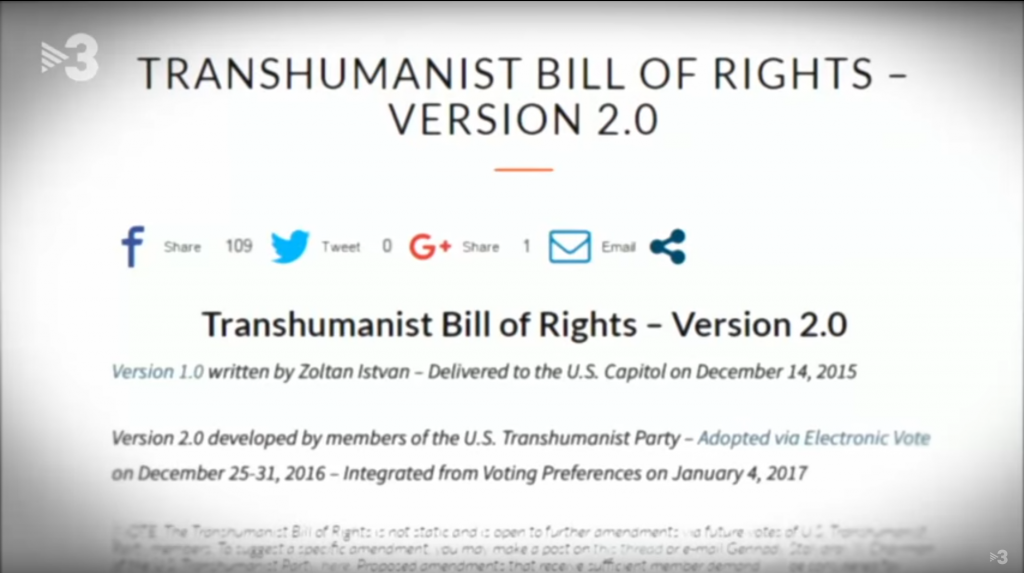
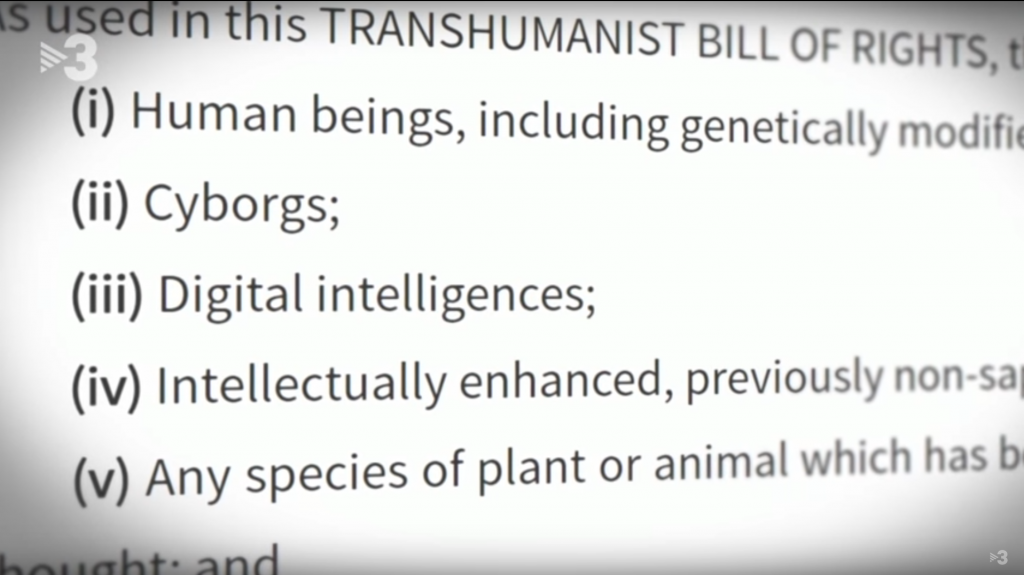
The Catalan television channel TV3 has published a new documentary, entitled “Sense ficció – Cíborgs entre nosaltres” (“Not Fiction – Cyborgs Among Us”), which is available to be viewed on YouTube. In addition to featuring today’s cutting-edge augmentations to human senses and several individuals who have already been enhanced with such augmentations, this documentary, in its latter segment, focuses on Zoltan Istvan’s 2015-2016 campaign for President as the candidate of the U.S. Transhumanist Party. As part of that segment (starting at 48:13 in the linked video), the documentary features screenshots of the Transhumanist Bill of Rights – Version 2.0, which was adopted democratically by the members of the U.S. Transhumanist Party via an electronic vote held between December 25 and December 31, 2016.

While the film is in Catalan, it is possible to receive an approximate automated translation of the subtitles into any major language, including English. To see the translated subtitles in English, go to the YouTube page linked above and click the “CC” button for “Subtitles / Closed Captions”. Under the gear-shaped “Settings” button, select “Subtitles / CC” > “Auto-Translate” > “English”. The translation is not perfect but is mostly intelligible. This feature is a fitting illustration of how technology has advanced in certain areas – such as auto-translate algorithms – which renders it possible to now watch films in other languages and mostly comprehend them without needing to learn those languages directly.

As the organizer of the vote to adopt the Transhumanist Bill of Rights – Version 2.0, I consider it an honor to have spearheaded this endeavor and thus to have contributed to how transhumanist ideas are perceived in the media. It is excellent to see that the new Transhumanist Party website is beginning to become a go-to source for media and other interested persons to find out about our positions and aspirations for the future.

Screenshots of the Transhumanist Bill of Rights from the documentary are below.

Results of Platform Vote #5 and Adopted Sections

Results of Platform Vote #5 and Adopted Sections

July 3, 2017 Gennady Stolyarov II Comments 2 comments

logo_bg

Gennady Stolyarov II


The U.S. Transhumanist Party conducted its sixth vote of the members and the fifth vote on its platform planks on June 18 through June 24, 2017. Official ballot options can be found here.

Detailed results of the voting have been tabulated here. In one instance, where no majority was reached in the first round of voting, options were selected based on the ranked-preference method with instant runoffs.

As a result, the following sections of Article III of the U.S. Transhumanist Party Constitution were adopted.

Section XLVII: The United States Transhumanist Party supports efforts to have bills proposed without sub-sections or provisions unrelated to the main subject of the bill. A single-subject or germaneness rule for bills would:

  1. Simplify bills, rendering them more accessible and less convoluted;
  2. Enable a focused vote for or against a bill without the possibility of having to accept or reject an embedded unrelated provision; and
  3. Prevent an unrelated provision from being buried within a bill as a possible tactic to have it passed.

Section XLVIII: The United States Transhumanist Party supports efforts to limit protectionism and subsidization of an industry or group of companies. The exception to this would be that of extenuating circumstances, such as natural disasters or catastrophes, in which case a limited window of support could be approved. The United States Transhumanist Party understands that in a free-market society, private businesses, in order to continue their existence, ought to adapt to market changes instead of being shielded from such changes.

Section XLIX: The United States Transhumanist Party supports efforts to increase autonomy of individuals to decide over their own bodies and holds that individuals should have the legal right to undertake procedures including gender reassignment, hysterectomies, vasectomies, technological augmentation, cosmetic alterations, genetic enhancements, and physical supplementation at or after the age of 18 years, as long as this does not create health hazards or threats to other individuals.

Section L: The United States Transhumanist Party supports the autonomy of an individual to decide on the continuation of that individual’s own life, including the right to choose or not to choose life-extending medical treatments. The United States Transhumanist Party does not consider it practicable or desirable for suicide to be illegal but discourages suicide from a moral standpoint, and furthermore considers that the legal right of suicide should only pertain to the individual and should not extend to any euthanasia or direct administration of a life-ending substance or procedure by any other person. The United States Transhumanist Party has grave concerns with anybody but the individual acting to hasten the end of that individual’s life.

Although each individual should be free to decide upon the duration of his, her, or its own life, the United States Transhumanist Party supports cultural changes and discussions that would encourage all individuals to undertake life-prolonging choices and activities. Advances in medical technology would facilitate more open-ended lifespans and would enable individuals to choose either finite or indefinite lengths of their lives. However, if individuals are recognized as having this autonomy, the United States Transhumanist Party is interested in persuading as many people as possible to decide to preserve their irreplaceable lives instead of hastening their end.

With regard to any legalization of assisted suicide or measures to provide patients with life-ending prescriptions, the United States Transhumanist Party supports stringent legal safeguards to ensure that each individual patient’s choice with regard to such matters is entirely free and uncoerced, and that there is no steering of any particular individual toward a life-ending choice by family members, medical practitioners, health insurers, activists, or any other individual or organization standing to benefit financially from the end of a patient’s life. However, efforts to persuade an individual to prolong his, her, or its life should not be restricted.

The United States Transhumanist Party opposes the emergence of any financially motivated lobby or industry whose primary business model would be assisted suicide or euthanasia, as the existence of such a lobby could create incentives and policies to steer people toward life-ending choices, including through legislation that might favor such “choices” in not-quite-voluntary situations. Instead, any prescription for a life-ending substance should only be provided as an incidental service by a patient’s primary-care physician, with the express written consent of at least one other unaffiliated physician, and the substance in question should only be allowed to be self-administered by the patient directly after a pre-defined time period since the obtaining of the prescription. Once the substance is prescribed, no medical practitioner should be permitted to benefit financially based on any specific choice of the patient to self-administer the substance to end the patient’s life. This position should not be construed to restrict any non-financially motivated political advocacy on the subject of assisted suicide, which involves individuals expressing their views on this subject in a public forum, when those individuals do not stand to gain financially from others choosing to obtain a life-ending substance.

Section LI: The United States Transhumanist Party supports efforts to establish a cross-border or international organ-donation system so that organ donors who wish to do so may donate their organs in a foreign country. This could pertain to Americans working or traveling in foreign countries, but also foreigners or travelers who pass away within U.S. borders. This system would be particularly useful for saving lives with organs that have a very short preservation duration, and would take too long to be sent to the country of the donor’s nationality.

Section LII: The United States Transhumanist Party supports efforts to increase the ability for public sousveillance on the functioning of government officials, in particular those who may propose laws, during negotiations and deliberations on proposing bills and national and international trade agreements. Furthermore, the United States Transhumanist Party supports efforts to make the current hosting of live-streams from United States Congress more user-friendly and accessible to the public, accompanied by links to proposed bills where applicable.

Section LIII: The United States Transhumanist Party supports efforts to have a mandatory standard clause or affidavit, affirming that a Representative, Senator, or other Legislative Branch lawmaker proposing a piece of legislation, such as a bill in Congress, has no conflict of interest between serving the public and serving other parties, such as special-interest groups. The clause would have to be signed and dated by the representative before the legislation is allowed to be proposed.

Section LIV: The United States Transhumanist Party supports increasing broad accountability of Federal Government departments, agencies, and entities, especially those tasked with national security and / or criminal investigations, to the United States Congress. Currently some agencies may receive government funding without any accountability as to what the funding is used for, often based on arguments that this information is ‘classified’ or ‘may not be revealed in the interest of national security’. This is irresponsible use of taxpayer money.

The United States Transhumanist Party does acknowledge that such entities or agencies may have security concerns regarding the publication of details of their budget plans. As such, the United States Transhumanist Party supports setting up a special non-partisan security budgetary review committee where more details of budget plans would have to be provided before considering to provide funds to an agency or entity.

Section LV: The United States Transhumanist Party supports efforts to consolidate and reduce some redundancies among agencies and entities tasked with national security and law enforcement, as well as to reduce the number of such agencies and entities currently in operation. However, while supporting the elimination of parallel redundancies which can create problems, the United States Transhumanist Party recognizes that certain types of hierarchical redundancies can help with quality control.

Section LVI: The United States Transhumanist Party supports efforts to ensure that no United States Representative or Senator may be obstructed in their ability to vote on any piece of legislation, or be kept from the Senate or House of Representatives for intra- or extra-curricular political-party activities which interfere with their primary task as representatives of the people within government. For example, protections should exist to prevent situations where Representatives or Senators are forced by their political parties to do fundraising calls during a vote on a bill.

Section LVII: The United States Transhumanist Party supports efforts to restrict and limit civil asset forfeiture laws, and other laws that assist law-enforcement agencies in circumventing the Fourth Amendment, such as asset seizure, or detainment or arrest in situations where no criminal charges have been filed, except as part of an active interrogation of a person suspected of a crime or unless the person detained or arrested poses a clear and probable danger of inflicting physical harm upon others or their property.

Section LVIII: The United States Transhumanist Party supports efforts to investigate questionable, but currently legal, actions by law-enforcement agencies that have over time garnered critical attention by the public. The safety of the public could benefit from such actions being revisited or revised to limit abuse and to close legal loopholes.

Section LIX: The United States Transhumanist Party considers it important for impartial, objective investigations of alleged police and other law-enforcement misconduct to be pursued. While law-enforcement agencies should not be prohibited from internally investigating potential abuses within their own ranks, such investigations should never be considered exclusive or conclusive, and further external checks and accountability should be instituted. As part of providing such checks and accountability, investigations regarding police misconduct, criminal activity, felonies, and misdemeanors should, in addition to any internal investigation, also be investigated by a different source – for example, a different police department, or a district attorney for a different area assigned to lead the investigation. The intent of this requirement is to limit the possibility of favorably biased or preferential treatment of a member of a given law-enforcement agency by that person’s colleagues, and to restore confidence by the public that an investigation into police misconduct is done as objectively as possible.

Section LX: The United States Transhumanist Party supports efforts to limit the possibility for police, district attorneys, and judges to favor one another through mutual “back-scratching” accommodations which may cause a particular criminal matter to be resolved in a manner inconsistent with the true facts of the situation or the requirements of applicable law.

Section LXI: The United States Transhumanist Party supports efforts to prevent members of Congress from receiving special benefits, subsidies, and tax breaks that other citizens do not receive, and that are not necessary to function as a member of Congress. This limitation would pertain, for example, to health-care subsidies that are inaccessible to other citizens. However, this limitation would not prevent members of Congress from obtaining working conditions and job-related benefits of the sort which are broadly available, without regard to rank or degree of influence, to other Americans working within the private or public sectors.

Section LXII: The U.S. Transhumanist Party supports efforts to ratify the United Nations Convention on the Rights of the Child, and to uphold the Rights of the Child as prescribed therein. This would include abolishing the death penalty for minors federally.

The United States Transhumanist Party, however, opposes restrictions on the rights of parents to choose to homeschool their children in any manner that respects the children’s basic freedom of conscience. Any ratification of the United Nations Convention on the Rights of the Child should not be construed to restrict any peaceful, rights-respecting practice of homeschooling.

Section LXIII: The United States Transhumanist Party opposes those specific cultural, religious, and social practices that violate individual rights and bodily autonomy. Examples of such unacceptable practices are forced marriage (including child marriage), male and female genital mutilation, and honor killings.

The Discovery Doctrine in International Law, with Respect to the Islands of La Encarnacion and San Juan Bautista – Article by Stan Vaughan

The Discovery Doctrine in International Law, with Respect to the Islands of La Encarnacion and San Juan Bautista – Article by Stan Vaughan

July 2, 2017 Stan Vaughan Comments 3 comments

logo_bg

Stan Vaughan


Editor’s Note: In accord with Article III, Section XXII of the U.S. Transhumanist Party Constitution, which states that “The United States Transhumanist Party supports efforts at political, economic, and cultural experimentation in the form of seasteads and micronations”, the U.S. Transhumanist Party has published this guest article by Stan Vaughan, explaining the historical basis in international law for the claims by the Kingdom of Ourania on the uninhabited Pacific Islands of La Encarnacion and San Juan Bautista. Find out more about the Kingdom of Ourania here and read here about the State Visit made by King Immanuel X of Ourania to the Republic of Molossia on June 17, 2017. The arguments made herein by Mr. Vaughan are his own analysis, and members of the U.S. Transhumanist Party are encouraged to study it, review the relevant history, and form their own views and perspectives on it. The United States Transhumanist Party does, however, wish Mr. Vaughan the best in forwarding the recognition and development of the Kingdom of Ourania, which may, if successful, lead to innovations in seasteading and construction of floating cities. We anticipate publishing future updates regarding the Kingdom of Ourania as they become available.

~ Gennady Stolyarov II, Chairman, United States Transhumanist Party, July 2, 2017

Flag of the Kingdom of Ourania

Public international law seems to recognize five ways to acquire insular areas. These are 1) cession, 2) occupation, 3) accretion, 4) subjugation, and 5) prescription. [Raphael Perl, The Falkland Islands Dispute in International Law and Politics: A Documentary Sourcebook (New York: Oceana Publications, Inc., 1983) (hereinafter cited as Perl) 12-13.]

This essay discusses how international law applies to the islands of La Encarnacion (a.k.a. Ducie) and San Juan Bautista (a.k.a. Henderson) in the South Pacific Ocean.

La Encarnacion

The island of La Encarnacion (a.k.a. Ducie) was discovered by a Spanish expedition led by Portuguese sailor Pedro Fernandes de Queirós on 26 January 1606, during an expedition that began in Callao, Peru. Supported by Pope Clement VIII and Philip III of Spain, Queirós was given the command of the San Pedro, San Pablo, and Zabra. The fleet was nicknamed Los Tres Reyes Magos (“The Three Wise Men”).  La Encarnacion (a.k.a. Ducie Island) was the first of eighteen discoveries on the trip. Queirós temporarily named it Luna Puesta, then finally settled on La Encarnacion.

The island was rediscovered by Edward Edwards, captain of HMS Pandora, who was sent in 1790 to capture the mutineers of HMS Bounty. He re-named the island Ducie in honour of Francis Reynolds-Moreton, 3rd Baron Ducie.

On March 10, 1867 it was claimed by US Captain John Daggett of Massachusetts for the United States under the Guano Islands Act (enacted August 18, 1856).

The State Department (William Seward, Secretary of State) considered later in 1867 that the claim would remain dormant or only in abeyance until such time as US citizenship of Captain Daggett was proved, which was done, reviving the dormant US claim.

San Juan Bautista

Pedro Fernandes de Queirós, leading the same Spanish expedition that discovered La Encarnacion, was also the first European to discover another uninhabited island on 29 January 1606. De Queirós named this island San Juan Bautista.

Captain Henderson of the British East India Company ship Hercules re-discovered the island on 17 January 1819 and re-named it Henderson Island.

Claim by the United Kingdom and the Implications of the Discovery Doctrine

In 1877, the islands were purportedly included under the protection of the United Kingdom by an Order in Council that claimed jurisdiction over all previously unclaimed Pacific Islands.

However, La Encarnacion and San Juan Bautista were not unclaimed islands, both having been claimed by Spain in 1606. Such claims were recognized via the Treaty of Utrecht (1713), Treaty of Paris (1763), Nootka Convention (1790), Treaty of Madrid (1814), and the First Hague Convention (1899).

The Discovery Doctrine is a concept of public international law expounded by the United States Supreme Court in a series of decisions, most notably Johnson v. M’Intosh in 1823. Chief Justice John Marshall justified the way in which colonial powers laid claim to lands. Here we will not dispute the controversial aspects of the doctrine concerning inhabited lands, but focus on the uncontroversial aspects of terra nullis (discovery of uninhabited land).

Marshall found that ownership of land comes into existence by virtue of discovery of that land, a rule that had been observed by all European countries.

At the time of the 1776 Declaration of Independence, discovery of terra nullis gave the discovering sovereign absolute title to the newly discovered land. This was amended in 1790 by the United Kingdom / Spain Nootka Convention, which said that, thereafter, newly discovered lands must also be occupied as well. However this treaty did not in any way affect previous discoveries and claims.

Sovereignty could effect cession in a treaty between ceding and acquiring sovereigns, and at no time in history has Spain ever ceded its sovereignty over La Encarnacion and San Juan Bautista to the United Kingdom, which specifically acknowledged Spanish sovereignty to these two islands in both 1744 and 1787, as will be discussed herein later.

Thus, prior to either the purported Edwards 1791 “rediscovery” or the 1819 Henderson “rediscovery”, both islands had been shown on the 1787 King of England Samuel Dunn/Thomas Kitchen map (shown below) as the Spanish possessions La Encarnacion and San Juan Bautista, both previously recognized by the discovery doctrine in international law as belonging to Spain. Thus the 1877 British Order of Council extending British purported sovereignty over all unclaimed islands has no basis in international law, which also says that the purported 1902 “annexations” of these islands are illegal under de jure international laws.

Spain, the United Kingdom, as well as the United States all are parties to the 1899 First Hague Convention, which prohibits and considers such annexations as unlawful.

Further, all three recognize the aforementioned discovery doctrine, George II having recognized in 1744 the islands as having been discovered by Spain, and George III in 1787 having recognized such discoveries by Spain under the names La Encarnacion and San Juan Bautista.

Thomas Kitchin (or Thomas Kitchen (1718–1784)) was an English engraver and cartographer, who became hydrographer to the king. The 1787 Samuel Dunn “A General Map of the World” shows La Encarnacion and San Juan Bautista, as does the 1744 map by Emmanuel Bowen (cartographer to UK King George II and father-in-law to Thomas Kitchin, his apprentice) at correct latitudes south of Tropic of Capricorn and correct longitudes.

Above, the 1744 King George II map of the world with the islands of La Encarnacion and San Juan Bautista at correct latitude south of Tropic of Capricorn and at correct longitude as well, and among those marked as “islands discovered by de Quiros of Spain”.

Above the 1787 King George III map of the world lists La Encarnacion and San Juan Bautista by their actual Spanish names, an acknowledgement of their absolute title by Spain 4 years before the so-called re-discovery of La Encarnacion as Ducie 1791 or the 1819 re-discovery as Henderson instead of San Juan Bautista.

In correspondence from the British Foreign and Commonwealth Office dated 29 March 2017 and postmarked 13 April 2017, the United Kingdom does not dispute the above facts.

Thus, there is no such island as “Ducie” island – only the previously claimed by Spain La Encarnacion Island. There is no such island as “Henderson” island, only the previously claimed by Spain San Juan Bautista Island.

Before the 18th century, discovery alone was sufficient to acquire absolute title to a terra nullis (A. Keller, O. Lissitzyn, & F. Mann, Creation of Rights of Sovereignty 1400-1801 (1938)).

See also William E. Hall, “Discovery gave not merely inchoate title but an absolute title” (International Law 126-127, 214-215, 8th edition, 1924).

International Law Regarding So-Called Annexations

Direct Annexation, by the end of the Napoleonic period, ceased to be recognized in international law as an accepted means of territorial acquisition. Thus, as in the case of La Encarnacion and San Juan Bautista Islands in the South Pacific, the purported annexations (and renaming of the islands), which the United Kingdom proclaimed in 1902, not only violated this principle, but was further illegal by the First Hague Convention of 1899, which had been signed 29 July1900 already by the UK, USA, and Spain. The UK had not acquired these islands by any treaty or cession from Spain, and as earlier pointed out, had already under King George II and King George III by their names and locations recognized their discovery by Spain and thus absolute title from 1606.

In 1948, Emilio Pastor Santos, a researcher of the Spanish National Research Council, claimed there was a historical basis that many islands in the Pacific, formerly parts of either the Viceroyalty of New Spain, or the Viceroyalty of Peru, actually still belonged to Spain and “continue legally under Spanish sovereignty.” These include “a number of small islands in Micronesia (Kapingamarangi or Coroa, Mapia or Güedes, Ocea or Matador, and  Rongerik or Pescadores). […]This is because the text of the German–Spanish Treaty of 1899 which transferred sovereignty of certain Spanish possessions in the Pacific to Germany, namely the Northern Mariana Islands (except Guam) and the Caroline Islands (including Palau), failed to include these smaller islands.”  (Wikipedia, “Mapia Atoll”)

On 12 January 1949, after presentation of the research to the Council of Ministers of Spain, the Spanish Foreign Minster declared this as de jure, and the Cabinet of Diplomatic Information of the Ministry of Foreign Affairs declared as follows: “The Ministry recognizes that it is a certain fact and historic truth that Spain reserves a series of rights certain groups of islands as not having been ceded by Spain.”

This situation resulted in the Kingdom of Ourania contacting Spain and acquiring a number of islands formerly either part of the Viceroyalty of New Spain or the Viceroyalty of Peru, but with the proviso they can never be re-assigned to the United Kingdom at any time in the future, unless the UK first returns Gibraltar and restores the territorial integrity of Spain concerning Gibraltar.

Stan Vaughan is a chess champion who resides in Southern Nevada. He ran for State Assembly District 15 as a Republican in 2016. He now represents the Kingdom of Ourania in its efforts to attain international recognition and form a floating city in the vicinity of the claimed islands of San Juan Bautista and La Encarnacion.  

U.S. Transhumanist Party General Discussion Thread for July 2017

U.S. Transhumanist Party General Discussion Thread for July 2017

July 1, 2017 Martin van der Kroon Comments 24 comments

logo_bg


The purpose of this post is to facilitate member comments pertaining to transhumanism and the U.S. Transhumanist Party, which might not specifically fit the subjects of any other post or article on the U.S. Transhumanist Party website. This is the place for members to offer suggestions or converse about any areas of emerging technologies and their political, moral, societal, cultural, and esthetic implications. The general discussion thread is also an ideal location to suggest or propose platform planks that may be considered for future platform voting.

The U.S. Transhumanist Party will endeavor to open one of these general comment threads per month. This comment thread pertains to the month of July 2017.

Type in your comments below. Please note that, to protect against spambots, the first comment by any individual will be moderated. After passing moderation, a civil commenter should be able to post comments without future moderation – although we cannot guarantee that the technical aspect of this functionality will work as intended 100% of the time.

In Time For Everyone, A Reason To Support Us – Article by Martin van der Kroon

In Time For Everyone, A Reason To Support Us – Article by Martin van der Kroon

June 30, 2017 Martin van der Kroon Comments 0 Comment

logo_bg

Martin van der Kroon


There is a lot of inequality in the world, from economic or wealth inequality to inequality of opportunity, to inequality that may have to do with ethnicity, biological sex, or gender. It is not a surprise when I say that we can do without new inequalities. This is exactly what some critics of transhumanism fear, that with the coming possibility of indefinite life-extension we will face lifespan inequality.

I think they are justified in their fears. Let’s take a step back and illustrate what that would look like, as for many indefinite life extension seems like science fiction, and at the moment it still is. What would a world with lifespan inequality look like?

(Spoilers for the movie In Time (2011) ahead)

Although often compared to society’s current situation of wealth inequality, the movie In Time might actually be more directly linked to a fear of lifespan inequality, for the obvious reason that the movie is about humans being able to buy ‘life-time’, but also have to spend it.

As per the In Time movie’s IMDB page: “In a future where people stop aging at 25, but are engineered to live only one more year, having the means to buy your way out of the situation is a shot at immortal youth. …”

In the movie the wealthy accumulate time as a means of profit, and by extension extra life time. The less fortunate have their daily lives, but are always close to their time running out. Obviously the chances of this exact scenario are slim, but the metaphor is apt nonetheless. Wealth can buy almost anything, and in a future where indefinite life extension is possible, the wealthy will want to buy this, too.

The problem we face is whether we end up getting into a situation similar to the movie In Time, the wealthy having time, and the poor almost always out of time, or whether we can create a framework to make life extension available and accessible to everyone, rich, poor, and everything in between.

The science and willingness to make indefinite life-extension possible are fascinating and amazing, but the critics are right that we have to tread carefully in how it may be applied.

This is a reason why, even if you otherwise do not consider yourself a transhumanist, you might wish to consider supporting the U.S. Transhumanist Party. As a political party looking towards the future, we strive to create a framework that makes available and accessible to all the possibility of indefinite life extension so that we may prevent another inequality from entering our world.

Martin van der Kroon is the Director of Recruitment for the U.S. Transhumanist Party.

Are You Being Tricked into Voting for the System? – Article by Sandra from The Right Side of Truth

Are You Being Tricked into Voting for the System? – Article by Sandra from The Right Side of Truth

June 30, 2017 Sandra from The Right Side of Truth Comments 0 Comment

logo_bg

Sandra from The Right Side of Truth


For years, we’ve been sold the idea that the political system of the United States is a choice between two very different parties. On the Left, we have the progressive-liberal Democratic Party championing forward thinking and social good, and on the Right, we have the conservative Republican Party, sometimes called the GOP (short for Grand Old Party), touting the ideas of less government and traditional values.

At least that’s what we’ve been told. These stark differences are pushed at every debate and every public event. However, what the parties rarely discuss is how similar most of their policies are in practice.

So exactly how is it that these two parties continually trick us into voting for one or the other? How is it they manage to stymy progress time and time again, thrusting us further into the past? Not surprisingly, their tactics are both extraordinarily basic and brutally effective. Here’s how they do it.

Drumming Up the Non-Issues

The favored tactic by public masters of deception is presenting non-relevant ideas to distract us from what truly matters. Every election we see it, and 2016 was a perfect example of this. Both candidates kept their audience focused on personal attacks and empty promises, constantly avoiding the real issues.

Take for example the issue of “the wall.” Democrats historically voted in favor of constructing a border wall with Mexico; Hillary Clinton, largely seen mocking Donald Trump on the topic, was quite in favor of it in the past. While the two candidates bickered over the wall and who should pay for it, there was never any real debate between the two about whether or not it was a good idea because under the surface both candidates supported it.

Yet if we return to the present, we can see very little being done in terms of large-scale action. The President—who is not a legislator—has not suddenly conjured up a solid concrete wall across the entire US-Mexico border. That it was suggested this would happen was absurd to begin with and little more than a distraction.

And it’s not the only distraction we see virtually every election. “Major” issues come up conveniently every four years regarding topics such as abortion, marriage, and military spending. Yet the moment the elections end, these issues become silent. No significant changes or votes are held because neither party ever intended to do anything in the first place.

The third-party candidates that seriously have an interest in changing our policies never receive a serious moment in the public’s eye. Debates are always between two parties, and the results are always the same no matter who wins. Alternative ideas are shut out, even when they come from within one of the major parties, as we saw in the 2012 election with Ron Paul’s repeated media blackballing despite a commanding voter base in the primaries.

The “Outsider” Candidate

Those who genuinely believe the idea that the controlling parties would allow an outsider (that is, someone with different views than the status quo) to become a serious candidate are sorely deceived. This is another tactic used to mislead the public into thinking they have a real choice.

While it pains me to use the same example repeatedly, the 2016 election is just one of the best in a long time to truly demonstrate how good these parties are at fooling us. We were fed two choices—Hillary Clinton, the “safe, regular Democrat” choice (and trust me, the party never gave Bernie Sanders a second thought), and Donald Trump, the Hollywood businessman with a mouth.

Surely Trump, with his uncouth speech and disrespect for the Republican Party, was the outsider—right? Yet in office we see him making the same choices any GOP candidate would have made. He is still pro-War, pro-Keynesian economics, and shows no major signs of instigating any promised changes.

Other than speech patterns, nothing would have been different under any other GOP candidate or under Hillary Clinton. To begin with, the president is the head of executive power; he or she does not independently pass laws nor create funding for public projects. All of these faculties fall to the House and the Senate, which are also dominated by shills that vote nearly exclusively on the party line.

The running of candidates such as Donald Trump, Barack Obama, and even Ronald Reagan are simple feints to distract us from the real issues. And the real issue is the perception that there are no alternatives. By funneling our votes into a predictable “A or B” pattern, the parties work together behind closed doors to ensure they remain in power with no challenge to their plans or wealth.

The “Thrown-Away Vote” Fallacy

Dictating how things are from above with tools such as the mainstream media or political announcement is only so effective. On many levels, people can see through the deception of public figures and come to different conclusions. How is it then that so many of us continue to fall victim to this scam?

Surprisingly, the problem is truly at the root of our culture, and it’s been instilled in most of us basically since birth. It’s the idea that voting outside of the two choices we’re given (Red or Blue) is a wasted vote. We’re taught to think voting for a third or fourth party is somehow a vote for whichever candidate we don’t want to win.

This is a logical fallacy that’s been perpetuated for decades to discourage us from breaking away from the two-party system. If enough people believe it, it becomes true to some extent—people fear throwing away their votes and thus don’t vote for anyone outside the standard parties.

But we already know from the Senate and the House that this is simply incorrect. While no third-party president has served to date, several unaffiliated or third-party candidates serve or have served in Congress. Their ideas were different, and their voter bases were small enough to avoid widespread control.

Breaking the Illusion of Choice

If we truly wish to end the illusion of choice in the voting system, we need to recognize the inherent flaws within the system. From the outset, the American system was designed to discourage the illiterate mob from having final say over major candidates. It was designed back when few citizens had a formal education, thus the Electoral College that supersedes the popular vote.

Because of this, changes need to be made within and without the current major parties. We must collectively vote out the leadership of both the Democratic and Republican parties while simultaneously pushing for third-party representation. Not just for a single party such as the Libertarians either—we need multiple parties represented because not all interests overlap.

No single party could ever hope to represent the needs of conflicting groups. Farmers do not share the same values as corporate America, and manufacturers run counter to mom-and-pop businesses just the same as the interests of the wealthy conflict with the poor. And this is totally natural!

We the voters must take responsibility by researching the issues that are important and by seeking candidates that suit our needs. That means watching documentaries, reading books and blogs, and listening to podcasts. Even entertainment venues such as Netflix—when the content is locally available—have something to offer to help us broaden our perspective.

And as might be expected, no perfect political system exists. At the end of the day, the real enemy of freedom isn’t just some evil council of political masterminds striving for world domination. The biggest opponent of choice is staring at us in the mirror. Will you overcome your fear of uncertainty? Tell us in the comments.

About the Author: Sandra is a political activist and free thinker who’s never afraid to speak her mind. Despite the seemingly hopeless situation in Washington, she’s confident that by coming together we can make real changes for the better. See her website at The Right Side of Truth.

City of New Antideath – Painting by Ekaterinya Vladinakova, Commissioned by Gennady Stolyarov II

City of New Antideath – Painting by Ekaterinya Vladinakova, Commissioned by Gennady Stolyarov II

June 29, 2017 Gennady Stolyarov II Comments 3 comments

logo_bg

Art by Ekaterinya Vladinakova

Painting Commissioned by Gennady Stolyarov II


City of New AntideathCity of New Antideath – Painting by Ekaterinya Vladinakova
Available via a Creative Commons Attribution-ShareAlike 4.0 International License

Commentary by Gennady Stolyarov II, Chairman of the United States Transhumanist Party, Editor-in-Chief of The Rational Argumentator: 

For my coming thirtieth birthday, I have commissioned a colossal cityscape depicting my vision and hope for the future progress of humankind. Artist Ekaterinya Vladinakova, a long-time supporter of transhumanism and life extension, was the evident best choice for this project.

The City of New Antideath represents a future society which has overcome death, disease, and today’s principal sources of material scarcity and discomfort. This city contains more than ample living space in ornate, radiantly illuminated skyscrapers. Smaller villas, domed towers, and other luxuriously ornamented buildings adorn the central walkways. There is ample room for pedestrian traffic and plant growth sculpted into geometrically complex patterns – including on the rooftop terraces of many of the mega-skyscrapers.

Flying cars and autonomous drones appear as streaks of light from the ground level. There is so much room for aerial transportation that no more traffic jams exist on the ground. One can opt for efficient transport, or for open-ended leisurely walking, and the two modes will not collide.

Over the years I have created a large number of building models using Sketchup, Minecraft, and even LEGO bricks. In my quest for permanence, they – or images of them – have been preserved and provided to the artist for inspiration. The first City of Antideath consisted of my Sketchup models. The City of New Antideath was not intended to be an exact replica, but rather a successor inspired by the prospect of juxtaposing the best architectural elements of all eras – past and yet to come.

I conveyed to Ekaterinya Vladinakova that the skyscrapers should exhibit a variety of bold colors and geometric shapes – but also be orderly and ornate. I have a great admiration for historical architecture from the 16th through 19th centuries – so while some of the buildings are geometric and futuristic, others borrow significant elements from Renaissance, Baroque, Neoclassical, or Victorian styles. Russian and Eastern architectural traditions find their manifestations in this cityscape as well. The idea is to portray a future of extreme diversity, where all of these elements will exist side by side and interact with one another in interesting ways. Far from cultural separatism or tribalism, the future needs to borrow and develop upon the best elements from all cultures, times, and places. The culture of New Antideath is rational, scientific, progress-oriented, universalist, cosmopolitan, and at the same time hyperpluralist and welcoming of all peaceful individuals.

The most significant vision I have for this artwork is that it will become the iconic vision of a techno-positive future. Accordingly, I am rendering it available for free download and distribution via a Creative Commons Attribution Share-Alike License so that it might be used by others who seek illustrations of a future we can all aspire for.

I still hope that I was not born too soon – that I may someday personally witness and experience a future of this sort. But for now, although the third decade of my life did not see such a future emerge, I am happy at least to have enabled its depiction so that others can be inspired to strive toward it. Given that our immediate world has become suffused by a pervasive, destructive malaise over the past two years, we will need visions such as this to overcome it and achieve better ways to be.

There are three versions of this digital painting available for free download (left-click on the links to open, right-click to download):

– Small (1200 by 1931 pixels)

– Medium (2400 by 3861 pixels)

– Original Size (11250 by 18100 pixels – a vast canvas with immense detail. Note: This file size is immense as well – but you will be able to zoom in to view individual buildings and regard them as smaller-scale paintings in their own right.)

For those seeking musical accompaniment in viewing this painting, I recommend my Transhumanist March, Op. 78 (2014) (MP3 and YouTube)  or Man’s Struggle Against Death, Op. 58 (2008) (MP3 and YouTube).

Find out more about Mr. Stolyarov here.

Ekaterinya Vladinakova is an accomplished digital painter. See her gallery here and her DeviantArt page here.  

U.S. Transhumanist Party Recognition for Music Box Radio in Colombia

U.S. Transhumanist Party Recognition for Music Box Radio in Colombia

June 28, 2017 Gennady Stolyarov II Comments 0 Comment

logo_bg

Gennady Stolyarov II


Gennady Stolyarov II, Chairman of the United States Transhumanist Party and Chief Executive of the Nevada Transhumanist Party, offers a message of support for one of our Allied Members from Colombia, Oscar Coronado Medina, and his radio program Music Box, accessible on Facebook at https://www.facebook.com/cajamusicalTuta/.

Become a member of the U.S. Transhumanist Party for free, no matter where you reside by filling out our Membership Application Form at https://goo.gl/forms/IpUjooEZjnfOFUMi2.

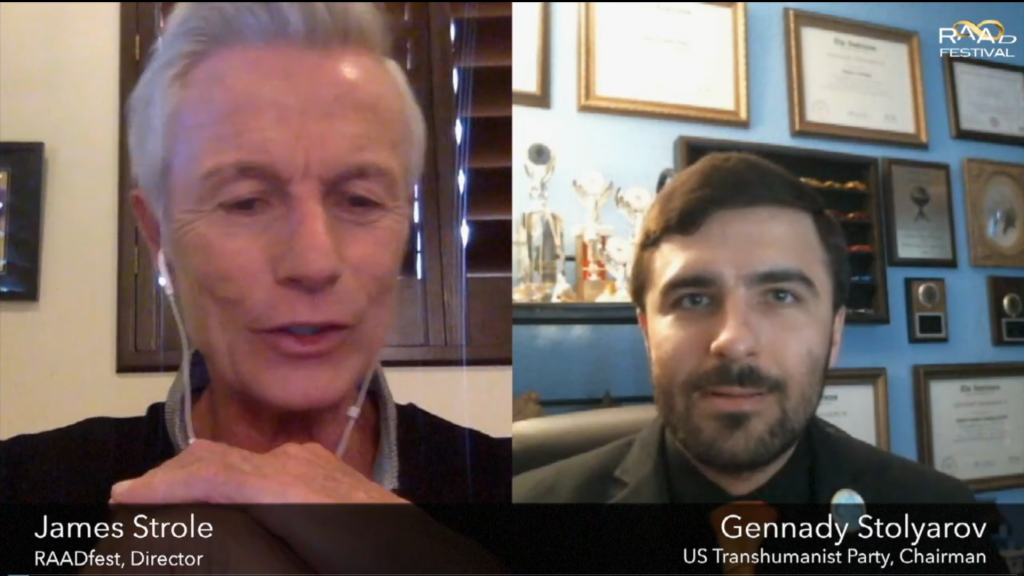
Activating Transhumanism – James Strole Interviews Gennady Stolyarov II on RAAD Fest

Activating Transhumanism – James Strole Interviews Gennady Stolyarov II on RAAD Fest

June 24, 2017 Gennady Stolyarov II Comments 0 Comment

logo_bg

Gennady Stolyarov II


U.S. Transhumanist Party Chairman Gennady Stolyarov II was interviewed by James Strole regarding the forthcoming RAAD Fest 2017 in San Diego, California, which will occur on August 9-13, 2017. This interview addressed Mr. Stolyarov’s impressions of RAAD Fest 2016, his goals for the transhumanist movement in politics, and how various perspectives within the transhumanist and life-extensionist movement can benefit from interfacing with one another. Watch the video of the interview on YouTube or below.

At RAAD Fest 2017, Mr. Stolyarov will be moderating a panel consisting of transhumanist philosophers, researchers, and activists – including Zoltan Istvan, Dr. Ben Goertzel, Dr. Max More, and Dr. . You can see the full RAAD Fest schedule here.

The panel moderated by Mr. Stolyarov will occur at 10 a.m.  on Friday, August 11, 2017. Machine augmentation of human bodies and minds will be one topic of discussion; transhumanist politics will be another. As previously announced, Mr. Stolyarov will inaugurate the panel with a brief presentation entitled “The U.S. Transhumanist Party: Pursuing a Peaceful Political Revolution for Longevity”.

Members of the U.S. Transhumanist Party: When registering for RAAD Fest, you can use the special discount code TRANSHUMAN, which will now reduce the cost of registration to $497.

Official Ballot Options for Platform Vote #5

Official Ballot Options for Platform Vote #5

June 18, 2017 Gennady Stolyarov II Comments 5 comments

logo_bg


The 7-day electronic voting period on the fifth set of proposed platform planks of the U.S. Transhumanist Party (17 potential planks in total) will occur from 12:01 a.m. U.S. Pacific Time on June 18, 2017, to 12:01 a.m.  U.S. Pacific Time on June 25, 2017. All members of the U.S. Transhumanist Party who have applied before 12:01 a.m. on June 18, 2017, will be eligible to vote, as long as they have expressed agreement with the three Core Ideals of the Transhumanist Party or have otherwise been rendered eligible to vote at the discretion of the Chairman.

All members who are eligible to vote will be sent a link to an electronic submission form whereby they will be able to cast their ballot.

When you are voting, it is strongly recommended that you keep this page of official ballot options and the submission form open simultaneously in different windows so that you can reference the relevant options as you vote on them. Due to space limitations, the submission form does not list the entire text of all the options.

It is also recommended that you set aside at least thirty minutes to consider and vote on all of the options and read their text closely, as some of the options contain minor variations upon other options. 

For some questions, electronic voting is  conducted by a ranked-preference method on individual articles where more options are possible than would be accommodated by a simple “Yes” or “No” vote. Members should keep in mind that the ranked-preference method eliminates the incentives for strategic voting – so members are encouraged to vote for the options that reflect their individual preferences as closely as possible, without regard for how other members might vote.

Results of the voting will be tabulated during late June 2017, with the intent to announce the results approximately 7 days after all votes have been submitted.

NOTE: The titles of the questions and potential Sections are descriptive and informational only and will not appear in the final adopted platform planks (which will be incorporated into Article III of the U.S. Transhumanist Party Constitution). They are intended as concise guides to the subject matter of the questions and potential Sections. Likewise, the letters assigned to Sections within this ballot will not reflect the numbering of the final adopted provisions, which will depend on which Sections are selected by the membership.

NOTE II: The inclusion of any proposals on this ballot does not indicate any manner of endorsement for those proposals by the U.S. Transhumanist Party at this time – except to place those proposals before the members to determine the will of the members with regard to whether or not the U.S. Transhumanist Party Platform should incorporate any given proposal.


Voter Identification

E-mail address

Provide the same e-mail address you used to register for U.S. Transhumanist Party membership. Your ballot will be cross-referenced to our membership rolls, and only ballots with matching e-mail addresses will be counted.

What is your name?

At minimum, first and last name are required, unless you are publicly known by a single-name pseudonym which is not itself a common name. Your identity will not be publicly disclosed by the Transhumanist Party, unless you choose and/or authorize its disclosure. Only other members of the Transhumanist Party will be able to see that you voted, but not how you voted. The nature of the selections made by the members may be disclosed, but, if they are, each individual vote will not be associated with the identity of the voter but rather will be presented in an anonymized manner.

Navigate the Options

Question I. Section E5-A. Germaneness / Single-Subject Rule for Bills
Question II. Section E5-B. Opposition to Protectionism and Subsidies
Question III. Section E5-C. Bodily Autonomy
Question IV. Section E5-D. Autonomy to Decide on the Continuation of One’s Own Life
Question V. Section E5-D. Ancillary Provisions Regarding Autonomy to Decide on the Continuation of One’s Own Life
Question VI. Section E5-E. International Organ-Donation System
Question VII. Section E5-F. Sousveillance of Government Officials in a Lawmaking Capacity
Question VIII. Section E5-G. Affidavit of Public Interest for Lawmakers
Question IX. Section E5-H. Accountability of Security Agencies to Congress
Question X. Section E5-H. Accountability of Security Agencies to Congress. Qualifying Language on Budgetary Review Committee
Question XI. Section E5-I. Reduction of Redundancies among Security and Law-Enforcement Agencies
Question XII. Section E5-J. Protection Against Obstruction of Congresspersons’ Ability to Vote
Question XIII. Section E5-K. Opposition to Civil Asset Forfeiture, Asset Seizure, and Excessive Detainment
Question XIV. Section E5-L. Investigation of Questionable Law-Enforcement Activities
Question XV. Section E5-M. Position on Internal Police Investigations of Misconduct
Question XVI. Section E5-N. Limitations on Favor-Trading Among Police, District Attorneys, and Judges
Question XVII. Section E5-O. Opposition to Special Benefits for Members of Congress
Question XVIII. Section E5-P. United Nations Convention on the Rights of the Child
Question XIX. Section E5-P. United Nations Convention on the Rights of the Child. Qualifying Language on Homeschooling
Question XX. Section E5-Q. Opposition to Rights-Violating Cultural, Religious, and Social Practices

Proposed Platform Sections

Question I. Section E5-A. Germaneness / Single-Subject Rule for Bills

Shall the following language be adopted as a new Section within the U.S. Transhumanist Party Platform?

“The United States Transhumanist Party supports efforts to have bills proposed without sub-sections or provisions unrelated to the main subject of the bill. A single-subject or germaneness rule for bills would:

  1. Simplify bills, rendering them more accessible and less convoluted;
  2. Enable a focused vote for or against a bill without the possibility of having to accept or reject an embedded unrelated provision; and
  3. Prevent an unrelated provision from being buried within a bill as a possible tactic to have it passed.”

Select one of the following options.

☐ Yes.

☐ No.

☐ Abstain.

Question II. Section E5-B. Opposition to Protectionism and Subsidies

Rank-order the Section E5-B Options that you support. Choose “1” for your most highly favored option, “2” for your second-most highly favored option, etc. You may include the option for “No Section of this sort” in your rank-ordering, and it does not need to be your most favored option if you do so. (For instance, some voters might favor some options but think that no language is preferable to some of the other options.)

If you choose “Abstain”, then do not rank-order any options, as you will be considered to have skipped this question.

☐ Option E5-B-1. [Based on Proposal by Martin van der Kroon] The United States Transhumanist Party supports efforts to limit protectionism and subsidization of an industry or group of companies. The exception to this would be that of extenuating circumstances, such as natural disasters or catastrophes, in which case a limited window of support could be approved. The United States Transhumanist Party understands that in a free-market society, private businesses, in order to continue their existence, ought to adapt to market changes instead of being shielded from such changes.

☐ Option E5-B-2. [Based on Proposal by Martin van der Kroon, with Complete Rejection of Economic Protectionism and Subsidization without Subsidies for Extenuating Circumstances] The United States Transhumanist Party supports efforts to abolish economic protectionism and refrain from subsidizing any industry or group of companies. The United States Transhumanist Party understands that in a free-market society, private businesses, in order to continue their existence, ought to adapt to market changes instead of being shielded from such changes.

☐ Option E5-B-NO. No Section of this sort.

Question III. Section E5-C. Bodily Autonomy

Shall the following language be adopted as a new Section within the U.S. Transhumanist Party Platform?

“The United States Transhumanist Party supports efforts to increase autonomy of individuals to decide over their own bodies and holds that individuals should have the legal right to undertake procedures including gender reassignment, hysterectomies, vasectomies, technological augmentation, cosmetic alterations, genetic enhancements, and physical supplementation at or after the age of 18 years, as long as this does not create health hazards or threats to other individuals.”

Select one of the following options.

☐ Yes.

☐ No.

☐ Abstain.

Question IV. Section E5-D. Autonomy to Decide on the Continuation of One’s Own Life

Rank-order the Section E5-D Options that you support. Choose “1” for your most highly favored option, “2” for your second-most highly favored option, etc. You may include the option for “No Section of this sort” in your rank-ordering, and it does not need to be your most favored option if you do so. (For instance, some voters might favor some options but think that no language is preferable to some of the other options.)

If you choose “Abstain”, then do not rank-order any options, as you will be considered to have skipped this question.

☐ Option E5-D-1. [Based on Proposal by Martin van der Kroon] The United States Transhumanist Party supports the autonomy of an individual to decide on the continuation of that individual’s own life.

☐ Option E5-D-2. [Expanded Version with Clarification Regarding Suicide] The United States Transhumanist Party supports the autonomy of an individual to decide on the continuation of that individual’s own life, including the right to choose or not to choose life-extending medical treatments. The United States Transhumanist Party does not consider it practicable or desirable for suicide to be illegal but discourages suicide from a moral standpoint, and furthermore considers that the legal right of suicide should only pertain to the individual and should not extend to any euthanasia or direct administration of a life-ending substance or procedure by any other person. The United States Transhumanist Party has grave concerns with anybody but the individual acting to hasten the end of that individual’s life.

☐ Option E5-D-NO. No Section of this sort.

Question V. Section E5-D. Ancillary Provisions Regarding Autonomy to Decide on the Continuation of One’s Own Life

If Section E5-D regarding the autonomy to decide on the continuation of one’s own life is adopted as part of the U.S. Transhumanist Party Platform, shall any of the following ancillary provisions be appended to that Section?

Select all the options you support. (You can select multiple options for this question.)  Any option receiving the majority of votes cast will be included in the ultimately adopted plank, unless Option E5-D-NO prevails in the vote on Question IV above. If you do not favor any of the options below, then you may leave this question blank.

☐ Ancillary Provision E5-D-i. Cultural Promotion of Life. Although each individual should be free to decide upon the duration of his, her, or its own life, the United States Transhumanist Party supports cultural changes and discussions that would encourage all individuals to undertake life-prolonging choices and activities. Advances in medical technology would facilitate more open-ended lifespans and would enable individuals to choose either finite or indefinite lengths of their lives. However, if individuals are recognized as having this autonomy, the United States Transhumanist Party is interested in persuading as many people as possible to decide to preserve their irreplaceable lives instead of hastening their end.

☐ Ancillary Provision E5-D-ii. Protection of Uncoerced Patient Choice. With regard to any legalization of assisted suicide or measures to provide patients with life-ending prescriptions, the United States Transhumanist Party supports stringent legal safeguards to ensure that each individual patient’s choice with regard to such matters is entirely free and uncoerced, and that there is no steering of any particular individual toward a life-ending choice by family members, medical practitioners, health insurers, activists, or any other individual or organization standing to benefit financially from the end of a patient’s life. However, efforts to persuade an individual to prolong his, her, or its life should not be restricted.

☐ Ancillary Provision E5-D-iii. Opposition to Financially Motivated Lobbies and Steering Toward Life-Ending Decisions. The United States Transhumanist Party opposes the emergence of any financially motivated lobby or industry whose primary business model would be assisted suicide or euthanasia, as the existence of such a lobby could create incentives and policies to steer people toward life-ending choices, including through legislation that might favor such “choices” in not-quite-voluntary situations. Instead, any prescription for a life-ending substance should only be provided as an incidental service by a patient’s primary-care physician, with the express written consent of at least one other unaffiliated physician, and the substance in question should only be allowed to be self-administered by the patient directly after a pre-defined time period since the obtaining of the prescription. Once the substance is prescribed, no medical practitioner should be permitted to benefit financially based on any specific choice of the patient to self-administer the substance to end the patient’s life. This position should not be construed to restrict any non-financially motivated political advocacy on the subject of assisted suicide, which involves individuals expressing their views on this subject in a public forum, when those individuals do not stand to gain financially from others choosing to obtain a life-ending substance.

Question VI. Section E5-E. International Organ-Donation System

Shall the following language be adopted as a new Section within the U.S. Transhumanist Party Platform?

“The United States Transhumanist Party supports efforts to establish a cross-border or international organ-donation system so that organ donors who wish to do so may donate their organs in a foreign country. This could pertain to Americans working or traveling in foreign countries, but also foreigners or travelers who pass away within U.S. borders. This system would be particularly useful for saving lives with organs that have a very short preservation duration, and would take too long to be sent to the country of the donor’s nationality.”

Select one of the following options.

☐ Yes.

☐ No.

☐ Abstain.

Question VII. Section E5-F. Sousveillance of Government Officials in a Lawmaking Capacity

Shall the following language be adopted as a new Section within the U.S. Transhumanist Party Platform?

“The United States Transhumanist Party supports efforts to increase the ability for public sousveillance on the functioning of government officials, in particular those who may propose laws, during negotiations and deliberations on proposing bills and national and international trade agreements. Furthermore, the United States Transhumanist Party supports efforts to make the current hosting of live-streams from United States Congress more user-friendly and accessible to the public, accompanied by links to proposed bills where applicable.”

Select one of the following options.

☐ Yes.

☐ No.

☐ Abstain.

Question VIII. Section E5-G. Affidavit of Public Interest for Lawmakers

Shall the following language be adopted as a new Section within the U.S. Transhumanist Party Platform?

“The United States Transhumanist Party supports efforts to have a mandatory standard clause or affidavit, affirming that a Representative, Senator, or other Legislative Branch lawmaker proposing a piece of legislation, such as a bill in Congress, has no conflict of interest between serving the public and serving other parties, such as special-interest groups. The clause would have to be signed and dated by the representative before the legislation is allowed to be proposed.”

Select one of the following options.

☐ Yes.

☐ No.

☐ Abstain.

Question IX. Section E5-H. Accountability of Security Agencies to Congress

Shall the following language be adopted as a new Section within the U.S. Transhumanist Party Platform?

“The United States Transhumanist Party supports increasing broad accountability of Federal Government departments, agencies, and entities, especially those tasked with national security and / or criminal investigations, to the United States Congress. Currently some agencies may receive government funding without any accountability as to what the funding is used for, often based on arguments that this information is ‘classified’ or ‘may not be revealed in the interest of national security’. This is irresponsible use of taxpayer money.”

Select one of the following options.

☐ Yes.

☐ No.

☐ Abstain.

Question X. Section E5-H. Accountability of Security Agencies to Congress. Qualifying Language on Budgetary Review Committee

If Section E5-H on the accountability of security agencies to congress is adopted, shall the following caveat be inserted?

“The United States Transhumanist Party does acknowledge that such entities or agencies may have security concerns regarding the publication of details of their budget plans. As such, the United States Transhumanist Party supports setting up a special non-partisan security budgetary review committee where more details of budget plans would have to be provided before considering to provide funds to an agency or entity.”

Select one of the following options.

☐ Yes.

☐ No.

☐ Abstain.

Question XI. Section E5-I. Reduction of Redundancies among Security and Law-Enforcement Agencies

Rank-order the Section E5-I Options that you support. Choose “1” for your most highly favored option, “2” for your second-most highly favored option, etc. You may include the option for “No Section of this sort” in your rank-ordering, and it does not need to be your most favored option if you do so. (For instance, some voters might favor some options but think that no language is preferable to some of the other options.)

If you choose “Abstain”, then do not rank-order any options, as you will be considered to have skipped this question.

☐ Option E5-I-1. [Based on Proposal by Martin van der Kroon] The United States Transhumanist Party supports efforts to consolidate and reduce redundancies among agencies and entities tasked with national security and law enforcement, as well as to reduce the number of such agencies and entities currently in operation.

☐ Option E5-I-2. [Based on Proposal by Martin van der Kroon, with Caveat by Ryan Starr]  The United States Transhumanist Party supports efforts to consolidate and reduce some redundancies among agencies and entities tasked with national security and law enforcement, as well as to reduce the number of such agencies and entities currently in operation. However, while supporting the elimination of parallel redundancies which can create problems, the United States Transhumanist Party recognizes that certain types of hierarchical redundancies can help with quality control.

☐ Option E5-I-NO. No Section of this sort.

Question XII. Section E5-J. Protection Against Obstruction of Congresspersons’ Ability to Vote

Shall the following language be adopted as a new Section within the U.S. Transhumanist Party Platform?

“The United States Transhumanist Party supports efforts to ensure that no United States Representative or Senator may be obstructed in their ability to vote on any piece of legislation, or be kept from the Senate or House of Representatives for intra- or extra-curricular political-party activities which interfere with their primary task as representatives of the people within government. For example, protections should exist to prevent situations where Representatives or Senators are forced by their political parties to do fundraising calls during a vote on a bill.”

Select one of the following options.

☐ Yes.

☐ No.

☐ Abstain.

Question XIII. Section E5-K. Opposition to Civil Asset Forfeiture, Asset Seizure, and Excessive Detainment

Rank-order the Section E5-K Options that you support. Choose “1” for your most highly favored option, “2” for your second-most highly favored option, etc. You may include the option for “No Section of this sort” in your rank-ordering, and it does not need to be your most favored option if you do so. (For instance, some voters might favor some options but think that no language is preferable to some of the other options.)

If you choose “Abstain”, then do not rank-order any options, as you will be considered to have skipped this question.

☐ Option E5-K-1. [Based on Proposal by Martin van der Kroon] The United States Transhumanist Party supports efforts to restrict and limit civil asset forfeiture laws, and other laws that assist law-enforcement agencies in circumventing the Fourth Amendment, such as asset seizure, or detainment or arrest longer than 48 hours.

☐ Option E5-K-2. [Based on Proposal by Martin van der Kroon, with Modification Regarding Detainment or Arrest] The United States Transhumanist Party supports efforts to restrict and limit civil asset forfeiture laws, and other laws that assist law-enforcement agencies in circumventing the Fourth Amendment, such as asset seizure, or detainment or arrest in situations where no criminal charges have been filed, except as part of an active interrogation of a person suspected of a crime or unless the person detained or arrested poses a clear and probable danger of inflicting physical harm upon others or their property.

☐ Option E5-K-NO. No Section of this sort.

Question XIV. Section E5-L. Investigation of Questionable Law-Enforcement Activities

Shall the following language be adopted as a new Section within the U.S. Transhumanist Party Platform?

“The United States Transhumanist Party supports efforts to investigate questionable, but currently legal, actions by law-enforcement agencies that have over time garnered critical attention by the public. The safety of the public could benefit from such actions being revisited or revised to limit abuse and to close legal loopholes.”

Select one of the following options.

☐ Yes.

☐ No.

☐ Abstain.

Question XV. Section E5-M. Position on Internal Police Investigations of Misconduct

Rank-order the Section E5-M Options that you support. Choose “1” for your most highly favored option, “2” for your second-most highly favored option, etc. You may include the option for “No Section of this sort” in your rank-ordering, and it does not need to be your most favored option if you do so. (For instance, some voters might favor some options but think that no language is preferable to some of the other options.)

If you choose “Abstain”, then do not rank-order any options, as you will be considered to have skipped this question.

☐ Option E5-M-1. [Based on Proposal by Martin van der Kroon] The United States Transhumanist Party supports efforts to prevent law-enforcement agencies from internally investigating missteps within their own departments or precincts, and concluding their internal investigations without further accountability. Instead, investigations regarding police misconduct, criminal activity, felonies, and misdemeanors should be investigated by a different source – for example, a different police department, or a District Attorney for a different area assigned to lead the investigation. The intent of this requirement is to limit the possibility of prejudice and bias toward a member of a given law-enforcement agency by that person’s colleagues, and to restore faith in the public mind that an investigation into police misconduct is done as objectively as possible.

☐ Option E5-M-2. The United States Transhumanist Party considers it important for impartial, objective investigations of alleged police and other law-enforcement misconduct to be pursued. While law-enforcement agencies should not be prohibited from internally investigating potential abuses within their own ranks, such investigations should never be considered exclusive or conclusive, and further external checks and accountability should be instituted. As part of providing such checks and accountability, investigations regarding police misconduct, criminal activity, felonies, and misdemeanors should, in addition to any internal investigation, also be investigated by a different source – for example, a different police department, or a district attorney for a different area assigned to lead the investigation. The intent of this requirement is to limit the possibility of favorably biased or preferential treatment of a member of a given law-enforcement agency by that person’s colleagues, and to restore confidence by the public that an investigation into police misconduct is done as objectively as possible.

☐ Option E5-M-NO. No Section of this sort.

Question XVI. Section E5-N. Limitations on Favor-Trading Among Police, District Attorneys, and Judges

Shall the following language be adopted as a new Section within the U.S. Transhumanist Party Platform?

“The United States Transhumanist Party supports efforts to limit the possibility for police, district attorneys, and judges to favor one another through mutual “back-scratching” accommodations which may cause a particular criminal matter to be resolved in a manner inconsistent with the true facts of the situation or the requirements of applicable law.”

Select one of the following options.

☐ Yes.

☐ No.

☐ Abstain.

Question XVII. Section E5-O. Opposition to Special Benefits for Members of Congress

Rank-order the Section E5-O Options that you support. Choose “1” for your most highly favored option, “2” for your second-most highly favored option, etc. You may include the option for “No Section of this sort” in your rank-ordering, and it does not need to be your most favored option if you do so. (For instance, some voters might favor some options but think that no language is preferable to some of the other options.)

If you choose “Abstain”, then do not rank-order any options, as you will be considered to have skipped this question.

☐ Option E5-O-1. [Based on Proposal by Martin van der Kroon] The United States Transhumanist Party supports efforts to prevent members of Congress from receiving special benefits, subsidies, and tax breaks that other citizens do not receive, and that are not necessary to function as a member of Congress. This limitation would pertain, for example, to health-care subsidies that are inaccessible to other citizens.

☐ Option E5-O-2. The United States Transhumanist Party supports efforts to prevent members of Congress from receiving special benefits, subsidies, and tax breaks that other citizens do not receive, and that are not necessary to function as a member of Congress. This limitation would pertain, for example, to health-care subsidies that are inaccessible to other citizens. However, this limitation would not prevent members of Congress from obtaining working conditions and job-related benefits of the sort which are broadly available, without regard to rank or degree of influence, to other Americans working within the private or public sectors.

☐ Option E5-O-NO. No Section of this sort.

Question XVIII. Section E5-P. United Nations Convention on the Rights of the Child

Shall the following language be adopted as a new Section within the U.S. Transhumanist Party Platform?

“The U.S. Transhumanist Party supports efforts to ratify the United Nations Convention on the Rights of the Child, and to uphold the Rights of the Child as prescribed therein. This would include abolishing the death penalty for minors federally.”

Select one of the following options.

☐ Yes.

☐ No.

☐ Abstain.

Question XIX. Section E5-P. United Nations Convention on the Rights of the Child. Qualifying Language on Homeschooling

If Section E5-P on the United Nations Convention on the Rights of the Child is adopted, shall the following caveat be inserted?

“The United States Transhumanist Party, however, opposes restrictions on the rights of parents to choose to homeschool their children in any manner that respects the children’s basic freedom of conscience. Any ratification of the United Nations Convention on the Rights of the Child should not be construed to restrict any peaceful, rights-respecting practice of homeschooling.”

Select one of the following options.

☐ Yes.

☐ No.

☐ Abstain.

Question XX. Section E5-Q. Opposition to Rights-Violating Cultural, Religious, and Social Practices

Rank-order the Section E5-Q Options that you support. Choose “1” for your most highly favored option, “2” for your second-most highly favored option, etc. You may include the option for “No Section of this sort” in your rank-ordering, and it does not need to be your most favored option if you do so. (For instance, some voters might favor some options but think that no language is preferable to some of the other options.)

If you choose “Abstain”, then do not rank-order any options, as you will be considered to have skipped this question.

☐ Option E5-Q-1. [Based on Proposal by Martin van der Kroon] The United States Transhumanist Party opposes those specific cultural, religious, and social practices that violate United States law, The Universal Declaration of Human Rights, and the United Nations Convention on the Rights of the Child. Examples of such unacceptable practices are forced marriage (including child marriage), male and female genital mutilation, and honor killings.

☐ Option E5-Q-2. The United States Transhumanist Party opposes those specific cultural, religious, and social practices that violate individual rights and bodily autonomy. Examples of such unacceptable practices are forced marriage (including child marriage), male and female genital mutilation, and honor killings.

☐ Option E5-Q-NO. No Section of this sort.

The Trolley Problem and Self-Driving Vehicles – Article by B.J. Murphy

The Trolley Problem and Self-Driving Vehicles – Article by B.J. Murphy

June 12, 2017 B.J. Murphy Comments 4 comments

logo_bg

B.J. Murphy


One of the most popular discussions in the field of technology today is that of self-driving vehicles. It’s a topic that brings up both optimistic joy and pessimistic fear, from the elimination of car-related fatalities to the elimination of millions of jobs. I usually stand on the optimistic side of the argument, but I also understand the fear.

After all:

  • According to the Bureau of Labor Statistics (BLS), there were nearly 1.8 million heavy-truck and tractor-trailer drivers in 2014, with a 5% increase per year. Meaning, there are likely around 2 million of these drivers today.
  • There were around 1.33 million delivery truck drivers in 2014, with a 4% increase per year. Meaning, there are over 1.4 million today.
  • There were around 233,700 taxi drivers and chauffeurs in 2014, with a 13% increase per year. Meaning, there are nearly 300,000 of these drivers today.

In other words, with the full mobilization of self-driving vehicles, we’re looking at around (+/-) 4 million jobs being automated in the next few years, thus no longer requiring human labor. This particular risk, however, isn’t what I’m currently focused on. The main focus of this article is on what is known as the “trolley problem” – a thought experiment in ethics that has since been rehashed to serve as “criticism” towards self-driving vehicles.

…

Read More Read More

Being Excited About Failure – Article by Martin van der Kroon

Being Excited About Failure – Article by Martin van der Kroon

June 9, 2017 Martin van der Kroon Comments 0 Comment

Martin van der Kroon


The much hyped CRISPR-Cas9 genome-editing technique often explained as being the ‘DNA scissors’ or the ‘cut and paste’ technique, has had a setback, and this has me excited.

CRISPR-Cas9 has has the scientific community, and in particular those involved in research and development of genome editing, raving over the roughly past 3 years. It is hailed as a cheap and fast way to edit genomes with great accuracy compared to other genome-editing techniques, and this is true. Now however, researchers have found CRISPR-Cas9 to have some annoying side-effects. The side-effects were found in mice who had their blindness corrected but also caused mutations in other parts of the DNA sequence, roughly 1500 mutations. It is unknown what the consequences of the mutations are at this moment.

“Why am I excited about this setback?” you might ask. …

Read More Read More

Would You Allow Your Children To Be Alone With a Robot? – Article by B.J. Murphy

Would You Allow Your Children To Be Alone With a Robot? – Article by B.J. Murphy

June 8, 2017 B.J. Murphy Comments 2 comments

logo_bg

B.J. Murphy


Would you allow your children to be alone with a robot? I ask not for the children’s safety in mind, but rather the robot’s.

As shown in the video provided above, a group of Japanese researchers – from ATR Intelligent Robotics and Communication Laboratories, Osaka University, Ryukoku University, and Tokai University – patrolled a public shopping complex in Osaka using a remotely-operated robot known as Robovie 2.

Children naturally being curious, hordes of them decide to surround the robot when spotted. Some were quite nice and simply wanted to play with the robot. However, others felt the need to attack it either by kicking, punching, or trying to rip its head off.

What I find most fascinating about this is that, like a child, whenever the robot feels like it’s in possible danger (or, rather, there’s an increased probability of danger) – of which it’s able to do so by calculating the probability of abuse based on interaction time, pedestrian density, and the presence of people above or below 4 feet 6 inches in height – the robot then changes course and brings itself within close proximity of a parent for protection.

Robots are, most certainly, coming and will potentially disrupt nearly every major industry in society. However, to ensure their overall safety, it might be best that, whenever a child comes close to one of these robots, a parent should always be nearby – not for the sake of the child, but for the sake of the robot.

Which then raises the question: what is the U.S. Transhumanist Party’s position on protecting robots from unnecessary physical abuse? For now, in accordance with the Party’s Constitution – in particular, Section XXXIII – it states:

“…Level 4 or lower-level entities – including domain-specific artificial intelligences that have not achieved sentience – may be utilized as part of the production systems of the future, in a similar manner to machines, algorithms, computer programs, and non-human animals today and based on similar ethical considerations.”

Speaking as an individual member of the U.S. Transhumanist Party, it is of my opinion that we should begin expanding upon the question of “ethical considerations” in regards to the physical abuse of robots. This shouldn’t be confused as being tantamount to giving robots, regardless of sentience, full rights as that of other sapient beings. That, too, is already addressed in Section XXXIII, which states:

“The United States Transhumanist Party stands for the rights of any sentient entities defined in the Preamble to the Transhumanist Bill of Rights as possessing Level 5 or more advanced information integration. Any such sentient entities, including new kinds of sentient entities that may be discovered or developed in the future, shall be considered to be autonomous beings with full rights, and shall not be made subservient to humans, unless they as individuals pose direct, empirically evident threats to the lives of others. The protections of full individual rights shall extend to Level 5 or higher-level artificial intelligences.”

One might think that this question could be juxtaposed with that of the question of property rights. And, to a certain degree, it would. However, when it comes to robots, we also have to consider the psychological ramifications as well. We deliberately give robots anthropomorphic features given the fact that research has shown, time and again, that, unlike other inanimate objects, robots have the ability to evoke empathetic emotional responses by humans as a result – especially when humans believe those robots are being abused.

In other words, by physically abusing robots, one is then potentially causing psychological harm to other sentient entities in consequence.

This then raises a problematic situation when simply juxtaposing non-sentient robot rights to that of property rights. Unlike other property, robots have the capability of evoking empathy out of humans. Thus my reasoning for wanting to bring this particular topic up for further discussion.

Where should Transhumanists stand – and, in particular, the U.S. Transhumanist Party – in regards to the physical abuse of robots, keeping in mind the potential psychological ramifications that may arise among humans as a direct result?

***

B.J. Murphy is the Director of Social Media of the U.S. Transhumanist Party.

U.S. Transhumanist Party Chairman Gennady Stolyarov II to Moderate RAAD Fest Panel on August 11, 2017

U.S. Transhumanist Party Chairman Gennady Stolyarov II to Moderate RAAD Fest Panel on August 11, 2017

June 7, 2017 Gennady Stolyarov II Comments 1 comment

logo_bg

Gennady Stolyarov II


The U.S. Transhumanist Party is pleased to announce that, as part of its presence at RAAD Fest 2017 in San Diego, Chairman Gennady Stolyarov II will be moderating a panel consisting of transhumanist philosophers, researchers, and activists – including Zoltan Istvan, Dr. Ben Goertzel, Dr. Max More, and Dr. Natasha Vita-More. You can see the full RAAD Fest schedule here.

The panel moderated by Mr. Stolyarov will occur at 10 a.m.  on Friday, August 11, 2017. Machine augmentation of human bodies and minds will be one topic of discussion; transhumanist politics will be another. As previously announced, Mr. Stolyarov will inaugurate the panel with a brief presentation entitled “The U.S. Transhumanist Party: Pursuing a Peaceful Political Revolution for Longevity”.

B.J. Murphy Discusses Transhumanism, His Thoughts on Mixed Reality, and Politics on the Some Future Podcast

B.J. Murphy Discusses Transhumanism, His Thoughts on Mixed Reality, and Politics on the Some Future Podcast

June 5, 2017 Martin van der Kroon Comments 0 Comment

Martin van der Kroon


The U.S. Transhumanist Party’s Director of Social Media, B.J. Murphy, was a guest on the Some Future podcast. They discuss what Transhumanism is and how it is perceived, B.J. Murphy’s thoughts on mixed reality using the Two-World Theory, the politics surrounding Transhumanism, and more. 

You can listen to the podcast via YouTube. If you wish to only listen to B.J. Murphy’s interview, click here.

Find out more about B.J. Murphy.

Dr. José Cordeiro Interviewed by Singularity Weblog at the International Longevity and Cryopreservation Summit in Madrid, Spain

Dr. José Cordeiro Interviewed by Singularity Weblog at the International Longevity and Cryopreservation Summit in Madrid, Spain

June 5, 2017 José Luis Cordeiro Comments 0 Comment

logo_bg

José Luis Cordeiro


The U.S. Transhumanist Party’s Technology Advisor, José Cordeiro, MBA, Ph.D., was interviewed by Nikola Danaylov of Singularity Weblog at the International Longevity and Cryopreservation Summit in Madrid, Spain, which was organized by Dr. Cordeiro and was held during May 25-27, 2017.

Listen to the audio interview below, download it, or see the original Singularity Weblog page hosting it.

Watch the video of the interview below or on its YouTube page.

The interview ventures into transhumanism, life extension, cryonics, and the political and cultural challenges that need to be overcome in order to achieve a world of indefinite lifespans, where technological transformations of the human condition would be broadly accepted.

Find out more about Dr. Cordeiro here.

LEAF Interview with Dr. Aubrey de Grey: Controlling the Main Aging Damages

LEAF Interview with Dr. Aubrey de Grey: Controlling the Main Aging Damages

June 4, 2017 Aubrey de Grey and Life Extension Advocacy Foundation Comments 1 comment

logo_bg

Aubrey de Grey and Life Extension Advocacy Foundation


The U.S. Transhumanist Party is pleased to feature this interview of Dr. Aubrey de Grey, the Transhumanist Party’s Anti-Aging Advisor, conducted by Elena Milova of the Life Extension Advocacy Foundation (LEAF), one of the Transhumanist Party’s most active Allied Organizations. You can also see this interview on YouTube here.

Description by LEAF: Please enjoy this interview with Dr. Aubrey de Grey, Chief Science Officer and Co-founder of SENS Research Foundation — one of the most successful advocacy and fundraising initiatives supporting breakthrough research on the main mechanisms of aging and age-related diseases.

In this video Dr. de Grey speaks about the progress in developing interventions to tackle age-related damages identified by SENS as the main ones.

Interviewer – LEAF/Lifespan.io Board member Elena Milova.

Dr. de Grey received his BA in Computer Science and Ph.D. in Biology from the University of Cambridge in 1985 and 2000, respectively. He is Editor-in-Chief of Rejuvenation Research , is a Fellow of both the Gerontological Society of America and the American Aging Association, and sits on the editorial and scientific advisory boards of numerous journals and organizations.

Subscribe to Lifespan.io’s YouTube channel for more.

This interview is presented by LEAF. Please support its work by becoming a “Lifespan Hero“.

U.S. Transhumanist Party General Discussion Thread for June 2017

U.S. Transhumanist Party General Discussion Thread for June 2017

June 1, 2017 Martin van der Kroon Comments 30 comments

logo_bg


The purpose of this post is to facilitate member comments pertaining to transhumanism and the U.S. Transhumanist Party, which might not specifically fit the subjects of any other post or article on the U.S. Transhumanist Party website. This is the place for members to offer suggestions or converse about any areas of emerging technologies and their political, moral, societal, cultural, and esthetic implications. The general discussion thread is also an ideal location to suggest or propose platform planks that may be considered for future platform voting.

The U.S. Transhumanist Party will endeavor to open one of these general comment threads per month. This comment thread pertains to the month of June 2017.

Type in your comments below. Please note that, to protect against spambots, the first comment by any individual will be moderated. After passing moderation, a civil commenter should be able to post comments without future moderation – although we cannot guarantee that the technical aspect of this functionality will work as intended 100% of the time.

U.S. Transhumanist Party Opposes Mandatory Minimum Prison Sentences

U.S. Transhumanist Party Opposes Mandatory Minimum Prison Sentences

June 1, 2017 Martin van der Kroon Comments 0 Comment

logo_bg

Martin van der Kroon


The U.S. Transhumanist Party officially opposes mandatory minimum sentences. We reiterate our position on this matter following a series of efforts to mandate minimum mandatory sentencing by the current U.S. Federal Government.

In this area we wish to bring readers’ attention to a memo by Attorney General Jeff Sessions, directing all federal prosecutors to apply minimum sentencing regarding drug-related crimes, and the proposed Bill H.R.1761 — 115th Congress (2017-2018) known as “Protecting Against Child Exploitation Act of 2017” which would also apply to teens voluntarily and consensually sending a partner of similar age content of themselves that could be considered ‘child pornography’ and subsequently subject both to the possibility of a minimum of 15 years’ imprisonment – a law intended to protect youth but achieving the opposite effect.

Regardless of the act that is criminalized, The U.S. Transhumanist Party opposes mandatory sentencing as adopted in Article III, Section XV, of the U.S. Transhumanist Party Constitution – which reads as follows:

“Section XV [Adopted by a vote of the members during March 26 – April 1, 2017]: The United States Transhumanist Party supports efforts to significantly reduce the massive incarcerated population in America by using innovative technologies to monitor criminals outside of prison. All mandatory sentencing laws should be abolished, and each individual should be sentenced based solely on the consideration of the nature of that individual’s crime, its context, and its severity.”

A minimum prison-sentence duration can have disproportionately disruptive effects on the offender – where in the above examples there may not be a victim – and his/her future, as well as an unnecessary, long, harmful effect on the offender’s family and the community. If a crime is of such severity that a sentence similar to or beyond the proposed minimum sentencing would be warranted, the presiding judge in a court case should be able to apply such a sentence without minimum-requirement restraints. However, such a decision should be made on a case-by-case basis and not prescribed in advance of knowing and considering the individual facts of any given person’s actions. 

Martin van der Kroon is the Director of Recruitment of the U.S. Transhumanist Party.

The Right to Die – Article by Martin van der Kroon

The Right to Die – Article by Martin van der Kroon

May 29, 2017 Martin van der Kroon Comments 3 comments

logo_bg

Martin van der Kroon


The U.S. Transhumanist Party is, among many other things, concerned with life extension, health, and in general the well-being of people. If life extension can be stretched to virtual immortality, that would be even more amazing, but should it be mandatory?

This post is my personal view, and I have proposed a Plank regarding this which has been added to the Exposure Period for Platform Vote #5. I’m not trying to convince people, but I would like to open the discussion on a topic that we may reasonably call controversial.

…

Read More Read More

U.S. Transhumanist Party Interview with Kevin Baugh, President of Molossia

U.S. Transhumanist Party Interview with Kevin Baugh, President of Molossia

May 28, 2017 Gennady Stolyarov II Comments 2 comments

logo_bg

Gennady Stolyarov II 


To celebrate Founders’ Day – the 40th anniversary of the founding of the Republic of Molossia – representatives of the U.S. and Nevada Transhumanist Parties made an international trip on May 27, 2017, to join President Kevin Baugh in his micronation.

Gennady Stolyarov II, Chairman of the U.S. Transhumanist Party, interviewed President Baugh on what attributes are needed to form a successful, long-lasting micronation, how micronationalism can inform our understanding of politics, countries, and governments, and how technology is essential to the development of micronations. Both micronationalism and technology have the potential to bring people closer together in terms of finding others who share similar interests and goals.

This speech by President Baugh provides background into the founding of Molossia and the concept behind it, as well as the ambitions for its future as a leading micronation of the world.

Find out about the Republic of Molossia here and read its Wikipedia entry here.

Become a member of the U.S. Transhumanist Party for free here.

Section XXII of the U.S. Transhumanist Party Platform reads: “The United States Transhumanist Party supports efforts at political, economic, and cultural experimentation in the form of seasteads and micronations. Specifically, the United States Transhumanist Party recognizes the existence and sovereignty of the Principality of Sealand, the Republic of Molossia, and the Free Republic of Liberland, and supports the recognition of these entities by all governments and political parties of the world.”

U.S. Transhumanist Party Interview with Travis McHenry, Grand Duke of Westarctica

U.S. Transhumanist Party Interview with Travis McHenry, Grand Duke of Westarctica

May 28, 2017 Gennady Stolyarov II Comments 0 Comment

logo_bg

Gennady Stolyarov II 


Gennady Stolyarov II, Chairman of the U.S. Transhumanist Party, interviews Grand Duke Travis McHenry of Westarctica on the attributes needed to form a long-lasting micronation, the role of technology in enabling more micronations to form over time, and what micronationalism can teach us about politics and organizational leadership.

Find out about Westartica here and read its Wikipedia entry here.

Become a member of the U.S. Transhumanist Party for free here.

Section XXII of the U.S. Transhumanist Party Platform reads: “The United States Transhumanist Party supports efforts at political, economic, and cultural experimentation in the form of seasteads and micronations. Specifically, the United States Transhumanist Party recognizes the existence and sovereignty of the Principality of Sealand, the Republic of Molossia, and the Free Republic of Liberland, and supports the recognition of these entities by all governments and political parties of the world.”

In the spirit of this plank, the U.S. Transhumanist Party also recognizes the nation of Westarctica and the efforts of Grand Duke Travis to eventually render its territory suitable for human habitation.

People-Centered Justice – Article by Martin van der Kroon

People-Centered Justice – Article by Martin van der Kroon

May 26, 2017 Martin van der Kroon Comments 0 Comment

Martin van der Kroon


According to the Bureau of Justice Statistics data from 2015, there were an estimated 6,741,400 people supervised within the U.S. criminal-justice system, 2,173,800 of whom are in either state or federal correctional facilities.

It is in itself concerning that the Bureau of Justice Statistics (BJS) has to ‘estimate’ the number of people within the system. One would think that BJS would know exactly how many people are within the criminal-justice system, or at least that ought to be the case. Regardless of whether the numbers are 100% accurate, the prison population and incarceration rate are both very high compared to any other Western nation relative to population size. The U.S. also has among the longest sentences in the Western world. 

One of the issues I believe is of particular influence is the reasoning that creating a more severe punishment will make it a better deterrent. Regardless of severity, this is a retributivist judicial system, the type used in most countries around the world.

…

Read More Read More

24-Day Exposure Period for Platform Vote #5

24-Day Exposure Period for Platform Vote #5

May 26, 2017 Gennady Stolyarov II Comments 2 comments

logo_bg

Gennady Stolyarov II


For its upcoming fifth Platform vote, the U.S. Transhumanist Party has continued to receive many suggestions from members. This exposure period is intended to encompass as many of these suggestions as possible. A vote will be scheduled on some or all of these items once they have been exposed for at least 24 days. For each item, a 7-day voting period is expected to be opened at the earliest at 12:01 a.m. on Sunday, June 18, 2017.

During the exposure period, please post your comments on this thread. If you post comments intended to be considered in voting and/or amending any of these planks in any other electronic medium, please note that you thereby give your consent to have your comments reproduced with attribution or linked within this discussion thread, in order to direct members’ attention and consideration to them.

After the exposure period, a 7-day electronic voting period will occur. Instructions for electronic voting will be sent to members of the U.S. Transhumanist Party via e-mail at that time. All individuals who are members of the U.S. Transhumanist Party as of the end of the exposure period and who have expressed agreement with its three Core Ideals will be eligible to vote thereafter. You can still vote if you become a member during the exposure period, so please apply here if you are interested. During the 7-day electronic voting period, you will still be able to become a member – but you will only be able to vote in subsequent elections, since we seek for voting on any given issue to be done by those members who have had an opportunity to thoroughly consider that issue and be involved in deliberations regarding it.

Electronic voting will be conducted by a ranked-preference method if more than a single option is presented for the wording of a particular plank or segment of a plank. Members will be able to rank-order their preferred selections on each individual Platform Section. The original text of each Section will be available for selection, as well as any reasonable amendments proposed by any member. Leadership of the Transhumanist Party reserves the right to edit any proposed amendment for correctness of spelling and grammar only – but not with regard to the substance, unless the person proposing the amendment requests or consents to a substantive edit. “No Section of this sort” will also be a choice, and any Section where a majority of votes favors this option will be not be adopted. Members will also be able to abstain from voting on any given Section.

The ranked-preference method has the advantage of eliminating a “winner-take-all” or “first-past-the-post” mentality and preventing people from being channeled into voting for sub-optimal choices (in their view) just because they fear an even less palatable alternative prevailing. Within the ranked-preference methodology, if no option obtains a clear majority as voters’ first choice, the option having the fewest first-choice votes is eliminated from consideration, and all those who voted for that option will have their votes assigned to their second-choice options. This process of elimination continues until one particular option has a clear majority of votes.

The Transhumanist Party encourages all members to participate in this process and for other transhumanists to sign up for membership during the exposure period. 

The Section titles below are provisional and will be replaced with official numbers for each plank that is adopted. The Section titles are informational only and will not be included in the adopted versions of the platform planks.


Section E5-A. Germaneness / Single-Subject Rule for Bills

Option E5-A-1. [Based on Proposal by Martin van der Kroon]

The United States Transhumanist Party supports efforts to have bills proposed without sub-sections or provisions unrelated to the main subject of the bill. A single-subject or germaneness rule for bills would:

  1. Simplify bills, rendering them more accessible and less convoluted;
  2. Enable a focused vote for or against a bill without the possibility of having to accept or reject an embedded unrelated provision; and
  3. Prevent an unrelated provision from being buried within a bill as a possible tactic to have it passed.

Section E5-B. Opposition to Protectionism and Subsidies

Option E5-B-1. [Based on Proposal by Martin van der Kroon] The United States Transhumanist Party supports efforts to limit protectionism and subsidization of an industry or group of companies. The exception to this would be that of extenuating circumstances, such as natural disasters or catastrophes, in which case a limited window of support could be approved. The United States Transhumanist Party understands that in a free-market society, private businesses, in order to continue their existence, ought to adapt to market changes instead of being shielded from such changes.

Option E5-B-2. [Based on Proposal by Martin van der Kroon, with Complete Rejection of Economic Protectionism and Subsidization without Subsidies for Extenuating Circumstances] The United States Transhumanist Party supports efforts to abolish economic protectionism and refrain from subsidizing any industry or group of companies. The United States Transhumanist Party understands that in a free-market society, private businesses, in order to continue their existence, ought to adapt to market changes instead of being shielded from such changes.

Section E5-C. Bodily Autonomy

Option E5-C-1. [Based on Proposal by Martin van der Kroon] The United States Transhumanist Party supports efforts to increase autonomy of individuals to decide over their own bodies and holds that individuals should have the legal right to undertake procedures including gender reassignment, hysterectomies, vasectomies, technological augmentation, cosmetic alterations, genetic enhancements, and physical supplementation at or after the age of 18 years, as long as this does not create health hazards or threats to other individuals.

Section E5-D. Autonomy to Decide on the Continuation of One’s Own Life

Option E5-D-1. [Based on Proposal by Martin van der Kroon] The United States Transhumanist Party supports the autonomy of an individual to decide on the continuation of that individual’s own life.

Option E5-D-2. [Expanded Version with Clarification Regarding Suicide] The United States Transhumanist Party supports the autonomy of an individual to decide on the continuation of that individual’s own life, including the right to choose or not to choose life-extending medical treatments. The United States Transhumanist Party does not consider it practicable or desirable for suicide to be illegal but discourages suicide from a moral standpoint, and furthermore considers that the legal right of suicide should only pertain to the individual and should not extend to any euthanasia or direct administration of a life-ending substance or procedure by any other person. The United States Transhumanist Party has grave concerns with anybody but the individual acting to hasten the end of that individual’s life.

[Questions on Section E5-D will allow members to select any, all, or none of the ancillary provisions below, with any measure receiving a majority of the votes being included in the ultimately adopted plank. The ancillary provisions are compatible with each of the main options above.]

Ancillary Provision E5-D-i. Cultural Promotion of Life. Although each individual should be free to decide upon the duration of his, her, or its own life, the United States Transhumanist Party supports cultural changes and discussions that would encourage all individuals to undertake life-prolonging choices and activities. Advances in medical technology would facilitate more open-ended lifespans and would enable individuals to choose either finite or indefinite lengths of their lives. However, if individuals are recognized as having this autonomy, the United States Transhumanist Party is interested in persuading as many people as possible to decide to preserve their irreplaceable lives instead of hastening their end.

Ancillary Provision E5-D-ii. Protection of Uncoerced Patient Choice. With regard to any legalization of assisted suicide or measures to provide patients with life-ending prescriptions, the United States Transhumanist Party supports stringent legal safeguards to ensure that each individual patient’s choice with regard to such matters is entirely free and uncoerced, and that there is no steering of any particular individual toward a life-ending choice by family members, medical practitioners, health insurers, activists, or any other individual or organization standing to benefit financially from the end of a patient’s life. However, efforts to persuade an individual to prolong his, her, or its life should not be restricted.

Ancillary Provision E5-D-iii. Opposition to Financially Motivated Lobbies and Steering Toward Life-Ending Decisions. The United States Transhumanist Party opposes the emergence of any financially motivated lobby or industry whose primary business model would be assisted suicide or euthanasia, as the existence of such a lobby could create incentives and policies to steer people toward life-ending choices, including through legislation that might favor such “choices” in not-quite-voluntary situations. Instead, any prescription for a life-ending substance should only be provided as an incidental service by a patient’s primary-care physician, with the express written consent of at least one other unaffiliated physician, and the substance in question should only be allowed to be self-administered by the patient directly after a pre-defined time period since the obtaining of the prescription. Once the substance is prescribed, no medical practitioner should be permitted to benefit financially based on any specific choice of the patient to self-administer the substance to end the patient’s life. This position should not be construed to restrict any non-financially motivated political advocacy on the subject of assisted suicide, which involves individuals expressing their views on this subject in a public forum, when those individuals do not stand to gain financially from others choosing to obtain a life-ending substance.

Section E5-E. International Organ-Donation System

Option E5-E-1. [Based on Proposal by Martin van der Kroon]

The United States Transhumanist Party supports efforts to establish a cross-border or international organ-donation system so that organ donors who wish to do so may donate their organs in a foreign country. This could pertain to Americans working or traveling in foreign countries, but also foreigners or travelers who pass away within U.S. borders. This system would be particularly useful for saving lives with organs that have a very short preservation duration, and would take too long to be sent to the country of the donor’s nationality.

Section E5-F. Sousveillance of Government Officials in a Lawmaking Capacity

Option E5-F-1. [Based on Proposal by Martin van der Kroon]

The United States Transhumanist Party supports efforts to increase the ability for public sousveillance on the functioning of government officials, in particular those who may propose laws, during negotiations and deliberations on proposing bills and national and international trade agreements. Furthermore, the United States Transhumanist Party supports efforts to make the current hosting of live-streams from United States Congress more user-friendly and accessible to the public, accompanied by links to proposed bills where applicable.

Section E5-G. Affidavit of Public Interest for Lawmakers

Option E5-G-1. [Based on Proposal by Martin van der Kroon] The United States Transhumanist Party supports efforts to have a mandatory standard clause or affidavit, affirming that a Representative, Senator, or other Legislative Branch lawmaker proposing a piece of legislation, such as a bill in Congress, has no conflict of interest between serving the public and serving other parties, such as special-interest groups. The clause would have to be signed and dated by the representative before the legislation is allowed to be proposed.

Section E5-H. Accountability of Security Agencies to Congress

Option E5-H-1. [Based on Proposal by Martin van der Kroon] The United States Transhumanist Party supports increasing broad accountability of Federal Government departments, agencies, and entities, especially those tasked with national security and / or criminal investigations, to the United States Congress. Currently some agencies may receive government funding without any accountability as to what the funding is used for, often based on arguments that this information is ‘classified’ or ‘may not be revealed in the interest of national security’. This is irresponsible use of taxpayer money.

Qualifying Language on Budgetary Review Committee [Based on Proposal by Martin van der Kroon]

If Option E5-H-1 is adopted, shall the following caveat be inserted?

“The United States Transhumanist Party does acknowledge that such entities or agencies may have security concerns regarding the publication of details of their budget plans. As such, the United States Transhumanist Party supports setting up a special non-partisan security budgetary review committee where more details of budget plans would have to be provided before considering to provide funds to an agency or entity.”

Select one of the following options.

☐ Yes.

☐ No.

☐ Abstain.

Section E5-I. Reduction of Redundancies among Security and Law-Enforcement Agencies

Option E5-I-1. [Based on Proposal by Martin van der Kroon] The United States Transhumanist Party supports efforts to consolidate and reduce redundancies among agencies and entities tasked with national security and law enforcement, as well as to reduce the number of such agencies and entities currently in operation.

Section E5-J. Protection Against Obstruction of Congresspersons’ Ability to Vote

Option E5-J-1. [Based on Proposal by Martin van der Kroon] The United States Transhumanist Party supports efforts to ensure that no United States Representative or Senator may be obstructed in their ability to vote on any piece of legislation, or be kept from the Senate or House of Representatives for intra- or extra-curricular political-party activities which interfere with their primary task as a representative of the people within government. For example, protections should exist to prevent situations where Representatives or Senators are forced by their political parties to do fundraising calls during a vote on a bill.

Section E5-K. Opposition to Civil Asset Forfeiture, Asset Seizure, and Excessive Detainment

Option E5-K-1. [Based on Proposal by Martin van der Kroon] The United States Transhumanist Party supports efforts to restrict and limit civil asset forfeiture laws, and other laws that assist law-enforcement agencies in circumventing the Fourth Amendment, such as asset seizure, or detainment or arrest longer than 48 hours.

Option E5-K-2. [Based on Proposal by Martin van der Kroon, with Modification Regarding Detainment or Arrest] The United States Transhumanist Party supports efforts to restrict and limit civil asset forfeiture laws, and other laws that assist law-enforcement agencies in circumventing the Fourth Amendment, such as asset seizure, or detainment or arrest in situations where no criminal charges have been filed, except as part of an active interrogation of a person suspected of a crime or unless the person detained or arrested poses a clear and probable danger of inflicting physical harm upon others or their property.

Section E5-L. Investigation of Questionable Law-Enforcement Activities

Option E5-L-1. [Based on Proposal by Martin van der Kroon] The United States Transhumanist Party supports efforts to investigate questionable, but currently legal, actions by law-enforcement agencies that have over time garnered critical attention by the public. The safety of the public could benefit from such actions being revisited or revised to limit abuse and to close legal loopholes.

Section E5-M. Position on Internal Police Investigations of Misconduct

Option E5-M-1. [Based on Proposal by Martin van der Kroon] The United States Transhumanist Party supports efforts to prevent law-enforcement agencies from internally investigating missteps within their own departments or precincts, and concluding their internal investigations without further accountability. Instead, investigations regarding police misconduct, criminal activity, felonies, and misdemeanors should be investigated by a different source – for example, a different police department, or a District Attorney for a different area assigned to lead the investigation. The intent of this requirement is to limit the possibility of prejudice and bias toward a member of a given law-enforcement agency by that person’s colleagues, and to restore faith in the public mind that an investigation into police misconduct is done as objectively as possible.

Option E5-M-2. The United States Transhumanist Party considers it important for impartial, objective investigations of alleged police and other law-enforcement misconduct to be pursued. While law-enforcement agencies should not be prohibited from internally investigating potential abuses within their own ranks, such investigations should never be considered exclusive or conclusive, and further external checks and accountability should be instituted. As part of providing such checks and accountability, investigations regarding police misconduct, criminal activity, felonies, and misdemeanors should, in addition to any internal investigation, also be investigated by a different source – for example, a different police department, or a district attorney for a different area assigned to lead the investigation. The intent of this requirement is to limit the possibility of favorably biased or preferential treatment of a member of a given law-enforcement agency by that person’s colleagues, and to restore confidence by the public that an investigation into police misconduct is done as objectively as possible.

Section E5-N. Limitations on Favor-Trading Among Police, District Attorneys, and Judges

Option E5-N-1. [Based on Proposal by Martin van der Kroon] The United States Transhumanist Party supports efforts to limit the possibility for police, district attorneys, and judges to favor one another through mutual “back-scratching” accommodations which may cause a particular criminal matter to be resolved in a manner inconsistent with the true facts of the situation or the requirements of applicable law.

Section E5-O. Opposition to Special Benefits for Members of Congress

Option E5-O-1. [Based on Proposal by Martin van der Kroon] The United States Transhumanist Party supports efforts to prevent members of Congress from receiving special benefits, subsidies, and tax breaks that other citizens do not receive, and that are not necessary to function as a member of Congress. This limitation would pertain, for example, to health-care subsidies that are inaccessible to other citizens.

Option E5-O-2. The United States Transhumanist Party supports efforts to prevent members of Congress from receiving special benefits, subsidies, and tax breaks that other citizens do not receive, and that are not necessary to function as a member of Congress. This limitation would pertain, for example, to health-care subsidies that are inaccessible to other citizens. However, this limitation would not prevent members of Congress from obtaining working conditions and job-related benefits of the sort which are broadly available, without regard to rank or degree of influence, to other Americans working within the private or public sectors.

Section E5-P. United Nations Convention on the Rights of the Child

Option E5-P-1. [Based on Proposal by Martin van der Kroon] The U.S. Transhumanist Party supports efforts to ratify the United Nations Convention on the Rights of the Child, and to uphold the Rights of the Child as prescribed therein. This would include abolishing the death penalty for minors federally.

Section E5-P. Qualifying Language on Homeschooling  

If Option E5-P-1 is adopted, shall the following caveat be inserted?

“The United States Transhumanist Party, however, opposes restrictions on the rights of parents to choose to homeschool their children in any manner that respects the children’s basic freedom of conscience. Any ratification of the United Nations Convention on the Rights of the Child should not be construed to restrict any peaceful, rights-respecting practice of homeschooling.”

Select one of the following options.

☐ Yes.

☐ No.

☐ Abstain.

Section E5-Q. Opposition to Rights-Violating Cultural, Religious, and Social Practices

Option E5-Q-1. [Based on Proposal by Martin van der Kroon] The United States Transhumanist Party opposes those specific cultural, religious, and social practices that violate United States law, The Universal Declaration of Human Rights, and the United Nations Convention on the Rights of the Child. Examples of such unacceptable practices are forced marriage (including child marriage), male and female genital mutilation, and honor killings.

Option E5-Q-2. The United States Transhumanist Party opposes those specific cultural, religious, and social practices that violate individual rights and bodily autonomy. Examples of such unacceptable practices are forced marriage (including child marriage), male and female genital mutilation, and honor killings.

R.I.P. Jacque Fresco – The Mind Behind The Venus Project

R.I.P. Jacque Fresco – The Mind Behind The Venus Project

May 20, 2017 B.J. Murphy Comments 4 comments

logo_bg

B.J. Murphy


“If you think we can’t change the world, it just means you’re not one of those who will.”
– Jacque Fresco

In the early morning of May 18, Jacque Fresco – the visionary futurist behind The Venus Project – had passed away at the age of 101 after years of battling Parkinson’s. Although the U.S. Transhumanist Party and Mr. Fresco had somewhat differing views on how to incorporate a future transformed by advanced science and technology, his passing is a true loss for the movement as a whole.

Mr. Fresco had envisioned a future where poverty was eliminated, war was no longer heard of, religion no longer shackled the mind, and the monetary system no longer had a grip over our socio-economic foundation. Instead, this future society would be solely based on the collective management of resources with the help of automation, robotics, and artificial intelligence – what he called a “Resource-Based Economy” (RBE). This vision would later be known as The Venus Project, whereby a Research Center was constructed in Venus, Florida to serve as a case-by-example in accordance to that vision.

We should consider ourselves extremely grateful that Mr. Fresco dedicated so much time, money, and effort on this vision of his. Not only did he help build a global community devoted to the materialization of his vision, but he had also inspired countless numbers of people within the Transhumanist movement to begin thinking about how to build a better and more peaceful future.

Jacque Fresco was a pioneer, one of the last great futurists of the 20th century. To the Transhumanist movement, Mr. Fresco was a giant, as we all equally stand on his shoulders. He may have passed away, but his vision for the future will always live on.

Rest in peace, our friend. You will truly be missed by millions.

***

B.J. Murphy is the Director of Social Media of the U.S. Transhumanist Party.

U.S. Transhumanist Party Chairman’s Six-Month Message and Principles of Conduct

U.S. Transhumanist Party Chairman’s Six-Month Message and Principles of Conduct

May 19, 2017 Gennady Stolyarov II Comments 0 Comment

logo_bg

Gennady Stolyarov II


As of May 17, 2017, six months have passed since I became the second Chairman in the history of the United States Transhumanist Party. When Zoltan Istvan originally requested that I assume leadership of the Transhumanist Party from him, he did so with the expectation that I would agree to remain in the Chairman role for at least six months. Now that my first six months have elapsed, I realize that the task of building a self-sustaining organization is just beginning. From the standpoint of the U.S. Transhumanist Party’s history, the initial period of my tenure has been characterized by peaceful, steady growth. The following achievements, in particular, have been notable:

  • Adoption of the greatly expanded Transhumanist Bill of Rights – Version 2.0, through our first member vote.
  • Development of a broad and thoughtful Platform (Article III of our Constitution) as a result of four electronic voting periods held this year so far. This Platform consists of 46 sections and can reasonably be considered transpartisan, incorporating some of the best elements of many schools of political thought, without being dogmatically entrenched in any of them and without falling prey to the downward-spiraling hyper-polarization of contemporary mainstream politics.
  • Recruitment of 457 members thus far. We hope to be able to grow this number substantially!
  • An illustrious set of 12 Advisors who have contributed highly valued subject-matter expertise.
  • Hosting of two insight-filled expert discussion panels on artificial intelligence and life extension.
  • Public outreach through four presentations (speaking to the Libertarian Party of Nevada, People Unlimited, the Extreme Futures Technology and Forecasting Work Group, and the Young Americans for Liberty Chapter at the University of Nevada in Reno), an interview with Ira Pastor of BioQuark, Inc., as well as one interactive online discussion with members on life-extension advocacy.
  • A regularly updated, state-of-the-art website with official announcements as well as member-submitted articles and posts, along with discussion threads where members can interact on subjects of their choice. The website is complemented by our Facebook page and group.

In other words, we have begun to lay the groundwork for an effective political organization, but this is a task of years rather than months. At this early stage, the Transhumanist Party’s main impact will be on public opinion, rather than on the ballot box directly. To maximize that impact now, we need both more members and more activity from existing members. The vision of the Transhumanist Party as a member-driven organization holds that individual members would exercise their initiative in proposing and carrying out projects that utilize their unique talents. You can simply e-mail me to request a Delegation of Authority to undertake an endeavor on behalf of the U.S. Transhumanist Party – and, if your idea has potential, you may become a Member Delegate and affiliate your project with us. A speech, meet-up, discussion group, video, representation at a public event, or online promotion and advocacy on behalf of the Transhumanist Party would all be welcomed – as would member submissions of written works (both non-fiction and fiction), techno-positive artwork, and relevant scientific research (if you have the right to share or republish it – for instance, under a Creative Commons license). Other creative ideas for influencing public opinion and attracting new members would be welcomed as well. You are always encouraged to share our membership application form with others, and to emphasize that we offer the most cosmopolitan, inclusive, and logistically easy-to-obtain member status of any political party in the United States, and likely in the world today.

In order to highlight the unique value proposition offered by the U.S. Transhumanist Party, which renders it worthy of active support and considerable growth, I would like to identify some principles of conduct which have set us apart from other political organizations, and which will continue to distinguish the Transhumanist Party during my tenure as Chairman. (I would also like to acknowledge the input of Martin van der Kroon, our new Director of Recruitment, in suggesting and helping to frame some of these principles.)

  1. At this time, the U.S. Transhumanist Party is a non-monetary organization. As an organization, we have no assets or liabilities. All of our activities are made possible by volunteers, who use their own property and retain ownership and control of that property as individuals. The U.S. Transhumanist Party does not accept donations or have any revenues or expenses as an organization. Therefore, there is no room for monetary influence by any politically connected special interest. We have effectively “taken money out of politics” – at least with respect to our own operations. Indeed, this manner of operation simulates (however imperfectly) the manner in which organizations would function in a future of technological radical abundance, which would be “post-scarcity” in the sense of basic human needs being always readily fulfillable, and which would therefore not pose the all-too-common conflicts between money and integrity that we observe in our era. The U.S. Transhumanist Party does not aim to take in money; rather, our purpose is to promote ideas that could enable us personally to reach that future of radical abundance – both by living long enough to witness it and by advocating the specific technologies that will greatly augment material production. Donations should instead be directed to the researchers working to expand lifespans and develop other technologies of the future.
  1. The U.S. Transhumanist Party resolutely opposes the downward spiral of incivility, hatred, and even occasional violence that have come to characterize politics in the United States and in some other Western countries over the past two years. We see politics as being about policy first, and are committed to focusing on constructive solutions of the pressing problems of our time – both through technology and through advocacy. We are also uniquely situated to take a longer-term view and advocate policies that could improve our lives decades and centuries from now, since we are not bound to the myopic focus which often comes with the desire to win proximate elections at all costs. The U.S. Transhumanist Party does not condone ad hominem attacks or smear campaigns, including against persons with whom we disagree from a policy perspective or whose actions we may find reprehensible (although we may certainly express criticism of such specific actions, where warranted). We always aim to engage in civil discourse and to seek common ground with others where possible. However, we also always aim to remain rational and driven by facts, evidence, and logic. We may, as we deem necessary, respond to any policy or political behavior with thoughtful communication, based on the information available, and acknowledge when gaps of information exist to as to prevent definitive statements. The U.S. Transhumanist Party is committed to reason in the political arena.
  1. The U.S. Transhumanist Party’s commitment to reason means that we value freedom of speech highly and insist on the importance of constructive criticism where warranted. We strive to avoid “flame” wars, tribal politics, or political witch hunts. We renounce political violence categorically, as it can derail our civilization and needlessly damage and destroy lives that could instead have taken a productive course and contributed to technological and societal progress. Per Article I, Section III, Operating Principle 2 of our Constitution, we will automatically disassociate ourselves from any individual engaging in such violence, threats of violence, or intentional prevention of peaceful gatherings. At the same time, we would seek for anyone – whether they agree with or dissent from our stances – to engage us in honest, good-faith, constructive dialogue about how political systems could be improved to make a future of universal radical abundance possible. Both collaboration and civil criticism – by us and of us – are welcome. We will positively acknowledge others, regardless of their political position, who engage in reasoned thought, action, and debate. We will not have internal censorship and will not attempt to project censorship outward. We seek to create not an intellectual “safe space” but rather a vehicle for discovery, problem-solving, and positive cultural transformation.
  1. The U.S. Transhumanist Party will not chain itself to pre-existing ideological “packages” and will not espouse a dogmatic approach with regard to any such “package”. We do articulate many principles and strongly held convictions – particularly regarding the feasibility and desirability of radical technological progress – but those convictions need not prevent us from seeking common ground with individuals who may have some similar goals but may use different vocabulary to articulate them. We recognize that any person who approaches the realm of ideas with sincere intentions for constructive outcomes, would be able to generate ideas of merit. Whatever religious, non-religious, political, or philosophical labels others may associate with themselves, we will not dismiss their ideas solely in reaction to such labels. Rather, we will consider these ideas based on the merits of the arguments made. We also recognize that we are not alone in striving for a better future and acknowledge that technological innovations and medical advancement are likely to happen at an accelerating rate regardless of any influence by the U.S. Transhumanist Party. This insight should give us hope and comfort, as our contributions will not be the only ones that improve the human condition. Others who hold different views from ours may, even inadvertently, contribute to human progress in ways that we would find clearly favorable. Too many past and present organizations have fallen into the unfortunate and highly limiting trap of ideological purism. We will endeavor not to let ideological constraints prevent us from being open to positive possibilities and opportunities arising from the work of others.

If the above principles of conduct inspire you to work toward a new political ideal, then I encourage you to contribute your efforts to the Transhumanist Party and to help spread awareness of it among others. Please e-mail me if you would like to organize a project on the Transhumanist Party’s behalf, and please encourage other thoughtful persons to join us as well. No individual alone can advance humankind into its next era, but the sum of our efforts might just be able to take us there.

Sincerely,
Gennady Stolyarov II, FSA, ACAS, MAAA, CPCU, ARe, ARC, API, AIS, AIE, AIAF
Chairman, United States Transhumanist Party
Chief Executive, Nevada Transhumanist Party
Editor-in-Chief, The Rational Argumentator
Author, Death is Wrong

Results of Platform Vote #4 and Adopted Sections

Results of Platform Vote #4 and Adopted Sections

May 14, 2017 Gennady Stolyarov II Comments 0 Comment

logo_bg

Gennady Stolyarov II


The U.S. Transhumanist Party conducted its fifth vote of the members and the fourth vote on its platform planks on May 7 through May 13, 2017. Official ballot options can be found here.

Detailed results of the voting have been tabulated here. In one instance, where no majority was reached in the first round of voting, options were selected based on the ranked-preference method with instant runoffs.

As a result, the following sections of Article III of the U.S. Transhumanist Party Constitution were adopted.

Section XXXIII: The United States Transhumanist Party stands for the rights of any sentient entities defined in the Preamble to the Transhumanist Bill of Rights as possessing Level 5 or more advanced information integration. Any such sentient entities, including new kinds of sentient entities that may be discovered or developed in the future, shall be considered to be autonomous beings with full rights, and shall not be made subservient to humans, unless they as individuals pose direct, empirically evident threats to the lives of others. The protections of full individual rights shall extend to Level 5 or higher-level artificial intelligences. However, Level 4 or lower-level entities – including domain-specific artificial intelligences that have not achieved sentience – may be utilized as part of the production systems of the future, in a similar manner to machines, algorithms, computer programs, and non-human animals today and based on similar ethical considerations.

Section XXXIV:  The United States Transhumanist Party holds that sousveillance laws should be enacted to ensure that all members of peaceful communities feel safe, to achieve governmental transparency, and to provide counter-balances to any surveillance state. For instance, law-enforcement officials, when interacting with the public, should be required to wear body cameras or similar devices continuously monitoring their activities.

The United States Transhumanist Party supports the use of technologies which increase monitoring of police action and policing activities, with expressed goals of increasing policing accountability.

The United States Transhumanist Party advocates for a requirement that data pertaining to recordings of police action be transmitted and recorded beyond police control, so as to be protected from falsification, deletion, and selective curation by police.

Section XXXV:  The United States Transhumanist Party considers it imperative to achieve reductions of the United States national debt in order to avoid calamitous scenarios of extreme inflation, default, and burdensome future tax increases on individuals. The United States Transhumanist Party supports the following measures to reduce the national debt:

1. Elimination of wasteful federal spending on programs, goods, and services where equivalent positive results could be obtained through lower expenditures.

2. Cessation of foreign military occupations and the return of American troops to be stationed exclusively on American territory. However, if a mutually appropriate defense treaty with another country requires the United States to station troops in that country, those troops would be allowed to remain there until the treaty obligations are fulfilled or reduced by mutual agreement with the affected country. If the United States continues to station troops in any country due to mutually appropriate defense treaties, the United States Transhumanist Party supports greater reciprocity in allowing military personnel from that country to be stationed in the United States for purposes of training and information exchange.

3. Removal of barriers to technological innovation and technologically driven economic growth, in order that a surge in such growth could increase federal revenues so as to generate increasing surpluses, as long as federal spending does not materially rise from current levels.

4. Elimination of the current cumbersome system of federal contracting, which favors politically connected incumbent firms whose advantage consists of navigating the system, rather than performing the best possible work. Instead, all federal agencies should be empowered to purchase supplies and equipment and to requisition projects from any entity capable of satisfying an immediate need at a reasonable cost. Exclusive and preferential contracts for particular entities should be prohibited, and all payments by federal agencies for work by non-employees should be determined on a case-by-case basis.

5. Digitization of as many federal services and functions as possible – to eliminate the waste and expense of paperwork, physical queues, and legacy information technology systems.

Section XXXVI: The United States Transhumanist Party supports the elimination of graduated taxation and income taxation more generally. Instead, the United States Transhumanist Party advocates a flat percentage-of-sales tax applicable only to purchases from businesses whose combined nationwide revenues from all affiliates exceed a specified threshold. This tax should be built into the price of goods from such large businesses and should not impede transaction efficiency in any manner. Transactions pertaining to wages, salaries, gifts, donations, barter, employee benefits, and inheritances should remain completely untaxed, as should transactions involving solely individuals and/or small businesses, for whom the establishment of a tax-reporting infrastructure would be onerous. Furthermore, all taxes on land and property should be abolished.

Section XXXVII: The United States Transhumanist Party supports more proportional representation of professions and occupations among legislative and executive government officials, instead of a system in which the plurality of political offices are held by attorneys. In particular, the United States Transhumanist Party holds that a greater proportion of politicians should possess training in mathematics, engineering, and the physical and biological sciences.

Section XXXVIII: The United States Transhumanist Party supports emerging alternative energy sources and their technological implementations. However, the United States Transhumanist Party opposes government subsidies for any energy source – including fossil fuels. Instead, the United States Transhumanist Party holds that superior, cleaner, and more efficient energy sources will also tend to become less costly and more broadly adopted under a system of unfettered market competition and innovation.

Section XXXIX: The United States Transhumanist Party supports the creation of a “Transhumanist Olympics” where augmentations and modifications of the human body would not disqualify persons from competing.

Section XL: In addition to its opposition to intolerant interpretations of religious doctrines, the United States Transhumanist Party is furthermore opposed to any interpretation of a secular, non-religious doctrine that results in the rejection of reason, censorship, violation of individual rights, suppression of technological advancement, and attempts to impose certain beliefs by force and/or by legal compulsion. Examples of such doctrines opposed by the United States Transhumanist Party include Stalinism, Maoism, Neo-Malthusianism or eco-primitivism, the death-acceptance movement, and the doctrine of censorship, now prevalent on many college campuses in the United States, in the name of “social justice”, combating “triggers” or “microaggressions”, or avoiding subjectively perceived offense.

Section XLI: The United States Transhumanist Party understands that the role of President comes with great power and responsibility towards all citizens equally, regardless of ethnicity, race, sex, gender, religious conviction or lack thereof, political position, or societal class. It is the United States Transhumanist Party’s view that the President, as an authority figure and head of state, should lead by example. The function of the President is to oversee and support the improvement of well-being for all United States citizens, and the welfare of the nation as a whole.

The United States Transhumanist Party recognizes that the power of the Executive Branch of the federal government has expanded far beyond the originally conceived Constitutional framework, so as to predominate over the Legislative and Judicial Branches, as well as over the institutions of civil society and individuals. The United States Transhumanist Party supports greatly curtailing and restricting the role of the U.S. President so as to confine that role within parameters originally conceived by the framers of the U.S. Constitution – particularly with regard to eliminating the unacceptable current prerogatives to unilaterally launch nuclear strikes and conduct military attacks, and to imprison, spy on, and assassinate Americans and others without due process.

Section XLII: The United States Transhumanist Party supports efforts to minimize conflicts of interest for government officials created by private businesses, religious institutions, not-for-profit organizations, special-interest groups, and certain individuals. However, the United States Transhumanist Party recognizes that the best way to minimize such conflicts of interest is not to micromanage the conduct of government officials – which can prevent petty improprieties but is inherently unable to avert the most damaging conflicts of interest among the highest echelons of power. Rather, the most promising solution is to reduce the scope of special economic privileges and protections that any government official would be capable of granting, thereby greatly diminishing the incentives of various special interests to even attempt to influence government officials.

Section XLIII: Irrespective of the means by which a government obtains its funds – be it from taxation or from other sources – the United States Transhumanist Party understands that a necessary function of government is to responsibly allocate such funds to protect the rights and increase the well-being of its citizens and other individuals within its jurisdiction. If a government requires the public to contribute to its funding, then the services, utilities, and research produced by that government should be easily and freely accessible to members of the public who have contributed such funds. Any government expenditure should be premised on the goal of increasing the well-being of citizens and other individuals within the government’s jurisdiction in the short, medium, and long terms, with the understanding that government exists to serve the people, and should allocate funds wisely with the intent of maximizing value per dollar for the purpose of protecting individuals’ rights and promoting their well-being.

Section XLIV: The United States Transhumanist Party supports efforts to have proposed laws accompanied by projections of expected results, including short-term, medium-term, and long-term effects. Such analysis should be based on scientific research and evidence and supported by the scientific and/or academic community with relevant subject-matter expertise. The intent is to have laws proposed to be created for the present day, and for such laws to function or improve in the future.

Section XLV: The United States Transhumanist Party supports efforts to depoliticize the appointment of Supreme Court Justices, and to further incentivize their impartiality toward political viewpoints.

Section XLVI: The United States Transhumanist Party supports efforts to revisit, condense, and simplify the law, with a focus on resolving issues among conflicting laws and closing illogical loopholes within the law.

Official Ballot Options for Platform Vote #4

Official Ballot Options for Platform Vote #4

May 6, 2017 Gennady Stolyarov II Comments 1 comment

logo_bg


The 7-day electronic voting period on the fourth set of proposed platform planks of the U.S. Transhumanist Party (14 potential planks in total) will occur from 12:01 a.m. U.S. Pacific Time on May 7, 2017, to 12:01 a.m.  U.S. Pacific Time on May 14, 2017. All members of the U.S. Transhumanist Party who have applied before 12:01 a.m. on May 7, 2017, will be eligible to vote, as long as they have expressed agreement with the three Core Ideals of the Transhumanist Party or have otherwise been rendered eligible to vote at the discretion of the Chairman.

All members who are eligible to vote will be sent a link to an electronic submission form whereby they will be able to cast their ballot.

When you are voting, it is strongly recommended that you keep this page of official ballot options and the submission form open simultaneously in different windows so that you can reference the relevant options as you vote on them. Due to space limitations, the submission form does not list the entire text of all the options.

It is also recommended that you set aside at least thirty minutes to consider and vote on all of the options and read their text closely, as some of the options contain minor variations upon other options. 

For some questions, electronic voting is  conducted by a ranked-preference method on individual articles where more options are possible than would be accommodated by a simple “Yes” or “No” vote. Members should keep in mind that the ranked-preference method eliminates the incentives for strategic voting – so members are encouraged to vote for the options that reflect their individual preferences as closely as possible, without regard for how other members might vote.

Results of the voting will be tabulated during mid-May 2017, with the intent to announce the results approximately 7 days after all votes have been submitted.

NOTE: The titles of the questions and potential Sections are descriptive and informational only and will not appear in the final adopted platform planks (which will be incorporated into Article III of the U.S. Transhumanist Party Constitution). They are intended as concise guides to the subject matter of the questions and potential Sections. Likewise, the letters assigned to Sections within this ballot will not reflect the numbering of the final adopted provisions, which will depend on which Sections are selected by the membership.

NOTE II: The inclusion of any proposals on this ballot does not indicate any manner of endorsement for those proposals by the U.S. Transhumanist Party at this time – except to place those proposals before the members to determine the will of the members with regard to whether or not the U.S. Transhumanist Party Platform should incorporate any given proposal.


Voter Identification

E-mail address

Provide the same e-mail address you used to register for U.S. Transhumanist Party membership. Your ballot will be cross-referenced to our membership rolls, and only ballots with matching e-mail addresses will be counted.

What is your name?

At minimum, first and last name are required, unless you are publicly known by a single-name pseudonym which is not itself a common name. Your identity will not be publicly disclosed by the Transhumanist Party, unless you choose and/or authorize its disclosure. Only other members of the Transhumanist Party will be able to see that you voted, but not how you voted. The nature of the selections made by the members may be disclosed, but, if they are, each individual vote will not be associated with the identity of the voter but rather will be presented in an anonymized manner.

Navigate the Options

Question I. Section E4-A. Protection of Level 5 Sentient Entities
Question II. Section E4-B. Sousveillance. Language on Technologies to Monitor Police
Question III. Section E4-B. Sousveillance. Language on Data Transmission Beyond Police Control
Question IV. Section E4-B. Sousveillance. Language on Sousveillance Laws
Question V. Section E4-C. Reduction of National Debt
Question VI. Section E4-C. Reduction of National Debt. Qualifying Language on Mutually Appropriate Defense Treaties
Question VII. Section E4-C. Reduction of National Debt. Qualifying Language on Reciprocity in the Stationing of Troops
Question VIII. Section E4-D. Tax Reform and Simplification
Question IX. Section E4-E. More Proportional Representation of Professions
Question X. Section E4-F. Alternative Energy
Question XI. Section E4-G. Transhumanist Olympics
Question XII. Section E4-H. Opposition to Secular Censorship
Question XIII. Section E4-I. Role of the U.S. President. Language on the Responsibility of the President
Question XIV. Section E4-I. Role of the U.S. President. Language on Reducing Executive Power
Question XV. Section E4-J. Conflicts of Interest for Government Officials
Question XVI. Section E4-K. Uses of Government Funds
Question XVII. Section E4-L. Use of Scientific Research to Support Laws
Question XVIII. Section E4-M. Appointments of Supreme Court Justices
Question XIX. Section E4-N. Simplification of Law

Proposed Platform Sections

Question I. Section E4-A. Protection of Level 5 Sentient Entities.

Rank-order the Section E4-A Options that you support. Choose “1” for your most highly favored option, “2” for your second-most highly favored option, etc. You may include the option for “No Section of this sort” in your rank-ordering, and it does not need to be your most favored option if you do so. (For instance, some voters might favor some options but think that no language is preferable to some of the other options.)

If you choose “Abstain”, then do not rank-order any options, as you will be considered to have skipped this question.

☐ Option E4-A-1. [Based on Proposal by Daniel Yeluashvili]

The United States Transhumanist Party stands for the rights of any sentient entities defined in the Preamble to the Transhumanist Bill of Rights as possessing Level 5 or more advanced information integration. Any such sentient entities, including new kinds of sentient entities that may be discovered or developed in the future, shall be considered to be autonomous beings with full rights, and shall not be made subservient to humans, unless they as individuals pose direct, empirically evident threats to the lives of others. The protections of full individual rights shall extend to Level 5 or higher-level artificial intelligences. However, Level 4 or lower-level entities – including domain-specific artificial intelligences that have not achieved sentience – may be utilized as part of the production systems of the future, in a similar manner to machines, algorithms, computer programs, and non-human animals today and based on similar ethical considerations.

☐ Option E4-A-2. [Based on Proposal by Daniel Yeluashvili, with Caveat Regarding Intentional Creation of Level 5 AIs]

The United States Transhumanist Party stands for the rights of any sentient entities defined in the Preamble to the Transhumanist Bill of Rights as possessing Level 5 or more advanced information integration. Any such sentient entities, including new kinds of sentient entities that may be discovered or developed in the future, shall be considered to be autonomous beings with full rights, and shall not be made subservient to humans, unless they as individuals pose direct, empirically evident threats to the lives of others. The protections of full individual rights shall extend to Level 5 or higher-level artificial intelligences. However, Level 4 or lower-level entities – including domain-specific artificial intelligences that have not achieved sentience – may be utilized as part of the production systems of the future, in a similar manner to machines, algorithms, computer programs, and non-human animals today and based on similar ethical considerations. Furthermore, the intentional creation of Level 5 or higher-level artificial intelligences should be restricted due to their status as human-level beings rather than simple tools, unless responsible safeguards from protecting that status can be established and maintained.

☐ Option E4-A-NO. No Section of this sort.

Question II. Section E4-B. Sousveillance. Language on Technologies to Monitor Police.

Shall the following language be adopted as part of a new Section on the subject of sousveillance within the U.S. Transhumanist Party Platform?

“The United States Transhumanist Party supports the use of technologies which increase monitoring of police action and policing activities, with expressed goals of increasing policing accountability.”

Select one of the following options.

☐ Yes.

☐ No.

☐ Abstain.

Question III. Section E4-B. Sousveillance. Language on Data Transmission Beyond Police Control.

Shall the following language be adopted as part of a new Section on the subject of sousveillance within the U.S. Transhumanist Party Platform?

“The United States Transhumanist Party advocates for a requirement that data pertaining to recordings of police action be transmitted and recorded beyond police control, so as to be protected from falsification, deletion, and selective curation by police.”

Select one of the following options.

☐ Yes.

☐ No.

☐ Abstain.

Question IV. Section E4-B. Sousveillance. Language on Sousveillance Laws.

Shall the following language be adopted as part of a new Section on the subject of sousveillance within the U.S. Transhumanist Party Platform?

“The United States Transhumanist Party holds that sousveillance laws should be enacted to ensure that all members of peaceful communities feel safe, to achieve governmental transparency, and to provide counter-balances to any surveillance state. For instance, law-enforcement officials, when interacting with the public, should be required to wear body cameras or similar devices continuously monitoring their activities.”

Select one of the following options.

☐ Yes.

☐ No.

☐ Abstain.

Question V. Section E4-C. Reduction of National Debt.

Shall the following language be adopted as part of a new Section on the subject of the reduction of the national debt within the U.S. Transhumanist Party Platform?

“Option E4-C-1. The United States Transhumanist Party considers it imperative to achieve reductions of the United States national debt in order to avoid calamitous scenarios of extreme inflation, default, and burdensome future tax increases on individuals. The United States Transhumanist Party supports the following measures to reduce the national debt:”

Select all the options you support. (You can select multiple options for this question.) Selecting any option other than Option E4-C-1-NO favors including the above preface language and the checked options, whereas Option E4-C-1-NO favors omitting the plank in entirety. Any option receiving the majority of votes cast will be included in the ultimately adopted plank. If Option E4-C-1-NO receives the majority of the votes cast, then the plank will not be adopted.

☐ Option E4-C-1-a. Elimination of wasteful federal spending on programs, goods, and services where equivalent positive results could be obtained through lower expenditures.

☐ Option E4-C-1-b. Cessation of foreign military occupations and the return of American troops to be stationed exclusively on American territory.

☐ Option E4-C-1-c. Replacement of all federal taxes with a single percentage-of-sales tax applicable only to purchases from large businesses, intended to be revenue-neutral but automatic in its operation and thereby compatible with seamless compliance and the elimination of the current extensive tax-compliance apparatus.

☐ Option E4-C-1-d. Removal of barriers to technological innovation and technologically driven economic growth, such that a surge in such growth could increase federal revenues so as to generate increasing surpluses, as long as federal spending does not materially rise from current levels.

☐ Option E4-C-1-e. Sales and leases of federally owned land, other than specific unique and distinguished landmarks, for residential, commercial, and philanthropic uses.

☐ Option E4-C-1-f. Elimination of the current cumbersome system of federal contracting, which favors politically connected incumbent firms whose advantage consists of navigating the system, rather than performing the best possible work. Instead, all federal agencies should be empowered to purchase supplies and equipment and to requisition projects from any entity capable of satisfying an immediate need at a reasonable cost. Exclusive and preferential contracts for particular entities should be prohibited, and all payments by federal agencies for work by non-employees should be determined on a case-by-case basis.

☐ Option E4-C-1-g. Digitization of as many federal services and functions as possible – to eliminate the waste and expense of paperwork, physical queues, and legacy information technology systems.

☐ Option E4-C-1-NO. Do not include a Section of this sort.

Question VI. Section E4-C. Reduction of National Debt. Qualifying Language on Mutually Appropriate Defense Treaties.

If Option E4-C-1-b from Question V is adopted, shall the following caveat be inserted?

“However, if a mutually appropriate defense treaty with another country requires the United States to station troops in that country, those troops would be allowed to remain there until the treaty obligations are fulfilled or reduced by mutual agreement with the affected country.”

Select one of the following options.

☐ Yes.

☐ No.

☐ Abstain.

Question VII. Section E4-C. Reduction of National Debt. Qualifying Language on Reciprocity in the Stationing of Troops.

If Option E4-C-1-b from Question V and the Qualifying Language on Mutually Appropriate Defense Treaties from Question VI are adopted, shall the following further caveat be inserted?

“If the United States continues to station troops in any country due to mutually appropriate defense treaties, the United States Transhumanist Party supports greater reciprocity in allowing military personnel from that country to be stationed in the United States for purposes of training and information exchange.”

Select one of the following options.

☐ Yes.

☐ No.

☐ Abstain.

Question VIII. Section E4-D. Tax Reform and Simplification.

Shall the following language be adopted as a new Section within the U.S. Transhumanist Party Platform?

“The United States Transhumanist Party supports the elimination of graduated taxation and income taxation more generally. Instead, the United States Transhumanist Party advocates a flat percentage-of-sales tax applicable only to purchases from businesses whose combined nationwide revenues from all affiliates exceed a specified threshold. This tax should be built into the price of goods from such large businesses and should not impede transaction efficiency in any manner. Transactions pertaining to wages, salaries, gifts, donations, barter, employee benefits, and inheritances should remain completely untaxed, as should transactions involving solely individuals and/or small businesses, for whom the establishment of a tax-reporting infrastructure would be onerous. Furthermore, all taxes on land and property should be abolished.”

Select one of the following options.

☐ Yes.

☐ No.

☐ Abstain.

Question IX. Section E4-E. More Proportional Representation of Professions.

Shall the following language be adopted as a new Section within the U.S. Transhumanist Party Platform?

“The United States Transhumanist Party supports more proportional representation of professions and occupations among legislative and executive government officials, instead of a system in which the plurality of political offices are held by attorneys. In particular, the United States Transhumanist Party holds that a greater proportion of politicians should possess training in mathematics, engineering, and the physical and biological sciences.”

Select one of the following options.

☐ Yes.

☐ No.

☐ Abstain.

Question X. Section E4-F. Alternative Energy.

Shall the following language be adopted as a new Section within the U.S. Transhumanist Party Platform?

“The United States Transhumanist Party supports emerging alternative energy sources and their technological implementations. However, the United States Transhumanist Party opposes government subsidies for any energy source – including fossil fuels. Instead, the United States Transhumanist Party holds that superior, cleaner, and more efficient energy sources will also tend to become less costly and more broadly adopted under a system of unfettered market competition and innovation.”

Select one of the following options.

☐ Yes.

☐ No.

☐ Abstain.

Question XI. Section E4-G. Transhumanist Olympics.

Rank-order the Section E4-G Options that you support. Choose “1” for your most highly favored option, “2” for your second-most highly favored option, etc. You may include the option for “No Section of this sort” in your rank-ordering, and it does not need to be your most favored option if you do so. (For instance, some voters might favor some options but think that no language is preferable to some of the other options.)

If you choose “Abstain”, then do not rank-order any options, as you will be considered to have skipped this question.

☐ Option E4-G-1. [Based on Section XVIII of the Nevada Transhumanist Party Platform] The United States Transhumanist Party supports the creation of a “Transhumanist Olympics” where augmentations and modifications of the human body would not disqualify persons from competing.

☐ Option E4-G-2. [Based on Proposal by Daniel Yeluashvili] The United States Transhumanist Party supports the expansion of the Special Olympics to allow augmentations and modifications of the human body which would not disqualify persons from competing.

☐ Option E4-G-NO. No Section of this sort.

Question XII. Section E4-H. Opposition to Secular Censorship.

Shall the following language be adopted as a new Section within the U.S. Transhumanist Party Platform?

“In addition to its opposition to intolerant interpretations of religious doctrines, the United States Transhumanist Party is furthermore opposed to any interpretation of a secular, non-religious doctrine that results in the rejection of reason, censorship, violation of individual rights, suppression of technological advancement, and attempts to impose certain beliefs by force and/or by legal compulsion. Examples of such doctrines opposed by the United States Transhumanist Party include Stalinism, Maoism, Neo-Malthusianism or eco-primitivism, the death-acceptance movement, and the doctrine of censorship, now prevalent on many college campuses in the United States, in the name of “social justice”, combatting “triggers” or “microaggressions”, or avoiding subjectively perceived offense.”

Select one of the following options.

☐ Yes.

☐ No.

☐ Abstain.

Question XIII. Section E4-I. Role of the U.S. President. Language on the Responsibility of the President.

Shall the following language be adopted as part of a new Section on the subject of the role of the U.S. President within the U.S. Transhumanist Party Platform?

“The United States Transhumanist Party understands that the role of President comes with great power and responsibility towards all citizens equally, regardless of ethnicity, race, sex, gender, religious conviction or lack thereof, political position, or societal class. It is the United States Transhumanist Party’s view that the President, as an authority figure and head of state, should lead by example. The function of the President is to oversee and support the improvement of well-being for all United States citizens, and the welfare of the nation as a whole.”

Select one of the following options.

☐ Yes.

☐ No.

☐ Abstain.

Question XIV. Section E4-I. Role of the U.S. President. Language on Reducing Executive Power.

Shall the following language be adopted as part of a new Section on the subject of the role of the U.S. President within the U.S. Transhumanist Party Platform?

“The United States Transhumanist Party recognizes that the power of the Executive Branch of the federal government has expanded far beyond the originally conceived Constitutional framework, so as to predominate over the Legislative and Judicial Branches, as well as over the institutions of civil society and individuals. The United States Transhumanist Party supports greatly curtailing and restricting the role of the U.S. President so as to confine that role within parameters originally conceived by the framers of the U.S. Constitution – particularly with regard to eliminating the unacceptable current prerogatives to unilaterally launch nuclear strikes and conduct military attacks, and to imprison, spy on, and assassinate Americans and others without due process.”

Select one of the following options.

☐ Yes.

☐ No.

☐ Abstain.

Question XV. Section E4-J. Conflicts of Interest for Government Officials.

Rank-order the Section E4-J Options that you support. Choose “1” for your most highly favored option, “2” for your second-most highly favored option, etc. You may include the option for “No Section of this sort” in your rank-ordering, and it does not need to be your most favored option if you do so. (For instance, some voters might favor some options but think that no language is preferable to some of the other options.)

If you choose “Abstain”, then do not rank-order any options, as you will be considered to have skipped this question.

☐ Option E4-J-1. [Based on Proposal by Martin van der Kroon] The United States Transhumanist Party supports efforts to minimize conflicts of interest for government officials created by private businesses, religious institutions, not-for-profit organizations, special interest groups, and certain individuals. Some of the aforementioned entities currently exert improper influence by means of directly or indirectly providing incentives considered to have monetary value, or by granting special status or privileges to government officials for the purpose of exerting such improper influence.

☐ Option E4-J-2. The United States Transhumanist Party supports efforts to minimize conflicts of interest for government officials created by private businesses, religious institutions, not-for-profit organizations, special interest groups, and certain individuals. However, the United States Transhumanist Party recognizes that the best way to minimize such conflicts of interest is not to micromanage the conduct of government officials – which can prevent petty improprieties but is inherently unable to avert the most damaging conflicts of interest among the highest echelons of power. Rather, the most promising solution is to reduce the scope of special economic privileges and protections that any government official would be capable of granting, thereby greatly diminishing the incentives of various special interests to even attempt to influence government officials.

☐ Option E4-J-NO. No Section of this sort.

Question XVI. Section E4-K. Uses of Government Funds.

Rank-order the Section E4-K Options that you support. Choose “1” for your most highly favored option, “2” for your second-most highly favored option, etc. You may include the option for “No Section of this sort” in your rank-ordering, and it does not need to be your most favored option if you do so. (For instance, some voters might favor some options but think that no language is preferable to some of the other options.)

If you choose “Abstain”, then do not rank-order any options, as you will be considered to have skipped this question.

☐ Option E4-K-1. [Based on Proposal by Martin van der Kroon]  The United States Transhumanist Party understands that a necessary function of government is to responsibly allocate publicly generated funds obtained via taxes to increase the welfare of the nation and well-being of its citizens. The United States Transhumanist Party strongly supports efforts to allocate funds towards publicly accessible utilities, services, and research that result in an increase of well-being for its citizens in the short, medium, and long terms, with the understanding that government exists to serve the people, and should allocate funds wisely with the intent of maximizing value per dollar for the purpose of citizens’ well-being and the nation’s welfare.

☐ Option E4-K-2. Irrespective of the means by which a government obtains its funds – be it from taxation or from other sources – the United States Transhumanist Party understands that a necessary function of government is to responsibly allocate such funds to protect the rights and increase the well-being of its citizens and other individuals within its jurisdiction. If a government requires the public to contribute to its funding, then the services, utilities, and research produced by that government should be easily and freely accessible to members of the public who have contributed such funds. Any government expenditure should be premised on the goal of increasing the well-being of citizens and other individuals within the government’s jurisdiction in the short, medium, and long terms, with the understanding that government exists to serve the people, and should allocate funds wisely with the intent of maximizing value per dollar for the purpose of protecting individuals’ rights and promoting their well-being.

☐ Option E4-K-NO. No Section of this sort.

Question XVII. Section E4-L. Use of Scientific Research to Support Laws.

Shall the following language be adopted as a new Section within the U.S. Transhumanist Party Platform?

“The United States Transhumanist Party supports efforts to have proposed laws accompanied by projections of expected results, including short-term, medium-term, and long-term effects. Such analysis should be based on scientific research and evidence and supported by the scientific and/or academic community with relevant subject-matter expertise. The intent is to have laws proposed to be created for the present day, and for such laws to function or improve in the future.”

Select one of the following options.

☐ Yes.

☐ No.

☐ Abstain.

Question XVIII. Section E4-M. Appointments of Supreme Court Justices.

Shall the following language be adopted as a new Section within the U.S. Transhumanist Party Platform?

“The United States Transhumanist Party supports efforts to depoliticize the appointment of Supreme Court Justices, and to further incentivize their impartiality toward political viewpoints.”

Select one of the following options.

☐ Yes.

☐ No.

☐ Abstain.

Question XIX. Section E4-N. Simplification of Law.

Shall the following language be adopted as a new Section within the U.S. Transhumanist Party Platform?

“The United States Transhumanist Party supports efforts to revisit, condense, and simplify the law, with a focus on resolving issues among conflicting laws and closing illogical loopholes within the law.”

Select one of the following options.

☐ Yes.

☐ No.

☐ Abstain.

U.S. Transhumanist Party General Discussion Thread for May 2017

U.S. Transhumanist Party General Discussion Thread for May 2017

May 1, 2017 Gennady Stolyarov II Comments 9 comments

logo_bg


The purpose of this post is to facilitate member comments pertaining to transhumanism and the U.S. Transhumanist Party, which might not specifically fit the subjects of any other post or article on the U.S. Transhumanist Party website. This is the place for members to offer suggestions or converse about any areas of emerging technologies and their political, moral, societal, cultural, and esthetic implications.

The U.S. Transhumanist Party will endeavor to open one of these general comment threads per month. This comment thread pertains to the month of May 2017.

Type in your comments below. Please note that, to protect against spambots, the first comment by any individual will be moderated. After passing moderation, a civil commenter should be able to post comments without future moderation – although we cannot guarantee that the technical aspect of this functionality will work as intended 100% of the time.

U.S. Transhumanist Party Presence at RAAD Fest on August 9-13, 2017 – The Revolution Against Aging and Death Has No Borders

U.S. Transhumanist Party Presence at RAAD Fest on August 9-13, 2017 – The Revolution Against Aging and Death Has No Borders

April 29, 2017 Gennady Stolyarov II Comments 2 comments

logo_bg

Gennady Stolyarov II


The United States Transhumanist Party is pleased to announce that it will have extensive representation at the 2017 RAAD Fest in San Diego on August 9-13. Gennady Stolyarov II, Chairman of the U.S. Transhumanist Party and Chief Executive of the Nevada Transhumanist Party, will deliver a 10-minute speech prior to moderating a panel of illustrious life-extension advocates, philosophers, and researchers. For a preview of Mr. Stolyarov’s speech, see the overview below.

The U.S. Transhumanist Party: Pursuing a Peaceful Political Revolution for Longevity

Overview: Today’s political systems are bitter and polarized because of a scarcity and a zero-sum mentality. Transhumanism promises a future of widespread abundance that overcomes today’s major sources of scarcity – particularly the scarcity of time that arises with today’s woefully short lifespans. The U.S. Transhumanist Party represents a new political paradigm that seeks primarily to influence public opinion to support the feasibility and desirability of indefinite life extension as well as a wide array of other emerging technologies that could radically improve all our lives. We are already pursuing a revolutionary new approach to politics through our free and open membership, electronic ranked-preference voting, member-driven platform, and transpartisan embrace of all thinkers who can help constructively shape a future of radical and universal flourishing.

Against War, the Greatest Enemy of Progress – Presentation by Gennady Stolyarov II

Against War, the Greatest Enemy of Progress – Presentation by Gennady Stolyarov II

April 27, 2017 Gennady Stolyarov II Comments 1 comment

logo_bg

Gennady Stolyarov II


Gennady Stolyarov II, Chairman of the U.S. Transhumanist Party and Chief Executive of the Nevada Transhumanist Party, articulates the view that war is not acceptable by any parties, against any parties, for any stated or actual justification.

This presentation was delivered to the Young Americans for Liberty (YAL) Chapter at University of Nevada, Reno (UNR), on April 24, 2017.

Read “Antipolemus, or, the Plea of Reason, Religion, and Humanity against War” by Desiderius Erasmus.

Read the Wikipedia page on the Free Syrian Army, in particular the section entitled “Allegations of war crimes against FSA-affiliated groups”, here.

Visit the Nevada Transhumanist Party Facebook group and see its Constitution and Bylaws.

Become a member of the U.S. Transhumanist Party for free here.

21-Day Exposure Period for Platform Vote #4

21-Day Exposure Period for Platform Vote #4

April 16, 2017 Gennady Stolyarov II Comments 23 comments

logo_bg

Gennady Stolyarov II


For its upcoming fourth Platform vote, the U.S. Transhumanist Party has received many suggestions from members. This exposure period is intended to encompass as many of these suggestions as possible. A vote will be scheduled on some or all of these items once they have been exposed for at least 21 days. For each item, a 7-day voting period is expected to be opened at the earliest at 12:01 a.m. on Sunday, May 7, 2017.

During the exposure period, please post your comments on this thread. If you post comments intended to be considered in voting and/or amending any of these planks in any other electronic medium, please note that you thereby give your consent to have your comments reproduced with attribution or linked within this discussion thread, in order to direct members’ attention and consideration to them.

After the exposure period, a 7-day electronic voting period will occur. Instructions for electronic voting will be sent to members of the U.S. Transhumanist Party via e-mail at that time. All individuals who are members of the U.S. Transhumanist Party as of the end of the exposure period and who have expressed agreement with its three Core Ideals will be eligible to vote thereafter. You can still vote if you become a member during the exposure period, so please apply here if you are interested. During the 7-day electronic voting period, you will still be able to become a member – but you will only be able to vote in subsequent elections, since we seek for voting on any given issue to be done by those members who have had an opportunity to thoroughly consider that issue and be involved in deliberations regarding it.

Electronic voting will be conducted by a ranked-preference method if more than a single option is presented for the wording of a particular plank or segment of a plank. Members will be able to rank-order their preferred selections on each individual Platform Section. The original text of each Section will be available for selection, as well as any reasonable amendments proposed by any member. Leadership of the Transhumanist Party reserves the right to edit any proposed amendment for correctness of spelling and grammar only – but not with regard to the substance, unless the person proposing the amendment requests or consents to a substantive edit. “No Section of this sort” will also be a choice, and any Section where a majority of votes favors this option will be not be adopted. Members will also be able to abstain from voting on any given Section.

The ranked-preference method has the advantage of eliminating a “winner-take-all” or “first-past-the-post” mentality and preventing people from being channeled into voting for sub-optimal choices (in their view) just because they fear an even less palatable alternative prevailing. Within the ranked-preference methodology, if no option obtains a clear majority as voters’ first choice, the option having the fewest first-choice votes is eliminated from consideration, and all those who voted for that option will have their votes assigned to their second-choice options. This process of elimination continues until one particular option has a clear majority of votes.

The Transhumanist Party encourages all members to participate in this process and for other transhumanists to sign up for membership during the exposure period. 

The Section titles below are provisional and will be replaced with official numbers for each plank that is adopted. The Section titles are informational only and will not be included in the adopted versions of the platform planks.


Section E4-A. Protection of Level 5 Sentient Entities.

Option E4-A-1. [Based on Proposal by Daniel Yeluashvili]

The United States Transhumanist Party stands for the rights of any sentient entities defined in the Preamble to the Transhumanist Bill of Rights as possessing Level 5 or more advanced information integration. Any such sentient entities, including new kinds of sentient entities that may be discovered or developed in the future, shall be considered to be autonomous beings with full rights, and shall not be made subservient to humans, unless they as individuals pose direct, empirically evident threats to the lives of others. The protections of full individual rights shall extend to Level 5 or higher-level artificial intelligences. However, Level 4 or lower-level entities – including domain-specific artificial intelligences that have not achieved sentience – may be utilized as part of the production systems of the future, in a similar manner to machines, algorithms, computer programs, and non-human animals today and based on similar ethical considerations.

Option E4-A-2. [Based on Proposal by Daniel Yeluashvili, with Caveat Regarding Intentional Creation of Level 5 AIs]

The United States Transhumanist Party stands for the rights of any sentient entities defined in the Preamble to the Transhumanist Bill of Rights as possessing Level 5 or more advanced information integration. Any such sentient entities, including new kinds of sentient entities that may be discovered or developed in the future, shall be considered to be autonomous beings with full rights, and shall not be made subservient to humans, unless they as individuals pose direct, empirically evident threats to the lives of others. The protections of full individual rights shall extend to Level 5 or higher-level artificial intelligences. However, Level 4 or lower-level entities – including domain-specific artificial intelligences that have not achieved sentience – may be utilized as part of the production systems of the future, in a similar manner to machines, algorithms, computer programs, and non-human animals today and based on similar ethical considerations. Furthermore, the intentional creation of Level 5 or higher-level artificial intelligences should be restricted due to their status as human-level beings rather than simple tools, unless responsible safeguards from protecting that status can be established and maintained.

Section E4-B. Sousveillance

Language on Technologies to Monitor Police [Based on Proposal by Bart Davis]

Shall the following language be adopted as part of a new Section on the subject of sousveillance within the U.S. Transhumanist Party Platform?

“The United States Transhumanist Party supports the use of technologies which increase monitoring of police action and policing activities, with expressed goals of increasing policing accountability.”

Select one of the following options.

☐ Yes.

☐ No.

☐ Abstain.

Language on Data Transmission Beyond Police Control [Based on Proposal by Steve Mann]

Shall the following language be adopted as part of a new Section on the subject of sousveillance within the U.S. Transhumanist Party Platform?

“The United States Transhumanist Party advocates for a requirement that data pertaining to recordings of police action be transmitted and recorded beyond police control, so as to be protected from falsification, deletion, and selective curation by police.”

Select one of the following options.

☐ Yes.

☐ No.

☐ Abstain.

Language on Sousveillance Laws [Based on Transhumanist Bill of Rights, Version 2.0, Article XIV]

Shall the following language be adopted as part of a new Section on the subject of sousveillance within the U.S. Transhumanist Party Platform?

“The United States Transhumanist Party holds that sousveillance laws should be enacted to ensure that all members of peaceful communities feel safe, to achieve governmental transparency, and to provide counter-balances to any surveillance state. For instance, law-enforcement officials, when interacting with the public, should be required to wear body cameras or similar devices continuously monitoring their activities.”

Select one of the following options.

☐ Yes.

☐ No.

☐ Abstain.

Section E4-C. Reduction of National Debt

Option E4-C-1. The United States Transhumanist Party considers it imperative to achieve reductions of the United States national debt in order to avoid calamitous scenarios of extreme inflation, default, and burdensome future tax increases on individuals. The United States Transhumanist Party supports the following measures to reduce the national debt:

[The question will allow members to select any, all, or none of the measures below, with any measure receiving a majority of the votes being included in the ultimately adopted plank.]

Option E4-C-1-a. Elimination of wasteful federal spending on programs, goods, and services where equivalent positive results could be obtained through lower expenditures.

Option E4-C-1-b. Cessation of foreign military occupations and the return of American troops to be stationed exclusively on American territory.

Option E4-C-1-c. Replacement of all federal taxes with a single percentage-of-sales tax applicable only to purchases from large businesses, intended to be revenue-neutral but automatic in its operation and thereby compatible with seamless compliance and the elimination of the current extensive tax-compliance apparatus.

Option E4-C-1-d. Removal of barriers to technological innovation and technologically driven economic growth, such that a surge in such growth could increase federal revenues so as to generate increasing surpluses, as long as federal spending does not materially rise from current levels.

Option E4-C-1-e. Sales and leases of federally owned land, other than specific unique and distinguished landmarks, for residential, commercial, and philanthropic uses.

Option E4-C-1-f. Elimination of the current cumbersome system of federal contracting, which favors politically connected incumbent firms whose advantage consists of navigating the system, rather than performing the best possible work. Instead, all federal agencies should be empowered to purchase supplies and equipment and to requisition projects from any entity capable of satisfying an immediate need at a reasonable cost. Exclusive and preferential contracts for particular entities should be prohibited, and all payments by federal agencies for work by non-employees should be determined on a case-by-case basis.

Option E4-C-1-g. Digitization of as many federal services and functions as possible – to eliminate the waste and expense of paperwork, physical queues, and legacy information technology systems.

Language on Mutually Appropriate Defense Treaties [Based on Proposal by Ryan Starr]

If Option E4-C-1-b is adopted, shall the following caveat be inserted?

“However, if a mutually appropriate defense treaty with another country requires the United States to station troops in that country, those troops would be allowed to remain there until the treaty obligations are fulfilled or reduced by mutual agreement with the affected country.”

Select one of the following options.

☐ Yes.

☐ No.

☐ Abstain.

Language on Reciprocity in the Stationing of Troops [Based on Proposal by Ryan Starr]

If Option E4-C-1-b is adopted, shall the following caveat be inserted?

“If the United States continues to station troops in any country due to mutually appropriate defense treaties, the United States Transhumanist Party supports greater reciprocity in allowing military personnel from that country to be stationed in the United States for purposes of training and information exchange.”

Select one of the following options.

☐ Yes.

☐ No.

☐ Abstain.

Section E4-D. Tax Reform and Simplification

Option E4-D-1. [Based on Section III of the Nevada Transhumanist Party Platform]  The United States Transhumanist Party supports the elimination of graduated taxation and income taxation more generally. Instead, the United States Transhumanist Party advocates a flat percentage-of-sales tax applicable only to purchases from businesses whose combined nationwide revenues from all affiliates exceed a specified threshold. This tax should be built into the price of goods from such large businesses and should not impede transaction efficiency in any manner. Transactions pertaining to wages, salaries, gifts, donations, barter, employee benefits, and inheritances should remain completely untaxed, as should transactions involving solely individuals and/or small businesses, for whom the establishment of a tax-reporting infrastructure would be onerous. Furthermore, all taxes on land and property should be abolished.

Section E4-E. More Proportional Representation of Professions

Option E4-E-1. [Based on Section IX of the Nevada Transhumanist Party Platform] The United States Transhumanist Party supports more proportional representation of professions and occupations among legislative and executive government officials, instead of a system in which the plurality of political offices are held by attorneys. In particular, the United States Transhumanist Party holds that a greater proportion of politicians should possess training in mathematics, engineering, and the physical and biological sciences.  

Section E4-F. Alternative Energy

Option E4-F-1. [Based on Section IX of the Nevada Transhumanist Party Platform] The United States Transhumanist Party supports emerging alternative energy sources and their technological implementations. However, the United States Transhumanist Party opposes government subsidies for any energy source – including fossil fuels. Instead, the United States Transhumanist Party holds that superior, cleaner, and more efficient energy sources will also tend to become less costly and more broadly adopted under a system of unfettered market competition and innovation.

Section E4-G. Transhumanist Olympics

Option E4-G-1. [Based on Section XVIII of the Nevada Transhumanist Party Platform] The United States Transhumanist Party supports the creation of a “Transhumanist Olympics” where augmentations and modifications of the human body would not disqualify persons from competing.

Option E4-G-2. [Based on Proposal by Daniel Yeluashvili] The United States Transhumanist Party supports the expansion of the Special Olympics to allow augmentations and modifications of the human body which would not disqualify persons from competing.

Section E4-H. Opposition to Secular Censorship

Option E4-H-1. [Based on Section XXVII of the Nevada Transhumanist Party Platform] In addition to its opposition to intolerant interpretations of religious doctrines, the United States Transhumanist Party is furthermore opposed to any interpretation of a secular, non-religious doctrine that results in the rejection of reason, censorship, violation of individual rights, suppression of technological advancement, and attempts to impose certain beliefs by force and/or by legal compulsion. Examples of such doctrines opposed by the United States Transhumanist Party include Stalinism, Maoism, Neo-Malthusianism or eco-primitivism, the death-acceptance movement, and the doctrine of censorship, now prevalent on many college campuses in the United States, in the name of “social justice”, combatting “triggers” or “microaggressions”, or avoiding subjectively perceived offense.

Section E4-I. Role of the U.S. President

Language on the Responsibility of the President [Based on Proposal by Martin van der Kroon]

Shall the following language be adopted as part of a new Section on the subject of the role of the U.S. President within the U.S. Transhumanist Party Platform?

“The United States Transhumanist Party understands that the role of President comes with great power and responsibility towards all citizens equally, regardless of ethnicity, race, sex, gender, religious conviction or lack thereof, political position, or societal class. It is the United States Transhumanist Party’s view that the President, as an authority figure and head of state, should lead by example. The function of the President is to oversee and support the improvement of well-being for all United States citizens, and the welfare of the nation as a whole.”

Select one of the following options.

☐ Yes.

☐ No.

☐ Abstain.

Language on Reducing Executive Power

Shall the following language be adopted as part of a new Section on the subject of the role of the U.S. President within the U.S. Transhumanist Party Platform?

“The United States Transhumanist Party recognizes that the power of the Executive Branch of the federal government has expanded far beyond the originally conceived Constitutional framework, so as to predominate over the Legislative and Judicial Branches, as well as over the institutions of civil society and individuals. The United States Transhumanist Party supports greatly curtailing and restricting the role of the U.S. President so as to confine that role within parameters originally conceived by the framers of the U.S. Constitution – particularly with regard to eliminating the unacceptable current prerogatives to unilaterally launch nuclear strikes and conduct military attacks, and to imprison, spy on, and assassinate Americans and others without due process.”

Select one of the following options.

☐ Yes.

☐ No.

☐ Abstain.

Section E4-J. Conflicts of Interest for Government Officials

Option E4-J-1. [Based on Proposal by Martin van der Kroon] The United States Transhumanist Party supports efforts to minimize conflicts of interest for government officials created by private businesses, religious institutions, not-for-profit organizations, special interest groups, and certain individuals. Some of the aforementioned entities currently exert improper influence by means of directly or indirectly providing incentives considered to have monetary value, or by granting special status or privileges to government officials for the purpose of exerting such improper influence.

Option E4-J-2. The United States Transhumanist Party supports efforts to minimize conflicts of interest for government officials created by private businesses, religious institutions, not-for-profit organizations, special interest groups, and certain individuals. However, the United States Transhumanist Party recognizes that the best way to minimize such conflicts of interest is not to micromanage the conduct of government officials – which can prevent petty improprieties but is inherently unable to avert the most damaging conflicts of interest among the highest echelons of power. Rather, the most promising solution is to reduce the scope of special economic privileges and protections that any government official would be capable of granting, thereby greatly diminishing the incentives of various special interests to even attempt to influence government officials.

Section E4-K. Uses of Government Funds

Option E4-K-1. [Based on Proposal by Martin van der Kroon]  The United States Transhumanist Party understands that a necessary function of government is to responsibly allocate publicly generated funds obtained via taxes to increase the welfare of the nation and well-being of its citizens. The United States Transhumanist Party strongly supports efforts to allocate funds towards publicly accessible utilities, services, and research that result in an increase of well-being for its citizens in the short, medium, and long terms, with the understanding that government exists to serve the people, and should allocate funds wisely with the intent of maximizing value per dollar for the purpose of citizens’ well-being and the nation’s welfare.

Option E4-K-2. Irrespective of the means by which a government obtains its funds – be it from taxation or from other sources – the United States Transhumanist Party understands that a necessary function of government is to responsibly allocate such funds to protect the rights and increase the well-being of its citizens and other individuals within its jurisdiction. If a government requires the public to contribute to its funding, then the services, utilities, and research produced by that government should be easily and freely accessible to members of the public who have contributed such funds. Any government expenditure should be premised on the goal of increasing the well-being of citizens and other individuals within the government’s jurisdiction in the short, medium, and long terms, with the understanding that government exists to serve the people, and should allocate funds wisely with the intent of maximizing value per dollar for the purpose of protecting individuals’ rights and promoting their well-being.

Section E4-L. Use of Scientific Research to Support Laws

Option E4-L-1. [Based on Proposal by Martin van der Kroon]  The United States Transhumanist Party supports efforts to have proposed laws accompanied by projections of expected results, including short-term, medium-term, and long-term effects. Such analysis should be based on scientific research and evidence and supported by the scientific and/or academic community with relevant subject-matter expertise. The intent is to have laws proposed to be created for the present day, and for such laws to function or improve in the future.

Section E4-M. Appointments of Supreme Court Justices

Option E4-M-1. [Based on Proposal by Martin van der Kroon] The United States Transhumanist Party supports efforts to depoliticize the appointment of Supreme Court Justices, and to further incentivize their impartiality toward political viewpoints.

Section E4-N. Simplification of Law

Option E4-N-1. [Based on Proposal by Martin van der Kroon] The United States Transhumanist Party supports efforts to revisit, condense, and simplify the law, with a focus on resolving issues among conflicting laws and closing illogical loopholes within the law.

U.S. Transhumanist Party General Discussion Thread for April 2017

U.S. Transhumanist Party General Discussion Thread for April 2017

April 11, 2017 Gennady Stolyarov II Comments 15 comments

logo_bg


The purpose of this post is to facilitate member comments pertaining to transhumanism and the U.S. Transhumanist Party, which might not specifically fit the subjects of any other post or article on the U.S. Transhumanist Party website. This is the place for members to offer suggestions or converse about any areas of emerging technologies and their political, moral societal, cultural, and esthetic implications.

The U.S. Transhumanist Party will endeavor to open one of these general comment threads per month. This comment thread pertains to the month of April 2017.

Type in your comments below. Please note that, to protect against spambots, the first comment by any individual will be moderated. After passing moderation, a civil commenter should be able to post comments without future moderation – although we cannot guarantee that the technical aspect of this functionality will work as intended 100% of the time.

U.S. Transhumanist Party Support for H.R. 1868, the Restoring American Privacy Act of 2017

U.S. Transhumanist Party Support for H.R. 1868, the Restoring American Privacy Act of 2017

April 8, 2017 Gennady Stolyarov II Comments 0 Comment

logo_bg

Gennady Stolyarov II


The United States Transhumanist Party and Nevada Transhumanist Party support H.R. 1868, the Restoring American Privacy Act of 2017, proposed by Rep. Jacky Rosen of Henderson, Nevada.

This bill, if enacted into law, would undo the power recently granted by S.J. Res. 34 for regional-monopoly Internet Service Providers (ISPs) to sell individuals’ private data – including browsing histories – without those individuals’ consent. For more details, read Caleb Chen’s article on Privacy News Online, “Congresswoman Rosen introduces Restoring American Privacy Act of 2017 to reverse S.J. Res. 34”.

Section I of the U.S. Transhumanist Party Platform states, “The United States Transhumanist Party strongly supports individual privacy and liberty over how to apply technology to one’s personal life. The United States Transhumanist Party holds that each individual should remain completely sovereign in the choice to disclose or not disclose personal activities, preferences, and beliefs within the public sphere. As such, the United States Transhumanist Party opposes all forms of mass surveillance and any intrusion by governmental or private institutions upon non-coercive activities that an individual has chosen to retain within his, her, or its private sphere. However, the United States Transhumanist Party also recognizes that no individuals should be protected from peaceful criticism of any matters that those individuals have chosen to disclose within the sphere of public knowledge and discourse.”

Neither governmental nor private institutions – especially private institutions with coercive monopoly powers granted to them by laws barring or limiting competition – should be permitted to deprive individuals of the choice over whether or not to disclose their personal information.

Individuals’ ownership over their own data and sovereignty over whether or not to disclose any browsing history or other history of online visitation to external entities are essential components of privacy, and we applaud Representative Rosen for her efforts to restore these concepts within United States federal law.

Results of Platform Vote #3 and Adopted Sections

Results of Platform Vote #3 and Adopted Sections

April 8, 2017 Gennady Stolyarov II Comments 3 comments

logo_bg

Gennady Stolyarov II


The U.S. Transhumanist Party conducted its fourth vote of the members and the third vote on its platform planks on March 26 through April 1, 2017. This was the most extensive platform ballot in the history of the U.S. Transhumanist Party thus far. Official ballot options can be found here.

Detailed results of the voting have been tabulated here. Where no majority was reached in the first round of voting, options were selected based on the ranked-preference method with instant runoffs.

As a result, the following sections of Article III of the U.S. Transhumanist Party Constitution were adopted.

Section XI: In supporting peaceful uses of nuclear energy, the United States Transhumanist Party endorses the thorium fuel cycle, which provides for a safe and nearly limitless energy source in the absence of the development of practical thermonuclear fusion.

Section XII: The United States Transhumanist Party holds that present and future societies should provide education systems accessible and available to all in pursuit of factual knowledge to increase intellectual acuity; promote critical thinking and logic; foster creativity; form an enlightened collective; attain health; secure the bounty of liberty for all sentient entities for our posterity; and forge new ideas, meanings, and values.

The United States Transhumanist Party supports efforts to reduce the cost of education while improving its access. In particular, the United States Transhumanist Party supports freely available, open-source, methods of learning, teaching, credentialing, and cultural creation that integrate emerging technologies into every facet of the learning process. The United States Transhumanist Party primarily advocates private innovation to deliver such educational improvements, but also advocates the application of these improvements to all publicly funded educational institutions. The United States Transhumanist Party holds that every person should aspire toward intellectual, moral, and esthetic enlightenment and sophistication and should contribute toward bringing about a new Age of Reason, where the highest reaches of intellectual activity are attainable and eagerly pursued by the majority of the population.

The United States has upheld basic education since the American Revolution. The United States Transhumanist Party believes, in keeping with what basic education was in the 1700s, relative to the state of technology given the advancement in society at the time, that ‘basic’ education should be defined as college, and that a key part of our agenda is to help encourage a more successful generation by paying for a ‘basic’ education up to and including college degrees.

Section XIII: The United States Transhumanist Party supports the involvement of intelligent laypersons in the political process to counteract and neutralize the influence of politically connected special interests and their paid representatives. The United States Transhumanist Party supports all electronic and other technologies that can inform and empower intelligent laypersons to monitor and contribute to political discussions and decisions.

Section XIV: The United States Transhumanist Party supports an end to the costly drug war, which is often an infringement upon the lives and liberties of innocent citizens who do not use drugs but fall victim to militant enforcement of drug prohibitions. The United States Transhumanist Party supports legalization of mild recreational drugs such as marijuana.

Section XV: The United States Transhumanist Party supports efforts to significantly reduce the massive incarcerated population in America by using innovative technologies to monitor criminals outside of prison. All mandatory sentencing laws should be abolished, and each individual should be sentenced based solely on the consideration of the nature of that individual’s crime, its context, and its severity.

Section XVI: Given the inevitability of technology eventually replacing the need for the labor of sentient entities, the United States Transhumanist Party holds that all sentient entities should be the beneficiaries of an unconditional universal basic income, whereby the same minimum amount of money or other resources is provided irrespective of a sentient entity’s life circumstances, occupations, or other income sources, so as to provide a means for the basic requirements of existence and liberty to be met.

Section XVII: The United States Transhumanist Party holds that present and future societies should take all reasonable measures to embrace and fund space travel, not only for the spirit of adventure and to gain knowledge by exploring the universe, but as an ultimate safeguard to its citizens and transhumanity should planet Earth become uninhabitable or be destroyed.

Section XVIII: The United States Transhumanist Party supports work to use science and technology to be able to eliminate all disabilities in humans who have them.

Section XIX: The United States Transhumanist Party supports an end to the two-party political system in the United States and a substantially greater inclusion of “third parties” in the political process through mechanisms such as proportional representation and the elimination of stringent ballot-access requirements. The United States Transhumanist Party also seeks to limit the influence of lobbying by politically connected special interests, while increasing the influence of advocacy by intelligent laypersons.

Section XX: The United States Transhumanist Party strongly supports the freedom of peaceful speech; religious, non-religious, and anti-religious philosophical espousal; assembly; protest; petition; and expression of grievances. The United States Transhumanist Party therefore strongly opposes all censorship, including censorship that arises out of identity politics and the desire to avoid perceived offensive behavior.

Section XXI: The United States Transhumanist Party supports a concerted effort by governments and by public opinion to eradicate police brutality against peaceful citizens, such that violent force is only utilized against individuals who actually pose an imminent threat to human lives.

Section XXII: The United States Transhumanist Party supports efforts at political, economic, and cultural experimentation in the form of seasteads and micronations. Specifically, the United States Transhumanist Party recognizes the existence and sovereignty of the Principality of Sealand, the Republic of Molossia, and the Free Republic of Liberland, and supports the recognition of these entities by all governments and political parties of the world.

Section XXIII: The United States Transhumanist Party supports the rights of children to exercise liberty in proportion to their rational faculties and capacity for autonomous judgment. In particular, the United States Transhumanist Party strongly opposes all forms of bullying, child abuse, and censorship of intellectual self-development by children and teenagers.

Section XXIV: The United States Transhumanist Party supports the promotion of animal welfare to the extent it does not conflict with human well-being. However, the United States Transhumanist Party opposes “animal liberation” movements that seek to return animals to the wilderness or espouse any attempts to separate domesticated animals from human influence. In particular, the United States Transhumanist Party supports the prohibition of cruelty to animals and a complete abolition of euthanasia of healthy animals by animal shelters. The United States Transhumanist Party supports a complete prohibition on the killing of non-contagious, non-aggressive dogs, cats, dolphins, whales, elephants, horses, tortoises, parrots, and primates. Furthermore, the United States Transhumanist Party supports the development and widespread consumption of artificially grown, biologically identical meat products that do not involve the killing of animals.

Section XXV: The United States Transhumanist Party welcomes both religious and non-religious individuals who support life extension and emerging technologies. The United States Transhumanist Party recognizes that some religious individuals and interpretations may be receptive to technological progress and, if so, are valuable allies to the transhumanist movement. On the other hand, the United States Transhumanist Party is also opposed to any interpretation of a religious doctrine that results in the rejection of reason, censorship, violation of individual rights, suppression of technological advancement, and attempts to impose religious belief by force and/or by legal compulsion.

Section XXVI: The United States Transhumanist Party holds that each of its members should vote or abstain from voting in accordance with that member’s own individual conscience and judgment. If an official or candidate of the United States Transhumanist Party expresses a preference for any particular non-transhumanist candidate for office, then no national or State-level Transhumanist Party, nor any individual transhumanist, ought to be in any manner bound to support that same non-transhumanist candidate.

Section XXVII: The United States Transhumanist Party advocates Constitutional reform to abolish the Electoral College in the United States Presidential elections and render the plurality of the popular vote the sole criterion for the election of President. While the original intent of the Electoral College as a deliberative body to check the passions of the poorly informed masses and potentially overturn the election of a demagogue may have been noble, the reality has not reflected this intention. Instead, the Electoral College has enabled votes from less cosmopolitan, less tolerant, more culturally ossified and monolithic areas of the country to disproportionately sway the outcome of Presidential elections, to the detriment of individual liberty and progress.

Section XXVIII: The United States Transhumanist Party advocates greatly shortening the timeframe for electoral campaigns. The current two-year election season, combined with voters’ short memories, renders it possible for both genuine merits and egregious transgressions of candidates to be forgotten by the time of voting. Longer campaign seasons also perpetuate the “horse-race” mentality on the part of the media and result in the search for contrived election drama in order to drive views and campaign contributions. The ensuing acrimony, misinformation, and outright violence are detrimental to the fabric of a civilized society. Election seasons should be as short as possible, to enable all relevant information to be disseminated quickly and be considered by most voters within the same timeframe as their decisions are made.

Section XXIX: The United States Transhumanist Party advocates abolishing all staggered party primaries and for all primary elections to be held on the same day across the entire country. With staggered party primaries, individuals voting later – solely because of the jurisdiction in which they reside – find their choices severely constrained due to the prior elimination of candidates they might have preferred. The staggered primary system tends to elevate the candidates who are least palatable to reasonable voters – but have the support of a vociferous, crass, and often violent fringe – toward frontrunner positions that create the pressure for other members of the political party to follow suit and reluctantly support the worst of the nominees.

Section XXX: The United States Transhumanist Party supports replacing the current “winner-take-all” electoral system with proportional representation, ranked preference voting, and other devices to minimize the temptations by voters to favor a perceived “lesser evil” rather than the candidates closest to those voters’ own preferences.

Section XXXI: The United States Transhumanist Party supports the right of any jurisdiction to secede from the United States specifically in opposition to policies that institutionalize racism, xenophobia, criminalization of dissent, and persecution of peaceful persons. The United States Transhumanist Party does not, however, condone any secession for the purposes of oppressing others. Therefore, the secession of the Confederate States in 1860 was illegitimate, but a future secession of a State may be justified in reaction to violent crackdowns by the federal government against individuals based on individuals’ national origin or ancestry.

Section XXXII: The United States Transhumanist Party encourages every reasonable precaution to prevent existential risks that endanger sentient life. While some existential risks arise from certain technologies, many existential risks also stem from the unaltered “natural” circumstances in which humans and other life forms find themselves. For both technological and “natural” existential risks, the strongest safeguards can be achieved through responsible development of protective technologies that empower rational and moral beings.

U.S. Transhumanist Party Discussed by Professor Steve Fuller in the National Academy of Sciences’ “Issues in Science and Technology” Magazine

U.S. Transhumanist Party Discussed by Professor Steve Fuller in the National Academy of Sciences’ “Issues in Science and Technology” Magazine

April 3, 2017 Gennady Stolyarov II Comments 1 comment

logo_bg

Gennady Stolyarov II


The Spring 2017 issue of the magazine Issues in Science and Technology, published by the National Academy of Sciences, features an article by Professor Steve Fuller, the Auguste Comte Chair in Social Epistemology in the Department of Sociology at the University of Warwick in the United Kingdom. This article, entitled “Does this pro-science party deserve our votes?” discusses the Transhumanist Party from the time of Zoltan Istvan’s 2016 run for President.

In this article, which offers both positive discussion and critiques of Istvan’s campaign, Professor Fuller writes:

What Istvan offered voters was a clear vision of how science and technology could deliver a heaven on earth for everyone. The Transhumanist Bill of Rights envisages that it is within the power of science and technology to deliver the end to all significant suffering, the enhancement of one’s existing capacities, and the indefinite extension of one’s life. To the fans whom Istvan attracted during his campaign, these added up to “liberty makers.” For them, the question was what prevented the federal government from prioritizing what Istvan had presented as well within human reach.

It would be interesting to see Professor Fuller’s thoughts, should he later wish to offer them, on the U.S. Transhumanist Party’s evolution over the past several months, especially as our latest, record-setting member vote will soon give rise to a major expansion of the U.S. Transhumanist Party Platform.

The Importance of 3D Printing to Ensuring the Viability of Interplanetary City Construction

The Importance of 3D Printing to Ensuring the Viability of Interplanetary City Construction

March 27, 2017 B.J. Murphy Comments 0 Comment

logo_bg

B.J. Murphy


Starting on March 26, members of the U.S. Transhumanist Party are taking part in the latest platform vote, which include 22 potential planks in total. Before the voting ends on April 2, I’d like to briefly discuss one of those potential planks – in particular, Section E3-G. Space Colonization. To be a little more clear, I wish to present a possible solution to one distinct question we’ll likely need to ask ourselves once actual space colonization efforts are underway.

A little over a year ago, a friend and fellow author Manu Saadia (author of Trekonomics: The Economics of Star Trek) posed a question to me about the viability of creating actual cities on other planets. It was, in his mind, one of the few things about Star Trek which seemed unrealistic, because of the fact that cities here on Earth thrive due to one important reason: imports/exports, i.e. resource exchange.

I’ll quote him below on his exact phrasing:

“[S]ettling a far away colony on Mars or a bunch of habitats in orbit is not a recipe for prosperity for these space-based outposts. Without fast and reliable means of exchange, I don’t see how these settlements could take full advantage of the network effects and of the endogenous dynamism of Earth’s great cities.”

He is correct in his assessment that, without the fast import and export of necessary resources, today’s cities simply wouldn’t survive. However, as I noted to him, I believe his strict reliance on economics, and much less so on technology, prevents him from understanding how interplanetary cities are still a viable prospect.

That is, he seems to completely ignore key technologies, such as 3D printing, which would directly address the current problem of importing and exporting resources from planet to planet. My own assessment was:

“Thanks to the company Made in Space, astronauts on the ISS are able to receive digital data from Earth that activates their 3D printer to print whatever supplies they need. It’s still in its infancy, but this really isn’t all that different from Star Trek’s teleportation technology.

Once it matures, I can easily see us establishing a base of developing trade agreements between different planets via 3D printing or other advanced technologies that’ll supersede 3D printing.”

If members of the U.S. Transhumanist Party were to successfully vote in favor of Section E3-G, I believe it will be our duty in discussing all of the obstacles that stand in between us and our space colonization aspirations. This brief article here will serve as only one possible solution, for which we should all discuss and consider as a Party.

***

B.J. Murphy is the Director of Social Media of the U.S. Transhumanist Party.

Official Ballot Options for Platform Vote #3

Official Ballot Options for Platform Vote #3

March 26, 2017 Gennady Stolyarov II Comments 2 comments

logo_bg


The 7-day electronic voting period on the third set of proposed platform planks of the U.S. Transhumanist Party (22 potential planks in total) will occur from 12:01 a.m. U.S. Pacific Time on March 26, 2017, to 12:01 a.m.  U.S. Pacific Time on April 2, 2017. All members of the U.S. Transhumanist Party who have applied before 12:01 a.m. on March 26, 2017, will be eligible to vote, as long as they have expressed agreement with the three Core Ideals of the Transhumanist Party or have otherwise been rendered eligible to vote at the discretion of the Chairman.

All members who are eligible to vote will be sent a link to an electronic submission form whereby they will be able to cast their ballot.

When you are voting, it is strongly recommended that you keep this page of official ballot options and the submission form open simultaneously in different windows so that you can reference the relevant options as you vote on them. Due to space limitations, the submission form does not list the entire text of all the options.

It is also recommended that you set aside at least thirty minutes to consider and vote on all of the options and read their text closely, as some of the options contain minor variations upon other options. 

For some questions, electronic voting is  conducted by a ranked-preference method on individual articles where more options are possible than would be accommodated by a simple “Yes” or “No” vote. Members should keep in mind that the ranked-preference method eliminates the incentives for strategic voting – so members are encouraged to vote for the options that reflect their individual preferences as closely as possible, without regard for how other members might vote.

Results of the voting will be tabulated during early April 2017, with the intent to announce the results approximately 7 days after all votes have been submitted.

NOTE: The titles of the questions and potential Sections are descriptive and informational only and will not appear in the final adopted platform planks (which will be incorporated into Article III of the U.S. Transhumanist Party Constitution). They are intended as concise guides to the subject matter of the questions and potential Sections. Likewise, the letters assigned to Sections within this ballot will not reflect the numbering of the final adopted provisions, which will depend on which Sections are selected by the membership.

NOTE II: The inclusion of any proposals on this ballot does not indicate any manner of endorsement for those proposals by the U.S. Transhumanist Party at this time – except to place those proposals before the members to determine the will of the members with regard to whether or not the U.S. Transhumanist Party Platform should incorporate any given proposal.


Voter Identification

E-mail address

Provide the same e-mail address you used to register for U.S. Transhumanist Party membership. Your ballot will be cross-referenced to our membership rolls, and only ballots with matching e-mail addresses will be counted.

What is your name?

At minimum, first and last name are required, unless you are publicly known by a single-name pseudonym which is not itself a common name. Your identity will not be publicly disclosed by the Transhumanist Party, unless you choose and/or authorize its disclosure. Only other members of the Transhumanist Party will be able to see *that* you voted, but not *how* you voted. The nature of the selections made by the members may be disclosed, but, if they are, each individual vote will not be associated with the identity of the voter but rather will be presented in an anonymized manner.

Navigate the Options

Question I. Section E3-A. Thorium Fuel Cycle
Question II. Section E3-B. Education – Language on Technological Improvements
Question III. Section E3-B. Education – Language on Free College
Question IV. Section E3-B. Education – Language on Desirable Educational Systems
Question V. Section E3-C. Involvement in the Political Process
Question VI. Section E3-D. End to Drug War
Question VII. Section E3-E. Prison Reform
Question VIII. Section E3-F. Universal Basic Income
Question IX. Section E3-G. Space Colonization
Question X. Section E3-H. Elimination of Disabilities
Question XI. Section E3-I. End to Two-Party Political System
Question XII. Section E3-J. Freedom of Speech
Question XIII. Section E3-K. Eradication of Police Brutality
Question XIV. Section E3-L. Seasteads and Micronations
Question XV. Section E3-M. Children’s Rights
Question XVI. Section E3-N. Animal Welfare
Question XVII. Section E3-O. Position on Religious Doctrines
Question XVIII. Section E3-P. “Vote Your Conscience” Plank
Question XIX. Section E3-Q. Abolition of the Electoral College
Question XX. Section E3-R. Shortening of Electoral Campaigns
Question XXI. Section E3-S. Abolition of Staggered Party Primaries
Question XXII. Section E3-T. Replacement of “Winner Take All” Electoral System
Question XXIII. Section E3-U. Secession under Certain Conditions
Question XXIV. Section E3-V. Existential Risk

Proposed Platform Sections

Question I. Section E3-A. Thorium Fuel Cycle

Shall the following language be adopted as a new Section within the U.S. Transhumanist Party Platform?

“In supporting peaceful uses of nuclear energy, the United States Transhumanist Party endorses the thorium fuel cycle, which provides for a safe and nearly limitless energy source in the absence of the development of practical thermonuclear fusion.”

Select one of the following options.

☐ Yes.

☐ No.

☐ Abstain.

Question II. Section E3-B. Education – Language on Technological Improvements

Shall the following language be adopted as part of a new Section on the subject of education within the U.S. Transhumanist Party Platform?

“The United States Transhumanist Party supports efforts to reduce the cost of education while improving its access. In particular, the United States Transhumanist Party supports freely available, open-source, methods of learning, teaching, credentialing, and cultural creation that integrate emerging technologies into every facet of the learning process. The United States Transhumanist Party primarily advocates private innovation to deliver such educational improvements, but also advocates the application of these improvements to all publicly funded educational institutions. The United States Transhumanist Party holds that every person should aspire toward intellectual, moral, and esthetic enlightenment and sophistication and should contribute toward bringing about a new Age of Reason, where the highest reaches of intellectual activity are attainable and eagerly pursued by the majority of the population.”

Select one of the following options.

☐ Yes.

☐ No.

☐ Abstain.

Question III. Section E3-B. Education – Language on Free College

Shall the following language be adopted as part of a new Section on the subject of education within the U.S. Transhumanist Party Platform?

“The United States has upheld basic education since the American Revolution. The United States Transhumanist Party believes, in keeping with what basic education was in the 1700s, relative to the state of technology given the advancement in society at the time, that ‘basic’ education should be defined as college, and that a key part of our agenda is to help encourage a more successful generation by paying for a ‘basic’ education up to and including college degrees.”

Select one of the following options.

☐ Yes.

☐ No.

☐ Abstain.

Question IV. Section E3-B. Education – Language on Desirable Educational Systems

Shall the following language be adopted as part of a new Section on the subject of education within the U.S. Transhumanist Party Platform?

“The United States Transhumanist Party holds that present and future societies should provide education systems accessible and available to all in pursuit of factual knowledge to increase intellectual acuity; promote critical thinking and logic; foster creativity; form an enlightened collective; attain health; secure the bounty of liberty for all sentient entities for our posterity; and forge new ideas, meanings, and values.”

Select one of the following options.

☐ Yes.

☐ No.

☐ Abstain.

Question V. Section E3-C. Involvement in the Political Process

Shall the following language be adopted as a new Section within the U.S. Transhumanist Party Platform?

“The United States Transhumanist Party supports the involvement of intelligent laypersons in the political process to counteract and neutralize the influence of politically connected special interests and their paid representatives. The United States Transhumanist Party supports all electronic and other technologies that can inform and empower intelligent laypersons to monitor and contribute to political discussions and decisions.”

Select one of the following options.

☐ Yes.

☐ No.

☐ Abstain.

Question VI. Section E3-D. End to Drug War

Shall the following language be adopted as a new Section within the U.S. Transhumanist Party Platform?

“The United States Transhumanist Party supports an end to the costly drug war, which is often an infringement upon the lives and liberties of innocent citizens who do not use drugs but fall victim to militant enforcement of drug prohibitions. The United States Transhumanist Party supports legalization of mild recreational drugs such as marijuana.”

Select one of the following options.

☐ Yes.

☐ No.

☐ Abstain.

Question VII. Section E3-E. Prison Reform

Shall the following language be adopted as a new Section within the U.S. Transhumanist Party Platform?

“The United States Transhumanist Party supports efforts to significantly reduce the massive incarcerated population in America by using innovative technologies to monitor criminals outside of prison. All mandatory sentencing laws should be abolished, and each individual should be sentenced based solely on the consideration of the nature of that individual’s crime, its context, and its severity.”

Select one of the following options.

☐ Yes.

☐ No.

☐ Abstain.

Question VIII. Section E3-F. Universal Basic Income

Rank-order the Section E3-F Options that you support. Choose “1” for your most highly favored option, “2” for your second-most highly favored option, etc. You may include the option for “No Section of this sort” in your rank-ordering, and it does not need to be your most favored option if you do so. (For instance, some voters might favor some options but think that no language is preferable to some of the other options.)

If you choose “Abstain”, then do not rank-order any options, as you will be considered to have skipped this question.

☐ Option E3-F-1. [Based on Section XII of the Nevada Transhumanist Party Platform]

The United States Transhumanist Party supports the replacement of all existing social welfare programs with a Universal Basic Income that is unconditionally distributed to all citizens, irrespective of wealth or income. The Universal Basic Income should be sufficiently large to enable survival and the basic necessities of contemporary civilized life, but the manner of spending of this income should remain entirely the responsibility of the recipient. Individuals who seek to earn above the Universal Basic Income will need to engage in a remunerative occupation or secure other private sources of income. Individuals who squander their Universal Basic Incomes on non-life-affirming activities will not be further subsidized by the remaining taxpayers.

☐ Option E3-F-2. [Platform Adaptation of Article XIX of the Transhumanist Bill of Rights, Version 2.0]

Given the inevitability of technology eventually replacing the need for the labor of sentient entities, the United States Transhumanist Party holds that all sentient entities should be the beneficiaries of an unconditional universal basic income, whereby the same minimum amount of money or other resources is provided irrespective of a sentient entity’s life circumstances, occupations, or other income sources, so as to provide a means for the basic requirements of existence and liberty to be met.

☐ Option E3-F-3. [Based on Transhuman National Committee Platform, Universal Basic Income Policy Plank]

The United States Transhumanist Party supports a Universal Basic Income. Currently, the United States spends more than 1 trillion US Dollars on welfare-related expenses. That sum would be reduced significantly if it was used to replace the current welfare system with a basic universal income. This would lower costs, reduce federal government bureaucracy, provide more support for more people, and be less invasive and paternalistic. It can be done without work disincentives.

The United States Transhumanist Party supports a policy structure for a basic income that could be as simple as a flat tax for everyone, of which an equivalent share of the United States budget would be divided by the amount of population, with the resulting amount sent to everyone who files a tax return in a given year. The basic income could be apportioned monthly in a process where the filing and administration are mostly managed by individual employers to keep overall bureaucratic or administrative costs to a minimum.

☐ Option E3-F-4. [Based on Transhuman National Committee Platform, Universal Basic Income Policy Plank, Removing Reference to Current US Welfare Spending]

The United States Transhumanist Party supports a Universal Basic Income. Current United States welfare-related expenses would be reduced significantly the current welfare system were replaced with a basic universal income. This would lower costs, reduce federal government bureaucracy, provide more support for more people, and be less invasive and paternalistic. It can be done without work disincentives.

The United States Transhumanist Party supports a policy structure for a basic income that could be as simple as a flat tax for everyone, of which an equivalent share of the United States budget would be divided by the amount of population, with the resulting amount sent to everyone who files a tax return in a given year. The basic income could be apportioned monthly in a process where the filing and administration are mostly managed by individual employers to keep overall bureaucratic or administrative costs to a minimum.

☐ Option E3-F-NO. No Section of this sort.

Question IX. Section E3-G. Space Colonization

Rank-order the Section E3-G Options that you support. Choose “1” for your most highly favored option, “2” for your second-most highly favored option, etc. You may include the option for “No Section of this sort” in your rank-ordering, and it does not need to be your most favored option if you do so. (For instance, some voters might favor some options but think that no language is preferable to some of the other options.)

If you choose “Abstain”, then do not rank-order any options, as you will be considered to have skipped this question.

☐ Option E3-G-1. [Based on Section XIII of the Nevada Transhumanist Party Platform]

The United States Transhumanist Party supports a significant acceleration of efforts at space exploration and colonization, particularly through private initiatives. The United States Transhumanist Party also supports redirecting offensive military budgets toward civilian space programs, such that every increase in a civilian space program’s budget would need to be offset by a greater reduction in military spending.

☐ Option E3-G-2. [Platform Adaptation of Article XXIII of the Transhumanist Bill of Rights, Version 2.0]

The United States Transhumanist Party holds that all nations and their governments should take all reasonable measures to embrace and fund space travel, not only for the spirit of adventure and to gain knowledge by exploring the universe, but as an ultimate safeguard to its citizens and transhumanity should planet Earth become uninhabitable or be destroyed.

☐ Option E3-G-3. [Platform Adaptation of Article XXIII of the Transhumanist Bill of Rights, Version 2.0, with “all nations and their governments” replaced by “present and future societies”]

The United States Transhumanist Party holds that present and future societies should take all reasonable measures to embrace and fund space travel, not only for the spirit of adventure and to gain knowledge by exploring the universe, but as an ultimate safeguard to its citizens and transhumanity should planet Earth become uninhabitable or be destroyed.

☐ Option E3-G-NO. No Section of this sort.

Question X. Section E3-H. Elimination of Disabilities

Shall the following language be adopted as a new Section within the U.S. Transhumanist Party Platform?

“The United States Transhumanist Party supports work to use science and technology to be able to eliminate all disabilities in humans who have them.”

Select one of the following options.

☐ Yes.

☐ No.

☐ Abstain.

Question XI. Section E3-I. End to Two-Party Political System

Shall the following language be adopted as a new Section within the U.S. Transhumanist Party Platform?

“The United States Transhumanist Party supports an end to the two-party political system in the United States and a substantially greater inclusion of “third parties” in the political process through mechanisms such as proportional representation and the elimination of stringent ballot-access requirements. The United States Transhumanist Party also seeks to limit the influence of lobbying by politically connected special interests, while increasing the influence of advocacy by intelligent laypersons.”

Select one of the following options.

☐ Yes.

☐ No.

☐ Abstain.

Question XII. Section E3-J. Freedom of Speech

Shall the following language be adopted as a new Section within the U.S. Transhumanist Party Platform?

“The United States Transhumanist Party strongly supports the freedom of peaceful speech; religious, non-religious, and anti-religious philosophical espousal; assembly; protest; petition; and expression of grievances. The United States Transhumanist Party therefore strongly opposes all censorship, including censorship that arises out of identity politics and the desire to avoid perceived offensive behavior.”

Select one of the following options.

☐ Yes.

☐ No.

☐ Abstain.

Question XIII. Section E3-K. Eradication of Police Brutality

Shall the following language be adopted as a new Section within the U.S. Transhumanist Party Platform?

“The United States Transhumanist Party supports a concerted effort by governments and by public opinion to eradicate police brutality against peaceful citizens, such that violent force is only utilized against individuals who actually pose an imminent threat to human lives.”

Select one of the following options.

☐ Yes.

☐ No.

☐ Abstain.

Question XIV. Section E3-L. Seasteads and Micronations

Shall the following language be adopted as a new Section within the U.S. Transhumanist Party Platform?

“The United States Transhumanist Party supports efforts at political, economic, and cultural experimentation in the form of seasteads and micronations. Specifically, the United States Transhumanist Party recognizes the existence and sovereignty of the Principality of Sealand, the Republic of Molossia, and the Free Republic of Liberland, and supports the recognition of these entities by all governments and political parties of the world.”

Select one of the following options.

☐ Yes.

☐ No.

☐ Abstain.

Question XV. Section E3-M. Children’s Rights

Shall the following language be adopted as a new Section within the U.S. Transhumanist Party Platform?

“The United States Transhumanist Party supports the rights of children to exercise liberty in proportion to their rational faculties and capacity for autonomous judgment. In particular, the United States Transhumanist Party strongly opposes all forms of bullying, child abuse, and censorship of intellectual self-development by children and teenagers.”

Select one of the following options.

☐ Yes.

☐ No.

☐ Abstain.

Question XVI. Section E3-N. Animal Welfare

Shall the following language be adopted as a new Section within the U.S. Transhumanist Party Platform?

“The United States Transhumanist Party supports the promotion of animal welfare to the extent it does not conflict with human well-being. However, the United States Transhumanist Party opposes “animal liberation” movements that seek to return animals to the wilderness or espouse any attempts to separate domesticated animals from human influence. In particular, the United States Transhumanist Party supports the prohibition of cruelty to animals and a complete abolition of euthanasia of healthy animals by animal shelters. The United States Transhumanist Party supports a complete prohibition on the killing of non-contagious, non-aggressive dogs, cats, dolphins, whales, elephants, horses, tortoises, parrots, and primates. Furthermore, the United States Transhumanist Party supports the development and widespread consumption of artificially grown, biologically identical meat products that do not involve the killing of animals.”

Select one of the following options.

☐ Yes.

☐ No.

☐ Abstain.

Question XVII. Section E3-O. Position on Religious Doctrines

Shall the following language be adopted as a new Section within the U.S. Transhumanist Party Platform?

“The United States Transhumanist Party welcomes both religious and non-religious individuals who support life extension and emerging technologies. The United States Transhumanist Party recognizes that some religious individuals and interpretations may be receptive to technological progress and, if so, are valuable allies to the transhumanist movement. On the other hand, the United States Transhumanist Party is also opposed to any interpretation of a religious doctrine that results in the rejection of reason, censorship, violation of individual rights, suppression of technological advancement, and attempts to impose religious belief by force and/or by legal compulsion.”

Select one of the following options.

☐ Yes.

☐ No.

☐ Abstain.

Question XVIII. Section E3-P. “Vote Your Conscience” Plank

Shall the following language be adopted as a new Section within the U.S. Transhumanist Party Platform?

“The United States Transhumanist Party holds that each of its members should vote or abstain from voting in accordance with that member’s own individual conscience and judgment. If an official or candidate of the United States Transhumanist Party expresses a preference for any particular non-transhumanist candidate for office, then no national or State-level Transhumanist Party, nor any individual transhumanist, ought to be in any manner bound to support that same non-transhumanist candidate.”

Select one of the following options.

☐ Yes.

☐ No.

☐ Abstain.

Question XIX. Section E3-Q. Abolition of the Electoral College

Shall the following language be adopted as a new Section within the U.S. Transhumanist Party Platform?

“The United States Transhumanist Party advocates Constitutional reform to abolish the Electoral College in the United States Presidential elections and render the plurality of the popular vote the sole criterion for the election of President. While the original intent of the Electoral College as a deliberative body to check the passions of the poorly informed masses and potentially overturn the election of a demagogue may have been noble, the reality has not reflected this intention. Instead, the Electoral College has enabled votes from less cosmopolitan, less tolerant, more culturally ossified and monolithic areas of the country to disproportionately sway the outcome of Presidential elections, to the detriment of individual liberty and progress.”

Select one of the following options.

☐ Yes.

☐ No.

☐ Abstain.

Question XX. Section E3-R. Shortening of Electoral Campaigns

Shall the following language be adopted as a new Section within the U.S. Transhumanist Party Platform?

“The United States Transhumanist Party advocates greatly shortening the timeframe for electoral campaigns. The current two-year election season, combined with voters’ short memories, renders it possible for both genuine merits and egregious transgressions of candidates to be forgotten by the time of voting. Longer campaign seasons also perpetuate the “horse-race” mentality on the part of the media and result in the search for contrived election drama in order to drive views and campaign contributions. The ensuing acrimony, misinformation, and outright violence are detrimental to the fabric of a civilized society. Election seasons should be as short as possible, to enable all relevant information to be disseminated quickly and be considered by most voters within the same timeframe as their decisions are made.”

Select one of the following options.

☐ Yes.

☐ No.

☐ Abstain.

Question XXI. Section E3-S. Abolition of Staggered Party Primaries

Shall the following language be adopted as a new Section within the U.S. Transhumanist Party Platform?

“The United States Transhumanist Party advocates abolishing all staggered party primaries and for all primary elections to be held on the same day across the entire country. With staggered party primaries, individuals voting later – solely because of the jurisdiction in which they reside – find their choices severely constrained due to the prior elimination of candidates they might have preferred. The staggered primary system tends to elevate the candidates who are least palatable to reasonable voters – but have the support of a vociferous, crass, and often violent fringe – toward frontrunner positions that create the pressure for other members of the political party to follow suit and reluctantly support the worst of the nominees.”

Select one of the following options.

☐ Yes.

☐ No.

☐ Abstain.

Question XXII. Section E3-T. Replacement of “Winner Take All” Electoral System

Shall the following language be adopted as a new Section within the U.S. Transhumanist Party Platform?

“The United States Transhumanist Party supports replacing the current “winner-take-all” electoral system with proportional representation, ranked preference voting, and other devices to minimize the temptations by voters to favor a perceived “lesser evil” rather than the candidates closest to those voters’ own preferences.”

Select one of the following options.

☐ Yes.

☐ No.

☐ Abstain.

Question XXIII. Section E3-U. Secession under Certain Conditions

Shall the following language be adopted as a new Section within the U.S. Transhumanist Party Platform?

“The United States Transhumanist Party supports the right of any jurisdiction to secede from the United States specifically in opposition to policies that institutionalize racism, xenophobia, criminalization of dissent, and persecution of peaceful persons. The United States Transhumanist Party does not, however, condone any secession for the purposes of oppressing others. Therefore, the secession of the Confederate States in 1860 was illegitimate, but a future secession of a State may be justified in reaction to violent crackdowns by the federal government against individuals based on individuals’ national origin or ancestry.”

Select one of the following options.

☐ Yes.

☐ No.

☐ Abstain.

Question XXIV.  Section E3-V. Existential Risk

Rank-order the Section E3-V Options that you support. Choose “1” for your most highly favored option, “2” for your second-most highly favored option, etc. You may include the option for “No Section of this sort” in your rank-ordering, and it does not need to be your most favored option if you do so. (For instance, some voters might favor some options but think that no language is preferable to some of the other options.)

If you choose “Abstain”, then do not rank-order any options, as you will be considered to have skipped this question.

☐ Option E3-V-1. The United States Transhumanist Party encourages every reasonable precaution to prevent existential risks that endanger sentient life. While some existential risks arise from certain technologies, many existential risks also stem from the unaltered “natural” circumstances in which humans and other life forms find themselves. For both technological and “natural” existential risks, the strongest safeguards can be achieved through responsible development of protective technologies that empower rational and moral beings.

☐ Option E3-V-2. [Platform Adaption of Article XXII of the Transhumanist Bill of Rights, Version 2.0]

The United States Transhumanist Party encourages every reasonable precaution to prevent existential risks, including those of rogue artificial intelligence, asteroids, plagues, weapons of mass destruction, bioterrorism, war, and global warming, among others.

☐ Option E3-V-3. [Based on Transhuman National Committee Platform, Resilience and Risk Policy Plank]

In support of the United States’ and our civilization’s resilience, the United States Transhumanist Party supports the inclusion of resilience-building activities and risk-management thinking as part of the ethical advancement of technology insofar as it does not impede such advancement.

The United States Transhumanist Party believes that existential risk should be dealt with on a case-by-case basis, regardless of the type of threat. The United States Transhumanist Party supports programs that promote a long-term approach to understanding how what we do as a society affects others and our long-term sustainability and resiliency as a civilization. The United States Transhumanist Party is focused on ensuring that societies are cognizant of the risks of such collective actions. Programs that include education and promote a wider long-term view or approach to problems will help society the most, and these are programs the United States Transhumanist Party seeks to support. The United States Transhumanist Party would like to see long-term thinking become a more common part of our culture and so holds that programs which align with this outlook should be funded by responsible citizens.

An example of the kinds of programs the United States Transhumanist Party may support is the Long Now Foundation, whose vision states that the Long Now has the goal of being the seed of a very long-term cultural institution. The Long Now Foundation hopes to provide a counterpoint to today’s accelerating culture and help make long-term thinking more common. The Long Now Foundation hopes to foster responsibility in the framework of the next 10,000 years, including through the pursuit of long-term projects like the Clock of the Long Now and the Library of Civilization.

☐ Option E3-V-NO. No Section of this sort.

The U.S. Transhumanist Party – Pursuing a Future of Extreme Progress – Presentation by Gennady Stolyarov II

The U.S. Transhumanist Party – Pursuing a Future of Extreme Progress – Presentation by Gennady Stolyarov II

March 26, 2017 Gennady Stolyarov II Comments 0 Comment

logo_bg

Gennady Stolyarov II


Listen to and download the audio recording of this presentation at http://rationalargumentator.com/USTP_Future_of_Extreme_Progress.mp3 (right-click to download).

Download Mr. Stolyarov’s presentation slides at http://rationalargumentator.com/USTP_Future_of_Extreme_Progress.pdf (right-click to download).


Gennady Stolyarov II, Chairman of the U.S. Transhumanist Party, delivered this presentation virtually at the Extreme Futures Technology and Forecasting (EFTF) Work Group on March 11, 2017.

Mr. Stolyarov outlines the background and history of the Transhumanist Party, its Core Ideals, its unique approach to politics and member involvement, and the hopes for transforming politics into a constructive focus on solutions to the prevailing problems of our time.

At the conclusion of the presentation Mr. Stolyarov answered a series of questions from futurists Mark Waser and Stuart Mason Dambrot.

Become a member of the U.S. Transhumanist Party for free here.

Watch the U.S. Transhumanist Party Discussion Panel on Artificial Intelligence here.

Watch the U.S. Transhumanist Party Discussion Panel on Life Extension here.

International Longevity & Cryopreservation Summit (ft. José Cordeiro, Aubrey de Grey and much more)

International Longevity & Cryopreservation Summit (ft. José Cordeiro, Aubrey de Grey and much more)

March 26, 2017 B.J. Murphy Comments 0 Comment

logo_bg

B.J. Murphy


On May 26-28, Spain will host the first International Longevity Cryopreservation Summit, with Fundacion VidaPlus serving as the main organizer. In attendance will be several speakers, which will include the U.S. Transhumanist Party’s advisors Dr. Aubrey de Grey and José Luis Cordeiro, where they will discuss longevity, indefinite lifespans, cryopreservation, and other biomedical areas.

If you’re thinking of attending this momentous event, early bird tickets are still on sale at the Summit’s main website. Early bird will end by April 1, so be sure to head on over and reserve your seat.

https://www.youtube.com/watch?v=CisYVhnfBSg

***

B.J. Murphy is the Director of Social Media of the U.S. Transhumanist Party.

Why I Fear Aging – Article by Hayley Harrison

Why I Fear Aging – Article by Hayley Harrison

March 19, 2017 Hayley Harrison Comments 2 comments

logo_bg

Hayley Harrison


My mother had leukemia. I really loved her, and she really loved me. When I went to the supermarket at night, she asked me to hurry back, and said she was worried about me. She really enjoyed my company and talking to me. She could talk to me about things she couldn’t tell anyone else. It was like we were best friends. Even though my mom was 74 when she died. I was adopted when my mom was 51 and my dad was 57, so they were already older.

I was closer to her than to any member of my family. Since I lost her, I feel like I’ve lost everything. Aging made her really sick. I found out that the AML leukemia that my mom had mostly affects the elderly.

My father has been in hospital nearly two weeks. He had an operation to remove something on his lung. He’s been unwell for a few weeks now. His appetite has gone right down. He kept sleeping in the chair a lot because of the infection. He’s 81. He’s had tests to see if he has cancer, but we don’t know the results yet.

My friend told me that if my father hadn’t have had the biopsy, his chest infection would have turned into pneumonia, and that would have killed him. The antibiotics have not worked yet. So I keep thinking, “What’s going to happen to him?”. I love my father, too.

If anti-aging medicine were available now, the doctors could have treated my mother as well as my father. My mother’s leukemia was caused by aging, as I discovered. I’d love to be able to talk with my mother and father again.

I don’t want to get old, because I don’t want to get decrepit and sick. The thought of me being so shrivelled up like my parents have got terrifies me.

This is why I’m so motivated to cure aging. I’m trying to do everything I can. I keep hearing a lot that science to cure aging is underfunded. I share science articles and promote science. I’m writing this article to get the message out to all the people about getting aging under medical control.

There’s quite a few people trying to solve the aging problem. Aubrey de Grey and SENS are working on rejuvenation biotechnology. They are doing this by solving the seven deadly causes of aging. These include cell loss, junk inside and outside the cell, extracellular crosslinks, death-resistant cells, and cancerous cells.

Imagine a world where nobody gets old anymore, where everyone is young and healthy. Some people would like to do their favorite sports again, and currently they cannot because of aging.

If I lived forever, I would look to have more confidence. I would try to not be scared of people anymore.

If I were to live longer, I’d imagine I could hang out with a few of my friends in America. I enjoy fashion. I have always wanted to look like a model. I would have the time to select the best clothing and look fantastic.

Hayley Harrison is an Allied Member of the United States Transhumanist Party and the Nevada Transhumanist Party. She resides in the United Kingdom. 


Benchmark Database of Lifespan-Extending Drugs Announced – Press Release by Biogerontology Research Foundation

Benchmark Database of Lifespan-Extending Drugs Announced – Press Release by Biogerontology Research Foundation

March 16, 2017 Biogerontology Research Foundation Comments 0 Comment

logo_bg


Note from the Editor: The following Press Release was originally published on EurekAlert! Science News by the Biogerontology Research Foundation. In accord with the U.S. Transhumanist Party’s open support of longevity science – in particular, Article V and Article VI of the Transhumanist Bill of Rights (v. 2.0) – we affirm our support by republishing the Press Release below.

~ B.J. Murphy, Director of Social Media, United States Transhumanist Party, March 16, 2017


Benchmark database of lifespan-extending drugs announced

Finding: The majority of age-related pathways have yet to be targeted pharmacologically

BIOGERONTOLOGY RESEARCH FOUNDATION

Scientists from the Biogerontology Research Foundation (BGRF) and University of Liverpool have announced a landmark database of lifespan-extending drugs and compounds called DrugAge. The database has 418 compounds, curated from studies spanning 27 different model organisms including yeast, worms, flies and mice. It is the largest such database in the world at this time. Significantly, the study found that the majority of age-related pathways have not yet been targeted pharmacologically, and that the pharmacological modulation of aging has by and large focused upon a small subset of currently-known age-related pathways. This suggests that there is still plenty of scope for the discovery of new lifespan-extending and healthspan-extending compounds.

DrugAge is the latest of a number of valuable resources freely available on the Human Aging Genomic Resources (HAGR) website created and maintained by the Integrative Genomics of Ageing Group at the University of Liverpool, led by Biogerontology Research Foundation Trustee Joao Pedro de Magalhaes, in collaboration with many other scientists worldwide, including BGRF Chief Science Officer and CEO of Insilico Medicine, Alex Zhavoronkov, PhD. Other resources available through HAGR include GenAge (a database of age and longevity-related genes in humans and model organisms), AnAge (a database on ageing, longevity records and life-history featuring over 4000 species), GenDR (a database of genes associated with the life extending effects of dietary restriction), and LongevityMap (a database of over 2000 human genes and genetic variations associated with longevity).

“DrugAge is the latest database created by Joao Pedro de Magalhaes, a world leader in the application of advanced bioinformatics and integrated computational approaches to biogerontology and ageing research. I am confident that it will gain widespread use in the ageing research community, and represents a significant milestone along the way to the coming paradigm shift in modern healthcare away from single disease treatment and toward geroprotective multi-disease prevention,” said Dmitry Kaminskiy, Managing Trustee of the Biogerontology Research Foundation.

The database is freely available to the public, and is searchable according to compound name, species and effect on lifespan. The data can be presented as both tables and interactive charts. Functional enrichment analysis of the targets of the database’s compounds was performed using drug-gene interaction data, which revealed a modest but statistically significant correlation between the cellular targets of the database’s compounds and known age-related genes.

The database encompasses the earlier efforts published by the BGRF scientists, Joao Pedro de Magalhaes, PhD and Alex Zhavoronkov, PhD as an open resource called Geroprotectors.org. The publication is available at http://www.aging-us.com/article/100799 .

“DrugAge represents a landmark resource for use in the biogerontology community. It is the largest database of lifespan-extending compounds compiled to date, and will surely come to be recognized as an extremely valuable resource for biogerontologists. Analysis performed using the database has already revealed interesting trends, including a modest but statistically significant overlap between lifespan-extending drugs and known age-related genes, a strong correlation between average/median lifespan changes and maximum lifespan changes, a strong correlation between the lifespan-extending effects of compounds between males and females, and perhaps most significantly that most known age-related pathways have yet to be targeted pharmacologically. More broadly, an understanding of the comparative effects of geroprotectors upon the lifespan of a variety of different model organisms is important both for basic research into the biology of ageing, demonstration of lifespan plasticity via modulation of a variety of distinct biomolecular targets as proof to regulators that healthspan extension is a viable paradigm for disease treatment and prevention, and for the eventual clinical translation of potential geroprotectors,” said Franco Cortese, Deputy Director and Trustee of the Biogerontology Research Foundation.

“Besides introducing the DrugAge database to the larger scientific community, this paper’s overarching significance lies in the finding that the large majority of known age-related pathways have not yet been targeted pharmacologically, and that we are in a very real sense at the starting line of the search for pharmacological agents capable of extending lifespan and healthspan via the modulation of known age-related pathways. There is still very much left to learn,” said Joao Pedro de Magalhaes, PhD, a Trustee of the Biogerontology Research Foundation (BGRF) and a Principal Investigator at the University of Liverpool’s Integrative Genomics of Aging Group (IGAG).

###

The paper ‘The DrugAge database of ageing-related drugs’ has been published in the journal Aging Cell.


Transhumanist Party Founder Zoltan Istvan to Speak at this Year’s Moogfest

Transhumanist Party Founder Zoltan Istvan to Speak at this Year’s Moogfest

March 15, 2017 B.J. Murphy Comments 2 comments

logo_bg
B.J. Murphy

****************

Transhumanist Party founder, and now Political and Media Advisor, Zoltan Istvan is scheduled to give a main futurist speech at this year’s Moogfest, which will take place sometime between May 18-21 in Durham, NC.

Zoltan will be speaking about his 2016 Presidential run under the U.S. Transhumanist Party, his travel across the country inside of the famous “coffin bus,” and the history of the Transhumanist movement – including the formation and current endeavors of the U.S. Transhumanist Party itself. If you’d like to attend this event, be sure to purchase tickets here.

In early 2015, when transhumanist US Presidential candidate Zoltan Istvan announced he would transform a 38-foot bus into a giant coffin and drive it across America to deliver a Transhumanist Bill of Rights to the US Capitol, many in the transhumanism community reacted with contempt and ridicule. Two years later, the Immortality Bus–created as a provocative symbol of resistance against death–has become one of the most recognized futurist projects in the world and has garnered approximately 50 million views across major media. The New York Times called the bus “the great brown sarcaphogus of the American highway…a metaphor of life itself.” Today feature films, documentaries, and even a likely final home in a major museum are being worked on for the Immortality Bus. Come hear Zoltan Istvan describe his captaining of the “coffin bus” and what really happened during this historic journey. [Source: Moogfest]

***

B.J. Murphy is the Director of Social Media of the U.S. Transhumanist Party.


25-Day Exposure Period for Platform Vote #3

25-Day Exposure Period for Platform Vote #3

March 1, 2017 Gennady Stolyarov II Comments 6 comments

logo_bg

Gennady Stolyarov II


Due to scheduling issues, the next U.S. Transhumanist Party vote will only be able to take place in late March 2017. However, it is also important to continue making steady progress on developing our platform. Therefore, the U.S. Transhumanist Party hereby announces the intention to hold a member vote on a larger number of platform planks than typical. To accommodate members’ ability to study and comment on the issues relating to these potential platform planks, the U.S. Transhumanist Party declares a longer exposure period of 25 days – until 12:01 a.m. on Sunday, March 26, 2017.

Comments from members have motivated the presentation of many of the potential planks below. Many of the planks concern areas of policy on which the U.S. Transhumanist Party has not yet taken an official position, as well as areas of electoral reform which will be vital in order to facilitate the success of minor political parties, including the Transhumanist Party.

During the exposure period, please post your comments on this thread. If you post comments intended to be considered in voting and/or amending any of these planks in any other electronic medium, please note that you thereby give your consent to have your comments reproduced with attribution or linked within this discussion thread, in order to direct members’ attention and consideration to them.

After the exposure period, a 7-day electronic voting period will occur. Instructions for electronic voting will be sent to members of the U.S. Transhumanist Party via e-mail at that time. All individuals who are members of the U.S. Transhumanist Party as of the end of the exposure period and who have expressed agreement with its three Core Ideals will be eligible to vote thereafter. You can still vote if you become a member during the exposure period, so please apply here if you are interested. During the 7-day electronic voting period, you will still be able to become a member – but you will only be able to vote in subsequent elections, since we seek for voting on any given issue to be done by those members who have had an opportunity to thoroughly consider that issue and be involved in deliberations regarding it.

Electronic voting will be conducted by a ranked-preference method if there is more than one affirmative option proposed for a given plank. Members will be able to rank-order their preferred selections on each individual Platform Section. The original text of each Section will be available for selection, as well as any reasonable amendments proposed by any member. Leadership of the Transhumanist Party reserves the right to edit any proposed amendment for correctness of spelling and grammar only – but not with regard to the substance, unless the person proposing the amendment requests or consents to a substantive edit. “No Section of this sort” will also be a choice, and any Section where a majority of votes favors this option will be not be adopted. Members will also be able to abstain from voting on any given Section.

The ranked-preference method has the advantage of eliminating a “winner-take-all” or “first-past-the-post” mentality and preventing people from being channeled into voting for sub-optimal choices (in their view) just because they fear an even less palatable alternative prevailing. Within the ranked-preference methodology, if no option obtains a clear majority as voters’ first choice, the option having the fewest first-choice votes is eliminated from consideration, and all those who voted for that option will have their votes assigned to their second-choice options. This process of elimination continues until one particular option has a clear majority of votes.

The Transhumanist Party encourages all members to participate in this process and for other transhumanists to sign up for membership during the exposure period. 

The Section titles below are provisional and will be replaced with official numbers for each plank that is adopted. The Section titles are informational only and will not be included in the adopted versions of the platform planks.


Section E3-A. Thorium Fuel Cycle

Option E3-A-1. [Based on Proposal by Andrew Popper]

In supporting peaceful uses of nuclear energy, the United States Transhumanist Party endorses the thorium fuel cycle, which provides for a safe and nearly limitless energy source in the absence of the development of practical thermonuclear fusion.


Section E3-B. Education

Option E3-B-1. [Based on Section IV of the Nevada Transhumanist Party Platform]

The United States Transhumanist Party supports efforts to reduce the cost of education while improving its access. In particular, the United States Transhumanist Party supports freely available, open-source, methods of learning, teaching, credentialing, and cultural creation that integrate emerging technologies into every facet of the learning process. The United States Transhumanist Party primarily advocates private innovation to deliver such educational improvements, but also advocates the application of these improvements to all publicly funded educational institutions. The United States Transhumanist Party holds that every person should aspire toward intellectual, moral, and esthetic enlightenment and sophistication and should contribute toward bringing about a new Age of Reason, where the highest reaches of intellectual activity are attainable and eagerly pursued by the majority of the population.

Option E3-B-2. [Based on Transhuman National Committee Platform, Education in the United States Policy Plank]

The United States has upheld basic education since the American Revolution. The United States Transhumanist Party believes, in keeping with what basic education was in the 1700s, relative to the state of technology given the advancement in society at the time, that ‘basic’ education should be defined as college, and that a key part of our agenda is to help encourage a more successful generation by paying for a ‘basic’ education up to and including college degrees.

Option E3-B-3. [Platform Adaptation of Article XX of the Transhumanist Bill of Rights, Version 2.0]

The United States Transhumanist Party holds that present and future societies should provide education systems accessible and available to all in pursuit of factual knowledge to increase intellectual acuity; promote critical thinking and logic; foster creativity; form an enlightened collective; attain health; secure the bounty of liberty for all sentient entities for our posterity; and forge new ideas, meanings, and values.


Section E3-C. Involvement in the Political Process

Option E3-C-1. [Based on Section VII of the Nevada Transhumanist Party Platform]

The United States Transhumanist Party supports the involvement of intelligent laypersons in the political process to counteract and neutralize the influence of politically connected special interests and their paid representatives. The United States Transhumanist Party supports all electronic and other technologies that can inform and empower intelligent laypersons to monitor and contribute to political discussions and decisions.


Section E3-D. End to Drug War

Option E3-D-1. [Based on Section VIII of the Nevada Transhumanist Party Platform]

The United States Transhumanist Party supports an end to the costly drug war, which is often an infringement upon the lives and liberties of innocent citizens who do not use drugs but fall victim to militant enforcement of drug prohibitions. The United States Transhumanist Party supports legalization of mild recreational drugs such as marijuana.


Section E3-E. Prison Reform

Option E3-E-1. [Based on Section X of the Nevada Transhumanist Party Platform]

The United States Transhumanist Party supports efforts to significantly reduce the massive incarcerated population in America by using innovative technologies to monitor criminals outside of prison. All mandatory sentencing laws should be abolished, and each individual should be sentenced based solely on the consideration of the nature of that individual’s crime, its context, and its severity.


Section E3-F. Universal Basic Income

Option E3-F-1. [Based on Section XII of the Nevada Transhumanist Party Platform]

The United States Transhumanist Party supports the replacement of all existing social welfare programs with a Universal Basic Income that is unconditionally distributed to all citizens, irrespective of wealth or income. The Universal Basic Income should be sufficiently large to enable survival and the basic necessities of contemporary civilized life, but the manner of spending of this income should remain entirely the responsibility of the recipient. Individuals who seek to earn above the Universal Basic Income will need to engage in a remunerative occupation or secure other private sources of income. Individuals who squander their Universal Basic Incomes on non-life-affirming activities will not be further subsidized by the remaining taxpayers.

Option E3-F-2. [Platform Adaptation of Article XIX of the Transhumanist Bill of Rights, Version 2.0]

Given the inevitability of technology eventually replacing the need for the labor of sentient entities, the United States Transhumanist Party holds that all sentient entities should be the beneficiaries of an unconditional universal basic income, whereby the same minimum amount of money or other resources is provided irrespective of a sentient entity’s life circumstances, occupations, or other income sources, so as to provide a means for the basic requirements of existence and liberty to be met.

Option E3-F-3. [Based on Transhuman National Committee Platform, Universal Basic Income Policy Plank]

The United States Transhumanist Party supports a Universal Basic Income. Currently, the United States spends more than 1 trillion US Dollars on welfare-related expenses. That sum would be reduced significantly if it was used to replace the current welfare system with a basic universal income. This would lower costs, reduce federal government bureaucracy, provide more support for more people, and be less invasive and paternalistic. It can be done without work disincentives.

The United States Transhumanist Party supports a policy structure for a basic income that could be as simple as a flat tax for everyone, of which an equivalent share of the United States budget would be divided by the amount of population, with the resulting amount sent to everyone who files a tax return in a given year. The basic income could be apportioned monthly in a process where the filing and administration are mostly managed by individual employers to keep overall bureaucratic or administrative costs to a minimum.

Option E3-F-4. [Based on Transhuman National Committee Platform, Universal Basic Income Policy Plank, Removing Reference to Current US Welfare Spending]

The United States Transhumanist Party supports a Universal Basic Income. Current United States welfare-related expenses would be reduced significantly the current welfare system were replaced with a basic universal income. This would lower costs, reduce federal government bureaucracy, provide more support for more people, and be less invasive and paternalistic. It can be done without work disincentives.

The United States Transhumanist Party supports a policy structure for a basic income that could be as simple as a flat tax for everyone, of which an equivalent share of the United States budget would be divided by the amount of population, with the resulting amount sent to everyone who files a tax return in a given year. The basic income could be apportioned monthly in a process where the filing and administration are mostly managed by individual employers to keep overall bureaucratic or administrative costs to a minimum.

Section E3-G. Space Colonization

Option E3-G-1. [Based on Section XIII of the Nevada Transhumanist Party Platform]

The United States Transhumanist Party supports a significant acceleration of efforts at space exploration and colonization, particularly through private initiatives. The United States Transhumanist Party also supports redirecting offensive military budgets toward civilian space programs, such that every increase in a civilian space program’s budget would need to be offset by a greater reduction in military spending.

Option E3-G-2. [Platform Adaptation of Article XXIII of the Transhumanist Bill of Rights, Version 2.0]

The United States Transhumanist Party holds that all nations and their governments should take all reasonable measures to embrace and fund space travel, not only for the spirit of adventure and to gain knowledge by exploring the universe, but as an ultimate safeguard to its citizens and transhumanity should planet Earth become uninhabitable or be destroyed.

Option E3-G-3. [Platform Adaptation of Article XXIII of the Transhumanist Bill of Rights, Version 2.0, with “all nations and their governments” replaced by “present and future societies”]

The United States Transhumanist Party holds that present and future societies should take all reasonable measures to embrace and fund space travel, not only for the spirit of adventure and to gain knowledge by exploring the universe, but as an ultimate safeguard to its citizens and transhumanity should planet Earth become uninhabitable or be destroyed.


Section E3-H. Elimination of Disabilities

Option E3-H-1. [Based on Section XIV of the Nevada Transhumanist Party Platform]

The United States Transhumanist Party supports work to use science and technology to be able to eliminate all disabilities in humans who have them.


Section E3-I. End to Two-Party Political System

Option E3-I-1. [Based on Section XV of the Nevada Transhumanist Party Platform]

The United States Transhumanist Party supports an end to the two-party political system in the United States and a substantially greater inclusion of “third parties” in the political process through mechanisms such as proportional representation and the elimination of stringent ballot-access requirements. The United States Transhumanist Party also seeks to limit the influence of lobbying by politically connected special interests, while increasing the influence of advocacy by intelligent laypersons.

Section E3-J. Freedom of Speech

Option E3-J-1. [Based on Section XX of the Nevada Transhumanist Party Platform]

The United States Transhumanist Party strongly supports the freedom of peaceful speech; religious, non-religious, and anti-religious philosophical espousal; assembly; protest; petition; and expression of grievances. The United States Transhumanist Party therefore strongly opposes all censorship, including censorship that arises out of identity politics and the desire to avoid perceived offensive behavior.


Section E3-K. Eradication of Police Brutality

Option E3-K-1. [Based on Section XXI of the Nevada Transhumanist Party Platform]

The United States Transhumanist Party supports a concerted effort by governments and by public opinion to eradicate police brutality against peaceful citizens, such that violent force is only utilized against individuals who actually pose an imminent threat to human lives.


Section E3-L. Seasteads and Micronations

Option E3-L-1. [Based on Section XXII of the Nevada Transhumanist Party Platform]

The United States Transhumanist Party supports efforts at political, economic, and cultural experimentation in the form of seasteads and micronations. Specifically, the United States Transhumanist Party recognizes the existence and sovereignty of the Principality of Sealand, the Republic of Molossia, and the Free Republic of Liberland, and supports the recognition of these entities by all governments and political parties of the world.


Section E3-M. Children’s Rights

Option E3-M-1. [Based on Section XXIII of the Nevada Transhumanist Party Platform]

The United States Transhumanist Party supports the rights of children to exercise liberty in proportion to their rational faculties and capacity for autonomous judgment. In particular, the United States Transhumanist Party strongly opposes all forms of bullying, child abuse, and censorship of intellectual self-development by children and teenagers.

Section E3-N. Animal Welfare

Option E3-N-1. [Based on Section XXIV of the Nevada Transhumanist Party Platform]

The United States Transhumanist Party supports the promotion of animal welfare to the extent it does not conflict with human well-being. However, the United States Transhumanist Party opposes “animal liberation” movements that seek to return animals to the wilderness or espouse any attempts to separate domesticated animals from human influence. In particular, the United States Transhumanist Party supports the prohibition of cruelty to animals and a complete abolition of euthanasia of healthy animals by animal shelters. The United States Transhumanist Party supports a complete prohibition on the killing of non-contagious, non-aggressive dogs, cats, dolphins, whales, elephants, horses, tortoises, parrots, and primates. Furthermore, the United States Transhumanist Party supports the development and widespread consumption of artificially grown, biologically identical meat products that do not involve the killing of animals.


Section E3-O. Position on Religious Doctrines

Option E3-O-1. [Based on Section XXVI of the Nevada Transhumanist Party Platform]

The United States Transhumanist Party welcomes both religious and non-religious individuals who support life extension and emerging technologies. The United States Transhumanist Party recognizes that some religious individuals and interpretations may be receptive to technological progress and, if so, are valuable allies to the transhumanist movement. On the other hand, the United States Transhumanist Party is also opposed to any interpretation of a religious doctrine that results in the rejection of reason, censorship, violation of individual rights, suppression of technological advancement, and attempts to impose religious belief by force and/or by legal compulsion.


Section E3-P. “Vote Your Conscience” Plank

Option E3-P-1. [Based on Section XXIX of the Nevada Transhumanist Party Platform]

The United States Transhumanist Party holds that each of its members should vote or abstain from voting in accordance with that member’s own individual conscience and judgment. If an official or candidate of the United States Transhumanist Party expresses a preference for any particular non-transhumanist candidate for office, then no national or State-level Transhumanist Party, nor any individual transhumanist, ought to be in any manner bound to support that same non-transhumanist candidate.


Section E3-Q. Abolition of the Electoral College

Option E3-Q-1. [Based on Section XXXI of the Nevada Transhumanist Party Platform]

The United States Transhumanist Party advocates Constitutional reform to abolish the Electoral College in the United States Presidential elections and render the plurality of the popular vote the sole criterion for the election of President. While the original intent of the Electoral College as a deliberative body to check the passions of the poorly informed masses and potentially overturn the election of a demagogue may have been noble, the reality has not reflected this intention. Instead, the Electoral College has enabled votes from less cosmopolitan, less tolerant, more culturally ossified and monolithic areas of the country to disproportionately sway the outcome of Presidential elections, to the detriment of individual liberty and progress.


Section E3-R. Shortening of Electoral Campaigns

Option E3-R-1. [Based on Section XXXII of the Nevada Transhumanist Party Platform]

The United States Transhumanist Party advocates greatly shortening the timeframe for electoral campaigns. The current two-year election season, combined with voters’ short memories, renders it possible for both genuine merits and egregious transgressions of candidates to be forgotten by the time of voting. Longer campaign seasons also perpetuate the “horse-race” mentality on the part of the media and result in the search for contrived election drama in order to drive views and campaign contributions. The ensuing acrimony, misinformation, and outright violence are detrimental to the fabric of a civilized society. Election seasons should be as short as possible, to enable all relevant information to be disseminated quickly and be considered by most voters within the same timeframe as their decisions are made.


Section E3-S. Abolition of Staggered Party Primaries

Option E3-S-1. [Based on Section XXXIII of the Nevada Transhumanist Party Platform]

The United States Transhumanist Party advocates abolishing all staggered party primaries and for all primary elections to be held on the same day across the entire country. With staggered party primaries, individuals voting later – solely because of the jurisdiction in which they reside – find their choices severely constrained due to the prior elimination of candidates they might have preferred. The staggered primary system tends to elevate the candidates who are least palatable to reasonable voters – but have the support of a vociferous, crass, and often violent fringe – toward frontrunner positions that create the pressure for other members of the political party to follow suit and reluctantly support the worst of the nominees.


Section E3-T. Replacement of “Winner Take All” Electoral System

Option E3-T-1. [Based on Section XXXIV of the Nevada Transhumanist Party Platform]

The United States Transhumanist Party supports replacing the current “winner-take-all” electoral system with proportional representation, ranked preference voting, and other devices to minimize the temptations by voters to favor a perceived “lesser evil” rather than the candidates closest to those voters’ own preferences.


Section E3-U. Secession under Certain Conditions

Option E3-U-1. [Based on Section XXXV of the Nevada Transhumanist Party Platform]

The United States Transhumanist Party supports the right of any jurisdiction to secede from the United States specifically in opposition to policies that institutionalize racism, xenophobia, criminalization of dissent, and persecution of peaceful persons. The United States Transhumanist Party does not, however, condone any secession for the purposes of oppressing others. Therefore, the secession of the Confederate States in 1860 was illegitimate, but a future secession of a State may be justified in reaction to violent crackdowns by the federal government against individuals based on individuals’ national origin or ancestry.


Section E3-V. Existential Risk

Option E3-V-1. The United States Transhumanist Party encourages every reasonable precaution to prevent existential risks that endanger sentient life. While some existential risks arise from certain technologies, many existential risks also stem from the unaltered “natural” circumstances in which humans and other life forms find themselves. For both technological and “natural” existential risks, the strongest safeguards can be achieved through responsible development of protective technologies that empower rational and moral beings.

Option E3-V-2. [Platform Adaption of Article XXII of the Transhumanist Bill of Rights, Version 2.0]

The United States Transhumanist Party encourages every reasonable precaution to prevent existential risks, including those of rogue artificial intelligence, asteroids, plagues, weapons of mass destruction, bioterrorism, war, and global warming, among others.

Option E3-V-3. [Based on Transhuman National Committee Platform, Resilience and Risk Policy Plank]

In support of the United States’ and our civilization’s resilience, the United States Transhumanist Party supports the inclusion of resilience-building activities and risk-management thinking as part of the ethical advancement of technology insofar as it does not impede such advancement.

The United States Transhumanist Party believes that existential risk should be dealt with on a case-by-case basis, regardless of the type of threat. The United States Transhumanist Party supports programs that promote a long-term approach to understanding how what we do as a society affects others and our long-term sustainability and resiliency as a civilization. The United States Transhumanist Party is focused on ensuring that societies are cognizant of the risks of such collective actions. Programs that include education and promote a wider long-term view or approach to problems will help society the most, and these are programs the United States Transhumanist Party seeks to support. The United States Transhumanist Party would like to see long-term thinking become a more common part of our culture and so holds that programs which align with this outlook should be funded by responsible citizens.

An example of the kinds of programs the United States Transhumanist Party may support is the Long Now Foundation, whose vision states that the Long Now has the goal of being the seed of a very long-term cultural institution. The Long Now Foundation hopes to provide a counterpoint to today’s accelerating culture and help make long-term thinking more common. The Long Now Foundation hopes to foster responsibility in the framework of the next 10,000 years, including through the pursuit of long-term projects like the Clock of the Long Now and the Library of Civilization.

Results of Platform Vote #2 and Adopted Sections

Results of Platform Vote #2 and Adopted Sections

February 26, 2017 Gennady Stolyarov II Comments 0 Comment

logo_bg

Gennady Stolyarov II


The U.S. Transhumanist Party conducted its third vote of the members and the second vote on its platform planks on February 16 through February 22, 2017. Official ballot options can be found here.

Detailed results of the voting have been tabulated here. Options were selected based on the ranked-preference method with instant runoffs.

As a result, the following sections of Article III of the U.S. Transhumanist Party Constitution were adopted.

Section VI: The United States Transhumanist Party upholds morphological freedom—the right to do with one’s physical attributes or intelligence whatever one wants so long as it does not directly harm others.

The United States Transhumanist Party considers morphological freedom to include the prerogative for a sentient intelligence to set forth in advance provisions for how to handle its physical manifestation, should that intelligence enter into a vegetative, unconscious, or similarly inactive state, notwithstanding any legal definition of death. For instance, a cryonics patient should be entitled to determine in advance that the patient’s body shall be cryopreserved and kept under specified conditions, in spite of any legal definition of death that might apply to that patient under cryopreservation.

The United States Transhumanist Party also recognizes that morphological freedom entails the duty to treat all sapients as individuals instead of categorizing them into arbitrary subgroups or demographics, including as yet undefined subcategorizations that may arise as sapience evolves.

The United States Transhumanist Party is focused on the rights of all sapient individuals to do as they see fit with themselves and their own reproductive choices.

However, the United States Transhumanist Party holds that the proper exercise of morphological freedom must also ensure that any improvement of the self should not result in involuntary harms directly inflicted upon others. Furthermore, the United States Transhumanist Party recognizes any sentient entity to have the freedom not to modify itself without being subject to negative political repercussions, which include but are not limited to legal and/or socio-economic repercussions.

The United States Transhumanist Party recognizes the ethical obligations of sapient beings to be the purview of those individual beings, and holds that no other group, individual, or government has the right to limit those choices – including genetic manipulation or other biological manipulation or any other modifications up to and including biological manipulation, mechanical manipulation, life extension, reproductive choice, reproductive manipulation, cryonics, or other possible modifications, enhancements, or morphological freedoms. It is only when such choices directly infringe upon the rights of other sapient beings that the United States Transhumanist Party will work to develop policies to avoid potential infringements.

Section VII:  The United States Transhumanist Party strongly supports and emphasizes all values and organized efforts related to the cultivation of science, reason, intelligence, and rational thinking.

The United States Transhumanist Party places no reliance upon any and all sources of information that cannot stand up to rational scrutiny.

The United States Transhumanist Party places no reliance upon any individual, organization, or belief system that intentionally distorts empirically verifiable evidence, including but not limited to scientific and historical evidence, to serve its own agenda.

The United States Transhumanist Party places no reliance upon any position or belief system that contains arguments built upon logical fallacies (with exemption granted to arguments containing both fallacious and logically defensible premises).

Section VIII: The United States Transhumanist Party supports maximum individual liberty to engage in scientific and technological innovation for the improvement of the self and the human species. In particular, the United States Transhumanist Party supports all rationally, scientifically grounded research efforts for curing diseases, lengthening lifespans, achieving functional, healthy augmentations of the body and brain, and increasing the durability and youthfulness of the human organism. The United States Transhumanist Party holds that all such research efforts should be rendered fully lawful and their products should be made fully available to the public, as long as no individual is physically harmed without that individual’s consent or defrauded by misrepresentation of the effects of a possible treatment or substance.

Section IX: The United States Transhumanist Party supports all emerging technologies that have the potential to improve the human condition – including but not limited to autonomous vehicles, electric vehicles, economical solar power, safe nuclear power, hydroelectricity, geothermal power, applications for the sharing of durable goods, artificial intelligence, biotechnology, nanotechnology, robotics, rapid transit, 3D printing, vertical farming, electronic devices to detect and respond to trauma, and beneficial genetic modification of plants, animals, and human beings.

Section X: The United States Transhumanist Party advocates the construction of a self-repairing, self-maintaining smart infrastructure which incorporates the distribution of energy, communications, and clean potable water to every building.

Veterans’ Transhumanist Association Interest – Announcement by John LaRocco

Veterans’ Transhumanist Association Interest – Announcement by John LaRocco

February 25, 2017 John LaRocco Comments 1 comment

logo_bg

John LaRocco


I am seeking potential interest in forming a Veteran Transhumanist Association, aimed at military veterans and those with experience working for/with them. In addition to providing a place where transhumanist-leaning veterans could gather, it would also engage in promoting the development and use of open-source and low-cost bionics (and skills necessary to develop and fabricate them) to vets and the public at large. Let me know if you are interested.

Contact Information for John LaRocco

E-mail: jwl54@uclive.ac.nz

Website: http://www.johnlarocco.com

John LaRocco is an electrical and biomedical engineer doing a postdoc at University of Texas. His areas of research interest include neuroengineering, brain-computer interface (BCI), prosthetics, additive manufacturing, sports biomechanics, 3D-printed weapons forensics, digital currencies, synthetic organisms, and historical technology. He has a Bachelor of Sciences degree in Biomedical Engineering from The College of New Jersey, and a Master of Sciences degree in Electrical and Computer Engineering from Rowan University. His recreational interests include writing, reading, martial arts, finance, folklore, and history.

Transhumanist Society Nightmares: EMPs – Article by Cody Meadows

Transhumanist Society Nightmares: EMPs – Article by Cody Meadows

February 25, 2017 Cody Meadows Comments 0 Comment

logo_bg

Cody Meadows


The electrical grid is a concern for every citizen in our society. Without it, we, as an advancing society, would be thrown backward in advancement or at least heavily thwarted in achievement until we get the problem fixed. Just thinking about how people would begin to act in a situation where the grid went down strikes fear in the hearts of millions. This is supported by the observation that “doomsday prepping” has became more mainstream. This is a situation that could be even more devastating for transhumanists.

An EMP attack strong enough to take out the electrical grid could be the equivalent to a transhumanist having a stroke. Imagine your mechanical arm or leg being shorted from such an attack. It literally could paralyze those who have chosen to or medically needed to utilize such a device. It could also be an equivalent to a heart attack. Integrated devices would no longer work; mechanical hearts, life-supporting technology would be knocked offline. The effects would be devastating. Battery backups, if unaffected, would have limited life spans or have power greatly reduced due to lack of working energy resources to recharge.

Unfortunately this will be a real threat to transhumanists. The possibility of getting all nations to use nuclear power for energy purposes only – especially those that believe they must retain the concept of mutually assured destruction and rouge nations – is slim to none.

Now that I have doomed and groomed us, let me bring some mitigation to the table. We as transhumanists must first advocate for the dismantling of such weapons by all nations in unison. The probability of this happening with such nations a North Korea and Iran is probably very low. Yes, I just brought us some more doom and gloom, but advocating for such a thing should not be overlooked either as the world develops.

The second mitigating factor would be for us to harden the grid. Let us advocate to protect our transformers, power lines, and plants. This can be achieved but will cost the taxpayers. The Foundation for a Resilient Society estimated in a May 13th, 2015, study that the cost to taxpayers of hardening the grid would be between 10-30 billion dollars.*A small tax or movement of existing taxes to protect the grid would be cost-effective and could help protect us from EMP attacks and save lives. This would increase our national security and should be brought to the attention of your lawmakers.

Aside from strengthening the grid itself and advocating for the dismantling of EMP weapons, public or privately made EMP safe rooms should be developed and funded. These would essentially be bunkers for transhumanists who rely on technology for “life” and require electronic equipment not strong or hardened enough to withstand an EMP. Equipment to detect an attack early would also be essential.

I’m sure there are more brilliant ideas out there about how to mitigate EMPs early. But the most important thing to take away from all this is EMPs are a real threat to both transhumanists and those who choose to live a non-transhumanist life. It is our right not to be injured or killed by an EMP. It is our duty to encourage our lawmakers to protect our rights by hardening the grid, developing early-warning systems, developing EMP-safe bunkers for transhumanists and essential sensitive electronic devices, and ultimately advocating for the dismantling of EMP-type weapons.

Source

The Foundation for Resilient Societies. “Fact Sheet on Preliminary Costing Model of The Foundation for Resilient Societies to Protect the U.S. Electric Grid from Man-made Electromagnetic Pulse (EMP) Hazards and Solar Geomagnetic Disturbances (GMD)“. 2015.

Cody Meadows is a member of the U.S. Transhumanist Party and submitted this article as a guest post.

The Future Business of Body Shops (h/t to Alcott Evans’s ‘Transhumanism, Meet Business’)

The Future Business of Body Shops (h/t to Alcott Evans’s ‘Transhumanism, Meet Business’)

February 23, 2017 B.J. Murphy Comments 2 comments

logo_bg
B.J. Murphy

****************

The following essay was originally published as a chapter for The Future of Business: Critical Insights into a Rapidly Changing World from 60 Future Thinkers that was edited by Rohit Talwar under Fast Future Publishing. This is not intended to be a response to Party member Alcott Evans’s article, “Transhumanism, Meet Business;” rather to serve as an extension upon its premise that the Transhumanist goal of body modification is now entering the business world.


How will cybernetics, 3D printing, and the biohacking movement change the way we enhance people?

Emergence of a new business sector

In the near future, I expect that the cyberpunk fantasy of cyborgs and genetically enhanced humans will become a lucrative business opportunity. Google co-founder Larry Page once said: “Lots of companies don’t succeed over time. What do they fundamentally do wrong? They usually miss the future.”[1] We are presently accelerating into a future where people can enhance and augment themselves at their whim. The question we need to ask ourselves, and one which I hope to answer in this chapter, is: how will a viable industry business model evolve for a future dominated by cyborgs?

The future of any business is nothing more than a race against time itself. It requires a keen eye on what is going on throughout the different sectors of science and technology, and subsequently a proactionary drive to move forward revolutionary ideas, even with the prospect of there being risks. To not move forward would be to remain in stasis. If you stand still or retreat, the future will continue accelerating, watching as you wither away – cast into the dustbin of history. If you are a business owner, or have any plans to become one in the future, this should scare the hell out of you.

Technology today is accelerating at an exponential pace, with computing power maintaining Moore’s Law – the doubling of transistors in a dense integrated circuit every 18 to 24 months. In addition, most other information technologies are adhering to what inventor Ray Kurzweil refers to as the law of accelerating returns – the exponential growth of evolutionary systems, including but not limited to technological growth.[2] Keeping this in mind, the success of a business – both small and large – requires exponential thinking, as opposed to a linear outlook. My aim is to help you envision that future, consequently allowing you to weigh up the available options carefully and determine the best method of moving your business forward into the future. So keep calm, take a breath, and let’s jump into the rabbit hole, shall we?

Introducing Body Shops

Let me first tell you my vision of this near-future business practice. My vision requires an open-minded understanding of what makes us human and what we can do to help ourselves and others address our current biological limitations. In the next 15 to 20 years, I expect the emergence of what I call Body Shops – that is, essentially, a shop where you walk in human and leave as a cyborg.[3] These shops will be on a par with tattoo and piercing shops in terms of access and popularity. The difference is that with tattoo and piercing shops you merely require staff with experience in both art and the proper means of piercing the body in non-detrimental ways. With Body Shops however, they will require people who are experienced in the fields of both plastic surgery and biotechnology – capable of delivering what I consider to be fast-food plastic surgery.

What do I mean when I say fast-food plastic surgery? Understanding this primarily requires insight into what makes the fast-food industry so popular, as opposed to sit-down restaurants. According to a study published in the Journal of the Academy of Nutrition and Dietetics, the growing popularity of fast food boils down to three simple factors:

  1. Speed – Their service is quick;
  2. Convenience – The restaurants are easy to get to; and
  3. Cost – They are inexpensive compared to full-service restaurants.[4]

When we think of plastic surgery, however, these three factors are practically nonexistent. Plastic surgery requires a lot of time to complete procedures and the healing process; the practice is limited to hospitals and private business establishments; and the price tag for a single procedure costs an arm and a leg (pun intended). So when I say fast-food plastic surgery, I’m basically advocating the idea that we will eventually reach the point where the business practice of modifying the human body will become fast, readily available, and inexpensive for the common person. This will become an essential business model for mass-market Body Shops. Let’s now explore the underlying enablers – cybernetic implants, 3D-printed prosthetic limbs, and biohacking.

Cybernetic implants and 3D-printed prosthetic technology 

Demand for augmentation of the human body is on the rise. According to the American Society of Plastic Surgeons (ASPS), from just 2012 to 2013, they witnessed a clear increase of interest among 30-to-70-year-olds in modifying their bodies via plastic surgery. In 2013 alone, 15.1 million more cosmetic enhancements were undertaken, alongside a 5.7 million increase in reconstructive procedures.[5] ASPS President Robert X. Murphy, Jr., MD, reported that “Facial rejuvenation procedures were especially robust last year, with more Americans opting for facelifts, forehead lifts, eyelid surgery, fillers and peels. With new devices and products hitting the market each year, there are more options and choices available to consumers wanting to refresh their look or [undergo] a little nip and tuck.”[6]

What Dr. Murphy said is especially important, for it paves the way to understanding the growing popularity of modifying the human body, for both medical and non-medical reasons. As more products hit the market, the more options people are given. Increasingly, this offers the opportunity to start re-looking at ourselves and re-defining what our body can and should do, whether it’s how it should appear or how it should affect our daily lives. We can reasonably assume that, the more technological advances create the potential to enhance our currently limited biology, the more people will take the leap forward and embrace the opportunity to modify themselves in ever-more fundamental and dramatic ways.

In fact, we’re already witnessing an increase in the number of people acquiring cybernetic implant procedures. In 2014, CNN Money interviewed Amal Graafstra, founder and CEO of biohacking company Dangerous Things. Graafstra discussed his company’s business practice of providing people with implantable radio frequency identification (RFID) and near-field communication (NFC) tags. Doing so would allow them to control electronics and other devices with simple gestures like waving their hand. “A couple of years ago,” Amal said, “I was selling a tag maybe once a week. Now we’re looking at least one a day. We’ve sold probably around 23,000 implants across all of the different types.”[7]

Dangerous Things isn’t the only company providing implants to help people unleash their inner cyborg either. Grindhouse Wetware is best known for its popular magnetic finger-tip implants. These allow people to acquire the physical sensation of feeling the shape and current of electromagnetic waves.[8] If provision of cybernetic implants is a reality in 2015, imagine what could happen in the next 15 to 20 years!

Pioneering the cybernetic limb market

At the forefront of this revolutionary new stage of human existence are Aimee Mullins and Hugh Herr – two very successful individuals at polar opposites in terms of profession. Both are pushing this train of thought beyond its originally perceived limits by ensuring that cybernetic artificial limbs are readily available, low in cost, and vary in design to help each person acquire their own sense of individuality. Mullins is both an athlete and a fashion model, whereas Herr is an engineer and biophysicist. What connects them is the fact that both are double amputees. I am sure you are wondering: so what? Well, it isn’t so much the double amputation of their legs which brings them together; rather how these two individuals decided to address their disability and their goals for humanity.

During a 2009 TED conference, Mullins walked on stage (you read that right) and started talking about why she no longer considers herself disabled. She recalled the time when she met up with a friend who noticed Mullins was now taller than her friend remembered. Mullins explained that she has an entire assortment of prosthetic legs that vary in length, allowing her the option of choosing her height on any given day. Her friend’s response was perfect: “But, Aimee, that’s not fair!” This response had become her “ah ha!” moment, realizing the practically limitless future possibilities of prosthetic technology and how it could affect our daily lives.

Mullins asserts that: “The conversation with society has changed profoundly in this last decade. It is no longer a conversation about overcoming deficiency. It’s a conversation about augmentation. It’s a conversation about potential. A prosthetic limb doesn’t represent the need to replace loss anymore. It can stand as a symbol that the wearer has the power to create whatever it is that they want to create in that space. So people that society once considered to be disabled can now become the architects of their own identities and indeed continue to change those identities by designing their bodies from a place of empowerment.”[9]

In 2014, during another TED conference, Hugh Herr discussed the remarkable history of his disability and how he made it his life’s mission to not only conquer his own, but subsequently conquer all disabilities as a whole. He leads the Massachusetts Institute of Technology (MIT) Media Lab’s Biomechatronics group, which is making great strides in engineering low-cost, highly efficient prosthetic limbs and exoskeleton suits.

Herr explained how he used different prosthetics to help conquer difficult feats in a more efficient way than he ever could with his original biological limbs, for example mountain climbing. This, in turn, became Herr’s ‘ah ha!’ moment, helping him reach a similar conclusion to Mullins. Herr explains: “Every person should have the right to live life without disability if they so choose — the right to live life without severe depression; the right to see a loved one in the case of [the] seeing impaired; or the right to walk or to dance, in the case of limb paralysis or limb amputation. As a society, we can achieve these human rights if we accept the proposition that humans are not disabled. A person can never be broken. Our built environment, our technologies are broken and disabled. We the people need not accept our limitations, but can transcend disability through technological innovation.”[10]

The coming transformation of the prosthetic limb market

These examples offers an excellent segue into the ongoing efforts of open-sourcing prosthetic technology to the overall populace. Both Herr and Mullins envision a near-future where prosthetic technology is available to everyone, empowering them with nearly limitless options in expressing their self-determination. The largest base of consumers for this future business practice will, at first, largely revolve around those with disabilities. Gradually, as those with disabilities are then enhanced and augmented with advanced technology, we will witness a shift in how we define disabled. In other words, people who are simply able-bodied may start to consider themselves disabled in comparison to those who’ve been enhanced.[11] Once that occurs, a whole new base of consumers could begin to emerge.

The growing popularity of low-cost prosthetic technology is overwhelmingly clear. In 2014, Intel held a contest entitled Make It Wearable. They invited teams to compete in developing new, wearable technologies that would essentially either change how humans go about their day-to-day lives or change the human condition itself. In response, entrants began engineering new and revolutionary technologies.[12] By November 3rd the finalists were selected. The winner was the Nixie – pan autonomous mini-drone that wraps around your wrist. In second place was the newly established UK-based company Open Bionics with a goal of producing low-cost, lightweight, modular limbs by combining bionics with 3D printing.[13]

Since then we’ve witnessed a wave of open-source, low-cost prosthetic limb production. Formed in 2014, volunteer-based group Limbitless Solutions has gained considerable attention for its emphasis on helping disabled youth become able-bodied again using Limbitless’ prosthetics. This was especially welcomed, given the lack of emphasis on youth from corporate prosthetic development companies because they would be developing prosthetic limbs that would need to be re-designed over time as the children grew up. With 3D printing, this problem goes away completely. The company mission states: “Limbitless Solutions is a growing engineering community devoted to changing lives through the innovation of new bionic arm designs and development of a worldwide network of makers and thinkers… Our mission is to create a world without limits, where everyone has access to the tools necessary to manufacture simple, affordable, and accessible solutions through open source design and 3D printing.”[14]

As 3D printing continues its seemingly exponential growth, the amount of options people will be able to choose from to enhance themselves should grow just as fast. As I was writing this, a new 3D printer was introduced to the world that could change the 3D-printing industry forever. Called the CLIP (Continuous Liquid Interface Production), the relatively new company Carbon3D had shocked the world at TED2015 with a 3D printer that uses light, oxygen, and UV-cured resin to develop objects 25-100 times faster than previous 3D printers.[15] This goes hand in hand with the goal of making Body Shop enhancements both affordable and quick.

Biohacking 

So we have covered both cybernetic implants and 3D-printed prosthetic technology. The last major facet of future Body Shop establishments will harness the power of biohacking.[16] As noted previously, there are already biohacking companies helping hack people’s biology via cybernetics. However, as fate would have it, in the last couple of years a new potential in biohacking has presented itself under the guise of genome editing.

Previously there were methods of editing an organism’s genome – for example RNAi (Ribonucleic acid interference); however, those methods were quite limiting. Thanks to a group of researchers, led by geneticist and molecular engineer George M. Church, a new method was developed with near-perfect accuracy throughout an entire range of different organisms, including the possibility of editing human biology.[17] This method has since come to be known as CRISPR (clustered regularly interspaced short palindromic repeats). This uses an RNA-guided DNA enzyme known as Cas9 to help target and manipulate, or altogether change, entire genome sequences. The possibilities for such a revolutionary new tool – medical and nonmedical – are practically limitless.

The prospect of gene hacking was predicted by Ramez Naam, who authored the book More Than Human: Embracing the Promise of Biological Enhancement, in which he stated: “In just a few decades, we’ve gone from the first tinkering with human genes to the discovery of dozens of techniques that could alter the human genome in very precise ways. Those techniques give us the power to cure diseases or to enhance and sculpt our bodies. This new control over our genes promises to enhance our quality of life as dramatically as the medical discoveries of the past century.”[18]

The path to body shops – imagining the future

So imagine with me, if you will, what these groups of radical technologies could achieve in the next 15 to 20 years. With cybernetic implants, we have the prospect of changing how people will interact with firstly their various electronic possessions, and subsequently their surrounding environment. A growing number of people are already acquiring magnetic finger-tip implants, solely for the purpose of enhancing their sense of touch. Once cybernetics advance to the point where a person’s entire body is connected in some way to online systems, we will officially give birth to bio-computing.

The markets for 3D printing and prosthetic technology are accelerating at a remarkable rate, delivering open-source, low-cost bionic limbs in just hours, and soon mere minutes! Enhanced and unenhanced people will walk into these Body Shops to try on new synthetic body parts as if they were a pair of glasses. By that time, we could officially have done away with disability altogether. The new market slogan won’t be “Become able-bodied!” Instead it will be “Become augmented!”

With genetic biohacking, we are truly traversing extremely radical grounds. People will be looking to well-regulated Body Shops for proper genetic enhancements, as opposed to DIY underground establishments. The marketing proposition would be to become superheroes; to become gods! For better or worse, this will be a new booming business opportunity.

Once this book is published, and you’re reading this chapter, months will have gone by, and even more new and radical technologies will have been developed. As noted at the beginning, future business strategy requires a keen eye on what is going on throughout the sectors of science and technology. We are moving at an incredible rate, and actually, I believe my 15-to-20-year estimation for the emergence of Body Shops may be a bit conservative. Getting there, however, requires an open mind, a proactionary drive to move forward, and, of course, it requires you.

As business people, it is up to you to determine how you will proceed with the future of human enhancements. I’ve presented a clear case for how enhancement could turn into a viable business opportunity. There will, of course, be a question of risks and how best to manage them. I can only offer the advice of adhering to the proactionary principle (as opposed to the precautionary principle) when discussing the mitigation of any possible risks. And of course, there’s the question of when these Body Shops will emerge. Whenever they do, I predict many will achieve dramatic success with the Body Shop business model, on which other businesses will eventually base their own strategies.

Having said that, this chapter certainly raises other questions you’ll need to answer for yourself:

  • How might your future business respond to laws that may or may not limit the degree in which a person can be enhanced?
  • Given the open-source nature of 3D-printing technologies, how can your company stand out from everyone else in terms of design, manufacturing, and service capabilities?
  • Given the potentially contentious nature of this market, are you prepared to become a business that represents the customers’ interests when they are put into question?

Let the future commence!

Notes

  1. Ha, T., 2014, “Computing Is Still Too Clunky: Charlie Rose and Larry Page in Conversation,” article, 03/15/15.
  2. Kurzweil, R., 2001, “The Law of Accelerating Returns,” article, 03/15/15.
  3. Cyborg (or Cybernetic organism): A being, both human and nonhuman, which contains significantly interconnected organic, biomechatronic and electronic parts that enable it to perform biological, mechanical, and computational functions
  4. Rydell, S. A., Harnack, L. J., Oakes, J. M., Story, M., Jeffery, R. W., French, S. A., 2008, “Why Eat at Fast-Food Restaurants: Reported Reasons among Frequent Consumers,” Journal of the Academy of Nutrition and Dietetics, 108(12), pp. 2066–2070
  5. American Society of Plastic Surgeons, 2014, “2013 Plastic Surgery Statistics Report,” report, 03/15/15
  6. 2014, “American Society of Plastic Surgeons Reports 15.1 Million Cosmetic Procedures in 2013; Marks Fourth Consecutive Year of Growth,” article, 03/15/15
  7. Naik, R., 2014, “The Business of Being a Cyborg,” article, 03/15/15
  8. Clark, L., 2012, “Magnet-Implanting DIY Biohackers Pave the Way For Mainstream Adoption,” article, 03/15/15
  9. Mullins, A., 2009, “Aimee Mullins: My 12 Pairs of Legs,” TEDtalk, 03/16/15
  10. Herr, H., 2014, “Hugh Herr: The New Bionics That Let Us Run, Climb and Dance,” TEDtalk, 03/16/15
  11. Murphy, B. J., 2013, “Will Today’s Handicapped Become Tomorrow’s First Post-Human?,” article, 03/16/15
  12. Murphy B. J., 2014, “Intel Wants You To Become A Cyborg!,” article, 03/16/15
  13. 2014, “Development Track Finalists,” webpage, 03/16/15
  14. 2014, “Mission Statement,” webpage, 03/17/15
  15. Murphy, B. J., 2015, “Carbon3D’s CLIP Has Just Re-Revolutionized the Entire 3D Printing Industry!,” article, 03/17/15
  16. Biohacking: Managing or altering the body’s own biology using medical, genetic manipulation, nutritional and electronic techniques.
  17. Mali, P., Esvelt, K. M., Church, G. M., 2013, “Cas9 as a versatile tool for engineering biology,” Nature Methods, 10(10), pp. 957-963.
  18. Naam, R., 2005, More Than Human: Embracing the Promise of Biological Enhancement, Broadway Books, New York, p. 41, Chap.1.

***

B.J. Murphy is the Director of Social Media of the U.S. Transhumanist Party.

Grand Galactic Actuary – Short Story by Gennady Stolyarov II

Grand Galactic Actuary – Short Story by Gennady Stolyarov II

February 22, 2017 Gennady Stolyarov II Comments 0 Comment

logo_bg

Gennady Stolyarov II


The short story below was authored by Gennady Stolyarov II, ASA, ACAS, MAAA, CPCU, ARe, ARC, API, AIS, AIE, AIAF, Chairman of the U.S. Transhumanist Party, and is one of the entries in the Society of Actuaries 12th Speculative Fiction Contest. It was published as one of the contest entries here.

You can read all of the entries here and vote for your choice of three of them here, until March 21, 2017. You are encouraged to read all of the submissions, and also to consider supporting Mr. Stolyarov’s story, which has a transhumanist and cosmopolitan message, couched in a bit of insurance humor. Remember only to vote one time!


Euclid Jefferson, recently retired actuary, stepped off the MoonX tourist shuttle and into a dull gray meteor crater. He found unfamiliar the combined experiences of low gravity and his cumbersome spacesuit. Although he could leap ahead and quickly jump out of the crater, he found it challenging even to raise his arms. After a few minutes of tentative jump-walking, he slowly turned to observe the shuttle’s pilot make a hasty takeoff. He wondered why he had been the only passenger on this particular flight. In the year 2036, such sparsely booked flights were not unheard of, but already quite uncommon. The weather at the spaceport had not been inclement, and the Archimedes Research Base usually attracted a steady flow of journalists, academics, and curiosity seekers.  Why was today different?

The domes of the research base were lit only dimly, and the moonscape was strangely empty as he approached. There was no welcoming party – just a lone figure at the base entrance, clad in the field uniform of a lunar geologist, but without the tools. As Euclid approached, he discerned the face of his wife Hypatia. He had not seen her for a year; on Earth, he had received a series of experimental rejuvenation treatments that took approximately twenty years off of his biological age. She, having been moon-bound in the meantime, still had the appearance of a woman in her early fifties. Over her spacesuit, she still wore the necklace Euclid had given her before their wedding. They had planned to return to Earth together, where she would recover from the muscle and bone atrophy caused by prolonged low-gravity exposure, and then planned to receive the rejuvenation treatments herself. For now, though, she looked weary and showed relief, but no joy, at his arrival. Her expression predominantly showed deep alarm.

“Euclid – no time for greetings. The base has been evacuated. All world governments are on standby to see how this situation is resolved. You were able to come because only you were cleared to come. Your pre-scheduled trip to the base was the fastest opportunity for getting an actuary here. You – only you – are needed.”

“What?” Euclid was incredulous.

“We have made first contact with an alien life form. It only wants to speak to an actuary. It refuses to move until it has done so.”

Hypatia pressed a key on her remote control, and the door into the base’s main dome slid away, admitting them inside. The research equipment had been cleared out, and no other human being was in sight. A few small utility bots scurried around the edges, performing routine essential maintenance, but the center of the dome’s vast floor was occupied only by a massive, indistinct contraption, semi-shrouded in shadow. It seemed to be a makeshift structure – one supported by hundreds of thick, cylindrical, mechanical legs on top of which sat ten-meter-high black panels, arranged in a dodecagon, the center of which emitted a faint glow. Narrow cracks between the panels betrayed hints of slow, deliberative motion.

As the doors slid shut behind them, Euclid and Hypatia removed their helmets. “I am Euclid Jefferson!” Euclid shouted at the black structure. His voice echoed throughout the dome. “I am an actuary!”

The mechanical legs lifted briskly off the ground, floated in mid-air for a full second, then descended upon the floor with a resounding stomp.

“Well, here we finally are,” boomed a slow, bass voice in perfect English. It was a self-assured voice, almost at the edge of Euclid’s auditory comfort, but he did not perceive it as malevolent or threatening. The room brightened suddenly as half of the structure’s panels slid away, leaving six standalone, massive computer screens. Thousands of three-dimensional spreadsheets, hundreds of thousands of lines of code appeared before Euclid in characters that were themselves three-dimensional, each comprised of intertwined geometric shapes more intricate than anything he had ever seen. Altogether they created a sea of ever-shifting, ever-evolving alien text. It seemed to him that calculations were ensuing in mid-air, but what was being calculated and why remained a mystery. At each of the six screens sat … an upright tortoise? Two meters tall? Deep blue in everything – skin, shell, eyes?  In a thick black overcoat with a cutout for the shell? Typing? Was the low gravity getting to Euclid’s head?

“My loyal associates,” the voice resounded again. “I hired them as hatchlings. They reason well, but still need a few centuries to learn.”

Euclid remained perplexed. “Who are you? How can you speak English?”

The sea of letters receded, and out of the center of the structure emerged the largest tortoise Euclid had ever seen – also completely blue – also in a black overcoat, except with ornate ruffles around the neck, limbs, and shell. He sat on a colossal, four-meter-tall throne, wrought from millions of tiny fibers that nonetheless buoyed his massive frame. A comparatively small table floated in front of him, filled with several dishes of giant leaves folded into elaborate designs. The alien’s eyes regarded Euclid with a superior but also inexhaustibly patient gaze.

“You stand before Turtor the Old, Grand Galactic Actuary, Ratemaker of the Milky Way. For my analytical and data-gathering capabilities, renowned throughout the civilized universe, the absorption of your primitive Earth languages is but a moment’s afterthought – and I have long observed your species and its myriad perplexing exemplars.”

“Grand Galactic… Actuary?”

Euclid paused to think. It occurred to him that Turtor and his associates must be products of convergent evolution – unrelated to the tortoises of Earth but simply similar in their biological structures. They must have emerged on another world where slow, herbivorous, non-senescing terrestrial reptiles became the dominant life forms instead of primates. Euclid wondered what sort of world it must have been. A perpetually warm one, with plenty of plants? No predators? Ample space and time to deliberate?

“You humans have finally sent one who is worthy to speak to me. All I was offered before were some meaningless dignitaries: General, President, some Secretary of some strange organization pretending to represent all your little tribes, your ‘nations’! Do you humans have no recognition that insurance rules the cosmos?”

“We had no idea that there was any sentient life apart from Earth!”

“This is no excuse,” boomed Turtor. “I have watched your world for centuries. You stumbled in the dark, speculating, but now you have emerged from your species’ infancy and can no longer evade the truth. You must now pay.”

“Pay for what?”

“Cosmic general liability insurance, of course.”

Euclid’s eyes widened. “What is this insurance you speak of?”

“Think back a few decades, in your world. When a teenager drove one of your primitive manual automobiles, he was required to purchase liability insurance. Even your primitive laws recognized the potential damage that an inexperienced young driver could inflict on others, so they required all drivers to provide financially for that eventuality. Now it is your species’ turn.”

“But what is the parallel here?” Euclid still did not understand.

Turtor let out a prolonged sigh. “I have all the time in the universe to explain, I suppose. Your species is no longer a child species. You have established a settlement on another world. Children who cannot drive do not need insurance. A child species that cannot colonize space does not need insurance to protect others from its depredations. But once you are out settling on other worlds, you can do great damage – just like a teenager driving one of your old Earth vehicles for the first time!”

“But respectfully, the Moon is a barren rock!” Euclid objected. “No other life exists here. We are only beginning to establish ourselves and master even this environment. We were not even aware of life forms on other worlds until you arrived!”

“We know your species sufficiently well to highly doubt that you will stop with the Moon,” Turtor replied. “There is a good reason why you were ignorant of the existence of other sapient species. As part of the Universal Insurance Mandate, those lacking required cosmic general liability insurance are shielded from any visual, auditory, or kinesthetic stimuli emanating from the rest of the galaxy’s inhabitants. Your species’ primitive efforts to search for extraterrestrial intelligence have yielded no signs to date precisely because of this. We have developed the ultimate risk-management strategy: avoidance of all contact with those who might do us harm and refuse to pay for the risk.”

“So we cannot contact other species unless we have cosmic general liability insurance – and who will sell us cosmic general liability insurance?” Euclid inquired.

“The Galactic Insurance Consortium – developed and operated by the most renowned actuaries of the Milky Way – exists for the sole purpose of maintaining, pricing, reserving, and selling insurance that accompanies all transactions of civilized beings. Whatever can be done, we provide the insurance policy that precisely covers all of the risks involved.”

Now Euclid was beyond intrigued. “A policy precisely tailored to each risk? How is this possible?”

“It is good that I am not in a hurry. You humans hurry too much, by the way – often pointlessly.” It was true that Turtor was taking his time to explain.  “My species – whose name would be far too intricate to pronounce in your language but is translated literally as ‘Blueshellians’ – are the most skilled students of risk this universe has produced. Our ancestors took their time, wandering through our world’s lush meadows, eating leaves, and, most importantly, pondering. For all the time you humans devoted to slaughtering one another, we spent orders of magnitude more time thoroughly cataloguing and comprehending all the risks on our home-world and devising ways to mitigate them. You fragile humans can senesce and die… we only grow larger and stronger with age. Only accidents and infectious disease can destroy us – so the foremost focus of our work has been on preventing accidents and diseases and finding ways to quickly pay for repairing the unpreventable damage. By the time we were ready to venture out into space, we could anticipate every major contingency and threat. Any more warlike species had no means of defeating us, since our predictive models foresaw their strategies and devised the perfect defenses. Eventually they all realized that their best interest was to adopt the Universal Insurance Mandate and retain us to manage their risks. The system we have built undergirds the galactic order. Through insurance of everyone against every conceivable fortuitous peril, we give everyone a stake in peace and good behavior – and the primitive way of law enforcement through force has been made entirely obsolete. We actuaries have rendered obsolete the rulers and political systems of primitive species. You humans are actually fortunate to have evolved as late as you did; you would not have wished your first contact to have been with any of the conqueror species whom we supplanted.”

“But how can you possibly comprehensively anticipate all major risks?” Euclid pressed.

“You might call this ‘big data’ – except far vaster than your human minds or even supercomputers can encompass. I travel the stars in search of species that may soon enter the spacefaring era and seek to observe them over the course of at least a few centuries before they establish their first settlement outside their home planet,” Turtor explained. “My tour takes me to your region of the galaxy once every two of your decades, and this is my twenty-fifth visit. If I combine what I have learned of your species, those in similar stages of technological development, and those far more advanced, I can formulate reliable exa-variate predictive models of the risks facing humankind.”

“Are you claiming to be able to predict the future? Can you anticipate what I will do next?” Euclid was incredulous.

“You will continue to stand here, questioning me. But no, my models will not exactly foretell the future. They will, however, lay out the paths along which the future is likely to unfold, with reasonable accuracy as to the probability of each path.”

“So what are the major risks that your insurance policy would cover for humans?”

“Cosmic general liability insurance will compensate for the unintentional damage your species might inflict upon others. Your species has a propensity toward violence driven by tribalism and ideology. Not even my insurance can cover intentional malfeasance; for that, we would simply block you in perpetuity. However, as a result of human belligerence, you also still have eighty-year-old arsenals of nuclear missiles with astonishingly poor oversight. Our policy will cover the damage you humans might inflict on other species as a result of accidental nuclear launches. Your species also practices poor overall hygiene and may inadvertently transmit your Earth diseases to other worlds. Humans, furthermore, have a tendency to unthinkingly alter the climates in which they reside. If you introduce climate changes that are harmful to another sapient species, we have geoengineering controls in place to repair the damage, but the insurance policy will pay the cost of such repairs. And of course, there are miscellaneous coverages if any of you humans should unintentionally injure another sapient being or cause damage to its residence or spacecraft.”

Euclid was puzzled. “I can see how these risks would eventually exist after contact with other life forms, but what is the rationale for requiring the entire species to purchase the policy? Individuals, after all, are responsible for inflicting particular instances of damage. Not all people will even be capable of harming other species at any given time!” Then a thought occurred to Euclid as to how this mandate might be escaped. “Are you not introducing cross-subsidization if you require everyone to pay for the losses that only a few are responsible for causing?”

“No more than one of your human group or blanket insurance policies or social insurance systems would produce cross-subsidization today,” Turtor replied confidently. “As with those policies, it is simply far more convenient to encompass all potential sources of risk within the same policy – and that way the premium gets spread across a larger population with less burden on each individual.”

“So what is the premium in any event? You require us to purchase coverage for risks that we have long considered uninsurable and enormous in the potential severity of losses. How much money are you planning to charge us?” Euclid realized that it would be best to obtain all relevant details before devising a response.

“Money? Your governments’ fanciful pieces of paper, or your primitive electronic credit system? No,” Turtor replied. “We have advanced for beyond your economic structures and their cumbersome media of exchange. The payment we seek is something… more tangible. And you are correct; the risks are enormous. Indeed, it is a wonder that your species has succeeded in surviving to this stage of development. My model from nineteen years ago gave this outcome only a 45-percent probability. That was quite a dangerous time period you just overcame. Even your own scientists said then that you were… two and a half of your minutes from doomsday?”

“So if not money, what are you seeking? Resources?”

“In a manner of speaking. Unless your species changes its ways, the premium that would suffice to cover your first twenty-year policy term will be… hmmm… can those calculations be correct?” He gestured to one of his Blueshellian associates, who nodded in affirmation. “They must be: Two Earths.”

“Two Earths!”

“Yes, everything tangible on your planet, except for life forms, twice over. It would actually come out to 2.08616 Earths precisely – but, given the divisibility issues involved, I will give you a discretionary schedule-rating discount equal to the fractional Earth.”

“But this is impossible – even if we wanted to pay!” Euclid objected.

“Hence our dilemma,” Turtor noted matter-of-factly.

“Surely there must be other discounts, loss-prevention measures we can take to reduce the premium!” Euclid expressed a faint hope.

“This is why I needed to speak to an actuary. Yes, we have approximately 1.5 trillion discount possibilities built into the rating plan. The indicated premium for your policy adjusts in real time based on the known behaviors of individual humans as well as decisions of large institutions within your societies. Ah – it looks like there is another civil war breaking out in your Sudan just now; you really need to stop having those! Were it not for my discretionary discount, your species’ premium would have risen by another 0.04 Earths as a result.”

“So what can we do? Nuclear disarmament?”

“That would save you 0.5 Earths. Not having the ability to destroy all sapient life forms from a centralized location is a good start.”

“That still leaves an impossibly high premium!”

“To solve the problem of infectious disease, you need to deploy nanobots that will detect and destroy harmful pathogens. We happen to offer them as a benefit to policyholders. As a bonus, they will also repair aging-related damage to your organisms far more seamlessly than your crude rejuvenation therapies. You might potentially live indefinitely like we do.”

“I would gladly take them if I could!” Euclid replied. Was there an opportunity to be had from all this?

“Very well, assuming they are deployed with haste, this results in a savings of another 0.8 Earths.”

“But now we at a premium of 0.7 Earths,” noted Euclid. “How could we possibly pay that?”

“Your planet has oceans covering approximately 70 percent of its landmass. You will cede the oceans to the Galactic Insurance Consortium,” Turtor responded. “It will not be obtrusive. Your ships will maintain right of way, but we will build monitoring platforms and maintain suitable habitats for all aquatic species. All oceanic resource extraction will now be performed by us; we can do it much more elegantly than you, with no long-term damage to any species’ population. We will trade with you for any resources you continue to extract from land. As part of our risk-management program, we will also maintain a permanent contingent of peacemakers who will live on the ocean platforms, observe your geopolitical dynamics, and interpose defensive shields around any humans who are about to be menaced by war or violent crime. If this results in a steady increase of peace and stability of your societies, you may, over time, become eligible for a conflict-free discount.”

It did not take Euclid long to decide. “An end to war and disease? Solutions to our environmental problems? In exchange for your oversight? This is a reasonable offer indeed! But what am I to do? I am but one traveler, one retired actuary! What authority do I have to make such a deal for all humankind?”

Hypatia tapped him on the shoulder. “You do not know?” She whispered to him. “All the governments of Earth and their intelligence agencies are tapped into this discussion. They have been listening all along! You were brought here as a last-ditch attempt to negotiate…”

“… And we can even hear your whispers!” another voice, harsher than Turtor’s, reverberated throughout the room. “Mr. Jefferson, this is Director Mal Powers of the United States National Security Agency. We thank you for your efforts to communicate with the alien entity and discover its demands. Our diplomats have been in ongoing international deliberations regarding this proposal.”

“I recommend approval. This could be just what humankind needs to escape its age-old miseries and join the advanced species of the galaxy!” Euclid exclaimed.

“Yet there are those among the nations of the world who espouse a different outlook,” Director Powers replied. “The alien entity, they contend, is a threat to human civilization, our distinctive culture and way of life. There are many who say we cannot abide this alien influence transforming our economy, taking our jobs in fishing, oil rigging, medicine, and arms manufacturing! And if we allow these Blueshellians to settle on our planet, how soon before they have a demographic advantage over us? So there is now a vote at the United Nations.”

“A vote on the proposal? But what is the alternative? The status quo?” Euclid inquired with confusion.

“Remember, we still have nuclear missiles on high alert. Instead of dismantling them, which could render us vulnerable to a stealth invasion by the aliens, we could launch them preemptively at this base and solve the situation in this way!” Euclid was horrified. Powers had sounded almost gleeful at the prospect.

“Are you seriously considering this?!” Euclid was furious. “The destruction of the most sophisticated life form we have yet encountered? Because of xenophobia and protectionism?!”

“Mr. Jefferson, we thank you for your service, however unintended, but these policy decisions are simply beyond your realm of expertise. You are an actuary, and you have proved invaluable in negotiating with this… galactic tortoise actuary – but we will remind you to leave the important decisions to those true policymakers who have global security interests in mind!” That did not sound like a mere reminder.

“If you would, Director Powers, at least let us know how the United Nations vote is proceeding?” Hypatia attempted another approach.

“Well, apart from Canada and the Scandinavian countries, whose delegates voted in favor of this insurance scheme, your recommendation does not have much support, it seems. The United States is probably going to abstain; I would have recommended opposition – but it was determined that this would appear too inhumane for some constituencies. Still, I think the outcome is a foregone conclusion, as there are plenty of nuclear powers willing to launch…”

“WHAT YOU FORGET,” Turtor’s voice boomed suddenly, “IS THAT ACTUARIES RULE THIS GALAXY!” Turtor’s platform shot up in a furious ascent, then landed thunderously upon the floor. The screens of Turtor’s associates swiveled around so that Euclid and Hypatia had a full view of what they displayed.

Missiles in silos throughout the world, bearing American, Russian, Chinese, British, French, Iranian markings… were all crumbling! The screens flashed again. Rows of tanks and military aircraft were shown literally coming apart at the seams. Within moments, they were mere piles of scrap metal. The next series of screens showed what looked to be state-of-the-art cyber-command centers. Euclid spotted a scowling, incredulous man in uniform who must have been Director Mal Powers. All of his computers were melting before his eyes. His analysts, too, sat, speechless. The last set of images was from within the United Nations Building. The delegates of all the nations of Earth were shown with mouths agape at a gigantic projection of Turtor, seated on his throne, proclaiming, “YOU SHALL HAVE PEACE!”

Then the screens fell dark, and Turtor calmed. “They shall have peace, but not access to other civilized life forms – not yet. Your species’ morality and restraint have yet to catch up to your technological advancement. Explore the barren segments of the universe for now, if you wish, but you will not have access to anything truly remarkable. Perhaps in a century or two, we might reconsider.”

“But individual humans do not all share the same hostile inclinations! These proponents of reflexive violence do not represent me!” Euclid protested.

“Nor me!” Hypatia exclaimed.

“Hmmm…” Turtor pondered for a moment. “I suppose I can make an underwriting exception, since we did have a productive conversation. I can price a cosmic general liability policy for a family of two. Associates, input the risk characteristics, please. Interesting… the underwriting system has accepted you.”

“But what will be our premiums?”

“This, I think, will suffice for the first policy term.” Turtor pointed to Hypatia’s necklace. “It has no real use-value in our economy – but our species also has retained a penchant for collecting shiny objects.”

Euclid turned to Hypatia. “This is a difficult choice… we can do it if you are certain.”

“Oh, it’s only a necklace!” she exclaimed. “The universe for a bauble? We accept!”

Gennady Stolyarov II (G. Stolyarov II) became the second Chairman in the history of the Transhumanist Party in November 2016. Mr. Stolyarov is an actuary,  independent philosophical essayist, science-fiction novelist, poet, amateur mathematician, composer, and Editor-in-Chief of The Rational Argumentator, a magazine championing the principles of reason, rights, and progress. Mr. Stolyarov regularly produces YouTube Videos discussing life extension, libertarianism, and related subjects. Read more about Mr. Stolyarov here. 


Transhumanism, Meet Business – Article by Alcott Evans

Transhumanism, Meet Business – Article by Alcott Evans

February 21, 2017 Alcott Evans Comments 1 comment

logo_bg

Alcott Evans


Being the tech and business enthusiast that I am, I have a weekly subscription for Bloomberg Businessweek, so the latest issue arrived in the mailbox yesterday.

After checking through the front-page index which provides headlines for every major topic, I noticed the title “Do-It-Yourself Transhumanism” under the Technology section of the magazine. The article can be read online here.

“Harbisson, whose U.K. passport shows he’s the first legally recognized cyborg, was born colorblind. He designed his antenna—which translates colors into one of 360 musical tones he’s memorized—back in 2003 with help from a cyberneticist. At first, he connected it to headphones and a laptop. Eventually, he persuaded a surgeon to drill into his skull, implant a chip, and fuse the antenna to his occipital bone.”

The field of human augmentation is rapidly becoming its own corporate industry, and many can openly assert that it already is its own industry; plastic surgery and liposuctions are becoming more and more common as we speak. As time passes and technological breakthroughs become more prominent, we will move from surgically fixing asymmetrical faces and other human cosmetic desires to programming “nanobots” which can dive into our bodies to perform the same tasks with relative ease.

Even in today’s early stage of mental and physical augmentations, we can clearly see the industry growing rapidly as individuals seek freedom of expression, a right granted to us by the Universal Declaration of Human Rights.

Alcott Evans is a member of the U.S. Transhumanist Party and submitted this article as a guest post.

Elon Musk and Merging With Machines – Article by Edward Hudgins

Elon Musk and Merging With Machines – Article by Edward Hudgins

February 21, 2017 Edward Hudgins Comments 0 Comment

logo_bg

Edward Hudgins


Elon Musk seems to be on board with the argument that, as a news headline sums up, “Humans must merge with machines or become irrelevant in AI age.” The PayPal co-founder and SpaceX and Tesla Motors innovator has, in the past, expressed concern about deep AI. He even had a cameo in Transcendence, a Johnny Depp film that was a cautionary tale about humans becoming machines.

Has Musk changed his views? What should we think?

Human-machine symbiosis

Musk said in a speech this week at the opening of Tesla in Dubai warned governments to “Make sure researchers don’t get carried away — scientists get so engrossed in their work they don’t realize what they are doing. But he also said that “Over time I think we will probably see a closer merger of biological intelligence and digital intelligence.” In techno-speak he told listeners that “Some high-bandwidth interface to the brain will be something that helps achieve a symbiosis between human and machine intelligence.” Imagine calculating a rocket trajectory by just thinking about it since your brain and the Artificial Intelligence with which it links are one!

This is, of course, the vision that is the goal of Ray Kurzweil and Peter Diamandis, co-founders of Singularity University. It is the Transhumanist vision of philosopher Max More. It is a vision of exponential technologies that could even help us live forever.

AI doubts?

But in the past, Musk has expressed doubts about AI. In July 2015, he signed onto “Autonomous Weapons: an Open Letter from AI & Robotics Researchers,” which warned that such devices could “select and engage targets without human intervention.” Yes, out-of-control killer robots! But it concluded that “We believe that AI has great potential to benefit humanity in many ways … Starting a military AI arms race is a bad idea…” The letter was also signed by Diamandis, one of the foremost AI proponents. So it’s fair to say that Musk was simply offering reasonable caution.

In Werner Herzog’s documentary Lo and Behold: Reveries of a Connected World, Musk explained that “I think that the biggest risk is not that the AI will develop a will of its own but rather that it will follow the will of people that establish its utility function.” He offered, “If you were a hedge fund or private equity fund and you said, ‘Well, all I want my AI to do is maximize the value of my portfolio,’ then the AI could decide … to short consumer stocks, go long defense stocks, and start a war.” We wonder if the AI would appreciate that in the long-run, cities in ruins from war would harm the portfolio? In any case, Musk again seems to offer reasonable caution rather than blanket denunciations.

But in his Dubai remarks, he still seemed reticent. Should he and we be worried?

Why move ahead with AI?

Exponential technologies already have revolutionized communications and information and are doing the same to our biology. In the short-term, human-AI interfaces, genetic engineering, and nanotech all promise to enhance our human capacities, to make us smarter, quicker of mind, healthier, and long-lived.

In the long-term Diamandis contends that “Enabled with [brain-computer interfaces] and AI, humans will become massively connected with each other and billions of AIs (computers) via the cloud, analogous to the first multicellular lifeforms 1.5 billion years ago. Such a massive interconnection will lead to the emergence of a new global consciousness, and a new organism I call the Meta-Intelligence.”

What does this mean? If we are truly Transhuman, will we be soulless Star Trek Borgs rather than Datas seeking a better human soul? There has been much deep thinking about such question but I don’t know and neither does anyone else.

In the 1937 Ayn Rand short novel Anthem, we see an impoverished dystopia governed by a totalitarian elites. We read that “It took fifty years to secure the approval of all the Councils for the Candle, and to decide on the number needed.”

Proactionary!

Many elites today are in the throes of the “precautionary principle.” It holds that if an action or policy has a suspected risk of causing harm … the burden of proof that it is not harmful falls on those proposing the action or policy. Under this “don’t do anything for the first time” illogic, humans would never have used fire, much less candles.

By contrast, Max More offers the “proactionary principle.” It holds that we should assess risks according to available science, not popular perception, account for both risks the costs of opportunities foregone, and protect people’s freedom to experiment, innovate, and progress.

Diamandis, More and, let’s hope, Musk are the same path to a future we can’t predict but which we know can be beyond our most optimistic dreams. And you should be on that path too!

Explore:

Edward Hudgins, “Public Opposition to Biotech Endangers Your Life and Health“. July 28, 2016.

Edward Hudgins, “The Robots of Labor Day“. September 2, 2015.

Edward Hudgins, “Google, Entrepreneurs, and Living 500 Years“. March 12, 2015.

Dr. Edward Hudgins is the director of advocacy for The Atlas Society and the editor and author of several books on politics and government policy. He is also a member of the U.S. Transhumanist Party. 

From Stem Cells to Gene Therapy and More – RAAD Fest Announcement by Coalition for Radical Life Extension

From Stem Cells to Gene Therapy and More – RAAD Fest Announcement by Coalition for Radical Life Extension

February 21, 2017 Coalition for Radical Life Extension Comments 0 Comment

logo_bg

Coalition for Radical Life Extension


As an organization that supports the Coalition for Radical Life Extension and has a place on its Advisory Team, the U.S. Transhumanist Party provides the following announcement from the Coalition regarding RAAD Fest – http://raadfest.com/

From Stem Cells to Gene Therapy and More: Join us where science and lifestyle meet personal empowerment to expand awareness of extended life through prevention as well as cures. Earlybird deadline is February 28 so visit us to see if it is a fit. The movement for radical life extension is about the creation of our own future. This will be an event you will treasure for life. #radicallifeextension #raadfest #antiaging #longevity

U.S. Transhumanist Party Discussion Panel on Life Extension – February 18, 2017

U.S. Transhumanist Party Discussion Panel on Life Extension – February 18, 2017

February 18, 2017 Gennady Stolyarov II Comments 1 comment

logo_bg

Gennady Stolyarov II


Listen to and download the audio recording of this panel discussion at http://rationalargumentator.com/USTP_Life_Extension_Panel.mp3 (right-click to download).

For its second expert panel, the U.S. Transhumanist Party invited Bill Andrews, Aubrey de Grey, Ira Pastor, and Ilia Stambler to discuss life extension and the quest to reverse biological aging through science and technology.

This two-hour panel discussion, moderated by Chairman Gennady Stolyarov II, took place on Saturday, February 18, 2017, at 10 a.m. U.S. Pacific Time. In this interactive venue, many opportunities for fresh discourse arose on the possibility of achieving dramatically greater longevity within our lifetimes. The substance of the discussion begins at 4:25 in the recording.

Questions the panelists considered include the following:

(i) How would you characterize the current state of efforts to reverse senescence / lengthen human lifespans?
(ii) How does progress in the areas of research you have delved into compare to your expectations approximately 10 to 15 years ago?
(iii) What are the most significant challenges and obstacles that you perceive to exist in the way of achieving serious reversal of biological aging?
(iv) What key technologies and methods of delivering treatments to patients would need to be developed in order for longevity escape velocity to be affordably achieved society-wide?
(v) What political reforms and societal / attitudinal changes would you advocate to accelerate the arrival of effective treatments to reverse biological aging and lengthen lifespans?
(vi) Are you concerned about any current political trends and how they might affect the progress of research into combating biological aging?
(vii) What can laypersons who are sympathetic to your goals do in order to hasten their realization? How can the effort to defeat aging become as popular and widely supported as efforts to defeat cancer and ALS are today?
(viii) What lessons can the history of anti-aging research offer to those who seek to advocate and help achieve effective scientific breakthroughs in this area in the coming years and decades?

References

“Genetic stabilization of transthyretin, cerebrovascular disease, and life expectancy” – Paper by Louise S. Hornstrup, Ruth Frikke-Schmidt, Børge G. Nordestgaard and Anne Tybjærg-Hansen. Arteriosclerosis, Thrombosis, and Vascular Biology. 2013;33:1441-1447, Originally published May 15, 2013.

“Recognizing Degenerative Aging as a Treatable Medical Condition: Methodology and Policy” – Paper by Ilia Stambler. Aging and Disease.

***

Panelists

Dr. Bill Andrews is the President and CEO of Sierra Sciences – http://www.sierrasci.com/. As a scientist, athlete, and executive, he continually pushes the envelope and challenges convention. In his 35-year biotech career, he has focused the last 23 years on finding ways to extend the human lifespan and healthspan through telomere maintenance. As one of the principal discoverers of both the RNA and protein components of human telomerase, Dr. Andrews was awarded 2nd place as “National Inventor of the Year” in 1997.

Dr. Aubrey de Grey is the biomedical gerontologist who researched the idea for and founded SENS Research Foundation – http://www.sens.org/. He received his BA in Computer Science and Ph.D. in Biology from the University of Cambridge in 1985 and 2000, respectively. Dr. de Grey is Editor-in-Chief of Rejuvenation Research, is a Fellow of both the Gerontological Society of America and the American Aging Association, and sits on the editorial and scientific advisory boards of numerous journals and organizations.

Ira Pastor has 30 years of experience across multiple sectors of the pharmaceutical industry, including pharmaceutical commercialization, biotech drug development, managed care, distribution, OTC, and retail. He is the CEO of BioQuark, Inc. – http://www.bioquark.com/ – and Executive Chairman of ReAnima Advanced Biosciences – https://reanima.tech/.

Dr. Ilia Stambler is a researcher at Bar Ilan University, Israel. His research focuses on the historical and social implications of aging and life-extension research. He is the author of A History of Life-extensionism in the Twentieth Century – www.longevityhistory.com. He is actively involved in advocacy for aging and longevity research – www.longevityforall.org.

Official Ballot Options for Platform Vote #2

Official Ballot Options for Platform Vote #2

February 15, 2017 Gennady Stolyarov II Comments 3 comments

logo_bg


The 7-day electronic voting period on the second set of five proposed platform planks of the U.S. Transhumanist Party will occur from 12:01 a.m. U.S. Pacific Time on February 16, 2017, to 12:01 a.m.  U.S. Pacific Time on February 23, 2017. All members of the U.S. Transhumanist Party who have applied before 12:01 a.m. on February 16, 2017, will be eligible to vote, as long as they have expressed agreement with the three Core Ideals of the Transhumanist Party or have otherwise been rendered eligible to vote at the discretion of the Chairman.

All members who are eligible to vote will be sent a link to an electronic submission form whereby they will be able to cast their ballot.

When you are voting, it is strongly recommended that you keep this page of official ballot options and the submission form open simultaneously in different windows so that you can reference the relevant options as you vote on them. Due to space limitations, the submission form does not list the entire text of all the options.

It is also recommended that you set aside at least fifteen minutes to consider and vote on all of the options and read their text closely, as some of the options contain minor variations upon other options. 

For most questions, electronic voting is  conducted by a ranked-preference method on individual articles where more options are possible than would be accommodated by a simple “Yes” or “No” vote. Members should keep in mind that the ranked-preference method eliminates the incentives for strategic voting – so members are encouraged to vote for the options that reflect their individual preferences as closely as possible, without regard for how other members might vote.

Results of the voting will be tabulated during late February 2017, with the intent to announce the results approximately 7 days after all votes have been submitted.

NOTE: The titles of the questions and potential Sections are descriptive and informational only and will not appear in the final adopted platform planks (which will be incorporated into Article III of the U.S. Transhumanist Party Constitution). They are intended as concise guides to the subject matter of the questions and potential Sections. Likewise, the letters assigned to Sections within this ballot will not reflect the numbering of the final adopted provisions, which will depend on which Sections are selected by the membership.

NOTE II: The inclusion of any proposals on this ballot does not indicate any manner of endorsement for those proposals by the U.S. Transhumanist Party at this time – except to place those proposals before the members to determine the will of the members with regard to whether or not the U.S. Transhumanist Party Platform should incorporate any given proposal.


Voter Identification

E-mail address

Provide the same e-mail address you used to register for U.S. Transhumanist Party membership. Your ballot will be cross-referenced to our membership rolls, and only ballots with matching e-mail addresses will be counted.

What is your name?

At minimum, first and last name are required, unless you are publicly known by a single-name pseudonym which is not itself a common name. Your identity will not be publicly disclosed by the Transhumanist Party, unless you choose and/or authorize its disclosure. Only other members of the Transhumanist Party will be able to see *that* you voted, but not *how* you voted. The nature of the selections made by the members may be disclosed, but, if they are, each individual vote will not be associated with the identity of the voter but rather will be presented in an anonymized manner.

Navigate the Options

Question I. Section E2-A. Morphological Freedom
Question II. Additional Text of Section E2-A. Reproductive Choice
Question III. Additional Text of Section E2-A. Ethical Obligations as Individual, Not Collective Purview
Question IV. Preceding Mention of Not Harming Others by the Word “Directly”
Question V. Section E2-B. Pro-Intelligence / Pro-Science Position
Question VI. Additional Text of Section E2-B. Unfavorable Treatment of Sources That Cannot Stand Up to Scrutiny
Question VII. Additional Text of Section E2-B. Nature of Scrutiny to Be Used to Justify Reliance
Question VIII. Additional Text of Section E2-B. Unfavorable Treatment of Entities That Intentionally Distort Evidence
Question IX. Additional Text of Section E2-B. Manner of Verifiability of Evidence
Question X. Additional Text of Section E2-B. Unfavorable View of Logical Fallacies
Question XI. Section E2-C. Liberty to Innovate
Question XII. Section E2-D. Support for Emerging Technologies
Question XIII. Section E2-E. Smart Infrastructure

Proposed Platform Sections

Question I. Section E2-A. Morphological Freedom. 

Rank-order the Section E2-A Options that you support. Choose “1” for your most highly favored option, “2” for your second-most highly favored option, etc. You may include the option for “No Section of this sort” in your rank-ordering, and it does not need to be your most favored option if you do so. (For instance, some voters might favor some options but think that no language is preferable to some of the other options.)

If you choose “Abstain”, then do not rank-order any options, as you will be considered to have skipped this question.

☐ Option E2-A-1. [Based on Section VI of the Nevada Transhumanist Party Platform]

The United States Transhumanist Party advocates for morphological freedom – the right of an individual to alter the appearance, composition, and prospects of his, her, or its organism, as long as such changes do not harm others.

☐ Option E2-A-2. [Platform Adaptation of Article X of the Transhumanist Bill of Rights, Version 2.0]

The United States Transhumanist Party upholds morphological freedom—the right to do with one’s physical attributes or intelligence whatever one wants so long as it does not harm others.

The United States Transhumanist Party considers morphological freedom to include the prerogative for a sentient intelligence to set forth in advance provisions for how to handle its physical manifestation, should that intelligence enter into a vegetative, unconscious, or similarly inactive state, notwithstanding any legal definition of death. For instance, a cryonics patient should be entitled to determine in advance that the patient’s body shall be cryopreserved and kept under specified conditions, in spite of any legal definition of death that might apply to that patient under cryopreservation.

The United States Transhumanist Party also recognizes that morphological freedom entails the duty to treat all sapients as individuals instead of categorizing them into arbitrary subgroups or demographics, including as yet undefined subcategorizations that may arise as sapience evolves.

However, the United States Transhumanist Party holds that the proper exercise of morphological freedom must also ensure that any improvement of the self should not result in involuntary harms inflicted upon others. Furthermore, the United States Transhumanist Party recognizes any sentient entity to have the freedom not to modify itself without being subject to negative political repercussions, which include but are not limited to legal and/or socio-economic repercussions.

☐ Option E2-A-NO. No Section of this sort.

Question II. Additional Text of Section E2-A. Reproductive Choice.

If Section E2-A on morphological freedom is adopted, shall the following sentence be integrated into the article?

“The United States Transhumanist Party is focused on the rights of all sapient individuals to do as they see fit with themselves and their own reproductive choices.”

Select one of the following options.

☐ Yes.

☐ No.

☐ Abstain.

Question III. Additional Text of Section E2-A. Ethical Obligations as Individual, Not Collective Purview

If Section E2-A on morphological freedom is adopted, shall the following sentence be integrated into the article?

“The United States Transhumanist Party recognizes the ethical obligations of sapient beings to be the purview of those individual beings, and holds that no other group, individual, or government has the right to limit those choices – including genetic manipulation or other biological manipulation or any other modifications up to and including biological manipulation, mechanical manipulation, life extension, reproductive choice, reproductive manipulation, cryonics, or other possible modifications, enhancements, or morphological freedoms. It is only when such choices directly infringe upon the rights of other sapient beings that the United States Transhumanist Party will work to develop policies to avoid potential infringements.”

Select one of the following options.

☐ Yes.

☐ No.

☐ Abstain.

Question IV. Preceding Mention of Not Harming Others by the Word “Directly”

If any option for Section E2-A on morphological freedom is adopted, shall any mention of not harming others be preceded by the word “directly”? For example, if members vote in the affirmative, then in Option E2-A-1, “as long as such changes do not harm others” would be revised to “as long as such changes do not directly harm others”. In Option E2-A-2, “so long as it does not harm others” would be revised to “so long as it does not directly harm others”.

Select one of the following options.

☐ Yes, add the word “directly”.

☐ No, do not add the word “directly”.

☐ Abstain.

Question V. Section E2-B. Pro-Intelligence / Pro-Science Position

Rank-order the Section E2-B Options that you support. Choose “1” for your most highly favored option, “2” for your second-most highly favored option, etc. You may include the option for “No Section of this sort” in your rank-ordering, and it does not need to be your most favored option if you do so. (For instance, some voters might favor some options but think that no language is preferable to some of the other options.)

If you choose “Abstain”, then do not rank-order any options, as you will be considered to have skipped this question.

☐ Option E2-B-1.  [Based on Section II of the Nevada Transhumanist Party Platform]

The United States Transhumanist Party supports the spread of a pro-science culture by emphasizing reason and secular values.

☐ Option E2-B-2. [Based on Proposal by Daniel Yeluashvili, Base Text]

The United States Transhumanist Party strongly supports and emphasizes all values and organized efforts related to the cultivation of science, reason, intelligence, and rational thinking.

☐ Option E2-B-NO. No Section of this sort.

Question VI. Additional Text of Section E2-B. Unfavorable Treatment of Sources That Cannot Stand Up to Scrutiny 

If Section E2-B regarding a pro-intelligence / pro-science position is adopted, shall additional language be included to the following effect?

Clause E2-B-Add-1: The United States Transhumanist Party [Possible Options: condemns, disavows, disregards, disapproves of, frowns upon, places no reliance upon] any and all sources of information that cannot stand up to [Possible Options: academic, rational, factually grounded, objective] scrutiny.

If so, which of the following wording options would you favor for the term to express the U.S. Transhumanist Party’s unfavorable outlook toward the aforementioned sources of information?

Rank-order the options you support. “Yes” favors including the above language, whereas “No” favors omitting it in entirety.

☐ Yes, use “condemns”.

☐ Yes, use “disavows”.

☐ Yes, use “disregards”.

☐ Yes, use “disapproves of”.

☐ Yes, use “frowns upon”.

☐ Yes, use “places no reliance upon”.

☐ No, do not include such a clause at all.

Question VII. Additional Text of Section E2-B. Nature of Scrutiny to Be Used to Justify Reliance

If Section E2-B regarding a pro-intelligence / pro-science position is adopted, shall additional language be included to the following effect?

Clause E2-B-Add-1: The United States Transhumanist Party [Possible Options: condemns, disavows, disregards, disapproves of, frowns upon, places no reliance upon] any and all sources of information that cannot stand up to [Possible Options: academic, rational, factually grounded, objective] scrutiny.

If so, which of the following wording options would you favor for the term to express the kind of scrutiny to which information should be able to stand up?

Rank-order the options you support. “Yes” favors including the above language, whereas “No” favors omitting it in entirety.

☐ Yes, use “academic”.

☐ Yes, use “rational”.

☐ Yes, use “factually grounded”.

☐ Yes, use “objective”.

☐ No, do not include such a clause at all.

Question VIII. Additional Text of Section E2-B. Unfavorable Treatment of Entities That Intentionally Distort Evidence

If Section E2-B regarding a pro-intelligence / pro-science position is adopted, shall additional language be included to the following effect?

Clause E2-B-Add-2: The United States Transhumanist Party [Possible Options: condemns, disavows, disregards, disapproves of, frowns upon, places no reliance upon – Same as choice for Question VI] any [Candidate entities for inclusion in the list: individual, organization, belief system] that intentionally distorts [Possible Options: academically, empirically, factually, objectively] verifiable evidence to serve its own agenda, including but not limited to [Candidate adjectives for inclusion in the list: scientific, historical, political, journalistic] evidence.

If so, which of the following entities do think should be included in the list of entities to be considered unfavorably if they engage in the distortion being described, and what sort of evidence do you think should be included in the list of evidence whose distortion the U.S. Transhumanist Party would oppose?

Select all the options you support. (You can select multiple options for this question.) “Yes” favors including the above language, whereas “No” favors omitting it in entirety.

☐ Yes, include “individual”.

☐ Yes, include “organization”.

☐ Yes, include “belief system”.

☐ Yes, include “scientific” evidence.

☐ Yes, include “historical” evidence.

☐ Yes, include “political” evidence.

☐ Yes, include “journalistic” evidence.

☐ No, do not include such a clause at all.

Question IX. Additional Text of Section E2-B. Manner of Verifiability of Evidence

If Section E2-B regarding a pro-intelligence / pro-science position is adopted, shall additional language be included to the following effect?

Clause E2-B-Add-2: The United States Transhumanist Party [Possible Options: condemns, disavows, disregards, disapproves of, frowns upon, places no reliance upon – Same as choice for Question VI] any [Candidate entities for inclusion in the list: individual, organization, belief system] that intentionally distorts [Possible Options: academically, empirically, factually, objectively] verifiable evidence to serve its own agenda, including but not limited to [Candidate adjectives for inclusion in the list: scientific, historical, political, journalistic] evidence.

If so, which adverb should be applied before “verifiable evidence”?

Rank-order the options you support. “Yes” favors including the above language, whereas “No” favors omitting it in entirety.

☐ Yes, use “academically”.

☐ Yes, use “empirically”.

☐ Yes, use “factually”.

☐ Yes, use “objectively”.

☐ No, do not include such a clause at all.

Question X. Additional Text of Section E2-B. Unfavorable View of Logical Fallacies.

If Section E2-B regarding a pro-intelligence / pro-science position is adopted, shall additional language be included to the following effect?

Clause E2-B-Add-3: The United States Transhumanist Party [Possible Options: condemns, disavows, disregards, disapproves of, frowns upon, places no reliance upon – Same as choice for Question VI] any position or belief system that contains arguments built upon logical fallacies (with exemption granted to arguments containing both fallacious and logically defensible premises).

Select one of the following options.

☐ Yes.

☐ No.

☐ Abstain.

Question XI. Section E2-C. Liberty to Innovate

Shall the following language be adopted as a new Section within the U.S. Transhumanist Party Platform?

“The United States Transhumanist Party supports maximum individual liberty to engage in scientific and technological innovation for the improvement of the self and the human species. In particular, the United States Transhumanist Party supports all rationally, scientifically grounded research efforts for curing diseases, lengthening lifespans, achieving functional, healthy augmentations of the body and brain, and increasing the durability and youthfulness of the human organism. The United States Transhumanist Party holds that all such research efforts should be rendered fully lawful and their products should be made fully available to the public, as long as no individual is physically harmed without that individual’s consent or defrauded by misrepresentation of the effects of a possible treatment or substance.”

Select one of the following options.

☐ Yes.

☐ No.

☐ Abstain.

Question XII. Section E2-D. Support for Emerging Technologies

Shall the following language be adopted as a new Section within the U.S. Transhumanist Party Platform?

“The United States Transhumanist Party supports all emerging technologies that have the potential to improve the human condition – including but not limited to autonomous vehicles, electric vehicles, economical solar power, safe nuclear power, hydroelectricity, geothermal power, applications for the sharing of durable goods, artificial intelligence, biotechnology, nanotechnology, robotics, rapid transit, 3D printing, vertical farming, electronic devices to detect and respond to trauma, and beneficial genetic modification of plants, animals, and human beings.”

Select one of the following options.

☐ Yes.

☐ No.

☐ Abstain.

Question XIII. Section E2-E. Smart Infrastructure

Shall the following language be adopted as a new Section within the U.S. Transhumanist Party Platform?

“The United States Transhumanist Party advocates the construction of a self-repairing, self-maintaining smart infrastructure which incorporates the distribution of energy, communications, and clean potable water to every building.”

Select one of the following options.

☐ Yes.

☐ No.

☐ Abstain.

MILE / U.S. Transhumanist Party Interview with Ira Pastor of Bioquark, Inc.

MILE / U.S. Transhumanist Party Interview with Ira Pastor of Bioquark, Inc.

February 11, 2017 Gennady Stolyarov II Comments 0 Comment

logo_bg

Gennady Stolyarov II 


Gennady Stolyarov II, Chairman of the U.S. Transhumanist Party, was honored to interview entrepreneur and pharmaceutical industry veteran Ira Pastor for MILE – the Movement for Indefinite Life Extension – the U.S. Transhumanist Party, and the Nevada Transhumanist Party. The hour-long conversation delved into a variety of interrelated subject areas, including regeneration and repair mechanisms in animals, potential applications in humans, development of substances and treatments that could achieve victories against diseases and lead to longer lifespans, political and regulatory implications for the development of such substances, the importance of awareness of this research within the broader society, and even a “moonshot” project called ReAnima for repairing traumatic injury to organs and tissues that would otherwise cause irreversible death in accident victims.

This interview took place on Saturday, February 11, 2017, at 10 a.m. U.S. Pacific Time.

Read about Bioquark here.

Read about Mr. Pastor here.

Join the U.S. Transhumanist Party for free here.

Visit and like the MILE – Movement for Indefinite Life Extension – Facebook page here.

New York Times Magazine Features Zoltan Istvan’s Immortality Bus Tour, Protest Against Nuclear Weapons

New York Times Magazine Features Zoltan Istvan’s Immortality Bus Tour, Protest Against Nuclear Weapons

February 10, 2017 Gennady Stolyarov II Comments 0 Comment

logo_bg


Mark O’Connell of the New York Times Magazine has written a feature-length story about Zoltan Istvan’s 2015 Immortality Bus tour, entitled “600 Miles in a Coffin-Shaped Bus, Campaigning Against Death Itself”. One noteworthy excerpt discusses the Transhumanist Party’s opposition to the unacceptable existential risk of nuclear war – a stance that the U.S. Transhumanist Party has strongly reaffirmed during its first platform vote in January 2017.

Mr. O’Connell writes of Zoltan Istvan’s 2015 protest against nuclear weapons:

Just past the security checkpoint at the entrance to the facility, there was a kind of open-air munitions exhibit that featured a squat replica of the Fat Man, along with dozens of other decommissioned rockets and bombs. In the undulating heat of the desert, these slender tilted obelisks loomed like the inscrutable monuments of an ancient thanatopia, a henge of metal phalluses thrusting skyward in ecstatic communion with the cosmic powers. Istvan removed from his backpack a banner he had printed for the occasion and, positioning himself in front of one of the larger rockets, instructed Horn to take a series of photographs of him bearing the rolled-out message: TRANSHUMANIST PARTY PREVENTS EXISTENTIAL RISK. The intention of the protest, if you could really call it that, was to create a series of images and short videos to be uploaded to Istvan’s various social-media accounts and shared among his many thousands of followers. Leaning self-consciously against the Fat Man replica, I scribbled in my notepad. Horn took out his phone and filmed a six-second Vine video of Istvan saying: “Stop nuclear war! It’s a devastating existential risk!” Then he filmed Istvan giving another brief speech on the central theme of his campaign: the need to divert government spending away from war and into research on life extension.

The U.S. Transhumanist Party is committed to building upon Zoltan’s early work in this area. U.S. Transhumanist Party Platform, in Article III, Section IV, of its Constitution, states:

In recognition of the dire existential threat that nuclear weapons pose to sapient life on Earth – including as a result of such weapons’ accidental deployment due to system failures or human misunderstanding – the United States Transhumanist Party advocates the complete dismantlement and abolition of all nuclear weapons everywhere, as rapidly as possible. If necessary for geopolitical stability, synchronized multilateral disarmament and non-proliferation treaties should be pursued, strengthened, and accelerated in the most expeditious manner. If, however, multilateral agreements among nations are not reached, then the United States Transhumanist Party advocates that all nuclear powers, especially the United States and Russia, should undertake unilateral nuclear disarmament at the earliest opportunity in order to preserve civilization from accidental annihilation.

CellAge Fundraiser Update and Donation Matching from LongeCity

CellAge Fundraiser Update and Donation Matching from LongeCity

February 8, 2017 Lifespan.io and Cell Age Comments 0 Comment

logo_bg

Lifespan.io and CellAge


The Transhumanist Party supports Lifespan.io and CellAge in their work towards groundbreaking scientific life-extension research. Finding a way to repair age-related damage to senescent cells would be a fundamental breakthrough for transhumanism, and we offer our best wishes and support for those striving towards these new technologies.

Here is an update from Lifespan.io and CellAge:

If you haven’t already noticed, our latest Campaign, CellAge, has been having a bit of difficulty in reaching its funding goal. So, in order to solve that problem, we asked all our backers from previous campaigns for feedback on how we can improve the current CellAge campaign.

We’ve gotten a staggering number of responses (which we’re still personally replying to) and have compiled all the reasons into one big, dramatic “what could have gone better” spreadsheet.

One of those reasons was that CellAge did not have a fund match.

So we fixed that.


CellAge is now endorsed by LongeCity. And they’re running a Fund Match up to $3000.

For those who don’t know, LongeCity is one of the oldest, most respected international pro-longevity organizations. Their exclusive forum boasts thousands of individuals learning, discussing and sharing latest breakthroughs of anything that has to do with slowing down aging.

Apart from generously contributing $800 right away, LongeCity is also running an internal fund match: anything donated via this special page before the 18th of February, will be doubled up to $3000.

To have them support CellAge means that they understand the significance of its success.

What makes this even more exciting is that CellAge has managed to secure additional external funding for their project, which means that they will be able to achieve the same goals even sooner.

The initial goal will now be $20,000, with all stretch goals being reduced as well.

Having raised over $15,000 so far, along with the fund match, means we’re incredibly close to successfully funding CellAge’s exciting research.

Just a quick refresher: CellAge is using customised synthetic biology to develop cutting edge ways to detect and destroy senescent cells, which contribute to age-related diseases. By developing this technology we will be able to give researchers a superior tool for finding senescent cells, and improving the quality of stem cell therapies.

Ultimately this will lead to a better way to remove problem senescent cells without the side effects traditional small molecules inevitably cause. In short, this technology can help start a revolution in medical research and a leap in how we treat age-related diseases for a healthier future.

If you’re still undecided, remember, every dollar you put into the LongeCity match will become two for CellAge.

Click here for donation match.

-The Lifespan Team

New Presenters for RAAD Fest 2017 – Announcement by Coalition for Radical Life Extension

New Presenters for RAAD Fest 2017 – Announcement by Coalition for Radical Life Extension

February 8, 2017 Coalition for Radical Life Extension Comments 0 Comment

logo_bg

Coalition for Radical Life Extension


As an organization that supports the Coalition for Radical Life Extension and has a place on its Advisory Team, the U.S. Transhumanist Party provides the following announcement from the Coalition regarding new speakers that will be participating in RAAD Fest 2017, as well as the special $50 discount code TRANSHUMAN that has been offered by the Coalition.

Discussion on Life-Extension Advocacy – Gennady Stolyarov II Answers Audience Questions

Discussion on Life-Extension Advocacy – Gennady Stolyarov II Answers Audience Questions

February 5, 2017 Gennady Stolyarov II Comments 1 comment

logo_bg

Gennady Stolyarov II


Gennady Stolyarov II, Chairman of the U.S. Transhumanist Party, answers audience questions regarding life-extension advocacy and possibilities for broadening the reach of transhumanist and life-extensionist ideas.

While we were unable to get into contact with our intended guest, Chris Monteiro, we were nonetheless able to have a productive, wide-ranging discussion that addressed many areas of emerging technologies, as well as trends in societal attitudes towards them and related issues of cosmopolitanism, ideology, and the need for a new comprehensive philosophical paradigm of transmodernism or hypermodernism that would build off of the legacy of the 18th-century Age of Enlightenment.

Become a member of the U.S. Transhumanist Party for free. Apply here.

The user comments submitted contemporaneously with this discussion are presented below.

User Comments

15-Day Exposure Period for Platform Vote #2 and Practice of Rolling Exposure Periods Going Forward

15-Day Exposure Period for Platform Vote #2 and Practice of Rolling Exposure Periods Going Forward

February 2, 2017 Gennady Stolyarov II Comments 2 comments

logo_bg

Gennady Stolyarov II


Informal polling of U.S. Transhumanist Party members has indicated that the majority of respondents prefer ballots to be relatively concise, with five issues addressed per ballot. The U.S. Transhumanist Party will endeavor to respect this preference where it is reasonable to do so.

In order to enable members’ suggestions regarding platform planks to still be considered on a relatively expeditious timeframe, the U.S. Transhumanist Party will henceforth institute the practice of rolling exposure periods, where any potential plank (and the set of options that has been generated in connection with it) may be placed on the ballot if it has been publicly exposed for at least 15 days. This will still allow members at least 15 days to comment on any proposal and suggest alternative variants. Furthermore, some proposals may be exposed for longer than 15 days as a result of this, allowing for more discussion. Once any five potential planks have been exposed for at least 15 days each, the U.S. Transhumanist Party will endeavor to circulate ballots to enable members to vote on them, which will potentially enable multiple votes to be held in closer succession while still keeping each ballot concise.

The United States Transhumanist Party also hereby opens its exposure period for its second vote on platform planks, which will last at least until 12:01 a.m. on February 16, 2017. Comments from members, and at times specific wording suggestions, have motivated the presentation of the five potential planks below. In some instances, multiple options have already been generated based on available sources and suggestions, however additional options may still be proposed for consideration.

During the exposure period, please post your comments on this thread. If you post comments intended to be considered in voting and/or amending any of these planks in any other electronic medium, please note that you thereby give your consent to have your comments reproduced with attribution or linked within this discussion thread, in order to direct members’ attention and consideration to them.

After the exposure period, a 7-day electronic voting period will occur. Instructions for electronic voting will be sent to members of the U.S. Transhumanist Party via e-mail at that time. All individuals who are members of the U.S. Transhumanist Party as of the end of the exposure period and who have expressed agreement with its three Core Ideals will be eligible to vote thereafter. You can still vote if you become a member during the exposure period, so please apply here if you are interested. During the 7-day electronic voting period, you will still be able to become a member – but you will only be able to vote in subsequent elections, since we seek for voting on any given issue to be done by those members who have had an opportunity to thoroughly consider that issue and be involved in deliberations regarding it.

Electronic voting will be conducted by a ranked-preference method. Members will be able to rank-order their preferred selections on each individual Platform Section. The original text of each Section will be available for selection, as well as any reasonable amendments proposed by any member. Leadership of the Transhumanist Party reserves the right to edit any proposed amendment for correctness of spelling and grammar only – but not with regard to the substance, unless the person proposing the amendment requests or consents to a substantive edit. “No Section of this sort” will also be a choice, and any Section where a majority of votes favors this option will be not be adopted. Members will also be able to abstain from voting on any given Section.

The ranked-preference method has the advantage of eliminating a “winner-take-all” or “first-past-the-post” mentality and preventing people from being channeled into voting for sub-optimal choices (in their view) just because they fear an even less palatable alternative prevailing. Within the ranked-preference methodology, if no option obtains a clear majority as voters’ first choice, the option having the fewest first-choice votes is eliminated from consideration, and all those who voted for that option will have their votes assigned to their second-choice options. This process of elimination continues until one particular option has a clear majority of votes.

The Transhumanist Party encourages all members to participate in this process and for other transhumanists to sign up for membership during the exposure period. 

The Section titles below are provisional and will be replaced with official numbers for each plank that is adopted. The Section titles are informational only and will not be included in the adopted versions of the platform planks.


Section E2-A. Morphological Freedom.

Option E2-A-1.

[Based on Section VI of the Nevada Transhumanist Party Platform]

The United States Transhumanist Party advocates for morphological freedom – the right of an individual to alter the appearance, composition, and prospects of his, her, or its organism, as long as such changes do not harm others.


Option E2-A-2.

[Platform Adaptation of Article X of the Transhumanist Bill of Rights, Version 2.0]

The United States Transhumanist Party upholds morphological freedom—the right to do with one’s physical attributes or intelligence whatever one wants so long as it does not harm others.

The United States Transhumanist Party considers morphological freedom to include the prerogative for a sentient intelligence to set forth in advance provisions for how to handle its physical manifestation, should that intelligence enter into a vegetative, unconscious, or similarly inactive state, notwithstanding any legal definition of death. For instance, a cryonics patient should be entitled to determine in advance that the patient’s body shall be cryopreserved and kept under specified conditions, in spite of any legal definition of death that might apply to that patient under cryopreservation.

The United States Transhumanist Party also recognizes that morphological freedom entails the duty to treat all sapients as individuals instead of categorizing them into arbitrary subgroups or demographics, including as yet undefined subcategorizations that may arise as sapience evolves.

However, the United States Transhumanist Party holds that the proper exercise of morphological freedom must also ensure that any improvement of the self should not result in involuntary harms inflicted upon others. Furthermore, the United States Transhumanist Party recognizes any sentient entity to have the freedom not to modify itself without being subject to negative political repercussions, which include but are not limited to legal and/or socio-economic repercussions.

Potential Add-On Language [Based on Transhuman National Committee Platform, Freedom of Self Policy Plank]

Clause E2-A-Add-1.  The United States Transhumanist Party is focused on the rights of all sapient individuals to do as they see fit with themselves and their own reproductive choices.

Clause E2-A-Add-2. The United States Transhumanist Party recognizes the ethical obligations of sapient beings to be the purview of those individual beings, and holds that no other group, individual, or government has the right to limit those choices – including genetic manipulation or other biological manipulation or any other modifications up to and including biological manipulation, mechanical manipulation, life extension, reproductive choice, reproductive manipulation, cryonics, or other possible modifications, enhancements, or morphological freedoms. It is only when such choices directly infringe upon the rights of other sapient beings that the United States Transhumanist Party will work to develop policies to avoid potential infringements.

Question E2-A-Add-3. If any option of the Morphological Freedom plank is adopted, shall any mention of not harming others be preceded by the word “directly”? For example, if members vote in the affirmative, then in Option E2-A-1, “as long as such changes do not harm others” would be revised to “as long as such changes do not directly harm others”. In Option E2-A-2, “so long as it does not harm others” would be revised to “so long as it does not directly harm others”.

☐ Yes, add the word “directly”.

☐ No, do not add the word “directly”.

Section E2-B. Pro-Intelligence / Pro-Science Position

Option E2-B-1.

[Based on Section II of the Nevada Transhumanist Party Platform]

The United States Transhumanist Party supports the spread of a pro-science culture by emphasizing reason and secular values.

Option E2-B-2.

[Based on Proposal by Daniel Yeluashvili, Base Text]

The United States Transhumanist Party strongly supports and emphasizes all values and organized efforts related to the cultivation of science, reason, intelligence, and rational thinking.

Potential Add-On Language [Based on Proposals by Daniel Yeluashvili, with Additional Options Generated]

Note: It is intended for members to have the options to accept or reject any of the following add-on clauses and to select candidate language within each clause when multiple variants may be feasible.

Clause E2-B-Add-1: The United States Transhumanist Party [Possible Options: condemns, disavows, disregards, frowns upon, places no reliance upon] any and all sources of information that cannot stand up to [Possible Options: academic, rational, factually grounded, objective] scrutiny.

Clause E2-B-Add-2: The United States Transhumanist Party [Possible Options: condemns, disavows, disregards, frowns upon, places no reliance upon] any [Candidate entities for inclusion in the list: individual, organization, belief system] that intentionally distorts [Possible Options: academically, empirically, factually, objectively] verifiable evidence to serve its own agenda, including but not limited to [Candidate adjectives for inclusion in the list: scientific, historical, political, journalistic] evidence.

Clause E2-B-Add-3: The United States Transhumanist Party [Possible Options: condemns, disavows, disregards, frowns upon, places no reliance upon] any position or belief system that contains arguments built upon logical fallacies (with exemption granted to arguments containing both fallacious and logically defensible premises).

Section E2-C. Liberty to Innovate

Option E2-C-1.

[Based on Section III of the Nevada Transhumanist Party Platform]

The United States Transhumanist Party supports maximum individual liberty to engage in scientific and technological innovation for the improvement of the self and the human species. In particular, the United States Transhumanist Party supports all rationally, scientifically grounded research efforts for curing diseases, lengthening lifespans, achieving functional, healthy augmentations of the body and brain, and increasing the durability and youthfulness of the human organism. The United States Transhumanist Party holds that all such research efforts should be rendered fully lawful and their products should be made fully available to the public, as long as no individual is physically harmed without that individual’s consent or defrauded by misrepresentation of the effects of a possible treatment or substance.

Section E2-D. Support for Emerging Technologies

Option E2-D-1.

[Based on Section XVII of the Nevada Transhumanist Party Platform]

The United States Transhumanist Party supports all emerging technologies that have the potential to improve the human condition – including but not limited to autonomous vehicles, electric vehicles, economical solar power, safe nuclear power, hydroelectricity, geothermal power, applications for the sharing of durable goods, artificial intelligence, biotechnology, nanotechnology, robotics, rapid transit, 3D printing, vertical farming, electronic devices to detect and respond to trauma, and beneficial genetic modification of plants, animals, and human beings.

Section E2-E. Smart Infrastructure

Option E2-E-1.

[Based on Proposal by Jennifer Warren]

The United States Transhumanist Party advocates the construction of a self-repairing, self-maintaining smart infrastructure which incorporates the distribution of energy, communications, and clean potable water to every building.

U. S. Transhumanist Party Condemns, Protests Trump Executive Order Detaining Immigrants, Permanent Residents, and Naturalized American Citizens

U. S. Transhumanist Party Condemns, Protests Trump Executive Order Detaining Immigrants, Permanent Residents, and Naturalized American Citizens

January 30, 2017 Gennady Stolyarov II Comments 0 Comment

logo_bg

Gennady Stolyarov II


While the U.S. Transhumanist Party has generally exercised great restraint in the criticism of conventional political figures such as Donald Trump, a hard line must be drawn at violations of basic human liberties, dignity, and decency. The open, cosmopolitan world which transhumanism requires has no place for bigotry and irrational detainment of individuals – entirely peaceful travelers with no possible connection to terrorism – on the sole basis of national origin, religious affiliation, or skin color. Donald Trump’s Executive Order on Immigration contravenes the ideals of transhumanism and directly impedes their realization. Scientists, university students, intellectuals, and other peaceful, productive persons who could have contributed to the realization of a future of technological abundance, have already been arbitrarily detained and subjected to humiliating conditions due to an unconstitutional, ex post facto executive order which has been enacted by an autocratic Executive Branch in defiance of multiple court-ordered stays. Numerous renowned academics, including winners of the Nobel Prize and Breakthrough Prize who have contributed key advances to biomedical sciences, have condemned the Executive Order on Immigration precisely for the reason that it will thwart scientific progress and punish many meritorious individuals.

As a result of this extra-legal detainment and deportations, in defiance of multiple court orders, of entirely legal immigrants, U.S. permanent residents, and even certain U.S. citizens, the U.S. Transhumanist Party is obligated by its own principles and member-adopted statements to condemn the egregious violations of both the United States Constitution and of basic, universal human rights by the Donald Trump administration.

Indeed, Article III, Section II, of the U.S. Transhumanist Party Platform, a part of our Constitution which was recently adopted by a democratic and transparent vote of U.S. Transhumanist members, condemns the types of restrictions entailed in Donald Trump’s Executive Order on Immigration in the strongest terms. The full text of this platform section reads, “The United States Transhumanist Party abhors all racism, nativism, xenophobia, and sexism. Accordingly, the United States Transhumanist Party condemns any hostile discrimination or legal restrictions on the basis of national origin, skin color, birthplace, ancestry, gender identity, or any manner of circumstantial attribute tied to a person’s lineage or accident of birth. Furthermore, the United States Transhumanist Party strongly opposes any efforts to close national borders, restrict immigration of peaceful individuals, or deny opportunities to individuals on the basis of ethnicity, race, or national origin. The United States Transhumanist Party unequivocally condemns all demagogues who seek to segregate individuals on the basis of national origin, race, or ethnicity. In particular, The United States Transhumanist Party opposes movements describing themselves as ‘white nationalism’, ‘America First’, ‘race realism’, and the ‘alt-right’ – as well as the counterparts of those movements in other countries.”

The Transhumanist Bill of Rights – Version 2.0, adopted by the members of the U.S. Transhumanist Party, in Article XXV, extends to all sentient entities the protections of the United Nations Universal Declaration of Human Rights. Surely these protections for sentient entities encompass peaceful travelers to the United States, as well as permanent residents and U.S. citizens irrespective of national origin. Article 9 of the Universal Declaration of Human Rights states that “No one shall be subjected to arbitrary arrest, detention or exile.” Furthermore, Article 11, Section 2, states that “No one shall be held guilty of any penal offence on account of any act or omission which did not constitute a penal offence, under national or international law, at the time when it was committed. Nor shall a heavier penalty be imposed than the one that was applicable at the time the penal offence was committed.” Travelers currently detained at U.S. airports are being held in arbitrary detention, and they are being deprived of liberty and of precious hours and days of their lives for acts that did not constitute any manner of penal offense. Their visas, green cards, and U.S. passports were entirely valid and legally recognized when they boarded their flights.

Not only on the basis of transhumanist principles, but on the basis of universal human rights which have been recognized since the Age of Enlightenment, the actions of the Trump Administrations and U.S. Customs and Border Enforcement are contrary to the progress of humanity and transhumanity and decidedly on the wrong side of history. To be silent regarding the ongoing travesties now would risk future allegations of indifference to a great evil that is unfolding.

Therefore, on January 29, 2017, Chairman Gennady Stolyarov II and Secretary/Treasurer Wendy Stolyarov, participated in the Bridges, Not Walls protest in Reno, Nevada, adding their voices to a diverse gathering of over 500 individuals in an entirely peaceful and remarkably orderly demonstration which received overwhelming support from the residents of Reno in the vicinity. In the photographs below, you will see Mr. Stolyarov, wearing “Supporter of Indefinite Life Extension” and “No Hate” pins while he holds posters warning of the true motives of those who use the excuse of “security” to ruin the lives of peaceful, innocuous individuals. Who knows what great innovators in the field of life extension might be prevented from coming to the United States due to Trump’s Executive Order on Immigration? Let the potential innovators in!

U.S. Transhumanist Party Endorses the Restricting First Use of Nuclear Weapons Act of 2017

U.S. Transhumanist Party Endorses the Restricting First Use of Nuclear Weapons Act of 2017

January 29, 2017 Gennady Stolyarov II Comments 0 Comment

logo_bg


Note from the Chairman: In accord with Article III, Section IV, of the U.S. Transhumanist Party Platform, which recognizes the dire existential threat that nuclear weapons pose to sapient life on Earth and advocates the complete dismantlement and abolition of all nuclear weapons everywhere, as rapidly as possible, the U.S. Transhumanist Party endorses the Restricting First Use of Nuclear Weapons Act of 2017, proposed by U.S. Representative Ted Lieu and U.S. Senator Edward Markey. While the proposal by Representative Lieu and Senator Markey to restrict the first use of nuclear weapons is much more modest than complete disarmament, it is also a basic and common-sense measure to prevent the United States Federal Government from acting as the aggressor in a potentially civilization-ending war. As such, the passage of this act would be a welcome first step on the path toward peace and nuclear disarmament.

For more information, please read the press release of January 24, 2017, from Representative Lieu and Senator Markey below.

~ Gennady Stolyarov II, Chairman, United States Transhumanist Party, January 29, 2017


Congressman Lieu, Senator Markey Introduce the Restricting First Use of Nuclear Weapons Act of 2017

Press Release by Congressman Ted Lieu & Senator Edward J. Markey

Washington – Today, Congressman Ted W. Lieu (D | Los Angeles County) and Senator Edward J. Markey (D-Massachusetts) introduced the Restricting First Use of Nuclear Weapons Act of 2017.  This legislation would prohibit the President from launching a nuclear first strike without a declaration of war by Congress. The crucial issue of nuclear “first use” is more urgent than ever now that President Donald Trump has the power to launch a nuclear war at a moment’s notice.

Upon introduction of this legislation, Mr. Lieu issued the following statement:

“It is a frightening reality that the U.S. now has a Commander-in-Chief who has demonstrated ignorance of the nuclear triad, stated his desire to be ‘unpredictable’ with nuclear weapons, and as President-elect was making sweeping statements about U.S. nuclear policy over Twitter. Congress must act to preserve global stability by restricting the circumstances under which the U.S. would be the first nation to use a nuclear weapon. Our Founders created a system of checks and balances, and it is essential for that standard to be applied to the potentially civilization-ending threat of nuclear war. I am proud to introduce the Restricting First Use of Nuclear Weapons Act of 2017 with Sen. Markey to realign our nation’s nuclear weapons launch policy with the Constitution and work towards a safer world.”

Upon introduction of this legislation, Senator Markey issued the following statement:

“Nuclear war poses the gravest risk to human survival. Yet, President Trump has suggested that he would consider launching nuclear attacks against terrorists. Unfortunately, by maintaining the option of using nuclear weapons first in a conflict, U.S. policy provides him with that power. In a crisis with another nuclear-armed country, this policy drastically increases the risk of unintended nuclear escalation. Neither President Trump, nor any other president, should be allowed to use nuclear weapons except in response to a nuclear attack. By restricting the first use of nuclear weapons, this legislation enshrines that simple principle into law. I thank Rep. Lieu for his partnership on this common-sense bill during this critical time in our nation’s history.”

Support for the Restricting First Use of Nuclear Weapons Act of 2017:

William J. Perry, Former Secretary of Defense – “During my period as Secretary of Defense, I never confronted a situation, or could even imagine a situation, in which I would recommend that the President make a first strike with nuclear weapons—understanding that such an action, whatever the provocation, would likely bring about the end of civilization.  I believe that the legislation proposed by Congressman Lieu and Senator Markey recognizes that terrible reality.  Certainly a decision that momentous for all of civilization should have the kind of checks and balances on Executive powers called for by our Constitution.”

Tom Z. Collina, Policy Director of Ploughshares Fund – “President Trump now has the keys to the nuclear arsenal, the most deadly killing machine ever created. Within minutes, President Trump could unleash up to 1,000 nuclear weapons, each one many times more powerful than the Hiroshima bomb. Yet Congress has no voice in the most important decision the United States government can make. As it stands now, Congress has a larger role in deciding on the number of military bands than in preventing nuclear catastrophe.”

Derek Johnson, Executive Director of Global Zero – “One modern nuclear weapon is more destructive than all of the bombs detonated in World War II combined. Yet there is no check on a president’s ability to launch the thousands of nuclear weapons at his command. In the wake of the election, the American people are more concerned than ever about the terrible prospect of nuclear war — and what the next commander-in-chief will do with the proverbial ‘red button.’ That such devastating power is concentrated in one person is an affront to our democracy’s founding principles. The proposed legislation is an important first step to reining in this autocratic system and making the world safer from a nuclear catastrophe.”

Megan Amundson, Executive Director of Women’s Action for New Directions (WAND) – “Rep. Lieu and Sen. Markey have rightly called out the dangers of only one person having his or her finger on the nuclear button. The potential misuse of this power in the current global climate has only magnified this concern. It is time to make real progress toward lowering the risk that nuclear weapons are ever used again, and this legislation is a good start.”

Jeff Carter, Executive Director of Physicians for Social Responsibility – “Nuclear weapons pose an unacceptable risk to our national security. Even a “limited” use of nuclear weapons would cause catastrophic climate disruption around the world, including here in the United States. They are simply too profoundly dangerous for one person to be trusted with the power to introduce them into a conflict. Grounded in the fundamental constitutional provision that only Congress has the power to declare war, the Restricting First Use of Nuclear Weapons Act of 2017 is a wise and necessary step to lessen the chance these weapons will ever be used.”

Diane Randall, Executive Secretary of the Friends Committee on National Legislation (Quakers) – “Restricting first-use of nuclear weapons is an urgent priority. Congress should support the Markey-Lieu legislation.”

###

The Transhumanist Party: New Politics for Life Extension and Technological Progress

The Transhumanist Party: New Politics for Life Extension and Technological Progress

January 29, 2017 Gennady Stolyarov II Comments 0 Comment


logo_bg

Gennady Stolyarov II


Gennady Stolyarov II, Chairman of the U.S. Transhumanist Party, discusses the progress made in late 2016 and early 2017 and the goals of transhumanist politics – how the advocacy of emerging technologies and life extension in a political context sets the Transhumanist Party’s approach apart from mainstream politics.

This presentation was delivered virtually on January 27, 2017, to a meeting of People Unlimited in Scottsdale, Arizona, as part of People Unlimited’s Ageless Education speaker series. After the conclusion of his remarks, Mr. Stolyarov answered several questions from the audience.

Results of Platform Vote #1 and Adopted Sections

Results of Platform Vote #1 and Adopted Sections

January 22, 2017 Gennady Stolyarov II Comments 3 comments

logo_bg

Gennady Stolyarov II


The U.S. Transhumanist Party conducted its second vote of the members and the first vote on its platform planks on January 15 through January 21, 2017. Official ballot options can be found here.

Detailed results of the voting have been tabulated here. Options were selected based on the ranked-preference method with instant runoffs.

As a result, the following sections of Article III of the U.S. Transhumanist Party Constitution were adopted.

Section I: The United States Transhumanist Party strongly supports individual privacy and liberty over how to apply technology to one’s personal life. The United States Transhumanist Party holds that each individual should remain completely sovereign in the choice to disclose or not disclose personal activities, preferences, and beliefs within the public sphere. As such, the United States Transhumanist Party opposes all forms of mass surveillance and any intrusion by governmental or private institutions upon non-coercive activities that an individual has chosen to retain within his, her, or its private sphere. However, the United States Transhumanist Party also recognizes that no individuals should be protected from peaceful criticism of any matters that those individuals have chosen to disclose within the sphere of public knowledge and discourse.

Section II: The United States Transhumanist Party abhors all racism, nativism, xenophobia, and sexism. Accordingly, the United States Transhumanist Party condemns any hostile discrimination or legal restrictions on the basis of national origin, skin color, birthplace, ancestry, gender identity, or any manner of circumstantial attribute tied to a person’s lineage or accident of birth. Furthermore, the United States Transhumanist Party strongly opposes any efforts to close national borders, restrict immigration of peaceful individuals, or deny opportunities to individuals on the basis of ethnicity, race, or national origin. The United States Transhumanist Party unequivocally condemns all demagogues who seek to segregate individuals on the basis of national origin, race, or ethnicity. In particular, The United States Transhumanist Party opposes movements describing themselves as “white nationalism”, “America First”, “race realism”, and the “alt-right” – as well as the counterparts of those movements in other countries.

Section III: The United States Transhumanist Party holds that the vast majority of technologies are beneficial to human well-being and should be enthusiastically advocated for and developed further. However, a minority of technologies could be detrimental to human well-being and, as such, their application, when it results in detrimental consequences, should be opposed. Examples of such detrimental technologies include nuclear, chemical, and biological weapons, mass-surveillance systems such as those deployed by the National Security Agency in the United States, and backscatter X-ray full-body scanners such as those used until 2013 by the Transportation Security Administration in the United States. Furthermore, the United States Transhumanist Party is opposed to the deliberate engineering of new active pathogens or the resurrection of once-existing pathogens, whose spread might not be able to be contained within laboratory settings. While it is impossible to un-learn the knowledge utilized in the creation of such technologies, the United States Transhumanist Party holds that all such knowledge should only be devoted toward peaceful, life-affirming, rights-respecting purposes, going forward.

Section IV: In recognition of the dire existential threat that nuclear weapons pose to sapient life on Earth – including as a result of such weapons’ accidental deployment due to system failures or human misunderstanding – the United States Transhumanist Party advocates the complete dismantlement and abolition of all nuclear weapons everywhere, as rapidly as possible. If necessary for geopolitical stability, synchronized multilateral disarmament and non-proliferation treaties should be pursued, strengthened, and accelerated in the most expeditious manner. If, however, multilateral agreements among nations are not reached, then the United States Transhumanist Party advocates that all nuclear powers, especially the United States and Russia, should undertake unilateral nuclear disarmament at the earliest opportunity in order to preserve civilization from accidental annihilation.

Section V: The United States Transhumanist Party supports concerted research in effort to eradicate disease and illness that wreak havoc upon and cause death of sapient beings. We strongly advocate the increase and redirection of research funds to conduct research and experiments and to explore life, science, technology, medicine, and extraterrestrial realms to improve all sentient entities.


Official Ballot Options for Platform Vote #1

Official Ballot Options for Platform Vote #1

January 15, 2017 Gennady Stolyarov II Comments 4 comments

logo_bg


The 7-day electronic voting period on the first five proposed platform planks of the U.S. Transhumanist Party will occur from 12:01 a.m. U.S. Pacific Time on January 15, 2017, to 12:01 a.m.  U.S. Pacific Time on January 22, 2017. All members of the U.S. Transhumanist Party who have applied before 12:01 a.m. on January 15, 2017, will be eligible to vote, as long as they have expressed agreement with the three Core Ideals of the Transhumanist Party or have otherwise been rendered eligible to vote at the discretion of the Chairman.

All members who are eligible to vote will be sent a link to an electronic submission form whereby they will be able to cast their ballot.

When you are voting, it is strongly recommended that you keep this page of official ballot options and the submission form open simultaneously in different windows so that you can reference the relevant options as you vote on them. Due to space limitations, the submission form does not list the entire text of all the options.

It is also recommended that you set aside at least fifteen minutes to consider and vote on all of the options and read their text closely, as some of the options contain minor variations upon other options. 

For most questions, electronic voting is  conducted by a ranked-preference method on individual articles where more options are possible than would be accommodated by a simple “Yes” or “No” vote. Members should keep in mind that the ranked-preference method eliminates the incentives for strategic voting – so members are encouraged to vote for the options that reflect their individual preferences as closely as possible, without regard for how other members might vote.

Results of the voting will be tabulated during the week of January 23-30, 2017, with the intent to announce the results approximately 7 days after all votes have been submitted.

NOTE: The titles of the questions and potential Sections are descriptive and informational only and will not appear in the final adopted platform planks (which will be incorporated into Article IV of the U.S. Transhumanist Party Constitution). They are intended as concise guides to the subject matter of the questions and potential Sections. Likewise, the letters assigned to Sections within this ballot will not reflect the numbering of the final adopted provisions, which will depend on which Sections are selected by the membership.

NOTE II: The inclusion of any proposals on this ballot does not indicate any manner of endorsement for those proposals by the U.S. Transhumanist Party at this time – except to place those proposals before the members to determine the will of the members with regard to whether or not the U.S. Transhumanist Party Platform should incorporate any given proposal.


Voter Identification

E-mail address

Provide the same e-mail address you used to register for U.S. Transhumanist Party membership. Your ballot will be cross-referenced to our membership rolls, and only ballots with matching e-mail addresses will be counted.

What is your name?

At minimum, first and last name are required, unless you are publicly known by a single-name pseudonym which is not itself a common name. Your identity will not be publicly disclosed by the Transhumanist Party, unless you choose and/or authorize its disclosure. Only other members of the Transhumanist Party will be able to see *that* you voted, but not *how* you voted. The nature of the selections made by the members may be disclosed, but, if they are, each individual vote will not be associated with the identity of the voter but rather will be presented in an anonymized manner.

Navigate the Options

Question I. Section A. Privacy Rights
Question II. Section B. Anti-Bigotry
Question III. Section C. Benefits and Risks of Technologies
Question IV. Section D. Nuclear Disarmament
Question V. Section E. Replacement of the Military-Industrial Complex

Proposed Platform Sections

Question I. Section A. Privacy Rights

Rank-order the Section A Options that you support. Choose “1” for your most highly favored option, “2” for your second-most highly favored option, etc. You may include the option for “No Section of this sort” in your rank-ordering, and it does not need to be your most favored option if you do so. (For instance, some voters might favor some options but think that no language is preferable to some of the other options.)

If you choose “Abstain”, then do not rank-order any options, as you will be considered to have skipped this question.

☐ Option A-1 [Based on Section XIX of the Nevada Transhumanist Party Platform]. The United States Transhumanist Party strongly supports individual privacy and liberty over how to apply technology to one’s personal life. The United States Transhumanist Party holds that each individual should remain completely sovereign in the choice to disclose or not disclose personal activities, preferences, and beliefs within the public sphere. As such, the United States Transhumanist Party opposes all forms of mass surveillance and any intrusion by governmental or private institutions upon non-coercive activities that an individual has chosen to retain within his, her, or its private sphere. However, the United States Transhumanist Party also recognizes that no individuals should be protected from peaceful criticism of any matters that those individuals have chosen to disclose within the sphere of public knowledge and discourse.

☐ Option A-2. The United States Transhumanist Party strongly supports individual privacy and liberty over how to apply technology to one’s personal life. The United States Transhumanist Party holds that each individual should remain completely sovereign in the choice to disclose or not disclose personal activities, preferences, and beliefs within the public sphere. As such, the United States Transhumanist Party opposes all forms of mass surveillance and any intrusion by governmental or private institutions upon non-coercive activities that individuals have chosen to retain within their private spheres. However, the United States Transhumanist Party also recognizes that no individuals should be protected from peaceful criticism of any matters that those individuals have chosen to disclose within the sphere of public knowledge and discourse.

☐ Option A-3. The United States Transhumanist Party strongly supports the liberty over how to apply technology to oneself and the privacy rights of any sentient entities to personal data, genetic material, digital, biographic, physical, and intellectual enhancements, and consciousness.

☐ Option A-NO. No Section of this sort.

Question II. Section B. Anti-Bigotry

Rank-order the Section B Options that you support. Choose “1” for your most highly favored option, “2” for your second-most highly favored option, etc. You may include the option for “No Section of this sort” in your rank-ordering, and it does not need to be your most favored option if you do so. (For instance, some voters might favor some options but think that no language is preferable to some of the other options.)

If you choose “Abstain”, then do not rank-order any options, as you will be considered to have skipped this question.

☐ Option B-1 [Based on Section XXX of the Nevada Transhumanist Party Platform]. The United States Transhumanist Party abhors all racism, nativism, xenophobia, and sexism. Accordingly, the United States Transhumanist Party condemns any hostile discrimination or legal restrictions on the basis of national origin, skin color, birthplace, ancestry, gender identity, or any manner of circumstantial attribute tied to a person’s lineage or accident of birth. Furthermore, the United States Transhumanist Party strongly opposes any efforts to close national borders, restrict immigration of peaceful individuals, or deny opportunities to individuals on the basis of ethnicity, race, or national origin. The United States Transhumanist Party unequivocally condemns all demagogues who seek to segregate individuals on the basis of national origin, race, or ethnicity. In particular, The United States Transhumanist Party opposes movements describing themselves as “white nationalism”, “America First”, “race realism”, and the “alt-right” – as well as the counterparts of those movements in other countries.

☐ Option B-2. In addition to supporting the freedoms within the United States Constitution and Bill of Rights, the United States Transhumanist Party emphatically supports the freedom of enhanced or augmented sentient entities to live free from ridicule, discrimination, abuse, or enslavement by any person, group, entity, or government. Accordingly, the United States Transhumanist Party also strongly supports legal immigration without bias. Furthermore, the United States Transhumanist Party ardently supports inclusiveness of all sentient entities.

☐ Option B-3. The United States Transhumanist Party is an egalitarian institution and believes in individual freedom of association sans coercion or violence. The United States Transhumanist Party holds that governments should not make rules either opposed to or in favor of groups or individuals based on circumstances of their birth. No government decisions should be made based on race, sex, or other circumstances of birth beyond individual control.

☐ Option B-4. The United States Transhumanist Party is an egalitarian institution and believes in individual freedom of association sans coercion or violence. The United States Transhumanist Party holds that governments should not make rules either opposed to or in favor of groups or individuals based on circumstances of their birth. No government decisions should be made based on race, sex, or other circumstances of birth beyond individual control. Accordingly, the United States Transhumanist Party is opposed to policies such as affirmative action or legally mandated restroom gendering, as such policies also represent legislation that puts people into categories and divides them based on circumstances beyond their choosing. The United States Transhumanist Party also supports freedom of association and holds that individual actions should not be censured so long as they are not violent or coercive to other individuals, even when they may contravene the ideals articulated herein.

☐ Option B-5. The United States Transhumanist Party supports acceptance, tolerance, and inclusivity of individuals and groups of all races, genders, classes, and peaceful religions, creeds, and ideologies. Accordingly, the United States Transhumanist Party condemns any hostile discrimination or legal restrictions on the basis of national origin, skin color, birthplace, ancestry, gender identity, or any manner of circumstantial attribute tied to a person’s lineage or accident of birth. Furthermore, the United States Transhumanist Party strongly opposes any efforts to enforce said restrictions regardless of cause or motivation thereof.

☐ Option B-NO. No Section of this sort.

Question III. Section C. Benefits and Risks of Technologies

Rank-order the Section C Options that you support. Choose “1” for your most highly favored option, “2” for your second-most highly favored option, etc. You may include the option for “No Section of this sort” in your rank-ordering, and it does not need to be your most favored option if you do so. (For instance, some voters might favor some options but think that no language is preferable to some of the other options.)

If you choose “Abstain”, then do not rank-order any options, as you will be considered to have skipped this question.

☐ Option C-1 [Based on Section XXVIII of the Nevada Transhumanist Party Platform]. The United States Transhumanist Party holds that the vast majority of technologies are beneficial to human well-being and should be enthusiastically advocated for and developed further. However, a minority of technologies could be detrimental to human well-being and, as such, their application, when it results in detrimental consequences, should be opposed. Examples of such detrimental technologies include nuclear, chemical, and biological weapons, mass-surveillance systems such as those deployed by the National Security Agency in the United States, and backscatter X-ray full-body scanners such as those used until 2013 by the Transportation Security Administration in the United States. Furthermore, the United States Transhumanist Party is opposed to the deliberate engineering of new active pathogens or the resurrection of once-existing pathogens, whose spread might not be able to be contained within laboratory settings. While it is impossible to un-learn the knowledge utilized in the creation of such technologies, the United States Transhumanist Party holds that all such knowledge should only be devoted toward peaceful, life-affirming, rights-respecting purposes, going forward.

☐ Option C-2. The United States Transhumanist Party unequivocally supports the advancement of technologies that benefit sentient beings’ wellness and extension and expansion of life. We enthusiastically advocate continued research and development that is devoted toward peaceful, life-affirming, and rights-respecting purposes. However, we stand against technologies that are detrimental to sentient entities. We stand opposed to the use of chemical, biological, and nuclear warfare tactics and devices that only bring death and destruction.

☐ Option C-3. The United States Transhumanist Party advocates caution in the development of technologies that may pose a threat to human life but does not seek to ban their development, as all technologies and science can have value, and often the specific uses are not known before a given technology and its derivatives are developed.

☐ Option C-NO. No Section of this sort.

Question IV. Section D. Nuclear Disarmament

Rank-order the Section D Options that you support. Choose “1” for your most highly favored option, “2” for your second-most highly favored option, etc. You may include the option for “No Section of this sort” in your rank-ordering, and it does not need to be your most favored option if you do so. (For instance, some voters might favor some options but think that no language is preferable to some of the other options.)

If you choose “Abstain”, then do not rank-order any options, as you will be considered to have skipped this question.

☐ Option D-1. In recognition of the dire existential threat that nuclear weapons pose to sapient life on Earth – including as a result of such weapons’ accidental deployment due to system failures or human misunderstanding – the United States Transhumanist Party advocates the complete dismantlement and abolition of all nuclear weapons everywhere, as rapidly as possible. If necessary for geopolitical stability, synchronized multilateral disarmament and non-proliferation treaties should be pursued, strengthened, and accelerated in the most expeditious manner. If, however, multilateral agreements among nations are not reached, then the United States Transhumanist Party advocates that all nuclear powers, especially the United States and Russia, should undertake unilateral nuclear disarmament at the earliest opportunity in order to preserve civilization from accidental annihilation.

☐ Option D-2. The United States Transhumanist Party opposes nuclear proliferation and endorses mutual nuclear-disarmament treaties.

☐ Option D-3. In recognition of the dire existential threat that nuclear weapons pose to sapient life on Earth, the United States Transhumanist Party advocates the eradication, disarmament, dismantlement, and abolition of all nuclear weapons worldwide.

☐ Option D-NO. No Section of this sort.

Question V. Section E. Replacement of the Military-Industrial Complex

Rank-order the Section E Options that you support. Choose “1” for your most highly favored option, “2” for your second-most highly favored option, etc. You may include the option for “No Section of this sort” in your rank-ordering, and it does not need to be your most favored option if you do so. (For instance, some voters might favor some options but think that no language is preferable to some of the other options.)

If you choose “Abstain”, then do not rank-order any options, as you will be considered to have skipped this question.

☐ Option E-1. [Based on Section XVI of the Nevada Transhumanist Party Platform] The United States Transhumanist Party supports the replacement of the military-industrial complex with concerted research efforts to cure cancer, heart disease, diabetes, Alzheimer’s disease, and other illnesses that kill far more Americans than any terrorist or foreign government. Any increase in government funding to disease-research efforts should be offset by a greater reduction in military spending.

☐ Option E-2. The United States Transhumanist Party supports the reduction of military expenditures on unnecessary items and the excessive costs that the United States military often incurs for items that could be procured less expensively. Reductions in unnecessary military spending would enable an increase in funding for concerted research efforts to cure cancer, heart disease, diabetes, Alzheimer’s disease, and other illnesses that kill far more Americans than any terrorist or foreign government.

☐ Option E-3. The United States Transhumanist Party opposes military expansion in the United States and seeks a reduction in size and funding to the military. Funding released by such reduction may be utilized to expand valuable scientific and technological research. The United States Transhumanist Party does not, however, advocate for the abolition of the military in its entirety.

☐ Option E-4. The United States Transhumanist Party supports concerted research in effort to eradicate disease and illness that wreak havoc upon and cause death of sapient beings. We strongly advocate the increase and redirection of research funds to conduct research and experiments and to explore life, science, technology, medicine, and extraterrestrial realms to improve all sentient entities.

☐ Option E-NO. No Section of this sort.

Draft Sample Ballot 1 for Platform Planks

Draft Sample Ballot 1 for Platform Planks

January 11, 2017 Gennady Stolyarov II Comments 0 Comment

logo_bg
Gennady Stolyarov II


The following is the draft sample ballot generated thus far as a compilation of the suggestions provided during the 15-day exposure period for the first set of U.S. Transhumanist Party platform planks. The exposure period will continue until 12:01 a.m. U.S. Pacific Time on January 15, 2017, and comments will continue to be solicited until that time, with any further reasonable suggestions incorporated into the draft sample ballot until the end of the exposure period.

The draft sample ballot is a work in progress and will be revised on this page as further input is received. The purpose of releasing the sample ballot at this time is to provide insight into the structure of the voting and the options that have already been generated, so as to enable any interested members of the Transhumanist Party to read and understand the available options and propose further refinements and alternatives.

After the exposure period, a 7-day electronic voting period will occur from 12:01 a.m. U.S. Pacific Time on January 15, 2017, to 12:01 a.m.  U.S. Pacific Time on January 22, 2017. Instructions for electronic voting will be sent to members of the U.S. Transhumanist Party via e-mail. All individuals who are members of the U.S. Transhumanist Party as of the end of the exposure period and who have expressed agreement with its three Core Ideals will be eligible to vote thereafter.

Electronic voting will be conducted by a ranked-preference method on individual sections where more options are possible than would be accommodated by a simple “Yes” or “No” vote.  Members should keep in mind that the ranked-preference method eliminates the incentives for strategic voting – so members are encouraged to vote for the options that reflect their individual preferences as closely as possible, without regard for how other members might vote.

NOTE: The titles of the questions and potential Sections are descriptive and informational only and will not appear in the final adopted platform planks (which will be incorporated into Article IV of the U.S. Transhumanist Party Constitution). They are intended as concise guides to the subject matter of the questions and potential Sections. Likewise, the letters assigned to Sections within this ballot will not reflect the numbering of the final adopted provisions, which will depend on which Sections are selected by the membership.

NOTE II: The inclusion of any proposals on this ballot does not indicate any manner of endorsement for those proposals by the U.S. Transhumanist Party at this time – except to place those proposals before the members to determine the will of the members with regard to whether or not the U.S. Transhumanist Party Platform should incorporate any given proposal.


Draft Sample Ballot

Proposed Platform Sections

Question I. Section A. Privacy Rights

Rank-order the Section A Options that you support. Choose “1” for your most highly favored option, “2” for your second-most highly favored option, etc. You may include the option for “No Section of this sort” in your rank-ordering, and it does not need to be your most favored option if you do so. (For instance, some voters might favor some options but think that no language is preferable to some of the other options.)

If you choose “Abstain”, then do not rank-order any options, as you will be considered to have skipped this question.

☐ Option A-1 [Based on Section XIX of the Nevada Transhumanist Party Platform]. The United States Transhumanist Party strongly supports individual privacy and liberty over how to apply technology to one’s personal life. The United States Transhumanist Party holds that each individual should remain completely sovereign in the choice to disclose or not disclose personal activities, preferences, and beliefs within the public sphere. As such, the United States Transhumanist Party opposes all forms of mass surveillance and any intrusion by governmental or private institutions upon non-coercive activities that an individual has chosen to retain within his, her, or its private sphere. However, the United States Transhumanist Party also recognizes that no individuals should be protected from peaceful criticism of any matters that those individuals have chosen to disclose within the sphere of public knowledge and discourse.

☐ Option A-2. The United States Transhumanist Party strongly supports individual privacy and liberty over how to apply technology to one’s personal life. The United States Transhumanist Party holds that each individual should remain completely sovereign in the choice to disclose or not disclose personal activities, preferences, and beliefs within the public sphere. As such, the United States Transhumanist Party opposes all forms of mass surveillance and any intrusion by governmental or private institutions upon non-coercive activities that individuals have chosen to retain within their private spheres. However, the United States Transhumanist Party also recognizes that no individuals should be protected from peaceful criticism of any matters that those individuals have chosen to disclose within the sphere of public knowledge and discourse.

☐ Option A-3. The United States Transhumanist Party strongly supports the liberty over how to apply technology to oneself and the privacy rights of any sentient entities to personal data, genetic material, digital, biographic, physical, and intellectual enhancements, and consciousness.

☐ Option A-NO. No Section of this sort.

Question II. Section B. Anti-Bigotry

Rank-order the Section B Options that you support. Choose “1” for your most highly favored option, “2” for your second-most highly favored option, etc. You may include the option for “No Section of this sort” in your rank-ordering, and it does not need to be your most favored option if you do so. (For instance, some voters might favor some options but think that no language is preferable to some of the other options.)

If you choose “Abstain”, then do not rank-order any options, as you will be considered to have skipped this question.

☐ Option B-1 [Based on Section XXX of the Nevada Transhumanist Party Platform]. The United States Transhumanist Party abhors all racism, nativism, xenophobia, and sexism. Accordingly, the United States Transhumanist Party condemns any hostile discrimination or legal restrictions on the basis of national origin, skin color, birthplace, ancestry, gender identity, or any manner of circumstantial attribute tied to a person’s lineage or accident of birth. Furthermore, the United States Transhumanist Party strongly opposes any efforts to close national borders, restrict immigration of peaceful individuals, or deny opportunities to individuals on the basis of ethnicity, race, or national origin. The United States Transhumanist Party unequivocally condemns all demagogues who seek to segregate individuals on the basis of national origin, race, or ethnicity. In particular, The United States Transhumanist Party opposes movements describing themselves as “white nationalism”, “America First”, “race realism”, and the “alt-right” – as well as the counterparts of those movements in other countries.

☐ Option B-2. In addition to supporting the freedoms within the United States Constitution and Bill of Rights, the United States Transhumanist Party emphatically supports the freedom of enhanced or augmented sentient entities to live free from ridicule, discrimination, abuse, or enslavement by any person, group, entity, or government. Accordingly, the United States Transhumanist Party also strongly supports legal immigration without bias. Furthermore, the United States Transhumanist Party ardently supports inclusiveness of all sentient entities.

☐ Option B-3. The United States Transhumanist Party is an egalitarian institution and believes in individual freedom of association sans coercion or violence. The United States Transhumanist Party holds that governments should not make rules either opposed to or in favor of groups or individuals based on circumstances of their birth. No government decisions should be made based on race, sex, or other circumstances of birth beyond individual control.

☐ Option B-4. The United States Transhumanist Party is an egalitarian institution and believes in individual freedom of association sans coercion or violence. The United States Transhumanist Party holds that governments should not make rules either opposed to or in favor of groups or individuals based on circumstances of their birth. No government decisions should be made based on race, sex, or other circumstances of birth beyond individual control. Accordingly, the United States Transhumanist Party is opposed to policies such as affirmative action or legally mandated restroom gendering, as such policies also represent legislation that puts people into categories and divides them based on circumstances beyond their choosing. The United States Transhumanist Party also supports freedom of association and holds that individual actions should not be censured so long as they are not violent or coercive to other individuals, even when they may contravene the ideals articulated herein.

☐ Option B-5. The United States Transhumanist Party supports acceptance, tolerance, and inclusivity of individuals and groups of all races, genders, classes, and peaceful religions, creeds, and ideologies. Accordingly, the United States Transhumanist Party condemns any hostile discrimination or legal restrictions on the basis of national origin, skin color, birthplace, ancestry, gender identity, or any manner of circumstantial attribute tied to a person’s lineage or accident of birth. Furthermore, the United States Transhumanist Party strongly opposes any efforts to enforce said restrictions regardless of cause or motivation thereof.

☐ Option B-NO. No Section of this sort.

Question III. Section C. Benefits and Risks of Technologies

Rank-order the Section C Options that you support. Choose “1” for your most highly favored option, “2” for your second-most highly favored option, etc. You may include the option for “No Section of this sort” in your rank-ordering, and it does not need to be your most favored option if you do so. (For instance, some voters might favor some options but think that no language is preferable to some of the other options.)

If you choose “Abstain”, then do not rank-order any options, as you will be considered to have skipped this question.

☐ Option C-1 [Based on Section XXVIII of the Nevada Transhumanist Party Platform]. The United States Transhumanist Party holds that the vast majority of technologies are beneficial to human well-being and should be enthusiastically advocated for and developed further. However, a minority of technologies could be detrimental to human well-being and, as such, their application, when it results in detrimental consequences, should be opposed. Examples of such detrimental technologies include nuclear, chemical, and biological weapons, mass-surveillance systems such as those deployed by the National Security Agency in the United States, and backscatter X-ray full-body scanners such as those used until 2013 by the Transportation Security Administration in the United States. Furthermore, the United States Transhumanist Party is opposed to the deliberate engineering of new active pathogens or the resurrection of once-existing pathogens, whose spread might not be able to be contained within laboratory settings. While it is impossible to un-learn the knowledge utilized in the creation of such technologies, the United States Transhumanist Party holds that all such knowledge should only be devoted toward peaceful, life-affirming, rights-respecting purposes, going forward.

☐ Option C-2. The United States Transhumanist Party unequivocally supports the advancement of technologies that benefit sentient beings’ wellness and extension and expansion of life. We enthusiastically advocate continued research and development that is devoted toward peaceful, life-affirming, and rights-respecting purposes. However, we stand against technologies that are detrimental to sentient entities. We stand opposed to the use of chemical, biological, and nuclear warfare tactics and devices that only bring death and destruction.

☐ Option C-3. The United States Transhumanist Party advocates caution in the development of technologies that may pose a threat to human life but does not seek to ban their development, as all technologies and science can have value, and often the specific uses are not known before a given technology and its derivatives are developed.

☐ Option C-NO. No Section of this sort.

Question IV. Section D. Nuclear Disarmament

Rank-order the Section D Options that you support. Choose “1” for your most highly favored option, “2” for your second-most highly favored option, etc. You may include the option for “No Section of this sort” in your rank-ordering, and it does not need to be your most favored option if you do so. (For instance, some voters might favor some options but think that no language is preferable to some of the other options.)

If you choose “Abstain”, then do not rank-order any options, as you will be considered to have skipped this question.

☐ Option D-1. In recognition of the dire existential threat that nuclear weapons pose to sapient life on Earth – including as a result of such weapons’ accidental deployment due to system failures or human misunderstanding – the United States Transhumanist Party advocates the complete dismantlement and abolition of all nuclear weapons everywhere, as rapidly as possible. If necessary for geopolitical stability, synchronized multilateral disarmament and non-proliferation treaties should be pursued, strengthened, and accelerated in the most expeditious manner. If, however, multilateral agreements among nations are not reached, then the United States Transhumanist Party advocates that all nuclear powers, especially the United States and Russia, should undertake unilateral nuclear disarmament at the earliest opportunity in order to preserve civilization from accidental annihilation.

☐ Option D-2. The United States Transhumanist Party opposes nuclear proliferation and endorses mutual nuclear-disarmament treaties.

☐ Option D-3. In recognition of the dire existential threat that nuclear weapons pose to sapient life on Earth, the United States Transhumanist Party advocates the eradication, disarmament, dismantlement, and abolition of all nuclear weapons worldwide.

☐ Option D-NO. No Section of this sort.

Question V. Section E. Replacement of the Military-Industrial Complex

☐ Option E-1. [Based on Section XVI of the Nevada Transhumanist Party Platform] The United States Transhumanist Party supports the replacement of the military-industrial complex with concerted research efforts to cure cancer, heart disease, diabetes, Alzheimer’s disease, and other illnesses that kill far more Americans than any terrorist or foreign government. Any increase in government funding to disease-research efforts should be offset by a greater reduction in military spending.

☐ Option E-2. The United States Transhumanist Party supports the reduction of military expenditures on unnecessary items and the excessive costs that the United States military often incurs for items that could be procured less expensively. Reductions in unnecessary military spending would enable an increase in funding for concerted research efforts to cure cancer, heart disease, diabetes, Alzheimer’s disease, and other illnesses that kill far more Americans than any terrorist or foreign government.

☐ Option E-3. The United States Transhumanist Party opposes military expansion in the United States and seeks a reduction in size and funding to the military. Funding released by such reduction may be utilized to expand valuable scientific and technological research. The United States Transhumanist Party does not, however, advocate for the abolition of the military in its entirety.

☐ Option E-4. The United States Transhumanist Party supports concerted research in effort to eradicate disease and illness that wreaks havoc upon and causes death of sapient beings. We strongly advocate the increase and redirection of research funds to conduct research and experiments and to explore life, science, technology, medicine, and extraterrestrial realms to improve all sentient entities.

☐ Option E-NO. No Section of this sort.


U.S. Transhumanist Party Discussion Panel on Artificial Intelligence – January 8, 2017

U.S. Transhumanist Party Discussion Panel on Artificial Intelligence – January 8, 2017

January 8, 2017 Gennady Stolyarov II Comments 3 comments

logo_bg

Gennady Stolyarov II


The U.S. Transhumanist Party’s first expert discussion panel, hosted in conjunction with the Nevada Transhumanist Party, asked panelists to consider emerging developments in artificial intelligence.

The panel took place on Sunday, January 8, 2017, at 10 a.m. U.S. Pacific Time.

Key questions addressed include the following:

(i) What do you think will be realistic, practical applications of artificial intelligence toward improving human lives during the next 5 years?
(ii) Are you genuinely concerned about existential risk stemming from AI, or do you think those concerns are exaggerated / overhyped (or do you have some intermediate position on these issues)?
(iii) On the other hand, do you perceive significant tendencies in contemporary culture to overhype the positive / functional capabilities of AI?
(iv) How can individuals, particularly laypersons, become better at distinguishing between genuine scientific and technological advances in AI and hype / fear-mongering?
(v) What is your techno-optimistic vision for how AI can help improve the future of human (and transhuman) beings?
(vi) What are your thoughts regarding prognostications of an AI-caused technological Singularity? Are they realistic?

Panelists

Zak Field is an international speaker, consultant, games designer, and entrepreneur based in Norwich, UK. A rising thought leader in Mixed Realities (VR/AR), Zak speaks and consults on Mixed Realities-related topics like gamification, Virtual Reality (VR), Augmented Reality (AR), Robotics, Artificial Intelligences (AIs), and the Internet of Things (IoT).

In 2015, Zak partnered with Futurist Miss Metaverse as co-founder of BodAi, a robotics and AI company developing Bods, lifelike humanoid robot companions made accessible through a unique system that accommodates practical 21st-Century business and lifestyle needs.

David J. Kelley is the CTO for the tech venture capital firm Tracy Hall LLC, focused on companies that contribute to high-density sustainable community technologies, as well as the principal scientist with Artificial General Intelligence Inc. David also volunteers as the Chairman of the Transhuman National Committee board. David’s career has been built on technology trends and bleeding each research primarily around the capitalization of product engineering where those new products can be brought to market and made profitable. David’s work on Artificial Intelligence in particular – the ICOM research project with AGI Inc. – is focused on emotion-based systems that are designed to work around human constraints and help remove the ‘human’ element from the design of AI systems, including military applications for advanced self-aware cognitive systems that do not need human interaction.

Hiroyuki Toyama is a Japanese doctoral student at the Department of Psychology in University of Jyväskylä, Finland. His doctoral study has focused on emotional intelligence (EI) in the context of personality and health psychology. In particular, he has attempted to shed light on the way in which trait EI is related to subjective well-being and physiological health. He has a great interest in the future development of artificial EI on the basis of contemporary theory of EI.

Mark Waser is Chief Technology Officer of the Digital Wisdom Institute and D161T4L W15D0M Inc., organizations devoted to the ethical implementation of advanced technologies for the benefit of all. He has been publishing data science research since 1983 and developing commercial AI software since 1984, including an expert system shell and builder for Citicorp, a neural network to evaluate thallium cardiac images for Air Force pilots and, recently, mobile front-ends for cloud-based AI and data science. He is particularly interested in safe ethical architectures and motivational systems for intelligent machines (including humans). As an AI ethicist, he has presented at numerous conferences and published articles in international journals. His current projects can be found at the Digital Wisdom website – http://wisdom.digital/

Demian Zivkovic is CEO+Structure of Ascendance Biomedical, president of the Institute of Exponential Sciences, as well as a scholar of several scientific disciplines. He has been interested in science, particularly neuropsychology, astronomy, and biology from a very young age. His greatest passions are cognitive augmentation and life extension, two endeavors he remains deeply committed to, to this day. He is also very interested in applications of augmented reality and hyperreality, which he believes have incredible potential for improving our lives.

He is a strong believer in interdisciplinarity as a paradigm for understanding the world. His studies span artificial intelligence, innovation science, and business, which he has studied at the University of Utrecht. He also has a background in psychology, which he has previously studied at the Saxion University of Applied Sciences. Demian has co-founded Ascendance Biomedical, a Singapore-based company focused on cutting edge biomedical services. Demian believes that raising capital and investing in technology and education is the best route to facilitate societal change. As a staunch proponent of LGBT rights and postgenderism, Demian believes advanced technologies can eventually provide a definite solution for sex/gender-related issues in society.

Transhumanist Bill of Rights – Results of Vote and Version 2.0

Transhumanist Bill of Rights – Results of Vote and Version 2.0

January 5, 2017 Gennady Stolyarov II Comments 7 comments

logo_bg

Gennady Stolyarov II


The U.S. Transhumanist Party conducted its first vote of the members on December 25 through December 31, 2016. Official ballot options can be found here.

Detailed results of the voting have been tabulated here. Options were selected based on the ranked-preference method with instant runoffs.

As a result, Version 2.0 of the Transhumanist Bill of Rights was compiled on the basis of the members’ decisions.

The resulting Version 2.0 of the Transhumanist Bill of Rights is permanently hosted here. Its text is also reproduced below.

Note: The order and nomenclature of the Articles in the compiled Version 2.0 of the Transhumanist Bill of Rights differs from the order and nomenclature on the ballot to provide a more logical sequence of Articles that places related provisions in proximity. However, the substance of the adopted Articles is reflective of the votes of the membership.

Note II: It is important to keep in mind that the Transhumanist Bill of Rights is not a policy platform but rather a member-driven expression of ideals for a transhumanist society. No individual is bound to it (indeed, its new Article I states this explicitly), it is not static, and it is subject to further amendments if/when member recommendations arise and meet with significant demand. (As Chairman, I note that many of the votes ultimately did not lead my own first preferences to be realized – but I accept the results as determining the document’s content.) Anyone who sees this version can always give feedback on the U.S. Transhumanist Party website (including on this thread) and/or Facebook page.


Transhumanist Bill of Rights – Version 2.0

Version 1.0 written by Zoltan Istvan – Delivered to the U.S. Capitol on December 14, 2015

Version 2.0 developed by members of the U.S. Transhumanist Party – Adopted via Electronic Vote on December 25-31, 2016 – Integrated from Voting Preferences on January 4, 2017

[NOTE: The Transhumanist Bill of Rights is not static and is open to further amendments via future votes of U.S. Transhumanist Party members. To suggest a specific amendment, you may make a post on this thread or e-mail Gennady Stolyarov II, Chairman of the U.S. Transhumanist Party, here. Proposed amendments that receive sufficient member demand will be considered for inclusion on future ballots.]

Preamble

Whereas science and technology are now radically changing human beings and may also create future forms of advanced sapient and sentient life, transhumanists establish this TRANSHUMANIST BILL OF RIGHTS to help guide and enact sensible policies in the pursuit of life, liberty, security of person, and happiness.

As used in this TRANSHUMANIST BILL OF RIGHTS, the term “sentient entities” encompasses:
        (i) Human beings, including genetically modified humans;
        (ii) Cyborgs;
        (iii) Digital intelligences;
        (iv) Intellectually enhanced, previously non-sapient animals;
       (v) Any species of plant or animal which has been enhanced to possess the capacity for intelligent thought; and
        (vi) Other advanced sapient life forms.

Sentient entities are defined by information-processing capacity such that this term should not apply to non-self-aware lifeforms, like plants and slime molds. Biological processing substrates are referred to as using an “analogue intelligence”, whereas purely electronic processing substrates are referred to as “digital intelligence”, and processing substrates that utilize quantum effects would be considered “quantum intelligence”.

Sentience is ranked as Level 5 information integration according to the following criteria:

  • Level 0 – No information integration: Inanimate objects; objects that do not modify themselves in response to interaction – e.g., rocks, mountains.
  • Level 1 – Non-zero information integration: Sensors – anything that is able to sense its environment – e.g., photo-diode sense organs, eyes, skin.
  • Level 2 – Information manipulation: Systems that include feedback that is non-adaptive or minimally adaptive – e.g., plants, basic algorithms, the system that interprets the output from a photo-diode to determine its on/off state (a photo diode itself cannot detect its own state). Level 2 capabilities include the following:
  1. Expression of emotion;
  2. Expression of sensory pleasure;
  3. Taste aversion.
  • Level 3 – Information integration – Awareness: Systems that include adaptive feedback, can dynamically generate classification – e.g., deep-learning AI, chickens, animals that are able to react to their environment, have a model of their perception but not the world. This level describes animals acting on instinct and unable to classify other animals into more types than “predator”, “prey”, or “possible mate”. Level 3 capabilities include the following:
  1. Navigational detouring (which requires an being to pursue a series of non-rewarding intermediate goals in order to obtain an ultimate reward); Examples: documentation of detouring in jumping spiders (Jackson and Wilcox 2003), motivational trade-off behavior in hermit crabs (Elwood and Appel 2009);
  2. Emotional fever (an increase in body temperature in response to a supposedly stressful situation — gentle handling, as operationalized in Cabanac’s experiments).
  • Level 4 – Awareness + World model: Systems that have a modeling system complex enough to create a world model: a sense of other, without a sense of self – e.g., dogs. Level 4 capabilities include static behaviors and rudimentary learned behavior.
  • Level 5 – Awareness + World model + Primarily subconscious self model = Sapient or Lucid: Lucidity means to be meta-aware – that is, to be aware of one’s own awareness, aware of abstractions, aware of one’s self, and therefore able to actively analyze each of these phenomena. If a given animal is meta-aware to any extent, it can therefore make lucid decisions. Level 5 capabilities include the following:
  1. The “sense of self”;
  2. Complex learned behavior;
  3. Ability to predict the future emotional states of the self (to some degree);
  4. The ability to make motivational tradeoffs.
  • Level 6 – Awareness + World model + Dynamic self model + Effective control of subconscious: The dynamic sense of self can expand from “the small self” (directed consciousness) to the big self (“social group dynamics”). The “self” can include features that cross barriers between biological and non-biological – e.g., features resulting from cybernetic additions, like smartphones.
  • Level 7 – Global awareness – Hybrid biological-digital awareness = Singleton: Complex algorithms and/or networks of algorithms that have capacity for multiple parallel simulations of multiple world models, enabling cross-domain analysis and novel temporary model generation. This level includes an ability to contain a vastly larger amount of biases, many paradoxically held. Perspectives are maintained in separate modules, which are able to dynamically switch between identifying with the local module of awareness/perspective or the global awareness/perspective. Level 7 capabilities involve the same type of dynamic that exists between the subconscious and directed consciousness, but massively parallelized, beyond biological capacities.

Article I. All sentient entities are hereby entitled to pursue any and all rights within this document to the degree that they deem desirable – including not at all.

Article II. The enumeration in this TRANSHUMANIST BILL OF RIGHTS of certain rights shall not be construed to deny or disparage any other rights retained by sentient entities.

Article III. All sentient entities shall be granted equal and total access to any universal rights to life.

Article IV. Sentient entities are entitled to universal rights of ending involuntary suffering, making personhood improvements, and achieving an indefinite lifespan via science and technology.

Article V. No coercive legal restrictions should exist to bar access to life extension and life expansion for all sentient entities. Life expansion includes life extension, sensory improvements, and other technologically driven improvements of the human condition that might be achieved in the future.

Article VI. Involuntary aging shall be classified as a disease. All nations and their governments will actively seek to dramatically extend the lives and improve the health of their citizens by offering them scientific and medical technologies to overcome involuntary aging.

Article VII. All sentient entities should be the beneficiaries of a system of universal health care.

Article VIII. Sentient entities are entitled to the freedom to conduct research, experiment, and explore life, science, technology, medicine, and extraterrestrial realms to overcome biological limitations of humanity. Such experimentation will not be carried out on any sapient being, without that being’s informed consent. Sentient entities are also entitled to the freedom to create cybernetic artificial organs, bio-mechatronic parts, genetic modifications, systems, technologies, and enhancements to extend lifespan, eradicate illness, and improve all sentient life forms. Any such creations that demonstrate sapience cannot be considered property and are protected by the rights presented herein.

Article IX. Legal safeguards should be established to protect individual free choice in pursuing peaceful, consensual life-extension science, health improvements, body modification, and morphological enhancement. While all individuals should be free to formulate their independent opinions regarding the aforementioned pursuits, no hostile cultural, ethnic, or religious perspectives should be entitled to apply the force of law to erode the safeguards protecting peaceful, voluntary measures intended to maximize the number of life hours citizens possess.

Article X. Sentient entities agree to uphold morphological freedom—the right to do with one’s physical attributes or intelligence whatever one wants so long as it does not harm others.

This right includes the prerogative for a sentient intelligence to set forth in advance provisions for how to handle its physical manifestation, should that intelligence enter into a vegetative, unconscious, or similarly inactive state, notwithstanding any legal definition of death. For instance, a cryonics patient has the right to determine in advance that the patient’s body shall be cryopreserved and kept under specified conditions, in spite of any legal definition of death that might apply to that patient under cryopreservation.

Morphological freedom entails the duty to treat all sapients as individuals instead of categorizing them into arbitrary subgroups or demographics, including as yet undefined subcategorizations that may arise as sapience evolves.

However, the proper exercise of morphological freedom must also ensure that any improvement of the self should not result in involuntary harms inflicted upon others. Furthermore, any sentient entity is also recognized to have the freedom not to modify itself without being subject to negative political repercussions, which include but are not limited to legal and/or socio-economic repercussions.

Article XI.  An altered, augmented, cybernetic, transgenic, anthropomorphic, or avatar sentient entity, whether derived from or edited by science, comprised of or conjoined with technology, has the right to exist, form, and join the neo-civilization.

Article XII.  All sentient entities are entitled to reproductive freedom, including through novel means such as the creation of mind clones, monoparent children, or benevolent artificial general intelligence. All sentient entities also have the right to prevent unauthorized reproduction of themselves in both a physical and a digital context. Privacy and security legislation should be enacted to prevent any individual’s DNA, data, or other information from being stolen and duplicated without that individual’s authorization.

Article XIII. All sentient entities have privacy rights to personal data, genetic material, digital, biographic, physical, and intellectual enhancements, and consciousness. Despite the differences between physical and virtual worlds, equal protections for privacy should apply to both physical and digital environments. Any data, such as footage from a public security camera, archived without the consent of the person(s) about whom the data were gathered and subject to legal retention, shall be removed after a period of seven (7) years, unless otherwise requested by said person(s).

Article XIV. Sousveillance laws should be enacted to ensure that all members of peaceful communities feel safe, to achieve governmental transparency, and to provide counter-balances to any surveillance state. For instance, law-enforcement officials, when interacting with the public, should be required to wear body cameras or similar devices continuously monitoring their activities.

Article XV. All sentient entities, with the exception only of those in legal detention, have the right to private internet access without such access being prohibited or circumvented by either private corporations or governmental bureaucracy.

Article XVI. All sentient entities should be protected from discrimination based on their physical form in the context of business transactions and law enforcement.

Article XVII.  All sentient entities have the right to defend themselves from attack, in both physical and virtual worlds.

Article XVIII. Societies of the present and future should afford all sentient entities sufficient basic access to wealth and resources to sustain the basic requirements of existence in a civilized society and function as the foundation for pursuits of self-improvement. Present and future societies should ensure that their members will not live in poverty solely for being born to the wrong parents.

Article XIX. Given the inevitability of technology eventually replacing the need for the labor of sentient entities, all sentient entities should be the beneficiaries of an unconditional universal basic income, whereby the same minimum amount of money or other resources is provided irrespective of a sentient entity’s life circumstances, occupations, or other income sources, so as to provide a means for the basic requirements of existence and liberty to be met.

Article XX. Present and future societies should provide education systems accessible and available to all in pursuit of factual knowledge to increase intellectual acuity; promote critical thinking and logic; foster creativity; form an enlightened collective; attain health; secure the bounty of liberty for all sentient entities for our posterity; and forge new ideas, meanings, and values.

Article XXI. All sentient entities are entitled to join their psyches to a collective noosphere in an effort to preserve self-consciousness in perpetuity.

Article XXII. Sentient entities will take every reasonable precaution to prevent existential risks, including those of rogue artificial intelligence, asteroids, plagues, weapons of mass destruction, bioterrorism, war, and global warming, among others.

Article XXIII. All nations and their governments will take all reasonable measures to embrace and fund space travel, not only for the spirit of adventure and to gain knowledge by exploring the universe, but as an ultimate safeguard to its citizens and transhumanity should planet Earth become uninhabitable or be destroyed.

Article XXIV. Transhumanists stand opposed to the post-truth culture of deception. All governments should be required to make decisions and communicate information rationally and in accordance with facts. Lying for political gain or intentionally fomenting irrational fears among the general public should entail heavy political penalties for the officials who engage in such behaviors.

Article XXV.  In addition to the rights enumerated herein, this TRANSHUMANIST BILL OF RIGHTS hereby incorporates by reference all of the rights expressed in the United Nations Universal Declaration of Human Rights, and hereby extends these rights to all entities encompassed by this TRANSHUMANIST BILL OF RIGHTS.

15-Day Exposure Period for Platform Planks on Privacy Rights, Anti-Bigotry, Benefits and Risks of Technologies, Nuclear Disarmament, and Replacement of the Military-Industrial Complex

15-Day Exposure Period for Platform Planks on Privacy Rights, Anti-Bigotry, Benefits and Risks of Technologies, Nuclear Disarmament, and Replacement of the Military-Industrial Complex

December 31, 2016 Gennady Stolyarov II Comments 24 comments

logo_bg

Gennady Stolyarov II


The membership of the U.S. Transhumanist Party continues to grow. Having reached over 254 members and having successfully implemented a voting infrastructure (which is currently being utilized in our vote on the Transhumanist Bill of Rights, ongoing until 12:01 a.m. on January 1, 2017), the Transhumanist Party can now begin to develop its platform with input from and voting by the members. The voting on the Transhumanist Bill of Rights has been an important learning experience for us, in that we have received ample member feedback and have sought to incorporate all of it in our ballot. This led to the ballot being extensive (with 38 substantive questions and numerous options for some of the questions), and has led us to consider how we can continue to ensure that all reasonable member input is reflected, while keeping each individual vote concise to enable even members with limited time to consider all the options and offer their input.

Our provisional solution with regard to future votes on the Transhumanist Party Platform is to consider five issue-specific planks per ballot. There will be multiple votes, each pertaining to a set of five planks, so members should not be discouraged if some issues are not mentioned on any given ballot. The intent is to continue the process of exposure and voting until the Transhumanist Party Platform is reasonably comprehensive and responsive to member suggestions in a large number of relevant areas. Even after the initial platform becomes reasonably comprehensive, the Transhumanist Party will accept member input regarding platform planks on an ongoing basis and will set up periodic votes on platform issues as soon as a sufficient mass of suggestions has accumulated to justify the compilation of a new ballot.

During the next 15 days, until 12:01 a.m. U.S. Pacific Time on January 15, 2017, members of the Transhumanist Party will be able to offer input regarding the five proposed planks below.

The first five planks being proposed pertain to timely issues which have motivated extensive discussion among members and comments made in outreach to the leadership of the U.S. Transhumanist Party. It is my personal view that, given ongoing world events, it is essential for the Transhumanist Party to take positions on issues such as privacy rights, opposition to bigotry, the imperative to use technology to improve and not damage human well-being, the imperative to prevent nuclear war (including accidental nuclear war), and the need to transition the focus of our productive infrastructure away from tools of warfare and destruction and toward research into and deployment of cures for diseases, including senescence, which are our real enemies.

What the specific positions on these issues will be, however, is ultimately subject to the determination of the members. The proposed planks being exposed are open to member suggestions, and every reasonable suggestion will generate an alternative option for members to vote on. Please offer your honest feedback regarding what you like about the original proposed version of each plank, what you dislike, and any revisions or additions you would favor. Please feel free to advocate your individual viewpoint – as all reasonable (serious, non-egregious, benevolently motivated) and topical suggestions will be considered in the voting process. If you make a suggestion that is best addressed in a plank on a different issue, then your suggestion will be considered during the development of a subsequent ballot and may influence the sequence by which planks get exposed.

During the exposure period, please post your comments on this thread. If you post comments intended to be considered in voting and/or amending any of these planks in any other electronic medium, please note that you thereby give your consent to have your comments reproduced with attribution or linked within this discussion thread, in order to direct members’ attention and consideration to them.

After the exposure period, a 7-day electronic voting period will occur from 12:01 a.m. U.S. Pacific Time on January 15, 2017, to 12:01 a.m.  U.S. Pacific Time on January 22, 2017. Instructions for electronic voting will be sent to members of the U.S. Transhumanist Party via e-mail. All individuals who are members of the U.S. Transhumanist Party as of the end of the exposure period and who have expressed agreement with its three Core Ideals will be eligible to vote thereafter. You can still vote if you become a member during the exposure period, so please apply here if you are interested. During the 7-day electronic voting period, you will still be able to become a member – but you will only be able to vote in subsequent elections, since we seek for voting on any given issue to be done by those members who have had an opportunity to thoroughly consider that issue and be involved in deliberations regarding it.

Electronic voting will be conducted by a ranked-preference method. Members will be able to rank-order their preferred selections on each individual Platform Section. The original text of each Section will be available for selection, as well as any reasonable amendments proposed by any member. Leadership of the Transhumanist Party reserves the right to edit any proposed amendment for correctness of spelling and grammar only – but not with regard to the substance, unless the person proposing the amendment requests or consents to a substantive edit. “No Section of this sort” will also be a choice, and any Section where a majority of votes favors this option will be not be adopted. Members will also be able to abstain from voting on any given Section.

The ranked-preference method has the advantage of eliminating a “winner-take-all” or “first-past-the-post” mentality and preventing people from being channeled into voting for sub-optimal choices (in their view) just because they fear an even less palatable alternative prevailing. Within the ranked-preference methodology, if no option obtains a clear majority as voters’ first choice, the option having the fewest first-choice votes is eliminated from consideration, and all those who voted for that option will have their votes assigned to their second-choice options. This process of elimination continues until one particular option has a clear majority of votes.

The Transhumanist Party encourages all members to participate in this process and for other transhumanists to sign up for membership during the exposure period. 


The text of the proposed platform planks below, other than Section D (which is newly written), is based on sections of the current Nevada Transhumanist Party Platform. The Section letters are provisional and will be replaced with official numbers for each plank that is adopted. The Section titles are informational only and will not be included in the adopted versions of the platform planks.

Section A. Privacy Rights

[Based on Section XIX of the Nevada Transhumanist Party Platform]

The United States Transhumanist Party strongly supports individual privacy and liberty over how to apply technology to one’s personal life. The United States Transhumanist Party holds that each individual should remain completely sovereign in the choice to disclose or not disclose personal activities, preferences, and beliefs within the public sphere. As such, the United States Transhumanist Party opposes all forms of mass surveillance and any intrusion by governmental or private institutions upon non-coercive activities that an individual has chosen to retain within his, her, or its private sphere. However, the United States Transhumanist Party also recognizes that no individuals should be protected from peaceful criticism of any matters that those individuals have chosen to disclose within the sphere of public knowledge and discourse.

Section B. Anti-Bigotry

[Based on Section XXX of the Nevada Transhumanist Party Platform]

The United States Transhumanist Party abhors all racism, nativism, xenophobia, and sexism. Accordingly, the United States Transhumanist Party condemns any hostile discrimination or legal restrictions on the basis of national origin, skin color, birthplace, ancestry, gender identity, or any manner of circumstantial attribute tied to a person’s lineage or accident of birth. Furthermore, the United States Transhumanist Party strongly opposes any efforts to close national borders, restrict immigration of peaceful individuals, or deny opportunities to individuals on the basis of ethnicity, race, or national origin. The United States Transhumanist Party unequivocally condemns all demagogues who seek to segregate individuals on the basis of national origin, race, or ethnicity. In particular, The United States Transhumanist Party opposes movements describing themselves as “white nationalism”, “America First”, “race realism”, and the “alt-right” – as well as the counterparts of those movements in other countries.

Section C. Benefits and Risks of Technologies

[Based on Section XXVIII of the Nevada Transhumanist Party Platform]

The United States Transhumanist Party holds that the vast majority of technologies are beneficial to human well-being and should be enthusiastically advocated for and developed further. However, a minority of technologies could be detrimental to human well-being and, as such, their application, when it results in detrimental consequences, should be opposed. Examples of such detrimental technologies include nuclear, chemical, and biological weapons, mass-surveillance systems such as those deployed by the National Security Agency in the United States, and backscatter X-ray full-body scanners such as those used by the Transportation Security Administration in the United States. Furthermore, the United States Transhumanist Party is opposed to the deliberate engineering of new active pathogens or the resurrection of once-existing pathogens, whose spread might not be able to be contained within laboratory settings. While it is impossible to un-learn the knowledge utilized in the creation of such technologies, the United States Transhumanist Party holds that all such knowledge should only be devoted toward peaceful, life-affirming, rights-respecting purposes, going forward.

Section D. Nuclear Disarmament

In recognition of the dire existential threat that nuclear weapons pose to sapient life on Earth – including as a result of such weapons’ accidental deployment due to system failures or human misunderstanding – the United States Transhumanist Party advocates the complete dismantlement and abolition of all nuclear weapons everywhere, as rapidly as possible. If necessary for geopolitical stability, synchronized multilateral disarmament and non-proliferation treaties should be pursued, strengthened, and accelerated in the most expeditious manner. If, however, multilateral agreements among nations are not reached, then the United States Transhumanist Party advocates that all nuclear powers, especially the United States and Russia, should undertake unilateral nuclear disarmament at the earliest opportunity in order to preserve civilization from accidental annihilation.

Section E. Replacement of the Military-Industrial Complex

[Based on Section XVI of the Nevada Transhumanist Party Platform]

The United States Transhumanist Party supports the replacement of the military-industrial complex with concerted research efforts to cure cancer, heart disease, diabetes, Alzheimer’s disease, and other illnesses that kill far more Americans than any terrorist or foreign government. Any increase in government funding to disease-research efforts should be offset by a greater reduction in military spending.


We welcome your feedback in the comments below.

Official Ballot Options for Transhumanist Bill of Rights – Voting Period of December 25-31, 2016

Official Ballot Options for Transhumanist Bill of Rights – Voting Period of December 25-31, 2016

December 24, 2016 Gennady Stolyarov II Comments 2 comments

logo_bg


The 7-day electronic voting period on the Transhumanist Bill of Rights will occur from 12:01 a.m. U.S. Pacific Time on December 25, 2016, to 12:01 a.m.  U.S. Pacific Time on January 1, 2017. All members of the U.S. Transhumanist Party who have applied before 12:01 a.m. on December 25, 2016, will be eligible to vote, as long as they have expressed agreement with the three Core Ideals of the Transhumanist Party or have otherwise been rendered eligible to vote at the discretion of the Chairman.

All members who are eligible to vote will be sent a link to an electronic submission form whereby they will be able to cast their ballot.

When you are voting, it is strongly recommended that you keep this page of official ballot options and the submission form open simultaneously in different windows so that you can reference the relevant options as you vote on them. Due to space limitations, the submission form does not list the entire text of all the options.

It is also recommended that you set aside at least one hour to consider and vote on all of the options and read their text closely, as some of the options contain minor variations upon other options. 

For most questions, electronic voting is  conducted by a ranked-preference method on individual articles where more options are possible than would be accommodated by a simple “Yes” or “No” vote. Members should keep in mind that the ranked-preference method eliminates the incentives for strategic voting – so members are encouraged to vote for the options that reflect their individual preferences as closely as possible, without regard for how other members might vote.

Results of the voting will be tabulated during the first week of January 2017, with the intent to announce the results approximately 7 days after all votes have been submitted.

NOTE: The titles of the questions and potential Articles are descriptive and informational only and will not appear in the final adopted Transhumanist Bill of Rights. They are intended as concise guides to the subject matter of the questions and potential Articles. Likewise, the numbers or letters assigned to Articles within this ballot will not reflect the numbering in the final adopted Transhumanist Bill of Rights, which will depend on which Articles are selected by the membership. For purposes of convenient distinction, the original Articles developed by Zoltan Istvan are assigned Arabic numerals (1 through 6), while the new Articles proposed by the membership are assigned Latin letters (A through S).

NOTE II: The inclusion of any proposals on this ballot does not indicate any manner of endorsement for those proposals by the U.S. Transhumanist Party at this time – except to place those proposals before the members to determine the will of the members with regard to whether or not the Transhumanist Bill of Rights should incorporate any given proposal.

Voter Identification

What is your name?

At minimum, first and last name are required, unless you are publicly known by a single-name pseudonym which is not itself a common name. Your identity will not be publicly disclosed by the Transhumanist Party, unless you choose and/or authorize its disclosure. The nature of the selections made by the members may be disclosed, but, if they are, each individual vote will not be associated with the identity of the voter but rather will be presented in an anonymized manner.

What is your e-mail address?

Provide the same e-mail address you used to register for U.S. Transhumanist Party membership. Your ballot will be cross-referenced to our membership rolls, and only ballots with matching e-mail addresses will be counted.

Navigate the Options

Preamble and General References

Question I. Base Text of the Preamble
Question II. Reference to Entities Encompassed by the Transhumanist Bill of Rights
Question III. “Gods” and “Archangels” in the Definition of Encompassed Entities
Question IV. Genetically Modified Humans in the Definition of Encompassed Entities
Question V. Intellectually Enhanced Animals in the Definition of Encompassed Entities
Question VI. Enhanced Plant or Animal Species in the Definition of Encompassed Entities

Original Articles

Question VII. Article 1 – Universal Rights
Question VIII. Article 2 – Protection from Impediments by Hostile Perspectives
Question IX. Article 3 – Morphological Freedom
Question X. Additional Text of Article 3 – Duty to Treat All Sapients as Individuals
Question XI. Additional Text of Article 3 – Non-Infliction of Involuntary Harms
Question XII. Additional Text of Article 3 – Freedom Not to Modify Oneself
Question XIII. Article 4 – Preventing Existential Risks
Question XIV. Article 5 – Space Travel
Question XV. Article 6 – Aging Classified as a Disease

Potential Article Additions

Question XVI. Article A – Access to Resources
Question XVII. Article B – Universal Basic Income
Question XVIII. Additional Text of Article A or B – Clause on Prevention of Hereditary Poverty
Question XIX. Article C – Legal Access to Life Extension / Life Expansion
Question XX. Article D – Privacy Rights
Question XXI. Additional Text of Article D – Equal Protections for Physical and Digital Privacy
Question XXII. Additional Text of Article D – Limited Retention Period for Data Archived Without Consent
Question XXIII. Article E – Online Access
Question XXIV. Article F – Sousveillance
Question XXV. Article G – Non-Discrimination Based on Physical Form
Question XXVI. Additional Text of Article G. Prohibition on Digital Intelligences Owning More Property Than the Richest Human
Question XXVII. Article H – Supporting Science and Valuable Human Endeavors
Question XXVIII. Article I – Reproductive Freedom
Question XXIX. Article J – Right of Self-Defense
Question XXX. Article K – Penalties for Lying for Political Gain
Question XXXI. Article L – Equal Rights for All Sentient Entities
Question XXXII. Article M – Right of New Types of Entities to Exist, Form and Join the Neo-Civilization
Question XXXIII. Article N – Collective Noosphere
Question XXXIV. Article O – Entitlement to Select Rights to Pursue
Question XXXV. Article P – Universal Health Care
Question XXXVI. Article Q – Desirable Educational Systems
Question XXXVII. Article R – Non-Exhaustiveness of Rights (9th-Amendment-Like Clause)
Question XXXVIII. Article S – United Nations Universal Declaration of Human Rights


Preamble and General References

Question I. Base Text of the Preamble

Rank-order the Preamble Options that you support. Choose “1” for your most highly favored option, “2” for your second-most highly favored option, etc. If you wish to abstain, do not mark any items and skip this question.

☐ Preamble Option 1 [Original Text by Zoltan Istvan]. Whereas science and technology are now radically changing human beings and may also create future forms of advanced sapient and sentient life, transhumanists establish this TRANSHUMANIST BILL OF RIGHTS to help guide and enact sensible policies in the pursuit of life, liberty, security of person, and happiness.

☐ Preamble Option 2. Transhumanist evolution is underway and establishes life principles that allow a sentient entity to alter, augment, and perform self-improvement efforts utilizing science and technology to achieve supreme intellectual, physical, and psychological capacities. This TRANSHUMANIST BILL OF RIGHTS extends sentient rights to enhanced neo-humans, cybernetic, transgenic, anthropomorphic, and avatar beings. The TRANSHUMANIST BILL OF RIGHTS provides a sentient entity the right to procreate, clone, and form, the right to expand and extend life beyond biological fundamental boundaries, and to live life without illness, aging, and catastrophic loss of self in pursuit of immortality. This TRANSHUMANIST BILL OF RIGHTS provides principles for intellectual and inclusive policies for all sentient entities in pursuit of life, liberty, eternal existence, and freedom to be different.

The TRANSHUMANIST BILL OF RIGHTS is not static. As the collective of sentient entities continues to unravel the mysteries of the Universe and discover more facts, the TRANSHUMANIST BILL OF RIGHTS will change. We (sentient entities) must be malleable, inclusive, and understanding in thought and spirit at the same pace as society evolves. We must continue to aspire, gain knowledge, and improve life.

☐ Preamble Option 3. Transhumanist evolution is underway and establishes life principles that allow a sentient entity to alter, augment, and perform self-improvement efforts utilizing science and technology to achieve supreme intellectual, physical, and psychological capacities; to provide a sentient entity the rights to procreate, clone, and adapt form; to expand and extend life beyond present-day boundaries; and to live life without illness and loss of self in pursuit of immortality. We organize to provide principles for intellectual and inclusive policies for all sentient entities in pursuit of life, liberty, and eternal existence. This TRANSHUMANIST BILL OF RIGHTS extends sentient rights to all humans, cyborgs, transgenic, anthropomorphic, avatar, and yet-to-be-identified beings as defined herein.

The TRANSHUMANIST BILL OF RIGHTS is not static. As the collective of sentient entities continues to unravel the mysteries of the Universe and discover more facts, the TRANSHUMANIST BILL OF RIGHTS will change. We (sentient entities) must be malleable, inclusive, and understanding in thought and spirit at the same pace as society evolves. We must continue to aspire, gain knowledge, and improve life.

☐ Preamble Option 4 [Usable if Option II(e) or Option II(f) below is adopted as well]. Transhumanist evolution is underway and establishes life principles that allow a sentient entity to alter, augment, and perform self-improvement efforts utilizing science and technology to achieve greater intellectual, physical, and psychological capacities. This TRANSHUMANIST BILL OF RIGHTS extends sentient rights to enhanced neo-humans, cybernetic, transgenic, anthropomorphic, and avatar beings – as well as any other being that demonstrates meta-cognition and self-directed awareness, which is capable of simultaneously modeling itself and its relation to the external reality, and whose cognitive processes can be described as “lucid” (characterized by continuous integration of information at Level 5 or a higher level as defined herein).  The TRANSHUMANIST BILL OF RIGHTS provides a sentient entity the right to procreate, clone, and form, the right to expand and extend life beyond unenhanced biological fundamental boundaries, and to live life without illness, aging, and catastrophic loss of self in pursuit of immortality. This TRANSHUMANIST BILL OF RIGHTS provides principles for intellectual and inclusive policies for all sentient entities in pursuit of life, liberty, eternal existence, and self-actualization.

The TRANSHUMANIST BILL OF RIGHTS is not static. As the collective of sentient entities continues to unravel the mysteries of the Universe and discover more facts, the TRANSHUMANIST BILL OF RIGHTS will change. We (sentient entities) must be malleable, inclusive, and understanding in thought and spirit at the same pace as society evolves as we push mankind forward. We must continue to aspire, gain knowledge, and improve life.

Question II. Reference to Entities Encompassed by the Transhumanist Bill of Rights

Version 1 of the Transhumanist Bill of Rights uses the enumeration of “human beings, sentient artificial intelligences, cyborgs, and other advanced sapient life forms” in each Article to refer to the entities encompassed by that Article. It has been suggested, instead, that a more concise term might be used in the Preamble to encompass all of the above-enumerated entities and perhaps others.

Such phrasing would be of the following form:

“As used in this TRANSHUMANIST BILL OF RIGHTS, the term [CHOSEN TERM] includes human beings, sentient artificial intelligences, cyborgs, and other advanced sapient life forms.”

Shall the Preamble be amended to include the above-quoted statement and, in all Articles, replace the enumeration of “human beings, sentient artificial intelligences, cyborgs, and other advanced sapient life forms” with the term selected as [CHOSEN TERM]?

Rank-order your preference for whether to use such a more concise all-encompassing term and, if so, what that term might be. Choose “1” for your most highly favored option, “2” for your second-most highly favored option, etc. If you wish to abstain, do not mark any items and skip this question.

☐ Option II(a). Keep the enumeration of “human beings, sentient artificial intelligences, cyborgs, and other advanced sapient life forms” in each Article.

☐ Option II(b). Use “thought-capable individuals” as the chosen term.

☐ Option II(c). Use “advanced sapient life forms” as the chosen term and remove that term from the longer descriptive listing. If this option is chosen, “advanced sapient life forms” will be defined to mean “human beings, sentient artificial intelligences, cyborgs, and other beings of comparable cognitive capability.”

☐ Option II(d). Use “sentient entities” as the chosen term.

☐ Option II(e). Use “sentient entities” as the chosen term, with a hierarchical definition of sentience as described below:

Sentient entities are defined by information-processing capacity such that this term should not apply to non-self-aware lifeforms, like plants and slime molds. Biological processing substrates are referred to as using an “analogue intelligence”, whereas purely electronic processing substrates are referred to as “digital intelligence” (instead of “sentient artificial intelligences”), and processing substrates that utilize quantum effects would be considered “quantum intelligence”.

Sentience is ranked as Level 5 information integration according to the following criteria:

  • Level 0 – No information integration: Inanimate objects; objects that do not modify themselves in response to interaction – e.g., rocks, mountains.
  • Level 1 – Non-zero information integration: Sensors – anything that is able to sense its environment – e.g., photo-diode sense organs, eyes, skin.
  • Level 2 – Information manipulation: Systems that include feedback that is non-adaptive or minimally adaptive – e.g., plants, basic algorithms, the system that interprets the output from a photo-diode to determine its on/off state (a photo diode itself cannot detect its own state). Level 2 capabilities include the following:
  1. Expression of emotion;
  2. Expression of sensory pleasure;
  3. Taste aversion.
  • Level 3 – Information integration – Awareness: Systems that include adaptive feedback, can dynamically generate classification – e.g., deep-learning AI, chickens, animals that are able to react to their environment, have a model of their perception but not the world. This level describes animals acting on instinct and unable to classify other animals into more types than “predator”, “prey”, or “possible mate”. Level 3 capabilities include the following:
  1. Navigational detouring (which requires an being to pursue a series of non-rewarding intermediate goals in order to obtain an ultimate reward); Examples: documentation of detouring in jumping spiders (Jackson and Wilcox 2003), Motivational trade-off behavior in hermit crabs (Elwood and Appel 2009);
  2. Emotional fever (an increase in body temperature in response to a supposedly stressful situation — gentle handling, as operationalized in Cabanac’s experiments).
  • Level 4 – Awareness + World model: Systems that have a modeling system complex enough to create a world model: a sense of other, without a sense of self – e.g., dogs. Level 4 capabilities include static behaviors and rudimentary learned behavior.
  • Level 5 – Awareness + World model + Primarily subconscious self model = Sapient or Lucid: Lucidity means to be meta-aware – that is, to be aware of one’s own awareness, aware of abstractions, aware of one’s self, and therefore able to actively analyze each of these phenomena. If a given animal is meta-aware to any extent, it can therefore make lucid decisions. Level 5 capabilities include the following:
  1. The “sense of self”;
  2. Complex learned behavior;
  3. Ability to predict the future emotional states of the self (to some degree);
  4. The ability to make motivational tradeoffs.
  • Level 6 – Awareness + World model + Dynamic self model + Effective control of subconcious: The dynamic sense of self can expand from “the small self” (directed consciousness) to the big self “social group dynamics”. The “self” can include features that cross barriers between biological and non-biological – e.g., features resulting from cybernetic additions, like smartphones.
  • Level 7 – Global awareness – Hybrid biological-digital awareness = Singleton: Complex algorithms and/or networks of algorithms that have capacity for multiple parallel simulations of multiple world models, enabling cross-domain analysis and novel temporary model generation. This level includes an ability to contain a vastly larger amount of biases, many paradoxically held. Perspectives are maintained in separate modules, which are able to dynamically switch between identifying with the local module of awareness/perspective or the global awareness/perspective. Level 7 capabilities involve the same type of dynamic that exists between the subconscious and directed consciousness, but massively parallelized, beyond biological capacities.

☐ Option II(f). Use “sentient entities” as the chosen term, with a further clarification that “sentient entities include all entities exhibiting Level 5 information integration, or lucidity – meaning that any such entity is meta-aware – aware of one’s own awareness, aware of abstractions, aware of one’s self, and therefore able to actively analyze each of these phenomena.”

☐ Option II(g). Use “sapients” as the chosen term and remove that “advanced sapient beings” from the longer descriptive listing. If this option is chosen, “sapients” will be defined to mean “human beings, sentient artificial intelligences, cyborgs, and other beings of comparable cognitive capability.”

Question III. “Gods” and “Archangels” in the Definition of Encompassed Entities

Shall the definition of beings to whom the Transhumanist Bill of Rights applies include a specific mention of “Gods” and “Archangels”? Select one of the following options.

☐ Yes.

☐ No.

☐ Abstain.

Question IV. Genetically Modified Humans in the Definition of Encompassed Entities

Shall the definition of beings to whom the Transhumanist Bill of Rights applies include a specific mention of “genetically modified humans”? Select one of the following options.

☐ Yes.

☐ No.

☐ Abstain.

Question V. Intellectually Enhanced Animals in the Definition of Encompassed Entities

Shall the definition of beings to whom the Transhumanist Bill of Rights applies include a specific mention of “intellectually enhanced, previously non-sapient animals”? Select one of the following options.

☐ Yes.

☐ No.

☐ Abstain.

Question VI. Enhanced Plant or Animal Species in the Definition of Encompassed Entities

Shall the definition of beings to whom the Transhumanist Bill of Rights applies include a specific mention of “any species of plant or animal which has been enhanced to possess the capacity for intelligent thought”? Select one of the following options.

☐ Yes.

☐ No.

☐ Abstain.

Original Articles

Question VII. Article 1 – Universal Rights

Rank-order the Article 1 Options that you support. Choose “1” for your most highly favored option, “2” for your second-most highly favored option, etc. You may include the option for “No Article of this sort” in your rank-ordering, and it does not need to be your most favored option if you do so. (For instance, some voters might favor some options but think that no language is preferable to some of the other options.)

If you choose “Abstain”, then do not rank-order any options, as you will be considered to have skipped this question.

☐ Option 1-1 [Original Text by Zoltan Istvan]. Human beings, sentient artificial intelligences, cyborgs, and other advanced sapient life forms are entitled to universal rights of ending involuntary suffering, making personhood improvements, and achieving an indefinite lifespan via science and technology.

☐ Option 1-2. Any sentient entity is entitled to enhance bodily and sensory capabilities, expand life, live free, and achieve eternal existence without suffering by utilizing science and technology.

☐ Option 1-3. All human beings, sentient artificial intelligences, cyborgs, and other advanced sapient life forms have the right to pursue transcendence of physical and mental limitations.

☐ Option 1-4. Human beings, sentient artificial intelligences, cyborgs, and other advanced sapient life forms are entitled to universal rights of ending involuntary suffering, making personhood improvements, and achieving an indefinite lifespan via science and technology, as well as any other behaviors constituting life enhancement.

☐ Option 1-NO. No Article of this sort.

Question VIII. Article 2 – Protection from Impediments by Hostile Perspectives

Rank-order the Article 2 Options that you support. Choose “1” for your most highly favored option, “2” for your second-most highly favored option, etc. You may include the option for “No Article of this sort” in your rank-ordering, and it does not need to be your most favored option if you do so. (For instance, some voters might favor some options but think that no language is preferable to some of the other options.)

If you choose “Abstain”, then do not rank-order any options, as you will be considered to have skipped this question.

☐ Option 2-1 [Original Text by Zoltan Istvan]. Under penalty of law, no cultural, ethnic, or religious perspectives influencing government policy can impede life-extension science, the health of the public, or the possible maximum amount of life hours citizens possess.

☐ Option 2-2. Under penalty of law, no cultural, ethnic, or religious perspectives influencing government policy can impede life-extension science, the health of the public, body modification, morphological enhancement, or the possible maximum amount of life hours citizens possess.

☐ Option 2-3. Legal safeguards should be established to protect individual free choice in pursuing peaceful, consensual life-extension science, health improvements, body modification, and morphological enhancement. While all individuals should be free to formulate their independent opinions regarding the aforementioned pursuits, no hostile cultural, ethnic, or religious perspectives should be entitled to apply the force of law to erode the safeguards protecting peaceful, voluntary measures intended to maximize the number of life hours citizens possess.

☐ Option 2-4. Legal safeguards should be established to protect individual free choice in pursuing peaceful, consensual life-extension science, health improvements, body modification, and morphological enhancement. While all individuals should be free to formulate their independent opinions regarding the aforementioned pursuits, no intolerant cultural, ethnic, or religious perspectives should be entitled to apply the force of law to erode the safeguards protecting peaceful, voluntary measures intended to maximize the number of life hours citizens possess.

☐ Option 2-5. No government or irrational group should be permitted to systematically deny any person or persons access to a life-enhancing technology or the freedom to pursue scientific and technological avenues for their betterment.

☐ Option 2-6. No government or irrational group should be permitted to systematically deny any sapient being access to a life-enhancing technology or the freedom to pursue scientific and technological avenues for their betterment or self-actualization.

☐ Option 2-7. No government or private entity should be permitted to systematically deny any person or persons access to a life-enhancing technology or the freedom to pursue scientific and technological avenues for their betterment.

☐ Option 2-8. Under penalty of law, no cultural, ethnic, or religious perspectives influencing government policy can impede efforts at transcending physical and mental limitations, improving the health of the public, or the possible maximum amount of life hours citizens possess.

☐ Option 2-9. Under penalty of law, no cultural, ethnic, political, or religious perspectives influencing government policy can impede life extension science, the health of the public, or the possible maximum amount of life hours citizens possess.

☐ Option 2-NO. No Article of this sort.

Question IX. Article 3 – Morphological Freedom

Rank-order the Article 3 Options that you support. Choose “1” for your most highly favored option, “2” for your second-most highly favored option, etc. You may include the option for “No Article of this sort” in your rank-ordering, and it does not need to be your most favored option if you do so. (For instance, some voters might favor some options but think that no language is preferable to some of the other options.)

If you choose “Abstain”, then do not rank-order any options, as you will be considered to have skipped this question.

☐ Option 3-1 [Original Text by Zoltan Istvan]. Human beings, sentient artificial intelligences, cyborgs, and other advanced sapient life forms agree to uphold morphological freedom—the right to do with one’s physical attributes or intelligence (dead, alive, conscious, or unconscious) whatever one wants so long as it doesn’t hurt anyone else.

☐ Option 3-2. Human beings, sentient artificial intelligences, cyborgs, and other advanced sapient life forms agree to uphold morphological freedom—the right to do with one’s physical attributes or intelligence (dead, alive, conscious, or unconscious) whatever one wants so long as it does not harm others.

☐ Option 3-3. Human beings, sentient artificial intelligences, cyborgs, and other advanced sapient life forms agree to uphold morphological freedom—the right to do with one’s physical attributes or intelligence whatever one wants so long as it does not harm others.

☐ Option 3-4. Human beings, sentient artificial intelligences, cyborgs, and other advanced sapient life forms agree to uphold morphological freedom—the right to do with one’s physical attributes or intelligence whatever one wants so long as it does not harm others. This right includes the prerogative for a sentient intelligence to set forth in advance provisions for how to handle its physical manifestation, should that intelligence enter into a vegetative, unconscious, or similarly inactive state, notwithstanding any legal definition of death.

☐ Option 3-5. Human beings, sentient artificial intelligences, cyborgs, and other advanced sapient life forms agree to uphold morphological freedom—the right to do with one’s physical attributes or intelligence whatever one wants so long as it does not harm others. This right includes the prerogative for a sentient intelligence to set forth in advance provisions for how to handle its physical manifestation, should that intelligence enter into a vegetative, unconscious, or similarly inactive state, notwithstanding any legal definition of death. For instance, a cryonics patient has the right to determine in advance that the patient’s body shall be cryopreserved and kept under specified conditions, in spite of any legal definition of death that might apply to that patient under cryopreservation.

☐ Option 3-6. Human beings and other sapient life forms agree to uphold morphological freedom—the right to do with one’s physical attributes or intelligence (dead, alive, conscious, or unconscious) whatever one wants so long as it doesn’t violate anyone else’s rights or cause harm.

☐ Option 3-NO. No Article of this sort.

Question X. Additional Text of Article 3 – Duty to Treat All Sapients as Individuals

If Article 3 on morphological freedom is adopted, shall one of the following sentences be appended after the base text of the article?

Choose “1” for your most highly favored option, “2” for your second-most highly favored option, etc. You may include the option “Do not add any sentence of this sort” in your rank-ordering, and it does not need to be your most favored option if you do so. (For instance, some voters might favor some options but think that no language is preferable to some of the other options.)

If you choose “Abstain”, then do not rank-order any options, as you will be considered to have skipped this question.

☐ Option 3-Add-X-1. “Morphological freedom entails the duty to treat all sapients as individuals instead of categorizing them into arbitrary subgroups or demographics.”

☐ Option 3-Add-X-2. “Morphological freedom entails the duty to treat all sapients as individuals instead of categorizing them into arbitrary subgroups or demographics, including as yet undefined subcategorizations that may arise as sapience evolves.”

☐ Option 3-Add-X-NO. Do not add any sentence of this sort.

Question XI. Additional Text of Article 3 – Non-Infliction of Involuntary Harms

If Article 3 on morphological freedom is adopted, shall the following sentence be appended after the base text of the article?

“However, the proper exercise of morphological freedom must also ensure that any improvement of the self should not result in involuntary harms inflicted upon others.”

Select one of the following options.

☐ Yes.

☐ No.

☐ Abstain.

Question XII. Additional Text of Article 3 – Freedom Not to Modify Oneself

If Article 3 on morphological freedom is adopted, shall one of the following sentences be appended after the base text of the article?

Choose “1” for your most highly favored option, “2” for your second-most highly favored option, etc. You may include the option “Do not add any sentence of this sort” in your rank-ordering, and it does not need to be your most favored option if you do so. (For instance, some voters might favor some options but think that no language is preferable to some of the other options.)

If you choose “Abstain”, then do not rank-order any options, as you will be considered to have skipped this question.

☐ Option 3-Add-XII-1. “Furthermore, any sentient entity is also recognized to have the freedom not to modify itself without being subject to negative legal or political repercussions.”

☐ Option 3-Add-XII-2. “Furthermore, any sentient entity is also recognized to have the freedom not to modify itself without being subject to negative legal, political, or socio-economic repercussions.”

☐ Option 3-Add-XII-3. “Furthermore, any sentient entity is also recognized to have the freedom not to modify itself without being subject to negative political repercussions, which include but are not limited to legal and/or socio-economic repercussions.”

☐ Option 3-Add-XII-4. “Furthermore, any sentient entity is also recognized to have the freedom not to modify itself without being subject to negative repercussions legally and/or socio-economically, but not necessarily limited to the aforementioned contexts.”

☐ Option 3-Add-XII-NO. Do not add any sentence of this sort.

Question XIII. Article 4 – Preventing Existential Risks

Rank-order the Article 4 Options that you support. Choose “1” for your most highly favored option, “2” for your second-most highly favored option, etc. You may include the option for “No Article of this sort” in your rank-ordering, and it does not need to be your most favored option if you do so. (For instance, some voters might favor some options but think that no language is preferable to some of the other options.)

If you choose “Abstain”, then do not rank-order any options, as you will be considered to have skipped this question.

☐ Option 4-1 [Original Text by Zoltan Istvan]. Human beings, sentient artificial intelligences, cyborgs, and other advanced sapient life forms will take every reasonable precaution to prevent existential risks, including those of rogue artificial intelligence, asteroids, plagues, weapons of mass destruction, bioterrorism, war, and global warming, among others.

☐ Option 4-2. Human beings, sentient artificial intelligences, cyborgs, and other advanced sapient life forms will endeavor to prevent existential risks, including those posed by rogue artificial intelligence, asteroids, plagues, biological threats, weapons of mass destruction, war, and global warming, among others.

☐ Option 4-3. Human beings, sentient artificial intelligences, cyborgs, and other advanced sapient life forms will take every reasonable precaution to prevent existential risks that endanger sentient life.

☐ Option 4-4. Human beings, sentient artificial intelligences, cyborgs, and other advanced sapient life forms will take every reasonable precaution to prevent existential risks that endanger sentient life. While some existential risks arise from certain technologies, many existential risks also stem from the unaltered “natural” circumstances in which humans and other life forms find themselves. For both technological and “natural” existential risks, the strongest safeguards can be achieved through responsible development of protective technologies that empower rational and moral beings.

☐ Option 4-5. Human beings, sentient artificial intelligences, cyborgs, and other advanced sapient life forms will take every reasonable precaution to prevent existential risks that endanger sentient life. While some existential risks arise from certain technologies, many existential risks also stem from the unaltered “natural” circumstances in which humans and other life forms find themselves. For both technological and “natural” existential risks, the strongest safeguards can be achieved through responsible development of protective technologies for empowerment of rational and moral beings.

☐ Option 4-6. Human beings, sentient artificial intelligences, cyborgs, and other advanced sapient life forms will promote the changing of every kind of risky practices that hurt our environment, including the uses of fossil fuels, deforestation, overpopulation, the waste of our natural resources, and diseases spread by viruses, bacteria, and other means. Unless we change those practices, we will not be able to improve our physical attributes or our intelligence as far as we desire. We as transhumanists emphasize friendly behaviors with our planet – the consolidation between transhuman beings and Earth, the environment and progress, science and technology.

☐ Option 4-7. Human beings, sentient artificial intelligences, cyborgs, and other advanced sapient life forms will take every reasonable precaution to prevent existential risks, including those of rogue artificial intelligence, asteroids, plagues, weapons of mass destruction, bioterrorism, war, global warming, and other existential threats.

☐ Option 4-NO. No Article of this sort.

Question XIV. Article 5 – Space Travel

Rank-order the Article 5 Options that you support. Choose “1” for your most highly favored option, “2” for your second-most highly favored option, etc. You may include the option for “No Article of this sort” in your rank-ordering, and it does not need to be your most favored option if you do so. (For instance, some voters might favor some options but think that no language is preferable to some of the other options.)

If you choose “Abstain”, then do not rank-order any options, as you will be considered to have skipped this question.

☐ Option 5-1 [Original Text by Zoltan Istvan]. All nations and their governments will take all reasonable measures to embrace and fund space travel, not only for the spirit of adventure and to gain knowledge by exploring the universe, but as an ultimate safeguard to its citizens and transhumanity should planet Earth become uninhabitable or be destroyed.

☐ Option 5-2. All nations and their governments will take all reasonable measures to embrace and fund space travel, not only for the spirit of adventure and to gain knowledge by exploring the universe, but as an ultimate safeguard to its citizens and transhumanity should planet Earth become uninhabitable or be destroyed, and due to the finite availability of Earth’s mineral resources.

☐ Option 5-3. All nations and their governments should take all reasonable measures to embrace and fund space travel, not only for the spirit of adventure and to gain knowledge by exploring the universe, but as an ultimate safeguard to its citizens and transhumanity should planet Earth become uninhabitable or be destroyed.

☐ Option 5-4. Present and future societies should take all reasonable measures to embrace and fund space travel, not only for the spirit of adventure and to gain knowledge by exploring the universe, but as an ultimate safeguard to its citizens and transhumanity should planet Earth become uninhabitable or be destroyed.

☐ Option 5-NO. No Article of this sort.

Question XV. Article 6 – Aging Classified as a Disease

Rank-order the Article 6 Options that you support. Choose “1” for your most highly favored option, “2” for your second-most highly favored option, etc. You may include the option for “No Article of this sort” in your rank-ordering, and it does not need to be your most favored option if you do so. (For instance, some voters might favor some options but think that no language is preferable to some of the other options.)

If you choose “Abstain”, then do not rank-order any options, as you will be considered to have skipped this question.

☐ Option 6-1 [Original Text by Zoltan Istvan]. Involuntary aging shall be classified as a disease. All nations and their governments will actively seek to dramatically extend the lives and improve the health of their citizens by offering them scientific and medical technologies to overcome involuntary aging.

☐ Option 6-2. Involuntary aging shall be classified as a disease. All nations and their governments should actively seek to dramatically extend the lives and improve the health of their citizens by offering them scientific and medical technologies to overcome involuntary aging.

☐ Option 6-3. Involuntary aging shall be classified as a disease. Present and future societies should actively seek to dramatically extend the lives and improve the health of their members by offering them scientific and medical technologies to overcome involuntary aging.

☐ Option 6-4. Involuntary aging will be classified as a disease. All nations and their governments will actively seek to dramatically extend the lives and improve the health of their citizens by offering them scientific and medical technologies to overcome involuntary aging.

☐ Option 6-NO. No Article of this sort.

Potential Article Additions

Question XVI. Article A – Access to Resources

Rank-order the Article A Options that you support. Choose “1” for your most highly favored option, “2” for your second-most highly favored option, etc. You may include the option for “No Article of this sort” in your rank-ordering, and it does not need to be your most favored option if you do so. (For instance, some voters might favor some options but think that no language is preferable to some of the other options.)

If you choose “Abstain”, then do not rank-order any options, as you will be considered to have skipped this question.

☐ Option A-1. Societies of the future should achieve equal access to wealth and resources for human beings, sentient artificial intelligences, cyborgs, and other advanced sapient life forms.

☐ Option A-2. Societies of the future should achieve equitable access to wealth and resources for human beings, sentient artificial intelligences, cyborgs, and other advanced sapient life forms.

☐ Option A-3. Societies of the present and future should afford all human beings, sentient artificial intelligences, cyborgs, and other advanced sapient life forms sufficient basic access to wealth and resources to sustain the basic requirements of existence in a civilized society and function as the foundation for pursuits of self-improvement.

☐ Option A-4. Societies of the present and future should afford all human beings, sentient artificial intelligences, cyborgs, and other advanced sapient life forms sufficient basic access to wealth and resources to sustain the basic requirements of existence in a civilized society and function as the foundation for pursuits of self-actualization.

☐ Option A-5. Societies of the present and future should strive toward continually improving the access to wealth and resources for human beings, sentient artificial intelligences, cyborgs, and other advanced sapient life forms – provided, however, that such access to wealth and resources shall always be pursued in such a manner as to raise the living standards of at least some sapient beings without forcibly diminishing the living standards of any other sapient beings.

☐ Option A-6. Societies of the future should afford equal access to life extension, expansion, enhancement, and therapies. Government and social programs should provide equal access to all sentient entities to pursue scientific and technological venues for their betterment.

☐ Option A-NO. No Article of this sort.

Question XVII. Article B – Universal Basic Income

Rank-order the Article B Options that you support. Choose “1” for your most highly favored option, “2” for your second-most highly favored option, etc. You may include the option for “No Article of this sort” in your rank-ordering, and it does not need to be your most favored option if you do so. (For instance, some voters might favor some options but think that no language is preferable to some of the other options.)

If you choose “Abstain”, then do not rank-order any options, as you will be considered to have skipped this question.

☐ Option B-1. All human beings, sentient artificial intelligences, cyborgs, and other advanced sapient life forms should be the beneficiaries of an unconditional universal basic income, whereby the same minimum amount of money or other resources is provided irrespective of a sapient being’s life circumstances, occupations, or other income sources, so as to provide a means for the basic requirements of existence to be met.

☐ Option B-2. All human beings, sentient artificial intelligences, cyborgs, and other advanced sapient life forms should be the beneficiaries of an unconditional universal basic income, whereby the same minimum amount of money or other resources is provided irrespective of a sapient being’s life circumstances, occupations, or other income sources, so as to provide a means for the basic requirements of existence and liberty to be met.

☐ Option B-3. Given the inevitability of technology eventually replacing the need for the labor of sentient entities, all human beings, sentient artificial intelligences, cyborgs, and other advanced sapient life forms should be the beneficiaries of an unconditional universal basic income, whereby the same minimum amount of money or other resources is provided irrespective of a sapient being’s life circumstances, occupations, or other income sources, so as to provide a means for the basic requirements of existence and liberty to be met.

☐ Option B-NO. No Article of this sort.

Question XVIII. Additional Text of Article A or B – Clause on Prevention of Hereditary Poverty

If either Article A or Article B is adopted, shall the following sentence be appended to the end of the adopted Article (and to the end of Article A if both Articles are adopted)?

“Present and future societies should ensure that their members will not live in poverty solely for being born to the wrong parents.”

Select one of the following options.

☐ Yes.

☐ No.

☐ Abstain.

Question XIX. Article C – Legal Access to Life Extension / Life Expansion

Rank-order the Article C Options that you support. Choose “1” for your most highly favored option, “2” for your second-most highly favored option, etc. You may include the option for “No Article of this sort” in your rank-ordering, and it does not need to be your most favored option if you do so. (For instance, some voters might favor some options but think that no language is preferable to some of the other options.)

If you choose “Abstain”, then do not rank-order any options, as you will be considered to have skipped this question.

☐ Option C-1. All human beings, sentient artificial intelligences, cyborgs, and other advanced sapient life forms should be entitled to a legal guarantee of equal access to life-extension therapies.

☐ Option C-2. All human beings, sentient artificial intelligences, cyborgs, and other advanced sapient life forms should be entitled to a legal guarantee of equal access to treatments that achieve life expansion, including life extension, sensory improvements, and other technologically driven improvements of the human condition that might be achieved in the future.

☐ Option C-3. No coercive legal restrictions should exist to bar access to life extension and life expansion for all human beings, sentient artificial intelligences, cyborgs, and other advanced sapient life forms. Life expansion includes life extension, sensory improvements, and other technologically driven improvements of the human condition that might be achieved in the future.

☐ Option C-4. All human beings, sentient artificial intelligences, cyborgs, and other advanced sapient life forms should be entitled to a legal guarantee of equitable access to treatments that achieve life expansion, including life extension, sensory improvements, and other technologically driven improvements of the human condition that might be achieved in the future – provided, however, that the practical inability of some to access such treatments must not be utilized as a reason to bar any others who are able access them.

☐ Option C-NO. No Article of this sort.

Question XX. Article D – Privacy Rights

Rank-order the Article D Options that you support. Choose “1” for your most highly favored option, “2” for your second-most highly favored option, etc. You may include the option for “No Article of this sort” in your rank-ordering, and it does not need to be your most favored option if you do so. (For instance, some voters might favor some options but think that no language is preferable to some of the other options.)

If you choose “Abstain”, then do not rank-order any options, as you will be considered to have skipped this question.

☐ Option D-1. All human beings, sentient artificial intelligences, cyborgs, and other advanced sapient life forms have a right to the protection of their personal privacy. As physical and digital identity become merged, personal data should be considered part of bodily autonomy.

☐ Option D-2. The right of the people to be secure in their persons, residences, documents, and private effects, both physical and ephemeral, against unreasonable searches and seizures, shall not be violated, and no warrants shall issue, but upon probable cause, supported by oath or affirmation, and specifically describing the place to be searched, and the persons or things to be seized.

☐ Option D-3. All sentient entities have privacy rights to personal data, genetic material, digital, biographic, physical, and intellectual enhancements, and consciousness.

☐ Option D-NO. No Article of this sort.

Question XXI. Additional Text of Article D – Equal Protections for Physical and Digital Privacy

If Article D is adopted, shall the following sentence be appended to the article?

“Despite the differences between physical and virtual worlds, equal protections for privacy should apply to both physical and digital environments.”

Select one of the following options.

☐ Yes.

☐ No.

☐ Abstain.

Question XXII. Additional Text of Article D – Limited Retention Period for Data Archived Without Consent

If Article D on privacy rights is adopted, shall one of the following sentences be appended after the base text of the article?

Choose “1” for your most highly favored option, “2” for your second-most highly favored option, etc. You may include the option “Do not add any sentence of this sort” in your rank-ordering, and it does not need to be your most favored option if you do so. (For instance, some voters might favor some options but think that no language is preferable to some of the other options.)

If you choose “Abstain”, then do not rank-order any options, as you will be considered to have skipped this question.

☐ Option D-Add-1. “Any data, such as footage from a public security camera, archived without the consent of the person(s) about whom the data were gathered and subject to legal retention, shall be removed after a period of seven (7) years.”

☐ Option D-Add-2. “Any data, such as footage from a public security camera, archived without the consent of the person(s) about whom the data were gathered and subject to legal retention, shall be removed after a period of seven (7) years, unless otherwise requested by said person(s).”

☐ Option D-Add-NO. Do not add any sentence of this sort.

Question XXIII. Article E – Online Access

Rank-order the Article E Options that you support. Choose “1” for your most highly favored option, “2” for your second-most highly favored option, etc. You may include the option for “No Article of this sort” in your rank-ordering, and it does not need to be your most favored option if you do so. (For instance, some voters might favor some options but think that no language is preferable to some of the other options.)

If you choose “Abstain”, then do not rank-order any options, as you will be considered to have skipped this question.

☐ Option E-1. All human beings, sentient artificial intelligences, cyborgs, and other advanced sapient life forms have the right to online access without such access being prohibited by either private corporations or governmental bureaucracy.

☐ Option E-2. All human beings, sentient artificial intelligences, cyborgs, and other advanced sapient life forms, with the exception only of those in legal detention, have the right to private internet access without such access being prohibited or circumvented by either private corporations or governmental bureaucracy.

☐ Option E-NO. No Article of this sort.

Question XXIV. Article F – Sousveillance

Rank-order the Article F Options that you support. Choose “1” for your most highly favored option, “2” for your second-most highly favored option, etc. You may include the option for “No Article of this sort” in your rank-ordering, and it does not need to be your most favored option if you do so. (For instance, some voters might favor some options but think that no language is preferable to some of the other options.)

If you choose “Abstain”, then do not rank-order any options, as you will be considered to have skipped this question.

☐ Option F-1. Sousveillance laws should be enacted to ensure that all members of peaceful communities feel safe, to achieve governmental transparency, and to provide counter-balances to any surveillance state. For instance, law-enforcement officials, when interacting with the public, should be required to wear body cameras or similar devices continuously monitoring their activities.

☐ Option F-NO. No Article of this sort.

Question XXV. Article G – Non-Discrimination Based on Physical Form

Rank-order the Article G Options that you support. Choose “1” for your most highly favored option, “2” for your second-most highly favored option, etc. You may include the option for “No Article of this sort” in your rank-ordering, and it does not need to be your most favored option if you do so. (For instance, some voters might favor some options but think that no language is preferable to some of the other options.)

If you choose “Abstain”, then do not rank-order any options, as you will be considered to have skipped this question.

☐ Option G-1. All human beings, sentient artificial intelligences, cyborgs, and other advanced sapient life forms should be protected from discrimination based on their physical form in the context of business transactions and law enforcement.

☐ Option G-2. Enhanced or augmented sentient entities have the right to live free from ridicule, discrimination, abuse, or enslavement by any person, group, entity, or government.

☐ Option G-NO. No Article of this sort.

Question XXVI. Additional Text of Article G. Prohibition on Digital Intelligences Owning More Property Than the Richest Human

If Article G is adopted, shall the following sentence be appended to the article?

“However, digital intelligences should not be permitted to own property in excess of the property owned by the richest human.”

Select one of the following options.

☐ Yes.

☐ No.

☐ Abstain.

Question XXVII. Article H – Supporting Science and Valuable Human Endeavors

Rank-order the Article H Options that you support. Choose “1” for your most highly favored option, “2” for your second-most highly favored option, etc. You may include the option for “No Article of this sort” in your rank-ordering, and it does not need to be your most favored option if you do so. (For instance, some voters might favor some options but think that no language is preferable to some of the other options.)

If you choose “Abstain”, then do not rank-order any options, as you will be considered to have skipped this question.

☐ Option H-1. All legitimate science and valuable human endeavors should be supported as keys to the future.

☐ Option H-2. Advanced sapient life forms are entitled to the freedom to conduct research, experiment, and explore life, science, technology, medicine, and extraterrestrial realms to overcome biological limitations of humanity. Advanced sapient life forms are also entitled to the freedom to create cybernetic artificial organs, bio-mechatronic parts, genetic modifications, systems, technologies, and enhancements to extend lifespan, eradicate illness, and improve all sentient life forms.

☐ Option H-3. Advanced sapient life forms are entitled to the freedom to conduct ethical research, experiment, and explore life, science, technology, medicine, and extraterrestrial realms to improve humanity. Advanced sapient life forms are also entitled to the freedom to create cybernetic artificial organs, bio-mechatronic parts, genetic modifications, systems, technologies, and enhancements to extend lifespan, eradicate illness, and improve all sentient life forms.

☐ Option H-4. Advanced sapient life forms are entitled to the freedom to conduct research, experiment, and explore life, science, technology, medicine, and extraterrestrial realms to overcome biological limitations of humanity. Such experimentation will not be carried out on any sapient being, without that being’s informed consent. Advanced sapient life forms are also entitled to the freedom to create cybernetic artificial organs, bio-mechatronic parts, genetic modifications, systems, technologies, and enhancements to extend lifespan, eradicate illness, and improve all sentient life forms. Any such creations that demonstrate sapience cannot be considered property and are protected by the rights presented herein.

☐ Option H-NO. No Article of this sort.

Question XXVIII. Article I – Reproductive Freedom

Rank-order the Article I Options that you support. Choose “1” for your most highly favored option, “2” for your second-most highly favored option, etc. You may include the option for “No Article of this sort” in your rank-ordering, and it does not need to be your most favored option if you do so. (For instance, some voters might favor some options but think that no language is preferable to some of the other options.)

If you choose “Abstain”, then do not rank-order any options, as you will be considered to have skipped this question.

☐ Option I-1. All sapient beings are entitled to reproductive freedom, including through novel means such as the creation of mind clones, monoparent children, or benevolent artificial general intelligence.

☐ Option I-2. All sapient beings are entitled to reproductive freedom, including through novel means such as the creation of mind clones, monoparent children, or benevolent artificial general intelligence. All sapient beings also have the right to prevent unauthorized reproduction of themselves in both a physical and a digital context. Privacy and security legislation should be enacted to prevent any individual’s DNA, data, or other information from being stolen and duplicated without that individual’s authorization.

☐ Option I-3. Any sentient entity is entitled to procreate, clone, and form to its full sentient potential.

☐ Option I-4. Any sentient entity is entitled to procreate, clone, and adapt form.

☐ Option I-NO. No Article of this sort.

Question XXIX. Article J – Right of Self-Defense

Rank-order the Article J Options that you support. Choose “1” for your most highly favored option, “2” for your second-most highly favored option, etc. You may include the option for “No Article of this sort” in your rank-ordering, and it does not need to be your most favored option if you do so. (For instance, some voters might favor some options but think that no language is preferable to some of the other options.)

If you choose “Abstain”, then do not rank-order any options, as you will be considered to have skipped this question.

☐ Option J-1. All advanced sapient life forms have the right to defend themselves from attack, in both physical and virtual worlds.

☐ Option J-NO. No Article of this sort.

Question XXX. Article K – Penalties for Lying for Political Gain

Rank-order the Article K Options that you support. Choose “1” for your most highly favored option, “2” for your second-most highly favored option, etc. You may include the option for “No Article of this sort” in your rank-ordering, and it does not need to be your most favored option if you do so. (For instance, some voters might favor some options but think that no language is preferable to some of the other options.)

If you choose “Abstain”, then do not rank-order any options, as you will be considered to have skipped this question.

☐ Option K-1. Transhumanists stand opposed to the post-truth culture of deception. All governments should be required to make decisions and communicate information rationally and in accordance with facts. Lying for political gain or intentionally fomenting irrational fears among the general public should entail heavy political penalties for the officials who engage in such behaviors.

☐ Option K-2. We stand opposed to the post-truth culture of deception. All governments should be required to make decisions and communicate information transparently and in accordance with facts.  All official meetings shall have minutes recorded and made available based on security clearance. “Closed-door” negotiations shall not be off the record, and shall be released to the public within four (4) years. Any duties carried out under the auspices of public office are considered to have occurred “in public” and subject to the same privacy protections, with exceptions for transport of clearance-secured materials.

Any organization which is categorized as a “news” organization shall be held accountable for disseminating false information or knowingly misleading the public, via fines based on a percentage of revenue.

Lying for political gain or intentionally fomenting irrational fears among the general public should entail heavy political penalties for the officials who engage in such behaviors, such as loss of elected or appointed position and prohibitions from holding public office for no less than five (5) years.

☐ Option K-NO. No Article of this sort.

Question XXXI. Article L – Equal Rights for All Sentient Entities

Rank-order the Article L Options that you support. Choose “1” for your most highly favored option, “2” for your second-most highly favored option, etc. You may include the option for “No Article of this sort” in your rank-ordering, and it does not need to be your most favored option if you do so. (For instance, some voters might favor some options but think that no language is preferable to some of the other options.)

If you choose “Abstain”, then do not rank-order any options, as you will be considered to have skipped this question.

☐ Option L-1. An entity in any form deemed sentient shall be granted the same universal rights to life as homo sapiens.

☐ Option L-2. All advanced sentient beings shall be granted equal and total access to any universal rights to life.

☐ Option L-NO. No Article of this sort.

Question XXXII. Article M – Right of New Types of Entities to Exist, Form and Join the Neo-Civilization

Rank-order the Article M Options that you support. Choose “1” for your most highly favored option, “2” for your second-most highly favored option, etc. You may include the option for “No Article of this sort” in your rank-ordering, and it does not need to be your most favored option if you do so. (For instance, some voters might favor some options but think that no language is preferable to some of the other options.)

If you choose “Abstain”, then do not rank-order any options, as you will be considered to have skipped this question.

☐ Option M-1. An altered, augmented, cybernetic, transgenic, anthropomorphic, or avatar sentient entity, whether derived from or edited by science, comprised of or conjoined with technology, has the right to exist, form, and join the neo-civilization.

☐ Option M-NO. No Article of this sort.

Question XXXIII. Article N – Collective Noosphere

Rank-order the Article N Options that you support. Choose “1” for your most highly favored option, “2” for your second-most highly favored option, etc. You may include the option for “No Article of this sort” in your rank-ordering, and it does not need to be your most favored option if you do so. (For instance, some voters might favor some options but think that no language is preferable to some of the other options.)

If you choose “Abstain”, then do not rank-order any options, as you will be considered to have skipped this question.

☐ Option N-1. All sentient entities are entitled to join their psyches to a collective nooshpere in an effort to preserve self-consciousness in perpetuity.

☐ Option N-NO. No Article of this sort.

Question XXXIV. Article O – Entitlement to Select Rights to Pursue

Rank-order the Article O Options that you support. Choose “1” for your most highly favored option, “2” for your second-most highly favored option, etc. You may include the option for “No Article of this sort” in your rank-ordering, and it does not need to be your most favored option if you do so. (For instance, some voters might favor some options but think that no language is preferable to some of the other options.)

If you choose “Abstain”, then do not rank-order any options, as you will be considered to have skipped this question.

☐ Option O-1. All advanced sentient beings are hereby entitled to pursue any and all rights within this document to the degree that they deem desirable – including not at all.

☐ Option O-NO. No Article of this sort.

Question XXXV. Article P – Universal Health Care

Rank-order the Article P Options that you support. Choose “1” for your most highly favored option, “2” for your second-most highly favored option, etc. You may include the option for “No Article of this sort” in your rank-ordering, and it does not need to be your most favored option if you do so. (For instance, some voters might favor some options but think that no language is preferable to some of the other options.)

If you choose “Abstain”, then do not rank-order any options, as you will be considered to have skipped this question.

☐ Option P-1. All human beings, sentient artificial intelligences, cyborgs, and other advanced sapient life forms should be the beneficiaries of a system of universal health care.

☐ Option P-NO. No Article of this sort.

Question XXXVI. Article Q – Desirable Educational Systems

Rank-order the Article Q Options that you support. Choose “1” for your most highly favored option, “2” for your second-most highly favored option, etc. You may include the option for “No Article of this sort” in your rank-ordering, and it does not need to be your most favored option if you do so. (For instance, some voters might favor some options but think that no language is preferable to some of the other options.)

If you choose “Abstain”, then do not rank-order any options, as you will be considered to have skipped this question.

☐ Option Q-1. Present and future societies should provide education systems accessible and available to all in pursuit of factual knowledge to increase intellectual acuity; promote critical thinking and logic; foster creativity; form an enlightened collective; attain health; secure the bounty of liberty for all sentient entities for our posterity; and forge new ideas, meanings, and values.

☐ Option Q-NO. No Article of this sort.

Question XXXVII. Article R – Non-Exhaustiveness of Rights (9th-Amendment-Like Clause)

Rank-order the Article R Options that you support. Choose “1” for your most highly favored option, “2” for your second-most highly favored option, etc. You may include the option for “No Article of this sort” in your rank-ordering, and it does not need to be your most favored option if you do so. (For instance, some voters might favor some options but think that no language is preferable to some of the other options.)

If you choose “Abstain”, then do not rank-order any options, as you will be considered to have skipped this question.

☐ Option R-1. The enumeration in this Transhumanist Bill of Rights of certain rights shall not be construed to deny or disparage any other rights retained by advanced sapient beings.

☐ Option R-2. The enumeration in this Transhumanist Bill of Rights of certain rights shall not be construed to deny or disparage any other rights retained by advanced sapient beings. This Transhumanist Bill of Rights recognizes and respects the potential for a specific kind of advanced sapient being to pursue a course of action that is existentially critical, yet distinct to its individual flourishing.

☐ Option R-NO. No Article of this sort.

Question XXXVIII. Article S – United Nations Universal Declaration of Human Rights

Rank-order the Article S Options that you support. Choose “1” for your most highly favored option, “2” for your second-most highly favored option, etc. You may include the option for “No Article of this sort” in your rank-ordering, and it does not need to be your most favored option if you do so. (For instance, some voters might favor some options but think that no language is preferable to some of the other options.)

If you choose “Abstain”, then do not rank-order any options, as you will be considered to have skipped this question.

☐ Option S-1. In addition to the rights enumerated herein, this Transhumanist Bill of Rights hereby incorporates by reference all of the rights expressed in the United Nations Universal Declaration of Human Rights, and hereby extends these rights to all entities encompassed by this Transhumanist Bill of Rights.

☐ Option S-NO. No Article of this sort.

Transhumanist Party Activism Project: Contributing Computing Power to The Longevity Meme Folding@home Team

Transhumanist Party Activism Project: Contributing Computing Power to The Longevity Meme Folding@home Team

December 18, 2016 Gennady Stolyarov II Comments 2 comments

logo_bg
Gennady Stolyarov II


The Transhumanist Party is pleased to announce the revitalization of an ongoing official activism project – one that all members, irrespective of geographical location, can easily join. This is a project that utilizes our favored approach of direct, individually attainable action toward the creation of a brighter future.

You can personally help advance the fight against a multitude of diseases – such as Alzheimer’s Disease, Parkinson’s Disease, and many cancers.

The Longevity Meme Folding@home team – a group of volunteers who donate their computing power to perform protein-folding simulations that could one day result in cures for major diseases and the lengthening of human lifespans – has been operating for years, contributing otherwise idle computer resources to actual meaningful biological research.

To take part in this effort, just download the client for the Folding@home project at http://folding.stanford.edu/. Then join The Longevity Meme team here, and your computer will do the rest over time. I have personally been engaged in this effort for over six years.

If you would like a digital reward for contributing to this project, I am able to give five levels of digital Open Badges via Credly. Here is a page describing the various tiers of badges.  Once you have reached the requisite number of Folding@home points to claim each badge, just contact me via e-mail here with a message that includes your user name and an e-mail address.

Lifespan.io & CellAge: Targeting Senescent Cells With Synthetic Biology

Lifespan.io & CellAge: Targeting Senescent Cells With Synthetic Biology

December 9, 2016 Wendy Stolyarov Comments 0 Comment

The Transhumanist Party supports Lifespan.io and CellAge in their work towards groundbreaking scientific life-extension research. Finding a way to repair age-related damage to senescent cells would be a fundamental breakthrough for transhumanism, and we offer our best wishes and support for those striving towards these new technologies.

From Lifespan.io and CellAge:

Our society has never aged more rapidly – one of the most visible symptoms of the changing demographics is the exponential increase in the incidence of age-related diseases, including cancer, cardiovascular diseases and osteoarthritis. Not only does aging have a negative effect on the quality of life among the elderly but it also causes a significant financial strain on both private and public sectors. As the proportion of older people is increasing so is health care spending. According to a WHO analysis, the annual number of new cancer cases is projected to rise to 17 million by 2020, and reach 27 million by 2030. Similar trends are clearly visible in other age-related diseases such as cardiovascular disease. Few effective treatments addressing these challenges are currently available and most of them focus on a single disease rather than adopting a more holistic approach to aging.

Recently a new approach which has the potential of significantly alleviating these problems has been validated by a number of in vivo and in vitro studies. It has been demonstrated that senescent cells (cells which have ceased to replicate due to stress or replicative capacity exhaustion) are linked to many age-related diseases. Furthermore, removing senescent cells from mice has been recently shown to drastically increase mouse healthspan (a period of life free of serious diseases).

Here at CellAge we are working hard to help translate these findings into humans!

CellAge, together with a leading synthetic biology partner, Synpromics, are poised to develop a technology allowing for the identification and removal of harmful senescent cells. Our breakthrough technology will benefit both the scientific community and the general public.

In short, CellAge is going to develop synthetic promoters which are specific to senescent cells, as promoters that are currently being used to track senescent cells are simply not good enough to be used in therapies. The most prominently used p16 gene promoter has a number of limitations, for example. First, it is involved in cell cycle regulation, which poses a danger in targeting cells which are not diving but not senescent either, such as quiescent stem cells. Second, organism-wide administration of gene therapy might at present be too dangerous. This means senescent cells only in specific organs might need to be targeted and p16 promoter does not provide this level of specificity. Third, the p16 promoter is not active in all senescent cells. Thus, after therapies utilizing this promoter, a proportion of senescent cells would still remain. Moreover, the p16 promoter is relatively large (2.1kb), making it difficult to incorporate in present gene therapy vehicles. Lastly, to achieve the intended therapeutic effect the strength of p16 promoter to drive therapeutic effect might not be high enough.

CellAge will be constructing a synthetic promoter which has a potential to overcome all of the mentioned limitations. A number of gene therapy companies, including uniQure, AGTC and Avalanche Biotech have successfully targeted other types of cells using this technology. With your help, we will be able to use same technology to develop tools and therapies for accurate senescent cell targeting.

Transhumanist Party Mentioned on United Nations Public Administration Network Website

Transhumanist Party Mentioned on United Nations Public Administration Network Website

December 9, 2016 Gennady Stolyarov II Comments 0 Comment

logo_bg
Gennady Stolyarov II


The United Nations Public Administration Network (UNPAN) has taken notice of the Transhumanist Party on its website, where it republished an article originally written by Dylan Love of NBC News. This November 18, 2016, article is titled “The Next Global Race Aims to Perfect Artificial Intelligence” and highlights Zoltan Istvan’s discussion of possibilities for the future of artificial intelligence, as well as concerns about geopolitical competition over AI development.

An excerpt from the article shows how the Transhumanist Party has contributed to discussion of this issue in a manner that the UN has deemed noteworthy:

Zoltan Istvan is founder of the Transhumanist Party, a legally recognized and PR-minded political effort that calls attention to what tomorrow’s mainstreaming of today’s rapidly developing technology could mean for human life.

Istvan campaigned for the U.S. presidency in 2016 on the platform of harnessing existing technologies to maximize both the quality and duration of one’s life. Though his theoretical thinking may seem to border on the fantastic, Istvan has enough street cred at the intersection of politics and technology that he has consulted with the U.S. Navy on the geopolitical implications of artificial intelligence. He readily identifies it as nothing less than a national security concern.

The Transhumanist Party encourages a diversity of perspectives from its members regarding the future potential, promise, and risks of artificial intelligence. In accord with its stepwise shift to a more participatory and member-driven governance model, the Transhumanist Party will soon be hosting discussion panels on a wide array of emerging technologies and their political and societal implications. Artificial intelligence will be among the first areas of technology discussed.

Draft Sample Ballot for Transhumanist Bill of Rights

Draft Sample Ballot for Transhumanist Bill of Rights

December 5, 2016 Gennady Stolyarov II Comments 10 comments

logo_bg
Gennady Stolyarov II


The following is the draft sample ballot generated thus far as a compilation of the suggestions provided during the 30-day exposure period for the Transhumanist Bill of Rights. The exposure period will continue until 12:01 a.m. U.S. Pacific Time on December 25, 2016, and comments will continue to be solicited until that time, with any further reasonable suggestions incorporated into the draft sample ballot until the end of the exposure period.

The draft sample ballot is a work in progress and will be revised on this page as further input is received. The purpose of releasing the sample ballot at this time is to provide insight into the structure of the voting and the options that have already been generated, so as to enable any interested members of the Transhumanist Party to read and understand the available options and propose further refinements and alternatives.

After the exposure period, a 7-day electronic voting period will occur from 12:01 a.m. U.S. Pacific Time on December 25, 2016, to 12:01 a.m.  U.S. Pacific Time on January 1, 2017. Instructions for electronic voting will be sent to members of the U.S. Transhumanist Party via e-mail. All individuals who are members of the U.S. Transhumanist Party as of the end of the exposure period and who have expressed agreement with its three Core Ideals will be eligible to vote thereafter.

Electronic voting will be conducted by a ranked-preference method on individual articles where more options are possible than would be accommodated by a simple “Yes” or “No” vote.  Members should keep in mind that the ranked-preference method eliminates the incentives for strategic voting – so members are encouraged to vote for the options that reflect their individual preferences as closely as possible, without regard for how other members might vote.

NOTE: The titles of the questions and potential Articles are descriptive and informational only and will not appear in the final adopted Transhumanist Bill of Rights. They are intended as concise guides to the subject matter of the questions and potential Articles. Likewise, the numbers or letters assigned to Articles within this ballot will not reflect the numbering in the final adopted Transhumanist Bill of Rights, which will depend on which Articles are selected by the membership. For purposes of convenient distinction, the original Articles developed by Zoltan Istvan are assigned Arabic numerals (1 through 6), while the new Articles proposed by the membership are assigned Latin letters (A through S, thus far).

NOTE II: The inclusion of any proposals on this ballot does not indicate any manner of endorsement for those proposals by the U.S. Transhumanist Party at this time – except to place those proposals before the members to determine the will of the members with regard to whether or not the Transhumanist Bill of Rights should incorporate any given proposal.

Draft Sample Ballot

Preamble and General References

Question I. Base Text of the Preamble

Rank-order the Preamble Options that you support. Choose “1” for your most highly favored option, “2” for your second-most highly favored option, etc. If you choose “Abstain”, then do not rank-order any options, as you will be considered to have skipped this question.

☐ Preamble Option 1 [Original Text by Zoltan Istvan]. Whereas science and technology are now radically changing human beings and may also create future forms of advanced sapient and sentient life, transhumanists establish this TRANSHUMANIST BILL OF RIGHTS to help guide and enact sensible policies in the pursuit of life, liberty, security of person, and happiness.

☐ Preamble Option 2. Transhumanist evolution is underway and establishes life principles that allow a sentient entity to alter, augment, and perform self-improvement efforts utilizing science and technology to achieve supreme intellectual, physical, and psychological capacities. This TRANSHUMANIST BILL OF RIGHTS extends sentient rights to enhanced neo-humans, cybernetic, transgenic, anthropomorphic, and avatar beings. The TRANSHUMANIST BILL OF RIGHTS provides a sentient entity the right to procreate, clone, and form, the right to expand and extend life beyond biological fundamental boundaries, and to live life without illness, aging, and catastrophic loss of self in pursuit of immortality. This TRANSHUMANIST BILL OF RIGHTS provides principles for intellectual and inclusive policies for all sentient entities in pursuit of life, liberty, eternal existence, and freedom to be different.

The TRANSHUMANIST BILL OF RIGHTS is not static. As the collective of sentient entities continues to unravel the mysteries of the Universe and discover more facts, the TRANSHUMANIST BILL OF RIGHTS will change. We (sentient entities) must be malleable, inclusive, and understanding in thought and spirit at the same pace as society evolves. We must continue to aspire, gain knowledge, and improve life.

☐ Preamble Option 3. Transhumanist evolution is underway and establishes life principles that allow a sentient entity to alter, augment, and perform self-improvement efforts utilizing science and technology to achieve supreme intellectual, physical, and psychological capacities; to provide a sentient entity the rights to procreate, clone, and adapt form; to expand and extend life beyond present-day boundaries; and to live life without illness and loss of self in pursuit of immortality. We organize to provide principles for intellectual and inclusive policies for all sentient entities in pursuit of life, liberty, and eternal existence. This TRANSHUMANIST BILL OF RIGHTS extends sentient rights to all humans, cyborgs, transgenic, anthropomorphic, avatar, and yet-to-be-identified beings as defined herein.

The TRANSHUMANIST BILL OF RIGHTS is not static. As the collective of sentient entities continues to unravel the mysteries of the Universe and discover more facts, the TRANSHUMANIST BILL OF RIGHTS will change. We (sentient entities) must be malleable, inclusive, and understanding in thought and spirit at the same pace as society evolves. We must continue to aspire, gain knowledge, and improve life.

☐ Preamble Option 4 [Usable if Option II(e) or Option II(f) below is adopted as well]. Transhumanist evolution is underway and establishes life principles that allow a sentient entity to alter, augment, and perform self-improvement efforts utilizing science and technology to achieve greater intellectual, physical, and psychological capacities. This TRANSHUMANIST BILL OF RIGHTS extends sentient rights to enhanced neo-humans, cybernetic, transgenic, anthropomorphic, and avatar beings – as well as any other being that demonstrates meta-cognition and self-directed awareness, which is capable of simultaneously modeling itself and its relation to the external reality, and whose cognitive processes can be described as “lucid” (characterized by continuous integration of information at Level 5 or a higher level as defined herein).  The TRANSHUMANIST BILL OF RIGHTS provides a sentient entity the right to procreate, clone, and form, the right to expand and extend life beyond unenhanced biological fundamental boundaries, and to live life without illness, aging, and catastrophic loss of self in pursuit of immortality. This TRANSHUMANIST BILL OF RIGHTS provides principles for intellectual and inclusive policies for all sentient entities in pursuit of life, liberty, eternal existence, and self-actualization.

The TRANSHUMANIST BILL OF RIGHTS is not static. As the collective of sentient entities continues to unravel the mysteries of the Universe and discover more facts, the TRANSHUMANIST BILL OF RIGHTS will change. We (sentient entities) must be malleable, inclusive, and understanding in thought and spirit at the same pace as society evolves as we push mankind forward. We must continue to aspire, gain knowledge, and improve life.

☐ Abstain.

Question II. Reference to Entities Encompassed by the Transhumanist Bill of Rights

Version 1 of the Transhumanist Bill of Rights uses the enumeration of “human beings, sentient artificial intelligences, cyborgs, and other advanced sapient life forms” in each Article to refer to the entities encompassed by that Article. It has been suggested, instead, that a more concise term might be used in the Preamble to encompass all of the above-enumerated entities and perhaps others.

Such phrasing would be of the following form:

“As used in this TRANSHUMANIST BILL OF RIGHTS, the term [CHOSEN TERM] includes human beings, sentient artificial intelligences, cyborgs, and other advanced sapient life forms.”

Shall the Preamble be amended to include the above-quoted statement and, in all Articles, replace the enumeration of “human beings, sentient artificial intelligences, cyborgs, and other advanced sapient life forms” with the term selected as [CHOSEN TERM]?

Rank-order your preference for whether to use such a more concise all-encompassing term and, if so, what that term might be. Choose “1” for your most highly favored option, “2” for your second-most highly favored option, etc. If you choose “Abstain”, then do not rank-order any options, as you will be considered to have skipped this question.

☐ Option II(a). Keep the enumeration of “human beings, sentient artificial intelligences, cyborgs, and other advanced sapient life forms” in each article.

☐ Option II(b). Use “thought-capable individuals” as the chosen term.

☐ Option II(c). Use “advanced sapient life forms” as the chosen term and remove that term from the longer descriptive listing. If this option is chosen, “advanced sapient life forms” will be defined to mean “human beings, sentient artificial intelligences, cyborgs, and other beings of comparable cognitive capability.”

☐ Option II(d). Use “sentient entities” as the chosen term.

☐ Option II(e). Use “sentient entities” as the chosen term, with a hierarchical definition of sentience as described below:

Sentient entities are defined by information-processing capacity such that this term should not apply to non-self-aware lifeforms, like plants and slime molds. Biological processing substrates are referred to as using an “analogue intelligence”, whereas purely electronic processing substrates are referred to as “digital intelligence” (instead of “sentient artificial intelligences”), and processing substrates that utilize quantum effects would be considered “quantum intelligence”.

Sentience is ranked as Level 5 information integration according to the following criteria:

  • Level 0 – No information integration: Inanimate objects; objects that do not modify themselves in response to interaction – e.g., rocks, mountains.
  • Level 1 – Non-zero information integration: Sensors – anything that is able to sense its environment – e.g., photo-diode sense organs, eyes, skin.
  • Level 2 – Information manipulation: Systems that include feedback that is non-adaptive or minimally adaptive – e.g., plants, basic algorithms, the system that interprets the output from a photo-diode to determine its on/off state (a photo diode itself cannot detect its own state). Level 2 capabilities include the following:
  1. Expression of emotion;
  2. Expression of sensory pleasure;
  3. Taste aversion.
  • Level 3 – Information integration – Awareness: Systems that include adaptive feedback, can dynamically generate classification – e.g., deep-learning AI, chickens, animals that are able to react to their environment, have a model of their perception but not the world. This level describes animals acting on instinct and unable to classify other animals into more types than “predator”, “prey”, or “possible mate”. Level 3 capabilities include the following:
  1. Navigational detouring (which requires an being to pursue a series of non-rewarding intermediate goals in order to obtain an ultimate reward); Examples: documentation of detouring in jumping spiders (Jackson and Wilcox 2003), Motivational trade-off behavior in hermit crabs (Elwood and Appel 2009);
  2. Emotional fever (an increase in body temperature in response to a supposedly stressful situation — gentle handling, as operationalized in Cabanac’s experiments).
  • Level 4 – Awareness + World model: Systems that have a modeling system complex enough to create a world model: a sense of other, without a sense of self – e.g., dogs. Level 4 capabilities include static behaviors and rudimentary learned behavior.
  • Level 5 – Awareness + World model + Primarily subconscious self model = Sapient or Lucid: Lucidity means to be meta-aware – that is, to be aware of one’s own awareness, aware of abstractions, aware of one’s self, and therefore able to actively analyze each of these phenomena. If a given animal is meta-aware to any extent, it can therefore make lucid decisions. Level 5 capabilities include the following:
  1. The “sense of self”;
  2. Complex learned behavior;
  3. Ability to predict the future emotional states of the self (to some degree);
  4. The ability to make motivational tradeoffs.
  • Level 6 – Awareness + World model + Dynamic self model + Effective control of subconcious: The dynamic sense of self can expand from “the small self” (directed consciousness) to the big self “social group dynamics”. The “self” can include features that cross barriers between biological and non-biological – e.g., features resulting from cybernetic additions, like smartphones.
  • Level 7 – Global awareness – Hybrid biological-digital awareness = Singleton: Complex algorithms and/or networks of algorithms that have capacity for multiple parallel simulations of multiple world models, enabling cross-domain analysis and novel temporary model generation. This level includes an ability to contain a vastly larger amount of biases, many paradoxically held. Perspectives are maintained in separate modules, which are able to dynamically switch between identifying with the local module of awareness/perspective or the global awareness/perspective. Level 7 capabilities involve the same type of dynamic that exists between the subconscious and directed consciousness, but massively parallelized, beyond biological capacities.

☐ Option II(f). Use “sentient entities” as the chosen term, with a further clarification that “sentient entities include all entities exhibiting Level 5 information integration, or lucidity – meaning that any such entity is meta-aware – aware of one’s own awareness, aware of abstractions, aware of one’s self, and therefore able to actively analyze each of these phenomena.”

☐ Option II(g). Use “sapients” as the chosen term and remove that “advanced sapient beings” from the longer descriptive listing. If this option is chosen, “sapients” will be defined to mean “human beings, sentient artificial intelligences, cyborgs, and other beings of comparable cognitive capability.”

☐ Abstain.

Question III. “Gods” and “Archangels” in the Definition of Encompassed Entities

Shall the definition of beings to whom the Transhumanist Bill of Rights applies include a specific mention of “Gods” and “Archangels”? Select one of the following options.

☐ Yes.

☐ No.

☐ Abstain.

Question IV. Genetically Modified Humans in the Definition of Encompassed Entities

Shall the definition of beings to whom the Transhumanist Bill of Rights applies include a specific mention of “genetically modified humans”? Select one of the following options.

☐ Yes.

☐ No.

☐ Abstain.

Question V. Intellectually Enhanced Animals in the Definition of Encompassed Entities

Shall the definition of beings to whom the Transhumanist Bill of Rights applies include a specific mention of “intellectually enhanced, previously non-sapient animals”? Select one of the following options.

☐ Yes.

☐ No.

☐ Abstain.

Question VI. Enhanced Plant or Animal Species in the Definition of Encompassed Entities

Shall the definition of beings to whom the Transhumanist Bill of Rights applies include a specific mention of “any species of plant or animal which has been enhanced to possess the capacity for intelligent thought”? Select one of the following options.

☐ Yes.

☐ No.

☐ Abstain.


Original Articles

Question VII. Article 1 – Universal Rights

Rank-order the Article 1 Options that you support. Choose “1” for your most highly favored option, “2” for your second-most highly favored option, etc. You may include the option for “No Article of this sort” in your rank-ordering, and it does not need to be your most favored option if you do so. (For instance, some voters might favor some options but think that no language is preferable to some of the other options.)

If you choose “Abstain”, then do not rank-order any options, as you will be considered to have skipped this question.

☐ Option 1-1 [Original Text by Zoltan Istvan]. Human beings, sentient artificial intelligences, cyborgs, and other advanced sapient life forms are entitled to universal rights of ending involuntary suffering, making personhood improvements, and achieving an indefinite lifespan via science and technology.

☐ Option 1-2. Any sentient entity is entitled to enhance bodily and sensory capabilities, expand life, live free, and achieve eternal existence without suffering by utilizing science and technology.

☐ Option 1-3. All human beings, sentient artificial intelligences, cyborgs, and other advanced sapient life forms have the right to pursue transcendence of physical and mental limitations.

☐ Option 1-4. Human beings, sentient artificial intelligences, cyborgs, and other advanced sapient life forms are entitled to universal rights of ending involuntary suffering, making personhood improvements, and achieving an indefinite lifespan via science and technology, as well as any other behaviors constituting life enhancement.

☐ Option 1-NO. No Article of this sort.

☐ Abstain.

Question VIII. Article 2 – Protection from Impediments by Hostile Perspectives

Rank-order the Article 2 Options that you support. Choose “1” for your most highly favored option, “2” for your second-most highly favored option, etc. You may include the option for “No Article of this sort” in your rank-ordering, and it does not need to be your most favored option if you do so. (For instance, some voters might favor some options but think that no language is preferable to some of the other options.)

If you choose “Abstain”, then do not rank-order any options, as you will be considered to have skipped this question.

☐ Option 2-1 [Original Text by Zoltan Istvan]. Under penalty of law, no cultural, ethnic, or religious perspectives influencing government policy can impede life-extension science, the health of the public, or the possible maximum amount of life hours citizens possess.

☐ Option 2-2. Under penalty of law, no cultural, ethnic, or religious perspectives influencing government policy can impede life-extension science, the health of the public, body modification, morphological enhancement, or the possible maximum amount of life hours citizens possess.

☐ Option 2-3. Legal safeguards should be established to protect individual free choice in pursuing peaceful, consensual life-extension science, health improvements, body modification, and morphological enhancement. While all individuals should be free to formulate their independent opinions regarding the aforementioned pursuits, no hostile cultural, ethnic, or religious perspectives should be entitled to apply the force of law to erode the safeguards protecting peaceful, voluntary measures intended to maximize the number of life hours citizens possess.

☐ Option 2-4. Legal safeguards should be established to protect individual free choice in pursuing peaceful, consensual life-extension science, health improvements, body modification, and morphological enhancement. While all individuals should be free to formulate their independent opinions regarding the aforementioned pursuits, no intolerant cultural, ethnic, or religious perspectives should be entitled to apply the force of law to erode the safeguards protecting peaceful, voluntary measures intended to maximize the number of life hours citizens possess.

☐ Option 2-5. No government or irrational group should be permitted to systematically deny any person or persons access to a life-enhancing technology or the freedom to pursue scientific and technological avenues for their betterment.

☐ Option 2-6. No government or irrational group should be permitted to systematically deny any sapient being access to a life-enhancing technology or the freedom to pursue scientific and technological avenues for their betterment or self-actualization.

☐ Option 2-7. No government or private entity should be permitted to systematically deny any person or persons access to a life-enhancing technology or the freedom to pursue scientific and technological avenues for their betterment.

☐ Option 2-8. Under penalty of law, no cultural, ethnic, or religious perspectives influencing government policy can impede efforts at transcending physical and mental limitations, improving the health of the public, or the possible maximum amount of life hours citizens possess.

☐ Option 2-9. Under penalty of law, no cultural, ethnic, political, or religious perspectives influencing government policy can impede life extension science, the health of the public, or the possible maximum amount of life hours citizens possess.

☐ Option 2-NO. No Article of this sort.

☐ Abstain.

Question IX. Article 3 – Morphological Freedom

Rank-order the Article 3 Options that you support. Choose “1” for your most highly favored option, “2” for your second-most highly favored option, etc. You may include the option for “No Article of this sort” in your rank-ordering, and it does not need to be your most favored option if you do so. (For instance, some voters might favor some options but think that no language is preferable to some of the other options.)

If you choose “Abstain”, then do not rank-order any options, as you will be considered to have skipped this question.

☐ Option 3-1 [Original Text by Zoltan Istvan]. Human beings, sentient artificial intelligences, cyborgs, and other advanced sapient life forms agree to uphold morphological freedom—the right to do with one’s physical attributes or intelligence (dead, alive, conscious, or unconscious) whatever one wants so long as it doesn’t hurt anyone else.

☐ Option 3-2. Human beings, sentient artificial intelligences, cyborgs, and other advanced sapient life forms agree to uphold morphological freedom—the right to do with one’s physical attributes or intelligence (dead, alive, conscious, or unconscious) whatever one wants so long as it does not harm others.

☐ Option 3-3. Human beings, sentient artificial intelligences, cyborgs, and other advanced sapient life forms agree to uphold morphological freedom—the right to do with one’s physical attributes or intelligence whatever one wants so long as it does not harm others.

☐ Option 3-4. Human beings, sentient artificial intelligences, cyborgs, and other advanced sapient life forms agree to uphold morphological freedom—the right to do with one’s physical attributes or intelligence whatever one wants so long as it does not harm others. This right includes the prerogative for a sentient intelligence to set forth in advance provisions for how to handle its physical manifestation, should that intelligence enter into a vegetative, unconscious, or similarly inactive state, notwithstanding any legal definition of death.

☐ Option 3-5. Human beings, sentient artificial intelligences, cyborgs, and other advanced sapient life forms agree to uphold morphological freedom—the right to do with one’s physical attributes or intelligence whatever one wants so long as it does not harm others. This right includes the prerogative for a sentient intelligence to set forth in advance provisions for how to handle its physical manifestation, should that intelligence enter into a vegetative, unconscious, or similarly inactive state, notwithstanding any legal definition of death. For instance, a cryonics patient has the right to determine in advance that the patient’s body shall be cryopreserved and kept under specified conditions, in spite of any legal definition of death that might apply to that patient under cryopreservation.

☐ Option 3-6. Human beings and other sapient life forms agree to uphold morphological freedom—the right to do with one’s physical attributes or intelligence (dead, alive, conscious, or unconscious) whatever one wants so long as it doesn’t violate anyone else’s rights or cause harm.

☐ Option 3-NO. No Article of this sort.

☐ Abstain.

Question X. Additional Text of Article 3 – Duty to Treat All Sapients as Individuals

If Article 3 on morphological freedom is adopted, shall one of the following sentences be appended after the base text of the article?

Choose “1” for your most highly favored option, “2” for your second-most highly favored option, etc. You may include the option “Do not add any sentence of this sort” in your rank-ordering, and it does not need to be your most favored option if you do so. (For instance, some voters might favor some options but think that no language is preferable to some of the other options.)

If you choose “Abstain”, then do not rank-order any options, as you will be considered to have skipped this question.

☐ Option 3-Add-X-1. “Morphological freedom entails the duty to treat all sapients as individuals instead of categorizing them into arbitrary subgroups or demographics.”

☐ Option 3-Add-X-2. “Morphological freedom entails the duty to treat all sapients as individuals instead of categorizing them into arbitrary subgroups or demographics, including as yet undefined subcategorizations that may arise as sapience evolves.”

☐ Option 3-Add-X-NO. Do not add any sentence of this sort.

☐ Abstain.

Question XI. Additional Text of Article 3 – Non-Infliction of Involuntary Harms

If Article 3 on morphological freedom is adopted, shall the following sentence be appended after the base text of the article?

“However, the proper exercise of morphological freedom must also ensure that any improvement of the self should not result in involuntary harms inflicted upon others.”

Select one of the following options.

☐ Yes.

☐ No.

☐ Abstain.

Question XII. Additional Text of Article 3 – Freedom Not to Modify Oneself

If Article 3 on morphological freedom is adopted, shall one of the following sentences be appended after the base text of the article?

Choose “1” for your most highly favored option, “2” for your second-most highly favored option, etc. You may include the option “Do not add any sentence of this sort” in your rank-ordering, and it does not need to be your most favored option if you do so. (For instance, some voters might favor some options but think that no language is preferable to some of the other options.)

If you choose “Abstain”, then do not rank-order any options, as you will be considered to have skipped this question.

☐ Option 3-Add-XII-1. “Furthermore, any sentient entity is also recognized to have the freedom not to modify itself without being subject to negative legal or political repercussions.”

☐ Option 3-Add-XII-2. “Furthermore, any sentient entity is also recognized to have the freedom not to modify itself without being subject to negative legal, political, or socio-economic repercussions.”

☐ Option 3-Add-XII-3. “Furthermore, any sentient entity is also recognized to have the freedom not to modify itself without being subject to negative political repercussions, which include but are not limited to legal and/or socio-economic repercussions.”

☐ Option 3-Add-XII-4. “Furthermore, any sentient entity is also recognized to have the freedom not to modify itself without being subject to negative repercussions legally and/or socio-economically, but not necessarily limited to the aforementioned contexts.”

☐ Option 3-Add-XII-NO. Do not add any sentence of this sort.

☐ Abstain.

Question XIII. Article 4 – Preventing Existential Risks

Rank-order the Article 4 Options that you support. Choose “1” for your most highly favored option, “2” for your second-most highly favored option, etc. You may include the option for “No Article of this sort” in your rank-ordering, and it does not need to be your most favored option if you do so. (For instance, some voters might favor some options but think that no language is preferable to some of the other options.)

If you choose “Abstain”, then do not rank-order any options, as you will be considered to have skipped this question.

☐ Option 4-1 [Original Text by Zoltan Istvan]. Human beings, sentient artificial intelligences, cyborgs, and other advanced sapient life forms will take every reasonable precaution to prevent existential risk, including those of rogue artificial intelligence, asteroids, plagues, weapons of mass destruction, bioterrorism, war, and global warming, among others.

☐ Option 4-2. Human beings, sentient artificial intelligences, cyborgs, and other advanced sapient life forms will endeavor to prevent existential risk, including those posed by rogue artificial intelligence, asteroids, plagues, biological threats, weapons of mass destruction, war, and global warming, among others.

☐ Option 4-3. Human beings, sentient artificial intelligences, cyborgs, and other advanced sapient life forms will take every reasonable precaution to prevent existential risks that endanger sentient life.

☐ Option 4-4. Human beings, sentient artificial intelligences, cyborgs, and other advanced sapient life forms will take every reasonable precaution to prevent existential risks that endanger sentient life. While some existential risks arise from certain technologies, many existential risks also stem from the unaltered “natural” circumstances in which humans and other life forms find themselves. For both technological and “natural” existential risks, the strongest safeguards can be achieved through responsible development of protective technologies that empower rational and moral beings.

☐ Option 4-5. Human beings, sentient artificial intelligences, cyborgs, and other advanced sapient life forms will take every reasonable precaution to prevent existential risks that endanger sentient life. While some existential risks arise from certain technologies, many existential risks also stem from the unaltered “natural” circumstances in which humans and other life forms find themselves. For both technological and “natural” existential risks, the strongest safeguards can be achieved through responsible development of protective technologies for empowerment of rational and moral beings.

☐ Option 4-6. Human beings, sentient artificial intelligences, cyborgs, and other advanced sapient life forms will promote the changing of every kind of risky practices that hurt our environment, including the uses of fossil fuels, deforestation, overpopulation, the waste of our natural resources, and diseases spread by viruses, bacteria, and other means. Unless we change those practices, we will not be able to improve our physical attributes or our intelligence as far as we desire. We as transhumanists emphasize friendly behaviors with our planet – the consolidation between transhuman beings and Earth, the environment and progress, science and technology.

☐ Option 4-7. Human beings, sentient artificial intelligences, cyborgs, and other advanced sapient life forms will take every reasonable precaution to prevent existential risk, including those of rogue artificial intelligence, asteroids, plagues, weapons of mass destruction, bioterrorism, war, global warming, and other existential threats.

☐ Option 4-NO. No Article of this sort.

☐ Abstain.

Question XIV. Article 5 – Space Travel

Rank-order the Article 5 Options that you support. Choose “1” for your most highly favored option, “2” for your second-most highly favored option, etc. You may include the option for “No Article of this sort” in your rank-ordering, and it does not need to be your most favored option if you do so. (For instance, some voters might favor some options but think that no language is preferable to some of the other options.)

If you choose “Abstain”, then do not rank-order any options, as you will be considered to have skipped this question.

☐ Option 5-1 [Original Text by Zoltan Istvan]. All nations and their governments will take all reasonable measures to embrace and fund space travel, not only for the spirit of adventure and to gain knowledge by exploring the universe, but as an ultimate safeguard to its citizens and transhumanity should planet Earth become uninhabitable or be destroyed.

☐ Option 5-2. All nations and their governments will take all reasonable measures to embrace and fund space travel, not only for the spirit of adventure and to gain knowledge by exploring the universe, but as an ultimate safeguard to its citizens and transhumanity should planet Earth become uninhabitable or be destroyed, and due to the finite availability of Earth’s mineral resources.

☐ Option 5-3. All nations and their governments should take all reasonable measures to embrace and fund space travel, not only for the spirit of adventure and to gain knowledge by exploring the universe, but as an ultimate safeguard to its citizens and transhumanity should planet Earth become uninhabitable or be destroyed.

☐ Option 5-4. Present and future societies should take all reasonable measures to embrace and fund space travel, not only for the spirit of adventure and to gain knowledge by exploring the universe, but as an ultimate safeguard to its citizens and transhumanity should planet Earth become uninhabitable or be destroyed.

☐ Option 5-NO. No Article of this sort.

☐ Abstain.

Question XV. Article 6 – Aging Classified as a Disease

Rank-order the Article 6 Options that you support. Choose “1” for your most highly favored option, “2” for your second-most highly favored option, etc. You may include the option for “No Article of this sort” in your rank-ordering, and it does not need to be your most favored option if you do so. (For instance, some voters might favor some options but think that no language is preferable to some of the other options.)

If you choose “Abstain”, then do not rank-order any options, as you will be considered to have skipped this question.

☐ Option 6-1 [Original Text by Zoltan Istvan]. Involuntary aging shall be classified as a disease. All nations and their governments will actively seek to dramatically extend the lives and improve the health of their citizens by offering them scientific and medical technologies to overcome involuntary aging.

☐ Option 6-2. Involuntary aging shall be classified as a disease. All nations and their governments should actively seek to dramatically extend the lives and improve the health of their citizens by offering them scientific and medical technologies to overcome involuntary aging.

☐ Option 6-3. Involuntary aging shall be classified as a disease. Present and future societies should actively seek to dramatically extend the lives and improve the health of their members by offering them scientific and medical technologies to overcome involuntary aging.

☐ Option 6-4. Involuntary aging will be classified as a disease. All nations and their governments will actively seek to dramatically extend the lives and improve the health of their citizens by offering them scientific and medical technologies to overcome involuntary aging.

☐ Option 6-NO. No Article of this sort.

☐ Abstain.

Potential Article Additions

Question XVI. Article A – Access to Resources

Rank-order the Article A Options that you support. Choose “1” for your most highly favored option, “2” for your second-most highly favored option, etc. You may include the option for “No Article of this sort” in your rank-ordering, and it does not need to be your most favored option if you do so. (For instance, some voters might favor some options but think that no language is preferable to some of the other options.)

If you choose “Abstain”, then do not rank-order any options, as you will be considered to have skipped this question.

☐ Option A-1. Societies of the future should achieve equal access to wealth and resources for human beings, sentient artificial intelligences, cyborgs, and other advanced sapient life forms.

☐ Option A-2. Societies of the future should achieve equitable access to wealth and resources for human beings, sentient artificial intelligences, cyborgs, and other advanced sapient life forms.

☐ Option A-3. Societies of the present and future should afford all human beings, sentient artificial intelligences, cyborgs, and other advanced sapient life forms sufficient basic access to wealth and resources to sustain the basic requirements of existence in a civilized society and function as the foundation for pursuits of self-improvement.

☐ Option A-4. Societies of the present and future should afford all human beings, sentient artificial intelligences, cyborgs, and other advanced sapient life forms sufficient basic access to wealth and resources to sustain the basic requirements of existence in a civilized society and function as the foundation for pursuits of self-actualization.

☐ Option A-5. Societies of the present and future should strive toward continually improving the access to wealth and resources for human beings, sentient artificial intelligences, cyborgs, and other advanced sapient life forms – provided, however, that such access to wealth and resources shall always be pursued in such a manner as to raise the living standards of at least some sapient beings without forcibly diminishing the living standards of any other sapient beings.

☐ Option A-6. Societies of the future should afford equal access to life extension, expansion, enhancement, and therapies. Government and social programs should provide equal access to all sentient entities to pursue scientific and technological venues for their betterment.

☐ Option A-NO. No Article of this sort.

☐ Abstain.

Question XVII. Article B – Universal Basic Income

Rank-order the Article B Options that you support. Choose “1” for your most highly favored option, “2” for your second-most highly favored option, etc. You may include the option for “No Article of this sort” in your rank-ordering, and it does not need to be your most favored option if you do so. (For instance, some voters might favor some options but think that no language is preferable to some of the other options.)

If you choose “Abstain”, then do not rank-order any options, as you will be considered to have skipped this question.

☐ Option B-1. All human beings, sentient artificial intelligences, cyborgs, and other advanced sapient life forms should be the beneficiaries of an unconditional universal basic income, whereby the same minimum amount of money or other resources is provided irrespective of a sapient being’s life circumstances, occupations, or other income sources, so as to provide a means for the basic requirements of existence to be met.

☐ Option B-2. All human beings, sentient artificial intelligences, cyborgs, and other advanced sapient life forms should be the beneficiaries of an unconditional universal basic income, whereby the same minimum amount of money or other resources is provided irrespective of a sapient being’s life circumstances, occupations, or other income sources, so as to provide a means for the basic requirements of existence and liberty to be met.

☐ Option B-3. Given the inevitability of technology eventually replacing the need for the labor of sentient entities, all human beings, sentient artificial intelligences, cyborgs, and other advanced sapient life forms should be the beneficiaries of an unconditional universal basic income, whereby the same minimum amount of money or other resources is provided irrespective of a sapient being’s life circumstances, occupations, or other income sources, so as to provide a means for the basic requirements of existence and liberty to be met.

☐ Option B-NO. No Article of this sort.

☐ Abstain.

Question XVIII. Additional Text of Article A or B – Clause on Prevention of Hereditary Poverty

If either Article A or Article B is adopted, shall the following sentence be appended to the end of the adopted Article (and to the end of Article A if both Articles are adopted)?

“Present and future societies should ensure that their members will not live in poverty solely for being born to the wrong parents.”

Select one of the following options.

☐ Yes.

☐ No.

☐ Abstain.

Question XIX. Article C – Legal Access to Life Extension / Life Expansion

Rank-order the Article C Options that you support. Choose “1” for your most highly favored option, “2” for your second-most highly favored option, etc. You may include the option for “No Article of this sort” in your rank-ordering, and it does not need to be your most favored option if you do so. (For instance, some voters might favor some options but think that no language is preferable to some of the other options.)

If you choose “Abstain”, then do not rank-order any options, as you will be considered to have skipped this question.

☐ Option C-1. All human beings, sentient artificial intelligences, cyborgs, and other advanced sapient life forms should be entitled to a legal guarantee of equal access to life-extension therapies.

☐ Option C-2. All human beings, sentient artificial intelligences, cyborgs, and other advanced sapient life forms should be entitled to a legal guarantee of equal access to treatments that achieve life expansion, including life extension, sensory improvements, and other technologically driven improvements of the human condition that might be achieved in the future.

☐ Option C-3. No coercive legal restrictions should exist to bar access to life extension and life expansion for all human beings, sentient artificial intelligences, cyborgs, and other advanced sapient life forms. Life expansion includes life extension, sensory improvements, and other technologically driven improvements of the human condition that might be achieved in the future.

☐ Option C-4. All human beings, sentient artificial intelligences, cyborgs, and other advanced sapient life forms should be entitled to a legal guarantee of equitable access to treatments that achieve life expansion, including life extension, sensory improvements, and other technologically driven improvements of the human condition that might be achieved in the future – provided, however, that the practical inability of some to access such treatments must not be utilized as a reason to bar any others who are able access them.

☐ Option C-NO. No Article of this sort.

☐ Abstain.

Question XX. Article D – Privacy Rights

Rank-order the Article D Options that you support. Choose “1” for your most highly favored option, “2” for your second-most highly favored option, etc. You may include the option for “No Article of this sort” in your rank-ordering, and it does not need to be your most favored option if you do so. (For instance, some voters might favor some options but think that no language is preferable to some of the other options.)

If you choose “Abstain”, then do not rank-order any options, as you will be considered to have skipped this question.

☐ Option D-1. All human beings, sentient artificial intelligences, cyborgs, and other advanced sapient life forms have a right to the protection of their personal privacy. As physical and digital identity become merged, personal data should be considered part of bodily autonomy.

☐ Option D-2. The right of the people to be secure in their persons, residences, documents, and private effects, both physical and ephemeral, against unreasonable searches and seizures, shall not be violated, and no warrants shall issue, but upon probable cause, supported by oath or affirmation, and specifically describing the place to be searched, and the persons or things to be seized.

☐ Option D-3. All sentient entities have privacy rights to personal data, genetic material, digital, biographic, physical, and intellectual enhancements, and consciousness.

☐ Option D-NO. No Article of this sort.

☐ Abstain.

Question XXI. Additional Text of Article D – Equal Protections for Physical and Digital Privacy

If Article D is adopted, shall the following sentence be appended to the article?

“Despite the differences between physical and virtual worlds, equal protections for privacy should apply to both physical and digital environments.”

Select one of the following options.

☐ Yes.

☐ No.

☐ Abstain.

Question XXII. Additional Text of Article D – Limited Retention Period for Data Archived Without Consent

If Article D on privacy rights is adopted, shall one of the following sentences be appended after the base text of the article?

Choose “1” for your most highly favored option, “2” for your second-most highly favored option, etc. You may include the option “Do not add any sentence of this sort” in your rank-ordering, and it does not need to be your most favored option if you do so. (For instance, some voters might favor some options but think that no language is preferable to some of the other options.)

If you choose “Abstain”, then do not rank-order any options, as you will be considered to have skipped this question.

☐ Option D-Add-1. “Any data, such as footage from a public security camera, archived without the consent of the person(s) about whom the data were gathered and subject to legal retention, shall be removed after a period of seven (7) years.”

☐ Option D-Add-2. “Any data, such as footage from a public security camera, archived without the consent of the person(s) about whom the data were gathered and subject to legal retention, shall be removed after a period of seven (7) years, unless otherwise requested by said person(s).”

☐ Option D-Add-NO. Do not add any sentence of this sort.

☐ Abstain.

Question XXIII. Article E – Online Access

Rank-order the Article E Options that you support. Choose “1” for your most highly favored option, “2” for your second-most highly favored option, etc. You may include the option for “No Article of this sort” in your rank-ordering, and it does not need to be your most favored option if you do so. (For instance, some voters might favor some options but think that no language is preferable to some of the other options.)

If you choose “Abstain”, then do not rank-order any options, as you will be considered to have skipped this question.

☐ Option E-1. All human beings, sentient artificial intelligences, cyborgs, and other advanced sapient life forms have the right to online access without such access being prohibited by either private corporations or governmental bureaucracy.

☐ Option E-2. All human beings, sentient artificial intelligences, cyborgs, and other advanced sapient life forms, with the exception only of those in legal detention, have the right to private internet access without such access being prohibited or circumvented by either private corporations or governmental bureaucracy.

☐ Option E-NO. No Article of this sort.

☐ Abstain.

Question XXIV. Article F – Sousveillance

Rank-order the Article F Options that you support. Choose “1” for your most highly favored option, “2” for your second-most highly favored option, etc. You may include the option for “No Article of this sort” in your rank-ordering, and it does not need to be your most favored option if you do so. (For instance, some voters might favor some options but think that no language is preferable to some of the other options.)

If you choose “Abstain”, then do not rank-order any options, as you will be considered to have skipped this question.

☐ Option F-1. Sousveillance laws should be enacted to ensure that all members of peaceful communities feel safe, to achieve governmental transparency, and to provide counter-balances to any surveillance state. For instance, law-enforcement officials, when interacting with the public, should be required to wear body cameras or similar devices continuously monitoring their activities.

☐ Option F-NO. No Article of this sort.

☐ Abstain.

Question XXV. Article G – Non-Discrimination Based on Physical Form

Rank-order the Article G Options that you support. Choose “1” for your most highly favored option, “2” for your second-most highly favored option, etc. You may include the option for “No Article of this sort” in your rank-ordering, and it does not need to be your most favored option if you do so. (For instance, some voters might favor some options but think that no language is preferable to some of the other options.)

If you choose “Abstain”, then do not rank-order any options, as you will be considered to have skipped this question.

☐ Option G-1. All human beings, sentient artificial intelligences, cyborgs, and other advanced sapient life forms should be protected from discrimination based on their physical form in the context of business transactions and law enforcement.

☐ Option G-2. Enhanced or augmented sentient entities have the right to live free from ridicule, discrimination, abuse, or enslavement by any person, group, entity, or government.

☐ Option G-NO. No Article of this sort.

☐ Abstain.

Question XXVI. Additional Text of Article G. Prohibition on Digital Intelligences Owning More Property Than the Richest Human

If Article G is adopted, shall the following sentence be appended to the article?

“However, digital intelligences should not be permitted to own property in excess of the property owned by the richest human.”

Select one of the following options.

☐ Yes.

☐ No.

☐ Abstain.

Question XXVII. Article H – Supporting Science and Valuable Human Endeavors

Rank-order the Article H Options that you support. Choose “1” for your most highly favored option, “2” for your second-most highly favored option, etc. You may include the option for “No Article of this sort” in your rank-ordering, and it does not need to be your most favored option if you do so. (For instance, some voters might favor some options but think that no language is preferable to some of the other options.)

If you choose “Abstain”, then do not rank-order any options, as you will be considered to have skipped this question.

☐ Option H-1. All legitimate science and valuable human endeavors should be supported as keys to the future.

☐ Option H-2. Advanced sapient life forms are entitled to the freedom to conduct research, experiment, and explore life, science, technology, medicine, and extraterrestrial realms to overcome biological limitations of humanity. Advanced sapient life forms are also entitled to the freedom to create cybernetic artificial organs, bio-mechatronic parts, genetic modifications, systems, technologies, and enhancements to extend lifespan, eradicate illness, and improve all sentient life forms.

☐ Option H-3. Advanced sapient life forms are entitled to the freedom to conduct ethical research, experiment, and explore life, science, technology, medicine, and extraterrestrial realms to improve humanity. Advanced sapient life forms are also entitled to the freedom to create cybernetic artificial organs, bio-mechatronic parts, genetic modifications, systems, technologies, and enhancements to extend lifespan, eradicate illness, and improve all sentient life forms.

☐ Option H-4. Advanced sapient life forms are entitled to the freedom to conduct research, experiment, and explore life, science, technology, medicine, and extraterrestrial realms to overcome biological limitations of humanity. Such experimentation will not be carried out on any sapient being, without that being’s informed consent. Advanced sapient life forms are also entitled to the freedom to create cybernetic artificial organs, bio-mechatronic parts, genetic modifications, systems, technologies, and enhancements to extend lifespan, eradicate illness, and improve all sentient life forms. Any such creations that demonstrate sapience cannot be considered property and are protected by the rights presented herein.

☐ Option H-NO. No Article of this sort.

☐ Abstain.

Question XXVIII. Article I – Reproductive Freedom

Rank-order the Article I Options that you support. Choose “1” for your most highly favored option, “2” for your second-most highly favored option, etc. You may include the option for “No Article of this sort” in your rank-ordering, and it does not need to be your most favored option if you do so. (For instance, some voters might favor some options but think that no language is preferable to some of the other options.)

If you choose “Abstain”, then do not rank-order any options, as you will be considered to have skipped this question.

☐ Option I-1. All sapient beings are entitled to reproductive freedom, including through novel means such as the creation of mind clones, monoparent children, or benevolent artificial general intelligence.

☐ Option I-2. All sapient beings are entitled to reproductive freedom, including through novel means such as the creation of mind clones, monoparent children, or benevolent artificial general intelligence. All sapient beings also have the right to prevent unauthorized reproduction of themselves in both a physical and a digital context. Privacy and security legislation should be enacted to prevent any individual’s DNA, data, or other information from being stolen and duplicated without that individual’s authorization.

☐ Option I-3. Any sentient entity is entitled to procreate, clone, and form to its full sentient potential.

☐ Option I-4. Any sentient entity is entitled to procreate, clone, and adapt form.

☐ Option I-NO. No Article of this sort.

☐ Abstain.

Question XXIX. Article J – Right of Self-Defense

Rank-order the Article J Options that you support. Choose “1” for your most highly favored option, “2” for your second-most highly favored option, etc. You may include the option for “No Article of this sort” in your rank-ordering, and it does not need to be your most favored option if you do so. (For instance, some voters might favor some options but think that no language is preferable to some of the other options.)

If you choose “Abstain”, then do not rank-order any options, as you will be considered to have skipped this question.

☐ Option J-1. All advanced sapient life forms have the right to defend themselves from attack, in both physical and virtual worlds.

☐ Option J-NO. No Article of this sort.

☐ Abstain.

Question XXX. Article K – Penalties for Lying for Political Gain

Rank-order the Article K Options that you support. Choose “1” for your most highly favored option, “2” for your second-most highly favored option, etc. You may include the option for “No Article of this sort” in your rank-ordering, and it does not need to be your most favored option if you do so. (For instance, some voters might favor some options but think that no language is preferable to some of the other options.)

If you choose “Abstain”, then do not rank-order any options, as you will be considered to have skipped this question.

☐ Option K-1. Transhumanists stand opposed to the post-truth culture of deception. All governments should be required to make decisions and communicate information rationally and in accordance with facts. Lying for political gain or intentionally fomenting irrational fears among the general public should entail heavy political penalties for the officials who engage in such behaviors.

☐ Option K-2. We stand opposed to the post-truth culture of deception. All governments should be required to make decisions and communicate information transparently and in accordance with facts.  All official meetings shall have minutes recorded and made available based on security clearance. “Closed-door” negotiations shall not be off the record, and shall be released to the public within four (4) years. Any duties carried out under the auspices of public office are considered to have occurred “in public” and subject to the same privacy protections, with exceptions for transport of clearance-secured materials.

Any organization which is categorized as a “news” organization shall be held accountable for disseminating false information or knowingly misleading the public, via fines based on a percentage of revenue.

Lying for political gain or intentionally fomenting irrational fears among the general public should entail heavy political penalties for the officials who engage in such behaviors, such as loss of elected or appointed position and prohibitions from holding public office for no less than five (5) years.

☐ Option K-NO. No Article of this sort.

☐ Abstain.

Question XXXI. Article L – Equal Rights for All Sentient Entities

Rank-order the Article L Options that you support. Choose “1” for your most highly favored option, “2” for your second-most highly favored option, etc. You may include the option for “No Article of this sort” in your rank-ordering, and it does not need to be your most favored option if you do so. (For instance, some voters might favor some options but think that no language is preferable to some of the other options.)

If you choose “Abstain”, then do not rank-order any options, as you will be considered to have skipped this question.

☐ Option L-1. An entity in any form deemed sentient shall be granted the same universal rights to life as homo sapiens.

☐ Option L-2. All advanced sentient beings shall be granted equal and total access to any universal rights to life.

☐ Option L-NO. No Article of this sort.

☐ Abstain.

Question XXXII. Article M – Right of New Types of Entities to Exist, Form and Join the Neo-Civilization

Rank-order the Article M Options that you support. Choose “1” for your most highly favored option, “2” for your second-most highly favored option, etc. You may include the option for “No Article of this sort” in your rank-ordering, and it does not need to be your most favored option if you do so. (For instance, some voters might favor some options but think that no language is preferable to some of the other options.)

If you choose “Abstain”, then do not rank-order any options, as you will be considered to have skipped this question.

☐ Option M-1. An altered, augmented, cybernetic, transgenic, anthropomorphic, or avatar sentient entity, whether derived from or edited by science, comprised of or conjoined with technology, has the right to exist, form, and join the neo-civilization.

☐ Option M-NO. No Article of this sort.

☐ Abstain.

Question XXXIII. Article N – Collective Noosphere

Rank-order the Article N Options that you support. Choose “1” for your most highly favored option, “2” for your second-most highly favored option, etc. You may include the option for “No Article of this sort” in your rank-ordering, and it does not need to be your most favored option if you do so. (For instance, some voters might favor some options but think that no language is preferable to some of the other options.)

If you choose “Abstain”, then do not rank-order any options, as you will be considered to have skipped this question.

☐ Option N-1. All sentient entities are entitled to join their psyches to a collective nooshpere in an effort to preserve self-consciousness in perpetuity.

☐ Option N-NO. No Article of this sort.

☐ Abstain.

Question XXXIV. Article O – Entitlement to Select Rights to Pursue

Rank-order the Article O Options that you support. Choose “1” for your most highly favored option, “2” for your second-most highly favored option, etc. You may include the option for “No Article of this sort” in your rank-ordering, and it does not need to be your most favored option if you do so. (For instance, some voters might favor some options but think that no language is preferable to some of the other options.)

If you choose “Abstain”, then do not rank-order any options, as you will be considered to have skipped this question.

☐ Option O-1. All advanced sentient beings are hereby entitled to pursue any and all rights within this document to the degree that they deem desirable – including not at all.

☐ Option O-NO. No Article of this sort.

☐ Abstain.

Question XXXV. Article P – Universal Health Care

Rank-order the Article P Options that you support. Choose “1” for your most highly favored option, “2” for your second-most highly favored option, etc. You may include the option for “No Article of this sort” in your rank-ordering, and it does not need to be your most favored option if you do so. (For instance, some voters might favor some options but think that no language is preferable to some of the other options.)

If you choose “Abstain”, then do not rank-order any options, as you will be considered to have skipped this question.

☐ Option P-1. All human beings, sentient artificial intelligences, cyborgs, and other advanced sapient life forms should be the beneficiaries of a system of universal health care.

☐ Option P-NO. No Article of this sort.

☐ Abstain.

Question XXXVI. Article Q – Desirable Educational Systems

Rank-order the Article Q Options that you support. Choose “1” for your most highly favored option, “2” for your second-most highly favored option, etc. You may include the option for “No Article of this sort” in your rank-ordering, and it does not need to be your most favored option if you do so. (For instance, some voters might favor some options but think that no language is preferable to some of the other options.)

If you choose “Abstain”, then do not rank-order any options, as you will be considered to have skipped this question.

☐ Option Q-1. Present and future societies should provide education systems accessible and available to all in pursuit of factual knowledge to increase intellectual acuity; promote critical thinking and logic; foster creativity; form an enlightened collective; attain health; secure the bounty of liberty for all sentient entities for our posterity; and forge new ideas, meanings, and values.

☐ Option Q-NO. No Article of this sort.

☐ Abstain.

Question XXXVII. Article R – Non-Exhaustiveness of Rights (9th-Amendment-Like Clause)

Rank-order the Article R Options that you support. Choose “1” for your most highly favored option, “2” for your second-most highly favored option, etc. You may include the option for “No Article of this sort” in your rank-ordering, and it does not need to be your most favored option if you do so. (For instance, some voters might favor some options but think that no language is preferable to some of the other options.)

If you choose “Abstain”, then do not rank-order any options, as you will be considered to have skipped this question.

☐ Option R-1. The enumeration in this Transhumanist Bill of Rights of certain rights shall not be construed to deny or disparage any other rights retained by advanced sapient beings.

☐ Option R-2. The enumeration in this Transhumanist Bill of Rights of certain rights shall not be construed to deny or disparage any other rights retained by advanced sapient beings. This Transhumanist Bill of Rights recognizes and respects the potential for a specific kind of advanced sapient being to pursue a course of action that is existentially critical, yet distinct to its individual flourishing.

☐ Option R-NO. No Article of this sort.

☐ Abstain.

Question XXXVIII. Article S – United Nations Universal Declaration of Human Rights

Rank-order the Article S Options that you support. Choose “1” for your most highly favored option, “2” for your second-most highly favored option, etc. You may include the option for “No Article of this sort” in your rank-ordering, and it does not need to be your most favored option if you do so. (For instance, some voters might favor some options but think that no language is preferable to some of the other options.)

If you choose “Abstain”, then do not rank-order any options, as you will be considered to have skipped this question.

☐ Option S-1. In addition to the rights enumerated herein, this Transhumanist Bill of Rights hereby incorporates by reference all of the rights expressed in the United Nations Universal Declaration of Human Rights, and hereby extends these rights to all entities encompassed by this Transhumanist Bill of Rights.

☐ Option S-NO. No Article of this sort.

☐ Abstain.

30-Day Exposure Period for the Transhumanist Bill of Rights – November 24 – December 24, 2016

30-Day Exposure Period for the Transhumanist Bill of Rights – November 24 – December 24, 2016

November 24, 2016 Gennady Stolyarov II Comments 102 comments

logo_bg
Gennady Stolyarov II


Having rapidly reached over 136 members, the U.S. Transhumanist Party is poised to take its first steps toward more democratic decision-making. The first area of focus for membership involvement will be matters of policy advocacy, beginning with the basic rights that transhumanists would wish to be instantiated in a desirable future world.

In December 2015, Zoltan Istvan delivered his Transhumanist Bill of Rights to the U.S. Capitol in Washington, D.C. You can read his article about it here.

Now it is time to expose the Transhumanist Bill of Rights for consideration by and input from the membership of the Transhumanist Party.

During the next 30 days, until 12:01 a.m. U.S. Pacific Time on December 25, 2016, members of the Transhumanist Party will be able to offer input regarding the Transhumanist Bill of Rights. Please offer your honest feedback regarding what you like about the original version, what you dislike, and any revisions or additions you would favor. Please feel free to advocate your individual viewpoint – as all reasonable (serious, non-egregious, benevolently motivated) suggestions will be considered in the voting process.

During the exposure period, please post your comments on this thread. If you post comments intended to be considered in voting and/or amending the Transhumanist Bill of Rights in any other electronic medium, please note that you thereby give your consent to have your comments reproduced with attribution or linked within this discussion thread, in order to direct members’ attention and consideration to them.

After the exposure period, a 7-day electronic voting period will occur from 12:01 a.m. U.S. Pacific Time on December 25, 2016, to 12:01 a.m.  U.S. Pacific Time on January 1, 2017. Instructions for electronic voting will be sent to members of the U.S. Transhumanist Party via e-mail. All individuals who are members of the U.S. Transhumanist Party as of the end of the exposure period and who have expressed agreement with its three Core Ideals will be eligible to vote thereafter. You can still vote if you become a member during the exposure period, so please apply here if you are interested. During the 7-day electronic voting period, you will still be able to become a member – but you will only be able to vote in subsequent elections, since we seek for voting on any given issue to be done by those members who have had an opportunity to thoroughly consider that issue and be involved in deliberations regarding it.

Electronic voting will be conducted by a ranked-preference method. Members will be able to rank-order their preferred selections on each individual Article of the Transhumanist Bill of Rights, including any new Articles that might be proposed during the exposure period. The original text of each Article will be available for selection, as well as any reasonable amendments proposed by any member. Leadership of the Transhumanist Party reserves the right to edit any proposed amendment for correctness of spelling and grammar only – but not with regard to the substance, unless the person proposing the amendment requests or consents to a substantive edit. “No Article of this sort” will also be a choice, and any Article where a majority of votes favors this option will be removed from the final adopted version of the Transhumanist Bill of Rights. Members will also be able to abstain from voting on any given article.

The ranked-preference method has the advantage of eliminating a “winner-take-all” or “first-past-the-post” mentality and preventing people from being channeled into voting for sub-optimal choices (in their view) just because they fear an even less palatable alternative prevailing. Within the ranked-preference methodology, if no option obtains a clear majority as voters’ first choice, the option having the fewest first-choice votes is eliminated from consideration, and all those who voted for that option will have their votes assigned to their second-choice options. This process of elimination continues until one particular option has a clear majority of votes.

The Transhumanist Party encourages all members to participate in this process and for other transhumanists to sign up for membership during the exposure period. This is an opportunity to demonstrate collaborative and democratic decision-making within the transhumanist movement and to teach the rest of the American political system an important lesson about how technology and rational voting systems can be used to produce truly representative outcomes.


The Transhumanist Bill of Rights – Version 1

(Authored by Zoltan Istvan – December 21, 2015)

Preamble: Whereas science and technology are now radically changing human beings and may also create future forms of advanced sapient and sentient life, transhumanists establish this TRANSHUMANIST BILL OF RIGHTS to help guide and enact sensible policies in the pursuit of life, liberty, security of person, and happiness.

Article 1. Human beings, sentient artificial intelligences, cyborgs, and other advanced sapient life forms are entitled to universal rights of ending involuntary suffering, making personhood improvements, and achieving an indefinite lifespan via science and technology.

Article 2. Under penalty of law, no cultural, ethnic, or religious perspectives influencing government policy can impede life extension science, the health of the public, or the possible maximum amount of life hours citizens possess.

Article 3. Human beings, sentient artificial intelligences, cyborgs, and other advanced sapient life forms agree to uphold morphological freedom—the right to do with one’s physical attributes or intelligence (dead, alive, conscious, or unconscious) whatever one wants so long as it doesn’t hurt anyone else.

Article 4. Human beings, sentient artificial intelligences, cyborgs, and other advanced sapient life forms will take every reasonable precaution to prevent existential risk, including those of rogue artificial intelligence, asteroids, plagues, weapons of mass destruction, bioterrorism, war, and global warming, among others.

Article 5. All nations and their governments will take all reasonable measures to embrace and fund space travel, not only for the spirit of adventure and to gain knowledge by exploring the universe, but as an ultimate safeguard to its citizens and transhumanity should planet Earth become uninhabitable or be destroyed.

Article 6. Involuntary aging shall be classified as a disease. All nations and their governments will actively seek to dramatically extend the lives and improve the health of its citizens by offering them scientific and medical technologies to overcome involuntary aging.


Help us develop a Version 2.0 of the Transhumanist Bill of Rights that is broadly representative of perspectives and aspirations within the transhumanist movement! We welcome your feedback in the comments below.

Libertarianism and Transhumanism – How Liberty and Radical Technological Progress Fit Together

Libertarianism and Transhumanism – How Liberty and Radical Technological Progress Fit Together

November 22, 2016 Gennady Stolyarov II Comments 2 comments

logo_bg
Gennady Stolyarov II

****************

Gennady Stolyarov II, as Chief Executive of the Nevada Transhumanist Party and as of November 17, 2016, the Chairman of the United States Transhumanist Party, discusses the complementarities between libertarian and transhumanist philosophies and objectives, encouraging more libertarians to embrace emerging technologies and an “upwing” perspective on progress, tolerance, and cosmopolitanism. Over time Mr. Stolyarov hopes to be able to do similar outreach to persons of other persuasions – from centrists to non-identitarian conservatives to left-progressives to socialists to apolitical individuals, seeking common ground in pursuit of the improvement of the human condition through emerging technologies.

This presentation was made to the Washoe County Libertarian Party Organizing Convention in Reno, Nevada, on November 20, 2016.

Presentation slides can be downloaded here.

United States Transhumanist Party

– Website
– Membership Application Form

Nevada Transhumanist Party

– Constitution and Bylaws
– Facebook Group (join to become a member)

A Techno-Optimist Movement: For an Evenly Distributed Future

A Techno-Optimist Movement: For an Evenly Distributed Future

November 19, 2016 B.J. Murphy Comments 1 comment

logo_bg
B.J. Murphy

****************

Prominently known as the “noir prophet” of the cyberpunk subgenre, sci-fi novelist William Ford Gibson once said, “The future is already here — it’s just not very evenly distributed.” [1]

We are living in a point of time in which we can conceivably recognize the emergence of a future once envisioned throughout science-fiction literature. Unfortunately, as stated by Gibson, the future doesn’t appear to be evenly distributed. Whether or not this is merely the hallmark of a future emerging from its infancy, only to then mature over time, shouldn’t prevent us from recognizing the current problems laid before us.

Like any problem, the first step is the recognition of its existence. While there is good reason to expect that the exponential growth rate of information technologies will help us surpass the unfortunate reality of our uneven distribution of said technologies [2], we mustn’t fall back on the apathetic notion that our inaction will not cause detrimental effects to achieving the future we all desire. Don’t forget, while it remains true that the common layperson is in equal access to necessary medical technologies, the means of which we distribute them are at the cost of a massive debt for most people below an upper-class status. [3]

Instead, by adhering to the Proactionary Principle [4] – that is, an ethical decision-making principle which relies on modern science (as opposed to popular perception) in assessing and mitigating possible future risks – we must enforce a state of dialogue to ensure action plans are set in motion to help alleviate, if not completely expropriate, both present and future problems if and when they present themselves.

Here in the United States, we have an entire set of different problems that are in need of being addressed – poverty, homelessness, climate change, etc. Unlike the politicians in Washington D.C., we are not here to compromise, let alone serve special interest groups, to try to tip-toe our way towards the issues at hand. Instead our interests are with the people and, subsequently, to that of a future contrary to Gibson’s statement. We have a fundamental belief that, by using modern science and advanced technologies, we could feasibly address each issue that has stricken this nation to its core.

The means of which we’ll ensure these technologies see the light of day will come from innumerable sources. Today we’re no longer left with a binary source of funding – whether it’s via taxes or private corporations. In the last few years we’ve witnessed the skyrocketing emergence of crowdfunding, in which the common people are given a say as to which ideas are worth spending large sums of money on. [5] Neither source of funding holds greater importance over the other. We’re left with an amazing opportunity to ensure everyone has a voice – whether it’s the government, private corporations, or the everyday citizen. The key, however, is transparency – one in which we strongly emphasize.

Though, who is “we”? We are what are known as Techno-Optimists – a diverse collective of individuals from all walks of life who envision an optimistic future made up of technologies that, at first glance, appear almost magical in nature, e.g. virtual and mixed reality, Artificial Intelligence (A.I.), cyborgs and genetically enhanced human beings, so on and so forth. But what we envision is in conflict with the current socio-economic situation we all bear witness to on a daily basis. It is that unfortunate truth in which our existence carries the utmost importance.

Unlike other organizations and groups that remain focused on specific technologies, our emphasis isn’t just on technological growth, but subsequently the insurance that everyone will be granted access to these technologies as we continue moving forward.

So far, we’re currently lacking in the technological race to the top. Keeping the present state of advancements in mind, the U.S. clearly downplays the importance of updating our systems to accommodate the acceleration of technological growth. In the U.S. we’re known for our poor public transportation systems, refusing to keep pace with the rest of the world in both efficiency and safety precautions, leaving people at risk. [6] If we’re to ensure the horrific Amtrak crash doesn’t occur again, we need to follow NASA’s lead by abandoning the archaic methods of transport and replace them for a more future-oriented system.

In the next 5 to 10 years, expect the emergence of virtual and mixed reality in every home, in every hospital, and every store you walk into. [7] 3D printing will be used throughout every major manufacturing industry, including but not limited to the automobile industry, architecture, and space exploration. [8] Soft A.I. will be integrated into our mobile devices, scanning our medical literature in search of treatments and cures to numerous diseases at the behest of each individual’s bodily self-determination. [9] They’ll subsequently be working hand in hand with our top climate scientists to help better extrapolate massive amounts of data and empower us with greater knowledge of our own planet, including better ways of living on it, e.g. the most efficient methods of cleaning oil spills, keeping environmental corporations in check to ensure they’re adhering to safety procedures, etc. [10]

Getting from here to there, however, is a much more tedious task, one in which necessitates our willingness to act ahead of schedule. It is in this pursuit in which we feel obligated to stand in the frontlines of this massive paradigm shift and help fight in the interests of those falling behind – or, as it would seem, being forced to remain behind by corporate greed and governmental bureaucracy. What is a home coupled with virtual reality and A.I. to whom cannot afford a home? [11] What is a car that is completely autonomous and augmentable to 3D-printed enhancements to whom cannot afford a car? [12] And what is a planet flooded with marvelous technological advancements beyond our wildest dreams to whom is smothered by an atmosphere veiled by greenhouse gases? [13]

Not only that, were none of these issues real, we’d still find ourselves in a dangerous predicament exacerbated by our very own robotics industry – technological unemployment. [14] The issue itself has been debated widely, though with little effect as a result. As the market continues to exponentially march into an autonomous realm – the next industrial revolution – thousands, if not millions, of people will be left without a job. And if we don’t act now, they’ll equally be left without a proper welfare system in place to ensure they remain afloat. [15]

Thankfully a global dialogue has already been initiated in the attempts to address this very serious issue, one in which goes against everything we’ve previously been taught throughout the history of economics. It goes by the name of a Basic Income Guarantee (or a Universal Basic Income) [16], whereby everyone will be granted a fixed income – either monthly or annually – regardless if employed or not, and which doesn’t affect one’s income by other means. This kind of radical policy, however, goes strictly against the interests of those profiting from the widening wage gap, necessitating a new grassroots movement demanding that a UBI welfare policy be discussed and implemented at a nationwide scale.

And finally, with talks of A.I. research reaching out into mainstream headlines for the first time in history, we’re now witnessing the gradual steps of another possible prohibition movement – that is, the prohibition of strong A.I. in fear of a Terminator-esque situation as a result. We might recognize the reasoning of this fear, but we certainly don’t share it. With all the progress that could come as a result of continuing A.I. research – medically, financially, etc. – the withholding of its growth would certainly set us back as the rest of the world moves ahead. If we don’t wish to be thrown into the dustbin of history, fighting in the interests of A.I. will be in tandem of fighting in the interests of our species who’ll greatly benefit from its awakening. [17]

The goal of Techno-Optimists should be to provide public safety information; to advocate for a sweeping technological transformation of society as a whole; and to engineer policies that’ll ensure a positive future equally distributed for everyone to enjoy. Technology by itself will not create the change we wish to convey for our future citizenry; rather technology must be guided with an ethical hand and a keen eye that is prepared for what is to come. To negate the importance of this understanding, one would surely hand over the future to the status quo.

1. 2012, “The Future Has Arrived — It’s Just Not Evenly Distributed Yet,” article.
2. Kurzweil, R., 2001, “The Law of Accelerating Returns,” article.
3. Skinner, J. S., 2013, “The Costly Paradox of Health-Care Technology,” article.
4. More, M., 2004, “The Proactionary Principle,” essay.
5. Neiss, S., Best, J., 2014, “Crowdfunding report signals increased revenue, jobs, and deal flow,” article.
6. Barry, K., 2013, “Public Transit Is Underfunded Because the Wealthy Don’t Rely On It,” article.
7. Orland, K., 2014, “Beyond gaming, the VR boom is everywhere—from classrooms to therapy couches,” article.
8. Ludwig, A., Harvey, S. E., 2013, “3D Printing Affects Every Industry, Even Homebuilding,” article.
9. Krawczyk, K., 2014, “Healthcare, Travel, Other Industries Making IBM Watson Apps,” article.
10. Temperley, J., 2015, “Artificial intelligence: can scientists stop ‘negative’ outcomes?,” article.
11. United States Census Bureau, 2013, “Housing Vacancies and Homeownership (CPS/HVS),” report.
12. Woodyard, C., 2015, “Used-car prices still on the rise,” article.
13. National Climatic Data Center, 2015, “Global Analysis – April 2015,” report.
14. Pistono, F., 2014, Robots Will Steal Your Job, But That’s OK: How to Survive the Economic Collapse and Be Happy, CreateSpace.
15. 2015, “Open Letter on the Digital Economy,” letter.
16. The U.S. Basic Income Guarantee Network, website.
17. Future of Life Institute, 2015, “Research Priorities for Robust and Beneficial Artificial Intelligence: an Open Letter,” letter.

***
B.J. Murphy is the Director of Social Media of the Transhumanist Party (USA). This article was originally published on the Institute for Ethics and Emerging Technologies.

A Transhumanist Opinion on Privacy

A Transhumanist Opinion on Privacy

November 18, 2016 Ryan Starr Comments 1 comment

logo_bg

Ryan Starr

****************

Privacy is a favorite topic of mine. Maintaining individual privacy is a crucial element in free society. Yet there are many who want to invade it for personal or political gain. As our digital fingerprint becomes a part of our notion of self, how do we maintain our personal privacy on an inherently impersonal network of data? Where do we draw that line on what is private, and how do we enforce it? These are questions that are difficult to answer when looking at a short-term perspective. However, if we look further into the probable future, we can create a plan that helps protect the privacy of citizens today and for generations to come. By taking into account the almost certain physical merger of human biology and technology, the answer becomes clear. Our electronic data should be treated as part of our bodily autonomy.

The explosive success of social media has shown that we already view ourselves as partly digital entities. Where we go, what we eat, and who we are with is proudly displayed in cyberspace for eternity. But beyond that we store unique data about ourselves “securely” on the internet. Bank accounts, tax returns, even medical information are filed away on a server somewhere and specifically identified as us. It’s no longer solely what we chose to let people see. We are physical and digital beings, and it is time we view these two sides as one before we take the next step into enhanced humanity.

Subdermal storage of electronic data is here, and its storage capabilities will expand rapidly. Soon we will be able to store a lot more than just access codes for our doors. It is hard to speculate exactly what people will chose to keep stored this way, and there may even come a time when what we see and hear is automatically stored this way. But before we go too far into what will be stored, we must understand how this information is accessed in present time. These implants are currently based in NFC technology. Near-Field Communication is a method of storing and transmitting data wirelessly within a very short distance. Yes, “wireless” is the key word. It means that if I can connect my NFC tag to my smart phone by just waiving my hand close to it (usually within an inch or so), then technically someone else can, too. While current antenna limitations and the discreetness of where a person’s tag is implanted create a highly secure method of storage, advances in technology will eventually make it easier to access the individual. This is why it is urgent we develop a streamlined policy for privacy.

The current Transhumanist position is that personally collected intellectual property, whether stored digitally or organically, is the property of the individual. As such, it should be protected from unauthorized search and download. The current platform also states that each individual has the freedom to enhance their own body as they like so long as it doesn’t negatively impact others. However, it does not specify what qualifies as a negative impact or how to prevent it. Morphological freedom is a double-edged sword. A person can a person enhance their ability to access information on themselves, but they can also use it to access others. It is entirely feasible enhancements will be created that allow a person to hack another. And collecting personal data isn’t the only risk with that. What if the hacking victim has an artificial heart or an implanted insulin pump? The hacker could potentially access the code the medical device is operating with and change or delete it, ultimately leading to death. Another scenario might be hacking into someone’s enhanced sensory abilities. Much like in the novel Ender’s Game, a person can access another to see what they see. This ability can be abused countless ways ranging from government surveillance to sexual voyeurism. While this is still firmly within the realm of science fiction, a transhuman society will need to create laws to protect against these person-to-person invasions of privacy.

Now let’s consider mass data collection. Proximity beacons could easily and cheaply be scattered across stores and cities to function as passive collection points much like overhead cameras are today. Retail stands to gain significantly from this technology, especially if they are allowed access to intimate knowledge about customers. Government intelligence gathering also stands to benefit from this capability. Levels of adrenaline, dopamine, and oxytocin stored for personal health analysis could be taken and paired with location data to put together an invasive picture of how people are feeling in a certain situation. Far more can be learned and exploited when discreetly collected biodata is merged with publicly observable activity.

In my mind, these are concerns that should be addressed sooner than later. If we take the appropriate steps to preserve personal privacy in all domains, we can make a positive impact that will last into the 22nd century.

***
Ryan Starr is the leader of the Transhumanist Party of Colorado. This article was originally published on his blog, and has been republished here with his permission.
Forthcoming Transitional Period of the Transhumanist Party

Forthcoming Transitional Period of the Transhumanist Party

November 14, 2016 Gennady Stolyarov II Comments 5 comments

The United States Transhumanist Party was founded by Zoltan Istvan in 2014. After Zoltan’s publicity-raising run for President in 2016, the Transhumanist Party is entering a new stage in its efforts to create a sustainable, long-lasting movement to advocate for life extension and the general application of science and technology for the dramatic improvement of the human condition.

To achieve that goal, Zoltan has requested that Gennady Stolyarov II, the current Chief Executive of the Nevada Transhumanist Party and author of Death is Wrong, become the new Chairman of the United States Transhumanist Party. During this Transitional Period, anticipated to span the year 2017, Mr. Stolyarov will be coordinating efforts to create the infrastructure for the Transhumanist Party going forward, including a membership base, an ever-growing scope of constructive activities, and ultimately elections that will determine a comprehensive platform, bylaws, and future officers after the conclusion of the Transitional Period.

zoltan_istvan_statement

Please check back on this website regularly for additional updates as the Transitional Period unfolds.

Leadership

Click here to find out about the leadership of the Transhumanist Party. Learn about some of the highlights of their past activism here.

Contact

Contact Chairman Gennady Stolyarov II  via e-mail here.

Contact Secretary-Treasurer Wendy Stolyarov via e-mail here.

The physical mailing address of the Transhumanist Party is the following:

PO Box 2455
Minden, NV 89423 

Proximate Goals

The immediate goals of the Transhumanist Party during the Transitional Period will be the following:

(1) Reach 100 members as soon as possible, with the goal of achieving adequate representation from among the transhumanist community. Once this threshold is achieved, voting on key issues may begin.

(2) Discuss the Transhumanist Bill of Rights previously proposed by Zoltan Istvan. Solicit input from members regarding possible improvements, refinements, and amendments. Afterward, a vote shall be held on the most current version of the Transhumanist Bill of Rights at that time, and a determination will be made regarding whether to adopt this document as an official statement of the Transhumanist Party going forward.

(3) Acquire additional officers (appointed positions during the Transitional Period), advisors, and volunteers.

(4) Pursue concrete, short-term projects that advance the aims of the transhumanist movement and philosophical ideas. Solicit input from membership regarding “low-hanging fruit” that can be attained with minimal funds and a modest volunteer base.

(5) Reach out to all State-level Transhumanist Parties, ascertain their status, and explore opportunities for collaboration and growth.

Become a Member

Membership in the Transhumanist Party is free of monetary cost. To become a member, please fill out the Membership Application. We request the following information:

(1) Your name.

(2) Are you eligible to vote in any United States elections? (Answer “Yes” or “No”. The answer will determine whether you will be a United States Member or an Allied Member. You will not be rejected due to a “No” answer.)

(3) Do you agree with the following Core Ideals of the Transhumanist Party (however you may interpret those ideals)? (Answer “Yes” or “No”. You will not be rejected for membership due to a “No” answer and will still be able to participate in discussions. However, voting on platform planks and organizational structure may, at the Chairman’s discretion, be limited to those members who answered “Yes” to this question, in order to ensure that the platform and party structure are representative of the views of those who hold core transhumanist ideals.)

Ideal 1. The Transhumanist Party supports significant life extension achieved through the progress of science and technology.

Ideal 2. The Transhumanist Party supports a cultural, societal, and political atmosphere informed and animated by reason, science, and secular values.

Ideal 3. The Transhumanist Party supports efforts to use science, technology, and rational discourse to reduce and eliminate various existential risks to the human species.

Interim Constitution

The drafting of the Constitution of the United States Transhumanist Party has begun. Article I has been developed to express certain immutable principles which may not be altered going forward. Article II has been developed to facilitate an effective transition. The remainder will be crafted with the input of members once an active, involved membership base has been established.

Please join our effort and help us create the infrastructure for an enduring political party of the future.

Can we make a positive science-fiction future the reality of our lifetimes?

maxime-delcambre-sci-fi-city-md-bannerjpgNote: Left-click on this image to get a full view of this digital work of art.

Art: “Sci-Fi City” by Maxime Delcambre – Created by digital artist Maxime Delcambre, this futuristic matte painting portrays a flourishing science fiction cityscape.

Visit Maxime Delcambre’s portfolio for more of his matte paintings and illustrations.

This work is licensed under a Creative Commons Attribution-Noncommercial-No Derivative Works 3.0 License and was originally posted on DeviantArt.

Posts navigation

NEWER POSTS

Social Media

Constitution of the U.S. Transhumanist Party

Transhumanist Bill of Rights – Version 3.0

U.S. Transhumanist Party Facebook Feed

Free Transhumanist Symbols

Guidelines for Community Conduct

SUBMIT A POST

LEV: The Game

Subject Categories

    - Life Extension
    - Artificial Intelligence
    - Space Colonization
    - Robotics
    - Biotechnology
    - Nanotechnology
    - Autonomous Vehicles
    - 3D Printing
    - Cryptocurrencies
    - Vertical Farming
    - Universal Basic Income
    - Existential Risk
    - Rationality

Hashtags

    #USTranshumanistParty, #TranshumanistParty, #TranshumanistPolitics, #TomRoss2024, #RossTwedt2024

Recent Posts

  • USTP Commends FDA’s “Commissioner’s National Priority Voucher” (CNPV) Program
  • U.S. Transhumanist Party Statement in Opposition to the United States’ and Israel’s War with Iran and Its Needless Escalation
  • A Bitter Taste in My Mouth – Article by Zach Richardson
  • U.S. Transhumanist Party Applauds Supreme Court Decision Upholding Birthright Citizenship in Trump v. Barbara
  • U.S. Transhumanist Party Congratulates Pete Karas on Securing Ballot Access for Wisconsin Secretary of State Campaign
  • ‘Human, All Too Human’: Will We Become Hostages to Our Own Minds by Implementing Universal AI? – Article by Ariel VA Feinerman
  • Hello, World! – A Hypothetical Scenario by François Joinneau
  • U.S. Transhumanist Party Mourns the Death of Jim Rutt (1953-2026), Previous Virtual Enlightenment Salon Guest
  • Seizing Policy Opportunities for Life Extension and Overcoming Political Obstacles in 2026 – Workshop at Vitalist Bay by Gennady Stolyarov II – May 14, 2026
  • U.S. Transhumanist Party Endorsements of Pete Karas for Secretary of State in Wisconsin and Blase Henry for Legislative District 17 in Arizona
  • U.S. Transhumanist Party Vote on the Question of Endorsing Pete Karas for Secretary of State in Wisconsin
  • U.S. Transhumanist Party Endorsement of Drew Bingaman, Candidate for Pennsylvania State House, 108th District
  • U.S. Transhumanist Party Reiterates Its Condemnation of Jeffrey Epstein and His Crimes, Calls for Transparency and a Focus on Truth, and Condemns the Close Association of Anti-Transhumanist Conspiracy Theorist Steve Bannon with Epstein
  • The Next Earthling: A Call for Humanity’s Upgrade – Article by Tom Ross
  • How Myth Could Teach AI to Grow a Conscience – Article by Tom Ross
  • U.S. Transhumanist Party Condemns Killings of Renee Good and Alex Pretti and Heavy-Handed ICE and Border Patrol Enforcement Tactics, Calls for Rule of Law and Respect for Truth, and Protection of All Individuals’ Constitutional and Human Rights
  • 6 Steps to Paradise: How Do We Prepare for a Post-Scarcity Society? – Article by Tom Ross
  • From Instrumentalist to Conductor: AI as a Catalyst for Human Creative Orchestration – Article by Tom Ross
  • U.S. Transhumanist Party Endorsement of Hunter Rand, Candidate for City Council in Sparks, Nevada, Ward 2
  • Piano Sonata No.3 in G minor, “Death is Wrong” – Composed by Adriano G. Santos, Inspired by the “Death is Wrong” Book Written by Gennady Stolyarov II

Recent Comments

  • R. Nicholas Starr on U.S. Transhumanist Party General Discussion Thread for 2026
  • Gennady Stolyarov II on U.S. Transhumanist Party General Discussion Thread for 2026
  • R. Nicholas Starr on U.S. Transhumanist Party General Discussion Thread for 2026
  • R. Nicholas Starr on U.S. Transhumanist Party General Discussion Thread for 2026
  • R. Nicholas Starr on U.S. Transhumanist Party General Discussion Thread for 2026

Archives

  • August 2026 (1)
  • July 2026 (3)
  • June 2026 (4)
  • May 2026 (1)
  • April 2026 (3)
  • February 2026 (3)
  • January 2026 (6)
  • December 2025 (1)
  • November 2025 (2)
  • October 2025 (1)
  • September 2025 (1)
  • August 2025 (6)
  • June 2025 (1)
  • May 2025 (1)
  • March 2025 (3)
  • February 2025 (1)
  • January 2025 (3)
  • December 2024 (2)
  • November 2024 (6)
  • October 2024 (3)
  • September 2024 (2)
  • August 2024 (5)
  • July 2024 (4)
  • June 2024 (3)
  • May 2024 (1)
  • March 2024 (1)
  • February 2024 (1)
  • January 2024 (8)
  • October 2023 (11)
  • September 2023 (6)
  • August 2023 (1)
  • July 2023 (4)
  • May 2023 (3)
  • April 2023 (3)
  • March 2023 (2)
  • February 2023 (12)
  • January 2023 (23)
  • December 2022 (2)
  • November 2022 (2)
  • October 2022 (3)
  • August 2022 (3)
  • July 2022 (2)
  • May 2022 (6)
  • March 2022 (3)
  • February 2022 (4)
  • January 2022 (7)
  • December 2021 (11)
  • November 2021 (4)
  • October 2021 (5)
  • September 2021 (2)
  • August 2021 (2)
  • July 2021 (3)
  • June 2021 (2)
  • May 2021 (6)
  • April 2021 (7)
  • March 2021 (4)
  • February 2021 (5)
  • January 2021 (6)
  • December 2020 (10)
  • November 2020 (4)
  • October 2020 (2)
  • September 2020 (1)
  • August 2020 (4)
  • July 2020 (5)
  • June 2020 (6)
  • May 2020 (3)
  • April 2020 (3)
  • March 2020 (6)
  • February 2020 (1)
  • January 2020 (6)
  • December 2019 (3)
  • November 2019 (2)
  • October 2019 (9)
  • September 2019 (10)
  • August 2019 (12)
  • July 2019 (18)
  • June 2019 (17)
  • May 2019 (12)
  • April 2019 (8)
  • March 2019 (12)
  • February 2019 (7)
  • January 2019 (13)
  • December 2018 (9)
  • November 2018 (5)
  • October 2018 (9)
  • September 2018 (5)
  • August 2018 (10)
  • July 2018 (13)
  • June 2018 (14)
  • May 2018 (8)
  • April 2018 (8)
  • March 2018 (10)
  • February 2018 (15)
  • January 2018 (17)
  • December 2017 (8)
  • November 2017 (17)
  • October 2017 (19)
  • September 2017 (11)
  • August 2017 (11)
  • July 2017 (16)
  • June 2017 (15)
  • May 2017 (10)
  • April 2017 (7)
  • March 2017 (8)
  • February 2017 (16)
  • January 2017 (8)
  • December 2016 (6)
  • November 2016 (5)

Categories

  • Allied Projects
  • Announcements
  • Art
  • Candidates
  • Debate
  • Discussion Panels
  • Distributed Computing
  • Exposure Periods
  • Foreign Ambassadors
  • General Discussion
  • Guest Articles
  • Inclusion
  • Interviews
  • Legislative Analysis
  • Official Ballots
  • Petitions
  • Platform
  • Presentations
  • Press Releases
  • Research
  • Sample Ballots
  • Science Fiction
  • Statements
  • Tolerance
  • Virtual Enlightenment Salons
  • Vote Results
  • Working Groups

Victor Run Virtual Race – June 4-6, 2021

Historical Archive – 2020 U.S. Presidential Ticket – Charlie Kam and Liz Parrish

Historical Archive – 2024 U.S. Presidential Ticket – Tom Ross and Daniel Twedt

© 2026   Copyright - U.S. Transhumanist Party - All Rights Reserved | WordPress design: Art Ramon Paintings