Godlike Technologies, Ancestral Psyche: The Human Paradox – Article by Siba Tcha-Mouza

Siba Tcha-Mouza
Introduction
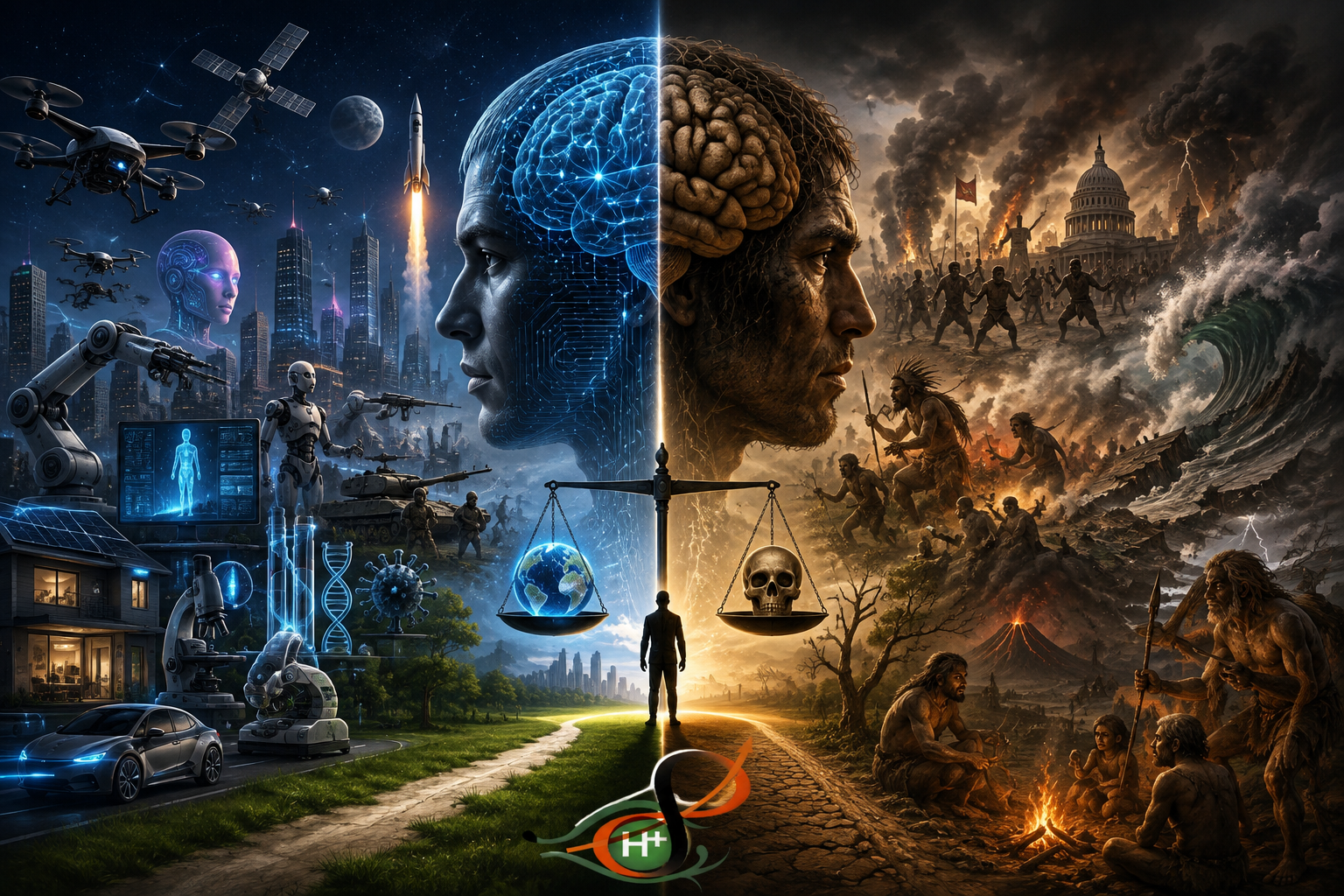
The rapid advancement of converging sciences and technologies not only multiplies human beings’ means of action upon nature and space, but also enhances and creates capacities to intervene upon their own biology and psyche. However, while the results of the transformation of matter through technology testify to human power, the human condition seems to be progressing at a considerably slower pace. The technological acceleration appears to exceed the speed at which human psychological dispositions and social institutions adapt to radically transformed environments.
Thus, human beings remain influenced by evolutionary and psychological dispositions inherited from their ancestral past, even though the environments in which these dispositions operate have changed profoundly. Human beings may therefore find themselves struggling with cognitive and emotional mechanisms that were adaptive under ancestral conditions but can become maladaptive in contemporary societies characterized by technological amplification, mass communication, anonymity, geopolitical interdependence, and unprecedented destructive capabilities.
So, what level of material power have human beings reached today that could enable them to transform their own condition? What risks and dangers does this growing power represent in the hands of human beings whose psychological architecture remains partly shaped by evolutionary pressures from the distant past? Does taking greater control of the updating of the human psyche seem to be a necessity for the human species?
1. Technological power: Do we finally have the means to transcend our own condition?
First of all, it is necessary to define the concept of “the human condition.” The definition that seems relevant to me here is the existentialist approach, namely that of Jean-Paul Sartre. The human condition is, I quote:
«The set of a priori limits that outline his fundamental situation in the universe.»¹
By a priori limits, the author refers to the birth of the human being, their initial environment, their body, the strengths and weaknesses of that body, their finitude or death. In this article, the emphasis will be placed more on disease, aging, death, and, of course, I add the state of the psyche as an aspect of the human condition. However, I do not intend to address this subject more broadly, as it will be the subject of a somewhat more in-depth reflection in another forthcoming work.
I then return to the question stated above. Certainly, the four major technological revolutions commonly distinguished in the contemporary industrial narrative have successively transformed human living conditions:²
a — End of the 18th century: Mechanization through the steam engine and coal.
b — End of the 19th century: Electrification and the emergence of assembly-line work characterized by mass production.
c — From the 1970s onward: Automation, computing, and the emergence of increasingly powerful information technologies. During the same broad period and the decades that followed, major advances were made in DNA sequencing, magnetic resonance imaging (MRI), biotechnology, and related biomedical technologies.
d — The current technological revolution: Digital technology, high-speed internet, connected objects, and artificial intelligence.
This latest revolution offers human beings immense power through the extraordinary advancement of converging sciences and technologies often discussed under the framework of NBIC (Nanotechnology, Biotechnology, Information Technology and Cognitive Sciences). NBIC should be understood as a conceptual framework describing the convergence of several technological domains rather than as a universally fixed scientific taxonomy.
This revolution is reshuffling the strategic cards. Mastery of these disruptive technosciences provides access to unprecedented forms of power and can generate considerable asymmetries between individuals, organizations, and states. Economic, military, sociopolitical, and geopolitical impacts are already enormous.
Human comfort is continuously being developed through the simplification of everyday tasks, optimization of the environment (home automation/smart homes), and the improvement of well-being through sensors, air purifiers, connected devices, and other technologies, including systems equipped with Artificial Intelligence.
Medicine is undergoing a profound and extremely rapid transformation thanks to robotics, artificial intelligence, genome editing (CRISPR), mRNA vaccines, 3D printing, digital twins, and increasingly sophisticated modeling capabilities. These technologies contribute to faster and potentially more accurate diagnostics, more targeted treatments, and the development of predictive medicine (assessing risks according to genetic and other data), preventive medicine (acting before symptoms appear), personalized medicine (adapting care to the patient’s individual profile), and participatory medicine (actively involving the patient). This is commonly referred to as 4P Medicine.
Human living conditions have therefore been deeply transformed. Yet technological progress does not automatically produce equivalent progress in human psychological adaptation, social cohesion, or political wisdom.
With regard to military applications, it should be noted that the destructive capacities available to states have reached a historically unprecedented level. To the traditional spaces of conflict or war theaters (land, sea, air) are added cyberspace and outer space. The psyche can also become a strategic domain through information warfare, psychological operations, neurotechnology, and the manipulation of attention and behavior.
Advanced research in neurotechnologies, including brain-computer interfaces, neuromodulation, and neural implants, is advancing through collaboration among private companies, leading academic laboratories, and international consortia. Technologies such as CRISPR and artificial intelligence could increasingly be adapted for military purposes, creating ethical and security challenges that deserve serious anticipation.
Humanity risks witnessing, or at least confronting, scenarios involving increasingly autonomous weapons, highly destructive biological technologies, and technologies capable of influencing cognition, perception, or behavior at a distance. These possibilities should be understood as risks and technological scenarios rather than as evidence that such capabilities already exist in the fully developed form imagined here.
Furthermore, through in vitro gametogenesis (IVG), in vitro fertilization (IVF), intracytoplasmic sperm injection (ICSI), and future developments in ectogenesis, one may legitimately raise hypothetical questions about the possibility of increasingly deliberate biological selection or reproduction. Could these technologies one day contribute to highly engineered forms of human reproduction, including, in a dystopian scenario, the production of “tailor-made soldiers”? Such a possibility remains speculative and raises profound ethical, biological, political, and human-rights questions.
After this brief and highly partial presentation of the means that technological power is capable of offering human beings, I dare to answer the question posed in the subtitle.
Indeed, technoscientific advances to date are very considerable. Particularly in the military sphere, humanity possesses destructive capabilities of a historically unprecedented scale.
However, the human condition (disease, unnecessary suffering, aging, and finitude, including death) has remained persistently present, while the same human being who seeks to overcome these limitations continues to generate conditions that produce suffering. No one is completely protected from disease. Many degenerative diseases remain incurable or only partially treatable with current medical means. Likewise, many other biological disorders remain beyond the full control of contemporary medicine.
Faced with the problems posed by the human condition, the results do not always match the human, technical, and financial resources invested in healthcare. Lifestyle, environmental toxicity resulting from human activity, side effects associated with food and medical consumption, etc., also give rise to other health problems, not to mention mental illnesses.
Humanity does not lack the means to truly embark on a long-term struggle against diseases, aging-related processes, unnecessary suffering, and other conditions that undermine human flourishing. But its evolutionary and psychological limitations can lead it to invest enormous resources in competition, domination, and self-destruction while remaining vulnerable to biological agents such as viruses and microbes and to large-scale natural phenomena such as tsunamis, floods, and earthquakes.
With the development of converging sciences and technologies and the ultimate power they may confer, will human beings, in their current psychological condition, have the wisdom necessary to manage this power without placing all of humanity and other animal species at existential risk?
2. The growing power of human beings versus their current cognitive condition: What existential risks and dangers?
The brain of present-day human beings is the product of a very long evolutionary history extending through Homo sapiens and earlier hominins. Human technological transformation and cultural evolution are progressing at a pace that is far faster than biological evolution. This does not mean that the human brain has remained biologically unchanged. Rather, it means that many evolutionarily conserved psychological systems continue to operate within environments that have changed at extraordinary speed.
In his work entitled Paleoanthropology of Cognition: An Overview on Hominins Brain Evolution, published in 2022, Professor Jean-Jacques Hublin, together with Jean-Pierre Changeux, summarizes important aspects of hominin brain evolution. They emphasize that brain size in Homo sapiens has remained relatively stable over approximately the last 300,000 years, while substantial reorganizations have occurred in different cerebral regions, including frontal and temporal areas, parietal regions, the cerebellum, and patterns of long-distance connectivity.³
This observation is important because it prevents an overly simplistic interpretation of the “ancestral brain.” Human evolution did not stop; neither did the brain remain frozen in a purely Paleolithic state. Nevertheless, the major evolutionary reorganization of the human nervous system extends deep into hominin evolution, whereas the technological and social environments of contemporary human beings have transformed within an extremely short historical period.
Some paleoanthropological analyses have even suggested a relatively recent reduction in average human brain size during the Holocene. However, the magnitude, timing, and especially the causes of such a reduction remain scientifically debated.⁴ Consequently, it would be excessive to state categorically that the human brain has lost 10 to 13% of its volume because of civilization.
What is more defensible is the observation that human beings retain evolutionarily conserved neural systems involved in threat detection, salience, reward, social attachment, status competition, and defensive behavior. These systems are not inherently pathological or primitive: they remain essential to human survival. The problem arises when mechanisms adapted to ancestral environments operate within modern environments characterized by enormous populations, instantaneous communication, ideological polarization, technological amplification, and weapons capable of causing destruction on a planetary scale.
Tooby and Cosmides famously formulated the idea that “our modern skulls house a Stone Age mind.”⁵
This formulation should be understood as a theoretical metaphor rather than as a literal neurological statement. The scientific concept of “evolutionary mismatch” describes situations in which characteristics shaped under earlier environmental conditions interact with environments substantially different from those in which they evolved.
The preservation of evolutionarily older neural systems, the relatively slow pace of genetic evolution compared with technological change, and the capacity of reward and learning systems to reinforce behavior can therefore contribute to the persistence of fear, aggression, status competition, and group-based biases.
Neuberg, Kenrick, and Schaller explained how human threat-management systems can be understood in evolutionary terms, including mechanisms associated with self-protection, disease avoidance, social categorization, and responses to perceived threats.⁶ The ancestral mechanisms do not respond exclusively to physical threats. Under particular circumstances, modern human beings can also experience ideological, cultural, territorial, economic, or identity differences through the same broad architecture of threat detection and social categorization.
The amygdala should not, however, be reduced to a simple “fear center” or to a biological mechanism of racism. Contemporary neuroscience indicates that amygdala responses are strongly influenced by threat, ambiguity, salience, learning, and social context. Prefrontal and other regulatory networks can modulate these rapid responses. The human brain therefore cannot be described simply as an amygdala that acts first and a prefrontal cortex that rationalizes afterward.
The central problem is instead the interaction between rapid emotional and motivational systems and slower processes of deliberation, regulation, learning, and social reasoning.
2.1. In the United States: Political and Ideological Violence
The January 6, 2021, attack on the United States Capitol by thousands of activists, many of whom had been mobilized by the false claim that the 2020 presidential election had been “stolen,” profoundly affected the country and generated major judicial and political repercussions.⁷
The ancestral cognitive mechanisms potentially relevant here include group polarization, coalition psychology, conformity, perceived collective threat, and forms of crowd behavior. In ancestral environments, strong allegiance to a coalition could contribute to survival. In a modern political environment, however, the same psychological tendencies can become dangerous when combined with misinformation, intense ideological polarization, charismatic leadership, and digital communication.
The adversary can consequently be psychologically transformed from a political opponent into an existential threat. The metaphor of a “Paleolithic coalition” is therefore useful only as an analytical model: it does not mean that contemporary political violence is literally identical to prehistoric warfare.
The Stephon Clark case (2018): In Sacramento, a young unarmed American citizen, whom I specify as “African American” for the purposes of analysis, was shot eight times; the police officers thought they saw a weapon, but he was holding an iPhone. The experimental work of Correll et al. (2002) demonstrates that ethnicity can interact with threat perception and shoot/don’t-shoot decisions under controlled experimental conditions.⁸ However, this study cannot by itself establish that racial bias or amygdala activity caused the specific decisions made by the officers in the Clark case.
Police violence through reflexive shooting is therefore not exclusively racial. Threat perception can interact with multiple forms of categorization, situational stress, uncertainty, institutional context, and individual differences.
The killing of Renée Nicole Good (37), an American citizen, poet, and queer/lesbian mother, who was shot by an ICE (Immigration and Customs Enforcement) agent in Minneapolis on January 7, 2026, in Minneapolis, provides another tragic example of the potentially lethal interaction between individual perception, institutional power, political conflict, and situational threat.⁹ The circumstances of an individual case should not, however, be reduced to a single psychological mechanism without appropriate forensic evidence.
The tragic assassination of Charlie Kirk, a conservative American political activist and prominent supporter of Donald Trump, during a speech on September 10, 2025, on the campus of Utah Valley University in Orem, Utah, illustrates another dimension of contemporary political violence.¹⁰ The event demonstrates that political identity itself can become a target in highly polarized environments. The precise psychological motives of an individual perpetrator cannot be inferred merely from the existence of the attack.
2.2. In Africa: Perceived Threat to Resources and Xenophobia
South Africa experiences xenophobic violence and intergroup tensions linked to economic insecurity, while interethnic conflicts can erupt over control of land, political influence, and resources.
According to my own direct observations and testimonies, tensions between social groups are almost permanent in many environments. They can remain dormant, waiting for triggering events to manifest themselves. My observations are consistent with scientific literature indicating that frustration, insecurity, perceived threat, social exclusion, and fear can contribute to violent or rejecting reactions.
Deprivation and stress can influence attention, threat appraisal, and emotional regulation. The “male warrior hypothesis” proposes an evolutionary model in which male coalitionary psychology may have been shaped partly by recurrent intergroup competition and territorial defense under ancestral conditions.¹¹ This is a hypothesis and explanatory model, not proof that contemporary violence is simply inherited from hunter-gatherers.
The important point is that contemporary economic or political conflicts can activate psychological mechanisms that are much older than the institutions in which they now operate.
2.3. In Europe
2.3.1. Hooliganism and Ultra Violence in Football
On May 30 and 31, 2026, in Paris, following PSG’s victory in the Champions League final, violent riots involving hooligans and ultras resulted in smashed shop windows, clashes with police, fireworks being fired, vehicles being set on fire, numerous injuries, and nearly 780 arrests.¹²
Hooliganism illustrates how ingroup/outgroup categorization and coalitionary aggression can operate without necessarily having a racial basis: the football club can function psychologically as a symbolic tribe.
However, biological explanations must be used cautiously. Identity fusion can under certain conditions produce exceptionally strong attachment to a group and willingness to act on its behalf. Research also indicates that identity fusion may facilitate both peaceful and violent collective action, depending on perceived threats, moral justification, and social context. Dopaminergic reward and learning systems may reinforce emotionally salient, status-related, or socially rewarding behavior, while neurobiological systems involved in affiliation and social bonding can strengthen ingroup cohesion. These processes are highly context-dependent and cannot be reduced to a single molecule or brain structure.
The fundamental phenomenon is therefore not “primitive aggression” in isolation, but the interaction between evolved social dispositions and contemporary systems of identity, status, competition, and collective belonging.
2.3.2. Identity Polarization and Riots
From July 30 to August 7, 2024, in the United Kingdom, riots occurred in more than 20 cities, including Southport, Liverpool, and Belfast, following the fatal attack on three young girls in Southport. Unfounded online rumors concerning the identity of the suspect fueled violence against mosques and hotels housing refugees.¹³
This episode illustrates how emotionally devastating events can interact with misinformation, group identity, perceived threat, and online amplification.
The death of children is particularly capable of generating intense emotional responses. However, it would be scientifically unjustified to claim that algorithms literally “overactivated the amygdala” and thereby directly caused the violence. A more defensible interpretation is that emotionally salient information, false identity claims, social categorization, and algorithmically amplified exposure can increase arousal, threat appraisal, anger, and rapid action tendencies while reducing opportunities for careful verification.
The phenomenon therefore illustrates an interaction between ancient psychological sensitivities and highly modern communication technologies.
Crettiez and Mucchielli (eds.) emphasize the shift from social protest toward identity-based and partisan confrontations.¹⁴
2.3.3. Identity- or Religion-Based Violence in Germany
A further example can be observed in Germany. On June 21, 2026, in Berlin, according to reporting based on police information, a 31-year-old man allegedly followed a 47-year-old man wearing a kippah and two children on Uhlandstraße, shouted antisemitic insults, spat at the group, and struck the man in the face. Two people who intervened were also involved in the incident. The police detained the suspect, who was reportedly intoxicated, while the circumstances and the possible antisemitic motive were investigated.¹⁶
This incident is particularly relevant to the present argument because the visible identity marker (the kippah) could function as a cue for social categorization in the perception of the aggressor. In evolutionary terms, categorization of people into “us” and “them” can occur rapidly, while contemporary cultural learning determines which categories acquire positive or negative meanings.
The case should not be interpreted as proof that a specific brain structure caused the attack. Rather, it provides a concrete contemporary example through which the broader mechanisms of categorization, prejudice, perceived group boundaries, emotional arousal, and aggression can be examined.
The danger becomes particularly significant when an identity marker is transformed into a symbolic representation of an entire group. The individual is then no longer perceived as an individual but as the embodiment of a collective category. This mechanism can contribute to dehumanization and to the psychological justification of hostility.
2.4. In Asia: Inter-Ethnic Conflicts
The interethnic clashes in Manipur (India), which began in May 2023 and continued with major deadly resurgences through 2025–2026, illustrate the persistence of violent intergroup conflict in the contemporary world.¹⁵
This violence should not be reduced to “racial differences.” It results from a complex interaction of political, territorial, economic, ethnic, and social conflicts. From the perspective of the evolutionary-mismatch framework, however, a modern political or institutional trigger can activate deeply rooted mechanisms of group categorization, threat perception, coalition formation, and retaliation.
The great history of humanity, strewn with murderous violence linked to rivalries between clans, ethnic groups, conquests, empires, colonization, geostrategy, slavery suffered by peoples across the world, etc., sufficiently demonstrates the persistence of violent dimensions of human social behavior and the continuing need for improvement.
The crucial question is therefore not whether human beings are “naturally violent.” Human beings are simultaneously capable of aggression, cooperation, empathy, sacrifice, reconciliation, and large-scale collective coordination. The problem is that the same psychological architecture can produce radically different outcomes depending on the social and technological environment in which it operates.
2.5. The Mental Space as a Battlefield
The contemporary “battlefield” is therefore no longer exclusively geographical. It is also informational, emotional, symbolic, and psychological.
Digital technologies can accelerate the circulation of information, but they can also accelerate the circulation of fear, hatred, humiliation, conspiracy theories, and collective indignation. The technological environment can consequently amplify pre-existing psychological tendencies rather than creating them from nothing.
The paradox is striking: humanity possesses increasingly sophisticated tools for communicating with billions of people while simultaneously possessing increasingly powerful means of intensifying division between those same people.
3. Redirecting and Accelerating the Transformation of the Human Psyche
In view of this tangible reality of the human psyche, illustrated above, the advent of the fourth technological revolution, which is currently endowing human beings with increasingly powerful and potentially godlike technological capabilities, could generate a dystopian world if psychological and institutional adaptation fails to keep pace.
In order to prevent this risk, indeed this very real danger, an urgent awakening of consciousness would be necessary. This capacity for human wisdom that has enabled humanity to reach this point despite the existence of nuclear weapons and growing international tensions.
The existence of this suprasocial capacity for cooperation and wisdom (the “spirit” that contributed to the creation of the League of Nations and the United Nations after devastating wars), although never guaranteed; the commitment of visionary minds imbued with humanism and advocating universal human dignity and flourishing; the commitment of governing classes convinced that the world could be organized differently for human dignity, world peace, and shared happiness, etc., could lead to the initiation of a vast global or universal program aimed at redirecting and accelerating the transformation of the human psyche so that it becomes much better adapted to the modern world.
This transformation should not mean the destruction of human individuality, cultural diversity, or legitimate disagreement. Nor should it imply coercive biological engineering or the imposition of a supposedly “perfect” psychological model by a political authority.
The updating of the human psyche must instead be conceived as an ethical project based on autonomy, informed consent, human dignity, human rights, pluralism, education, critical thinking, emotional regulation, intercultural competence, and the capacity to cooperate beyond narrow group identities.
The objective would therefore not be to eliminate the ancestral psychological systems that have contributed to human survival. It would be to develop stronger mechanisms for regulating them, understanding them, redirecting them, and, where future technologies ethically permit, potentially modifying some of their maladaptive expressions.
Biological and social transformation, as well as the chosen and controlled transformation of the human psyche, may take place jointly and interdependently. It would thus constitute a cycle of self-evolution, in which the biological body, society, culture, technology, and mind mutually transform one another.
Such transformation could occur through education and culture long before any biological intervention. Cognitive training, emotional education, artificial intelligence, neurotechnology, psychotherapeutic approaches, social institutions, and eventually carefully regulated biological or neurotechnological interventions could become components of a broader process of human self-transformation.
The fundamental principle should nevertheless remain clear: the transformation of the psyche must never become a justification for domination over the psyche.
Let us imagine that humanity succeeds in rising above itself to rid itself of its weapons, because from now on humanity ceases to be its own enemy in order to unite and cooperate closely and intensely against natural scourges.
I am deeply convinced that the determination of researchers will continue to force biology to reveal, sooner than expected, many of its still poorly understood laws, thereby giving humanity increasing hope in the face of unnecessary suffering.
The objective would ultimately be to transform technological power from an instrument of competition and destruction into an instrument of collective emancipation.
Conclusion
Jean-Paul Sartre’s formula, “Existence precedes essence,”¹ seems highly relevant to me in the sense that the destruction of humanity could result from its passivity regarding its own evolution. The profound transformation of the habitat, the mastery of matter through an understanding of the laws of the universe that had long remained hidden, have been the fruit of an incessant quest and of visions that were never abandoned.
Human beings have transformed their environment on an extraordinary scale. They have crossed geographical barriers, extended their biological capabilities through medicine, connected continents through telecommunications, decoded part of the genetic code, created artificial intelligence, and developed technologies capable of modifying living matter.
However, the “human creator” has forgotten to recreate itself by taking greater control of its own evolution. This omission could prove dangerous because many of the psychological dispositions inherited from our evolutionary history continue to operate within a radically transformed world.
The problem is not that human beings literally possess a Stone Age brain. The problem is that evolutionarily conserved psychological systems operate today within environments whose scale, speed, anonymity, technological amplification, and destructive potential are unprecedented.
The contemporary human being can therefore possess godlike technological power while remaining vulnerable to fear, status competition, group polarization, prejudice, revenge, tribal identification, misinformation, and collective emotional contagion.
This present world is characterized by geographical movements, cultural changes, the permanent transformation of cultural or ethnic identities, the artificial formation of nations from highly heterogeneous social or cultural groups, mass migration, instantaneous communication, and unprecedented interdependence between populations.
The profound updating of the human psyche is therefore, in my view, not a luxury but a strategic imperative.
The central challenge of the coming technological era may consequently not be whether humanity will be capable of creating increasingly powerful technologies. It is whether humanity will become psychologically, ethically, and institutionally capable of living with them.
If this imbalance persists, technological progress could amplify ancestral psychological vulnerabilities and transform local conflicts into global risks.
If, on the contrary, humanity succeeds in consciously transforming its education, institutions, culture, social cognition, emotional regulation, and where ethically justified and scientifically validated, its biological and neurotechnological capacities, technological power could become an instrument for overcoming unnecessary suffering rather than multiplying it.
The profound updating of the human psyche is thus, in my view, the most realistic long-term approach capable of helping humanity build a flourishing future within the context of a godlike technological revolution.
Siba Tcha-Mouza
Siba Tcha-Mouza is the U.S. Transhumanist Party’s Foreign Ambassador in Togo. Learn more about Siba Tcha-Mouza here.
Bibliography
1. Sartre, J.-P. (1946). L’existentialisme est un humanisme. Nagel.
2. Schwab, K. (2016). The fourth industrial revolution. World Economic Forum. https://www.weforum.org/publications/the-fourth-industrial-revolution/ The World Economic Forum confirms that Schwab’s 2016 work presents the Fourth Industrial Revolution as a technological transformation characterized by the convergence of physical, digital, and biological technologies.
3. Hublin, J.-J., & Changeux, J.-P. (2022). Paleoanthropology of cognition: An overview on hominins brain evolution. Comptes Rendus. Biologies, 345(2), 57–75. https://doi.org/10.5802/crbiol.92
4. DeSilva, J. M., Traniello, J. F. A., Claxton, A. G., & Fannin, L. D. (2021). When and why did human brains decrease in size? A new change-point analysis and insights from brain evolution in ants. Frontiers in Ecology and Evolution, 9, 742639. https://doi.org/10.3389/fevo.2021.742639
5. Cosmides, L., & Tooby, J. (1997). Evolutionary psychology: A primer. Center for Evolutionary Psychology, University of California, Santa Barbara.
6. Neuberg, S. L., Kenrick, D. T., & Schaller, M. (2010). Evolutionary social psychology. In S. T. Fiske, D. T. Gilbert, & S. T. Lindzey (Eds.), Handbook of social psychology (5th ed., Vol. 2, pp. 761–796). Wiley. https://doi.org/10.1002/9780470561119.socpsy002021
7. U.S. House of Representatives, Select Committee to Investigate the January 6th Attack on the United States Capitol. (2022). Final report of the Select Committee to Investigate the January 6th Attack on the United States Capitol. U.S. Government Publishing Office.
8. Correll, J., Park, B., Judd, C. M., & Wittenbrink, B. (2002). The police officer’s dilemma: Using ethnicity to disambiguate potentially threatening individuals. Journal of Personality and Social Psychology, 83(6), 1314–1329. https://doi.org/10.1037/0022-3514.83.6.1314
9. Reuters. (2026, January 8). Who was Renee Nicole Good, the woman killed by US immigration agent in Minneapolis? Reuters.
10. Reuters. (2025, September 10). Conservative influencer Charlie Kirk shot dead at Utah event. Reuters.
11. McDonald, M. M., Navarrete, C. D., & Van Vugt, M. (2012). Evolution and the psychology of intergroup conflict: The male warrior hypothesis. Philosophical Transactions of the Royal Society B: Biological Sciences, 367(1589), 670–679. https://doi.org/10.1098/rstb.2011.0301
12. Reuters. (2026, May 30). Jubilant PSG supporters spill onto Paris streets, some clashes with police. Reuters.
13. Home Office. (2026). The Southport Inquiry: Phase 1 report. UK Government.
14. Crettiez, X., & Mucchielli, L. (Eds.). (2010). Les violences politiques en Europe: Un état des lieux. Éditions La Découverte.
15. Reuters. (2024, May 24). Manipur’s ethnic violence splinters teams and sporting dreams. Reuters.
16. DIE ZEIT/dpa. (2026, June 21). Bericht über einen mutmaßlich antisemitischen Angriff in Berlin auf einen Mann mit Kippa und zwei Kinder. DIE ZEIT/dpa.